Blog

  • The Future of AI Is Uncertain, And It’s Up to Us

    The Future of AI Is Uncertain, And It’s Up to Us

    • Jack Goodman, Founder of Studiosity, reviews AI Snake Oil: What Artificial Intelligence Can Do, What It Can’t, and How to Tell the Difference by Arvind Narayan and Sayash Kapoor.

    Is artificial intelligence (AI) going to transform our universities? Or will it destroy the need for a tertiary education? Right now, it’s impossible to tell.

    If you read the media, you’re likely to think things will end up at one extreme or the other. That’s because we are living in an age of AI hype, where exaggerated claims about the technology – both on the plus side from the biggest AI engineering firms, and on the downside from those concerned about a dystopian future – are dominating the conversation.

    For those of us who aren’t computer scientists or software engineers with domain expertise, wouldn’t it be helpful to have a guide to help us unpack what’s going on and figure out how to engage with this technology that may prove to be world-altering?

    If you’re a head of state or a billionaire, then you probably already have an AI advisor. For the rest of us, Arvind Narayanan and Sayash Kapoor, two computer scientists at Princeton University, have kindly written AI Snake Oil as a layman’s roadmap to the current and likely future trajectory of the technology. (Alongside the book the pair have launched a website that’s full of the most current commentary and analysis.)

    Narayanan and Kapoor are concerned with the full gamut of AI, not just the ‘generative’ variety that has garnered so much attention since its ‘debut’ with the arrival of ChatGPT. They helpfully separate AI into three main streams: Predictive AI, Generative AI and Content Moderation AI. All three suffer from claims of exaggerated effectiveness, a lack of scientific evidence and fantastic claims about their future capabilities.

    For the purposes of a higher education audience, it’s generative AI that’s of most interest, because that’s the technology that can simulate the intellectual output of an educated brain – whether in the form of text or visual imagery. They put genAI into its historical context: most of us don’t know that the neural network theory that underpins genAI goes back to the 1950s, and that it’s been through a series of cycles of hype and disappointment.

    Sadly, the authors aren’t particularly interested in the impact of genAI on higher education, apart from noting off-handedly that the technology appears to be largely undetectable, and that financially-strapped universities that think the technology will deliver endless efficiency dividends may be sadly disappointed. At various points they mention how they encourage active engagement with AI to understand what it can and cannot do, all from the perspective of their lives at Princeton. That’s not particularly helpful given how outlandishly wealthy, privileged, and tiny that university is.

    Also, the authors miss an opportunity to explore different types of genAI technologies, particularly those that may be designed to encourage learning versus others that improve human productivity by offloading cognitive effort. No doubt the latter are already transforming human work, but whether they have a place in higher education is a different question.

    There is a concept in AI known as ‘alignment’, which refers to the risk that uncontrolled AI may, as it approaches more powerful levels of general intelligence, act against the interests of humans and harm (or even kill) us. It’s controversial, and the authors devote an entire chapter to how we should think about, and respond to, technology companies’ pursuit of artificial general intelligence (AGI).

    From the perspective of higher education, our sector may be better served in the immediate term by thinking about alignment in terms of the interests of educational institutions and the (mostly American) technology companies that are at the vanguard of developing genAI. The culture of incrementalism that has traditionally served universities well may not be so effective when dealing with such a rapidly approaching paradigm shift in humans’ relationship with technology.

    The conclusion of AI Snake Oil is a little surprising. The authors make clear that humanity’s relationship with AI will be determined by all of us –individuals and institutions, as well as regulators and politicians. No doubt there is an opportunity for universities and their leaders to take a leading role in shaping this conversation, using their institutional resources and cultural authority to help inform the public and guide us all toward a better relationship with ever more powerful computers.

    We all need to be educated, informed, and willing to speak up – so that we don’t end up living in a world where AI is dominated by the largest and most powerful corporations the planet has ever seen. That will be the worst of all possible outcomes.

    Studiosity is a learning technology company that works with 100+ universities globally and serving 2.2 million university students across the UK, Australia, New Zealand, Canada, and the Middle East. Jack founded Studiosity in Sydney in 2003 with a vision to make the highest quality academic study support accessible to every student, regardless of their geographic or socio-economic circumstances.

    Source link

  • Getting Started: A Basic 10 Point Guide to Launching an Academic Career – Faculty Focus

    Getting Started: A Basic 10 Point Guide to Launching an Academic Career – Faculty Focus

    Source link

  • Restoring Public Health by Changing Society (Rupa Marya)

    Restoring Public Health by Changing Society (Rupa Marya)

    We are told that our personal health is our individual responsibility based on our own choices. Yet, the biological truth is that human health is dependent upon the health of nature’s ecosystems and our social structures. Decisions that negatively affect these larger systems and eventually affect us are made without our consent as citizens and, often, without our knowledge. Dr. Rupa Marya, Associate Professor of Medicine at UC San Francisco, and Faculty Director of the Do No Harm Coalition (https://www.donoharmcoalition.org/) , says “social medicine” means dismantling harmful social structures that directly lead to poor health outcomes, and building new structures that promote health and healing.

    Learn more about Rupa Marya and her work here. (https://profiles.ucsf.edu/rupa.marya)

    Source link

  • Higher Education Inquirer Investigating White House, DOGE Communications

    Higher Education Inquirer Investigating White House, DOGE Communications

     
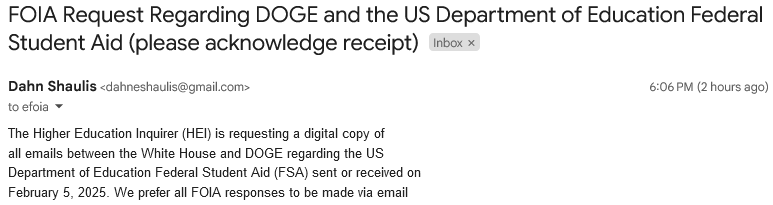
    The Higher Education Inquirer (HEI) is investigating email communications between the White House and DOGE regarding the US Department of Education Federal Student Aid (FSA).  HEI has been using FOIA responses for a number of years to expose corruption in the US higher education business. The White House has 20 days to acknowledge receipt. We will let you know if and when we get any responses from the White House.  

    Source link

  • New legislation in Scotland increases the SFC’s powers, but only up to a point

    New legislation in Scotland increases the SFC’s powers, but only up to a point

    Post-school reform in Scotland continues to chug along, following last month’s announcement of the preferred future shape of the funding body landscape.

    Today sees the legislation that will enact the changes introduced in Holyrood: the Tertiary Education and Training (Funding and Governance) (Scotland) Bill.

    We’ve been over how responsibilities for further education student support and apprenticeships and skills funding will shift around, and the bill also contains expected changes to the governance arrangements of the Scottish Funding Council (SFC), as well as some technical changes relating to fees and private provision.

    But what’s emerged as perhaps the more pressing question for the higher education sector is how the legislation will change SFC responsibilities and powers, as these apply to its work with universities. The legislation sets out the route the Scottish government will take here, and it’s a fairly balanced one – we are still a long way from an England-style “boots on the ground” regulatory environment, likely to the relief of many.

    Tell us about your finances

    Much of what the bill will do legislatively is through modifications to the Further and Higher Education (Scotland) Act 2005. Section 22(4) of this gives the SFC various powers to “pull” information from universities – or strictly, from their governing bodies – but only where the funder knows that the information exists, or may exist.

    The new legislation aims to create a landscape in which post-16 education bodies must “proactively notify SFC of certain developments of which the SFC might otherwise be unaware” in what the bill’s policy memorandum characterises as a “push” of information – a responsibility to notify the funding council of things it would not have known otherwise. Those who are more used to other UK systems will probably be thinking of “reportable events”.

    It’s suggested that notifications would likely be sought in the following kinds of situation:

    • Where a university is planning voluntary or compulsory severance (so no daily refreshing of the QMUL UCU cuts tracker for the SFC)
    • Where a university has reached a certain threshold in a rapidly worsening financial viability situation
    • A major data breach, such as resulting from a cyberattack.

    But exactly how this will work is not specified on the face of the legislation – it would be determined by ministers via the laying of regulations, with consultation and an affirmative procedure in the Scottish Parliament, “given that they could potentially place significant obligations on post-16 education bodies.” But this does mean that there is a lack of clarity on exactly what the bill is going to mandate.

    Part of the rationale for beefing up the legislation from what was previously anticipated (and let’s be honest, what was in the consultation) seems to be that ministers have not received enough clarity about the financial challenges being faced by certain universities and colleges. When the policy memorandum notes that “there can be challenges for SFC in getting information from post-16 education bodies about their financial sustainability,” you feel that really the issue is about ministerial oversight and the sense of having active levers to pull. This is given an explicit tweak elsewhere in the bill (again, quoting the policy memorandum):

    New section 15A(2) allows the Scottish Ministers to seek information and advice from the SFC relating to post-16 education bodies, this could be an individual body or the bodies as a whole. Section 15A(3) requires the SFC to respond to any such request from the Scottish Ministers and the SFC may also offer information proactively when it considers it appropriate to do so. This is necessary because unforeseen circumstances may arise of which the Scottish Ministers might otherwise be unaware (and so would not know to enquire).

    So what are you going to do about it?

    Also in the 2005 Act is provision for the SFC to “secure the promotion or carrying out of studies designed to improve economy, efficiency and effectiveness in the management or operations of any fundable body” – but no such power exists where the matters are not related to financial support.

    The new legislation would amend this, with the intention of making the SFC able to “address a broader range of matters to assist with performance improvement.” So in scope for an efficiency study would now be the needs and interests of learners:

    The policy intention is that the SFC could, particularly where notified of certain adverse circumstances (such as course closures), instigate studies or reviews of the impact on students and learners so that assistance could be provided to ensure they are not negatively impacted. For example, if a college was heading towards needing to close courses before students could complete them, the SFC could help to make arrangements for the students to continue their education at different colleges.

    Bringing the student interest in scope sounds sensible in theory, but there remains the question of what changes on the ground, beyond the production of a study. The 2005 Act allows the SFC to attend and speak to an institution’s governing body – the new section 15(4) of this bill will extend this to the issuing of a set of written recommendations.

    So the SFC will be able to recommend setting specific improvement targets, or requiring the development of an improvement plan. And it will now even be able to publish these, “where there is wider interest amongst institutions, or the public, in the recommendations and they are not sensitive.” But it won’t be obliged to.

    And what if its recommendations are ignored?

    As with the SFC’s right to address meetings, already provided for in section 16 of the 2005 Act, there is no corresponding duty on the fundable body to do anything in response to the recommendations. However, as a matter of good governance and practice, the Scottish Government would expect the fundable body to consider them appropriately.

    But beyond these recommendations, in the legislation as it stands there would be proper statutory powers for the SFC to influence educational institutions’ behaviour, through the issuing of guidance, which currently is “purely administrative” (though presumably always very welcome). The Tertiary Education and Training Bill will change this, so that institutions must have regard to the guidance, in the carrying out of their funded activities (note that “have regard to” is quite woolly language – something that the Office for Students has exploited frequently within the way HERA was drafted). But the SFC will have to consult both ministers and institutions in issuing guidance.

    It could have been otherwise

    Various alternative approaches were considered and rejected. The use of codes of conduct (“for example to address concerns around breaches of fair work conditions”) was felt to potentially lead to complex interactions with other requirements, and diminish autonomy. Plus there would have been a need for “appropriate enforcement mechanisms,” which is a whole other question.

    More powers of audit and investigation were also considered and not taken forward, which would have been a move towards a “more interventionist SFC.” Likewise for stronger enforcement and intervention action, including serving enforcement notices or the removing, suspending, or appointing of officers or governing body members.

    But this would have been “a fundamental change to SFC’s role which requires more careful consideration” – and would have gone way beyond what was originally consulted on.

    There’s still a long way to go here – Universities Scotland is already noting the “new, very broadly defined provisions regarding the monitoring of the financial sustainability of institutions,” and raising concerns that too much change in the relationship between the SFC and universities (or universities and the Scottish government) could jeopardise the classification of universities in the Office for National Statistics classification.

    The Scottish government seems to be aware of this particular risk – but there are certainly MSPs keen for the SFC to become more “interventionist”, and the legislation now faces a complicated passage through a Parliament in which the SNP does not hold a majority. The ministerial statement to Holyrood launching the bill saw Ross Greer of the Scottish Greens concerned about whether the SFC would have the ability to intervene in matters relating to fair work – higher education minister Graeme Dey said he would be happy to discuss the issue further.

    For now the legislation aims at a delicate balancing act between juicing up the SFC’s role and preserving universities’ autonomy. The next question is whether this persists in the face of deeper scrutiny and parliamentary compromises.

    Source link

  • Higher education postcard: Taxila | Wonkhe

    Higher education postcard: Taxila | Wonkhe

    We’re doing anther historical incursion today – looking at what was an internationally renowned centre of higher learning in the Indus valley.

    We have to wind the clock back a long way. In 535 BCE Persian emperor Cyrus the Great invaded the lands to the east, and by 540 BCE had taken all of the lands to the west of the Indus. A regional capital was established at Taxila, which by then had probably already been a city for about 500 years. It was the obvious choice, having been capital of the ancient kingdom of Gandhāra. We also need to note that in 326 BCE Taxila surrendered to Alexander the Great’s army; that a few years later it became part of the Mauryan empire for over 100 years; then part of the Yavana empire for another hundred years or so; then occupied by Indo-Scythians between 80-ish BCE and 30 CE; and the Kushan empire until about 375 CE.

    The following account draws strongly on Roy Lowe and Yoshihito Yasuhara’s 2016 work, The origins of higher learning. After the Persian conquest, Taxila became a centre for Vedic learning. By the time of Alexander and the early Mauryan emperors, there was a demand for scholars who could speak Greek.

    As well as the Vedic scriptures, medicine was taught at Taxila. Two eminent healers – Charaka and Jivaka – both studied at Taxila, perhaps under the teacher Disapamok Achariya. Other notable people associated with Taxila included Panini (who was neither the inventor of the sandwich nor the inventor of sticker albums, but was in fact a Sanskrit grammarian) and Chanakya, an early political economist.

    Lowe and Yasuhara tell us something about academic life at Taxila. Individual teachers shared a building with their students, and would enrol up to five hundred students. Senior students were used as assistant teachers, as clearly 500 is too many for one person (it’s easy to recognise the doctoral-students-as-teaching-assistants model here).

    The curriculum comprised “the three Vedas and the eighteen accomplishments”. The three Vedas – books of verses – were the Rigveda (knowledge of the verses), the Yajurveda (knowledge of the sacrifice) and the Samaveda (knowledge of the chants). The eighteen accomplishments are not so clearly specified. On the evidence seen by Lowe and Yasuhara they may have included “elephant lore, magic charms, spells for reincarnating the dead, hunting, the study of animals’ cries, archery, the art of prognostication, charms, divining from bodily symptoms, and medicine”; to which was later added “logic, the atomic theory of creation, arithmetic, law, accountancy, agriculture and astronomy.”

    This looks like a cracking degree programme to me. Particularly once I’d realised it was prognostication not procrastination, for which I’d want to submit a claim for accreditation of prior experiential learning. And, if you’re tempted to get sniffy about seriousness, it probably represented a good stab at the frontiers of knowledge at that time. Which is what first and second cycle qualifications of the UK higher education qualifications frameworks are about nowadays. So not so daft really.

    The Kusham empire, in the first century CE, destroyed the city of Taxila to make way for their own city, rebuilt a little to the north. And in the fifth century the Hunas destroyed the rebuilt city. (It is not clear if these Hunas were connected to the Huns who were busy invading Europe at about this time.

    And so there we have it; a very early institution of higher education. It is now a world heritage site, as suggested by the postcard, and a very popular tourist destination in Pakistan.

    A final cultural connection. A favourite of mine from the 1970s TV schedules was Monkey! This was a TV adaptation of an early Chinese novel, the Voyage to the West.

    The song played over the closing credits includes the lines “In Gandhāra, Gandhāra, they say it was in India…” – our heroes were escorting a Buddhist monk, Tripitaka, to being back some holy scrolls to help the emperor restore morality and order to China. It seems likely, I would suggest, that they were heading to Taxila.

    And really finally, here’s a jigsaw of the card, in case you feel the need of some pleasant distraction.

    Source link

  • Podcast: Protection, visas, commuter students

    Podcast: Protection, visas, commuter students


    By submitting you agree to our terms and conditions

    Source link

  • There’s nothing certain about the circumstances when a duty of care applies to students

    There’s nothing certain about the circumstances when a duty of care applies to students

    The Secretary of State for Education was recently asked in Parliament if she would meet with campaigners to discuss the “duty of care” owed by higher education providers to their students.

    Janet Daby – the Minister for Children, Families and Wellbeing in the Department for Education (DfE) responded on her behalf, and also outlined the department’s current view on the law for holding negligent institutions to account.

    At first glance, her response was unhelpful – arguing the department’s position is that a duty of care in higher education may arise in “certain circumstances”:

    Such circumstances would be a matter for the courts to decide, based on the specific facts and context of the case being considered, and will be dependent on the application by a court of accepted common law principles.

    It would be easy to argue that lawmakers, including Janet Daby and skills minister Jacqui Smith, should not simply defer to the courts on matters of law and institutional accountability.

    After all, lawmakers have the power to create laws – so overall responsibility doesn’t rest solely with judges and their judicial interpretation of common law principles.

    But perhaps Daby’s response was more helpful than it looked – because it directly confronts misleading statements that have persisted since 2023, particularly those made by former Minister Robert Halfon.

    Although some might view her answer as a cautious response, in reality, it was a breath of fresh air – a much-need step in addressing the confusion that has clouded our understanding of legal responsibilities in higher education.

    From Halfon’s Law to Daby’s Law

    To grasp the significance of Janet Daby’s correction, we must first revisit the origins of the confusion – what I’ll call here Halfon’s Law.

    Introduced by Robert Halfon in 2023, it laid the foundation for a misrepresentation of the legal duties owed by higher education providers to their students. Halfon’s Law is a belief that stemmed from a misunderstanding of online material, initially presented in a now-deleted AMOSSHE blog that was published in 2015.

    In responding to the 128,000+ registered voters who signed our parliamentary e-petition calling for a statutory duty of care, Halfon asserted his department’s belief that universities already owed their students a broad and generalised duty of care. He said:

    Higher Education providers do have a general duty of care to deliver educational and pastoral services to the standard of an ordinarily competent institution and, in carrying out these services, they are expected to act reasonably to protect the health, safety and welfare of their students. This can be summed up as providers owing a duty of care to not cause harm to their students through the university’s own actions.

    At first glance, this might sound reasonable, but in truth, it was far from accurate. By conflating a general moral and legal principle – to act in a way that avoids causing harm to others – with a formal, court recognised duty of care that only arises in specific, legally-defined circumstances and relationships, Halfon introduced a dangerous oversimplification.

    It was a distortion used to justify dismissing the petitioners’ call for a statutory duty of care, effectively silencing important conversations about the protections that students need.

    Halfon’s Law, with the documented source having now been quietly removed from its original website, was a misstep in understanding the complexities of legal responsibilities in higher education. Its fall from grace is something to be celebrated.

    Enter Daby’s Law: Janet Daby’s response marks a shift towards legal clarity. A duty of care may arise in certain specific circumstances, but ultimately, it is the courts that will determine the existence and application of any such duty on a limited case-by-case basis – should lengthy and costly litigation ever actually occur.

    As it stands therefore, nobody truly knows what protections are in place, leaving students vulnerable, and institutions at risk of being punished for failing to do the right thing. As such, Daby’s position not only corrects the errors of Halfon’s Law, but also raises significant concerns, including the urgent need for a properly codified duty that both universities and their students can understand.

    The advocacy that led to Daby’s law

    Daby’s correction of the record didn’t happen by chance. It was the direct result of relentless behind-the-scenes efforts from advocates, especially ForThe100, who recognised the need to dismantle Halfon’s contention? – since it was a significant barrier preventing meaningful progress.

    For too long, Halfon’s Law and its sweeping and factually incorrect statements had clouded the conversation around student safety and wellbeing, effectively stopping us from moving forward and pushing for the protections students desperately need. Too many policymakers thought it true – and so dismissed the need for a dedicated duty.

    The subtle shift in content and tone, while preferable to outright inaccuracy, introduces its own set of challenges. Without clear or codified guidance, students, families, and institutions are left to navigate a murky and uncertain legal landscape.

    That vagueness is deeply problematic. It means widespread confusion about rights and responsibilities, leaving institutions uncertain of their obligation, and exposed to unforeseen legal liabilities – while students are left unsure of the protections they can depend on.

    Worse, the lack of clear, direct, and upfront standards is a reactive rather than proactive system, shifting the burden onto individuals to seek legal recourse only after harm has occurred.

    This approach neither prioritises prevention nor ensures accountability, leaving gaps in a system meant to put students first.

    It is now crucial that the government corrects the public response to our petition without delay. Halfon’s Law remains embedded in the official narrative, and its continued presence in government communications perpetuates confusion, and blocks meaningful progress.

    More importantly, for over five decades, students have been without adequate legal protection, and this gap continues to undermine their safety and wellbeing.

    Nobody should be reassured by a duty that arises in “certain circumstances” where those circumstances would be a matter for “the courts to decide”. Students and universities need instead to know where they stand – with the same sort of clarity on offer for the duty of care that universities as employers owe to their staff.

    The next step is for the government to act – taking concrete steps toward enacting statutory reform that holds higher education institutions accountable for their acts and omissions with regard to student safety and wellbeing, and giving students and their families the confidence that when they enrol into a university, they know the minimum “duty of care” that they can actually expect.

    Source link

  • Ohio Northern sues professor for having the audacity to defend his rights in court

    Ohio Northern sues professor for having the audacity to defend his rights in court

    Following Professor Scott Gerber’s vocal opposition to his school’s diversity, equity, and inclusion policies, Ohio Northern University ordered campus police to yank him out of class and march him to the dean, who demanded Gerber’s immediate resignation. A judge decried the school’s apparent “callous disregard for due process,” but because Gerber had the courage to fight back in court, ONU took things even further — filing a federal lawsuit to shut him up.

    But Gerber is not having it. A longtime critic of ONU’s initiatives around DEI, Gerber’s objections made him a target of administrators, who launched an investigation into him in January 2023. From then until his sudden termination, ONU outright refused to disclose the specific accusations against him. When the school finally told Gerber he lacked “collegiality,” FIRE explained to ONU that this charge looked a lot like retaliation for his views on DEI, which would be a stark violation of the university’s commitment to academic freedom. We called on ONU in March, and again in May, to provide Gerber with the specifics of its collegiality concerns, to no avail. 

    Out of work and still wondering what he did wrong, Gerber took ONU to court. His complaint centered on the university’s failure to provide him with the specific grounds for dismissal. This fundamental principle of due process protects the right of the accused to defend themselves. After all, if you don’t know what you’re accused of doing, it’s impossible to prove your innocence. Universities provide due process to ensure accurate disciplinary determinations, especially when a tenured professor’s livelihood hangs in the balance. That’s why an Ohio state court allowed Gerber’s breach of contract claim to proceed, criticizing ONU’s “troubling . . . lack of any detailed determination” of how its allegations “affected his fitness as a faculty member.” 

    That case is now headed to trial. 

    Professor suspended for reasons unknown — even to him 

    News

    Why did Ohio Northern University suspend professor Scott Gerber? We have no idea, and neither does he.


    Read More

    But for defending his rights in state court, ONU sued Gerber in federal court on Jan. 20, claiming Gerber’s “perverted” lawsuit is apparently an “attempt to accomplish . . . personal vendettas” and “unleashing political retribution” against ONU — notwithstanding the state court holding Gerber’s claims warranted proceeding to a jury. ONU’s suit claims Gerber’s “true goal is to manufacture outrage, to influence political retribution, and to extract vengeance against” ONU. According to the lawsuit, Gerber’s attempt to hold the university to its own policies is an unlawful “abuse of process.” 

    Disturbingly, the crux of ONU’s complaint rests on Gerber’s protected speech. The university faults Gerber for expressing accurate information about his ordeal in the Wall Street Journal and through a press release published by his attorneys at America First Legal, maligned by ONU as a “manufactured narrative” designed to “manufacture outrage.” Yet Gerber and America First Legal cite the university’s own words and policies to make his case, which a state court has allowed to proceed by rejecting ONU’s efforts to dismiss his claims.

    The irony of ONU refusing to provide Gerber with the bare minimum of process before summarily terminating him, then launching a whole federal lawsuit instead to get him to stop fighting, is palpable.

    ONU’s suit is a classic example of abusing the legal system to silence your critics. Such a strategic lawsuit against public participation, or SLAPP, is a tactic that seeks solely to impose punishing litigation costs on their targets. The lawsuit is the punishment. Gerber must now bear the burden of defending this meritless suit while he prepares for trial in state court.

    Why ‘SLAPP’ lawsuits chill free speech and threaten the First Amendment

    Issue Pages

    You can’t use the legal system to punish people for speech you don’t like.


    Read More

    On a larger note, if nonprofits like FIRE cannot convey truthful information about the cases we litigate without incurring a separate lawsuit, that will imperil a wide array of civil rights advocacy. Defending against an onerous SLAPP puts further strain on the already limited resources dedicated to protecting civil liberties.

    Terminated professors must turn to courts to vindicate their rights as the option of last resort, and the First Amendment protects their right to do so. When universities seek in turn to use courts to bully professors into submission, judges must firmly reject these thinly veiled attempts to achieve censorship by lawsuit. 

    We’ll keep our readers updated. 


    FIRE defends the rights of students and faculty members — no matter their views — at public and private universities and colleges in the United States. If you are a student or a faculty member facing investigation or punishment for your speech, submit your case to FIRE today. If you’re a faculty member at a public college or university, call the Faculty Legal Defense Fund 24-hour hotline at 254-500-FLDF (3533). If you’re a college journalist facing censorship or a media law question, call the Student Press Freedom Initiative 24-hour hotline at 717-734-SPFI (7734).

    Source link