
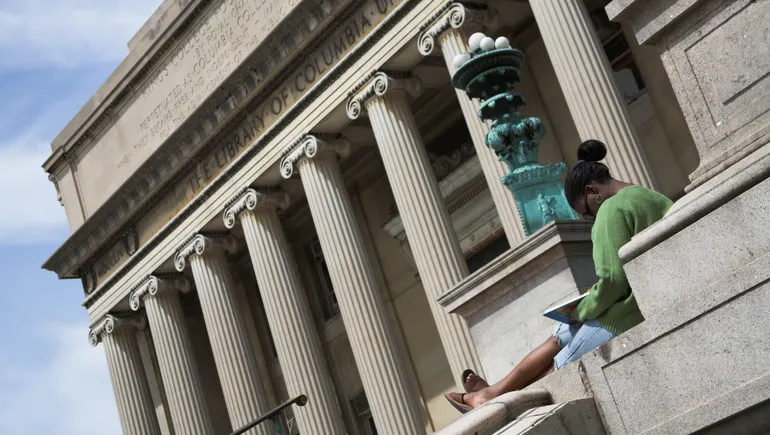
Federal officials hope their agreement with Columbia University will be a “template for other universities around the country,” U.S. Education Secretary Linda McMahon said Thursday.
Her remarks, made in a NewsNation interview, come as some critics publicly worry that the deal will spur the Trump administration to put financial pressure on other universities. Columbia law professor David Pozen, for instance, wrote in a blog post Wednesday that “the agreement gives legal form to an extortion scheme.”
Despite praise for the deal from some corners of the university, critics have also accused Columbia of capitulating to the Trump administration’s attacks on higher education.
The Trump administration has withheld federal funding from a long list of colleges, often claiming they are not doing enough to address antisemitism or otherwise violating civil rights laws. Columbia became the face of those battles in March, when the Trump administration canceled $400 million of the New York institution’s federal grants and contracts.
Under the deal reached Wednesday, Columbia agreed to a litany of policy changes and concessions, including paying the federal government $221 million, to settle civil rights investigations and to have the “vast majority” of $400 million in federal grant funding reinstated, according to the university’s announcement.
Along with having most of the money reinstated, “Columbia’s access to billions of dollars in current and future grants will be restored,” the university said in Wednesday’s announcement.
The deal ends the Trump administration’s probes into whether Columbia had failed to protect Jewish students from harassment and the Equal Employment Opportunity Commission’s similar investigation into its treatment of employees.
The 22-page agreement is wide-ranging. Columbia agreed to provide the federal government with admissions data on both its accepted and rejected applicants, craft training “to socialize all students to campus norms and values,” and have an independent monitor oversee its compliance with the deal. It also said it would establish processes to ensure students are committed to “civil discourse, free inquiry, open debate, and the fundamental values of equality and respect.”
Additionally, the university said it would decrease its financial dependence on international students — who make up roughly 40% of enrollment — and ask foreign applicants for their reasons “for wishing to study in the United States.”
And Columbia will codify measures it announced in March, which include banning masks meant to conceal one’s identity and having a senior vice provost review programming focusing on the Middle East, including the university’s Center for Palestine Studies; Institute for Israel and Jewish Studies; and Middle Eastern, South Asian, and African Studies.
That leader, Miguel Urquiola, will review those and other programs — including their leadership and curriculum — to ensure they are “comprehensive and balanced,” according to the agreement.
Columbia also agreed to appoint an administrator to serve as a student liaison to address concerns about antisemitism. That administrator will make recommendations to top officials about how the university can support Jewish students.
‘A dangerous precedent’
Claire Shipman, Columbia’s acting president, suggested the deal doesn’t undermine the university’s autonomy. “It safeguards our independence, a critical condition for academic excellence and scholarly exploration, work that is vital to the public interest,” she said in a Wednesday statement.
Indeed, the agreement says it does not give the federal government control over the university’s employee hiring, admission decisions or academic speech.
However, critics have swiftly and vociferously denounced the deal, arguing that the university has yielded to an authoritarian administration and harmed the higher education sector at large.
“Never in the history of our nation has an educational institution so thoroughly bent to the will of an autocrat,” Todd Wolfson, the president of the American Association of University Professors, said in a Thursday statement. “This settlement subverts our democracy and capitulates to the Trump plan to target the pillars of our democracy: the judiciary, the free press, and our education systems.”
Others suggested it could create a playbook for the Trump administration to use with other colleges.
Joseph Slaughter, an English and comparative literature professor at Columbia, said in an email Thursday that the deal “appears to preserve a measure of institutional independence and academic freedom.”
But, Slaughter continued, “It nonetheless legitimizes the federal administration’s extortionist tactics, erodes the academic autonomy that has made American universities the envy of the world, and sets a dangerous precedent for the normalization of political interference in teaching, research, and the pursuit of truth.”
Through the deal, Columbia avoided a consent decree, in which a judge would have been appointed to oversee the university’s compliance with the agreement. The Trump administration had reportedly been pursuing that option earlier this year.
However, Slaughter argued that the deal resembles a consent decree but lacks “the ordinary legal safeguards and judicial oversight that might protect Columbia from further federal extortion and political interference in its academic mission.”
Pozen raised similar arguments about the deal, writing that Columbia was brought to the negotiating table after the federal government cut off funds without “following the congressionally mandated procedures.”
“The Trump administration has made clear that while Columbia is first in line, it intends to reach comparable agreements with other schools — to scale the Columbia shakedown into a broader model of managing universities deemed too woke,” Pozen wrote. “As has already occurred with law firms, tariffs, and trade policy, regulation by deal is coming to higher education.”
Will Creeley, the legal director at the Foundation for Individual Rights and Expression, said in a statement Thursday that some of the changes require students to commit to “laudable values,” including free inquiry and open debate.
But other goals, including “equality and respect,” are vague and leave “far too much room for abuse.”
Creeley also said the agreement “can’t be separated from the unlawful pressure campaign that produced it.”
‘A major step forward’
Brian Cohen, the head of the Columbia/Barnard Hillel, a center for Jewish students at the university, said in a Wednesday statement that the announcement of the deal acknowledged that “antisemitism at Columbia is real.”
“In the months ahead, Columbia/Barnard Hillel will continue our work with the administration, faculty, students, and alumni to strengthen Jewish life at Columbia including making sure that the roadmap laid out in this agreement is followed,” Cohen said. “This is not the end of the process, however it is a major step forward.”
The Stand Columbia Society likewise praised the deal. The group is composed of students, employees and alumni that have been pushing for some of the same changes that the Trump administration has demanded, including for the university to implement a mask ban and to dole out discipline for students involved in the protest encampment erected last spring.
“The Stand Columbia Society believes this agreement represents an excellent outcome that restores research funding, facilitates real structural reforms, and preserves core principles of academic freedom and institutional autonomy,” it said Wednesday.
Despite the deal, Tim Walberg, the Michigan Republican who chairs the U.S. House education committee, criticized Columbia’s leaders in a statement Wednesday evening.
“The need for a federal settlement underscores Columbia’s lack of institutional willingness to effectively respond to antisemitism,” Walberg said. “This school and its so-called leaders have failed time and time again to keep Jewish students, faculty, and staff safe.”
Walberg added that lawmakers would monitor the university’s “purported commitments” to the deal and work on “legislative solutions to address antisemitism.”