
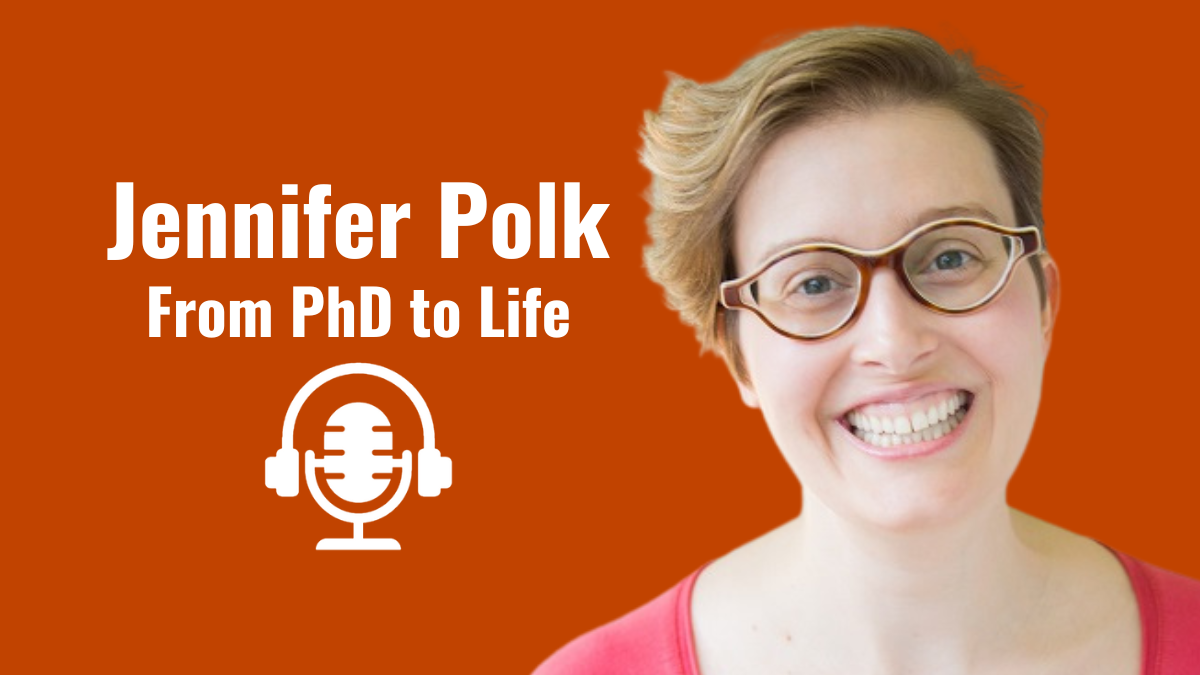
Informational interviews can help your journey from PhD to Life
Jennifer Polk, PhD has been helping PhDs get clear on their career path since 2013. You may have read her articles on University Affairs, Inside Higher Ed, and The Chronicle of Higher Education. If you’re on #AcademicTwitter, you’ve seen her tweets @FromPhDtoLife.
Jen is an expert at helping grad students and people with doctorates confidently market themselves for the jobs they actually want.
What are informational interviews? And, how can they help your transition from academia? It’s all in this interview with career coach, Dr. Jennifer Polk.
Subscribe to The Social Academic blog.
The form above subscribes you to new posts published on The Social Academic blog.
Want emails from Jennifer about building your online presence? Subscribe to her email list.
Looking for the podcast? Subscribe on Spotify.
Prefer to watch videos? Subscribe on YouTube.
Meet Dr. Jen Polk
Jennifer: It’s Jennifer van Alstyne. I’m here with Dr. Jennifer Polk. And we’re going to be talking about informational interviews today. You might recognize Jennifer from a live conversation that we had last year about networking.
Dr. Jennifer Polk, I’m so excited that you’re here to talk with me. Would you mind introducing yourself for everyone?
Jen: Sure, yeah. Thanks for having me!
So feel free to call me Jen, everyone. Dr. Polk if you want to be formal, but Jen is perfectly fine.
The short version is that I help PhDs get clear on their career path so they can confidently market themselves for jobs they actually want. Typically, that means outside of academia. But I’ve worked with everyone, on all the things.
I have a PhD myself in history. I got that 10 years ago. These days, I’m self-employed. And it’s cool. It’s good work to be able to help people figure out what’s next, and get there. It’s very empowering.
Jennifer: That’s great! Thanks for sharing that with me.
Now, I know that it’s really hard to kind of imagine what life might be like outside of the academy for many professors who’ve been in for a long time. But also for graduate students who are going through and really trying to figure out what their next steps are. It’s something that’s affecting everyone, no matter where you are in your academic career.
There may be a good opportunity for you outside of academia. Jen is someone that can help with that.
Subscribe to The Social Academic blog.
The form above subscribes you to new posts published on The Social Academic blog.
Want emails from Jennifer about building your online presence? Subscribe to her email list.
Looking for the podcast? Subscribe on Spotify.
Prefer to watch videos? Subscribe on YouTube.
Jennifer: There’s a way that people can learn more about jobs outside of academia, and that’s through informational interviews. That’s kind of a jargon-y word. What is an informational interview?
Jen: That was a great prompt. Yes, check marks to all of what you said. Totally.
Informational interviews. If you haven’t heard this term before, it might sound very strange. It’s not very eloquent, right? But just know that it is a super common term. Even if you haven’t come across it before, it’s really common. It’s not just corporate. It’s common everywhere.
All it means is having a conversation with somebody who works in a job, a field, for an employer, or who has in the past that interests you. The specifics of that conversation depends on what you want to learn.
This is a learning experience. Sometimes people get the idea that this form of networking–yeah, an informational interview like it is a form of networking–but it’s not really about you. In fact, it is not about you pitching your services or you asking for a job. It’s a learning experience.
I want to emphasize that it is a community building experience. Do you want to be in community with this person and people like them?That’s a short answer to what [an informational interview] is. Just conversating with somebody else.
Jennifer: I love that. I think that so many people have a fear or anxiety about informational interviews. Maybe that’s because they don’t know what it is. It sounds like an info interview is a conversation you have with someone to learn more about their job, or their field. And learn more about them to see if they’re someone that you want to stay connected with, or maybe you want to do a job like that. Or, maybe you don’t. And that’s good information too. Thank you so much for clearing up that definition for everyone.
Subscribe to The Social Academic blog.
The form above subscribes you to new posts published on The Social Academic blog.
Want emails from Jennifer about building your online presence? Subscribe to her email list.
Looking for the podcast? Subscribe on Spotify.
Prefer to watch videos? Subscribe on YouTube.

Jennifer: What advice do you have for those people who are feeling really anxious, or scared, or nervous about approaching an informational interview?
Jen: First off, what you described, Jennifer, is really common. If you are feeling that, welcome. You’re in really excellent company. I’ve been there, and so many of my clients, and the PhDs that interact with grad students, PhDs, all of the above have experienced that. It’s totally normal, common.
Those feelings can be what prevent folks from taking the leap into doing informational interviews. You’re in really good company there.
I’m not answering a question directly, but I will say that once folks start doing informational interviews, it’s like a light goes off. Everything changes. It’s really incredible. I think there’s so many different reasons for that. But I really encourage you to do it. Just take one step at a time. This is not the only way to do it. This is not like the way that is necessarily going to be right for you. But for example, it could be that you decide to do one informational interview with a person that you already know and trust.
Jennifer: Oooh.
Jen: Maybe they’re from your personal life, or family, or you worked with them years ago. So you don’t sort of already know everything about them in terms of their career, and their job, but you know there’s some level of comfort and trust. You say, “Okay.” Maybe you send them a text, or an email, Facebook message, whatever it is:
“Hey, can we have a chat about your job? Because I’m thinking about what I want to do next, and I’m confused about what some options are. You work as a project manager. That’s something that intrigues me. Can we just have a convo so I can learn more about that?”
This is relatively low stakes. That first step is important. Then you take another step after that. Right? This doesn’t have to be this big overwhelming kind of campaign that you go on. Just do it once. Send that one email, send that one message. That’s the first step.
Jennifer: So just sending that first message, and maybe reaching out to someone who you already know, who you’re already familiar with. That can be a really good idea for people who are feeling uncomfortable, or nervous, or anxious about that process. I love that idea, and I think that that would make it so much less anxiety provoking for me. Like, “Oh, you know, I do have people that I could reach out to about that kind of thing. I can have a conversation with that friend that I haven’t talked to in a few years.” I’m sure they wouldn’t be upset to hear about it. If they don’t have time, that’s okay! But I can reach out. That’s pretty low stakes for me, so I really like that.
Subscribe to The Social Academic blog.
The form above subscribes you to new posts published on The Social Academic blog.
Want emails from Jennifer about building your online presence? Subscribe to her email list.
Looking for the podcast? Subscribe on Spotify.
Prefer to watch videos? Subscribe on YouTube.

Jennifer: When people are reaching out for the first time, is there something that holds them back from actually reaching out? Is there something that’s like preventing them from doing that step?
Jen: Yeah, to generalize, I think that folks can get in their heads. Shocking, right? Of course [sarcastically]. And they worry about things that are just way too many steps in the future.
I always like to remind myself, and you know sometimes others is appropriate: that is a later problem. So, first off, don’t get in your head too much.
I think what you said, that if they don’t respond, if they don’t have time, that’s not personal. That’s also a really important reminder. You can send the email. Whether they respond or not is not necessarily about you. Maybe they never checked LinkedIn. Maybe their parent just died. Maybe they don’t have any child care in a pandemic. You don’t know what’s going on, right?
Jennifer: Yeah.
Jen: You know, decide not to take it personally. I will say that when you send that first message, your job is not done until you’ve sent the follow-up. I think that’s really, really important advice.
My inbox is a mess, always. You know, direct messages [DMs] on Twitter or LinkedIn, there’s no kind of way to like Mark As Read, or file it into different folders. These things are just messy by nature. Not everyone is really skilled at managing their inbox. So, your job is not done until you’ve followed up. If you need to.
Jennifer: That is such great advice. You know, I did this kind of workshop at the beginning of the pandemic that was all about How to Stay Connected During Social Distancing. During that workshop I taught people that you have to assume that people are busy, or that they’re too swamped with things in their own life to hear you the first time.
That follow-up is not just a courtesy for them, but for yourself, because you do want to be heard. Right? Otherwise, you probably wouldn’t have reached out in the first place. Sending that follow-up is a good thing to do for yourself as well as the people who are around you.
And assuming that people might not have time, or that their schedules might change, is going to set you up for not being disappointed. Just expect something to come up. And then if it does, you can be flexible with it. This is kind of a low stakes thing for you. You’re reaching out, and it’s okay if they’re too busy on the other end. Most of the time, they’ll tell you if they have the capacity to do so.

Jennifer: One thing that I want to be sure to ask about is can an informational interview help you get a job? Does that get me a job if I do those? What is the correlation between informational interviews and careers?
Jen: That’s a great question. So how are these two things connected? I already said don’t think of an informational interview as a way for you to ask for a job or pitch yourself to an employer. But it does happen.
The outcome of informational interviews are unknown at the outset. And I have heard the stories. These are true stories that sometimes happen to folks where they do an informational interview and all of a sudden the person that they’re interviewing says
- “Hey, you wanna join the team?”
- “There’s an open position I think you’d be great for.”
- “Hold up, something is coming through. I’ll message you when that happens.”
This absolutely does happen. That can happen in your first informational interview, or your 150th. Purposefully, that’s a big number, I know. So, it definitely does happen.
I would say you can be open to that. But that is probably not gonna happen to you. Especially, I would say, if you’re switching sectors potentially.
Jennifer: Okay.
Jen: That doesn’t mean there’s no connection. Learning really is important. Learning is important for you so that you
- Can make better decisions about what you want
- Have more of the information about what this job title is all about
- What is this job ad actually mean when it’s translated through an actual person who’s doing it
Is this employer actually toxic? Based on the job ad, you’re not sure, you know. The learning piece is really important for you to make good decisions.
The learning piece also helps you craft stronger application materials because you get a sense from communicating interacting with that person more about
- What that employer cares about
- What that field is actually really about
- What kind of stories they find compelling
You can write better cover letters, you can write better resumes, and application materials. These are kind of indirect connections.
A lot of the time when folks are thinking surface level, they will think, “Well, my informational interviews did not lead to a job.”
Yes, they didn’t lead to a job directly. But then when you asked, what was the value of informational interviews?
- “Oh, well I learned that there was a whole field I never heard about.”
- “This new company that you know was doing exactly what I wanted.”
- “There was this this job title that I thought was totally something different, but actually was exactly what I was looking for.”
Et cetera, et cetera, et cetera. So indirect, very important.
They are very self-affirming for a lot of people. They boost the confidence of people doing informational interviews. I’m not promising that, but that really is often an outcome, an unanticipated bonus. It is confidence boosting for a lot of people. It is affirming to have somebody give you some of their time, to give you advice. That is a gift, right? It’s a nice thing that they respect you. They take you seriously. They want to help you. That’s nice.
Am I making sense? Like it’s good. And that helps your job search.
Jennifer: Oh, yeah. I think that that confidence thing is something.
If you’re one of those people who’s nervous or anxious about it, and you know that not only doing this can help you
- With your career
- Make better decisions
- Network
- Meet more people
- Boost your confidence by practicing more and reaching out to more people that you admire
I mean that, that’s great. That is some incentive to actually try an informational interview if you’ve maybe been on the fence. So, I love that.
Jen: Yeah, now you’ve got this new person kind of on your team.
Jennifer: I love that idea, having someone on your team was kind of true. The more I learn about someone, the more I want to root for them. The more I want to cheer them on. If I’m gonna sit there and talk with someone for half an hour in a way that’s helping them, I’m also feeling like I have a little bit of a stake in their outcome. Like I want them to do well.
If you’re feeling that anxiety, remember that that’s someone who’s trying to help you, who kind of wants to be on your team. You can let them by reaching out. I love that.
Subscribe to The Social Academic blog.
The form above subscribes you to new posts published on The Social Academic blog.
Want emails from Jennifer about building your online presence? Subscribe to her email list.
Looking for the podcast? Subscribe on Spotify.
Prefer to watch videos? Subscribe on YouTube.

Jennifer: How do you find people to do informational interviews with? How can people get started? I know you said that you can reach out to a friend or a family member, but what about people you don’t know?
Jen: Yeah, all of the above. Really everywhere. Some examples are in-person conferences. These as someone put it to me on Twitter today, “organic conversations.” So, after the panel, in the hallway. Right, totally cool.
So from your professional life:
- People that you’ve worked with in the past
- Other professors in your department
- Other grad students that you know have already graduated and gone off to work in industry
- Anybody that you’ve interacted with professionally over the years is fair game
- Social media.
LinkedIn is kind of an obvious one. It’s a great one. These people can be total strangers, but I think it’s really helpful in terms of actually making the connection, and by that I mean like actually having the conversation, and not just sending the message. It’s helpful if there is some sort of connection already there (i.e. you have a person in common, you went to the same undergraduate institution).
Twitter. People you follow, people that follow you back, are you communicating in the same thread? All of the above really matters.
You can also just find people randomly online. Somebody was
- On a YouTube channel
- Participated in a podcast
- Wrote a blog post that you admire
I did that for one of the folks I did an informational interview with 10 years ago: a woman who wrote a blog post about AltAc career transitions. I looked her up. She was in Toronto. I’m in Toronto. She had an English PhD. I’m a history PhD. I was like well, there’s some connections there. So, I sent her an email. And not so far into the future we met in person.
Jennifer: I love that!

Jennifer: I have a question. You said something a while back zero, to your first interview, to like 150 interviews. How many info interviews have you done?
Jen: Oh, boy. I don’t know.
Jennifer: [Laughs.] It’s a big number.
Jen: Well, I probably haven’t done that many. And, not all of the conversations I’ve had that are informational interview-like were seen in that light at the time, if that makes sense.
Jennifer: Even though it was doing the actions of informational interviews, it wasn’t necessarily considered an informational interview at the time.
Jen: Yeah. Informational interview is a form of networking, but it’s a form of networking where you as the person doing the interviewing–doesn’t always happen this way in reality–but all you need to do is prepare a list of questions and ask.
In that way, there is less kind of back and forth versus ‘networking more proper,’ if I can make that distinction, which is really meant to be a real true back and forth where both parties are sharing.
I am not suggesting that in an informational interview situation you’re not being helpful, and there’s no back and forth. Just, if you’re feeling nervous about it, remember all you need to do is go in as a researcher with a list of questions. I say that to hopefully take the pressure off.
So why did I say 150?
Jennifer: Yeah.
Jen: There was a reason I picked that number. A client that I had last year, over the summer and fall, now it’s the summer again, so about a year ago. She did 150 informational interviews. She told me this subsequently. And that was a choice that she made. You know, there’s reasons why that suited her personality, why that suited her job search, we could talk more about that. The opportunities that she pursued came directly out of that and not out of her applying to jobs. So the jobs that she ended up getting, she took a couple of part-time contracts with startups and small organizations…
Jennifer: Wow.
Jen: Those came directly out of informational interviews. And never did she apply formally for a position.
Jennifer: That’s amazing.
Jen: Now, that is one example. There are many, many examples. But that is one true real life example.
Jennifer: Oh, that’s great. 150 interviews helped that particular person because it matched their personality to do a lot of them. And it helped them find the career path that they were interested in. So that’s very cool.
What if you’re like, “Oh my god, 150 is nowhere near what I’m capable of. I can do like five informational interviews?”
Jen: Yeah, I think five is a great number.
Let me talk about my process when I advise PhDs on the job search. And when I say PhDs I mean people that have a PhD, people that don’t have a PhD but sort of you know relate, grad students, all of the above.
The process that I would recommend is first to kind of get right in your mind about what is going on. So I call that Prep.
And then you go into Focus. And this Focus section is you want to focus on yourself. That’s basically self-reflection, right? What do you want? What do you need? What do you have already?
Then, the third step is Identify. Identify some possibilities. That’s when you do research. A big part of that research is probably going to be informational interviews. But that’s not the only type of research you’re doing.
If you have limited capacity for informational interviews, at least right now, you can really emphasize the other types of research. But you’re going to do it strategically. You’re going to get your mind right. You’re going to focus on yourself.
And then you’re gonna say, okay, based on what I’ve learned about myself, what are the types of jobs that I want to do some research on by reading
- Job ads
- Company websites
- Blogs
- Listening to podcasts
To learn more about whether these things would align with what I know about myself.
Jennifer: Right.
Jen: Then you’d be very selective, “Okay, so it seems like project management is a role that is really going to suit me. Or, instructional designer.” Let’s say, “Those are the two that I’m really thinking. I haven’t really talked to anybody yet about them.”
Then, “Okay, let me go and talk to five people. Maybe three for one, and two for the other. And see you know, if I’m on the right track.” And maybe you are. Maybe you’re not, right? Maybe you need to pivot a bit. Maybe you decide, “Well, it’s not instructional designer. It’s more educational developer I’m going for, which is slightly different.”
Maybe at that point you decide you want to do more informational interviews. But the first five were really helpful in narrowing and pivoting. Does that make sense?
Jennifer: That makes so much sense. I absolutely love that. It sounds like having that process, having that kind of approach really helps people who are going through this.
Subscribe to The Social Academic blog.
The form above subscribes you to new posts published on The Social Academic blog.
Want emails from Jennifer about building your online presence? Subscribe to her email list.
Looking for the podcast? Subscribe on Spotify.
Prefer to watch videos? Subscribe on YouTube.

Jennifer: Can you tell me a little bit more about your program? I’m sure people who are listening want to hear about it because it might be right for them.
Jen: Yeah, thanks for asking. Let me finish the steps here. So yeah: Prep, Focus, Identify. Right? That’s where you really want to narrow down like, “Okay, this is what I’m going for.” So this person has decided on educational developer, right?
Then step four is Market. I use that term purposefully: Market to employers. That’s when you want to write your resume and worry about your LinkedIn profile, or not, depending on your job search.
Jennifer: I bet some people are really surprised right now. They’re like, “I thought I needed my resume first.”
Jen: No.
Jennifer: People, you really need this program because this is telling you that you might be putting your energy into the wrong places at the wrong time. Oh, I love that, Jen.
Jen: Yeah, exactly. Thank you for saying that. So, do those things last, folks.
Jennifer: Wow, yeah.
Jen: Don’t skip the earlier stuff. That’s what I found. That’s why I built it this way.
So what is my program? So I have a PhD Career Clarity program. This is a paid program. It’s 12 months access. That doesn’t mean that it takes 12 months, but you’ve got 12 months because you know everyone’s life is different. And job searches can take time depending on you.
It’s basically an online course, self-paced. You go at the pace you want. It’ll take you through all of those four steps from “I don’t know if I even I’m ready to job search or want to,” all the way to interviewing for positions.
But let me say, if you’re thinking about it, or you’re not even yet thinking about it but you’re curious, I do have a free training for PhDs.
Jennifer: If you’re even thinking that you know a program like that might be helpful for you, want to get that group coaching in then be sure to sign up because that free workshop is going to give you more information about it. And it’s going to tell you some of those myths that might be holding you back from really getting clarity on your career, what you want to do next.
This is your life, right? This is important. It’s a big decision to figure out what kind of path you want to go down. This is a great program that can help you get there. I can vouch for that because my fiancé needed this program to help and figure out his next steps. He’s been in it for months now, and found it really helpful.
So I encourage you to sign up for that free workshop.

Jennifer: What’s a really good informational interview question that I should add to that list?
Jen: Kind of taking a step back from your question: what to ask you can Google the stuff and get lots of different lists. There’s value in that. Take a quick scan of what people say.
But ultimately, you want to go through: what do you actually want to learn from this person? What do you want to learn from them right now? Really do that introspection to decide what is most important.
Why do I say that? I had a client a couple of years back. He came to me and had already done a bunch of informational interviews, probably a dozen or two of them. And it just wasn’t working.
I was surprised, but it turned out, and this was his insight, that he’d done informational interviews because that was a task that had been suggested to him as a thing that he needed to do. So he went out and did it, but he never actually really cared about the people and the career paths that he was learning about.
He didn’t care, right? So it was really just a road exercise for him. Aha, okay. Once he determined, “Well actually, I really am interested in this. And this person is really cool because…” That like additional energy and interest, then the informational interviews just were totally mind expanding.
What is a good question to ask in informational interviews? It really is going to depend, classic academic answer, on what you really want to know.
Sometimes folks, I think there’s a real skill in asking questions. You might not be as skilled at it yet as you can become to be.
One tip is that sometimes you might think, “Well, I’ll just ask this person what their salary is.” But you’re like, that’s kind of inappropriate, but I want to know what I can expect to make. Aha, well then that’s the question you want to ask.
Instead of asking the person how much money do you make? Or, how much money did you make when you first entered this field? Which is the first question a lot of folks think to ask, what do you actually want to know:
- How much money could I expect to make?
- What is a reasonable range for somebody with my background in experience pivoting into this role?
Jennifer: That is a great question. Making it about yourself really helps take that kind of pressure off someone to talk about their own salary.
Jen: Exactly.
Jennifer: They may open up about it anyway. They may be totally fine talking about financial things. But putting the onus on you, making it about yourself, seems so much nicer. I like that. I’d feel much more comfortable with that.
Jen: A similar piece of advice to that is sometimes you think, well let me ask this person about something specific to them. Or, specific to their team, or employer. When actually what you really want to know is the trends in that sector or field in general. Does that make sense?
Jennifer: It does.
Jen: Right. I mean maybe you do want to know about that company specifically, but typically you probably don’t.
- So instead of: What are the parental leave provisions on your team?
- What you really want to know is: What are the parental leave trends that you’re seeing in this industry in general?
Jen: Oh that is some next level thinking. My fiancé has been doing informational interviews and learning from all these people. He’s definitely getting some great insights. But thinking about the trends, thinking about how it’s affecting more than just the individual, is a bigger approach. Wow.
We’re all researchers, right? We’ve all done that in our work. But researching your field, researching what you want to do next, is not something that people are always thinking about putting energy into. But it can really pay off. I just love that informational interviews can really help people experience some of that excitement, be warned about some toxic workplaces, I mean get the information that they need to actually make decisions for themselves. So that’s my favorite thing about it.
Subscribe to The Social Academic blog.
The form above subscribes you to new posts published on The Social Academic blog.
Want emails from Jennifer about building your online presence? Subscribe to her email list.
Looking for the podcast? Subscribe on Spotify.
Prefer to watch videos? Subscribe on YouTube.

Jennifer: Is there anything else you’d like to add about informational interviews before we wrap up?
Jen: Let me repeat something I said earlier. That this is a real sticking point for a lot of folks. That they get stuck. And even folks in my program.
In the program, it’s a self-paced online course, but I’ve got regular live small group meetings over Zoom. Sometimes folks come and I ask, have you done informational interviews yet? It’s like, “No, not yet. I’ve skipped ahead.” It’s like, “Thank you. Well let’s talk about that.” Right? Don’t skip this stage. There’s different approaches, different strategies for every specific person, of course. And we can talk about that.
I think: Just do it. You can talk about why and how, et cetera. But ultimately, just do some.
Join the PhD Career Clarity Program with the bonus ‘Sample Emails for PhD Jobseekers’.
Jennifer: Yeah! And if you do it, you can build some confidence. You can do some networking. You can really get comfortable talking about yourself, and asking people questions. You can get better at asking questions. There sounds like so many benefits, it’s kind of like well you definitely should be doing this. But also you’re gonna benefit from it too.
Thank you so much for talking with me today about all of this. Everyone who’s listening, be sure to sign up for that free workshop from Jen. You don’t want to miss that.
Jen, how can people get in touch with you?
Jen: Yeah, awesome.
So, I spent way too much time on Twitter. If you’re on Twitter, I’m there. My handle is @FromPhDToLife.
That’s also my website FromPhDToLife.com.
You can find me on LinkedIn at Jennifer Polk, PhD. I’m happy to get messages there.
I’ve also got a Facebook page From PhD to Life.
And you can email me [email protected]. I’m happy to get your messages. And follow up if I ignore you.
Jennifer: That’s right, follow up! Be sure to follow up.
Well thank you so much for listening to this interview. Be sure to like this interview. And subscribe to The Social Academic so you don’t miss the next one. Jen, thank you so much for joining me!
Jen: Yeah, you’re welcome. It’s always fun to chat. I’ll be back in a year or two, right? No pressure!
Jennifer: That’s right! [Laughs.]
Subscribe to The Social Academic blog.
The form above subscribes you to new posts published on The Social Academic blog.
Want emails from Jennifer about building your online presence? Subscribe to her email list.
Looking for the podcast? Subscribe on Spotify.
Prefer to watch videos? Subscribe on YouTube.
Bio for Jen Polk, PhD
Jennifer Polk, PhD, is a career coach and educator. She regularly facilitates professional development workshops and delivers presentations for students and postdocs. Her University Affairs blog was a three-time gold winner from the Canadian Online Publishing Awards. Jen’s essays have also appeared in Inside Higher Ed, the Chronicle of Higher Education, the Globe and Mail, Academic Matters, as well as in three books.
More recently, she was an expert panelist for the 2021 Canadian Council of Academies report, Degrees of Success, on the challenges PhDs face transitioning to employment. In addition, Jen currently serves on the board of directors for CAGS, the Canadian Association for Graduate Studies. She earned her PhD in history from the University of Toronto. Find Jen online at From PhD to Life.
Check out her free job search training for PhDs thinking about leaving academia.