
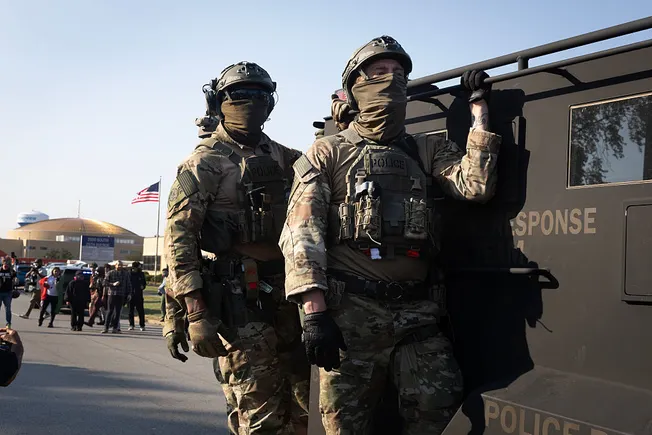
Educators are pushing for virtual schooling as an option for students and families who are living in fear of the increasing Immigrations and Customs Enforcement presence in and around school communities nationwide.
“This is an emergency,” said Chicago Board of Education member Anusha Thotakura during a public board meeting on Oct. 23. “Although the safest place for kids is at school, even if there is something that we can do to prevent one family being separated or one child coming back home to see that their parents are not there, we need to explore those avenues.”
The Chicago area, including its schools and students, has been hit hard in recent weeks by the federal government’s immigration crackdown. There have been multiple individuals apprehended by ICE on or near school grounds, including near elementary schools.
The Trump administration said the increased enforcement is needed to reduce illegal immigration and is important for national security and safety. Changes issued in January to Department of Homeland Security policy no longer protect schools from enforcement raids. Since then, schools have witnessed apprehensions during drop-off and pick-up hours.
In an effort to resist, school communities in Chicago — including oftentimes their teachers and education leaders — have formed school patrols and walking school buses, are providing families with groceries, and are also taking part in neighborhood watches by blowing whistles to alert community members when enforcement agents are nearby, Chicago education leaders have said.
However, travel to and from school is the main concern, said board member Emma Lozano during Thursday’s board meeting.
“Safe passage does not exist right now, they are all over the street,” Lozano said, saying that community members were being apprehended as recently as Thursday morning, leaving children frightened that they’d return to an empty house after school. “Our parents are asking for remote learning if possible.”
However, such a decision would likely require Illinois Gov. JB Pritzker to declare a state of emergency, board members said.
Chicago Teacher’s Union President Stacy Davis Gates also pushed the district earlier this week, saying to K-12 Dive that while a virtual academy already exists, it is not yet available to all students. In the meantime, educators are being as flexible and creative as possible to ensure students can still complete their assignments, she said.
Chicago wouldn’t be the first to float the idea of a virtual academy as a way to ensure both the safety and academic continuation for children of immigrants and immigrant children. In August, the Los Angeles Unified School District emphasized its virtual school option after a 15-year-old LAUSD student with disabilities was detained outside of a district high school at gunpoint.
In March, the New York State Education Department also told superintendents across the state that school districts were allowed to offer virtual learning “to individual students who may be unable or averse to attending school, including during times of political uncertainty.” Those students could include English Language Learners, immigrant and migrant students, as well as “others who may be affected and reluctant to attend school in person due to concerns about their personal safety and security,” said the letter.
The option for remote schooling comes as recent immigration enforcement policies under the Trump administration — including vagueness surrounding who will be arrested and how long they may be detained — is causing chronic anxiety in students. These federal immigration enforcement policies have been linked to absenteeism, classroom disengagement and heightened emotional distress, according to a July report released by psychiatric researchers at University of California, Riverside and New York University. This, the researchers wrote, has led students “to avoid school or withdraw from public life.”
“We feel the weight of ICE in our city, in our country, and students have been posting minute-by-minute updates on ICE agent locations in hopes to protect our fellow students,” said Destiny Singleton, in tears during the Thursday board meeting in Chicago. Singleton is a senior from the city’s Ogden International High School and is the board’s 2025-2026 honorary student member. “And I feel like we shouldn’t do this because we’re children and we shouldn’t need to protect ourselves in this way, and we are terrified. Everyone is terrified.”
About 620,000 K-12 students were in the U.S. without legal permission in 2021, according to research from Fwd.us, a nonprofit social welfare organization. The organization estimated that most states had at least 1,000 such students in K-12 schools and that some states like Florida and California had over 70,000. Texas, it says, had around 111,000.
Most states had tens of thousands of K-12 students with at least one parent who was in the country without legal permission, the organization said.