
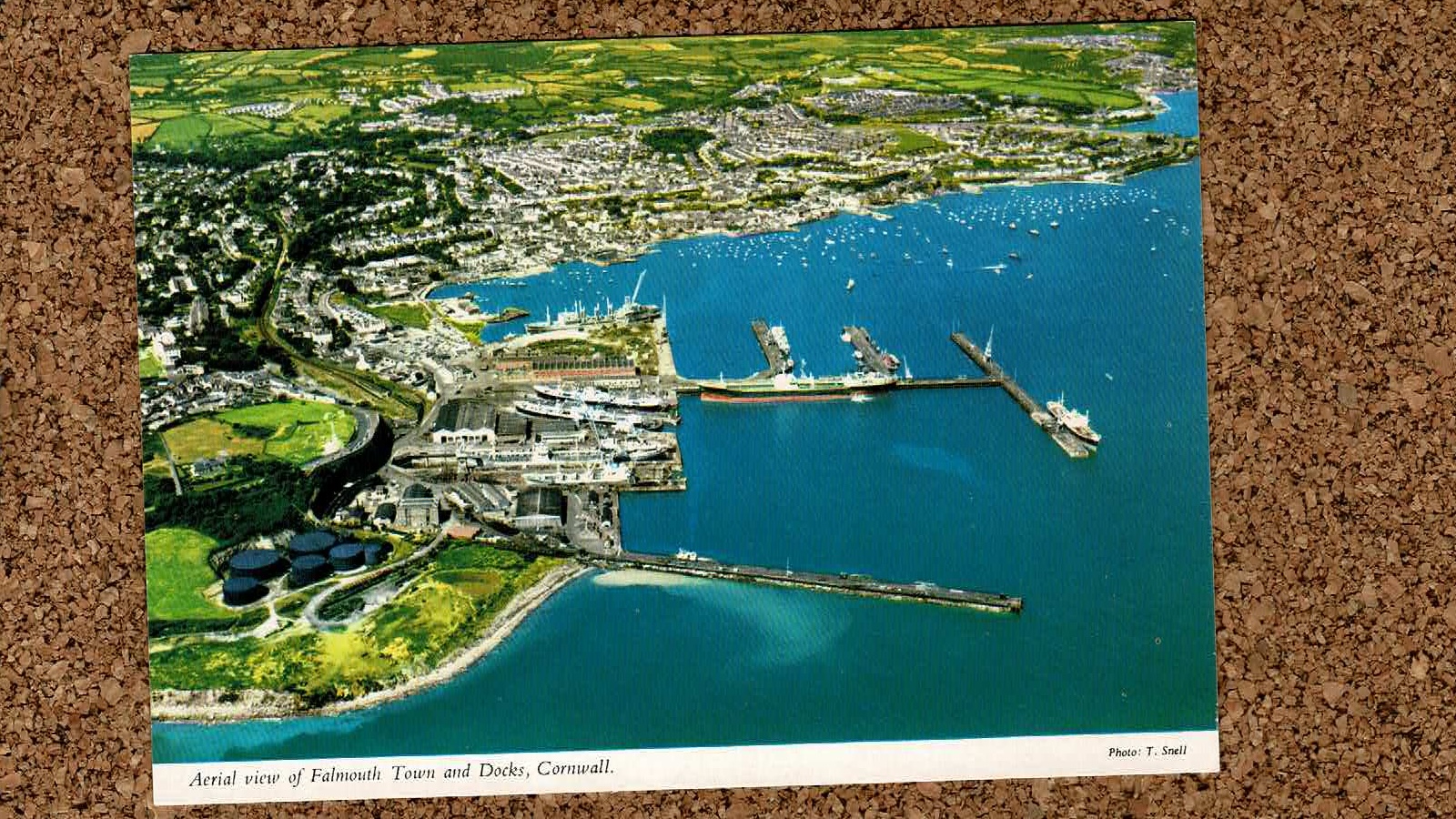
Falmouth is a long way from nearly everywhere else, if you’re travelling by land. This is a very salient fact. It means that if you’re in Falmouth, then Falmouth is where you first look for anything.
And so the Falmouth School of Art, which looks to have started sometime in 1867 or 1868, must have been very welcome to the town and the county.
The classes, which had been held in the municipal offices as part of a school of art and science, had outgrown their space and in 1901 the foundation stone was laid for a new building, in Arwenack Avenue. This would house just the art school.
The observant amongst you will have noticed by now that the postcard is a general view of Falmouth. This is an occupational hazard when trying to find a #HigherEducationPostcard of an institution in a picturesque place, or one with other famous buildings. It is why, for example, its hard to find a postcard of SOAS, when UCL and Senate House are nearby. But, the card does include Arwenack Avenue, on which the new school was located: it is, I think, somewhere in the red circle in the image below:
The school was a private venture, and it was not until 1938 that the local education authority took over running the school. (Needless to say, this is a very unusual situation: pretty much all of the other similar schools I’ve looked at were brought into local authority control in the late 1890 or early 1900s.) The school was initially under the control of the principal of the Truro School of Art: not a merger, but one person running two schools.
In the 1950s the college moved to new premises just up the hill from Arwenack Avenue. This was Kerris Vean, a large house built in 1875. It also had room to expand, and is still part of the university’s Falmouth campus today.
In the 1960s the school had about 120 students, although many of these were part time. This did not prevent it being accepted (after a reassessment) as a suitable location for the National Advisory Council for Art Education’s diploma in art and design, which was the primary qualification available at that time. Teachers included Barbara Hepworth; the school also conducted entrance examinations for the Slade School at UCL and the Royal College of Art. Staff numbers increased to 25, and more space was provided by the local education authority.
In the 1970s the CNAA recognised the school for a BA(Hons) in Fine Art. There was now residential accommodation for 57 students. And as anyone who has ever managed an institution with an art school will recognise, this scale was difficult – lots of space, not many students to fill it, a relatively high number of staff, and tight funding.
The school faced down a threat of closure in 1984, and in 1987 it merged with Cornwall College’s art and design provision to become the Falmouth School of Art and Design. Its range of subjects broadened to include design and journalism, and in 1988 it became a corporation independent of the local authority.
In 1995, recognising the breadth of its provision, the college became Falmouth College of the Arts, offering degrees validated by University of Plymouth. It became University College Falmouth in 2005; took over Dartington College of Art’s provision in 2008, and in 2012 became Falmouth University.
Here’s as always, is a jigsaw of the card. The card has not been posted, so I can’t be sure, but I would guess that it dates from the 1960s.
Why Falmouth University and not the University of Falmouth? I was asked last week whether there was a reason for “University of X” or “X University”. Looking at the legal names of universities in the UK (and some, for example Durham, have a trading name Durham University, and a legal name University of Durham) it seems that the pattern is as follows:
- The norm is “University of X”
- In Wales the default in English is “X University”, perhaps to match the preposition-less pattern in Welsh, where, for example, Cardiff University is Prifysgol Caerdydd (but nota bene University of South Wales, not South Wales University)
- If a university is named after a person or a thing it is “X University” – for example Brunel University
- If the place name is qualified in some way, it is “X University” – for example Buckinghamshire New University, Birmingham City University
- If the place is small, it is “X University” – for example Cranfield University, Keele University
- If the place is a sub-unit of a larger place, it is “X University” – for example Aston University – except when in London – for example University of Greenwich.
Is this a firm set of rules? Probably not, unless the Privy Council office has some tucked away in a file. Is it universally true? Again, no: and one counterexample to the above is Falmouth University. And this is why I chose to do Falmouth this week.
Also, notably, when I shared this analysis on social media, the most sensible response was that I was overthinking it. Which was probably true!