
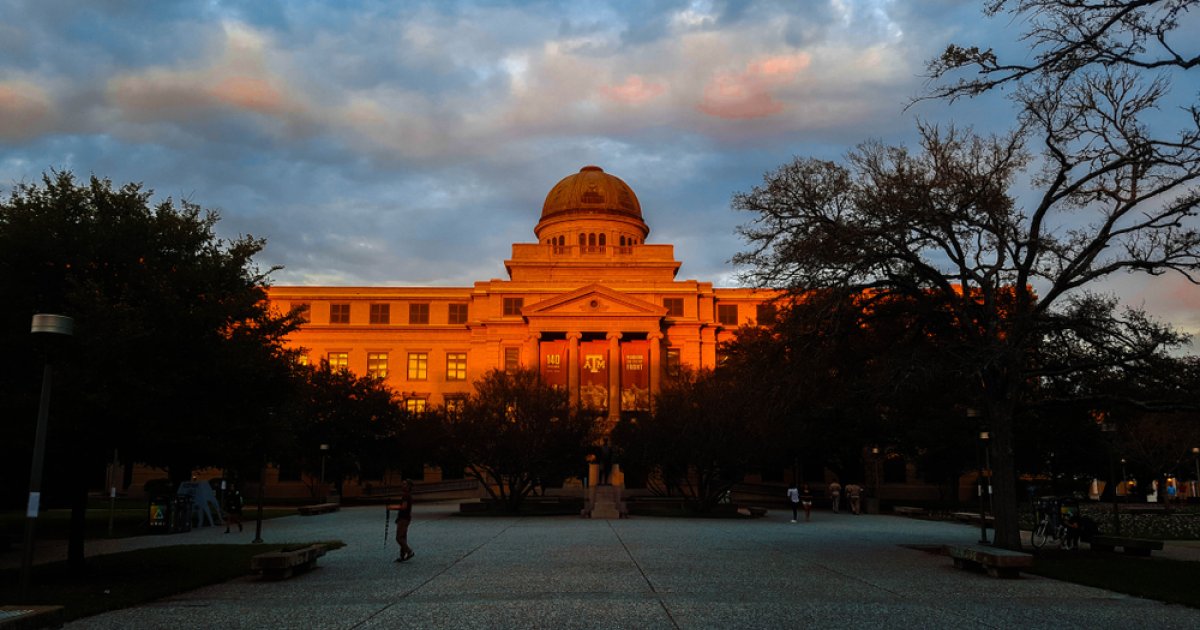
The chill in the air on Texas’ campuses isn’t just the winter storm sweeping the nation. The state’s public university systems have taken aim at faculty course materials that touch on the topics of race and gender, imposing a system of effective prior review that gives administrators carte blanche to excise course material they don’t like or think will pose political problems. At Texas A&M University alone, administrators have canceled or interfered with approximately 200 courses.
Now faculty and students are fighting back. On Jan. 29, they’re holding a protest on the College Station campus and circulating a petition to drum up public support for faculty academic freedom rights — and the ability of students in Texas to receive a comprehensive education.
The petition, organized by the American Association of University Professors, urges Texas A&M to “abandon its policy of censorship and prioritize a high-quality education for its students.” The petition comes on the heels of a press conference late last week at which faculty and students aired grievances about A&M’s censorship of course content.
Texas A&M board to vote on sweeping classroom censorship proposal
Texas A&M may hand presidents power to veto what professors teach. That’s not education — it’s censorship. FIRE urges the board to reject it.
FIRE has launched a new webpage devoted to Texas faculty censorship issues across the university systems. The webpage explains the timeline that led to this point, highlights two cases that have received significant public attention, and provides a link for faculty to reach out to FIRE with other cases of administrative censorship.
Two high-profile faculty draw attention to censorship absurdities
Not long after the new year, Martin Peterson’s situation drew significant public attention to the inherent absurdity of heavy-handed administrative interference in course materials. Administrators presented Peterson, an A&M philosophy professor, with a choice: He could either remove readings by the philosopher Plato from his course on…introductory philosophy, , or he could accept a reassignment to teach a different class.
Specifically, Texas A&M told Peterson he could “mitigate” his course content by “remov[ing] the modules on race ideology and gender ideology, and the Plato readings that may include these.” Only six weeks after the TAMU board announced that campus leaders would dictate to professors what they could or could not include in their classes, Plato, one of the foundational figures of Western philosophy, couldn’t be included because Plato’s work could touch on topics that ran afoul of Texas state ordinances targeting disfavored ideas.
At the same time, Leonard Bright, a professor in A&M’s Bush School of Government and Public Service, had his graduate-level ethics course canceled after pushing back against university officials’ orders to submit his course materials that touch on race and gender for review. He argued that these topics were threaded integrally throughout the course, and added that given the nature of his teaching, he could not comply with a university order to specify what specific topics he would cover on individual days. University officials said that because Bright hadn’t supplied the course materials for review, they canceled his class.
VICTORY: Federal court blocks Texas A&M’s unconstitutional drag ban
A federal judge upheld the First Amendment rights of a Texas A&M student group by blocking an attempt by officials to ban the group’s upcoming drag show “Draggieland”
Bright’s explanation is utterly reasonable. College courses — especially upper-level graduate courses — often contain discursive discussions that are impossible to predict. If an in-class discussion suddenly touches on race or gender, does that mean the class has to screech to a halt? Is Bright forbidden from referencing a work that may touch on those topics as a recommendation to his students or an answer to their questions? It seems that under A&M’s current rules, the answer is arguably “yes.”
Given public reports about the range of the administrative reviews and the number of courses administrators have interfered with at A&M, we are confident that Bright and Peterson are not alone. Texas faculty at public institutions affected by these reviews should reach out to FIRE if they have experienced similar censorship on campus. And FIRE’s Faculty Legal Defense Fund program is available for faculty to contact if they encounter disciplinary issues arising from their protected expression.
Public officials can’t censor ideas they dislike out of existence. College campuses must remain places for discussion and debate, not censorship.