
Higher education marketing strategies have changed, as digital marketing no longer works the way it once did. Many institutions are feeling that shift. Website traffic has plateaued for many institutions. Organic clicks are harder to win. Social engagement is unpredictable. Meanwhile, enrollment pressure continues to mount.
That tension framed Higher Education Marketing’s January 2026 webinar, “2026 Digital Marketing Roadmap: Top Trends to Drive Enrollment.” Its central message was clear: most schools aren’t failing at marketing, they’re relying on metrics and tactics that no longer reflect how students make decisions.
In 2026, the student journey isn’t shorter. It’s less visible.
Prospective students now explore programs through AI-powered search, peer content, social media, comparison platforms, and short-form video, often long before they ever reach your website. By the time they land on a program page, trust is already forming or slipping away.
This article distills the webinar into a strategic roadmap for marketing and enrollment leaders. It breaks down what’s changed, which assumptions need revisiting, and how institutions can recalibrate their approach to reach and convert students in today’s fragmented, AI-shaped ecosystem.
Higher education marketing has changed.
Let us help you build a strategy that drives enrollment today.
What’s Changing in Higher Education Marketing Strategies, and What Is No Longer True
For years, higher education digital marketing operated under a largely linear model: students searched on Google, clicked through to a website, browsed program pages, and submitted a form. Campaign success was measured by traffic volume, page rankings, and last-click conversions. It was predictable, measurable, and optimizable.
That model no longer reflects how students behave in 2026.
Today’s prospective students move through a nonlinear journey shaped by tools and platforms outside institutional control. Discovery happens in AI-generated summaries. Validation occurs through Reddit threads, TikTok reviews, or student-created content. Comparison shopping unfolds across aggregator sites, program review platforms, and influencer commentary. The institutional website is often no longer the first touchpoint or the most persuasive one.
One of the most important mindset shifts for enrollment teams is this:
A drop in website traffic does not automatically signal a failure in marketing.
Visibility and engagement have decoupled. Your program may be featured in AI search results or short-form content viewed by thousands, yet those impressions may not translate into immediate clicks. This is not a contradiction; it’s a reflection of how content is now consumed across platforms designed to answer questions before users visit source pages.
Influence has become cumulative and distributed. No single metric tells the whole story.
This structural shift requires schools to reframe how they define visibility, track performance, and attribute success. Impressions, mentions, saves, watch time, and platform-specific engagement are now as important as sessions and bounce rates. Schools that continue to optimize only for clicks and last-touch conversions risk misunderstanding how and why students choose programs and missing the opportunity to influence them earlier in their decision-making journey.
Search Is Now a Resource, Not a Click Path
Search engine optimization is not obsolete, but its purpose has fundamentally shifted.
In 2026, search acts less as a click funnel and more as a decentralized information source. AI-powered platforms now intercept early-stage research, responding directly to student queries with summaries, comparisons, and cited facts. Students ask nuanced questions like:
- Is this program flexible for working adults?
- What do alumni say about the experience?
- How does this degree compare to others?
- Will this lead to real job outcomes?
Answers increasingly come from AI interfaces or featured snippets, not from the institution’s homepage. In many cases, the first exposure to your school is a paragraph or phrase pulled from your site, sometimes without a click.
This shift redefines the goals of SEO. Ranking is still important, but it is no longer sufficient on its own. Visibility now includes being cited, summarized, and trusted in AI-generated responses.
Effective SEO in 2026 means:
- Writing with clarity, authority, and intent
- Structuring content with descriptive headings and FAQ blocks
- Providing evidence-based, specific answers to student questions
- Using schema markup and semantic formatting where appropriate
SEO is now about building referenceable content that AI systems, search engines, and prospective students trust. Your goal is not just to attract visits but to shape what students learn about your programs before theyland on your site. Schools that adjust their content strategy accordingly will establish trust earlier, influence more decisively, and earn clicks not through mechanics, but through credibility.
What Schools May Misread in 2026
Many institutions risk drawing the wrong conclusions from their marketing data by clinging to outdated assumptions. Some of the most common misreads include:
- “Traffic is down, so demand must be weaker.”
- “Our SEO rankings look fine, so we’re okay.”
- “Social media is just for awareness.”
- “Leads are slower, so interest has declined.”
These interpretations ignore how dramatically the student journey has changed. Demand may still be strong, but the way prospective students research, vet, and decide has shifted beyond traditional web behavior.
Today, higher education marketing trends and social content often shape preferences before students search. AI summaries can build or erode trust before a single pageview occurs. And channels like organic social and paid ads often support conversions indirectly, playing a key role long before a form is submitted.
In 2026, the better question is not “Where did the lead come from?” but “Where did trust form?”
That insight requires more sophisticated analysis:
- Tracking assisted conversions instead of relying solely on last-click attribution
- Using GA4 to monitor meaningful event completions (not just sessions or form fills)
- Evaluating cross-channel influence, especially how awareness platforms support mid- and bottom-funnel activity
- Measuring user behavior and engagement over time, not just impressions or vanity metrics
In a nutshell, how should schools interpret lower website traffic in 2026? Lower direct traffic doesn’t necessarily indicate lower demand. Students are researching via AI tools, social platforms, and peer content before visiting a website. Influence builds across channels long before a click.
Schools that understand these nuances will make smarter budget decisions, identify real performance gaps, and stay aligned with how students actually choose programs in today’s multi-touch environment.
Trend #1: Paid, Organic, Social, and Email Are No Longer Separate
One of the most important takeaways from the 2026 Digital Marketing Roadmap webinar is that digital channels can no longer be managed in isolation. The lines between paid, organic, social, and email have blurred, not because they’ve lost value, but because prospective students now move fluidly across them. Each channel plays a role, but none can operate alone.
In 2026, the strongest strategies recognize the specific function of each medium within a larger ecosystem:
- Paid media accelerates initial discovery and sharpens visibility around key deadlines.
- Organic content builds long-term authority and search engine trust.
- Social media reinforces credibility through validation and peer narratives.
- Email and CRM workflows move qualified leads toward action with tailored follow-up and reminders.
Conversion rarely happens on the first exposure. Student and parent journeys are asynchronous, often spanning weeks or months. Influence is cumulative and shaped by multiple, often overlapping, digital moments.
What’s the best way to unify paid, organic, and social strategies? Adopt a campaign-first approach. Rather than starting with platforms, institutions should begin with a clear, time-sensitive objective, whether it’s an upcoming program launch, enrollment milestone, or open house. From there, each channel supports that objective with coordinated, platform-appropriate content.
The alternative, operating channel by channel, leads to fragmentation. Messages become inconsistent. Results are harder to attribute. Impact is diluted.
Worse, if your institution is absent from a key channel at a key moment, another school may earn trust in your place.
Integrated campaigns, not isolated tactics, define successful enrollment marketing in 2026.
Trend #2: Social Platforms Are Now Search Engines for Trust
In 2026, social media is no longer just a brand awareness tool; it has become a primary source of research for prospective students at the decision stage. Platforms like TikTok, Instagram, YouTube, and LinkedIn now function as search engines where students evaluate whether a school is credible, welcoming, and worth their investment.
Before visiting your website or speaking to an admissions rep, students often turn to social platforms to find answers to questions they may not feel comfortable asking directly:
- Is this program actually respected?
- Will I fit in here?
- Can I balance this program with work or family?
- Are students like me succeeding?
In response, social content strategies must shift from promotion to proof.
Effective social media in 2026 is answer-first, searchable, and evidence-based. Schools that win attention and trust on these platforms produce content designed to surface in search queries and to address the exact questions prospective students are already asking.
- Short-form video grabs attention and creates an emotional connection:
“Why I chose this program”
“A day in my life as an online learner”
“What surprised me about starting grad school” - Longer-form content builds clarity and depth:
Walkthroughs of the learning experience
Explainers on workload, support, and structure
Graduate spotlights with clear outcomes
Each post should guide viewers to the next step, whether that’s visiting a program page, watching a related video, or saving the post for later.
How do students use social media differently now? Social platforms are now search engines for trust. Students use them to validate credibility, hear from peers, and understand real experiences before engaging with institutional websites. Content must be searchable, answer-focused, and human.
This shift reframes social platforms not as side channels, but as conversion-critical environments where early trust is either built or lost. Institutions that treat social media as part of the enrollment journey, rather than as a separate communications stream, will stand out in a trust-first digital landscape.
Trend #3: Trust, Proof, and Human Signals Matter More Than Ever
While social platforms increasingly shape trust at scale, final decisions still hinge on human proof and credibility. AI has transformed how students discover and compare institutions, but it has not changed the fundamentals of decision-making. In 2026, trust remains the single most valuable currency in higher education marketing. And trust is built, not claimed.
AI can summarize facts, generate overviews, and simulate tone. What it cannot replicate is lived experience or authentic human insight. This is where institutions must differentiate themselves.
Today’s prospective students are more skeptical and more discerning. They weigh cost, time, and opportunity against an increasingly competitive landscape. In this context, schools that communicate transparently and provide human-centered, verifiable content stand out.
Trust is built through:
- Real student voices that reflect the diversity of your learner population
- Faculty presence that communicates clarity, approachability, and expertise
- Unambiguous information about tuition, workload, deadlines, and expected outcomes
- A consistent narrative across website, email, ads, and social, not just in message, but in tone and intent
This is not about dramatic claims or flashy assets. It’s about making every digital touchpoint a low-friction, high-credibility experience.
Outcomes-focused education marketing plays a central role. Prospective students need to know what they will gain from a program: skills, credentials, job placement, and personal growth. Generic statements are no longer enough. Institutions must illustrate value with tangible proof, whether through alumni testimonials, employer recognition, or clear program outcomes.
Enrollment decisions are complex and often emotional. Schools that remove ambiguity, reduce perceived risk, and demonstrate results will consistently outperform those that rely on volume-based messaging or performative branding.
In short, authenticity scales. AI may shape discovery, but human signals close the gap between interest and action.
Campaign Scenarios: What This Looks Like in Practice
To realign digital marketing for education in 2026, institutions must shift from channel-based tactics to integrated, student-centered campaigns. Below are two example scenarios that illustrate the difference between traditional and current best practices.
Scenario 1: Program Recruitment Campaign
Old Approach
- Publish a generic SEO blog (e.g., “Benefits of a Nursing Career”)
- Run paid search and display ads pointing to a static program page
- Measure success based on impressions, clicks, and form submissions
2026-Aligned Approach
- Build a dedicated “Program Answer Hub” that addresses real, specific student questions. e.g., “Can I work full-time while completing this RN program?” or “What kind of clinical support is available online?”
- Structure the content with strong H2s and embedded FAQs to increase the likelihood of being cited in AI-generated search responses
- Repurpose key insights from the blog into short-form social videos featuring students, faculty, or alumni
- Run both paid search and paid social campaigns, driving to landing pages tailored by audience segment (e.g., working professionals, recent graduates)
- Measure performance using GA4 key event tracking (e.g., info request, video viewed, program comparison clicked), and assess assisted conversions across channels
Scenario 2: Intake Promotion Campaign
Old Approach
- Launch short-term lead generation ads ahead of the deadline
- Send one-size-fits-all emails reminding students to apply
2026-Aligned Approach
- Use paid social video to highlight program flexibility, graduate outcomes, or application tips in a fast-paced, mobile-friendly format
- Share organic student stories that illustrate the balance between school, work, and life
- Create landing pages that clearly define who the program is for, and who it isn’t, to build trust early
- Send segmented nurture emails focused on common concerns like cost, workload, or career ROI
- Track performance across the funnel, focusing on influence and engagement, not just final conversions
In both cases, alignment across platforms, message clarity, and trust-building content drive stronger enrollment outcomes.
Reporting and Measurement in 2026
In 2026, effective digital marketing for education hinges on the ability to track and connect every stage of the enrollment pathway, from initial inquiry to enrollment confirmation. Institutions must be able to measure the progression from:
Leads → Meetings → Applications → Enrollments
across all major touchpoints, including:
- Organic search
- Paid search
- Paid social
- Organic social
- AI-generated citations
- Email campaigns
- Live and virtual events
- Referral sources
Without this visibility, optimization is reduced to guesswork. Teams risk investing in tactics that influence visibility but not outcomes or vice versa. To avoid this, institutions should define key events in Google Analytics 4 (GA4) that reflect meaningful behaviors (e.g., info requests, virtual tour sign-ups, program comparisons) and connect them to CRM and admissions data where possible.
This integration ensures marketing success is not measured by impressions or clicks alone, but by qualified leads and conversions. Schools that structure their reporting to reflect enrollment impact, rather than marketing vanity metrics, will gain the clarity needed to refine strategies, justify spend, and close the loop between awareness and enrollment.
In 2026, this is not an advanced measurement. It is the new baseline.
A Readiness Checklist for Institutions
In 2026, digital marketing success depends less on completing a list of tactics and more on asking the right strategic questions:
- Can AI tools accurately explain our programs based on what we’ve published?
- Do our social channels actively answer the questions prospective students are asking?
- Is our content structured clearly enough to serve both human readers and machine-generated summaries?
- Can we measure influence across the full decision journey, not just the final click?
These questions surface the true readiness of an institution’s marketing strategy. If the answer is “no” or “not yet,” the solution is not starting over; it’s realigning current efforts with how students now search, compare, and decide. Schools that ask and answer these questions honestly will be better positioned to adapt quickly, invest wisely, and support enrollment growth.
Real-World Examples From Prestigious Institutions
Harvard Business School Online: Emphasizes outcome-driven storytelling through publicly shared learner success narratives. HBS Online shares real-world success stories of alumni (e.g. promotions, salary increases) to illustrate the tangible benefits of its programs, helping prospective learners see clear returns on their education investment.
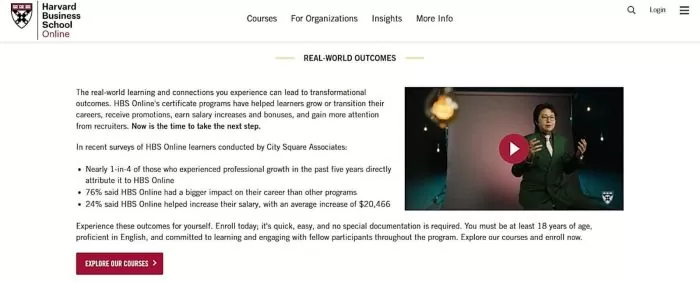
Source: Harvard Business School Online
University of Toronto (School of Continuing Studies): Focuses on clarity and transparency with detailed program pages and extensive FAQs. Each course page provides clear content outlines, and a comprehensive help center answers common questions, ensuring prospective students easily find information and feel confident about program details.
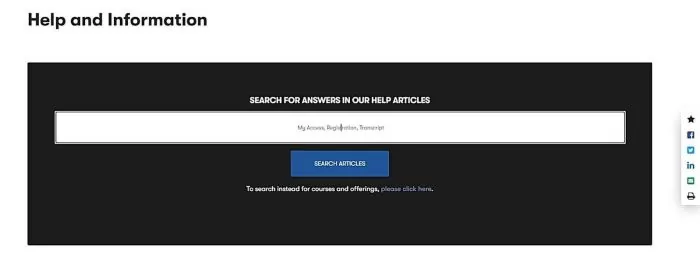
Source: University of Toronto (School of Continuing Studies)
University of Oxford: Offers dedicated distance learning program pages that make comparison easy. Oxford’s site lists all online and low-residency courses in one place with key details, allowing prospective students to compare programs and understand the format (fully online or hybrid) before applying.
Source: University of Oxford
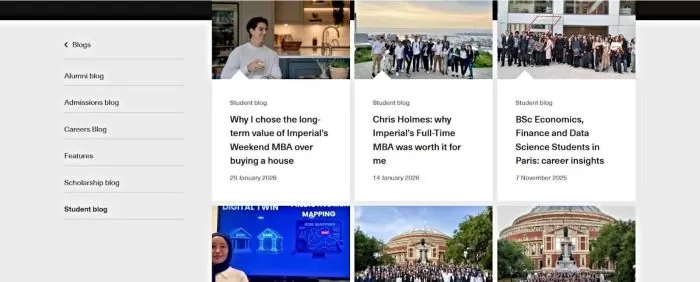
Imperial College Business School: Features student-led blogs for its MBA programs, giving an authentic peer perspective. Current Online MBA students regularly write about their experiences and achievements on the Imperial Student Blog, providing relatable insights and social proof to prospective MBA candidates.
Source: Imperial College Business School
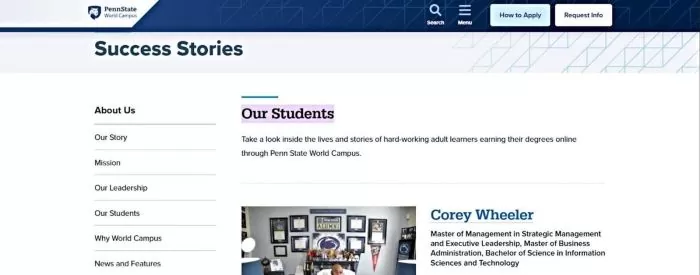
Penn State World Campus: Highlights online student success stories as social proof. The World Campus “Success Stories” page shares narratives of working adult learners achieving their degrees online, demonstrating how flexible programs helped them advance careers and inspiring future students with real outcomes.
Source: Penn State World Campus
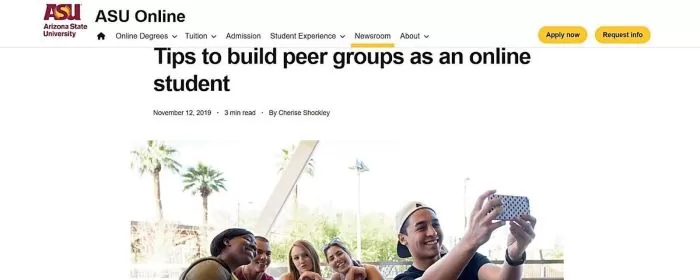
Arizona State University Online: Leverages student ambassador content for authenticity. ASU Online’s #LearnASULive ambassadors (current online students) share first-hand accounts and tips about balancing studies with life, allowing prospects to connect with real student experiences and fostering a sense of community.
Source: Arizona State University Online
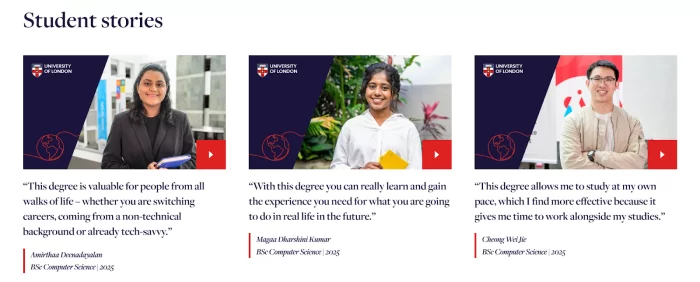
University of London: Shares online program student narratives to personalize its offerings. Through student story videos and quotes on its site, the university highlights diverse learner journeys and outcomes (e.g., a student praising the degree’s value for all backgrounds), underlining the flexibility and broad appeal of its distance learning programs.
Source: University of London
Clarity Wins in 2026
Success in 2026 won’t come from chasing every new platform feature or piling on tactics. It will come from clarity about what students need, how they make decisions, and where your institution fits into that process.
The schools seeing results aren’t necessarily spending more. They’re communicating better. Their messages are aligned across platforms. Their campaigns are structured around real questions and measurable goals. Their content shows what enrollment actually looks like, and why it’s worth it.
Higher Education Marketing’s role is to help institutions navigate this shift. Not by selling quick fixes, but by interpreting what the signals mean and translating them into strategies that move the needle. We help schools build marketing systems that are coordinated, trackable, and designed to convert intent into action.
Digital marketing still drives enrollment. But in 2026, it does so through cumulative influence, clear positioning, and trust that’s earned across multiple touchpoints. The path is still there. It just takes sharper focus to see it.
Higher education marketing has changed.
Let us help you build a strategy that drives enrollment today.
FAQs
How should schools interpret lower website traffic in 2026?
Lower direct traffic doesn’t necessarily indicate lower demand. Students are researching via AI tools, social platforms, and peer content before visiting a website. Influence builds across channels long before a click.
What’s the best way to unify paid, organic, and social strategies?
Adopt a campaign-first approach. Rather than starting with platforms, institutions should begin with a clear, time-sensitive objective, whether it’s an upcoming program launch, enrollment milestone, or open house.
How do students use social media differently now?
Social platforms are now search engines for trust. Students use them to validate credibility, hear from peers, and understand real experiences before engaging with institutional websites. Content must be searchable, answer-focused, and human.