Author: admin

  • Improving Academic Supports for Incarcerated Students

    Improving Academic Supports for Incarcerated Students

    In 2023, Congress reinstated use of Pell Grants for students in prison, expanding their access to higher education.

    One of the stipulations was that colleges would provide them with the same access to resources that on-campus students have, including academic supports, career advising, tutoring, mental health resources and study halls. However, a recently published report from the University of Puget Sound finds that this provision has been difficult to fulfill, in part because of prison systems, but also because of the overly bureaucratic processes at higher ed institutions themselves.

    The report identifies existing barriers, as well as opportunities to better serve incarcerated students.

    What’s the need: Higher education programs in prisons can help incarcerated individuals improve their educational attainment and career opportunities upon release, as well as increase socioeconomic mobility for affected individuals and their families.

    Providing education to incarcerated individuals, however, can be a challenge due to their lack of access to technology and learning materials, restrictions on when they can participate and policies like lockdowns that impede learning opportunities.

    “Prison rules and staff often limit the ability to study, work together, possess books and supplies in cells, and meet outside the classroom,” according to the report. Students can also lack access to faculty outside of the classroom.

    Students often are unaware of or unable to access traditional campus resources such as research databases, learning management systems, disability and mental health resources, and tutoring.

    The findings: Puget Sound’s report includes survey data from alumni of higher education in prison (HEP) programs and faculty. Researchers also relied on in-depth interviews with 25 stakeholders involved in such programs, as well as any affiliated teaching and learning center staff members. Interviews were conducted between August and November 2024.

    In conversations with faculty, researchers learned that silos often exist between teaching and learning centers and HEP programs, which can leave professors without sufficient resources or supports to be effective instructors. Even at the national level, pedagogical or student success–oriented conversations often don’t take into account incarcerated students.

    For instructors, working with incarcerated students can be demanding because it’s not part of their regular teaching load, they have long commutes or they have to adapt their materials and syllabi to a low- or no-tech teaching environment, according to the report. Some professors reported feeling isolated from peers or unable to share or receive feedback about their teaching.

    Keep Reading

    The University of Puget Sound compiled resources from higher education in prison programs to improve teaching and learning, including trainings, sample faculty and student handbooks, models for mental health support, and more.

    See the full guide here.

    What can help: The researchers identified a variety of innovative programs to enhance incarcerated students’ learning and educational outcomes.

    Some HEP programs, including those at Rutgers University and Scripps College, established peer tutoring opportunities among incarcerated students, in which graduates provide feedback on writing, research, time management and study skills.

    “The implementation of peer-to-peer tutoring does not just help the students receiving support. It builds professional development skills, volunteer or employment histories, and confidence for the tutors themselves as they continue their learning journeys,” the report says.

    The University of Utah Prison Education Program pays incarcerated students about $600 per month to provide peer support in a one-stop location. Student employees offer homework assistance, help organize events and educate their peers on health and wellness topics.

    The report also advocates for developing college prep and student success courses for incoming incarcerated students to help them get familiar with resources and technology that they may not know about. Tufts University Prison Initiative of Tisch College offers a two-semester foundation of academic success course, for example.

    Incarcerated students may also have mental health needs or disabilities that require extra intervention from the institution. Loyola University in Chicago’s HEP program employs a social worker who meets with students individually to understand their needs and connect them with support.

    Administrators can also institutionalize support for instructors of these programs by counting teaching in prison settings as a part of a regular course load or providing training for such programs during new faculty orientations. Learning communities, course development stipends and certifications can also incentivize effective teaching practices among instructors who teach in prisons.

    Connecting campus staff, particularly those in teaching and learning centers, with HEP faculty and students can also break down silos between campus and incarcerated students and ensure learners are being best served, according to the report.

    In the future, researchers hope to establish a national learning community for pedagogy in prison and a convening of stakeholders in this space to share resources.

    Source link

  • Trump Targets Nevada at Reno’s Undocumented Student Supports

    Trump Targets Nevada at Reno’s Undocumented Student Supports

    Photo illustration by Justin Morrison/Inside Higher Ed | Cheriss May/NurPhoto/Getty Images | Brycia James/iStock/Getty Images 

    Centers and programs for undocumented students are caught in a politically precarious moment after the Department of Justice called for an investigation of the University of Nevada at Reno’s undocumented student services. Immigrant students’ advocates say the move marks an escalation in the Trump administration’s ongoing crackdown on higher ed benefits for these students. And they worry campus programs supporting undocumented students might pre-emptively scale back or close altogether.

    In a letter late last month, DOJ officials directed Education Secretary Linda McMahon to investigate the Nevada university over UndocuPack, its support program for undocumented students.

    According to the letter, the DOJ had received reports of the university’s “efforts to assist illegal immigrants” by providing referrals to on- and off-campus resources, student aid, and academic and career support, including helping students find “career opportunities that do not require applicants to provide a Social Security Number.”

    “We are referring this matter to the Department of Education to investigate whether UNR is using taxpayer funds [to] subsidize or promote illegal immigration,” the letter read.

    The U.S. Department of Education did not respond to a request for comment; Inside Higher Ed received an automatic out-of-office message citing the government shutdown.

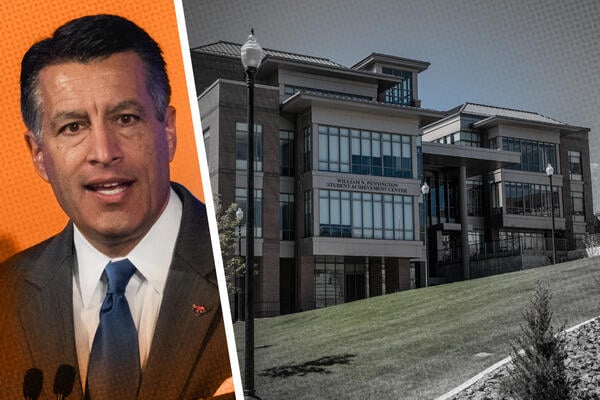
    But UNR is pushing back. Brian Sandoval, a former Republican governor of Nevada and the university’s first Hispanic president, responded with a forceful defense of the program.

    He stressed to students and staff that the UndocuPack program offers supports to all students, regardless of citizenship status, and uses no federal funds. He also emphasized that several state-funded scholarships don’t take immigration or residency status into account; the university doesn’t dole out state or federal aid to anyone ineligible.

    “The University has remained in compliance with federal and state law, as well as the Nevada and United States Constitutions regarding adherence to federal and state eligibility requirements for undocumented students for federal aid and scholarships,” Sandoval wrote. “In addition, we have made good, and will continue to make good on our commitment in ensuring a respectful, supportive, and welcoming environment on our campus where all our students have access to the tools they need for success.”

    He said the university plans to respond to the proposed investigation “through the appropriate legal channels.”

    A ‘Test Case’

    The threat to UNR brings fresh worries for undocumented students’ advocates, who say it’s the latest in a string of federal efforts to curb public higher ed benefits for such students.

    The Justice Department has already sued five states over policies allowing undocumented students to pay in-state tuition, successfully quashing state laws in Texas and Oklahoma after their attorneys general swiftly sided with the federal government. Over the summer, the Education Department announced it would investigate five universities for offering scholarships intended for undocumented students, claiming such programs violated civil rights law. The department also ended Clinton-era guidance that allowed undocumented students to participate in adult and career and technical education programs in response to Trump’s February executive order demanding that “no taxpayer-funded benefits go to unqualified aliens.”

    Diego Sánchez, director of policy and strategy at the Presidents’ Alliance on Higher Education and Immigration, said going after UNR’s UndocuPack program is “part of a broader effort by the administration to intimidate colleges and universities that seek to serve undocumented students.” But it also takes the campaign a step further, “targeting any form of campus support for undocumented students,” including academic and career services. “It’s definitely a pattern of escalating attacks via different avenues of law.”

    The DOJ’s letter cites the Personal Responsibility and Work Opportunity Reconciliation Act of 1996, which bars undocumented immigrants from many public benefits, but Sánchez maintains that “no court has ever interpreted PRWORA to bar universities from offering support offices, mentoring resource centers for undocumented students.”

    Those kinds of supports for undocumented students exist at colleges and universities across the country. A 2020 study found at least 59 undocumented student resource centers on campuses nationwide, mostly in California but also in other states including Arizona, Colorado, Florida, New Jersey, Oregon, Texas, Utah and Washington.

    Sánchez worries that colleges and universities could modify or scrap perfectly lawful programs out of fear after seeing the DOJ chide UNR for such common supports. He also expects the Trump administration to target more programs like UndocuPack.

    UNR feels like “a test case,” he said.

    Gaby Pacheco, president and CEO of TheDream.US, a scholarship provider for undocumented students, said other colleges and universities with undocumented student supports are already weighing what to do in response to the developments in Nevada.

    “Do we duck and hide and lay low so that we don’t get picked on, or do we stand together with others and potentially become a target of this? It’s a question that a lot of people and institutions … are asking themselves,” Pacheco said.

    She worries canceling or minimizing undocumented student support programs will send those students a message—“that they don’t belong.” And she doesn’t believe trying to lie low or scale back programs will deflect federal attention.

    “This is just month nine into this administration. We still have a full three more years to go,” she said. And the administration seems like it plans to “continue full force until, in essence, there are no policies left where undocumented students have access to higher education.”

    Source link

  • Universities Are Curators of Knowledge, Not Chaos (opinion)

    Universities Are Curators of Knowledge, Not Chaos (opinion)

    In a year already defined by polarization and violence, the assassination of Charlie Kirk at Utah Valley University plunged higher education into crisis. The killing of one of the nation’s most prominent conservative activists on a college campus has been weaponized by political factions, prompting administrative crackdowns and faculty firings. What were once familiar battles in the campus culture wars have escalated into something more dangerous: a struggle over the very conditions of inquiry, where violence, scandal and political pressure converge to erode academic freedom. And now, a proposed “compact” with higher education institutions would seek to condition federal funding on requirements that colleges ensure a “broad spectrum of viewpoints” in each academic department and that they abolish “institutional units that purposefully punish, belittle, and even spark violence against conservative ideas.”

    At the center of this struggle lies a persistent illusion: that the university should provide a platform for “every perspective.” Critics claim campuses suppress conservative voices or silence dissenting students, arguing institutions should resemble open marketplaces where all viewpoints compete for attention. Enticing as this rhetoric may be, the expectation is both unworkable and misguided. No university can present every possible outlook in equal measure, nor should it. The mission of higher education is more demanding: to cultivate, critique and transmit knowledge while attending to perspectives that have shaped history and public life. The contrast between an endless marketplace of opinion and the rigorous pursuit of knowledge is crucial to understanding what universities are for.

    Karl Mannheim once distinguished between ideology and knowledge, cautioning against their uncritical conflation. That warning remains essential. Universities are not platforms for unchecked ideology but institutions dedicated to showing how knowledge emerges through observation, interpretation, critique and debate. Perspectives matter, but exposure alone is insufficient; they must be contextualized and weighed against evidence. Free speech and academic freedom overlap but are not the same. Free speech protects individuals from state repression in public life. Academic freedom protects scholars in their pursuit of inquiry and ensures students gain the tools to test claims critically. The distinction is central: The university has an obligation not to amplify all voices equally, but to cultivate discernment.

    This does not mean shielding students from offensive or discredited ideas. On the contrary, a serious education requires grappling with perspectives that once commanded influence, however abhorrent they may now appear. Students of American history must study the intellectual justifications once advanced for slavery—not because they deserve validation, but because they shaped institutions and legacies that continue to structure society. Students of religious history should encounter theological controversies that once divided communities, whether or not they resonate today, because they explain enduring traditions and conflicts. To include such perspectives is not to offer them equal standing with contemporary knowledge, but to illuminate their historical weight and consequences.

    Confusing exposure with endorsement—or opinion with knowledge—risks leaving students adrift in noise. Universities are not megaphones for any thesis but arenas where students learn how to evaluate sources, test claims and trace the consequences of ideas over time. Academic freedom does not mean a free-for-all. Instead, it allows scholars to curate, critique and contextualize knowledge—including ideas that are controversial, even offensive or (as in the study of slavery or fascism) historically consequential. Education that multiplies opinions without cultivating methods of judgment undermines critical capacity; education that fosters discernment equips students to enter public debates wisely and responsibly.

    Recent events in higher education reveal how fragile these principles have become. Violence itself intimidates expression, but administrative and political overreaction magnifies the threat. Faculty have been disciplined for social media posts. In Texas, a lecturer was dismissed for teaching about gender identity. In California, University of California, Berkeley administrators released to federal authorities the identities of more than a hundred students and faculty whose names appeared (as accused, accuser or affected party) in complaints about antisemitism. Faculty watch colleagues punished unjustly, while students—especially international and marginalized ones—face surveillance and potential charges. Across the country, dissent is mistaken for hate, controversial speech treated as threat and scandal avoidance prioritized over defending expressive rights.

    Academic freedom has long enjoyed special constitutional protection, granting professors wide latitude in teaching and research. But this protection depends on public trust: the sense that higher education fosters critical inquiry rather than partisan indoctrination. When professors behave as ideologues or exercise poor judgment in public, that trust erodes. Yet the greater danger comes not from individual missteps but from capitulating to the demand that every perspective deserves equal standing—or from letting violence and political pressure set the boundaries of what may be said. Higher education should not resemble a bazaar of endless opinion but a community dedicated to the disciplined creation, transmission and critique of knowledge. By training students not to hear every voice equally but to weigh evidence and evaluate claims, universities preserve both their scholarly mission and their democratic role. Institutions that cave to intimidation, or that mistake neutrality for abdication, abandon their responsibility to defend inquiry.

    Equally important, universities serve as legitimating institutions. To place a perspective within their walls signals that it merits serious study, that it has crossed the threshold from private belief to public knowledge. This conferral of legitimacy makes curatorial responsibility critical. Treating perspectives as interchangeable voices distorts the university’s purpose, but so does admitting or excluding them solely under political pressure. Both compromises undermine credibility. External actors understand this and exploit universities’ legitimating authority, pressing institutions to provide platforms that elevate discredited or dangerous views into claims of scholarly validation. The responsibility of the university is not to magnify every claim in equal volume but to steward the line between ideas worth engaging and those demanding correction or refusal. Only in this way can institutions preserve their academic mission and their democratic contribution.

    The way forward is neither unbounded opinion nor fearful silence. It is the principled defense of creating, critiquing and reimagining knowledge through inquiry guided by evidence and protected from violence and censorship. To retreat from this responsibility is to weaken not only higher education but democracy itself.

    Gerardo Martí is the William R. Kenan Jr. Professor of Sociology at Davidson College.

    Source link

  • Institutions, Over Peers and Tribes, Bolster Indigenous Student Belonging

    Institutions, Over Peers and Tribes, Bolster Indigenous Student Belonging

    Daniel de la Hoz/iStock/Getty Images Plus

    A new study from the American Indian College Fund and National Native Scholarship Providers found that Indigenous students report a stronger sense of belonging on campus when their college provides “perceptions of a sense of acceptance, inclusion and identity.”

    They call this “institutional support,” and it’s the primary predictor of belonging, trailed by peer support, campus climate and tribal support, the study showed. 

    The “Power in Culture Report,” released Wednesday, examined Indigenous students’ sense of belonging at the institutional and state level. NNSP surveyed more than 560 students enrolled at 184 institutions across multiple sectors, including tribal colleges and universities, predominantly white institutions, Hispanic-serving institutions, and other minority-serving institutions. The survey was conducted between March and April of 2024. 

    Unsurprisingly, tribal colleges foster a greater sense of institutional belonging among Indigenous students than other institution types. At nontribal institutions, Indigenous students must create belonging via “informal networks and cultural resilience amid institutional neglect or performative inclusion.” Indigenous students at nontribal campuses also report experiencing more microaggressions and cultural isolation. Students at institutions with larger populations of Indigenous students report a 14 percent higher sense of belonging than those at schools with fewer Native peers. 

    When looking at Indigenous student belonging at the state level, students attending college in states with larger tribal populations actually report a lower sense of belonging and say they feel less supported than students in states with smaller tribal populations, “suggesting that population size alone does not equate to meaningful support,” the study noted. Students in states with a tribal college or university reported an 18 percent lower sense of belonging than students in states without a tribal institution. 

    At all institution types, students living off-campus reported a 16 percent higher sense of belonging than those living on-campus. 

    The report includes several policy recommendations to bolster Indigenous student belonging, including recruiting Indigenous faculty and staff, funding Native language revitalization courses, and establishing meaningful relationships with local tribal nations.

    Source link

  • “New Collaborations Needed” as U.S. Cuts Global Health Funds

    “New Collaborations Needed” as U.S. Cuts Global Health Funds

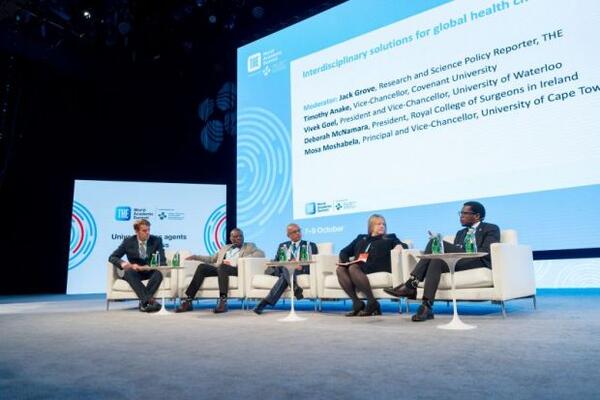
    Universities focused on global health will have to collaborate more with each other and with industry and philanthropic organizations in the face of the Trump administration’s multibillion-dollar aid cuts, according to academic leaders from around the world.

    Funding covering projects tackling conditions such as AIDS, tuberculosis and Ebola has been upended since Donald Trump returned to power in January, and speakers at Times Higher Education’s World Academic Summit said that it would be impossible to replace the lost dollars overnight.

    Mosa Moshabela, vice chancellor of the University of Cape Town, said that his institution had been one of the largest recipients of National Institutes of Health funding outside the U.S., supporting projects in areas such as HIV and tuberculosis prevention, and that his institution had been “impacted a lot” by the White House’s decisions.

    “We realize the danger of having placed all our eggs in one basket, pretty much,” said Moshabela, himself a leading public health researcher.

    “We know that, in terms of scale of funding, we’re not necessarily going to have one source that can replace the amount [we received] from the NIH, but by spreading our partnerships we can still achieve similar results—and we are strengthening our partnerships in the Middle East, in Asia, across the globe, and also looking at new donors that are coming through.”

    Moshabela said that Cape Town was also putting pressure on the South African government to increase research spending, highlighting that it currently spent only 0.6 percent of gross domestic product in this area, despite a long-standing target for the outlay to reach a minimum of 1.5 percent.

    “Even between universities, we are adopting the principle of cooperation over competition,” Moshabela continued.

    “For a long time, we were competing for the same sources of funding, but now what we’re trying to do as a strategy is to cooperate more rather than compete over sources of funding.”

    Vivek Goel, vice chancellor of Canada’s University of Waterloo, agreed that it would take time to fill the funding gap left by U.S. cuts.

    “I don’t think it’s realistic to expect that overnight we are going to fill those gaps,” he said. “I think we became very reliant on a certain model … I think in collaboration between governments, philanthropy, industry and our institutions we can come up with new ways of working that can replace that work [on global health, but] not necessarily all of that funding.”

    Goel, another public health researcher, highlighted that it was not just U.S. funding that was being lost, pointing to research that was funded by Canadian sources or philanthropic organizations but that depended on clinics or infrastructure operated by the United States Agency for International Development. Researchers may also lose access to Centers for Disease Control data, he warned.

    Drawing down funding for global health research in the future will require a change of mindset, Moshabela argued, such as focusing on solutions with wider commercial benefit to attract the support of pharmaceutical companies and working to develop broader ecosystems and not just clinical interventions to win funding from philanthropists.

    Deborah McNamara, president of RCSI University of Medicine and Health Sciences, said that Western universities should approach the funding challenges “with humility.”

    “Our partners in the Global South have been doing more with less for a very, very long time,” she noted.

    “I think we’ve all observed over time waste in development funding, and in the surgical arena certainly we often discover [that] at hospitals that we work with they have large amounts of donated equipment that perhaps can’t be maintained, can’t be run, [and] isn’t operational.

    “By listening more we can reduce the waste that happens and direct [funding] more effectively.”

    Source link

  • Changing the Default Setting

    Changing the Default Setting

    Earlier this week the presidents of three of the formerly regional accreditors—Middle States, SACSCOC and WASC—hosted a webinar on AI and transfer credit. I watched, as did several colleagues; both topics are important, and since we’re covered by Middle States, it’s useful to know where its policies and expectations are heading. Credit loss upon transfer is a chronic issue on which accreditors have historically been muted; serious attention would be welcome.

    It was … frustrating My colleagues and I tried afterward to isolate actual concrete changes and came away befuddled. It reminded me a bit of “strategic plans” that say things like, “We will achieve excellence.” OK, but that’s neither a strategy nor a plan. At best, it’s an intention.

    Heather Perfetti, the president of MSCHE, stated that she doesn’t want accreditors to be seen as barriers to credit transfer; if anything, they’re urging a shift in the burden of proof for credit transfer from yes to no. That’s good, as far as it goes, but the key word is “urging.” Urging is not requiring. Kay McClenney famously noted that “students don’t do optional.” I’ve seen too many cases of universities not doing optional when it comes to accepting credits in transfer.

    The stated reason is usually something about standards; the real reason is economic self-interest. Departments don’t want to “give away” any more credits than they have to, so they don’t. That changes only when orders come down from above—say, from a provost’s office because the college is desperate for enrollment, or from a State Legislature that got sick of shenanigans and passed a law, like MassTransfer in Massachusetts. Accreditors could conceivably play that role—it would be naïve to think that outcomes assessment would have gained the momentum it did without pressure from accreditors—but they’d have to put some force behind it. I didn’t catch any mention of that.

    To be fair to the accreditors, that’s much harder now that they’ve lost their de facto regional monopolies. The regional accreditors are membership-driven organizations whose imprimatur opens up access to federal financial aid. Membership-driven organizations aren’t normally tough on their members, but the unusual combination of regional monopoly and access to federal financial aid gave them the leverage to push their members harder than they otherwise could. That didn’t always work out ideally—some colleges went bankrupt having recently satisfied accreditors that they were financially sound—but the structure made it at least possible for the accreditors to carry real weight.

    The first Trump administration broke the regional monopolies and opened the door to alternative accreditors. Now there’s an entirely new body emerging in SACS’s territory, and colleges are empowered to shop around. When members can shop around for more lenient or ideologically aligned accreditors, it becomes more difficult for the legacy accreditors to issue mandates.

    The new preference—I can’t call it a mandate or a policy—seems to mean that colleges should “default to yes” on credit transfer, in the absence of evidence that they shouldn’t. It wasn’t immediately clear what would constitute evidence that they shouldn’t. Lack of regional accreditation isn’t supposed to be dispositive in itself. Over time, a college could track success rates of students in Calc II who transferred in Calc I from College X, and if the rate were low enough, they could cite that. But that would require first allowing everything in for several years to build a track record; after that, the politics of saying no would be more complicated.

    The connection to AI, as near as I could tell, was that it would allow colleges to assess transcripts and issue transfer decisions much more quickly at scale. That would actually help. As one of the presidents put it—I should have written it down, but alas—the current system works like trading in a car for a new one but not being told the value of your trade-in until you’ve had the new one for a few months. It’s not consumer-friendly at all. If transfer credit decisions could be issued at the same time as admission and financial aid decisions, students would be much more able to make informed decisions. I have concerns about AI hallucinations in this context (and many others), but if defaulting to yes is built in, it might work at least as well as the current system.

    So, I’ll give this shift a cheer and a half out of three. The direction is positive; I just hope they can find a way to move from an intention to a plan.

    Source link

  • How the manufactured narrative of ‘failure’ is distracting us from resolving the systemic problems holding back the study of Modern Languages – Part 2. 

    How the manufactured narrative of ‘failure’ is distracting us from resolving the systemic problems holding back the study of Modern Languages – Part 2. 

    This post was kindly written by Vincent Everett, who is head of languages in a comprehensive school and sixth form in Norfolk. He blogs as The Nice Man Who Teaches Languages

    In Part 1, I looked at how the low grades given at GCSE languages – up to a grade lower than in pupils’ other subjects – is a manufactured situation, easily solved at the stroke of a pen. The narrative around languages being harder is nothing to do with the content of the course or the difficulty of the exam. It is simply a historical anomaly of how the grades are allocated. There is also a false narrative that this unfair grading is due to pupils’ individual ability, the nation’s ability, or the quality of teaching. And I made a subtle plea for commentators to avoid reinforcing this narrative to push their own diagnosis or solutions. 

    In Part 2, I will consider what happens in post-16 language learning. This has also been the subject of reporting in the wake of A-Level results and the recent HEPI report. I am not going to deny that A-Level languages are in crisis. But the crisis in A-Level and the crisis of language learning post-16 are not one and the same. 

    There are specific problems with the current A-Level specification for languages. The amount of content to be studied, comprising recondite details of every aspect of the Spanish / French / German speaking world, is unmanageable. Worse, as this post explains, the content is out of kilter with the exam. All the encyclopaedic knowledge of politics, history, popular culture and high culture which takes up the bulk of the course, is ultimately only required for one question in just one part of the Speaking Exam. The difficulty of the course is compounded by the extremely high standards required, especially for students who have learned their language in the school context. I personally know of language teachers and college leaders who have discouraged their own children from taking A-Level languages in order not to jeopardise their grades for university application. It is getting to the point where I can no longer, in good conscience, let ambitious students embark on the course without warning them of the overwhelming workload and doubtful outcomes. 

    So A-Level could be improved. But as an academic course, it will always remain the domain of a tiny few. Similarly, specialist Philology degrees at university – the academic study of the language through the intersection of literary and textual criticism, linguistics and the history of the language – only attract a very small minority. Neither university language degrees, nor A-Level, are a mainstream language learning pathway. 

    It is a particularly British mentality to only value language learning if its intellectual heft is boosted by the inclusion of essays, abstruse grammar, linguistics, literature, politics, history, and a study of culture. In other words, philology. Philology is not the same as language learning.  

    Universities do offer language learning opportunities for students of other disciplines. However, in sixth form, because of the funding requirement to offer Level 3 courses, there are no mainstream language learning options available to the vast majority of students who do not study A-Level languages. We have a gap in 16-19 provision where colleges do not offer a mainstream language learning pathway. 

    This gap is fatal to language study. It means GCSE is seen as a dead-end. It means that universities have a tiny pool of students ready and able to take up language degrees or degrees with languages as a component. 

    The crisis is not one of how to channel more people into studying A-Level languages. It is a question of finding radical new ways of offering mainstream language learning post-16, and how to make this the norm. We know from the HEPI report that young people in the UK are among the most avid users of the online language learning app Duolingo. Young people are choosing to engage with language learning, but in terms of formal education, we are leaving a two-year gap between GCSE and the opportunities offered by universities. 

    If this hiatus in language learning is the problem, is there a solution? I have two suggestions. One of which is relatively easy, if we agree that action is needed. If universities genuinely believe that a language is an asset, then they could send a powerful message to potential applicants. 

    Going to university means joining an international organisation, including the possibility of studying abroad, using languages for research, engaging with other students from across the globe, and quite possibly taking a language course while at university. The British Academy reports that universities are calling for language skills across research disciplines, so I hope that they would be able to send a strong message to students in schools and colleges. 

    The message around applications and admissions could be that evidence of studying a language or languages post-16 is something that universities look for. At the very least, they could signal that an interest in self-directed language learning is something they would value. 

    I understand that most universities would stop short of making a qualification in a language a formal entry requirement, because they fear it could exclude many applicants, especially those from disadvantaged groups. But a strong message could help reverse the situation where language learning opportunities are currently denied to many under-privileged school pupils, who aren’t getting the message around the value of pursuing a language. 

    And my second, more difficult suggestion? Would it be possible to plug the two-year gap with a provision at sixth form or college? An app such as Duolingo has attractions. There is the flexibility and independence of study, as well as the focus on motivation by level of learning, hours of study or points scored. It is very difficult to imagine how a sixth form or college could provide language classes for their varied intake from schools, with different language learning experiences in different languages. 

    Is there scope here for a new Oak Academy to step in and create resources? Or for the government to commission resources from an educational technology provider? Is there a role for universities here? The inspiring Languages for All project shows what can happen when a university engages with local schools to identify and tackle obstacles to language learning. The pilot saw Royal Holloway University working with schools across Hounslow, to increase participation at A-Level in a mutually beneficial partnership. Many of the strategies could equally apply to more mainstream (non A-Level) language learning partnerships. These included strong messaging, co-ordinated collaboration between colleges, face-to-face sessions and events at the university, and deployment of university students as mentors. 

    The aim would be to transform the landscape. Currently we have a dead-end GCSE where unfair grading serves as a deterrent, and where there is no mainstream option to make continuing with language learning the norm. A strong message from universities, along with an end to unfair grading, could make a big difference to uptake at GCSE. A realisation that A-Level and specialist philology degrees are not sufficient for the language learning needs of the country could lead to alternative, imaginative and joined-up options post-16. It could also boost the provision or recognition of self-study of a language and may even lead to the reinvigoration of adult education or university outreach language classes. And it could even see a larger pool of candidates for philology degrees at university. 

    Source link

  • The Possibility of Our Problems: Educating for the Futures Our Students Will Face – Faculty Focus

    The Possibility of Our Problems: Educating for the Futures Our Students Will Face – Faculty Focus

    Source link

  • The Possibility of Our Problems: Educating for the Futures Our Students Will Face – Faculty Focus

    The Possibility of Our Problems: Educating for the Futures Our Students Will Face – Faculty Focus

    Source link

  • OfS Access and Participation data dashboards, 2025 release

    OfS Access and Participation data dashboards, 2025 release

    The sector level dashboards that cover student characteristics have a provider-level parallel – the access and participation dashboards do not have a regulatory role but are provided as evidence to support institutions develop access and participation plans.

    Though much A&P activity is pre-determined – the current system pretty much insists that universities work with schools locally and address stuff highlighted in the national Equality of Outcomes Risk Register (EORR). It’s a cheeky John Blake way of embedding a national agenda into what are meant to be provider level plans (that, technically, unlock the ability to charge fees up to the higher level) but it could also be argued that provider specific work (particularly on participation measures rather than access) has been underexamined.

    The A&P dashboards are a way to focus attention on what may end up being institutionally bound problems – the kinds of things that providers can fix, and quickly, rather than the socio-economic learning revolution end of things that requires a radicalised cadre of hardened activists to lead and inspire the proletariat, or something.

    We certainly don’t get any detailed mappings between numeric targets declared in individual plans and the data – although my colleague Jim did have a go at that a while ago. Instead this is just the raw information for you to examine, hopefully in an easier to use and speedier fashion than the official version (which requires a user guide, no less)

    Fun with indicators

    There are four dashboards here, covering most of what OfS presents in the mega-board. Most of what I’ve done examines four year aggregations rather than individual years (though there is a timeseries at provider level), I’ve just opted for the 95 per cent confidence interval to show the significance of indicator values, and there’s a few other minor pieces that I’ve not bothered with or set a sensible default on.

    I know that nobody reads this for data dashboard design tips, but for me a series of simpler dashboards are far more useful to the average reader than a single behemoth that can do anything – and the way HESA presents (in the main) very simple tables or plain charts to illustrate variations across the sector represents to me a gold standard for provider level data. OfS is a provider of official statistics, and as such is well aware that section V3.1 of the code of practice requires that:

    Statistics, data and explanatory material should be relevant and presented in a clear, unambiguous way that supports and promotes use by all types of users

    And I don’t think we are quite there yet with what we have, while the simple release of a series of flat tables might get us closer

    If you like it you should have put a confidence interval on it

    To start with, here is a tool for constructing ranked displays of providers against a single metric – here defined as a life cycle stage (access, continuation, completion, attainment, progression) expressed as a percentage of successful achievements for a given subgroup.

    Choose your split indicator type on the top right, and the actual indicator on the top right – select the life cycle stage on the box in the middle, and set mode and level (note certain splits and stages may only be available for certain modes and levels). You can highlight a provider of interest using the box on the bottom right, and also find an overall sector average by searching on “*”. The colours show provider group, and the arrows are upper and lower confidence bounds at the standard 95 per cent level.

    You’ll note that some of the indicators show intersections – with versions of multiple indicators shown together. This allows you to look at, say, white students from a more deprived background. The denominator in the tool tip is the number students in that population, not the number of students where data is available.

    [singles rank]

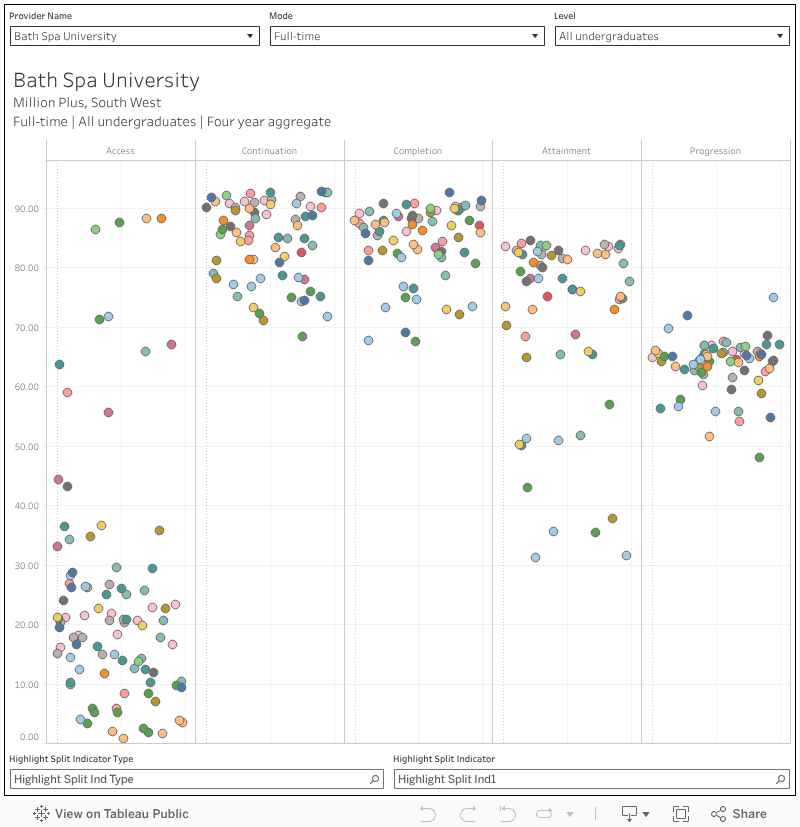
    I’ve also done a version allowing you to look at all single indicators at a provider level – which might help you to spot particular outliers that may need further analysis. Here, each mark is a split indicator (just the useful ones, I’ve omitted stuff like “POLAR quintiles 1,2,4, and 5” which is really only worth bothering with for gap analysis), you can select provider, mode, and level at the top and highlight a split group (eg “Age (broad)”) or split (eg “Mature aged 21 and over”).

    Note here that access refers to the proportion of all entrants from a given sub-group, so even though I’ve shown it on the same axis for the sake of space it shows a slightly different thing – the other lifecycle stages relate to a success (be that in continuation, progression or whatever) based on how OfS defines “success”.

    [singles provider]

    Oops upside your head

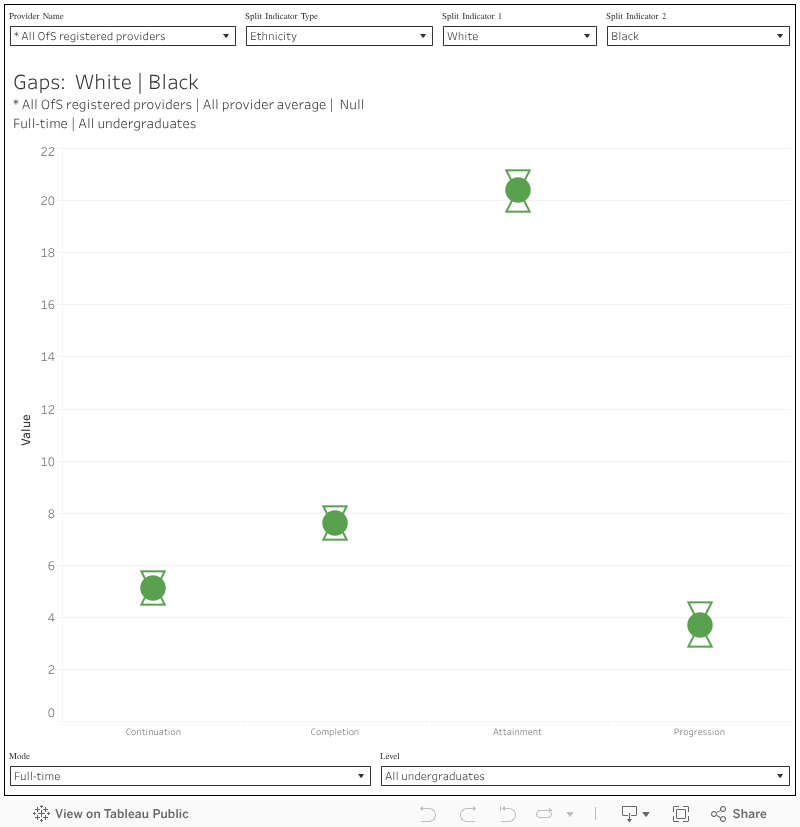
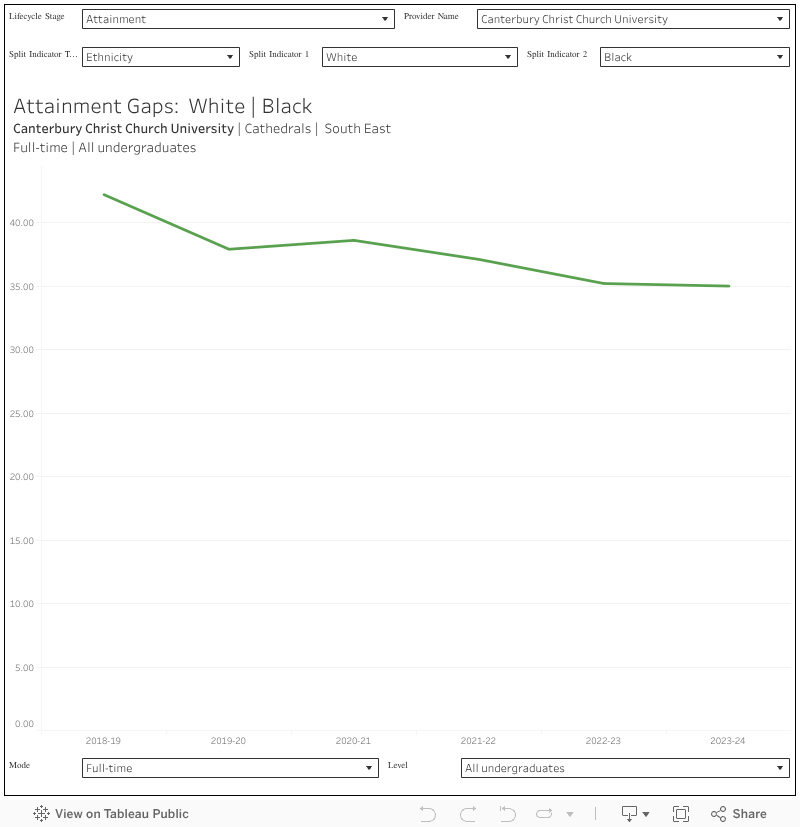
    As you’ve probably spotted from the first section, to really get things out of this data you need to compare splits with other relevant splits. We are talking, then, about gaps – on any of the lifecycle stages – between two groups of students. The classic example is the attainment gap between white and Black students, but you can have all kinds of gaps.

    This first one is across a single provider, and for the four lifecycle stages (this time, we don’t get access) you can select your indicator type and two indicators to get the gap between them (mode, and level, are at the bottom of the screen). When you set your two split, the largest or most common group tends to be on indicator 1 – that’s just the way the data is designed.

    [gaps provider]

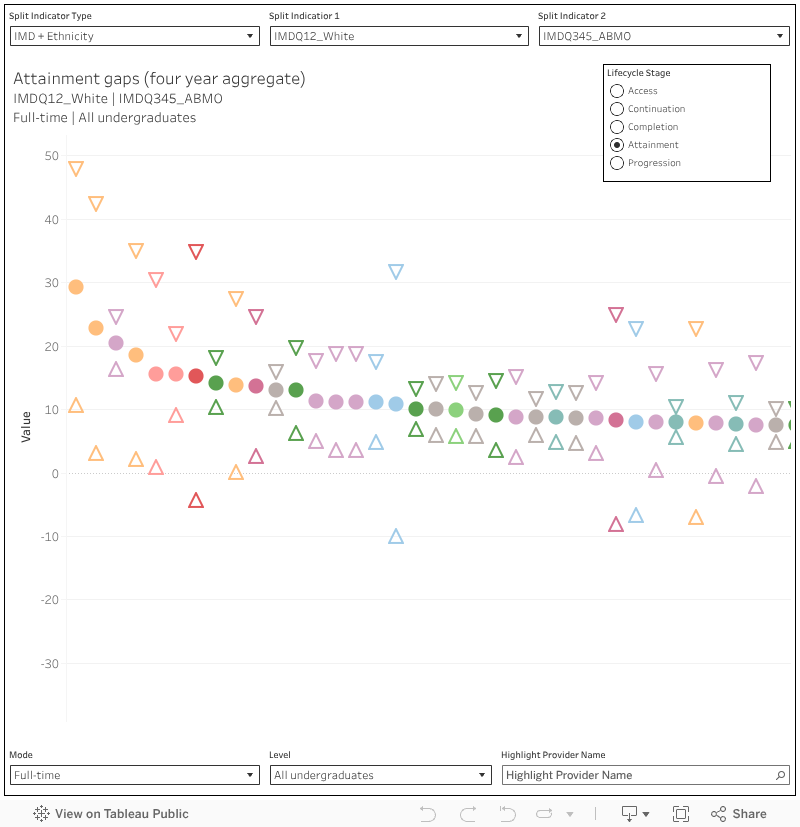
    As a quick context you can look for “*” again on the provider name filter to get sector averages, but I’ve also built a sector ranking to help you put your performance in context with similar providers.

    This is like a cross between the single ranking and the provider-level gaps analysis – you just need to set the two splits in the same way.

    [gaps rank]

    Sign o’ the times

    The four year aggregates are handy for most applications, but as you being to drill in you are going to start wondering about individual years – are things getting gradually worse or gradually better? Here I’ve plotted all the individual year data we get – which is, of course, different for each lifecycle stage (because of when data becomes available). This is at a provider level (filter on the top right) and I’ve included confidence intervals at 95 per cent in a lighter colour.

    [gaps provider timeseries]

    Source link