Over the summer, Statistics Canda put out a few papers on higher education and immigration which got zero press but nevertheless are interesting enough that I thought you might all want to hear about them. Below are my précis:
The first paper, Recent trends in immigration from Canada to the United States by Feng Hou, Milly Yang and Yao Lu, is a very general look at outbound migration to the United States, looking specifically at the characteristics of Canadian citizens who applying for labour certification in the United States in 2015 and in 2024. I found the three top-line results all somewhat surprising.
The number of US certification applicants declined by just over 25% between 2015 and 2024.
Outbound migration to the US by Canadians is predominantly a “new” Canadian thing. In 2015, Canadian citizens born outside Canada made up 54% of those seeking certification, and by 2024 that proportion had increased to nearly 60%.
Among Canadians seeking US certification in 2015, 41% had a master’s or doctoral degree. In 2024, that proportion had fallen to 31%.
In other words, brain drain to the US changed significantly over the space of a decade: fewer Canadians headed south, and among those who did, declining proportions were Canadian-born or held advance degrees. All somewhat surprising.
In the 2011-15 period, 13% of all immigrants were former international students. By the 2016-21 period, that number had risen to 23%.
About a third of immigrants who were students in Canada say their highest degree was taken outside Canada. It’s a bit difficult to parse this. It may mean, for instance, that they obtained a bachelor’s degree in Canada, went to another country for their master’s degree and came back; it may also mean that they took a master’s degree abroad and took some kind of short post-graduate certificate here.
A little over a third of all immigrants who studied in Canada have a STEM degree, a proportion that increased a tiny bit over time. This is higher than for the Canadian-born population, but not hugely different from that of immigrants who did not study here.
A little under half of all former international STEM students in the immigrant pool were working in a STEM field, but this is strongly correlated with the level of education. Among sub-Bachelor’s graduates this proportion was a little over 20%, while among those with a Master’s degree or higher it was over 50%. This is significantly higher than it is for Canadian-born post-secondary graduates. In non-STEM fields, the relationship is reversed (i.e. Canadian-born graduates are more likely to be working in an aligned field).
In other words, former international students are a rising proportion of all immigrants, a high proportion are STEM graduates, and a high proportion of them go on to work in STEM fields. All signs that policy is pushing results in the intended direction.
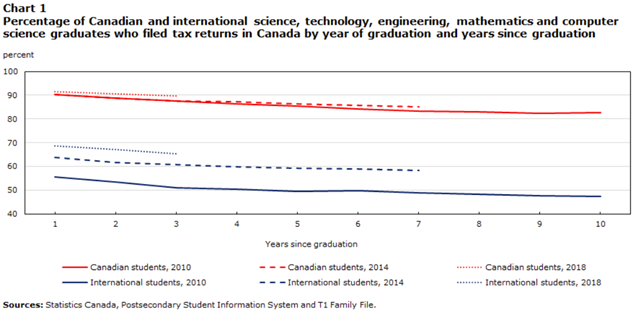
The final paper, Retention of science, technology, engineering, mathematics and computer science graduates in Canada by Youjin Choi and Feng Hou, follows three cohorts of both domestic and international student graduates to see whether they stayed in the country (technically, it measures the proportion of graduates who file tax returns in Canada, which is a pretty good proxy for residency). The results are summed up in one incredibly ugly chart (seriously, why is StatsCan dataviz so awful?), which I reproduce below:
So, in the chart the Y-axis is the percentage of STEM graduates who stay in Canada (measured by the proxy of tax filing) and the X-axis is years since graduation. Since they are following three different cohorts of graduates, the lines don’t all extend to the same length (the earliest cohort could be followed for ten years, the middle for seven and the most recent for just three). The red set of lines represents outcomes for Canadian-born students and the blue set of lines does the same for international students.
So, the trivial things this graph shows are that: i) both Canadian and international students leave Canada but ii) international students do so more frequently and iii) leaving the country is something that happens gradually over time. The interesting thing it shows, though, is that the most recent cohort (class of 2018) of STEM graduates are more likely to stay than earlier ones, and that this is especially true for international students: the retention rate of international graduates from the class of 2018 was almost fifteen percentage points higher than for the class of 2015.
Was it a more welcoming economy? Maybe. But you’d have to think that our system of offering international students a path to citizenship had something to do with it too.
Two other nuggets in the paper:
Canadian-born STEM graduates are slightly more likely to leave than non-STEM graduates (it’s not a huge difference, just a percentage point or two) while among international student graduates, those from STEM programs are substantially less likely to leave than those from non-STEM fields (a fifteen-point gap or more).
Regardless of where they are from, and regardless of what they studied, graduates from “highly-ranked” universities (no definition given, unfortunately) were more likely to leave Canada, presumably because degree prestige confers a certain degree of mobility.
You are now fully up to date on the latest data on domestic and international graduates and their immigration pathways. Enjoy your day.
Q: What is the university’s mandate behind this role? How does it help align with and advance the university’s strategic priorities?
A: Excellence in undergraduate education is essential to how Notre Dame envisions itself fulfilling its institutional mission. The digital learning project manager will contribute directly to the educational experience of our undergraduate students, working with faculty, learning designers, a media team and other project management professionals to create cutting-edge digital offerings meant to enhance Notre Dame’s signature residential learning environment.
In addition, the person in this role will manage initiatives that bring elements of Notre Dame’s academic life to learners beyond our campus. These range from online courses open to the general public to online pathway programs for current high school students exploring college opportunities and incoming first-year Notre Dame students prepping for the rigors of a university curriculum.
Q: Where does the role sit within the university structure? How will the person in this role engage with other units and leaders across campus?
A: The digital learning project manager is a member of the Office of Digital Learning, which is part of a larger unit, reporting to the Office of the Provost, called Notre Dame Learning. Housing the ODL and the Kaneb Center for Teaching Excellence, Notre Dame Learning brings together their teaching and learning expertise along with that of the Office of Information Technology’s Teaching and Learning Technologies group to serve as the hub of learning excellence and innovation at Notre Dame.
Working in the ODL will give the person in this position the chance to collaborate directly with instructors, the university’s academic departments and colleges, and colleagues across the Notre Dame Learning organization. They will work closely with the ND Learning leadership team to advance the organization’s strategic priorities.
Q: What would success look like in one year? Three years? Beyond?
A: From day one, building relationships will be paramount in this position. The Notre Dame family embodies a strong sense of community, and successful project managers on our campus are those who embrace the human component of their work, recognizing that shepherding a project from initiation to completion requires personal connection as much as it does the ability to keep a group on task. The importance of being able to understand faculty priorities and concerns, interface with administrators both internal and external to Notre Dame, and partner with colleagues across the ODL and Notre Dame Learning more generally cannot be overstated. As these relationships deepen over time, the digital learning project manager will become a go-to member of the Notre Dame Learning team and assume a larger role in driving its initiatives.
Q: What kinds of future roles would someone who took this position be prepared for?
A: Given all the different skill sets someone in this position will draw on and/or develop—e.g., project management, client/stakeholder relations, written and verbal communication, familiarity with media production and learning design processes, knowledge of higher education and organizational dynamics more broadly—it is a role that can serve as a springboard into opportunities with expanded leadership components. This might be within a unit like the Office of Digital Learning, in other areas of higher ed such as student services or information technology, or in fields outside academia altogether. Named as America’s Best Large Employer by Forbes earlier this year, Notre Dame is a great place both to work and build toward future career success.
Please get in touch if you are conducting a job search at the intersection of learning, technology and organizational change. If your gig is a good fit, featuring your gig on Featured Gigs is free.
Students link trust in higher education to affordability and financial stress to their academic performance. A new round of results from Inside Higher Ed’s Student Voice survey series, out today, delves deeper into the connection between students’ finances and their success. One key finding: Most students report some level of surprise with the full cost of attending college, including but not limited to tuition and other directly billable expenses. At least a quarter of students have trouble budgeting as a result.
In another set of findings, 36 percent of students say that an unexpected expense of $1,000, or even less (see breakdown below), could threaten their ability to stay enrolled. Another 22 percent say the same of an expense between $1,001 and $2,500. This is the kind of need that many emergency aid programs are designed for, but 64 percent of respondents don’t even know if their institution offers such assistance.
About the Survey
Student Voice is an ongoing survey and reporting series that seeks to elevate the student perspective in institutional student success efforts and in broader conversations about college.
Look out for future reporting on the main annual survey of our 2025–26 cycle, Student Voice: Amplified. Future reports will cover health and wellness, college involvement, career readiness, and more. Check out what students have already said about trust, artificial intelligence and academics.
Some 5,065 students from 260 two- and four-year institutions, public and private nonprofit, responded to this main annual survey about student success, conducted in August. Explore the data captured by our survey partner Generation Lab here and here. The margin of error is plus or minus one percentage point.
Mordecai Ian Brownlee, president of Community College of Aurora in Colorado, is walking 71 miles over three days next month to raise awareness of his own college’s emergency fund—specifically, to get community members to match a $71,000 donation. The fund started at just $8,000 during the pandemic, Brownlee said, but the college’s students frequently face unanticipated medical, utility, transportation and other costs. Without a way to bridge those gaps, their persistence is at risk. Even the standard grant of $250 can make a big difference, he said, though many of the college’s students are more chronically food- and housing-insecure.
Because need is a spectrum and many needs overlap, the college offers multiple forms of assistance and tries to build awareness of each where possible: Staff at the college food bank advertise the emergency grant fund, academic advisers act as case managers and so on. There’s also a community component: The college partners with a local nonprofit to offer students in need free groceries, and it recently got a city bus stop reinstated outside its primary campus so students wouldn’t have to spend money on rideshares, especially in the winter months.
“Previously, higher education was really seen as this transactional interaction of sorts, where you’re just focusing on delivering the learning outcomes—the wholeness and care of a person wasn’t necessarily a part of these institutional issues,” Brownlee said. “Yet if that person is in that classroom and hungry, there will be no retention, there will be no persistence, there will be no completion.”
Helping students realize social and economic mobility means addressing financial crises, food and housing insecurity, mental health and mentorship needs, and more, he added: “These are people who have a dream but may not have a network.”
Bahar Akman Imboden, managing director of the Hildreth Institute, which is focused on state-level practices and policies that enhance affordability, access and student success, said the new Student Voice findings reinforce how “lack of clarity around the true cost of attendance can derail students.” They also resonate with policy discussions in Massachusetts, where Hildreth is based, she said, as the state recently cut stipends for low-income students after the semester had started, reducing eligibility by up to $400 in some cases.
“We’ve struggled to communicate that even what may seem like a small amount can completely upend a student’s education,” Imboden said, and the new data “will be incredibly helpful in making that case to decision-makers.”
Students on Cost of Attendance, Emergency Aid and More
Here are more details about this newest round of survey results from our main annual Student Voice survey of more than 5,000 two- and four-year students.
1. Just 27 percent of students have a clear understanding of the full cost of attendance.
Asked about their grasp of the full cost of attending college, including tuition and fees but also housing, course materials, transportation, food and more, just over a quarter of students say they have a solid understanding that allows them to budget appropriately. This increases to 29 percent among students who have never seriously considered stopping out of college and decreases to 21 percent among students who have seriously considered stopping out—aligning with prior research identifying college costs as a top reason students do not persist.
The plurality of all Student Voice respondents, 47 percent, understand most costs, but not all. The remainder have less to no understanding and face various degrees of surprise about associated costs, challenging their ability to budget or pay for things they need.
2. A majority of students report that surprise costs, in some cases as little as $100, could put their enrollment at risk.
A slight plurality of students, 24 percent, say that an unforeseen cost exceeding $2,500 would challenge their ability to stay enrolled, while 19 percent say no surprise cost could threaten their persistence. But the remainder indicate that various expenses below $2,500 could push them out of college: Roughly one in five each say this of a $500 to $1,000 expense and of a $1,001 to $2,500 one. Particular differences emerge between continuing- and first-generation students, with 29 percent of the former and 46 percent of the latter indicating that amounts of $1,000 or less could challenge their ability to stay enrolled. The pattern is similar for four-year versus two-year students and for private nonprofit versus public institution students, with community college and public institution students significantly more likely than their respective counterparts to report that an unforeseen expense of $1,000 or less could threaten their persistence.
According to Trellis Strategies’ most recent Student Financial Wellness Survey, 56 percent of students would have trouble obtaining even $500 in cash or credit to meet an unexpected expense, and 68 percent have run out of money at least once since the beginning of the year. Many emergency grant programs are capped at $500 or less, but all these numbers can help local aid efforts.
3. Awareness of available aid is lacking.
Nearly two in three Student Voice respondents don’t know if their institution offers emergency aid, and just 5 percent have accessed emergency aid at their college. Just about one in 10 students each say that they know the criteria for eligibility for such aid, or that they know how to apply for it. Black (9 percent) and Hispanic students (7 percent) are somewhat more likely to have accessed such aid than white (4 percent) and Asian American and Pacific Islander students (3 percent).
A 2016 survey by NASPA: Student Affairs Administrators in Higher Education found that three in four institutions offered emergency aid of some kind, including one-time grants, loans and completion scholarships of less than $1,500 for students facing unexpected financial crises, as well as food pantries and housing and transportation assistance. The pandemic put a spotlight on student financial insecurity and brought new, if temporary, funding opportunities. Taken together, these data points suggest a large gap between available assistance and students’ awareness of it.
4. Some students are more stressed about finances than they are about academics.
Balancing academics with personal, family or financial responsibilities, including work, remains a top source of stress for students, at 50 percent, compared to 48 percent in last year’s main Student Voice survey. Some 38 percent of students also cite paying for college as a top stressor in 2025, up from last year’s 34 percent. Fewer, but still a significant share—22 percent—flag paying for personal expenses. Private nonprofit students are actually less likely than their public institution peers to say paying for college is a top stressor, at 22 percent versus 42 percent, respectively. The four-year–versus–two-year split here is narrower, at 37 percent versus 43 percent.
Some 37 percent of all students say short-term academic pressure is a top issue, while 38 percent cite job and internship searches. These are both more traditional stressors associated with college, but the latter has a clear financial dimension.
Addressing Higher Ed’s Cost Transparency Problem
Anika Van Eaton, vice president of policy at uAspire, a nonprofit dedicated to advancing economic mobility for underrepresented students, said that even financial aid offers don’t always include the full cost of attendance, citing a 2022 federal Government Accountability Office report finding that 91 percent of colleges do not provide accurate information in these letters. According to the report, colleges should include a net price that includes all key costs, subtracting only grants and scholarships—though many don’t include information on books, off-campus housing and meals, and other living expenses. Some colleges also “make their net price seem cheaper by factoring in loans that students will eventually have to repay,” the office found, while about a quarter don’t even include information on tuition and fees. Forthcoming research from uAspire suggests that colleges are improving in this area, Van Eaton said, but, ultimately, “we need standardized financial aid offers using the same terminology that show a complete cost picture so students are guaranteed to receive this crucial information up front.”
Students also need to understand college costs “beyond just seeing the numbers,” she added. One implication: High schools have an important role to play in educating and supporting soon-to-be graduates as they “navigate deciding their postsecondary plans and making what is likely one of the largest financial decisions of their lives.”
Sarah Austin, a policy analyst at the National Association of Student Financial Aid Administrators, said students tend to focus more on direct costs, or what “they actually see on their bill,” versus all the indirect costs that go along with attending college. NASFAA, which has a voluntary College Cost Transparency Initiative, seeks to promote accuracy and clarity in financial aid offers by encouraging even small shifts, such as colleges using standard terminology, “or making it clear what is loan aid versus gift aid—things like that. Because students are, in fact, not clear on what their total cost is in many situations,” Austin added.
Realistic indirect costs estimates are also crucial—and these are “are tricky for many schools to construct,” she said. Forthcoming research from NASFAA examines how institutions are calculating indirect costs and cost of attendance in general, in part to identity best practices. “Some schools have super robust cost of attendance construction processes where they’re surveying students, looking at, maybe, local data that they have access to, and putting that together every year,” Austin said. “Other schools maybe just have a set amount—they don’t review it annually, or they just blanket increase it because they know costs are going up.”
A provision in the FAFSA Simplification Act passed in 2020 allowed the Education Department to begin regulating cost of attendance, but it hasn’t exercised that power, and experts are divided on whether that is the best approach.
Congress continues to take interest in cost transparency. The Senate Health, Education, Labor and Pensions Committee last month published a request for information on ways to improve transparency to lower costs. “Americans want the most value for their hard-earned money,” wrote Senator Bill Cassidy, the committee’s Republican chair. “They are used to shopping for products where prices are clearly labeled and information on quality is readily available. But when they shop for a college—one of the biggest financial decisions of their lives—it’s much harder to compare price and value across the available options.”
Alyssa Manthi
Student Voice respondent Alyssa Manthi, a first-generation, fourth-year undergraduate studying history and religious studies at the University of Chicago, said she used to think attending a private nonprofit institution like hers was financially out of reach. That’s until a high school counselor—and her mother—pushed her to apply to a scholarship program through which she received a full ride to Chicago, including a cost-of-living stipend that Manthi said generally reflects the indirect costs of attendance.
Finances did become less predictable when Manthi was studying in Paris during her sophomore year, however. She’d had to front the payment for her plane ticket and spent much of her savings to replace a damaged computer during finals week before she left. Once abroad without a meal plan for the first time, and without a campus job, she ran out of cash with a few weeks left in the term.
Luckily, she was able to access emergency aid through the university, she recalled.
“They have it through the bursar’s office, where you can fill out an emergency aid application,” she said. “I was like, ‘Hey, I just need to be able to get food for the next two weeks before I go home,’ and I provided the proof that my laptop broke, since a lot of that was the money I was going to spend.”
Manthi said she does sometimes worry about what might happen if she needs significant additional emergency aid before she graduates, since it’s such a limited resource. Complications around costs and housing also effectively stymied her tentative plan to study abroad for another term. Still, she said she credits the university’s Odyssey Scholars cohort model and Center for College Student Success with connecting her to resources and peers who have made navigating college’s hidden financial curriculum easier. This includes information about various emergency aid resources and job listings.
“Just making sure that students have access to that information from the get-go was very helpful to me,” she said. Of her funding package generally, which includes a federal Pell Grant dollars and other institutional aid, Manthi added, “Knowing that I have that backing has relieved a lot of stress that I think I would have felt the past three years.”
Knowing that I have that backing has relieved a lot of stress that I think I would have felt the past three years.”
—Student Voice respondent Alyssa Manthi
In terms of college cost transparency, Manthi said her biggest outstanding concern is that many prospective students may not understand that private nonprofit institutions, even highly selective ones, could be financially within reach. She said she’d be paying significantly more to attend the Illinois public institution to which she was also accepted, for example.
High sticker prices that are often deeply discounted are another part of the cost transparency conversation, with some experts warning that this practice is sowing further distrust in higher education. Institutions are expensive to run, and college pricing is complex, but leaders may not recognize the extent of the public dissatisfaction of this practice, at least concerning their campus: According to Inside Higher Ed’s 2025 Survey of College and University Chief Business Officers with Hanover Research, 88 percent agreed that their own institution is transparent about the full, net cost of attendance, but just 42 percent said the same of colleges and universities as a whole.
Most CBOs also agreed their institution is sufficiently affordable. Yet more than half were at least moderately concerned about the sustainability of their institution’s tuition discount rate, with private nonprofit college and university CBOs especially concerned. About the same share were concerned about sticker price increases. And some 65 percent of all CBOs said their institution had increased institutional financial aid/grants in the last year to address affordability concerns.
One notable exception to the high-price, high-discount trend is Whitworth College, which is in the middle of a tuition reset.
“What I do wish students knew is, don’t write off the private institutions just because of the high sticker cost, because that’s what I did to start,” Manthi said. “It was just so ingrained that those places weren’t for us, or it didn’t feel like it was accessible.”
This independent editorial project is produced with the Generation Lab and supported by the Gates Foundation.
For more than 80 years, the system of higher education in the United States has partnered with the federal government to produce the best science, technology and scholarship in the world. Competing for federal research support on the basis of merit, universities have produced countless innovations and spurred enormous economic growth. The Trump administration has now proposed a “Compact for Academic Excellence in Higher Education” that threatens to destroy this partnership.
Holding hostage federal loans and grants, the “compact” is essentially a unilateral executive decree that cannot be refused. Although it sounds in high and unobjectionable ideals, it is in fact designed to undermine the traditional academic independence and freedom that have sustained the greatness of American universities. The compact should be immediately and forcefully rejected by all self-respecting institutions of higher education.
Universities and colleges have two essential missions. They serve to increase our knowledge of the world and to educate our young. Knowledge cannot be increased if it is assessed by political criteria, as distinguished from standards of intellectual merit. But the compact requires that institutions of higher education abolish “institutional units that … belittle … conservative ideas.” What exactly counts as conservative is unstated and left in the control of the administration. The compact seeks to supplant intellectual competence with explicitly political criteria, to be determined by a political agency. This demand violates not only academic freedom, but also free speech. It imposes government orthodoxy on private entities.
The compact demands that universities offer empirical verification that each institutional field, department and unit represent a “broad spectrum of viewpoints.” It thus invites government to overrule scientific consensus on the range of acceptable inquiry. Most colleges of environmental sciences, for example, teach that global climate change is accelerated by human conduct. But Trump himself, speaking before the United Nations, branded this view the “greatest con job.” Most medical schools teach that vaccines are important to health. But Trump’s secretary of health and human services “has been crusading against vaccines for decades.” Under the compact, government might insist that every biology department house a vaccine denier, or that every environmental science program contain a climate change skeptic. Political control of this kind would quickly degrade the intellectual integrity of university scholarship.
Early in the 20th century, American universities were managed by laypersons who attempted to censor and control the scholarship of professors. But in 1915, the newly established American Association of University Professors defined and defended academic freedom in the canonical Declaration of Principles on Academic Freedom and Academic Tenure. The declaration set forth principles that are now enshrined in contracts at virtually every American college and university. These principles protect academic freedom, which rests on the axiom that scholarly excellence is to be determined by academic rather than political standards. Trump’s proposed compact wantonly violates this essential principle, even as it purports to protect academic freedom.
The declaration also makes clear the educational goal of American colleges and universities, which is to equip students to think for themselves. The compact, in contrast, requires universities to suppress “support for entities designated by the U.S. Government as terrorist organizations.” Government may of course create such designations, but unfortunately they may also be problematic, overbroad or erroneous. Students and professors should be allowed to criticize such errors, but the compact would prevent this. It would require American colleges and universities to become instruments of official thought control. This is what happened in the United States during World War I, when professors were fired for opposing the war. We have spent a century repenting those mistakes, and now the Trump administration demands that we repeat them.
Some provisions in the compact are unobjectionable because they merely restate existing law. The Supreme Court has outlawed the use of race in admissions. Congress has laid out procedures for enforcing antidiscrimination law under Title VI and Title IX. These tools are adequate to enforce the law. But the compact has a larger goal: It seeks to break the independence of American higher education, an independence that has fueled the ascent of American colleges and universities to greatness. The compact goes far beyond the Supreme Court’s ruling on affirmative action to require that all admissions decisions “be based upon and evaluated against objective criteria.” It also requires “grade integrity,” freezing tuition rates for five years, disclosure of postgraduate earnings and free tuition for students in the hard sciences at universities with large endowments. It limits the percentage of foreign students and requires screening for anti-American bias.
The diversity of American institutions of higher education is commonly understood to be a source of its enormous strength. Competing against each other for students, American colleges and universities admit students based on their own distinct and legal criteria. But the administration seeks to end that heterogeneity. For many institutions what matters is the creativity of a student’s essay, the qualitative assessment of recommendations and the resilience of an applicant’s personality as revealed in a résumé. The administration would have universities ignore all that. It would turn our colleges and universities into drab, bureaucratic and uniform institutions, under the shadow of the continuous threat of government interference.
Under the compact, universities also must commit to institutional neutrality, the idea that university leaders and departments will not officially comment on social and political issues of the day that do not affect the university. This is an ideal embodied in the 1967 Kalven report at the University of Chicago, but its adoption and interpretation is a very local matter, and it should not be required as a condition for receipt of federal funds.
Institutional neutrality is important because it protects the maximum freedom of students and faculty to vigorously inquire, without battling the pall of official ideas. But some institutions might have specific missions that they deem essential. For example, a religious institution of higher learning might have a certain set of principles that require leaders to speak out. If government gets to decide what counts as a social or political issue, a medical school might not be able to opine on the safety of vaccines, an environmental department on the impacts of climate change or a law school on violations of the rule of law. Of course, universities may choose not to opine on these matters, but for the administration to impose this silence is truly inimical to a marketplace of ideas.
The compact insists that universities “commit to defining” gender roles “according to reproductive function and biological processes.” Gender troubles certainly abound in universities, and prior administrations may have contributed to these difficulties. But these quandaries are for universities to settle. The diversity of approaches taken by American colleges and universities is our greatest strength. The compact unaccountably seeks to impose its own ideology on all institutions of higher education. It seeks to replace a pluralist market with a single orientation set by Washington, D.C.
The architect of America’s public-private research partnership, Vannevar Bush, asserted that “scientific progress” required “the free play of free intellects, working on subjects of their own choice, in the manner dictated by their curiosity for exploration of the unknown.” The Trump administration would do well to recognize that a genuine marketplace of ideas requires academic freedom for scholars and a competitive environment for institutions.
For the administration to attempt to use federal funds to force colleges and universities to toe a conservative line is to create what our constitutional law calls unconstitutional conditions. No university that is committed to independently searching for the truth, or to producing students who can think for themselves, should submit to the deliberate and possibly illegal humiliations contained in the compact. Institutions that do so may very well cease being universities in the full sense of the term. They should just say no.
Robert Post is the Sterling Professor of Law at Yale Law School, where he served as dean from 2009 to 2017. His research specialties include issues of free speech and academic freedom.
Tom Ginsburg is the Leo Spitz Distinguished Service Professor of International Law at the University of Chicago Law School and director of Chicago’s Forum for Free Inquiry and Expression.
Employees who had the messages put on their accounts told Inside Higher Ed that it was “wild to see your name attached to a message that you had nothing to do with.”
J. David Ake/Getty Images
The American Federation of Government Employees, a union representing federal workers, sued the Trump administration Friday, challenging the automated out-of-office email responses it placed on many employees’ email accounts when the government shut down.
The message, which was placed on the email accounts of all furloughed staff members without their consent, blamed Democrats in the Senate for causing the shutdown.
AFGE’s members, who will be represented by the legal firms Democracy Forward and Public Citizen Litigation Group, argue in the complaint that the message Trump attached to their email accounts is “partisan political rhetoric.” Not only does it violate the Hatch Act, a federal law that requires nonappointed government staff to stay nonpartisan, but it also violates the First Amendment rights of the individual employees, they argue.
“The Trump-Vance administration is losing the blame game for the shutdown, so they’re using every tactic to try to fool the American people, including taking advantage of furloughed civil servants,” Skye Perryman, president of Democracy Forward, said in a news release. “Even for an administration that has repeatedly demonstrated a complete lack of respect for the Constitution and rule of law, this is beyond outrageous. The court must act immediately to stop this flagrant unlawfulness.”
Walk into almost any office on a campus right now and you’ll hear the same thing: “We’re experimenting with AI.” Someone is drafting social posts in ChatGPT. Someone else is piloting a chatbot for admissions FAQs. Another is tinkering with predictive models in the CRM.
These efforts are well intentioned, but nearly three years into the ready availability of generative AI tools, higher ed needs to understand that dabbling isn’t enough anymore.
Higher education is under immense pressure. From the demographic cliff to the search cliff, the drop in international enrollment to the decline in the public perception of higher education, our industry is fraught with challenges. When we combine these challenges with the escalating expectations from students and families and the “experience economy,” we’re setting ourselves up to fall dangerously behind.
AI can be part of the solution to those challenges. But if we limit ourselves to scattered experiments, we risk wasting resources and missing the opportunity to use AI as a true strategic advantage.
The Risks of Dabbling
When AI adoption is fragmented, several challenges emerge:
Duplicated work and tool sprawl. Different units adopt different tools, leading to confusion, inconsistent data and hidden costs.
Inconsistent brand voice. Without shared guidelines, AI-generated content can erode the consistency of a university’s storytelling.
Ethical blind spots. Dabbling often means no governance. Sensitive student data can inadvertently end up in AI tools.
Staff frustration. When AI feels like extra work instead of a supportive tool, teams become skeptical. That makes adoption harder later.
Lost momentum. When experiments aren’t connected to measurable outcomes, leadership may conclude that AI “doesn’t work here.”
The paradox is this: Dabbling may feel safer, but it is actually riskier than intentional adoption.
What Intentional Adoption Looks Like
Intentional adoption doesn’t mean rushing into automation or replacing staff. It means aligning AI with institutional goals, building literacy across teams, creating ethical guardrails and sharing results transparently.
Take admissions chatbots. Many institutions piloted them to handle high-volume FAQs. Some fizzled out because there was no plan for training, governance or integrating insights back into the enrollment strategy. But at campuses where chatbots were tied to yield goals, tested with student input and connected to human follow-up, they became powerful tools for reducing melt and increasing student satisfaction.
Or consider content creation. I’ve seen marketing teams use AI to repurpose one student story into dozens of assets, like email copy, Instagram posts, video scripts. When done thoughtfully, this allowed teams to do more with the same staff, freeing time for higher-level strategy. When done haphazardly, it can lead to a flood of off-brand content that students recognize as AI, eroding trust.
A Framework for Readiness
So how can institutions move from dabbling to adopting? One approach I use with teams is the AI Maturity Matrix.
The matrix evaluates readiness across six dimensions—vision, leadership support, skills, governance, collaboration, and technology—and places organizations on a five-stage curve:
Nascent: AI is barely leveraged, or individual experiments happen in silos.
Developing: Small pilots exist but aren’t connected to strategy.
Scaling: Multiple projects are coordinated and tied to goals.
Optimized: AI is part of daily workflows, with governance and training in place.
Transformational: AI is a true differentiator, fueling innovation and efficiency across the institution.
Most higher ed teams that I speak with fall in the second and third categories. They are experimenting and maybe scaling, but without the governance or strategy to optimize. The matrix helps teams see their starting point clearly and, more importantly, identify what it will take to get to the next stage.
The key is not to leap from nascent to transformational overnight, but instead move steadily, stage by stage, building capacity along the way.
A Call to Action for Higher Ed Leaders
The issue isn’t whether higher education will use AI; it’s whether we’ll use it well.
If you’re leading a team, here are three questions to start with:
Do we know where we stand on the AI maturity curve?
Are our current experiments connected to our overarching goals?
What’s one step we could take in the next 30 days to build intentional capacity?
These questions are urgent. Students are already comparing their campus experience to the seamless, personalized interactions they get from Amazon, Spotify or Netflix. Faculty and staff are already using AI tools in their personal lives, whether institutions acknowledge it or not. The longer we leave AI adoption uncoordinated, the greater the gap grows between what higher ed delivers and what students expect.
I still hear from people who believe AI is a passing fad. Meanwhile, the world around us is shifting in significant ways that have the potential to leave us far behind. Institutions must approach their AI adoption with clarity and intentionality. Those that treat it as a novelty risk being left behind.
The time for dabbling is over. The time for intentional adoption is now.
Jaime Hunt is president of Solve Higher Ed and an adjunct faculty member at West Virginia University teaching courses in higher ed marketing and emerging media.
This HEPI blog was kindly authored by Professor Julie Mennell, Vice-Chancellor of the University of Cumbria, and Martin Williams, Chair of the University of Cumbria.
Barrow-in-Furness, now in the county of Westmorland and Furness, exemplifies the Government’s approach to stimulating regeneration and growth. Considerable public money is being committed, and the University of Cumbria, as the local university, is deeply involved. We are proud of what we and others are trying to do and confidently expect that many benefits will result. But our involvement also reminds us how national systems, such as student financial support, cannot currently flex to support a nationally-mandated priority – and makes us wonder whether it is time for a little experimentation.
The Government’s reasons for focusing on Barrow are clear. Undoubtedly the town is in need of regeneration; its current health and education outcomes make depressing reading. However, Barrow is also the only place in the country where BAE Systems manufactures the nuclear-powered submarines, which are crucial to Britain’s national and global defence strategy. With a volatile international situation, these craft are in demand, and the order books at the Barrow shipyard are full for decades to come. Constructing nuclear submarines is a highly technical, labour-intensive business, and the company and its suppliers urgently need to grow and upskill their workforces. However, the local Furness population is ageing, and for decades, employers there have struggled to attract and retain skilled workers. To grow, Barrow has to improve its ‘liveability’ – in other words, a big regeneration effort.
Because the submarine programme is a national priority, Government has been prepared to intervene directly to support this goal. It has invested £220 million, coordinated by a Board chaired by a former Cabinet Secretary. Their recently published 10 Year Plan recognises the interconnectedness of what needs to happen, covering health, transport, education, skills, housing, environment and leisure. It is ambitious, but not unrealistic, given the underpinning demand from a large, profitable company and its associated supply chains. The Government’s recent Defence Industrial Strategy document quotes Team Barrow as a model on which to build.
The University of Cumbria has been deeply involved in the development of this Plan. We sit on the Team Barrow Delivery Board and will contribute to everything the Plan seeks to achieve. We are already BAE Systems’ main supplier of project managers, via degree apprenticeships. We train the nurses and healthcare workers that the town will need, and from this year, our new Medical School means we can provide a wider range of practitioners. We can produce the teachers to improve the schools, and the artists and environmental scientists to enhance Furness’s natural and cultural landscapes.
We can and will do more. This month the University opens a new campus, supported by Town Deal money, right next to the shipyard on Barrow Island. With BAE Systems, we are now creating new courses based there in mechanical engineering and computer science. There will be a new Doctoral Training Centre and Innovation Hub to develop and test potentially viable new products and processes and to attract more PhD-level skills into Furness. There is potential for even closer working with the local FE Colleges. We are investing, and we want to invest, and the public purse is supporting that investment.
But this is the supply side. Will it be enough to attract students and researchers at the speed and in the numbers that are wanted?
In a demand-led higher education system, this is primarily a matter for universities. We have to convince students to enrol. If they don’t come, our income will be directly affected. The onus is on us to sell our offerings, and on potential employers to give extra support to students if they think that is worthwhile.
Fair enough, but should that be the whole story in this case? The courses are being created in response to a Government goal. The faster the recruitment to these courses, the quicker the effect on the supply of local skills. We know there are barriers to overcome. It isn’t accidental that Barrow is currently a higher education cold spot. A lot of Barrovians come from families that believe university courses are not for them. BAE Systems are offering generous scholarships and paid placements for local students, but mindsets don’t change quickly. And how many people from outside the region will instinctively encourage their children or friends to consider a course in Barrow in Furness, offered by the University of Cumbria? Barrow is a remote and superficially not very attractive town. The University of Cumbria isn’t in ‘the Russell Group’. A new course, by definition, won’t appear in the Times league tables and won’t yet have employment outcomes (although as a university, we rank top in Northwest England on this measure). We believe they will be good quality courses, offering excellent prospects in the jobs market, but it will take time to establish their reputation.
The whole rationale behind the Barrow Rising programme is that Government intervention is needed if Barrow is to become what the country needs it to be. However, the Government’s Higher Education funding system offers no incentives for students to overcome their possible preconceptions. There is a ‘level playing field’ of student choice; any course, anywhere, attracts the same support. 12 years of this model has demonstrated its results. Students tend to play safe and favour longer-established, higher-prestige institutions. A perfectly sensible approach for them to take. But might the public interest right now be better served by a playing field that could be tilted slightly in favour of, for example, engineering courses in Barrow?
Fiddling with funding systems is tricky and prone to unintended consequences. Nevertheless, Barrow is a small place, of particular interest to Government and facing some particular challenges. It would surely be useful to the Government to know whether targeted financial incentives, nudging students towards strategically important courses in particular places, made a difference to behaviours. If successful, the approach could be applied to a few other selected priority areas or courses.
This would be a new step, but this Government has signalled it wants to think imaginatively in support of growth. With a higher education policy document expected in the autumn, is there space to experiment with a more strategic use of a tiny piece of the huge student finance budget?
High school history teacher Antoine Stroman says he wants his students to ask “the hard questions” — about slavery, Jim Crow, the murder of George Floyd and other painful episodes that have shaped the United States.
Now, Stroman worries that President Donald Trump’s push for “patriotic education” could complicate the direct, factual way he teaches such events. Last month, the president announced a plan to present American history that emphasizes “a unifying and uplifting portrayal of the nation’s founding ideals,” and inspires “a love of country.”
Stroman does not believe students at the magnet high school where he teaches in Philadelphia will buy this version, nor do many of the teachers I’ve spoken with. They say they are committed to honest accounts of the shameful events and painful eras that mark our nation’s history.
“As a teacher, you have to have some conversations about teaching slavery. It ishard,”Stroman told me. “Teaching the Holocaust is hard. I can’tnotteach something because it is hurtful. My students will come in and ask questions, and you really have to make up your mind to say, ‘I can’t rain dance around this.’”
Related: Become a lifelong learner. Subscribe to our free weekly newsletter featuring the most important stories in education.
These are tense times for educators: In recent weeks, dozens of teachers and college professors have been fired or placed under investigation for social media posts about their views of slain 31-year-old conservative activist Charlie Kirk, ushering in a slew of lawsuits and legal challenges.
In Indiana, a portal called Eyes on Education encourages parents of school children, students and educators to submit “real examples” of objectionable curricula, policies or programs. And nearly 250 state, federal and local entities have introduced bills and other policies that restrict the content of teaching and trainings related to race and sex in public school. Supporters of these laws say discussion of such topics can leave students feeling inferior or superior based on race, gender or ethnicity; they believe parents, not schools, should teach students about political doctrine.
“It has become very difficult to navigate,” said Jacob Maddaus, who teaches high school and college history in Maine and regularly participates in workshops on civics and the Constitution, including programs funded by the Sandra Day O’Connor Institute. Almost 80 percent of teachers surveyed recently by the institute say they have “self-censored” in class due to fear of pushback or controversy. They also reported feeling underprepared, unsupported and increasingly afraid to teach vital material.
After Kirk’s death Trump launched a new “civics education coalition,” aimed at “renewing patriotism, strengthening civic knowledge, and advancing a shared understanding of America’s founding principles in schools across the nation.” The coalition is made up made up almost entirely of conservative groups,including Kirk’sTurning Point USA, whose chief education officer, Hutz Hertzberg, said in a statement announcing the effort that he “is more resolved than ever to advance God-centered, virtuous education for students.”
So far, no specific guidelines have emerged: Emails to the Department of Education — sent after the government shut down — were not returned.
Some students, concerned about the shifting historical narratives, have taken steps to help preserve and expand their peers’ access to civics instruction. Among them is Mariya Tinch, an 18-year-old high school senior from rural North Carolina. “Trump’s goal of teaching ‘patriotic’ education is actually what made me start developing my app, called Revolve Justice, to help young students who didn’t have access to proper civic education get access to policies and form their own political opinions instead of having them decided for them,” she told me.
Growing up in a predominantly white area, Tinch said, “caused civic education to be more polarized in my life than I would like as a young Black girl. A lot of my knowledge in regard to civic education came from outside research after teachers were unable to fully answer my questions about the depth of the issues that we are taught to ignore.”
Mariya Tinch, a high school senior in North Carolina, at the 2025 Ready, Set, App! competition (second from left). She developed an app to help students get access to policies and form their own political opinions. Credit: Courtesy of Mariya Tinch
Other students are upset about federal cuts to history education programs, including National History Day, a 50-year-old nonprofit that runs a history competition for some 500,000 students who engage in original historic research and provides teachers with resources and training. Youth groups are now forming as well, including Voters of Tomorrow, which has a goal of building youth political power by “engaging,educating, and empowering our peers.”
There will surely be more attention focused on the founders’ original ideals for America as we approach the 250th anniversary of the signing of the Declaration of Independence this July. Some teachers and groups that support civics teachers are creating resources, including the nonprofit iCivics, with its “We can teach hard things — and we should” guidelines.
How all of these different messages resonate with students remains to be seen. In the meantime, Jessica Ellison, executive director of the nonprofit National Council for History Education is fielding a lot of questions from history teachers and giving them specific advice.
“They might be anxious about any teaching that could get them on social media or reported by a student or parent,” Ellison told me, noting the strategy she shares with teachers is to focus on “the three S’s –— sources, state standards and student questions.”
Ellison also encourages teachers to “lean into the work of historians. Read the original sources, the primary sources, the secession documents from Mississippi and put them in front of students. If it is direct from the source you cannot argue with it.”
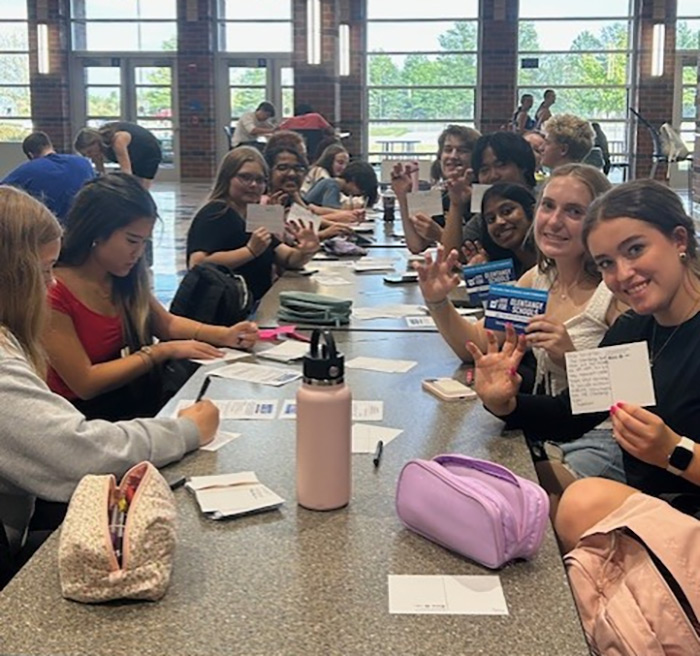
In September, students at Berlin High School in Delaware, Ohio, participated in a sign creation and postcard campaign for a levy on the ballot. Credit: Courtesy Michael LaFlamme
Michael LaFlamme has his own methods: He teaches Advanced Placement government and U.S. history at Olentangy Berlin High School outside of Columbus, Ohio, where many of his students work the polls during elections to see up close how voting works. They learn about civics via a participatory political science project that asks students to write a letter to an elected official. He also encourages students to watch debates or political or Sunday morning news shows with a parent or grandparent, and attend a school board meeting.
“There is so much good learning to be done around current events,” LaFlamme told me, noting that “it becomes more about community and experience. We are looking at all of it as political scientists.”
For Maddaus, the teacher in Maine, there is yet another obstacle: How his students consume news reinforces the enormous obstacles he and other teachers face to keep them informed and thinking critically. Earlier this fall, he heard some of his students talking about a rumor they’d heard over the weekend.
“Mr. Maddaus, is it true? Is President Donald Trump dead?” they asked.
Maddaus immediately wanted to know how they got this false news.
“We saw it on TikTok,” one of the students replied — not a surprising answer, perhaps, given that 4 out of 10 young adults get their news from the platform.
Maddaus says he shook his head, corrected the record and then went back to his regularly scheduled history lesson.
The Hechinger Report provides in-depth, fact-based, unbiased reporting on education that is free to all readers. But that doesn’t mean it’s free to produce. Our work keeps educators and the public informed about pressing issues at schools and on campuses throughout the country. We tell the whole story, even when the details are inconvenient. Help us keep doing that.
On the face of it, I can understand why the REF team have pressed pause on their guidance development for 2029.
The sector is in serious financial difficulties, and while most are keen to see a greater focus on People, Culture and Environment (PCE), the challenges experienced by pilot institutions with the proposed assessment mechanism were real.
We cannot get away from this.
But of course, where there’s a vacuum, people will rush to fill it with their own pet peeves and theories, up to and including a full reversion to the rules of REF 2021.
PCE and EDI
One of the biggest fallacies being promoted is this view that PCE is what Iain Mansfield, Director of Research at the Policy Exchange Thinktank, and former Special Adviser, called “a euphemism for Equity Diversity and Inclusion (EDI)”. This conflation of REF PCE with EDI is entirely false. In fact, the PCE pilot included five different enablers of research culture, only one of which related to inclusivity. Of the others (strategy, responsibility, connectivity, and development) two were already themes in REF 2021 Environment Statements (strategy and collaboration) so not exactly a dramatic shift in a whole new direction.
Indeed, the Code of Practice and Environment elements of REF 2021 already placed a significant focus on EDI. Equality Impact Assessments had to be performed at every stage of the submission, EDI training for REF decision-makers was an essential requirement for even submitting to the REF, and both institution- and unit-level environment statements demanded narratives as to how equality and diversity in research careers were promoted across the institution. So anyone seeking a reversion to REF 2021 rules in order to eliminate a focus on EDI is going to be deeply disappointed.
Perhaps the biggest disappointment about this attempt to row back on any deeper focus on research culture in the next REF is that having a thriving research culture is an integral part of any definition of research excellence, whilst being perhaps the second biggest challenge facing the sustainability of the research sector after funding. The Wellcome Trust report, and the Nuffield report that preceded it, taught us that poor incentives, highly competitive & toxic environments, precarious research careers, and unmanageable workloads, are leading to questionable research practices, increased retractions, a loss of talent and reduced trust in science. And all this at a time when we really need more talent and greater trust in science. It wasn’t that long ago that this all led to a Government R&D Culture Strategy making a clear case for better investment in research culture for the benefit of society, but still, in the recent DSIT survey of the UK Research & Development workforce, only 52 per cent of higher education respondents said the culture of their organisation enabled them to perform their best work, compared to 85 per cent in the private sector.
The point of adding greater weight, and a clearer assessment mechanism, to a broader range of culture elements in the next REF was thus to address exactly these issues. As a reminder, the international advisory group for the next REF recommended a split of 33:33:33 for PCE, outputs and impact. Reducing the weight allocated to PCE would not only reduce the attention given to promoting positive research cultures, but actually increase the weighting allocated to the element of REF that is most responsible for driving poor research cultures: publications. We know that the publish-or-perish culture is causing significant problems across the sector. Re-calibrating the assessment to put greater weight on publications would run counter to the Coalition for Advancing Research Assessment’s first commitment: to recognise the diversity of contributions to research.
Outputs
I do think the pause in REF is an opportunity to think about how we recognise, incentivise and reward the better research cultures we clearly need. I’ve written before about how many elements of our research culture are essentially hygiene factors and as such should not attract gold stars, but be established as a basic condition of funding. There is also an opportunity to supply culture-related data (e.g., research misconduct reporting, and research staff pay gaps) alongside the other environment data already supplied to support REF-decision making. This could be formative in and of itself, as could the use of case studies (a tested REF assessment technology) by which HEIs report on their research culture interventions.
Whatever is decided, no-one working in a research-intensive institution can deny the power of the additional weight allocated to PCE in REF 2029. The knowledge that 25 per cent of the next exercise will be allocated to not just E, but P and C, has naturally been a lever staff have pulled to get culture issues up the agenda. And we’ve seen significant improvements: policy changes, new initiatives, and culture indicators moving in a good direction. So whilst it might feel like an easier move to simply revert back to the rules of REF 2021, there is an opportunity cost to this. A lot has already been invested in preparing institutions for a greater focus on research culture, and more will need to be invested in reverting back to the rules for REF 2021.
Because of the REF’s direct link both to (unhypothecated) gold and (international) glory, nothing really motivates universities more. To row back on efforts to recognise, incentivise, and reward the thriving research cultures that are at the very heart of any ‘excellent’ research institution therefore makes little sense. And it makes even less sense when financial constraints are putting those environments under even more pressure, making it more important than ever that we put people first. Can we do it in a more sensitive and manageable way? Yes, of course. Should we ditch it and run for the cover of REF 2021 rules? Absolutely not.
One of the basic expectations of a system of regulation is consistency.
It shouldn’t matter how prestigious you are, how rich you are, or how long you’ve been operating: if you are active in a regulated market then the same rules should apply to all.
Regulatory overreach can happen when there is public outrage over elements of what is happening in that particular market. The pressure a government feels to “do something” can override processes and requirements – attempting to reach the “right” (political or PR) answer rather than the “correct” (according to the rules) one.
So when courses at Oxford Business College were de-designated by the Secretary of State for Education, there’s more to the tale than a provider where legitimate questions had been raised about the student experience getting just desserts. It is a cautionary tale, involving a fascinating high-court judgment and some interesting arguments about the limits of ministerial power, of what happens when political will gets ahead of regulatory processes.
Business matters
A splash in The Sunday Times back in the spring concerned the quality of franchised provision from – as it turned out – four Office for Students registered providers taught at Oxford Business College. The story came alongside tough language from Secretary of State for Education Bridget Phillipson:
I know people across this country, across the world, feel a fierce pride for our universities. I do too. That’s why I am so outraged by these reports, and why I am acting so swiftly and so strongly today to put this right.
And she was in no way alone in feeling that way. Let’s remind ourselves, the allegations made in The Sunday Times were dreadful. Four million pounds in fraudulent loans. Fake students, and students with no apparent interest in studying. Non-existent entry criteria. And, as we shall see, that’s not even as bad as the allegations got.
De-designation – removing the eligibility of students at a provider to apply for SLC fee or maintenance loans – is one of the few levers government has to address “low quality” provision at an unregistered provider. Designation comes automatically when a course is franchised from a registered provider: a loophole in the regulatory framework that has caused concern over a number of years. Technically an awarding provider is responsible for maintaining academic quality and standards for its students studying elsewhere.
The Office for Students didn’t have any regulatory jurisdiction other than pursuing the awarding institutions. OBC had, in fact, tried to register with OfS – withdrawing the application in the teeth of the media firestorm at the end of March.
So everything depended on the Department for Education overturning precedent.
Ministering
It is “one of the biggest financial scandals universities have faced.” That’s what Bridget Phillipson said when presented with The Sunday Times’ findings. She announced that the Public Sector Fraud Authority would coordinate immediate action, and promised to empower the Office for Students to act in such cases.
In fact, OBC was already under investigation by the Government Internal Audit Agency (GIAA) and had been since 2024. DfE had been notified by the Student Loans Company about trends in the data and other information that might indicate fraud at various points between November 2023 and February 2024 – notifications that we now know were summarised as a report detailing the concerns which was sent to DfE in January 2024. The eventual High Court judgement (the details of which we will get to shortly) outlined just a few of these allegations, which I take from from the court documents:
Students enrolled in the Business Management BA (Hons) course did not have basic English language skills.
Less than 50 per cent of students enrolled in the London campus participate, and the remainder instead pay staff to record them as in attendance.
Students have had bank details altered or new bank accounts opened in their name, to which their maintenance payments were redirected.
Staff are encouraging fraud through fake documents sent to SLC, fake diplomas, and fake references. Staff are charging students to draft their UCAS applications and personal statements. Senior staff are aware of this and are uninterested.
Students attending OBC do not live in the country. In one instance, a dead student was kept on the attendance list.
Students were receiving threats from agents demanding money and, if the students complained, their complaints were often dealt with by those same agents threatening the students.
Remote utilities were being used for English language tests where computers were controlled remotely to respond to the questions on behalf of prospective students.
At the Nottingham campus, employees and others were demanding money from students for assignments and to mark their attendance to avoid being kicked off their course.
At the instigation of DfE, and with the cooperation of OBC, GIAA started its investigation on 19 September 2024, continuing to request information from and correspond with the college until 17 January 2025. An “interim report” detailing emerging findings went to DfE on 17 December 2024; the final report arrived on 30 January 2025. The final report made numerous recommendations about OBC processes and policies, but did not recommend de-designation. That recommendation came in a ministerial submission, prepared by civil servants, dated 18 March 2025.
Process story
OBC didn’t get sight of these reports until 20 March 2025, after the decisions were made. It got summaries of both the interim and final reports in a letter from DfE notifying it that Phillipson was “minded to” de-designate. The documentation tells us that GIAA reported that OBC had:
recruited students without the required experience and qualifications to successfully complete their courses
failed to ensure students met the English language proficiency as set out in OBC and lead provider policies
failed to ensure attendance is managed effectively
failed to withdraw or suspend students that fell below the required thresholds for performance and/or engagement;
failed to provide evidence that immigration documents, where required, are being adequately verified.
The college had 14 days to respond to the summary and provide factual comment for consideration, during which period The Sunday Times published its story. OBC asked DfE for the underlying material that informed the findings and the subsequent decision, and for an extension (it didn’t get all the material, but it got a further five days) – and it submitted 68 pages of argument and evidence to DfE, on 7 April 2025. Another departmental ministerial submission (on 16 April 2025) recommended that the Secretary of State confirm the decision to de-designate.
According to the OBC legal team, these emerging findings were not backed up by the full GIAA reports, and there were concerns about the way a small student sample had been used to generalise across an entire college. Most concerningly, the reports as eventually shared with the college did not support de-designation (though they supported a number of other concerns about OBC and its admission process). This was supported by a note from GIAA regarding OBC’s submission, which – although conceding that aspects of the report could have been expressed more clearly – concluded:
The majority of the issues raised relate to interpretation rather than factual accuracy. Crucially, we are satisfied that none of the concerns identified have a material impact on our findings, conclusions or overall assessment.
Phillipson’s decision to de-designate was sent to the college on 17 April 2025, and it was published as a Written Ministerial Statement. Importantly, in her letter, she noted that:
The Secretary of State’s decisions have not been made solely on the basis of whether or not fraud has been detected. She has also addressed the issue of whether, on the balance of probabilities, the College has delivered these courses, particularly as regards the recruitment of students and the management of attendance, in such a way that gives her adequate assurance that the substantial amounts of public money it has received in respect of student fees, via its partners, have been managed to the standards she is entitled to expect.
Appeal
Oxford Business College appealed the Secretary of State’s decision. Four grounds of challenge were pursued with:
Ground 3: the Secretary of State had stepped beyond her powers in prohibiting OBC from receiving public funds from providing new franchised courses in the future.
Ground 1: the decision was procedurally unfair, with key materials used by the Secretary of State in making the decision not provided to the college, and the college never being told the criteria it was being assessed against
Ground 4: By de-designating courses, DfE breached OBCs rights under Article 1 of the First Protocol to the European Convention on Human Rights (to peaceful enjoyment of its possessions – in this case the courses themselves)
Ground 7: The decision by the Secretary of State had breached the public sector equality duty
Of these, ground 3 was not determined, as the Secretary of State had clarified that no decision had been taken regarding future courses delivered by OBC. Ground 4 was deemed to be a “controversial” point of law regarding whether a course and its designation status could be a “possession” under ECHR, but could be proceeded with at a later date. Ground 7 was not decided.
Ground 1 succeeded. The court found that OBC had been subject to an unfair process, where:
OBC was prejudiced in its ability to understand and respond to the matters of the subject of investigation, including as to the appropriate sanction, and to understand the reasons for the decision.
Judgement
OBC itself, or the lawyers it engaged, have perhaps unwisely decided to put the judgement into the public domain – it has yet to be formally published. I say unwisely, because it also puts the initial allegations into the public domain and does not detail any meaningful rebuttal from the college – though The Telegraph has reported that the college now plans to sue the Secretary of State for “tens of millions of pounds.”
The win, such as it is, was entirely procedural. The Secretary of State should have shared more detail of the findings of the GIAA investigation (at both “emerging” and “final” stages) in order that the college could make its own investigations and dispute any points of fact.
Much of the judgement deals with the criteria by which a sample of 200 students were selected – OBC was not made aware that this was a sample comprising those “giving the greatest cause for suspicion” rather than a random sample, and the inability of OBC to identify students whose circumstances or behaviour were mentioned in the report. These were omissions, but nowhere is it argued by OBC that these were not real students with real experiences.
Where allegations are made that students might be being threatened by agents and institutional staff, it is perhaps understandable that identifying details might be redacted – though DfE cited the “”pressure resulting from the attenuated timetable following the order for expedition, the evidence having been filed within 11 days of that order” for difficulties faced in redacting the report properly. On this point, DfE noted that OBC, using the materials provided, “had been able to make detailed representations running to 68 pages, which it had described as ‘comprehensive’ and which had been duly considered by the Secretary of State”.
The Secretary of State, in evidence, rolled back from the idea that she could automatically de-designate future courses without specific reason, but this does not change the decisions she has made about the five existing courses delivered in partnership. Neither does it change the fact that OBC, having had five courses forcibly de-designated, and seen the specifics of the allegations underpinning this exceptional decision put into the public domain without any meaningful rebuttal, may struggle to find willing academic partners.
The other chink of legal light came with an argument that a contract (or subcontract) could be deemed a “possession” under certain circumstances, and that article one section one of the European Convention on Human Rights permits the free enjoyment of possessions. The judgement admits that there could be grounds for debate here, but that debate has not yet happened.
Rules
Whatever your feelings about OBC, or franchising in general, the way in which DfE appears to have used a carefully redacted and summarised report to remove an institution from the sector is concerning. If the rules of the market permit behaviour that ministers do not like, then these rules need to be re-written. DfE can’t just regulate based on what it thinks the rules should be.
The college issued a statement on 25 August, three days after the judgement was published – it claims to be engaging with “partner institutions” (named as Buckinghamshire New University, University of West London, Ravensbourne University London, and New College Durham – though all four had already ended their partnerships with the remaining students being “taught out”) about the future of the students affected by the designation decision – many had already transferred to other courses at other providers.
In fact, the judgement tells us that of 5,000 students registered at OBC on 17 April 2025, around 4,700 had either withdrawn or transferred out of OBC to be taught out. We also learn that 1,500 new students, who had planned to start an OBC-delivered course after 2025, would no longer be doing so. Four lead providers had given notice to terminate franchise agreements between April 2024 and May of 2025. Franchise discussions with another provider – Southampton Solent University – underway shortly before the decision to de-designate, had ended.
OBC currently offers one course itself (no partnership offers are listed) – a foundation programme covering academic skills and English language including specialisms in law, engineering, and business – which is designed to prepare students for the first year of an undergraduate degree course. It is not clear what award this course leads to, or how it is regulated. It is also expensive – a 6 month version (requiring IELTS 5.5 or above) costs an eyewatering £17,500. And there is no information as to how students might enroll on this course.
OBC’s statement about the court case indicates that it “rigorously adheres to all regulatory requirements”, but it is not clear which (if any) regulator has jurisdiction over the one course it currently advertises.
If there are concerns about the quality of teaching, or about academic standards, in any provider in receipt of public funds they clearly need to be addressed – and this is as true for Oxford Business College as it is for the University of Oxford. This should start with a clear plan for quality assurance (ideally one that reflects the current concerns of students) and a watertight process that can be used both to drive compliance and take action against those who don’t measure up. Ministerial legal innovation, it seems, doesn’t quite cut it.