As colleges and universities reconsider their long-term online program management (OPM) strategies, many are opting to bring services back in-house. But taking that leap from a traditional OPM model to a more autonomous, self-directed approach requires more than good intentions. It demands a deep, institutional understanding of your operational readiness.
That’s where this discovery workbook comes in.
Designed for higher ed leaders who are exploring the feasibility of an internal OPM model, this interactive guide walks you through the foundational questions, functional assessments, and strategic planning tools you need to make informed decisions and set your institution up for long-term success.
You’ll explore your institution’s current capabilities and uncover critical gaps across data, tech, and talent — while equipping your teams to take aligned, strategic action.
What’s Inside?
Strategic readiness prompts to evaluate your institution’s vision, leadership alignment, and change management culture
Functional deep-dives into five core operational areas: market research, marketing, enrollment, retention, and academic services
A robust gap analysis rubric to assess capabilities across data, technology, and talent
Planning tools including a RACI matrix and a rose-thorn-bud exercise to turn insights into action
Guidance on identifying the right support partners and what to look for in a modern, DIY OPM model
Whether you’re just beginning to evaluate your current OPM contract or actively planning for transition, this workbook offers a practical path forward.
Use this interactive workbook to explore what it takes to manage your online programs in-house.
Our mission is to enable impact in higher education. We help our partners achieve more, deliver superior experiences, and drive impact across the entire student lifecycle by leveraging and aligning data, technology, and talent.
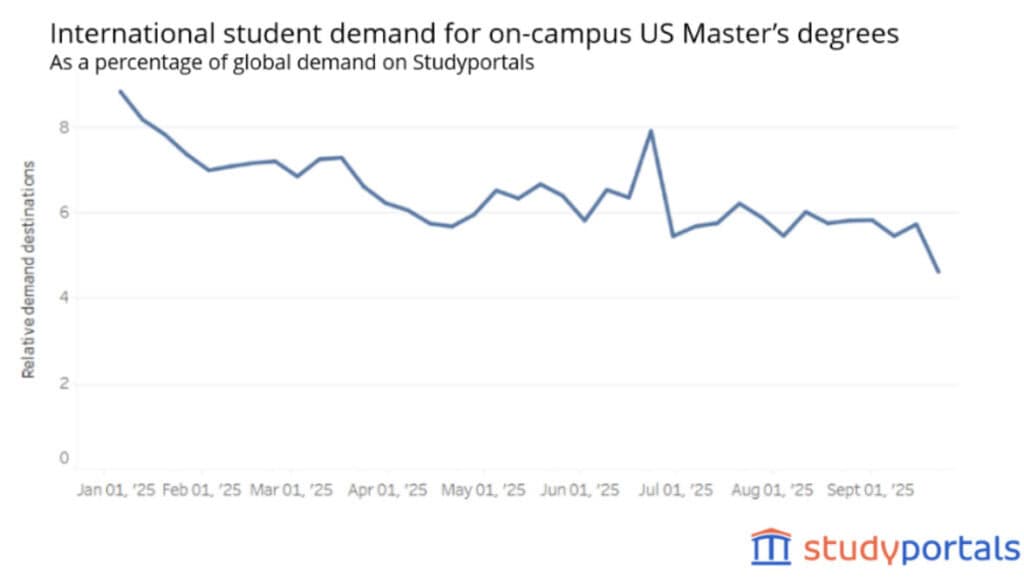
The data, collected from January 6 to September 28, aligns closely with the start of Donald Trump’s second presidential term and the ensuing uncertainty around student visas and post-graduation work opportunities. It is based on the search behaviour of over 50 million prospective students on Studyportals.
“Prospective international students and their families weigh not only academic reputation but also regulatory stability and post-graduation prospects,” said Studyportals CEO Edwin van Rest: “Right now, those factors are working against institutions.”
Studyportals said the steep decline – dropping more than 60% in less than nine months – corresponds to proposed and enacted policy changes impacting student visa duration, Optional Practical Training (OPT) and H-1B work authorisation in the US.
Last week, the Trump administration shocked businesses and prospective employees by hiking the H-1B visa fee to $100,000 – over 20 times what employers previously paid. Days later, the government announced proposals to overhaul the visa system in favour of higher-paid workers.
Sector leaders have warned that OPT could be the administration’s next target, after a senior US senator called on the homeland security secretary Kristi Noem to stop issuing work authorisations such as OPT to international students.
Such a move would have a detrimental impact on student interest in the US, with a recent NAFSA survey suggesting that losing OPT reduces enrolment likelihood from 67% to 48%.
Meanwhile, roughly half of current students planning to stay in the US after graduation would abandon those plans if H-1B visas prioritised higher wage earners, the survey indicated.
“Prospective students are making go/no-go enrolment decisions, while current students are making stay/leave retention decisions,” said van Rest.
“Policy changes ripple through both ends of the pipeline, reducing new inflow and pushing out existing talent already contributing to US research, innovation and competitiveness,” he added.
Data: Studyportals
The search data revealed a spike in interest at the beginning of July, primarily from Vietnam and Bangladesh, and to a lesser extent India and Pakistan. Experts have suggested the new Jardine-Fulbright Scholarship aimed at empowering future Vietnam leaders could have contributed to the rise.
Meanwhile, Iran, Nepal and India have seen the steepest drops in master’s demand, declining more than 60% this year to date compared to last.
While federal SEVIS data recorded a 0.8% rise in international student levels this semester, plummeting visa arrivals and anecdotal reports of fewer students on campus suggest the rise was in part due to OPT extensions – individuals who are counted in student totals but who are not enrolled on US campuses or paying tuition fees.
Beyond the immediate financial concerns of declining international enrolments for some schools, van Rest warned: “The policies we adopt today will echo for years in global talent flows.”
The UK and Ireland have gained the most relative market share of international interest on Studyportals – both up 16% compared to the same period in 2024. Australia, Austria, Sweden and Spain all experienced a 12% increase on the previous year.
In the US, international students make up over half of all students enrolled in STEM fields and 70% of all full-time graduate enrolments in AI-related disciplines, according to Institute of International Education (IIE) data.
The policies we adopt today will echo for years in global talent flows
Edwin van Rest, Studyportals
What’s more, universities with higher rates of international enrolment have been found to produce more domestic STEM graduates, likely due to greater investment in these disciplines, National Foundation for American Policy (NFAP) research has shown.
Last year, graduate students made up 45% of the overall international student cohort (including OPT), compared to undergraduate which comprised roughly 30%, according to IIE Open Doors data.
Universities with higher proportions of overseas students have been found to produce more domestic STEM graduates, likely due to greater investment in these disciplines, National Foundation for American Policy (NFAP) research has shown.
The news of plummeting international demand comes as domestic enrolments are declining, with less high school graduates entering college education and an overall demographic shrinking of university-age students.
In a recent survey by the American Council on Education (ACE), nearly three quarters of college leaders said they were concerned about enrolment levels this semester, with 65% moderately or extremely worried about immigration restrictions and visa revocations.
Director of Universities UK International (UUKi), Jamie Arrowsmith, has issued an update to the sector regarding various changes due to take place as a result of the government’s immigration white paper, published in May 2025.
UUKi, the sector body representing UK universities’ global interests, has been engaging with officials on the various proposals facing the sector. This includes the government’s ambition to implement an international student levy, shortening the Graduate Route from two years to 18 months, and tightening the Basic Compliance Assessment (BCA) thresholds that universities are held to.
Arrowsmith’s update brought the news that the Home Office has committed to phased implementation of the new BCA thresholds. He also said that the Home Office has also committed to “discretionary exceptions for smaller providers and for institutions that would have passed under current rules”.
The government’s proposal is to raise the minimum pass requirement of each BCA metric by five percentage points, so that a sponsor must maintain a course enrolment rate of at least 95% and a course completion rate of 90% in order to pass the compliance threshold.
However, the change that has most unsettled the sector is the proposal to tighten the visa refusal rate compliance threshold, halving it from 10% to 5%.
Arrowsmith told members that UKVI is now piloting enhanced data sharing to give sponsors more insight into visa refusals – a step UUKi has long called for.
“While this is welcome, we’re clear that further systems and data improvements are needed as a matter of course to support institutions in adjusting to the tighter thresholds,” said Arrowsmith.
The incoming measures also include a traffic-light banding system that rates sponsors on compliance performance, with underperforming institutions facing being placed on a UKVI action plan or a possible recruitment cap.
“We’re also seeking greater clarity on the proposed red-amber-green rating system and will continue to engage through the Education Advisory Group and regular discussions with UKVI and the Home Office,” added Arrowsmith.
A spokesperson for the Home Office told The PIENews: “We strongly value the contribution of international students and recognise their importance to the UK’s world-leading universities. That’s why we’re tightening the rules to ensure those coming here are genuine students and education providers take their responsibilities seriously.”
Communications surrounding curtailing the Graduate Route are “expected imminently”, said Arrowsmith, and UUKi is arguing strongly against the implementation from the January/February 2026 intake, “so that those students are able to access the two-year offer they applied for”.
“We continue to press for written confirmation that PhD graduates will retain three years’ eligibility, and for changes to apply from a set course start date rather than a graduation date, to provide clarity for institutions and applicants,” he continued.
We strongly value the contribution of international students and recognise their importance to the UK’s world-leading universities. That’s why we’re tightening the rules to ensure those coming here are genuine students and education providers take their responsibilities seriously UK Home Office
News from this week’s Labour Party conference has brought some overdue clarity on the proposed levy on universities’ income from international students. Education Secretary Bridget Phillipson confirmed the measure remains on the table, with the revenue earmarked to fund targeted maintenance grants.
The announcement sparked backlash from sector leaders. Some took aim at the government’s assumptions that universities will be able to simply pass the levy onto international students through higher tuition fees, while others argued that it’s unfair to force international students to essentially pay for domestic maintenance grants.
As the government seeks to implement these reforms, most can be enacted through changes to the immigration rules without requiring an act of parliament — the only exception being the levy on international student fees.
The humanities are on a roll. In Belarus, the humanities are so feared that the country has just declared the European Humanities University – which left the country and set up in neighbouring Lithuania about 20 years ago – an “extremist organization”. And in South Korea, new humanities enrolments are up strongly.
Canada has long shared a medical accreditation system with its neighbour to the south. But Trump-inspired changes de-emphasized equity, diversity, and inclusion. Result? Canada is going it alone on Medical Accreditation.
With elections coming in the next few weeks/months, here are manifesto analyses for various parties in the Netherlands and Costa Rica. Marvel at how some issues echo around the world.
Beyond the financial crisis in Kenyan universities (see almost every previous Fifteen this year), it turns out that the government is in arrears paying academic faculty (it is fairly common in Africa for academic salaries to be paid directly by government rather than by universities) and as a result they have now gone on strike. Universities there have now been closed for over a week.
There’s a row brewing in Belgium as the French part of the country wrestles with very significant budget deficits and the government of Wallonie-Bruxelles has identified higher education as a place to cut: in particular, by eliminating subsidies for students who take too long to graduate and rationalization of program offerings. This is not going over well.
This month, Russian embassies around the world have been advertising scholarships for local students who wish to study in Russia. Here are examples from Kenya, Sri Lanka, and Bangladesh. It might be a hard sell, as a number of Africa governments are warning that they have evidence Russia is using such scams to enrol unsuspecting young people into the Russian Army.
Long, sad, but very good article from a recently-emigrated Venezuelan professor on the challenges of teaching in that country – particularly on salaries of under $3/month.
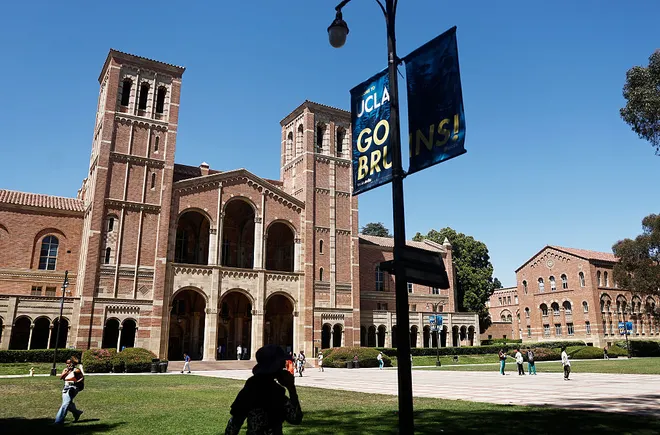
Trump lost in court to both Harvard and UCLA, leading some to breathe a sigh of relieve. However, last week the government decided it would slap a $100,000 charge on every new H1B application. As usual with Trump details are unclear, but if the new scheme applies to universities, it would pretty much devastate any attempt by universities to hire foreign professors. Expect major changes in global academic flows.
Are any of those European “let’s poach global talent” schemes enacted in the wake of last winter’s vandalism of the US science system bearing fruit? In a limited way, yes. Lund University is reporting that it has received over 1300 applications for its global recruitment program though about 20% of those were for a single joint position in Theology and Humanities. Meanwhile, 25 American professors have been recruited for a two-year stint with offers of half a million euros each.
According to reports, a brief note issued by the Department of Home Affairs through the Provider Registration and International Student Management System (PRISMS), which oversees international student data, confirms that evidence levels have been updated.
“The September 2025 evidence level update for countries and education providers (based on student visa outcome data from 1 July 2024 to 30 June 2025) has taken place, effective for applications lodged on or after 30 September 2025,” read a statement by the DHA on the PRISMS website.
Consultants and universities in Australia are able to work out these levels through the government’s document checklist tool, which reveals a provider’s risk standing based on the requirements triggered when paired with a student’s country of origin.
Reports suggest that level 1 (lowest risk) includes Bangladesh and Sri Lanka; level 2 (moderate risk) includes India, Bhutan, Vietnam, China, and Nepal; and level 3 (highest risk) includes Fiji, the Philippines, Pakistan, and Colombia.
Although India and Vietnam, both prominent source markets for Australia, improved from level 3 to level 2 on the back of stronger grant rates, China slipped from level 1 to level 2, possibly due to a surge in asylum applications from Chinese nationals, particularly students, as some reports suggest.
While education providers in Australia registered under CRICOS (Commonwealth Register of Institutions and Courses for Overseas Students) are assigned an evidence level, each country is also given one based on its past performance with student visas, particularly visa refusals, asylum applications, and breaches of conditions.
Are there not more Indians applying for protection visas? Hasn’t Nepal followed Sri Lanka and Bangladesh in political turmoil, where the economy has suffered? This has raised concerns around students meeting GS requirements Ravi Lochan Singh, Global Reach
The combination of provider and country levels determines the documents required for an international student’s visa application.
Stakeholders have highlighted the lack of transparency in assessing country risk levels, particularly as students from countries with reduced risk ratings may still arrive in Australia under precarious conditions.
“Are there not more Indians applying for protection visas? Hasn’t Nepal followed Sri Lanka and Bangladesh in political turmoil, where the economy has suffered? This has raised concerns around students meeting GS requirements. There are also whispers that certain operators may encourage students to apply for protection visas,” stated Ravi Lochan Singh, managing director, Global Reach.
Visa prioritisation is already tied to intended caps, with applications processed on a first-in, first-out basis until a provider reaches 80% of its allocation, explained Singh.
With almost all universities now streamlined for visas and the majority promoted from level 2 to level 1, lowest risk, and almost none remaining in level 3, the evidence-level system appears unnecessary to some.
“The concept of ‘streamlining’ (and then the development later of the SSVF) took place at a time where there was a whole-of-government focus on growing international student numbers and increasing the value, while maintaining integrity, of the highly important international education sector,” shared Mike Ferguson, pro vice-chancellor of Charles Sturt University.
According to Ferguson, a former DHA official, “English and financial requirements were streamlined as part of the visa process, based on a risk assessment, given the other safeguards in place – obligations enforced by TEQSA and ASQA in terms of providers ensuring students have sufficient English proficiency and the use of the GTE requirement to consider a student’s holistic economic circumstances.”
However, with international student numbers rising since the early 2010s, “times have changed” and the focus has shifted to managing enrolments and ensuring sustainable growth, explained Ferguson.
“My view is that all students should provide evidence of funds and English with the visa process. That would align with community expectations, support enhanced integrity and potentially help to some degree with some of the course hopping behaviour we are seeing (though the latter requires a range of measures),” he contineud.
“DHA could still determine the degree to which they scrutinise the funds submitted but that would be based on a more holistic and granular risk assessment – not just based on country and provider.”
Evidence levels of select Australian institutions, showing whether they have remained steady, been upgraded, or downgraded, as shared by Ravi Lochan Singh. Correction: Deakin University was previously categorized under risk level 2 (not 1) and has since been upgraded to 1.
Singh further stated that concerns around visa hopping and attrition could be exacerbated, as international students may now enter Australia through universities and then transition to higher-risk, non-university sectors without needing new visa applications, especially since Australia has yet to mandate linking study visas to the institution of initial enrolment, unlike neighbouring New Zealand.
Moreover, Singh pointed out that when students arrive without adequate financial backing, it can increase visa misuse, which may lead authorities to tighten risk classifications again.
“The document checklist tool provides a clear framework for assessing the risk level of a university. However, it raises concerns about the recent trend of promoting the application of visas without financial funds, as suggested by the document checklist tools. While these visas may be approved, this approach could potentially lead to the return of the country to risk level 3 in the future,” stated Singh.
“For instance, if a country’s risk level is 3 (such as Pakistan), and Home Affairs requires financial and English requirements to be attached to the visa application, the university’s risk level is inferred to be 2. If the Home Affairs tool waives this requirement, the risk level is reduced to 1.”
The PIE has requested comment from the DHA and is awaiting a response.
Australia’s reported changes to country evidence levels come just a month after the government announced an additional 25,000 international student places for next year, raising the cap to 295,000.
Every year, Hispanic Heritage Month offers the United States a chance to honor the profound and varied contributions of Latino communities. We celebrate scientists like Ellen Ochoa, the first Latina woman in space, and activists like Dolores Huerta, who fought tirelessly for workers’ rights. We use this month to recognize the cultural richness that Spanish-speaking families bring to our communities, including everything from vibrant festivals to innovative businesses that strengthen our local economies.
But there’s a paradox at play.
While we spotlight Hispanic heritage in public spaces, many classrooms across the country require Spanish-speaking students to set aside the very heart of their cultural identity: their language.
This contradiction is especially personal for me. I moved from Puerto Rico to the mainland United States as an adult in hopes of building a better future for myself and my family. The transition was far from easy. My accent often became a challenge in ways I never expected, because people judged my intelligence or questioned my education based solely on how I spoke. I could communicate effectively, yet my words were filtered through stereotypes.
Over time, I found deep fulfillment working in a state that recognizes the value of bilingual education. Texas, where I now live, continues to expand biliteracy pathways for students. This commitment honors both home languages and English, opening global opportunities for children while preserving ties to their history, family, and identity.
That commitment to expanding pathways for English Learners (EL) is urgently needed. Texas is home to more than 1.3 million ELs, which is nearly a quarter of all students in the state, the highest share in the nation. Nationwide, there are more than 5 million ELs comprising nearly 11 percent of the U.S. public school students; about 76 percent of ELs are Spanish speakers. Those figures represent millions of children who walk into classrooms every day carrying the gift of another language. If we are serious about celebrating Hispanic Heritage Month, we must be serious about honoring and cultivating that gift.
A true celebration of Hispanic heritage requires more than flags and food. It requires acknowledging that students’ home languages are essential to their academic success, not obstacles to overcome. Research consistently shows that bilingualism is a cognitive asset. Those who are exposed to two languages at an early age outperform their monolingual peers on tests of cognitive function in adolescence and adulthood. Students who maintain and develop their native language while learning English perform better academically, not worse. Yet too often, our educational systems operate as if English is the only language that matters.
One powerful way to shift this mindset is rethinking the materials students encounter every day. High-quality instructional materials should act as both mirrors and windows–mirrors in which students see themselves reflected, and windows through which they explore new perspectives and possibilities. Meeting state academic standards is only part of the equation: Materials must also align with language development standards and reflect the cultural and linguistic diversity of our communities.
So, what should instructional materials look like if we truly want to honor language as culture?
Instructional materials should meet students at varying levels of language proficiency while never lowering expectations for academic rigor.
Effective materials include strategies for vocabulary development, visuals that scaffold comprehension, bilingual glossaries, and structured opportunities for academic discourse.
Literature and history selections should incorporate and reflect Latino voices and perspectives, not as “add-ons” during heritage month, but as integral elements of the curriculum throughout the year.
But materials alone are not enough. The process by which schools and districts choose them matters just as much. Curriculum teams and administrators must center EL experiences in every adoption decision. That means intentionally including the voices of bilingual educators, EL specialists, and, especially, parents and families. Their life experiences offer insights into the most effective ways to support students.
Everyone has a role to play. Teachers should feel empowered to advocate for materials that support bilingual learners; policymakers must ensure funding and policies that prioritize high-quality, linguistically supportive instructional resources; and communities should demand that investments in education align with the linguistic realities of our students.
Because here is the truth: When we honor students’ languages, we are not only affirming their culture; we are investing in their future. A child who is able to read, write, and think in two languages has an advantage that will serve them for life. They will be better prepared to navigate an interconnected world, and they carry with them the ability to bridge communities.
This year, let’s move beyond celebrating what Latino communities have already contributed to America and start investing in what they can become when we truly support and honor them year-round. That begins with valuing language as culture–and making sure our classrooms do the same.
Altagracia “Grace” Delgado, Texas Association for Bilingual Education & Assessment for Good
Altagracia “Grace” Delgado has devoted 30 years to education, serving as a bilingual teacher, literacy coach, and both a school and central office administrator. A passionate advocate for students in special populations, she collaborates with various organizations to ensure they receive the support and resources they need. Grace serves as a Board Member of the Texas Association for Bilingual Education and an Advisory Board Member for Assessment for Good, a project of the Advanced Education Research & Development Fund, as well as the Houston Christian University’s Women in Leadership Program.
Latest posts by eSchool Media Contributors (see all)
This audio is auto-generated. Please let us know if you have feedback.
Dive Brief:
The National Institutes of Health has temporarily restored the University of California system’s research funding it abruptly revoked under President Donald Trump, officials from the U.S. Department of Justice said in court filings this week.
A federal judge issued a preliminary injunction last month ordering NIH, along with the U.S. departments of Defense and Transportation, to reinstate the canceled funding for the university system and its researchers while a related lawsuit proceeds.
Trump administration officials said Monday the three agencies were complying but reported some administrative difficulties that would take until mid-October to resolve.
Dive Insight:
Researchers and faculty from the University of California’s Berkeley and San Francisco campuses filed a class-action lawsuit against the Trump administration in June, alleging its mass termination of research grants was illegal and jeopardized U.S. advancement. At the University of California, Los Angeles alone, NIH reportedly cut some 500 research grants worth over $500 million.
In September, U.S. District Judge Rita Lin temporarily ordered three agencies to reinstate the grants and barred them from making further cuts en masse against the system for the duration of the court case.
NIH has now restored the bulk of that funding to comply with the order. But the agency is running into issues verifying if the grants it canceled are held by University of California researchers who work at institutions outside of their home system, federal officials told the court on Monday.
In total, NIH identified 61 grants that likely meet this parameter, all but nine of which have been reinstated.
Officials are trying to verify that the researchers on the remaining nine grants are still employed by the University of California, a process challenged by potentially out-of-date agency files, court documents said.
As of Monday, NIH anticipated completing that work by the end of the week, though the shutdown of the federal government has likely altered that timeline.
The Defense Department also declared a successful return of funds to University of California institutions. But the agency reported administrative difficulties on behalf of its components, such as the National Security Agency, the Defense Advanced Research Projects Agency and the branches of the military.
Simply identifying relevant awards issued through those groups has been a challenge, officials said, “because of the number of DoD Components and the variety of grants systems involved.”
“Reinstatement has been particularly complicated, as a fiscal matter, where funding has already been deobligated,” the court filing said. “In most cases, DoD Components have contacted UC institutions so that they can work together to modify awards and restore funding.”
Prior to the government shutdown, the Defense Department gave an estimated completion date of Oct. 10.
This audio is auto-generated. Please let us know if you have feedback.
How well did you keep up with this week’s developments in K-12 education? To find out, take our five-question quiz below. Then, share your score by tagging us on social media with #K12DivePopQuiz.
This audio is auto-generated. Please let us know if you have feedback.
This fall, North Carolina is one of the latest states rolling out a direct admission program that offers high school seniors acceptance to a range of public and private colleges.
Through direct admissions, colleges proactively admit students based on high school academic performance metrics such as GPA, SAT scores, or the amount of credits they received.
Around the start of the school year, more than 62,000 public high school seniors in North Carolina were offered direct admission to select colleges through the NC College Connect Program. Eleven of the University of North Carolina System’s 16 colleges, 29 private colleges and all 58 of the state’s community colleges are participating.
The UNC System first piloted NC College Connect last year in partnership with state agencies, the governor’s office and North Carolina’s community college system. The system launched the program to increase access to higher education in the state, Shun Robertson, UNC’s senior vice president for strategy and policy, said in an email.
For many high school seniors, “the process of applying to college, transferring between institutions, and navigating the maze of financial aid feels like an insurmountable series of hurdles,” said Robertson. “Eliminating these barriers has been a high priority.”
Over the past decade, direct admissions policies have increased the likelihood that in-state students both apply to college and apply to more colleges, said John Lane, vice president for academic affairs at the State Higher Education Executive Officers Association, in an email. In turn, that shift has effectively increased college enrollment, he said.
“Direct admissions policies and programs are impactful because they eliminate the complications and uncertainties of longstanding college application processes,” said Lane. “Instead, students are proactively admitted.”
UNC’s program
The UNC System piloted its direct admissions initiative last fall and notified over 70,000 high school seniors with GPAs of 2.8 or higher of their eligibility for the program, Robertson said.
Those seniors could apply to six UNC institutions and all 58 state community colleges for the 2025-26 academic year by sharing on an online portal their email address, their potential major, and when they’d like to start college, he said.
UNC System officials haven’t been able to review outcome data yet for the pilot program, a spokesperson said. But over 5,000 students responded to the letter during the pilot, the spokesperson said.
The system simplified the program this fall. Students won’t have to formally apply to get into one of the colleges on their list, rather they are provided direct admission to institutions based on their GPA and whether they meet the program’s requirements, Robertson said. Then they just need to submit a program form to accept their admission, he said.
Students accepting admission to community colleges must still fill out applications, but they will already be admitted, according to the initiative’s website.
The program also expanded to include private colleges in the state and added more UNC institutions, said Robertson. The University of North Carolina Chapel Hill, the system’s highly selective flagship, remains excluded from the program.
Some of the private institutions in the program have additional direct admission qualification requirements, such as foreign language course requirements.
UNC System officials hope direct admissions will help the state’s institutions enrollment numbers long term by tapping into a growing college-aged student population.
Like most of the country, North Carolina is expected to see a decline in high school graduates between 2025 and 2030, according to a report last year from the Western Interstate Commission for Higher Education. However, that pool of students is expected to grow again in North Carolina after that year.
WICHE predicts that North Carolina will be one of 12 states, along with the District of Columbia, to have growing numbers of high school students between 2023 and 2041. Overall, North Carolina should see a 6% increase in high school graduates over that period, per WICHE projections.
“As more students and families choose to live in North Carolina, the UNC System is making sure that we serve as a gateway to opportunity for postsecondary education for them and building an educated workforce for our state,” said Robertson.
Research from 2022 on Idaho’s direct admissions program found a 4% to 8% increase in first-time undergraduate enrollment per campus. Those enrollments were driven by an increase in attendance at two-year institutions, the research found.
Direct admissions programs have also been attributed to increases in applications among Black, Latinx, multiracial, first-generation and low-income students, according to a 2023 study by researchers at the University of Illinois Urbana-Champaign and the University of Wisconsin-Madison.
That study also found that students offered direct admissions were more likely to apply to a college or university and twice as likely to apply to an institution that offered them guaranteed acceptance.
Houston Independent School District laid off 160 uncertified teachers and 54 staff members as part of “staff leveling” efforts “to align teachers with student enrollment,” according to a district announcement on Monday. Additionally, 232 teachers were reassigned to unfilled positions.
The district’s student enrollment data for the 2025-26 school year has yet to be released, though Houston ISD said in a February board meeting that it was conservatively budgeting for a decrease in enrollment of about 8,000 students, which would lead to a loss of $67 million in revenue.
At the same meeting, the district said it would consider a proposal this fall to close some schools in the 2026-27 school year. It cited a 30,000 student decline in Houston ISD’s enrollment over the last decade.
Dive Insight:
The major staffing shift for Houston ISD “is a standard process that ensures the most effective teachers are leading our classrooms,” said Trey Serna, a district spokesperson, in a Monday video announcement.
When staffing adjustments are needed, Texas’ largest school district primarily considers a teacher’s performance and certification, Serna said.
The move comes as the district has recently reported early successes during a state takeover aimed at turning around low-performing schools. Superintendent Mike Miles, who was appointed by the state in June 2023, reported a sharp increase in A- and B-rated schools in the 2024-25 school year and has promised that all Houston ISD schools will fall into A- and B-rated categories by 2027.
Adjustments to budgets and staffing due to enrollment declines are a challenge many public schools are facing nationwide.
If declining enrollments persist, education economics researchers foresee more layoffs and hiring freezes for districts moving forward. This, they said, could lead to a broad reversal in teacher shortages.
Education finance experts have suggested that while districts increasingly consider teacher layoffs, they should focus on firing ineffective and uncertified educators first.
In September, Florida’s Orange County Public Schools announced mass teacher reassignments as it faces a sharp, unexpected decline in enrollment this school year. Because Orange County Public Schools had 157 vacancies due to a hiring freeze, Superintendent Maria Vazquez said she was hopeful the district could retain most of its instructional staff.
Texas’ Austin Independent School District is also moving ahead with plans to consolidate some of its schools amid ongoing enrollment declines. Superintendent Matias Segura said in a Wednesday Instagram video that the district will publish its first draft for consolidation and boundary changes by Friday evening.
“It won’t be perfect, and it isn’t final,” Segura said of the draft plan. “Our goal is the same one our community shares: every family deserves an excellent neighborhood school that is vibrant, well-resourced, and ready to meet each child’s needs.”
The district plans to collect community feedback and refine the plan before the school board votes on Nov. 20.

![Building an Internal OPM [Workbook]](https://blog.college-counseling.com/wp-content/uploads/2025/10/1759786546_Building-an-Internal-OPM-Workbook.jpg)