Author: admin
-

UK study visa applications up 7% while dependant numbers plummet
New Home Office migration statistics show the full effect of an almost outright ban on dependants – with numbers dropping sharply for the second year in a row since the policy was announced.
While there were 419,558 main applications for UK study visas in the year ending September 2025, marking a 7% increase on the previous year, there were 20,366 dependants – a 57% decrease year on year.
It marks the second consecutive year of falling dependants, with this number decreasing annually by a whopping 87% in the year ending September 2024.
It follows new rules introduced in January 2024 to ban students on postgraduate-taught programs from bringing their dependants with them to the UK.
The number of UK study visas issued to international students and their dependants rose sharply after 2016 – reaching a post-Covid peak of 652,072 in 2023. Now, since the dependants ban, the number of study visas issued has fallen to 439,924.
According to the Home Office, there has been roughly one dependant for every 20 main study visa applicants since the year ending March 2025 – a stark decline since the year ending September 2023, when this number stood at six per 20 main applicants.
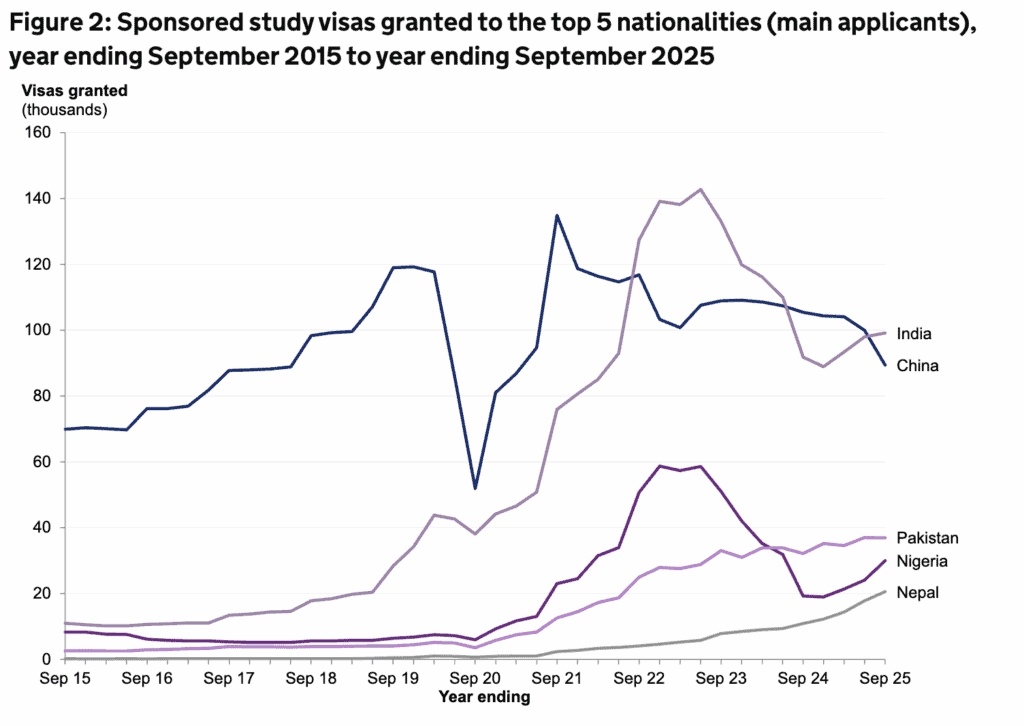
Source: Home Office Indian students were issued the most sponsored study visas in the year ending September 2025, with 99,18 visas issued. Chinese students made up the second biggest cohort – with 89,397 visas issued, 15% fewer than the previous year.
Pakistani students were the third biggest group – issued 39,924 study visas, while there were gains for Nepali students (up 89% to 20,572) and Nigerian students (up 56% to 30,009).
According to James Pitman, chairman of Independent Higher Education (IHE) and CEO of Studygroup, the effect of the dependants ban has been discriminatory – disproportionately affecting women.
Speaking in a personal capacity at yesterday’s IHE annual conference, Pitman acknowledged that the dependants visa has “a major flaw”, but said that this could have been corrected rather than withdrawing the scheme entirely for taught degrees.
“As predicted by the sector, that withdrawal was gender discriminatory, leading to the loss of 19,000 female students vs prior year in the January 2024 intake alone,” he said. “Every one of those was a human story, of ambitions denied, families fractured, careers restricted and yet again women being discriminated against – in this case by UK government policy.”
Every one of those was a human story, of ambitions denied, families fractured, careers restricted and yet again women being discriminated against
James PitmanHome Office figures obtained by Pitman via a freedom of information request show a marked year-on-year decline in women issued sponsored study visa grants for courses at RQF level 6-8 or equivalent starting in January.
In 2023, of 81,079 total student visas, 45% were issued to women, compared to 55% that were issued to men. But the following year, after the dependants ban was brought in, the gender split was 66% in favour of men. These numbers stayed stable in 2025, the data showed, with 65% of sponsored study visas issued to men.
-

Podcast: Budget, R&D, Scotland’s tertiary bill
This week on the podcast we examine how Budget 2025 reshapes the university funding model – from the international levy and modest new maintenance grants, to confirmed tuition fee uplifts and changes to pension tax arrangements that will affect institutional costs.
We discuss what the package tells us about the government’s approach to public finances, the politics of international recruitment, and the sustainability of cross-subsidy in a tight fiscal environment for higher education.
Plus we discuss research and innovation announcements and get across debate in Holyrood on the Tertiary Education and Training (Funding and Governance) (Scotland) Bill.
With Ken Sloan, Vice-Chancellor and CEO at Harper Adams University, Debbie McVitty, Editor at Wonkhe, David Kernohan, Deputy Editor at Wonkhe and presented by Jim Dickinson, Associate Editor at Wonkhe.
On the site:
Budget 2025 for universities and students
Universities now need to be much clearer about the total cost of a course
Student finance changes in the budget – Director’s cut
Reclassification ghosts and jam tomorrow at stage 2 of Scotland’s tertiary bill
A government running out of road still sets the economic weather for higher education
A change in approach means research may never be the same again
You can subscribe to the podcast on Apple Podcasts, YouTube Music, Spotify, Acast, Amazon Music, Deezer, RadioPublic, Podchaser, Castbox, Player FM, Stitcher, TuneIn, Luminary or via your favourite app with the RSS feed.
-

What Football Can Tell Us About How to Teach Reading – The 74
Get stories like this delivered straight to your inbox. Sign up for The 74 Newsletter
When I go to my son’s football games, I can tell you which team will win — most of the time — just by watching them warm up. It’s not necessarily having the flashiest uniforms or the biggest player; it’s about the discipline, the focus and the precision of their routines.
A school is no different.
In my Texas school district, I can walk into a classroom and, in the first five minutes, tell you if effective reading instruction is happening. I don’t need to see the lesson plan or even look at the teacher. I just need to look at the kids. Are they engaged? Are they in a routine? Are they getting the “reps” they need?
For too long, districts have been losing the game before it starts. They buy a new playbook (i.e., a curriculum) as a “hail Mary,” hoping for a fourth-quarter miracle. Still, they ignore the fundamentals, practice and team culture required for sustainable success.
Chapel Hill Independent School District is committed to educating all children to compete in an ever-changing world. To that end, we’ve made literacy a nonnegotiable priority across all campuses. We anchor our approach in research-based practices and a culture of continuous learning for both students and staff.
We’re building for the long run: a literacy dynasty. But our literacy success hasn’t come without putting in the work. We have a relentless focus on the fundamentals and, most importantly, a culture where every player — every teacher and administrator — fits our system.
Trust the Analytics, Not Your Gut
In reading instruction, we can’t make assumptions; all instruction has to start with the fundamentals. For decades, instruction was based on gut feelings, like an old-school coach deciding whether to go for it on fourth down or punt based on a hunch. But today, the best coaches trust the analytics, not their gut. They watch the game film.
Chapel Hill is an analytics district; we do our research. And our game film is the science of reading.
Many years ago, we started using structured literacy for a small group of students with dyslexia. It worked so well that we asked ourselves: If structured literacy is effective for a small group of students with dyslexia, shouldn’t it be essential for all students?
We didn’t just adopt a new curriculum; we redesigned our literacy infrastructure — from structured literacy professional development for every teacher to classroom coaching and a robust tiered system of support to ensure no student falls through the cracks.
That logic is our offensive strategy. It’s why we use tools like the Sold a Story podcast to show our staff why we’ve banned the strategies of a bygone era, like three-cueing. We have to be willing to reprogram the brain to align with what research proves works. But having the right playbook is only half the battle.
A great playbook is useless without the right team to execute it.
This is the most crucial part: “First who, then what.” In the NFL draft, teams don’t always draft the most talented player available. They conduct interviews and personality assessments and ultimately draft the player who best fits their system—the cultural fit.
Tom Brady is arguably the greatest quarterback of all time, but he couldn’t run a read-option offense, which requires a fast, running quarterback. He wouldn’t fit the system, and the team would fail. But put Brady in a play-action offense, sit back and watch the magic happen.
We operate the same way. When we interview, we’re not just looking for a teacher with excellent credentials and experience; we’re looking for a “Chapel Hill Way” teacher. It’s a specific profile: someone who believes in our philosophy of systematic, explicit, research-based instruction.
This culture starts with our team captains: our campus principals. We need them to believe in our playbook, not just buy in because the district office said so. We invest in their development so they can champion literacy daily, monitor instruction and ensure every classroom executes our playbook with fidelity. It’s their conviction that turns a curriculum on a shelf into a living, breathing part of our culture.
Talented teams win games. Disciplined, team-first organizations build dynasties.
Building a dynasty requires sacrifice. When an educator joins our team, whether they’re a rookie or a seasoned veteran, we ask them to let go of the “I’ve always done it this way” mindset. That’s the equivalent of a player prioritizing their personal stats over a team win.
It’s a team-first mindset. It’s about a willingness to put personal preference aside to build a championship team. For Chapel Hill ISD, our championship is ensuring every child learns to read.
Our team-first philosophy has translated into measurable results: Across campuses, students are gaining the foundational skills they need, and data shows growth for every subgroup, including students with dyslexia and multilingual learners. We want students to become a product of our expectations, rather than their environment. Our district, which serves a diverse population, including a high percentage of students classified as low socioeconomic status, consistently scores above the state average in third-grade reading.
At Wise Elementary, our largest campus[MOU1] , 56% of third graders met grade-level standards, and 23% scored above grade level on the 2023-2024 STARR assessment. And we had similar results across the district.
So to my fellow education leaders: Before you shop for a new playbook, ensure you have the right team culture in place. Define your culture. Draft the right players. Build your team. Coach your captains. And obsess over the fundamentals.
That’s how you win.
Did you use this article in your work?
We’d love to hear how The 74’s reporting is helping educators, researchers, and policymakers. Tell us how
-
A partnership across the Atlantic to inform the world
Preety Sharma is a public health and development consultant currently based in Northern India, near the border with Nepal. She is also a News Decoder correspondent, one of dozens who came to News Decoder through a journalism fellowship at the Dalla Lana School of Public Health at the University of Toronto.
For more than five years, the University of Toronto and News Decoder have partnered to help train health professionals in journalism, with the goal of meeting this need: Too much disinformation in the world about important health issues and too much factual information presented to the public in articles that are difficult to read.
Under the program, mid-career professionals spend a year in journalism training at the University of Toronto and as part of the program, pitch stories to professional news organizations. But to get published, the articles must meet the strict standards of each news organization that accepts the story pitches.
To publish on News Decoder, for example, the stories must be written in way that is accessible to young people and to those who read English as a foreign language. This is challenging for many professional journalists. The stories must also have a global angle and show how the problems in the stories play out in different parts of the world.
Sharma’s first story for News Decoder was on how a relatively inexpensive food product made from algae could be the solution to ending world hunger. Another story she wrote, on the problem of plastics in children’s toys, became News Decoder’s most-read story of all time.
“My first couple of stories were with News Decoder,” Sharma said. “I am glad to have had an opportunity to share it with a diverse and young audience globally.”
Sharma is now a News Decoder correspondent, someone who writes periodically for the site.
Bringing specialized knowledge to journalism
Marcy Burstiner, News Decoder’s educational news director, has worked with Sharma on all her stories and thinks the Dalla Lana program and its partnership with News Decoder is unique and important. “When I taught university journalism, I often told science majors that they should consider going into journalism,” she said. “There are a thousand medical publications but they are not written with a general audience in mind and meanwhile most journalists lack the specialized knowledge to really understand and put into context what is happening in medicine and the hard sciences.”
For News Decoder, this problem is particularly important, she said. “Health and science are two subjects that young people are hungry for information on and that’s our target audience,” Burstiner said. “But, because so much of the information is dense, they turn to sites on the internet that present pseudo science and they can’t tell the difference.”
Sharma agrees. “In the age of fake news and social media information explosion, it is crucial to have a credible and trusted media outlet that can present complex issues, ideas and concepts to youth in a simple and educational style,” she said.
News Decoder Founder Nelson Graves said that the partnership between the University of Toronto and News Decoder was a win-win proposition from the start. “Fellows at the Dalla Lana School of Public Health have a chance to publish stories examining some of the world’s most pressing issues on our global platform,” he said. “They benefit from editing by journalists with deep international experience.”
The students in News Decoder’s global community and readers around the globe also benefit from the fellows’ reporting and insights, he said and that helps to maintain News Decoder’s breadth and depth.
“News Decoder’s association with the University of Toronto encapsulates our nonprofit’s commitment to global citizenship and to fostering connections across borders and between generations,” Graves said.
Connecting with young people
Correspondent Norma Hilton also came to News Decoder through the University of Toronto’s fellowship in global journalism. Her first story was on K-Pop and social media influencers, a topic that’s important to News Decoder’s teen audience. Hilton said it was a great learning experience. “I’d never really written for a youth audience or taken more of an education angle to my stories before,” she said. “So, it was great to understand what young people want to hear about and write for them.”
Hilton is also one of many University of Toronto fellows who have not only written stories for News Decoder, but become an integral part of the News Decoder team. She participated in workshops and cross-border roundtables with students and produced articles and videos that serve as journalism tutorials on such things as how to cover events, how to fact-check articles and how to cover traumatic situations.
“I’ve never really thought I’d be on a panel of any kind, but being able to talk about my journalism experience and hopefully help younger people be interested in journalism and its power, has been the honour of a lifetime,” Hilton said.
News Decoder Managing Director Maria Krasinski argued that the partnership with the University of Toronto is unique. “Neither of our organisations is a traditional journalism school,” she said. “Rather, we both recognize that learning journalism skills helps people, no matter their discipline or profession, communicate clearly and with impact.”
She said that, for the students News Decoder works with, journalism is an entry point, a way to take action and engage with the issues affecting their communities and participate meaningfully in civic dialogue. “Young people discover that journalism isn’t just writing stories, it’s about learning to question, to listen and to make sense of the world,” she said.
For the University of Toronto fellows, meanwhile, the journalism fellowship adds a powerful new skill to their already impressive toolkits. “It helps them translate their knowledge and expertise into stories that resonate beyond academic and industry circles,” Krasinski said. “Many of the fellows stay connected to News Decoder well after their fellowship ends. They are based all over the world and bring a diversity of perspectives and experience that enriches our news platform.”
-

Students must intentionally develop durable skills to thrive in an AI-dominated world
Key points:
As AI increasingly automates technical tasks across industries, students’ long-term career success will rely less on technical skills alone and more on durable skills or professional skills, often referred to as soft skills. These include empathy, resilience, collaboration, and ethical reasoning–skills that machines can’t replicate.
This critical need is outlined in Future-Proofing Students: Professional Skills in the Age of AI, a new report from Acuity Insights. Drawing on a broad body of academic and market research, the report provides an analysis of how institutions can better prepare students with the professional skills most critical in an AI-driven world.
Key findings from the report:
- 75 percent of long-term job success is attributed to professional skills, not technical expertise.
- Over 25 percent of executives say they won’t hire recent graduates due to lack of durable skills.
- COVID-19 disrupted professional skill development, leaving many students underprepared for collaboration, communication, and professional norms.
- Eight essential durable skills must be intentionally developed for students to thrive in an AI-driven workplace.
“Technical skills may open the door, but it’s human skills like empathy and resilience that endure over time and lead to a fruitful and rewarding career,” says Matt Holland, CEO at Acuity Insights. “As AI reshapes the workforce, it has become critical for higher education to take the lead in preparing students with these skills that will define their long-term success.”
The eight critical durable skills include:
- Empathy
- Teamwork
- Communication
- Motivation
- Resilience
- Ethical reasoning
- Problem solving
- Self-awareness
These competencies don’t expire with technology–they grow stronger over time, helping graduates adapt, lead, and thrive in an AI-driven world.
The report also outlines practical strategies for institutions, including assessing non-academic skills at admissions using Situational Judgment Tests (SJTs), and shares recommendations on embedding professional skills development throughout curricula and forming partnerships that bridge AI literacy with interpersonal and ethical reasoning.
Latest posts by eSchool Media Contributors (see all) -

Higher Education’s Long Reckoning With Indigenous Oppression
[Editor’s note: United American Indians of New England host the National Day of Mourning. Their website is at United American Indians of New England – UAINE.]
Each November, while much of the United States celebrates Thanksgiving, Indigenous communities and their allies gather in Plymouth, Massachusetts, and across the country for the National Day of Mourning. It is a day that confronts the mythology of national innocence and replaces it with historical clarity. For Higher Education Inquirer, the significance of this day extends directly into the heart of American higher education—a system built, in no small part, on the expropriation of Indigenous land, the exploitation of Native Peoples, and the continued structural racism that shapes their educational opportunities today.
From the earliest colonial colleges to the flagship research institutions of the twenty-first century, U.S. higher education has never been separate from the project of settler colonialism. It has been one of its instruments.
Land, Wealth, and the Origins of the University
America’s oldest colleges—Harvard, Yale, William & Mary, Dartmouth—were founded within the colonial order that dispossessed Indigenous communities. While missionary language framed some of these institutions’ early purposes, they operated through an extractive logic: the seizure of land, the conversion of cultural worlds, and, eventually, the accumulation of immense academic wealth.
The Morrill Land-Grant Acts of 1862 and 1890 expanded this pattern on a national scale. Recent research documented by the “Land-Grab Universities” project shows that nearly eleven million acres of Indigenous land—taken through coercive treaties, forced removal, or outright theft—were funneled into endowments for public universities. Students today walk across campuses financed by displacements their own institutions have yet to fully acknowledge, let alone remedy.
Higher Education as an Arm of Assimilation
The United States also used education as a tool for forced assimilation. The Indian boarding school system, with the Carlisle Industrial School as its model, operated in partnership with federal officials, church agencies, and academic institutions. Native children were taken from their families, stripped of their languages, and subjected to relentless cultural destruction.
Universities contributed research, training, and personnel to this system, embedding the logic of “civilizing” Indigenous Peoples into the academy’s structure. That legacy endures in curricula that minimize Indigenous knowledge systems and in institutional cultures that prize Eurocentric epistemologies as default.
Scientific Racism, Anthropology, and the Theft of Ancestors
American universities played a central role in producing scientific racism. Anthropologists and medical researchers collected Indigenous remains, objects, and sacred items without consent. Museums and university labs became repositories for thousands of ancestors—often obtained through grave robberies, military campaigns, or opportunistic scholarship.
The 1990 Native American Graves Protection and Repatriation Act (NAGPRA) was designed to force institutions to return ancestors and cultural patrimony. Yet decades later, many universities are still out of compliance, delaying repatriation while continuing to benefit from the research collections they amassed through violence.
Contemporary Structural Racism in Higher Education
The oppression is not confined to history. Structural racism continues to constrain Native Peoples in higher education today.
Native students remain among the most underrepresented and under-supported groups on American campuses. Chronic underfunding of Tribal Colleges and Universities (TCUs) reflects a broader political disregard for Indigenous sovereignty and self-determination. Meanwhile, elite institutions recruit Native students for marketing purposes while failing to invest in retention, community support, or Indigenous faculty hiring.
Some universities have begun implementing land acknowledgments, but these symbolic gestures have little impact when institutions refuse to confront their material obligations: returning land, committing long-term funding to Indigenous programs, or restructuring governance to include tribal representatives.
What a Real Reckoning Would Require
A genuine response to the National Day of Mourning would require far more than statements of solidarity. It would involve confronting the ways American higher education continues to profit from dispossession and the ways Native students continue to bear disproportionate burdens—from tuition to cultural isolation to the racist violence that still occurs on and around campuses.
Real accountability would include:
• Full compliance with NAGPRA and expedited repatriation.
• Transparent reporting of land-grant wealth and the return or shared governance of those lands.
• Stable, meaningful funding for TCUs.
• Hiring, tenure, and research policies that center Indigenous scholarship and sovereignty.
• Long-term institutional commitments—financial, curricular, and political—to Indigenous communities.These steps require institutions to shift from performative recognition to structural transformation.
A Day of Mourning—And a Call to Action
The National Day of Mourning is not merely a counter-holiday. It is a reminder that the United States was founded on violence against Native Peoples—and that its colleges and universities were not passive beneficiaries but active participants in that violence.
For higher education leaders, faculty, and students, the question is no longer whether these histories are real or whether they matter. They are documented. They are ongoing. They matter profoundly.
The real question is what institutions are willing to give up—land, power, wealth, or narrative control—to support Indigenous liberation.
On this National Day of Mourning, HEI honors the truth that Indigenous survival is an act of resistance, and Indigenous sovereignty is not a symbolic aspiration but an overdue demand. The future of higher education must move through that truth, not around it.
Sources
Roxanne Dunbar-Ortiz, An Indigenous Peoples’ History of the United States.
The Land-Grab Universities Project (High Country News & Land-Grab Universities database).
David Treuer, The Heartbeat of Wounded Knee.
Margaret D. Jacobs, A Generation Removed: The Fostering and Adoption of Indigenous Children in the Postwar World.
NAGPRA regulations and compliance reports. -

From detection to development: how universities are ethically embedding AI-for-learning
- HEPI Director Nick Hillman’s verdict on the Budget can be found on the Times Higher website here.
- Today’s blog was kindly authored by Mike Larsen, Chief Executive Officer at Studiosity, a HEPI Partner.
The future of UK higher education rests upon the assurance of student learning outcomes. While GenAI presents the sector with immense opportunities for advancement and efficiency, the sector is constrained by an anachronistic model of plagiarism detection rooted in adversarialism. I believe the ‘Police and Punish’ model must now be replaced by ‘Support and Validate’.
A reliance upon detection was perhaps once a necessary evil but it has never aligned with the fundamental values of higher education. The assumption that policing student behaviour is the only way to safeguard standards no longer applies.
Such a punitive policy model has become increasingly untenable, consuming valuable university resources in unviable investigations and distracting from universities’ core mission. I believe there is a compelling alternative.
As assessment methods undergo necessary change, higher education institutions must consciously evaluate the risks inherent in abandoning proven means of developing durable critical thinking and communication skills, such as academic writing. New learning and assessment methodologies are required but must be embraced via evidence and concurrently protect the core promise of higher education.
An emerging policy framework for consideration and research is ‘support and validate’ which pairs timely, evidence-based academic support with student self-validation of authorship and learning.
Building capability, confidence and competence provides the ideal preparation for graduates to embrace current and future technology in both the workplace and society.
The combination of established and immediate academic writing feedback systems with advanced authorship and learning validation capabilities creates a robust and multi-layered solution capable of ensuring quality at scale.
This is an approach built upon detecting learning, not cheating. Higher education leaders may recognise this integrated approach empowers learners and unburdens educators, without compromising quality. It ensures the capabilities uniquely developed by higher education, now needed more than ever, are extended and amplified rather than replaced by techno-solutionism.
We must build a future where assessment security explicitly prioritises learning, not policing. For UK higher education, a pivot from punishment to capability-building and validation may be the only sustainable way to safeguard the value of the degree qualification.
Studiosity’s AI-for-Learning platform scales student success at hundreds of universities across five continents, with research-backed evidence of impact. Studiosity has recently acquired Norvalid, a world leader in tech-enabled student self-validation of authorship and authentic learning, shifting how higher education approaches assessment security and learning.
-

Universities now need to be much clearer about the total cost of a course
Now that we know the undergraduate fee caps that will apply in England in 2026-27 and 2027-28, now seems like a good time to get something off my to-do list.
For the sector, the headline is financial stability – after years of the fee cap being frozen while costs rose, two years of confirmed inflationary increases provide some relief.
But the announcement also crystallises a compliance problem that has been building since April, when new price transparency provisions came into force under the Digital Markets, Competition and Consumers Act 2024.
Last week the Competition and Markets Authority published finalised guidance on Complying with the law on unfair commercial practices relating to price transparency.
For a student starting a three-year degree next September, the total tuition cost is now entirely calculable. Year 1: £9,535. Year 2: £9,790. Year 3: £10,050. Total: £29,375.
And yet university prospectuses and websites overwhelmingly advertise just the Year 1 figure – understating the actual three-year cost by nearly £2,000.
Under the new CMA guidance that practice looks legally vulnerable. And, at least for England, OfS about to consult on applying a new “treating students fairly” condition to all registered providers, the regulatory architecture to enforce compliance is assembling itself.
A note before I get going – the DMCC Act is UK-wide legislation, and the CMA’s price transparency requirements apply to universities in Scotland, Wales and Northern Ireland just as they do in England.
The OfS regulatory overlay – particularly Condition C5, whatever version of it gets applied to existing providers, and a presumption of non-compliance where consumer law has been breached – is England-specific.
Scottish, Welsh and Northern Irish universities don’t face the same automatic read-across from CMA findings to registration consequences. But they remain fully exposed to CMA enforcement, including direct fines and redress orders. It just means the enforcement route is different.
£29,375. And the rest
CMA209 is formal CMA guidance issued under the DMCC Act on the price transparency provisions – not HE-specific, but nothing in it carves higher education out.
At its heart, it says that whenever a trader gives information about a product and its price, that is usually an “invitation to purchase” – and at that point the consumer must be given a realistic, meaningful and attainable total price, including any fees, taxes or other payments they will necessarily incur if they go ahead.
The guidance defines “invitations to purchase” broadly – a website listing, an advert, a prospectus entry, an email, an instant message from an ambassador, so long as it indicates the characteristics of a product and its price and enables the consumer to decide whether to purchase or take some other “transactional decision.”
Universities can’t rely on the detailed fee terms being buried on a separate page, or in the conditions of offer, to cure a misleading headline later in the journey.
Three specific practices are now explicitly prohibited or heavily restricted:
Drip pricing – showing one price up front and then introducing mandatory charges only later in the process – is now a prohibited practice under section 230 of the DMCC Act. The guidance is unambiguous:
The practice of showing consumers an initial headline price for a product and subsequently introducing additional mandatory charges as consumers proceed with a purchase or transaction – sometimes called ‘drip pricing’ – is prohibited under the UCP provisions.
Partitioned pricing – giving a list of components without also giving the overall total – is:
…generally prohibited since it is not consistent with providing the ‘total price’ of the product.
You can’t say “Tuition fee £X, additional compulsory course costs apply, see small print” without also giving either a single total price or, where that total genuinely cannot be calculated, a clear and prominent explanation of how it will be calculated.
Non-prominent variable pricing information – where some part of the total price cannot reasonably be calculated in advance, traders must tell consumers how that part will be calculated, “with as much prominence as” any calculable components. A footnote in the terms and conditions will not do.
Mandatory charges and hidden course costs
The guidance is explicit that the “total price” must include any fees, taxes, charges or other payments that the consumer will necessarily incur. Mandatory charges include – per the guidance –
administration fees, however described, such as booking or processing fees, quality assurance charges, platform charges… [and]… fees relating to additional services that cannot be avoided.
Crucially, the guidance also says that charges arising from the trader’s own input costs – including the costs of third parties they choose to contract with – are mandatory and must be baked into the advertised price, not bolted on separately.
Consumers have no control over such expenses. They cannot compare and select the third-party provider or products they use and have no way of opting out of them.
I’m thinking maybe mandatory DBS and occupational health checks for health courses where the university organises the process, or compulsory field trip costs where the programme design offers no realistic non-paying route. Under CMA209, those all look like mandatory charges that should be rolled into the total price shown wherever the course and its fee are advertised – not left for discovery on a faculty web page in week three of term.
The guidance is also explicit that merely calling something an “extra” or listing it separately does not make it optional:
A charge is mandatory if the consumer will have to pay the additional charge in order to purchase or receive the advertised product. It is still a mandatory charge even if the consumer could theoretically avoid it by purchasing or signing up for an additional product.
The guidance notes that refundable security deposits – money held against potential damage that’s “automatically refunded if not called upon” – don’t need to be included in the total price.
But non-refundable deposits that form part of the purchase price are different. International students routinely pay substantial non-refundable deposits to secure places – often £1,000–3,000 or more, and sometimes 50 per cent of the first year’s fees.
These are mandatory charges, payable before the student can even accept an offer. Under CMA209’s logic, the existence of the deposit, its amount, and the circumstances in which it might be forfeited are all material information that should be disclosed upfront – not discovered partway through the application process.
The guidance’s emphasis on not introducing charges “later in the process” is directly relevant – if a student applies based on a headline fee figure and only later discovers they need to pay a substantial non-refundable deposit before they can confirm their place, that looks a lot like drip pricing.
The “additional course costs” problem
Plenty of universities maintain a separate page – often linked from the main fees section – listing “additional course costs” that students should “budget for.” Under CMA209, this structure is problematic on multiple fronts.
First, where those costs are genuinely mandatory – DBS checks, professional registrations, required equipment – listing them separately is textbook partitioned pricing. The guidance is explicit:
It is not enough to present the individual price components and expect the consumer to calculate the total price.
A course page that shows tuition at £9,535 and then separately lists a £50 DBS check, £150 uniform and £120 professional body registration is doing exactly what CMA209 prohibits – presenting components without the total.
Even where costs relate to optional modules, the guidance requires that variable pricing information be given “with as much prominence as” the calculable headline price. A link to a separate page does not constitute equal prominence.
The “optional” categorisation itself deserves scrutiny. The guidance notes that a charge remains mandatory “even if the consumer could theoretically avoid it” through alternative choices.
If a geology degree features fieldwork in its marketing, and the fieldwork module has a £500 field trip cost, the theoretical existence of non-fieldwork routes doesn’t make that cost optional for students buying the product as advertised.
The test is whether the base price is “realistic, meaningful and attainable” for the degree as typically experienced – not whether a determined student could engineer a cheaper path through.
Universities may need to audit every course’s additional costs and ask hard questions about what’s genuinely optional versus what’s mandatory in practice. The answer will often be uncomfortable. Oh, and the cost of resitting something also clearly needs more… clarity.
Multi-year degrees and in-contract price increases
The guidance has a specific section on “periodic pricing” – contracts where the consumer makes regular payments in return for ongoing services, such as subscriptions, gym memberships or broadband. It distinguishes between “rolling contracts” (can be cancelled any time, so the total price is just the price per period) and “minimum term contracts” (consumer commits for a defined period).
For minimum term contracts, traders can either provide:
….the cumulative price that the consumer will have to pay over the entire minimum length of the contract, inclusive of all mandatory charges in that period
…or provide:
the total price that the consumer pays for each period of the contract… alongside a prominent statement of the number of months the consumer is committed to pay that price for.
Most undergraduate degrees look very like a minimum-term periodic arrangement in substance. The student expects to be there for three or four years, paying annual tuition fees for ongoing access to teaching and services, and will normally make their transactional decision on the basis of the whole degree rather than a single year.
The CMA’s own 2023 HE guidance reinforces this as follows:
…the contract for educational services is for the full duration of the course, with milestones to be achieved in order to progress to the next year or other period of study.
Applied to tuition fees, that raises some uncomfortable questions. If a university advertises fees at £9,535 for a three-year degree, is it in effect inviting the student into a three-year minimum term contract for services, with periodic payments due each year?
If so, under CMA209 it should either present the total cumulative cost for the minimum term – or present a per-year total price plus a prominent statement of the minimum term, with any one-off fees (or, by analogy, any known annual increases) properly disclosed.
Guidance was already clear that fee variation clauses are more likely to be fair if they include a “worked example” of how the clause might operate. Abstract percentages – “fees may increase by up to 5% annually” – don’t give consumers equivalent information to concrete pound figures.
An international applicant who sees “£28,000” as the headline may not instinctively calculate that (“up to”) 5 per cent annual increases would mean approximately £88,200 over three years rather than £84,000 – a difference of over £4,000.
For that percentage to have “as much prominence as” the headline price, it would need to be translated into the actual cost impact. This is particularly important for vulnerable consumers who may not run compound calculations when making application decisions.
Universities might have argued that the total cost of a degree “cannot reasonably be calculated in advance” because future fee caps depend on inflation forecasts not yet made. For home UGs in England, that defence has now evaporated.
Continuing to advertise “£9,535” when £29,375 is knowable would, under CMA209’s logic, be hard to reconcile with the requirement to provide the total price in an invitation to purchase.
The guidance is explicit that traders should use any information already available to calculate the total price. The worked example for hotel bookings states that:
…if a consumer searches for a ‘three-night stay for two people’ on a hotel booking website, the trader should use this information to calculate the total price based on those requirements including any per-transaction charges (and any other mandatory charges).
By analogy – if a student is applying for a three-year degree starting in 2025, the university has all the information it needs to calculate and display the total cost.
As we noted when the DMCC provisions came into force in April, vague claims that fees “may rise with inflation” may breach the rules if they fail to explain how, when, or by how much – or if that information isn’t given equal weight to the headline figure.
Universities might argue that the “product” is access to one year of teaching and assessment, with progression to subsequent years being a separate (conditional) transaction. Under that framing, each year would be a genuinely rolling contract and the periodic pricing provisions wouldn’t require cumulative totals.
The problem with that defence is threefold – it contradicts how universities market degrees (as three or four-year qualifications leading to awards), it contradicts the CMA’s own 2023 HE guidance on the duration of the educational services contract, and it would require universities to fundamentally redesign their offer letters, student contracts, and progression frameworks. It is not, I tentatively suggest, an easy pivot.
The deferral problem
The interaction between in-contract price increases and deferrals creates another drip pricing risk that universities may need to address.
A student who applied for 2025 entry and accepts an offer does so on the basis of £9,535 fees. If they then defer to 2026, they face £9,790 – a £255 increase. The CMA’s 2023 HE guidance already flagged that deferrals require:
…transparent information on the level of fees for that year if they could increase, and any other significant potential aspects of the course that you know will or may be different.
Under CMA209, this looks like exactly the kind of later-revealed mandatory charge that the drip pricing prohibition targets. The student was shown one price when they made their transactional decision (accepting the offer), then charged a different, higher price when they actually enrol. Universities offering deferrals with “fees will be the rate applicable in your year of entry” are building this mechanism into their standard practice.
The compliant approach would be to disclose at the point of offer – or certainly at the point of accepting a deferral – what the Year 1 fee for 2026 entry will be, what the total degree cost will be (using the now-known 2026-27, 2027-28, and projected 2028-29 figures), and how this differs from the cost had the student started in 2025. Anything less risks a student committing to defer without understanding the price implications.
Non-standard degree structures
The DfE announcement also creates specific presentation challenges for degrees that don’t follow the standard three-year full-time model.
Foundation years: The announcement confirms that classroom-based foundation years remain frozen at 2025-26 levels while subsequent years increase. A four-year programme with a foundation year therefore has a complex cost profile: Year 0 at one price, Years 1–3 escalating. You cannot simply multiply the Year 1 fee by four – and the total will be different from a standard three-year degree starting in the same year. How should universities present this? The CMA209 logic suggests they need to show the actual cumulative total for the specific programme structure, not an indicative per-year figure that doesn’t reflect reality.
Placement years and years abroad: Different percentage caps apply – 20 per cent of the full fee for sandwich placements, 15 per cent for years abroad and Turing years. A four-year degree with a placement year has three years at full fee and one at 20 per cent, while a degree with a year abroad has three at full fee and one at 15 per cent. For a 2025 entrant on a four-year sandwich course, the calculation would be £9,535 (Year 1) + £9,790 (Year 2, placement) × 20% + £10,050 (Year 3) + [2028–29 fee] (Year 4) – giving a total of around £21,543 plus the unknown final year. Universities need to work through these calculations for every programme variant and present the results clearly.
Accelerated degrees: Two-year accelerated degrees have higher annual caps (£11,750 for 2026-27, £12,060 for 2027-28). A student choosing between a standard three-year degree and an accelerated two-year version is making a comparison that matters – £29,375 over three years versus approximately £23,810 over two years (for a 2026 entrant). CMA209’s requirement that prices be “realistic, meaningful and attainable” for the product as advertised suggests universities should be helping students make this comparison, not obscuring it with per-year figures that don’t facilitate like-for-like assessment.
Part-time study: Part-time degrees stretch over 4–6+ years, accumulating more annual increases. The maths becomes more complex and the cumulative cost may substantially exceed the nominal fee multiplied by FTE years. Again, the guidance suggests universities should be doing this calculation for students, not leaving them to work it out themselves.
Home students versus international students
For home students in England, the government has now confirmed two years of fee increases, with a stated intention to legislate for automatic annual uprating thereafter. Ironically, the specific inflation measure remains technically unconfirmed – the Post-16 Education and Skills White Paper indicated fees would rise “in line with inflation” but didn’t specify which index.
You and I know that the figures are the OBR’s projections of inflation as of today, but that’s hardly an “objective verifiable inflation index.” Universities can at least show the trajectory for students whose entire degree is now priced.
For international students, the position is much more exposed. Here, fee-setting is entirely at the university’s discretion, and annual uplifts of several hundred pounds – or several per cent – are routine.
If a university can state “fees will increase by up to X per cent annually,” then it can calculate a maximum total cost for the degree. The guidance’s logic would suggest it should be displaying that maximum – or at minimum, the inflation cap and worked examples – with equal prominence to the Year 1 headline figure. Asking a student to commit to a multi-year programme on the basis of “£28,000 in year 1 – fees may rise in future years” without any structure looks exactly like the sort of thing this guidance is trying to stamp out.
The universities that have moved to fixed-fee guarantees are in the cleanest compliance position. If the fee genuinely won’t increase, you can advertise Year 1 and the cumulative total is just three or four times that figure. Everyone else – particularly those with vague “may increase with inflation” language buried in terms – is more exposed.
The deposits problem
The deposit practices that have become widespread in international recruitment also deserve particular scrutiny under the new framework.
According to UUKi survey data from last year, two thirds of providers charge deposits for international students at a specific monetary amount, with a further 17 per cent setting deposits as a percentage of the tuition fee – often 50 per cent.
Universities have been encouraged to set earlier deadlines for applications and deposits as a way of “managing risk” – but the effect is to shift that risk onto students, who must commit substantial sums before they have complete information about accommodation, living costs, or visa outcomes.
Of course universities have been explicitly encouraged to use deposits to reduce the likelihood of students transferring out of the degree programme. The logic is straightforward – if a student has already paid £5,000–15,000 that they’ll lose if they change their mind, they’re locked in.
But that sits uncomfortably with OfS Condition F2, which requires registered providers to publish clear information about transfer arrangements – and with OfS’ legal duty to monitor the availability and utilisation of student transfer schemes.
More broadly, the Consumer Rights Act 2015 already constrains what universities can do. Cancellation or early termination charges must be limited to what is “fair and proportionate” – meaning the university can recover its genuine costs or lost profit, but cannot levy charges designed to punish students for changing their mind or to scare them into staying in the contract.
When challenged, universities might argue that the CAS allocated to the student could have gone to someone else, so they’ve lost the profit they would have made. But if the university hasn’t actually recruited to its CAS allocation – if numbers are down and places remain unfilled – that argument collapses.
CMA’s existing guidance is clear that traders can only retain money to cover actual costs and losses, not to enforce compliance targets or prevent student choice. Universities aren’t really allowed to shift the burden of their regulatory obligations or commercial risks onto students.
DMCC adds further layers. Under the duty of professional diligence, universities must act with the skill, care, and honesty that a reasonable trader should exercise in line with good market practice.
Breaching that duty becomes unlawful when it distorts, or risks distorting, a consumer’s decision-making – a bar that drops further when the consumers in question are vulnerable. Practices that exploit a student’s weakness, confusion, or lack of experience can breach the Act even if no actual loss can yet be proven.
OfS’ own prohibited behaviours list – currently applicable only to new registrants but expected to be extended – includes:
…requiring a student to pay a disproportionately high sum of money as penalty to the provider or for services which have not yet been supplied, where the student decides not to sign the contract or withdraws from the contract after signing it.
In its consultation response, OfS argued that the prohibited behaviours it was proposing closely reflect existing legal requirements “with which traders in any sector are required to comply.”
If that’s right, then the current deposit practices of many universities may in many cases already be legally questionable – the prohibited behaviours list just makes explicit the kinds of practices consumer protection law is already concerned about.
The interaction with immigration policy is awkward. The Legal Migration white paper signalled that UKVI will soon be demanding visa refusal rates of less than 10 per cent and course enrolment rates of at least 90 per cent of CASs issued.
In the C5 consultation, one respondent suggested that OfS should work closely with UKVI to “agree a position on non-repayment of deposits for visa-sponsored students” – presumably because universities are using deposit forfeiture to manage these compliance targets.
But again – universities can’t shift the burden of their regulatory obligations onto students. If a student’s visa is refused through no fault of their own, or if they withdraw before enrolment for legitimate reasons, treating a 50 per cent deposit as simply forfeited looks difficult to defend as “fair and proportionate” under consumer protection law.
Postgraduate provision
I’ve focused on undergraduate study here, but the transparency issues are at least as acute – arguably more so – for postgraduate provision.
Taught masters programmes of one year limit the in-contract increase problem. But doctoral programmes run for 3–4+ years, with annual fee increases that are often entirely uncapped for international students. A PhD student starting at £25,000 per year with 5 per cent annual increases faces a four-year total of over £107,000 – significantly more than £100,000 if they’d assumed stable fees.
The sums involved make transparency even more important, and current practice is often worse than undergraduate – many doctoral programme pages show only the current-year fee with no indication of how it will change.
Postgraduate loans for home students are capped and don’t cover the full cost of many programmes, creating an additional transparency issue – the gap between the loan available and the fee charged is itself a mandatory cost that students need to understand upfront.
The deposit problem is particularly tricky for international PGT students. A student who paid a 50 per cent deposit on a £20,000 masters programme – £10,000 – and then changed their mind about the course, or had accommodation fall through, or discovered that the cost of living information the university supplied was three years out of date, faces losing that entire sum unless they fit restrictive refund criteria.
They’re locked in, or they’re out of pocket – and the consumer protection framework suggests many of those lock-ins may be unfair.
Agents and intermediaries
The guidance is explicit that both the party making an invitation to purchase and the trader on whose behalf it is made can be liable:
If the product is being marketed on the seller’s behalf or in their name, the seller may also be responsible if the invitation to purchase fails to comply with the requirements of the UCP provisions.
This has big implications for a sector that has become heavily dependent on international recruitment agents. Agents are involved in over 50 per cent of international student admissions – in some markets, the figure reaches 70 per cent.
Under CMA209, if an agent in Lagos or Mumbai is advertising “Study at [University] for £22,000” without disclosing annual increases or the mechanism by which fees will rise, both the agent and the university are potentially in breach of the price transparency provisions.
The guidance says that traders using other businesses to market their products must ensure they have provided those businesses with all the information required by the DMCC Act, and must also ensure that those businesses are complying with their obligations under the DMCC Act.
If we’re honest, that’s compliance burden most universities are not currently equipped to manage. Many do not systematically audit agent materials. Commission arrangements are commercially sensitive and rarely transparent. Sub-agents – informal intermediaries whose details may not even be known to the contracting university – add further layers of opacity.
The guidance creates, at minimum, an expectation that universities will need much tighter control over what partners and agents say about fees and increases.
The guidance also notes that:
…if an invitation to purchase is directed at UK consumers, it must comply with the relevant UCP provisions, even if the trader making the invitation to purchase is located outside the UK.”
That jurisdictional reach catches overseas agents advertising to prospective international students who will study in the UK.
Bang average
Consumer protection law uses an “average consumer” test – would the practice mislead or affect the transactional decision of a typical consumer? But that test isn’t applied uniformly.
Where a practice is directed at a particular group, the average consumer is judged by reference to that group. And where a practice is likely to materially distort the behaviour of consumers who are “particularly vulnerable” due to mental or physical infirmity, age, or credulity, it’s assessed from the perspective of the average member of that vulnerable group.
DMCC recognises that vulnerability can arise from permanent characteristics – age, disability, low literacy – or from temporary circumstances like bereavement, financial stress, or life crisis.
Applying from abroad to study in an unfamiliar country, navigating a complex visa system, relying on agents whose incentives may not align with your own, committing substantial deposits before you have complete information – all of this creates vulnerability in the consumer protection sense.
In higher education, several groups of students could reasonably be considered vulnerable consumers in this context:
International students face acute information asymmetry. They may be unfamiliar with UK consumer protection norms, language barriers may affect comprehension of complex fee terms, they’re making decisions from a distance often based on agent advice, and the financial stakes – total cost of attendance including living costs, visas, flights – are enormous. The combination of agent recruitment practices and student vulnerability is a killer – agents have financial incentives that may not align with student interests, students may not know agents are paid by universities, and the power imbalance is huge.
Young people – most undergraduate applicants are 17ish when they make application decisions – are making one of the largest financial commitments of their lives with limited experience of contracts, consumer rights, or long-term financial planning. The guidance’s examples of misleading practices often involve consumers failing to notice or understand pricing complexity – that risk is heightened for young people navigating an unfamiliar system.
First-generation HE students lack family knowledge to draw on. They may not know what questions to ask, may be more susceptible to impressive-sounding marketing claims, and may not have access to informal networks that help more advantaged students navigate the system.
Students from disadvantaged backgrounds have a different vulnerability – the financial implications of hidden costs or unexpected fee increases fall harder on those with less family buffer. The same opaque pricing that a wealthy student might absorb as an inconvenience could derail the plans of a student with no margin for error.
DMCC requires traders to design their sales practices, contracts, and communications with these vulnerabilities in mind. It is no defence to say that the “average” consumer would cope – if a foreseeable group of people is likely to be misled, disadvantaged, or harmed, the practice breaches the Act.
The duty of professional diligence demands that universities act with the skill, care, and honesty that a reasonable trader should exercise in line with good market practice. Practices that (even inadvertently) exploit weakness, confusion, or lack of experience can be unlawful even if no actual loss can yet be proven.
If university marketing practices disproportionately affect vulnerable groups – and there’s good reason to think they do – the compliance standard should be assessed accordingly.
A fee presentation that might not mislead an experienced, sophisticated consumer could still breach the rules if it’s likely to mislead the students actually being recruited. The “average consumer” for an international recruitment agent’s materials isn’t a UK-based parent with professional advice – it’s someone in China, Nigeria or India trying to understand what three years of study will actually cost.
OfS is coming
If all of this feels a bit theoretical – the CMA has guidance, but will anyone actually enforce it? – OfS’ parallel moves should concentrate minds.
OfS has already been pointing providers in this direction:
…if providers are making changes that increase fees for new entrants in line with prescribed limits, they should make sure that prospective students have access to information about the full cost of their course, for the duration of the course, before they commit themselves to undertaking a higher education course.
That language – “full cost of their course, for the duration of the course, before they commit” – is close to what CMA209 now makes a legal requirement. The sector can’t reasonably claim it had no warning.
OfS has also established an important ceiling for continuing students – they can’t be charged more than the lower of either the relevant prescribed fee limit, or the level to which fees can be increased in line with the inflationary statement recorded in the Access and Participation Plan (or annual fee information return) that was in effect in their year of entry.
That inflationary statement mechanism – which effectively caps what returning students can be charged – creates a documented ceiling that universities could, in principle, use to calculate and disclose maximum cumulative costs at the point of admission.
It also means that the universities on my spreadsheet that have already increased their fees for continuing students beyond that which was committed to in the APP are very much risking it for a biscuit.
Sinclair C5
Of course OfS has published a new initial condition of registration, C5 (“Treating students fairly”), a version of which it says it will consult on applying to existing registered providers imminently. The condition is currently in force for new registrants – extending it to the existing register would make fee transparency a live regulatory issue for every provider in England.
C5’s version of “consumer protection law” explicitly includes the Digital Markets, Competition and Consumers Act 2024 – so non-compliance with CMA209’s price transparency provisions would directly implicate the condition. And the scope is, if anything, broader than CMA209 itself.
The condition covers:
…any arrangements the provider has made or plans to make to attract individuals to study at the provider, encourage individuals to submit applications to study at the provider, or to otherwise communicate with students or anyone with an interest in studying at the provider.
The accompanying guidance defines “information about the provider” as anything individuals may rely on in their decision-making – including:
…emails or other forms of communication; presentations delivered at open days; any written material used to inform communications (such as scripts for recruitment phone calls).
On agents, C5 is if anything more explicit than CMA209. The guidance states that:
…where a provider works with recruitment agents or other entities similarly working on its behalf, it will be held accountable for their behaviour.”
And the provider must:
…undertake appropriate due diligence on all third parties and on all third parties’ arrangements.
On partnerships, the condition “applies to all higher education provided through all forms of partnership arrangements” and may result in “more than one provider being responsible for compliance with this condition in relation to the same student.”
Delivery providers in franchise arrangements will have to must submit lead provider documents – including “template student contracts (including terms related to tuition fees and additional costs)” – and if they think those documents contain problematic provisions, they’re expected to work with the lead provider to address this before applying for registration.
What are universities actually selling?
More broadly, the price transparency requirements raise an uncomfortable question – what, exactly, is the “product” that universities advertise?
Prospectuses don’t just show lecture theatres and libraries. They feature students playing sports, performing in shows, running societies, going on trips. Open days tour the SU facilities. Marketing copy talks about “joining a vibrant community” and “making friends for life.”
If that’s part of how the product is marketed, CMA209 suggests it’s part of the product – and if accessing it costs extra, those costs are material information. A university advertising a “great and vibrant SU” without mentioning that club membership fees typically run to £5–50 per society, that sports clubs charge for kit and fixtures, and that participation in activities often costs money beyond tuition, is arguably presenting a version of the product whose price doesn’t reflect what students would actually pay to access it.
Where a free inter-campus bus or shuttle is part of that promotional bundle – the thing that makes a multi-site timetable viable without extra cost – withdrawing it mid-course effectively increases the mandatory costs faced by students. At minimum, that raises the same kinds of questions about hidden charges and changes to the product that the price transparency regime is designed to address.
For students from lower-income backgrounds who chose the university partly based on its marketed student life, discovering the hidden costs of participation is a form of bait-and-switch – even if legally defensible.
The logic extends to living costs. Section 227 of the DMCC Act prohibits misleading omissions – failing to provide material information that consumers need for informed decisions. For students choosing between universities, living costs are often the second-largest expense after tuition, and they vary enormously by location. A student choosing between London and a smaller city could face a £15,000+ difference over three years – that’s material.
Where universities make claims about accommodation, those claims must be accurate. “Affordable accommodation from £X per week” is misleading if that figure refers only to heavily oversubscribed halls available only to first-years, while most students pay significantly more in the private rented sector. Marketing materials featuring halls and campus living are potentially misleading if most students spend most of their degree in private accommodation of significantly lower quality at higher cost.
Even a university in a notably expensive area that makes living costs look lower than they really are in its marketing may be committing a misleading omission – and OfS’ Condition C5 reinforces this by covering:
…anything individuals may rely on in their decision making about whether (or what) to study at the provider.
What happens now
The unfair commercial practices provisions of the DMCC Act came into force on 6 April 2025. This is not prospective regulation – it applies now. The CMA has indicated it will update its sector-specific guidance in light of the new Act, but no timetable has been given for HE – and the absence of sector-specific guidance does not provide a grace period.
The CMA now has direct enforcement powers under the DMCC Act. It doesn’t need to go to court to determine that an infringement has occurred – it can make that determination itself and impose financial penalties directly on businesses and individuals. The reputational and financial exposure for non-compliance has increased substantially.
There will be some in the sector suggesting this is all rather tiresome – more compliance burden when universities should be focused on teaching and research or restructuring for survival. Sure, sure – but for me, that response misses the point.
Consider what the current system asks of applicants. A 17-year-old browsing a website is expected to notice that £9,535 is a Year 1 figure, intuit that fees will rise annually, locate the relevant inflation mechanism buried in terms and conditions, run compound calculations across three or four years, and identify which “additional course costs” are genuinely optional versus effectively mandatory – all while simultaneously choosing A-levels and writing personal statements.
It’s not a reasonable expectation. It’s a system designed by people who understand it for people who don’t, and the information asymmetry falls hardest on exactly the students who can least afford to get it wrong – first-generation applicants without family knowledge to draw on, international students navigating an unfamiliar system from thousands of miles away, young people from disadvantaged backgrounds with no financial buffer for unexpected costs.
I’m no lawyer, and some of the above might not turn out to be technically required, but it seems to me that the point here isn’t to do the bare minimum to stay on the right side of the CMA, or in England, OfS.
It’s to recognise that when you transfer the cost of higher education onto students and graduates – when you ask them to take on £30,000, £50,000, £80,000 of debt for a degree – you take on a corresponding obligation to help them understand what they’re buying and what they’ll pay. That means straining every sinew to make pricing clear, not hunting for loopholes that let you technically comply while keeping the complexity intact.
In other words, however much of a pain in the arse it is, transparency isn’t bureaucratic overreach. It’s just what fairness looks like when you write it down.