Author: admin

  • Undoing Bologna: Russia’s Conservative Turn in Higher Education with Dmitry Dubrovsky

    Undoing Bologna: Russia’s Conservative Turn in Higher Education with Dmitry Dubrovsky

    One of the consequences of Vladimir Putin’s invasion of Ukraine has been a vast reconfiguring of Russia’s academic and intellectual life. Universities, thought of as a potential hotbed of opposition since the White Ribbon movement of 2011, came under intense control and its personnel placed under even greater scrutiny.

    Many faculty fled. Connections with international partners in the West were severed. And then to top it off, the Russian government announced that it would abandon the three degree bachelor’s, master’s doctoral system introduced when the country joined the Bologna Process 20 years earlier.

    All this has combined to create what some have called a slow motion collapse in Russian higher education. But to understand what’s been happening in Russian Universities since February 2022, you really need to go back to the dawn of the Putin era in January 2000, and understand how ideological control of institutions has come to rest squarely inside the Kremlin.

    Joining the podcast today is Dmitry Dubrovsky. He’s a scholar at the Institute for International Studies at Charles University in Prague, where he has taught ever since being designated as a foreign agent by the Putin regime in early 2022. And he writes primarily about the politics of academic freedom and civil society in Russia.

    He’s with us today to talk about this slow motion collapse, the internal governance of Russian institutions, and how the country might one day be put back on a track to integration with European academia. Over to Dmitry.


    The World of Higher Education Podcast
    Episode 4.5 | Undoing Bologna: Russia’s Conservative Turn in Higher Education with Dmitry Dubrovsky

    Transcript

    Alex Usher (AU): Dmitry, I want to take us back to the year 2000. Vladimir Putin is the new president of the Russian Federation. What was the state of the higher education sector at the time, and how did Putin approach it? How did he view higher education as an instrument of state policy?

    Dmitry Dubrovsky (DD): Well, the legacy of the 1990s left Putin with a serious challenge. The system faced underfunding and fragmentation. At the same time, scholars were eager to join the European system. There had been attempts in the 1990s, but the biggest problems were the lack of financing and the absence of international mechanisms or tools to fully integrate into the European system of higher education and science.

    Putin saw higher education and science, first and foremost, as a tool to join Europe—to become part of the European family and a prominent member of the global market of ideas. That’s why Russia joined the Bologna Process in 2003 and actively pushed for internationalization.

    AU: So in that sense, it’s probably not that different from most other countries in the former socialist bloc, like Poland or Romania—the idea that internationalization would bring about an improvement in higher education. Is that about right?

    DD: It is right, with one very important difference. At first it might seem small, but it became a very serious issue. In higher education and science, everywhere in the world, there are always people who believe that their own system is highly advanced—at the very top.

    The problem in the late Soviet Union and the Russian Federation was that a substantial number of people survived the collapse of the USSR still believing that Russian and Soviet science was the most advanced in the world. In some cases, for certain disciplines, that might have been true. But in most areas—especially the humanities and social sciences—it wasn’t.

    By the late 1990s, there was a substantial group of people who were deeply disappointed in the results of democratic reforms and in what democracy had brought, both to the country overall and to higher education and science in particular.

    AU: Okay, now, Putin was president until 2008, and then he switched places for four years with Prime Minister Medvedev. He returns to power as president in 2012. And as you say, it’s a different Putin—a much more authoritarian Putin. How did his approach to higher education change? If we think of “Putin 1.0” around 2000, what does “Putin 2.0” look like after 2012? How does he try to exert greater control over the system?

    DD: It’s important to note that before Putin came back to power, there was a very significant period of reform in Russian higher education. Especially around 2007–2008, reforms were focused on improving quality and gaining international recognition. This was the era of what we call “managerialist modernization.”

    The idea was to select flagship universities that would drive the rest of the system forward into a brighter future.

    AU: And eventually that becomes the 5–100 Project.

    DD: Yes, the 5–100, or “5–2020” project. The goal was that at least five Russian universities should appear in the world rankings. It was a very interesting period because it marked a serious transformation in the sociocultural landscape of Russian higher education.

    For the first time, the so-called “effective managers” entered the system. From the mid-2000s onward, higher education began receiving serious investment from the state, making it appealing to a new managerial class and their approaches. Internationalization advanced, but it went hand in hand with growing managerial control over universities.

    Even before Putin returned in 2012, higher education was already being used as a tool to demonstrate the effectiveness of Russian policy and as an instrument of soft power, particularly through supporting Russian universities in former Soviet countries like Armenia, Azerbaijan, and Tajikistan.

    When Putin came back, however, the situation changed dramatically. What I call the “conservative shift” began—not just in politics broadly, but within higher education and science.

    AU: And some of that has to do with the broader crackdown at the time. I remember there was a lot of pressure on foreign organizations, which made international cooperation more difficult. For example, the government targeted the Open Society Foundations, George Soros’ network that had been active in supporting the social sciences and humanities. There was also a crackdown on things like gender studies and spaces for LGBTQ students.

    Masha Gessen wrote about this in her book The Future is History. Why did that happen at that moment? What was it about Putin that made him say, “This is an area I want to control and push in a more conservative direction”?

    DD: First and foremost, we have to remember the protests of 2011–2012. That was the time of the so-called “white ribbon” movement. It came very close to a revolution, though in the end it never happened—we failed. I was a member of that movement myself.

    The significant participation of scholars and students in those protests put higher education under special scrutiny from the security services and the political apparatus. They believed that control over the education system could restore their legitimacy and symbolic power in society.

    And remember, these leaders were, in many ways, Soviet people. They genuinely believed, “This is how the Soviet Union ruled—through control, especially in education and ideology.” And to some extent, that was true. The Soviet Union consolidated its power in part through universities.

    Putin believed the same could work for him—that restoring control over higher education would allow him to strengthen his government, which had been undermined by the events of 2011–2012.

    AU: We’ve been talking about the relationship between institutions and the government, but the government also changed the way institutions were run a couple of times, right? How has the exercise of power within Russian universities changed? I’m pretty sure there’s been a change in the process of selecting university leaders. How has that affected Putin’s ability to control universities?

    DD: The specificity of Russian universities in the 1990s was that there was an enormous amount of democracy. There was absolutely no money in the system, so it was extremely poor—but at the same time, it was a kind of “poor democracy.” There were numerous elections, and the whole system of university governance was very active in self-governance.

    There were real political struggles. People fought for the position of dean, they competed for the position of rector. Even department chairs could be elected. Almost every administrative position within a Russian university could be filled through an election.

    When Putin consolidated power, especially during the managerial reforms, there was pressure—particularly on the flagship universities in the 5–100 Project—to amend their charters and replace elections with government appointments.

    The official explanation was simple: if the state was providing so much budget support, then the state should also assign the rector rather than leave it to an election.

    Even now, some Russian rectors are still technically elected. But in Putin’s Russia, an “election” is not an election in the normal sense. The ministry proposes the candidate, people watch the process, and it ends up looking very much like the way Putin himself is “elected.”

    AU: Dmitry, in the early days of the 2022 invasion of Ukraine, one thing that surprised a lot of people in the West—it seemed to come out of the blue—was a letter in support of the invasion signed by several hundred university rectors. Why did they do that? I mean, presumably they were ordered to by Putin, but why did Putin think that would be legitimizing?

    DD: In post-Soviet societies there is a very high level of trust in higher education and science. The leaders of higher education were expected to officially support the so-called “hard decision” about the war.

    But it’s important to remember—something some of our colleagues abroad seem to forget—that most of these rectors were never democratically chosen. They do not represent the voices of Russian scholars, lecturers, or faculty members. They mostly represent the vision of the presidential administration. Their role was to collect names for a list of support and then sign this shameful document.

    And of course, this didn’t start in 2022. Under the “foreign agent” law of 2015, the government began a long anti-Western campaign—searching for “un-American” groups of influence, cutting connections with international centers, and declaring institutions like Central European University or Bard College in New York to be “undesirable organizations.”

    This created a climate of fear and anxiety among the leaders of higher education. And there was direct blackmail: if you decided not to sign, that was your choice—but you had to think about your faculty, your team, your colleagues. They would probably be fired soon.

    AU: What changed on university campuses after the invasion? Obviously, if I were in Putin’s position, I’d be worried about student unrest. So what happened in terms of surveillance on campus, and how did faculty react? I mean, you were a faculty member at the time, and you’re one of many who left fairly quickly after the invasion. How big a brain drain was there?

    DD: Not as big as you might think, for different reasons. Academics can’t move as easily as other people—they need to be sure they’ll have a way to continue working, and for many there simply wasn’t anywhere to settle quickly.

    My personal story was different. By coincidence, I had an invitation for a fellowship. Long story short, I relocated quickly from my home city of St. Petersburg to Prague. But for many others, leaving was far more difficult.

    As for institutional surveillance—yes, it was there. It looks like Russia had been preparing for war for about two years beforehand. Around two years before the invasion, they started introducing special vice rectors responsible for “youth” whose actual role was to monitor and control loyalty.

    At the same time, they established special departments within Russian universities with very long titles—things like “Promoting Civic Consciousness, Preventing Extremism, and Managing Interethnic Relations.” In practice, these were institutions embedded in higher education to control and discipline students and scholars.

    Their real work was searching social networks, looking for so-called “betrayal” behaviors among students and faculty, and reporting them to the security services and police. Today, almost every region of the Russian Federation has one of these departments to oversee and report on improper behavior.

    AU: After that rectors’ letter, Russia was suspended from the Bologna Process, and in retaliation Putin announced a return to the pre-Bologna system. So, getting rid of the bachelor’s, master’s, PhD framework and bringing back the old Russian model with the second PhD. How is this process unfolding? How easy is it to undo Bologna?

    DD: That’s a good question. I don’t think Russia is really going to undo Bologna. They’re not planning a full reversal or trying to recreate the Soviet path.

    From one side, there’s direct pressure on the Ministry of Higher Education and its bureaucrats to dramatically change a system that has been built over twenty years. But this system cannot simply be reversed. Legally, if students have already been admitted to a particular program, the state can’t just stop it midstream. At the very least, it would take four or five years to change. It can’t happen overnight.

    Secondly, to me this feels like an exercise in mimicry or emulation from the old Soviet-style bureaucratic circles in higher education. I follow what’s happening closely—the statements from the Minister of Education—and they always try to explain what will be different, but they can’t. They have no clear idea what they’re trying to create.

    Officially, they say, “This is not Bologna anymore. It has proved to be ineffective. Now we will collect the best achievements of the Russian system of education.” But what does that even mean? It’s absolutely impossible to understand. From my perspective, they are trying more to sabotage the process than to implement something substantial.

    AU: Looking ahead, what do you think a post-Putin higher education system in Russia might look like? Is there a path back into the European higher education space, and what would it take to undo the damage that’s been done since 2012?

    DD: That’s a good question. Currently, I would describe the situation as a “fourth deglobalization.” We’ve essentially gone back to the conditions of 2003, before joining the Bologna Process.

    That doesn’t mean there’s no capacity—many faculty members still working in Russia earned their degrees in Western institutions. There is still substantial expertise within the system. But the fate of Russian higher education is very difficult to predict because it is so closely tied to the political fate of the Russian Federation itself.

    If sanctions were to decrease and the war were to end, perhaps things could return to something like “normalcy.” But even that is debatable—what would “normalcy” mean in this context? At best, it might look like the Cold War era, perhaps similar to the late 1970s.

    There are already serious restrictions in place: academic sanctions, boycotts, and bans on cooperation imposed by many institutions and countries. These severely limit Russia’s ability to develop visible academic exchanges with Europe. Instead, Russia is turning elsewhere—towards an “alternative globalization,” aligning more closely with countries like China, Iran, South Africa, and Brazil within the BRICS framework, [a political and economic bloc of major emerging economies that positions itself as an alternative to Western-led alliances].

    AU: Dmitry, thank you so much for being with us today. It just remains for me to thank our excellent producers, Sam Pufek and Tiffany MacLennan, and you, our listeners, for joining us. If you have any questions or comments on this week’s episode, or suggestions for future ones, please don’t hesitate to get in touch at [email protected].

    Join us next week when our guest will be Joshua Travis Brown from Johns Hopkins University’s School of Education. He’ll be joining us to talk about his fascinating new book from Oxford University Press, Capitalizing on College: How Higher Education Went from Mission-Driven to Margin Obsessed. Bye for now.

    *This podcast transcript was generated using an AI transcription service with limited editing. Please forgive any errors made through this service. Please note, the views and opinions expressed in each episode are those of the individual contributors, and do not necessarily reflect those of the podcast host and team, or our sponsors.

    Source link

  • Why critical data literacy belongs in every K–12 classroom

    Why critical data literacy belongs in every K–12 classroom

    Key points:

    An unexpected group of presenters–11th graders from Whitney M. Young Magnet High School in Chicago–made a splash at this year’s ACM Conference on Fairness, Accountability, and Transparency (FAccT). These students captivated seasoned researchers and professionals with their insights on how school environments shape students’ views of AI. “I wanted our project to serve as a window into the eyes of high school students,” said Autumn Moon, one of the student researchers.

    What enabled these students to contribute meaningfully to a conference dominated by PhDs and industry veterans was their critical data literacy–the ability to understand, question, and evaluate the ethics of complex systems like AI using data. They developed these skills through their school’s Data is Power program.

    Launched last year, Data is Power is a collaboration among K-12 educators, AI ethics researchers, and the Young Data Scientists League. The program includes four pilot modules that are aligned to K-12 standards and cover underexplored but essential topics in AI ethics, including labor and environmental impacts. The goal is to teach AI ethics by focusing on community-relevant topics chosen by our educators with input from students, all while fostering critical data literacy. For example, Autumn’s class in Chicago used AI ethics as a lens to help students distinguish between evidence-based research and AI propaganda. Students in Phoenix explored how conversational AI affects different neighborhoods in their city.

    Why does the Data is Power program focus on critical data literacy? In my former role leading a diverse AI team at Amazon, I saw that technical skills alone weren’t enough. We needed people who could navigate cultural nuance, question assumptions, and collaborate across disciplines. Some of the most technically proficient candidates struggled to apply their knowledge to real-world problems. In contrast, team members trained in critical data literacy–those who understood both the math and the societal context of the models–were better equipped to build responsible, practical tools. They also knew when not to build something.

    As AI becomes more embedded in our lives, and many students feel anxious about AI supplanting their job prospects, critical data literacy is a skill that is not just future-proof–it is future-necessary. Students (and all of us) need the ability to grapple with and think critically about AI and data in their lives and careers, no matter what they choose to pursue. As Milton Johnson, a physics and engineering teacher at Bioscience High School in Phoenix, told me: “AI is going to be one of those things where, as a society, we have a responsibility to make sure everyone has access in multiple ways.”

    Critical data literacy is as much about the humanities as it is about STEM. “AI is not just for computer scientists,” said Karren Boatner, who taught Autumn in her English literature class at Whitney M. Young Magnet High School. For Karren, who hadn’t considered herself a “math person” previously, one of the most surprising parts of the program was how much she and her students enjoyed a game-based module that used middle school math to explain how AI “learns.” Connecting math and literature to culturally relevant, real-world issues helps students see both subjects in a new light.

    As AI continues to reshape our world, schools must rethink how to teach about it. Critical data literacy helps students see the relevance of what they’re learning, empowering them to ask better questions and make more informed decisions. It also helps educators connect classroom content to students’ lived experiences.

    If education leaders want to prepare students for the future–not just as workers, but as informed citizens–they must invest in critical data literacy now. As Angela Nguyen, one of our undergraduate scholars from Stanford, said in her Data is Power talk: “Data is power–especially youth and data. All of us, whether qualitative or quantitative, can be great collectors of meaningful data that helps educate our own communities.”

    Latest posts by eSchool Media Contributors (see all)

    Source link

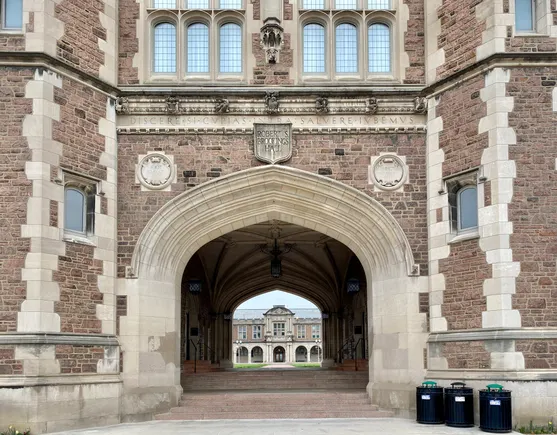
  • Washington University lays off over 300 employees

    Washington University lays off over 300 employees

    This audio is auto-generated. Please let us know if you have feedback.

    Dive Brief:

    • Washington University in St. Louis has laid off 316 staffers and eliminated another 198 unfilled positions since March, Chancellor Andrew Martin said in a community message Tuesday. 
    • Leaders made the cuts to the private university’s main campus as well as to its medical center. In all, the reductions are expected to save about $52 million annually, Martin said. 
    • The chancellor cited several budget pressures driving the cuts, including “drastic reductions in federal research funding,” the changing needs of students, and “ineffective processes and redundancies in the way we operate.” 

    Dive Insight:

    Martin framed the workforce cuts overall in terms of mission and financial sustainability. “If we want to be great, and not just good, we must focus our resources where they will have the most impact and ensure that we’re positioned for success in the long-term,” he said.

    He said the current round of reductions were finished but hinted that there could be more changes down the line. “We must continue to evaluate how we work and identify additional ways to operate more effectively in support of our mission, if we are to be successful,” Martin said. 

    Nonetheless, WashU is in a much stronger position than many of its peers in the private college world. 

    For fiscal 2024, the university logged $20.5 billion in assets on its balance sheet and an operating surplus of $150.3 million. 

    Still, that surplus has been steadily shrinking in recent years. Just between fiscal years 2022 and 2024, the figure fell by 58%. Over the same period, total expenses rose by nearly 25%, or about $1 billion, to $5.1 billion in fiscal 2024.

    For fiscal 2025, the university broke even on its budget thanks to “prudent financial management and thoughtful work,” Martin said in late July. Among other actions, WashU paused new construction projects such as a planned arts and sciences building and green space upgrades.

    In the same July message, Martin pointed to long-term “structural budget challenges that WashU must address” and announced that the university would skip annual merit raises for its employees for fiscal 2026. 

    I know this is disappointing news,” he said. “Please know it is not a reflection of your hard work and contributions, which I deeply value, but a necessary step as we prioritize long-term institutional stability and strategic investment in our core mission.” 

    As WashU looks ahead to future fiscal years, Martin noted in his July message that the university will face a heightened endowment tax bill of roughly $37 million after Republicans’ massive tax and budget bill passed this summer takes effect. 

    In fiscal 2024, the university’s endowment was worth $12 billion, or about $797,600 per student, according to the latest study from the National Association of College and University Business Officers and asset management firm Commonfund.

    Source link

  • At least 4 presidents abruptly departed their institutions last month amid pressure campaigns

    At least 4 presidents abruptly departed their institutions last month amid pressure campaigns

    This audio is auto-generated. Please let us know if you have feedback.

    The higher education sector saw several notable examples of college president turnover in September, at a time when the position is becoming increasingly fraught.

    In some cases, presidents announced their intention to retire or move on to a new institution with ample lead time. But in others, they stepped down abruptly after facing pressure campaigns from politicians or from within their college.

    Below, we’re rounding up some of last month’s most significant college leadership changes.

    President: Mark Welsh
    Institution: Texas A&M University
    Coming or going?: Going

    Mark Welsh stepped down as president of Texas A&M University on Sept. 19 after the content of one of the institution’s classes created a political maelstrom. Earlier in the month, a conservative state lawmaker shared a video of a Texas A&M professor teaching about gender identity and called for the instructor to be fired. Welsh quickly complied, but the lawmaker then began calls for the president to be fired as well.

    The Texas A&M University System Board of Regents authorized a settlement with Welsh on Sept. 26 but declined to share specifics until the details are finalized, The Texas Tribune reported.


    President: Michael Schill
    Institution: Northwestern University
    Coming or going?: Going

    On Sept. 4, Michael Schill announced he would step down as president of Northwestern University, pending the selection of an interim leader. Northwestern named Henry Bienen, who previously led the university for over two decades, as interim president on Sept. 16.

    Schill’s departure followed a three-year tenure marked by increased federal scrutiny. 

    Last May, conservative lawmakers opened an investigation into Northwestern’s handling of pro-Palestinian protests on its campus and ordered the private Illinois university to turn over extensive paperwork related to student and employee discipline and conduct cases. Schill, along with other college leaders, was also called to testify regarding campus protest responses.

    Schill and Northwestern’s board chair announced in April that the university would self-fund vital research that has been threatened by the Trump administration cuts.


    President: Andrés Acebo
    Institution: New Jersey City University
    Coming or going?: Coming

    Andrés Acebo became New Jersey City University’s permanent president on Sept. 10, after serving as the institution’s interim president since January 2023. He will be the youngest known president to lead a public New Jersey university, according to NJCU.

    Acebo joined NJCU at a turbulent time for the beleaguered university. A year into his tenure, a state-appointed monitor directed NJCU to find an academic partner to help stabilize its finances. NJCU is now on track to become part of fellow public institution Kean University

    In its announcement, NJCU credited Acebo with helping orchestrate “a remarkable financial and academic recovery.”


    President: Sean Huddleston
    Institution: Martin University
    Coming or going?: Going

    Martin University announced on Sept. 11 that President Sean Huddleston will step down this fall. Huddleston has led Indiana’s only predominantly Black institution for six years

    Martin has faced a number of financial and organizational challenges in recent years, including declining enrollment, increased borrowing and a 2022 cyberattack that affected its transcripts. All these factors were cited in a 2023 audit that found that “substantial doubt exists about the university’s ability to continue.”

    Since then, Huddleston has overseen a number of new initiatives, including a forthcoming “virtual campus,” a significant tuition reset, and a tuition forgiveness program that erased up to $10,000 in debt for qualifying students.

    Huddleston’s last day is set for Nov. 28. 

    President: Kimberly Espy
    Institution: Wayne State University
    Coming or going?: Going

    Kimberly Espy stepped down as president of Wayne State University on Sept. 17. 

    Source link

  • How Credit for Prior Learning Strengthens Workforce Ties

    How Credit for Prior Learning Strengthens Workforce Ties

    In today’s rapidly evolving workforce landscape, higher education institutions face mounting pressure to demonstrate value, relevance and return on investment. Amid this challenge lies an underutilized strategy with remarkable potential: credit for prior learning.

    We’ve long recognized CPL’s benefits for students. Learners who receive CPL credits are more likely to complete their degrees (49 percent vs. 27 percent for those without) and, on average, they earn 17.6 additional credits, finish nine to 14 months sooner and save between $1,500 and $10,200 in tuition costs (CAEL). But what’s often overlooked is CPL’s power to transform relationships between educational institutions and employers—creating a win-win-win for students, institutions and industry.

    Beyond a Student Benefit

    The traditional narrative around CPL emphasizes student advantages: increased enrollment, improved completion rates and reduced time to graduation. These metrics matter tremendously, but they tell only part of the story.

    CPL can serve as a bridge between academia and industry, creating powerful new partnerships. When colleges and universities embrace robust CPL programs, they send a clear message to employers: We value the training and development you provide. Recognizing corporate training as creditworthy learning demonstrates respect for workplace knowledge and underscores higher education’s commitment to real-world relevance.

    Employer and Workforce Gains

    For employers, CPL validates that their internal training programs have academic merit. This recognition strengthens recruitment and retention efforts, as workers see clear pathways to advance their education without duplicating learning they’ve already mastered. Companies that invest in employee development also gain educational partners who understand industry needs and value the attributes that drive employee success.

    The benefits extend further: Organizations with tuition remission or reimbursement programs can reduce costs while enhancing employee motivation and persistence.

    Deeper Collaboration Between Higher Ed and Industry

    As institutions evaluate workplace training for credit equivalency, they gain invaluable insights into industry practices and skill needs. This exchange allows colleges to refine curricula to better meet market demand, ensuring graduates possess the competencies employers seek—not just those defined within academic silos.

    The hard but necessary conversations—between faculty and corporate training leaders—help ensure CPL evaluations are rigorous and relevant. Key questions include: Why include certain topics but not others? How do we know participants can demonstrate knowledge? Does the training align with broader disciplinary or leadership needs, or is it niche? These discussions strengthen both educational and workplace outcomes.

    Reimagining CPL

    The future of higher education lies in breaking down artificial barriers between academic and workplace learning. By embracing CPL as a cornerstone strategy—not only for student success but also for employer partnerships—institutions can position themselves at the nexus of education and employment.

    This approach doesn’t diminish academic rigor; it expands our understanding of where and how meaningful learning occurs. Done well, CPL creates pathways that honor all learning, regardless of where it happens. And for learners, the message is clear: Your hard work counts.

    Source link

  • How AI Can Smooth College Credit Transfer

    How AI Can Smooth College Credit Transfer

    Upward transfer is viewed as a mechanism to provide college students with an accessible and affordable on-ramp to higher education through two-year colleges, but breakdowns in the credit-transfer process can hinder a student’s progress toward their degree.

    A recent survey by Sova and the Beyond Transfer Policy Advisory Board found the average college student loses credits transferring between institutions and has to repeat courses they’ve already completed. Some students stop out of higher education altogether because transfer is too challenging.

    CourseWise is a new tool that seeks to mitigate some of these challenges by deploying AI to identify and predict transfer equivalencies using existing articulation agreements between institutions. So far, the tool, part of the AI Transfer and Articulation Infrastructure Network, has been adopted at over 120 colleges and universities, helping to provide a centralized database for credit-transfer processes and automate course matching.

    In the most recent episode of Voices of Student Success, host Ashley Mowreader speaks with Zachary Pardos, an associate professor at the University of California, Berkeley, about how CourseWise works, the human elements of credit transfer and the need for reliable data in transfer.

    An edited version of the podcast appears below.

    Q: As someone who’s been in the education-technology space for some time, can you talk about this boom of ed-tech applications for AI? It seems like it popped up overnight, but you and your colleagues are a testament to the fact that it’s been around for decades.

    Zach Pardos, associate professor at UC Berkeley and the developer of CourseWise

    A: As soon as a chat interface to AI became popularized, feasible, plausible and useful, it opened up the space to a lot of people, including those who don’t necessarily have a computer science background. So in a way, it’s great. You get a lot more accessibility to this kind of application and work. But there have also been precepts—things that the field has learned, things that people have learned who’ve been working in this space for a while—and you don’t want to have to repeat all those same errors. And in many ways, even though the current generation of AI is different in character, a lot of those same precepts and missteps still apply here.

    Q: What is your tool CourseWise and why is it necessary in the ed-tech space?

    A: CourseWise is a spinoff of our higher education and AI work from UC Berkeley. It is meant to be a credit-mobility accelerator for students and institutions. It’s needed because the greatest credit-mobility machine in America, the thing that gets families up in socioeconomic status, is education. And it’s the two-year–to–four-year transition often that does that, where you can start at a more affordable school that gives two-year associate’s degrees and then transition to a four-year school.

    But that pathway often breaks down. It’s often too expensive to maintain, and so for there to be as many pathways as possible that are legitimate between institutions, between learning experiences, basically acknowledging what a student has learned and not making them do it again, requires us to embrace technology.

    Q: Can you talk more about the challenges with transfer and where course equivalency and transfer pipelines can break down in the transition between the two- and four-year institutions?

    A: Oftentimes, when a student applies to transfer, they’ll have their transcript evaluated [by the receiving institution], and it’ll be evaluated against existing rules.

    Sometimes, when it’s between institutions that have made an effort to establish robust agreements, the student will get most of their credit accepted. But in instances where there aren’t such strong ties, there’s going to be a lot of credit that gets missed, and if the rules don’t exist, if the institution does go through the extra effort, or the student requests extra effort to consider credit that hasn’t been considered before, this can be a very lengthy process.

    Sometimes that decision doesn’t get made until after the student’s first or second semester, semesters in which they maybe had to decide whether or not to take such a course. So it really is a matter of not enough acknowledgment of existing courses and then that process to acknowledge the equivalency of past learning being a bit too slow to best serve a learner.

    Q: Yeah. Attending a two-year college with the hopes of earning a bachelor’s degree is designed to help students save time and money. So it’s frustrating to hear that some of these students are not getting their transfer equivalencies semesters into their progress at the four-year, because that’s time and energy lost.

    A: Absolutely. It’s unfortunately, in many cases, a false promise that this is the cheaper way to go, and it ends up, in many cases, being more expensive.

    Q: We can talk about the transfer pipeline a lot, but I’ll say one more thing: The free marketplace of higher education and the idea that a student can transfer anywhere is also broken down by a lack of transfer-articulation agreements, where the student’s credits aren’t recognized or they’re only recognized in part. That really hinders the student’s ability to say, “This is where I want to go to college,” because they’re subject to the whims of the institutions and their agreements between each other.

    A: That’s right, and it’s not really an intentional [outcome]. However, systems that have a power dynamic often have a tendency not to change, and that resistance to change, kind of implicitly, is a commitment not to serve students correctly.

    Accreditors Weigh In

    The Council of Regional Accrediting Commissions (C-RAC) supports the exploration and application of AI solutions within learning evaluation and credit transfer, according to a forthcoming statement from the group to be released Oct. 6. Three accrediting commissions, MSCHE, SACSCOC and WSCUC, are holding a public webinar conversation to discuss transfer and learning mobility, with a focus on AI and credit transfer on Oct. 6. Learn more here.

    So what you do need is a real type of intervention. Because it’s not in any one spot, you could argue, and you could also make the argument that every institution is so idiosyncratic in its processes that you would have to do a separate study at every institution to figure out, “OK, how do we fix things here?” But what our research is showing on the Berkeley end is that there are regularities. There are patterns in which credit is evaluated, and where you could modify that workflow to both better serve the institution, so it’s not spending so many resources on manually considering equivalencies, and serve the student better by elevating opportunities for credit acceptance in a more efficient way.

    That’s basically what CourseWise is. It’s meant to be an intervention that serves the institution and serves the student by recognizing these common patterns to credit acceptance and leveraging AI to alleviate the stress and friction that currently exists in affording that credit.

    Q: Can you walk us through where CourseWise fits into the workflow? How does it work practically?

    A: CourseWise is evolving in its feature set and has a number of exciting features ahead, which maybe we’ll get to later. But right now, the concrete features are that on the administrator side, on the staff or admissions department side, you upload an institution’s existing articulation agreements—so if you’re a four-year school, it’s your agreements to accept credit from two-year schools.

    So then, when you receive transcripts from prospective transfer students, the system will evaluate that transcript to tell you which courses match existing rules of yours, where you’ve guaranteed credit, and then it’ll also surface courses that don’t already have an agreement.

    If there’s a high-confidence AI match, it’ll bring that to the administrator’s attention and say, “You should consider this, and here’s why.” It’ll also bring to their attention, “Here’s peer institutions of yours that have already accepted that course as course-to-course credit.”

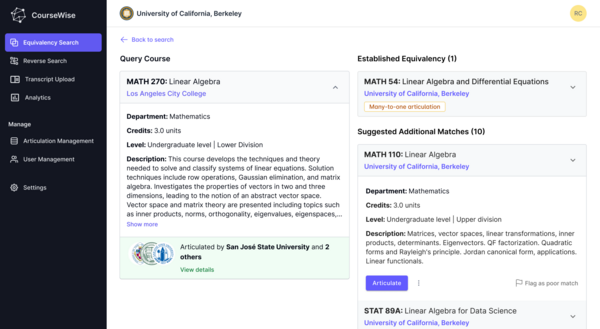
    A screenshot of the CourseWise software, showing a query course, Math 270: Linear Algebra, and how it compares to the equivalent courses on Linear Algebra.

    CourseWise compares classes in institutions’ catalogs to identify existing agreements for credit transfer and possible course-to-course transfers to improve student outcomes.

    Q: Where are you getting that peer-to-peer information from?

    A: We think of CourseWise as a network, and that information on what peer institutions are doing is present. We have a considerable number of institutions from the same system. California is one—we have 13 California institutions, and we’re working on more. The other is State University of New York, SUNY. We have the SUNY system central participating in a pilot. It’ll be up to the individual institutions to adopt the usage. But we have data at the system-center level, and because of that centralized data, we are able to say, for every SUNY institution that’s considering one of the AI credit acceptance requests, give that context of, “Here are other four-year peer institutions within your system that already accept this—not just as generic elective credit, but accept it as perhaps degree satisfying, or at least course-to-course credit.”

    Q: That’s awesome; I’m sure it’s a time saver. But where do the faculty or staff members come back into the equation, to review what the AI produced or to make sure that those matches are appropriate?

    A: Faculty are a critical part of the governance of credit equivalency in different systems. They have different roles; often it’s assumed that faculty approve individual courses. That’s true in most cases. Sometimes it’s committees; different departments will have a committee of faculty, or they may even have a campus standing committee that considers this curricular committee that makes those decisions.

    But what CourseWise is doing right now to incorporate faculty appropriately is we’re allowing for the institution to define what is that approval workflow and the rules around that. If it’s a lower-division statistics class, can your admission staff make that decision on acceptability, even if it’s not existing in a current agreement?

    Under what circumstances does it need to be routed to a faculty member to approve? What kind of information should be provided to that faculty member if they don’t have it, making it easy to request information, like requesting a syllabus be uploaded by the sending institution or something to that effect?

    Oftentimes, this kind of approval workflow is done through a series of emails, and so we’re trying to internalize that and increase the transparency. You have different cases that get resolved with respect to pairs of courses, and you can see that case. You can justify why a decision was made, and it can be revisited if there’s a rebuttal to that decision.

    Now, over time, what we hope the field can see as a potential is perhaps for certain students, let’s say, coming from out of state; it’s more a faculty committee who gives feedback to a kind of acceptance algorithm that is then able to make a call, and they can veto that call. But it creates a default; like with ChatGPT, there’s an alignment committee that helps give feedback to ChatGPT answers so that it is better in line with what most users find to be a high-quality response. Because there’s no way that we can proactively, manually accept or evaluate every pair of institutions to one another in the United States—there’s just no FTE count that would allow for that, which means that prospective students from out of state can’t get any guarantee if we keep it with that approach.

    Faculty absolutely have control. We’re setting up the whole workflow so an institution can define that. But one of the options we want to give institutions is the option to say, “Well, if the student is coming from out of state or coming from this or that system, you can default to a kind of faculty-curated AI policy.”

    Q: That’s cool. I’ve heard from some colleges that they have full teams of staff who just review transcripts every single day. Having a centralized database where you can see past experiences of which courses have been accepted or rejected—that can save so much time and energy. And that’s not even half of what CourseWise is doing.

    A: Absolutely, and we work closely with leadership and these institutions to get feedback. And one of the people involved in that early feedback is Isaiah Vance at the Texas A&M University system, and he’s given us similar feedback where, if you have a new registrar or a new leadership that comes in, and they want to know how good the data is, they want that kind of transparency of how were decisions made, if you have that transparency in that organization to look that over, it can really help an institution get comfortable with those past decisions or decide how they should change in the future.

    Q: What are some of the outcomes you’ve seen or the feedback you’ve heard from institutions that are using the tool?

    A: We have a study that we’re about to embark upon to measure a before-and-after change in how institutions are doing business and how much it’s saving time or not, versus a control of not having the system when making these decisions.

    We don’t have the results of that yet. We do have a paper out on where articulation officers, for example, are spending their time. They’re spending a lot of time on looking for the right course that might articulate. So we definitely have identified there is a problem. It’s an open question to what degree CourseWise is remedying that. We certainly are working nonstop to remedy it, but we’re going to measure that rigorously over the next year.

    Some early feedback is positive, but also interesting that institutions, many of them, are spending a lot of time getting that initial data uploaded, catalog descriptions, articulations and the rigorousness and validity of that data. Maybe it’s spread across a number of Excel spreadsheets at some institutions—that problem is real—and so I think it’s going to take a field-level or industry-level effort to make sure that everyone can be on board with that data-wrangling stage.

    Q: That was my hypothesis, that the tool has a lot of benefits once everything’s all set up and they’ve done the labor of love to hunt down and upload all these documents, find out which offices they’re hiding behind.

    A: There are a number of private foundations, funders who are invested in that particular area. So I’m optimistic that there’s a solution out there and that we’ll be a part of that.

    Q: I wonder if we can talk about how this tool can improve the student experience with transfer and what it means to have these efficiencies and database to lean back on.

    A: Right now, most of the activity is with the four-year schools, because they’re the ones uploading the articulations. They’re the ones evaluating transcripts. But in the next four months, we’re releasing a student-facing planner, which will directly affect students at the sending institutions.

    This planner will allow a student who’s at a community college to choose what destination school and major they’re interested in that’s part of the CourseWise network. Then [CourseWise provides] what courses they need to take, or options of courses to take that will transfer into the degree program that they’re seeking, such that when they transfer, they would only have to do the equivalent of two full years of academic work at that receiving school.

    It would also let them know what other majors at other institutions they may want to consider because of how much of the credit that they’ve already taken is accepted into the degree programs there. So the student may be 20 percent of the way in completing their initially intended destination program, but maybe they’re 60 percent of the way to another program that they didn’t realize.

    Q: What’s next for CourseWise?

    A: So the student part is the navigation, the administrator articulation expansion and policy for expansion is creating the pathways; you need a GPS in order to know what the paths are and how to traverse them as a learner. But also states—I mentioned regularities—there are commonalities in how these processes take place, but there’s also very specific state-level concerns and structures, like common course numbering, credit for prior learning, an emphasis on community colleges accepting professional certificate programs and so forth.

    I think the future is both increasing that student-facing value, helping with achievement from the student point of view. But then also leveraging the fundamental AI equivalency engine and research to bring in these other ways of acknowledging credit, whether it’s AP credit or job-training credit or certificates or cross-walking between all these different ways in which higher education chooses to speak about learning, right?

    If you have a requirement satisfied in general education in California, how do you bring that to New York, given New York’s general education requirements? Are there crosswalks that can be suggested and established with the aid of AI? And I’m excited about connecting these different sorts of dialects of education using technology.

    Source link

  • Missouri President Wants Local Officials to Address Crime

    Missouri President Wants Local Officials to Address Crime

    University of Missouri president Mun Choi is pressing local officials about crime rates near the Columbia campus after a student from neighboring Stephens College died Sunday following a downtown shooting, KCUR and the Columbia Missourian reported. 

    The president’s demand to address the city’s “rampant crime rate” has gathered some support, but critics say that his characterization of the local climate is overexaggerated, pointing to data from the local police department.

    The shooting, which also resulted in serious injuries to two others, took place early Saturday morning on the college town’s main street. One individual, not from the city, got into a verbal dispute and then opened fire toward the people he was confronting. The three individuals he hit, however, were bystanders.    

    In a letter sent the same day as the shooting, Choi called on city and county leaders to bolster the police presence and prosecute crimes to the fullest extent of the law. He also urged them to take down encampments of unhoused individuals, pass a loitering notice and repeal policies that “attract criminals to the region.”  

    But when asked during a press conference Monday what policies and practices he believes “attract criminals,” the MU president said he had none to cite. Neither the shooter in the Saturday incident nor any of the victims have been identified as unhoused, according to local reporting.

    “That is why I am asking [local leaders] to evaluate the processes that we have and the practices,” he explained. “Are we giving the impression to potential criminals that this is a region that doesn’t take crime enforcement as well as the punishment that comes with it seriously?”

    Choi later added that students and local business owners have been raising safety concerns about the city’s unhoused population. According to university data, the number of arrests and trespassing violations issued to the unhoused has “gone up dramatically” since 2019, he said.

    That is different, however, from what some local police department data shows.

    In a Facebook post Monday, the city’s mayor, Barbara Buffaloe, said there have been 58 gunshot incidents since the beginning of the year. That’s down from 105 in the first nine months of 2024.

    Columbia Police Department chief Jill Schlude did note in a separate letter, however, that since 2019 more crimes have been concentrated downtown, occurring between midnight and 3 a.m. 

    “The connection between late-night social activity and violence is clear, and that is where we continue to focus our efforts,” Schlude said.

    Regardless of any disputes over the data, multiple government officials—including Gov. Mike Kehoe, several members of the Columbia City Council and Mayor Buffaloe—have voiced support for Choi’s general call to improve safety. Buffaloe has also committed to forming a task force on the matter, and the CPD has outlined plans to increase the police presence downtown. 

    “Statistics cannot be used solely as a reason for us to move away from what needs to be done in the city of Columbia,” Choi said.

    Source link

  • UNC Professor on Leave After Alleged Advocacy of Political Violence

    UNC Professor on Leave After Alleged Advocacy of Political Violence

    Eros Hoagland/Getty Images

    Officials at the University of North Carolina at Chapel Hill placed Professor Dwayne Dixon on leave Monday while the university investigates his “alleged advocacy of politically motivated violence,” said Dean Stoyer, UNC Chapel Hill’s vice chancellor for communications and marketing.

    Dixon, an associate professor of Asian and Middle Eastern studies, used to be a member of Silver Valley Redneck Revolt, a chapter of the antifascist, antiracist, anticapitalist political group Redneck Revolt. The group was formed in 2016 and some members, including Dixon, were present at the 2017 Unite the Right rally in Charlottesville, Va., to provide armed security and medical assistance to counterprotesters. Redneck Revolt disbanded in 2019 and has no active chapters, according to its website.

    In a 2018 interview with The Chronicle of Higher Education, Dixon described himself as an “anarchist,” and he is no stranger to blowback for his political activism and support for gun rights. He was arrested for bringing a semiautomatic rifle to a Ku Klux Klan counterprotest in Durham, N.C., in 2018—the case was later dismissed as unconstitutional on the grounds that the charges violated Dixon’s First and Second Amendment rights. He was also among 20 people who protected counterprotesters in Durham when white supremacists protested the removal of a Confederate statue in 2017. Through all these events, Dixon remained employed at UNC Chapel Hill.

    Why is Dixon in the hot seat now? The answer is convoluted, but it begins with fliers on the Georgetown University campus.

    On Sept. 24, Andrew Kolvet, a spokesperson for the late Charlie Kirk’s Turning Point USA, posted on X a photo of a flier on the Georgetown campus in Washington, D.C., that read, “Hey Fascist! Catch!”—a nod to engraving on the casing of bullets left behind by Kirk’s suspected killer—and “The only political group that celebrates when Nazis die.” The flier also included a QR code to a Google form for a potential Georgetown chapter of the John Brown Gun Club, a Redneck Revolt affiliate organization known as a “leftist gun-rights group” with multiple independent chapters, including one in the D.C. area, according to the Counter Extremism Project. It “arms itself to defend against far-right violence and often appears as a security force at protests to protect against expected far-right violence,” the CEP wrote. Google has since removed the form for violating its terms of service.

    University officials removed the fliers and reported them to the FBI. Education Secretary Linda McMahon also weighed in: “At a moment like this, Georgetown has to determine what it stands for as an institution … Allowing violent rhetoric to fester on our nation’s campuses without consequences is dangerous. It must be condemned by institutional leaders,” she wrote on X. “I am grateful to those who spoke out against this and made noise about the posters on campus—you made a difference. There is power in speaking up to reveal these hateful ideologies that have incited deadly violence.”

    Kolvet posted again, this time linking to a recent Fox News article that cited Dixon’s involvement in Redneck Revolt based on an old blog post that has since been taken down. “I posted this flyer our team spotted at Georgetown University, and now we find out professors at ‘elite’ schools are members of this group and its offshoots,” Kolvet wrote. “This professor must be immediately fired and the group/network investigated.”

    Dixon was placed on leave Monday, which will “allow the University to investigate these allegations in a manner that protects the integrity of its assessment,” UNC’s Stoyer said in his statement. “Depending upon the nature and circumstances of this activity, this conduct could be grounds for disciplinary action up to and including potential termination of employment.”

    UNC Chapel Hill officials declined to answer any other questions about Dixon and did not say whether Kolvet’s post or the Fox News article led to the investigation. Dixon did not reply to a request for comment but told the student newspaper The Daily Tarheel that he left the Silver Valley Redneck Revolt in 2018.

    A Change.org petition to reinstate Dixon is circulating and as of Wednesday evening had more than 900 signatures. In a statement Wednesday, the North Carolina chapter of the American Association of University Professors, as well as UNC Chapel Hill’s AAUP president, condemned the university’s actions and demanded Dixon be reinstated.

    “Right-wing activists are attacking Dixon for prior membership in a group that has been inactive since 2019, and are baselessly connecting him to flyers allegedly posted by a different group on a different campus outside of North Carolina. Fox News picked up the story on September 27, 2025, without verifying the existence of the flyers, and apparently this was enough for UNC’s administration to remove a professor from the classroom in the middle of the semester and bar him from campus,” the statement read. “Let’s call this what it is: UNC administrators are capitulating to a call from a right-wing group, infamous for attacking faculty, to fire a professor based on an unsubstantiated rumor.”

    Dixon joins the ranks of dozens of college and university faculty members who have been placed on leave, disciplined or fired in the weeks since Kirk was shot and killed. All of these professors have been investigated after right-wing personalities identified them on social media. Two of them—Michael Hook, who was placed on leave for social media comments he made about Kirk’s death, and Thomas Alter, who was terminated after being accused of inciting violence during a speech—have been reinstated by court orders.

    Source link

  • Contextualizing Completion Gaps for First-Gen Students

    Contextualizing Completion Gaps for First-Gen Students

    First-generation students are twice as likely to leave college without completing a bachelor’s degree than their peers, even if they come from higher-income backgrounds and come to college academically prepared, according to a new report from the Common App. The findings suggest these factors do make a difference for student success outcomes but don’t erase other barriers first-generation students might face.

    The report, released Thursday and the fourth in a series on first-generation students, used data from the National Student Clearinghouse Research Center to track enrollment, persistence and completion rates for 785,300 Common App applicants in the 2016–17 application cycle. (Students whose parents didn’t complete bachelor’s degrees made up 32 percent of the sample.) The report also took into account how a range of factors could affect student outcomes, including students’ incomes, their levels of academic preparation and how well-resourced their colleges are.

    Previous studies have shown that “first-generation students are certainly not a monolith,” said Sarah Nolan, lead author of the report and a research scientist at Common App. “We were hoping to give readers a sense for … which first-generation students might in particular need more support.”

    The good news is the report found first-generation applicants enroll in college at rates on par with their peers. Over 90 percent of Common App applicants, first-generation and otherwise, enrolled in college within six years of applying.

    But first-generation students were slightly more likely to not enroll immediately (17 percent) or to enroll at a two-year college (12 percent) compared to other applicants (14 percent and 4 percent, respectively). That gap mostly closed when comparing students with strong academic records, defined as having SAT or ACT scores or GPAs in the top quartile. According to the report, that finding may be because a higher share of first-generation students may need extra coursework before enrolling in a four-year institution.

    Students might also work to save up for college first or opt for community colleges’ more affordable tuition rates, the report suggested. Lower-income first-generation students, who qualified for application fee waivers, were also less likely to immediately enroll at four-year institutions and more likely to first enroll at a community college compared to similar students not from first-generation backgrounds.

    Over all, “we are really heartened to see that there’s really not very strong differences in college enrollment,” Nolan said.

    Completion rates, however, are another story. While about 70 percent of first-generation students do complete a bachelor’s degree within six years of enrolling, the report found stark disparities between them and their peers.

    About half of first-generation students completed a bachelor’s degree within four years, compared to 68 percent of continuing-generation students, a gap of 18 percentage points. And that disparity persisted when looking at six-year graduation rates. About 69 percent of first-generation students graduated within six years, compared to 86 percent of continuing-generation students, a 17-percentage-point difference.

    These gaps shrank but didn’t disappear for first-generation students with strong academic records and higher incomes. Academically prepared first-generation students were twice as likely to disenroll with no degree than their continuing-generation counterparts, 14 percent and 6 percent, respectively. In a similar vein, 24 percent of higher-income first-generation students left college without a degree within six years compared to 12 percent of their continuing-generation counterparts. Even for first-generation students who were both academically prepared and relatively well-off, these gaps remained.

    Differences in the institutions first-generation and continuing-generation students attend—and the levels of supports they offer—didn’t account for completion-rate gaps, either.

    Even when attending the exact same institutions, first-generation students were 10 percentage points less likely to earn a bachelor’s degree within six years than continuing-generation students.

    However, higher per-student expenditures did seem to contribute to better student success outcomes. At institutions that spent at least $20,000 per student, 84 percent of first-generation graduated within six years, compared to 94 percent of continuing-generation students. The gap between first-generation and continuing-generation students’ completion rates widened to 15 percentage points at colleges that spent more moderately, $10,000 to $15,000 per student, and 17 percentage points at colleges with low per-student expenditures, less than $7,500.

    These findings suggest that, while first-generation students disproportionately face financial constraints and barriers to college prep, it doesn’t explain away their graduation rate gaps. And students attending less resourced institutions isn’t a full explanation, either. Other obstacles must be at play.

    What those barriers are may be “best answered by speaking with first-generation students themselves and unpacking what’s happening at the individual level,” Nolan said. But first-generation students likely struggle with limited access to information about higher ed and its “hidden curriculum” of expectations, regardless of income, high school performance or which college they attend.

    “Having the right resources at the right time on the pathway—that’s really critical for student success,” Nolan added.

    The stakes of success are high—the report found many first-generation students spent considerable time and money on college with no degree to show for it. Almost a third of first-generation students who didn’t earn a degree were enrolled for at least four years.

    But a hopeful finding is that “additional investment can be quite positive for helping these students really actualize their potential,” Nolan said.

    Source link

  • Lane Community College Board Apologizes to President

    Lane Community College Board Apologizes to President

    The Lane Community College Board of Education apologized to President Stephanie Bulger at its Tuesday meeting for how members disrespected her on the basis of her race and sex, Lookout Eugene-Springfield reported

    The board’s apology follows the findings of an investigative report released in August that determined board members were frequently dismissive of Bulger—a Black woman—and often deferred questions to male staff members. The report found that former board chair Zach Mulholland was frequently hostile toward Bulger and often cut her off in their interactions. (He was also found to have physically intimidated a student at a board meeting.) Although Mulholland was censured by the board last month, he has resisted calls to step down.

    Much of the report focused on Mulholland, but other members were also implicated.

    “The board recognizes and is accountable for the harm caused to you, President Bulger,” said Austin Fölnagy, the current board chair, who was also accused of dismissive behavior. “We are deeply sorry for the negative impact our behavior has had on you and the college community at large. President Bulger, please accept the board’s apology for treating you badly.” 

    He added that the board is “committed to learning from our shortcomings” and will take “remedial actions including training in bias, discrimination and harassment” this fiscal year.

    Bulger has been president of the Oregon community college since July 2022.

    Source link