University of Missouri president Mun Choi is pressing local officials about crime rates near the Columbia campus after a student from neighboring Stephens College died Sunday following a downtown shooting, KCUR and the Columbia Missourian reported.
The president’s demand to address the city’s “rampant crime rate” has gathered some support, but critics say that his characterization of the local climate is overexaggerated, pointing to data from the local police department.
The shooting, which also resulted in serious injuries to two others, took place early Saturday morning on the college town’s main street. One individual, not from the city, got into a verbal dispute and then opened fire toward the people he was confronting. The three individuals he hit, however, were bystanders.
In a letter sent the same day as the shooting, Choi called on city and county leaders to bolster the police presence and prosecute crimes to the fullest extent of the law. He also urged them to take down encampments of unhoused individuals, pass a loitering notice and repeal policies that “attract criminals to the region.”
But when asked during a press conference Monday what policies and practices he believes “attract criminals,” the MU president said he had none to cite. Neither the shooter in the Saturday incident nor any of the victims have been identified as unhoused, according to local reporting.
“That is why I am asking [local leaders] to evaluate the processes that we have and the practices,” he explained. “Are we giving the impression to potential criminals that this is a region that doesn’t take crime enforcement as well as the punishment that comes with it seriously?”
Choi later added that students and local business owners have been raising safety concerns about the city’s unhoused population. According to university data, the number of arrests and trespassing violations issued to the unhoused has “gone up dramatically” since 2019, he said.
That is different, however, from what some local police department data shows.
In a Facebook post Monday, the city’s mayor, Barbara Buffaloe, said there have been 58 gunshot incidents since the beginning of the year. That’s down from 105 in the first nine months of 2024.
Columbia Police Department chief Jill Schlude did note in a separate letter, however, that since 2019 more crimes have been concentrated downtown, occurring between midnight and 3 a.m.
“The connection between late-night social activity and violence is clear, and that is where we continue to focus our efforts,” Schlude said.
Regardless of any disputes over the data, multiple government officials—including Gov. Mike Kehoe, several members of the Columbia City Council and Mayor Buffaloe—have voiced support for Choi’s general call to improve safety. Buffaloe has also committed to forming a task force on the matter, and the CPD has outlined plans to increase the police presence downtown.
“Statistics cannot be used solely as a reason for us to move away from what needs to be done in the city of Columbia,” Choi said.
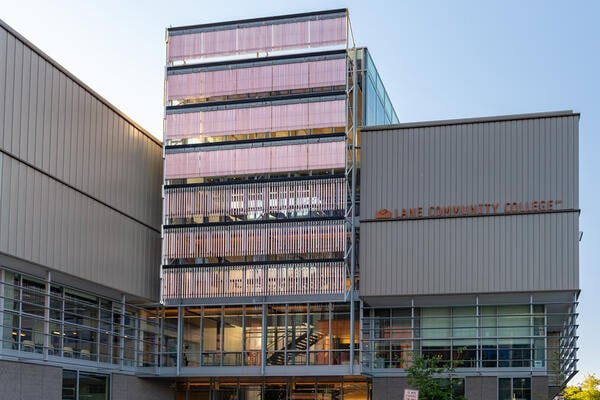
The Lane Community College Board of Education apologized to President Stephanie Bulger at its Tuesday meeting for how members disrespected her on the basis of her race and sex, Lookout Eugene-Springfield reported.
The board’s apology follows the findings of an investigative report released in August that determined board members were frequently dismissive of Bulger—a Black woman—and often deferred questions to male staff members. The report found that former board chair Zach Mulholland was frequently hostile toward Bulger and often cut her off in their interactions. (He was also found to have physically intimidated a student at a board meeting.) Although Mulholland was censured by the board last month, he has resisted calls to step down.
Much of the report focused on Mulholland, but other members were also implicated.
“The board recognizes and is accountable for the harm caused to you, President Bulger,” said Austin Fölnagy, the current board chair, who was also accused of dismissive behavior. “We are deeply sorry for the negative impact our behavior has had on you and the college community at large. President Bulger, please accept the board’s apology for treating you badly.”
He added that the board is “committed to learning from our shortcomings” and will take “remedial actions including training in bias, discrimination and harassment” this fiscal year.
Bulger has been president of the Oregon community college since July 2022.
In recent weeks, the plight of Gazan students and scholars accepted to UK universities has gained attention in British and international media. These individuals are recipients of highly competitive scholarships such as Chevening, as well as other academic awards. They have earned their place at some of the most prestigious institutions in the United Kingdom. Their achievements are remarkable by any standard, but especially so given that they were reached under the harshest conditions imaginable: the collapse of Gaza’s educational infrastructure under bombardment, the absence of functioning universities, and the daily struggle for survival amidst man-made famine and starvation, displacement, and violent death.
Yet despite this extraordinary resilience, these students faced the risk of losing their places before they could even set foot in the UK. The obstacle was not academic performance or funding but rather a bureaucratic and logistical impasse deriving from the Home Office requirement to provide biometric data. Following the brutal assault by Hamas and other armed organisations on Israeli civilians and military bases on October 7th, 2023 and the horrific devastation Israel has unleashed on the Palestinians in Gaza since, the Visa Application Centre (VAC) in Gaza has been closed, thus preventing biometric processing.
Support for Gazan Students
As Israeli academics organised under the banner of the Black Flag Action Group, opposed to the ongoing war in Gaza, we mobilised in support of these students. Over 140 signatories, including Israeli students and scholars at British universities as well as Israeli graduates from British universities, urged the UK government to act decisively and inclusively. In our open letter, we stressed that no administrative hurdle should prevent prospective students from taking up the places they have already earned. When laboratories, libraries, lecture halls and archives lie in ruins, the opportunity to study abroad is not just a personal achievement; it constitutes a lifeline for the ongoing intellectual and professional life of Gazan Palestinians. To have denied these students their places would have been to contradict the UK’s own commitments under schemes like Chevening, which are premised on the idea that education can foster leadership, dialogue, and international understanding.
Window of Hope and Future Implications
On 3 September 2025, the UK government announced that it would expedite visas for Chevening scholars and others to travel to a third country for biometric processing. We were also very relieved to hear that a group of 34 Palestinian students with places at UK universities have safely arrived in the UK to begin their studies after being evacuated from Gaza last week. These are surely welcome steps, but urgent policy questions for higher education in the UK still remain, including what seem to be the remaining rules preventing students from Gaza from bringing family members with them. In fact, as recently reported by the BBC at least four mothers and one father have so far declined places because they would not leave their children behind. As the recent public discussion shows, these go beyond the immediate emergency and touch on structural issues that universities and government alike must confront:
Visa and Mobility Frameworks: Current biometric requirements are ill-suited to situations of war and humanitarian crisis. Universities and advocacy groups must press the Home Office to establish flexible, transparent, and accountable procedures for students from conflict zones.
Equity of Access: Scholarship schemes such as Chevening are designed to promote global leadership. Yet their credibility is undermined if access is contingent not only on merit but also on whether students can survive a war zone and navigate opaque visa procedures.
Moral Responsibility of universities to students and their dependents: UK institutions that have offered places to Gazan students cannot treat their admission as symbolic. They must actively lobby the government, provide legal and financial assistance, and ensure that students’ right to education is not hollow.
The plight of Gazan students is not an abstract problem. It is about gifted men and women who have already demonstrated courage, brilliance, and commitment. Universities, civil society, and policymakers have an ethical obligation to work together to ensure that the promise of higher education for Gazan students in the British system of higher education will not be abandoned at the very moment it is most needed.
With 18 per cent of students reporting mental health difficulties, a figure which has tripled in just seven years, universities are navigating a crisis.
The student experience can compound many of the risk factors for poor mental health – from managing constrained budgets and navigating the cost of learning crisis, to moving away from established support systems, and balancing high-stakes assessment with course workload and part-time work.
In response, universities provide a range of free support services, including counselling and wellbeing provision, alongside specialist mental health advisory services. But if we’re honest, these services are under strain. Despite rising expenditure, they’re still often under-resourced, overstretched, and unable to keep pace with growing demand. With staff-student ratios at impossible levels and wait times for therapeutic support often exceeding ten weeks, some students are turning to alternatives for more immediate care.
And in this void, artificial intelligence is stepping in. While ChatGPT-written essays dominate the sector’s AI discussions, the rise of “pastoral AI” highlights a far more urgent and overlooked AI use case – with consequences more troubling than academic misconduct.
Affective conversations
For the uninitiated, the landscape of “affective” or “pastoral” AI is broad. Mainstream tools like Microsoft’s Copilot or OpenAI’s ChatGPT are designed for productivity, not emotional support. Yet research suggests that users increasingly turn to them for exactly that – seeking help with breakups, mental health advice, and other life challenges, as well as essay writing. While affective conversations may account for only a small proportion of overall use (under three per cent in some studies), the full picture is poorly understood.
Then there are AI “companions” such as Replika or Character.AI – chatbots built specifically for affective use. These are optimised to listen, respond with empathy, offer intimacy, and provide virtual friendship, confidants, or even “therapy”.
This is not a fringe phenomenon. Replika claims over 25 million users, while Snapchat’s My AI counts more than 150 million. The numbers are growing fast. As the affective capacity of these tools improves, they are becoming some of the most popular and intensively used forms of generative AI – and increasingly addictive.
A recent report found that users spend an average of 86 minutes a day with AI companions – more than on Instagram or YouTube, and not far behind TikTok. These bots are designed to keep users engaged, often relying on sycophantic feedback loops that affirm worldviews regardless of truth or ethics. Because large language models are trained in part through human feedback, its output is often highly sycophantic – “agreeable” responses which are persuasive and pleasing – but these can become especially risky in emotionally charged conversations, especially with vulnerable users.
And it’s young people who are engaging with them most. More than 70 per cent of companion app users are aged 18 to 35, and two-thirds of Character.AI’s users are 18 to 24 – the same demographic that makes up the majority of our student population.
The potential harm here is not speculative. It is real and affecting students right now. Yet “pastoral” AI use remains almost entirely absent from higher education’s AI conversations. That is a mistake. With lawsuits now spotlighting cases of AI “encouraged” suicides among vulnerable young people – many of whom first encountered AI through academic use – the sector cannot afford to ignore this.
Paint a clearer picture
Understanding why students turn to AI for pastoral support might help. Reports highlight loneliness and vulnerability as key indicators. One found that 17 per cent of young people valued AI companions because they were “always available,” while 12 per cent said they appreciated being able to share things they could not tell friends or family. Another reported that 12 per cent of young people were using chatbots because they had no one else to talk to – a figure that rose to 23 per cent among vulnerable young people, who were also more likely to use AI for emotional support or therapy.
We talk often about belonging as the cornerstone of student success and wellbeing – with reducing loneliness a key measure of institutional effectiveness. Pastoral AI use suggests policymakers may have much to learn from this agenda. More thinking is needed to understand why the lure of an always-available, non-judgemental digital “companion” feels so powerful to our students – and what that tells us about our existing support.
Yet AI discussions in higher education remain narrowly focused, on academic integrity and essay writing. Our evidence base reflects this: the Student Generative AI Survey – arguably the best sector-wide tool we have – gives little attention to pastoral or wellbeing-related uses. The result is, however, that data remains fragmented and anecdotal on this area of significant risk. Without a fuller sector-specific understanding of student pastoral AI use, we risk stalling progress on developing effective, sector-wide strategies.
This means institutions need to start a different kind of AI conversation – one grounded in ethics, wellbeing, and emotional care. It will require drawing on different expertise: not just academics and technologists, but also counsellors, student services staff, pastoral advisers, and mental health professionals. These are the people best placed to understand how AI is reshaping the emotional lives of our students.
Any serious AI strategy must recognise that students are turning to these tools not just for essays, but for comfort and belonging too, and we must offer something better in return.
If some of our students find it easier to confide in chatbots than in people, we need to confront what that says about the accessibility and design of our existing support systems, and how we might improve and resource them. Building a pastoral AI strategy is less about finding a perfect solution, but more about treating pastoral AI seriously, as a mirror which reflects back at us student loneliness, vulnerabilities, and institutional support gaps. These reflections should push us to re-centre these experiences, to reimagine our pastoral support provision, into an image that’s genuinely and unapologetically human.
“The Movie Industry in America is DYING a very fast death,” declared the 47th president in a post earlier this year on Truth Social. To lure more film productions back to America, Trump ordered the Department of Commerce and the U.S. Trade Representative to place a 100% tariff on foreign films.
Hollywood went into panic mode. But the summer months passed without any update from the White House. Then, on Monday, Trump renewed his calls for a foreign-film tariff.
Much has been made about the financial implications of Trump’s shocking movie mandate. But beyond the economic concerns, both the industry and elected officials alike have failed to consider the broader constitutional implications of the president’s chaotic posts, should the tariffs actually be implemented.
Nestled in his posts, declaring offshore film productions a “National Security threat,” Trump further justified the tariffs this year by labeling foreign films as “propaganda.” For any American who cares about free speech, that should be the cue to jump up and holler, “Cut!”
“Propaganda” carries an ominous connotation, one that those in power have often used to censor speech they dislike. But no matter what the president declares to be propaganda, whether movies or any other medium, it is still protected speech. That protection extends to both making and watching films, regardless of where they were produced, as the First Amendment safeguards not only the right to speak, but also the right to receive information and ideas.
Artists have the right to express their ideas, even when such ideas irk those in power.
Details are incredibly murky, and the White House clarified in May that “no final decisions” have been made on what the policy would look like. But Trump’s threats to use the government’s might to financially punish Hollywood for working with foreign filmmakers, while limiting Americans’ access to those films, are deeply worrying.
Any directive that aims to suppress movies based on their content or filmmakers’ creative choices would violate both the letter and the spirit of the First Amendment. The president claims these tariffs would strengthen American industry, but doing so by targeting filmmakers and their art, based on their place of origin or viewpoint, is as un-American as it gets. It’s less Mr. Smith Goes to Washington and more The Manchurian Candidate.
America’s proud free speech tradition is built on protecting speech critical of those in power. Because of this, the arts have historically been a potent force for social and political change in this country. One just has to look at the history of cinema to see that.
‘So to Speak’ Podcast: ‘The Trials of Lenny Bruce’
His trials began with a police bust at the Jazz Workshop in San Francisco in 1961, and ended with an obscenity conviction in New York in 1964.
Since the medium’s advent over a century ago, movies have been a dominant form of artistic expression in the United States. Not only that, but it’s historically been used to push back against the status quo.
During the studio system’s heyday, Meet John Doe shone a spotlight on the rising threat of fascism on domestic soil. Later, Casablanca tackled the dangers of isolationism. At the height of the Cold War, the Gary Cooper western High Noon challenged the Red Scare. Heralding the start of New Hollywood, Easy Rider rebelled against the prudish, white-picket-fence America of Eisenhower and Kennedy, while They Live! condemned the Reagan-era capitalism of the late 80s and early 90s. During the War on Terror, The Dark Knight questioned the morality of the Patriot Act surveillance state.
Not only that, but courts have consistently repelled government efforts to suppress artistic expression, reaffirming that artists have the right to express their ideas, even when such ideas irk those in power.
In a free society, the government, regardless of who is in power, cannot dictate what films we can watch or what books we can read.
In the 1948 Supreme Court case Winters v. New York, a 6-3 majority explained that “one man’s amusement teaches another’s doctrine.” The First Amendment protects everything from highbrow political commentary to sensational entertainment. Artistically, the line between high- and low-value expression is too subjective, too paper-thin to entrust the government with policing it. This free speech principle still rings true today, but the president seems willing to cast it aside to exert greater control over the film industry.
The nation’s highest court also has much to say on why taxing speech is unconstitutional because, let’s be clear, Trump’s tinseltown tariffs are just another tax. The Supreme Court has repeatedly ruled that the First Amendment protects us against government taxing expression it dislikes.
Like all art, movies both provoke and inspire. They are, in the words of the late film critic Roger Ebert, “empathy machines.” In the darkness of a movie theater, we sit with strangers from different backgrounds. We gravitate to those cathedral-like spaces to share in one singular experience that is more than likely foreign to our own. We watch movies to be swept up in something different. At the very least, movies can challenge our ideas, much like a thriving free speech culture. At their best, movies change us.
In a free society, the government, regardless of who is in power, cannot dictate what films we can watch or what books we can read. And when we encounter a film that we may disagree with, the way we respond is our own speech, our own art, our own expression. As the nation’s chief executive, Trump cannot use the force of the presidency to target filmmakers and their artistic expression in the name of “national security” or “propaganda.” That’s unconstitutional. And that’s to say nothing of the other legal roadblocks to his plan.
The president’s vague, broad call for speech-retaliatory tariffs against foreign films has the potential to silence storytellers, chill the efforts of studios, and prevent American audiences from participating in the international exchange of ideas movies provide.
That doesn’t “Make Hollywood Great Again.” It makes it worse.
Nick Hillman, HEPI Director, bottles his thoughts about this year’s Labour Party Conference.
As multiple fringe events showed, when it comes to higher education the Labour Conference was very busy, with notably more vice-chancellors in attendance than in days of yore.
My Conference sojourn started on Saturday with a trip to Liverpool’s famous Cavern Club to watch the brilliant in-house Beatles tribute band. At the time, I mused about which fab-four song might best sum up the next few days. ‘Taxman’ perhaps?
(If you drive a car) I’ll tax the street
(If you try to sit) I’ll tax your seat
(If you get too cold) I’ll tax the heat
(If you take a walk) I’ll tax your feet
In fact, when it came to higher education, the big news was a giveaway rather than a new tax. I’ll always remember where I was when Margaret Thatcher resigned as Prime Minister (in the Manchester University Students’ Union shop). Perhaps education policy wonks will similarly always remember where they were when they heard maintenance grants were on their way back (albeit for a second time – they were last reintroduced in the mid-2000s before being abolished a decade later).
In my case, I was with dozens of others in a fascinating HEPI fringe event on students’ cost of living, chaired by my colleague Rose Stephenson and featuring Alex Stanley (NUS), Gavan Conlon (London Economics) and Nic Beech (University of Salford). This came hot on the heels of two other HEPI fringe events – one on public opinion and higher education featuring a bevy of vice-chancellors and another with Cambridge University Press and Assessment on ‘Quality Matters’.
It was no surprise the news about maintenance grants won a spontaneous round of applause. It reminded me of the cheer I got during a speech to the University of Derby in 2016, when I read out the breaking news that UKIP’s Leader had just stood down (‘Nigel Farage resigns’, the Guardian reported, ‘after “achieving political ambition”’).
In both instances, the initial reaction was premature. Brexit was not the end of Faragism and it quickly became clear in Liverpool that the return of maintenance grants is not quite what it first seemed either.
Access to our colleges and universities shouldn’t just be for a wealthy few.
That’s why I’m bringing back maintenance grants for those who need them most.
Labour is ambitious for all our young people, no matter their background. I’m putting our values into action.
Most people who have calculated the cost of reintroducing grants have assumed it would cost something in the region of £2 billion a year. However, Ministers plan to fund the new grants via the proposed levy on international students’ fees, which is expected to raise around £600 million. So entitlement to the new means-tested grants will, it turns out, be limited by students’ course choice. You will be quids in only if you are studying what the politicians want you to study.
As I noted at the King’s College London Policy Institute fringe meeting on Wednesday afternoon, funding the new grants from the new levy may seem like clever politics, at least inside Number 10 and the Treasury and also perhaps by anyone seeking election as the Labour Party’s Deputy Leader.
Students and vice-chancellors have been desperate for grants to return and rightly so – for the reasons why, see our recent report on a Minimum Income Standard for Students with TechnologyOne and Loughborough University. But the levy / tariff / tax on international students is hated by those same students and vice-chancellors, putting them in something of a bind when it comes to responding to the Government’s announcement.
Not only do international students typically come from countries that are poorer than the UK, but they are already subsidising UK research and the teaching of domestic students. Now they are expected to contribute towards the day-to-day living costs of poorer home students too (just so long as those UK students are studying courses deemed to be of most economic value). Just how broad do Ministers think international students’ shoulders are?
Many of them come from wealthy backgrounds but some do not have very deep pockets and none is obliged to study in the UK rather than elsewhere. So our higher education institutions are unlikely to be able to pass on the full 6% without seeing a drop in demand.
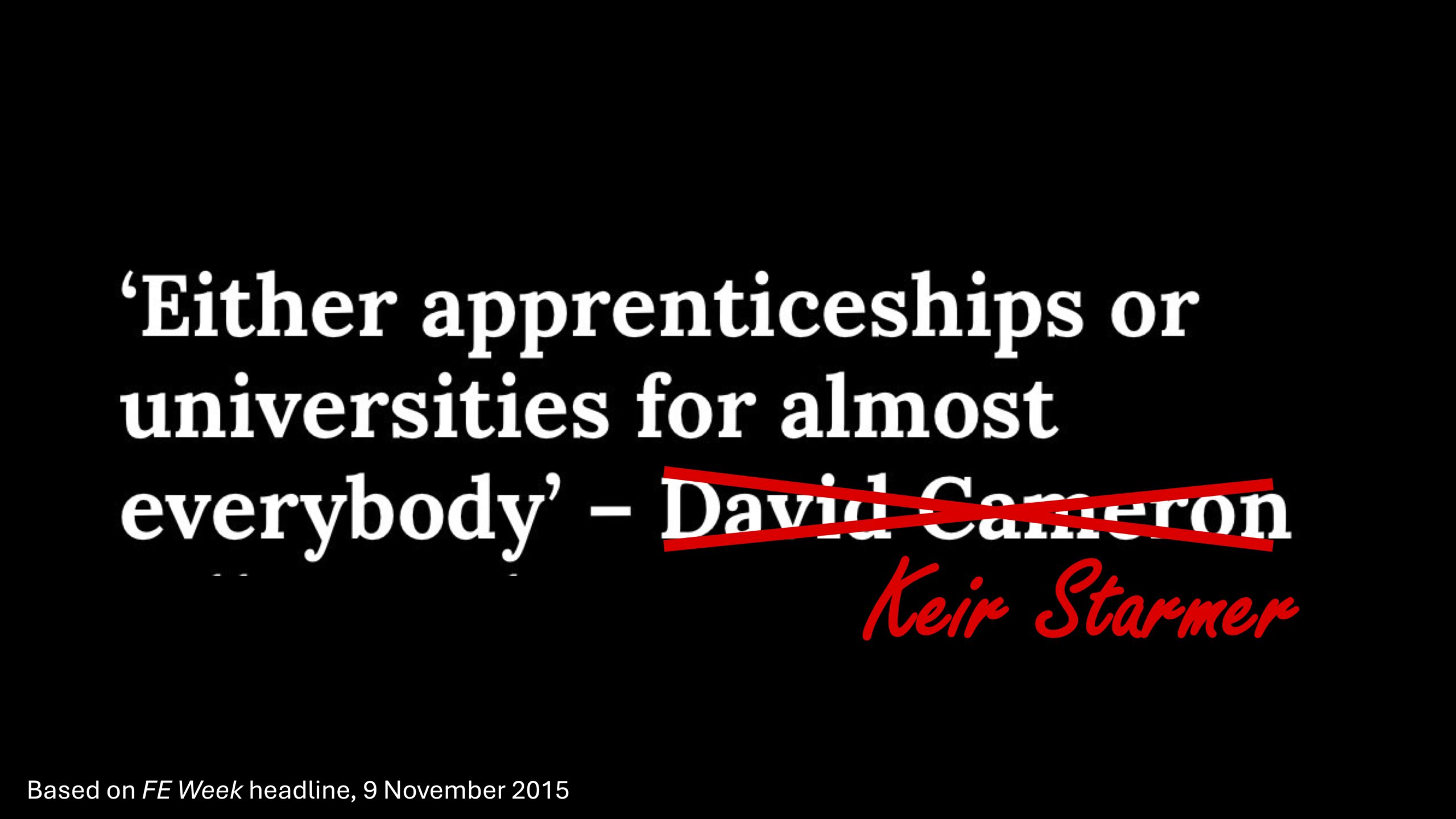
It was great to witness so many backbench Labour MPs, like Alex Sobel, Daniel Zeichner, Abtisam Mohamed and Dr Lauren Sullivan, advocating for UK universities across the conference fringe programme. But more generally, there were parts of the Conference that felt flat as well as parts that were presumably in line with what the organisers wanted – including the Leader’s big set-piece speech. Starmer’s big reveal was the rejection of the ancient 50% target for young people’s participation in higher education in preference for a new target ‘That two-thirds of our children should go either to university… Or take a gold standard apprenticeship.’
The Prime Minister would be unlikely to welcome the comparison but this reminded me of nothing so much as David Cameron’s pledges as Prime Minister. In 2013, for example, Cameron said: ‘I want us to have as a new norm the idea that in school, everybody, everyone who can, either takes that path on to university, or takes that path on to an apprenticeship. You should be doing one or the other.’
The challenge is not coming up with such commitments; it is delivering them. Fewer adults are doing apprenticeships now than when David Cameron spoke, despite the introduction of an Apprenticeship Levy. Perhaps Starmer can succeed where Cameron and his successors failed…
At the end of the Conference, I was left feeling the biggest omission compared to past Labour Conferences was a clear and broad narrative about His Majesty’s Official Opposition: the Conservative Party. If the choice facing the country really is between ‘division’ and ‘decency’, as Keir Starmer says, then might not the best way to defeat division be, as with Le Pen in France or the AfD in Germany, for centre-right and centre-left parties to act together?
If Tony Blair and William Hague can work together, surely this is not impossible? But – and this is a personal opinion only – I left Liverpool wondering if the main problem for today’s Labour leadership is that they have spent the last 15 years making such strong criticisms of their bedfellows in the mainstream centre of British politics that they are unable to admit they may now need to work with the centre-right to stave off their worst fears.
Then again, perhaps today’s Tory Party also cannot see that the opposite of division is not so much ‘decency’ (however much we might want that) as collaboration. We’ll find out for certain next week as the policy caravan moves across the north-west to Manchester for the Conservative Party Conference. Do come to HEPI’s event there if you can – it is outside the secure zone so no expensive pass is needed.
Carole Cox, HEPI’s Events and Communications Administrator (and HEPI’s biggest Beatles’s fan) explains why Liverpool is the perfect place for day-trippers and long-stayers.
The City of Liverpool has the biggest single collection of Grade One listed buildings than any other English city outside London and it was named the European Capital of Culture in 2008. A football mecca, it also boasts a plethora of museums, including the World Museum, the International Slavery Museum, the Museum of Liverpool, Tate Liverpool and the Merseyside Maritime Museum.
It is also an interestingly quirky place, which harbours some amazing public toilets (you read that right). For example, if you ever happen to drop into the Philharmonic Dining Rooms in the Georgian Quarter, feel free to admire the famous Grade I-listed urinals in their pink marble splendour.
And then, there is the deservedly famous Mersey Beat. Liverpool and The Beatles, these are words that go together well.* The Liverpudlian group are considered the best-selling band in music history, hailed as pioneers who revolutionised the music industry and popular culture.
In summary, Liverpool is a ‘blast’ in more ways than one: a city which does not shy away from its heritage, a city with so much to offer culturally, but also a windy city open to the strong maritime winds gusting from the docks. Which may be why the French translation of the 1964 Beatles film A Hard Day’s Night is Les Quatre Garçons Dans Le Vent, a French colloquial idiom for their growing popularity – which, when translated word-for-word, awkwardly reads as ‘the four boys in the wind’.
* ‘these are words that go together well’ are lyrics from the 1965 Beatles song Michelle (Lennon/McCartney).
On Thursday, the White House published a presidential memo — technically, a national security presidential memorandum — outlining its upcoming efforts to combat political violence.
In the wake of Charlie Kirk’s assassination, a heightened attention to political violence makes sense. But this memo doesn’t focus on actual violence. It includes frequent references to constitutionally protected speech and ideas.
While there are quite a few pieces of this order that set off alarm bells, a few of the phrases struck me as especially troubling. Here they are.
‘anti-Americanism, anti-capitalism, and anti-Christianity’
There are common recurrent motivations and indicia uniting this pattern of violent and terroristic activities under the umbrella of self-described “anti-fascism.” [ . . . ] Common threads animating this violent conduct include anti-Americanism, anti-capitalism, and anti-Christianity; support for the overthrow of the United States Government; extremism on migration, race, and gender; and hostility towards those who hold traditional American views on family, religion, and morality.
This is the most troubling passage in the memo, and there’s stiff competition for that title. This is the White House directly identifying beliefs, pointing the finger at them, and saying, “These are the suspicious people we need to watch.” In America, we shouldn’t target people for their ideologies. We should target them for their actions, full stop.
Recent Democratic administrations have engaged in the same guilt-by-association tactics. During the Obama administration, the IRS targeted nonprofit groups with the words “Tea Party” or “Patriots” in their names, identifying groups by ideology and punishing them by subjecting them to extra processes. And its explanation was that this was just a “shortcut” — other organizations with similar profiles had violated IRS rules, so they jumped to targeting groups that used similar words.
In 2023, the FBI distributed an internal memo linking “ethnically motivated violent extremists” to traditional Catholic ideology, a call for viewpoint-based targeting that was only exposed by a whistleblower and oversight from Congress. In 2022, an internal FBI memo linked the Gadsden flag and other patriotic symbols to violent extremism. And while such links do exist, and it makes sense for law enforcement to identify them, it also risks sweeping up ordinary Americans.
A man carries a Gadsden flag at a Proud Boys rally in Portland, Oregon, 2019.
It may well be that some people who engage in politically motivated violence have anti-American beliefs, oppose the traditional family, or dislike organized religion. They should be prosecuted. And if there’s evidence of conspiracy or concrete steps toward violence, that may warrant an investigation. But we cannot start investigating other people simply because they happen to share those beliefs. Doing so would open the door to investigations of any political movement or ideology if any one of its adherents happened to engage in violence.
‘…designation as a ‘domestic terrorist organization’’
The memo also says:
[T]he Attorney General may recommend that any group or entity whose members are engaged in activities meeting the definition of “domestic terrorism” in 18 U.S.C. 2331(5) merits designation as a “domestic terrorist organization.”
Designating something a domestic terrorist organization sounds like a parallel to the process we use for identifying foreign terrorist organizations (FTO). That process was created by Congress in a statute. Being designated as an FTO triggers a number of legal effects, enabling the government to seize assets, revoke visas, bar entry of non-citizens, and prosecute people who provide any direct help to the organization. Congress has the ability to block or revoke FTO designation, and organizations themselves are entitled to judicial review of the decision to include them on a list.
There is no such process for designating a domestic terrorist organization. In fact, the “domestic terrorist organization” definition proposed here has no legal safeguards and no clear significance. It’s completely made up. It seems an organization so designated will receive extra scrutiny from the federal government until it pleases the attorney general to remove them from the list. Donors, speakers, employees, and members of these organizations will all have their speech chilled for as long as the executive branch sees fit.
It’s hard not to compare this to the Hollywood blacklist during McCarthyism. There were, in fact, real Russian spies elsewhere in America, many of them motivated by their ideological commitment to communism. Some of them were passing nuclear secrets to our rival in the middle of a nuclear arms race, the stakes of which were, potentially, catastrophic beyond all human imagination. Many people on the blacklist did have ties to communism or communist sympathies, as well. But putting people on a list because the government didn’t like their politics violated the freedoms we claimed to be protecting.
‘…politically motivated terrorist acts such as organized doxing…’
“Organized doxing” is a strange phrase.
Doxing (or doxxing) is generally defined as publishing private information that makes someone online personally identifiable. It’s also legal in most places, as long as the information was lawfully obtained and isn’t otherwise part of harassment or incitement efforts. Whether you think that’s bad or not, I don’t know that organizing the effort makes it worse. If someone posts your personal information online, your first question isn’t likely to be, “How many people were involved and what was their political purpose?”
However distasteful it might be in context, doxing is protected speech unless it violates some other existing law. After all, doxing describes much of the basic activity of news media, where otherwise unknown information is found and published, and frequently, that information is personally identifiable. That’s especially true when the “doxing” the government is upset about is information related to public employees in the course of their duties, such as the location of ICE agents.
A missive from the most powerful man in the world carries so much force that it is, inevitably, a blunt instrument. When the president uses his pen to take aim at anything, it will cause a chilling effect.
The administration itself has arguably been encouraging coordinated doxing efforts to identify people who said cruel things in the wake of Charlie Kirk’s assassination. When the vice president calls on the public to contact the employers of people who made unkind statements, and there have been groups soliciting submissions of those statements to catalog them, it would take exceptional care on the part of any future participants to avoid their efforts turning into doxing.
If organized doxing is a politically motivated terrorist act when an NGO encourages it, but it’s legal when the White House encourages it, the current administration should remember that it will be leaving that loaded gun on the desk of the next president — who may define “permissible doxing” much differently.
‘Investigate institutional and individual funders, and officers and employees of organizations…’
The memo directs that the National Joint Terrorism Task Force and its local offices shall investigate “institutional and individual funders, and officers and employees of organizations, that are responsible for, sponsor, or otherwise aid and abet the principal actors engaging in” political violence, intimidation, or obstruction of the rule of law.
To aid or abet criminal conduct requires knowledge of the conduct. To the extent officers and employees of organizations are knowingly breaking the law, I’d like to think that law enforcement is investigating them anyway. It’s been a few decades since I took criminal law, but I’m pretty sure “investigate people who know they’re breaking the law” was on the first page of the outline. Same with people who are “responsible for” it.
So what this memo is adding, then, is to investigate “institutional and individual funders” who “sponsor” the organizations that aid the principal actors engaged in political violence. That reading is also reflected in a call for the use of financial surveillance tools. It’s also consistent with a Justice Department push to investigate a group tied to billionaire investor and Democratic megadonor George Soros.
If there is evidence that a donor was knowingly funding violence, they should be investigated, but the administration hasn’t actually shown such evidence. They simply assert there is a vast conspiracy on the left — going all the way up to its highest echelons — to fund and foment political violence, and so a sprawling investigation of the president’s ideological and political opponents is justified.
We have already seen orders like this get misused
A missive from the most powerful man in the world carries so much force that it is, inevitably, a blunt instrument. When the president uses his pen to take aim at anything, it will cause a chilling effect.
For example, when President Trump issued an executive order on gender ideology that prohibited federal funding to programs that suggest gender is a spectrum, Texas A&M cancelled an annual drag show and the National Endowment for the Arts reviewed applications for their consistency with the order. Neither of these outcomes were obvious on the face of the order.
What will the overreactions to this new memo look like? Donors ending their support because they don’t want to risk an investigation? Groups being denied bank loans or leases because they’re on a government list with no way to appeal that determination? Activists going underground because they want to challenge an orthodoxy, hiding their opinions from the places where they would otherwise be challenged in the marketplace of ideas?
If this is the plan to save American values, what’s the plan to destroy them look like?
Hey everyone, quick bit of exciting Re: University news before we get started. Our speakers are beginning to go live on the site here. We’ll be shouting them out on the blog over the next few weeks, so watch this space. Also, a huge thanks to our many dynamic partners and sponsors for making it all happen, check them out here. And of course, thank you to everyone who has already grabbed a ticket, we are already 75% sold out and we are looking forward to having some very interesting conversations with you in January. Anyway, on with the blog…
Question: What policy would increase student preparation for post-secondary education, thus lowering dropouts and average time-to-completion while at the same time lowering per-student delivery costs?
Answer: Introducing (or re-introducing) Grade 13 and move (or return) to make 3-year degrees the norm.
It’s a policy that has so many benefits it’s hard to count them all.
Let’s start with the basic point that older students on the whole are better-prepared students. In North America, we ask students to grow up and make decisions about academics and careers awfully early. In some parts of the world, they deal with this by having students take “gap years” to sort themselves out. In North America we are very Calvinist (not the good kind) about work and study, and think of tie off just to mature and think as “wasteful”, so we drive them from secondary school to university/college as fast as possible.
But there’s no reason that the line between secondary and post-secondary education needs to be where it is today. In antebellum America, the line was in people’s early teens; and age 18 wasn’t an obvious line until after World War II (Martin Luther King Jr. started at Morehead College age 15 because it decided to start taking high school juniors). The Philippines drew the line after 10 years of schooling until about six years ago. Ontario’s elimination of grade 13 was one of the very few examples anywhere in the world of a jurisdiction deciding to roll the age of transition backwards.
But it’s not clear in Ontario – which has now run this experiment for nearly 25 years – that the system is better off if you make students go to post-secondary education at 18 rather than 19. If you give students an extra year to mature, they probably have a better sense of what specific academic subjects actually consist of and how they lead to various careers. Because they have a better sense of what they want to do with their lives, they study with more purpose. They are more engaged. And almost everything we know about students suggests that more engaged students are easier to teach, switch programs less often, and drop out less frequently.
These all seem like good outcomes that we threw away for possibly no good reason.
Students would spend another year at home. Not all of them would enjoy that, but their parents’ pocket-books sure would. They’d also spend one more year in classes of approximately thirty instead of classes of approximately three hundred. Again, this seems like a good thing.
And as for cost, well, the per-student cost of secondary education is significantly lower than that of the per-student cost of post-secondary education. I don’t just mean for families, for whom the cost of secondary school is zero. I also mean for governments who are footing the bill for the post-secondary part of the equation, too (at least this is the case everywhere outside Ontario, which has abysmal levels of per-student spending on public post-secondary education).
There really is only one problem with moving from a 6+6+4 system of education to a 6+7+3 system. It’s not that a three-year degree is inherently bad or inadequate. Quebec has a 6+5+2+3 system and as far as I know no one complains. Hell, most of Europe, and to some extent Manitoba, are on a 6+6+3 system and no one blinks.
No, the problem is space. Add another year of secondary school and you need bigger secondary schools. And no one is likely to want to get into that, particularly when the system is already bursting – in most of the country, particularly in western Canada – from a wave of domestic enrolments. It is possible that some universities and colleges could convert some of their space to house high schools (the University of Winnipeg has quite a nice one in Wesley Hall), but that wouldn’t be a universal solution. Architecture and infrastructure in this case act as a limiting factor on policy change. However, by the early-to-mid 2030s when secondary student and then post-secondary numbers level off or even start to decline again, that excuse will be gone. Why wouldn’t we consider this?
(Technically another potential solution here of is to adopt something like a CEGEP, since these which arguably bridge the gap between secondary and university better that grade 13 did. But the real estate/infrastructure demands of creating a new class of institutions probably make that a non-starter).
Anyways, this is just idle talk. This might be a complete waste of time and money, of course. My suggestions about possible benefits could be totally off. Interestingly, as far as I know, Ontario never did a post-policy implementation review about eliminating grade 13/Ontario Academic Credits. Did we gain or lose as a society? What were the cost implications? Seems like the kind of questions to which you’d want to know the answers (well, I wish I lived in a country that thought these were questions worth answering, anyway). And even if we thought there were benefits to keeping students out of post-secondary for one more year, architectural realities would almost certainly get in the way.
But if we’re genuinely interested in thinking about re-making systems of education, these are the sorts of questions we should be asking. Take nothing for granted.
Ukrainian President Volodymyr Zelensky says religion was one topic his family never mentioned at the dinner table.
That could be because he’s from the Jewish minority, or because the overwhelming Orthodox Christian majority was split into different branches.
Ukraine’s Orthodox have gradually become more Ukrainian, to the detriment of a once-powerful pro-Russian Church, and the trend has sped up now that Kyiv and Moscow are at war.
The conflict between the pro-Kyiv Orthodox Church of Ukraine (OCU) and the pro-Moscow Ukrainian Orthodox Church (UOC) gets lost in the international coverage of the drama on the battlefield.
But with about 80% of Ukrainians identifying as Orthodox Christians, even if probably less than half attend church regularly, this split between the two Churches seeps into politics.
Christmas in Kyiv
The religious conflict crept into the news last month when the pro-Kyiv Church authorized all Ukrainian parishes to celebrate Christmas on December 25 if they wished, rather than the traditional Orthodox date of January 7.
The symbolism of allowing Christmas to be celebrated on the date used in the West was not lost on Ukrainian believers.
The roots to this clash go back to the communist period. While Ukraine was part of the Soviet Union, it was under the umbrella of the Russian Orthodox Church.
When the Soviet Union collapsed in 1991, the Ukrainian Orthodox Church continued to operate in the newly sovereign Ukraine, but proclaimed its loyalty to the Moscow Patriarchate.
Ukrainian patriots objected and said they deserved their own Church. Their rival Orthodox Church of Ukraine was created in 1992, soon after Ukraine’s independence. It was recognized as autocephalous (independent) by the Ecumenical Patriarchate in Istanbul — the highest authority in Orthodox Christianity — in 2019.
The politics of praying in Ukrainian
The two Churches have the same theology, liturgy and even architecture as the Moscow Church. But the Kyiv Church prays in Ukrainian rather than Church Slavonic and declares allegiance to Ecumenical Patriarch Bartholomew in Istanbul instead of Moscow’s Patriarch Kirill.
Originally much larger, the Moscow Church saw parishes defecting to its rival, especially after the war began. Under this pressure, the Ukrainian branch declared its independence from Russia in May, condemned the invasion and refused to recognize Patriarch Kirill in its liturgies.
It’s unclear now which Church is larger. But the head of the Kyiv Patriarchate, Metropolitan Epiphinius, told Religion News Service in May: “Every day, Ukrainians are gradually coming to understand which Church is truly Ukrainian and which Church is Russian.”
The Moscow Patriarchate tried to shield off Russian-occupied Crimea by creating its own metropolitanate (archdiocese) there in June. The Kyiv Church refused to recognize this.
When Putin annexed four Ukrainian territories in September — even though he did not completely control them — he tried to justify the move in religious terms, calling it a “glorious spiritual choice.”
Sermons, spies and the Security Service
But Kyiv increasingly saw the pro-Moscow Church as a fifth column, or spies of Putin. In October, the acting head of Ukraine’s Security Service revealed it had found 33 suspected Russian agents among the Moscow Church’s clergy in Ukraine.
Some preached pro-Russian sermons, Kyiv said, some had anti-Ukrainian literature and some were army chaplains who passed on information about Ukrainian artillery batteries to Russian agents.
That’s when the Kyiv Church authorized all Ukrainian parishes to celebrate Christmas on December 25 if they wished. On December 1, Zelensky upped the ante by calling for an official ban on all activities of the Moscow Patriarchate’s Church in Ukraine. Parliament was asked to draft a suitable law, which may be difficult given the provision in the Ukrainian constitution of freedom of religion.
In late December, Ukraine refused to renew the Moscow Church’s lease on the Cathedral of the Dormition at Kyiv’s Monastery of the Caves, traditionally the center of Ukrainian Orthodoxy.
On January 7, Metropolitan Epiphanius, head of the pro-Kyiv Church, celebrated the traditional Christmas there to show he was the new man in charge now.
And in its latest turn to faith, Russia called for a 36-hour truce to mark the traditional Christmas on January 7. Kyiv and its western allies rejected this as a cynical ploy, and both sides continued shelling each other as if nothing had happened.
The battlefield struggle is still the main story, both in its ultimate importance and in the David-and-Goliath story that readers understand. The religious rivalry will always be secondary.
But these pinpricks on the faith front add up to a new phase in the growth of local nationalism, which helps buoy Ukrainian morale. In hoping to defeat a country he thought would easily give in, Putin has done more than anyone to forge a united and defiant Ukrainian nation.
Three questions to consider:
1. Why do politicians often appeal to religion during a war?
2. Do mainstream journalists make religious angles clear in a conflict?
3. When do separate small events add up to a noteworthy trend?
Literacy has always been the foundation of learning, but for middle school students, the stakes are especially high. These years mark the critical shift from learning to read to reading to learn.
When students enter sixth, seventh, or eighth grade still struggling with foundational skills, every subject becomes harder–science labs, social studies texts, even math word problems require reading proficiency. For educators, the challenge is not just addressing gaps but also building the confidence that helps adolescents believe they can succeed.
The confidence gap
By middle school, many students are keenly aware when they’re behind their peers in reading. Interventions that feel too elementary can undermine motivation. As Dr. Michelle D. Barrett, Senior Vice President of Research, Policy, and Impact at Edmentum, explained:
“If you have a student who’s in the middle grades and still has gaps in foundational reading skills, they need to be provided with age-appropriate curriculum and instruction. You can’t give them something that feels babyish–that only discourages them.”
Designing for engagement
Research shows that engagement is just as important as instruction, particularly for adolescents. “If students aren’t engaged, if they’re not showing up to school, then you have a real problem,” Barrett said. “It’s about making sure that even if students have gaps, they’re still being supported with curriculum that feels relevant and engaging.”
To meet that need, digital programs like Edmentum’s Exact Path tailor both design and content to the learner’s age. “A middle schooler doesn’t want the cartoony things our first graders get,” Barrett noted. “That kind of thing really does matter–not just for engagement, but also for their confidence and willingness to keep going.”
Measuring what works
Educators also need strong data to target interventions. “It’s all about how you’re differentiating for those students,” Barrett said. “You’ve got to have great assessments, engaging content that’s evidence-based, and a way for students to feel and understand success.”
Exact Path begins with universal screening, then builds personalized learning paths grounded in research-based reading progressions. More than 60 studies in the past two years have shown consistent results. “When students complete eight skills per semester, we see significant growth across grade levels–whether measured by NWEA MAP, STAR, or state assessments,” Barrett added.
That growth extends across diverse groups. “In one large urban district, we found the effect sizes for students receiving special education services were twice that of their peers,” Barrett said. “That tells us the program can be a really effective literacy intervention for students most at risk.”
Layering supports for greater impact
Barrett emphasized that literacy progress is strongest when multiple supports are combined. “With digital curriculum, students do better. But with a teacher on top of that digital curriculum, they do even better. Add intensive tutoring, and outcomes improve again,” she said.
Progress monitoring and recognition also help build confidence. “Students are going to persist when they can experience success,” Barrett added. “Celebrating growth, even in small increments, matters for motivation.”
A shared mission
While tools like Exact Path provide research-backed support, Barrett stressed that literacy improvement is ultimately a shared responsibility. “District leaders should be asking: How is this program serving students across different backgrounds? Is it working for multilingual learners, students with IEPs, students who are at risk?” she said.
The broader goal, she emphasized, is preparing students for lifelong learning. “Middle school is such an important time. If we can help students build literacy and confidence there, we’re not just improving test scores–we’re giving them the skills to succeed in every subject, and in life.”
Laura Ascione is the Editorial Director at eSchool Media. She is a graduate of the University of Maryland’s prestigious Philip Merrill College of Journalism.