Author: admin

  • HHS Looks to Block Harvard From Federal Funds

    HHS Looks to Block Harvard From Federal Funds

    Joseph Prezioso/AFP/Getty Images

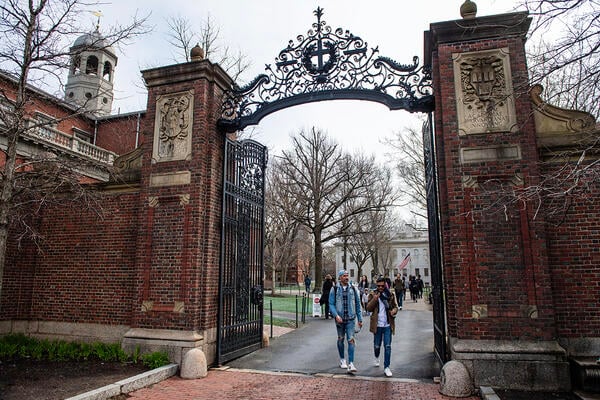
    The U.S. Department of Health and Human Services’ Office for Civil Rights announced Monday that it’s moving to cut off Harvard University’s eligibility to receive federal funding.

    The announcement comes amid a power struggle between Harvard and the White House. 

    While the Trump administration has accused Harvard of allowing antisemitism to run amok on campus—and the university has acknowledged concerns on the front—it has sought sweeping power over the institution and changes that go beyond addressing antisemitism. The HHS Office for Civil Rights previously found that Harvard violated Title VI of the Civil Rights Act of 1964, which bars discrimination based on race, color and national origin, and acted with “deliberate indifference toward discrimination and harassment against Jewish and Israeli students,” according to an HHS news release.

    Now HHS OCR has recommended cutting off federal funding to Harvard “to protect the public interest” through a suspension and debarment process operated by the HHS Office of the Assistant Secretary for Financial Resources. Suspension would be temporary and debarment would last “for a specified period as a final determination that an entity is not responsible enough to do business with the federal government because of the wrongdoing,” according to the agency. The move comes less than two weeks after the Education Department placed Harvard on heightened cash monitoring—a highly unusual move given the university’s significant resources.

    Harvard did not immediately respond to a request for comment Monday.

    “OCR’s referral of Harvard for formal administrative proceedings reflects OCR’s commitment to safeguard both taxpayer investments and the broader public interest,” HHS OCR director Paula M. Stannard said in a statement. “Congress has empowered federal agencies to pursue Title VI compliance through formal enforcement mechanisms, including the termination of funding or denial of future federal financial assistance, when voluntary compliance cannot be achieved.”

    Harvard has 20 days to request a hearing in front of an HHS administrative law judge, who will decide whether the university violated Title VI.

    Monday’s announcement is the latest salvo by the federal government after Harvard emerged initially victorious in a legal battle over more than $2 billion in frozen federal research funding. While a judge ruled that the Trump administration illegally froze funds granted to Harvard, the federal government has continued to pressure the private institution to make changes to disciplinary processes, admissions, hiring and more. Other Ivy League institutions, such as Columbia University and Brown University, have agreed to such deals, under federal scrutiny.

    Source link

  • Public Scholarship with Drs. Ben Railton and Vaughn Joy

    Public Scholarship with Drs. Ben Railton and Vaughn Joy

    What is public scholarship? And, if it’s something you value as an academic, how do you house the resources you want to share online? Dr. Ben Railton and Dr. Vaughn Joy are featured in this episode of The Social Academic podcast. Jennifer van Alstyne asks them about their just-launched public website collaboration, Black and White and Read All Over.

    Who do you hope visits your website? How do you hope they engage with what you share with them? When this married couple wanted a permanent space for their public scholarship, they chose to create it together. A special thank you to Dr. Walter Greason for sharing #ScholarSunday would make for a great podcast episode! I’m delighted to have these two on the show for you just in time for the launch of their new website. Congratulations!

    This episode was broadcast live on September 29, 2025.

    This episode will be available on Spotify soon. English captions for the video and a full text transcription will be added for you in the next 1-2 weeks. Thank you.

    Visit their website
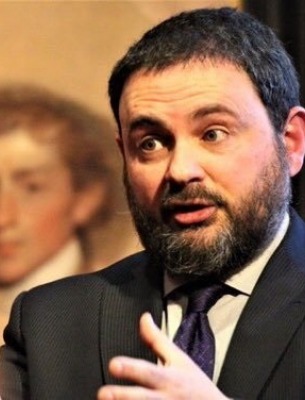
    Dr. Ben Railton during a talk or lecture

    Ben Railton is Professor of English Studies, Director of Graduate English, and Coordinator of American Studies at Fitchburg State University. He’s the author of six books, most recently Of Thee I Sing: The Contested History of American Patriotism (2021). He also contributes the bimonthly Considering History column to the Saturday Evening Post. He’s most proud to be Dad to two college student sons, Aidan and Kyle; and husband to his badass wife and website co-host Vaughn.

    Vaughn Joy is an independent researcher and recent graduate with a PhD in History from University College London. Her first book, Selling Out Santa: Hollywood Christmas Films in the Age of McCarthy, explores how Hollywood manipulated the American Christmas holiday for socially conservative ends in the post-war, early Cold War period in response to federal pressures on the motion picture industry. Her other work concerns McCarthyism, Hollywood business practices and politics, and media literacy of pop culture.

    Dr. Vaughn Joy wears a red sweater, red lipstick, and cute glasses

    Black and White and Read All Over

    Ben and Vaughn have recently launched a shared website that hosts Ben’s daily AmericanStudier blog and weekly round up of public scholarship in his #ScholarSunday threads, as well as Vaughn’s weekly film review newsletter, Review Roulette.

    The site, called Black and White and Read All Over, also welcomes announcements from other scholars to share their achievements, upcoming events, and forthcoming publications to promote academic pride and joy in our community.

    Ben Railton and Vaughn Joy cuddle, smiling close

    Source link

  • What to Do When Presidents Face Personal and Political Attacks

    What to Do When Presidents Face Personal and Political Attacks

    When a crisis strikes, college and university presidents and chancellors are asked to balance competing priorities in real time: protecting students, reassuring faculty, and staff, addressing trustees and communicating with stakeholders, including the public and other key partners. All while trying to be the role model and stay on mission as best as possible.

    While each crisis has distinctive characteristics, these situations never unfold in a vacuum. Today, they are happening as the value of higher education is being questioned, policymakers are sharpening their scrutiny, and financial pressures are forcing tough choices across campus communities. Moreover, our fast, fragmented information environment doesn’t just shape crises. It can, in effect, create them, manufacturing controversy where little existed.

    Strong crisis communications are not just about surviving the alarming hours, days or weeks of a crisis. They are about preserving trust and protecting reputation–which inevitably connects with revenue–thereby positioning the institution to lead credibly into the future.

    We were heartened when attending a recent annual, on-the-record convening of college presidents and journalists at the Press Club in Washington, DC, last month. Campus leaders showed up and readily expressed renewed energy for their roles and prospects for what remains the world’s most admired higher education system. These higher ed leaders gathered voluntarily (yes, voluntarily) to share specific examples of today’s campus environment, dispel some of the current higher ed narratives and inform the media–without defensiveness or naiveté–of the impact on their immediate communities and beyond.

    We cannot recommend engaging in such public conversations highly enough, as a means of building goodwill and busting myths. After all, the best crisis “response” begins long before any crisis occurs.

    Preparing before the crisis

    Presidents should ensure their teams are equipped with:

    • Clear, values-based messaging. A well-defined set of institutional values, articulated consistently (and easily located on public-facing websites), gives everyone a steady reference point. Do students, faculty, staff, families, alumni, neighbors and legislators know what the university stands for during times thick and thin?
    • Scenario planning and tabletop exercises. Running through potential crises, from student protests to cybersecurity breaches, helps identify weaknesses in protocols and message discipline. Exercises also clarify roles so that when a real situation arises, the team knows who speaks, who decides and who executes.
    • Designated spokespeople, prepared with media training. While a president may become the voice in a crisis, other leaders, such as a provost, communications official or dean of students, must be ready to carry the message.

    Leading during the crisis

    During the heat of a crisis, your guiding stars are simple: safety and support for your people. Accuracy, speed and transparency will matter most. Keep the following principles in mind:

    • Respond promptly, but don’t speculate. Silence creates a vacuum, but premature statements can backfire or harm. Even a short acknowledgment, such as “We are aware of the situation and will share updates as we confirm details,” signals attentiveness and concern.
      This playbook paid off during the pandemic for William & Mary, when President Katherine A. Rowe gathered input from the university’s subject-matter experts early on and established credible public health and safety approaches.
    • Center your people, not your process. Your stakeholders need to hear about safety, support and accountability before they hear about the college’s committees or investigations coming together. Prioritize action coupled with compassion. Even 20 years later, we remember the example of Scott Cowen, president of Tulane University during Hurricane Katrina, and the trust built due to his people-first approach. During the pandemic, Colgate University President Brian Casey modeled people-first leadership by moving into student housing to better understand students’ experiences and guide the campus through an especially challenging time.
    • Communicate consistently across channels. Students, families and alumni are likely to first encounter your messages (or off-base, inaccurate versions of this news) on social media, while others may hear news via email, during town halls or staff meetings. Coordinated, consistent language is critical for accuracy and credibility.
    • Engage trustees and legislators early. Surprises erode trust. One university president we admire follows the “No surprises” rule, crisis or no crisis. Keep key stakeholders briefed, even if details are evolving. A healthy president-board relationship, or the opposite, can easily become apparent during a crisis.

    The all-important post-crisis phase

    Too many falter by assuming that once any headlines fade, the crisis is behind them. In fact, the post-crisis period is where reputations are refined and strengthened. Presidents should treat this phase as an opportunity for reflection, accountability and rebuilding confidence.

    • Conduct a candid after-action review. What worked? What didn’t? Invite honest feedback from leadership, communications staff and key campus partners. A president who once worked at NASA introduced that agency’s practice of conducting a “hotwash,” the immediate, constructive, after-action review at her university.
    • Fix what needs improvement. Based on what you learn from the after-action review, consider who among your team demonstrated they are best suited for crisis situations. Determine who will stand in when these individuals are away or temporarily unreachable. Have a backup plan for the backup plan, including communications tools ranging from analog to digital. Cybersecurity breaches happen, as do power outages. Consider engaging external expertise to audit your policies and practices before, yes, the next crisis.
    • Follow up with your community. Students, faculty, staff, families and alumni will remember how your institution followed through. Report on the status of (non-confidential) investigations, share policy changes and highlight steps taken to prevent recurrence. Determine the cadence and keep to it, for communication containing substantive updates. Demonstrating accountability reinforces trust.
    • Reconnect the crisis to the institution’s mission. For example, if the issue involved free speech, show how new steps align with the university’s now-broader commitment to inquiry and dialogue. If it involved safety, emphasize your institution’s improved duty of care.
    • Strengthen external relationships. Use the post-crisis time to meet with legislators, donors and alumni leaders. Transparency about what happened and how the university has responded often earns respect over time, potentially turning doubters into advocates. The word potentially is deliberate here, in that this work can be challenging, it may take years and we need to be realistic about what is feasible. Is there common ground to be found? Are we seeking to please a few at the expense of the many?

    The special case of manufactured crises

    While the principles of communication are consistent across all crises, a manufactured crisis—one designed to harm a leader through disinformation—requires a different approach. Unlike a natural disaster or an institutional mistake, these situations are orchestrated attacks. Their primary purpose is not to address a problem but to create one. They become personal, understandably taken to heart. Leaders must steel themselves, identify key allies to clarify misinformation, and draw from resources in the “bank of goodwill” built during their presidency. Always easier said than done, yet the challenge for any leader in such circumstances is to not become the crisis.

    Why it matters more than ever

    Higher education’s current reputational challenges heighten the stakes. Campus leaders cannot afford to treat crisis communications as a tactical exercise. Instead, crisis communications should be integrated into a broader strategy for sustaining trust in the institution and, by extension, in the value of higher education itself.

    Handling a crisis can demonstrate an institution’s resilience, values and leadership. It can show students and families that the university is committed to their safety and success. It can show legislators that higher education takes accountability seriously. And it can remind the broader public that colleges and universities remain vital engines of knowledge, opportunity and community—even in turbulent times. You may have heard this beautiful phrase before, but remember and repeat: Higher education builds America.

    Crises will come. Presidents cannot control exactly when or how. By preparing in advance, leading with compassion and clarity in the moment and taking ownership in the aftermath, leaders can turn adversity into an opportunity to strengthen their institution’s credibility and standing. All of higher education stands to benefit from such examples of leadership.


    If you have any questions or comments about this blog post, please contact us.

    Source link

  • Jimmy Kimmel is back, but don’t get complacent

    Jimmy Kimmel is back, but don’t get complacent

    This essay was originally published by The Dallas Observer on Sept. 26, 2025.


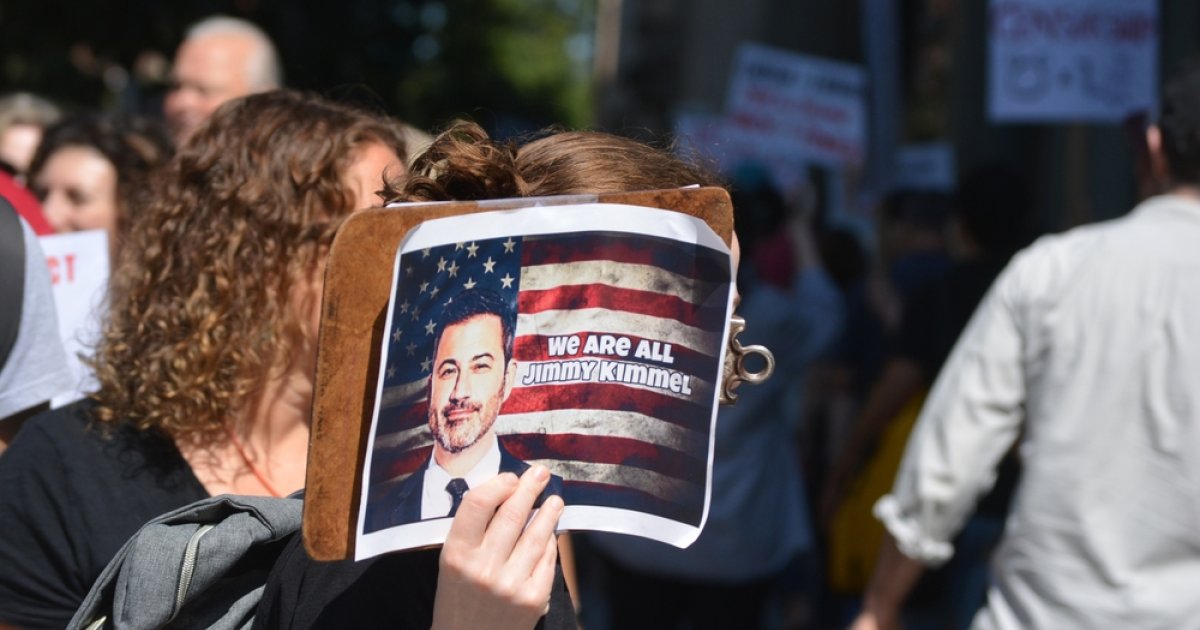
    Last week, ABC suspended Jimmy Kimmel just hours after FCC Chair Brendan Carr directed a thinly veiled threat at the media giant over comments Kimmel made about Charlie Kirk’s assassination.

    “This is a very, very serious issue right now for Disney,” Carr said on Benny Johnson’s The Benny Show. “We can do this the easy way or the hard way. These companies can find ways to take action on Kimmel, or there is going to be additional work for the FCC ahead.”      

    Carr’s message was a clear example of a government pressure tactic known as “jawboning,” and though ABC reversed the suspension days later, returning Kimmel to the air with an emotional yet triumphant monologue on free speech, the damage had been done. Kimmel was off the air for three episodes, and President Donald Trump took the opportunity to encourage even more censorship, saying on Truth Social, “That leaves Jimmy [Fallon] and Seth [Meyers], two total losers, on Fake News [sic] NBC. Their ratings are also horrible. Do it NBC!!!”

    Why our critics’ whataboutery over Jimmy Kimmel is wrong

    Jimmy Kimmel wasn’t canceled by a mob — he was silenced after FCC pressure. Critics say we’re inconsistent, but we’ve opposed jawboning and cancel culture for years. This case is no different.


    Read More

    Consider the events that immediately followed Carr’s comments the same day. Nexstar, an Irving-based company that owns various ABC affiliate stations, suspended Jimmy Kimmel Live! from its programming. Sinclair, another media company that owns ABC affiliate stations, followed suit. Then Disney, which owns ABC, announced Kimmel’s indefinite suspension, thus shutting production down entirely.

    The justified backlash against Disney/ABC was swift, prompting them to switch sides. On Monday, the media giant announced that the show would return to the air. The show’s “welcome back” monologue amassed a record of over 14 million YouTube hits in 16 hours. CNN data analyst Harry Enten reported that a typical monologue on the show rakes in roughly 240,000 YouTube views. That’s over 5,000% growth, courtesy of the Streisand effect.

    Still, we must not let celebration temper our vigilance. As FIRE Chief Counsel Robert Corn-Revere said recently in a Washington Post op-ed, “The law denies the [FCC] ‘the power of censorship’ as well as the ability to impose any ‘regulation or condition’ that interferes with freedom of speech.”

    That Trump’s administration chilled protected speech notwithstanding the law is distressing. Jawboning is unconstitutional, as the Supreme Court unanimously held last year in NRA v. Vullo. In that case, the state of New York pressured financial institutions and insurance companies to sever ties with the gun rights organization in the aftermath of the Parkland shooting. Justice Sonia Sotomayor wrote in the opinion, “Government officials cannot attempt to coerce private parties in order to punish or suppress views that the government disfavors.”

    Yet that is exactly what happened here. We just witnessed the FCC attempt to coerce Disney to suppress Kimmel’s speech, just as New York attempted to coerce financial institutions to suppress the NRA’s advocacy.

    Carr’s influence wasn’t the only factor. Outrage over Kimmel’s remarks was already building. A New York Times analysis of “thousands” of posts and media mentions found that criticism started “as a whisper, then eventually as a shout.” Breitbart covered it, Newsbusters’ Alex Christy wrote an X post that drew 15 million views, Fox’s The Five picked it up, The Blaze host Auron MacIntyre called for Kimmel’s firing, another viral post demanded his “career completely destroyed,” and Elon Musk weighed in: “Jimmy Kimmel is disgusting.” But it was Carr’s podcast threat that pushed the outrage into overdrive. As the Times noted, the anger “became apoplectic” after his remarks. His intervention should have carried no weight, yet instead it was a force multiplier.

    Another cause for concern in this otherwise triumphant moment is that Trump made it abundantly clear his sights are still on Kimmel, according to a Truth Social post on Tuesday night.

    Trump continued, “He is yet another arm of the DNC and, to the best of my knowledge, that would be a major Illegal Campaign. I think we’re going to test ABC out on this. Let’s see how we do. Last time I went after them, they gave me $16 Million Dollars. This one sounds even more lucrative. A true bunch of losers!”

    The First Amendment abuses do not stop there. On Sept. 15, Trump filed a shakedown lawsuit against The New York Times for $15 billion in response to unfavorable coverage. That same day, Attorney General Pam Bondi threatened to target Americans for “hate speech” — she then walked her comments back after conservative outrage.

    Moments like these are why our country needs an unflinching devotion to the First Amendment. They serve as a good reminder that, eventually, the shoe always ends up on the other foot. As Sen. Ted Cruz put it, “It might feel good right now to threaten Jimmy Kimmel, but when it is used to silence every conservative in America, we will regret it.”

    That is no apocalyptic bluster. Under both Republican and Democratic leadership, FIRE has stood firm against First Amendment abuses regardless of which wing or team color it comes from. The tendency for power to target disfavored views or ideas transcends party lines and can only be contained with a consistent, principled application of the First Amendment. As FIRE President Greg Lukianoff wrote recently in a New York Times op-ed, “The weapon that you reach for today will be used against you tomorrow.”

    Kimmel’s return is worth cheering, but unless we resist each attempt at government-driven censorship, the next suspension may not be so brief.

    Source link

  • A Statement from The Higher Education Inquirer

    A Statement from The Higher Education Inquirer

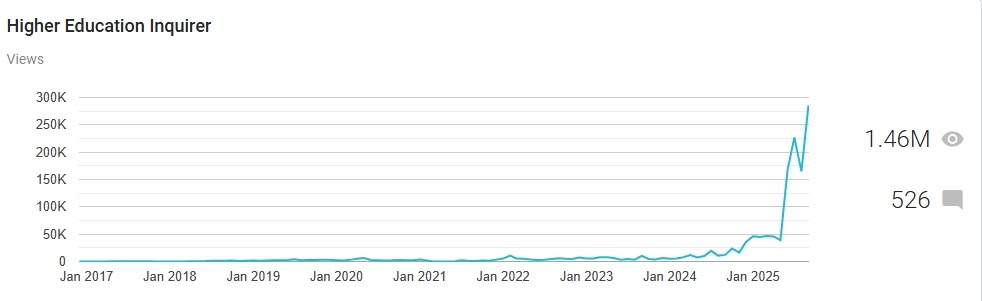
    This month, The Higher Education Inquirer has surpassed 280,000 views, the highest in our history. That milestone is not just a number — it represents the growing community of readers who care about uncovering the truth behind higher education’s power structures.

    And yet, we must also be candid: we are considering ceasing operations at the very moment our popularity is peaking. Some may find this paradox hard to understand. Why step back now, when the audience has never been larger?

    The reality is that investigative journalism is most vulnerable when it is most effective. Our work has never been about clicks or page views; it has been about holding powerful institutions accountable. With that mission has come heightened scrutiny and retaliation. The lawsuit we currently face is just one example of the legal and financial pressures designed to silence independent voices. Even when such cases are ultimately thrown out or defeated, the process is exhausting and expensive, diverting energy away from reporting and into survival.

    Beyond the lawsuit, the sustainability of this project has always been tenuous. Unlike large media corporations, we have no shield of corporate lawyers, no deep-pocketed donors, and no guarantee of steady funding. Every article is the product of labor that is often invisible — research, fact-checking, and the personal toll of constant resistance to disinformation and intimidation.

    In this environment, popularity does not equate to stability. If anything, it makes us more of a target. The more people read, the more those exposed by our work have an incentive to retaliate.

    If The Higher Education Inquirer does close, it will not be because the audience wasn’t there. It will be because the system in which independent journalism struggles to survive has failed to protect those doing the work.

    We remain deeply grateful to our readers. Whether this is a pause, a transition, or an end, we want you to understand why we are considering this step. The paradox of our situation speaks volumes about the fragility of truth-telling in America — and the lengths to which power will go to keep it contained.

    Source link

  • ED Rule Making Will Move Online if Government Shuts Down

    ED Rule Making Will Move Online if Government Shuts Down

    Screenshot/Alexis Gravely

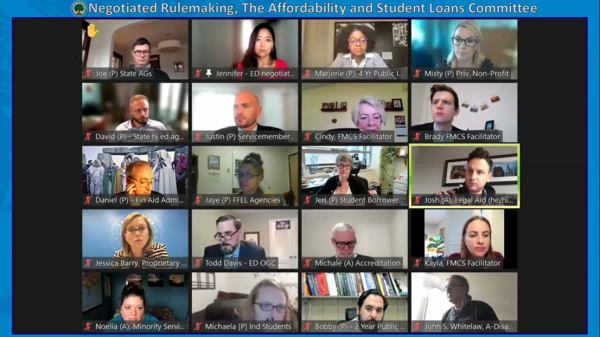
    The Education Department’s current rule-making session, in which committee members are determining how to implement new student loan policies, will be delayed by two weeks if Congress fails to pass legislation to keep the government open, Trump officials announced Monday morning.

    “There is the possibility—which seems to be growing by the hour—of a lapse in appropriations,” one department official said during the rule-making session’s commencement Monday. “Have no fear, however,” he added, “we do have a contingency plan for that.”

    The official, Jeffrey Andrade, deputy assistant secretary for policy, planning and innovation, went on to explain that if the government does shut down Oct. 1, the remainder of the session would take place online from Oct. 15 to 17. (The plans were also posted to the Federal Register on Monday.)

    Managing a virtual negotiated rule-making session, however, would be nothing new to the department staff, as all sessions prior to the start of the second Trump administration have been held online since the COVID-19 pandemic broke out in 2020.

    “Again, fingers crossed,” Andrade said. “But the oddsmakers, when I last checked, were in the high 60s in favor of them not passing a continuing resolution in time. So that’s a plan.”

    The department was already facing a tight timeline to negotiate the various regulatory changes, and some are worried that the two-week delay could further complicate the effort.

    “A government shutdown throws a wrench into the rule making,” said Clare McCann, managing director of policy for the Postsecondary Education and Economics Research Center at American University. “Even assuming a shutdown is over in two weeks, as the department hopes, almost all of the Education Department’s staff will be furloughed in the meantime and unable to continue working on the draft regulations. With such a crunched timeline for finishing the rules in the first place, this makes the department’s job much more challenging.”

    If the government were to shut down, about 87 percent of the Education Department’s nearly 2,500 employees would be furloughed, according to the agency’s contingency plan. The department is planning to keep on employees who are working on the rule-making process and to carry out other provisions in the One Big Beautiful Bill Act, which was signed into law over the summer.

    Student aid distributions will not be paused and loan payments will still be due, but the department will cease grant-making activities and pause civil rights investigations. Grantees, though, can still access funds awarded over the summer and before Sept. 30.

    Source link

  • Grants return, the levy stays

    Grants return, the levy stays

    Speaking at the Labour Party conference, Secretary of State for Education Bridget Phillipson announced the (limited) return of student maintenance grants by the end of this Parliament:

    I am announcing that this Labour government will introduce new targeted maintenance grants for students who need them most. Their time at college or university should be spent learning or training, not working every hour god sends.

    As further details emerged, it became clear that these would be specifically targeted to students from low-income households who were studying courses within the same list of “government priority” subject areas mentioned in plans for the lifelong learning entitlement. As a reminder these are:

    • computing
    • engineering
    • architecture, building & planning (excluding landscape gardening)
    • physics & astronomy
    • mathematical sciences
    • nursing & midwifery
    • allied health
    • chemistry
    • economics
    • health & social care

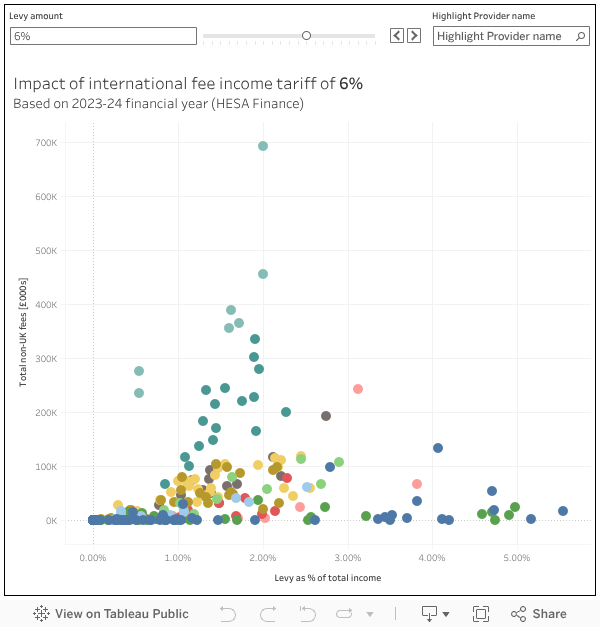
    These additional grants will be funded with income from the proposed levy on international student fees, of which little is known outside of the fact that the immigration white paper’s annex contained modelling of its effects were it to be set at six per cent of international student fee income. The international student levy will apply to England only.

    There will be further details on the way the new grants will work, and on the detail of the levy, in the Autumn Statement on 26 November. This is what we know so far – everything else is based on speculation.

    Eligibility

    A whole range of questions surround the announcement.

    How disadvantaged will a student have to be – and will it be based on family income in the same way that the current system is? Imagine if entitlement was set at below the current threshold for the maximum loan – disadvantaged enough to get the full loan, not enough for a grant.

    If it’s set anywhere near the current threshold – £25,000 residual family income since 2007 – there’s a lot of “disadvantage” going on above that figure. If it’s set above that figure, that will beg the question – why assume a parental contribution in the main loan part of the scheme?

    Will it be on top of, or simply displace some of the existing loan? If it’s the latter, that won’t help with day to day costs, and as the Augar review noted – those from the most disadvantaged backgrounds are least likely to pay back in full anyway, which would make the “grant” more of a debt-relief scam.

    The distribution in the apparent hypothecation will be fascinating. It does mean that international students studying at English universities will be funding grants for English domiciled students wherever they are studying. Will devolved nations now follow suit?

    If international student recruitment falls, will that mean that the amount of money available for disadvantaged student grants falls too or is the Treasury willing to agree a fixed amount for the grants that doesn’t change?

    Restricting grants to those on the lowest incomes does mean that the government intends to relieve student poverty for some but not others, based on course choice. Will that shift behaviour – on the part of students and universities – in problematic ways?

    With the LLE on the way, will grants be chunked up and down by credit? See Jim’s piece from the weekend on the problematic incentives that this would create.

    The hypothecation also raises real moral questions about international student hardship being exacerbated to fund home student hardship relief – if, as many will do, universities put fees up to cover the cost of the levy. The possibility of real resentment from international students, who already know they’re propping up the costs of lower and subsidised fees, is significant.

    For LLE modular tuition fee funding, under OfS quality proposals Bronze/Requires improvement universities will have to apply for their students to access it – they will need to demonstrate that there is a rationale for them doing IS-8 courses. Will that apply for these grants too?

    Phillipson’s speech also referenced work– students’ time at college or university should be “spent learning or training, not working every hour god sends”. By coincidence, Jim worked up some numbers on how much “work” the current loan scheme funds earlier. Whether we’ll get numbers from Phillipson on what she thinks “every hour god sends” means in practice, and how many hours she thinks students should be learning or training for, remains to be seen.

    We might also assume that the grant won’t be increased for those in London, and reduced for studying at home in the way that the maintenance loan is now. And if this is all we’re going to get in the way of student finance reform, all of the other myriad problems with the system may not get touched either.

    The levy

    There’s a certain redistributive logic in using tuition fee income from very prestigious universities to support learners at FE colleges or local providers, though it is unlikely that university senior managers will see it in quite those terms.

    A six per cent levy on international fee income in England for the 2023–24 financial year would have yielded around £620m, with half of that coming from the 20 English providers in the Russell Group. Of course, this doesn’t mean that half of all international students are at the Russell Group – it means that they are able to charge higher tuition fees to the international students they do recruit.

    [Full screen]

    Of course, the levy applies to all providers – and, as we saw back when the idea was first floated there are some outside of the Russell Group that see significant parts of their income come from international fees, and would see their overall financial sustainability adversely affected by the levy. In the main these tend to be smaller specialist providers, but there are some larger modern universities too. Some universities don’t even have undergraduate students, but will still see their fees top-sliced to fund undergraduate-level grants elsewhere.

    [Full screen]

    There has been a concerted lobbying effort by various university groups aimed at getting the government to abandon the levy plan – as it appears that this effort has failed you would expect the conversations to turn to ensuring the levy is not introduced at six per cent as the Home Office previously modelled, or mitigating its impact for some or all providers. Certainly, as Phillipson chose the same speech to remind us she had taken “the decisive steps we needed on university finances” it would feel like it is not her intention to add to the woes of higher education providers that are genuinely struggling.

    DfE has said that the new grants will be “fully funded” by an international student levy. It’s worth noting that this is not the same as saying that all the levy money will go towards the grants.The tie between the grants and the levy is politically rather astute – it will be very difficult for Labour backbenchers to argue against grants for students on low income, even if they are committed to making arguments in the interests of their local university. But legislatively, establishing a ring fence that ensures the levy only pays for these grants will be very difficult – other parts of government will have their eye on this new income, and the Treasury is famously very resistant to ringfencing money that comes in.

    It also opens up the idea of the government specifically taxing higher education with targeted levies. It is notable that there has been no indication that the levy will be charged on private school fees, or fees paid to English language colleges, where these are paid by non-resident students. DfE itself suggests that £980m of international fees go to schools, and a further £850m goes to English language training – why leave a certain percentage of that on the table when it can be used to support disadvantaged young people in skills training?

    What would it achieve?

    In the end, even grants at the maximum level of £3,000 a year that were recommended by the Augar review wouldn’t have made much difference to student poverty, and there’s been a lot of inflation since.

    And a part of the idea of the levy was to reduce (albeit slightly) the number of study visas granted – if you recall, the Home Office report emerged in a month that everyone became concerned about students claiming asylum. If that part of the plan works (if that was ever really the plan, rather than a fortunate coincidence) then surely there would be less money to play with for maintenance – and any future government that attempts to reduce international higher education recruitment would be accused of taking the grants away from working class students on priority courses?

    The real value in the reintroduction of the grant is that it is politically totemic for Labour. But if it encourages more disadvantaged students to go into HE because of a perception of better affordability when they will still struggle, there will be both a financial and political cost in the long term.

    Source link

  • Education at a Glance 2025, Part 2

    Education at a Glance 2025, Part 2

    Three weeks ago, the Organization for Economic Co-operation and Development (OECD) released its annual stat fest, Education at a Glance (see last week’s blog for more on this year’s higher education and financing data). The most interesting thing about this edition is that the OECD chose to release some new data from the recent Programme for International Assessment of Adult Competencies (PIAAC) relating to literacy and numeracy levels that were included in the PIAAC 2013 release (see also here), but not in the December 2024 release.   

    (If you need a refresher: PIAAC is kind of like the Programme for International Student Assessment (PISA) but for adults and is carried out once a decade so countries can see for themselves how skilled their workforces are in terms of literacy, numeracy, and problem-solving).

    The specific details of interest that were missing in the earlier data release were on skill level by level of education (or more specifically, highest level of education achieved). OECD for some reason cuts the data into three – below upper secondary, upper secondary and post-secondary non-tertiary, and tertiary. Canada has a lot of post-secondary non-tertiary programming (a good chunk of community colleges are described this way) but for a variety of reasons lumps all college diplomas in with university degrees in with university degrees as “tertiary”, which makes analysis and comparison a bit difficult. But we can only work with the data the OECD gives us, so…

    Figures 1, 2 and 3 show PIAAC results for a number of OECD countries, comparing averages for just the Upper Secondary/Post-Secondary Non-Tertiary (which I am inelegantly going to label “US/PSNT”) and Tertiary educational attainment. They largely tell similar stories. Japan and Finland tend to be ranked towards the top of the table on all measures, while Korea, Poland and Chile tend to be ranked towards the bottom. Canada tends to be ahead of the OECD average at both levels of education, but not by much. The gap between US/PSNT and Tertiary results are significantly smaller on the “problem-solving” measure than on the others (which is interesting and arguably does not say very nice things about the state of tertiary education, but that’s maybe for another day). Maybe the most spectacular single result is that Finns with only US/PSNT education have literacy scores higher than university graduates in all but four other countries, including Canada.

    Figure 1: PIAAC Average Literacy Scores by Highest Level of Education Attained, Population Aged 25-64, Selected OECD Countries

    Figure 2: PIAAC Average Numeracy Scores by Highest Level of Education Attained, Population Aged 25-64, Selected OECD Countries

    Figure 3: PIAAC Average Problem Scores by Highest Level of Education Attained, Population Aged 25-64, Selected OECD Countries

    Another thing that is consistent across all of these graphs is that the gap between US/PSNT and tertiary graduates is not at all the same. In some countries the gap is quite low (e.g. Sweden) and in other countries the gap is quite high (e.g. Chile, France, Germany). What’s going on here, and does it suggest something about the effectiveness of tertiary education systems in different countries (i.e. most effective where the gaps are high, least effective where they are low)?

    Well, not necessarily. First, remember that the sample population is aged 25-64, and education systems undergo a lot of change in 40 years (for one thing, Poland, Chile and Korea were all dictatorships 40 years ago). Also, since we know scoring on these kinds of tests decline with age, demographic patterns matter too. Second, the relative size of systems matters. Imagine two secondary and tertiary systems had the same “quality”, but one tertiary system took in half of all high school graduates and the other only took in 10%. Chances are the latter would have better “results” at the tertiary level, but it would be entirely due to selection effects rather than to treatment effects.

    Can we control for these things? A bit. We can certainly control for the wide age-range because OECD breaks down the data by age. Re-doing Figures 1-3, but restricting the age range to 25-34, would at least get rid of the “legacy” part of the problem. This I do below in Figures 4-6. Surprisingly little changes as a result. The absolute scores are all higher, but you’d expect that given what we know about skill loss over time.  Across the board, Canada remains just slightly ahead of the OECD average. Korea does a bit better in general and Italy does a little bit worse, but other than the rank-order of results is pretty similar to what we saw for the general population (which I think is a pretty interesting finding when you think of how much effort countries put in to messing around with their education systems…does any of it matter?)

    Figure 4: PIAAC Average Literacy Scores by Highest Level of Education Attained, Population Aged 25-34, Selected OECD Countries

    Figure 5: PIAAC Average Numeracy Scores by Highest Level of Education Attained, Population Aged 25-34, Selected OECD Countries

    Figure 6: PIAAC Average Problem Scores by Highest Level of Education Attained, Population Aged 25-34, Selected OECD Countries

    Now, let’s turn to the question of whether or not we can control for selectivity. Back in 2013, I tried doing something like that, but it was only possible because OECD released PIAAC scores not just as averages but also in terms of quartile thresholds, and that isn’t the case this time. But what we can do is look a bit at the relationship between i) the size of the tertiary system relative to the size of the US/PSNT system (a measure of selectivity, basically) and ii) the degree to which results for tertiary students are higher than those for US/PSNT. 

    Which is what I do in Figure 7. The X-axis here is selectivity [tertiary attainment rate ÷ US/PSNT attainment rate rate] for 25-34 year olds on (the further right on the graph, the more open-access the system), and the Y-axis is PIAAC gaps Σ [tertiary score – US/PSNT score] across the literacy, numeracy and problem-solving measures (the higher the score, the bigger the gap between tertiary and US/PSNT scores). It shows that countries like Germany, Chile and Italy are both more highly selective and have greater score gaps than countries like Canada and Korea, which are the reverse. It therefore provides what I would call light support for the theory that the less open/more selective a system of tertiary education is, the bigger the gap tertiary between Tertiary and US/PSNT scores on literacy, numeracy and problem-solving scores.  Meaning, basically, beware of interpreting these gaps as evidence of relative system quality: they may well be effects of selection rather than treatment.

    Figure 7: Tertiary Attainment vs. PIAAC Score Gap, 25-34 year-olds

    That’s enough PIAAC fun for one Monday.  See you tomorrow.

    Source link

  • Education Department takes a preliminary step toward revamping its research and statistics arm

    Education Department takes a preliminary step toward revamping its research and statistics arm

    In his first two months in office, President Donald Trump ordered the closing of the Education Department and fired half of its staff. The department’s research and statistics division, called the Institute of Education Sciences (IES), was particularly hard hit. About 90 percent of its staff lost their jobs and more than 100 federal contracts to conduct its primary activities were canceled.

    But now there are signs that the Trump administration is partially reversing course and wants the federal government to retain a role in generating education statistics and evidence for what works in classrooms — at least to some extent. On Sept. 25, the department posted a notice in the Federal Register asking the public to submit feedback by Oct. 15 on reforming IES to make research more relevant to student learning. The department also asked for suggestions on how to collect data more efficiently.

    The timeline for revamping IES remains unclear, as is whether the administration will invest money into modernizing the agency. For example, it would take time and money to pilot new statistical techniques; in the meantime, statisticians would have to continue using current protocols.

    Still, the signs of rebuilding are adding up. 

    Related: Our free weekly newsletter alerts you to what research says about schools and classrooms.

    At the end of May, the department announced that it had temporarily hired a researcher from the Thomas B. Fordham Institute, a conservative think tank, to recommend ways to reform education research and development. The researcher, Amber Northern, has been “listening” to suggestions from think tanks and research organizations, according to department spokeswoman Madi Biedermann, and now wants more public feedback.  

    Biedermann said that the Trump administration “absolutely” intends to retain a role in education research, even as it seeks to close the department. Closure will require congressional approval, which hasn’t happened yet. In the meantime, Biedermann said the department is looking across the government to find where its research and statistics activities “best fit.”

    Other IES activities also appear to be resuming. In June, the department disclosed in a legal filing that it had or has plans to reinstate 20 of the 101 terminated contracts. Among the activities slated to be restarted are 10 Regional Education Laboratories that partner with school districts and states to generate and apply evidence. It remains unclear how all 20 contracts can be restarted without federal employees to hold competitive bidding processes and oversee them. 

    Earlier in September, the department posted eight new jobs to help administer the National Assessment of Educational Progress (NAEP), also called the Nation’s Report Card. These positions would be part of IES’s statistics division, the National Center for Education Statistics. Most of the work in developing and administering tests is handled by outside vendors, but federal employees are needed to award and oversee these contracts. After mass firings in March, employees at the board that oversees NAEP have been on loan to the Education Department to make sure the 2026 NAEP test is on schedule.

    Only a small staff remains at IES. Some education statistics have trickled out since Trump took office, including its first release of higher education data on Sept. 23. But the data releases have been late and incomplete

    It is believed that no new grants have been issued for education studies since March, according to researchers who are familiar with the federal grant making process but asked not to be identified for fear of retaliation. A big obstacle is that a contract to conduct peer review of research proposals was canceled so new ideas cannot be properly vetted. The staff that remains is trying to make annual disbursements for older multi-year studies that haven’t been canceled. 

    Related: Chaos and confusion as the statistics arm of the Education Department is reduced to a skeletal staff of 3

    With all these changes, it’s becoming increasingly difficult to figure out the status of federally funded education research. One potential source of clarity is a new project launched by two researchers from George Washington University and Johns Hopkins University. Rob Olsen and Betsy Wolf, who was an IES researcher until March, are tracking cancellations and keeping a record of research results for policymakers. 

    If it’s successful, it will be a much-needed light through the chaos.

    Contact staff writer Jill Barshay at 212-678-3595, jillbarshay.35 on Signal, or [email protected].

    This story about reforming IES was produced by The Hechinger Report, a nonprofit, independent news organization focused on inequality and innovation in education. Sign up for Proof Points and other Hechinger newsletters.

    The Hechinger Report provides in-depth, fact-based, unbiased reporting on education that is free to all readers. But that doesn’t mean it’s free to produce. Our work keeps educators and the public informed about pressing issues at schools and on campuses throughout the country. We tell the whole story, even when the details are inconvenient. Help us keep doing that.

    Join us today.

    Source link

  • Charlie Kirk: Hero of ‘Civil Discourse’ or Fount of Division?

    Charlie Kirk: Hero of ‘Civil Discourse’ or Fount of Division?

    Charlie Kirk: Hero of ‘Civil Discourse’ or Fount of Division?

    Ryan Quinn

    Mon, 09/29/2025 – 03:00 AM

    Pointing to the slain activist’s inflammatory statements about minority groups, some are pushing back—at their own peril—against the right’s framing of him as an emblem of quality discourse.

    Byline(s)

    Source link