Author: admin

  • Universities reject $430,000 VC salaries – Campus Review

    Universities reject $430,000 VC salaries – Campus Review

    University submissions to the inquiry into independent senator Jacqui Lambie’s There for Education, Not Profit Bill have opposed the legislation, which proposes limiting vice-chancellor salaries to $430,000.

    Please login below to view content or subscribe now.

    Membership Login

    Source link

  • The Wonkhe HE staff survey – how good is work in higher education?

    The Wonkhe HE staff survey – how good is work in higher education?

    As financial pressures continue to bear down on higher education institutions across the UK, there is a visible impact on higher education staff, as resources shrink, portfolios are rationalised, and redundancy programmes are implemented. These are definitively tough times for the sector and its people.

    One way this plays out is in the industrial relations landscape, with unions balloting for industrial action, as well as, on some specific issues, advancing joint work with employers.

    But there is a wider, arguably more nuanced, lens to bring to bear, about how the current circumstances are reshaping staff experiences of working in higher education, and what options are available to those with responsibility for leading and supporting higher education staff.

    When the Wonkhe team came up with the idea of running a national survey for higher education staff we knew from the outset that we would not be able to produce definitive statements about “the HE staff experience” derived from a representative sample of responses. There is no consensus over how you would define such a sample in any case.

    The best national dataset that exists is probably found in UCEA publications that combine institutional staff experience survey datasets at scale – one published in 2024 titled “What’s it really like to work in HE?” and one in May this year diving into some of the reported differences between academic and professional staff, “A tale of two perspectives: bridging the gap in HE EX.

    Instead we wanted to, firstly, ask some of the questions that might not get asked in institutional staff surveys – things like, how staff feel about their institution’s capacity to handle change, or the relative importance of different potential motivating factors for working in HE, or, baldly, how institutional cost-cutting is affecting individuals. And secondly, as best we can, to draw out some insight that’s focused on supporting constructive conversations within institutions about sustaining the higher education community during challenging times.

    We’ll be reporting on three key areas:

    1. “Quality of work” – discussed further below
    2. Professional motivations, the relative importance of different motivators for our sample group, and the gap between the level of importance afforded key motivators and the extent to which respondents believe they actually get to experience these in their roles – DK has tackled that subject and you can read about his findings here
    3. Views on institutional change capability – coming soon!

    We’ve not covered absolutely everything in this tranche of reporting – partly because of time pressures, and partly because of format constraints. We have a fair bit of qualitative data to dive into, as well as the third area of investigation on institutional change capability all still to come – watch this space.

    The methodology and demographics bit

    We promoted the survey via our mailing list (around 60,000 subscribers) during July and August 2025, yielding a total of 4,757 responses. We asked a whole range of questions that we hoped could help us make meaningful comparisons within our sample – including on things like nationality, and type and location of institutions – but only some of those questions netted enough positive responses to allow us to compare two or more good-sized groups.

    Our working assumption is that if there was a group of around 500 or more who share a particular characteristic it is reasonable to compare their responses to the group of respondents who did not have that particular characteristic. We have conducted analysis of the following subgroups:

    • Career stage: Early career (n=686), mid career (n=1,304), and late career (n=2,703)
    • Those with an academic contract (n=1,110) and those with a non-academic contract (n=3,394) – excluding some other kinds of roles/contracts
    • Time in higher education: five years or fewer (n=908); 6-10 years (n=981); 11-20 years (n=1,517) and more than 20 years (n=1,333)
    • Working arrangements: on-site (n=988); working from home or remotely (n=475); and flexible/hybrid (n=3,268)
    • Leadership role: respondents who said they have formal management or leadership responsibility in their current role for projects, programmes, resources, or people (n=3,506), and those who did not (n=1,214)

    And we also looked at the following identity characteristics:

    • Gender: men (n=1,386) and women (n=3,271)
    • Sexuality: those who identified as gay, lesbian, bisexual or queer (n=654) and those who did not (n=4,093)
    • Ethnicity: those who identified as being of a minoritised ethnicity (n=247) and those who did not (n=4,444)
    • Disability: those who identified as being disabled (n=478) and those who did not (n=4,269)

    In one case – that of respondents who identified as being of a minoritised ethnicity – our sample didn’t meet the threshold for wholly robust analysis, but we found some differences in reported experience, which we think is worth reporting given what we already know about this group of staff, and would caution that these findings should be viewed as indicative rather than definitive.

    In some cases we have combined subgroups to make larger groups – for example we’ve grouped various academic roles together to compare with roles on other kinds of contracts. In others we’ve ignored some very small (usually n=3 and below) groups to make for a more readable chart; for this reason we don’t often show all responses. And although our response rates are high you don’t have to refine things much to get some pretty low numbers, so we’ve not looked at intersections between groups.

    We have reported where we found what we considered to be a meaningful difference in response – a minimum of four percentage points difference.

    The financial context

    88 per cent of respondents said their institution has taken material steps to reduce costs in the last 12 months, offering a background context for answers to the wider survey and the assurance that the thing we are looking at is definitely staff views against a backdrop of change.

    51.6 per cent said they personally had been negatively affected by cost reduction measures, while 41.9 per cent said the personal impact was neutral. This suggests that while cost reduction may be widely viewed as negative, that experience or the views that arise from it may not be universal.

    Of those that said they had been negatively affected we found no meaningful differences among our various comparator groups. Leaders and those later in their career, were as likely to report negative impacts as those without leadership responsibilities or earlier in their career, suggesting that there is little mileage in making assumptions about who is more likely to be negatively impacted – though of course we did not try to measure the scale of the impact, and we’re mindful we were talking to people who had not lost their jobs as a result of cost-saving measures.

    The one exception was between those on academic contracts, of whom nearly two third (65.3 per cent) reported negative impacts, and those on non-academic contracts, of whom the number reporting negative impact was closer to half (47.4 per cent). This difference gives important context for the wider findings, in which those on academic contracts are consistently more likely to offer a negative perspective than those on non-academic contracts across a range of questions. This tallies to some degree with the national picture explored in UCEA’s “Bridging the gap” report in which academics were more likely to report challenges with workload, work-life balance, and reward and recognition, than professional staff – though higher levels of work satisfaction.

    Regretting and recommending HE

    We asked whether, taking into account what is known about other available career paths, whether respondents feel that choosing to work in HE was the right decision for them – two thirds said yes (66.9 per cent) while 23.8 per cent were unsure. Only 9 per cent said no.

    Those approaching the end of their career were more likely to agree (74.3 per cent) compared to those mid-career (65 per cent) or early career (61.2 per cent). Those with leadership responsibilities were also slightly more likely to agree, at 68.2 per cent, compared to 62.3 per cent for those without leadership responsibilities.

    Those on academic contracts were slightly less likely to agree, at 60.8 per cent compared to 68.9 per cent for those on non-academic contracts.

    However, the real divide opens up when we looked at responses to our follow up question: whether respondents would recommend a career in higher education to someone they cared about who was seeking their advice. A much smaller proportion of our sample agreed they would recommend a career in HE (42.2 per cent), with much higher rates of “unsure” (32.1 per cent) and “no” (24.5 per cent) – most likely reflecting the impact of current challenges as compared to people’s longer-term lived experience.

    For the recommend question, the career-stage trend reverses, with those approaching the end of their careers less likely to say they would recommend a career in HE (39.2 per cent) compared to 41.6 per cent for those mid-career and 50.4 per cent for early career respondents.

    There was a substantial difference by role: only 25.7 per cent of those on academic contracts would recommend a career in HE, compared to 46.9 per cent of those on non-academic contracts.

    We did not find any differences by gender, ethnicity, disability, or sexuality on either confidence in the decision to work in HE or willingness to recommend it as a career.

    Quality of work

    One of the great things about higher education as an employment sector is that there are lots of ways to be employed in it and lots of different types of jobs. What one person values about their role might be quite different from what another person appreciates – and the same for the perceived downsides of any given role.

    So rather than trying to drill down into people’s reported experiences based on our own probably biased views about what “good work” looks and feels like, we turned to the idea of “quality of work” as a guiding framework to look at respondents’ experiences and perceptions. We asked 16 questions in total derived from this 2018 Carnegie UK-RSA initiative on measuring job quality in the UK which proposes seven distinct dimensions of work quality, including pay and conditions, safety and wellbeing, job design, social support, voice, and work-life balance.

    We also kept in mind that, while support, safety and wellbeing at work are foundational conditions for success, so is effective performance management and the opportunity to apply your skills. In the spirit of Maslow’s hierarchy of needs we clustered our questions broadly into four areas: safety, security, and pay/conditions; the balance between support and challenge; relationships with colleagues; and “self-actualisation” incorporating things like autonomy and meaningfulness.

    For each question, respondents were offered a choice of Strongly disagree, Disagree, Agree, and Strongly agree. Here we report overall levels of agreement (ie Agree and Strongly Agree)

    You can see the full findings for all our comparator groups in the visualisation below.

    [Full screen]

    Headlines on quality of work and interaction with willingness to recommend

    You can see all the workings out below where I’ve gone through the results line by line and reported all the variations we could see, but the TL;DR version is that the quality dimensions that jump out as being experienced comparatively positively are physical safety, good working relationships with colleagues, and meaningfulness of work. Two key areas that emerge as being experienced comparatively negatively are feeling the organisation takes your wellbeing seriously, and opportunities for progression – the level of agreement is startlingly low for the latter.

    We compared the various quality dimensions against whether people would recommend a career in higher education for the whole sample and found that across every question there was a direct correlation between a positive response and likelihood to recommend a career in HE – and the inverse for negative responses. We think that means we’re asking meaningful questions – though we’ve not been able to build a regression model to test which quality questions are making the largest contribution to the recommend question (which makes us sad).

    [Full screen]

    Going through the various comparator groups for the quality of work questions we find that there are three core “at risk” groups – one of which is respondents of a minorised ethnicity, which comes with caveats regarding sample size. Another is those on academic contracts, and the third is disabled respondents. These groups did not consistently respond more negatively to every question on quality of work, but we did find enough differentiation to make it worth raising a flag.

    So to try to see whether we could find some core drivers for these “at risk” groups, we plotted the response to the “recommend” question against the responses to the quality questions just for these groups. At this point the samples for disabled and minoritised ethnic responses become just too small to draw conclusions – for example, under 100 respondents who identified as being of a minoritised ethnicity said they would not recommend a career in HE.

    However, over 400 of those on academic contracts said they would not recommend a career in HE, so we compared the answers of that group to those of respondents on non-academic contracts who also would not recommend a career in HE (just shy of 700 respondents). Interestingly for a number of the quality questions there was no differentiation in response between the groups, but there was noticeable difference for “reasonable level of control over work-life balance”, “able to access support with my work when I need it”, and “opportunities to share my opinion” – in the sense that among the group that would not recommend HE the academic cohort were more likely to give negative responses to these questions, giving a modest indication of possible priority areas for intervention.

    We also found that those who had worked in higher education for five years or fewer were frequently more likely to report agreement with our various propositions about quality work. While there’s clearly some overlap with those early in their career they are not entirely the same group – some may have entered HE from other sectors or industries – though early career respondents do also seem to emerge as having a slightly more positive view as well, including on areas like emotional safety, and wellbeing.

    Safety, security and pay and conditions

    The four statements we proposed on this theme were:

    • I feel reasonably secure in my job
    • I am satisfied with the pay and any additional benefits I receive
    • I feel physically safe at work
    • I feel emotionally safe at work

    On job security, overall two thirds (66.3 per cent) of our sample agreed or strongly agreed that they feel reasonably secure in their job. Those on academic contracts reported lower levels of agreement (57.8 per cent). Those who said they had been employed in higher education for five years or fewer reported higher levels of agreement (71.4 per cent). Respondents who identified as disabled reported slightly lower levels of agreement (61.9 per cent).

    On satisfaction with pay, conditions and additional benefits, overall 63.8 per cent of respondents agreed or strongly agreed that they were satisfied. Those on academic contracts reported lower levels of agreement (56.3 per cent). Those who identified as having a minoritised ethnicity had the lowest levels of agreement of all our various comparators (53.1 per cent), and were twice as likely to strongly disagree that they were satisfied with pay and benefits than those from non-minoritised ethnicities (15.2 per cent compared to 7.9 per cent). Those who identified as disabled had lower levels of agreement (54.6 per cent agreement) compared to those who did not consider themselves disabled (64.9 per cent agreement)

    On physical safety, the vast majority of respondents (95.8 per cent) agreed or strongly agreed they feel physically safe at work with very little variation across our comparator groups. While the overall agreement was similar between men and women, notably men were more likely to register strong agreement (66.3 per cent) than women (51.9 per cent).

    On emotional safety the picture is more varied. Overall 72 per cent agreed or strongly agreed they feel emotionally safe at work. Those who reported being earlier in their career reported higher levels of agreement (78.6 per cent), as did those who reported having worked in the HE sector for five years or fewer (78.6 per cent). Those with academic contracts reported lower levels of agreement (61.62). Those who identified as having a minoritised ethnicity had lower levels of agreement (62.7 per cent) and were more than twice as likely to strongly disagree they feel emotionally safe at work than those who are not minoritised (14.2 per cent compared to 6.1 per cent).

    Balance, challenge, and performance

    The four statements we proposed on this theme were:

    • The work I do makes appropriate use of my skills and knowledge
    • I have a reasonable level of control over my work-life balance
    • My organisation demonstrates that it takes my wellbeing seriously
    • My organisation demonstrates that it takes my performance seriously

    On using skills and knowledge 79.2 per cent of our sample agreed or strongly agreed that their work makes appropriate use of their skills and knowledge. There was very little variation between comparator groups – the one group that showed a modest difference was those who reported being disabled, whose agreement levels were slightly lower at 75.3 per cent.

    On control over work-life balance, 80.7 per cent of our sample agreed or strongly agreed they have a “reasonable” level of control. Those who had worked in higher education for five years or fewer were more likely to agree (87.2 per cent). 86.5 per cent of those who work from home agreed, compared to 74.4 per cent of those who work on campus or onsite, and 81.7 per cent of those who have hybrid or flexible working arrangements. Those who reported having leadership responsibilities had lower levels of agreement (78.9 per cent) compared to those who did not (85.9 per cent).

    The biggest difference was between those on academic contracts (66 per cent agreement) and those on non-academic contracts (85.3 per cent agreement). There were also slightly lower scores for disabled respondents (74.7 per cent compared to 81.2 per cent for non-disabled respondents) and for minoritised ethnicities (76.6 per cent compared to 81 per cent for non-minoritised ethnicities).

    On wellbeing, 57.8 per cent of our sample agreed or strongly agreed that their organisation demonstrates that it takes their wellbeing seriously. This was higher for early-career respondents – 60 per cent agreement compared to 57.9 per cent for those in mid-career, and 55.5 per cent for those approaching the end of their career. Agreement was higher for those with five years or fewer in higher education at 68.4 per cent agreement, compared with 54.5 per cent for those with more than 20 years’ experience.

    Those on academic contracts were substantially less likely to agree with only 39.7 per cent agreement that their organisation demonstrates that it takes their wellbeing seriously. Disabled respondents were also much less likely to agree than non-disabled respondents, at 47.7 per cent and 59 per cent respectively. Those working from home reported slightly lower levels of agreement, at 52.6 per cent.

    On performance, 63.1 per cent of our sample reported that their organisation demonstrates that it takes their performance seriously. This was slightly higher for those who had five years or fewer in higher education, at 69.6 per cent. Again, there was a difference between those on academic contracts with 57.8 per cent agreement and those on non-academic contracts, with 64 per cent agreement. Disabled respondents were slightly less likely to agree (58 per cent agreement) than non-disabled (63.8 per cent agreement).

    Relationships with colleagues

    The four statements we proposed on this theme were:

    • I am able to access support with my work when I need it
    • I am given sufficient opportunities to share my opinion on matters that affect my work
    • For the most part I have a good working relationship with my colleagues
    • I generally trust that the people who work here are doing the right things

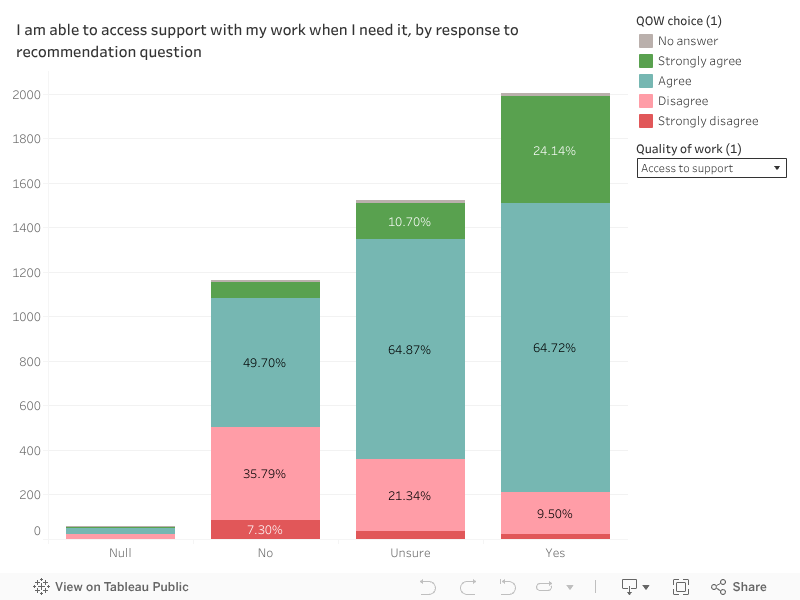
    On accessing support, 76.2 per cent of our sample agreed they are able to access support when they need it. There was higher agreement among those early in their career at 81.3 per cent, and similarly among those who had worked five years or fewer in HE, at 82.8 per cent. There was lower agreement among those on academic contracts: 62.3 per cent agreement versus 80.5 per cent for those on non-academic contracts. Those from a minoritised ethnicity had lower agreement at 70.6 per cent, as did disabled respondents at 67.4 per cent.

    On opportunities to share opinion, 70.4 per cent of our sample agreed or strongly agreed they were given sufficient opportunities to share their opinion on matters that affect their work. There was a small difference between those who held a leadership role and those who did not, at 71.9 per cent and 66 per cent agreement respectively. Again, those on academic contracts had lower levels of agreement, at 58.2 per cent compared to 73.9 per cent for those on non-academic contracts. Disabled staff also had lower agreement at 60.9 per cent.

    On working relationships, cheeringly, 96.1 per cent of our sample agreed or strongly agreed they have good working relationships with their colleagues. While this held true overall across all our comparator groups regardless of leadership roles, working location, personal characteristics or any other factor, notably those of a minoritised ethnicity strongly agreed at a lower rate than those who did not identity as being from a minoritised ethnicity (39.6 per cent strong agreement compared to 48.3 per cent).

    On trust, 70.8 per cent of our sample agreed or strongly agreed that they generally trust the people they work with are doing the right things. This was very slightly lower among those who work from home or remotely, at 65.9 per cent. Agreement was lower among those on an academic contract, at 61.6 per cent, compared to 73.4 per cent of those on a non-academic contract. Agreement was also lower among disabled respondents, at 63.8 per cent.

    “Self-actualisation”

    The four statements we proposed on this theme were:

    • My current job fits with my future career plans and aspirations
    • I am comfortable with the level of autonomy I have in my job
    • There are sufficient opportunities for progression from this job
    • The work I do in my job is meaningful

    On career plans, 76.1 per cent of our sample agreed or strongly agreed that their current job fits with their future career plans and aspirations. Those who said they work from home or remotely had slightly lower levels of agreement at 69.3 per cent. Those who said they do not have any kind of leadership role had slightly lower levels of agreement at 69.4 per cent.

    On autonomy, 82.5 per cent of our sample agreed or strongly agreed they were comfortable with the level of autonomy they have in their job. Those with an academic contract had very slightly lower levels of agreement at 77.9, compared to 83.8 per cent agreement among those on non-academic contracts. Those of a minoritised ethnicity had lower levels of agreement at 73.9 per cent, as did disabled respondents, at 75.9 per cent agreement.

    On progression, a startling 29.5 per cent agreed or strongly agreed that there are sufficient opportunities for progression from their current position. There was a modest difference between those with leadership roles, 31.1 per cent of whom agreed, compared to 25 per cent of those without a leadership role. Those on academic contracts had higher levels of agreement at 38.5 per cent, compared to 26.8 per cent of those on non-academic contracts.

    On meaningful work, 86.1 per cent of our sample agreed or strongly agreed that the work they do in their job is meaningful. Those who work from home or remotely had very slightly lower levels of agreement at 77.9 per cent but otherwise this held true across all our comparator groups.

    Aspiration to lead and preparedness to lead

    We asked about whether respondents aspire to take on or further develop a leadership role in higher education, and if so, whether they are confident they know what a path to leadership in higher education involves in terms of support and professional development. These questions are particularly relevant given the generally negative view about opportunities to progress held by our survey respondents.

    [Full screen]

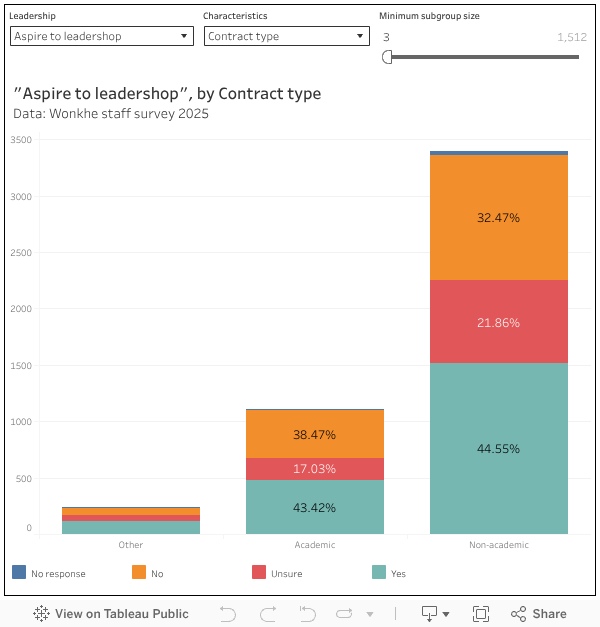
    Overall, 44.5 per cent of our sample said they aspire to take on or further develop a leadership role. Curiously, this was only slightly higher for those who already have some level of leadership responsibility, at 48.3 per cent. This can be explained to some degree by differentiation by career stage: 58.8 per cent of early career respondents aspired to take on or develop leadership roles, as did 50.9 per cent of mid-career respondents.

    Aspiration to lead was higher among those identifying as lesbian, gay, or bisexual at 52.6 per cent compared to 43.2 per cent for those who did not. Aspirations were also higher among respondents of a minoritised ethnicity, at 54.5 per cent, compared to 43.8 per cent among those not of a minoritised ethnicity.

    We also asked respondents whether they are confident they know what a path to leadership involves in terms of support and professional development, where we found some important variations. Confidence about pathways to leadership was lower among early career respondents, at 22.8 per cent agreement, and even mid-career respondents confidence was lower than the numbers reporting they aspire to leadership, at 36.6 per cent.

    While there was no difference in aspiration between respondents on academic contracts and those on non-academic contracts, those on academic contracts were more likely to say they are confident they know what a path to leadership involves, at 50.3 per cent compared to 34.8 per cent.

    While there was no difference in aspiration between men and women respondents, women were slightly less likely than men to report confidence in knowing about the path to leadership, at 37.5 per cent compared to 42 per cent. Those who identify as lesbian, gay or bisexual, those of a minoritised ethnicity, and disabled respondents were also slightly less likely than their comparator groups to express confidence, despite having expressed aspiration to lead at a higher rate.

    These findings around demographic difference suggest that there remains some work to be done to make leadership pathways visible and inclusive to all.

    We’ll be picking up the conversation about sustaining higher education community during tough times at The Festival of Higher Education in November. It’s not too late to get your ticket – find out more here.


    Source link

  • UOW to backpay $6.6m to underpaid staff – Campus Review

    UOW to backpay $6.6m to underpaid staff – Campus Review

    The University of Wollongong is set to backpay more than $6.6 million to thousands of underpaid staff.

    Please login below to view content or subscribe now.

    Membership Login

    Source link

  • Online-only lectures not a bad thing – Campus Review

    Online-only lectures not a bad thing – Campus Review

    On Campus

    Online lectures give students opportunities to engage with material in ways that suit them

    Students have been protesting to keep in-person lectures at the newly amalgamated Adelaide University next year.

    Please login below to view content or subscribe now.

    Membership Login

    Source link

  • Exploring the motivation and satisfaction of higher education staff

    Exploring the motivation and satisfaction of higher education staff

    For all the criticisms leveled at the sector as a group of employers, the number of staff working in higher education keeps on growing.

    Understanding why they choose to work in higher education, what they value about their work, and how well the organisation they work for lives up to their expectations can help inform questions about what matters the most when resources are tight – pay and conditions are obviously important but people work in HE for a whole range of reasons, and not all of those expectations require resource to meet.

    In our summer staff survey we gathered nearly 5,000 responses on these topics from people who currently work in or around the sector. We don’t make any claims that this is a representative sample – we can’t say with certainty what the sector as a whole feels but comparing similar groups of staff (for example by contract type) with each other yields fascinating insights and points the way towards understanding this fundamental issue.

    For our motivation question bank we presented a range of possible motivations as follows:

    • Working in an organisation whose values I share
    • Opportunities for learning, development and professional growth
    • Working alongside and collaborating with like-minded colleagues
    • The generosity of the pay and benefits package
    • Having the autonomy to focus on the work that is important to me
    • Having a level of flexibility about where and when I work
    • My physical working environment and the resources I have access to within it
    • Receiving recognition for my hard work and contribution
    • Knowing the work I do makes a positive impact – on students, on the advancement of knowledge, on my community
    • Working in an organisation that I am confident is generally well run, and achieving its objectives
    • Having opportunities to engage in activities that enhance community connection eg networks, clubs and groups, volunteering, public lectures etc

    Then we asked people whether they felt each was an “important” motivation, and whether they were “happy” with their organisation’s performance against each one. A “yes” answer means that someone was happy, or agreed something was important.

    We’re not running any fancy statistics here, but our working assumption is that a difference of more than four percentage points between different groups is interesting and notable enough to report on. This would vary by the size of the groups in question.

    Two sectors?

    We don’t know for sure (it isn’t data that we collect via HESA for the population) but there’s as many professional and support services staff as there are academics. And the former are far more likely to have experience working outside higher education – from the responses to our staff survey we see that around 80 per cent of our professional and support staff had worked outside the sector, compared to 64 per cent of academics, though those numbers might be lower in both instances had we specifically excluded casual work such as temporary work while studying.

    The cliché of the unworldly professor in an ivory tower is clearly being left in the past – but the kinds of roles done by professional services staff are in demand right across the economy. On the face of it is far easier for them to find work elsewhere, and given the state of the sector, you’d assume this might be better paid.

    Given this, it was surprising to see that while 68.8 per cent of academic respondents cited pay and benefits packages as something that was important to them, nearly three quarters of professional and support staff found this area of the working experience important.

    In asking these kinds of questions you almost don’t expect people to say they are happy with their pay and benefits – so more than 40 per cent of our professional services respondents doing so is notable. After all, we hear enough from the various sector professional associations about the difficulty of recruiting and retaining skilled staff in a variety of key roles.

    [Full screen]

    Relative importance

    Of all the suggested motivations for working in higher education, only two were not selected as important by more than 80 per cent of respondents: pay and conditions (73.5 per cent) and having opportunities to engage in activities that enhance community connection (41.4 per cent) – the latter scoring significantly lower than every other suggestion.

    The three most important motivations selected were “knowing the work I do makes a positive impact” (87.5 per cent), “Working alongside and collaborating with like-minded colleagues” (86.9 per cent) and “Working in an organisation I am confident is generally well run” (84.5 per cent).

    Looking at the areas where there was the largest gap between those who said something was important to them and those that agreed they are happy with the extent they get to experience it in their working lives, by far the largest gap relates to confidence the organisation is run well and is achieving its objectives, only 31.7 per cent saying they are happy with this, a gap of 52.8 percentage points.

    The next highest gap relates to recognition: whereas 80.4 per cent of respondents said receiving recognition for their hard work and contribution was important, only 33.3 per cent said they were happy with this – a gap of 47.1 percentage points.

    The third highest gap was in opportunities for learning, development and professional growth: whereas 83 per cent of respondents said this was important, only 44.3 per cent said they were happy with this, a gap of 38.7 percentage points.

    Free as in freedom

    Academic respondents were far more likely to cite autonomy to focus on the work that is important to them as a key motivating factor (86.7 per cent), but the number is still high for other staff (79.6 per cent), whereas professional services staff (83.5 per cent) were slightly more likely than academics (79.9 per cent) to cite flexibility in when and where they work.

    Staff of all kinds are reasonably happy (c.65 per cent) with the levels of flexibility on offer. Clearly the experiences of Covid-19, and perhaps the drive for providers to rationalise estates – swapping offices for desks, or regular desks for hot desks – is also having an impact. You might expect that women would be more likely to value flexibility in working and you would be right – 84.8 per cent of women in our sample said this was important to them, compared to 76.5 per cent of men. However, similar proportions of men and women (around 65 per cent) reported being happy with the amount of flexibility on offer.

    In terms of autonomy – the ability that a member of staff has to focus on work that is important to them – a little under half of both academic and professional staff were happy with what was on offer. It is worth bearing in mind that autonomy is always limited in some way in any role; for example, marking and exam boards pretty much need to happen when they do.

    Value judgement

    Despite frequent accusations of cultural relativism, a strength of universities is their values. Intriguingly, 60 per cent of professional services staff by just 45 per cent of academics were happy with the way that this manifests – despite similar levels of importance (85.8 per cent for academics, 82.7 per cent for professional) being placed on sharing the values of the organisation one works for.

    If we think back to the idea that professional services staff would be more likely to work in other sectors, this does make sense. Values, and the sense of having a positive impact (86 per cent said this was important to them), are clearly going to be key motivations to work in a sector where perhaps pay and conditions don’t stack up.

    An amazing 90 per cent of academic staff said that knowing that the work they did has a positive impact (on students, the advancement of knowledge, and/or on their community) was important to them. But just 53 per cent of academics and of professional staff saw this in practice. To be fair, this was one of the best performing motivations in our survey – but it is interesting that staff are no longer seeing the good that higher education does, especially when it is becoming so important to make this case culturally and with the government.

    Recommend to others

    It’s easy to get disheartened when you think about the staffing needs of higher education providers and how they are met. Although academics are clamouring to work in the UK sector, it feels like the terms and conditions are worsening and newer staff – in particular – are getting a raw deal. With professional staff, the fact that many specialisms can get better paid work elsewhere has some wondering about the quality of the staff we are able to recruit.

    We asked all of our respondents whether they would recommend working in the sector to someone they cared about – and perhaps surprisingly three-quarters said “yes” or “maybe”. And there was very little difference between those making “yes”, “no”, or “maybe” on any of the motivation axes we discuss above (those who said “yes” were very marginally less likely to say pay and benefits were important to them).

    However those that were more likely to recommend the sector to others were significantly happier with every aspect we examined. In contrast more than 80 per cent of those who would not recommend working in the sector were not happy with the amount of recognition they got for their hard work and contribution, and more than 85 per cent felt that their organisation was not run well. Recommendation is generally considered a good proxy for job satisfaction, and this survey seems to bear that out.

    What people want to change

    We asked respondents to say more where they had identified a gap between something they consider to be important, but the degree to which they are happy with the extent they actually experience that.

    There were comments on workload and wellbeing, small-scale or systemic failures to offer recognition for achievement and, particularly from those in professional services, a desire for greater recognition, and development and/or progression opportunities. Some commented that the economic environment makes these asks more difficult.

    But in terms of messages for leaders there is a lot about communication and consultation – a sense that the people who work in the sector understand the financial problems the university faces but want to be told the truth about them and be constructive in helping to solve them.

    Clearer lines of communication and wider consultation on significant changes.

    Greater dialogue with leaders when major decisions are made which impact the way in which I can carry out my role and an opportunity to demonstrate my expertise to build trust in my decision making.

    Clear, transparent and timely sharing of strategy and the impact of the changes to come from the changes.

    Another challenge is on the perceived values driving strategy and tactics – there’s a sense that management decisions are perceived as being short term, and that it is financial expediency rather than an underlying (and shared) purpose that is informing decisions.

    There’s also commentary on issues around execution of strategy – the sense that while plans are spoken about they are not always put into practice or cascaded down the institution, or become snarled in bureaucracy.

    Greater consistency, both between faculties and also on strategic planning. At the moment there are so many different initiatives that, while we talk about working smarter, the opposite is actually the case.

    We need a clear strategy as to how we are going to get through the next couple of years which needs to be properly communicated. At the moment it feels like we are stuck in a vortex of chaos, with school level projects being put on hold whilst we wait for university level decisions, but the months go by and no meaningful direction or plan seems to be in place.

    Better delegation and direction from above, more collaboration across the institution as a whole but also with core departments where the work intercepts with others work, creating a network of colleagues in those core teams.

    A key takeaway is that the kind of organisational complexity in decision-making that has long been tolerated in higher education may not serve staff well when resources are stretched and bandwidth is low. Complexity may serve various legitimate organisational purposes but it can also cut staff off from understanding what’s happening, and what they personally need to do about it. It also creates a lack of consistency as multiple messages emerge from different quarters.

    But also, while we were specifically focused on areas for improvement, it’s worth adding that a good few comments gave a general thumbs up – their working environment was clearly motivating them in the right ways – and that shows that it can be done.

    The biggest risk of an exercise like this one is to suggest that where there is discontent or concern, that it is attributable to the wider environment, and not something that can be addressed or mitigated. While there’s clearly very little scope in most institutions to roll out shiny new initiatives, most comments suggest that some attention to hygiene factors – praise, involvement, honesty – could make a difference in sustaining staff motivation during these trying times.

    We’ll be picking up the conversation about sustaining higher education community during tough times at The Festival of Higher Education in November. It’s not too late to get your ticket – find out more here.

    Source link

  • California School Board Member Stipends Could Change Under New Bill – The 74

    California School Board Member Stipends Could Change Under New Bill – The 74


    Get stories like this delivered straight to your inbox. Sign up for The 74 Newsletter

    There’s more to being a diligent school board member than attending a couple of meetings a month.

    Those meetings require preparation, research and one-on-one conversations with school leadership. There are school site visits. Many districts require regular board training. Sometimes there are spinoff committee meetings about parcel taxes or school nutrition. There’s also an expectation that board members attend events like football games, PTA meetings and retirement ceremonies. Meetings with parents and other constituents are a core part of the role, too.

    For all of this, Woodland Joint Unified School District board president Deborah Bautista Zavala says she earns a stipend of $240 a month, minus taxes — the maximum allowed by the state for her district with just under 10,000 students.

    “You don’t do it for money, but to improve the education of students,” said Bautista Zavala.

    But the lack of money, she said, is a real problem for attracting and retaining qualified school board members who truly represent the community.

    That could change if Gov. Gavin Newsom signs Assembly Bill 1390, which would raise the maximum monthly stipend for school board members in both school districts and county offices of education.

    This would be the first time in over 40 years that school board members’ compensation has been reconsidered — and the measure comes at a time when school boards are grappling with financial deficits, consolidation, uncertainty about federal funding and potential school closures.

    Proponents of the bill have argued that while school board members dedicate large amounts of time to their position, they are not compensated adequately. Currently, school board members can earn no more than $60 each month in small districts or up to $1,500 for the state’s largest districts.

    There is also a clause in the current law that allows board member stipends to be raised by 5% each year beyond the maximum, but 7 out of 10 boards still have stipends at or below the maximum, according to Troy Flint, chief information officer for the California School Boards Association.

    Raising school board compensation has been a longstanding issue for the California School Boards Association, which sponsored the bill, but it has become more pressing in the years since the pandemic, Flint said.

    “The job is vastly more complex than it used to be,” said Flint. “It requires a strong knowledge of finance, an aptitude for community engagement, a working knowledge of educational theory and an ability to deal with culture wars and political issues.”

    The role is at an inflection point: More than 6 out of 10 school board members did not run for reelection over the past three cycles, Flint said.

    Legislative analysis referenced an EdSource article, which found that 56% of 1,510 school board races across 49 California counties did not appear on a local ballot in 2024, either because there was one unopposed candidate who became a guaranteed winner or because there were no candidates at all.

    The bill’s author, Assemblymember José Luis Solache Jr., D-Lynwood, argues that increasing board members’ compensation could lead to bigger, more diverse candidate pools. School boards often attract retirees or other professionals with stable income and spare time. Low stipends put the job out of reach for those from working families or younger people who are already struggling to make ends meet, Solache said.

    Solache would know: He began serving on the board for the Lynwood Unified School District starting in 2003, when he was 23 years old. He has since worked with other young elected officials to find ways to recruit young people into office. Solache sees this bill as a way to improve recruitment for an important community role.

    “It’s an underpaid job. We compensate the president, senators, Assembly members, state senators,” Solache said. “Why can’t you compensate the school board members that have jurisdiction over your child’s education?”

    Raising the stipends of elected officials can raise eyebrows in Sacramento, Solache said. The bill set the maximums by setting an amount between inflation since 1984, when rates were set, and what the maximum would have been if the boards had raised the rates 5% annually as allowed by law.

    Maximums for board members in the smallest districts saw the greatest increase. Currently, the maximum for a board member at a school district with fewer than 150 students is $60 a month. Under this bill, that same board member could earn up to $600 monthly, which Solache said is more equitable.

    But board members won’t necessarily see raises, even if Newsom signs it into law. The bill merely raises the ceiling for compensation. The decision to actually offer raises to school board members will happen at the local level, and that could be a tough sell given the budget constraints school districts are facing in the coming year.

    “There’s no getting around that: that in a time of limited resources, adding money for board members is taking money away from other places,” said Julie Marsh, a professor at USC’s Rossier School of Education, who recently served as the lead author of a study analyzing the experiences of 10 school board members across the state.

    “We need to just really keep in mind the demands of that role and the decisions that they’re making around the superintendent, the budgets for these places, the curricular decisions that are being made. And as a state, there’s been a lot put on these positions in terms of making really important decisions,” she said.

    Bautista Zavala believes it will be tough to make the case to some of her fellow board members at Woodland Unified, which is in a community 20 miles northwest of Sacramento. The district of 9,500 students struggled to pass a facilities bond last November, despite facilities in dire need of improvement. The optics of board members giving themselves a raise could be tricky if they’re also negotiating with teachers or classified staff.

    “You have to be strategic about bringing this forward,” she said.

    She encourages board members to raise stipends to bring new voices to school boards. She says members who believe they don’t need a raise can donate the stipend.

    Some people believe serving on a board is a civic duty, and compensation shouldn’t factor into the role, said Jonathan Zachreson, board member at Roseville City School District. But he said that’s not realistic for many people. He hopes that raising the stipends for board members will also mean raising the expectations for board members.

    Zachreson is concerned that some boards outsource policymaking to groups, including the California School Boards Association, rather than doing in-depth research themselves to find a solution that works best for the community.

    “It’s worth the time commitment to actually learn and not just rubber-stamp proposals,” said Zachreson.

    But some believe there could be unintended consequences in raising the stipends of board members.

    “The worst-case scenario, I think, from a superintendent’s point of view, would be if the increase in pay becomes attractive to the wrong kind of people, who want to micromanage the superintendent and want to be well compensated for that,” said Carl Cohn, a former superintendent of the Long Beach Unified School District and State Board of Education member.

    Some boards are exempt

    Some school districts and county boards of education are exempt from this model because they have their own local charter. This includes the Los Angeles Unified School District, the state’s largest school district with an $18.8 billion budget this academic year; it won’t be impacted by the bill should it become law. A separate LAUSD Compensation Review Committee outlines board members’ salaries — a strategy that Marsh said makes the district appear less self-serving.

    In 2017, Los Angeles Unified school board members who didn’t work elsewhere received a 174% pay increase.

    “With the increase in compensation in Los Angeles Unified, we saw candidates earlier in their careers, single parents, women of color, immigrants and others with similar lived experience to our students step up,” said board member Tanya Ortiz Franklin in a statement to EdSource. “I hope that will be the trend across the state and improve decision-making for California’s public schools.”

    According to a 2023 committee resolution, Los Angeles Unified board members made $127,500 annually if they weren’t employed elsewhere and $51,000 if they had another source of income. And on July 1 until 2027, board members would receive a 1% annual increase — leading most recently to salaries of $128,775 and $51,510, depending on outside employment.

    Meanwhile, compensation in the San Francisco Unified School District, currently $500 monthly for board members, is governed by the city and county and is also exempt. The board of supervisors must approve compensation for county board members in Alpine, San Benito and San Bernardino counties.

    Beyond compensation

    Increasing school board members’ compensation might help address issues such as poor recruitment and retention, Marsh said. But professional development and other non-financial support could go a long way, since board members come in with varying degrees of knowledge on data, governance and technology.

    “With the rapidly changing context around us — whether that’s around the politics and the political climate and the divisiveness, or shifting technology — I think there’s a need to further support folks,” Marsh said.

    This story was originally published on EdSource.


    Get stories like these delivered straight to your inbox. Sign up for The 74 Newsletter

    Source link

  • Texas Tech System Ends Class Discussions of Trans Identity

    Texas Tech System Ends Class Discussions of Trans Identity

    The Texas Tech University System has ordered all faculty to refrain from classroom discussions of transgender identity, The Texas Tribune reported.

    In a letter to the leaders of the five universities in the system, Texas Tech Chancellor Tedd Mitchell wrote that the institutions must comply with “current state and federal law,” which “recognize only two human sexes: male and female.“ He cited Texas House Bill 229, which defines sex strictly as determined by reproductive organs, a letter from Texas governor Greg Abbott directing agencies to “reject woke gender ideologies,” and President Trump’s January executive order—which is not a federal law—declaring the existence of just two genders.

    “While recognizing the First Amendment rights of employees in their personal capacity, faculty must comply with these laws in the instruction of students, within the course and scope of their employment,” Mitchell wrote.

    The move follows a confusing week at Angelo State University—part of the Texas Tech System—where a new set of policies first seemed to prohibit faculty from engaging in any sort of pride displays but ultimately limited discussion and content only related to trans identity.

    Mitchell’s letter provided little guidance for faculty about how to implement the new policy, suggesting it presents certain challenges.

    “This is a developing area of law, and we acknowledge that questions remain and adjustments may be necessary as new guidance is issued at both the state and federal levels,” he wrote. “We fully expect discussions will be ongoing.”

    Source link

  • Ethnic Studies Mandate in California Schools Stalls Over Money, Politics – The 74

    Ethnic Studies Mandate in California Schools Stalls Over Money, Politics – The 74


    Get stories like this delivered straight to your inbox. Sign up for The 74 Newsletter

    This story was originally published by CalMatters. Sign up for their newsletters.

    This fall, every high school in California was supposed to offer ethnic studies — a one-semester class focused on the struggles and triumphs of marginalized communities.

    But the class appears stalled, at least for now, after the state budget omitted funding for it and the increasingly polarized political climate dampened some districts’ appetite for anything that hints at controversy.

    “Right now, it’s a mixed bag. Some school districts have already implemented the course, and some school districts are using the current circumstances as a rationale not to move forward,” said Albert Camarillo, a Stanford history professor and founder of the university’s Center for Comparative Studies in Race and Ethnicity. “But I’m hopeful. This fight has been going on for a long time.”

    California passed the ethnic studies mandate in 2021, following years of debate and fine-tuning of curriculum. The class was meant to focus on the cultures and histories of African Americans, Asian Americans, Native Americans and Latinos, all of whom have faced oppression in California. The state’s curriculum also encourages schools to add additional lessons based on their student populations, such as Hmong or Armenian.

    The course would have been required for high school graduation, beginning with the Class of 2030.

    But the state never allotted money for the course, which meant the mandate hasn’t gone into effect. The Senate Appropriations Committee estimated that the cost to hire and train teachers and purchase textbooks and other materials would be $276 million. Some school districts have used their own money to train teachers and have started offering the class anyway.

    Accusations of antisemitism

    Meanwhile, fights have erupted across the state over who and who isn’t included in the curriculum. Some ethnic studies teachers incorporated lessons on the Gaza conflict and made other changes put forth by a group of educators and activists called the Liberated Ethnic Studies Model Curriculum Consortium. That’s led to accusations of antisemitism in dozens of school districts.

    Antisemitism has been on the rise generally in California, not just in schools. Statewide, anti-Jewish hate crime rose 7.3% last year, according to the California Department of Justice. In Los Angeles County, hate crimes — including slurs— against Jewish people rose 91% last year, to the highest number ever recorded, according to the county’s Commission on Human Relations.

    Those numbers in part prompted a pair of legislators to propose a bill addressing antisemitism in California public schools. Assembly Bill 715, which is now headed to Gov. Gavin Newsom, would beef up the discrimination complaint process in schools and create a statewide antisemitism coordinator to ensure schools comply. Another bill, which died, would have directly addressed antisemitism in ethnic studies classes by placing restrictions on curriculum.

    ‘On life support’

    But the delays and public controversies have taken a toll. No one has tracked how many schools offer ethnic studies, or how many require it, but some say the momentum is lost.

    It’s already on life support and this could be one more arrow,” said Tab Berg, a political consultant based in the Sacramento area.

    Berg has been a critic of ethnic studies, saying it’s divisive. A better way to encourage cultural understanding is to eliminate segregation in schools and ensure the existing social studies curriculum is comprehensive and accurate, he said. “We should absolutely find ways to help students appreciate and understand other cultures. But not in a way that leads to further polarization of the school community.”

    Carol Kocivar, former head of the state PTA and a San Francisco-based education writer, also thinks the class may be stalled indefinitely.

    “I think the people who supported ethnic studies didn’t realize they were opening a can of worms,” Kocivar said. “Until there’s an agreement on the ideological guardrails, I just don’t see it moving forward on a broad scale.”

    Kocivar supports the ethnic studies curriculum generally, but thinks it should be woven into existing classes like English, history and foreign language. That would leave room in students’ schedules for electives while still ensuring they learn the histories of marginalized communities.

    Schools moving ahead

    In Orange County, nearly all high schools are offering ethnic studies as a stand-alone elective course or paired with a required class like English or history. Teachers use curriculum written by their districts with public input, drawn from the state’s recommended curriculum. They also have the option of adding lessons on Vietnamese, Hmong or Cambodian culture, reflecting the county’s ethnic makeup.

    “The feedback has been overwhelmingly positive,” said Marika Manos, manager of history and social science for the Orange County Department of Education. “Students see themselves in the curriculum and in the broader story of America. … It’s a wonderful opportunity for them to get some joy in their day.”

    A handful of districts are waiting to see if the state authorizes funding, but the rest have found their own money to hire and train teachers and purchase materials. There was some pushback against Santa Ana Unified when two Jewish civil rights groups sued, claiming the district’s ethnic studies courses contained antisemetic material. The district settled earlier this year and changed the course curriculum.

    Polarized political climate

    Camarillo, the Stanford professor, said the national political climate “no question” has had a significant effect on the ethnic studies rollout. Parents might have genuine concerns about what’s being taught, “but we’re also seeing the impact of extremist groups that are fomenting distrust in our schools.”

    He pointed to book bans, attacks on “woke” curriculum and other so-called culture war issues playing out in schools nationwide.

    But the fight over ethnic studies has been going on for decades, since the first student activists pushed for the course at San Francisco State in the 1960s, and he’s hopeful that the current obstacles, especially the fights over antisemitism, will eventually resolve.

    “I hate to see what’s happening but I think there’s hope for a resolution,” he said. “Ethnic studies can help us understand and appreciate each other, communicate, make connections. I’ve seen it play out in the classroom and it’s a beautiful thing.”

    ‘A really special class’

    In Oakland, Summer Johnson has been teaching ethnic studies for three years at Arise High School, a charter school in the Fruitvale district. She uses a combination of liberated ethnic studies and other curricula and her own lesson plans.

    She covers topics like identity, stereotypes and bias; oppression and resistance; and cultural assets, or “the beautiful things in your community,” she said. They also learn the origins of the class itself, starting with the fight for ethnic studies at San Francisco State.

    Students read articles and write papers, conduct research, do art projects and give oral presentations, discuss issues and take field trips. She pushes the students to “ask questions, be curious, have the tough conversations. This is the place for that.”

    She’s had no complaints from parents, but sometimes at the beginning of the semester, students question the value of the class.

    “When that happens, we have a discussion,” Johnson said. “By the end of the class, students learn about themselves and their classmates and learn to express their opinions. Overall students respond really well.”

    Johnson, who has a social studies teaching credential, sought out training to teach ethnic studies and feels that’s critical for the course to be successful. Teachers need to know the material, but they also need to know how to facilitate sensitive conversations and encourage students to open up to their peers.

    “It’s a really special class. I’d love to see it expand to all schools,” Johnson said. “The purpose is for students to have empathy for each other and knowledge of themselves and their communities. And that’s important.”

    This article was originally published on CalMatters and was republished under the Creative Commons Attribution-NonCommercial-NoDerivatives license.


    Get stories like these delivered straight to your inbox. Sign up for The 74 Newsletter

    Source link

  • Southern University Student’s Parents File Wrongful Death Lawsuit Following Alleged Fraternity Hazing

    Southern University Student’s Parents File Wrongful Death Lawsuit Following Alleged Fraternity Hazing

    T Caleb Jayden Wilson he parents of Caleb Jayden Wilson have filed a comprehensive civil lawsuit seeking accountability from multiple parties they allege are responsible for their son’s death following a fraternity hazing incident at Southern University.

    Urania Brown Wilson and Corey Wilson, Sr., filed the wrongful death and survival damages petition Friday in the 19th Judicial District Court in East Baton Rouge Parish, seven months after losing their 20-year-old son. The junior mechanical engineering student and member of Southern’s renowned “Human Jukebox” marching band died in February following what authorities describe as a brutal hazing ritual.

    The lawsuit casts a wide net of accountability, naming as defendants Omega Psi Phi Fraternity Inc., its local Beta Sigma and Lambda Alpha chapters, the State of Louisiana through the Board of Supervisors of Southern University and A&M College, and 12 individual fraternity members.

    Among the individual defendants are Caleb M. McCray, Kyle M. Thurman, and Isaiah E. Smith—all previously arrested by Baton Rouge police in connection with Wilson’s death. McCray faces the most serious charges, including manslaughter and felony criminal hazing.

    The petition alleges multiple levels of negligence, from gross misconduct by individuals to institutional failures by the university and fraternity organizations. According to the filing, Wilson died as a direct result of being repeatedly punched in the chest during an unsanctioned, off-campus ritual at a local warehouse on February 27.

    The lawsuit particularly criticizes the response following Wilson’s collapse, alleging that fraternity members delayed calling emergency services and instead transported him to a local hospital where they provided false information about his injuries before abandoning him.

    Following an internal investigation that found the Beta Sigma chapter violated the student code of conduct, Southern University expelled the chapter and implemented a temporary moratorium on new member intake activities for all Greek organizations.

    The civil action seeks to leverage Louisiana’s strengthened anti-hazing laws, including the Max Gruver Act, which criminalized certain forms of hazing following another high-profile fraternity death. The legislation was named after Louisiana State University student Maxwell Gruver, who died in a 2017 fraternity hazing incident.

    The case highlights ongoing concerns about hazing culture in higher education and the challenges institutions face in monitoring and preventing dangerous initiation practices, particularly those occurring off-campus and outside official oversight.


    Source link