Author: admin

  • Convert More Inquiries Into Enrollments in 2025

    Convert More Inquiries Into Enrollments in 2025

    Reading Time: 14 minutes

    Turning inquiries into enrollments is where real growth happens. In today’s competitive education market, generating leads is just the beginning. The bigger challenge? Guiding prospective students through the decision-making journey thoughtfully, strategically, and at scale.

    That’s where lead nurturing in education comes in.

    Done right, lead nurturing builds trust over time. It moves beyond one-off follow-ups or generic emails, instead delivering timely and relevant touchpoints that support prospects at each stage of their journey. For schools and universities, it’s one of the most powerful levers for boosting application and enrollment rates.

    This post breaks down how educational institutions worldwide are evolving their lead nurturing strategies for 2025. We’ll cover actionable techniques like segmenting by intent, building automation that feels personal, and aligning communication with what Gen Alpha expects. Along the way, we’ll share real-life examples to illustrate how schools are implementing this in practice.

    Are you looking for education marketing services?

    Our expert digital marketing services can help you attract and enroll more students!
    Changing Student Expectations in 2025 (Gen Z and Gen Alpha)

    Why is fast response time so important in student lead nurturing? Today’s prospective students, spanning late Gen Z and the emerging Generation Alpha, expect immediacy and personalization. These digital natives grew up with instant streaming, smart devices, and AI assistants. When they reach out to schools, they expect the same level of responsiveness. In fact, most prospective students enroll at the first institution that replies. That first-touch speed is no longer a bonus; it’s the baseline.

    This shift has raised the bar for student engagement. When a teen submits an inquiry at 8 p.m. or a parent messages on Sunday morning, they want a prompt reply. Waiting days for an email or being stuck in a voicemail loop is a fast track to lost leads. Live chat, chatbots, text messaging, and fast email responses have become expected, not exceptional.

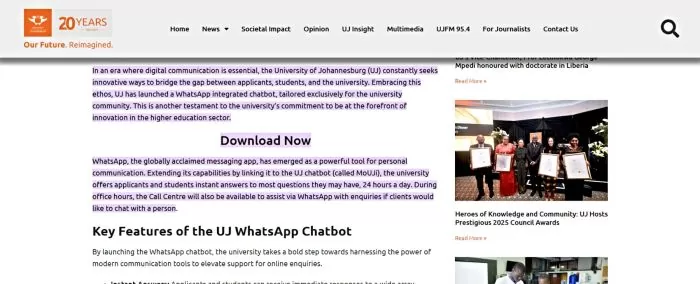
    Example: To meet these expectations, the University of Johannesburg implemented MoUJi, an AI-powered chatbot on their website and messaging platforms to provide instant 24/7 answers to prospective student inquiries. This chatbot handles common admissions questions (e.g. application status, program info) and syncs with student records, significantly improving first-response times for Gen Z/Gen Alpha prospects. UJ’s always-on approach has led to faster conversions, as more than half of students now enroll at the first institution to reply, making immediacy the new baseline.
    HEM BP Image 1HEM BP Image 1

    Source: UJ News

    Of course, speed alone isn’t enough. Students also expect relevance. A student asking about health sciences should not receive a generic welcome packet. Provide tailored content, whether it’s a program-specific brochure, alumni video, or next steps based on where they are in the enrollment process.

    Tone and channel matter too. Younger Gen Alpha students may prefer casual WhatsApp or Instagram DMs. Adult learners might gravitate toward email or phone. The goal is to meet students where they are, with the right message, at the right time.

    Actionable insight: Audit your current inquiry process. Are you responding within the first hour? Are you using the same platforms where students made contact? If not, explore adding a chatbot, setting up automated SMS/email alerts, or staggering staff shifts to cover peak hours. In 2025, responsiveness is no longer a luxury; it’s the difference between a lead and a lost opportunity.

    Segmenting Leads for Targeted Nurturing

    To nurture leads effectively, one size cannot fit all, because not all leads are equal. A key early step is lead segmentation: categorizing and organizing your inquiries into meaningful groups. 

    How can segmenting leads improve enrollment outcomes for schools? Segmentation helps you focus your energy where it pays off, ensuring each prospective student gets information and attention tailored to their needs. You can segment leads on multiple dimensions: source of the lead, program interest, timeline to enrollment, and engagement behavior. Breaking your giant inquiry list into smaller segments lets you craft follow-up strategies that resonate with each group, rather than blasting generic messages to everyone.

    What are useful segmentation categories for schools? Consider these four core dimensions from HEM’s lead nurturing in education framework:

    • Source: How did the lead find you (e.g., organic website form, paid ad, education fair)? A student from a high-intent channel, like an agent referral, may need a different approach than someone from a broad awareness campaign.
    • Program or Interest Area: What are they interested in studying? Target content accordingly.
    • Enrollment Timeline: Are they looking to enroll now or years from now? Your follow-up cadence should reflect that.
    • Engagement Behavior: Have they interacted with your emails, attended a webinar, or ignored follow-ups? Hot leads deserve more attention.

    By tagging leads across these criteria, you can prioritize and personalize your outreach, automate smarter, and increase conversion efficiency. For example, “Fall 2025 Business Masters prospects from Facebook” who opened three emails might get invited to an alumni panel, while “2026 boarding school parents” could receive nurturing newsletters and event invites over a longer cycle.

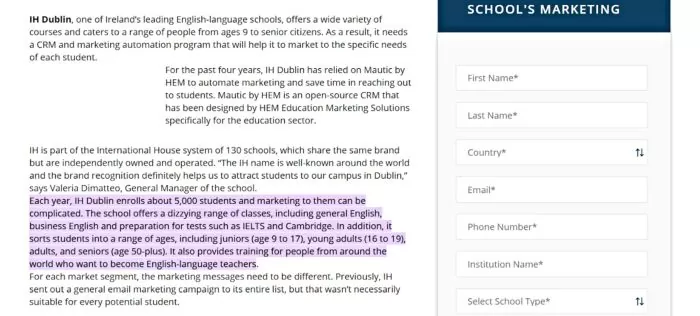
    Example: International House Dublin, a prominent English-language school, effectively segments its wide-ranging audience, which includes everyone from teenagers to corporate professionals, to ensure personalized lead nurturing. The school uses its CRM and marketing automation to group inquiries by age, course interest, and language level. A 15-year-old exploring summer camps receives youth-oriented content like social media snippets or student testimonials, while a 40-year-old business English prospect might get LinkedIn-style resources or an invite to a professional language webinar. This segmentation strategy ensures tailored, relevant communication for each lead, improving both engagement and conversion.
    HEM BP Image 2HEM BP Image 2

    Source: Higher Education Marketing

    Actionable Insight: If you’re just starting, begin by tagging leads by program and temperature (“hot,” “warm,” “cold”). Even a simple domestic vs. international distinction helps tailor outreach. Segmentation is the essential first step in treating leads as individuals, not numbers. And in 2025, that personal touch is now expected.

    Prioritizing and Scoring Your Leads

    Once you’ve segmented your inquiries, the next step is to determine lead quality. Which inquiries are most likely to turn into enrollments? Ideally, your admissions team would personally follow up with every lead. But limited time and resources mean you need to focus on the best opportunities. Lead prioritization and lead scoring allow you to rank leads by their likelihood to enroll, guiding where to devote personalized outreach versus automated nurturing.

    Start by identifying signals that suggest high intent. Did the lead schedule a tour? Attend a webinar? Engage with multiple emails? Our HEM webinar series advises schools to “identify each online source that delivers leads, and rank which sources tend to deliver the highest-intent prospects.” Historical data can help here; perhaps students from referral programs convert more often than those from general ads.

    Lead scoring formalizes this process. Assign points to meaningful actions and attributes: +10 for a virtual event, +5 for local applicants, +5 for a relevant test score, -5 for vague interest in a distant intake. The result is a numeric ranking that helps you target high-potential leads with fast, personal follow-up while keeping lower-interest leads on longer nurturing paths.

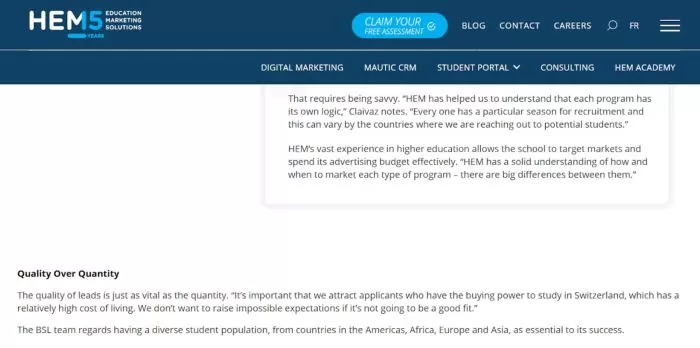
    Example: Business School Lausanne (Switzerland) uses a data-driven lead scoring model to prioritize inquiries most likely to enroll. BSL assigns points for behaviors and attributes (e.g., +10 for attending a webinar, +5 if local, -5 if long timeline) and tracks this in their CRM. This scoring helped BSL’s small admissions team focus on quality over quantity. “Each program has its own logic… and season,” notes BSL’s dean, so they leverage data to target high-intent leads by region and timing. By concentrating outreach on top-scoring international prospects, the school not only improved efficiency but also enhanced global diversity in its intakes (since they could devote more time to engaged candidates from various countries rather than chasing every cold lead).
    HEM BP Image 3HEM BP Image 3

    Source: Higher Education Marketing

    Actionable Insight: Define a few high-priority criteria for your school and flag those leads. Build tiered workflows, personal outreach for top scorers, automated flows for the rest, and refine your model over time using enrollment results.

    Ensuring CRM Hygiene and Integration

    A sophisticated CRM is only as effective as the data it holds. Without regular maintenance, even the best platforms can become cluttered, inconsistent, and fragmented, undermining your lead nurturing efforts. CRM hygiene means keeping your database clean, updated, and fully integrated with all your lead capture channels.

    First, ensure every lead source flows directly into your CRM. Whether it’s your website inquiry forms, live chat, student fairs, or Facebook messages, all data should be centralized. Avoid manual transfers whenever possible to reduce errors and response delays. Forms, event sign-ups, and chatbots should automatically populate fields and trigger workflows in real time.

    Next, standardize how data is entered and tagged. Use predefined categories and consistent naming conventions. If one lead source is labeled “HS Fair” and another “High School Event,” your reporting will be skewed. CRM hygiene also means merging duplicate entries, correcting missing data, and regularly reviewing fields for accuracy.

    Compliance is another core aspect. Be sure your CRM tracks communication consent in accordance with regional laws like GDPR, CASL, and CAN-SPAM. Respecting privacy builds trust and protects your institution legally.

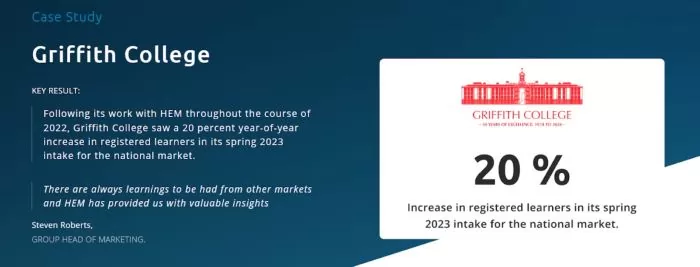
    Example: Griffith College (Ireland): Undertook a comprehensive CRM cleanup and integration initiative that paid off in enrollment gains. As Ireland’s largest private college, Griffith had amassed a large inquiry database in HubSpot over the years. In 2022, they partnered with consultants to audit this CRM data, merge duplicates, update missing fields, and standardize lead sources. They also integrated all lead capture points – website forms, event sign-ups, Facebook lead ads – so that every prospect flows directly into HubSpot in real time (eliminating error-prone manual imports). After these hygiene improvements and streamlining of workflows, Griffith saw a 20% year-over-year increase in registered learners for Spring 2023. Clean data also enabled better segmentation; “dedicated workflows” now target specific audiences in their market with relevant content automatically.
    HEM BP Image 4HEM BP Image 4

    Source: Higher Education Marketing

    Actionable Insight: Schedule monthly data checks and quarterly audits to ensure consistency, eliminate duplicates, and verify integration across all lead sources. Clean data enables smarter, faster, and more personalized outreach.

    Automating Lead Nurturing Workflows

    With segmented, prioritized, and clean data in place, automation becomes the engine that powers scalable, personalized communication. Lead nurturing in education workflows ensures that no inquiry is overlooked and that each prospective student receives timely, relevant touchpoints guiding them toward enrollment.

    What role does automation play in modern lead nurturing strategies? Automation enables schools to nurture large numbers of leads while maintaining personalization. Automated workflows deliver timely touchpoints, such as welcome emails, event reminders, application prompts, and follow-up messages, based on a lead’s actions or profile. With branching logic and program-specific workflows, automation ensures no inquiry is overlooked and frees staff to focus on high-value, high-intent leads.

    Workflows are automated sequences of communications and tasks triggered by specific actions or characteristics. For instance, a lead who submits an inquiry form might automatically receive a welcome email, followed by a testimonial video, and later an invitation to apply. Use branching logic that adjusts messaging based on behavior. If a lead clicks a financial aid link, they receive scholarship information. If they remain inactive, they’re routed into a slower, long-term campaign.

    This systematized approach enables your team to engage thousands of prospects without manual effort. It also supports tiered nurturing: high-priority leads can trigger alerts for personal outreach, while low-priority leads receive regular updates through drip campaigns.

    Automation by program type and lead score further refines communication. Undergraduate prospects might get campus life content and application deadlines, while MBA leads receive career stats and admissions webinars.

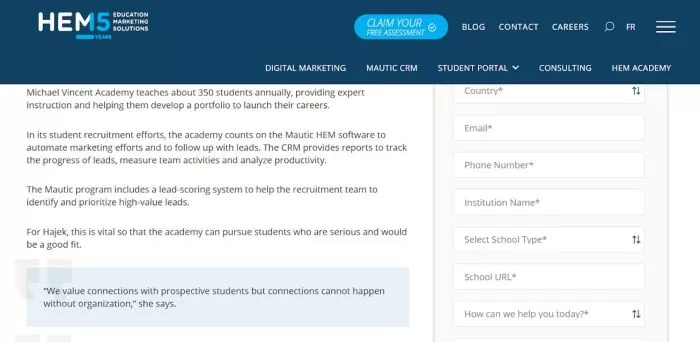
    Example: Michael Vincent Academy (USA): This Los Angeles beauty academy uses marketing automation to nurture leads at scale. As a small, private school (~350 students/year) without state funding, MVA needed to work “smarter, not harder,” says its CEO. They implemented HEM’s Mautic CRM to automate repetitive recruitment tasks: inquiry form submissions trigger immediate personalized emails, and scheduled drip campaigns send course info and alumni success stories over time. The CRM also tracks each lead’s progress and alerts staff when a high-value prospect engages (so they can personally reach out). The result is that “key elements of the academy’s workflow are now automated, allowing staff to spend more time connecting with prospective students,” rather than manual data entry.
    HEM BP Image 5HEM BP Image 5

    Source: Higher Education Marketing

    Actionable Insight: Start with a “welcome series” automation. Then build event follow-ups and dormant lead workflows. Use branching logic to scale personalization and free your team for high-touch moments.

    Engaging Leads Across Multiple Channels

    In 2025, engaging prospective students effectively means communicating across the full range of channels they use every day. Relying on email alone is no longer enough. Students and their families expect institutions to be present and responsive on email, text, social media, messaging apps, and even video calls. By orchestrating conversations across these platforms, schools can deliver a seamless and personalized lead-nurturing experience.

    Email remains foundational for many schools because it’s scalable and direct. But augmenting email with SMS or text messaging can increase visibility and response, particularly for time-sensitive communications like deadline reminders or event invitations. A friendly text from an admissions counselor often prompts a faster reply than an email alone.

    Messaging platforms such as WhatsApp, Facebook Messenger, and WeChat are essential for reaching international audiences. Schools that integrate their CRM with these apps can ensure students receive real-time support in their preferred environments. Meanwhile, chatbots and live chat widgets on institutional websites offer 24/7 responsiveness, capturing leads and answering questions immediately, even outside business hours.

    Social media content also plays a subtle but powerful role in nurturing. Students often monitor a school’s Instagram or TikTok after inquiring, using it to assess campus life, student experiences, and the overall vibe. Frequent, engaging posts, such as student takeovers, Q&A videos, and highlight reels from events, build trust and connection. Private groups on Facebook or Discord can further nurture admitted students by creating a sense of belonging before they even arrive.

    Finally, video calls and phone consultations remain invaluable for more complex or personal conversations, especially with parents or mature learners. Scheduling one-on-one chats after a lead shows interest helps deepen the relationship and guide the student toward enrollment.

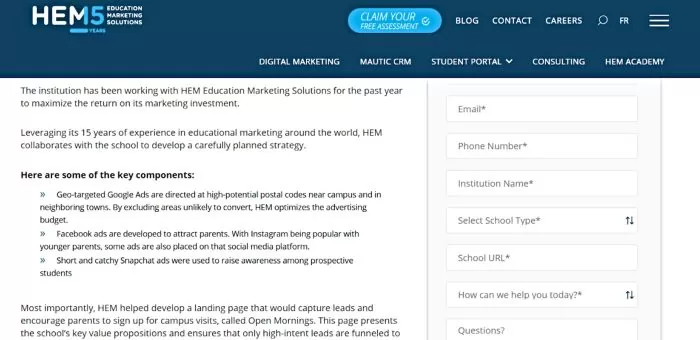
    Example: Queen Anne’s School exemplifies coordinated multi-channel engagement. They ran dual campaigns that targeted both parents and students: engaging Facebook and Instagram ads were tailored for parents, while vibrant Snapchat ads focused on student interests. This approach ensured the entire decision-making unit received relevant messaging on their preferred platforms. By tailoring content and channel per audience, Queen Anne’s created a connected, multi-touch nurturing experience that contributed to better recruitment outcomes.
    HEM BP Image 6HEM BP Image 6

    Source: Higher Education Marketing

    Actionable Insight: Review your communication strategy and expand beyond your primary channel. Add one new platform, whether a texting tool, chatbot, or social campaign, and measure its impact. Prioritize consistency and responsiveness, not volume, and always align messaging with where each prospect is in their decision journey.

    Personalizing the Nurture Journey

    Today’s students are used to hyper-customized experiences from the apps and services they use daily. If your school sends generic emails or one-size-fits-all messages, you risk losing the attention and trust of prospective students. Personalization helps you build real connections, and it can significantly increase your chances of converting an inquiry into an enrollment.

    Start with the basics: use the student’s first name and program of interest in every message. “Hi, Sam, we saw you’re exploring our Biology program…” is far more effective than a bland greeting. Most CRMs and email tools allow this kind of dynamic personalization with ease.

    Next, tailor content to fit the student’s interest and where they are in their journey. Someone researching a business degree should receive content about business-related careers, program features, or a student success story from that faculty – not generic school-wide information. Similarly, if a lead has already applied, they should be receiving reminders about next steps, not introductory program brochures.

    Behavioral personalization adds another layer. If a student lingers on your financial aid page, follow up with a scholarship guide. If they start but don’t finish an application, trigger a helpful reminder email or call.

    Finally, consider personalization at scale through tools like personalized video. A student who receives a message like “Hi, Jordan – congrats on your acceptance to our engineering program!” is more likely to feel recognized and valued.

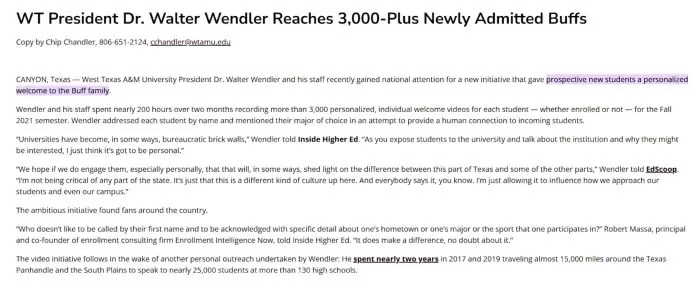
    Example: West Texas A&M delivered an extraordinary level of personalization in admissions by having its president record 3,000 individual welcome videos for newly admitted students. In Spring 2021, President Walter Wendler spent nearly 200 hours personally addressing each admitted student by name, congratulating them, and mentioning their intended major in a short video clip. The videos helped incoming freshmen feel a human connection to the university before ever setting foot on campus. Indeed, WTAMU officials believed this effort would tip the scales for students deciding where to enroll, by showing that WTAMU sees them as individuals, not numbers.
    HEM BP Image 7HEM BP Image 7

    Source: West Texas A&M

    Measuring Results and Continuously Improving

    Effective lead nurturing starts with emails and running campaigns, but it’s also about tracking what works and refining your strategy over time. Without measurement, you’re flying blind. Schools that succeed in converting inquiries into enrollments are those that monitor their funnel closely: from inquiry to application, admission, and enrollment. Every stage can offer insight if you’re capturing the right data.

    At the core, this means using your CRM to track where leads come from, how they interact with your communications, and what ultimately drives them to enroll. Schools should “measure leads and enrolled students by source”. Knowing, for instance, that webinar attendees convert at a higher rate than paid ad clicks allows you to double down on that tactic.

    Equally important is monitoring engagement: Are students opening your emails? Clicking links? Attending virtual sessions? These are early signals of effectiveness. If email open rates drop off midway through a sequence, your messaging or timing may need adjustment.

    It’s also critical to examine conversion rates between funnel stages. If your inquiry-to-application rate is stuck at 10%, targeted nurturing improvements, like faster replies or more tailored messaging, might lift it to 15%, a meaningful jump.

    Actionable Insight: Create a monthly report that tracks each stage of your funnel, including lead source and engagement metrics. Pick one weak spot each quarter, run a small experiment, and measure the impact. Optimization is ongoing, and the key to sustained enrollment growth.

    Embracing a Digital-First, Student-Centric Approach

    Mastering lead nurturing in education today means more than adopting new tools, it requires a student-first mindset. In 2025, prospective students expect fast responses, personalized communication, and authentic engagement. Schools that align their outreach with these expectations, supported by data and automation, are seeing stronger results across the board.

    The institutions highlighted in this article show that consistent, relevant nurturing works. It builds trust, improves yield, and creates better-fit incoming classes.

    But nurturing is not just about conversions. It’s about respect. When a student receives helpful, well-timed guidance tailored to their interests, it signals that your school sees them as more than a number. That personal attention can tip the scales when it’s time to choose.

    As you refine your student recruitment strategies, ask: Are we showing up where students are? Are we engaging quickly and meaningfully? Are we using our data wisely and ethically? With each improvement, you move closer to a recruitment process that feels less like marketing and more like service.

    In short: every inquiry is the start of a journey. With thoughtful, digital-first nurturing, your school can guide more students to a confident, well-informed “yes.”

    Are you looking for education marketing services?

    Our expert digital marketing services can help you attract and enroll more students!

    Frequently Asked Questions

    Question: Why is fast response time so important in student lead nurturing? 

    Answer: Today’s prospective students, spanning late Gen Z and the emerging Generation Alpha, expect immediacy and personalization. These digital natives grew up with instant streaming, smart devices, and AI assistants. When they reach out to schools, they expect the same level of responsiveness.

    Question: How can segmenting leads improve enrollment outcomes for schools? 

    Answer: Segmentation helps you focus your energy where it pays off, ensuring each prospective student gets information and attention tailored to their needs.

    Question: What role does automation play in modern lead nurturing strategies?

    Answer: Automation enables schools to nurture large numbers of leads while maintaining personalization. Automated workflows deliver timely touchpoints, such as welcome emails, event reminders, application prompts, and follow-up messages, based on a lead’s actions or profile.

    Source link

  • A topic modelling analysis of higher education research published between 2000 and 2021

    A topic modelling analysis of higher education research published between 2000 and 2021

    by Yusuf Oldac and Francisco Olivas

    We recently embarked upon a project to explore the development of higher education research topics over the last decades. The results were published in Review of Education. Our aim was to thematically map the field of research on higher education and to analyse how the field has evolved over time between 2000 and 2021. This blog post summarises our findings and reflects on the implications for HE research.

    HE research continues to grow. HE researchers are located in globally diverse geographical locations and publish on diversifying topics. Studies focusing on the development of HE with a global-level analysis are increasingly emerging. However, most of these studies are limited to scientometric network analyses that do not include a content-related focus. In addition, they are deductive, indicating that they tried to fit their new findings into existing categories. Recently, Daenekindt and Huisman (2020) were able to capture the scholarly literature on higher education through an analysis of latent themes by utilising topic modelling. This approach got attention in the literature, and the study’s contribution was highlighted in an earlier SRHE blog post. We also found their study useful and built on it in our novel analysis. However, their analysis focused only on generating topics from a wide range of higher education journals and did not identify explanatory factors, such as change over the years or the location of publication. After identifying this gap, we worked towards moving one step further.

    A central contribution of our study is the inclusion of a set of research content explanatory factors, namely: time, region, funding, collaboration type, and journals, to investigate the topics of HE research. In methodological terms, our study moves ahead of the description of the topic prevalence to the explanation of the prevalence utilizing structural topic modelling (Roberts et al, 2013).

    Structural topic modelling is a machine learning technique that examines the content of provided text to learn patterns in word usage without human supervision in a replicable and transparent way (Mohr & Bogdanov, 2013). This powerful technique expands the methodological repertoire of higher education research. On one hand, computational methods make it possible to extract meaning from large datasets; on the other, they allow the prediction of emerging topics by integrating the strengths of both quantitative and qualitative approaches. Nevertheless, many scholars in HE remain reluctant to engage with such methods, reflecting a degree of methodological conservatism or tunnel vision (see Huisman and Daenekindt’s SRHE blog post).

    In this blog post, our intention is not to go deep into the minute details of this methodological technique, but to share a glimpse of our main findings through the use of such a technique. With the corpus of all papers published between 2000 and 2021 in the top six generalist journals of higher education, as listed by Cantwell et al (2022) and Kwiek (2021) both, we analysed a dataset of 6,562 papers. As a result, we identified 15 emergent research topics and several major patterns that highlight the thematic changes over the last decades. Below, we share some of our findings, accompanied by relevant visualisations.

    Glimpse at the main findings with relevant visuals

    The emergent 15 higher education topics and three visibly rising ones

    Our topic modelling analysis revealed 15 distinct topics, which are largely in line with the topics discussed in previous studies on this line (eg Teichler, 1996; Tight, 2003; Horta & Jung, 2014). However, there are added nuances in our analysis. For example, the most prevalent topics are policy and teaching/learning, which are widely acknowledged in the field, but new themes have emerged and strengthened over time. These themes include identity politics and discrimination, access, and employability. These areas, conceptually linked to social justice, have become central to higher education research, especially in US-based journals but not limited to them. The visual below demonstrates the changes over the years for all 15 topics.

    • The Influence of funding on higher education research topics

    Research funding plays a crucial role in shaping certain topics, particularly gender inequality, access, and doctoral education. Studies that received funding exhibited a higher prevalence of these socially significant topics, underscoring the importance of targeted funding to support research with social impact. The data visualisation below summarises the influence of reported funding for each topic. The novelty of this pattern needs to be highlighted because we have not come across a previous study looking into the influence of funding existence on research topics in the higher education field.

    • The impact of collaboration on higher education research topics

    Collaborative publications are more prevalent in topics such as teaching and learning, and diversity and social relations. By contrast, theoretical discussions, identity politics, policy, employability, and institutional management are more common in solo-authored papers. This pattern aligns with the nature of these topics and the data requirements for research. Please see the visualised data below.

    We highlight that although the relationship between collaboration and citation impact or researcher productivity is well studied, we are not aware of any evidence of the effect of collaboration patterns on topic prevalence, particularly in studies focusing on higher education. So, this finding is a novel contribution to higher education research.

    • Higher education journals’ topic preferences

    Although the six leading journals claim to be generalist, our analysis shows they have differing publication preferences. For example, Higher Education focuses on policy and university governance, while Higher Education Research and Development stands out for teaching/learning and indigenous knowledge. Journal of Higher Education and Review of Higher Education, two US-based journals, have the highest prevalence of identity politics and discrimination topics. Last, Studies in Higher Education has a significantly higher prevalence in teaching and learning, theoretical discussions, doctoral education, and emotions, burnout and coping than most of the journals.

    • Regional differences in higher education research topics

    Topic focus varies significantly by the region of the first author. First, studies from Asia exhibit the highest prevalence of academic work and institutional management. Studies from Africa show a higher prevalence of identity politics and discrimination. Moreover, studies published by first authors from Eastern European countries stand out with the higher prevalence of employability. Lastly, the policy topic has a high prevalence across all regions. However, studies with first authors from Asia, Eastern Europe, Africa, and Latin America and the Caribbean showed a higher prevalence of policy research in higher education than those from North America and Western Europe. By contrast, indigenous knowledge is most prominent in Western Europe (including Australia and New Zealand). The figure below demonstrates these in visual format.

    Concluding remarks

    Higher education research has grown and diversified dramatically over the past two decades. The field is now established globally, with an ever-expanding array of topics and contributors. In this blog post, we shared the results of our analysis in relation to the influence of targeted funding, collaborative practices, regional differences, and journal preferences on higher education research topics. We have also indicated that certain topics have risen in prevalence in the last two decades. More patterns are included in the main research study published in Review of Education.

    It is important to note that we could only include the higher education papers published up to 2021, the latest available data year when we started the analyses. The impact of generative artificial intelligence and recent major shifts in the global geopolitics, including the new DEI policies in the US and overall securitisation of science tendencies, may not be reflected fully in this dataset. These themes are very recent, and future studies, including replications with similar approaches, may help provide newly emerging patterns.

    Dr Yusuf Oldac is an Assistant Professor in the Department of Education Policy and Leadership at The Education University of Hong Kong. He holds a PhD degree from the University of Oxford, where he received a full scholarship. Dr Oldac’s research spans international and comparative higher education, with a current focus on global science and knowledge production in university settings.

    Dr Francisco Olivas obtained his PhD in Sociology from The Chinese University of Hong Kong. He joined Lingnan University in August 2021. His research lies in the intersections between cultural sociology, social stratification, and subjective well-being, using quantitative and computational methods.

    Author: SRHE News Blog

    An international learned society, concerned with supporting research and researchers into Higher Education

    Source link

  • Are young college graduates losing an edge in the job market?

    Are young college graduates losing an edge in the job market?

    This audio is auto-generated. Please let us know if you have feedback.

    Dive Brief:

    • Young college graduates are now spending more time unemployed than job hunters with only a high school diploma, according to an analysis published Monday.
    • Researchers at the Federal Reserve Bank of Cleveland found that, from June 2024 to June 2025, 37.1% of unemployed workers between the ages of 22 and 27 with at least a bachelor’s degree either found work or stopped looking for work each month. That’s compared to 41.5% of their peers who only completed high school.
    • Their report comes amid other signs of a tough job market for recent graduates. The most recent unemployment data from the U.S. Bureau of Labor Statistics, released Thursday, shows 9.7% of bachelor’s degree holders ages 20 to 24 were unemployed in September up from 6.8% a year prior.

    Dive Insight:

    A college degree still provides young workers with economic and professional advantages, the Cleveland Fed analysis found. Once employed, college graduates earn more than their degreeless counterparts and experience increased job stability, it said.

    However, researchers pointed to signs that some of the job market advantages of a college degree are eroding. 

    For decades, workers with a high school degree typically saw unemployment rates about 5 percentage points higher than college graduates did, according to the analysis. 

    That gap temporarily widened during the 2008 financial crisis, when high school graduates had a particularly difficult time finding work. 

    But the Great Recession obscured that the gap in job-finding rates between high school graduates and those with four-year college degrees had been slowly closing since the turn of the century, according to the Cleveland Fed researchers.

    With brief exception during the pandemic, the unemployment rate gap between the two groups has slowly shrunk since 2008.

    In July, the 12-month average unemployment rate for young college graduates stood only 2.5 percentage points lower than that of their peers without a postsecondary degree. That’s the smallest gap since the record low of 2.4 percentage points in March 2024.

    That slim difference, combined with the delay in degree-holders getting hired, indicates “that a long period of relatively easier job-finding prospects for college grads has ended,” researchers said Monday.

    “The labor market advantages conferred by a college degree have historically justified individual investment in higher education and expanding support for college access,” they said. “If the job-finding rate of college graduates continues to decline relative to the rate for high school graduates, we may see a reversal of these trends.”

    The pandemic resulted in a tight labor market, but the Cleveland Fed researchers said their findings can’t solely be attributed to the long-lasting disruptions of COVID-19.

    “If historically tight labor markets drove narrowing, the high school job-finding rate should have risen to match college rates rather than a decline in the college job-finding rate,” they said. 

    The decades-long trend also predates the influence of artificial intelligence on the job market.

    Instead, the researchers noted that the timing correlates with a broader market shift from “college-biased to education-neutral growth in labor demand.”

    “Declining job prospects among young college graduates may reflect the continued growth in college attainment, adding ever larger cohorts of college graduates to the ranks of job seekers, even though technology no longer favors college-educated workers,” they said.

    However, older degree-holders are not seeing the same stark unemployment numbers.

    In September, 3.6% of bachelor’s degree-holders ages 25 to 34 were unemployed, according to BLS data. That’s well under the overall unemployment rate of 4.4%, which is the highest it’s been in four years.

    Source link

  • 3 reasons to switch to virtual set design

    3 reasons to switch to virtual set design

    Key points:

    If you’ve attended a professional show or musical recently, chances are you’ve seen virtual set design in action. This approach to stage production has gained so much traction it’s now a staple in the industry. After gaining momentum in professional theater, it has made its way into collegiate performing arts programs and is now emerging in K-12 productions as well.

    Virtual set design offers a modern alternative to traditional physical stage sets, using technology and software to create immersive backdrops and environments. This approach unlocks endless creative possibilities for schools while also providing practical advantages.

    Here, I’ll delve into three key benefits: increasing student engagement and participation, improving efficiency and flexibility in productions, and expanding educational opportunities.

    Increasing student engagement and participation

    Incorporating virtual set design into productions gets students excited about learning new skills while enhancing the storytelling of a show. When I first joined Churchill High School in Livonia, Michigan as the performing arts manager, the first show we did was Shrek the Musical, and I knew it would require an elaborate set. While students usually work together to paint the various backdrops that bring the show to life, I wanted to introduce them to collaborating on virtual set design.

    We set up Epson projectors on the fly rail and used them to project images as the show’s backdrops. Positioned at a short angle, the projectors avoided any shadowing on stage. To create a seamless image with both projectors, we utilized edge-blending and projection mapping techniques using just a Mac® laptop and QLab software. Throughout the performance, the projectors transformed the stage with a dozen dynamic backdrops, shifting from a swamp to a castle to a dungeon.

    Students were amazed by the technology and very excited to learn how to integrate it into the set design process. Their enthusiasm created a real buzz around the production, and the community’s feedback on the final results were overwhelmingly positive.

    Improving efficiency and flexibility

    During Shrek the Musical, there were immediate benefits that made it so much easier to put together a show. To start, we saved money by eliminating the need to build multiple physical sets. While we were cutting costs on lumber and materials, we were also solving design challenges and expanding what was possible on stage.

    This approach also saved us valuable time. Preparing the sets in the weeks leading up to the show was faster, and transitions during performances became seamless. Instead of moving bulky scenery between scenes or acts, the stage crew simply switched out projected images making it much more efficient.

    We saw even more advantages in our spring production of She Kills Monsters. Some battle scenes called for 20 or 30 actors to be on stage at once, which would have been difficult to manage with a traditional set. By using virtual production, we broke the stage up with different panels spaced apart and projected designs, creating more space for performers. We were able to save physical space, as well as create a design that helped with stage blocking and made it easier for students to find their spots.

    Since using virtual sets, our productions have become smoother, more efficient, and more creative.

    Expanding educational opportunities

    Beyond the practical benefits, virtual set design also creates valuable learning opportunities for students. Students involved in productions gain exposure to industry-level technology and learn about careers in the arts, audio, and video technology fields. Introducing students to these opportunities before graduating high school can really help prepare them for future success.

    Additionally, in our school’s technical theater courses, students are learning lessons on virtual design and gaining hands-on experiences. As they are learning about potential career paths, they are developing collaboration skills and building transferable skills that directly connect to college and career readiness.

    Looking ahead with virtual set design

    Whether students are interested in graphic design, sound engineering, or visual technology, virtual production brings countless opportunities to them to explore. It allows them to experiment with tools and concepts that connect directly to potential college majors or future careers.

    For schools, incorporating virtual production into high school theater offers more than just impressive shows. It provides a cost-effective, flexible, and innovative approach to storytelling. It is a powerful tool that benefits productions, enriches student learning, and prepares the next generation of artists and innovators.

    Latest posts by eSchool Media Contributors (see all)

    Source link

  • New international enrollment dipped this fall, NAFSA survey finds

    New international enrollment dipped this fall, NAFSA survey finds

    This audio is auto-generated. Please let us know if you have feedback.

    Dive Brief:

    • Many U.S. colleges are experiencing declines in undergraduate and graduate enrollment amid tightening visa policies, according to a new study released by NAFSA: Association of International Educators and other groups. 
    • U.S. colleges reported a 6% average drop in new international bachelor’s enrollment and a 19% drop in new international master’s enrollment for the fall. Of some 200 surveyed U.S. institutions, 48% saw declines in their international bachelor’s students, and 63% experienced a drop-off in international graduate enrollment. 
    • Canada suffered even more dramatic declines, while international student enrollment rose in Asian and European countries, according to the NAFSA study. Both U.S. and Canadian institutions primarily blamed restrictive government policies for the decline.

    Dive Insight:

    Since taking office, the Trump administration has launched a suite of aggressive policies that have made it difficult for many international students to study in the U.S. 

    Among other moves, dramatically slowed visa processing raised concerns this summer that tens of thousands of students might be stymied from coming to the U.S. for college. On top of that, the administration has revoked thousands of visas for international students already studying here and proposed a four-year cap on student visas, which could hit doctoral students particularly hard. 

    In the U.S., restrictive government policies were by far the No. 1 obstacle to international enrollment, with 85% of surveyed colleges citing them in the NAFSA study. That’s up from 58% of colleges that said the same in 2024. 

    “We are navigating one of the most dynamic moments in international education, driven in no small part by shifts in U.S. visa and immigration policy,” NAFSA Executive Director and CEO Fanta Aw said in a statement. “The ripple effects of these policy changes are being felt across campuses and communities around the world.”

    The distant No. 2 concern was tuition and living costs, with 47% of U.S. respondents citing them as an obstacle this year. 

    As international enrollment declines take a toll on college finances, 36% of colleges surveyed by NAFSA said they plan to expand into new markets to adapt. Another 28% are planning budget cuts, and 26% intend to expand online programming to gin up enrollment. 

    To be sure, the U.S. isn’t the only country where government restrictions weigh on foreign enrollment. In Canada — where new international bachelor’s and master’s enrollment fell by 36% and 35%, respectively — 90% of polled colleges listed restrictive policies as the top obstacle to enrollment. European colleges, excluding those in the U.K., also listed restrictions as the primary obstacle. 

    The survey was conducted in October and drew on responses from 461 institutions across 63 countries, including 201 U.S. colleges. 

    The NAFSA study adds to mounting evidence of international enrollment drop-offs this fall. A survey of more than 800 colleges found that their international enrollment declined overall by 1% in fall 2025, with their graduate student enrollment plummeting by 12%, per the annual Open Doors report from the Institute of International Education and the U.S. Department of State released earlier this month.

    New international enrollment fell even more overall — by 17% — this fall, according to the Open Doors survey.

    Source link

  • Schools grapple with whooping cough as 2025 outpaces last year’s peak numbers

    Schools grapple with whooping cough as 2025 outpaces last year’s peak numbers

    This audio is auto-generated. Please let us know if you have feedback.

    Dive Brief:

    Dive Insight:

    The Texas Department of State Health Services reported on Nov. 3 that it was tracking a significant increase in pertussis cases in 2025. According to provisional data, the agency said, “Texas has had more than 3,500 reported pertussis cases through October this year, roughly four times the number reported for the same period last year.”

    The number of cases is also reportedly the highest for the state in 11 years.

    Texas schools, among other entities like hospitals, are required to report individuals who are suspected of having pertussis within one work day, according to the state health agency.

    This is the second consecutive year that Texas has experienced high year-over-year increases in reported pertussis cases, and it’s also the second consecutive year the state’s Department of State Health Services has issued a health alert, according to a news release.

    The CDC said reported cases of pertussis are currently trending down in 2025 since a peak in November 2024, when more than six times as many cases were reported, compared to 2023. The agency added that case counts will likely change as it finalizes the data.

    In September, Colorado-based healthcare system UCHealth reported that cases of whooping cough “are on track to be even worse this year than in 2024,” adding that health officials in parts of the state have warned of “a noticeable jump” in pertussis cases as kids have returned to school.

    In many states across the U.S. — including Florida, Oregon and Washington — cases of pertussis as of Sept. 20 were already outpacing total year-to-date cases reported by the CDC in 2025. UCHealth’s September report noted that the worst U.S. pertussis outbreaks so far in 2025 were on the West Coast, with high numbers also reported in Ohio, Michigan, Illinois, Minnesota, North Carolina and Arizona.

    Other childhood diseases are also on the rise as a result of shifting attitudes toward vaccines and vaccine mandates. According to the CDC, the best defense against pertussis is a vaccination.

    In March, measles infections spread across several U.S. states, a quarter-century after the potentially fatal disease had been declared eradicated in the U.S. in 2000.

    In addition to the impact on student health, an uptick in acute and chronic illnesses can also increase chronic absenteeism issues for schools and school districts. A CDC study published last year found that in 2022, 5.8% of children experienced chronic school absenteeism for health-related reasons.

    Source link

  • With News Decoder, students explore their role in the world

    With News Decoder, students explore their role in the world

    Back in 2020, during the height of the Covid epidemic, high school students in the U.S. state of Connecticut sat down with News Decoder founder Nelson Graves to explore a number of thorny topics that ranged from the death penalty to whether animals should be kept in zoos.

    The students in “American Voices & Choices: Ethics in Modern Society” at Westover School had been working with News Decoder since the start of that academic year, mastering the process we call Pitch, Report, Draft and Revise — or PRDR — to identify topical issues at the intersection of ethics and public policy.

    They pitched ideas they wanted to report on: teen health; police brutality; abortion; economic privilege in the environmental movement; the risks of experimental vaccines; the impact of alcohol on youth.

    Later, each student received detailed feedback from a News Decoder editor, aimed at helping them narrow their research and produce original reporting.

    Westover was an early News Decoder school partner. Since our founding 10 years ago, News Decoder has worked with high school and university students in 89 schools across 23 countries.

    Decoding news in school

    Teachers have used us as part of their course curricula, as extra credit assignments and as standalone learning opportunities for their students.

    At Realgymnasium Rämibühl Zürich in Switzerland, teacher Martin Bott brings News Decoder in each year. In one weeklong workshop, students produced podcasts. Over five days, they pitched News Decoder stories about a problem they identified in their local communities, identified an expert to interview, found how that problem was relevant to people in other countries and then wrote a podcast script, revised it and recorded it. “[News Decoder] enabled me to do a few projects which really open up perspectives for the students, give them a taste of life beyond the classroom and of the world of journalism,” Bott said. 

    In another workshop for RGZH, News Decoder turned students into “foreign correspondents.” They were tasked with finding stories in Zurich that people in other countries would find interesting. Like the students in the podcasting workshop, they then found an expert to interview, wrote a draft and revised it with the goal of publishing it on News Decoder. 

    One student in the workshop noticed a demonstration of people with dogs and got up the nerve to talk to one of them. They were from an organization that rescued Spanish greyhounds and she decided it would be a good idea for a News Decoder story. The story she wrote ended up as one of News Decoder’s most-read stories of all time.

    Not only have Bott’s students been able to publish stories on News Decoder, many of these stories, including the article about the greyhounds, have won awards in our twice yearly global storytelling competition. 

    “We’ve been delighted to get so many of those stories published on News Decoder,” Bott said. “That’s very, very motivating for the students. And it’s a wonderful learning process for them because they realise it’s not just about school rules and so on out there.”

    Challenging students to do more

    Bott said that working with professionals at News Decoder gets the students to step up. “When you’re a journalist, you’ve got a responsibility,” he said. “That’s something we’ve been able to talk about with journalists who’ve met us from various parts of the world through News Decoder. And you’ve got real pressure as well. And they’re not, I think they’re not quite used to that. So it really opens their eyes.”

    At The Hewitt School in New York, 15 teens at the all-girls school meet once a month as a club. They read and discuss News Decoder stories and pitch their own stories. They also prepare for a cross-border webinar; each year they join with students from a News Decoder partner school in another country, and decide with those students on a topic to explore. 

    They then research the topic, interview experts and come together with the students from the other school to present their findings live in a video conference before an audience of people from the two schools.

    In 2024, students from The Thacher School in California worked with peers at the European School of Brussels II on a webinar on consumerism and the human impacts of climate change. 

    Russell Spinney is faculty adviser for News Decoder at Thacher. “The webinars really were kind of ways just to get to know each other, discover that we actually do have some common interests. But not only that, that we also have problems that are similar,” he said. 

    “News Decoder’s workshops,” he said, “get students to think of ways to communicate their research beyond the classroom and connect with what’s going on in the world.” News Decoder has partnered schools this way in some 50 school-school webinars. 

    Source link

  • Indiana’s Attack on Intellectual Diversity

    Indiana’s Attack on Intellectual Diversity

    Indiana’s new Act 202, which advocates of free inquiry have feared would suppress academic freedom despite its claims to promote intellectual diversity, now has been implemented in real life: Citing Act 202, Indiana University (IU) officials suspended Social Work professor Jessica Adams from teaching a class called “Diversity, Human Rights and Social Justice” because U.S. Senator Jim Banks complained that she showed a chart in class that included “Make America Great Again” as a slogan that can be used as covert white supremacy.

    Senator Banks declared, “At least one student in the classroom was uncomfortable, and I’m sure there are more. This type of hateful rhetoric has no place in the classroom.” He is wrong. Hateful rhetoric has every place in the classroom, and bans on all ideas deemed “hateful” by someone would require massive repression. The goal of a challenging university must be to make students uncomfortable at times.

    Although Act 202 is a terrible law, it’s important to point out that this law does not allow Adams to be suspended. Act 202 only allows colleges to do two things in response to complaints: Provide the information to the trustees, and “refer” them “for consideration in employee reviews and other tenure and promotion decisions.”

    It does not authorize censoring classes or removing teachers on the grounds of intellectual diversity. In fact, Act 202 specifically prohibits this action because it says that institutions cannot “Limit or restrict the academic freedom of faculty members or prevent faculty members from teaching, researching, or writing publications about diversity, equity, and inclusion or other topics.”

    Obviously, banning a professor from teaching because they used a chart about white supremacy is a direct violation of this provision of Act 202. By suspending a professor from a class and invoking this law, the Indiana University administration is going far beyond the requirements and the authority of the law, and Indiana officials are violating the Bill of Rights, Act 202 and their own policies.

    The unjustifiable, illegal suspension of Adams without due process is yet another act of repression by Indiana University officials.

    But the attack from Act 202 in the name of intellectual diversity has a long history. The right has taken the language of the left, mockingly imitating the words and then turning them into tools of repression.

    In 2003, David Horowitz urged conservatives to “use the language that the left has deployed” and declare that there is “a lack of ‘intellectual diversity’ on college faculties.” Horowitz tried to invoke “academic freedom” to justify suppressing it, creating the Academic Bill of Rights and his “Students for Academic Freedom,” claiming that protecting the rights of students meant banning professors from expressing political views.

    Horowitz’s terrible idea is implemented in Act 202, where one fireable offense is the crime of being deemed by trustees “likely” while teaching “to subject students to political or ideological views and opinions that are unrelated to the faculty member’s academic discipline or assigned course of instruction.” One problem is that no evidence of any misconduct is needed, simply a feeling that a professor might be “likely” to say something forbidden. But the deeper flaw is the belief that professors should not be allowed to say anything unrelated to their classes.

    The AAUP’s standard is for “teachers to avoid persistently intruding material which has no relation to their subject.” It’s not the presence of any ideas unrelated to a class that violates academic norms, but only persistently intruding material. And this rule must be applied in a viewpoint neutral manner. Colleges cannot punish unrelated speech about politics more than they punish unrelated speech about football or the weather or any other topic. By targeting political viewpoints alone for penalties, SB 202 clearly violates the First Amendment.

    Heterodox Academy, an organization that advocates for viewpoint diversity, spoke out strongly against these repressive aspects of Act 202. Joe Cohn warned: “The trustees’ guess that the faculty member is likely to ever express a political or ideological view that isn’t germane to the class is sufficient to justify the denial of promotion or tenure.”

    These kinds of massive, totalistic bans on speech have an enormous chilling effect in practice, since no one knows what ideas could be deemed “unrelated” to a professor’s field by a trustee who knows nothing about that field.

    Indiana has legislated Horowitz’s old dream of banning politics from the classroom, which in practice is meant to be a targeted attack on the expression of left-wing viewpoints.

    When we resist bad laws like Act 202 by attacking intellectual diversity, we end up undermining the values we’re trying to protect and undercutting public support. Instead of denouncing the concept of intellectual diversity, we ought to say instead that we are defending intellectual diversity against those who cynically or misguidedly invoke it in order to destroy it.

    In the past century, no concept has done more to protect intellectual diversity than tenure. Act 202, by creating a post-tenure review by trustees with no competence to judge academic work, undermines tenure and endangers intellectual diversity rather than defending it.

    The Indiana law, by weakening tenure protections, is one of the greatest threats to intellectual diversity in the state. We need to attack the “intellectual diversity” law not because we oppose intellectual diversity, but because we support it. We want professors to be judged by their academic work, not by their political views, and we want academic work to be judged by academic experts rather than unqualified political appointees, because intellectual diversity is endangered when academic freedom and shared governance are attacked.

    This week, I spoke about Indiana’s intellectual diversity law as part of a panel on academic freedom at Purdue University Northwest (an event funded by the University of Chicago’s Forum for Free Inquiry and Expression as part of its Academic Freedom Institute). And while attacks on academic freedom can inspire some people to mobilize against the threat, the far more common response is fear and silence.

    In an atmosphere of budget cuts, no one is safe. We’re all contingent now, even the diminishingly few faculty with tenure in places where tenure still means something, because entire departments can be whacked to pieces as easily as a controversial adjunct professor is not rehired.

    Indiana’s Act 202 attacks intellectual diversity. And when administrators violate the law to suspend faculty for presenting controversial views, academic freedom is under even greater threat.

    Source link

  • What to Know About the Definition of Professional Degree

    What to Know About the Definition of Professional Degree

    The Trump administration is soon expected to propose a plan that would cap loans for a number of advanced degrees—including master’s and doctoral degrees in nursing—and it’s gone viral on social media.

    From TikTok to Instagram, to local news headlines, the plan set off a storm of online criticism as influencers and advocacy groups take issue with the supposed declassification of certain degrees. But defining programs as professional or graduate isn’t a debate about social prestige or cultural characterization; it’s a debate about access to student loans, and now the Education Department is saying it’s time to “set the record straight.”

    “Certain progressive voices have been fear mongering about the Department of Education supposedly excluding nursing degrees from being eligible for graduate student loans,” the department said in a news release Monday. “This is misinformation.”

    The commentators are concerned about an upcoming federal rule, prompted by Congress’s One Big Beautiful Bill Act, that could limit student loan access depending on what post-baccalaureate program a student enrolls in. Certain advanced degrees like dentistry, law or a masters in divinity will be eligible for higher student loans. (An advisory committee approved a draft of the rule in early November, which is slated to be formally proposed on the Federal Register in early 2026.)

    Inside Higher Ed has been reporting on the new loan limits for months and closely followed the negotiations over which programs should be considered as professional. So, here’s what you need to know about how the loan limits really work.

    Graduate v. Professional Is a Technical Term

    Many public critics of the proposal argue that not considering careers like nursing, speech pathology, teaching and social work as professionals would be a disrespectful blow to the dignity of students, many of whom are women, and the perceived value of the pathways they are pursuing. Some have even made uninformed suggestions that this could interfere with a students’ ability to gain licensure or a job after graduation. But those arguments imply that the terms have to do with a student’s level of competency or the capacity of a degree program, which they don’t.

    @vickichanmd

    Starting July 2026, “professional” students will be eligible for 50K a year in federal loans, while “nonprofessional” students $20,500. Coincidence that the fields chosen to get less than half the support are predominantly female? 🤔 ETA: I know I forgot some degrees, especially public health. So sorry for the oversight, 😥 should have been at the top of the list after the pandem¡c.

    ♬ original sound – dj auxlord

    Instead, the department would use the labels of professional and graduate, as defined in the department’s draft rule, to determine how much students can borrow.

    Here’s how that will work. If a degree falls in one of the 11 main categories deemed professional, a student pursuing it can take out up to $50,000 a year for four years or $200,000 total. Meanwhile, a student in any other graduate degree program can only borrow $20,500 per year or $100,000.

    The lifelong limit for all borrowers is $257,500 and that includes any loans from a bachelor’s degree. So, if a student were to pursue both a Master’s in public health and a medical degree, or any other combination of degrees from the two categories, they would not be able to combine the loan limits to access $300,000 total.

    Before the One Big Beautiful Bill Act, students in any post-baccalaureate program could borrow up to the cost of attendance through a program known as Grad PLUS. Students in a master’s or doctoral program who already took out a Grad PLUS loan prior to July 1, 2026 will maintain access to loans for up to the full cost of attendance as long as they stay within the same program, under the draft plan.

    And prior to the legislation, the term professional had little substantial meaning. The federal definition in the Higher Education Act served more as a guideline for colleges as they decided whether to self-identify their doctoral programs as professional and to distinguish between degrees that led to a career in the field or in academia. Master’s degrees, like a master’s of science in nursing, had no reason to call themselves professional.

    It’s not clear how the loan caps will affect students. Critics of the plan argue they’ll make financing education more difficult and lead to a shortage of employees, and some research has suggested that students will have to turn to private loans to pay for the program. However, suggesting that certain job titles are being “declassified” or will “no longer” be deemed credible is misleading.

    @reygantawney Replying to @Kayla Perkins NP programs are NOT included in the DOEs proposed “professional degree” definition, meaning NP students fall under lower loan caps. This proposal isn’t final, but the implications could be massive for students and the healthcare workforce. #departmentofeducation #nursepractitionerstudent #nursepractitioner #healthcare #healthcareworker ♬ original sound – REYGAN TAWNEY

    What Programs Count as Professional?

    So, the real question then becomes which programs count as professional and how did the Trump administration decide that definition?

    Currently, 11 main degrees would be considered professional under the draft rule. Those degrees, almost all of which are doctoral, include: medicine, osteopathic medicine, podiatry, chiropractic, optometry, pharmacy, dentistry, veterinary medicine, law, theology, and clinical psychology. All but one—clinical psychology—were noted in the HEA definition.

    Clinical psychology was added during the negotiating process, which wrapped up in early November. One member of the negotiating committee argued that there was a high demand for medical providers to treat patients with mental health challenges, particularly veterans diagnosed with PTSD.

    @urnurseguru NPs weren’t ‘removed’ from anything except a loan bucket they never belonged in 😂💅 Stop confusing LOAN categories with your PROFESSIONAL status. #nursingtiktok #nursepractitioner #studentloans #npschool #urnurseguru ♬ original sound – URNurseGuru

    Similar arguments were made for other health care roles like nurses, audiologists and occupational therapists and some committee members warned that adding one category and not others could make the proposal vulnerable to legal challenges. But the Trump administration wanted to keep the new legal definition almost as narrow as possible.

    Multiple sources familiar with the negotiation process told Inside Higher Ed that committee members warned the department that certain industry groups would push back.

    “I was absolutely expecting something like this,” one source said. “The only question was which profession would break through. But among the politically savvy people I talked to we were betting nurses.”

    Why Did ED Define Professional This Way?

    Education Department officials repeatedly said during the negotiations that the narrow definition reflected Congress’s intent—to limit federal spending on graduate student loans.

    Between 2000 and 2020, the number of Americans who had taken out federal student loans doubled from about 21 million to about 45 million and the amount they owed skyrocketed from $387 billion to $1.8 trillion, according to a 2024 report from the Brookings Institute, a nonpartisan D.C. think tank.

    And research from multiple sources shows that much of that increase in debt can be traced back to graduate students. A 2023 report from the Department of Education showed that while the amount of undergraduate loans decreased between 2010 and 2021, the amount of graduate student loans steadily grew. And though individual graduate students only make up about 21 percent of all borrowers, they could soon be responsible for the majority of all outstanding debt.

    Another study from the Georgetown Center on Education and the Workforce shows that between 2000 and 2024, the median net tuition and fees among graduate degree programs have more than tripled and the median debt principal among graduate borrowers has grown from $34,000 to $50,000.

    The Trump administration and Republicans on Capitol Hill say that results from a lack of limits on federal loans. They argue that with essentially unlimited graduate loans, colleges and universities have no incentive to keep costs low and students are convinced to take out more debt than they can handle. By ending Grad PLUS and limiting larger loans to a narrow group of degrees, they say, the goal is to drive down college costs and lower government spending.

    “Placing a cap on loans will push the remaining graduate nursing programs to reduce their program costs, ensuring that nurses will not be saddled with unmanageable student loan debt,” the department’s fact sheet noted.

    What Consequences Could It Cause?

    But the online critics and other advocates question whether the loan caps will actually reduce student debt and drive down college costs.

    They are worried that instead of lowering college costs, it will force more students—particularly low-income, first generation students and students of color—to depend on the private loan market.

    For many of those borrowers, depending on private lenders could mean higher interest rates and more debt to be paid off. But some, especially those with low credit scores or no credit history, might not be able to access any loan and then wouldn’t be able to pursue certain degrees.

    Critics also argue that the loan cap will not only limit opportunities for socioeconomic mobility, but also cause workforce shortages in high-demand, high-cost careers such as nursing, physical therapy and audiology as well as high-demand, low-return careers such as social work and education.

    @addieruckman The US Department of Education is considering new rules that would significantly change the definition of what is deemed a “professional degree,” affecting graduate programs and potentially capping federal loan amounts for those not meeting the new definition. This debate over which programs qualify for “professional” status could likely impact students’ access and ability to afford their education. What we do is so important, even if the government doesn’t recognize it!! #departmentofeducation #slp #slpsoftiktok #CapCut ♬ original sound – casey

    “At a time when healthcare in our country faces a historic nurse shortage and rising demands, limiting nurses’ access to funding for graduate education threatens the very foundation of patient care,” said Jennifer Mensik Kennedy, president of the American Nurses Association, which is a vocal critic of the draft rule. “In many communities across the country, particularly in rural and underserved areas, advanced practice registered nurses ensure access to essential, high-quality care that would otherwise be unavailable.”

    The Education Department countered that internal data indicates 95 percent of nursing students borrow below the $20,500 annual loan limit and wouldn’t be affected by the new cap. They also added that this loan cap only applies to post-baccalaureate degrees; about 80 percent of the nursing workforce just has an associate’s degree in nursing or a bachelor’s of science in nursing—both of which can lead to certification as a registered nurse.

    The department’s proposal could still be amended before it takes effect. The public will have at least 30 days to comment on the plan once it’s posted to the Federal Register. After the public comment period ends, ED officials will have to review and respond to the comments before issuing a final rule. But most higher ed experts don’t expect anything in the proposal to change no matter how many critiques ED receives.

    After that, Congress could still make changes to the law or a new administration could opt to rewrite the definition. But that would take time and likely more Democrats in office, so significant change isn’t anticipated any time soon.


    Source link

  • AI-Powered Data for Community College Student Success

    AI-Powered Data for Community College Student Success

    Colleges and universities sit on a large wealth of data, ranging from student attendance and interactions with learning management systems to employment and earnings data for graduates. But uniting legacy systems and having responsive data remains a wicked problem for many institutions.

    This year, Central New Mexico Community College is deploying a new AI-powered predictive analytics tool, CampusLens, part of CampusWorks, to improve data visibility in student retention, early alerts and career outcomes.

    In the latest episode of Voices of Student Success, host Ashley Mowreader speaks with Tracy Hartzler, president of Central New Mexico Community College, to discuss the risks with taking on new tools, the college’s approach to change management and the need for more responsive data.

    An edited version of the podcast appears below.

    Q: Can you introduce yourself, your role and your institution?

    Tracy Hartzler, President of Central New Mexico Community College

    A: My name is Tracy Hartzler. I’m president of Central New Mexico Community College. We’re located in Albuquerque, New Mexico. We serve three counties around us, and our population is about 900,000 residents in our area, so it’s about half the state of New Mexico who lives in our service area, but it’s an incredibly diverse area.

    We have a significant population of Hispanic, Latino students. We have a large population of Indigenous students, as well. We are the largest undergraduate institution in the state, and that’s distinct because we only issue or grant certificates and associate degrees. We are not a bachelor’s degree–granting institution, so our focus really is on those students who are seeking entry into college—whether that’s our dual credit students who are still in high school—but also those who are returning for upskilling. They’ve already earned their bachelor’s degree or degrees, and they’re coming back for some hands-on or applied skills, or those who are getting back into education and training because they’re looking for greater financial stability.

    Like so many other colleges, we know we want to learn from others, and so we’re really proud that we work with many of our other colleges across the state of New Mexico, but we certainly engage in conversations with leaders and schools who participate in American Association of Community Colleges who are part of the global community college leader network.

    But we’re really pleased and we’ve been really pushed by our peers who are members of the Alliance for Innovation and Transformation—group of higher education institutions, there’s about 60 of us—with some other thought partners to really help us think how we can best leverage technology and change our processes and deliver better education and training for our students and better serve our employers.

    We also are relying on lessons learned from those outside of higher education, so whether it’s in hospitality, healthcare, manufacturing and others. So while we know we have great work to do in New Mexico, and we are incredibly fortunate to work with strong partners who tell us what they want and how we can best serve them, we certainly look to other schools and other organizations to help us make those transitions faster so we can better serve our community.

    Q: From my vantage point, it seems community colleges are often some of the most nimble when it comes to learning from other institutions.

    A: Absolutely. You know, it’s great to be scrappy. I think we and here at CNM, we certainly punch above our weight. We are excited to take on new challenges. We are, frankly, fortunate to be able to move faster. So, if something doesn’t work, we can pivot away from it entirely or continue to revise it. And frankly, the urgency to do so is really placed on us by our employer partners, our community partners and our students. They really are pressing us to be responsive to them because they don’t have time to waste, and they certainly don’t have resources to waste. So, we really step in. And again, I don’t think CNM is unique in that we all respond to the need as quickly and as best we can.

    Q: We’re talking today about a new AI-powered predictive analytics tool that you all implemented. Historically, what has been the college’s retention and persistence strategy? What are some of the challenges you have seen when supporting students?

    A: Before the pandemic, we were able to and we were participating in a lot of futures work: What do students need? What do they need now? What do employers need in the future? Which, at that time, seemed so far off, and so we were already on a journey again, whether it was working with AFIT or others to help us better identify what we needed to do and how we needed to change to better meet our student and our employer needs.

    We knew that that would include certainly technology and leveraging technology, but we also knew it would mean changing how we do things, how we schedule, how we use the data in our systems. And we also knew we have a tremendous amount of information. We have a lot of data, but like so many other places, it’s in seven legacy systems. And we have over 100 applications that help our data systems talk to each other, to generate reports that our staff use, and it’s incredibly challenging to wrangle this data in a way that is useful, that helps us drive and drive change again.

    Most of the data is legacy data. It’s what happened last year, and how do we think that’s going to improve? What are we doing now to then improve performance a year ahead, and then we hope that what we do over the next year meets the need, but it takes us too long to really react.

    So, we were looking for ways to take the assets we have—which includes our incredible faculty and a number of our leaders and our office of data strategy and some of our contractors, like CampusWorks and consultants—to help us wrangle this data in a way that helps us be data informed in a time-sensitive way.

    We had a lot of processes in place that were helping us to do that. A lot of our steps were manual and creating reports, and it really slowed down what our frontline advisers and navigators and employment advisers really were able to do, because we were requiring them to do so much manipulation with the data then to be able to identify what they should do once they got this great report.

    So, we were looking for ways to leverage technology. And again, the pandemic happens. We’re increasingly dependent on our systems, using them to greater degrees than we had before, including our learning management system. We are also undertaking a transition conversion from our old student information system to a new student information systemin Workday. We’re making all these changes and upgrading technology, and frankly, AI is coming along that’s really dramatically changing how we work, or could change how we work. We’re trying to figure out a better way to wrangle all these opportunities.

    We were so excited to learn about CampusWorks and their product, CampusLens, because we think that tool will help us leapfrog, not only the tool but the experts that that CampusWorks brings to the table to help us to analyze data and develop tools that will help our frontline staff much more quickly and easily identify how they can help students. To register from class A to B, to help them identify all the predictors that say, if the student’s missing one assignment or they haven’t attended class, here are the automatic prompts for you as an adviser or navigator—or if you choose to automate that process you can. But really, how can we help individuals—our employees—still help and better connect with students to keep them on the track of success?

    It certainly can also help us schedule, help our faculty and all of our associate deans who do incredible jobs trying to figure out ways to schedule our incredible programming to be most effective for students. Some of this information that we’ve had in different places, when it comes together in a product like CampusLens, will help us generate these tools so that we can we can more quickly assess our situation and better adapt, test, try and iterate ways to better, like I said, schedule classes, schedule our work-based experiences, help our employers predict the number of graduates who are going to come out of our programs at any given time.

    When we have employers come to us with dramatic needs, you know, they need 1,000 technicians over three years, well, what do we need to do to scale and ramp up our programming to meet that need?

    I’m excited that we have a tool that will help us do that, instead of the army of staff and technical staff that I would have to try to find to help us do that in an efficient way. That’s why a product and a team, a quality, curious and an innovative team at CampusWorks to help us work through some of these projects.

    Q: How does the tool work logistically? What are you excited about when it comes to the capabilities of CampusWorks and CampusLens?

    A: It helps us better, frankly, use staff time to keep students and others on the right track—on the track that they’ve chosen, by the way.

    What is most exciting, at least for us with CampusLens, is their Career Lens. So all institutions, all community colleges, are focused on many phrases, but all go to the federal emphasis, or your statewide emphasis on return on investment. What is the value that a learner gets from your program that can be defined a lot of ways. It could be defined by wages, wages a year out, it could be defined for many years out from completing a certificate or degree. It looks at what’s your job in a particular program. We know the federal government, whether when they’re leading the rules around rule-making for Workforce Pell, we know that those regulations are going to help us require that we analyze our programs for results. Will these programs allow students to be eligible for federal assistance?

    We know that we can use all of this data and CampusLens is going to be able to help us identify which programs are eligible for Workforce Pell, what are the wages? It’ll help us report out the successes of our programs, or, frankly, identify those programs where wages are not at the median level. What do we need to do, then, to repackage or reschedule or build up some of our programs to meet the wage requirements that we want individuals to accomplish, to achieve and earn, but also that will meet some of our federal standards?

    So, I’m really excited about the workforce component of this, which is really what we’re all looking for. All of us [higher education leaders] want, I’d say, a silver bullet when it comes to unifying this data and being able to tell the story and being able to design programming is responsive and frankly to be able to tell our stakeholders, whether they’re legislators or federal government agencies giving us funding for workforce training, what are the outcomes? That’s so important that we’re able to show and tell the story with really valuable data? And I’m excited that CampusLens allows us to achieve that.

    Q: How have you all been thinking about AI as a tool on campus, what are those conversation looking like with your staff and employees?

    A: I want to start with our governing board. CNM is governed by a seven-member elected governing board, and our governing board represents geographic areas in our community. They are focused on how we are best serving our students, our employers and our community members and what does that mean for technology? Is the college investing in programming and the right tools? Are we getting the greatest benefit from the tools we’ve purchased? That also includes the question of, how are our faculty and staff using the tools to better help our learners?

    We talked about retention and persistence and how we use data, but it takes training and professional development to be able to use the tools to the greatest advantage. And of course, this is all in service to our learners and our employers. So it starts with our leadership, and then it flows through.

    I don’t think we’re any different than a lot of other colleges. We’ve looked at our policies, and we’ve built on our existing academic integrity policies around AI use, and we have faculty policies on how they describe and expect use, or have authorized use, if you will, approved use, embedded use of AI in their coursework, in their programs. We have policies in place.

    We also have done some pilot work. We’ve created a fund for individuals to come to a group around data, frankly, out of our data governance team and our IT team to be able to pitch ideas for three-month sprints or pilots, and they report back. What was the result? What did we learn? Is it something we should scale

    I will say many of those pilots are both on the business side or the operation side of the college, but also on the student and teaching and learning side. So that’s really interesting. We look forward to some of those first official pilots coming forward in the next month or so.

    What I’m most excited about, though, is the systemic use of AI across the institution. I appreciate the pilots get us excited and interested. It gets people familiar with tools as they evolve and change. But how do we embed AI into our systems work? That’s why I’m excited about CampusLens.

    You can only have so many pilots and scale up pilots, and you can read how many articles that tell you and advice pieces from Gartner to McKinsey to whatever source you may choose that help you try to identify how to scale up pilots. But I wanted something that was going to help us leapfrog that, and frankly, CampusLens allows us to do that with a multi-year co-development opportunity to help us focus on the student journey, but really in a systemic way, look at all of our data sources and our use and all of even our new systems like Workday that help us to leverage a tool that sits above our data sources. We’ll learn the operational side of this as we go on. But I’m really focused on students, and this was the easiest way to take a risk at a systemic change with a trusted partner who has incredible expertise, as we’ve known for years, and our relationship with them to help us take that leap, to help us implement a system-wide approach to using AI and how that can change and enhance all the human work that we do with our students.

    It’s not necessarily about eliminating the human touch to what we do. It’s about helping our advisers and our navigators and our faculty members and our intern placement officers, helping them do their work more successfully, always evaluated by student satisfaction, student placement, employer satisfaction and the like.

    I appreciate pilots, there’s a great role for them. And I really appreciate that we are able to take a systemic swing at this work.

    Q: You used the work risk earlier applied to taking on this system, what do you consider the risks or challenges of this process?

    A: There’s always a risk in the investment you’re making initially and the ongoing risk. The risk is not only the contract for the service, hiring the expertise and hiring a partner who’s been affiliated and connected to higher education for decades, who understands students, understands institutional requirements and for compliance and integrity and data governance and permissible uses. Working with a partner that has that basic understanding is critical. That mitigates your risk immediately.

    The financial risk is always: Are we chasing AI attachments to every system we have, or are we helping to right size those to be able to leverage a holistic or a system-wide, comprehensive AI-aided business analytics or business intelligence tool? That’s a very different approach then again, enhancing all of the six legacy systems I have, plus using one system or one tool to be able to do that intelligence work. That’s a risk, and that’s something different that we’ve had to navigate.

    I don’t underestimate the time and challenge and excitement of staff in using technology, that can be seen as a risk. There’s a real temptation, and I see it almost daily, to just lift what we do currently in our old systems and shift it to a new system and just be satisfied with going faster or generating a nicer looking report. It’s not what we wanted and that is so not what we can do in higher ed. We are called to be more innovative and to really use our information differently. And this tool will allow us to do that in terms of really getting to the intelligence side of predictive analytics.

    That’s always seen as almost a holy grail for us, and to see that it’s within reach now, that’s worth the risk for us. We’ll be able to see the analytics and the predictive analytics that we were at one time working on a project, and we thought we might get there in two or three years. The fact that I can probably do this by the end of this academic year is really important for us. And by the way, not just see some results at the end of this academic year, but know that it’s going to be iterative and evolve, so that we’re going to continue to see growth and change and adaptation and be a part of that shaping is really important to us.

    I think I mean the risk is time, resources, and security, and we face those all the time. But I will dare say the risk is also not doing anything. If we aren’t moving in this direction, you are risking putting resources, and particularly too much money and technologies that you still have to reconcile in some way. You risk, frankly, burning out your staff by adding another dashboard they’ve got to learn instead of one that’s much more comprehensive. You’re still going to have them look at 10 different screens to come up with all the information they need to advise one student. So, you don’t want to burn out your staff. You actually need them to be more efficient and effective and spend time with the student in a different way.

    The risks of not taking a step like this are substantial, because the world will continue. Students will still demand more, and they always demand more to make their work easier, which means our work can be a little bit harder, and employers are expecting us to be responsive. So if you don’t act and take certain risks, you’re either irrelevant or your students are unprepared for the world that they’re going to be entering, and we just don’t have time for that. That’s just not an option.

    Q: I appreciated your comment on the risks of using a new tool to do the exact same thing. We know that faculty and staff are often crunched for time and ensuring that we’re creating new systems that are evolutionary and actually creating efficiencies for everyone involved is important.

    A: Yeah, and that’s scary. It does mean that we will be changing how we work. It means we will be removing some of the guesswork of whether our efforts will work. We can see whether, if I move certain levers in a student journey, does this really make the difference? Does it really move the needle, not only for that student, but maybe very similarly situated students?

    It’s really important. This will change how we work. We’ll be asking our employees, my colleagues, to think differently and do their work differently, because they’ll have more information available to them with suggestions on how to act, so they don’t have to always consider and frankly, reinvent the wheel. That’s really important, but I don’t underestimate what that change looks like, because when you have expertise in old systems or even evolving systems, and that expertise can be threatened or seem to be threatened, then we have to navigate that, and again, always make sure we’re serving our students and doing it the best way we can.

    This technology, the tools, the guidance and the continued evolution will, I think, go a long way toward mitigating that fear. When I brought this option for CampusLens to my team, I made sure my team kicked the tires. This wasn’t a president’s folly. It was sincere, deliberate vetting by many individuals across the college to say, is this the right approach? What are our questions? What are our fears? What’s my role? Will it really better serve our students, and what does that look like with professional development? How do I use this team of experts that I’m not used to working with? How are they going to integrate and challenge us and help us do our work? So there were a number of challenges in the five or six months that it took us to ascertain whether this is the right approach for us, and I appreciate that it’s a collaborative effort, and that that is continuing as we talk about change management and the work that we have to test the tool and move it out in the college.

    Q: Where are you all at in this change process? What are you looking forward to as the next step?

    A: We’re still early in our stages of implementing CampusLens. Much of what we hope for centers arounds adoption and effectiveness and we really hope for a long-term operational integration. Again, my interest is not only in pilots, but in helping us make systemic change and better leveraging all the legacy data sources that we have.

    What we are hoping to see in the next 12 months would be how we move from tracking legacy data and focusing on what has happened to helping us think about what is likely to happen based on the data we see. So again, shift in mindset from always reporting out past data, old data, lagging data to what do we think will happen? And then how do we change behavior to improve what we think will happen or change the trajectory, if that’s what we want to do? I think it’s really important for our community, for us to continue to test the model, the tool and the logic, so it’s going to continue to be refined. I know that as we go through over time, we will continue to improve, refine, revise the model so that it better reflects what our community here in Central New Mexico needs and what our students need.

    We’re early in the stages. What I’ve seen so far is exciting, and it’s what we wanted to accomplish, and this tool is going to help us accomplish it, I think, sooner, and to be able to test our work sooner.

    We bet your colleague would like this article, too. Send them this link to subscribe to our newsletter on Student Success.

    Source link