Author: admin

  • Focus Friday: September 26 | HESA

    Focus Friday: September 26 | HESA

    Hi everyone,

    Tiffany here.

    A quick reminder that Focus Friday kicks off today (Sept 26) at 12:30-1:30pm Eastern on the Future of Higher Education. I’m being joined by Jackie Pichette from RBC and Sunny Chan from Business + Higher Education Roundtable. If you haven’t registered yet, it isn’t too late. Sign up here.

    This is a new initiative from HESA but the session is simple: we’ll start with some questions to our invited guests, then open the floor for a coffee-chat style discussion. Bring your ideas, hang out, and learn something new.

    Two weeks ago, we asked for what you want to chat about during Focus Friday and thank you to everyone who already submitted suggestions for future topics! Here’s what you told us you want to hear about most:

    • AI and Technology: by far the top theme (teaching, learning, admissions, student support, policy, and the future of work).
    • Internationalization: Canada’s future strategy and global comparisons.
    • Funding & Finance: enrolment pressures, revenue models, government funding.
    • Student Experience & Equity: belonging, value perception, well-being.
    • Politics & Governance: provincial/federal expectations, US political spillovers, policy changes as they happen.
    • Academic Programming & Curriculum: innovation in credentials, Quality Assurance reform (one of my favourite topics, so thanks for saying it).
    • Plus: a variety of topics we’ll touch on throughout the year.

    Keep sharing your ideas in the Zoom Registration Form or reach out anytime at [email protected].

    From here on, the Focus Friday emails will give a summary of the last discussion. Can’t make the session or simply one of our text-loving audience members? We got you.

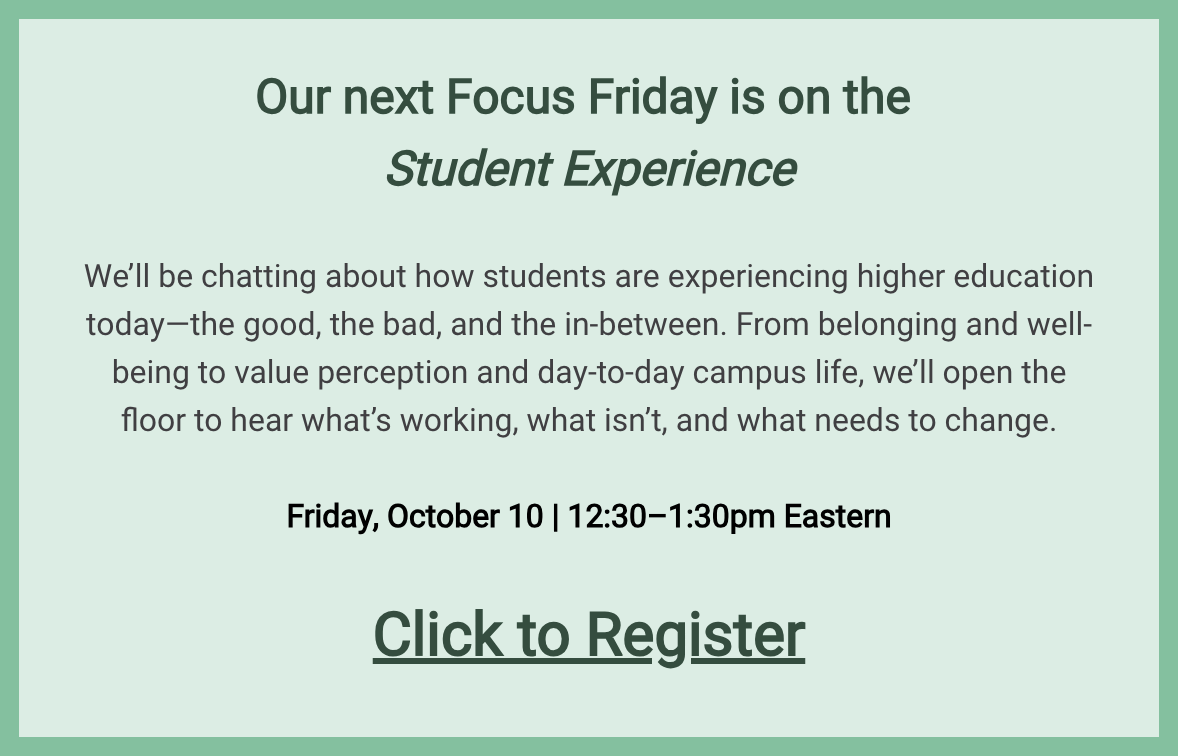
    The next Focus Friday will be on October 10th focused on the student experience and student life. I’ll be bringing you some folks directly from your own campuses to lead our discussion. Register via the big green box below.

    Looking forward to these conversations with you!

    Cheers,

    Tiff

    Source link

  • Trending Higher Ed Marketing Terms: A Glossary for Institutional Leaders

    Trending Higher Ed Marketing Terms: A Glossary for Institutional Leaders

    The pace of change in marketing technology can be dizzying, particularly for colleges and universities that are navigating enrollment challenges, digital transformation, and shifting student expectations. As your institution evaluates its tech stack, partners, and strategic priorities, fluency in key marketing technology (MarTech) terms isn’t just helpful. It’s essential.

    This glossary highlights 33 of the most relevant MarTech buzzwords for 2025 and beyond. Each term is defined with higher ed in mind, helping you decode the jargon and focus on what matters: reaching, enrolling, and retaining students more effectively.

    The language of modern higher ed marketing

    Consider this your cheat sheet for decoding today’s higher ed marketing terminology. Browse the buzzwords below, organized by topic.

    Data & identity terms

    First-party data
    Information collected directly through your institution’s digital properties — like your website, CRM, or application portal — used for personalized and compliant outreach.

    Zero-party data
    Data students or prospects intentionally share, such as preferences, interests, or intended major, often gathered via forms or surveys.

    Third-party data
    Data acquired from external providers to supplement internal profiles, which is increasingly less reliable due to privacy regulations and cookie deprecation.

    Cookieless tracking
    Alternatives to third-party cookies, using first-party data or contextual signals to measure behavior and personalize experiences.

    Student digital twin
    A virtual representation of a student that consolidates academic, behavioral, and engagement data to personalize support and anticipate needs. Learn more.

    Unified data architecture
    An integrated framework that brings together siloed systems (CRM, SIS, LMS) into a cohesive data environment for analytics and action.

    Data pipeline / ETL
    “Extract, transform, load” (ETL) processes that move and prepare data between systems, ensuring accurate and timely flow across platforms.

    Data trust/data hygiene
    Ensuring your data is clean, consistent, and reliable — a foundation for accurate analytics and effective campaigns.

    Data compliance
    Adhering to legal and ethical standards for data collection, usage, and storage, which is critical for maintaining trust and avoiding penalties.

    Data governance
    The policies and standards that ensure institutional data is accurate, secure, and compliant with regulations like FERPA and GDPR.

    GDPR (General Data Protection Regulation)
    A European Union regulation that sets strict guidelines for collecting and managing personal data, influencing privacy standards worldwide.

    AI & automation terms

    Generative AI
    Artificial intelligence that creates content (text, video, imagery) based on prompts and data inputs, increasingly used for marketing and student engagement.

    Predictive analytics
    Data models that forecast future behaviors, such as enrollment likelihood or student success risk, using historical and behavioral inputs.

    Predictive modeling
    A subset of predictive analytics that builds statistical models to anticipate outcomes, such as course success, stop-out risk, or inquiry-to-application conversion.

    Lead scoring
    Assigning values to prospective students based on behaviors and attributes to prioritize outreach and improve conversion.

    Marketing automation
    Tools that automate tasks like email sends, lead nurturing, and retargeting to deliver timely, personalized communication at scale.

    Conversational AI
    Chatbots and virtual assistants that engage users in real time, guiding inquiries and collecting data while reducing staff workload.

    AI-driven personalization
    Using machine learning to tailor experiences (like web content or email) based on user data and behavior.

    Engagement scoring
    Measuring how actively a student or lead is interacting with content to gauge interest and inform next steps.

    Retention risk scoring
    Modeling that identifies students likely to stop out based on early indicators, enabling timely support and intervention.

    Ready for a Smarter Way Forward?

    Higher ed is hard — but you don’t have to figure it out alone. We can help you transform challenges into opportunities.

    Performance & optimization terms

    Attribution modeling
    Techniques for assigning credit to marketing touchpoints across the funnel, helping determine what’s driving conversions.

    Return on investment (ROI)
    Measuring the effectiveness of marketing efforts by comparing cost to revenue or outcomes generated.

    Funnel optimization
    Improving each stage of the enrollment funnel (from awareness to application) to increase yield and reduce friction.

    A/B testing
    Running controlled experiments between two versions of content or creative to identify what performs best.

    Lift analysis
    A method of measuring the incremental impact of a campaign or intervention by comparing it to a control group.

    Real-time analytics
    Instant access to performance data, allowing teams to adjust campaigns or communications on the fly.

    Brand equity
    The perceived value and trustworthiness of your institution’s brand, which influences enrollment decisions and marketing ROI. Learn about its importance in higher ed.

    Experience, search & strategy terms

    System integration
    Connecting technology platforms (CRM, SIS, LMS, CMS) so data can flow across systems and support a seamless user experience.

    Program viability modeling
    Using market, enrollment, and financial data to assess which academic programs to invest in, optimize, or sunset. Learn more about academic portfolio strategy.

    Behavioral segmentation
    Grouping users based on their actions (like clicks, visits, or engagement) to enable more precise targeting.

    Semantic search
    Search engines increasingly rely on meaning and intent rather than keywords, making content structure and clarity more important than ever.

    Structured data/schema markup
    Code that helps search engines understand and categorize your content, improving visibility in search engines and AI search.

    Cross-lifecycle marketing
    Coordinating engagement strategies across the entire student lifecycle (from prospect to alumni) to build long-term relationships and lifetime value.

    Looking ahead

    Understanding MarTech terms isn’t about chasing trends. It’s about equipping your institution to make informed, future-ready decisions about technology, data, and strategy. Use this glossary as a reference point as you audit your tech stack, plan campaigns, or vet potential partners.

    Ready to go deeper? Partner with Collegis to unlock the full power of your data and technology. Our marketing services and data expertise enable institutions to build smarter strategies, streamline their systems, and drive measurable growth in enrollment and student success.

    Innovation Starts Here

    Higher ed is evolving — don’t get left behind. Explore how Collegis can help your institution thrive.

    Source link

  • Can you tell compelling stories about important things?

    Can you tell compelling stories about important things?

    A journalist is the eyes and ears of the public. Given the time, skills and tools needed, journalists go out into the world to ask questions, observe what is happening and gather factual information to report it all to the public. 

    They tell this information through stories in written publications or in other ways like podcasts or videos. The public can access these stories on news sites, or on podcast and video platforms. Sometimes they are free and sometimes they are behind “pay walls” — they require payment fees or subscriptions before you can read or download them.

    Journalists tell stories in different ways:

    News stories inform the public about current events or issues. They report important facts and provide readers with the context to make sense of them. A reporter gathers information for a news story by doing research and conducting interviews. 

    Investigative reports and feature stories go deeper and are based on interviews and research. What distinguishes them from news stories is their purpose, and often their length. Rather than simply informing the public about current events, investigative stories expose an issue — like corruption, corporate wrongdoing, or systemic problems — that affects the public in some way, while feature stories go deeper into a topic and explore a new angle. 

    Opinion stories are written from one person or group’s perspective, so while they can be interesting and spark debate in a community, they do not include the “objectivity” that is central to regular journalism. We often call this advocacy journalism. 

    Native advertising is advertising that resembles journalism in style, tone and format so to sell readers on an idea, product or service without readers realizing that there is a commercial agenda behind the message. By making an ad seem like the news organization’s editorial content, readers are more likely to accept the ad’s claims as true.

    Helping people make sense of the world

    Good quality news and investigative stories are accurate, authoritative and balanced and they help readers make sense of events. To tell these stories, journalists must first make sense of events themselves and they do that by asking questions that people have and getting answers to those questions. Sometimes that means asking questions that seem basic or seem to come from ignorance. In other words, journalists often ask the questions many people might be embarrassed to ask themselves.

    But that’s the way they end up with an informative story that is well reported. Here are some ways to tell if a journalist has succeeded in doing that: 

    ● They use authoritative and clearly identified sources that enable readers to have confidence in a story’s accuracy. 

    ● They use quotes to bring a story to life and give it balance

    ● They provide readers with enough context to help them make sense of the event in question. 

    ● If a story portrays a some person or organization in a negative way, it should be clear they were given an opportunity to comment

    Using sources and quotes and providing context and opportunity for comment allows a journalist to tell the truth, be fair and serve the public.

    Take climate stories. When journalists cover the environment, the first truth is that climate change is happening

    Facts versus truth

    Telling the truth of what and whom climate change is impacting and why it is important means that a journalist must use facts, provide a source’s quotes in context and explain what the data says. 

    But what are facts? Facts are information that can be verified through data that is collected scientifically rather than based purely on opinion. When stating facts, a journalist should be able to back up those facts with data from a verifiable source and let you know when they can’t do that. They should also tell you the source of all the information in the story and what makes the source credible — their record of expertise or experience on the matter. 

    How do you know if a journalist has been fair? 

    In any story produced by a journalist, there are stakeholders — these are the people affected by a problem or involved in a story. To be fair, the journalist gives all the major stakeholders — the perpetrators and victims — a voice in the story.

    At the same time, the journalist should hold stakeholders accountable for their actions.

    The victims should be given the chance to tell their stories but the journalist should explain the context — why someone might believe what they do or have acted in the way they did so that the audience can form an understanding of the stakeholders and their actions.

    Journalists and the public they serve

    Ultimately journalism should serve the public. The journalist should provide news consumers with enough information to form an educated opinion, without being swayed by a journalist’s bias. To do that, the information should be easily understood and accessible — not bogged down with jargon or made overly complicated. 

    A story also needs to be newsworthy. It must be worth a person’s time to read or listen to or view it. That doesn’t mean that it has to be about an event that happened today or yesterday, but it should be relevant or interesting to the news consumer in some way. In journalism we call this “compelling.” Maybe what makes a story compelling is that it is about an event that has just happened or is about to happen. Maybe it is about something happening near your audience. 

    Or maybe what is happening or happened is significant — it will affect people in important ways. 

    But even if the story is about something happening now, is important and affects people in significant ways, the audience for it won’t find it compelling if it is told in a boring way.

    Telling stories worth hearing

    Journalists often look for three things to make an important story compelling:

    Human interest: The story focuses on the emotional or personal aspects, evoking empathy, compassion, or curiosity. 

    Conflict: There are people who are for and against something happening or have competing claims on something. We often see this in stories about politics. 

    Novelty: Something makes the story new or different. 

    How can all this help you find and tell compelling stories? Let’s take a look at possible environmental stories. 

    Ask yourself: What types of things are happening around you regarding the weather, the air you breathe, the water around you, the land you live on and the food your region or country grows and eats? Are any of these things threatened? Do you know of any communities suffering? 

    Do you know of any individuals or organizations who are standing up against these impacts? What are they doing and why? And have there been any big successes in terms of climate change that you can think of? Have you heard of any good news about the environment in your area? 

    You can think about your neighbors, your school, your friends, your family, or anyone you know! It doesn’t have to be something that seems big and someone can be an expert without a fancy title.

    Why tell true stories?

    Storytelling is the way that journalists can convey complex information in a manner that is relatable and accessible to an audience. 

    Ultimately, good journalism is not only about gathering information that is verifiable, it is also about telling stories about what is happening in a way that is relatable and accessible to its audience.

    If a journalist shines light on a problem or reports on an event, they can show through storytelling why it is important, who is affected, what solutions are out there and who the solutions benefit and what is delaying the solutions. 

    It is the quilt of these stories, sewn by the audience’s understanding, that forms the blanket of our reality. Like any good quilt, it includes the light and the dark, the details and the bigger picture, patterns and contrast. 

    Storytelling is the context that gives a journalistic product meaning and purpose. 


    Questions to consider:

    1. Why might an important story put someone to sleep?

    2. What does it mean to make a story “compelling”?

    3. In what ways do journalists serve the public?



    Source link

  • NAEP scores for class of 2024 show major declines, with fewer students college ready

    NAEP scores for class of 2024 show major declines, with fewer students college ready

    This story was originally published by Chalkbeat. Sign up for their newsletters at ckbe.at/newsletters.

    Students from the class of 2024 had historically low scores on a major national test administered just months before they graduated.

    Results from the National Assessment of Educational Progress, or NAEP, released September 9, show scores for 12th graders declined in math and reading for all but the highest performing students, as well as widening gaps between high and low performers in math. More than half of these students reported being accepted into a four-year college, but the test results indicate that many of them are not academically prepared for college, officials said.

    “This means these students are taking their next steps in life with fewer skills and less knowledge in core academics than their predecessors a decade ago, and this is happening at a time when rapid advancements in technology and society demand more of future workers and citizens, not less,” said Lesley Muldoon, executive director of the National Assessment Governing Board. “We have seen progress before on NAEP, including greater percentages of students meeting the NAEP proficient level. We cannot lose sight of what is possible when we use valuable data like NAEP to drive change and improve learning in U.S. schools.”

    These results reflect similar trends seen in fourth and eighth grade NAEP results released in January, as well as eighth grade science results also released Tuesday.

    In a statement, Education Secretary Linda McMahon said the results show that federal involvement has not improved education, and that states should take more control.

    “If America is going to remain globally competitive, students must be able to read proficiently, think critically, and graduate equipped to solve complex problems,” she said. “We owe it to them to do better.”

    The students who took this test were in eighth grade in March of 2020 and experienced a highly disrupted freshman year of high school because of the pandemic. Those who went to college would now be entering their sophomore year.

    Roughly 19,300 students took the math test and 24,300 students took the reading test between January and March of 2024.

    The math test measures students’ knowledge in four areas: number properties and operations; measurement and geometry; data analysis, statistics, and probability; and algebra. The average score was the lowest it has been since 2005, and 45% of students scored below the NAEP Basic level, even as fewer students scored at NAEP Proficient or above.

    NAEP Proficient typically represents a higher bar than grade-level proficiency as measured on state- and district-level standardized tests. A student scoring in the proficient range might be able to pick the correct algebraic formula for a particular scenario or solve a two-dimensional geometric problem. A student scoring at the basic level likely would be able to determine probability from a simple table or find the population of an area when given the population density.

    Only students in the 90th percentile — the highest achieving students — didn’t see a decline, and the gap between high- and low-performing students in math was higher than on all previous assessments.

    This gap between high and low performers appeared before the pandemic, but has widened in most grade levels and subject areas since. The causes are not entirely clear but might reflect changes in how schools approach teaching as well as challenges outside the classroom.

    Testing officials estimate that 33% of students from the class of 2024 were ready for college-level math, down from 37% in 2019, even as more students said they intended to go to college.

    In reading, students similarly posted lower average scores than on any previous assessment, with only the highest performing students not seeing a decline.

    The reading test measures students’ comprehension of both literary and informational texts and requires students to interpret texts and demonstrate critical thinking skills, as well as understand the plain meaning of the words.

    A student scoring at the basic level likely would understand the purpose of a persuasive essay, for example, or the reaction of a potential audience, while a students scoring at the proficient level would be able to describe why the author made certain rhetorical choices.

    Roughly 32% of students scored below NAEP Basic, 12 percentage points higher than students in 1992, while fewer students scored above NAEP Proficient. An estimated 35% of students were ready for college-level work, down from 37% in 2019.

    In a survey attached to the test, students in 2024 were more likely to report having missed three or more days of school in the previous month than their counterparts in 2019. Students who miss more school typically score lower on NAEP and other tests. Higher performing students were more likely to say they missed no days of school in the previous month.

    Students in 2024 were less likely to report taking pre-calculus, though the rates of students taking both calculus and algebra II were similar in 2019 and 2024. Students reported less confidence in their math abilities than their 2019 counterparts, though students in 2024 were actually less likely to say they didn’t enjoy math.

    Students also reported lower confidence in their reading abilities. At the same time, higher percentages of students than in 2024 reported that their teachers asked them to do more sophisticated tasks, such as identifying evidence in a piece of persuasive writing, and fewer students reported a low interest in reading.

    Chalkbeat is a nonprofit news site covering educational change in public schools.

    For more news on national assessments, visit eSN’s Innovative Teaching hub.

    Latest posts by eSchool Media Contributors (see all)

    Source link

  • The Grand Irony of Nursing Education and Burnout in U.S. Health Care

    The Grand Irony of Nursing Education and Burnout in U.S. Health Care

    Nursing has long been romanticized as both a “calling” and a profession—an occupation where devotion to patients is assumed to be limitless. Nursing schools, hospitals, and media narratives often reinforce this ideal, framing the nurse as a tireless caregiver who sacrifices for the greater good. But behind the cultural image is a system that normalizes exhaustion, accepts overwork, and relies on the quiet suffering of an increasingly strained workforce.

    The cultural expectation that nurses should sacrifice their own well-being has deep historical roots. Florence Nightingale’s legacy in the mid-19th century portrayed nursing as a noble vocation, tied as much to moral virtue as to medical skill. During World War I and World War II, nurses were celebrated as patriotic servants, enduring brutal conditions without complaint. By the late 20th century, popular culture reinforced the idea of the nurse as both saintly and stoic—expected to carry on through fatigue, trauma, and loss. This framing has carried into the 21st century. During the COVID-19 pandemic, nurses were lauded as “heroes” in speeches, advertisements, and nightly news coverage. But the rhetoric of heroism masked a harsher reality: nurses were sent into hospitals without adequate protective equipment, with overwhelming patient loads, and with little institutional support. The language of devotion was used as a shield against criticism, even as nurses themselves broke down from exhaustion.

    The problem begins in nursing education. Students are taught the technical skills of patient care, but they are also socialized into a culture that emphasizes resilience, self-sacrifice, and “doing whatever it takes.” Clinical rotations often expose nursing students to chronic understaffing and unsafe patient loads, but instead of treating this as structural failure, students are told it is simply “the reality of nursing.” In effect, they are trained to adapt to dysfunction rather than challenge it.

    Once in the workforce, the pressures intensify. Hospitals and clinics operate under tight staffing budgets, pushing nurses to manage far more patients than recommended. Shifts stretch from 12 to 16 hours, and mandatory overtime is not uncommon. Documentation demands, electronic medical record systems, and administrative oversight add layers of clerical work that take time away from direct patient care. The emotional toll of constantly navigating life-and-death decisions, combined with lack of rest, creates a perfect storm of burnout. The grand irony is that the profession celebrates devotion while neglecting the well-being of the devoted. Nurses are praised as “heroes” during crises, but when they ask for better staffing ratios, safer conditions, or mental health support, they are often dismissed as “not team players.” In non-unionized hospitals, the risks are magnified: nurses have little leverage to negotiate schedules, resist unsafe assignments, or push back against retaliation. Instead, they are expected to remain loyal, even as stress erodes their health and shortens their careers.

    Recent years have shown that nurses are increasingly unwilling to accept this reality. In Oregon in 2025, nearly 5,000 unionized nurses, physicians, and midwives staged the largest health care worker strike in the state’s history, demanding higher wages, better staffing levels, and workload adjustments that reflect patient severity rather than just patient numbers. After six weeks, they secured a contract with substantial pay raises, penalty pay for missed breaks, and staffing reforms. In New Orleans, nurses at University Medical Center have launched repeated strikes as negotiations stall, citing unsafe staffing that puts both their health and their patients at risk. These actions are not isolated. In 2022, approximately 15,000 Minnesota nurses launched the largest private-sector nurses’ strike in U.S. history, and since 2020 the number of nurse strikes nationwide has more than tripled.

    Alongside strikes, nurses are pushing for legislative solutions. At the federal level, the Nurse Staffing Standards for Hospital Patient Safety and Quality Care Act has been introduced, which would mandate minimum nurse-to-patient ratios and provide whistleblower protections. In New York, the Safe Staffing for Hospital Care Act seeks to set legally enforceable staffing levels and ban most mandatory overtime. Even California, long considered a leader in nurse staffing ratios, has faced crises in psychiatric hospitals so severe that Governor Gavin Newsom introduced emergency rules to address chronic understaffing linked to patient harm. Enforcement remains uneven, however. At Albany Medical Center in New York, chronic understaffing violations led to hundreds of thousands of dollars in fines, a reminder that without strong oversight, even well-crafted laws can be ignored.

    The United States’ piecemeal and adversarial approach contrasts sharply with other countries. In Canada, provinces like British Columbia have legislated nurse-to-patient ratios similar to those in California, and in Quebec, unions won agreements that legally cap workloads for certain units. In the United Kingdom, the National Health Service has long recognized safe staffing as a matter of public accountability, and while austerity policies have strained the system, England, Wales, and Scotland all employ government-set nurse-to-patient standards to protect both patients and staff. Nordic countries go further, with Sweden and Norway integrating nurse well-being into health policy; short shifts, strong union protections, and publicly funded healthcare systems reduce the risk of burnout by design. While no system is perfect, these models show that burnout is not inevitable—it is a political and policy choice.

    Union presence consistently makes a difference. Studies show that unionized nurses are more successful at securing safe staffing ratios, resisting exploitative scheduling, and advocating for patient safety. But unionization rates in nursing remain uneven, and in many states nurses are discouraged or even legally restricted from organizing. Without collective power, individual nurses are forced to rely on personal endurance, which is precisely what the system counts on.

    The outcome is devastating not only for nurses but for patients. Burnout leads to higher turnover, staffing shortages, and medical errors—all while nursing schools continue to churn out new graduates to replace those driven from the profession. It is a cycle sustained by institutional denial and the myth of infinite devotion.

    If U.S. higher education is serious about preparing nurses for the future, nursing programs must move beyond the rhetoric of sacrifice. They need to teach students not only how to care for patients but also how to advocate for themselves and their colleagues. They need to expose the structural causes of burnout and prepare nurses to demand better conditions, not simply endure them. Until then, the irony remains: a profession that celebrates care while sacrificing its caregivers.


    Sources

    • American Nurses Association (ANA). “Workplace Stress & Burnout.” ANA Enterprise, 2023.

    • National Nurses United. Nursing Staffing Crisis in the United States, 2022.

    • Bae, S. “Nurse Staffing and Patient Outcomes: A Literature Review.” Nursing Outlook, Vol. 64, No. 3 (2016): 322-333.

    • Bureau of Labor Statistics. “Union Members Summary.” U.S. Department of Labor, 2024.

    • Shah, M.K., Gandrakota, N., Cimiotti, J.P., Ghose, N., Moore, M., Ali, M.K. “Prevalence of and Factors Associated With Nurse Burnout in the US.” JAMA Network Open, Vol. 4, No. 2 (2021): e2036469.

    • Nelson, Sioban. Say Little, Do Much: Nursing, Nuns, and Hospitals in the Nineteenth Century. University of Pennsylvania Press, 2001.

    • Kalisch, Philip A. & Kalisch, Beatrice J. The Advance of American Nursing. Little, Brown, 1986.

    • Oregon Capital Chronicle, “Governor Kotek Criticizes Providence Over Largest Strike of Health Care Workers in State History,” January 2025.

    • Associated Press, “Oregon Health Care Strike Ends After Six Weeks,” February 2025.

    • National Nurses United, “New Orleans Nurses Deliver Notice for Third Strike at UMC,” 2025.

    • NurseTogether, “Nurse Strikes: An Increasing Trend in the U.S.,” 2024.

    • New York State Senate Bill S4003, “Safe Staffing for Hospital Care Act,” 2025.

    • San Francisco Chronicle, “Newsom Imposes Emergency Staffing Rules at State Psychiatric Hospitals,” 2025.

    • Times Union, “Editorial: Hospital’s Staffing Violations Show Need for Enforcement,” 2025.

    • Oulton, J.A. “The Global Nursing Shortage: An Overview of Issues and Actions.” Policy, Politics, & Nursing Practice, Vol. 7, No. 3 (2006): 34S–39S.

    • Rafferty, Anne Marie et al. “Outcomes of Variation in Hospital Nurse Staffing in English Hospitals.” BMJ Quality & Safety, 2007.

    • Aiken, Linda H. et al. “Nurse Staffing and Education and Hospital Mortality in Nine European Countries.” The Lancet, Vol. 383, No. 9931 (2014): 1824–1830.

    Source link

  • College admissions in a rapidly evolving world

    College admissions in a rapidly evolving world

    The years ahead will be anything but boring for college admissions officers. From demographic changes and increasing college competition to budget cuts and evolving approaches for admissions requirements — not to mention tectonic federal policy shifts and the rapid proliferation of artificial intelligence — the field is as fluid as ever. 

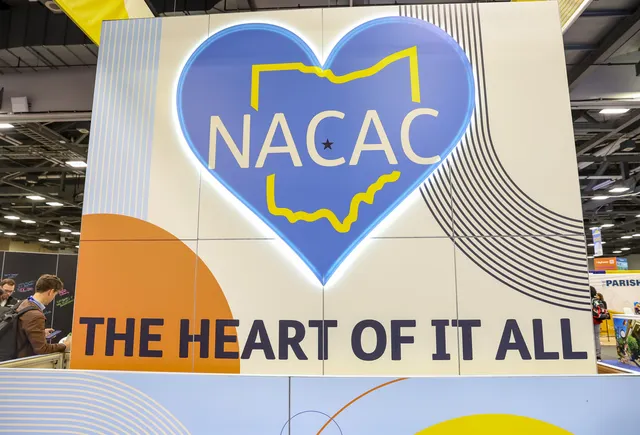
    Those topics and more were under discussion at the Sept. 18-20 annual conference of the National Association for College Admission Counseling in Columbus, Ohio. 

    While there are many forces outside the control of the admissions office, attendees tuned into the internal challenges and opportunities they’re navigating. Panelists, for instance, dug into data on diversity in college enrollment, how to best prepare future students for college math classes and when to deploy AI in institutional operations. 

    Here’s an in-depth look at some of the most interesting conversations Higher Ed Dive heard at NACAC’s 2025 conference:

    Source link

  • Education Department officially launches 2026-27 FAFSA form

    Education Department officially launches 2026-27 FAFSA form

    This audio is auto-generated. Please let us know if you have feedback.

    Dive Brief: 

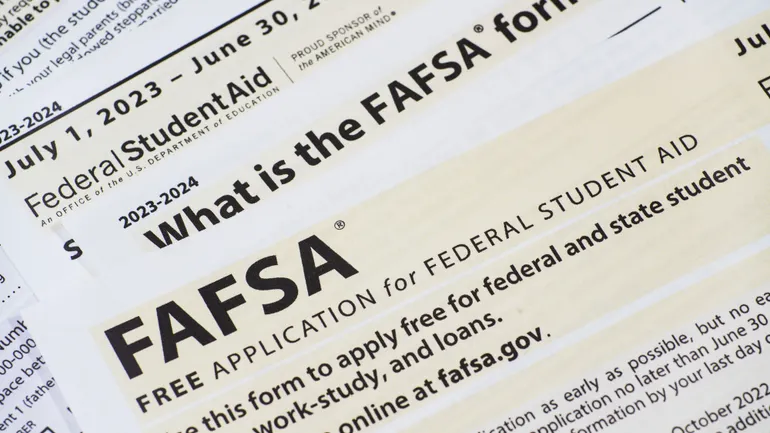
    • The U.S. Department of Education rolled out the 2026-27 Free Application for Federal Student Aid to all students Wednesday, about a week before the congressionally mandated deadline.  

    • Education Department officials billed the release as the “earliest launch in the program’s history.” The new form comes with several updates, including a redesigned process for inviting parents or other contributors to add information to the application and faster account verification for students and parents, according to the agency. 

    • The on-time FAFSA follows later than usual releases the past two years. In 2023, the Education Department didn’t roll out the FAFSA until the final days of December — nearly three months after students and their families usually can access the form. 

    Dive Insight: 

    Education Department officials praised the on-time release after two rocky financial aid cycles. 

    “No one would have thought this was possible after the Biden-Harris administration infamously botched FAFSA’s rollout two short years ago,” U.S. Education Secretary Linda McMahon said in a Wednesday statement. 

    In 2023, the Biden administration was responsible for carrying out the first major redesign of the FAFSA in over four decades, including by paring down the number of questions applicants must answer. However, even after the Education Department released the FAFSA in December that year, many students and families struggled to complete the form due to glitches and other technical issues. 

    Moreover, the Education Department didn’t begin sending FAFSA applicant data to colleges that financial aid cycle until March 2024, even though that information is typically available shortly after the form rolls out in October. Scores of colleges pushed back their traditional May 1 decision deadline as a result. 

    In response, congressional lawmakers passed a law in November 2024 mandating that the Education Department release the form by Oct. 1 each year. The statute also requires the U.S. education secretary to testify before Congress if the agency anticipates it will miss the deadline. 

    This year, the Education Department began beta testing the form in early August. During that period, students started nearly 44,000 FAFSA forms and submitted roughly 27,000 of them, according to the department. The agency has processed almost 24,000 FAFSA forms without rejection. 

    However, this financial aid cycle hasn’t come without criticism. A report earlier this month from the U.S. Government Accountability Office, a federal watchdog agency, raised questions about whether the Education Department was adequately overseeing contracted work on the new back-end system launched in 2023 for processing FAFSAs

    In September 2024, the Education Department told GAO officials that several functions required by a contract with a third-party vendor were not yet available, including the ability to make corrections to FAFSA applications and modify eligibility rules. At the time, the department said those functions would be available by 2026. 

    However, as of May 2025, the Education Department couldn’t provide an update on the system and said it was no longer tracking the contractual requirements, according to the GAO report. GAO recommended that Federal Student Aid’s chief operating officer take steps to improve contract monitoring. 

    The GAO’s report included a response from Aaron Lemon-Strauss, executive director of the FAFSA program, who pushed back on GAO’s framing. Lemon-Strauss wrote that some of its recommendations embrace a model that “assumes initial contracts can fully anticipate a system’s evolving needs.”

    Lemon-Strauss, who joined the department last year, said the agency has made changes to its FAFSA vendor contracts that allow it to adapt to user needs. For instance, after the 2024 FAFSA release, department officials identified that the FAFSA system still did not allow users to import their answers from the prior year to start their new forms — a contractually required feature. 

    “This is undoubtedly a helpful feature and one that should be included in the FAFSA,” Lemon-Strauss said to GAO. “Yet, rather than mechanically moving to implementing renewal capability, the team examined user data to determine where their next efforts would be maximally useful.”

    Internal data showed that some 5% of users were exiting the form and not returning once they needed to invite their parents or other contributors — such as a spouse or a parent’s spouse — to work on the application. In response, the Education Department decided to prioritize redesigning the process to invite outside contributors instead of focusing on the contractually required feature, Lemon-Strauss said.

    Source link

  • The 2026-27 FAFSA launches a week ahead of schedule

    The 2026-27 FAFSA launches a week ahead of schedule

    This audio is auto-generated. Please let us know if you have feedback.

    Dive Brief: 

    • The U.S. Department of Education rolled out the 2026-27 Free Application for Federal Student Aid to all students Wednesday, about a week before the congressionally mandated deadline.  
    • Education Department officials billed the release as the “earliest launch in the program’s history.” The new form comes with several updates, including a redesigned process for inviting parents or other contributors to add information to the application and faster account verification for students and parents, according to the agency. 
    • The on-time FAFSA follows later than usual releases the past two years. In 2023, the Education Department didn’t roll out the FAFSA until the final days of December — nearly three months after students and their families usually can access the form. 

    Dive Insight: 

    Education Department officials praised the on-time release after two rocky financial aid cycles. 

    “No one would have thought this was possible after the Biden-Harris administration infamously botched FAFSA’s rollout two short years ago,” U.S. Education Secretary Linda McMahon said in a Wednesday statement. 

    In 2023, the Biden administration was responsible for carrying out the first major redesign of the FAFSA in over four decades, including by paring down the number of questions applicants must answer. However, even after the Education Department released the FAFSA in December that year, many students and families struggled to complete the form due to glitches and other technical issues. 

    Moreover, the Education Department didn’t begin sending FAFSA applicant data to colleges that financial aid cycle until March 2024, even though that information is typically available shortly after the form rolls out in October. Scores of colleges pushed back their traditional May 1 decision deadline as a result. 

    In response, congressional lawmakers passed a law in November 2024 mandating that the Education Department release the form by Oct. 1 each year. The statute also requires the U.S. education secretary to testify before Congress if the agency anticipates it will miss the deadline. 

    This year, the Education Department began beta testing the form in early August. During that period, students started nearly 44,000 FAFSA forms and submitted roughly 27,000 of them, according to the department. The agency has processed almost 24,000 FAFSA forms without rejection. 

    However, this financial aid cycle hasn’t come without criticism. A report earlier this month from the U.S. Government Accountability Office, a federal watchdog agency, raised questions about whether the Education Department was adequately overseeing contracted work on the new back-end system launched in 2023 for processing FAFSAs

    In September 2024, the Education Department told GAO officials that several functions required by a contract with a third-party vendor were not yet available, including the ability to make corrections to FAFSA applications and modify eligibility rules. At the time, the department said those functions would be available by 2026. 

    However, as of May 2025, the Education Department couldn’t provide an update on the system and said it was no longer tracking the contractual requirements, according to the GAO report. GAO recommended that Federal Student Aid’s chief operating officer take steps to improve contract monitoring. 

    The GAO’s report included a response from Aaron Lemon-Strauss, executive director of the FAFSA program, who pushed back on GAO’s framing. Lemon-Strauss wrote that some of its recommendations embrace a model that “assumes initial contracts can fully anticipate a system’s evolving needs.”

    Lemon-Strauss, who joined the department last year, said the agency has made changes to its FAFSA vendor contracts that allow it to adapt to user needs. For instance, after the 2024 FAFSA release, department officials identified that the FAFSA system still did not allow users to import their answers from the prior year to start their new forms — a contractually required feature. 

    “This is undoubtedly a helpful feature and one that should be included in the FAFSA,” Lemon-Strauss said to GAO. “Yet, rather than mechanically moving to implementing renewal capability, the team examined user data to determine where their next efforts would be maximally useful.”

    Internal data showed that some 5% of users were exiting the form and not returning once they needed to invite their parents or other contributors — such as a spouse or a parent’s spouse — to work on the application. In response, the Education Department decided to prioritize redesigning the process to invite outside contributors instead of focusing on the contractually required feature, Lemon-Strauss said.

    Source link

  • Test yourself on the past week’s K-12 news

    Test yourself on the past week’s K-12 news

    This audio is auto-generated. Please let us know if you have feedback.

    How well did you keep up with this week’s developments in K-12 education? To find out, take our five-question quiz below. Then, share your score by tagging us on social media with #K12DivePopQuiz.

    Source link

  • Most adults say higher education is important but want colleges to stay out of politics

    Most adults say higher education is important but want colleges to stay out of politics

    This audio is auto-generated. Please let us know if you have feedback.

    Dive Brief:

    • Nearly 4 in 5 surveyed Americans, 78%, said a college education is somewhat or very important to a young person’s success, according to a new poll from researchers at Vanderbilt University.
    • Despite increasing polarization around higher ed, a significant majority of both Democrats and Republicans — 87% and 68%, respectively — said a college education was at least somewhat important.
    • The broadly favorable public sentiment comes amid the federal government’s allegations of “violations, shortcomings and biases” at colleges, John Geer, head of the nonpartisan Vanderbilt Project on Unity & American Democracy, said in a Wednesday press release.

    Dive Insight:

    The Trump administration has increasingly targeted higher education, decrying colleges as hubs of liberal indoctrination and wastes of federal funding. Against this backdrop, Vanderbilt researchers polled 1,030 adults in English and Spanish from Sept. 5 to Sept. 8.

    “Higher education has undoubtedly been a primary concern for President [Donald] Trump’s administration,” Geer said. “Certainly, people expressed areas of concern and viewed certain institutions as more problematic than others, but support for colleges and universities remains substantial, even in the midst of these many criticisms from Washington,” he said.

    Nearly two-thirds of respondents, 65%, said colleges have a positive effect on society. A large majority of Democrats agreed with this statement, as did most of the “traditional” Republicans surveyed, according to the Wednesday release. 

    A deeper schism emerged from Republican respondents who identified with the Make America Great Again movement. Among those supporting MAGA ideology, 65% said colleges have a negative effect on the U.S. 

    In a February poll, Vanderbilt found that a majority of Republicans surveyed, 52%, identified with the MAGA movement — though slight, it was the first majority since researchers began asking the question in June 2023.

    The September survey also found a broader skepticism of some aspects of higher education that transcended political divides. Among the overall respondent pool, 67% said ideological or political bias is at least somewhat of a serious problem at colleges. Within that share, 35% said bias is a problem at most institutions.

    However, the respondents who said political bias exists on campuses did not broadly fault academic instruction. About 2 in 5, or 43%, blamed administrative decisions, while 16% cited what is being taught in the classroom.

    Nearly three-quarters of respondents, 71%, said colleges should not “take official positions on controversial political issues.” Broken down by political party, 83% of Republicans and 59% of Democrats concurred with that statement. 

    “That mix of skepticism and expectation underscores how difficult it will be for colleges to persuade the public that they are neutral arbiters in a polarized environment,” Vanderbilt said.

    The public showed mixed opinions on different types of institutions, the poll found. 

    For instance, 70% of respondents expressed confidence in community colleges. Vanderbilt researchers noted that community colleges “have largely avoided the controversies embroiling larger, wealthier institutions.”

    But that confidence level dropped sharply for Ivy League institutions. Less than half of those surveyed, 48%, expressed a somewhat or very favorable opinion of those eight universities. 

    What’s more, respondents’ view of the Ivies varied significantly by their political party. Among Democrats, 72% approved of Ivy League universities, compared to just 33% of Republicans.

    Other colleges earned a similar approval rating as the Ivies but with a smaller political divide.

    Just 2 in 5 respondents expressed overall confidence in colleges in the Southeastern Conference, which includes the University of Georgia, the University of Tennessee and Mississippi State University among its 16 members.

    About half of Republicans, 51%, expressed a favorable opinion of those institutions, as did 33% of Democrats.

    Source link