Author: admin

  • Are we outsourcing our thinking to AI?

    Are we outsourcing our thinking to AI?

    Key points:

    I’ll admit that I use AI. I’ve asked it to help me figure out challenging Excel formulas that otherwise would have taken me 45 minutes and a few tutorials to troubleshoot. I’ve used it to help me analyze or organize massive amounts of information. I’ve even asked it to help me devise a running training program aligning with my goals and fitting within my schedule. AI is a fantastic tool–and that’s the point. It’s a tool, not a replacement for thinking.

    As AI tools become more capable, more intuitive, and more integrated into our daily lives, I’ve found myself wondering: Are we growing too dependent on AI to do our thinking for us?

    This question isn’t just philosophical. It has real consequences, especially for students and young learners. A recent study published in the journal Societies reports that people who used AI tools consistently showed a decline in critical thinking performance. In fact, “whether someone used AI tools was a bigger predictor of a person’s thinking skills than any other factor, including educational attainment.” That’s a staggering finding because it suggests that using AI might not just be a shortcut. It could be a cognitive detour.

    The atrophy of the mind

    The term “digital dementia” has been used to describe the deterioration of cognitive abilities as a result of over-reliance on digital devices. It’s a phrase originally associated with excessive screen time and memory decline, but it’s found new relevance in the era of generative AI. When we depend on a machine to generate our thoughts, answer our questions, or write our essays, what happens to the neural pathways that govern our own critical thinking? And will the upcoming era of agentic AI expedite this decline?

    Cognitive function, like physical fitness, follows the rule of “use it or lose it.” Just as muscles weaken without regular use, the brain’s ability to evaluate, synthesize, and critique information can atrophy when not exercised. This is especially concerning in the context of education, where young learners are still building those critical neural pathways.

    In short: Students need to learn how to think before they delegate that thinking to a machine.

    Can you still think critically with AI?

    Yes, but only if you’re intentional about it.

    AI doesn’t relieve you of the responsibility to think–in many cases, it demands even more critical thinking. AI produces hallucinations, falsifies claims, and can be misleading. If you blindly accept AI’s output, you’re not saving time, you’re surrendering clarity.

    Using AI effectively requires discernment. You need to know what you’re asking, evaluate what you’re given, and verify the accuracy of the result. In other words, you need to think before, during, and after using AI.

    The “source, please” problem

    One of the simplest ways to teach critical thinking is also the most annoying–just ask my teenage daughter. When she presents a fact or claim that she saw online, I respond with some version of: “What’s your source?” It drives her crazy, but it forces her to dig deeper, check assumptions, and distinguish between fact and fiction. It’s an essential habit of mind.

    But here’s the thing: AI doesn’t always give you the source. And when it does, sometimes it’s wrong, or the source isn’t reputable. Sometimes it requires a deeper dive (and a few more prompts) to find answers, especially to complicated topics. AI often provides quick, confident answers that fall apart under scrutiny.

    So why do we keep relying on it? Why are AI responses allowed to settle arguments, or serve as “truth” for students when the answers may be anything but?

    The lure of speed and simplicity

    It’s easier. It’s faster. And let’s face it: It feels like thinking. But there’s a difference between getting an answer and understanding it. AI gives us answers. It doesn’t teach us how to ask better questions or how to judge when an answer is incomplete or misleading.

    This process of cognitive offloading (where we shift mental effort to a device) can be incredibly efficient. But if we offload too much, too early, we risk weakening the mental muscles needed for sustained critical thinking.

    Implications for educators

    So, what does this mean for the classroom?

    First, educators must be discerning about how they use AI tools. These technologies aren’t going away, and banning them outright is neither realistic nor wise. But they must be introduced with guardrails. Students need explicit instruction on how to think alongside AI, not instead of it.

    Second, teachers should emphasize the importance of original thought, iterative questioning, and evidence-based reasoning. Instead of asking students to simply generate answers, ask them to critique AI-generated ones. Challenge them to fact-check, source, revise, and reflect. In doing so, we keep their cognitive skills active and growing.

    And finally, for young learners, we may need to draw a harder line. Students who haven’t yet formed the foundational skills of analysis, synthesis, and evaluation shouldn’t be skipping those steps. Just like you wouldn’t hand a calculator to a child who hasn’t yet learned to add, we shouldn’t hand over generative AI tools to students who haven’t learned how to write, question, or reason.

    A tool, not a crutch

    AI is here to stay. It’s powerful, transformative, and, when used well, can enhance our work and learning. But we must remember that it’s a tool, not a replacement for human thought. The moment we let it think for us is the moment we start to lose the capacity to think for ourselves.

    If we want the next generation to be capable, curious, and critically-minded, we must protect and nurture those skills. And that means using AI thoughtfully, sparingly, and always with a healthy dose of skepticism. AI is certainly proving it has staying power, so it’s in all our best interests to learn to adapt. However, let’s adapt with intentionality, and without sacrificing our critical thinking skills or succumbing to any form of digital dementia.

    Latest posts by eSchool Media Contributors (see all)

    Source link

  • The difficult human work behind responsible AI use in college operations

    The difficult human work behind responsible AI use in college operations

    This audio is auto-generated. Please let us know if you have feedback.

    COLUMBUS, OHIO — Artificial intelligence-based products and software for college admissions and operations are proliferating in the higher education world. 

    How to choose from among them? Well, leaders can start by identifying a problem that is actually in need of an AI solution. 

    That is one of the core pieces of advice from a panel on deploying AI technology responsibly in college administration at the National Association for College Admission Counseling’s conference last week.

    Jasmine Solomon, senior associate director of systems operations at New York University, described a “flooded marketplace” of AI products advertised for a range of higher ed functions, from tutoring systems to retention analytics to admissions chatbots. 

    “Define what your AI use case is, and then find the purpose-built tool for that,” Solomon said. “If you’re using a general AI model or AI tool for an unintended purpose, your result is going to be poor.” 

    Asking why before you buy

    It’s also worth considering whether AI is the right tool. 

    “How does AI solve this problem better? Because maybe your team or the tools that you already have can solve this problem,” Solomon said. “Maybe you don’t need an AI tool for this.”

    Experts on the panel pointed out that administrators also need to think about who will use the tool, the potential privacy pitfalls of it, and its actual quality. 

    As Solomon put it, “Those built-in AI features — are they real? Are they on a future-release schedule, or is it here now? And if it’s here now, is it ready for prime time or is it ‘here now, and we’re beta testing.’” 

    Other considerations in deploying AI include those related to ethics, compliance and employee contracts.

    Institutions need to be mindful of workflows, staff roles, data storage, privacy and AI stipulations in collective bargaining contracts, said Becky Mulholland, director of first-year admission and operations at the University of Rhode Island

    “For those who are considering this, please, please, please make sure you’re familiar with those aspects,” Mulholland said. “We’ve seen this not go well in some other spaces.”

    On top of all that is the environmental impact of AI. One estimate found that AI-based search engines can use as much as 30 times more energy than traditional search. The technology also uses vast amounts of water to cool data centers.

    Panelists had few definitive answers for resolving AI’s environmental problems at the institutional level. 

    “There’s going to be a space for science to find some better solutions,” Mulholland said. “We’re not there right now.” 

    Solomon pointed to the pervasiveness of AI tools already embedded in much of our digital technology and argued untrained use could worsen the environmental impact. 

    “If they’re prompting [AI] 10, 20 times just to get the answer they want, they’ve used far more energy than if they understood prompt engineering,” Solomon said. 

    Transparency is also important. At NYU, Solomon said the university was careful to ensure prospective students knew they were talking with AI when interacting with its chatbot — so much so that they named the tool “NYUAdmissionsBot” to make its virtual nature as explicit as possible. 

    “We wanted to inform them every step of the way that you were talking to AI when you were using this chatbot,” Solomon said. 

    ‘You need time to test it’

    After all the big questions are asked and answered, and an AI solution chosen, institutions still have the not-so-small task of rolling the technology out in a way that is effective in both the short and long term. 

    The rollout of NYU’s chatbot in spring 2024 took “many, many months,” according to Solomon. “If a vendor tells you, ‘We will be up in a week,’ multiply that by like a factor of 10. You need time to test it.” The extra time can ensure a feature is actually ready when it’s unveiled for use. 

    The upside to all that time and effort for something like an admissions chatbot, Solomon noted, is that the AI feature can be available around-the-clock to answer inquiries, and it can quickly address the most commonly asked questions that would normally be flooding the inboxes of admissions staff. 

    But even after a successful initial rollout of an AI tool or feature, operations staff aren’t done. 

    Solomon described a continuous cycle of developing key metrics of success, running controlled experiments with an AI product and carefully examining data from AI use, including by having a human looking over the shoulder of the robots. In NYU’s case, this included looking at responses the chatbot gave to inquiries from prospective students.

    Source link

  • Southern Oregon University to cut 23 programs and lay off 18 employees

    Southern Oregon University to cut 23 programs and lay off 18 employees

    This audio is auto-generated. Please let us know if you have feedback.

    Dive Brief:

    • Southern Oregon University will eliminate 10 bachelor’s degrees, 12 minors and one graduate program in the face of long-term structural budget deficits after a vote by the institution’s board.
    • The public university will also lay off 18 employees and cut roughly three dozen other jobs through retirements, the elimination of vacant positions and other methods. SOU will shift 17 jobs off its payroll by funding them through alternative sources, such as the SOU Foundation, a nonprofit affiliated with the university.
    • The cuts are intended to stabilize SOU following years “marked by unprecedented fiscal crises,” according to the plan approved by trustees last week in a 7-2 vote.

    Dive Insight:

    SOU has faced a quartet of problems plaguing other higher education institutions — declining enrollment, flat state funding, rising costs and a shifting federal policy landscape.

    The university’s full-time equivalent enrollment fell almost 22% from 4,108 students in 2015 to 3,209 in 2024, according to state data. 

    “It is also highly likely that the federal government’s intent to dismantle support systems for low-income students also will have a devastating impact,” the plan noted.

    Earlier this year, the Trump administration sought to reduce funding to certain need-based student aid programs and eliminate others altogether, such as the Federal Supplemental Educational Opportunity Grant program. Since then, both chambers of Congress have rejected some of those overtures in their own budget proposals for fiscal year 2026, though House lawmakers likewise pitched eliminating FSEOG. 

    At the state level, Oregon’s fiscal 2025-27 budget raised funding for its public universities slightly. But SOU argued that the bump fails to cover increasing costs outside of its control, such as retirement and medical benefits.

    In June, SOU’s board of trustees directed the university to find $5 million in savings by the end of fiscal 2026.

    In response, University President Rick Bailey planned more significant cuts to set SOU up for longer-term stability. He declared financial exigency at the beginning of August, paving the way for a dramatic restructuring at the institution.

    The plan pitched to SOU’s board Friday will cut more than $10 million from the university’s annual educational and general budget over the next four years, bringing it down to approximately $60 million total.

    Academically, the proposal will sunset “low-enrolled or less regionally relevant programs” to focus on “what SOU does best for the majority of students,” it said.

    Following the reduction, the university will offer a total of 30 majors and 19 minors meant to lead students toward interdisciplinary programs “aligned with regional workforce demands.”

    “SOU is no longer a comprehensive university,” the plan said. “We cannot continue to provide all the programs and supports as we have in the past.”

    Bachelor’s degrees slated for elimination include international studies, chemistry, Spanish and multiple mathematics programs. It will also cut a graduate leadership degree focused on outdoor expeditions.

    Some programs originally considered for elimination — such as creative writing and economics — will go on with restructured curricula and face additional review in coming years. 

    The plan will also restructure SOU’s honors college and eliminate direct funding for its annual creativity conference.

    During Friday’s meeting, board member Debra Fee Jing Lee supported the cuts, arguing SOU‘s strength moving forward will be based on its ability “to be lean and agile and entrepreneurial.”​​

    Board member Elizabeth Shelby similarly voted for the proposal.

    “It’s incumbent upon us to plan as we must for the next several years, even if that requires additional cuts,” she said.

    But Hala Schepmann, a board member and chair of SOU’s chemistry and physics department, opposed the plan, calling it “the nuclear option.”

    “Do we need to make immediate cuts? Yes,” she said. “But taking away key foundational components of our institution will make it harder for us to make progress.”

    Schepmann also took issue with deciding on the plan amid “significant fluctuations” in the university’s projected budget.

    This summer, SOU lowered projections for its expected revenue by $1.9 million after an internal analysis found “a multi-decade issue” of double-counting some online education tuition revenue.

    The workforce reduction comes just two years after SOU eliminated nearly 82 full-time positions through a combination of layoffs, unfilled vacancies, voluntary reductions and retirements. 

    That wave of cuts left the remaining employees “feeling as though they were asked to do more with less,” according to the proposal. It argued that the new round of cuts will address this issue by paring down programs in tandem with shrinking the workforce.

    Source link

  • Compass Framework for AI Literacy Integration into Higher Education – Sovorel

    Compass Framework for AI Literacy Integration into Higher Education – Sovorel

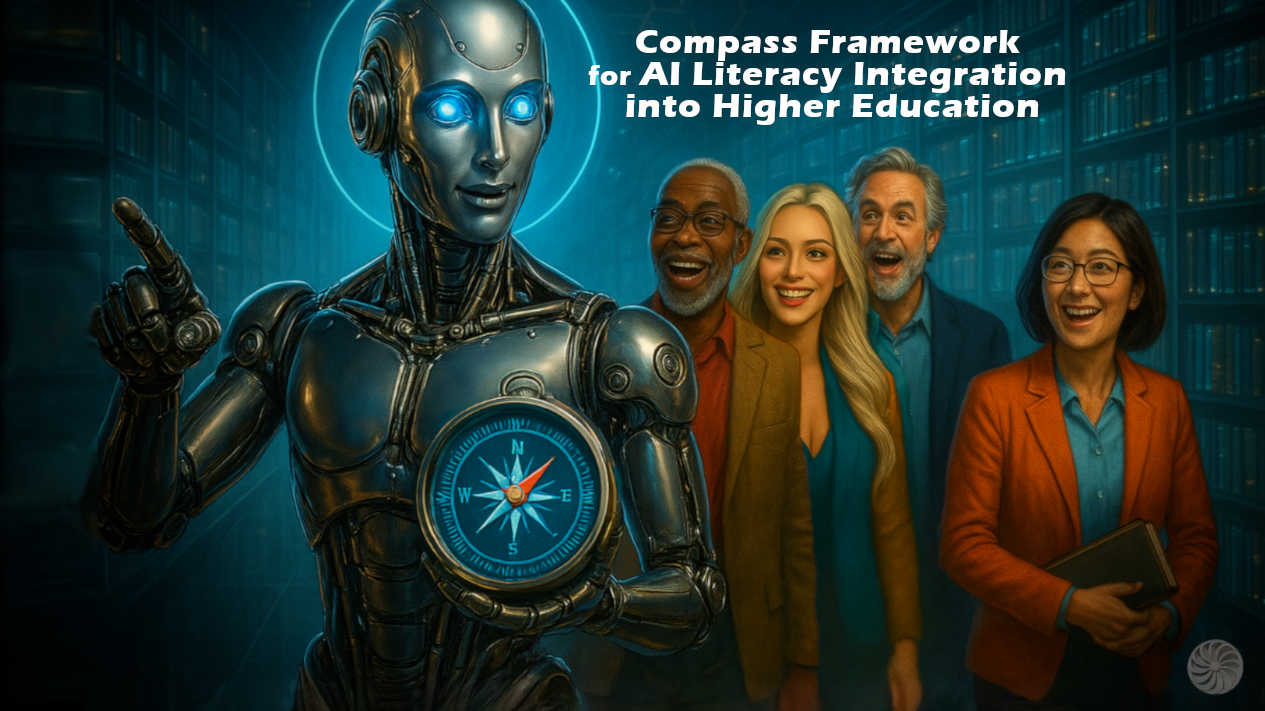
    As a way to help all of academia, colleges, universities, and other educational institutions around the world, I introduce the “Compass Framework for AI Literacy Integration into Higher Education.” This is a completely free (Creative Commons 4.0) AI literacy framework for easy and flexible integration of AI literacy into the curriculum. This framework is designed from my experience working with many universities around the world, reviewing other AI frameworks, and from various other research.

    *The full Compass Framework for AI Literacy Integration into Higher Education document, along with detailed explanations, example information, and full references used, is available here: http://sovorelpublishing.com/wp-content/uploads/2025/09/Compass-Framework-for-AI-Literacy-Integration-into-Higher-Education.pdf

    The AI literacy components are made up of: Awareness, Capability (including prompt engineering), Knowledge, and Critical Thinking (to include bias, ethics, environmental impacts, and avoiding overreliance.

    This AI literacy framework also addresses student learning outcomes and provides specific examples of how this framework can be integrated without necessarily increasing credit requirements. Additional information is also presented dealing with needed subskills, advanced AI skills for degree-specific fields, alternative frameworks, and additional actions needed to ensure overall success with AI literacy integration.

    An introductory video on this important and free AI literacy framework is available through the Sovorel Center for Teaching & Learning educational YouTube channel here:

    The Compass Framework for AI Literacy Integration into Higher Education has been designed and made available for free by the Sovorel Center for Teaching & Learning. Please let us know you have used it, it has been helpful for your organization, or if you have any other feedback. Thank you very much, and we appreciate everyone’s ongoing support.

    Source link

  • Angelo State Allows Pride Flags, Keeps Anti-Trans Policies

    Angelo State Allows Pride Flags, Keeps Anti-Trans Policies

    Michael Barera/Wikimedia Commons

    Directives related to a slate of convoluted and sometimes contradictory new policies prohibiting discussion of transgender topics and identity have left employees at Angelo State University frightened and confused.

    As of Monday, conversations and content about transgender identities are still prohibited, but employees are allowed to use students’ preferred names, display rainbow flags in their offices and on their cars, and talk about lesbian, gay, bisexual and queer identities, according to emails from department heads to faculty obtained by Inside Higher Ed.

    The changes were clarified to employees after a meeting between the deans, provost and ASU legal counsel. Employees are still seeking other clarifications. For example, students who are already working on papers related to transgender identity are allowed to continue doing so, but it’s unclear whether they could give a final class presentation on the topic. 

    Only some faculty members at some the university’s colleges have been told about these changes. Others are still responding to the initial policies handed down to employees Friday following a meeting with Angelo State leadership. The policies are stringent and exhaustive: no pride flags, no calling students by the singular “they” or using their preferred names (unless it aligns with their sex assigned at birth), no pronouns in email signatures and no mention of the fact that there are more genders than the two assigned at birth.

    None of the policies are formalized in writing, and that is purposeful, said Brian Evans, president of the Texas Conference of the American Association of University Professors. The guidance only changed after faculty brought up questions about the policies, which deans took back to the provost and university counsel. Final details about what is and is not allowed and how the rules will be enforced are still under discussion.

    Source link

  • Colleges Teach Students Healthy Eating, Cooking Habits

    Colleges Teach Students Healthy Eating, Cooking Habits

    A 2025 survey of 5,000 undergraduates by Inside Higher Ed, supported by Generation Lab, found that the greatest share of students rated their nutrition at college as average (44 percent), with an additional 30 percent describing their nutrition as below average or poor.

    A number of colleges and universities are working to teach students proper nutrition habits and equip them to lead healthy lives in and beyond college.

    The research: A 2023 literature review found that college students experience a variety of risk factors that make them uniquely positioned to experience food insecurity, including busy schedules and a lack of access to nutritious food.

    Several studies found that students who had cooking experience were less likely to face food insecurity, implying that those without cooking or food-preparation skills may be at higher risk for food insecurity, according to the report.

    The report suggests colleges can provide cooking and meal-preparation demonstrations to help students gain skills, as well as learn how to prepare low-budget, nutritious meals. One study cited in the literature review suggested adding nutrition education—including food budgeting and recipes—as a feature of first-year seminars.

    Inside Higher Ed compiled five examples of nutrition education designed to address student health, food insecurity and malnutrition.

    1. University of Memphis: Grilling Classes

    To help teach students how to cook using relevant tools and resources, the University of Memphis staff hosts a lunchtime nutrition class, teaching students how to prepare and grill a personal pizza.

    The university charges students $15 to participate in the class, which covers ingredients and lunch foods, providing a low-cost and casual introduction to basic cooking principles.

    1. University of North Dakota: Culinary Corner

    At UND, students get the chance to lead their peers in cooking classes. Events are open to all campus members, including faculty and staff, and the hourlong sessions in the wellness center teach students how to prepare simple meals.

    In addition, UND has a virtual demonstration library so students can teach themselves how to cook a range of healthful recipes from wherever they are, including honey-glazed salmon, chana masala or acai bowls. Each demonstration video features a student instructor and a recipe card for viewers to follow along.

    1. Lewis College, University of Georgia Cooperative Extension: Fulton Fresh University

    This fall Georgia State University students benefited from a free cooking demonstration and nutrition course pilot hosted by two local institutions.

    Fulton Fresh University, a partnership between Lewis College and the University of Georgia Cooperative Extension, typically educates seniors or those in low-income communities. But in 2024, the partners tested a new offering for college students who don’t necessarily know how to cook and are more inclined to eat quick meals or takeout, according to a university press release.

    The four-week, no-cost course provided students with 10 pounds of produce at each session, in addition to spices and a variety of kitchen tools to keep.

    1. Iowa State University: Culinary Boot Camp

    Iowa State University students can participate in a two-credit course, Culinary Boot Camp, which provides nutrition education and culinary skills to promote healthy living.

    The course, which has been offered since 2016, covers topics including storing food safely, reducing food waste, converting recipes and shopping efficiently for groceries, among others.

    1. Cornell University: Get Cooking With Cornell Dining

    Cornell offers students a chance to learn from the professionals: the campus dining team. Members host events in the Discovery Kitchen in a residence hall on campus, where students can practice preparing plant-based dishes, which they then enjoy.

    The goal is to help students learn to make healthy dishes that are both tasty and environmentally friendly.

    Do you have a wellness intervention that might help others promote student success? Tell us about it.

    Source link

  • Kentucky to End In-State Tuition for Undocumented Students

    Kentucky to End In-State Tuition for Undocumented Students

    Photo illustration by Justin Morrison/Inside Higher Ed | amriphoto/E+/Getty Images | klyaksun and SAHACHAT/iStock/Getty Images

    The Kentucky Council on Postsecondary Education agreed to terminate its offering of in-state tuition to undocumented students, according to a settlement filed in court Monday, WKU Public Radio reported.   

    The termination of reduced tuition remains tentative, as the settlement has yet to be signed by a district court judge, but if it does come to fruition, Kentucky would be the third state to capitulate to demands of the Trump administration on the issue.

    President Trump’s Department of Justice has sued multiple states over their policies that provide in-state tuition to undocumented students, arguing that doing so discriminates against out-of-state Americans. Republican-led states that were sued quickly agreed to scrap the policies. But Kentucky, governed by a Democrat, took longer. (Similar lawsuits against Minnesota and Illinois are still pending.)

    The state attorney general, a Republican, told the council that the lawsuit would be a “losing fight,” WKU reported.

    The Trump administration and state Republicans leaders have used these lawsuits to go around state legislatures and Congress to change policies and programs.

    Some higher education and legal experts have called the practice unlawful collusion and tried to intercede on behalf of the immigrant students in court, but they’ve had little luck so far.

    MALDEF, the same Latino civil rights group that tried and failed to intervene in the Texas lawsuit, has filed a motion to intervene in Kentucky, but the court has yet to rule on that request.

    Source link

  • States Need to Pass Budgets

    States Need to Pass Budgets

    This isn’t unique to my state, but it’s my first time encountering it.

    Pennsylvania’s state government runs on a July-to-June fiscal year, which means that it was supposed to have passed a budget for this fiscal year by July 1.

    It hasn’t passed one yet, and passage doesn’t look imminent.

    This is becoming a problem.

    It’s already a problem for our county, which has announced cuts. And it’s increasingly a problem for the college.

    Based on previous years, we’ve expected the state allocation to cover a little over 40 percent of the operating budget. (The county’s figure is much lower.) So far this year, it has covered zero percent, for a difference of—let’s see, carry the three—millions.

    We have reserves, and they’ve come in handy. But they’re meant to even out cash flow over the course of a year, to cover emergencies and to help with large expenses. They were never intended to supplant the state’s role in the budget. Our CFO recently had to calculate the number of months we could go without the state allocation, which is a number you never want to matter.

    For those keeping score at home, reserves at a community college are very different from endowments at universities. Endowments are generated mostly from a combination of donations and investment returns, and they’re meant to “throw off” a certain amount per year to pay for other things. Those other things can be the operating budget, or scholarships, or facilities, as specified. (Endowment funds are a mix of restricted and unrestricted. Restricted funds can only be used for designated purposes; unrestricted funds are more flexible.)

    Reserves, by contrast, are generated from operational savings and are meant to provide a bit of buffer. They’re almost always invested very conservatively because they’re meant to be liquid. Endowments can take greater risks because they’re intended to have much longer time horizons. If endowments are like retirement accounts, reserves are closer to savings accounts.

    They’re crucial for cash flow because peak revenue times and peak spending times don’t always align. For a college on a traditional calendar, August shows high revenues and low spending, and October shows high spending and low revenues. That’s because students pay tuition in August to take classes in October.

    Reserves can create perverse incentives for legislators. A legislator looking to pay for some other line item closer to his heart may see a public college with relatively healthy reserves as a painless target for cutting. But once reserves are spent, they’re spent, and one of the dangers of public-sector math is that even a single year’s cut can become a new baseline. At that point, climbing out of the hole can become a Sisyphean nightmare.

    In practice, that means that public colleges have to perform a delicate balance with reserves. Save too much, and you become a tempting target. Save too little, and you may find yourself in a tight spot if something happens.

    Right now, something is happening—or not happening, to be exact—with a major impact. The frustrating part is that the something in question is unnecessary. This isn’t the aftermath of a natural disaster; it’s collateral damage from a political standoff. The fact that it leaves us much more vulnerable to, say, a natural disaster doesn’t seem to bother legislators.

    So, my request to the elected leaders of Pennsylvania, and to other states in similar spots: Pass a budget! Reserves weren’t meant for this.

    Source link

  • What Missouri Can Teach Trump About Merging ED and Labor

    What Missouri Can Teach Trump About Merging ED and Labor

    In a recent statement and a series of fireside chats, Education Secretary Linda McMahon repeatedly drew attention to her efforts to move all career, technical and adult education programs from the Department of Education to the Department of Labor and consolidate some as part of the Trump administration’s quest to eliminate waste, fraud and abuse.

    “I can’t think of a more inefficient system than to have duplication and just one side not knowing what the other is doing,” she said at one conservative policy summit last week. “So let’s consolidate them all in the Department of Labor, where I think they should be. And if we show that this is an incredibly efficient and effective way to manage these programs, it is my hope that Congress will look at that and approve these moves.”

    According to ED, many staff members from the Office of Career, Technical and Adult Education are already working under the supervision of the DOL, though the funding for the programs they oversee is still managed by McMahon. Moving that money, which was appropriated by Congress to the Education Department, would require legislative approval. But symbolically, the integration process is under way.

    The Trump administration is not the first government body to propose or execute such a merger, however. A handful of states have combined their departments of higher education and workforce development agencies in the hopes of better aligning state budgets, curriculum and grant allocation with the needs of local employers. Missouri, for example, has been working since 2018 to integrate what was the Department of Higher Education and the Division of Workforce Development into a new Department of Higher Education and Workforce Development.

    Inside Higher Ed spoke with the newly fused department’s commissioner, Bennett Boggs, and deputy commissioner, Leroy Wade, to understand how it came to be, what challenges they faced in the process and the benefits they’ve seen as a result.

    The conversation has been edited for length and clarity.

    Q: Take me back and tell me a little bit about what sparked this merger for Missouri.

    Wade: There was a realization that we weren’t being as effective as we could be as a state in terms of our economic development. And so Governor Parson, at that point, put together a group called Talent for Tomorrow that looked at what direction do we need to go and what kinds of things do we need to focus on? And then there was an ancillary piece called Best in the Midwest that looked around at our surrounding states to decide, from an economic development, from a workforce perspective, how are we doing?

    Unfortunately, what we found was that we weren’t doing really very well. We were toward the bottom in almost everything that we looked at. And so out of that process and a listening tour all around the state to hear what folks wanted and what their perspective was, came two things. One was to try and streamline our Department of Economic Development. The other piece was to look at, how do we change our pipeline system? And that’s what brought the Division of Workforce Development to merge with the Department of Higher Education

    Q: How did the process of merging these two institutions work? Was it all led by the governor and the state executive branch, or did it require any legislative backing?

    Wade: The governor has the authority to reorganize state government, if you will, at least to a certain extent. So the process started with an executive order laying out what that reorganization would look like. Now, the Legislature has a role in that process. They can’t make changes to it, but they can either vote to accept it or not. But it went through; there was no legislative opposition.

    There was some existing statutory language that talked about the Department of Higher Ed, and so there had to be some language changes to adopt the new name of the organization and to reflect some of the structural changes that took place. But it was really all driven by that executive order.

    Q: One of the core justifications we’ve heard from the Trump administration for merging the CTE operations at a federal level is to eliminate what they say are duplicate programs. When Missouri combined its agencies, was that one of your motivations as well, and did you find any duplicates to consolidate?

    Boggs: What we have found here in Missouri is not so much duplication as an opportunity for coordination. A large part of it was about combining functions that have similar end goals but are not exactly the same program. It’s about asking, how can they be coordinated to be more effective together?

    Commissioner Bennett Boggs

    One of the answers to that is leveraging broader expertise. If you bring people and programs together and help broaden the perspective of the work that they’re doing, it allows the organization to move from silos to strategic partnerships.

    For example, Missouri is very strong in registered apprenticeships. But it’s not just in the trades. We’ve also developed some really effective programs in education and health care and some other professional industries. Part of that is because we’ve been able now to coordinate with local workforce boards, local regional employers and then the two- and four-year institutions, particularly regional ones. Before, these three groups may have been unintentionally competing because they weren’t that aware of each other, but now by working together they can be a funding stream. They can bring resources together to help strengthen and accelerate workforce development that would not have happened if they kept operating separately.

    It also just strengthens our communications and helps us as a department talk about higher education in terms of, how does this make life better for Missourians? And that’s a better, healthier conversation to be having.

    Q: Despite the shared end goal, there had to be times where there was internal conflict in trying to streamline things. For example, if both an apprenticeship program and a health-care school are training hospital technicians, I can imagine they’re each trying to fill their own seats. So what were some of the challenges you faced in the merger process and how did you overcome them?

    Boggs: We know in Missouri, 65 percent of all jobs currently require education or training past high school, and that number is only expected to grow. Of that, 35 percent would be an associate degree or some certification, and 30 percent would be a bachelor’s degree and above. So this is a statewide effort to create pathways for all Missourians—so this is not either-or, it’s yes-and.

    Why can’t a student have an internship or a work-based learning experience while in a postsecondary institution? And so part of those regional partnerships is that they help us think about things like that. They’re not only preparing students for the current job but asking, how do we get them on a pathway to be ready for the next one?

    One of the challenges in this is understanding that different sections of our department work in different time frames. For example, we run 21 job centers in the state, and when folks come in the door there, they need a job to pay the rent next week. We also have different parts of the department that are approving academic programs in a way that might not really take off for three to five years. It’s not only a difference in pace but also culture and lingo. We just have to be aware of each other and learn.

    The other challenge is potential for misalignment related to policies, data and physical infrastructure. This really hits home in terms of our planning and budget folks. We now have an array of state and federal programs that support Missourians in paying for education, whether that’s state-funded financial aid or federal [Workforce Innovation and Opportunity Act] funds. These separate funding streams have different requirements, different reporting structures and eligibility criteria, so our staff then has to be able to think quickly, know about and pivot between multiple particular funding streams.

    Q: We’ve also heard critics of the merger at the federal level suggest that there may be barriers in statute that make it difficult to merge or consolidate various programs and grants. Did you experience any difficulties legally when merging your two agencies?

    Boggs: We didn’t encounter any legal hurdles, but as I was mentioning earlier, understanding the differences in the federal and state funding streams and the requirements and the structures and the eligibility requirements, those kinds of things had to get worked through.

    Q: So would you say it was less about trying to change the existing rules and regulations for various programs and more trying to understand those stipulations in order to use the funding in a more strategic, collaborative way?

    Boggs: I think that’s pretty accurate. It’s about keeping the similar end goal in mind, and then asking, what funds can be used to help advance to that shared goal?

    Q: All challenges aside, over all, has this merger positively affected Missouri’s higher ed and workforce development landscape? And, if so, how?

    Boggs: Absolutely. It’s changed the tone and the conversation statewide in terms of postsecondary education being part of economic and community development. It has pulled in strategic partners, from job centers, regional workforce boards, chambers of commerce and regional universities to have really interesting gatherings and talk about where they need to grow. And it makes for a better conversation about the cutting-edge research our flagship institution does. Over all, it helps us as a state have a better, more comprehensive conversation about learning and workforce development.

    Q: Has the Trump administration reached out to you in an effort to learn from Missouri’s experiences in merging these two departments?

    Boggs: No, but if they wanted to contact us, we’d be happy to assist however we could.

    Q: Do you think there’s an opportunity for the federal government to learn from both the challenges and the successes that you have experienced at the state level?

    Boggs: You know there’s a famous quote from Louis Brandeis that says, “States are the laboratories of democracy.”

    I wouldn’t pretend to know what the federal government can take away from Missouri. They are operating at a much more complicated level, with many more components in play. But certainly in Missouri, we’ve had a good experience doing this, and we’re still discovering new areas for improvement all the time.

    In fact, we’ve got a technical cleanup bill we’re proposing this upcoming legislative session of just small bits and pieces in the state statutes from before the merger that still need to be addressed. Part of what helped us out, though, is data—the integrating of some of the disparate data systems into now a more comprehensive data group, and that’s helping us statewide with better policymaking.

    Source link

  • New Promise Programs Launch for Families Making Under $100K

    New Promise Programs Launch for Families Making Under $100K

    When Jake Winston began looking at colleges in fall 2019, he was primarily looking at public colleges in his home state of North Carolina, as he felt those would be the only institutions he could afford. He was interested in Washington & Lee University, in Virginia, due to its location—far enough for a change of scenery, but not so far he couldn’t visit home—and its rich and complex history. But he didn’t think he could afford the high price tag.

    At a presentation by admissions officials, though, he learned about the W&L Promise, which covers the full cost of tuition for all students whose families fall into a specific income bracket. Once he got his aid offers back from colleges, WLU was the obvious choice, costing him just $5,000 annually, a sum that he paid out of pocket using money he made from summer research jobs.

    “Being able to know I was going to graduate debt-free from the start allowed me to pick what I was passionate in, and that’s teaching, which is not the highest-paying role in the country,” said Winston, who now teaches seventh-grade history in Northern Virginia. “But it is what I wanted to do with my life.”

    WLU has one of the oldest tuition-guarantee programs in the country. It launched in 2014, offering free tuition to students whose families make less than $75,000 each year; now, that number has surged up to $150,000, and students whose family income is less than $75,000 also get free room and board.

    Since then, more and more colleges—especially, but not only, selective private institutions—are offering completely free tuition to students whose families fall under a certain income threshold. Nowadays, that maximum is typically $100,000 annually, an income bracket that includes about 57 percent of U.S. families as of 2024, according to an analysis by the Motley Fool. But some have expanded the offer of free tuition to those whose families make as much as $200,000, encompassing all but 16 percent of American households. (Most programs also require the families to have typical assets, and some are only open to in-state students.)

    In the past year alone, a slew of universities has announced new free tuition programs or expanded their existing programs, including Wake Forest University, Reed College, Emory University, Macalester College, Tufts University, the Massachusetts Institute of Technology, Harvard University and Lasell University.

    Administrators at more than half a dozen institutions with promise programs told Inside Higher Ed that they hope that the move will attract low-income students who didn’t realize how financially accessible higher education, even at expensive institutions, can be. It’s also an effort to improve cost transparency—an area that has frequently come under scrutiny as the actual cost of college has become increasingly obscured by scholarships, aid, fees and books and other indirect costs.

    Breaking the Cost Barrier

    For many institutions offering tuition guarantees—also called promise programs—it’s more of a change in rhetoric than in actual financial aid policy.

    Carnegie Mellon University in Pittsburgh, for example, announced a program last November guaranteeing free tuition for students with family incomes under $75,000 and promising those with incomes under $100,000 wouldn’t have to take out any student loans to access a CMU education, beginning with the incoming class in fall 2025. But according to Brian Hill, the university’s associate vice provost for student financials and enrollment systems, that’s how the university had already been quietly operating since 2016.

    “In truth, it was to make sure that prospective students knew that CMU was an affordable option for them. That was the primary reason,” he said. “We’ve been saying that we met full demonstrated financial need for our students … [but] a barrier we don’t know if we’d gotten through or not is students that would look at the sticker price [of $67,020 per year] and just completely write CMU off before they even explored it.”

    The surge of these programs comes amid concerns about the growing cost of higher education and that the return on investment of a bachelor’s degree doesn’t warrant the seemingly exorbitant cost; a few institutions in the U.S. now have a sticker price upward of $100,000 a year.

    At the same time, experts argue that the price of higher education has actually gone down when accounting for inflation and the high rate of aid students generally receive. For several decades, higher education has followed a model in which institutions advertise a high cost of attendance but a significant number of students receive large scholarships. This approach helps to make higher education look like a luxury product while students and families feel like they’re getting a good deal. But that strategy has come to bite institutions in the butt, according to W. Joseph King, former president of Lyon College and a higher education consultant, as many low- and middle-income students now feel the high cost of college makes an education unattainable.

    “What this led to was almost like an arms race of rising stated tuition numbers and a fall in net tuition numbers. All sorts of groups, including the federal government, have been trying to get to numbers that are more reflective of the actual cost,” he said.

    Promise programs aim to change that narrative by showing low- and middle-income families that getting an education even at a seemingly pricey school can be achievable.

    Colleges have made other attempts to communicate that message to students and parents. That includes developing net price calculators, which often show that low-income students would be paying just a fraction of the sticker price, or announcing that their institution is able to meet all of a student’s demonstrated financial need—a number based on a federal student aid formula that determines how much a family is able to pay.

    But many families have no idea what demonstrated financial need means or are unaware of net price calculators, enrollment professionals say. Simply saying that an institution offers free tuition can be the ultimate tool for price transparency, according to Milyon Trulove, vice president and dean of admission and financial aid at Reed College, which announced plans to expand its regional promise program—currently available only to students in Oregon and Washington—to all students with family incomes under $100,000 in 2026.

    The institution also has a net price calculator, he said. But if presented with both that calculator and the promise of free tuition, the latter will immediately be meaningful to students, whereas the former won’t.

    “[Students] say, ‘This makes sense to me, today, right now … and now I can listen to all the other stuff about fit and anxiety about money is no longer in the way of me fully participating in the college admission process,’” he said.

    Along with institutions offering free tuition to any student who fits within a certain income bracket, even more institutions offer tuition guarantees to students based on grade point average or for transferring from a local community college system.

    ‘Rigorous Financial Planning’

    Most of the university officials who spoke with Inside Higher Ed said that their institution was in a very strong financial position and able to afford to support so many students because of large endowments and generous donations, including fundraising specifically aimed at increasing student aid.

    From 2016 to 2024, Carnegie Mellon, for example, increased its undergraduate financial aid budget 86 percent.

    “We truly made a massive commitment to making affordability a real thing at CMU,” said Hill. “I think we’re in a very positive position in terms of finances, but it took a lot of commitment from … executive leadership to make this a priority.”

    Wake Forest, which announced last week that it will offer free tuition to all North Carolina students with family incomes below $200,000, is one of the few schools that said that its promise program, called the North Carolina Gateway, would substantially increase the total amount of aid it gives out. President Susan Wente said that, similarly to CMU, the funds for the initiative come in large part from a massive fundraising effort that has raised over $150 million for financial aid since 2022.

    “This involved rigorous financial planning and analysis and knowing we could meet the commitment, should we announce it,” she said.

    But not every university with a promise program is leaning on massive donation campaigns. Radford University, a public institution in Virginia, was able to begin offering free tuition to all students from Virginia with incomes below $100,000 simply because of the ample amount of funding it gets from the state, according to Dannette Gomez Beane, vice president for enrollment management and strategic communication.

    Virginia tends to be generous toward higher education, Beane said, but the two regional public universities in southwest Virginia, which has the lowest college-going rate of higher education of any area in the state, receive the most funding. That’s what allowed Radford to begin its promise program, which the institution promoted heavily in the 60-mile radius around its campus, in 2024.

    “With all things higher ed and higher ed financial aid, not everything is sure, and we’re learning that this year more than ever,” she said. “I think that state funding, federal funding—if you have models that are dependent on those, you have to constantly be adjusting your models … there is that vulnerability, but we’re just gracious that we’ve had favor with the state.”

    Boosting Low-Income Enrollment

    Although many of these programs are new, those that have been around for multiple years have seen positive results. At Washington & Lee, Sally Richmond, vice president for admissions and financial aid, said that there have been massive jumps in enrollment of rural students, first-generation students and Pell-eligible students since she joined the university in 2016.

    It’s impossible to say whether those changes can be attributed specifically to the university’s promise program, she noted. But, she said, “our financial aid office, who is certainly on the front line of having these conversations along with our admissions team, speaks to the fact that this concept of the promise is the one that resonates most with our prospective students and families.”

    Reed College, similarly, saw a 25 percent increase in middle-income students in its program’s first year, during which it was only available to students from Oregon and Washington.

    Wente, Wake Forest’s president, said she is eager to see how the university’s newly announced tuition guarantee program will impact low- and middle-income enrollment.

    “As a scientist myself, we’re going to pilot this, look at its impact, look at how we can ensure that it’s really achieving what we hope in terms of offering students greater access,” she said. “In terms of the middle and lower income bands, those are the students who often don’t have as many options. So, how do we give them as many options as possible?”

    Source link