The final version of this year’s Free Application for Federal Student Aid was made available to all students Wednesday—eight days ahead of schedule. This marks the application’s earliest launch date since it first transitioned to an online platform nearly two decades ago, according to the Department of Education.
Education Secretary Linda McMahon used the announcement as an opportunity to criticize the Biden administration for its “infamously botched” rollout of an extensive FAFSA overhaul two years prior.
“I am extremely proud to announce the earliest launch of the FAFSA form in history, which ensures American students and families have access to critical resources as they begin or continue their postsecondary education journey,” she said in a news release. “Under President Trump’s leadership, our talented team has redesigned and streamlined the process so all American students can now successfully complete the form in minutes.”
There were limited changes to this year’s form, but to test the changes that were made, a beta version was first made available to a select number of students and families in early August. Then, last week, all students could access the test form. Over the course of those two months, more than 40,000 applications have been started, about 27,000 have been submitted and roughly 24,000 have been processed without rejection.
Updates to this year’s form include a redesigned process for inviting parents to contribute to the form and a faster verification process for new accounts. And over all, the students who have tested the form so far have had a good experience, with 97 percent of respondents reporting satisfaction and 90 percent saying it took a reasonable amount of time to complete.
This HEPI guest blog was kindly authored by Pamela Baxter, Chief Product Officer (English) at Cambridge University Press & Assessment.Cambridge University Press & Assessment are a partner of HEPI.
UK higher education stands at a crossroads: one of our greatest exports is at risk. Financial pressures are growing. International competition for students is more intense than ever. As mentioned in Cambridge’s written evidence to the Education Select Committee’s Higher Education and Funding: Threat of Insolvency and International Students inquiry, one of the crucial levers for both quality and stability is how we assess the English language proficiency of incoming international students. This will not only shape university finances and outcomes but will have serious implications for the UK’s global reputation for educational excellence.
The regional and national stakes
The APPG for International Students’ recent report, The UK’s Global Edge, Regional Impact and the Future of International Students, makes clear that the flow of international students is not only a localised phenomenon. Their presence sustains local economies and drives job creation in regions across the UK. They help deliver on the Government’s wider ambitions for creating opportunities for all by bringing investment and global connectivity to towns and cities. Their impact also stretches to the UK’s position on the world stage, as recruitment and academic exchange reinforce our soft power and bolster innovation.
International students bring nearly £42 billion to the UK economy each year, the equivalent of every citizen being around £560 better off. International talent is embedded in key sectors of life across the nations, with almost one in five NHS staff coming from outside the UK and more than a third of the fastest-growing UK start-ups founded or co-founded by immigrants. As HEPI’s most recent soft power index showed, 58 serving world leaders received higher education in the UK.
The value of higher education is rising
According to the OECD’s Education at a Glance 2025 report – recently launched in the UK in collaboration with HEPI and Cambridge University Press & Assessment – higher education is delivering greater benefits than ever. Nearly half of young adults in OECD countries now complete tertiary education. The returns for individuals and societies in terms of employment, earnings and civic participation are substantial. But when attainment in higher education is so valuable, deficiencies in the preparation of students – including inadequate English language skills – can have considerable costs.
Why robust testing matters
Robust English language testing is, therefore, fundamental. It ensures that international students can fully participate in academic life and succeed in their chosen courses. It also protects universities from the costs that arise when students are underprepared.
The evidence is clear that not all tests provide the same level of assurance. Regulated secure English language tests such as IELTS have demonstrated reliability and validity over decades. By contrast, newer and under-regulated at-home tests have been linked to weaker student outcomes. A recent peer-reviewed study in the ELT Journal found that students admitted on the basis of such tests often struggled with the academic and communicative demands of their courses.
The HOELT moment
The proposed introduction of a Home Office English Language Test (HOELT) raises the stakes still further. The Home Office has indicated an interest in at-home invigilation. While innovation of this kind may appear to offer greater convenience, it also risks undermining quality, fairness and security. The HOELT process must be grounded in evidence, setting high minimum standards and ensuring robust protections against misuse. High-stakes decisions such as the creation of HOELT should not be driven by cost or convenience alone. They should be driven, instead, by whether the system enables talented students to succeed in the UK’s competitive academic environment, while safeguarding the country’s immigration processes.
Conclusion: Sustaining and supporting international student success
International students enhance the UK’s educational landscape, bolster the UK’s global reputation and contribute to long-term growth and prosperity. But the benefits they bring are not guaranteed. Without trusted systems for English language assessment, we risk undermining the very conditions that allow them to thrive and contribute meaningfully.
As the Government pursues the creation of its own HOELT, it has a unique opportunity to ensure policy is evidence-led and quality-driven. Doing so will not only safeguard students and UK universities but will also reinforce the UK’s standing as a world leader in higher education.
Your chance to engage: Join Cambridge University Press & Assessment and HEPI at Labour Party Conference 2025
These and other issues will be explored in greater detail at Cambridge University Press & Assessment’s forthcoming event in partnership with HEPI at the Labour Party Conference 2025, where policymakers and sector leaders will come together to consider how to secure and strengthen UK higher education on a global stage.
Nearly half of all students worldwide have engaged in online learning.
Online and hybrid education have shifted from emergency responses during the COVID-19 pandemic to permanent, influential forces reshaping education from kindergarten to high school to higher education. Once seen as supplemental, these models play a central role in how students, families, and institutions approach learning, access, and opportunity.
Full online enrollment remains rare in grades K-12, with just 0.6% of U.S. public school students fully online. However, hybrid learning is widespread, with 63% of students using online tools daily (National Center for Education Statistics, 2023). Globally, nearly half of all students have engaged in online learning, fueling a K–12 online education market valued at more than 171 billion U.S. dollars (Devlin Peck, n.d.; Yellow Bus ABA, n.d.).
In higher education, the shift is even more pronounced. By 2023, over half of U.S. college students had taken at least one online course, and over one-quarter were enrolled exclusively online (National Center for Education Statistics, 2023; BestColleges, 2023). Adult learners and graduate students have been especially drawn to online programs, attracted by the flexibility and accessibility they offer (Arizton Advisory & Intelligence, 2023).
But the numbers alone do not tell the whole story. To understand the future of online and hybrid learning, we need to listen to families, not as bystanders, but as essential decision-makers, advocates, and partners in shaping students’ educational journeys.
What families and students think, and why it matters
Across education levels, families appreciate the flexibility of online and hybrid models but consistently voice concerns about academic rigor, social connection, and equitable access.
In K–12, parents generally prefer in-person schooling but want schools to improve the quality of online options (Barnum, 2020; Dong, Cao, & Li, 2020; Garbe, Ogurlu, Logan, & Cook, 2020). Adult and international students in higher education often rely on online programs to balance work and family demands. However, they face barriers such as isolation, inconsistent internet access, and limited interaction with peers and faculty (Kibelloh & Bao, 2014).
Research underscores that strong course design is essential for satisfaction and success (Babb, Stewart, & Johnson, 2010; Detyna & Koch, 2023) and that social connection is not a luxury but a critical factor in persistence and well-being (Tayebinik & Puteh, 2012). Equity gaps also loom large: students without access to reliable devices, broadband, or support networks face steeper challenges (Eduljee, Murphy, Emigh-Guy, & Croteau, 2023; Neece, McIntyre, & Fenning, 2020).
Families’ pandemic experiences reinforce these themes. Many described overwhelming stress and inequities that left them skeptical of online learning without stronger support and communication (Dong et al., 2020; Garbe et al., 2020; Neece et al., 2020).
Key findings: What families want, and what budget cuts threaten
1. Families are cautious about fully online. Only 11% said they would consider a fully online experience for their student. In contrast, about 60% were open to hybrid models, which they saw as the “best of both worlds,” combining affordability, flexibility, and connection.
2. First-generation families are more open. Nearly one in five said they would consider fully online, and 60% were open to hybrid options. These pathways can be lifelines, but cuts to advising, technology, or aid risk undermining that promise.
3. Income divides are stark. Families earning under $60,000 were twice as likely to express interest in fully online compared to higher-income families. Yet as state funding declines, public colleges may raise tuition or online fees, making even “affordable” pathways harder to access.
4. Race and ethnicity matter. Black and Hispanic families showed greater openness to online and hybrid formats than Asian or White families. That opportunity will only expand if institutions sustain culturally responsive communication, peer representation, and targeted support.
5. Generational and gender differences are shifting demand. Younger parents and female caregivers are more comfortable with online and hybrid learning. Demand will keep growing, but families may see online options as second-class without continued investments in quality and communication.
6. Region matters, too. Families in the Great Lakes and Far West regions were more receptive to online learning, while New England families leaned more traditional. These cultural and infrastructural differences should shape institutional strategies.
These findings show that online and hybrid education hold real promise, especially for families seeking flexibility, affordability, and access. But that promise rests on a fragile foundation. Budget cuts threaten the very investments that make these models credible: faculty development, instructional design, technology, and support services. Without them, families’ trust could erode.
What this means for colleges: Practical implications
The research points to clear takeaways for colleges and universities:
Flexibility matters, but only if paired with quality. Families want flexible options backed by evidence of rigor, outcomes, and strong faculty engagement.
Hybrid is a strength, not a compromise. Market it as a high-quality “best of both worlds,” not a fallback option.
Equity-focused support is critical. Expand device loan programs, connectivity grants, and first-generation mentoring to close gaps.
Culturally tailored communication builds trust. Engage families with inclusive outreach and visible peer representation.
Generational shifts mean rising demand. Younger parents are more open to online and hybrid; invest now to meet tomorrow’s expectations.
Regional strategy matters. Align program design and marketing with local cultures, broadband realities, and institutional density.
Ultimately, this is about listening. For some families, online pathways may be the only way higher education is possible. For others, a hybrid model that blends connection with convenience is the right fit. Institutions that understand these diverse perspectives and invest in the structures that support them will be best positioned to earn families’ trust and help students thrive.
Babb, S., Stewart, C., & Johnson, R. (2010). Constructing communication in blended learning environments. Journal of Online Learning and Teaching, 6(2), 365–374.
Tayebinik, M., & Puteh, M. (2012). Sense of community: How important is this quality in blended courses? In Proceedings of the International Conference on Education and Management Innovation (Vol. 30, pp. 606–609). IACSIT Press. Yellow Bus ABA. (n.d.). Online education market size. YellowBusABA.com.
How can you assuage family fears about the cost of college?
After two years of reading survey responses and digging into the numbers, I have learned something simple and essential about how families and students navigate the college planning journey: most families do not walk away from college because of the price tag itself. They walk away because they do not understand what that number means.
What these studies, and broader research (George-Jackson & Gast, 2015; Marcus, 2016; Rainey & Taylor, 2024; Uperberg, 2023; Gallup & Lumina Foundation, 2025), show us is simple but urgent: cost is not just about dollars. It is about clarity, confidence, and trust.
Let’s start with what I learned from the broader research.
What research tells us about cost, aid, and college decisions
Across the literature, several consistent themes emerge about how families perceive cost, aid, and value in college planning:
Sticker price stops the conversation
Families often see the full cost of attendance and assume it is what they will pay. Most are unaware of net price calculators, or if they are aware, they do not know how to interpret the results (George-Jackson & Gast, 2015). This lack of understanding creates a “sticker shock” effect that prevents many students from even considering certain institutions, particularly those with higher published tuition rates. Research shows this disproportionately affects first-generation and lower-income families.
My takeaway: If sticker price ends the conversation before it begins, institutions must lead with clarity about net price and affordability, not bury those numbers deep on a website.
Loan fear limits options
Families are deeply wary of borrowing, shaped by personal experiences, community narratives, and national headlines about student debt. This fear often pushes students toward the cheapest option or away from college altogether, regardless of fit or long-term return (Rainey & Taylor, 2024; Uperberg, 2023). While many students still anticipate borrowing, the emotional weight of debt creates hesitancy, stress, and in some cases, a complete halt in the college search process.
My takeaway: Colleges need to acknowledge debt anxiety directly, offering tools like loan repayment calculators, loan repayment assistance programs (LRAPs), or transparent messaging that frames borrowing as an investment, not a trap.
College value is still believed, but proof is demanded
Despite concerns, most families still believe higher education is a worthwhile investment and a pathway to upward mobility (Gallup & Lumina Foundation, 2025). However, they are increasingly asking colleges to “show the math.” They want to see career placement rates, average earnings by major, and clear evidence that a degree will lead to tangible outcomes (Marcus, 2016). Simply promising that college “pays off” is no longer enough.
My takeaway: Institutions must highlight outcomes early and often— weaving graduate stories, salary data, and career ROI into recruitment messaging, not waiting until yield season.
Aid matters, but only if it is understood
Financial aid has the potential to completely change affordability for students, but too often, the way it is communicated undermines its impact. Many students and families report being unclear on how aid works, what types of aid are available, and how to apply (Rainey & Taylor, 2024). Complex language, late timing, and lack of plain explanations mean that aid packages often add to stress instead of reducing it.
My takeaway: Aid communication must be simplified, visual, and personal. Families need plain language, early outreach, and real-world examples of how aid changes the bottom line.
Revolutionize your financial aid offers with video
What RNL research reveals about cost, clarity, and college decisions
Sticker shock is real and misleading
Families often see the full cost of attendance and assume it is what they will pay.
72% of families eliminated a college based on sticker price alone (RNL, Ardeo, & CampusESP, 2025).
Only 12% of students used a net price calculator (RNL, Ardeo, & Halda, 2024).
More than half of parents still did not know their likely aid after visiting a college website (RNL, Ardeo, & CampusESP, 2025).
Students say: Sticker price stops the conversation. Families say: We are not asking for a discount; we are asking for clarity.
My takeaway: If families do not know the real price, they walk away before there is even a chance to explain. That is not a money problem; it is a communication problem.
Clarity is the new currency
Confusion about aid derails progress toward enrollment.
57% of students started but did not finish at least one application because “it seemed too expensive” (RNL, Ardeo, & Halda, 2024).
65% of prospective families say final cost (after financial aid and scholarships) is the decisive factor to choose a college, and 80% of students agree (RNL, Ardeo, & CampusESP, 2025).
43% of families have trouble finding a financial aid or scholarship calculator, and nearly four out of ten cannot find scholarship info on college websites (RNL, Ardeo, & CampusESP, 2025).
Students say: Confusion kills momentum. Families say: If we do not understand the process, we will not finish it.
My takeaway: Clarity is not just nice, it is currency. If cost feels hidden or complicated, families spend their trust elsewhere.
Fear of loans drives the conversation
Loan fear shapes how families perceive every option.
71% of students said loan concerns shaped their planning negatively; 8 in 10 still plan to borrow (RNL, Ardeo, & Halda, 2025).
72% of students, and 51% of families (69% of first-generation), would be more likely to enroll if the college offered a Loan Repayment Assistance Program (RNL, Ardeo, & CampusESP, 2025).
Students say: Debt is emotional, not just financial. Families say: We fear making a mistake that follows us for years.
My takeaway: Until you address loan fear head-on, families will see debt as a dealbreaker, not a doorway.
Families are involved, but often left out
Parents and caregivers play a central role, but they often lack the tools.
80% of students involve a parent or caregiver in college planning, but first-gen parents are less confident reviewing aid (RNL, Ardeo, & Halda, 2024).
Email is the preferred channel for all families (90%), yet awareness of portals and tools is low, especially among low-income and first-gen families (RNL, Ardeo, & CampusESP, 2025).
Students say: Families want to help but need more than a brochure. Families say: Include us; do not just assume we know where to look.
My takeaway: Families are the co-pilots of this journey. Ignore them, and you risk losing the student, too.
Technology needs a human touch
Digital tools can open doors, but students and families still crave connection.
91% of students use college websites; 65% are more likely to apply after a virtual tour (RNL, Halda, & Modern Campus, 2025).
1 in 4 apply after engaging with an AI assistant, but many still follow up with email (RNL, Halda, & Modern Campus, 2025).
Only 53% of families know about parent/family portals, with even lower awareness among first-gen families (RNL, Ardeo, & CampusESP, 2025).
Students say: Yes, we are digital, but we are also human. Families say: Technology helps, but we still want a person on the other side.
My takeaway: Digital opens the door, but human connection makes families walk through it.
Cost is not just about affordability; it is about perception, trust, and understanding.
Families and students are not asking for a discount; they are asking for clarity. When institutions lead with transparency, plain language, and humanity, they transform the way students and families see higher education.
Assessing research culture has always been seen as difficult – some would say too difficult.
Yet as REF 2029 pauses for reflection, the question of whether and how culture should be part of the exercise is unavoidable. How we answer this has the potential to shape not only the REF, but also the value we place on the people and practices that define research excellence.
The push to assess research culture emerged from recognition that thriving, well-supported researchers are themselves important outcomes of the research system. The Stern Review highlighted that sustainable research excellence depends not just on research outputs but on developing the people who produce them. The Harnessing the Metric Tide report built on this understanding, recommending that future REF cycles should reward progress towards better research cultures.
A significant proportion of what we have learnt about assessing research culture came from the People, Culture and Environment indicators project, run by Vitae and Technopolis, and Research England’s subsequent REF PCE pilot exercise. Together with the broader consultation as part of the Future Research Assessment Programme, this involved considerable sector engagement over multiple years.
Indicators
Nearly 1,600 people applied to participate in the PCE indicators co-development workshops. Over 500 participated across 137 institutions, with participants at all levels of career stage and roles. Representatives from ARMA, NADSN, UKRN, BFAN, ITSS, FLFDN and NCCPE helped facilitate the discussions and synthesise messages.
The workshops confirmed what many suspected about assessing research culture. It’s genuinely difficult. Nearly every proposed indicator proved problematic. Participants raised concerns about gaming and burden. Policies could become tick-box exercises. Metrics might miss crucial context. But participants saw that clusters of indicators used together and contextualised could allow institutions to tell meaningful stories about their approach and avoid the potentially misleading pictures painted by isolated indicators.
A recurring theme was the need to focus on mechanisms, processes and impacts, not on inputs. Signing up for things, collecting badges, and writing policies isn’t enough. We need to make sure that we are doing something meaningful behind these. This doesn’t mean we cannot evidence progress, rather that the evidence needs contextualising. The process of developing evidence against indicators would incentivise institutions to think more carefully about what they’re doing, why, and for whom.
The crucial point that seems to have been lost is that REF PCE never set out to measure culture directly. Instead, it aimed to assess credible indicators of how institutions enable and support inclusive, sustainable, high-quality research.
REF PCE was always intended to be an evolution, not a revolution. Culture has long been assessed in the REF, including through the 2021 Environment criteria of vitality and sustainability. The PCE framework aimed to build on this foundation, making assessment more systematic and comprehensive.
Finance and diversity
Two issues levelled at PCE have been the sector’s current financial climate and the difficulty of assessing culture fairly across institutional diversity. These are not new revelations. Both were anticipated and debated extensively in the PCE indicators project.
Workshop participants stressed that the assessment must recognise that institutions operate with different resources and constraints, focusing on progress and commitment rather than absolute spending levels. There is no one-size-fits-all answer to what a good research culture looks like. Excellent research culture can look very different across the sector and even within institutions.
This led to a key conclusion: fair assessment must recognise different starting points while maintaining meaningful standards. Institutions should demonstrate progress against a range of areas, with flexibility in how they approach challenges. Assessment needs to focus on ‘distance travelled’ rather than the destination reached.
Research England developed the REF PCE pilot following these insights. This was deliberately experimental, testing more indicators than would ultimately be practical, as a unique opportunity to gather evidence about what works, what doesn’t, what is feasible, and equitable across the sector. Pilot panel members and institutions were co-designers, not assessors and assessees. The point was to develop evidence for a streamlined, proportionate, and robust approach to assessing culture.
REF already recognises that publications and impact are important outputs of research. The PCE framework extended this logic: thriving, well-supported people working across all roles are themselves crucial outcomes that institutions should develop and celebrate.
This matters because sustainable research excellence depends on the people who make it happen. Environments that support career development, recognise diverse contributions, and foster inclusion don’t just feel better to work in – they produce better research. The consultation revealed sophisticated understanding of this connection. Participants emphasised that research quality emerges from cultures that value integrity, collaboration, and support for all contributors.
Inputs
Some argue that culture is an input to the system that shouldn’t be assessed directly. Others suggest establishing baseline performance requirements as a condition for funding. However, workshop discussions revealed that setting universal standards low enough for all institutions to meet renders them meaningless as drivers of improvement. Baselines are important, but alone they are not sufficient. Research culture requires attention through assessment, incentivisation and reward that goes beyond minimum thresholds.
Patrick Vallance and Research England now have unprecedented evidence about research culture assessment. Consultation has revealed sector priorities. The pilot has tested practical feasibility. The upcoming results, to be published in October, will show what approaches are viable and proportionate.
Have we encountered difficulties? Yes. Do we have a perfect solution for assessing culture? No. But this REF is a huge first step toward better understanding and valuing of the cultures that underpin research in HE. We don’t need all the answers for 2029, but we shouldn’t discard the tangible progress made through national conversations and collaborations.
This evidence base provides a foundation for informed decisions about whether and how to proceed. The question is whether policymakers will use it to build on promising foundations or retreat to assessment approaches that miss crucial dimensions of research excellence.
The REF pause is a moment of choice. We can step back from culture as ‘too hard’, or build on the most substantial sector-wide collaboration ever undertaken on research environments. If we discard what we’ve built, we risk losing sight of the people and conditions that make UK research excellent.
Higher Education Inquirer : The People Have Fought Back Against the President Before & Can Again w/ Prof. Corey Brettschneider (Malcolm Nance, Black Man Spy)
The People Have Fought Back Against the President Before & Can Again w/ Prof. Corey Brettschneider (Malcolm Nance, Black Man Spy)
By luck or judgment two separate regulatory regimes applying in the HE sector came into effect on the same day last month.
They are condition E6, the new condition of registration imposed by the Office for Students to better protect students from harassment and sexual misconduct, and a revised duty to secure freedom of speech within the law set out in the Freedom of Speech Act 2023.
Both regimes impose restrictions on the use of non-disclosure agreements (NDAs) by HE institutions. However, their scope is slightly different.
Condition E6 forbids provisions which have the object or effect of preventing students from “disclosing information about an allegation of harassment and/or sexual misconduct, which in any way involves or affects one or more students” to any other person. These restrictions on NDAs were introduced as free-standing requirements on 1 September 2024.
The Freedom of Speech Act measures also relate to harassment and sexual misconduct, but the restrictions are not confined to misconduct affecting students. These restrictions extend to NDA provisions in agreements that prevent anyone connected with the institution, including visiting speakers, from disclosing information about a complaint they have made about misconduct to any other person.
In an ideal world, these two separate regulations would be better aligned, but in practice, institutions will be able to square the circle by following the more onerous of the two provisions in any given situation.
The regulatory guidance on condition E6 states:
Although this provision does not apply to other persons, providers should consider the wider requirements of this condition in applying such restrictions to other persons such as staff, and not to inhibit discussion of these issues that might support those who have experienced harassment or sexual misconduct, or allow issues to be aired and properly addressed.”
This suggests the guidance appears to anticipate the free speech measures. However, somewhat strangely, the issue of NDAs is not mentioned at all in the OfS’s regulatory advice on the free speech duty.
And there’s more
As if two overlapping NDA regimes were not troublesome enough, a third is now in sight. Amendments to the Employment Rights Bill in July 2025 (at report stage in the House of Lords) impose new restrictions on confidentiality clauses relating to harassment and discrimination (as defined in the Equality Act 2010).
Again, the scope of the targeted misconduct (harassment or sexual misconduct) is similar, but these provisions focus on workplace harassment and are confined to restrictions in agreements between workers and employers. There is also the possibility of exceptions being created by regulations, though we don’t know what these would look like yet.
So, the scope of the restrictions will be narrower than the current legislation universities operate under. However, the range of misconduct covered is wider as it extends to direct and indirect discrimination as well as harassment. Though this does not include breach of the reasonable adjustments duty or victimisation.
Bringing it all together
All three sets of restrictions build on existing limits to NDAs.
First, there are currently provisions that protect whistleblowers from signing gagging clauses that prevent them from making a disclosure. The connection between sexual misconduct and protected disclosures will be made explicit by another proposed measure in the Employment Rights Bill, as it adds disclosure of information about sexual harassment to the list of disclosures qualifying for whistleblower protections.
Many protected disclosures involve misconduct that is potentially criminal. It is already the case that an NDA will be unenforceable to the extent that it seeks to prevent reporting of a criminal offence to the relevant authorities or cooperating with their enquiries. These rules will be codified in a slightly broader form by provisions in the Victims and Prisoners Act 2024, coming into effect on 1 October 2025.
Secondly, lawyers involved in the drawing up of confidentiality agreements will be aware of the warning notice from the Solicitors Regulatory Authority, first issued in 2018 and revised in August 2024. The warning notice means it will amount to professional misconduct to draft NDAs that are not legally enforceable, or to obscure limitations in the scope of the confidentiality requirements being lawfully imposed by using obfuscatory drafting.
There are also broader reputation and compliance issues to consider. As a result, several policy initiatives exist to encourage HEIs to limit or eliminate the use of these agreements. One of the most significant recent developments was the launch in 2022 by Universities UK of a strategic guide to tackling staff-to-student sexual misconduct. The guide considers that the use of NDAs can inhibit the development of a culture which makes this kind of conduct less likely, and says that they should not be used to prevent “reporting parties from speaking out or to restrict what the university might disclose to others.”
The development of placing limits on NDAs has been piecemeal and inconsistent, but the direction of travel is clear. It is increasingly difficult to use blanket NDAs. Thought needs to be given to the proposed reasons for and the effects of NDAs in relation to any aspect of an HEI’s operations. It will rarely be appropriate to seek NDAs in relation to issues of harassment or sexual misconduct, and other (common) processes and approaches for handling such situations effectively with staff, students, members, visitors, and other stakeholders will be required.
Social media is a front door for student outreach.
Let us be honest: College planning is not just about campus tours and glossy brochures anymore. These days, it is about late-night scrolling. It is about finding your future in a 15-second TikTok or watching a day-in-the-life dorm vlog on YouTube, possibly squeezed between a skateboarding dog and a viral dance challenge. And let us admit it, none of this is mindless. Students make real decisions right there in the middle of the scroll, about where they belong, who they want to be, and what opportunities are out there (Astleitner & Schlick, 2025).
That is the story the 2025 E-Expectations Trend Report tells us. Social media is not a bonus channel for student outreach; it is the front door. In fact, 63% of students are on Instagram, but only 53% see college content there. That is a missed opportunity (RNL, Halda, & Modern Campus, 2025). Here is the twist: Colleges know social is powerful, too. The 2025 Marketing and Recruitment Practices Report for Undergraduate Students shows that enrollment teams rank social media, retargeted, and video ads among their most effective digital tactics. Still, when it comes time to pull out their wallets, colleges spend most of their spending on Instagram and Facebook, while TikTok and YouTube, where teenagers spend much of their time, are left underused (RNL, 2025).
Social media is where the search begins
The E-Expectations data shows that for 56% students, social media matters most when they start thinking about college. Before they ever request information or take a tour, they are watching you. They are searching for clues, hints, and maybe a sign that this could be their future home.
We know they are asking themselves:
“Could I see myself there?”
“Do these students look like me?”
“Would I fit in?”
This lines up with findings from the Pew Research Center (2024), which reports that over 90% of teenagers use social media every day, and platforms like Instagram and TikTok are where they are most active. More importantly, teenagers rely on these platforms for support in decision-making, including school decisions (American Student Assistance, 2021).
For first-generation and underrepresented students, that early scroll matters even more. Social media often serves as their first “window in,” a way to explore campus life and build confidence before they ever reach out (Wohn, Ellison, Khan, Fewins-Bliss, & Gray, 2013; Brown, Pyle, & Ellison, 2022). Maybe they are wondering if the dining hall food is as good as those Instagram stories claim, or if the students in the videos hang out together.
Your social media should say:
“We see you. We want you to feel welcome before you even set foot on campus.”
Yet, the 2025 Marketing Practices Report suggests that many institutions lead with brand identity campaigns, polished facilities videos, or rankings rather than authentic student stories that help them feel like they belong (RNL, 2025). Students are looking for belonging; colleges are still showing off prestige. That gap is where connections can get lost.
What makes students follow?
The E-Expectations data makes one thing clear: Students want more than glossy photos. They want real, raw, relevant content that speaks to their life and dreams.
37% follow colleges for student life content.
31% want “the lowdown” on how to apply.
30% are all about content in their major
That desire for honesty is backed up by research: High school students value user-generated content for authenticity but still expect official accounts to provide reliable information. The sweet spot is when both work together (Karadağ, Tosun, & Ayan, 2024). Emotional validation from peers does not just spark a like; it deepens their sense of connection (Brandão & Ramos, 2024). In other words, students are not just following but searching for a place where they feel understood.
Not just where, but when
The E-Expectations data details a crucial truth: Social media matters most when students start college planning. More than half (56%) are scrolling and watching before picking up a brochure or visiting a website. After that, social media’s influence drops steadily as they move through applications, visits, and acceptance. By the time they are accepted, only 21% say social media still plays a significant role (RNL, 2025).
The Marketing Practices Report, however, shows that many colleges still dial up their social spend around yield campaigns (RNL, 2025). That timing mismatch means institutions may miss the critical “imagination phase” when students decide if a school even makes their list. We want to meet them at the beginning, not just at the finish line.
Other research backs this up: Universities with consistent, active presences across platforms are far more likely to stay on students’ minds (Capriotti, Oliveira, & Carretón, 2024), and aligning posts with algorithmic sequencing ensures they see the content when it matters (Cingillioglu, Gal, & Prokhorov, 2024). We want to make sure we are in their feed when they need us the most, not just when institutions need them.
Human connections start with digital ones
Behind every follow, like, and story tap is a student looking for an exciting and safe future. Research on elite universities shows the highest engagement comes from Instagram content that blends professionalism with authenticity (Bonilla Quijada, Perea Muñoz, Corrons, & Olmo-Arriaga, 2022). Prospective students use social media to assess fit, culture, and belonging in admissions (Jones, 2023).
When we lean into authentic stories on students’ platforms, we can transform social media from a megaphone into a welcome mat. The 2025 Marketing and Recruitment Practices Report shows that social ads are effective, but they work best when they align with the raw, real, and relevant content students say draws them in (RNL, 2025).
This is what we should be doing
Institutions should aim to do more than hope students do not scroll past. Encourage exploration, curiosity, and the search for stories that sound like their own. Teenagers are not interested in polished perfection alone; they are looking for something real that feels possible for them.
You, as institutions, need to show up where students are. Meet them in their late-night scroll, not just in a campus brochure. Answer their questions about laundry machines and dining hall mysteries, as well as the questions about belonging and opportunity. When you share genuine stories and welcome every curiosity, no matter how unusual, you help students see themselves on your campuses.
Our collective mission goes beyond applications and acceptance rates. We want students to find their people, place, and purpose. We care about more than numbers; we care about each student’s journey. Let us help them write the next chapter, not just enroll for the next semester.
Be the reason a student stops scrolling and starts imagining a future with you!
Students are already scrolling. The question is: Will they stop on your story? Get the data, benchmarks, and practical recommendations in the 2025 E-Expectations Report. The late-night scroll is real. Let’s make sure students find you there! Explore the 2025 E-Expectations Report for practical strategies to build authentic, high-impact connections with prospective students.
Talk with our marketing and recruitment experts
RNL works with colleges and universities across the country to ensure their marketing and recruitment efforts are optimized and aligned with how student search for colleges. Reach out today for a complimentary consultation to discuss:
When Starr Dixon heard the Trump administration was floating a proposal last spring to eliminate Head Start, the 27-year-old parent in rural Michigan cried for a week.
The free, federally funded early learning program has been life-changing for her and her young daughter, she said. It provided stability after Dixon, who lives about 100 miles north of Lansing, left a yearslong abusive relationship.
While her 3-year-old daughter has blossomed socially, emotionally and verbally in the program during the last year and a half, Dixon has taken on numerous volunteer positions with Head Start, gaining experience that she can put on her resume after a 7-year gap in employment. She hopes to ultimately apply for a job at Head Start.
“It has just completely transformed my life,” she said.
This year, I talked to people in communities across rural America and learned how Head Start is essential in places where there are few other child care options. Head Start also provides an economic boost for these areas and serves as direct support for parents, many of whom go on to volunteer for or get jobs at their local programs.
Related: Young children have unique needs and providing the right care can be a challenge. Our free early childhood education newsletter tracks the issues.
Though my reporting focused on western Ohio, parents in other parts of the country, like Dixon, shared similar stories with me about how critical Head Start is to their lives. But since January, the Trump administration has taken what some call a “death by a thousand cuts” approach to the program, firing federal staff, closing regional offices and offering no increase in spending on Head Start in budget proposals.
All those moves have caused chaos and upheaval. In Alabama, Jennifer Carroll, who oversees 39 Head Start sites run by the Community Action Partnership of North Alabama, told me she is reassuring the families she works with that her program’s funding is stable for at least the rest of the year. Carroll fears that if parents think Head Start funding is in jeopardy, they’ll pull their children out of the program, disrupting their learning.
Another example: Keri Newman Allred is the executive director of Rural Utah Child Development Head Start, which operates Head Start programs spread across 17,000 square miles in central and east Utah. Newman Allred estimates her programs, which employ 91 residents and serve 317 children, can survive for one more year. After that, without more money, they will have to make cuts to the program if they want to give teachers a raise to meet inflation.
While other Head Start programs can supplement operations with private donations, Newman Allred’s programs serve some of the most sparsely populated parts of America, known as “frontier counties,” where there are no deep-pocketed philanthropies. Her programs rely solely on federal funding.
In April, the Department of Government Efficiency, or DOGE, abruptly shuttered five of Head Start’s 10 regional offices. Programs in Maine that were without directors or that needed assistance with regulations, finances or federal requirements have been left to go it alone without consistent, daily support.
“The closure of regional offices has all but crippled programs,” said Sue Powers, senior director of strategic initiatives at the Aroostook County Action Program in the rural, northernmost tip of Maine. “No one’s checking in. When you’re operating in a program that is literally in crisis, and you need [regional staff] and do not have them, it’s more than alarming.”
This story about Head Start was produced by The Hechinger Report, a nonprofit, independent news organization focused on inequality and innovation in education. Sign up for the Hechinger newsletter.
The Hechinger Report provides in-depth, fact-based, unbiased reporting on education that is free to all readers. But that doesn’t mean it’s free to produce. Our work keeps educators and the public informed about pressing issues at schools and on campuses throughout the country. We tell the whole story, even when the details are inconvenient. Help us keep doing that.
Prospective students no longer make decisions based on glossy brochures or carefully scripted marketing campaigns. They want real stories from real people, and they want to picture themselves as part of campus life before they ever set foot on it. That’s why student ambassadors have become indispensable.
A student ambassador is more than a tour guide or spokesperson – they’re the authentic voice of your institution: a current student or recent graduate who shares lived experiences, highlights your community, and gives prospective students a glimpse of what life is really like. By acting as both storyteller and guide, ambassadors help institutions build trust at a time when trust is critical.
This article explores who student ambassadors are, what they actually do, and why creating a program can give your institution a competitive edge. We’ll also cover how to select the right ambassadors, highlight the qualities that make them effective, and provide examples of schools that have successfully built and implemented programs.
Struggling to stand out in a crowded market?
Boost enrollment with digital student ambassador strategies!
What Is a Student Ambassador Program?
A student ambassador program is a structured initiative where carefully selected students serve as official representatives of their school. These ambassadors, whether current students or recent alumni, act as the institution’s authentic storytellers, sharing first-hand experiences with prospective students, parents, alumni, and the wider community.
At its core, the program creates a bridge between the school and its audiences. Ambassadors embody the institution’s values and culture, providing insights that go far beyond brochures or websites. They might guide campus tours, host Q&A sessions, or showcase their daily life through social media takeovers. In every interaction, they give others a genuine window into what it’s like to be part of the community.
The structure of these programs can vary, but most are run through admissions or marketing departments. Some rely on volunteers, while others pay ambassadors through work-study arrangements. Training is usually provided, ensuring ambassadors are prepared to represent the school across recruitment events, digital campaigns, and peer-to-peer outreach.
The benefits are mutual. Institutions gain trusted, relatable voices that enhance visibility and build trust with future students. Meanwhile, ambassadors themselves develop leadership, communication, and professional skills that strengthen their résumés. Done well, these programs turn students into a school’s most powerful advocates.
Roles and Responsibilities of Student Ambassadors
So, what exactly do student ambassadors do? The short answer: a lot. They wear many hats, all focused on building connections and giving prospective students an authentic glimpse into campus life. Let’s break down their core responsibilities.
Welcoming Campus Hosts
Ambassadors lead tours, host orientation sessions, and share personal stories that bring campus life to life. Whether guiding a group across campus or welcoming students on a shadow day, they create a sense of belonging from the very first interaction.
Outreach and Q&A
Ambassadors are often the friendly voices behind follow-up calls, emails, or DMs. They answer questions about academics, housing, or student life, providing honest, peer-to-peer advice that builds trust.
Event Support
From open houses to admitted student days, ambassadors are the student face of recruitment events. They staff tables, join panels, and even help run virtual sessions, adding energy and relatability that administrators alone can’t replicate.
Content Creation and Promotion
Many student ambassador programs now include a digital storytelling component. Ambassadors create Instagram takeovers, vlogs, blogs, or TikTok snippets that showcase “a day in the life” through authentic eyes. This user-generated content is gold. It resonates far more than polished marketing materials.
Peer Mentorship
Beyond recruitment, ambassadors often mentor new students, particularly freshmen or international students. They answer questions, point peers toward resources, and serve as friendly guides who help boost retention and ease the transition into campus life.
Liaisons with Administration
Ambassadors also act as bridges between students and staff. They communicate common concerns to the administration and relay updates back to peers, fostering two-way communication and trust.
At their core, student ambassadors represent and connect. They don’t just speak about the institution, they embody it. Every tour they lead, message they send, or video they post becomes a living example of the school’s values in action.
Students want to see themselves in your school’s story.Ambassadors make that possible. They provide the human touch that no brochure or website ever could, turning curiosity into connection, and connection into enrolment.
Qualities of an Effective Student Ambassador
Not every student is the right fit for the ambassador role. Schools need to carefully select students who can represent their institution with authenticity and professionalism. So, what qualities set great student ambassadors apart?
Strong Communication Skills: Effective ambassadors are clear, confident communicators. Whether chatting one-on-one with a nervous high schooler or speaking to a room of parents, they know how to connect. Online, their warmth and clarity shine through in emails, chats, or social media posts.
Positivity and Enthusiasm: The best ambassadors radiate genuine excitement about their school. Their positivity is contagious, making visitors feel welcome and leaving a memorable impression.
Leadership and Initiative: Great ambassadors don’t wait to be told what to do. Whether it’s helping a lost visitor or jumping into an online Q&A, they show reliability and initiative.
Inclusivity and Empathy: Ambassadors ensure everyone feels valued. They’re sensitive to cultural differences, welcoming to all, and empathetic toward students navigating the uncertainty of big transitions.
Professionalism: Even as students, ambassadors understand they represent the school’s brand. They arrive prepared, dress appropriately, and conduct themselves with courtesy, on campus and online.
Knowledgeable and Resourceful: Ambassadors know the school’s programs, services, and traditions. And if they don’t know an answer, they know how to find it quickly.
Digital Fluency: Today’s ambassadors are digital natives. They’re comfortable creating TikToks, hosting webinars, or managing Instagram takeovers. Their ability to adapt to new platforms is a vital asset.
When these qualities come together, communication, enthusiasm, leadership, empathy, professionalism, knowledge, and tech skills, you get a true embodiment of the school’s values, someone who can make every interaction personal and every prospective student feel like they belong.
Why Student Ambassadors Are Important (Benefits for Your Institution)
Why should your institution invest in a student ambassador program? The answer is simple: ambassadors are one of the most effective ways to bring authenticity, engagement, and trust into your recruitment and marketing efforts. Let’s break down the key benefits.
Authenticity in Marketing
Prospective students are savvy. They don’t just want glossy brochures; they want honest voices. Student ambassadors bring that authenticity by sharing real stories, challenges, and triumphs. Their perspective humanizes your institution’s brand and makes every piece of content, whether a social media post or campus tour, more relatable and trustworthy.
Increased Engagement
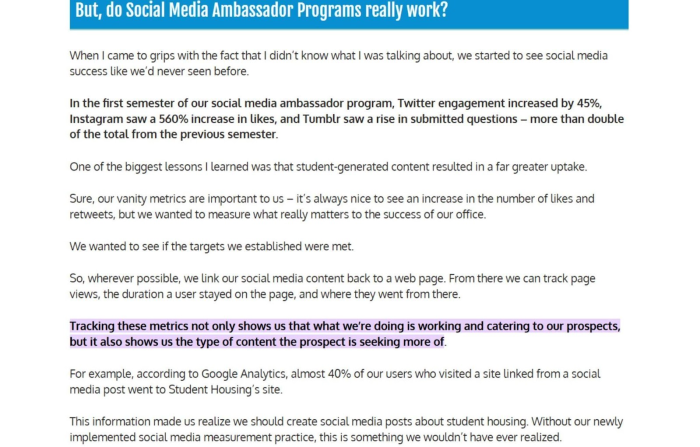
When prospects hear directly from peers, engagement skyrockets. A student-led social media post, blog, or Q&A session feels personal, not promotional. For example, the University of Guelph’s student ambassador program boosted digital interactions dramatically, with a 45% increase in Twitter engagement and a 560% surge in Instagram likes within one semester. That’s the power of peer-driven content.
Better Recruitment & Enrolment Outcomes
A personal connection can make the difference between “I’m interested” and “I’m applying.” Ambassadors help prospects imagine themselves on campus, creating bonds that admissions staff alone can’t replicate. Schools like John Cabot University in Rome showcase ambassadors prominently in their recruitment strategy, even encouraging prospective students to contact ambassadors directly. That accessibility fosters trust and can translate into higher application and enrolment rates.
Stronger Community & Retention
Ambassadors bring new students and help keep them. By welcoming newcomers, offering guidance, and serving as peer mentors, ambassadors ease the transition to college life. At Bishop O’Dowd High School in California, nearly 400 student ambassadors reshaped the campus environment, creating what leaders called “a culture of positivity and engagement.” Programs like this build pride, morale, and stronger student retention.
Expanded Reach (Especially Online)
Your admissions team can’t be everywhere at once, but ambassadors can extend your reach digitally. From Instagram takeovers to late-night chats with international prospects, ambassadors provide real-time, student-to-student communication across time zones. They also bring the institution into spaces where prospects already spend time, such as YouTube, TikTok, and Discord, ensuring no question goes unanswered.
Leadership Development (A Two-Way Benefit)
It’s not just the institution that benefits. Ambassadors gain professional skills in leadership, communication, and digital engagement. Many list the role on resumes, use it to network with alumni, and carry their ambassador pride into their alumni years. That growth feeds back into your institution: the more empowered the ambassadors feel, the stronger advocates they become during and after their studies.
More than just friendly faces, student ambassadors are powerful storytellers, culture shapers, and recruitment catalysts. They infuse authenticity into marketing, build personal bridges with prospects, enrich campus life, and extend your institution’s digital footprint. In the higher ed landscape, their influence can be the deciding factor in whether a prospect chooses your school.
How to Build a Successful Student Ambassador Program
So you’re ready to launch a student ambassador program. Where do you start? Building a program that feels authentic, sustainable, and effective requires more than just asking a few enthusiastic students to help at open houses. It needs strategy, structure, and a focus on both institutional goals and student development. Here’s a roadmap to help you design a program that works.
1. Define Clear Objectives
Before recruiting a single ambassador, clarify why your program exists.
Is your priority to boost applications?
Do you want to increase engagement at open houses and virtual events?
Or is the goal to expand your reach internationally?
Your objectives shape everything else, from who you recruit to the channels you emphasize. For example, if international recruitment is a focus, it makes sense to involve multilingual students or those who’ve studied abroad.
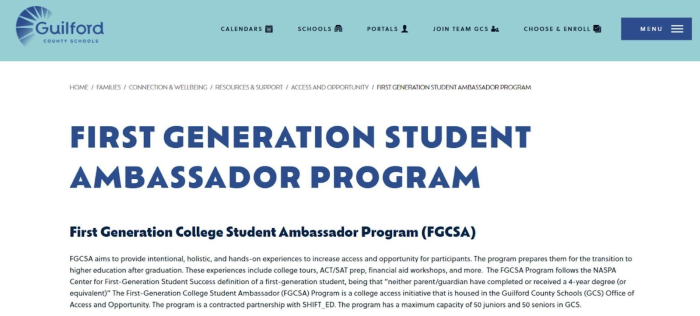
Example: The First Generation College Student Ambassador Program in Guilford County Schools was launched with a specific objective: to increase access to college for first-generation students. The program “aims to provide intentional, holistic, and hands-on experiences to increase access and opportunity” for participants and prepares them for the transition to higher education. By explicitly stating this purpose, the district kept the program focused, offering college tours, SAT/ACT prep, and workshops, all designed to meet the clear goal of empowering first-gen students to succeed after graduation.
Not every student is ambassador material. Create eligibility guidelines that reflect the qualities you need.
Look for:
Strong communication and interpersonal skills
Academic reliability (solid GPA)
Active involvement in campus life
A positive, professional online presence
Diversity matters, too. Aim for a team that represents different programs, backgrounds, and perspectives so prospective students can connect with someone who reflects their own journey.
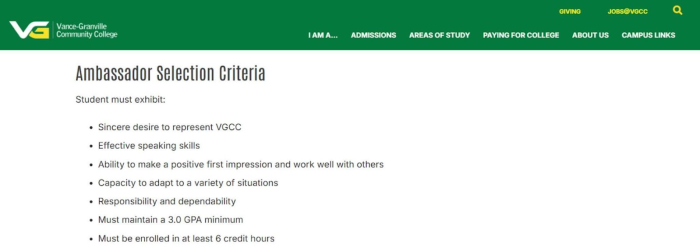
Example:Vance-Granville Community College (NC): VGCC’s Student Ambassador Leadership Program sets strict selection criteria to ensure ambassadors have the right qualities. Applicants must “maintain a 3.0 GPA minimum” and be enrolled half-time, and they are evaluated on attributes like effective speaking skills, a positive first impression, adaptability, responsibility, and dependability. By codifying these requirements, VGCC attracts top student leaders who are academically solid and genuinely motivated to represent the college.
Treat ambassador recruitment like a competitive job search.
Ask for an application form where students share why they want the role.
Request a short essay, or even better, a one-minute video to showcase personality and enthusiasm.
Review their social media presence; as they’ll likely use it in the role.
Conduct interviews or group activities to evaluate how they interact under pressure.
The mix of application, interview, and review helps you select students who are genuinely passionate and prepared to represent your school.
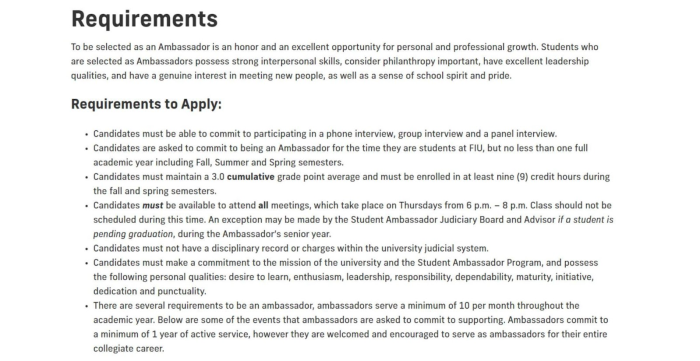
Example: Florida International University:FIU treats ambassador recruitment like a job hiring process, requiring candidates to go through multiple interview stages. Prospective FIU Student Ambassadors must “commit to participating in a phone interview, group interview, and a panel interview” as part of the application. Only students who successfully navigate all rounds and meet other requirements (e.g., 3.0 GPA, full-year commitment) are selected.
Provide ambassadors with FAQ sheets on admissions, housing, or financial aid so they feel confident answering questions. Assign a staff coordinator as a mentor and check in regularly. Occasional refresher sessions help keep everyone sharp.
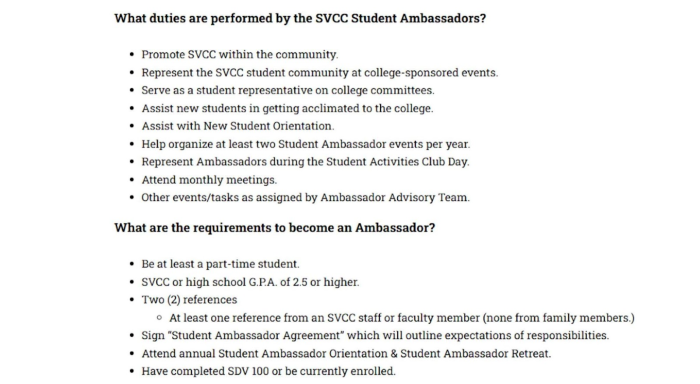
Example: Southside Virginia Community College: SVCC invests in training and team development for its ambassadors by mandating an orientation and an annual retreat. All new ambassadors must “attend annual Student Ambassador Orientation & Student Ambassador Retreat” and participate in monthly meetings. During these sessions, students receive guidance in public speaking, event hosting, and campus knowledge. The retreat, in particular, serves as both training and bonding – a dedicated time to build skills and camaraderie. Ongoing support from staff advisors (assigned at each campus) further ensures ambassadors have mentorship throughout the year.
Clarity is essential. Outline exactly what ambassadors will do and how often.
Examples include:
Weekly or monthly campus tours
Required participation in a set number of events per semester
Social media contributions (Instagram stories, blog posts, TikTok takeovers)
Optional extras like mentoring first-year or international students
Compensation can be financial (work-study wages or stipends) or perks like free merch, event tickets, or professional development opportunities. Make sure the role feels rewarding and achievable alongside academics.
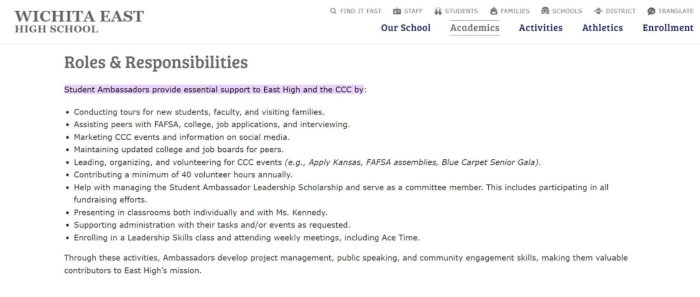
Example: Wichita East High School: East High’s ambassadors operate under a clear set of responsibilities and expectations. According to the program description, ambassadors lead campus tours for new students and visitors, assist peers with college and job applications (including FAFSA help), promote school events on social media, maintain information boards, and volunteer at key events like college fairs. They are required to contribute a minimum of 40 volunteer hours annually in these activities. Ambassadors must also uphold school conduct standards and serve as role models.
A successful ambassador program is also a community. Encourage bonding through:
Regular team meetings
Social gatherings or retreats
Recognition events or ambassador spotlights
A strong sense of camaraderie boosts morale and translates into better representation at events.
Example: The College Preparatory School: At College Prep, fostering community is central to the ambassador program. The school’s Admission Ambassadors represent a student body of 370, where connection, curiosity, and collaboration are defining values. Each ambassador profile highlights not only individual strengths but also the shared culture of independence, kindness, and deep relationships that tie the community together. By spotlighting ambassadors’ personal stories and the values they embody, College Prep nurtures a sense of team identity that extends beyond recruitment events. This approach creates cohesion among ambassadors themselves while reflecting the school’s wider commitment to inclusivity and connection, ensuring the program is both a showcase and a unifying force for the entire student body.
Think beyond tours and open houses. Ambassadors can be powerful storytellers for your brand.
Invite them to contribute blogs, vlogs, or Q&As for your website.
Run student social media takeovers for a “day in the life” view.
Feature ambassadors in recruitment videos or email campaigns.
Have them moderate online communities for admitted students, such as Facebook or Discord groups.
Encouraging ambassadors to share personal milestones, like landing an internship or study abroad experience, also strengthens your brand with authentic proof points.
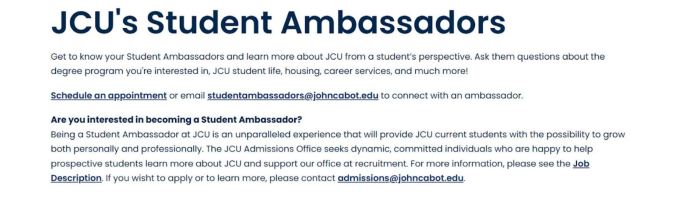
Example: John Cabot University: JCU has woven student ambassadors directly into its admissions and marketing communications. The university’s website features a “Meet Your Student Ambassadors” page with profiles of current students (including photos, majors, hometowns, and personal stories) and actively invites prospects to connect with them. Interested students can schedule a one-on-one video call via Calendly or send an email to reach a JCU ambassador. This approach makes ambassadors a front-line part of marketing – essentially living testimonials that lend authenticity. JCU ambassadors also create content: they share their experiences through blogs and social media takeovers, giving an inside look at life in Rome.
Don’t let your program run on autopilot. Measure its impact and adjust.
Ask prospective students if ambassador interactions influenced their decision.
Gather feedback from ambassadors about training, workload, and support.
Monitor metrics: event attendance, social media engagement, and application trends.
If you notice gaps, like not enough STEM majors on your team or weak performance at virtual events, adapt accordingly. A good ambassador program evolves with your institution’s needs and with changes in student behavior.
Example: University of Guelph:Guelph’s social media ambassador initiative shows the importance of measuring impact and iterating. After launching the program, Guelph didn’t just celebrate a surge in likes and follows – they dug into analytics to see what prospective students cared about. For example, by tracking which web pages prospects visited via ambassadors’ posts, the admissions team discovered an unexpectedly high interest in student housing information. With that insight, they adjusted their content strategy: ambassadors began creating more posts about dorm life and residence tours.
When structured thoughtfully, a student ambassador program becomes a win-win. Prospective students see a genuine, welcoming face of your institution. Current students gain leadership skills and professional growth. And your institution benefits from more authentic marketing, stronger recruitment outcomes, and an energized campus culture.
It’s more than a marketing tactic; it’s an investment in your community. Build it right, and your ambassadors will become some of your strongest advocates, now and well into their alumni years.
Turning Students Into Your Strongest Advocates
Student ambassador programs are far more than a recruitment tool. They are a way to put authentic student voices at the heart of your institution’s story. Ambassadors connect with prospects in ways no brochure or campaign ever could, offering real-life perspectives that build trust and spark genuine interest.
For institutions, the benefits are clear: more authentic marketing, stronger engagement, improved recruitment outcomes, and a livelier campus community. For students, it’s a chance to develop leadership, communication, and professional skills while giving back to the school they love.
The key is to be intentional. Define your goals, select the right ambassadors, support them with training, and continually refine the program. Done well, an ambassador initiative can become one of your institution’s most impactful long-term assets. Creating student advocates who not only help today’s prospects but remain champions of your brand long after graduation.
Struggling to stand out in a crowded market?
Boost enrollment with digital student ambassador strategies!
Frequently Asked Questions
Question: What is a student ambassador program?
Answer: A student ambassador program is a structured initiative where carefully selected students serve as official representatives of their school. These ambassadors, whether current students or recent alumni, act as the institution’s authentic storytellers, sharing first-hand experiences with prospective students, parents, alumni, and the wider community.
Question: What is the role of a student ambassador?
Answer: The short answer: a lot. They wear many hats, all focused on building connections and giving prospective students an authentic glimpse into campus life.
Question: What qualities does a student ambassador have?
Answer: A student ambassador has strong communication skills, enthusiasm, leadership, inclusivity, professionalism, knowledge of their institution, resourcefulness, and digital fluency, allowing them to authentically represent their school and connect meaningfully with prospective students.