Author: admin

  • Academic coaching is data-driven support for students in the dark

    Academic coaching is data-driven support for students in the dark

    Universities offer a wide range of support to students – lecturers’ office hours, personal tutors, study skills advisors, peer-mentoring officers, mental health and wellbeing specialists, and more.

    But even with these services in place, some students still feel they are falling through the cracks.

    Why? One of the most common pieces of student feedback might offer a clue – “I wish I had known you and come to you earlier”.

    Within the existing system, most forms of support rely on students to take the first step – to reach out, refer themselves, or report a problem.

    But not all students can or will: some are unsure who to turn to, others worry about being judged, and many feel too overwhelmed to even begin. These are the students who often disappear from view – not because support does not exist, but because they cannot access it in time.

    Meanwhile, academics are stretched thin by competing research and teaching demands, and support teams – brilliant though they are – can only respond once a student enters this enquiry-response support system.

    Systematic support that requires courage

    As a result, students struggling silently often go unnoticed: for those “students in the dark”, there is often no obvious red flag for support services to act on until it is too late.

    NSS data in recent years reveal a clear pattern of student dissatisfaction with support around feedback and independent study, indicating a growing concern and demand for help outside the classroom.

    While the existing framework works well for those confident and proactive students, without more inclusive and personalised mechanisms in place, we risk missing the very group who would benefit most from early, student-centred support.

    This is where academic coaching comes in. One of its most distinctive features is that it uses data not as an outcome, but as a starting point. At Buckinghamshire New University, Academic Coaches work with an ecosystem of live data – attendance patterns, assessment outcomes, and engagement time with the VLE – collaborating closely with data intelligence and student experience teams to turn these signals into timely action.

    While our academic coaching model is still in its early phase, we have developed simulated student personae based on common disengagement patterns and feedback from colleagues. These hypothetical profiles help us shape our early intervention strategies and continuously polish our academic coaching model.

    For example, “Joseph”, a first-year undergraduate (level 4) commuter student, stops logging into the VLE midway through the term. Their engagement drops from above cohort average to zero and stays that way for a week. In the current system, this might pass unnoticed.

    But through live data monitoring, we can spot this shift and reach out – not to reprimand but to check in with empathy. Having been through the student years, many of us know, and even still remember, what it is like to feel overwhelmed, isolated, or simply lost in a new environment. The academic coaching model allows us to offer a gentle point of re-entry with either academic or pastoral support.

    One thing to clarify – data alone does not diagnose the problem – but it does help identify when something has changed. It flags patterns that suggest a student might be struggling silently, giving us the opportunity to intervene before there is a formal cause for concern. From there, we Academic Coaches reach out with an attentive touch: not with a warning, but with an invitation.

    This is what makes the model both scalable and targeted. Instead of waiting for students to self-refer or relying on word of mouth, we can direct time and support where it is likely to matter most – early, quietly, and personally.

    Most importantly, academic coaching does not reduce students to data points. It uses data to ask the right questions and to guide an appropriate response. Why has this student disengaged? Perhaps something in their life has changed.

    Our role is to notice this change and offer timely and empathetic support, or simply a listening ear, before the struggle becomes overwhelming. It is a model that recognises the earlier we notice and act, the greater the impact will be. Sometimes, the most effective student support begins not with a request, but with a well-timed email in the student’s inbox.

    Firefighting? Future-proofing

    The academic coaching model is not just about individual students – it is about rethinking how this sector approaches student support at a time of mounting pressure. As UK higher education institutions face financial constraints, rising demand, and increasing complexity in students’ needs, academic coaching offers a student-centred and cost-effective intervention.

    It does not replace personal tutors or other academic or wellbeing services – instead, it complements them by stepping in earlier and guiding students toward appropriate support before a crisis hits.

    This model also helps relieve pressure on overstretched academic staff by providing a clearly defined, short-term role focused on proactive engagement – shifting the approach from reactive firefighting to preventative care.

    Fundamentally, academic coaching addresses a structural gap: some students start their university life already at a disadvantage – unsure how to fit into this new learning environment or make use of available support services to become independent learners – and the current system often makes it harder for them to catch up.

    While the existing framework tends to favour confident and well-connected students, academic coaching helps rebalance the system by creating a more equitable pathway into support – one that is data-driven yet recognises and respects each student’s uniqueness. In a sector that urgently needs to do more with less, academic coaching is not just a compassionate gesture, but a future-facing venture.

    That said, academic coaching is not a silver bullet and it will not solve every problem or reach every student. From our discussions with colleagues and institutional counterparts, one of the biggest challenges identified – after using data to flag students – is actually getting them on board with the conversation.

    Like all interventions, academic coaching needs proper investment, training, interdepartmental cooperation, clear role boundaries, and a scalable framework for evaluating impact.

    But it is a timely, student-centred response to a gap that traditional structures often miss – a role designed to notice what is not being said, to act on early warning signs, and to offer students a safe place to re-engage.

    As resources tighten and expectations grow, university leadership must invest in smarter, more sensible forms of support. Academic coaching offers not just an added layer – it is a reimagining of how we gently guide students back on track before they drift too far from it.

    Source link

  • Virginia Democrats Accuse GMU Rector of Conflict of Interest

    Virginia Democrats Accuse GMU Rector of Conflict of Interest

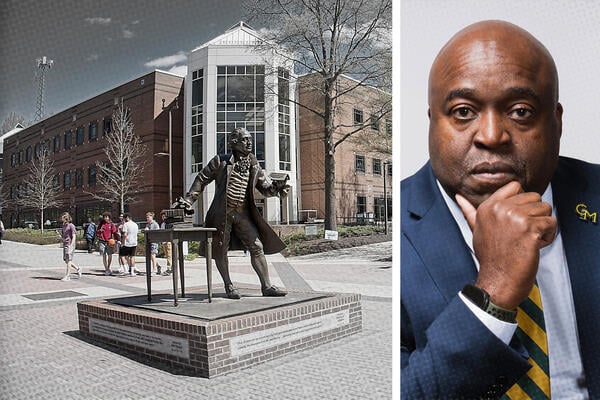
    Photo illustration by Justin Morrison/Inside Higher Ed | Robert Knopes/UCG/Universal Images Group/Getty Images | Maxine Wallace/The Washington Post/Getty Images

    Virginia Democrats want George Mason University board rector Charles Stimson to recuse himself from federal investigations into the university as well as discussions about the university president’s future, saying that his role at the Heritage Foundation, which recently released a report critical of GMU, presents a conflict of interest.

    The letter comes almost two weeks after a state Senate committee blocked 14 gubernatorial appointments to university boards, including six at GMU, which left the Board of Visitors without a quorum. The letter also follows the Heritage report that accused GMU of attempting to hide diversity, equity and inclusion programs. Stimson has had several jobs at Heritage, where he’s currently deputy director of the organization’s legal and judicial studies center.

    The Trump administration has accused GMU of engaging in discriminatory hiring practices and implementing “unlawful DEI policies” and has opened several investigations into the university.

    However, GMU president Gregory Washington has stood his ground, arguing that the federal government rushed the investigation and disputing its findings while rejecting calls to personally apologize. Now, as GMU’s Board of Visitors is stuck without a quorum while a legal challenge over the appointments plays out, state Democrats are seeking to neutralize Stimson in his role as rector.

    A Call for Recusal

    Senate Majority Leader Scott Surovell and other top Democrats in the Senate, L. Louise Lucas and Mamie E. Locke, specifically took issue with the Heritage report’s call to “withhold federal taxpayer funds from universities that violate the Civil Rights Act of 1964,” which the Education Department accused GMU of doing. State Democrats argued that Stimson’s employer is essentially seeking to harm the university.

    “This creates an untenable ethical conflict where your employer’s published position is diametrically opposed to your duties as Rector,” the lawmakers wrote to Stimson.

    (Stimson is one of multiple university board members appointed by Republican governor Glenn Youngkin with distinctly right-wing profiles, including some with ties to conservative think tanks, the Trump administration, GOP megadonors and former Republican politicians, Inside Higher Ed found earlier this year.)

    State Democrats also raised concerns over how he became rector.

    “The appearance of impropriety is compounded by the fact that your selection as Rector reportedly occurred only after direct intervention by Governor Youngkin, raising questions about whether your Heritage Foundation affiliation influenced that appointment,” the Democrats wrote.

    Given what they view as a conflict of interest, the three Democratic leaders called on Stimson to recuse himself “from all Board of Visitors deliberations, discussions, and votes” involving Washington’s employment status or performance evaluations, GMU responses to federal DEI investigations or compliance concerns, GMU funding strategies and university DEI policies.

    “If you cannot commit to this recusal, I believe the appropriate course would be your resignation as Rector to eliminate this conflict entirely,” Surovell and the other Democrats wrote to Stimson while calling on him to respond “outlining the specific steps you will take to address this conflict.”

    Neither GMU officials nor Stimson responded to requests for comment from Inside Higher Ed.

    Youngkin accused Democrats of trying to undermine university boards.

    “Virginia’s progressive left elected officials are trying to paralyze the governing boards of Virginia’s colleges and universities by using despicable bullying and intimidation tactics,” Youngkin wrote in a post on X.

    Faculty Support

    As Washington, GMU’s first Black president, has found himself in the Trump administration’s cross hairs and fighting back, board support has been a constant question. Rumors of Washington’s expected firing swirled in July, but the Board of Visitors kept him on the job.

    George Mason faculty have also rallied around the embattled president, with dozens of professors, students and others protesting outside the July meeting. GMU’s chapter of the American Association of University Professors applauded the senators’ letter on Tuesday.

    “We believe that Mr. Stimson has failed to fulfill his fiduciary duties and has repeatedly exceeded his proper authority as Rector of the Board of Visitors. His conflicting leadership role at the Heritage Foundation and his repeated attempts to overreach his authority threaten the foundation of Virginia’s largest public university, endangering its governance, stability, and future,” the GMU-AAUP Executive Committee wrote in an email to members.

    The local AAUP chapter struck a sharper tone than Virginia’s Senate leadership, alleging that Stimson has “usurped GMU President Gregory Washington’s authority to manage the university’s responses to federal investigations, contrary to the president’s delegated authority established in the [Board of Visitors’] Bylaws.”

    GMU-AAUP also echoed the call for Stimson to recuse himself from certain board duties.

    “If Rector Stimson cannot commit to this recusal, we join Senators Surovell, Lucas, and Locke in calling for his resignation as Rector to eliminate this conflict entirely,” the organization wrote. “The independence, integrity, and future of George Mason University depend on nothing less.”

    The group previously voted no confidence in the Board of Visitors in July.

    Source link

  • Scholarship, Not Ideology, Guides Civics Curricula

    Scholarship, Not Ideology, Guides Civics Curricula

    To the editor,

    I write in response to Ryan Quinn’s recent article (“The Battle for ‘Viewpoint Diversity’” Sept. 2, 2025) on the new civic center at Utah State University, which mandates general education courses on Western civilization. In his words: “Utah’s Legislature created a civic center at Utah State University committed to ‘viewpoint diversity and civil discourse’ … Those courses must include three that engage with ‘primary texts predominantly from Western civilization,’ such as ancient Israel, Greece or early Christianity. There’s no mention of Islam.”

    Well, there’s no mention of Shintoism, Confucianism or Buddhism, either, but I fail to see what’s puzzling about excluding Islam from a “Western civilization” curriculum. Islam’s primary texts played no part in the political construction of the West. Quinn’s implied request is analogous to demanding that a curriculum devoted to Aztec or Inca civilization include the Bible simply because Spain invaded, conquered, subjugated and colonized those societies. 

    As a matter of civics, the distinction between the Islamic world and the West is foundational and elementary. It is recognized historically and intellectually by all who have studied the West’s construction.

    Most Americans—and by extension, our education systems—naturally focus on their own historical and cultural heritage. We’re in the United States; courses here typically reflect what shaped this nation: Greco-Roman republicanism, state Christianity and Enlightenment ideals. People are curious how and why our country got to where it is. If we taught in Iran, China or elsewhere, the focus would reflect their heritage—not ours.

    This isn’t a value judgment. It’s just a fact. As odd as it sounds, the United States was conceived as a reactivation of the Roman Republic 1,800 years after it came to an abrupt halt. The Founders live action role played as ancient Romans in their writings. It’s strange, but that’s precisely why it fascinates students. So these texts are not political baggage; they’re intriguing questions of origin and identity.

     The question here isn’t moral judgment or wishful thinking. It’s scholarly clarity. Let’s demand substance, not ideology.

    Mike Fontaine is a professor of classics at Cornell University.

    Source link

  • 2026 College Free Speech Rankings: America’s colleges get an ‘F’ for poor free speech climate

    2026 College Free Speech Rankings: America’s colleges get an ‘F’ for poor free speech climate

    • Claremont McKenna takes the top spot, while Barnard College, Columbia University, and Indiana University come in last.
    • 166 of the 257 schools surveyed got an F for their speech climate.
    • For the first time ever, a majority of students would prevent speakers from both the left and right who express controversial views, ranging from abortion to transgender issues, from stepping foot on campus.

    WASHINGTON, D.C., Sept. 9, 2025 – If America’s colleges could earn report cards for free speech friendliness, most would deserve an “F”— and conservative students are increasingly joining their liberal peers in supporting censorship.

    The sixth annual College Free Speech Rankings, released today by the Foundation for Individual Rights and Expression and survey partner College Pulse, show a continued decline in support for free speech among all students, but particularly conservatives. Students of every political persuasion show a deep unwillingness to encounter controversial ideas. The survey, which is the most comprehensive look at campus expression in the country, ranked 257 schools based on 68,510 student responses to a wide array of free speech-related questions.

    The rankings come at a notable moment for free speech on college campuses: clashes over the Israeli-Palestinian conflict, a vigorous and aggressive culture of student activism, and the Trump administration’s persistent scrutiny of higher education. 

    “This year, students largely opposed allowing any controversial campus speaker, no matter that speaker’s politics,” said FIRE President and CEO Greg Lukianoff. “Rather than hearing out and then responding to an ideological opponent, both liberal and conservative college students are retreating from the encounter entirely. This will only harm students’ ability to think critically and create rifts between them. We must champion free speech on campus as a remedy to our culture’s deep polarization.”

    The best colleges for free speech

    1. Claremont McKenna College
    2. Purdue University
    3. University of Chicago
    4. Michigan Technological University
    5. University of Colorado, Boulder
    6. University of North Carolina, Greensboro
    7. Vanderbilt University
    8. Appalachian State University
    9. Eastern Kentucky University
    10. North Carolina State University

    The worst colleges for free speech

    1. Loyola University, Chicago

    2. Middlebury College

    3. New York University

    4. Boston College

    5. University of California, Davis

    6. Northeastern University

    7. University of Washington

    8. Indiana University

    9. Columbia University

    10. Barnard College

    EXPLORE THE RANKINGS

    For the second time, Claremont McKenna has claimed the top spot in the rankings. Speech controversies at the highest-rated schools are rare, and their administrations are more likely to support free speech. The schools that improved their score the most, including Dartmouth College and Vanderbilt University, worked to reform their policies and recently implemented new programs that support free speech and encourage open discourse. 

    The lowest-rated schools are home to restrictive speech policies and some of last year’s most shocking anti-free speech moments, including threats to press freedom, speaker cancellations, and the quashing of student protests.

    “Even one egregious anti-free speech incident can destroy students’ trust in their administration and cause a school to plummet in the rankings,” said FIRE Vice President of Research Angela C. Erickson. “If campus administrators, faculty, and students want to enjoy an atmosphere of trust on campus, they can start by protecting each other’s rights.”

    Other key findings from the report include:

    • 166 of the 257 schools surveyed got an F for their speech climate, while only 11 schools received a speech climate grade of C or higher.
    • Only 36% of students said that it was “extremely” or “very” clear that their administration protects free speech on campus.
    • A record 1 in 3 students now holds some level of acceptance – even if only “rarely” — for resorting to violence to stop a campus speech.
    • 53% of students say that the Israeli-Palestinian conflict is a difficult topic to discuss openly on campus. On 21 of the campuses surveyed, at least 75% of students said this — including 90% of students at Barnard.
    • For the first time ever, a majority of students oppose their school allowing any of the six controversial speakers they were asked about onto campus — three controversial conservative speakers and three controversial liberal ones.

    “More students than ever think violence and chaos are acceptable alternatives to peaceful protest,” said FIRE Chief Research Advisor Sean Stevens. “This finding cuts across partisan lines. It is not a liberal or conservative problem — it’s an American problem. Students see speech that they oppose as threatening, and their overblown response contributes to a volatile political climate.” 

    Explore the full rankings here.


    The Foundation for Individual Rights and Expression (FIRE) is a nonpartisan, nonprofit organization dedicated to defending and sustaining the individual rights of all Americans to free speech and free thought—the most essential qualities of liberty. FIRE recognizes that colleges and universities play a vital role in preserving free thought within a free society. To this end, we place a special emphasis on defending the individual rights of students and faculty members on our nation’s campuses, including freedom of speech, freedom of association, due process, legal equality, religious liberty, and sanctity of conscience.

    CONTACT 

    Katie Stalcup, Communications Campaign Manager, FIRE: 215-717-3473; [email protected] 

    Source link

  • The Coming Federal Cuts – Part 2: ESDC

    The Coming Federal Cuts – Part 2: ESDC

    Yesterday, I explained why the federal government now finds itself in a position where it has to cut program budgets by at least 15% just to keep the budget deficit to $50 billion by 2028. Today, I am going to explain how this will play out at Employment and Social Development Canada (ESDC), which plays a major role in funding for skills and education in Canada, mainly through the Canada Education Savings Program (CESP) and the Canada Student Financial Assistance Program (CSFAP).

    Now, just a note at the start. It is vanishingly unlikely that the feds will actually look for 15% savings in every program. The 15% rule is for the Department as a whole, and ESDC is one big mother of a department. It includes all sorts of programs including EI (which in theory is exempt from cuts), and child care.

    So, let’s start with CESP, which delivers about a billion dollars a year via matching grants to parents saving for their kids’ education via Registered Education Savings Plans (RESPs). This program doesn’t allow for a lot of nuance in cutting. The program gives out about $1.1 billion a year in Canada Education Savings Grants (CESGs), roughly 85% of which goes on a basic 20 cent-to the dollar match rate and about 15% of which goes to “additional” (i.e. higher) matching rates for lower-income Canadians (A-CESGs). It also runs the Canada Learning Bond Program, which is another roughly $150 million per year which is a non-matching grant of up to $2000 to children from low-income backgrounds to start their educational savings.

    There are basically four options here:

    1) The government could cut program spending across the board by 15%. That is, it could lower the base CESG matching rate from 20% to 17%, and A-CESG payment rates for lower income contributors to 26.5% and 34% from the current 30% and 40%. That would save about $150 million/year. It could also reduce the CLB payout to $1700.  

    2) The government could eliminate the A-CESG pieces entirely and go with a flat 20% coverage. That’s a pretty quick way to a 15% reduction.

    3) The government could axe the CLB. Again, a very quick way to get close to 15% reduction.

    4) The government could hold the A-CESG and CLB harmless and reduce the CESG base rate even further, to about 15%.  

    Now, personally, I think CESG probably comes out of this unscathed – that is, a 0% cut – because it’s one of the most popular government programs in existence. But these options give you a sense of what cuts might be, if applied uniformly across the department.

    (Yes, there are also presumably some savings to be made on the personnel side, but it’s a pretty simple and lean program – if you could get savings equal to even 0.5% of total expenditures from that, I’d be shocked).

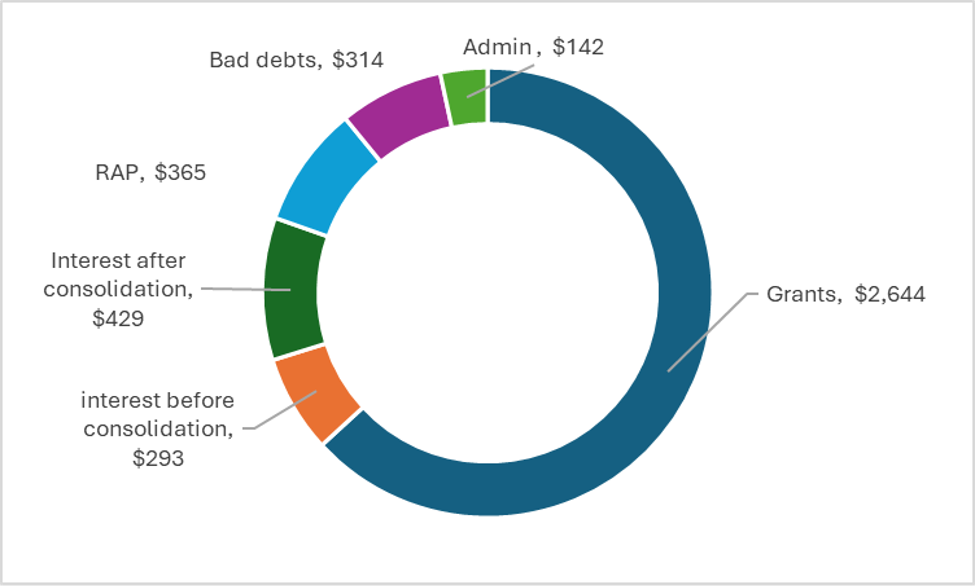
    Let’s now head over to CSFAP spending and see how that might fare. It’s a bit more complex than CESG so it’s worth looking at its basic cost-structure. Using data from the CSFAP’s 2023 Actuarial report, it’s possible to look at overall direct program costs, as shown below in Figure 1. Technically, this is not a full state of program costs because there’s another billion or so in “alternative payments” to jurisdictions that do not participate in the CSFAP (i.e. Quebec, Nunavut and the NWT). But since this sum is calculated as a fraction of direct programs, we can more or less ignore them here – a 15% cut of the direct costs automatically translates through to a 15% cut in alternative payments as well. And our target number – given that CSFAP direct expenses are about $4.2 billion – would be about $628 million.

    Figure 1: Major areas of CSFAP spending, in millions, 2023-24

    So where do you carve out that much money from CSLP? Well for starters we could and should get rid of the $429 million we spent eliminating interest on loans after graduation. These subsidies do nothing for access; rather, they boost the incomes of middle-class 20–30-year-olds who have already finished school. And it is not a long-standing program. It is, in fact, a quite recent thing, announced by then-finance minister Chrystia Freeland in 2023 when the Liberals were desperately trying to throw a bone to house-poor urban twenty-somethings who at the time were threatening to vote not-Liberal. Now cutting this wouldn’t be a straight $429 million savings – loss of that subsidy would likely lead to increases in bad debt and Repayment Assistance program (RAP) charges somewhat. So, let’s call that a $350M win.  

    Where to find the other $275 million? Not administration: most of the admin money is tied up in payments to provinces for running the front end of the program or to the National Student Loans Service Centre (an outsourced agency which resides over by Square One in Mississauga for running the back end), neither of which can easily be changed in the short term. Maybe you could lose a couple of million in staff costs but not much more. Very little you can do about bad debts either.  RAP and interest subsidies before consolidation could be made less generous. In particular, the income threshold for access to RAP could be brought back down from the current $45K (roughly – it depends on family size) to say $38K, and interest during school could be brought up from zero to the current inflation rate or the government rate of borrowing (i.e. somewhere between 2 and 2.5%). I don’t have access to detailed financial figures on this, but my guess is that the RAP measure might save $50M or so; in-school interest might get you $100M.

    That still doesn’t quite get us to the required $625 million, so the only option left here is to start hacking away at grants. A straight cut in the maximum grant would be the easiest way to cut costs; bringing that down from $4200/year to, say, $3500/year would reduce spending by something along the lines of $400M/year. Another and more likely option would be for the feds to copy what Doug Ford did when he wanted to contain student aid costs – change grant eligibility criteria in such a way as to make grants harder to obtain. The obvious way to do this, I think, would be to change the rules for dependent/independent student status (i.e. the point at which students are considered to no longer get money from their parents) so that it took students five years to reach such independent status instead of four. I am not exactly sure how much that would save, but I’d wager it would be a minimum of a quarter-billion. 

    So, your menu of cut options for cutting CSFAP is, essentially:

    Bring back interest after graduation $350 million
    Admin $3-5 million
    Reduce RAP threshold to $38K $50 million
    Introduce in-school interest of 2.5% $100 million
    Cut maximum grants by $700/year $400/million
    Change definition of independent student $250 million

    (To be clear here, I am guessing a bit on some of these numbers. Intelligently, I hope, but they are guesses. Don’t take the numbers here as gospel. And if any friends at CSLP want to correct me, please do!)

    If it were me, to get to (roughly) the required $625 million I’d bring back interest after graduation – or introduce an equal-to-government-rate-of-borrowing interest rate for the entire life of the loan, which probably ends up with similar savings – and change the definition of independent students. Neither are pleasant but these are the ones that would probably affect access the least.  

    (Again, the Liberals may choose not to cut anything in CSFAP, because hey this is an income security program of a sort, and if we’re obsessing about “affordability” – but that just means cuts elsewhere in the portfolio will be larger).

    Of course, ESDC is much more than these two programs. Take a gander at the full list of programs the programs the Ministry runs (I make it about fifty if you include everything). A lot of those are scattered skills initiatives like Youth Employment and Skills, Indigenous Skills and Employment Training, the Skills and Partnership Fund, Skills for Success Program, the Innovative Work-integrated Learning Initiative. I have no idea what most of these do exactly, nor is it easy to access any budget data about them. But let’s put it this way – few of these programs have a particularly large policy constituency to back them up. My guess is that cuts across these programs will be significantly higher than 15% and some of them may cease to exist altogether.  

    Enough for today.  Tomorrow we’ll do research funding.

    Source link

  • Bringing Real Transparency to College Pricing

    Bringing Real Transparency to College Pricing

    In today’s unpredictable higher education marketplace, TuitionFit, created by Mark Salisbury, offers something that colleges and universities have refused to provide—clear and honest information about what students actually pay. By gathering and anonymizing financial aid offers that students submit voluntarily, TuitionFit makes visible the hidden world of tuition discounting, where sticker prices are inflated but rarely reflect reality.

    The statistics show just how broken and confusing the system has become. For the 2024–25 academic year, private nonprofit colleges awarded institutional grants that equaled 56.3 percent of the published sticker price for first-time, full-time undergraduates and 51.4 percent for all undergraduates. In other words, more than half of published tuition is an illusion. Despite average published tuition of $11,610 at public four-year in-state colleges and $43,350 at private nonprofit institutions, the real net tuition and fees that students pay is far lower. At public four-year schools, inflation-adjusted net tuition has fallen from $4,340 in 2012–13 to $2,480 in 2024–25, while net tuition at private nonprofits has gradually declined from $19,330 in 2006–07 to $16,510 in 2024–25. Families who see terrifying sticker prices often don’t realize that the average all-in, post-aid cost of a four-year degree is closer to $30,000.

    These numbers also reveal deep inequities. At very selective private institutions in 2019–20, low-income students paid about $13,410 after aid, while wealthier peers often paid nearly $39,250. Such disparities are rarely explained by colleges themselves, who prefer to mask their discounting practices with vague averages and opaque award letters.

    This is why TuitionFit is so important. Instead of navigating by distorted averages or marketing spin, students and families can see what peers with similar academic and financial profiles are actually paying. That knowledge provides leverage in negotiating aid offers and choosing institutions that will not leave them with crushing debt. In an era when sticker prices continue to climb while net prices quietly decline, TuitionFit brings clarity at the individual level.

    The Higher Education Inquirer commends Salisbury and TuitionFit for providing a measure of transparency in a system that thrives on opacity. While it cannot by itself resolve the structural inequities of American higher education finance, it arms students and families with something they desperately need: the truth.

    Source link

  • https://www.highereducationinquirer.org/2025/09/tech-on-lockdown.html

    https://www.highereducationinquirer.org/2025/09/tech-on-lockdown.html

    In 2025, consumers face a deepening dilemma: how much personal information they must surrender in order to simply participate in the digital economy—and how much risk of fraud, surveillance, and exploitation comes with it. The modern internet is locked down, not just by corporate firewalls, but by an endless cycle of demands for identification and the rising threat of scams.

    The trade-off is stark. On one side, companies require increasingly invasive personal data for access to basic services. Signing up for a financial aid platform, an online class, or even a subscription news site often involves revealing Social Security numbers, bank accounts, or biometric data. Meanwhile, universities, retailers, and fintech companies justify these demands as “verification” or “compliance.” Consumers are told that without surrendering their information, they cannot belong.

    On the other side, scammers are thriving. From phishing emails that mimic official communications to sophisticated AI-generated calls that sound like family members in distress, fraud is no longer just the realm of obvious spam. The same technology that enables secure payments and online enrollment also fuels deepfake schemes, identity theft, and financial ruin.

    Caught in this digital chokehold, working-class families often pay the highest price. The poorest are more likely to rely on insecure devices, public Wi-Fi, or predatory fintech platforms. They are also more likely to be blamed when fraud occurs, accused of “carelessness” when in reality the system forces them into unsafe digital practices. Meanwhile, the wealthy and elite universities insulate themselves with private cybersecurity teams, exclusive networks, and legal firepower.

    Higher education illustrates this divide vividly. Students applying for loans or grants must disclose enormous amounts of personal data—only to find themselves targets of phishing schemes or, worse, data breaches at the very institutions they trusted. The recent wave of ransomware attacks against universities, along with the growth of “robocolleges” that automate student services with minimal oversight, shows how fragile the system has become. The illusion of safety masks a reality of vulnerability.

    The underlying problem is structural. Data has become currency, and consumers are forced to spend it in order to function. Yet once surrendered, it cannot be taken back. Every digital form filled out, every student portal login, every financial aid verification increases the exposure to fraud. The system tells us to “trust” while offering few protections when trust is violated.

    “Tech on lockdown” means more than clamping down on personal devices. It means a society where access is conditioned on surrender, and where surveillance and scams thrive in tandem. Consumers must navigate between giving up their privacy or risking being locked out, between handing over sensitive information or falling prey to those who exploit it.

    What Consumers Can Do

    While systemic change is essential, there are some basic protective strategies individuals can adopt:

    • Use multi-factor authentication wherever possible, especially on student loan and financial accounts.

    • Limit use of public Wi-Fi for sensitive transactions.

    • Monitor credit reports and financial statements regularly.

    • Be skeptical of unsolicited emails, texts, or calls—even those that appear to come from trusted institutions.

    • When possible, push institutions (including colleges) to explain why they require specific personal data and how they will protect it.

    These measures won’t fix the structural issues, but they can provide some insulation while policymakers, regulators, and institutions continue to fall behind in addressing this growing dilemma.


    Sources

    • Federal Trade Commission (FTC). Consumer Sentinel Network Data Book 2024.

    • Federal Bureau of Investigation (FBI). Internet Crime Report 2024.

    • EDUCAUSE. Cybersecurity and Privacy in Higher Education, 2024.

    • The Higher Education Inquirer. “Robocolleges: Higher Education’s Automation Experiment.” (2024)

    • Identity Theft Resource Center. 2024 Annual Data Breach Report.

    Source link

  • 10 points of note in today’s OECD ‘Education at a Glance’ report

    10 points of note in today’s OECD ‘Education at a Glance’ report

    Author:
    Nick Hillman

    Published:

    • This morning, HEPI and Cambridge University Press & Assessment, are hosting the UK launch of the OECD’s Education at a Glance, which is the most important annual international comparative education publication produced anywhere in the world.
    • Here, HEPI Director, Nick Hillman, takes a look at what it says.

    The OECD’s Education at a Glance is the most important and the most mis-named publication in education, for this year’s edition is 541 pages long! It will take time to digest in full. But for now, here are 10 key points on what it all means for the UK (and especially England):

    1. In England, you’re less likely to have benefited from tertiary education if your parents had a relatively low level of education … but you’re more likely to have had some tertiary education than similar people in other developed countries. This may be a surprise to people who know we still have a long way to go in widening access to higher-level education but it’s not a big surprise to anyone who has looked very closely at first-in-family students – there’s multiple ways to measure who is a first-in-family student but, on some measures, the majority of students these days are first-in-family
    2. The NEETs (young people Not in Employment, Education or Training) challenge is bad and has been getting worse, especially among men. Again, this won’t come as a huge surprise to anyone who has focused on the terrible educational and employment record of lower educated young men – or who has read HEPI’s recent report on the issue. But it is salutary to find out the UK is not only performing badly but that we are performing the worst of any developed country when it comes to earnings for low-skilled adults: ‘25-34 year-olds with below upper secondary education earn 43% less than those with upper secondary or post-secondary non-tertiary attainment, the largest gap among OECD countries’.
    3. Part of the reason for the UK’s comparative success at higher education relative to other countries is the comparatively low drop-out rate. Again, this is covered by a recent HEPI report, which also noted that new initiatives like the Lifelong Learning Entitlement call for a new conception of non-continuation. 
    4. People often say it’s better to invest government money in the compulsory stage of education rather than the tertiary / voluntary stage. The OECD’s numbers suggest the UK has already taken this policy to its extreme. Government spending on higher education (per student) is around $8,000, around half of the average for the OECD and about half of the amount spent ‘at primary to post-secondary non-tertiary levels’ ($13,000). This is an even more extreme way of describing comparative spending on schooling and higher education than the way I put it in a recent speech.
    5. While there is one international student for every three home students in the UK, across the OECD as a whole the ratio is completely different at 1:13. From the vantage point of the OECD in Paris, this is a real UK success story – though the Home Office continues to push for policies to reverse recent trends.
    6. Our postgraduate participation rates for home students are distinctly average, at least when compared to those across the OECD as a whole: ‘In the United Kingdom, 17% of 25-34 year-olds hold a master’s or equivalent degree, which is similar to the OECD average of 16%.’ If we aspire to be as well educated as the best educated countries, then we need more home postgraduates alongside all the ones from overseas. It’s probably fair to say that higher education debates in the UK (and HEPI is perhaps guilty here too) remain overly focused on undergraduate education.
    7. Women are more likely to obtain tertiary education across the developed world. But the gap between men and women is bigger in the UK than elsewhere and has been slowly growing while it has stayed the same on average across the OECD as a whole: ‘In the United Kingdom, they [women] accounted for 56% of first-time entrants in 2023, up from 55% in 2013. Across the OECD, women make up 54% of new entrants on average, the same share as in 2013.’
    8. The teacher supply crisis here is particularly down to a higher-than-average proportion of teachers leaving for other roles: ‘England is among the countries with high turnover, with 0.8% of teachers retiring and 8.7% resigning each year’. The OECD think it should be easier for people to switch careers into teaching here: ‘16 out of 28 countries with available data offer dedicated alternative pathways into teaching for individuals changing careers. In contrast, England does not offer dedicated pathways for second career teachers.’ (Now Teach might have something to say about this?)
    9. In some important respects, our school system is different: primary school teachers’ salaries have been falling in England while rising elsewhere (including in Scotland); UK school pupils have around one week less of school holiday than pupils elsewhere on average (though I recognise this might sound odd at this precise moment, given the long summer holidays have just come to an end); and primary school class sizes are above average in the UK.
    10. There’s a (very) big difference between the conditions for lower-level academic staff and more senior ones. The former receive less than similarly qualified people while the latter earn much more: ‘In England, junior academic staff earn 16% less than workers with at least a bachelor’s or equivalent degree, while senior academic staff earn 80% more.’ Perhaps this explains why some older staff have seemed less keen on industrial action than their younger colleagues. Our report on academics’ terms and conditions explains more.

    Source link

  • Tracking Key Lawsuits Against the Trump Administration

    Tracking Key Lawsuits Against the Trump Administration


    By

    Jessica Blake


    President Donald Trump’s efforts to reshape higher education and the federal government have spurred a flurry of lawsuits as higher education associations, students, legal advocacy organizations and colleges push back and seek relief through the courts.

    The lawsuits started almost immediately after Trump’s first day, and seven months later, advocates continue to file new complaints, challenging various executive orders, guidance documents or decisions to cut grants. Inside Higher Ed is tracking some of the key legal challenges related to higher ed. That includes Harvard University’s efforts to restore more than $2.7 billion in frozen research funding and protect its ability to enroll international students as well as several lawsuits aiming to stop the dismantling of the Education Department. Of the 42 included in our searchable database, judges have ruled against the administration in two-thirds of the cases so far. You can find more analysis of the lawsuits filed so far here.

    We’ll refresh the database weekly, so check back on Mondays for updates.

    What’s new as of Sept. 8: In one of the more significant rulings for higher ed this year, the district court judge ruled that it was illegal for the administration to freeze more than $2 billion in federal research funding for Harvard University. The judge wrote that doing so violated the institution’s First Amendment and procedural rights. The government is planning to appeal but hasn’t done so yet. Legal experts expect the fight over funding to end at the Supreme Court. For more on details of the ruling and what it means for higher education at large, check out Inside Higher Ed’s reporting on the matter here and here.

    Source link

  • Reasons to be cheerful – HEPI

    Reasons to be cheerful – HEPI

    Author:
    Nick Hillman

    Published:

    • Pamela Baxter is Chief Product Officer and Managing Director of IELTS Cambridge at Cambridge University Press & Assessment

    At a time when the value of higher education is being called into question, the OECD’s latest Education at a Glance report offers an unequivocal statement of support for the sector – both globally and in the UK.

    This annual report gives a snapshot of the state of education in the world’s developed nations. By gathering comparative data covering the OECD’s members as well as partner countries, it lets policymakers measure their country’s achievements and set standards against best international practice.

    The 2025 report’s focus on tertiary education gives many reasons for optimism. The highlight is that, with 48% of young adults in surveyed countries holding a tertiary qualification, educational attainment is higher than ever. 

    The share of 25 to 34-year-olds with tertiary attainment increased over the last five years across OECD and partner countries – rising from 45% (2019) to 48% (2024). In the UK, tertiary education among the same cohort grew from 52% to 60% over that period – twelve percentage points above the OECD’s average.

    The report is unambiguous in stating the benefits of higher education: “Supporting equitable access to tertiary education”, it tells us, “remains crucial to strengthening social mobility as educational attainment is closely reflected in labour market outcomes.”

    Adults with an undergraduate university qualification (or equivalent), the report tells us, earn on average 54% more than those with only upper secondary education. (This goes up to 83% when those adults have a postgraduate degree.)

    But the benefits are not only financial. The report emphasises how tertiary education is directly linked to higher employment rates, and even to better health – with 51% of tertiary-educated adults rating their health as very good or excellent, compared to 26% of those with below upper secondary education.

    The report also pinpoints areas where the developed world as a whole must do better. We are told, for instance, that completion rates of young adults going into tertiary education are low – particularly among men – with under half of new entrants finishing their programmes within the expected duration. 

    The rise and rise of international student mobility

    The 2025 report shows the continuing growth of international student mobility in OECD countries, with the number of mobile students as a proportion of total student numbers more than doubling over the past decade. This is good news.

    I was especially heartened to read that the UK continues to be one of the most attractive destinations for international students: 23% of all tertiary students in the UK were international according to 2023 numbers – an increase of six percentage points since 2013, and well above the OECD average of 7%. 

    International students contribute almost £42 billion a year to the UK economy – the equivalent of every UK citizen being £560 better off. This pipeline of international talent is essential to the UK government’s high-growth economic sectors, as well as our universities’ global reputation and competitiveness.

    At Cambridge University Press & Assessment we are deeply aware of the importance of international students to the UK’s educational landscape – and indeed to the country’s wider strengths. International students’ ability to fully participate in, and contribute to, their chosen courses is essential not only to their future success, but to the UK’s prospects as an intellectual, economic and cultural power. We consider it our responsibility to make sure that those globally mobile students seeking paths to higher education are equipped with the right skills to thrive. We’re not alone in that.

    The 2025 edition of Education at a Glance provides a vivid snapshot of the state of global education. It tells us what we are doing well and, crucially, where there is room for improvement. Cambridge welcomes these findings, and we are proud to be sponsoring its launch.

    Source link