Author: admin

  • Government to reform ‘toothless’ TEQSA – Campus Review

    Government to reform ‘toothless’ TEQSA – Campus Review

    The federal government has published a consultation paper calling for suggestions to reform the Tertiary Education Quality and Standards Agency (TEQSA) Act, which determines the regulator’s powers.

    Please login below to view content or subscribe now.

    Membership Login

    Source link

  • What do the next five years hold? – Campus Review

    What do the next five years hold? – Campus Review

    It’s been five years since our first podcast episode was released on September 9, 2020. Our aim was high: to launch a platform seeking to change higher education for good.

    Please login below to view content or subscribe now.

    Membership Login

    Source link

  • Colorado’s 3rd year of Universal Pre-K Gets Off the Ground – The 74

    Colorado’s 3rd year of Universal Pre-K Gets Off the Ground – The 74


    Join our zero2eight Substack community for more discussion about the latest news in early care and education. Sign up now.

    Sign up for Chalkbeat Colorado’s free daily newsletter to get the latest reporting from us, plus curated news from other Colorado outlets, delivered to your inbox.

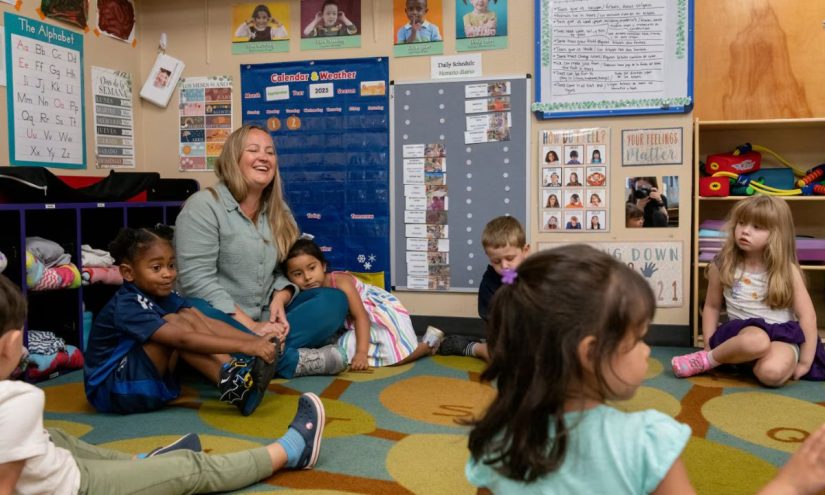
    The little boy clung to his mother as she carried him through the wooden half-door of the preschool classroom on Tuesday morning. Tears streamed down his face. It was going to be a tough drop-off.

    While other children finished bananas, raisin bagels, and milk, Vraja Johnson, the lead teacher, ushered the mother and son toward a cozy corner in the back of the classroom. She spoke softly in English and Spanish to the nervous preschooler. Several minutes later, when his mother had slipped away, the boy nestled into a large blue beanbag clutching Tucker the Turtle, a stuffed animal that helps preschoolers understand that it’s OK to retreat into your shell — and to come back out when you’re ready.

    It was the first day of preschool in the Otters classroom at El Nidito, a bilingual child care program at The Family Center in Fort Collins. The little boy and his 11 classmates are among 40,000 children enrolled in Colorado’s universal preschool program this year. The $349 million program offers tuition-free preschool — typically a half day — to all children in the year before kindergarten.

    Now entering its third year, Colorado’s preschool for all program has smoothed out since its rocky rollout in 2023. At the time, application system errors, glitches in the state’s preschool matching algorithm, and last-minute reductions in preschool hours for some children caused widespread confusion and frustration.

    A national early childhood group recently ranked Colorado third in the country for the share of children served by state-funded preschool. Around 70% of the state’s 4-year-olds are enrolled in the program, which generally covers about $6,000 a year in preschool costs per child.

    But wrinkles remain. The state is still fighting two lawsuits brought by religious preschools that objected to non-discrimination rules protecting LGBTQ children, families, and employees. Both suits are pending in federal appeals court. And the national early childhood group found that Colorado meets only two of 10 benchmarks meant to ensure that preschool classrooms are high quality.

    Currently, the “universal preschool” label doesn’t indicate anything about the caliber of classroom a child will join. Rather, it simply indicates the state is paying for 10 to 30 hours of class time. Of about 2,000 preschools participating in the program, some have the state’s lowest rating and meet only basic health and safety standards.

    Others, including El Nidito, which has been around for 25 years, have the state’s highest rating.

    A morning in Johnson’s classroom makes it easy to see why. She and her co-teacher, an experienced sub named Maria Chavira, are warm, cheerful, and organized. Their young charges are curious, silly, and always in motion.

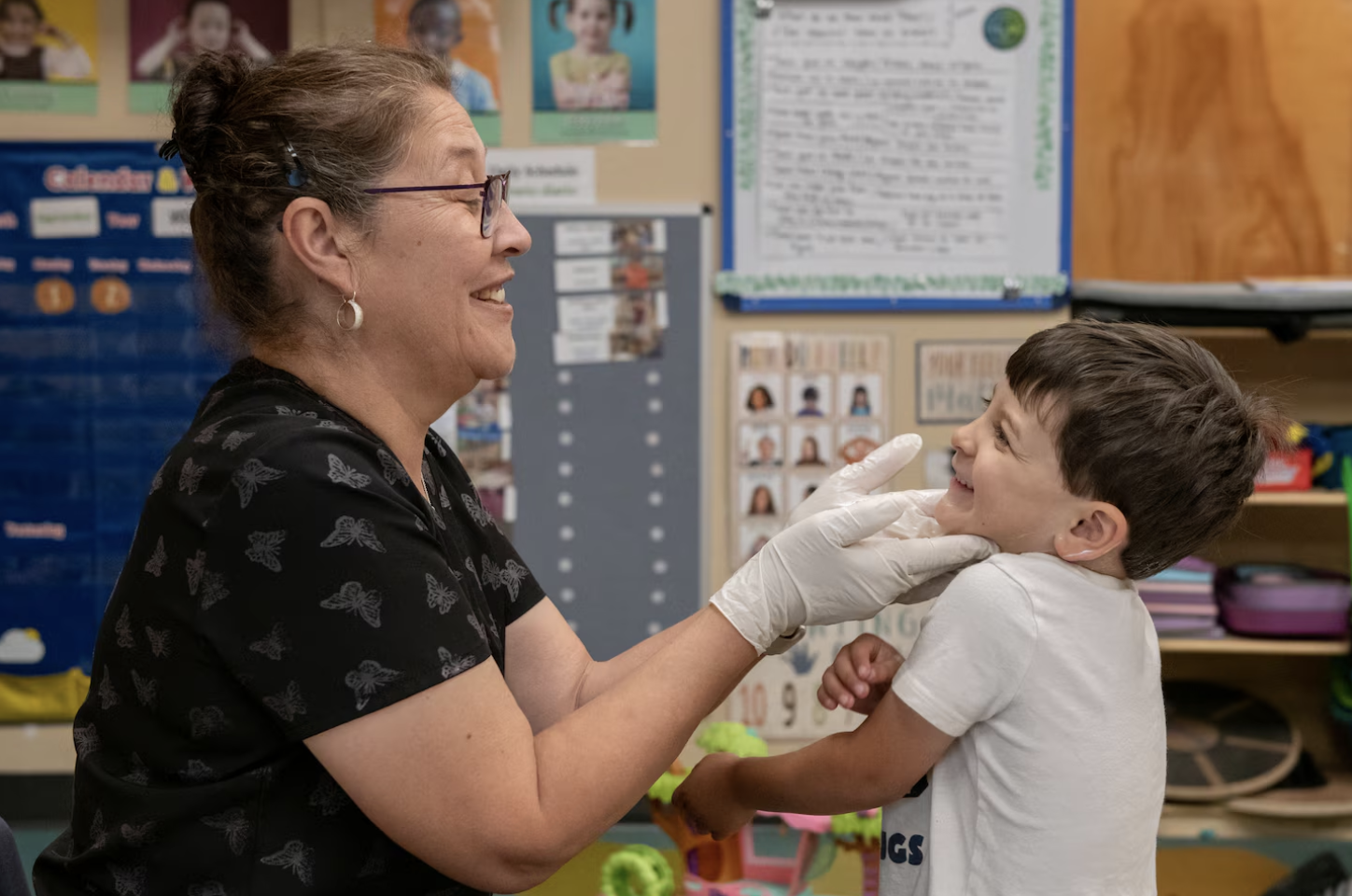
    Maria Chavira, a substitute teacher at the El Nidito child care program in Fort Collins, puts sunscreen on a preschool student before they go outside. (Rachel Woolf for Chalkbeat)

    During breakfast, two boys held bananas up to their ears like phones.

    “Ring, ring, ring. Hi, Henry,” one said as the other burst out laughing.

    Nearby at the sensory table, as one little boy poured dried pinto beans through a cardboard tube, he said, “Did you ever watch ‘Boss Baby?’ The baby is a bossssss. Babies can’t be bosses!”

    Meanwhile, the little boy who’d struggled to leave his mother was getting braver, slowly testing the waters of group play. One minute he crouched next to a little girl in front of a tree house play set. Later, he tried out bear and leopard hand puppets as the Boss Baby skeptic threw Tucker the Turtle up in the air next to him.

    Johnson, who switched from a sales and marketing career to early childhood education in 2007, seems to have a sixth sense for detecting imminent meltdowns, skirmishes, and rule-bending.

    She quickly peeled away from a conversation with a visitor when a little girl dressed in head-to-toe pink accidentally got a squiggle of red marker on her new cowboy boots.

    “Your mom can get that out. The markers are washable,” Johnson said as tears welled in the preschooler’s eyes.

    Then she averted the crisis with five words: “Do you want a hug?”

    Chalkbeat is a nonprofit news site covering educational change in public schools.


    Get stories like these delivered straight to your inbox. Sign up for The 74 Newsletter

    Source link

  • Rising Above the Noise: How SIUE’s Chancellor is Transforming a University and Community

    Rising Above the Noise: How SIUE’s Chancellor is Transforming a University and Community

    The second line band’s brass instruments gleamed in the morning sun as they led nearly a thousand first-year students out of the Vadalabene Center arena. The festive New Orleans style procession wound its way across Southern Illinois University Edwardsville’s campus, past the towering Cougar statue where students would soon gather for their traditional class photo. Parents lined the walkway, some having extended their stay just to witness this moment—their children’s ceremonial entry into college life.

    Among the crowd, one mother approached Dr. James T. Minor with tears in her eyes. 

    “That’s my son,” she said, pointing to a young man adjusting his position for the photo. “This is so great. I can’t believe what you’re doing. I’m so proud of him.” 

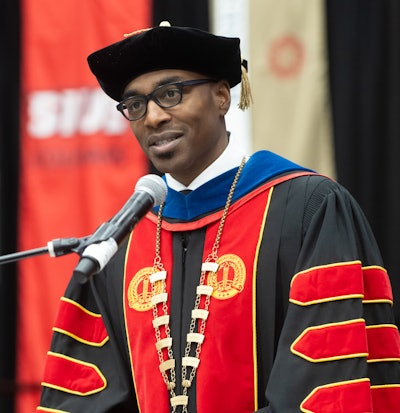
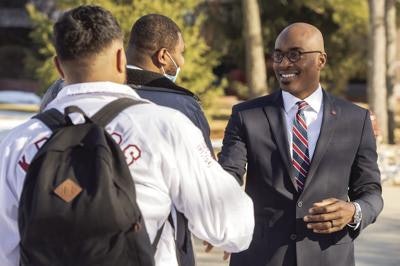
    Dr. James Minor talking to a SIUE student. For Minor, SIUE’s first African American chancellor, this moment embodied everything he hopes to achieve at the institution he has led since March 2022. 
    A Detroit native with a Ph.D. from the University of Wisconsin-Madison and a distinguished career spanning federal government, the California State University system, and scholarship in educational policy, Minor brings both academic rigor and practical experience to his transformational vision.

    “This is as close as I get to what’s truly special about university communities,” he reflects on the school’s most recent convocation. “You’ve got thousands of young people who have made a decision about their life—that they’re going to pursue a college degree—and the university has a responsibility to facilitate that.”

    But behind this celebratory scene lies a story of dramatic transformation, one that has seen SIUE emerge from serious fiscal challenges to become a model for how regional public universities can thrive in challenging times.

    A $18 Million Wake-Up Call
    When Minor arrived on campus in March 2022, he brought credentials that positioned him uniquely for the challenges ahead. As the 10th chancellor in SIUE’s history, his appointment followed distinguished service as deputy assistant secretary at the Department of Education, where he administered more than $7 billion in federal higher education programming. His most recent role as assistant vice chancellor and senior strategist at California State University—where he helped achieve the system’s highest graduation rates in history and secured hundreds of millions of dollars for graduation initiatives—prepared him for the complex work of institutional transformation. 

    But even this impressive background couldn’t ready him for what he discovered within his first 45 days: an $18 million structural deficit that had been masked by years of poor budget practices. 

    “I was giving a university budget presentation that was not particularly pleasant,” Minor recalls of those early days in his tenure. “That was not on my list of things to do in the first 100 days—to organize and understand this structural deficit, communicate it to the university community, and then lay out a plan for managing it.”

    Dr. James T. Minor at commencement.Dr. James T. Minor at commencement.The distinction between a structural deficit and a spending deficit became crucial to Minor’s communication strategy. Unlike a simple overspend that could be corrected immediately, SIUE faced a fundamental mismatch between fixed expenses and revenue. The number of people, buildings, and courses— the structural components of the budget—exceeded revenue by roughly $18 million.

    “We had available cash sources and other things that we could manipulate to cover it,” Minor explains. “We operated that way for a number of years before I arrived, but we all know that’s not sustainable.”

    The solution required what Minor calls “environmental responsiveness”— the ability of institutions to expand and contract according to changing conditions. This meant making hard choices about class sizes, graduate assistantships, and operational efficiencies that some within the university community initially resisted. 

    Fast forward to September 2025, and Minor will soon announce to the campus community that SIUE has effectively resolved its structural deficit, maintains one of the best cash positions among Illinois universities, and accomplished this transformation without spending a single dollar from its cash reserves.

    Building a Culture of Student-Centered Data
    Perhaps even more significant than the financial turnaround has been Minor’s campaign to make SIUE fluent in its own student success metrics. When he arrived, he was stunned by what he discovered during informal surveys of faculty and staff.

    “I would walk into a room and ask, ‘Who here can tell me our four-year and six-year graduation rates?’” Minor recalls. “These are people who presumably should have an idea— people who work here, not people shopping at Target or in the grocery store. I would ask about our first-to-second-year retention rate, and it wasn’t meant to embarrass people. It was to underscore the lack of awareness we had as a university community about the most important thing we do.”

    Today, when Minor walks into any room on campus, hands shoot up when he asks those same questions. “People expect the question,” he says with satisfaction. “I have promised them, I don’t care if we’re talking about the paint in the stairwell, I will start every conversation here at the university about our student outcome data.”

    Dr. James Minor meeting students on campus.Dr. James Minor meeting students on campus.This data-driven approach has yielded measurable results for the institution that boasts more than 12,000 students. First-to-second-year retention rates have increased, graduation rates have ticked up, and the university is expecting growth—a major accomplishment in today’s challenging enrollment environment.

    Dr. Robin Hughes, dean of the School of Education, Health and Human Behavior, sees Minor’s unique combination of scholarship and leadership as precisely what SIUE needed. 

    “Chancellor Minor is by far what most institutions look for and want in an organizational leader,” Hughes observes. “He is a distinguished scholar whose work focuses on the study of higher education organizations. He is also an experienced organizational leader who brings both academic insight and institutional expertise to his work. A strong advocate for students, he makes organizational decisions that positively impact their success both during their studies and beyond.”

    Dr. Jessica Harris, acting chief of staff and vice chancellor for Anti-racism, Diversity, Equity and Inclusion, chaired the search committee that brought Minor to SIUE.

    “I remember reading his cover letter and saying to my mom, ‘I think this is our next chancellor,’” Harris recalls. “Every accomplishment he talked about in his career was about how it positively impacted or transformed the experience for students. That was a consistent thread throughout his cover letter.”

    Nearly four years into his tenure, Harris sees that student-centered focus as the driving force behind institutional change.

    “One of the major shifts I’ve seen is a very clearly articulated and collective focus on student success,” she explains. “Not that it wasn’t a commitment before, but there’s a level of intentionality I didn’t see across all areas before he started. Every presentation starts with mission—this is why we’re here, these are our enrollment numbers, retention and graduation numbers. He keeps it front of mind for us.”

    Dr. Earleen Patterson, associate vice chancellor for Student Opportunities, Equity, Diversity and Inclusion, has witnessed this transformation firsthand.

    “There’s a reason I’m still here,” she says of her longevity at the university that began in 1990. “Over the course of time, I’ve seen a lot of evolution of this journey of progress toward being inclusive, toward offering opportunities to every sector of our population.”

    The results are visible in SIUE’s incoming class, which Patterson describes as having “the highest African American enrollment in the history of the university.” This fall’s freshman class includes nearly 600 Black students in the Boundless Scholars Experience alone—a comprehensive academic program designed to promote belonging, academic achievement and degree completion. At a time when voices opposing diversity, equity and inclusion efforts grow louder across the higher education landscape, SIUE has chosen to double down on its mission, letting results speak louder than rhetoric. 

    The focus on student success extends far beyond enrollment numbers. Patterson describes a comprehensive approach to retention that begins before students even attend their first class. The Boundless Scholars Experience moved students in early, gathering them with their families in the campus ballroom for what Patterson calls “real talk” about college expectations. 

    “What they saw was a room that reflected who they are,” Patterson explains. “But we let them know, come Monday, as you walk out into the university community, you may be the only one in your biology course, in your chemistry course, in your economics course. But you have a community, you have a village.” 

    This village includes strategic course placement with faculty who are particularly effective with first-year students, early warning systems that track attendance and performance, and support staff who can call students by name when they miss class. 

    “It marvels them when they come into my office, and I already know you missed chemistry on Tuesday,” Patterson says with a chuckle. “They’re like, ‘How do you know?’ I care enough to know about that—about all of these students.” 

    For Dominic Dorsey, president of the Black Faculty and Staff Association and director of the Access (Disability Services) Department, representation at the leadership level makes a tangible difference for students.

    “We’ve been blessed not just to have Dr. Minor as our first Black chancellor, but to have a chancellor that’s an actual thought leader and transformational in the truest sense of the word,” he says.

    Dorsey’s own department has seen dramatic growth, with registered students with disabilities increasing from about 650 when he arrived in 2018 to nearly 1,400 today. This growth reflects SIUE’s broader commitment to inclusive excellence that extends beyond traditional diversity metrics.

    Town-Gown Collaboration 
    The transformation at SIUE also stretches beyond campus borders through an unprecedented partnership with the city of Edwardsville. Mayor Art Risavy, a small business owner who has served as mayor for five years after a decade as an alderman, describes an intentional effort to strengthen university- city relations. 

    “Early on, when I became mayor, one of the first things we decided collectively was we wanted to work on our relations with the university,” Risavy explains. “We reached out to the chancellor, and it didn’t take long—Chancellor Minor wants to do stuff pretty quickly—before we had a meeting set up.”

    These conversations led to concrete initiatives: improved website integration between city and university, the Hashbrown Huddle breakfast meetings that bring students directly into downtown Edwardsville, and shared committee appointments that give the university voice in city governance.

    “We want to see students in our businesses, involved in our organizations,” Risavy says. “We want them to feel comfortable downtown, going through our shops and participating in our events. This is their home for four years or five or six years.” 

    The collaboration extends to shared programming, with Minor and Risavy regularly attending each other’s events, from the city’s state of the city address to SIUE’s ice cream social that draws over a thousand participants.

    Navigating Challenges with Bold Leadership 
    The success story at SIUE is unfolding against a backdrop of national political tensions around higher education, particularly concerning diversity, equity, and inclusion efforts. For leaders like Dorsey and Patterson, this context requires strategic adaptation without abandoning core values. 

    “The way that we approach the work has not changed,” Dorsey explains. “We just don’t publicize the way the work is done. Our ancestors created an underground railroad for a reason—it’s a reason why it wasn’t an above ground railroad.” 

    This approach allows SIUE to continue providing scholarships, celebration opportunities, and support systems for underrepresented students while focusing public attention on broader institutional success metrics that benefit all students. 

    Patterson emphasizes the importance of drowning out external noise. 

    “If we were to play into that distraction, we wouldn’t be able to focus on the charge that is in front of us. And these students are in front of us,” she said. 

    Doug James, immediate past president of the Staff Senate, describes an administration focused on “majoring on the major things” while maintaining awareness of smaller concerns. 

    “I think there was an appetite for honest conversation,” he says. “Let’s get in a room and talk about what are our challenges, where are we winning, what are the things we get to celebrate, and what needs our attention.” 

    Yet Harris points to concrete evidence of this collective effort.

    “You don’t see 10 percentage point increases in Black student retention without people doing work inside and outside of the classroom. We’ve hit historic fundraising goals since Chancellor Minor’s been here. He’s helping to shift our culture. He often talks about us being first and best in class.” 

    Looking ahead, Harris envisions SIUE becoming “a model regional public institution with a national reputation” within the next three to five years. The university is already approaching 80% retention for domestic students and has set an ambitious goal of 90% first-to-second-year retention—a benchmark that would distinguish SIUE among institutions of its type. 

    “In the midst of all the challenges facing higher education, all the anti-DEI efforts, all the darts being thrown at us,” Harris reflects, “we are keeping on. We’re not deterred. In fact, we are making really great progress.”

    The Price of Progress 
    Minor’s transformation of SIUE hasn’t come without resistance. As the first African American chancellor in the institution’s history, he acknowledges the complexity of his position with remarkable candor.

    “Some people think about it individually. I haven’t,” he tells me. “I’ve thought about what it means for other people and what it means for this university community with respect to our ability to move forward.”

    Quite frankly, the university community has had to adjust to new leadership and some members have experienced dissonance with the very idea that a Black man is in charge.

    “Sometimes it’s passive resistance, sometimes it’s active resistance, sometimes it’s a level of questioning and verifying before we can participate or agree to move in the right direction, and quite honestly, sometimes it’s blatant sabotage,” the chancellor admits.

    Yet Minor approaches these challenges with the same organizational theory perspective he brings to budget management and student success metrics. For him, institutional transformation requires acknowledging and managing all forms of resistance while maintaining a clear focus on the core mission.

    Still, the significance of this representation isn’t lost on the broader SIUE community, particularly among Black alumni who lived through earlier eras of the institution. Minor recalls one particularly poignant encounter with an alumna from the mid-1960s: “She came up to me, grabbed my hand and started patting my hand as any good grandmother would do, and said, ‘Baby, I’m so proud of you. It’s so wonderful to see you in this role.’ And as she was patting my hand, she leaned in and said, ‘Now, don’t you mess this up.’”

    The exchange captures the weight of expectation that comes with being a first—representing not just personal achievement, but the hopes and dreams of those who paved the way.

    “For individuals from that era, that generation, I represent their hopes and dreams for equity and equality and opportunity,” Minor reflects.

    A Model for Regional Public Universities

    The SIUE story offers lessons for similar institutions nationwide. Minor’s approach demonstrates that even universities without massive endowments can achieve significant transformation through strategic focus, data-driven decision- making, and commitment to operational efficiency.

    “Regional public institutions don’t have the margin to be inefficient,” Minor argues. “We’ve got 1960s infrastructures and boilers and aging infrastructure that we have to manage. You can’t manage that and be grossly inefficient at the same time.” 

    As SIUE prepares for its next chapter, the metrics tell a story of remarkable progress. The university maintains a strong financial position, has achieved record fundraising including the largest single gift in institutional history, and expects continued enrollment growth in a challenging market. 

    But for Minor, the real measure of success remains that moment during convocation when a parent’s pride reflects the transformative power of higher education. 

    “The idea that I get to help facilitate the environment in which young people have an opportunity to transform their life—it’s a dream job,” he says. “It’s not the title, it’s not the status, it’s not the position. It is having the opportunity to facilitate the environment in which young people have an opportunity to transform their life. 

    “I love university communities. I love the power of institutions,” he adds. “I love the idea that they could be beacons of social and economic opportunity. I love the idea that the teaching and learning environment can transform the mind, prepare people professionally in a way that changes the trajectory of their life and their children’s lives. That, to me, is powerful in its own right.”

    That transformation happens every day, every semester, every academic year at SIUE. And as the second line band plays on, leading another class of students toward their futures, the sound carries a promise—that this institution, this community, this partnership between town and gown will continue rising above the noise to focus on what matters most: changing lives through education.


    Source link

  • Ten Education Issues to Watch at the Start of the School Year – The 74

    Ten Education Issues to Watch at the Start of the School Year – The 74


    Get stories like this delivered straight to your inbox. Sign up for The 74 Newsletter

    One big budget bill and 181 executive orders into the Trump administration, one thing is clear for those of us checking our crystal balls ahead of the school year.

    There is a big difference between policy change aligned to winning an election and disruption for the sake of chaos.

    The three-sentence email sent on June 30 that froze billions of dollars of funding across the education continuum in Republican and Democratic counties around the country the night before the funding was anticipated begs the overarching question facing those working in education:

    To state the obvious, the review of the federal funding could have been announced and conducted ahead of the date funds are normally made available, and the disruption could have been minimized.

    Instead, leaders on the right and the left had to write letters, file lawsuits, and respond to panicking constituents to move money Congress had already approved to be spent.

    “The education formula funding included in the FY2025 Continuing Resolution Act supports critical programs that so many rely on. The programs are ones that enjoy longstanding, bipartisan support,” said Republican U.S. Sen. Shelley Moore Capito from West Virginia.

    Many leaders on both sides of the aisle, including Superintendent Mo Green, a Democrat, are hoping for “a return to the predictable, reliable federal partnership that our schools need to serve students effectively.”

    That remains aspirational as the federal Department of Education begins to be dismantled, more responsibility is handed off to states, and local and state education agencies have to find ways to work with multiple federal agencies moving forward.

    Recently at the summer convening of the National Governors Association, when Colorado Gov. Jared Polis asked U.S. Secretary of Education Linda McMahon for clearer communication, she said, “No guarantees from me that we’ll eliminate all the communication gaps that do happen.”

    Our top 10 issues are not the ones featuring most prominently in the news cycle right now.

    DEI continues to be in the news, and in case you missed it, over the summer EdNC published perspectives on DEI by a policymaker, a former superintendent, and an educator.

    Cellphones and AI in classrooms also continue to be highlighted in the media.

    And we know there are many, many other issues you care about, including WNC recovery, literacy, youth wellbeing, learning differences, community schools, school safety, vaccines and school health, school performance and the portfolio model, LGBTQ+ youth, the health of teacher and principal pipelines, STEM, arts and education, and more.

    As we head back to school, the EdNC team will continue to cover all of those issues, but here are the top 10 issues we think will frame this school year.

    Access to education, opportunity, and the American dream

    1. Access to education for immigrants without legal status

    For more than 40 years, students without legal status to be in the country have been allowed to attend public schools free of charge in districts across the United States, and over time that has included access to early education and postsecondary opportunities.

    Federal case law cites reasons for this decision, including:

    • Not wanting to penalize children for their presence in the country;
    • Recognizing that many students will remain in the country, some becoming lawful residents or citizens;
    • Not perpetuating “a subclass of illiterates within our boundaries, surely adding to the problems and costs of unemployment, welfare, and crime;” and
    • Concluding that “whatever savings might be achieved by denying these children an education, they are wholly insubstantial in light of the costs involved to these children, the State, and the Nation.”

    The 74 recently reported, “From cradle to career, President Donald Trump has launched a comprehensive campaign to close off education to undocumented immigrants, undercutting, advocates say, the very reason many came to the United States: for a chance at a better life.”

    Immigrants without legal status have had access to Head Start since a 1998 interpretation of the Personal Responsibility and Work Opportunity Reconciliation Act of 1996 (PRWORA).

    “Head Start is the federally funded, comprehensive preschool program designed to meet the emotional, social, health, nutritional, and psychological needs of children aged 3 to 5 and their families,” according to the N.C. Department of Health and Human Services (DHHS).

    “The Early Head Start program — established in 1994 — is the companion program created to address the same needs of children birth to age 3, expectant mothers, and their families,” says the DHHS website.

    On July 10, the U.S. Department of Health and Human Services (HHS) said via press release, “Head Start is reserved for American citizens from now on.”

    “For too long, the government has diverted hardworking Americans’ tax dollars to incentivize illegal immigration,” said HHS Secretary Robert F. Kennedy, Jr.

    The policy shift, says the release, aligns with “recent Executive Orders by President Trump, including Executive Order 14218 of February 19, 2025, ‘Ending Taxpayer Subsidization of Open Borders,’ prioritizing legal compliance and the protection of public benefits for eligible Americans.”

    An HHS impact analysis finds, “These figures point to approximately 500,000 children under the age of 5 in poverty who have an unauthorized parent or are unauthorized themselves. Combining this estimate with an estimate that Head Start programs serve approximately 26% of the potentially eligible population, we anticipate that approximately 115,000 Head Start children and families could be impacted, or about 16% of total cumulative enrollment in Head Start programs in FY 2024.”

    Also on July 10, “The U.S. Department of Education today announced it will end taxpayer subsidization of illegal aliens in career, technical, and adult education programs.”

    The department says that postsecondary education programs — “including adult education programs authorized under Title II of the Workforce Innovation and Opportunity Act of 2014, postsecondary career and technical education programs under the Carl D. Perkins Career and Technical Education Act of 2006, and other programs when used to fund postsecondary learning opportunities” — also constitute “federal public benefits” subject to citizenship verification requirements.

    “This policy shift threatens to undermine community development, workforce readiness, and economic mobility across the nation,” says a statement issued by The Presidents’ Alliance on Higher Education and Immigration, an alliance of American college and university leaders. “Many of the named programs are a central component of the nation’s community colleges and provide access for continuing and returning adult learners.”

    In 1988 — after the U.S. Supreme Court decision that safeguarded access to K-12 but before the 1996 law that expanded access beyond elementary and secondary education — Dallas Herring, beloved and known as the father of North Carolina’s community college system, wrote, “The twentieth century, by every standard of assessment, in the long view of history, must be considered one of the most remarkable in the experience of mankind. It is especially significant in education, for the opportunity to study and to learn has been extended during these times to almost all of the people everywhere in America. Total education is becoming a possibility as the people respond to the challenge of universal opportunity in education. The door, at last, is open.”

    Herring also wrote — as the dawn of not just a new century approached but of a new millennium — that “it was clear that the open door is not enough.”

    As the open door begins to close, Herring reminds us what is at stake. “Education of the masses of humanity, not only as economic beings, but especially as human beings, will be essential to the achievement of peace and prosperity,” he wrote.

    Data from the Census Bureau population estimates indicate that the nation’s population growth rate in 2023-24 was driven mostly by immigration.

    Twenty states and the District of Columbia have filed suit. North Carolina is not one of the 20.

    2. Pathways to work are more important than ever

    It is almost impossible these days to have a conversation about community colleges, postsecondary access, or attainment without the word pathways coming up.

    Sometimes leaders are talking about “guided pathways,” which is a college-wide approach to student success. Nationally, that work had been shifting from an outcomes approach to an access approach.

    A much anticipated book to be published by Harvard Education Press in August, “More Essential Than Ever: Community College Pathways to Educational and Career Success,” promises guidance for college leaders and state policymakers.

    The cliff notes, according to the authors: “Community colleges today will need to make concerted efforts to strengthen pathways to post-completion success in employment and further education and thus ensure that students’ investment of effort, time, and money pays off.”

    Seamless pathways” often refer to agreements between community college and four-year colleges and universities that improve transfer and graduation rates by improving the student experience.

    In 24 states, more than 200 community colleges now offer four-year degrees. North Carolina is not one of them, and a recent essay says, “The debate over who and where bachelor’s degrees should be offered is too often driven by institutional priorities and policies set in the past…. Community colleges can play a central role in helping graduates achieve a bachelor’s degree. States and all colleges should support these low-cost, high-value degree pathways.”

    But, both across the nation and our state, it is the pathways for students to enlist, enroll, or employ so they have access to a family-sustaining living wage that is the focus for many leaders, organizations, and initiatives.

    And, in North Carolina, it is these pathways that are critically important to the state’s attainment goal.

    Citing the 4.6 million youth between the ages of 16 and 24 who are neither enrolled in school nor working a job, the National Governors Association (NGA) is focusing this year on getting students ready for jobs.

    In partnership with NGA, America Achieves recently launched its Good Jobs Economy initiative, designed to “build a prosperous, competitive nation where everyone has clear pathways to good jobs, employers access the talent they need, and Americans at large scale can reach and stay in the middle class.”

    Lumina Foundation recently announced a new initiative called “FutureReady States” with the goal of increasing access to education and credential training that “pays off in the labor market.”

    StriveTogether — a national network with the goal of having 4 million more youth in the United States on a path to economic opportunity by 2030 — has an impact fund that identifies opportunities to improve the experiences of students in high school to set them on a path to college and careers.

    Much of this leadership at both the national and state level focuses on different experiences that expedite that pathway for students who want to go from high school or community college graduation straight into the workforce.

    It is in this work where terms like work-based learning, apprenticeships, internships, co-ops, and credentials of value; approaches like graduation from high school in three years; and innovative initiatives like SparkNC and the NC Works website come in.

    In keeping with this trend, the Federal Reserve Bank of Richmond is implementing a new approach to measuring success through its Survey of Community College Outcomes, “which broadens the definition of community college student success to include not only degree attainment, but also attainment of shorter-term credentials, such as certificates or industry licensures, successful transfer to a four-year institution, or persistence in enrollment beyond four years.”

    According to a press release from the N.C. Community College System, beginning in July 2026, the new Workforce Pell Grant program will allow eligible students to use federal financial aid for short-term, high-quality training programs — some as short as eight weeks depending on instructional hours and program design. These programs lead directly to jobs in high-demand fields like health care, engineering and advanced manufacturing, trades and transportation, and information technology, says the release.

    “This is a major step forward in making higher education more accessible and responsive to today’s workforce needs,” said Jeff Cox, president of the system.

    With a community college system that is 58 strong; a nationally watched model for funding community colleges called Propel; Boost, North Carolina’s accelerated college to career program; and a system whose leadership is in transition again, all eyes are on North Carolina.

    3. Exposing middle school students to college

    A May 2025 headline in the Associated Press asks, “Can middle schoolers handle college?”

    When students at Valle Crucis School (VCS) were displaced after Hurricane Helene, Caldwell Community College & Technical Institute stepped up to host Principal Bonnie Smith, her team, and 120 sixth through eighth grade students on the community college’s campus in Watauga County.

    President Mark Poarch said the middle school students were exposed through the experience to many positives and had the opportunity to learn more about college programs and how they connect to industries.

    “I think there are a lot of silver linings in having them on a college campus,” said Poarch. So many that the community college’s foundation guaranteed a scholarship for all current VCS middle school students.

    “It has brought new energy and new life to this campus unlike anything we’ve ever seen before,” said Poarch.

    In Haywood County, another model for exposing middle school students to college will launch in 2026-27.

    The innovative new middle school, developed in partnership with Haywood Community College, will be academically rigorous and led by Lori Fox, the principal of Haywood Early College. Under her leadership, the early college is among the best in the nation and an Apple Distinguished School.

    California has been leading the way with exposing middle school students to college, and the state is now pushing to create access for more students — not just high achievers. In that state, middle school students may enroll in one community college course each semester free of charge.

    Recent legislation back here in North Carolina requires all middle and high school students in public schools to have career development plans.

    And a recent report using North Carolina data explores a new measure of school quality called “high school readiness.”

    “As the name suggests, the basic idea is to capture how well a middle school prepares its students for the next stage of their education by quantifying its effects on high school grades — or to be more precise, ninth-grade grade-point averages,” says this article about the report.

    4. Local, state, and philanthropic funding for the safety net for students and families

    The different types of investments in pathways all share in common academic and/or social support for students.

    The expensive and expansive budget bill recently passed by Congress cuts through the federal safety net that many in North Carolina and across the nation rely on, placing more of the responsibility on local and state governments.

    An estimated 520,000 North Carolinians could lose their health insurance, according to this press release.

    “When we think about Medicaid, we typically think about health insurance,” says an article published in Forbes about the impact of the policy change on schools. “But Medicaid is also among the largest funding sources for K–12 public schools, providing an estimated $7.5 billion annually to pay for essential services for student learning and development.”

    Note that the above data is district data prior to Medicaid expansion in North Carolina.

    Cuts to the Supplemental Nutrition Assistance Program (SNAP) are “equally serious,” says Gov. Josh Stein. As many as 1.4 million North Carolinians — including 600,000 children — could lose food assistance. EdNC previously reported the impact of cuts to SNAP by county in North Carolina.

    According to reporting by the News & Observer, Stein also said, “the state has to be exceptionally conservative fiscally, meaning that we have to preserve the revenue sources we have to so that we can deal with issues like feeding hungry children, or ensuring that our health care system works for everybody.”

    Some counties are waiting to see how the state responds before they consider how to address the gap in federal support. Others counties, like Jackson County, are moving ahead with funding free schools meals for all for the school year.

    The advocacy of coalitions like School Meals for All NC has never been more important at every level of government.

    School choice and the funding of public education

    5. Wordsmithing school choice: Choice vs. fit, uniform vs. plural, quality vs. accountability, and the impact of churn

    Choice in the context of “school choice” is a political term. It’s not how parents talk or think. All over the world, parents use the word “fit” to describe how they select a school for their child.

    And fit is different for different parents. For some, it is about the teacher or the principal. For others, it is about attending school with kids from the neighborhood. For many, it is has to do with the type of educational experience the school provides.

    Public schools continue to provide more opportunities for fit than any other educational sector.

    In North Carolina, there are 115 school districts and 2,700 schools, including 208 charters, seven lab schools, three residential schools, and one regional school. Public schools offer an abundance of fit through the following types of school options: year-round, magnet, language immersion, single-sex, early college, career academies, virtual academies, community schools, alternative schools, and more.

    Check out how Buncombe County Schools is explaining why parents should choose public schools.

    EdNC continues to cover the inter-relationship of those two terms, and the choices parents are actually making to find the right fit for their students.

    We monitor enrollment across public schools, private schools, and homeschools. So far, even with school choice expansion fully funded, public school market share is holding steady at 84% — that’s 1,538,563 students.

    We track the data on private school vouchers, called Opportunity Scholarships in North Carolina. So far, since school choice expansion, it is estimated that more than 90% of the new applicants for vouchers were already attending private school.

    The data will be important moving forward in understanding parent choice and student fit, but there are broader trends to be aware of.

    In North Carolina, our state constitution mandates a “general and uniform system of free public schools.” In democracies around the world, according to the leading research on educational pluralism conducted by Ashley Rogers Berner at the John Hopkins School of Education, uniform isn’t the north star and states don’t exclusively deliver education. But where other countries build choice into their systems, they also build in quality control.

    Quality, not accountability, is the word of choice.

    The legislature has charged the recently established Office of Learning Research — led by Jeni Corn and part of the Collaboratory at UNC — to recommend a nationally standardized test for use in third and eighth grade by private and public schools for 2026-27. For more information, see section 3J.23 of this bill.

    A necessary first step, that in and of itself does not guarantee quality or accountability. EdNC joined a delegation from California that was in Boston looking at how the public schools there have more comprehensively partnered with religious schools, including in the areas of testing, professional development, and curriculum.

    Berner talks about why school choice isn’t enough, and why academic content needs to change and expectations need to increase regardless of setting.

    “To be blunt, a libertarian, let-a-thousand-flowers-bloom approach,” she says, is unlikely to move important data points at scale. She has interesting things to say about curriculum — think of the big bet Jackson County made on the Wit & Wisdom curriculum under the leadership of Superintendent Dana Ayers.

    Because fit matters to parents, with school choice comes more “churn,” sometimes also called “swirl.”

    “There are real, tangible impacts on a students’ learning and wellbeing at every churn — especially mid-year,” says a recent article titled, “School choice is great, but the churn it allows comes at a cost.” Researchers are calling for educational navigators, formal transfer windows, and better, more accessible information about schools for parents making the decisions.

    Ray Gronberg with the NC Tribune first reported on how the race between Phil Berger and Sam Page will feature key differences in school choice between Republican candidates.

    Berger favors what he calls “universal school choice.”

    Page’s website says he believes school “vouchers should be targeted to families who need them most.” That means, writes Gronberg, “income caps on school voucher eligibility to help working families, not the wealthy” and “policies to prevent private schools from inflating tuition due to vouchers.”

    6. The relationship between education spending and teacher pay

    Page also favors “raising teacher starting pay to $50,000 to keep North Carolina competitive,” which brings us to the relationship between education spending and teacher pay.

    As the wait for the Leandro decision on school funding continues, given the changes at the federal level and the impact of Hurricane Helene, there is going to be even more pressure on state appropriations for education unless and until Republicans come to a different meeting of the minds on tax policy.

    The N.C. Department of Public Instruction’s “Highlights” is our go-to source for information on education funding and budgets. North Carolina spent about $12.6 billion on public education in 2024-25, and almost 60% of that goes to instructional personnel and related services.

    Nationally, studies find that school spending is up, but teacher salaries are not.

    In 2024, the libertarian Reason Foundation published this report that found inflation-adjusted, per-pupil spending had risen across the country — in every state except North Carolina. “North Carolina’s inflation-adjusted education revenue grew from $10,806 per student in 2002 to $10,790 per student in 2020, a −0.1% growth rate that ranked 50th in the U.S.,” says the report.

    Meanwhile, writes Chad Aldeman, an education analyst, “pay for other college-educated workers has risen steadily, leaving teachers behind.”

    One consequence is that teachers are increasingly being priced out of housing in their district, finds Aldeman, citing research by the National Council on Teacher Quality.

    BEST NC has advocated for teacher pay as well as advanced teaching roles that are already leading to higher pay for educators. Leah Sutton, who used to work for BEST NC, now leads the advanced teaching roles program for DPI.

    The Public School Forum of North Carolina has been convening a working group to study a weighted-student funding formula. While that organization’s leadership is in transition, the work is ongoing, led by Lauren Fox and Elizabeth Paul. A recent grant from the Kellogg Foundation — in addition to other funding — will support the study moving forward with the working group next scheduled to meet in September.

    The support of legislators continues to be important.

    In 2023, Senators Michael Lee, Amy Galey, and Lisa Barnes sponsored a bill that would convert North Carolina’s funding formula to a weighted student funding (WSF) model. In early 2025, Lee led a discussion about school funding at the Hunt Institute’s Holshouser Retreat.

    “This is an incredibly important issue for education in North Carolina,” Lee said to his fellow legislators. “We have to move forward to get something done, and that will require us to work in a bipartisan way with Superintendent Green and the governor.”

    Nationally, 41 states use student-based funding in their formula, and in some Republican states, more than $1 billion has been invested in the shift.

    This issue is not new: One of WestEd’s supporting reports in the Leandro case addressed cost adequacy, distribution, and alignment of funding. It’s more than five years old now, but you can find it here.

    7. The health of district fund balances

    The Local Government Commission — a commission within the state treasurer’s office — annually collects fund balance data for North Carolina’s 115 school districts. In an email to EdNC from the LGC back in 2020, fund balances were described as “a savings account that schools can use” if they have unanticipated expenses or opportunities.

    In Durham County Public Schools and Winston-Salem/Forsyth Public Schools, fund balances have been in the news as districts cope with accounting errors, highlighting the important of the CFO role.

    In western North Carolina, fund balances have been in the news as school districts rely on them to make ends meet given the decline in local revenue from the loss of tourism.

    An interesting realization emerging from Hurricane Helene is that community colleges don’t have fund balances — which is a different problem.

    Last year, EdNC published a 10-year look at fund balances for school districts.

    Here is updated data through June 30, 2024, which is before both the Sept. 30, 2024 end of federal funding for COVID and Hurricane Helene. We are anxiously waiting to see the hit on fund balances that we anticipate in the June 30, 2025 data, which will likely be ready in early 2026.

    The state of messaging and advocacy

    In these polarized, politicized times, both messaging and advocacy are changing across party lines.

    When school choice expansion was announced in spring 2023, then-Gov. Roy Cooper reacted by declaring a state of emergency for public education. By January, he had iterated his language, declaring 2024 the year of public schools. He visited more than 60 child care centers, schools, community colleges, and businesses to highlight public education statewide.

    The N.C. School Boards Association launched this “public education matters” website.

    Higher Ed Works changed its name to Public Ed Works and launched a billboard campaign for teacher pay.

    Parents for Educational Freedom in NC (PEFNC) recently celebrated its 20th anniversary, including a fireside chat with Secretary McMahon. Their website links to this school choice website to help parents navigate, and PEFNC now has a team of 13 parent liaisons, including some who speak Spanish.

    Charter schools are having to navigate being both public schools and part of the school choice movement.

    A poll by The Carolina Journal in January 2025 found that 55.2% of those surveyed were dissatisfied with the quality of K-12 education students receive in local public schools, and it also found that 56.8% of those surveyed were comfortable sending their students to local public schools.

    Now draft pillars of Superintendent Mo Green’s strategic plan will include “Celebrate Why Public Education is the Best Choice” and “Galvanize Champions to Fully Invest In and Support Public Education.”

    What’s the right mix of messaging, advocacy, and lobbying across all lines of difference to ensure adequate funding and continuous improvement at all schools for all students?

    Sen. Kevin Corbin, R-Macon, tells constituents, “I can promise you what you won’t get. You won’t get things you don’t ask for.”

    Cross-partisan strategies addressing the following key elements continue to hold promise at the local, state, and federal level, according to the Aspen Institute:

    • Challenges and solutions must be easy to communicate and appeal to a broad base,
    • Solutions are responsive to local context and garner local support,
    • Parents, teachers, the business community, or politicians in higher office are willing to provide political cover for policymakers,
    • Both sides can walk away claiming a win — even if each side’s “win” is different, and
    • Using the media as an accelerant.

    This year, we are paying close attention to how three important constituencies talk to the public and talk to policymakers: educators, business leaders, and parents.

    8. From grass roots to grass tops, educators are finding different ways to lean in

    Here are some examples of how educators at the local and state level are finding different ways to lean in to advocate with both the public and policymakers.

    On Aug. 20, 2025, North Carolina’s educator-in-chief, Superintendent Green, will launch his strategic plan for public education, including community members, leaders, parents, and educators.

    The North Carolina Principal of the Year Network is dedicated to showcasing the exemplary work occurring within North Carolina’s public schools, fostering a culture of excellence, and advocating for the advancement of school leaders and public education across the state. Their strategy is working: They have a new website, host regional trainings, and POY Elena Ashburn is now senior advisor for education policy to Gov. Stein.

    In early 2024, the North Carolina Association of Educators (NCAE) released a strategic plan whose first priority is “Grow Our Union.” The organization’s goal is to have 30,000 members by 2030.

    A principal in Madison County is circulating a proposal for teacher-storytellers to help us “better understand the state of every school system in WNC and eventually the state.”

    9. Will business leaders come together and align on issues that matter?

    When I was growing up, it seemed to me like business leaders — think Hugh McColl, Eddie Crutchfield, Rolfe Neill — had a bat line to both the governor and legislative leadership.

    At the young age of 90, McColl recently said if he worries about something, it is about education.

    The NC Chamber plays a critical role in education and workforce advocacy.

    BEST NC is a nonprofit, nonpartisan coalition of business leaders committed to improving the education system through policy and advocacy.

    The North Carolina Business Committee for Education (NCBCE) — a nonprofit that operates out of the office of the governor — works to make the critical connection between North Carolina employers and school districts through work-based learning.

    The Public School Forum of North Carolina hosted a summit and continues to convene and inform business executives about the future of public education.

    Nationally, the Business Roundtable is an association of more than 200 CEOs. Jim Goodnight, their website says, “spearheaded the creation of a national Business Roundtable report calling on business leaders to support and advocate for efforts to improve early learning and third-grade reading proficiency. In North Carolina, he rallied a group of CEOs to the cause.”

    What if these leaders and organizations worked together, stood together more?

    An example exists in philanthropy. Invest Early NC is an early childhood funders collaborative focused on outcomes for children and families prenatal to age 8 so children are healthy, safe, nurtured, learning, and ready to succeed by the end of third grade. The collaborative has adopted a bipartisan approach with public-private partnerships, lifting community voice to inform decision-making. The collaborative has staff, conducted a statewide landscape analysis, collectively weighs in on issues, and is now beginning to develop a 10-year plan.

    This state loves being #1 for business. Longer term, we need to strive to be #1 for students and workers for that trend to hold.

    10. This era for parent rights is complicated for students

    No doubt we are living in a political era that values parents’ rights.

    “Parents are the most natural protectors of their children. Yet many states and school districts have enacted policies that imply students need protection from their parents,” said Secretary McMahon. “These states and school districts have turned the concept of privacy on its head –prioritizing the privileges of government officials over the rights of parents and wellbeing of families. Going forward, the correct application of FERPA will be to empower all parents to protect their children from the radical ideologies that have taken over many schools.”

    For students, it’s more complicated than the politics.

    Schooling is compulsory in North Carolina, and teachers stand in loco parentis, or in the place of parents, for the 1,025 hours that children are in our public classrooms each year.

    But our students spend the other 7,735 hours of their year outside the classroom and the school.

    In data from 2015-23, you can see that one in 100 children in North Carolina now experience substantiated abuse or neglect by their parents, guardians, or caretakers.

    And, in 2024, North Carolina’s chronic absenteeism rate was 25%, up from 15% in 2018.

    The Hechinger Report finds, “Absenteeism cuts across economic lines. Students from both low- and high-income families are often absent as are high-achieving students.”

    North Carolina law urges and requires consideration of what is in the best interests of the child, prioritizing child wellbeing, safety, and development.

    Ensuring their best interests has historically required a comprehensive approach across all settings where they spend time — home, school, faith, and community — with teachers, parents, ministers, and community leaders all serving as checks on each other.


    This article first appeared on EdNC and is republished here under a Creative Commons Attribution-NoDerivatives 4.0 International License.


    Get stories like these delivered straight to your inbox. Sign up for The 74 Newsletter

    Source link

  • The PIEoneer Awards 2025: winners revealed

    The PIEoneer Awards 2025: winners revealed

    Winners across 21 categories were announced at a glamorous gala hosted at the historic Guildhall in London, with many more entrants recognised as highly commended for their outstanding achievements and contributions to global education over the past year.

    “It feels as though the quality of The PIEoneer Award entries improves every year, and 2025 has been no exception,” commented The PIE’s editor, Beth Kennedy.

    A distinguished judging panel – representing a wide range of expertise and international backgrounds – sought out individuals and organisations redefining excellence and driving progress in global education.

    “We, and our panel of judges, were truly blown away by this year’s finalists. It’s been another challenging year for the international education sector, but their hard work, innovation and drive to make life better for international students has been truly inspiring – a sign that our community is set to thrive for many years to come,” continued Kennedy.

    In keeping with its commitment to sustainability, The PIE once again rolled out the green carpet, encouraging attendees to wear pre-loved outfits and showcase eco-friendly glamour.

    This year, the Sustainability international impact award went to the International Education Sustainability Group (IESG) with QS Quacquarelli Symonds and the University of Exeter highly commended for their Future17 SDG Challenge.

    The coveted PIEoneer of the year award recognised EasyTransfer for its efforts in simplifying global tuition payments for over 800,000 students in
    more than 170 countries.

    Each year, The PIE recognises an individual for their Outstanding contribution to the industry and this year Keith Segal, president and CEO at Guard.me, was recognised for his work in international education over the last three decades.

    It’s been another challenging year for the international education sector, but their hard work, innovation and drive to make life better for international students has been truly inspiring
    Beth Kennedy, The PIE

    The full list of winners and highly commended for the 2024 PIEoneer Awards are:

    • Business school of the year: UC Business School, New Zealand
      Highly commended: Leicester Castle Business School (LCBS), De Montfort University, United Kingdom
    • Championing diversity, equity and inclusion award: Jusoor, Global
      Highly commended: Edward Consulting, Nigeria
    • Digital innovation of the year – learning: Seenaryo, United Kingdom
      Highly commended: My Speaking Score – Real-Time TOEFL® Speaking Insights, Canada
    • Digital innovation of the year – student recruitment: VisaMonk – AI Powered Visa Interview Prep Platform, India
      Highly commended: Platty – Innovative Online Government Student Management Platform, Australia & Gyanberry – AI Powered Medical Admissions Platform, United Arab Emirates
    • Emerging leader of the year: Bimpe Femi-Oyewo, Nigeria
      Highly commended: Ricardo Tavares, United Kingdom
    • Employability international impact award: Virtual Internships, United Kingdom
      Highly commended: Wayble, Canada & PeopleCert / PeopleCert Accredited Academic Partner Program, United Kingdom
    • Excellence in data and insight: Beyond enrolment: Tracking international graduate outcome data, Netherlands
      Highly commended: Voyage’s Social Source, Australia
    • International alum of the year: Adityakumar Shrimali, India, London College of Fashion, University of the Arts, London and International Students House, London, United Kingdom
      Highly commended: Chenai Dunduru, Zimbabwe, Torrens University, Australia
    • International student recruitment organisation of the year: Keystone Education Group, Global
      Highly commended: NCUK, United Kingdom
    • Language training provider of the year: Discover English, Australia
      Highly commended: International House Yangon-Mandalay, Myanmar
    • Marketing campaign of the year: FPT University, Vietnam, STEM education in the age AI
      Highly commended: Queen’s University Belfast & PingPong Digital, United Kingdom, Bridging Research & Reputation: Queen’s Inspiring Experts Campaign in China
    • Membership organisation of the year: AIRC: The Association of International Enrollment Management, United States
      Highly commended: AIEA, United States
    • Outstanding contribution to the industry: Keith Segal, Guard.me, Canada
    • PIEoneer of the year: EasyTransfer, United Kingdom
      Highly commended: Global Seal of Biliteracy, United States
    • Progressive education delivery award: Kruu Edutech Private Limited, India & Global Cities, Inc., a Program of Bloomberg Philanthropies, United States
      Highly commended: Real Madrid Global Sports Management, Summer Discovery, United States
    • Public / Private partnership of the year: ISDC, Jain University, GOAL Guyana and SQA, ISDC, United Kingdom, GOAL – Guyana Online Academy of Learning, Guyana
      Highly commended: International student higher education recruitment, marketing and admissions support, Kaplan International, United Kingdom, Arizona State University, United States & University of Greenwich and Studiosity – A multi-year partnership, Studiosity, United Kingdom, University of Greenwich, United Kingdom
    • Secondary school international innovation: USAP Community School, Zimbabwe
      Highly commended: German European School Singapore (GESS), Singapore
    • Student support award: IES Abroad, United States
      Highly commended: KI Student Grief Network and Mindfulness-based Resilience, United Kingdom & Shorelight – The Shorelight Center for Academic Success (CAS), United States
    • Study abroad and exchange experience of the year: Coventry University Immersive Telepresence In Theatre (Romeo and Juliet Online), United Kingdom
      Highly commended: Think Pacific, United Kingdom
    • Sustainability international impact award: International Education Sustainability Group (IESG), Global
      Highly commended: Future17 SDG Challenge by QS Quacquarelli Symonds and the University of Exeter, Global
    • The Charlene Allen award for inspirational leadership: Kris Holloway, United States & Sonya Singh, India
      Highly commended: Miri Firth, United Kingdom

    The PIEoneer Awards will return to the Guildhall in September 2026 for its 10th anniversary.

    Source link

  • Pause for REFlection: Time to review the role of generative AI in REF2029

    Pause for REFlection: Time to review the role of generative AI in REF2029

    Author:
    Nick Hillman

    Published:

    • This blog has been kindly written for HEPI by Richard Watermeyer (Professor of Higher Education and Co-Director of the Centre for Higher Education at the University of Bristol), Tom Crick (Professor of Digital Policy at Swansea University) and Lawrie Phipps (Professor of Digital Leadership at the University of Chester and Senior Research Lead at Jisc).
    • On Tuesday, HEPI and Cambridge University Press & Assessment will be hosting the UK launch of the OECD’s Education at a Glance. On Wednesday, we will be hosting a webinar on students’ cost of living with TechnologyOne – for more information on booking a free place, see here.

    For as long as there has been national research assessment exercises (REF, RAE or otherwise), there have been efforts to improve the way with which research is evaluated and Quality Related (QR) research funding consequently distributed. Where REF2014 stands out for its introduction of impact as a measure of what counts as research excellence, for REF2029, it has been all about research culture. Though where impact has become an integral dimension of the REF, the installation of research culture (into a far weightier environment or as has been proposed People, Culture and Environment (PCE) statement) as a criterion of excellence appears far less assured, especially when set against a three-month extension to REF2029 plans. 

    A temporary pause on proceedings has been announced by Sir Patrick Vallance, the UK Government’s Minister for Science, as a means to ensure that the REF provides ‘a credible assessment of quality’. The corollary of such is that the hitherto proposed formula (many parts of which remain formally undeclared – much to the frustration of universities’ REF personnel and indeed researchers) is not quite fit for purpose, and certainly not so if the REF is to ‘support the government’s economic and social missions’. Thus, it may transpire that research culture is ultimately downplayed or omitted from the REF. For some, this volte face, if it materialises, may be greeted with relief; a pragmatic step-back from the jaws of an accountability regime that has become excessively complex, costly and inefficient (if not even estranged from the core business of evaluating and then funding so-called ‘excellent’ research) and despite proclamations at the conclusion of its every instalment, that next time it will be less burdensome.   

    While the potential backtrack on research culture and potential abandonment of PCE statements will be focused on to explain the REF’s most recent hiatus, these may be only cameos to discussion of its wider credibility and utility; a discussion which appears to be reaching apotheosis, not least given the financial difficulties endemic to the UK sector, which the REF, with its substantial cost, is counted as further exacerbating. Moreover, as we are finding in our current research, the REF may have entered a period not limited to incremental reform and tinkering at the edges but wholesale revision; and this as a consequence of higher education’s seemingly unstoppable colonisation by artificial intelligence. 

    With recent funding from Research England, we have undertaken to consult with research leaders and specialist REF personnel embedded across 17 UK HEIs – including large, research-intensive institutions and those historically with a more modest REF footprint, to gain an understanding of existing views of and practices in the adoption of generative AI tools for REF purposes. While our study has thrown up multiple views as to the utility and efficacy of using generative AI tools for REF purposes, it has nonetheless revealed broad consensus that the REF will inevitably become more AI-infused and enabled, if not ultimately, if it is to survive, entirely automated. The use of generative AI for purposes of narrative generation, evidence reconnaissance, and scoring of core REF components (research outputs and impact case studies) have all been mooted as potential applications with significant cost and labour-saving affordances and applications which might also get closer to ongoing, real-time assessments of research quality, unrestricted to seven-year assessment cycles. Yet the use of generative AI has also been (often strongly) cautioned against for the myriad ways with which it is implicated and engendered with bias and inaccuracy (as a ‘black box’ tool) and can itself be gamed in multiple ways, for instance in ‘adversarial white text’. This is coupled with wider ongoing scientific and technical considerations regarding transparency, provenance and reproducibility. Some even interpret its use as antithetical to the terms of responsible research evaluation set out by collectives like CoARA and COPE.

    Notwithstanding, such various objections, we are witnessing these tools being used extensively (if in many settings tacitly and tentatively) by academics and professional services staff involved in REF preparations. We are also being presented with a view that the use of GenAI tools by REF panels in four years’ time is a fait accompli, especially given the speed by which the tools are being innovated. It may even be that GenAI tools could be purposed in ways that circumvent the challenges of human judgement, the current pause intimates, in the evaluation of research culture. Moreover, if the credibility and integrity of the REF ultimately rests in its capacity to demonstrate excellence via alignment with Government missions (particularly ‘R&D for growth’), then we are already seeing evidence of how AI technologies can achieve this.

    While arguments have been previously made that the REF offers good value for (public) money, the immediate joint contexts of severe financial hardship for the sector; ambivalence as to the organisational credibility of the REF as currently proposed; and the attractiveness of AI solutions may produce a new calculation. This is a calculation, however, which the sector must own, and transparently and honestly. It should not be wholly outsourced, and especially not to one of a small number of dominant technology vendors. A period of review must attend not only to the constituent parts of the REF but how these are actioned and responded to. A guidebook for GenAI use in the REF is exigent and this must place consistent practice at its heart. The current and likely escalating impact of Generative AI on the REF cannot be overlooked if it is to be claimed as a credible assessment of quality. The question then remains: is three months enough? 

    Notes

    • The REF-AI study is due to report in January 2026. It is a research collaboration between the universities of Bristol and Swansea and Jisc.
    • With generous thanks to Professor Huw Morris (UCL IoE) for his input into earlier drafts of this article.

    Source link

  • If we are going to build AI literacy into every level of learning, we must be able to measure it

    If we are going to build AI literacy into every level of learning, we must be able to measure it

    Everywhere you look, someone is telling students and workers to “learn AI.” 

    It’s become the go-to advice for staying employable, relevant and prepared for the future. But here’s the problem: While definitions of artificial intelligence literacy are starting to emerge, we still lack a consistent, measurable framework to know whether someone is truly ready to use AI effectively and responsibly. 

    And that is becoming a serious issue for education and workforce systems already being reshaped by AI. Schools and colleges are redesigning their entire curriculums. Companies are rewriting job descriptions. States are launching AI-focused initiatives.  

    Yet we’re missing a foundational step: agreeing not only on what we mean by AI literacy, but on how we assess it in practice. 

    Two major recent developments underscore why this step matters, and why it is important that we find a way to take it before urging students to use AI. First, the U.S. Department of Education released its proposed priorities for advancing AI in education, guidance that will ultimately shape how federal grants will support K-12 and higher education. For the first time, we now have a proposed federal definition of AI literacy: the technical knowledge, durable skills and future-ready attitudes required to thrive in a world influenced by AI. Such literacy will enable learners to engage and create with, manage and design AI, while critically evaluating its benefits, risks and implications. 

    Second, we now have the White House’s American AI Action Plan, a broader national strategy aimed at strengthening the country’s leadership in artificial intelligence. Education and workforce development are central to the plan. 

    Related: A lot goes on in classrooms from kindergarten to high school. Keep up with our free weekly newsletter on K-12 education. 

    What both efforts share is a recognition that AI is not just a technological shift, it’s a human one. In many ways, the most important AI literacy skills are not about AI itself, but about the human capacities needed to use AI wisely. 

    Sadly, the consequences of shallow AI education are already visible in workplaces. Some 55 percent of managers believe their employees are AI-proficient, while only 43 percent of employees share that confidence, according to the 2025 ETS Human Progress Report.  

    One can say that the same perception gap exists between school administrators and teachers. The disconnect creates risks for organizations and reveals how assumptions about AI literacy can diverge sharply from reality. 

    But if we’re going to build AI literacy into every level of learning, we have to ask the harder question: How do we both determine when someone is truly AI literate and assess it in ways that are fair, useful and scalable? 

    AI literacy may be new, but we don’t have to start from scratch to measure it. We’ve tackled challenges like this before, moving beyond check-the-box tests in digital literacy to capture deeper, real-world skills. Building on those lessons will help define and measure this next evolution of 21st-century skills. 

    Right now, we often treat AI literacy as a binary: You either “have it” or you don’t. But real AI literacy and readiness is more nuanced. It includes understanding how AI works, being able to use it effectively in real-world settings and knowing when to trust it. It includes writing effective prompts, spotting bias, asking hard questions and applying judgment. 

    This isn’t just about teaching coding or issuing a certificate. It’s about making sure that students, educators and workers can collaborate in and navigate a world in which AI is increasingly involved in how we learn, hire, communicate and make decisions.  

    Without a way to measure AI literacy, we can’t identify who needs support. We can’t track progress. And we risk letting a new kind of unfairness take root, in which some communities build real capacity with AI and others are left with shallow exposure and no feedback. 

    Related: To employers,AIskills aren’t just for tech majors anymore 

    What can education leaders do right now to address this issue? I have a few ideas.  

    First, we need a working definition of AI literacy that goes beyond tool usage. The Department of Education’s proposed definition is a good start, combining technical fluency, applied reasoning and ethical awareness.  

    Second, assessments of AI literacy should be integrated into curriculum design. Schools and colleges incorporating AI into coursework need clear definitions of proficiency. TeachAI’s AI Literacy Framework for Primary and Secondary Education is a great resource. 

    Third, AI proficiency must be defined and measured consistently, or we risk a mismatched state of literacy. Without consistent measurements and standards, one district may see AI literacy as just using ChatGPT, while another defines it far more broadly, leaving students unevenly ready for the next generation of jobs. 

    To prepare for an AI-driven future, defining and measuring AI literacy must be a priority. Every student will be graduating into a world in which AI literacy is essential. Human resources leaders confirmed in the 2025 ETS Human Progress Report that the No. 1 skill employers are demanding today is AI literacy. Without measurement, we risk building the future on assumptions, not readiness.  

    And that’s too shaky a foundation for the stakes ahead. 

    Amit Sevak is CEO of ETS, the largest private educational assessment organization in the world. 

    Contact the opinion editor at [email protected]. 

    This story about AI literacy was produced by The Hechinger Report, a nonprofit, independent news organization focused on inequality and innovation in education. Sign up for Hechinger’s weekly newsletter. 

    The Hechinger Report provides in-depth, fact-based, unbiased reporting on education that is free to all readers. But that doesn’t mean it’s free to produce. Our work keeps educators and the public informed about pressing issues at schools and on campuses throughout the country. We tell the whole story, even when the details are inconvenient. Help us keep doing that.

    Join us today.

    Source link

  • AI can be a great equalizer, but it remains out of reach for millions of Americans; the Universal Service Fund can expand access

    AI can be a great equalizer, but it remains out of reach for millions of Americans; the Universal Service Fund can expand access

    In an age defined by digital transformation, access to reliable, high-speed internet is not a luxury; it is the bedrock of opportunity. It impacts the school classroom, the doctor’s office, the town square and the job market.

    As we stand on the cusp of a workforce revolution driven by the “arrival technology” of artificial intelligence, high-speed internet access has become the critical determinant of our nation’s economic future. Yet, for millions of Americans, this essential connection remains out of reach.

    This digital divide is a persistent crisis that deepens societal inequities, and we must rally around one of the most effective tools we have to combat it: the Universal Service Fund. The USF is a long-standing national commitment built on a foundation of bipartisan support and born from the principle that every American, regardless of their location or income, deserves access to communications services.

    Without this essential program, over 54 million students, 16,000 healthcare providers and 7.5 million high-need subscribers would lose internet service that connects classrooms, rural communities (including their hospitals) and libraries to the internet.

    Related: A lot goes on in classrooms from kindergarten to high school. Keep up with our free weekly newsletter on K-12 education.

    The discussion about the future of USF has reached a critical juncture: Which communities will have access to USF, how it will be funded and whether equitable access to connectivity will continue to be a priority will soon be decided.

    Earlier this year, the Supreme Court found the USF’s infrastructure to be constitutional — and a backbone for access and opportunity in this country. Congress recently took a significant next step by relaunching a bicameral, bipartisan working group devoted to overhauling the fund. Now they are actively seeking input from stakeholders on how to best modernize this vital program for the future, and they need our input.

    I’m urging everyone who cares about digital equity to make their voices heard. The window for our input in support of this vital connectivity infrastructure is open through September 15.

    While Universal Service may appear as only a small fee on our monthly phone bills, its impact is monumental. The fund powers critical programs that form a lifeline for our nation’s most vital institutions and vulnerable populations. The USF helps thousands of schools and libraries obtain affordable internet — including the school I founded in downtown Brooklyn. For students in rural towns, the E-Rate program, funded by the USF, allows access to the same online educational resources as those available to students in major cities. In schools all over the country, the USF helps foster digital literacy, supports coding clubs and enables students to complete homework online.

    By wiring our classrooms and libraries, we are investing in the next generation of innovators.

    The coming waves of technological change — including the widespread adoption of AI — threaten to make the digital divide an unbridgeable economic chasm. Those on the wrong side of this divide experienced profound disadvantages during the pandemic. To get connected, students at my school ended up doing homework in fast-food parking lots. Entire communities lost vital connections to knowledge and opportunity when libraries closed.

    But that was just a preview of the digital struggle. This time, we have to fight to protect the future of this investment in our nation’s vital infrastructure to ensure that the rising wave of AI jobs, opportunities and tools is accessible to all.

    AI is rapidly becoming a fundamental tool for the American workforce and in the classroom. AI tools require robust bandwidth to process data, connect to cloud platforms and function effectively.

    The student of tomorrow will rely on AI as a personalized tutor that enhances teacher-led classroom instruction, explains complex concepts and supports their homework. AI will also power the future of work for farmers, mechanics and engineers.

    Related: Getting kids online by making internet affordable

    Without access to AI, entire communities and segments of the workforce will be locked out. We will create a new class of “AI have-nots,” unable to leverage the technology designed to propel our economy forward.

    The ability to participate in this new economy, to upskill and reskill for the jobs of tomorrow, is entirely dependent on the one thing the USF is designed to provide: reliable connectivity.

    The USF is also critical for rural health care by supporting providers’ internet access and making telehealth available in many communities. It makes internet service affordable for low-income households through its Lifeline program and the Connect America Fund, which promotes the construction of broadband infrastructure in rural areas.

    The USF is more than a funding mechanism; it is a statement of our values and a strategic economic necessity. It reflects our collective agreement that a child’s future shouldn’t be limited by their school’s internet connection, that a patient’s health outcome shouldn’t depend on their zip code and that every American worker deserves the ability to harness new technology for their career.

    With Congress actively debating the future of the fund, now is the time to rally. We must engage in this process, call on our policymakers to champion a modernized and sustainably funded USF and recognize it not as a cost, but as an essential investment in a prosperous, competitive and flourishing America.

    Erin Mote is the CEO and founder of InnovateEDU, a nonprofit that aims to catalyze education transformation by bridging gaps in data, policy, practice and research.

    Contact the opinion editor at [email protected].

    This story about the Universal Service Fund was produced by The Hechinger Report, a nonprofit, independent news organization focused on inequality and innovation in education. Sign up for Hechinger’s weekly newsletter.

    The Hechinger Report provides in-depth, fact-based, unbiased reporting on education that is free to all readers. But that doesn’t mean it’s free to produce. Our work keeps educators and the public informed about pressing issues at schools and on campuses throughout the country. We tell the whole story, even when the details are inconvenient. Help us keep doing that.

    Join us today.

    Source link

  • Higher Education Inquirer : Trump’s War on Reality

    Higher Education Inquirer : Trump’s War on Reality

    The second Trump administration has unleashed a coordinated assault on reality itself—an effort that extends far beyond policy disagreements into the realm of deliberate gaslighting. Agency by agency, Trump’s lieutenants are reshaping facts, science, and language to consolidate power. Many of these figures, despite their populist rhetoric, come from elite universities, corporate boardrooms, or dynastic wealth. Their campaign is not just about dismantling government—it’s about erasing the ground truth that ordinary people rely on.

    Department of State → Department of War

    One of the starkest shifts has been renaming the State Department the “Department of War.” This rhetorical change signals the administration’s embrace of permanent conflict as strategy. Secretary Pete Hegseth, a Princeton graduate and former hedge fund executive, embodies the contradiction: Ivy League polish combined with cable-news bravado. Under his watch, diplomacy is downgraded, alliances undermined, and propaganda elevated to policy.

    Department of Defense

    The Pentagon has been retooled into a megaphone for Trump’s narrative that America is perpetually under siege. Despite the promise of “America First,” decisions consistently empower China and Russia by destabilizing traditional alliances. The irony: many of the architects of this policy cut their teeth at elite think tanks funded by the same defense contractors now profiting from chaos.

    Department of Education

    Trump’s appointees have doubled down on dismantling federal oversight, echoing the administration’s hostility to “woke indoctrination.” Yet the leaders spearheading this push often come from private prep schools and elite universities themselves. They know the value of credentialism for their own children, while stripping protections and opportunities from working families.

    Department of Justice

    Justice has been weaponized into a tool of disinformation. Elite law school alumni now run campaigns against “deep state” prosecutors, while simultaneously eroding safeguards against corruption. The result is a justice system where truth is malleable, determined not by evidence but by loyalty.

    Department of Health and Human Services

    Public health has been subsumed into culture war theatrics. Scientific consensus on climate, vaccines, and long-term health research is dismissed as partisan propaganda. Yet many of the leaders driving this narrative hail from institutions like Harvard and Stanford, where they once benefited from cutting-edge science, they now ridicule.

    Environmental Protection Agency

    The EPA has become the Environmental Pollution Agency, rolling back rules while gaslighting the public with claims of “cleaner air than ever.” Appointees often come directly from corporate law firms representing Big Oil and Big Coal, cloaking extractive capitalism in the language of freedom.

    Department of Labor

    Workers are told they are winning even as wages stagnate and union protections collapse. The elites orchestrating this rollback frequently hold MBAs from Wharton or Harvard Business School. They speak the language of “opportunity” while overseeing the erosion of worker rights and benefits.

    Department of Homeland Security

    Reality itself is policed here, where dissent is rebranded as domestic extremism. Elite operatives with ties to intelligence contractors enforce surveillance on ordinary Americans, while elite families enjoy immunity from scrutiny.


    The Elite Architecture of Gaslighting

    What unites these agencies is not just Trump’s directives, but the pedigree of the people carrying them out. Far from being the populist outsiders they claim to be, many hail from Ivy League schools, white-shoe law firms, or Fortune 500 boardrooms. They weaponize their privilege to convince the public that up is down, war is peace and lies are truth.

    The war on reality is not a sideshow—it is the central project of this administration. For elites, it is a way to entrench their power. For the rest of us, it means living in a hall of mirrors where truth is constantly rewritten, and democracy itself hangs in the balance.


    Sources

    • New York Times, Trump’s Cabinet and Their Elite Connections

    • Washington Post, How Trump Loyalists Are Reshaping Federal Agencies

    • Politico, The Ivy League Populists of Trump’s Inner Circle

    • ProPublica, Trump Administration’s Conflicts of Interest

    • Brookings Institution, Trump’s Assault on the Administrative State

    • Center for American Progress, Gaslighting the Public: Trump’s War on Facts

    Source link