Author: admin

  • US proposes visa time limit rule to end “abuse” of system

    US proposes visa time limit rule to end “abuse” of system

    The proposed rule, announced by the Department of Homeland Security (DHS) on August 27, would upend the longstanding “duration of status” policy and enforce additional restrictions on students changing programs and institutions.  

    If finalised, the new rule would limit the length of time international students, professors and other visa holders can stay in the US, which DHS claims would curb “visa abuse” and increase the department’s “ability to vet and oversee these individuals”.  

    Trump initially put forward the proposal during his first administration, only for it to be withdrawn under Biden. In recent weeks, a rehashed version of the plans has been moving closer towards final approval.  

    Yesterday’s publication of the finalised proposal in the Federal Register was met with immediate denunciation by stakeholders who say it would place an undue administrative burden on students as well as representing a “dangerous government overreach”. Now the proposal is under a 30-day public comment period.  

    “These changes will only serve to force aspiring students and scholars into a sea of administrative delays at best, and at worst, into unlawful presence status – leaving them vulnerable to punitive actions through no fault of their own,” said NAFSA CEO Fanta Aw.  

    Under the rule, students could only remain in the US on a student visa for a maximum of four years and would have to apply for a DHS extension to stay longer.  

    The policy document reasons that 79% of students in the US are studying undergraduate or master’s degrees which are generally two or four-year programs, thus: “a four-year period of admission would not pose an undue burden to most nonimmigrant students”.  

    And yet, stakeholders have previously pointed out that the average time taken to complete an undergraduate degree – for both domestic and international students – exceeds four years, meaning that the majority of students would have to file for an extension to complete their studies.  

    Meanwhile, this reasoning does not consider postgraduate students on longer programs or the many students that go onto Optional Practical Training (OPT), who would have to apply for a visa extension as well as the work permit itself. 

    If finalised, master’s students would no longer be able to change their program of study, and first year students would be unable to transfer from the institution that issued their visa documents.   

    Alarmingly, the rule would hand power to the government to determine academic progress, with “a student’s repeated inability or unwillingness” to complete their degree, deemed an “unacceptable” reason for program extensions.  

    It would also limit English-language students to a visa period of less than 24 months, and the grace period for F-1 students, post-completion, would be reduced from 60 to 30 days.  

    Such far reaching provisions amount to “a dangerous overreach by government into academia,” said Aw, pointing out that international students and exchange visitors are already “the most closely monitored non-immigrants in the country.”  

    Government interference into the academic realm in this way introduces a wholly unnecessary and new level of uncertainty to international student experience

    Fanta Aw, NAFSA

    “For too long, past administrations have allowed foreign students and other visa holders to remain in the US virtually indefinitely, posing safety risks, costing untold amount of taxpayer dollars, and disadvantaging US citizens,” DHS said in a statement.  

    Framing the issue as one of national security, the department said it had identified 2,100 F-1 visa holders who arrived between 2000 and 2010 and have remained in status, becoming what DHS called “forever” students “taking advantage of US generosity”.  

    Putting this in perspective, commentators have highlighted that in 2023 alone there were 1.6 million F-1 visa holders in the US.  

    As well as imposing significant burdens on students and intruding on academic decision-making, the proposal would also place strain on federal agencies and increase the existing immigration backlog, warned Miriam Feldblum, CEO of the Presidents’ Alliance on Higher Education and Immigration.

    “International students deserve assurance that their admission period to the US will conform to the requirements of their academic programs,” said Feldblum, issuing a grave warning that the rule would further deter international students and “diminish” US competitiveness.  

    “At a time when the US is already facing declines in international student enrolment, we must do everything we can to keep the door open to these individuals, who are essential to our future prosperity,” she continued, alluding to recent falls in US visa issuance.  

    Since coming to office, a barrage of hostile policies from the Trump administration have erected unprecedented barriers for students hoping to study in the US, with a near-month long visa interview suspension earlier this summer still wreaking havoc on visa appointment availability around the world. 

    The latest government data revealed a 30% drop in student arrivals this July, with colleges bracing for a drastic drop in international student numbers for the upcoming year. If the decline continues, experts have warned of USD $7bn in damages to the US economy.  

    According to Aw, the proposed rule would “certainly” deter international students further, “without any evidence that the changes would solve any of the real problems that exist in our outdated immigration system”. 

    Appealing to Trump’s recent remarks pushing for a more-than doubling of the Chinese student population in the US, Aw urged the government to engage with the sector to ensure the US remained the “premier destination” for global talent while keeping the country “safe and prosperous”. 

    Source link

  • Civil rights, hate speech, and the First Amendment

    Civil rights, hate speech, and the First Amendment

    We know the First Amendment protects hate speech. But has it always done so? And how have civil rights groups responded when their members are the target of hate speech?

    University of Iowa Law Professor Samantha Barbas is the author of a new law review article, “How American Civil Rights Groups Defeated Hate Speech Laws.”

    Timestamps:

    00:00 Intro

    04:04 “The Birth of a Nation” movie controversy

    12:44 Henry Ford’s anti-Semitic “Dearborn Independent”

    22:41 American Jewish Committee’s “quarantining” solution

    28:41 ACLU’s Eleanor Holmes Norton defending a racist in court

    33:42 Racist Senate candidate J.B. Stoner

    37:28 Neo-Nazis and Skokie

    47:20 Why are college students afraid of saying “the wrong thing?”

    52:31 Barbas’ favorite free speech literature

    53:15 Barbas’ free speech hero

    Read the transcript here: https://www.thefire.org/research-learn/so-speak-podcast-transcript-civil-rights-hate-speech-and-first-amendment.

    Enjoy listening to the podcast? Donate to FIRE today and get exclusive content like member webinars, special episodes, and more. If you became a FIRE Member through a donation to FIRE at thefire.org and would like access to Substack’s paid subscriber podcast feed, please email [email protected].

    Show notes:


    Source link

  • How Do We Rebuild Public Trust in Higher Education? Together

    How Do We Rebuild Public Trust in Higher Education? Together

    A recent Lumina–Gallup poll offers a rare piece of good news: public confidence in higher education has ticked up from a recent low of 36% to 43%. While the rebound is modest, it breaks a years-long narrative of decline, and it’s worth asking: What is driving renewed trust?

    Drs. Julie Posselt and Adrianna Kezar Respondents pointed to three factors: quality of education, opportunities for graduates, and innovation. In other words, the public is telling us that when we deliver tangible value—educational excellence, new opportunities, and forward-looking ideas—trust grows.

    At the USC Rossier School of Education, this belief is guiding our next chapter. This month, we are merging the Pullias Center for Higher Education and the Center for Enrollment Research, Policy and Practice. Working collectively under the Pullias banner thanks to the generous bequest of the Earl and Pauline Pullias family, we are coming together to propel learning across decades of experience in research-practice partnerships. 

    The teams in our centers work with community colleges, school districts, nonprofits, businesses, government agencies, state higher education systems, and national associations. Though we love theory work as much as the next professors, we know theory’s greatest power is realized when tested and applied in the real world, in partnership with the communities we serve.

    Take the USC College Advising Corps. Through partnerships with public high schools across Los Angeles County, we place nearly 40 trained college advisers per year, most of them recent college graduates from across Southern California, into underresourced high schools. The result has been to support 10,000 high school seniors annually, with more than 88,000 first-generation, low-income, and underrepresented students helped since the program began more than a decade ago. This is the kind of scale, innovation, and equity-driven practice that the public recognizes and values.

    Our work to date and going forward will be defined as much by our approach. We partner with communities, connecting research directly to policy and practice to innovate on the systems that shape student access and success, from high school through graduate education and into the workforce. This work often means capacity building, institutional improvement, and student-centered design—not in theory alone, but in practice, in partnership, and at scale.

    Look around and you’ll find many more examples of people and organizations who inspire not just through individual excellence but also by deepening wells of mutual support and mutual investment. There are longstanding national examples such as Campus Compact, which brought together college presidents across the country to sign a declaration and create an organization focused on civic engagement; they have sponsored collaborative responses to crises and offer faculty development. That kind of solidarity is not typical, but to our minds it is increasingly valuable.

    Benjamin Franklin warned at the signing of the Declaration of Independence, “We must all hang together, or most assuredly we shall all hang separately.” His words are as relevant to higher education today as it was to the Continental Congress. Our sector’s future depends on resisting the pull toward isolation and polarization, and instead modeling connection, mutual support, and shared purpose. 

    In a year certain to bring challenges, higher education must lead not from the top of the ivory tower, but from within networks of trust we build with the communities around us—of professionals and publics. For us, merging our centers is just one example of the belief that we are stronger together—intellectually, financially, and in service of the public good. We welcome connecting with you through your stories and examples of the same. 

     ____________

    Drs. Julie Posselt and Adrianna Kezar are Co-Directors of the Pullias Center for Higher Education at University of Southern California.

    Source link

  • Human connection still drives school attendance

    Human connection still drives school attendance

    Key points:

    At ISTE this summer, I lost count of how many times I heard “AI” as the answer to every educational challenge imaginable. Student engagement? AI-powered personalization! Teacher burnout? AI lesson planning! Parent communication? AI-generated newsletters! Chronic absenteeism? AI predictive models! But after moderating a panel on improving the high school experience, which focused squarely on human-centered approaches, one district administrator approached us with gratitude: “Thank you for NOT saying AI is the solution.”

    That moment crystallized something important that’s getting lost in our rush toward technological fixes: While we’re automating attendance tracking and building predictive models, we’re missing the fundamental truth that showing up to school is a human decision driven by authentic relationships.

    The real problem: Students going through the motions

    The scope of student disengagement is staggering. Challenge Success, affiliated with Stanford’s Graduate School of Education, analyzed data from over 270,000 high school students across 13 years and found that only 13 percent are fully engaged in their learning. Meanwhile, 45 percent are what researchers call “doing school,” going through the motions behaviorally but finding little joy or meaning in their education.

    This isn’t a post-pandemic problem–it’s been consistent for over a decade. And it directly connects to attendance issues. The California Safe and Supportive Schools initiative has identified school connectedness as fundamental to attendance. When high schoolers have even one strong connection with a teacher or staff member who understands their life beyond academics, attendance improves dramatically.

    The districts that are addressing this are using data to enable more meaningful adult connections, not just adding more tech. One California district saw 32 percent of at-risk students improve attendance after implementing targeted, relationship-based outreach. The key isn’t automated messages, but using data to help educators identify disengaged students early and reach out with genuine support.

    This isn’t to discount the impact of technology. AI tools can make project-based learning incredibly meaningful and exciting, exactly the kind of authentic engagement that might tempt chronically absent high schoolers to return. But AI works best when it amplifies personal bonds, not seeks to replace them.

    Mapping student connections

    Instead of starting with AI, start with relationship mapping. Harvard’s Making Caring Common project emphasizes that “there may be nothing more important in a child’s life than a positive and trusting relationship with a caring adult.” Rather than leave these connections to chance, relationship mapping helps districts systematically identify which students lack that crucial adult bond at school.

    The process is straightforward: Staff identify students who don’t have positive relationships with any school adults, then volunteers commit to building stronger connections with those students throughout the year. This combines the best of both worlds: Technology provides the insights about who needs support, and authentic relationships provide the motivation to show up.

    True school-family partnerships to combat chronic absenteeism need structures that prioritize student consent and agency, provide scaffolding for underrepresented students, and feature a wide range of experiences. It requires seeing students as whole people with complex lives, not just data points in an attendance algorithm.

    The choice ahead

    As we head into another school year, we face a choice. We can continue chasing the shiny startups, building ever more sophisticated systems to track and predict student disengagement. Or we can remember that attendance is ultimately about whether a young person feels connected to something meaningful at school.

    The most effective districts aren’t choosing between high-tech and high-touch–they’re using technology to enable more meaningful personal connections. They’re using AI to identify students who need support, then deploying caring adults to provide it. They’re automating the logistics so teachers can focus on relationships.

    That ISTE administrator was right to be grateful for a non-AI solution. Because while artificial intelligence can optimize many things, it can’t replace the fundamental human need to belong, to feel seen, and to believe that showing up matters.

    The solution to chronic absenteeism is in our relationships, not our servers. It’s time we started measuring and investing in both.

    Latest posts by eSchool Media Contributors (see all)

    Source link

  • Where do states stand on college and career readiness metrics?

    Where do states stand on college and career readiness metrics?

    This audio is auto-generated. Please let us know if you have feedback.

    Dive Brief:

    • While nearly every state has some form of college and career readiness criteria for high school students, there are still areas for growth in how data on students’ postsecondary readiness is collected, according to a July report from All4Ed and the Urban Institute. 
    • Though criteria vary depending on each state’s priorities and goals, 42 states currently use at least one college and career readiness indicator in their school accountability systems.
    • Accountability systems include both indicators and measures. The report defines indicators as offering information on a critical aspect of school performance, while measures are the data points used within an indicator to determine whether particular student inputs or outcomes were achieved.

    Dive Insight:

    “Forty-two states are using a college and career readiness indicator, that’s great progress,” said Anne Hyslop, All4Ed’s director of policy development and the report’s author. “All of these measures have been developed in the last decade or so.”

    The report found that 39 of the 42 states with indicators include both college and career readiness measures, and 20 of these states also measure military or civic readiness.

    Advanced Placement or International Baccalaureate courses and exams are the most common measures of college readiness, used by 35 states. They are followed by dual or concurrent enrollment coursework (34 states) and college admission test scores, such as the SAT and ACT (26 states).

    For career readiness assessment, earning industry-recognized credentials or completing a career and technical education pathway are the most common measures. Some states also use work-based learning or internships.  

    Hyslop noted that not all states have a clear distinction between indicators for college, career and military readiness. Some states combine several measures into a single indicator, while others group different sets of measures into multiple indicators. 

    “This is where getting better transparency and data would be really helpful,” Hyslop said. “A lot of states may report readiness across all of the measures, but they don’t report how many students are ready for college, how many are ready for career, etc. They don’t report it separately.”

    The report highlighted North Dakota as a good example of this distinction. The state’s indicator, Choice Ready, has a list of essential skills required of all students that align with the state’s graduation requirements. Once students have demonstrated these essential skills, they need to show readiness in two of three areas: postsecondary ready, workforce ready or military ready. 

    For Hyslop, improving data collection is the “lowest-hanging fruit.” 

    “There is so much data that is being collected on student readiness, but the way that it is reported is not necessarily leading to the maximum value from that data, because it’s not always fully disaggregated by student subgroups,” said Hyslop. “It’s just a matter of packaging it in more useful formats.”

    The outlier states that do not currently have a college and career readiness indicator are Alaska, Kansas, Maine, Minnesota, Nebraska, New Jersey, Oregon and Wisconsin, according to the report. Illinois is currently in the final stages of developing its indicator.

    Source link

  • 6 higher education trends to watch for in the 2025-26 academic year

    6 higher education trends to watch for in the 2025-26 academic year

    This audio is auto-generated. Please let us know if you have feedback.

    This year has already brought big challenges to the higher education sector, from major shifts in federal policy to massive cuts in government research funding. 

    As college leaders gear up for the 2025-26 academic year, they’re staring down even more change ahead.

    The U.S. Department of Education is undertaking massive regulatory changes, the Trump administration is ramping up investigations into colleges, and Republican lawmakers are continuing their crackdown on diversity, equity and inclusion. 

    Below, we’re rounding up six trends we’re keeping tabs on.

    Trump and Republicans usher in a new era of financial retrenchment

    Last year, colleges slashed spending on staff, faculty, programs and more in response to difficult enrollment realities and rising costs. The budget pressures have only intensified for many in the higher education world since President Donald Trump took office in January. 

    The Trump administration has targeted about $3.3 billion in grant funding for termination at public and private universities nationwide — about $206 per student — according to an analysis by the Center for American Progress. 

    In addition to contractions in research spending, institutions are juggling myriad changes to federal policy by Trump and congressional Republicans that could have significant effects on institutional budget planning. This includes a more fraught environment for international students, cuts to federal student lending and a higher endowment tax, to name just a few. 

    As they brace for a painful new era of higher ed, institutions of all kinds — from Stanford University to the University of Nebraska — are freezing hiring, offering buyouts, laying off faculty and staff, and pulling back on capital projects.

    The new legal minefield

    The Trump administration’s legal and financial warfare against Harvard University has grabbed an outsized share of headlines, and arguably for good reason. Harvard is the richest and oldest college in the U.S. If the administration succeeds in a multi-agency, omnidirectional attack on the institution, where does that leave the rest of the nation’s colleges? 

    Facing this question, some institutions have already made deals with the Trump administration as they attempt to maintain their federal funding and stay out of legal battles. Others are reported or confirmed to be in negotiations with the federal government. And many colleges are facing a difficult balancing act between mission and compliance.

    In its attacks on colleges, the Trump administration has introduced novel and aggressive readings of civil rights laws and U.S. Supreme Court cases, as well as threatened vast sums of funding for colleges it considers out of compliance with federal statute. 

    For instance, the Education Department deemed the University of Pennsylvania in violation of civil rights law for prior policies allowing transgender women to play on sports teams aligning with their gender identity. Penn became one of the first colleges to strike a deal with the administration rather than risk the sort of multi-agency attack — complete with prolonged litigation — being deployed against Harvard. 

    Meanwhile, federal agencies suspended nearly $600 million in funding from the University of California, Los Angeles over allegations that it violated civil rights law because it didn’t do enough to respond to a pro-Palestinian protest encampment on its campus in spring 2024. Police cleared the encampment at the university’s request after less than a week. 

    Among other legal risks under Trump, policies meant to support transgender students or diversity programs can now potentially prompt prosecution of a college under the False Claims Act, a federal law dealing with fraud in government contracting. That’s according to a May message from Deputy Attorney General Todd Blanche introducing the Civil Rights Fraud Initiative that specifically listed colleges as potential False Claims Act targets.

    New regulations coming down the pike

    The Education Department has its work cut out for it over the next year. That’s because the agency must craft regulations to carry out the higher education-related provisions of the sweeping domestic policy bill passed by Republican lawmakers this summer. 

    The changes under the One Big Beautiful Bill Act — which has been slammed by many higher education advocates — are vast. 

    Source link

  • These 4 trends are shaping the 2025-26 school year

    These 4 trends are shaping the 2025-26 school year

    This audio is auto-generated. Please let us know if you have feedback.

    A new school year is upon us — and as with any year, the return to the classroom brings with it an array of challenges both novel and familiar.

    Shifting enrollments alone present existential challenges for many school systems as declining birth rates result in lower student populations, which public schools are now in greater competition to attract and retain. Compounding those challenges are newer hurdles like artificial intelligence and a changing federal policy landscape that are impacting approaches to teaching and learning.

    To help you unpack the obstacles and opportunities on the table this fall, here are four trends to watch in the 2025-26 school year.

    Enrollment crucial as budgets tighten

    As the new school year begins, fall enrollment numbers will be crucial for district budgets, said Marguerite Roza, a research professor and director of Georgetown University’s Edunomics Lab. 

    Due to federal COVID-19 emergency relief funds, many districts appeared to ignore the realities of their declining enrollment, she said. However, when relief funding dissipates and budgets tighten, districts need to keep a very close eye on their fall enrollment: Even if it’s just 1% lower or higher than forecasted, that will be “super important” for schools’ bottom lines, Roza said.

    For some districts, an influx of migrant students has offset declines in non-migrant student populations, Roza said. But that kind of enrollment growth is worth keeping an eye on, she said — especially amid the Trump administration’s heightened immigration enforcement policies. Though schools cannot record a student’s immigration status, a drop in English learners could be a signal of that change, she said.

    Additionally, districts should look for declines in kindergarten or at secondary grade levels, Roza said. If a district has fewer kindergarteners but strong high school enrollment, for instance, then it has a birthrate problem, she said. But if it’s a more widespread issue, it may be that people are moving out of the area.

    Growing school choice policies may also have an impact on enrollment down the line, Roza said.

    Some districts with significant and ongoing enrollment drops will also have to make tough decisions this school year about the future of their schools. For instance, district leaders in Atlanta, Austin and St. Louis public schools are all currently considering whether they should close or consolidate school buildings due to budget challenges and enrollment declines.

    Federal policy whiplash persists

    Schools continue to face the whiplash of the Trump administration’s drastic shift in and rapid enforcement of federal policies, which have included the withholding of federal funding in some cases. That’s especially true for districts’ policies related to LGBTQ+ issues as well as diversity, equity and inclusion.

    Whereas the Biden administration encouraged the inclusion and protection of transgender students, for instance, the Trump administration quickly and forcefully reversed course. Federal officials have so far made an example out of multiple education agencies — including in Maine, California, Minnesota and major districts in Northern Virginia — for what it says are violations of Title IX. Those violations have included allowing transgender students to play on women’s and girls’ sports teams.

    Schools have also been under the microscope for practices meant to level the playing field for Black and brown students, which the administration says are discriminatory against White and Asian students in some cases. In April, for example, the department launched an investigation into Chicago Public Schools for its “Black Students Success Plan.”

    Many civil rights organizations, teacher organizations and sometimes even school districts, however, have challenged the Trump administration’s policies, which they say have been made in some cases without going through the proper legal channels and violate students’ rights. As those cases work their way through the courts, policies continue to shift. In one case, key efforts by the administration to roll back DEI measures — including a requirement from the administration that asked districts to certify they are not incorporating DEI in their schools — were blocked by a judge in August, at the launch of the 2025-26 school year.

    Source link

  • Partnership? Students in Scotland need protection

    Partnership? Students in Scotland need protection

    It’s easy to trace differences in culture back much further – arguably right back to Bologna in 1088, and the Rectors of the Ancients in the 15th Century.

    But at the very least since 2003, students’ unions in England have looked North of the border jealously at a country so committed to student partnership that it created a statutory agency to drive it.

    Partnership at all levels thrives when there’s will, time, and frankly, money. It’s tougher to reflect the principles of students having power when times are tight – when the excel sheets no longer add up, when restructures have to be planned, and when cuts have to be crafted to the facilities and services that students have been inputting on for years.

    Beyond the potentially apocryphal stories of truly student-led institutions in ancient times, students in any system are bound to be treated as, and regard themselves as, at best junior partners – with, both at individual and collective levels, a significant power asymmetry.

    In such scenarios, when leaders spend their days choosing between any number of awful options, it’s often going to be the least institutionally risky path that’s taken. And the danger is that students – who previously might have relied on partnership to secure their interests – now really need protection instead.

    I spend quite a bit of time here lamenting the implementation of protection measures for students in England. But in conversations with students and their leaders in Scotland, I’m now finding myself repeatedly reflecting on the fact that at least, in England, there are some.

    3 months to open your email

    Take complaints. The Office of the Independent Adjudicator (OIA) doesn’t always generate the answer that student complainants would like – it often feels too distant, and at least temporally, hard to access.

    It also has a tendency to seek resolution when it’s sometimes justice that should prevail – and increasingly feels like providers are paying students off (often with NDAs for non-harassment complaints) before they get there.

    But in Scotland, students have to use the Scottish Public Services Ombudsman (SPSO). As I type, “due to an increase in the volume of cases” it is currently receiving, there is a delay of 12 weeks in allocating complaints to a reviewer.

    Some comfort that will be to the international PGT who has cause to complain in month 10 of their studies, only to have to encounter a complaint, an appeal, and then a further 12 weeks just to get the SPSO to open their letter. UKVI will have ensured they’re long gone.

    It’s clear that few get as far as the SPSO. When it investigates a complaint, it usually reports its findings and conclusions in what it calls a decision letter – and these findings are published as decision reports. Since May 2021, just ten have been published.

    Either students in Scotland have much less to complain about than their counterparts in England and Wales, or universities in Scotland are much better at resolving complaints, or this is a system that obviously isn’t working.

    Never OK

    Then there’s harassment and sexual misconduct. Just under a year ago Universities Scotland’s update on anti-harassment work suggested a system of protection that’s patchy at best.

    37 per cent of institutions weren’t working with survivors to inform their approach, 21 per cent didn’t have policies allowing for preventative suspension where necessary, and only 71 per cent of institutions had “updated their policies” following guidance from UUK on staff-student relationships – which could still mean all 19 universities are permitting staff to pursue students.

    Universities Scotland acknowledges that most identify funding as a barrier, but England’s regulator makes clear that providers “must” deploy necessary resources, with higher-risk institutions expected to invest more. If you can’t fund student safety properly, perhaps you shouldn’t be operating is the message in England.

    And there’s no sign that Scotland will be taking part in the prevalence research that’s been piloted in England.

    Cabinet Secretary Jenny Gilruth’s praise for Scotland’s “partnership approach” suggested either complacency or a failure to grasp that Scotland is sliding toward being significantly less robust than England in protecting students. When partnership fails to deliver safety, protection becomes essential – and on harassment, it feels like Scotland is failing to provide either adequately.

    Best practice should not be voluntary

    Or take mental health. While Wales has responded to parliamentary concerns about consistency by accepting recommendations for a “common framework for mental health support” backed by registration and funding conditions, Scotland continues to rely on voluntary approaches that deliver patchy outcomes.

    The Welsh government’s response to its Children, Young People and Education Committee shows what serious commitment looks like. New MEDR registration conditions will require clear expectations for student wellbeing, supported by data collection requirements, evaluation frameworks, and crucially, funding considerations built into budget allocations.

    There’s partnership rhetoric – but it’s partnership backed by regulatory teeth. Wales has grasped what Scotland appears to miss – that “best practice should not be voluntary” when student lives are at stake, as one bereaved parent told Westminster’s Petitions Committee.

    The Welsh approach is set to recognise that students need “parity of approach” and “consistency between departments, institutions, and academic teams” – something that purely voluntary frameworks cannot deliver.

    Scotland’s reliance on institutional goodwill for mental health provision increasingly looks naive. Maintaining flexibility for institutions to design services suited to their contexts, is one thing – but Wales will ensure baseline standards that students can depend on regardless of which university they attend.

    The contrast is stark – Wales will treat student mental health as a regulatory priority requiring systematic oversight, while Scotland appears content to hope that partnership alone in a context of dwindling funding will somehow deliver consistency. When partnership fails to protect the most vulnerable students, Wales will have built backup systems – Scotland has built excuses about funding pressures that Welsh universities face too.

    Promises promises

    Then there’s consumer protection – or, as I like to rebrand it, delivering on the promises made to students. It’s easy to assume that students in Scotland aren’t covered – but plenty do pay fees, and those that don’t are supposed to be protected too.

    But over two and a half years since the Competition and Markets Authority revised its guidance to universities on compliance, there seems to be a nationwide problem. Of the 16 universities I’ve looked at in Scotland, 15 still include contractual terms limiting liability in the event of a strike involving their own staff – something CMA has advised is unlawful, and which OfS is effectively enforcing in cases like Newcastle.

    In a year when strikes are more likely, why should students in Scotland not be afforded the same rights to the education they’ve signed up for than their English counterparts?

    The CMA also bans clauses that limit compensation for breach of contract to the total paid in fees – something that would be very attractive in Scotland for obvious reasons. Yet 14 of the country’s universities continue to publish contractual terms that apparently allow them to with impunity. Several have highly problematic clauses on in-contract fee increases too.

    And CMA’s guidance on “variation clauses” – that should not result in too wide an ability to vary the course or services that were offered when students signed up – looks like it’s been flouted too.

    I’m no lawyer, but most universities in Scotland seem to be affording themselves the right to pretty much change anything and everything – and when finances are as tight as they are, that means students and their complaints about cuts can be bottom of the risk register, if they feature at all.

    You’re the voice

    Or take student voice itself. The mandatory Learner Engagement Code required by the Tertiary Education and Research (Wales) Act 2022 could be transformative – moving from “should” to “must” with genuine comply-or-explain mechanisms, protected status for student representatives, and mandatory training on rights and responsibilities for all students. Or it could emerge as something weak and vague, disappointing everyone who fought to get student engagement into primary legislation.

    But at least there is one. At minimum, Wales recognises that student partnership requires legal backing, not just goodwill that evaporates when finances get tight. Scotland’s partnership model, for all its historical reputation, increasingly looks like an expensive way of avoiding the hard work of building systems that actually protect students when partnership fails.

    However flawed, students in England now have new rights over freedom of speech – including a right to not be stopped from speaking on the basis of “reputational impact” on the provider. Several Scottish universities seem to have extraordinarily wide exemptions for “disrepute” and “reputation” that are almost certainly in breach of the Human Rights Act.

    You could even, at a stretch, look at cuts and closures. For all the poor implementation and enforcement of a system designed to protect students when their campus, course, university or pathway is closed in England, at least the principle is in place. Student Protection Plans are required in Scotland by SAAS for private providers – but not of universities. Why?

    We voted against Brexit

    I could go on. Scotland regularly positions itself as more European than England, particularly in higher education where the “partnership approach” is often presented as evidence of continental-style governance. Scottish politicians invoke European models when defending their policies, suggesting Scotland’s collaborative approach mirrors sophisticated systems across the continent.

    Yet European student rights frameworks put Scotland to shame. In Serbia, students have the legal right to nutrition, rest and cultural activities. In Sweden, students enjoy the same workplace protections as employees under the Work Environment Act. In Lithuania, there’s a minimum amount of campus space allocated per student by law, and student representatives hold veto power over university senate decisions – if they use it, a special committee reviews the issue and a two-thirds majority is required to override.

    In Latvia, students’ unions receive at least 0.05% of the annual university budget by law, with legal rights to request information from any department on matters affecting students. In Poland, students have guaranteed rights to study programmes where at least 30 per cent of credits are elective, and universities must consult student governments when appointing managers with student affairs responsibilities. Student protests and strikes are specifically protected, with mediation rights.

    In the Netherlands, universities must inform the national confidential inspector whenever staff may have engaged in harassment involving students – and any staff hearing about allegations must report them to management. Spain mandates every university has an independent ombudsperson with statutory reporting duties. In Croatia, universities are legally obliged to provide students’ unions workspace, co-finance their activities, and offer administrative support. And Austrian students make up significant proportions of curriculum committees by statute, ensuring programmes remain flexible and career-relevant.

    Can I get the Bill

    It’s not as if there isn’t a legal vehicle that could improve things. The Tertiary Education and Training (Funding and Governance) (Scotland) Bill is weaving its way through the Scottish Parliament as we speak – but it couldn’t be weaker in protections for students if it tried.

    • Section 8 allows the new Council, when conducting efficiency studies, to consider “the extent to which the needs and interests of students are being met” and then issue recommendations to universities and colleges. But recommendations are not binding.
    • Section 11 amends the 2005 Act to require the Council, in exercising its functions, to “have regard to the desirability of protecting and promoting the interests of current and prospective learners.” Again, this is a duty on the Council, not directly on universities, and is about regard rather than enforceable standards.
    • Section 18 allows Scottish Ministers to designate private providers so that their students can access public student support. That’s a consumer-style protection, but it’s about access to funding rather than quality or rights.
    • Section 19–20 updates the rules around how student support is administered and delegated — but again, that’s more about machinery than protections.

    There’s no new regulatory framework for how universities behave towards students (on contracts, teaching quality, complaints handling, etc.). There are no rights conferred directly on students — no duty of fair treatment, no consumer protection-style obligations, no statutory complaints rights.

    Universities themselves are not made subject to enforceable duties in the Bill, beyond existing general oversight via the Funding Council. And while the Council can give guidance (section 10) and issue recommendations (section 8), institutions are only required to “have regard” rather than comply.

    Cakeism in Scotland

    Models of student partnership have served Scotland well over the decades – and should continue to. After all, learning outcomes take two to tango – and that’s true from the classroom right up the boardroom.

    But right now here in 2025, partnership often feels like a luxury for when rivers of money start flowing back in – and even the most well meaning and moral SMT or Court has a duty to protect the institution before it protects its students.

    Ultimately, partnership and protection should not feel like mutual exclusives, or something a country should choose. It’s perfectly possible, and in the current funding climate, deeply desirable, for students to have both.

    Scottish ministers – through a new section of the Funding and Governance Bill – should legislate to make it so.


    Source link

  • How Technology Can Smooth Pain Points in Credit Evaluation

    How Technology Can Smooth Pain Points in Credit Evaluation

    Earlier this month, higher education policy leaders from all 50 states gathered in Minneapolis for the 2025 State Higher Education Executive Officers Higher Education Policy Conference. During a plenary session on the future of learning and work and its implications for higher education, Aneesh Raman, chief economic opportunity officer at LinkedIn, reflected on the growing need for people to be able to easily build and showcase their skills.

    In response to this need, the avenues for learning have expanded, with high numbers of Americans now completing career-relevant training and skill-building through MOOCs, microcredentials and short-term certificates, as well as a growing number of students completing postsecondary coursework while in high school through dual enrollment.

    The time for pontificating about the implications for higher education is past; what’s needed now is a pragmatic examination of our long-standing practices to ask, how do we evolve to keep up? We find it prudent and compelling to begin at the beginning—that is, with the learning-evaluation process (aka credit-evaluation process), as it stands to either help integrate more Americans into higher education or serve to push them out.

    A 2024 survey of adult Americans conducted by Public Agenda for Sova and the Beyond Transfer Policy Advisory Board found, for example, that nearly four in 10 respondents attempted to transfer some type of credit toward a college credential. This included credit earned through traditional college enrollment and from nontraditional avenues, such as from trade/vocational school, from industry certification and from work or military experience. Of those who tried to transfer credit, 65 percent reported one or more negative experiences, including having to repeat prior courses, feeling limited in where they could enroll based on how their prior learning was counted and running out of financial aid when their prior learning was not counted. Worse, 16 percent gave up on earning a college credential altogether because the process of transferring credit was too difficult.

    What if that process were drastically improved? The Council for Adult and Experiential Learning’s research on adult learners finds that 84 percent of likely enrollees and 55 percent of those less likely to enroll agree that the ability to receive credit for their work and life experience would have a strong influence on their college enrollment plans. Recognizing the untapped potential for both learners and institutions, we are working with a distinguished group of college and university leaders, accreditors, policy researchers and advocates who form the Learning Evaluation and Recognition for the Next Generation (LEARN) Commission to identify ways to improve learning mobility and promote credential completion.

    With support from the American Association of Collegiate Registrars and Admissions Officers and Sova, the LEARN Commission has been analyzing the available research to better understand the limitations of and challenges within current learning evaluation approaches, finding that:

    • Learning-evaluation decision-making is a highly manual and time-intensive process that involves many campus professionals, including back-office staff such as registrars and transcript evaluators and academic personnel such as deans and faculty.
    • Across institutions, there is high variability in who performs reviews; what information and criteria are used in decision-making; how decisions are communicated, recorded and analyzed; and how long the process takes.
    • Along with this variability, most evaluation decisions are opaque, with little data used, criteria established or transparency baked in to help campus stakeholders understand how these decisions are working for learners.
    • While there have been substantial efforts to identify course equivalencies, develop articulation agreements and create frameworks for credit for prior learning to make learning evaluation more transparent and consistent, the data and technology infrastructure to support the work remain woefully underdeveloped. Without adequate data documenting date of assessment and aligned learning outcomes, credit for prior learning is often dismissed in the transfer process; for example, a 2024 survey by AACRAO found that 54 percent of its member institutions do not accept credit for prior learning awarded at a prior institution.

    Qualitative research examining credit-evaluation processes across public two- and four-year institutions in California found that these factors create many pain points for learners. For one, students can experience unacceptable wait times—in some cases as long as 24 weeks—before receiving evaluation decisions. When decisions are not finalized prior to registration deadlines, students can end up in the wrong classes, take classes out of sequence or end up extending their time to graduation.

    In addition to adverse impacts on students, MDRC research illuminates challenges that faculty and staff experience due to the highly manual nature of current processes. As colleges face dwindling dollars and real personnel capacity constraints, the status quo becomes unsustainable and untenable. Yet, we are hopeful that the thoughtful application of technology—including AI—can help slingshot institutions forward.

    For example, institutions like Arizona State University and the City University of New York are leading the way in integrating technology to improve the student experience. The ASU Transfer Guide and CUNY’s Transfer Explorer democratize course equivalency information, “making it easy to see how course credits and prior learning experiences will transfer and count.” Further, researchers at UC Berkeley are studying how to leverage the plethora of data available—including course catalog descriptions, course articulation agreements and student enrollment data—to analyze existing course equivalencies and provide recommendations for additional courses that could be deemed equivalent. Such advances stand to reduce the staff burden for institutions while preserving academic quality.

    While such solutions are not yet widely implemented, there is strong interest due to their high value proposition. A recent AACRAO survey on AI in credit mobility found that while just 15 percent of respondents report currently using AI for credit mobility, 94 percent of respondents acknowledge the technology’s potential to positively transform credit-evaluation processes. And just this year, a cohort of institutions across the country came together to pioneer new AI-enabled credit mobility technology under the AI Transfer and Articulation Infrastructure Network.

    As the LEARN Commission continues to assess how institutions, systems of higher education and policymakers can improve learning evaluation, we believe that increased attention to improving course data and technology infrastructure is warranted and that a set of principles can guide a new approach to credit evaluation. Based on our emerging sense of the needs and opportunities in the field, we offer some guiding principles below:

    1. Shift away from interrogating course minutiae to center learning outcomes in learning evaluation. Rather than fixating on factors like mode of instruction or grading basis, we must focus on the learning outcomes. To do so, we must improve course data in a number of ways, including adding learning outcomes to course syllabi and catalog descriptions and capturing existing equivalencies in databases where they can be easily referenced and applied.
    2. Provide students with reliable, timely information on the degree applicability of their courses and prior learning, including a rationale when prior learning is not accepted or applied. Institutions can leverage available technology to automate existing articulation rules, recommend new equivalencies and generate timely evaluation reports for students. This can create more efficient advising workflows, empower learners with reliable information and refocus faculty time to other essential work (see No.3).
    1. Use student outcomes data to improve the learning evaluation process. Right now, the default is that all prior learning is manually vetted against existing courses. But what if we shifted that focus to analyzing student outcomes data to understand whether students can be successful in subsequent learning if their credits are transferred and applied? In addition, institutions should regularly review course transfer, applicability and student success data at the department and institution level to identify areas for improvement—including in the design of curricular pathways, student supports and classroom pedagogy.
    2. Overhaul how learning is transcripted and how transcripts are shared. We can shorten the time involved on the front end of credit-evaluation processes by shifting away from manual transcript review to machine-readable transcripts and electronic transcript transmittal. When accepting and applying prior learning—be it high school dual-enrollment credit, credit for prior learning or a course transferred from another institution—document that learning in the transcript as a course (or, as a competency for competency-based programs) to promote its future transferability.
    3. Leverage available technology to help learners and workers make informed decisions to reach their end goals. In the realm of learning evaluation, this can be facilitated by integrating course data and equivalency systems with degree-modeling software to enable learners and advisers to identify the best path to a credential that minimizes the amount of learning that’s left on the table.

    In these ways, we can redesign learning evaluation processes to accelerate students’ pathways and generate meaningful value in the changing landscape of learning and work. Through the LEARN Commission, we will continue to refine this vision and identify clear actionable steps. Stay tuned for the release of our full set of recommendations this fall and join the conversation at #BeyondTransfer.

    Beth Doyle is chief of strategy at the Council for Adult and Experiential Learning and is a member of the LEARN Commission.

    Carolyn Gentle-Genitty is the inaugural dean of Founder’s College at Butler University and is a member of the LEARN Commission.

    Jamienne S. Studley is the immediate past president of the WASC Senior College and University Commission and is a member of the LEARN Commission.

    Source link

  • Extremist Group Claims Responsibility for “Swatting” Calls

    Extremist Group Claims Responsibility for “Swatting” Calls

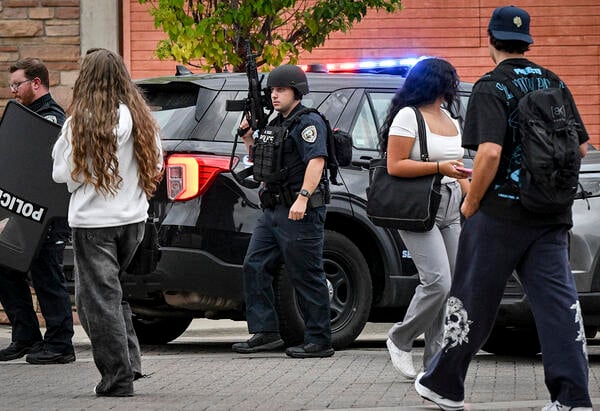
    Aaron Ontiveroz/The Denver Post/Getty Images

    A person who goes by the name Gores online claimed responsibility for the flurry of so-called swatting calls made to colleges and universities over the past several days, Wired reported.

    Gores is the self-proclaimed leader of an online group called Purgatory, which is linked to a violent online extremist network called The Com, according to Wired. Alongside another Purgatory member called tor, Gores began placing fake calls to campus and local emergency services about active shooters about noon Aug. 21, the same day the University of Tennessee at Chattanooga and Villanova University received swatting calls. 

    As of Wednesday afternoon, Inside Higher Ed counted 19 confirmed swatting calls since Aug. 19, including at Mercer University, the University of Wisconsin at Madison, the University of Utah and the University of New Hampshire.

    Not all of the calls placed by Purgatory have been successful. In some cases, authorities correctly identified the calls as hoaxes. When the group placed a call to Bucknell University in Lewisburg, Pa., a researcher listening in on the call was able to alert the university. The FBI is investigating the uptick in swatting calls and has not publicly confirmed Purgatory’s involvement. Gores told Wired that the swatting spree will continue for another two months. 

    Purgatory offers to make swatting calls for as little as $20, though the price has increased to $95 since this recent campaign of calls began, according to Wired. Three members of Purgatory were arrested in 2024 and pleaded guilty earlier this year for threats made to a Delaware high school, a trailer park in Alabama, Albany International Airport, an Ohio casino and a private residence in Georgia. 

    Ashley Mowreader contributed to this article.

    Source link