Author: admin

  • Everything is Awesome: Legos® to Teach Teamwork and Communication – Faculty Focus

    Everything is Awesome: Legos® to Teach Teamwork and Communication – Faculty Focus

    Source link

  • Everything is Awesome: Legos® to Teach Teamwork and Communication – Faculty Focus

    Everything is Awesome: Legos® to Teach Teamwork and Communication – Faculty Focus

    Source link

  • A government running out of road still sets the economic weather for higher education

    A government running out of road still sets the economic weather for higher education

    For a party that it’s become fashionable to criticise for failing to have prepared for power, Labour has in fact set an awful lot of ambitious policy machinery into motion over the last 16 months.

    There’s barely been a month go by without some large-scale reform to how the country is governed, organised, and understood as a sum of diverse parts and competing pressures, and we’ve had our work cut out thinking through the implications of each for the higher education sector: from devolution to industrial strategy, from health reform to an explicit tying together of skills and migration (which has barely got started yet), from a new communities strategy to belatedly moving skills policy to the Department for Work and Pensions.

    Whatever your views on the merits and mechanics of these, and the many other initiatives that different departments have launched, they are all downright interesting – and pose a plethora of questions for how higher education fits in and demonstrates value.

    But all need time. The overall ambitions of devolution are still on their starting blocks as councils pitch their ideas for new geographies; the industrial strategy was explicitly badged as bearing fruit in 2035; the NHS workforce plan that should really have been alongside the 10-year health plan has been delayed to the spring – and so on and so on. No-one involved in pulling together all these long-term reforms did so under the assumption that all the pieces would be in place within one parliamentary term.

    Yet here we now are, with the commentariat consensus being that both Keir Starmer and Rachel Reeves are toast, and public sentiment pointing emphatically in that direction as well – though this is not to say the party cannot regain momentum under a new leader. The sector is already asking questions about how to prepare for a Reform government (as discussed in the most recent instalment of our new HE Influence newsletter, I should mention).

    The post-16 white paper presented a somewhat upbeat vision of what the government would like higher education’s role to feel like across the country, but was weaker on any kind of immediate reform, proposing instead that traditionally glacial changes to research funding, a piece-by-piece strengthening of the Office for Students’ remit, and putting FE, HE and business in the same room would do much of the heavy lifting, given time and goodwill.

    All this feels like a recipe for the sector to retreat to more comfortable home territory over the next few years, fighting battles over the international student levy, the size of teaching grants, and the shape of the REF, and gradually giving up on pushing for a central role in the government’s overall vision for the country, given the increasing probability that dreams like a planned and unswerving industrial strategy will all be swept away in 2029.

    Quite what’s to be done about all this is a question for another day – with the Budget looming on Wednesday, and admittedly still three and a half years in office remaining for Labour, the other thing that’s worth reflecting on is quite how much the choices the Chancellor makes around tax, public spending, debt, and general macroeconomics will determine the success – or otherwise – of higher education institutions in England over the next few years. These big tickets items all impact the sector deeply, however much the temptation might be to throw one’s hands up in the air, snipe about a “tax” on overseas recruitment, and start looking at what opposition parties can be convinced of.

    Labour on labour

    There’s a pretty strong case to be made for the most consequential policy decision for universities since Labour came to power being the decision to hike employer national insurance contributions in last autumn’s budget. Clearly it has cost universities a small fortune, and the move also sucked up a sizeable slice of the government’s various funding “boosts” for schools and FE colleges – and the NHS and elsewhere – leaving less putative generosity to go around.

    But perhaps most importantly of all, the ENICs rise has decimated the labour market for young people – in the court of public opinion at least – by making new hires and part-time workers more expensive, all while AI is supposedly making them obsolete.

    The result is that university graduates – and the institutions ever more judged on those graduates’ success – are seen to be in a right old state. The Guardian was the latest to take a run at this last week, with tales of qualified grads banging their heads against the job application wall, accompanied by analysis from the paper demonstrating that almost half of all jobs lost since Labour came to power were among the under-25s. Down in the small print we see that this is driven almost entirely via reduced employment of 16- and 17-year-olds, but the vibes aren’t good, even if less hyperbolic analysis from the likes of the Institute of Student Employers and Prospects Luminate paints merely a concerning, rather than cataclysmic, picture.

    The sad fact is that, longer term, this deluge of negative publicity about the value of a degree – alongside a necessary tailing off of the supposed “graduate premium” as a viable sector talking point as the minimum wage heads ever up – will inevitably move from being fodder for anti-HE journalists to actually driving changes in young people’s decision-making (even if a tight jobs market in the short-term often pushes graduates back towards postgraduate study) and scar the sector’s ability to make its case for its value.

    The result is that keeping a watchful eye on Labour’s economic moves around the costs associated with employment – both on Wednesday and beyond – has become a matter of some importance for higher education. Further increases in the national living wage over the next few years, lower-profile changes to business taxation, and even wildcards like any surprise revenue-raising changes to the growth and skills levy, all hold the possibility of making this problem worse. All while leading to higher costs for universities and making it harder for students to work alongside their studies, despite this being ever more necessary.

    Pound in pocket

    Rachel Reeves finally taking the plunge with an income tax rise, as a good proportion of the Labour backbenches were calling for, seems to have definitively fallen off the table for the Budget – with a handful of consequences worth noting for the sector.

    First, it will almost certainly mean that future spring and autumn statements will be equally fraught, as the Treasury fails to leave clear blue water between its spending plans and its spending rules. By not maintaining a sensible “headroom”, public finances will remain permanently at the mercy of external shocks and OBR downgrades, and we’ll probably be back here in less than six months’ time wondering what levers will need to be pulled. At least at some point in the Parliament, said levers will end up being haircuts to departmental budgets rather than new taxes or further borrowing.

    Following on from this, the use of a basket of smaller revenue-raising measures to partially fill the gap left by not raising income tax increases the likelihood that this shortfall gets filled by employment-related measures – that is, all the issues we’ve been over above, which have serious consequences for universities as large employers who are not quite in the public sector (as may be the case this week if rumoured changes to salary sacrifice rules go ahead).

    And the other effect that an income tax rise would have achieved, which the “smorgasbord” approach will not to the same extent, is bringing down inflation.

    Inflation is arguably the most serious financial threat that higher education institutions face. Even if many within the sector, both in internal conversations and public pronouncements, are often quite happy to let audiences believe that measures like the dependants ban are what’s most responsible for blowing a hole in HE finances, the fundamentals weren’t sound even before the post-pandemic recruitment glut.

    While tuition fees and maintenance loans in England (and, at least for one year, Wales) are now linked to inflation, or more precisely to inflation forecasts – Office for Budget Responsibility predictions on Wednesday will set the levels for 2026–27 – the idea of any measures to compensate for all the shortfalls baked in over several years of rocketing price rises appears to have been permanently nixed.

    And it’s worth bearing in mind that the index link does not mean that either student maintenance or teaching funding will actually keep pace with inflation in the coming years. For one thing, OBR forecasts have repeatedly underestimated inflation, and there’s no corrective mechanism in the system. For student maintenance, even if predictions come true, other features of the system mean that the average, rather than maximum, maintenance loan continues to be worth less each year.

    For teaching funding, it’s important to stress that Labour has in no way committed to keeping the overall package inflation-proofed. While tuition fees are the major part here, other elements such as high-cost subject funding took a real-terms tumble this year, and no-one is predicting that the reforming the Strategic Priorities Grant means upward movement on how much it’s worth – the reverse is far likelier, given DfE’s commitments elsewhere.

    University staff have had a decade or more of below inflation pay rises, and there doesn’t seem any serious capacity or appetite among higher education employers to do fundamental work here – the year-on-year squabbles will continue, and high levels of inflation over the coming years will eat further into staff remuneration and the attractiveness of higher education careers.

    And inflation-linked rises in tuition fees will also change applicant behaviour. One thing we’ll start getting a sense of on Wednesday will be the likelihood of when fees will cross the (supposedly) psychologically important barrier of £10,000. Back in March, the OBR was expecting RPIX to run at 2.7 per cent in Q1 2027, and 2.8 per cent in Q1 2028, which would lead to tuition fee caps of around £9,790 in 2026–27 and around £10,065 in 2027–28. We won’t know for certain until autumn 2026, but the picture will start to come into focus.

    Now the significance of fees being materially above, rather than roughly equal to, £10k is perhaps overstated. But DfE isn’t really sure – it has reportedly commissioned modelling on how students will respond to rises, but the results aren’t due until the spring.

    All in all, there’s a whole host of reasons why Budget decisions and their effect on inflation, as well as the OBR forecasts themselves, have become heavily intertwined with the future behaviour and wellbeing of higher education staff and students.

    Gilt trips

    Perhaps the most overlooked publication of the last few years for really understanding how the Treasury thinks about higher education is the Institute for Fiscal Studies analysis of how the interplay between interest rates and Treasury gilts affect the cost of student loans.

    In a nutshell, it costs far more for the government to borrow than it used to (the 15-year gilt yield has continued to rise since the IFS did its sums in January 2024), and so it’s very reluctant to allow for too much expansion in the student loan book – it’s a far cry from when the broad strokes of student finance were put in place by the coalition government, and this was basically thought of as free money.

    This goes a long way to explain why the government is so reticent to use the student loan book in any radical way – and thus we see things like a real-terms freeze in tuition fees being presented as if it’s an almost saint-like act of generosity to the sector, or the foundering of DfE’s tepid-but-probably-genuine desire to properly boost maintenance loans.

    We’re waiting for the specifics (hopefully) of maintenance grant implementation on Wednesday, but the cost of government borrowing feels like it has played a role in the last year of behind-the-scenes policy deliberations here. In the run-up to last autumn’s Budget, there was plenty of speculation, and government nods to the press, about the potential for movement on the overall maintenance package and grants in particular. Clearly the battle with the Treasury was lost, and DfE was told to come up with an alternate source of funding – hence the international student levy. What we don’t yet know is to what extent grants will replace, rather than supplement, loans – if what we see is a switch from one to the other, the expense to the public purse of borrowing is a likely primary driver, especially given the hidden costs associated with annual tuition fee rises. While the sector isn’t really getting any more money in real terms, this isn’t to say that the government’s finances are not being stretched by indexing fees.

    What this all means is that, unfortunately, the sector needs to keep an eye on the gilts market. The supposed flip-flop on raising income tax has already done some damage here, and the government repeatedly needing to borrow more than it expected to is another issue. There’s a wider question of perceived government competence around balancing the books that drives behaviour too – confidence is in short supply as it is, and it will get worse if the Starmer era implodes. This all equates to longer-term uncertainty about the use of the student loan book.

    Even if you’ve given up on the Labour government in its current form, and are pinning hopes on a future government being more receptive to calls for support and investment in both universities and students, Number 10 and the current Treasury team are still setting the economic weather. While much of the sector will be waiting for the moment Rachel Reeves stops speaking on Wednesday to see the fee levy policy paper – assuming there is one, and the can doesn’t get kicked – there are many reasons to think the wider public finances are a much more important determinant of the future of higher education. And it’s one that isn’t painting a particularly cheery picture at the moment.

    Source link

  • Can there ever be a definitive graduate premium?

    Can there ever be a definitive graduate premium?

    The idea of a graduate premium is a central plank of the way the Westminster government justifies the level of tuition fees, the existence of maintenance loans, and the design of an increasingly punishing repayment system based on earnings.

    In essence we tell applicants that they will earn more on average, so they will pay more for the privilege of study.

    One policy question that urgently needs attention is whether the graduate premium in an expanding and diverse system is equal to the task of supporting increasingly onerous repayments – and how much (or how little) of this debt needs to be waived because of low graduate salaries in certain industries.

    We should not fall into the trap of equating low salaries with the “worth” of undergraduate study: however poorly we pay them we need the army of graduates that run the public sector, and even the industrial strategy admits that without the (infamously low pay) creative industries we may as well pack up the idea of civilisation and go home.

    But we do need to think about whether the system as a whole stacks up in periods like we have been living through – low wage growth overall and high interest rates. And at this point the graduate repayment (annual earnings) threshold isn’t far off the annualised minimum wage.

    The minimum

    The national minimum wage, since 1999, has set hourly lower limits on pay at various age points.

    Compliance is high among employers (though not complete: ONS estimates around 447,000 or 1.5 per cent of all jobs held by those aged 16 or over were paid below the relevant minimum wage). It has raised earnings among the very lowest paid in society.

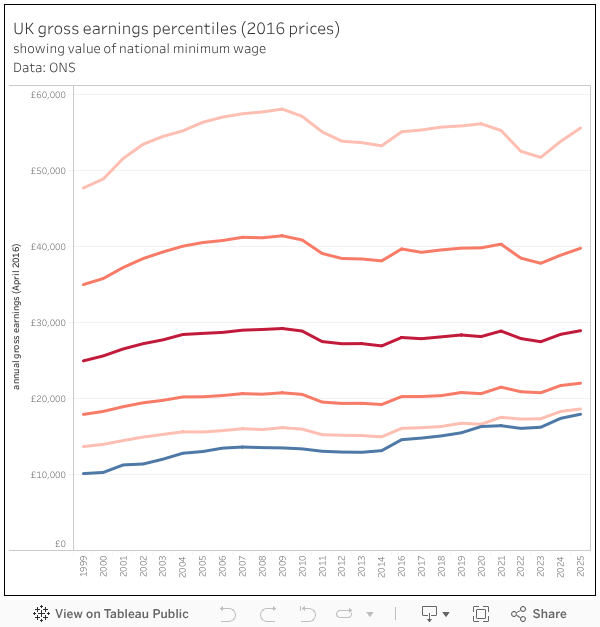
    It has probably been the single most transformative means of addressing poverty in recent times: in most years since the minimum has risen beyond inflation – in real terms the value of the higher rate has increased by 77 per cent since it was introduced.

    [Full screen]

    Over a period where wages more generally have largely stagnated in real terms this is a remarkable uplift – and it is to the credit of governments of all stripes that this policy of direct and tangible improvements to low pay has continued through multiple economic downturns.

    But is it possible that a large increase in the earnings of the lowest decile will have an impact on the way we understand the earnings benefits that a degree could bring?

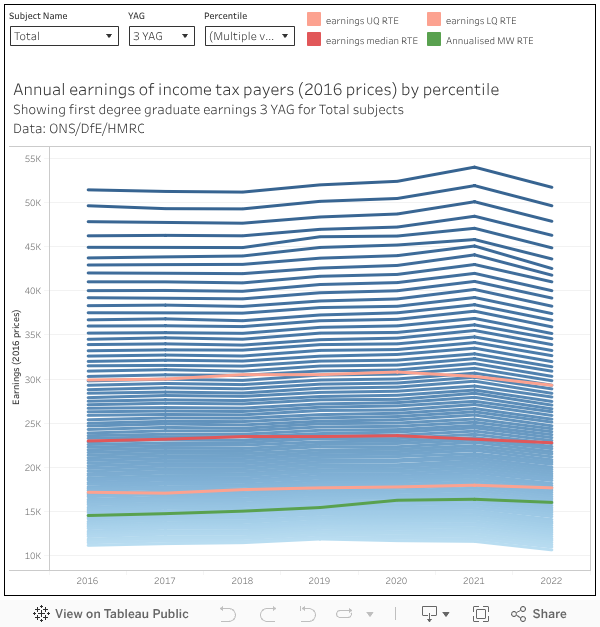
    Certainly if we plot the minimum wage against income percentiles (these are gross figures, at 2016 prices) it is notable how close its value has crept to the tenth percentile of income, suggesting that earnings at the lower end of the spectrum are now bunching at a higher real-terms level.

    [Full screen]

    The question has to be what, if any, impact this has on the graduate earnings premium and thus repayments.

    Low earners and graduates

    Currently around 10 per cent of those in employment are paid an hourly wage equivalent to the national minimum wage. If this rate of pay was linked to a full time role (eight hours a day for each of the 253 annual working days in England) it would make for annual earnings of around £24,700.

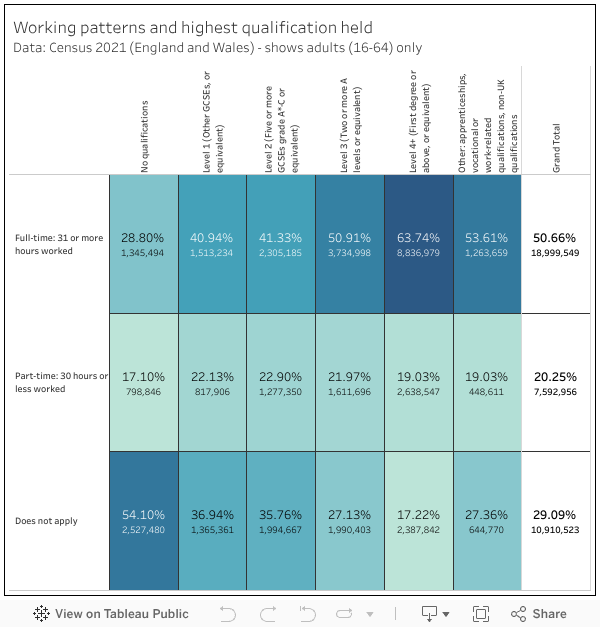
    However, workers on a low hourly wage are more likely to be on part-time hours, while we also know that the likelihood of you holding a full time job increases in line with the highest qualification you hold.

    [Full screen]

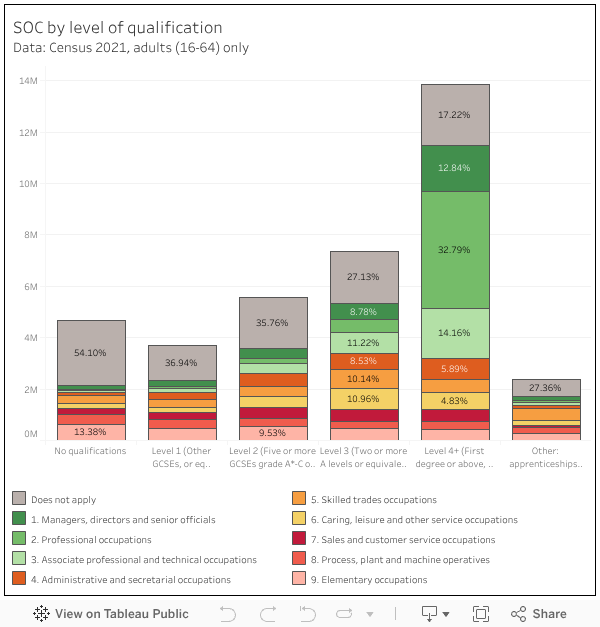
    The jobs involved are more likely to be elementary roles. In the main, jobs like this are primarily held by those with lower level qualifications, or no qualifications at all.

    [Full screen]

    Conversely, jobs done by graduates are far more likely to be full time, and are more likely to be managerial, professional, and associated professional roles – what the Office for Students calls “graduate jobs” than those with other levels of qualification. Around 60 per cent of graduates are in these roles, compared with around 27 per cent of those with level 3 qualifications (two A levels, so enough to have the option to attend some kind of higher education).

    Strikingly, the number (not the proportion) of graduates in “non-graduate” jobs is broadly similar to the number of those qualified to level 3 with “non-graduate” jobs.

    LEO and the minimum wage

    Instinctually, you’d expect a graduate to be earning comfortably above what is set at a national minimum for reasons of avoiding worker poverty. For this reason, it is fair to assume that gross earnings below the minimum wage relate to part-time work. The canonical failing of LEO is that it doesn’t differentiate between part-time and full-time work, but from the Census (so, 2020–21 issues apply to a certain extent) we know that graduates are less likely to be in part-time work (and more likely to be working at all) than all other groups.

    However, there are industry-based differences, and it is reasonable to assume that subject-based differences between earnings are derived from these. To give one obvious example, part-time work is a huge deal in creative and performing arts – so a lower than expected graduate salary in subjects like these would suggest that graduates are participating (at low/no pay) in the industry they have trained for and supporting this with part-time work.

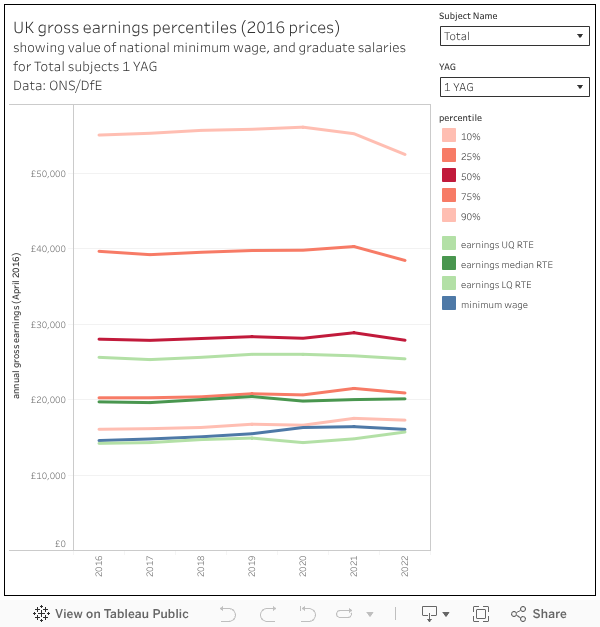
    With this caveat in mind, I have plotted LEO earnings against income percentiles for the whole working population and the value of the national minimum wage, all indexed to 2016 prices. The available LEO data extends from 2016 through to 2022, and in the latter year salaries across the economy experienced a real-terms downturn – something which (as we see from the chart above) has been cancelled out over the past few years.

    [Full screen]

    The two filters allow you to choose a subject area of interest, and to look at graduate gross earnings 1,3,5, and 10 years after graduation for each tax year.

    The median gross earnings of graduates is slightly above the median gross earnings of all earners (all ages, all levels of qualification) after ten years – though there is substantial industry-driven variation by subject. After one year (so comparing the gross earnings of 21-22 year olds with national averages) graduate earnings are around the lower quartile – and the intervening years see the difference between the two gradually bridged.

    Recall here that graduates are included within the percentile values – we are not looking here at a premium over non-graduates but a premium when compared to all earners. At the end of the day graduates are probably more concerned with the buying power of their own earnings than whether they are doing better than non-graduates.

    And, given how close the minimum wage is to the repayment threshold, looking at the premium over the minimum wage  (in cash term) is probably a more reasonable thing to do than I would have thought back at the birth of LEO.

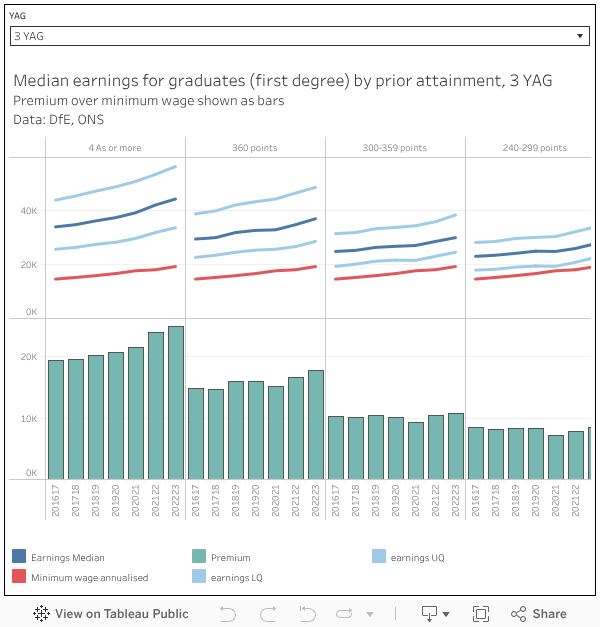
    We know prior attainment is one indicator of future salary (mostly as an indicator of deprivation more generally) so hear is a visualisation that plots LEO by prior attainment against the annualised minimum wage.

    [Full screen]

    How earnings are annualised in LEO

    The temptation with LEO is to read the figures as salaries, and to be fair the presentation of the data does everything it possibly can to encourage that reading. But inside the sausage machine, things are very different.

    The medians and quartiles familiar to us are based on individual graduate tax records for pay as you earn (PAYE, usually used by people in employment) and self assessment (SA, usually used by freelancers and the self-employed).

    With PAYE, earnings for a given tax year are divided by the number of days of employment recorded, to give an average daily wage. This is then multiplied by the number of working days in a tax year (which would appear to be different across the UK due to differing numbers of bank holidays: so 253 in England, 252 in Scotland, and 251 in Northern Ireland) to give annualised earnings.

    Because SA doesn’t offer dates of employment, LEO just uses the raw earnings. Annualised PAYE and raw SA income are then added together to give the final figure for each graduate, which are then used to produce the median and quartile data that is published.

    Another way

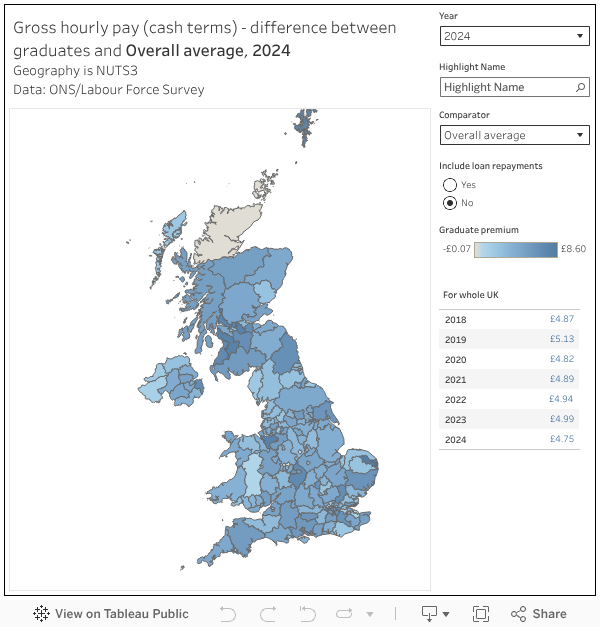
    I chanced upon some Labour Force Statistics data which neatly cuts across this issue by using gross hourly pay (and as luck would have it, broken down by NUTS3 regions over a number of years) as a measure of earnings. Big thanks to the ONS team for answering my questions on this one, and offering me information on the numbers in each group and an extra year of data.

    Now, LFS isn’t half as good as administrative data – it is a large, representative, survey of UK residents which has been dogged by low response rates in recent years – but it was, at the time, official statistics and thus is worth taking reasonably seriously. We do get two big benefits – the first is with hourly earnings we can confirm like with like, rather than needing to compensate for differing patterns of work; while the second is we get some regional data.

    A note of caution on that latter one – I’d be looking at the UK wide figures more closely as the NUTS3 regions (roughly equivalent to a top level local authority) may have quite low numbers of workers in each group (see the tooltips).

    [Full screen]

    What jumps out at me here is a clear and substantial wage premium for being a graduate, both nationally and in pretty much any area of the country. This largely holds against any qualification group of comparators, against average hourly earnings for everyone, and (very much) against the national minimum wage for the year in question. If you include loan repayments (take nine per cent off the hourly gross) there are a handful of areas of the UK where graduates are paid less than those with level three qualifications – and these largely map to other measures of deprivation.

    You would expect a result like that given what we know about the impact of place on income and the tendency among graduates to move to maximise opportunities and earnings. But even so, national premiums do hold up and appear to be broadly stable or growing since 2018. You can see the impact of the pandemic here – where graduate earnings overall remained stronger during 2020 and 2021.

    I should note here again that if you compare graduates with all earners, you are including the graduates themselves on both sides of the equation.

    Reasons to be GLMS

    Now you are probably ahead of me here, but the government used to do a graduate focused look at labour force survey data – imaginatively enough, called “graduate labour market statistics” (GLMS). I say “used to” because the 2024 iteration (released in summer 2025) is to be the last one ever. There’s an open consultation (follow the link) if you have thoughts on that – but you need to hurry, as responses are requested by the start of next month.

    The ostensible reason for discontinuing GLMS is the problems faced by LFS – the falling number of responses leading to issues with sample variability. Since 2024 it has been badged as “official statistics in development” (meaning that testing of quality, volatility, and an ability to meet user needs is underway), while improvements have been made that affect data throughout 2023 and 2024. From 2025 these improvements are fully in effect, and from 2026 a new “transformed labour force survey” (TLFS) will be the means by which ONS generates its whole suite of employment data.

    GLMS has clearly had some recent issues (although to be clear, these issues have not had a meaningful impact on the published national level data) but the data above suggests that it does have the potential (with appropriate caveats) to provide a more nuanced look at qualification level and regional data. Certainly, comparing the graduate population with those who hold at least the two A levels or equivalent that could get them into higher education feels like a simple and meaningful comparison we could learn from.

    A transformed LEO?

    If we are interested in graduate earnings premiums, the most useful thing that could be included in future LEO releases is hourly earnings. This would neatly address the part-time work issue, and focus directly on earning power rather than working patterns (which may vary for a number of reasons).

    Of course, earnings are only one part of the benefit of being a graduate – and for some (I’m looking at my creative peers here) the ability to make enough money to live on by doing the thing they love is probably going to be a bigger incentive than the ability to earn more than their neighbour. That’s not to say the salary data isn’t important for them to see, but telling me that I won’t earn much as a musician is not going to stop me from wanting to study music.

    That said, it does appear that (over the last few years at least) median graduate earnings have remained stable (or grown slightly) in real terms when compared to a given percentile of income tax payers. This isn’t a fair comparison – in that LEO data includes non-taxpayers and this particular HMRC data does not, but as a benchmarking tool it is interesting. By default I’m showing all but the top 10 percentiles of taxpayer income, alongside LEO by subject, and the minimum wage (all at 2016 prices).

    [Full screen]

    We know in LEO that a number of factors influence earnings: provider and subject (yes), but also prior disadvantage (of which prior attainment is one visible metric), sex, industry of employment (an economist will earn more in a bank than in a university), and region of employment. And if you control for all of these factors you are not going to get big enough groups to make statistically valid observations.

    All of which is a rather maths-heavy way of saying that past performance does not tell us a great deal about the future career prospects and earnings of a single applicant chosen at random. Looking at very broad, national, figures suggests to me that a boost in earning power (which grows throughout your career) is available for three years of study – but I would caveat that by saying if your sole interest in higher study is to increase your earning power then there are other metrics available that could help you maximise this particular benefit.

    Source link

  • What the Universities Accord missed: O’Kane – Campus Review

    What the Universities Accord missed: O’Kane – Campus Review

    The lead reviewer of Australias universities Mary O’Kane has outlined what the Universities Accord missed during her address at the University of Sydney 2025 Bradley Oration .

    Please login below to view content or subscribe now.

    Membership Login

    Source link

  • 350 jobs go at CSIRO – Campus Review

    350 jobs go at CSIRO – Campus Review

    Australia’s leading science and research agency will cut hundreds of jobs across the nation as rising costs outpace funding.

    Please login below to view content or subscribe now.

    Membership Login

    Source link

  • Uni boosts gender diversity by 30% in maths – Campus Review

    Uni boosts gender diversity by 30% in maths – Campus Review

    As the artificial intelligence (AI) and quantum computing industries explode, trained STEM professionals are in high demand. Mathematics is foundational to these fields.

    Please login below to view content or subscribe now.

    Membership Login

    Source link

  • South Dakota Opts Into Trump’s Education Tax Credit Program – The 74

    South Dakota Opts Into Trump’s Education Tax Credit Program – The 74


    Get stories like this delivered straight to your inbox. Sign up for The 74 Newsletter

    South Dakota is the fourth state in the country to commit to President Donald Trump’s federal education tax credit program, Republican Gov. Larry Rhoden announced Friday in Sioux Falls.

    Under the program, South Dakotans who owe federal income taxes can either send up to $1,700 to the federal government, or they can donate that $1,700 to a government-recognized scholarship granting organization to public, private or homeschool entities in the state. The program starts in 2027.

    Nebraska’s Republican Gov. Jim Pillen announced the state’s commitment in September. Republican governors for North Carolina and Tennessee announced their commitment this summer. Oregon, New Mexico and Wisconsin officials said they do not intend to opt into the program. Some critics nationally have questioned whether there will be proper guardrails, accountability and “quality control” in place.

    Rhoden called the imminent program a “winning situation” for South Dakota taxpayers.

    “I’d just as soon give those dollars to a private school than Uncle Sam,” Rhoden said at the announcement, standing in front of a row of students attending the St. Joseph Academy. “I think they know how to spend it a little wiser than the federal government.”

    Rhoden added that the federal tax credit will “pair well” with South Dakota’s existing tax credit program, which allows insurance companies to donate up to a total of $5 million to a private school scholarship program for students whose families have low incomes.

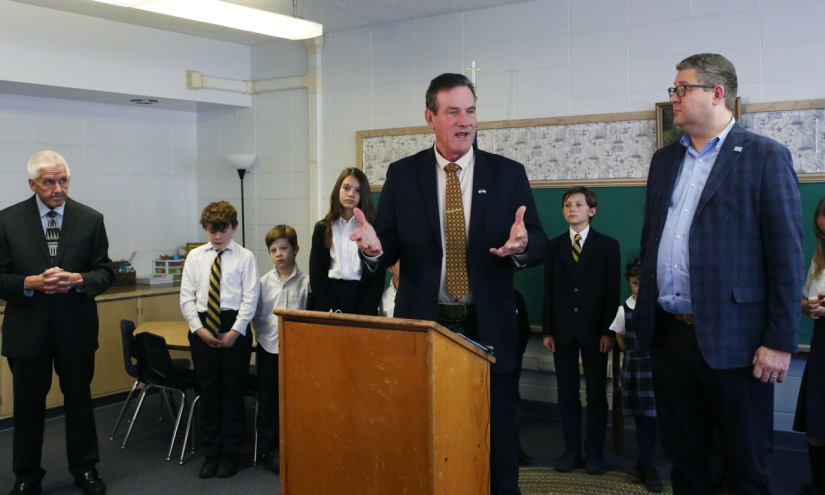
    South Dakota Gov. Larry Rhoden (left) and First Lady Sandy Rhoden (right) speak to St. Joseph Academy students in Sioux Falls on Nov. 11, 2025. (Photo by Makenzie Huber/South Dakota Searchlight)

    The program will further support the state’s growing alternative instruction movement, Rhoden said, including homeschooling and microschools popping up throughout the state. Alternative instruction enrollment has nearly tripled in South Dakota in the last decade, making up about 7% of school-age children in the state.

    Sara Hofflander, founder of St. Joseph Academy, said the school is “grateful” for the potential extra funding, though she plans to “approach everything cautiously.”

    “Running an independent school obviously requires a heavy commitment from families,” Hoffman said, adding that the extra funding would “lift some of that burden, so we can focus more on the needs of our students.”

    Historically, “school choice” efforts in the state have met resistance from the public school industry.

    Advocates vehemently fought former Gov. Kristi Noem’s effort to introduce Education Savings Accounts, which would have provided public funding for private education and homeschool options during the last legislative session, calling the failed effort an attack on public education. Those same advocates referred to the state’s education tax credit program as “backdoor school voucher program.”

    But Rob Monson, executive director for the School Administrators of South Dakota, said the program will benefit public and private education. South Dakotans can direct their tax credit dollars to organizations representing public schools in the state. The funding could be spent on not only tuition and fees for private schools, but tutoring, special needs services for students with disabilities, transportation (such as busing), afterschool care and computers.

    “That’s a huge win for taxpayers of South Dakota, but also every form of education across the state,” Monson said.

    South Dakota Education Secretary Joe Graves said the program will support education innovations and a “robust competitive system.”

    Graves told lawmakers on Thursday, while presenting lackluster test scores to a committee, that “innovation” would be key to improving student outcomes, especially for Native American students and children living in “education deserts.”

    “We’re not doing well enough, and we need to do better,” Graves said at Friday’s announcement.

    If more students attend private or alternative schooling options, that would mean less state funding for public schools because of decreased student enrollment. Monson told South Dakota Searchlight that state revenues could be impacted by participation in the tax credit program, since it would remove federal tax dollars used to support other programs or go toward states. The federal government would still be obligated to fund some federal education programs, Monson added.

    The scholarship funds would be available to families whose household incomes do not exceed 300% of their area’s median gross income. The U.S. Department of Treasury is expected to issue proposed rules detailing the program’s operation.

    Graves said he assumes there will be reporting “at some level” of how the funds are spent.

    South Dakota Searchlight is part of States Newsroom, a nonprofit news network supported by grants and a coalition of donors as a 501c(3) public charity. South Dakota Searchlight maintains editorial independence. Contact Editor Seth Tupper for questions: [email protected].


    Did you use this article in your work?

    We’d love to hear how The 74’s reporting is helping educators, researchers, and policymakers. Tell us how

    Source link

  • What America’s Declining Happiness Means — and How Higher Education Fits In

    What America’s Declining Happiness Means — and How Higher Education Fits In

    A recent report has sounded an alarm: happiness in the United States is falling more sharply than in almost every other developed nation. According to coverage by CBS News, Americans increasingly report loneliness, deep political division, and diminished life satisfaction. While this trend is worrying in itself, a closer look shows that it’s not just a problem of individual melancholy — it reflects a broader weakening of social structures, civic trust, and community cohesion. Historically, these phenomena have been central to the nation’s sense of coherence; now, they may be eroding.

    Historical Roots and the Social Capital Framework

    To understand the scale of what’s happening, it helps to go back. Over two decades ago, Robert D. Putnam’s seminal Bowling Alone documented a dramatic decline in American “social capital” — the network of associations, civic participation, and interpersonal trust that undergirds a functioning democracy. Putnam traced declines in everything from civic organizations to informal social gatherings, arguing that this fraying of social infrastructure had profound consequences. 

    Social capital theory provides a useful lens here: trust between citizens, engagement in local institutions, and time spent in shared civic life are not just feel‑good extras, but foundations for collective resilience.

    Later empirical work has revisited these concerns. Weiss, Paxton, Velasco, and Ressler (2018) developed a newer measure of social capital and found evidence that the decline persists. Inequality also appears to play a role: as income gaps widen, interpersonal trust tends to decrease. In research published in Finance & Development, economists found that rising inequality explained a substantial portion of the decline in social trust in the United States.

    More recently, political scientists have documented how perceived political polarization erodes social trust. In a nationally representative panel study, Amber Hye‑Yon Lee showed that when people believe their country is deeply divided, their trust in fellow citizens drops — even beyond partisan loyalties. Pew Research Center data further illustrate this generational shift: younger cohorts, raised in a more polarized and atomized society, report lower social trust than earlier generations. 

    At the same time, the digital revolution hasn’t necessarily filled the gap. Sabatini and Sarracino (2014) found that while people are more active on social media, this does not compensate for lost in-person connection — and may even undermine trust. During the COVID-19 pandemic, researchers observed increased remote communication, but also stronger political echo chambers: in a study of 41,000 Americans’ social networks, political homophily (interacting mostly with those who share one’s partisan identity) increased. 

    Well-Being, Health, and Mortality

    The decline in social trust and cohesion is not just a sociological problem — it is deeply linked to health. A growing body of epidemiological research ties subjective well‑being to longevity and mortality. For instance, a widely cited study by Lawrence, Rogers, and Wadsworth found that lower happiness is associated with higher all‑cause mortality risk in U.S. adults. In another longitudinal study, researchers followed more than 30,000 adults over 14 years and found that individuals with low life satisfaction lived, on average, 8–10 years less than those with high satisfaction — even after controlling for sociodemographic and behavioral variables. 

    These findings suggest that declining happiness is not just a matter of mental distress or cultural malaise — it translates into concrete health inequities and life expectancy gaps.

    Recent Trends and the Global Context

    Over the past decade, the United States has slid in global happiness rankings, according to the World Happiness Report. Some analyses suggest that the U.S. now falls behind peer nations on measures of life evaluation, meaning that Americans are increasingly less satisfied with their lives in a broad, reflective sense. 

    Meanwhile, epidemiological studies of happy life expectancy — the number of years people spend in a state of subjective well‑being — show that although well-being improved from 1970–2000, gains were uneven by race and gender. The recent reversal or stagnation in happiness is thus especially alarming in light of these prior gains.

    The Role of Higher Education: Past, Present, and Potential Futures

    Given this historical and empirical context, higher education institutions have a complex and potentially pivotal role in responding to declining well-being.

    On one hand, universities could help rebuild social capital. Institutions of higher learning have unique capacity to foster cross-partisan civic engagement, to embed community-building in pedagogy, and to support students’ social and emotional development. By investing in mental health infrastructure, peer networks, and service-based learning, colleges could act as local laboratories for restoring trust and social cohesion.

    Higher education also has a research function: universities can produce evidence about what strengthens well-being, what interventions mitigate loneliness or political fragmentation, and how different models of community engagement impact long-term health outcomes. Through partnerships with public policy institutions, universities can help translate these findings into programs that bolster social infrastructure outside campus walls.

    However, higher education also runs risks. If institutions remain fragmented, politically polarized, or focused on prestige rather than public mission, they may contribute to social fragmentation rather than healing it. Elite universities, in particular, may be perceived as disconnected from broader communities, undermining trust rather than reinforcing it. In such a scenario, higher education may reproduce the very inequalities and isolation that are driving declining well‑being.

    Moreover, without deliberate strategies, campus networks may reinforce echo chambers: social connections among students may mirror broader partisan divides, especially in environments where political homogeneity is common.

    Health Equity Implications

    The decline in American happiness intersects directly with issues of health equity. Lower well-being and eroded trust disproportionately affect marginalized communities — those with fewer economic resources, less social support, and weaker civic infrastructure. When universities take an active role in promoting well-being and rebuilding social capital, they not only support individual students but may contribute to reducing structural health disparities.

    Conversely, if higher education plays a passive role, or if access to supportive, socially rich campus environments is limited to privileged groups, the decline in happiness may deepen existing inequities. The gap in life expectancy tied to subjective well-being suggests that we cannot ignore the social determinants of happiness: economic inequality, community fragmentation, political polarization, and institutional trust all matter.

    A Call to Action

    To address this crisis, higher education leaders, policymakers, and public health practitioners should consider the following:

    1. Reinforce community-building: Colleges should invest in programs that promote cross-group interaction, civic participation, and social trust.

    2. Prioritize mental health: Expand counseling, peer support, and proactive well-being initiatives, especially for students who might otherwise fall through the cracks.

    3. Align research with public value: Fund and promote research on social cohesion, well-being interventions, and the relationship between trust and health, and ensure that findings inform public policy.

    4. Foster institutional humility and outreach: Universities should engage with local communities, not as isolated centers of prestige, but as partners in building social infrastructure and resilience.

    5. Measure what matters: Beyond graduation rates and research output, institutions should track well-being metrics — social trust, belonging, mental health — as central indicators of their impact.


    It Doesn’t Have to Be This Bad 

    The decline in happiness across the United States is not a passing phase or a matter of individual pathology. Rather, it reflects deep shifts in social trust, political cohesion, and community infrastructure. Historically, scholars like Putnam sounded the alarm on social capital’s erosion. Today, health researchers warn that falling well‑being shortens lives and exacerbates inequalities.

    Higher education, if reoriented toward building connections, purpose, and trust, could play a vital role in reversing this trajectory. But if universities remain inward-looking or inequality-driven, they risk accelerating the very forces that undermine societal well-being. The stakes are high — not only for individual students, but for the future health and cohesion of the nation.


    Scholarly Sources:

    • Lee, Amber H. Y. “Social Trust in Polarized Times: How Perceptions of Political Polarization Affect Americans’ Trust in Each Other.” Political Behavior, 2022. PMC

    • Weiss, Inbar, Pamela Paxton, Kristopher Velasco, and Robert W. Ressler. “Revisiting Declines in Social Capital: Evidence from a New Measure.” Social Indicators Research, 2018. PMC

    • Lawrence, Elizabeth M., Richard G. Rogers, and Tim Wadsworth. “Happiness and Longevity in the United States.” Social Science & Medicine, 2015. PMC

    • Study on life satisfaction and mortality (14-year follow-up): PMC

    • Research on income inequality and trust: “In Equality, We Trust” (IMF / Finance & Development) IMF

    • Study of happy life expectancy, 1970–2000: PMC

    • Putnam, Robert D. Bowling Alone: The Collapse and Revival of American Community. (on social capital history) Wikipedia+1

    Source link

  • One Approach High-Performing Public and Charter Schools Share – And How to Do It – The 74

    One Approach High-Performing Public and Charter Schools Share – And How to Do It – The 74


    Get stories like this delivered straight to your inbox. Sign up for The 74 Newsletter

    US News & World Report released its latest ranking of public elementary schools. The results exposed the key component to student success, even if the topmost schools approached it in vastly different ways.

    For New York City, Lower Lab, an Upper East Side Gifted & Talented school was ranked number one by US News. Also in the top 10 were four citywide G&T programs. Each school exclusively accepts students who have been designated as “gifted.”

    Rounding out the top 10, however, are Success Academy – Bushwick and Success Academy – Bensonhurst, public charter schools that accept students by lottery, while also prioritizing English Language Learners (ELL).

    On the surface, these schools couldn’t be more different. Number one, Lower Lab, has only 13% of students qualifying for Free or Reduced Price Lunch (FRL), and 1% ELLs. Number 10, Success Academy Charter School – Bensonhurst, conversely,  has 65% of its students qualifying for free or reduced price lunch, and 26% who are English language learners. 

    But the selective G&T schools and the unscreened charter schools have one characteristic in common: An expectation that their students can succeed.

    The book, “Science of Learning: 99 Studies That Every Teacher Needs to Know,” describes an experiment where “researchers falsely told teachers some of their students had been identified as potential high achievers. The students were in fact chosen at random.”

    At the end of the year, the “students that were chosen were more likely to make larger gains in their academic performance,” with those “7-8 years old gaining an average of 10 verbal IQ points.”

    This study concluded that “when teachers expected certain children would show greater intellectual development, those children did show greater intellectual development.”

    At the G&T schools, teachers have every reason to believe their students are capable of performing at the highest levels.

    Parents have seen this firsthand.

    “I strongly believe that when teachers are told their students are gifted, they begin to treat them as gifted — and this changes everything,” asserts mom Natalya Tseytlin. “In a gifted classroom, if a student struggles, teachers don’t assume it’s because of laziness or inability; they respond with patience and extra attention. In a regular class, that student might not receive the same support or challenge, because the teacher sees the child as average. 

    Tseytlin said her son started his first grade gifted and talented program with limited English skills. But because his teacher offered consistent support and believed in him, he excelled. 

    “Today he is performing at the same level as his peers,” she said.

    “I don’t think the expectations at (my child’s) G&T school are so high that only gifted kids can meet them,” another parent, who only asked to be identified as M.K. opined. “Regular schools don’t ‘push’ kids enough to reach their potential. Those G&T schools that do push, get results because most kids are capable of this level of learning without being ‘gifted.’ If teachers treat students as capable, students will indeed meet expectations.”

    The belief that all students can perform at a “gifted” level is sacrosanct at Success Academy.

    “Success Academy is Gifted for All,” CEO Eva Moskowitz affirms. “When adult expectations are high, our scholars — mostly low-income, Black and Hispanic — can meet the highest academic standards.”

    The same is true at Harlem Academy, a kindergarten through 8th grade private school for students whose potential might otherwise go unrealized. 

    “It’s tough to decouple the influence of high-quality programming from high expectations,” concedes Head of School Vinny Dotoli, “but authentically challenging students is central to the ethos of our school. When great teachers set ambitious goals and provide the structure and support to reach them, it almost always makes a lasting difference in student achievement.”

    Parents with children in schools where high expectations aren’t the norm would love to see changes. 

    “I have a daughter in a dual language program in East Harlem,” Maria McCune relates. “A neighbor who used to attend our school changed his daughter to a G&T program at another school in East Harlem. He immediately noticed a difference in the quality of instruction and in his daughter’s performance (MUCH improved). I participate in my daughter’s School Leadership Team and I have seen the apathy teachers there exhibit. It is concerning. When I tried to provide feedback about improving the educational experience, teachers/staff often became defensive. It is this that leads me to want to pursue G&T for my daughter.”

    For Tiffany Ma, the solution is obvious. “Our second grader that transferred into G&T writes much neater and does her homework much more happily since she’s in an environment where academics and homework is valued by other classmates and parents. We should expand G&T programs. It’s regular programming that shouldn’t exist.”

    Yet New York City seems headed in the opposite direction. Mayor-Elect Zohran Mamdani has vowed to get rid of elementary school G&T programs  that begin in kindergarten. He would wait until students enter third grade, even though the research referenced above specifically mentioned children 7 and 8 years of age( i.e. second graders), as being the biggest beneficiaries of high expectations. He is against charter schools, as well. 

    This move would lower the academic standards and expectations of all schools, which deeply concerns parents like McCune. She fears “Children like my daughter may be left as collateral damage of an educational experience that falls short of setting them up for significant academic success.”

    The top schools in NYC have repeatedly demonstrated that high expectations are key to helping all students reach their full potential.

    We need more such schools, be they public G&T, charter, or private. And more teachers who believe in all our kids.


    Did you use this article in your work?

    We’d love to hear how The 74’s reporting is helping educators, researchers, and policymakers. Tell us how

    Source link