Ohio State University has advised resident advisers to restrict all dorm floor and common room decor—as well as welcome programming for incoming students—to “Ohio State spirit themes” to avoid offending or alienating students. That means motifs like “retro video games and SpongeBob” motifs, which one outraged former RA on Reddit said they decorated with, won’t be allowed.
The move comes partly in response to SB1, a higher ed law Ohio passed in March that prohibits DEI, requires institutions to “demonstrate intellectual diversity” and mandates institutional neutrality on “controversial” subjects such as climate change, electoral politics, foreign policy, immigration, marriage and abortion.
“SB1 was certainly a factor, but our goal is to create an open and welcoming environment for all students … including in our residence halls, as we build community throughout our spaces and programming,” Dave Isaacs, OSU communications and media relations manager, said in a statement shared with Inside Higher Ed. “And this was discussed with RAs during their orientation for the position.”
Move-in activities are also required to be Buckeye-themed, including “necklace making and mug decorating,” the statement said.
Students took to Reddit to pan the new decorating rules, with one commenter posting, “SB1 and university leadership has sucked the life out of literally everything.”
“There were no comments supporting Ohio State’s decision,” the student newspaper, The Lantern, noted. “However, one user called on students to protest the state and national government over these decisions, rather than Ohio State’s administration.”
Federal agencies say that research at American universities contributes to the country’s national security and colleges need to guard against foreign threats.
Warning American colleges and universities about increasing foreign threats to research, a group of federal intelligence agencies and the Education Department released new guidance this week outlining how the institutions can better protect themselves.
For example, the 40-page “Safeguarding Academia” bulletin in part encourages colleges and researchers to be transparent about who else is involved in a research project, noting that failing to disclose foreign collaborations could lead to sanctions. The agencies urged researchers to do their due diligence on any potential collaborators and outlined other cybersecurity best practices.
“Protecting the integrity of U.S. research—while fostering international collaboration—is critical to maintaining a robust and secure research ecosystem,” the bulletin states. “Striking this balance is essential to preserving academic freedom, safeguarding researchers’ lifework, and ensuring that innovation continues to thrive in a secure and principled manner.”
James Cangialosi, the acting director at the National Counterintelligence and Security Center, added in a statement that while American colleges conduct research key to the country’s global competitiveness and national security, “foreign adversaries are increasingly exploiting the open and collaborative environment of U.S. academic institutions for their own gain.”
“Today’s bulletin highlights this evolving security threat and provides mitigation strategies that academic institutions can implement to better protect their research, their institutions, as well as their staff and students,” Cangialosi said. “With the new school year starting, it’s critical to get these materials in the hands of academic institutions now.”
This week marked the start of the semester for hundreds of colleges across the U.S. But many international students, plagued by difficulty getting visa appointments and unusually high rates of visa denials, are still unsure if they’ll be able to attend college in the U.S. this year.
At the University of Maryland Baltimore County, a midsize public university that has a student body composed of about 15 percent international students, international Ph.D. and undergraduate students appear to be largely unaffected by visa issues. But the rate of visa issuance for master’s students is only about half what it has been in previous years, according to David Di Maria, UMBC’s vice provost for global engagement.
Most of UMBC’s master’s students are from India, the country that now sends the most international students to the U.S.—but which experts say has had virtually no visa appointments available for the past several months.
“I think what has impacted that population the most is that you’ve got a country where … you could probably guess, it’s the highest volume in terms of students visa applications at a time when there are fewer slots available,” Di Maria said. “Hopefully it’s a blip. Hopefully, in future terms, there won’t be an extended period where students are unable to secure visa appointments.”
The backlog in visa appointments dates to the Trump administration’s pause on all student visa interviews in late May, after which the government began mandating social media reviews for all F-1 visa applicants. Some experts argue that the mandatory social media reviews have also extended the visa process by adding more responsibilities to the workload of consulate staff.
Since then, experts have speculated about how significant the drop in international student enrollment will be this fall. NAFSA, the association that represents international education professionals, predicted earlier this summer that international enrollment would drop between 30 and 40 percent, resulting in $7 billion in lost revenue and 60,000 lost jobs. Experts warn that a dip that significant could have major repercussions for the economies of college towns and cities. Colleges may also have to scramble to find professors to lead low-level classes that international graduate students were slated to teach.
Stuck In a Holding Pattern
It’s difficult to tell if those projections are accurate. The Department of State hasn’t updated visa issuance numbers since May, at which point figures were already lower than they had been the previous year.
But now, the picture of what this academic year might look like is beginning to take shape as institutions and experts report that significant numbers of international students are stuck in a holding pattern, unable to find visa appointments even after the semester has begun.
“I actually joined a WhatsApp group in April … of all these Indian students who are aspiring to study in the U.S. this fall, and I [see] a lot of students saying, ‘No slots, no slots,’” said Girish Ballolla, chief executive officer of Gen Next Education, an international recruitment firm. “Basically, what they’re saying is they’re going online trying to schedule an appointment and they’re not finding any slots. Those students are, like, now talking about, ‘Oh, should I defer to spring? Should I take up my university’s offer of an online program?’”
Other countries with severely limited appointments include China, Japan and Nigeria, according to NAFSA.
Inside Higher Ed reached out to over 30 universities with significant international student enrollment to ask how many of their committed incoming students were unable to attend due to visa issues. Most did not respond; others declined to answer the question or said that data was not yet available.
A handful of institutions noted that they’ve had only a small number of students impacted by delays and denials; Grinnell College, located in Iowa, has only one international student out of 72 who was unable to come to campus due to visa delays. At Mount Holyoke College, “fewer than seven” students are still waiting on their visas, a spokesman said in an email, though he said other students had deferred until the spring. It’s not unusual for a small number of students to miss the start of the semester due to visa issues, even in a regular semester.
On the other hand, Cornell University, like UMBC, said some of its graduate students had trouble getting their visas—or were simply concerned about coming to the U.S.
“Cornell accepted roughly the same number of international students this year as in past years and roughly the same number accepted our offer as in the past, but we have experienced some melt at the graduate level as students were worried about the visa application process or chose not to come to the U.S. because of the political climate,” Wendy Wolford, vice provost for international affairs, told Inside Higher Ed in an email.
Grinnell, Cornell and Mount Holyoke, as well as UMBC, are among the 20 institutions with the highest proportion of international students in the U.S., according to The New York Times.
Visa Denials Are Up, Too
On top of having difficulty securing appointments, more students are having their visas denied, experts report.
Sudhanshu Kaushik, the director of the North American Association of Indian Students, said that students from the subcontinent are being denied at a higher rate than he’s seen in his five years leading the organization.
Many have been told the reason for their denial is because there’s not enough proof that they’re not attempting to immigrate to the U.S. That’s usual in some cases, Kaushik said, but it’s become common this year even among wealthier students from major cities with deep roots and connections in India.
“A demographic that’s never had an issue is facing lots of issues,” he said. He also noted that some students are receiving denials many weeks after their visa interview, in some cases getting the news just a few days before they were hoping to start classes.
Colleges are attempting to accommodate students facing visa delays and denials by offering them the chance to defer their admission until spring or take online classes, according to Joann Ng Hartmann, NAFSA’s senior impact officer.
“Schools are really thinking and working very hard to be flexible, because they want these international students on campus,” she said.
Cornell also devised what Wolford called a “global semester program” that will offer international students who couldn’t get their visas in time the option to spend their first semester at one of three international partner institutions before hopefully coming to Cornell in the fall.
Some students are still hoping they’ll make it to campus this semester, despite not receiving visas by orientation.
“At this point for us, the census date is Sept. 10, and that’s when we really know who’s here and who’s not,” said Di Maria of UMBC. “I do have a number of students who are still optimistic that say they would arrive later in the week, or even next week.”
Many financial aid advisers are worried that the Trump administration’s latest effort to bolster identity verification in the student aid system could have unintended consequences. Instead of simply catching fraudulent grant applicants and borrowers, some fear that the verification process could also prevent real, eligible students from accessing public benefits.
Education Department officials, however, assure aid advisers that one of their top priorities is to distribute aid smoothly to the students who have a right to it, even as they protect the integrity of the taxpayer-funded programs.
In an electronic announcement published Aug. 12, Federal Student Aid officials said they would be checking the identities of an additional 300,000 aid applicants, on top of the 125,000 students already flagged in June. Some college advisers said they were alarmed by the sheer scale of the requests—especially given what they describe as a very tight timeline.
While aid officers generally support the concept of catching identity thieves, they fear that requiring students to complete the verification process so quickly could delay or even block aid access for some legitimate students, putting them in a financial hole. FSA says the program will eventually be automated, limited to first-time students and managed by agency officials. But at the moment, it’s a manual process that can affect students midway through their program; financial aid officers say it is becoming increasingly complicated and burdensome.
“Schools have been asking for help on how to find these people and prevent fraudulent identities from obtaining Title IV aid, so we’re very supportive of the Department of Ed’s attempts to assume responsibility,” said Karen McCarthy, vice president of public policy and federal relations at the National Association of Student Financial Aid Administrators. “Unfortunately, the timing and how long it took ED to get this off the ground means that it’s August … We are entering, if not already in, the season of really large-scale disbursement. If verification is outstanding, schools may have to hold disbursements for those students.”
The largest unknown seems to be what the consequences of an incomplete or overdue identity verification will be.
The majority of students in the latest wave of verification requests are returning to college and need to verify their identity for the 2024–25 academic year as well as secure their awards for 2025–26. But some were flagged solely for last academic year and in most instances have already graduated or stopped out, making it harder to track them down and complete the process.
Verification results for 2025–26 can be submitted up to 60 days after the data portal opens Aug. 31. At the same time, according to a Federal Register notice, verifications and any other changes to aid applications for 2024–25 must be completed by Sept. 13, making for a busy two weeks for students and aid officers.
Experts have raised a number of questions about whether missing this tight deadline for 2024 could have repercussions. Some fear it could block students from completing future identity verifications or receiving upcoming disbursements; others worry that aid already disbursed in 2024–25 will need to be retracted. Either way, they say, it could have a crippling effect on low-income students.
“There’s going to be a variety of impact,” one financial aid adviser said. “The monetary impact could be anything from a few hundred dollars to 10-, 15- or 20,000.”
However, the Office of Federal Student Aid told Inside Higher Ed that missing that deadline shouldn’t be a problem—except in rare situations.
Verifications for 2024 don’t have to be reported through the portal the same way upcoming 2025 ones do, one agency official said on background. Rather, aid officers just need to verify the student’s identity and determine internally whether a student’s 2024 aid should be awarded; therefore, “there’s no deadline that people are going to hit and fall afoul of,” he added.
And in the “rare” scenario where an institution discovers inaccuracies on a 2024 FAFSA form, the department said, colleges can reach out to FSA to ensure a student’s eligibility is not impacted.
‘We Are Not Blocking Students’
“If anyone has any examples of that Sept. 13 deadline actually being a blocker for students, we can move the deadline back, because we are here to make sure we are not blocking students,” the FSA adviser said. “There is no reason” a 2024 verification delay should affect a student’s ability to complete the 2025 process and have their award disbursed.
Department officials also noted that they have streamlined the process to reduce the administrative burden, cutting steps such as making students provide a statement of purpose or notarizing the verification.
And of the 300,000 aid applicants flagged in the most recent set of verification requests, the external vendor that helped identify them says that at least 50,000 are examples of fraud. The vendor is “very confident” that the other 250,000 are as well, the FSA official said, but the agency is playing it safe and having colleges check each case for good measure before stripping those recipients of aid.
Ellen Keast, the department’s deputy press secretary, said it’s all part of the agency’s “student- and taxpayer-first mentality.”
“We are committed to ensuring that every single dollar is spent on eligible students, not fraudsters,” she said. “This is not about putting a burden on postsecondary institutions; it’s about warning them, before they disburse both taxpayer money and their own, that the ‘student’ in front of them is most likely not a real person.”
But representatives from NASFAA and college financial aid officers are still not clear on how the process will play out.
Caleb Williams, director of enrollment management at Northern Arizona University, said that in addition to the typical verifications that occurred before the Trump administration’s new campaign was announced, selection rates for 2024–25 verification at his institution rose by 54 percent in June and another 13 percent in August. As he understands it, he added, a student “flagged for Identity verification cannot receive aid in any year until the process is completed.”
Meanwhile, Charles Mayfield, the director of financial assistance at Northwest Missouri State University, believes that if an institution misses the September deadline for 2024 verifications, it will not be able to reinstate any of last year’s aid. But it would still be able to complete the 2025 verification and process that year’s aid.
Mayfield hopes that the department will put out clarified guidance to relieve aid advisers’ confusion and explain exactly what the September deadline means, how it will be enforced and what the consequences will be for students. But like the staff at NASFAA, he said his greatest frustration is not the general need for clarification but its timing at the end of an academic year.
“These students have received financial aid for the whole academic year, and now it’s all going to be taken away, and they’re at risk of not being able to enroll for the next academic year,” he said. “In the industry, we all know that students who stop out are much less likely to finish their degree.”
It would be one thing if these concerns and challenges were specific to one college, Mayfair said, but when there are 15 or 20 colleges expressing the same confusion on a Listserv on the same day, the department should be more responsive.
“It feels like when something doesn’t go right, we have to prove to the FSA that it didn’t work the way it was supposed to,” he said. “And until we can outright prove that—using data that’s on their system, that they should already have access to—they won’t acknowledge it.”
McCarthy from NASFAA said that what the department told Inside Higher Ed about 2024 and 2025 verification being handled separately“sounds promising,” but as of Aug. 22 she hadn’t received the same notification from FSA.
Other smaller concerns, such as whether the system for flagging fraud is accurate and if the new portal is functional, also have yet to be addressed, she added.
“It’s an awful lot of work being pushed onto schools,” she explained. “So we want to make sure that it’s useful, beneficial work and that these are actual, really concerning applications, not sloppy work on the Department of Ed which then leads to delays for students.”
ELYRIA, Ohio —Nolan Norman had no idea what microelectronic manufacturing entailed when his adviser at Midview High suggested he take the school’s new class on it last year.
Yet once he started fusing metal to circuit boards, he says he was hooked. “When I was little, I thought that wizards made these things,” the 18-year-old joked of the electronics he’s now able to assemble. Despite long “hating” the idea of college, he was motivated to enroll in the microelectronic manufacturing bachelor’s degree program at nearby Lorain County Community College this fall. He’s spent the summer working in a job in the field that gives him both college credit and pays $18 an hour. Said Norman: “Now I’m seeing the path to get to be one of these wizards.”
Norman’s path wasn’t accidental: Two years ago, Lorain County Community College partnered with Midview High to create the course, one of several ways the college is trying to recruit and train more young people for jobs in manufacturing.
Nationally, more than 400,000 manufacturing jobs are going unfilled, many of them in advanced manufacturing, which requires the sort of high-tech skills and postsecondary credentials that Norman is working toward. President Donald Trump is leveraging tariffs in part, he has said, to grow manufacturing jobs in the United States, including those that involve machinery or robotics and training after high school.
Nolan Norman, 18, an incoming freshman at Lorain County Community College, observes a circuit board under a microscope on Aug. 6 in Elyria, Ohio. Credit: Dustin Franz for The Hechinger Report
Yet as it is, colleges have struggled to add and revise their training based on employer input and prepare students for tomorrow’s jobs, not just today’s. In the area surrounding Lorain County Community College, officials estimate that they’d have to teach four times the number of students to meet today’s unfilled manufacturing jobs.
Gogebic Community College, in rural Michigan, suspended its 22-year-old manufacturing technology program this spring because of low enrollment. “We could not get people into it,” registrar Karen Ball said, speaking in her personal capacity and not on behalf of the institution. “The needs in manufacturing are evolving so quickly, that to stay on top of it is too difficult.”
And then there is the history of manufacturing in communities like Norman’s, where so many factories moved to other countries in recent decades. The manufacturing workforce in the Great Lakes region shrunk by 35 percent between 2000 and 2010, a loss of 1.6 million jobs. But nationwide manufacturing has seen some recovery since then, rising from 11.5 million manufacturing jobs in 2010 to 12.9 million today, according to an analysis by the Economic Innovation Group.
“If your family experienced tumultuous layoffs in steel or automotives, they may see manufacturing as a risky pathway rather than a solid pathway,” said Marisa White, vice president for enrollment management and student services at Lorain County Community College. “Individuals are like, ‘I don’t want my kids to go into something like that.’”
Related: Interested in more news about colleges and universities? Subscribe to our free biweekly higher education newsletter.
White and other Lorain officials, though, have been slowly making strides in adding more students in recent years — and in trying to keep up with the needs of companies.
Printed circuit boards before components are attached in a lab at Lorain County Community College in Elyria, Ohio. Credit: Dustin Franz for The Hechinger Report
In addition to partnering with Midview High, staff from the college set up tables at food banks and Boys and Girls Clubs where they answer questions about its manufacturing degree and certificate programs, and even partner with a nearby manufacturing nonprofit that uses holograms and a robot dog to get the attention of high school students. That is paying off, officials say. The college now produces 120 graduates each year in advanced manufacturing — a category that includes industrial engineering tech, mechanical engineering tech, welding, automation and microelectronics — compared to 43, a decade ago.
It has also cultivated a large network of local employers and a system to do market research before launching certificate programs. In some cases, it partners with companies that pay for employees to get training at Lorain college. In a classroom on a recent Wednesday, one of those electrician apprentices, Tyler Tector, 25, had rigged a series of plastic tubes to a small air pump. He hoped it would generate enough suction to keep its grip on his lab partner’s smartphone, which dangled precariously in the air (and already had a cracked screen from some previous misadventure).
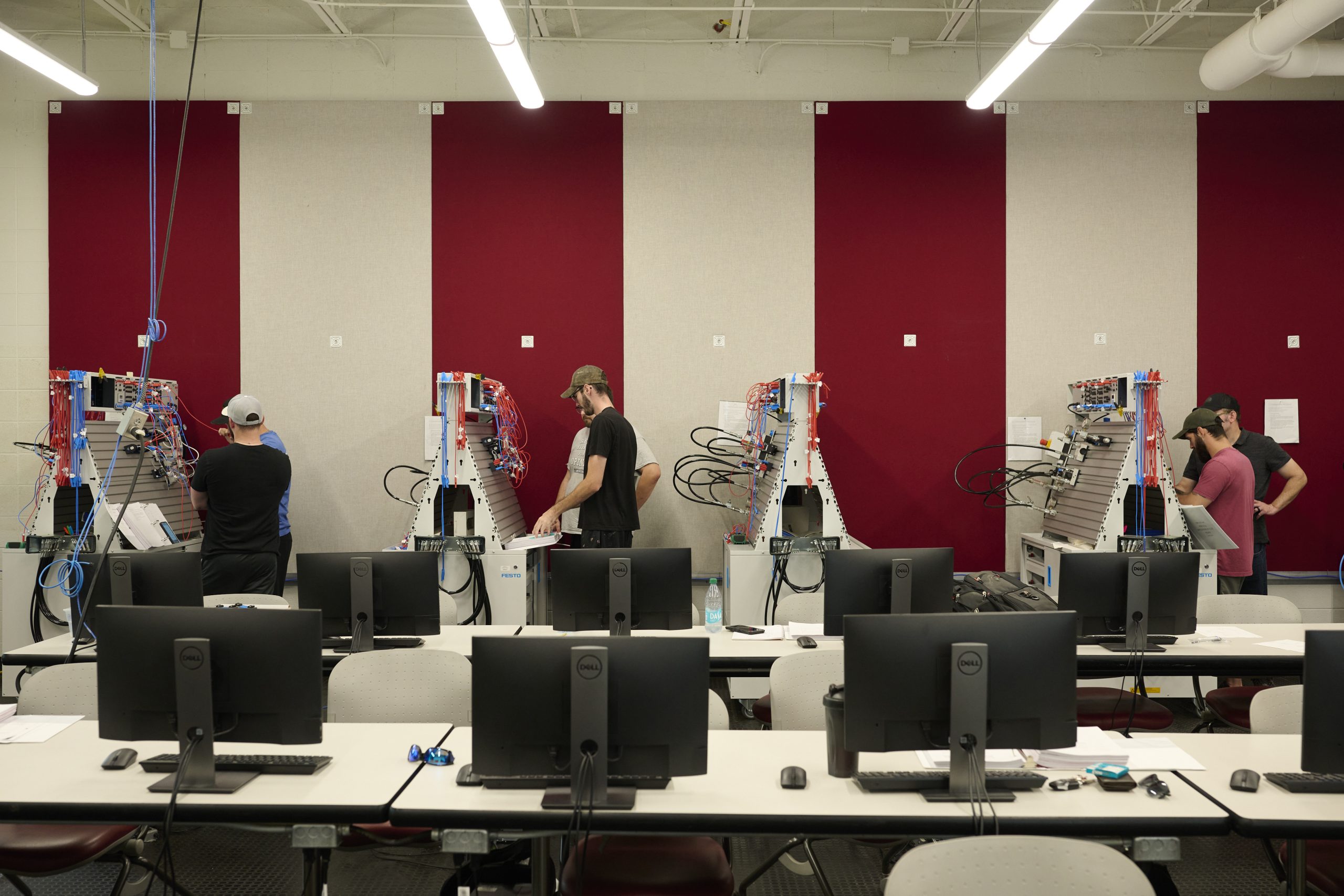
The assignment was part of a class in practical applications of fluid power. Tector’s employer, Ford Motor Co., was sending him and a small group of other apprentice electricians to take this class once a week, so they could better work with the growing number of robots at the local engine plant.
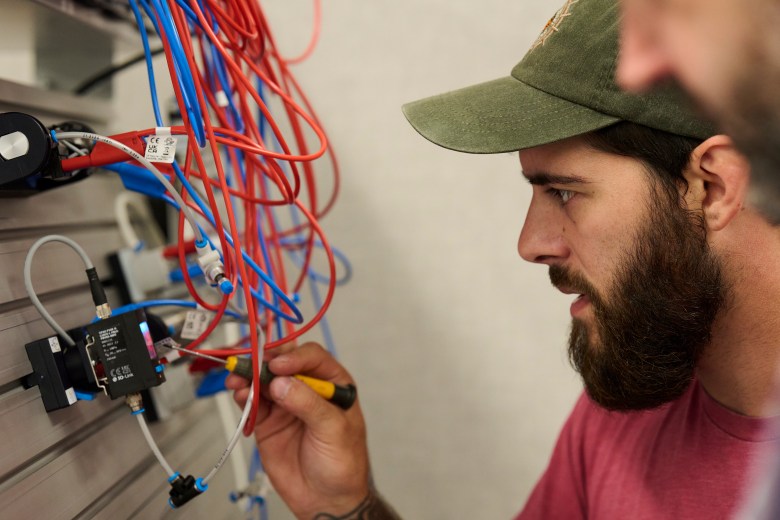
Nick Wade, an electrical apprentice for Ford Motor Co., works on a circuitry exercise during professor Brian Iselin’s practical applications of fluid power course at Lorain County Community College in Elyria, Ohio. Credit: Dustin Franz for The Hechinger Report
“Robots are the best co-workers,” joked Tector, who added that he’s not worried about bots putting him out of a job because so many humans are needed to fix them. “They do exactly what you tell them to do. They don’t ask questions. They don’t yell and complain.” They are finicky though, he added. If anything in a robot’s area gets bumped out of place even a fraction of an inch, that could throw the machine off and require reprogramming.
So many employers told college officials they need technicians with basic knowledge across a range of trades that the college is starting a new associate degree program in the fall called Multicraft Industrial Maintenance that will include lessons like the one Tector is doing but in a condensed format.
“Because of the high-tech nature of things, employers don’t want students siloed into trades anymore,” said Brian Iselin, an assistant professor in manufacturing who is leading the effort.
Johnny Vanderford, who leads the college’s microelectronic manufacturing degree program, often spends part of his lunch break scouring LinkedIn for the latest job postings by local employers to see what skills they are looking for. His program’s model involves finding every student a paid internship, and students can take classes two days a week or in the evening to have the rest of the time free for paid work in the field.
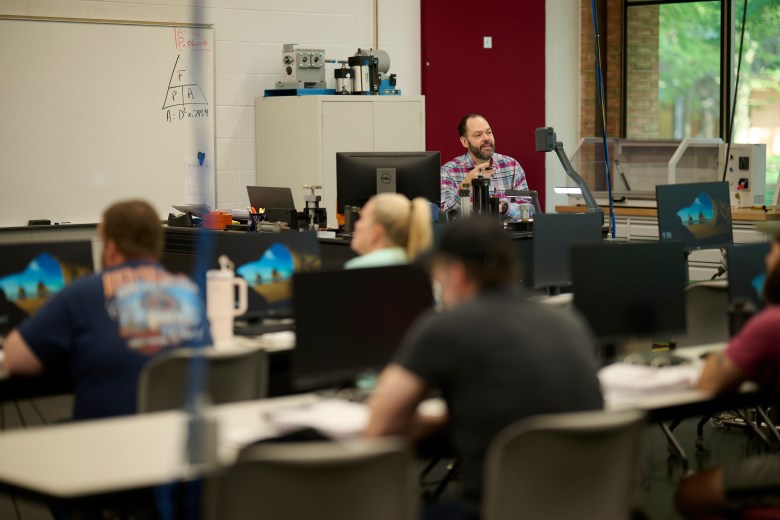
Professor Brian Iselin teaches a course to employees of Ford’s Cleveland Engine Plant No. 1 at Lorain County Community College in Elyria, Ohio. Credit: Dustin Franz for The Hechinger Report
Vanderford pointed to a PowerPoint slide showing more than 90 manufacturing companies in the area he said the college has worked with: “We basically tailor our curriculum to meet their workforce needs.” In some cases that means wedging into a class syllabus training on some specialized machine that might be used at only a handful of employers.
Rather than simply having advisory committees with a few large companies that meet occasionally, today Lorain and many other colleges follow a model that involves frequent discussions with company leaders, instructors directly participating in those meetings and a greater focus on the skills employers need.
“Those relationships take time,” said Shalin Jyotishi, managing director of the Future of Work and Innovation Economy Initiative at the think tank New America. He says that it is hard for other community colleges to replicate best practices from Lorain because they are labor-intensive to enact.
Employers also have a tendency to change their plans. For instance, when Tesla pledged to build an electrical vehicle plant in Flint, Michigan, the local Mott Community College started an EV program, said Jyotishi. But the plant never came. “The college still has a Tesla sign,” he said.
The numbers no longer add up at Gogebic Community College, in Michigan’s Upper Peninsula.
When the college suspended its program in manufacturing technology in May, it had just three students.
As with many programs at the college, a single employee was charged with administering and teaching. Doing all that plus staying on top of nearby companies’ workforce needs was “unsustainable,” said Ball, the registrar.
The few small manufacturers in the area all say they have different needs, rather than one clear set of skills, she said, noting that “you can’t be a generalist in manufacturing.” Even when the college does identify a needed skill to teach, it takes at least six months to a year to get the program approved by college leaders and the accreditor. By then, companies might need something different.
And the pay offered by small manufacturers is often low, despite an expectation of training beyond a high school diploma, said Ball.
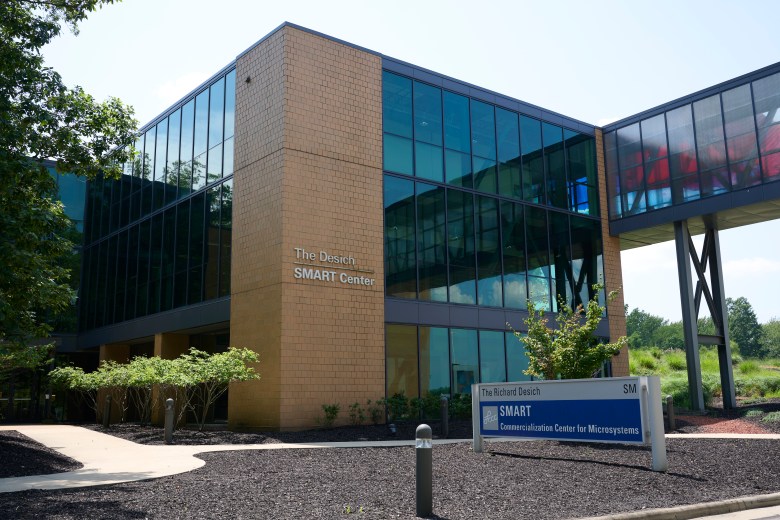
The Richard Desich SMART Center at Lorain County Community College in Elyria, Ohio, houses the microelectronic manufacturing systems program, which teaches students about the manufacture of semiconductors. Credit: Dustin Franz for The Hechinger Report
Nationwide, automation has reduced the earning power for many manufacturing jobs, said Jyotishi of New America. “For a long time manufacturing was the bedrock of the middle class,” said Jyotishi. “That wage premium for manufacturing has actually gone away.”
And there’s a danger that as colleges aim to please employers, they will create programs that are too narrow, argues Davis Jenkins, senior research scholar at Columbia University’s Community College Research Center. (Editor’s note: The Hechinger Report, which produced this story, is an independent unit of Columbia’s Teachers College.) “You don’t want specific skills training — you don’t want to just train students to work in a fab,” he said, referring to a facility where microchips and other electronics are produced. “Whenever schools buy a lot of specific equipment for training, I worry a lot. What students really need are broader skills.”
Even Lorain doesn’t always find the right fit. During the pandemic, the college started what it calls fast-track programs, which typically run 16 weeks, across a range of professional fields (not just manufacturing). But because of mixed success attracting students, officials recently slimmed the list from 60 to 13, said Tracy Green, vice president of strategic and institutional development at Lorain County Community College. And the college recently started winding down a program in industrial safety because of a lack of student interest, even though there are still a large number of job postings by local companies for jobs with those skills, said Iselin.
One provision in Trump’s new “one big, beautiful bill” promises a boost to manufacturing education, however. For the first time, the law will allow low-income students to use federal Pell Grants for short-term certificate programs, in what is known as Workforce Pell. It’s a change many community college leaders have been calling for for years as they have created more short-term programs in response to demand by students and employers who want to quickly gain new skills in fast-changing areas, including manufacturing. But that program won’t be up and running until the 2026-27 academic year.
The promise of a big new employer moving to town can galvanize student interest in manufacturing.
In Ohio, the talk for years has been a $28 billion Intel chip manufacturing plant under construction in Columbus. The facility is expected to bring some 3,000 jobs to the area, and the company has committed $50 million to workforce education in the state, including $2 million to Lorain County Community College, which it used to buy new classroom equipment, support student scholarships, and pay for program development and instructor training.
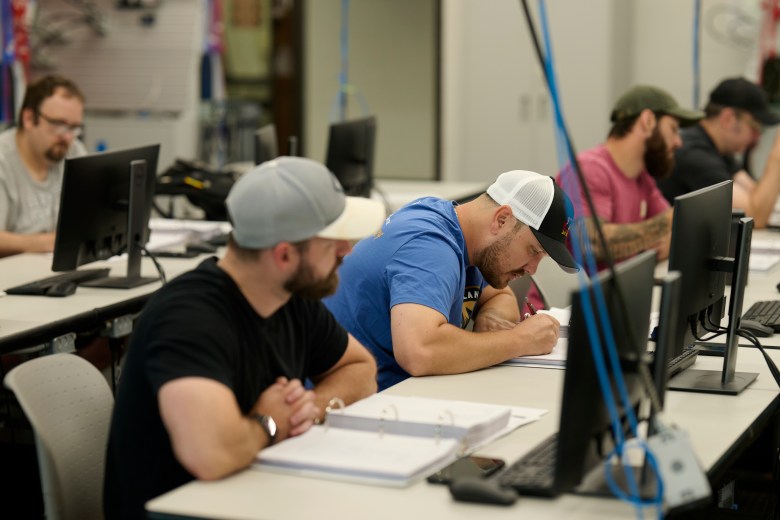
Chris Dukles, 36, an electrician apprentice for Ford Motor Co., takes notes during a course taught by Brian Iselin at Lorain County Community College. Credit: Dustin Franz for The Hechinger Report
The top graduates in Lorain County Community College’s microelectronic manufacturing program each year typically get internships at Intel’s closest existing plant, which is in Chandler, Arizona, a suburb of Phoenix. It’s a motivator to work hard in their classes, some students say.
Lia Douglas, a student in the microelectronic manufacturing program at Lorain, scored one of those slots and headed to Arizona last summer. The experience, though, was sobering.
“My plan really was to make a good impression with my internship, get a job maybe in Arizona even if it was for a year or two, and then try to move back to Ohio when they have an Ohio plant,” she said.
But one day last July, all the employees were unexpectedly summoned to an all-hands call where the company announced a wave of layoffs and reductions in some benefits that had interested Douglas, including a sabbatical program. This year, Intel announced that the opening of the Ohio plant has been delayed until 2030.
“I learned I had a little too much faith in a company and the promises of a company,” she said. “And it reminded me that at the end of the day, the company has to make money.”
She’s still glad she chose Lorain’s program, which has landed her several local internships and opened her eyes to the many small and mid-sized manufacturers in the area.
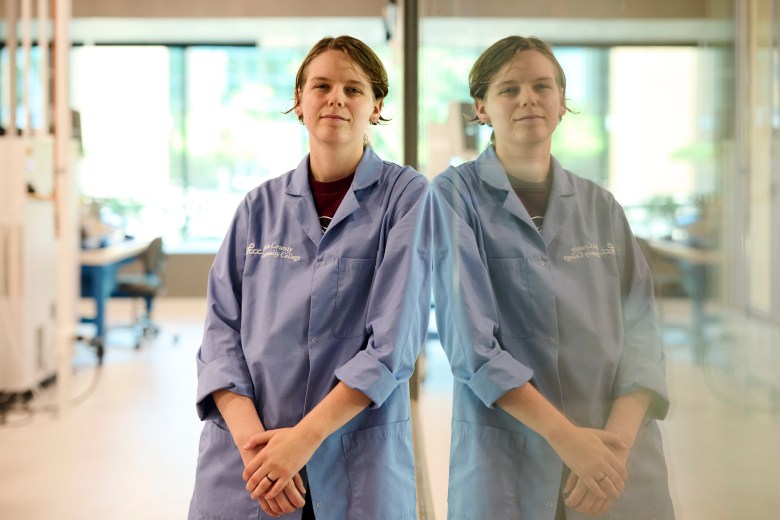
Lia Douglas is a student in the microelectronic manufacturing program at Lorain County Community College. Credit: Dustin Franz for The Hechinger Report
And she has been hooked on a career in making things ever since she was in middle school and a family friend taught her a bit of welding. Her hero was Adam Savage, co-host of the TV show “MythBusters,” who she even got to meet at a comic book convention in Cleveland.
Douglas complains that students are told in high school that they either have to choose a trade for hands-on work or an academic track to prepare for a career behind a desk that might involve design and project management. She says that as manufacturing changes, there’s plenty of room to do both. In fact, she says, when a group of doctoral students from Kent State University recently visited the college’s clean room, she was amused to see them struggle with some of the tools the students routinely use in the microelectronic manufacturing program.
“It takes as much brainpower to figure out what is the right tool for the right process as getting a Ph.D.,” she said.
Contact editor Caroline Preston at 212-870-8965, via Signal at CarolineP.83 or on email at [email protected].
The Hechinger Report provides in-depth, fact-based, unbiased reporting on education that is free to all readers. But that doesn’t mean it’s free to produce. Our work keeps educators and the public informed about pressing issues at schools and on campuses throughout the country. We tell the whole story, even when the details are inconvenient. Help us keep doing that.
Rubrics are a valuable tool that supports student growth and facilitates instructor grading and feedback (Suskie, 2018). As instructors, we see this value; unfortunately, many of our students, especially first-year students, are unfamiliar with the concept. This presents an opportunity to raise their awareness of a tool that will benefit them as they master concepts and seek course success.
The Context
During a two-week mathematics-focused summer bridge program, I teach a segment called Behind the Scenes, which highlights various success strategies students will need to leverage to be successful in college. One lesson exposes these students to the concept of rubrics, covering everything from their purpose, structure, and application.
The Illustration
As noted by Doyle and Zakrajsek (2018), “The human brain is constantly looking for connections. Connections help you use prior knowledge to build bridges to the new material, creating a more meaningful understanding of the new material” (p. 15). Building off this idea, the lesson begins with an illustration about desserts, specifically cake, a concept which will resonate with most if not all students. The following instructions are given:
I took a vote and decided that math is out, cake is in. Cake has much more bearing on your future than math. Your assignment is to design the cake I want to eat for lunch today. You will be graded on this, and it will be worth a lot of points. Take a couple of minutes to sketch out your design, making note of the details. You will not be graded on your artistic ability or lack of materials.
As students are working, I’m walking around the room. Sometimes, they will ask me questions about my preferences. Much to their dismay, I tell them I am not answering questions at that time, but that they will understand why in a few minutes.
The Discussion
I ask for volunteers to share their designs with me. As the student shares, I find a reason why I do not want to eat their cake. Perhaps there are not enough layers, or it’s not my favorite flavor. I will then subjectively give them a grade, loosely based on the rubric I will eventually show them, but with an element of randomness to aid the discussion. Finally, I’ll show them a picture of the right answer: a three-layer lemon cake decorated with pale yellow frosting, lemon slices, and a few small flowers.
I then pose a series of questions for discussion:
What did you think of my grading?
Was it subjective or objective? Why?
If we repeated this assignment, what would you want to know to meet my expectations?
Understandably, students are not a fan of how I graded, correctly identifying the subjective nature. Based on the grading and feedback they heard me give the volunteers, they can identify several criteria that would be helpful to know in advance. As we talk through these ideas, I make the connection that in higher education the tool we use to be transparent about expectations and objectively grade assessments is called a rubric. Of course, I also backtrack and tell them, “FYI, math is back in – turns out it is useful.”
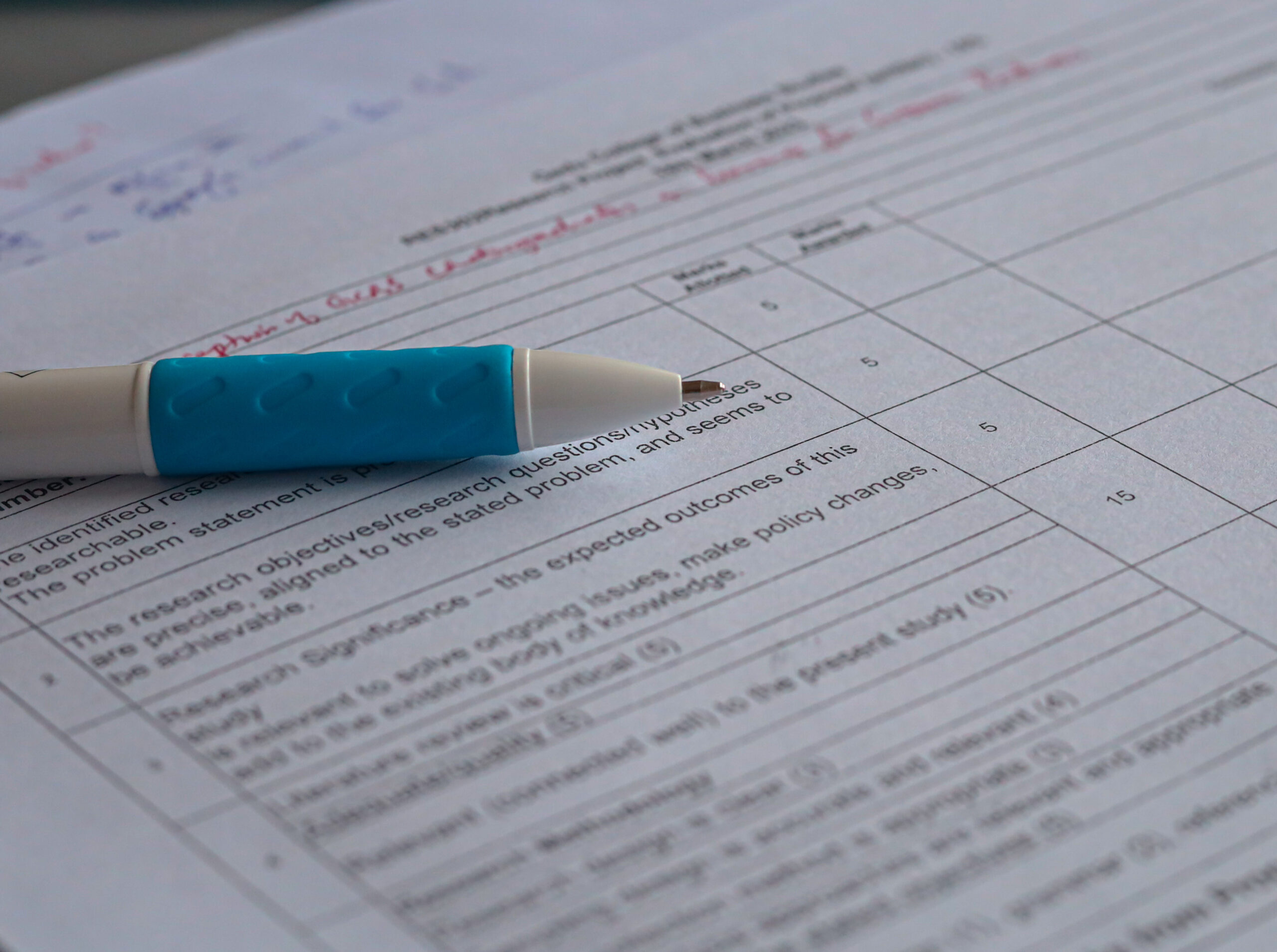
Once we have defined a rubric, we talk about the structure. I present to them a sample cake rubric, and talk about the grid format, with rows representing the criteria we will be evaluating (layers, flavor, decoration); columns representing the performance rating (needs improvement, proficient, advanced); and the cells containing descriptions of performance and point values (0, 5, 10).
The Application
After we establish what a rubric is and how instructors use it, we turn towards application of rubrics as a way for them to pre-grade their assignments before submitting. Each student in the program will be enrolled in a first-year seminar their first term, which becomes the example from which they can practice. I pass out the first-year seminar rubric along with the assignment prompts, which are consistent throughout the course. I also provide two sample responses, one that clearly does not meet expectations (43 words total), and one that does meet expectations (270 words total). I ask them to work in pairs to review the submissions and grade them using the given rubric, which includes four criteria and two performance levels.
Pairs are then asked to report out their score for the first submission, and we talk through their decisions. I share with them my grade as well. This process is repeated for the second submission. We also discuss what they liked about the experience and what they found challenging. In all, this lesson takes about thirty minutes but could be shortened or lengthened as needed.
Doyle and Zakrajsek (2018) further identified that “when learning something new, it helps to be interested in it, see a value to it, pay attention to it, associate it with something you already know, and practice it a lot” (p. 100). The cake illustration is something they already know, and let’s be honest, if it relates to food, college students are very interested. Through the absurd example, they see the value which piques their curiosity and attention. The hands-on practice, while maybe not sufficient in and of itself, at least provides some experience with a new idea from which they can build their confidence.
This rubric lesson not only raises awareness of a grading technique they will encounter over their time in college, but they get practice with an actual rubric that will be used in their first term. Further, their review of poor and exemplary submissions can help frame the direction they need to take when it comes to their own assignments. As McGuire (2015) pointed out, one way “to help your students gain competence is giving them targeted feedback, rubrics, and exemplars” (p. 88).
When students understand the purpose of the rubric, they are better positioned to achieve success in their courses. Proactively, it allows them to assess whether they are meeting assignment expectations before the due date. Reactively, it allows them to understand why they missed points, leveraging the feedback as formative assessment and making corrections for future assignments.
Sarah A. Forbes, PhD, is the Student Academic Success Director and a first-year seminar instructor at Rose-Hulman Institute of Technology. In these roles, she helps students learn new strategies for academic success. Sarah also serves as a first-year seminar instructional designer, summer bridge program director, and academic advising program administrator.
References
Doyle, T., & Zakrajsek, T. D. (2018). The new science of learning: How to learn in harmony with your brain. Stylus Publishing.
McGuire, S. Y. (2015). Teach students how to learn. Stylus Publishing.
Suskie, L. (2018). Assessing student learning: A common sense guide. John Wiley & Sons, Incorporated.
The Australian National University (ANU) admitted its has “much work to do” regarding its management and culture in a report it produced for the sector regulator’s ongoing investigation into its governance.
The Self-Assurance Report, completed for the Tertiary Education Quality and Standards Agency (TEQSA), is the first step in TEQSA’s current compliance assessment of the university’s leadership, council culture and financial position, which started in October, 2024.
“The report makes clear that we’re on a journey and that we still have much work to do in the areas of risk management, governance and culture,” vice-chancellor Genevieve Bell said in a statement.
“We recognise that ANU is at a critical point in its history – one where we need to reset not only our finances but also our operating and structural model.”
The university has reported an operating deficit every year since 2020, except 2021, and has forecast a $110 deficit for 2025 and a break-even for 2026.
The recurring deficits caused a major restructure, known as Renew ANU, that aims to save $250 million in yearly spending; $100 million in salary costs and $150m in non-salary costs.
There has 135 voluntary separations and 83 staff redundancies so far, which has saved $13 million, and $37 million has been saved from spending cuts.
From this point, there will be no more forced redundancies that haven’t already been announced, management has said. More salary savings will come from natural attrition.
It has also restructured its teaching operations, causing entire schools, such as its School of Music, to close.
“While the program of work has taken a strategic, phased approach to organisational change, guided by clear principles and extensive consultation, it has been a significant cultural shift and has caused anxiety and uncertainty in the university community,” the report said.
“Council has been regularly briefed about the progress of the work; and an internal governance board has maintained appropriate oversight … council has identified and is addressing the risks that led to the university’s current financial position, however, there remains work to be done to bring the whole university community along on this journey.
“Given the complexities with the university’s finances, this involves continuing to work with the university community in an enhanced way to ensure the finances are more easily understood.”
Vice-chancellor Genevieve Bell. Picture: Andrew Meares
The university’s ongoing deficits were not the result of one factor, the report said, but multiple, including the 2017-2021 strategic plan that called for an overall reduced, but more diverse, student base, and a had a projected increase in philanthropic donations. There were also costs associated with hailstorm and fire damage throughout 2019 and 2020.
The strategic plan initiated an ambitious philanthropic campaign that aimed to produce $1bn in donations over 10 years, which would make up for budget shortfalls relating to the overall reduction in student headcount.
The Self-Assurance Report said the philanthropic campaign “never eventuated and was quietly abandoned in late 2022.”
Professor Bell said the university council was very open to reflecting on its own practices and culture when it was discussed at a meeting in early August.
The Cover Letter, which was submitted alongside the Self-Assurance Report, also said ANU will set up an independent investigation into matters raised by academic Liz Allen, who alleged she was bullied and intimidated by ANU chancellor Julie Bishop at the Quality of governance at Australian higher education providers inquiry.
Dr Allen initially lodged a workplace complaint about the incident and the university agreed to appoint an external investigator, who eventually terminated the investigation on ethical grounds of ANU interference.
Professor Bell was absent with the flu on the day of the inquiry hearing, although she responded to the claims on the same day in a statement.
“Although we cannot address individual allegations publicly [due to ongoing investigations], I was really saddened to see members of our university in such distress, both those who appeared at the inquiry and those on our campus who have been impacted,” she said.
“Here on campus, I have now hosted nine ‘Facing the Future’ conversations and I want to thank staff who have made themselves available … I have been encouraged that people have been frank in their feedback, and most have turned up with a spirit of optimism and passion for the university which is a wonderful thing to hear in moments of change.”
The Self-Assurance Report assured TEQSA that ANU has a competent leadership team.
ANU’s executive leadership team. Source: ANU
“While the majority of the Executive Leadership Team are relatively new to their positions, they bring extensive experience to their roles from both within, and external to, ANU and the sector,” it said.
Only three out of nine members of its executive leadership team started their term before February, 2024.
The National Tertiary Education Union (NTEU) on Tuesday launched a petition urging the council to sack chancellor Julie Bishop and vice-chancellor Genevieve Bell and reverse the job and course cuts. It follows a vote of no confidence in the leadership pair by 800 ANU staff in March.
“We don’t need a new investigation, we need new leadership,” NTEU ACT division secretary Lachlan Clohesy said of the independent investigation into Dr Allen’s allegations.
“The matters raised during the Senate hearing are already being investigated by the regulator, TEQSA, and that is appropriate.
“This investigation is a distraction at a time when over one hundred people still face forced redundancies.”
The tertiary education union will take the University of Technology Sydney (UTS) to the Fair Work Commission over the university’s decision to pause enrolments to 140 courses.
Please login below to view content or subscribe now.
The University of Wollongong (UOW) and Western Sydney University (WSU) have confirmed job cut numbers, with a combined 351 staff to be cut from the institutions.
Please login below to view content or subscribe now.