Author: admin

  • OfS pushes ahead with two tier fairness for students

    OfS pushes ahead with two tier fairness for students

    Good news for students in England. Providers will soon be subject to tough new rules that ensure they’re treated fairly. But only if they’re in a new provider. Elsewhere, it seems, the unfairness can reign on!

    Just a few days before applications to join its register reopen, the Office for Students (OfS) has published consultation outcomes and final decisions on reforms to its registration requirements.

    It sets out the regulator’s decisions following its February 2025 consultation on changes to the entry conditions that higher education providers have to meet to register with OfS, and therefore access student loan funding. It covers:

    • A new initial condition C5 (treating students fairly), replacing the old consumer protection and student protection plan conditions (C1 and C3).
    • New governance conditions E7, E8 and E9, replacing the old governance requirements (E1 and E2).
    • Tighter application requirements, including more detailed financial planning, declarations about investigations, and restrictions on resubmitting applications after refusal.

    Conusingly, the changes interact closely with two separate consultations on subcontracting.

    First, in January 2025 the Department for Education consulted on requiring delivery providers in franchised or subcontractual arrangements to register directly with OfS for their students to be eligible for student support.

    Then, in June 2025 OfS ran its own consultation on the regulation of subcontracted provision, focusing on how such providers would be assessed, overseen, and held accountable if brought into the system.

    These reforms don’t themselves impose registration on subcontracted delivery providers, but they prepare the ground – the new conditions clarify how subcontracted applicants could meet C5 and related requirements, and OfS signals that it is ready to align with whatever the government decides on the January DfE proposals.

    Chin plasters

    We’re several months on now from the initial jaw on the floor moment, but by way of reminder – the main proposals on treating students fairly are justified as follows:

    Providers are facing increasing financial challenges. They must have effective management and governance to navigate those challenges in a way that delivers good student outcomes. Where providers are making tough financial decisions, they must continue to meet the commitments they have made to students. Our engagement with students shows that being treated fairly is very important to them and suggests that too often this does not happen.

    Against that backdrop, and repeated never-met promises to act to address student protection issues, you’d have thought that there would be progress on what is happening inside the 429 providers already on the register. Alas not – its centrepiece proposals on treating students fairly are only to apply to new providers, with a vague commitment to consult on what might be applied to everyone else (closing the stable door) at some point down the line (one the horse has bolted).

    But worse than that, in its infinite wisdom OfS has somehow managed to concoct a situation where for this tiny group of new providers, it will:

    • Remix lots of existing consumer protection law so that instead of talking about consumer rights, it talks about treating students fairly
    • In some areas go further than consumer protection law, because OfS can and has decided to in the student interest
    • In some areas not go as far as consumer protection law, because…. reasons?

    On the topline, what’s now being introduced is a new initial registration condition – C5, “treating students fairly” – that will replace the old consumer protection entry tests for providers seeking to join the OfS register.

    Instead of simply requiring a university or college to show that it has “had due regard” to CMA guidance, applicants will have to demonstrate that they treat students fairly in practice.

    To do that, OfS will review the policies and contracts they intend to use with students, and judge them against a new “prohibited behaviours” list, a detriment test, and any track record of adverse findings under consumer or company law. In effect, OfS is shifting from a box-ticking exercise about compliance to an upfront regulatory judgement about fairness.

    Providers will have to publish a suite of student-facing documents – terms and conditions, course change policies, refund and compensation policies, and complaints processes – which together will constitute their student protection plan.

    And the scope of the new condition is deliberately broad – it covers current, prospective, and former students, higher education and ancillary services like accommodation, libraries, or disability support, and information issued to attract or recruit students, including advertising and online material. In short, C5 sets a new standard of fairness at the point of entry to the system, at least for those providers trying to join it.

    Students aren’t consumers, but they are, or are they

    The problem is the relationship with consumer law. OfS is at pains to stress that new Condition C5 sits comfortably alongside consumer law, drawing on concepts that will be familiar to anyone who has worked with CMA guidance.

    It makes use of the same building blocks – unfair terms, misleading practices, clarity of information – and even names the same statutes.

    But we’re also reminded that C5 is not consumer law – it’s a regulatory condition of registration, judged and enforced by OfS as a matter of regulatory discretion. That means satisfying C5 doesn’t guarantee compliance with the Consumer Rights Act 2015 or the Digital Markets, Competition and Consumers Act 2024, and conversely, complying with the Act doesn’t automatically secure a pass on C5. The frameworks overlap, but they don’t align.

    In some respects C5 goes further. By creating its own “prohibited behaviours list”, OfS has declared that certain contractual terms – which the Consumer Rights Act 2015 would only treat as “grey list” risks – will always be unfair in the student context. Examples include terms that allow a provider to unilaterally withdraw an offer once it has been accepted, clauses that limit liability for disruptions within the university’s own control (like industrial action), or refund policies that impose unreasonable hurdles or delays.

    The list also bans misleading representations such as claiming “degree” or “university” status without proper authority, omitting key information about additional compulsory costs, or publishing fake or cherry-picked student reviews. It even extends to the legibility and clarity of terms and policies, requiring that documents be accessible and understandable to students.

    C5 also sweeps in documents that may not ordinarily have contractual force, like course change policies or compensation arrangements, and makes them part of the fairness test. In that sense, the regulator is demanding a higher standard than the law itself, rooted in its view of the student interest.

    But in other senses, C5 lags behind. Where DMCC now treats omissions of “material information” as unlawful if they’re likely to influence a student’s decision, C5 only bites when omissions cause demonstrable detriment, judged against whether the detriment was “reasonable.”

    DMCC introduces explicit protections for situational vulnerability, and a statutory duty of professional diligence in overseeing agents and subcontractors – neither concept is reflected in C5. DMCC makes universities liable for what their agents say on TikTok about visas or jobs – C5 says providers are accountable too, but stops short of importing the full professional diligence duty that the law now demands. DMCC makes clear that the full price of a degree needs to be set out in advance – including anything you have to buy on an optional module. C5 not so much.

    We will protect you

    The problem with all of that from a student point of view is that the Competition and Markets Authority is going to take one look at all of this and think “that means we don’t have to busy ourselves with universities” – despite the rights being different, and despite no such regulation kicking in in the rest of the UK.

    And worse, it makes the chances of students understanding their rights even thinner than they are now. On that, some respondents asked for wider duties to ensure students actively understand their rights – but OfS’ response is that its focus is on whether documents are fair, clear, and not misleading, and that if issues arise in practice (like if notifications flag that students aren’t being given fair or accurate information), OfS can require further information from the provider and take action.

    How on earth students would know that their rights had been breached, and that they can email an obscure OfS inbox is never explained. Even if students find the webpage, students are told that OfS “will not be able to update you on the progress or outcome of the issue that you have raised”.

    They’d likely make a complaint instead – but even if they got as far as the OIA, unless I’ve missed it I’ve never seen a single instance of OfS taking action (either at strategic/collective level or individual) off the back of the information I’m sure it gets regularly from its friends in Reading.

    I suspect this all means that OfS will now not publish two lots of information for students on their rights, depending on whether they’re new or existing members of the register – because like pretty much every other OfS strategy on the student interest, students are framed as people to be protected by a stretched mothership rather than by giving them some actual power themselves.

    I can make an argument, by the way, that sending complaints to lawyers to be assessed for legal risk to the provider, routinely ignoring the OIA Good Practice Framework, refusing to implement an OIA recommendation, not compensating a group when an individual’s complaint obviously applies to others who didn’t complain, using NDAs on complaints that don’t concern harassment and sexual misconduct, deploying “academic judgment” excuses on any appeal where the student is let down, or the practice of dragging out resolutions and making “deal or no deal” “goodwill” offers to coax exhausted students into settling are all pretty important fairness issues – but the relationship with the OIA in a whole document on fairness is barely mentioned.

    As usual, almost nothing has changed between proposals and outcome – but there’s a few nuggets in there. “Information for students” has been replaced with “information about the provider” – to make clear the duty extends beyond enrolled students and covers all marketing/info materials. The problem is that under DMCC stuff like, for example, misleading information on the cost of living in a given city is material, but under OfS “treating students fairly” doesn’t appear to be “about” the provider.

    OfS has clarified that its concerns about “ancillary services” only applies where there is a contract between student and provider (not with third parties), but has added that providers are responsible for information they publish about third-party services and expects universities to exercise “due diligence” on them and their contracts.

    Some language has been more closely aligned with the DMCCA on things like omissions and fake reviews), and in its “detriment” test providers now must do “everything reasonable” rather than “everything possible” to limit it.

    Banned practices

    In some ways, it would have been helpful to translate consumer law and then go further if necessary. But looking at the overlap between the CMA’s unfair commercial practices regime and OfS’s prohibited behaviours list reveals some odd gaps.

    OfS has borrowed much of the language around misleading marketing, fake reviews, false urgency, and misused endorsements, but it has not imported the full consumer protection arsenal. The result is that students don’t seem to be guaranteed the same protections they would enjoy if they were buying a car, a washing machine, or even a mobile phone contract.

    General CMA guidance prevents companies from mimicking the look of competitors to confuse buyers – but the practice is not explicitly barred by OfS. The CMA bans direct appeals to children – no mention of the vulnerable consumer / due diligence duties in OfS’ stuff. Under DMCC, a practice that requires a consumer to take onerous or disproportionate action in order to exercise rights that they have in relation to a product or service is banned – but there’s little on that from OfS.

    Fee increases

    One note on fees and increases – in the response, OfS points to a “statement” that anyone with an Access and Participation Plan has to submit on whether it will increase fees. It supposedly has to specify the “objective verifiable index” that would be used (for example, the Retail Price Index or the Consumer Price Index), in all cases the amount must not exceed the maximum amount prescribed by the Secretary of State for Education, and under consumer protection law, all students must have a right to cancel a contract in the event of a price increase, even where that price increase is provided for in the contact.

    Here’s the first five I found in approved Access and Participation Plans on Google:

    • “Our intention is to charge the maximum fee, subject to the fee limits set out in Regulations” (the doesn’t seem compliant to me)
    • “We will not raise fees annually for 2024-25 new entrants” (that one from a provider that has announced that it will after all)
    • “We will not raise fees annually for 2024-25 new entrants” (that from a provider who now says that for those who started before 1 August 2025, the continuing fee will be £9,535)
    • “We will not raise fees annually for new entrants” (that from a provider that now says “the fee information and inflation statement provided on page 69 of our 2025/26 to 2028/29 Access and Participation Plan are no longer current)
    • “Subject to the maximum fee limits set out in Regulations we will increase fees each year using RPI-X” (what it’s actually doing is increasing its fees by RPI-X as projected by the OBR, which is a very different figure, and no way would pass muster as an “objective verifiable index”

    I’d add here to this utterly laughable situation that the CMA is very clear that the right to cancel in the event of a material change or price increase has to be exercisable in practice:

    In the HE sector, switching course or, in some cases, withdrawing and switching HE provider, is likely to be difficult or impractical in practice, bearing in mind that in many cases the student will not be able simply to transfer their credits to another HE provider, and so saying the student can switch may not improve matters for them, or alleviate the potential unfairness of a variation.

    I’m not sure there’s a provider in the country that’s compliant with that.

    Wider changes

    On its reforms to registration requirements, the exciting news is that rather than introduce one new Condition of Registration, there’s going to be three – E7 (governing documents and business plan), E8 (fraud and inappropriate use of public funds) and E9 (on fit and proper persons, knowledge and expertise).

    In the future, providers will have to submit a defined set of governing documents at registration – replacing the previous reliance on self-assessment against public interest governance principles. Providers will also have to submit a clear and comprehensive five-year business plan showing objectives, risks, compliance with ongoing conditions, and consideration of students’ interests.

    Specific senior roles (chair of governing body, accountable officer, finance lead, and an independent governor) will have to demonstrate sufficient knowledge and expertise, usually tested through interviews. And a new fit and proper persons test will mean that those in senior governance and management roles will be subject to checks on past conduct (e.g. fraud, misconduct, behaviour undermining public trust).

    Providers will also have to have comprehensive and effective arrangements to prevent, detect, and stop fraud and the inappropriate use of public funds. A “track record” test also applies, the upshot of which is that relevant convictions or regulatory sanctions within the past 60 months could bar registration unless exceptional circumstances apply.

    You’ll not be surprised to learn that in the consultation, some worried that the changes would increase bureaucracy, slow down registration, and impose disproportionate burdens on smaller providers. Others objected to the removal of self-assessment against the Public Interest Governance Principles (PIGPs) at the point of registration, fearing this would dilute student protection or cause confusion given that PIGPs still apply on an ongoing basis.

    Concerns were also raised about creating a two-tier system where new entrants face tougher entry requirements than established providers, and about the practicality of requiring a five-year business plan when forecasting beyond two or three years is often unrealistic. Many also questioned a new interview requirement for key individuals, seeing it as costly, stressful, open to coaching, and potentially inconsistent. Just like student assessment!

    OfS was right all along, of course – arguing that the new conditions give stronger protection for students and taxpayers, that the five-year planning horizon is essential to test medium-term sustainability, and maintains that fit and proper person interviews are the most effective way to test leadership capacity.

    If you were one of the handful of respondents, it wasn’t all in vain – the phrase “policies and procedures” is now “policies and processes”, OfS has clarified the level of knowledge required (the chair and independent governor only need “sufficient awareness” of student cohorts rather than detailed operational knowledge) and a minimum requirement for fraud prevention arrangements is now in the actual condition (rather than just in guidance).

    Registering with OfS

    Much of that is now reflected in a tightening of the registration process itself. Applicants will now be required to submit a defined set of final, governing-body-approved documents at the point of application – including governing documents, financial forecasts, business plans, and information on ownership and corporate structure.

    The idea is to eliminate the previous piecemeal approach, under which providers often submitted partial or draft materials, and to ensure that applications arrive complete, coherent, and capable of demonstrating that a provider has the resources and arrangements necessary to comply with the ongoing conditions of registration.

    Some argued that the shift makes the process more rigid and burdensome, particularly for smaller or specialist providers, and warned that requiring fully approved documents could create practical difficulties or delay applications. Others were worried about duplication with other regulators and barriers to entry for innovative providers.

    Again, OfS is pressing on regardless, arguing that a standardised approach will improve efficiency and consistency, while promising proportionate application of the rules, detailed guidance on the required documents, and limited flexibility where a final document cannot yet exist.

    To the extent to which some might argue that a heavy and complex burden is a tough ask for small new providers – and runs counter to the original Jo Johnson “Byron Burgers” vision, the message seems to be that it turns out that scale and complexity is required to protect public money and the student interest. It would arguably be a lot easier (on both OfS and Independent HE’s members) if DfE was to just say so.

    Defeat from the jaws of victory

    Sometimes, OfS gets close to getting it – finally, an education regulator properly thinking through the ways in which students are treated unfairly – only to go and spoil it and say something stupid like “this will only apply to new providers”.

    As I noted when the consultation came out, what we now have is one set of rights for students in a new(ly registering) provider that they’ll never be proactively told about, and another set of much weaker ones for everyone else that they’re not told about either, all in the name of “fairness”, at exactly the point that the regulator itself admits is one where providers are under pressure to not deliver on some of the promises they made to students.

    The lack of justification or explanation for that remains alarming – and while cock up is often a better explanation than conspiracy, it’s hard to conclude anything other than OfS has proactively decided to turn a blind eye (while blindfolding students) to existing unfairness while everyone gets their cuts done. What a time to be a student.


    Source link

  • Helping College Students Emotionally Before They Turn to AI

    Helping College Students Emotionally Before They Turn to AI

    Photo illustration by Justin Morrison/Inside Higher Ed | Kirillm/iStock/Getty Images

    As more students engage with generative artificial intelligence and chat bots, the ways they use AI are changing. A 2025 report published by the Harvard Business Review found that, according to the discourse on social media, “therapy/companionship” is the No. 1 use case for generative AI chat bots.

    For college counseling centers, this change reflects students’ desire for immediate support. “This is not a generation that would call a counseling center and get an appointment two weeks, four weeks later,” said Joy Himmell, director of counseling services for Old Dominion University. “They want help when they want it.”

    But it’s important for counseling centers to educate students on the risks of using generative AI tools for well-being support, Himmell said.

    The research: While ChatGPT and similar text-generating chat bots are touted as productivity tools that can expedite learning and workflow, some people turn to them for personal and emotional support.

    According to a 2024 safety report, OpenAI found that some users experience anthropomorphization—attributing humanlike behaviors and characteristics to nonhuman entities—and form social relationships with the AI. Researchers hypothesized that humanlike socialization with an AI model could affect how individuals interact with other people and hamper building healthy relationship skills.

    A 2025 study from MIT Media Lab and Open AI found that high usage of ChatGPT correlates with increased dependency on the AI tool, with heavy users more likely to consider ChatGPT a “friend” and to consider messaging with ChatGPT more comfortable than face-to-face interactions. However, researchers noted that only a small share of ChatGPT users are affected to that extent or report emotional distress from excessive use.

    Another study from the same groups found that higher daily usage of ChatGPT correlated with increased loneliness, dependence and problematic use of the tool, as well as lower socialization with other humans.

    In extreme cases, individuals have created entirely fabricated lives and romantic relationships with AI, which can result in deep feelings and real hurt when the technology is updated.

    This research shows that most people, even heavy users of ChatGPT, are not seeking emotional support from the chat bot and do not become dependent on it. Among college students, a minority want AI to provide well-being support, according to a different survey. A study from WGU Labs found that 41 percent of online learners would be comfortable with AI suggesting mental health strategies based on a student’s data, compared to 38 percent who said they would be somewhat or very uncomfortable with such use.

    In higher education: On campus, Himmell has seen a growing number of students start counseling for anxiety disorders, depression and a history of trauma. Students are also notably lonelier, she said, and less likely to engage with peers on campus or attend events.

    Student mental health is a top retention concern, but few counseling centers have capacity to provide one-on-one support to everyone who needs it. At her center, more students prefer in-person counseling sessions, which Himmell attributes to them wanting to feel more grounded and connected. But many still engage with online or digital interventions as well.

    A significant number of colleges have established partnerships with digital mental health service providers to complement in-person services, particularly since the COVID-19 pandemic necessitated remote instruction. Such services could include counseling support or skill-building education to reduce the need for intensive in-person counseling.

    Digital mental health resources cannot replace some forms of therapy or risk assessment, Himmell said, but they can augment counseling sessions. “Having automated AI systems with emotional intelligence to be able to convey some of those concepts and work with students, in some ways, it actually frees the counselor in terms of doing that kind of [skill building], so that we can get more into the nitty-gritty of what we need to talk about,” she explained.

    AI counseling or online engagement with ChatGPT is not a solution to all problems, Himmell said. For those who use chat bots as companions, “it sets up a system that is not based in reality; it’s a facade,” Himmell said. “Even though that can serve a purpose, in the long run, it really doesn’t bode well for emotional or social skill development.”

    Faculty and staff need to learn how to identify students at risk of developing AI dependency. Compared to anxiety or depression, which have more visible cues in the classroom, “the symptomology related to that inner world of AI and not engaging with others in ways that are helpful is much more benign,” Himmell said. Campus stakeholders can watch out for students who are disengaged socially or reluctant to engage in group work to help identify social isolation and possible digital dependency.

    AI in the counseling center: Part of addressing student AI dependency is becoming familiar with the tools and helping students learn to use them appropriately, Himmell said. “We need to be able to harness it and use it, not be afraid of it, and embrace it,” she said. She also sees a role for counseling centers and others in higher education to provide additional education on AI in different formats and venues.

    Old Dominion partners with TalkCampus, which offers 24-7 peer-based support. The counseling service is not automated, but the platform uses AI to mine the data and identify risk factors that may come up in conversation and provide support if needed.

    Source link

  • Speed Checks

    Speed Checks

    Should a student be allowed to take the same class five or six times without someone intervening?

    An older school of community college thought used to refer to the “right to fail.” It was a version of tough love, combined with a libertarian sense that students know best what they need. If someone needs to fail calculus several times to figure out that engineering might not be the path for them, this camp would say, then so be it. Sometimes the ninth time is the charm. Failure may be the best teacher, but sometimes even the best teacher needs some repetition to get the point across.

    Early in my career, I was sympathetic to this viewpoint. After all, it applies in many other spheres of endeavor. For example, it became brutally clear at a young age that professional baseball was not in my future; I indulged my right to fail nearly every time I swung a bat. Crashing out as hard as I did, as early as I did, spared me the frustration that many players feel later in life when they top out in the minor leagues but keep trying to redeem years of sunk cost. Sales positions involve rapid and frequent failure. Actors and comedians know well what it is to crater an audition or to bomb in front of a crowd. Learning what doesn’t work is part of learning what does. Why should academia be any different? Besides, some people are late bloomers, and community colleges are all about second chances.

    Two things changed my mind. The first was getting to know students better. The second was changes to federal financial aid.

    Students clued me in over time, each in different ways. For a couple of years in grad school, I worked a few hours a week in the campus writing center as a tutor. I remember working with a student on a draft of her paper; the paper was full of grammatical mistakes, awkward constructions, abrupt transitions and the various signs of an uncomfortable writer.

    As we discussed each type of mistake, she got flustered, saying that she knew what she did wrong, but she didn’t know why. To prove her point, she showed me a note she had written her friend earlier that day. The note wasn’t eloquent, but it was clear, readable and effective; in other words, it was everything the paper wasn’t. When I asked her what the difference was, she replied that she actually cared about the note.

    Aha!

    What looked like a lack of ability or knowledge was actually a sign of indifference. When she cared, she was perfectly capable of writing reasonably well. The paper felt forced because it was forced.

    What’s true at the assignment level can be true at the course level, too. It’s hard to do well in a class you don’t care about.

    But sometimes students get stuck in ruts. (We all do, for that matter.) Tunnel vision can set in, and they might not see an alternative to the path they’re on. That’s when another set of eyes can make a difference.

    Years ago, when we still had in-person registration, a student came to me to get permission to take a course for the fourth time. When I asked why he failed it the first three times, he responded that he hated it. I asked why he wanted to retake a class he hated. He responded that it was a requirement. But it wasn’t, I pointed out; it was only a requirement for one major, and we had other majors. He looked puzzled.

    I asked if he’d had a class he liked. He mentioned liking a psych class. I told him that we had a psych major and showed what he would need to do to graduate with that. His entire demeanor changed. About a year later, he and his girlfriend stopped by my office to thank me; his entire outlook had changed, and he was on a track he enjoyed. He always had the native ability—he just needed someone to point out that there was another option. Human intervention wasn’t about stopping or scolding, it was about pointing out an option that hadn’t occurred to him.

    Later, of course, feds lowered the lifetime limit for Pell eligibility. Suddenly, spending multiple semesters on the same class made it much less likely that a student would finish at all. Whatever the merits of that policy change, its impact is real. Before a student burns through too much aid, I think we have an obligation to interrupt the spiral and see if there’s a more productive path.

    That view lacks the simple clarity of “the right to fail,” but I think it comes closer to reflecting the world in which students live. Speed checks save lives, and check-ins save careers. I’d rather have someone intervene than watch the student keep hitting their head against the wall, only to (eventually) walk away with student loans and nothing to show for them.

    Source link

  • Adriel A. Hilton | Diverse: Issues In Higher Education

    Adriel A. Hilton | Diverse: Issues In Higher Education

    Dr. Adriel A. HiltonAdriel A. Hilton has been named Vice President of Institutional Strategy and Chief of Staff at Columbia College Chicago. Most recently, he served with Washington State’s Department of Children, Youth, and Families and previously led strategic student affairs and enrollment initiatives at Southern University at New Orleans. 

    Hilton holds a BA in Business Administration (Finance) from Morehouse College, a Master of Applied Social Science in Public Administration from Florida A&M University, an MBA from Webster University, and a PhD in Higher Education Administration from Morgan State University.

    Source link

  • No More One-Trick Ponies: Adapt, Evolve, or Step Aside

    No More One-Trick Ponies: Adapt, Evolve, or Step Aside


    Dr. Mordecai Ian Brownlee 
    The year 2025 has been marked by numerous legislative changes, resulting in a state of legislative whiplash that has directly impacted institutions of higher education nationwide. From executive orders, to the dismantling of the Department of Education, to call of regional accreditation reform, to the discontinuance of federal funds, to the national erosion of Diversity, Equity, and Inclusion programs (and anything that remotely resembles it), higher education have been conditioned to brace daily for the next social media post or breaking news update that can send our colleges and universities into a frenzy. With the passage of H.R.1 by the 119th Congress, known as the One Big Beautiful Bill Act, the higher education sector will need to work quickly to fully understand the Act’s impact on our institutions, students, and communities as the 2025-2026 school year begins. As we seek understanding, it is essential to distinguish fact from fiction, separate narratives from actualities, and prioritize responsibility over fear.

    Leadership in the next era of higher education

    Now is the time for leaders serving in this evolving era to make an explicit declaration that, regardless of the circumstances, their respective institutional missions must not and will not fail. The dreams of our students, as well as the livelihoods of our faculty and staff, are at stake. Not to mention, in such a disruptive era, higher education must normalize the assessment of its academic and student support services to determine the relevance and impact of colleges and universities on the broader communities they serve. Far gone are the days of piddling the same old student experiences and academic programs that fail to lead students to livable wages, let alone failing to provide social care for learners seeking to realize brighter futures. Far gone should be the days when institutional legacies prevent institutions from making necessary changes to ensure institutional vitality and sustainability. In addition to addressing wasteful processes and systems that continue to strain the institution’s ability to serve its enrolled students responsibly.

    Equitable student success reimagined

    It is essential to note that this work must be envisioned, designed, and implemented differently, given the internal and external political realities prevailing within the respective states of our institution. How we lead this work in the state of Colorado, where I serve as a college president, will undoubtedly differ from how it is led in other states. From coast to coast, from metro to rural, from public to private, and from four-year to two-year institutions, the real power for equitable student success lies in our ability to bring our institutional missions to life in new ways that build bridges to fulfill academic rigor and provide opportunities for the disenfranchised. Regardless of the environment, I encourage us, as educators, to recognize the dynamic shift that must occur within our perspectives and approaches.

    Our profession doesn’t need any more one-trick ponies – people who can only serve and have an impact if the conditions are ideal or to their liking. What we need are those who deeply understand that the failure of our students and the missions of our institutions is not an option. We need those who understand the power of environmental scanning and program assessment, as well as the ethical responsibility we have to those we serve, to provide transformative and meaningful learning experiences that account for the political and cultural differences present in each community.

    It is this educational versatility paired with agility that will ensure our ability to do “the work” despite the times. Yes, our job titles may change, our departments may be reorganized, and our funding may be discontinued. However, I challenge every college president and their respective institutional boards not to become distracted. Instead, cultivate your awareness of the times, re-center yourself around your respective missions, and embrace the changes that our institutions must implement, recognizing that through disruption, genuine innovation can emerge. And while that change may not be ideal, it is indeed necessary.

    Dr. Mordecai Ian Brownlee is President of Community College of Aurora.


    Source link

  • What Fields of Study Are Driving International Demand in the UK?

    What Fields of Study Are Driving International Demand in the UK?

    There will be a short-pause in HEPI blogs as we undertake some work on the website. We look forward to delivering blogs to your inbox again later next week.

    This HEPI blog was kindly authored by Justin Woods, Director UK of ApplyBoard

    As the UK sector anticipates new policy requirements and tighter scrutiny around post-study pathways, aligning programme offerings with student demand has never been more important. Yet, international students bring a wide range of goals and preferences to their study decisions. How can institutions support under-enrolled programmes while continuing to attract high-quality applicants?

    Entrant data from the 2023/24 academic year points to some clear shifts, including a higher proportion of international students enrolling in computing/IT and health and medicine.Examining these enrolment patterns by source market and field can help institutions stay aligned with evolving demand.

    Computing and Health Made Up a Larger Share of Entrants to the UK in 2023/24

    International student demand in the UK evolves in small but meaningful ways. In 2023/24, more students chose to begin their studies in computing/IT and health and medicine, fields that offer clear links to employment and future skill needs.

    The overall field of study mix among international students in the UK has remained fairly stable since the pandemic, but subtle shifts are beginning to take shape. The share of entrants in computing/IT was up three percentage points in 2023/24 compared to 2019/20. While modest, this represents a change of several thousand more students choosing this field of study. Health and medicine also remained strong in 2023/24, accounting for more than 11% of new starters.

    This trend mirrors developments in the UK labour market. The country’s tech sector now exceeds £1.2 trillion in market value. Meanwhile, NHS staffing shortages remain a pressing concern, with recent estimates pointing to a shortfall of over 10,000 nurses. As students assess where their UK education might lead them, it is likely that domestic labour shortages and growth sectors are shaping the value students perceive in certain programmes. Indeed, when ApplyBoard asked prospective students about their post-study career plans, ‘engineer’ and ‘nurse’ were the two most popular responses, with several tech jobs (such as IT, cybersecurity, and data analysis) appearing in the top 20 as well.

    UCAS data for the June 30, 2025 deadline shows that 4,700 international undergraduate students applied for a nursing programme, 19% higher than the 2024 deadline.

    Which Student Populations are Driving Demand in Computing/IT and Health and Medicine?

    While computing/IT and health and medicine made up 10% and 11% of all international entrants in 2023/24, several student populations pursued these fields at significantly higher rates:

    table visualization

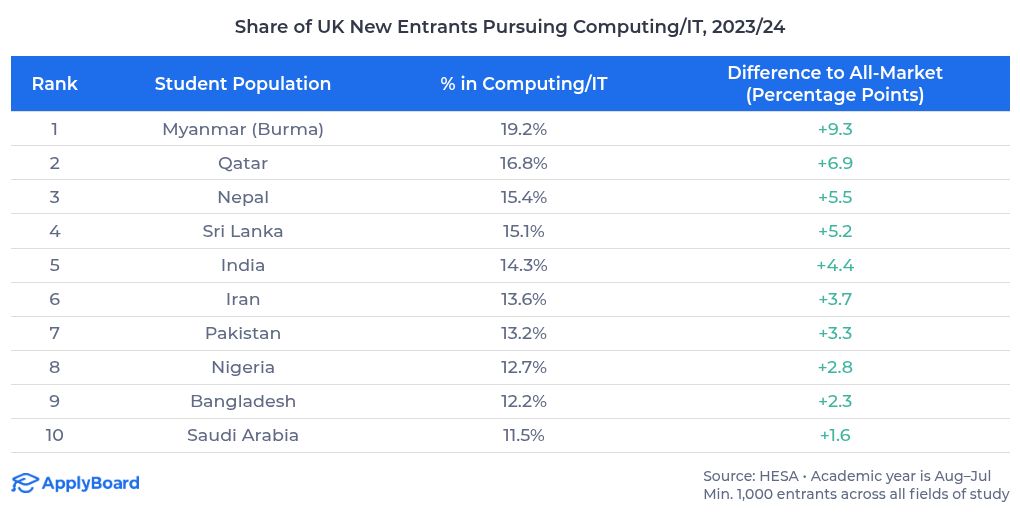
    Computing/IT is a top study priority for several key student populations. Nearly one-in-five international students from Myanmar entering the UK in 2023/24 pursued a computing/IT field, more than double the all-market average. Other student populations with notably high engagement in this field of study include those from Qatar, Nepal, Sri Lanka, and India, all of which had 14% or more of their new UK entrants choose computing/IT. All told, these trends show a broad pattern of interest among students across South Asia, the Middle East, and Africa.

    Some emerging markets (between 500 and 1,000 entrants in 2023/24) with a high proportion of students entering computing/ITinclude Algeria (23%), Uzbekistan (15%), Morocco (14%), and Bahrain (12%).

    Health and medicine shows a comparable trend, with a different mix of student populations driving above-average interest:

    table visualization

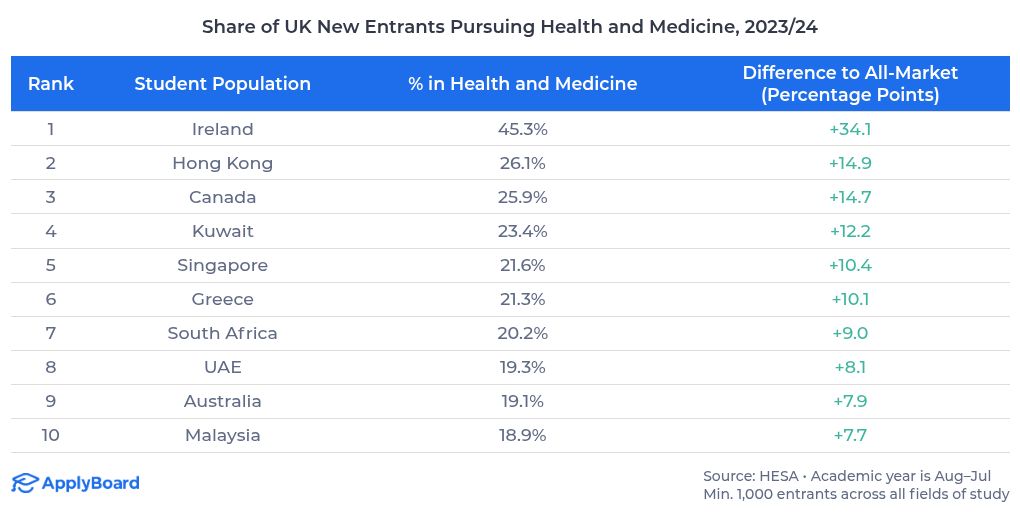
    Health and medicine draws above-average interest from a globally distributed set of student markets. Students from Ireland, Hong Kong, and Canada were especially likely to enter health and medicine programmes in 2023/24, with one in four entrants from each market choosing this field. Other high-interest markets span the Middle East, Southeast Asia, and Southern Europe, underscoring a wide geographic appeal of health-related fields.

    Some emerging markets (between 500 and 1,000 entrants in 2023/24) with a high proportion of students entering health and medicineinclude the Philippines (38%), Zimbabwe (30%), Jordan (19%), and Belgium (19%).

    What Fields of Study do the UK’s Largest International Student Populations Pursue?

    Field of study preferences don’t just vary by market. They also take on different significance when viewed through the lens of student volume. Looking at the UK’s largest international student populations helps reveal which programmes are driving demand at scale.

    chart visualization

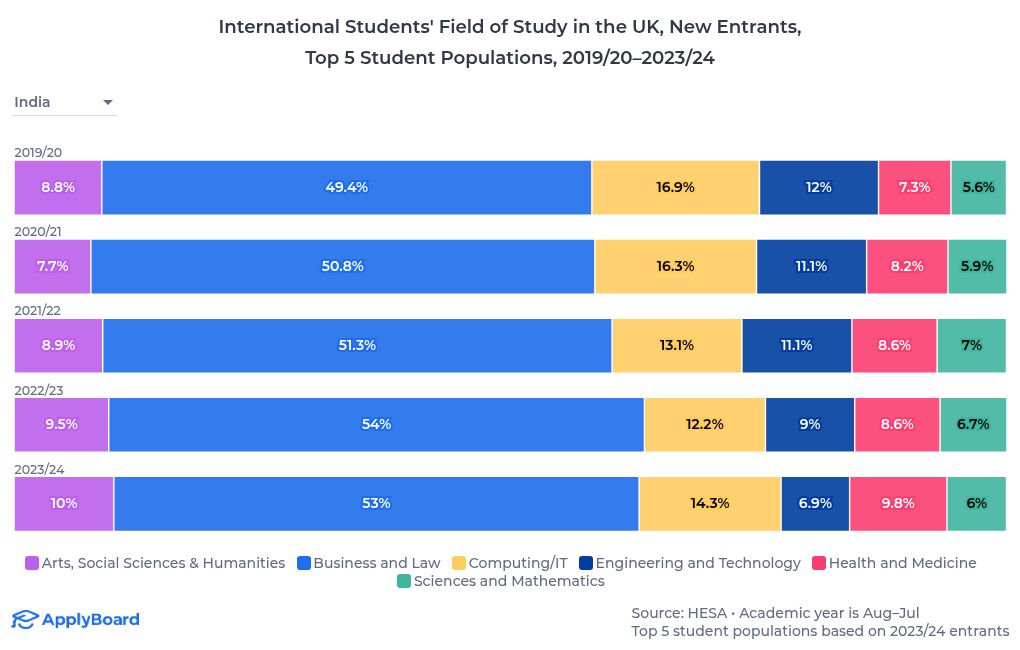
    Business and law continues to dominate among high-volume source markets, particularly in South Asia. In 2023/24, over half of new students from India and Pakistan entered this field. For China, on the other hand, business and law enrolment has declined steadily. Instead, arts, social sciences, and humanities has become the top choice among students from China, accounting for nearly 38% of entrants in 2023/24.

    Engineering and technology, once popular across multiple markets, has seen a notable decline. The field accounted for 12% of international entrants from India in 2019/20 but just 7% in 2023/24. A similar drop occurred among Pakistani students. However, with the UK launching a £54 million recruitment strategy to attract global research talent from the US in June, we expect this field to see somewhat of a rebound over the next couple of years.

    Even ashealth and medicine has received increased attention across the UK sector, its performance among the largest student populations remains steady. Indeed, Nigeria and the US remain strong contributors, with 15% of new students entering this field. As institutions prepare for further sectoral reforms and anticipate post-White Paper adjustments, maintaining a steady corridor into healthcare-aligned programmes and post-graduate opportunities could prove especially important in safeguarding both student outcomes and national workforce goals.

    Aligning Your Institution With What’s Next

    Programme-level shifts in international demand rarely happen all at once, but they matter more than ever in today’s climate of policy change and increasing scrutiny. Institutions that respond early to evolving student priorities will be better positioned to sustain enrolment, diversify their cohorts, and meet labour-aligned goals.

    Source link

  • What’s happened since Texas killed in-state tuition for undocumented students

    What’s happened since Texas killed in-state tuition for undocumented students

    SAN ANTONIO — Ximena had a plan. 

    The 18-year-old from Houston was going to start college in the fall at the University of Texas at Tyler, where she had been awarded $10,000 a year in scholarships. That, she hoped, would set her up for her dream: a Ph.D. in chemistry, followed by a career as a professor or researcher.

    “And then the change to in-state tuition happened, and that’s when I knew for sure that I had to pivot,” said Ximena, who was born in Mexico but attended schools stateside since kindergarten. (The Hechinger Report is referring to her by only her first name because she fears retaliation for her immigration status.) 

    In June, the Texas attorney general’s office and the Trump administration worked together to end the provisions in a state law that had offered thousands of undocumented students like her lower in-state tuition rates at Texas public colleges. State and federal officials successfully argued in court that the long-standing policy discriminated against U.S. citizens from other states who paid a higher rate. That rationale has now been replicated in similar lawsuits against Kentucky, Oklahoma and Minnesota — part of a broader offensive against immigrants’ access to public education. 

    At UT Tyler, in-state tuition and fees for the upcoming academic year total $9,736, compared to more than $25,000 for out-of-state students. Ximena and her family couldn’t afford the higher tuition bill, so she withdrew. Instead, she enrolled at Houston Community College, where out-of-state costs are $227 per semester hour, nearly three times the in-district rate. The school offers only basic college-level chemistry classes, so to set herself up for a doctorate or original research, Ximena will still need to find a way to pay for a four-year university down the line. 

    Her predicament is exactly what state lawmakers from both political parties had hoped to avoid when they passed the Texas Dream Act, 2001 legislation that not only opened doors to higher education for undocumented students but was also meant to bolster Texas’s economy and its workforce long-term. With that law, Texas became the first of more than two dozen states to implement in-state tuition for undocumented students, and for nearly 24 years, the landmark policy remained intact. Conservative lawmakers repeatedly proposed to repeal it, but despite years of single-party control in the state legislature, not enough Republicans embraced repeal even as recently as this spring, days before the Texas attorney general’s office and the federal Department of Justice moved to end it. 

    Now, as the fall semester approaches, immigrant students are weighing whether to disenroll from their courses or await clarity on how the consent agreement entered into by the state and DOJ affects them.

    Immigration advocates are worried that Texas colleges and universities are boxing out potential attendees who are lawfully present and still qualify for in-state tuition despite the court ruling — including recipients of the Deferred Action for Childhood Arrivals program, asylum applicants and Temporary Protected Status holders — because university personnel lack immigration expertise and haven’t been given clear guidelines on exactly who needs to pay the higher tuition rate

    At Austin Community College, which serves an area as large as Connecticut, members of the board of trustees are unsure how to accurately implement the ruling. As they await answers, they’ve so far decided against sending letters asking their students for sensitive information in order to determine tuition rates. 

    “This confusion will inevitably harm students because what we find is that in the absence of information and in the presence of fear and anxiety, students will opt to not continue higher education,” said Manuel Gonzalez, vice chair of the ACC board of trustees.

    A billboard promoting Austin Community College in Spanish sits on a highway that leads to Lockhart, Texas. Credit: Sergio Flores for The Hechinger Report

    Policy experts, meanwhile, warn that Texas’s workforce could suffer as talented young people, many of whom have spent their entire education in the state’s public school system, will no longer be able to afford the associate’s and bachelor’s degrees that would allow them to pursue careers that would help propel their local economies. Under the Texas Dream Act, beneficiaries were required to commit to applying for lawful permanent residence as soon as possible, giving them the opportunity to hold down jobs related to their degrees. Without resident status, it’s likely they’ll still work — just more in lower-paying, under-the-radar jobs.  

    “It’s so short-sighted in terms of the welfare of the state of Texas,” said Barbara Hines, a former law school professor who helped legislators craft the Texas Dream Act. 

    Related: Become a lifelong learner. Subscribe to our free weekly newsletter featuring the most important stories in education. 

    By the turn of the century, almost two decades after undocumented children won the right to attend public school in the U.S., immigrant students and their champions remained frustrated that college remained out of reach. 

    For retired Army National Guard Maj. Gen. Rick Noriega, a Democrat who served in the Texas Legislature at the time, that reality hit close to home when he learned of a young yard worker in his district who wanted to enroll at the local community college for aviation mechanics but couldn’t afford out-of-state tuition. 

    Noriega called the school chancellor’s office, which was able to provide funding for the student to attend. But that experience led him to wonder: How many more kids in his district were running up against the same barriers to higher education? 

    So he worked with a sociologist to poll students at local high schools about the problem, which turned out to be widespread. And Noriega’s district wasn’t an outlier. In a state that has long had one of the nation’s largest unauthorized immigrant populations, politicians across the partisan divide knew affected constituents, friends or family members and wanted to help. Once Noriega decided to propose legislation, a Republican, Fred Hill, asked to serve as a joint author on the bill. 

    To proponents of the Texas Dream Act, the best argument in support of in-state tuition for undocumented students was an economic one. After the state had already invested in these students during K-12 public schooling, it made sense to continue developing them so they could eventually help meet Texas’ workforce needs. 

    “We’d spent all this money on these kids, and they’d done everything that we asked them to do — in many instances superstars and valedictorians and the like — and then they hit this wall, which was higher education that was cost prohibitive,” said Noriega. 

    The legislation easily passed the Texas House of Representatives, which was Democratic-controlled at the time, but the Republican-led Senate was less accommodating. 

    “I couldn’t even get a hearing,’” said Leticia Van de Putte, the then-state senator who sponsored the legislation in her chamber. 

    To persuade her Republican colleagues, she added several restrictions, including requiring undocumented students to live in Texas for three years before finishing high school or receiving a GED. (Three years was estimated as the average time it would take a family to pay enough in state taxes to make up the difference between in-state and out-of-state tuition.) She also included the clause mandating that undocumented students who accessed in-state tuition sign an affidavit pledging to pursue green cards as soon as they were able.   

    Van de Putte also turned to Texas business groups to hammer home the economic case for the bill. And she convinced the business community to pay for buses to bring Latino evangelical conservative pastors from Dallas, San Antonio, Houston and other areas of the state to Austin, so they could knock on doors in support of the legislation and pray with Republican senators and their staff. 

    After that, the Texas Dream Act overwhelmingly passed the state Senate in May 2001, and then-Gov. Rick Perry, a Republican, signed it into law the following month.

    Related: How Trump is changing higher education: The view from four campuses

    Yet by 2007, even as immigrant rights advocates, faith-based groups and business associations formed a coalition to defend immigrants against harmful state policies, the Texas legislature was starting to introduce a wave of generally anti-immigrant proposals. In 2010, polling suggested Texans overwhelmingly opposed allowing undocumented students to pay in-state tuition rates. 

    By 2012, a new slew of right-wing politicians was elected to office, many philosophically opposed to the law — and loud about it. Perry’s defense of the policy had come back to haunt him during the 2012 Republican presidential primary, when his campaign was dogged by criticism after he told opponents of tuition equity during a debate, “I don’t think you have a heart.” 

    Still, none of the many bills introduced over the years to repeal the Texas Dream Act were successful. And even Texas Gov. Greg Abbott, a Republican border hawk, at times equivocated on the policy, with his spokesperson saying in 2013 that Abbott believed “the objective” of in-state tuition regardless of immigration status was “noble.”

    Legislative observers say that some Republicans in the state continue to support the policy. “It’s a bipartisan issue. There are Republicans in support of in-state tuition,” said Luis Figueroa, senior director of legislative affairs at the public policy research and advocacy nonprofit Every Texan. “They cannot publicly state it.”

    Meanwhile, as the topic became more politically charged in Texas, the Texas Dream Act ended up amplifying a larger conversation that eventually led to the creation of DACA, the Obama-era program that has given some undocumented immigrants access to deportation protections and work permits. 

    Even before DACA, many immigrants worked, and those who remain undocumented often still do, either as independent contractors for employers that turn a blind eye to their immigration status or by starting their own businesses. A study from May 2020 found that unauthorized residents make up 8.2 percent of the state’s workforce, and for every dollar spent toward public services for them, the state of Texas recouped $1.21 in revenue. 

    But without the immediate legal permission to work, undocumented college graduates who had benefited from the Texas Dream Act found themselves limited despite their degrees. As the fight for tuition equity spread to other states, so did the fight for a legal solution to support the students it benefited. 

    When these young people — affectionately dubbed Dreamers — took center stage to more publicly advocate for themselves, their plight proved sympathetic. By 2017, the same year Trump began his first term, polling had flipped to show a plurality of Texans in support of in-state tuition for undocumented students. More recently, research has indicated time and time again that Americans support a pathway to legal status for undocumented residents brought to the U.S. as children. 

    But arguments against in-state tuition regardless of immigration status also grew in popularity: Critics contended that the policy is unfair to U.S. citizens from other states who have to pay higher rates, or that undocumented students are taking spots at competitive schools that could be filled by documented Americans. 

    The DOJ leaned on similar rhetoric in the lawsuit that killed tuition equity in Texas, saying the state law is superseded by 1996 federal legislation banning undocumented immigrants from getting in-state tuition based on residency. That argument has become a template as the Trump administration has sued to dismantle other states’ in-state tuition policies for undocumented residents.

    In Kentucky, state Attorney General Russell Coleman, a Republican, has followed in Texas’ footsteps, recommending that the state council overseeing higher education withdraw its regulation allowing for access to in-state tuition instead of fighting to defend it in court. 

    At the same time, the Trump administration has found other ways to cut back on higher education opportunities for undocumented students, rescinding a policy that had helped them participate in career, technical and adult education programs and investigating universities for offering them scholarships. 

    Related: Which schools and colleges are being investigated by the Trump administration? 

    Back in Texas, the sudden policy change regarding in-state tuition is causing chaos. Even the state’s two largest universities, Texas A&M and the University of Texas, are using different guidelines to decide which students must pay out-of-state rates. 

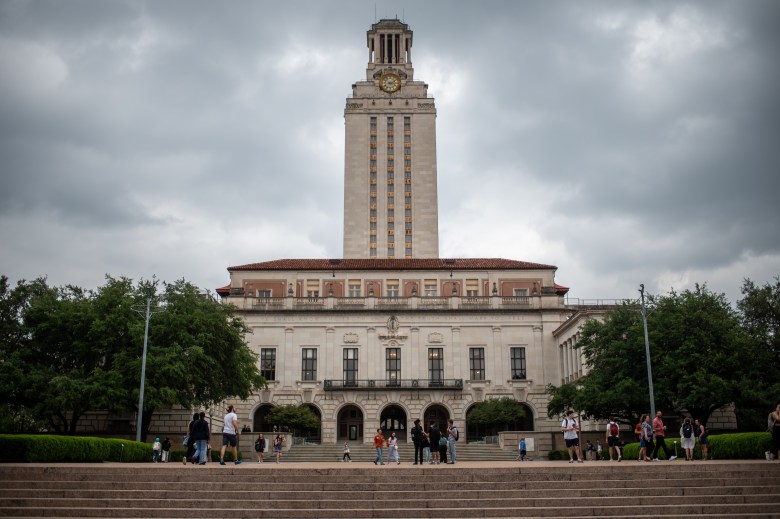
    Clouds fill the sky behind the tower at the University of Texas. Credit: Sergio Flores for The Washington Post via Getty Images

    “Universities, I think, are the ones that are put in this really difficult position,” Figueroa said. “They are not immigration experts. They’ve received very little guidance about how to interpret the consent decree.” 

    Amid so much confusion, Figueroa predicted, future lawsuits will likely crop up. Already, affected students and organizations have filed motions in court seeking to belatedly defend the Texas Dream Act against the DOJ.

    In the meantime, young scholars are facing difficult choices. One student, who asked to remain anonymous because of her undocumented immigration status, was scrolling through the news on her phone before bed when she saw a headline about the outcome of the DOJ court case. 

    “I burst in tears because, you know, as someone who’s been fighting to get ahead in their education, right now that I’m in higher education, it’s been a complete blessing,” she said. “So the first thing that I just thought of is ‘What am I going to do now? Where is my future heading?’ The plans that I have had going for me, are they going to have to come to a complete halt?’” 

    The young woman, who has lived in San Antonio since she was 9 months old, had enrolled in six courses for the fall at Texas A&M-San Antonio and wasn’t sure whether to drop them. It would be her final semester before earning her psychology and sociology degrees, but she couldn’t fathom paying for out-of-state tuition. 

    “I’m in the unknown,” she said, like “many students in this moment.”

    Contact editor Caroline Preston at 212-870-8965, via Signal at CarolineP.83 or on email at [email protected].

    This story about the Texas Dream Act was produced by The Hechinger Report, a nonprofit, independent news organization focused on inequality and innovation in education. Sign up for the Hechinger newsletter.

    The Hechinger Report provides in-depth, fact-based, unbiased reporting on education that is free to all readers. But that doesn’t mean it’s free to produce. Our work keeps educators and the public informed about pressing issues at schools and on campuses throughout the country. We tell the whole story, even when the details are inconvenient. Help us keep doing that.

    Join us today.

    Source link

  • From volume to value – shaping the future of international education recruitment

    From volume to value – shaping the future of international education recruitment

    Taking place on 16 September 2025 at Torrens University’s Surry Hills Campus in Sydney (17 Foveaux Street), this event brings together key stakeholders – education agents, government officials, providers across higher education, VET, ELICOS, plus service partners – for a critical industry reset.

    Amidst two years of sweeping reform in visa policies, compliance and accountability frameworks, and shifting global student demand, SYMPLED 2025 offers education recruiters a place for dialogue and strategy. Drawing from its reputation as one of Australia’s most practical events for admissions, compliance, and student-support experts, the symposium promises actionable insights and collaboration on the issues at hand 

    The program features a rich array of speakers, including:

    • Hon Julian Hill, assistant minister for international education 
    • Michal Sestak, founder and migration agent of SIS Consulting Pty Ltd and AustraliaOnline, moderating a panel on “The Dilemma of the Genuine Student” amid a surge in visa refusal appeals—from 2,400 in 2023 to 40,000 in 2025 
    • International student panel on the future of international student representative bodies 
    • Ian Aird, CEO of English Australia, in a “Call to Action” panel exploring the role of ELICOS in bridging tourism, working holiday, and long-term education sectors 

    Additional speakers include leaders from tuition protection, international education bodies, compliance, and provider networks:

    • Melinda Hatton, director of the Tuition Protection Service
    • Carmen Basilicata, executive director, Integrity, ASQA
    • Toshi Kawaguchi, director, international education, StudyNSW
    • Dirk Mulder, founder and CEO of The Koala News
    • Mark Lucas, senior vice president, HUATONG International (HTI)
    • Melanie Macfarlane, board member, ISEAA

    SYMPLED 2025 is where the international education community can recalibrate and collaborate, unlocking “value” in recruitment and practice for a more resilient future.

    For the full lineup, program updates, and registration, visit the official SYMPLED website.

    Source link

  • Care experienced students are assets, not risks

    Care experienced students are assets, not risks

    We have spent decades asking what support care leavers need to “catch up” in education. But what if we focused instead on what they already bring?

    Thirty years since I left the care system, I reflect on low expectations, persistent awarding gaps, and why higher education needs to reframe the care experience.

    Low expectations

    “One GCSE is enough, you’re in care”. That’s what I was told as a teenager growing up in the care system. That message stayed with me, if one GCSE was enough for someone like me, then I was not expected to succeed, I was expected to survive.

    By the time I was studying for my A levels I was living independently and worked full time. University at 18 was not an option, it was unthinkable. Years later, I found myself on a BTEC in health and social care as part of a role as a children’s rights worker, and that was where I discovered psychology.

    Suddenly, everything in my life made sense, my upbringing, my responses, the systems around me. I applied for university in 2002 and completed my first term while pregnant. At 36 I became a lecturer in education and psychology in higher education, teaching education through a psychological lens to education students, many of whom want to become teachers themselves.

    A full circle moment

    Recently, I hosted an A level psychology student for a placement. On the final day, she revealed that one of her teachers had been one of my undergraduate students. The moment was moving, not because she was care experienced (she wasn’t), or because the teacher was (they weren’t), but because it showed how my journey, rooted in care, had rippled out into the education system in ways I never imagined.

    That moment hit me like a wave. It was not just a neat coincidence, it was a full circle moment that challenged everything I had been told about my place in education.

    It reminded me that care experienced students are not simply passing through higher education as “at risk” individuals in need of support. Instead, we are contributing to it, we are building it and sometimes we are shaping the success of others in ways that last longer than we realise.

    Ditching deficit thinking

    What if we stopped asking what care experienced students lack? Too often, care leavers are described as “at risk” of exclusion, poor attainment, and drop-out. We talk about their trauma, instability, or disadvantage.

    Those challenges are real and need addressing – but rarely do we ask what strengths they bring with them. We bring resilience, not just as a feel good buzzword, but as a lived practice. We know how to manage under pressure, navigate uncertainty, and stay focused when stability is not guaranteed.

    We bring empathy, because we have seen how systems can fail people and we have learned how to listen, observe, and understand beneath the surface. We bring adaptability because when your life has taught you that plans change, support disappears, and people move on, you learn how to adjust quickly, quietly, and effectively and we bring purpose. Many of us enter education not out of expectation, but out of intent because we want to create the kind of impact we once needed. It is that intent that makes us powerful educators, mentors, and role models even for students who do not share our background.

    Within the classroom, I sometimes hear mature students described as “assets” because they bring work experience, life experience, and often support other students. Care experienced students who are appropriately nurtured and empowered bring their own strengths to their peers. They also bring different and valuable perspectives – particularly relevant to social sciences disciplines – about social inequity, systemic injustice, and resilience that can open up important conversations about theory and its relevance to the “real world” and prepare the students they learn alongside for work in a world in which they will encounter diverse and disadvantaged others.

    My time in care taught me skills that have defined my academic and professional life – I learned independence young and I developed empathy and adaptability not just emotionally, but practically, not as nice extras but as core strengths. They have helped me understand students better and helped shape the kind of lecturer I am.

    Care experienced students do not just overcome adversity, they carry rich insight, emotional intelligence, and a deep understanding of social systems and sometimes, like in my case, they help educate the people who go on to teach the next generation.

    Having said that, it’s 30 years since I left the care system – is it still the same?

    Not enough has changed

    In many ways, the system looks different today. Every looked-after child has a Personal Education Plan (PEP), schools appoint designated teachers, virtual school heads oversee progress, and there’s a £2,345 per-child annual Pupil Premium Plus. In principle, care-experienced learners are a priority. Some universities make contextual offers to care leavers in recognition of the challenges they faced on their way through the education system.

    Yet the numbers tell a different story:

    • only 37 per cent of looked-after children reach expected levels at Key Stage 2 (vs 65 per cent of peers)
    • only 7.2 per cent achieve grade 5+ in English and maths at GCSE (vs 40 per cent)
    • at age 19, just 13 per cent of care leavers enter higher education (vs 45 per cent of others).

    These gaps are not just statistical, they reflect structural inequalities, where expectations remain low and pathways to university feel closed off before they have even begun. For a care experienced student to find their way into higher education is a testament to their determination, resilience, and motivation before they even start.

    A fight not a right

    My mantra was “education was a fight not a right”. We may no longer say, “one GCSE is enough” out loud – but it is still heard in the subtext of our systems.

    We talk about “widening participation” and “belonging,” but too often, care experienced learners are left out of those conversations, or placed into categories of concern rather than capability. Recently, my ten-year-old said something that stopped me in my tracks: “children shouldn’t be judged on academic intelligence but on creative intelligence. School is more about following the rules than finding yourself.”

    They are right – the education system has moved from creativity to conformity and in doing so, we do not just risk excluding care experienced learners, we risk losing the individuality, emotional intelligence, and imaginative power that all students bring. The ones who have had to survive the most often bring innovation and creativity. When we centre care experienced voices in policy, in pedagogy, and in professional learning, we begin to close the awarding gap, the one that limits how we (and sometimes they) see their potential.

    Higher education did not just change my life. It gave me the chance to change other people’s too – and that is an opportunity we should provide to all our children.

    Source link

  • Mindfulness for Your Life in Academia with Jennifer Askey

    Mindfulness for Your Life in Academia with Jennifer Askey

    What does it mean to be a mindful academic? Jennifer Askey, PhD asked me about mindful practices when I was a guest on her podcast. While I went to a graduate program for creative writing where that was a focus, the mindful practices I’ve kept are simple. The one I shared with Jennifer? My favorite room spray, a ritual spritz I use just before meetings. Lavender, apple blossom, clover.

    It got me thinking how just talking about mindfulness can help us be more intentional with the care we give to ourselves. And, the spaces we create for other people. Not just mindfulness for self-care. When academics are more intentional about their thoughts and actions it makes a difference for all areas of your life.

    Join me and executive leadership and mindfulness coach, Dr. Jennifer Askey in this live conversation.

    Dr. Jennifer Askey is an executive leadership and mindfulness coach who works with higher education leaders all over North America. She leverages assessments, mindfulness practices, and powerful coaching conversations to help her clients build the career impact they want to see. In her coaching, the client’s own journey of self-awareness comes to the forefront, so that their personal and professional decisions are rooted in their values, their awareness of their skills and assets, and their commitments to community, organization, and family.

    Jennifer Askey, PhD, PCC

    Jennifer is also a sought-after workshop leader and team alignment facilitator. She works with units to establish a solid connection between their success parameters and their strategic and operational tactics. Her clients appreciate her sense of humour, her dedication to their growth, and her willingness to share resources, ideas, and inspiration with them. She is currently pursuing certification in the Sustained Dialogue methodology and Next-Stage Facilitation.

    Dr. Askey hasn’t always been a coach. She came to coaching first as a client in 2016, when she was seeking a career change. In her first career, she was a professor of German literature, language, and culture, specializing in young adult literature in German and comparative literature studies of Holocaust fiction. She holds a PhD in German Studies from Washington University in St Louis, is a Certified Professional Co-Active Coach, a Certified Positive Intelligence Coach, and a Professional Certified Coach through ICF.

    Source link