We have spent decades asking what support care leavers need to “catch up” in education. But what if we focused instead on what they already bring?
Thirty years since I left the care system, I reflect on low expectations, persistent awarding gaps, and why higher education needs to reframe the care experience.
Low expectations
“One GCSE is enough, you’re in care”. That’s what I was told as a teenager growing up in the care system. That message stayed with me, if one GCSE was enough for someone like me, then I was not expected to succeed, I was expected to survive.
By the time I was studying for my A levels I was living independently and worked full time. University at 18 was not an option, it was unthinkable. Years later, I found myself on a BTEC in health and social care as part of a role as a children’s rights worker, and that was where I discovered psychology.
Suddenly, everything in my life made sense, my upbringing, my responses, the systems around me. I applied for university in 2002 and completed my first term while pregnant. At 36 I became a lecturer in education and psychology in higher education, teaching education through a psychological lens to education students, many of whom want to become teachers themselves.
A full circle moment
Recently, I hosted an A level psychology student for a placement. On the final day, she revealed that one of her teachers had been one of my undergraduate students. The moment was moving, not because she was care experienced (she wasn’t), or because the teacher was (they weren’t), but because it showed how my journey, rooted in care, had rippled out into the education system in ways I never imagined.
That moment hit me like a wave. It was not just a neat coincidence, it was a full circle moment that challenged everything I had been told about my place in education.
It reminded me that care experienced students are not simply passing through higher education as “at risk” individuals in need of support. Instead, we are contributing to it, we are building it and sometimes we are shaping the success of others in ways that last longer than we realise.
Ditching deficit thinking
What if we stopped asking what care experienced students lack? Too often, care leavers are described as “at risk” of exclusion, poor attainment, and drop-out. We talk about their trauma, instability, or disadvantage.
Those challenges are real and need addressing – but rarely do we ask what strengths they bring with them. We bring resilience, not just as a feel good buzzword, but as a lived practice. We know how to manage under pressure, navigate uncertainty, and stay focused when stability is not guaranteed.
We bring empathy, because we have seen how systems can fail people and we have learned how to listen, observe, and understand beneath the surface. We bring adaptability because when your life has taught you that plans change, support disappears, and people move on, you learn how to adjust quickly, quietly, and effectively and we bring purpose. Many of us enter education not out of expectation, but out of intent because we want to create the kind of impact we once needed. It is that intent that makes us powerful educators, mentors, and role models even for students who do not share our background.
Within the classroom, I sometimes hear mature students described as “assets” because they bring work experience, life experience, and often support other students. Care experienced students who are appropriately nurtured and empowered bring their own strengths to their peers. They also bring different and valuable perspectives – particularly relevant to social sciences disciplines – about social inequity, systemic injustice, and resilience that can open up important conversations about theory and its relevance to the “real world” and prepare the students they learn alongside for work in a world in which they will encounter diverse and disadvantaged others.
My time in care taught me skills that have defined my academic and professional life – I learned independence young and I developed empathy and adaptability not just emotionally, but practically, not as nice extras but as core strengths. They have helped me understand students better and helped shape the kind of lecturer I am.
Care experienced students do not just overcome adversity, they carry rich insight, emotional intelligence, and a deep understanding of social systems and sometimes, like in my case, they help educate the people who go on to teach the next generation.
Having said that, it’s 30 years since I left the care system – is it still the same?
Not enough has changed
In many ways, the system looks different today. Every looked-after child has a Personal Education Plan (PEP), schools appoint designated teachers, virtual school heads oversee progress, and there’s a £2,345 per-child annual Pupil Premium Plus. In principle, care-experienced learners are a priority. Some universities make contextual offers to care leavers in recognition of the challenges they faced on their way through the education system.
Yet the numbers tell a different story:
only 37 per cent of looked-after children reach expected levels at Key Stage 2 (vs 65 per cent of peers)
only 7.2 per cent achieve grade 5+ in English and maths at GCSE (vs 40 per cent)
at age 19, just 13 per cent of care leavers enter higher education (vs 45 per cent of others).
These gaps are not just statistical, they reflect structural inequalities, where expectations remain low and pathways to university feel closed off before they have even begun. For a care experienced student to find their way into higher education is a testament to their determination, resilience, and motivation before they even start.
A fight not a right
My mantra was “education was a fight not a right”. We may no longer say, “one GCSE is enough” out loud – but it is still heard in the subtext of our systems.
We talk about “widening participation” and “belonging,” but too often, care experienced learners are left out of those conversations, or placed into categories of concern rather than capability. Recently, my ten-year-old said something that stopped me in my tracks: “children shouldn’t be judged on academic intelligence but on creative intelligence. School is more about following the rules than finding yourself.”
They are right – the education system has moved from creativity to conformity and in doing so, we do not just risk excluding care experienced learners, we risk losing the individuality, emotional intelligence, and imaginative power that all students bring. The ones who have had to survive the most often bring innovation and creativity. When we centre care experienced voices in policy, in pedagogy, and in professional learning, we begin to close the awarding gap, the one that limits how we (and sometimes they) see their potential.
Higher education did not just change my life. It gave me the chance to change other people’s too – and that is an opportunity we should provide to all our children.
What does it mean to be a mindful academic? Jennifer Askey, PhD asked me about mindful practices when I was a guest on her podcast. While I went to a graduate program for creative writing where that was a focus, the mindful practices I’ve kept are simple. The one I shared with Jennifer? My favorite room spray, a ritual spritz I use just before meetings. Lavender, apple blossom, clover.
It got me thinking how just talking about mindfulness can help us be more intentional with the care we give to ourselves. And, the spaces we create for other people. Not just mindfulness for self-care. When academics are more intentional about their thoughts and actions it makes a difference for all areas of your life.
Join me and executive leadership and mindfulness coach, Dr. Jennifer Askey in this live conversation.
Bio
Dr. Jennifer Askey is an executive leadership and mindfulness coach who works with higher education leaders all over North America. She leverages assessments, mindfulness practices, and powerful coaching conversations to help her clients build the career impact they want to see. In her coaching, the client’s own journey of self-awareness comes to the forefront, so that their personal and professional decisions are rooted in their values, their awareness of their skills and assets, and their commitments to community, organization, and family.
Jennifer Askey, PhD, PCC
Jennifer is also a sought-after workshop leader and team alignment facilitator. She works with units to establish a solid connection between their success parameters and their strategic and operational tactics. Her clients appreciate her sense of humour, her dedication to their growth, and her willingness to share resources, ideas, and inspiration with them. She is currently pursuing certification in the Sustained Dialogue methodology and Next-Stage Facilitation.
Dr. Askey hasn’t always been a coach. She came to coaching first as a client in 2016, when she was seeking a career change. In her first career, she was a professor of German literature, language, and culture, specializing in young adult literature in German and comparative literature studies of Holocaust fiction. She holds a PhD in German Studies from Washington University in St Louis, is a Certified Professional Co-Active Coach, a Certified Positive Intelligence Coach, and a Professional Certified Coach through ICF.
If you’re a proper Eurovision Song Contest loser like me, you look forward each year to the crowdsourced fansourced compilation of the season’s Iceberg.
On the surface is the stuff you figure that “normal” casual Saturday night viewers will notice – like the considerable coverage afforded to Malta’s entry this year, which involved its artist Miriana Conte attempting to argue that her song “Serving Kant” really meant “serving song”.
Then several layers below sea level there’s things like the news that Sasha Bognibov – who has entered the Moldovan selection several times with a series of increasingly creepy entries – had died of a heart attack, only to come back alive a few days later.
“Icebergs of ignorance”, as they’re officially known, were originally invented by a Japanese management consultant in the 80s. Sidney Yoshida’s keynote at the 1989 International Quality Symposium in Mexico had described his research on a car manufacturer named Calsonic – where he’d found that senior managers at the firm only saw about 4 percent of the issues, with the bulk hidden at lower levels.
And like an iceberg, most of the danger lies beneath the surface – with supervisors and frontline staff far more aware of the everyday challenges. In theory it all highlights the need for stuff like open communication, feedback loops and genuine staff voice – so decision-makers aren’t steering blind.
Under the surface
I’ve long been fascinated by the way the concept might apply in a university. Plenty of senior leaders might take the view that the cultural (and now regulatory/legal) protection afforded to academic staff saying critical things on social media on everything from workload to the travel booking system means very little is below the surface – but my guess is that that can breed complacency about the things that people don’t say out loud.
From a higher education sector and public perception point of view, we might interpret new research from the Policy Institute at King’s and HEPI in a similar way – an iceberg of misunderstanding where the surface-level chatter obscures the submerged reality.
The public apparently overestimate graduate regret, assumes that nearly half of graduates feel crushed by debt when only 16 per cent say so, and underestimate higher education’s economic heft. And like Yoshida’s managers, the danger isn’t so much ignorance of the big headlines as it is the quiet accumulation of false assumptions beneath the surface – gaps in knowledge that, if unchallenged, steer the national conversation off course.
But it’s the big financial crisis in the sector where I keep thinking most about the Iceberg. Above the surface, to the extent to which the issue is “cutting through”, it’s the prospect of a provider going under that the press seem really keen to report on. Every other day one of us at Team Wonkhe will get a message from journo or other asking us who might be on the brink, presumably because stories like this in the i Paper (“At least six unis at risk of going bust before 2025 freshers finish their degrees”) get clicks.
Just below the surface (for me at least) is what’s happening to student demand (or, more accurately, supply) – a process that seems to be converting “high”, “medium” and “low” tariff group categories into “medium”, “low” and “has a pulse” as each day of Clearing 2025 goes on.
The next level down for me is redundancy rounds and telegraphed cuts. They definitely sound bad – especially if a course closes. But if they result in 24 hour library becoming a 15 hour one, or the optional electives on an undergraduate degree being slashed, they seem be harder to pin down and understand – and often aren’t being picked up and protected by consumer law, complaints or Student “Protection” Plans.
The worst of all of that, at least so far, has been down the bottom end of the league tables – although journos hoping for an actual collapse may find that the realities of processes like endless cost-cutting remain buried at the bottom of the iceberg because of the amount of debt that everyone’s in.
A small provider like Spurgeon’s can fall over because the banks aren’t expecting millions to be repaid on shiny buildings – big universities extended in that way are likely to be able to renegotiate because banks like being paid back, albeit in a way that effectively surrenders the already shaky illusion that the Board of Governors is in control to a shadow board of bankers insisting on deeper and deeper cuts to students with the least social capital and confidence to complain about them.
We need a shrink
What then manifests is the scourge of shrinkflation. You know the idea – when the Quality Street tubs appear in the supermarket in September, you’re only minutes away from a national newspaper pointing out that there’s two fewer toffee pennies in this year’s tub of 525g than last year. I mean have you seen how small a Freddo is these days?
The problem for students is that this stuff is hard to spot and even harder to enforce rights over. It is simply not possible to lose the number of academic staff that the sector has lost over the past two years and for providers to not be in breach of contract – promises have either been broken, or the contract itself gives a university too wide a discretion to vary, or it doesn’t and the risks of not making the cuts are greater than the risks of a handful of students having the energy to complain.
And when the big red flags from the Office for “Students” are about financial sustainability with the odd askance murmur about finding efficiencies in a way that protects the student experience, it’s not as if the regulatory environment is doing anything other than egging on the shrinkflation. You’re only going to get inspected on the provision by OfS if your outcomes are terrible, and it seems to have all but given up doing inspections anyway.
Will a student enrolling onto a three year degree get the course they were promised in two years time? I’ve no idea, and all OfS can offer in protection terms is “let’s hope you paid your fees on a credit card because you might be able to get the credit card company to do a chargeback”.
Every year I get taken in by a fresh promise that OfS will actually enforce the stuff about broken promises. Almost a year ago to the day Director for Fair Access and Participation John Blake turned up at an SU staff conference to declare that he’d heard students worried about being promised one thing and getting another loud and clear. What he didn’t say was that a full year on, its new definitions of “fairness” will only apply to students in newly registered providers – with no sense of when “fairness” might be a thing for everyone else.
Deep down
But the temptation would be to assume that the harms of where we are are exclusively in those layers already mentioned. For me, right down at the bottom of the Iceberg – for the public, regulators and students themselves – is the sharing problem.
I often lament that being in a university library in certain weeks of the year is like being on a short-formed Cross Country train with no air con on a Bank Holiday Monday when the service before it has been cancelled. There’s nowhere to sit, everyone is very tense, and there’s a real sense that an actual fight might break out between two otherwise polite members of the public over a seat reservations issue.
There’s always an idiot with their bag on a seat, the catering trolley can’t get through, and the wheelchair user finds themselves yelling at those with suitcases because they’ve been plonked in the space for chairs at the end of the carriage. It’s carnage.
Over the years, I’ve often skim-read commentary from financial and management consultant types that “one less international PGT means needing to recruit two home students”, as if the only thing that matters is the overall financial target rather than having enough of everything for the students being recruited.
What I (almost certainly naively) never expected is that it pretty much is panning out like that at the top end of the tables – and while there’s debates to be had about acquisition costs, suitability for a course and/or culture, market instability and the loss of “local” options and choice, the thing that worries me most of all is the sharing thing.
Let’s imagine – hopelessly simplistically, I know – that some universities are indeed setting a financial target regardless of the number of students that would involve recruiting. As part of that, let’s imagine that these are universities more likely to recruit students living away from home. If 1 x PGT becomes 2 x UG, are there enough bed spaces in the city?
Enough is enough
Enough books in the library? Enough marking capacity to hit the 2 week turnaround pledge? Enough sockets for laptops when everyone’s in at once? Enough spaces in seminar rooms to avoid students sitting on the floor? Enough counselling staff to cope when that extra intake tips more students into crisis? Enough careers support to avoid queues that make the whole thing feel tokenistic rather than transformative?
Enough quiet corners for those who can’t concentrate in noisy shared flats or packed libraries? Enough placements to go around when professional courses all need them at the same time of year? Enough personal tutor appointments to avoid the system becoming decidedly impersonal? Enough contact with actual academics rather than a carousel of casualised staff? Enough eduroam bandwidth when every lecture, seminar, and social is streaming at once? Enough student housing that isn’t mouldy, miles away, or eye-wateringly expensive?
“Enough” is already pretty subjective – and itself subject to wild differences between subject areas on campus in a way that makes it hard to not always spot someone (probably an international PGT in the Business School) who’s worse off. Even if they knew they could and even if they were minded to, it’s pretty hard for a student to argue that something that is still there and was always shared is being stretched a little too thinly now.
And this sort of thing almost always manifests in conflict between students rather than pinning the blame tail on the university donkey – see our dismal debates about things like NHS access and immigration for a classic example.
It’s not even as if the regulator doesn’t understand. John Blake again, a year ago:
When the 2012 number controls were abolished, there are institutions that literally doubled in size overnight… I don’t know that the answer is us saying, no, you can’t have your students, or you have to do this. But I think there’s definitely scope for us thinking about what the obligation of institutions is to have discussions with their local community about where their students are going to go, because it’s clearly not sustainable for every institution to double itself overnight in small places.
See also everything else about a university experience that, by definition, involves sharing things.
Swear words
It remains the case that it’s almost as bad to sing the uncensored version of Miriana Conte’s Eurovision entry in a church as it is to even gently propose some student number controls. And even though one of the least publicly resisted immigration rules is not a cap but a “if you want more CAS, you have to think about whether you have the capacity” (maybe because it’s never been meaningfully or publicly enforced by UKVI), people even seem to be nervous about suggesting something like that for home students.
I’ve said it before and I’ll say it again – higher education is an endeavour that is profoundly unsuited to very rapid expansion and very rapid contraction at programme, subject and institutional level. But the biggest mistake of all would be to focus on the end of the league tables where the impacts of contraction are closest to the Iceberg’s surface.
Cramming tens of thousands more students into the cities of the (not so) high tariffs may well be just as damaging, all while the tone of their recruitment relationship – “you’re lucky to be here” – reduces the chances of students doing anything other than the HE equivalent of putting your head down, crouching next to the toilet and staring at your phone for three gruelling hours. Or, in HE’s case, years.
It’s really not hard this one. You want to expand your student numbers by more than 5 per cent in a subject area? Publicly consult on how you’ll do it – including the results of conversations with staff, students, the local community and local providers, and you’re on. Imagine suggesting out loud that doing some planning to ensure more students doesn’t mean a worse experience would represent a regulatory “burden”.
Utah State University will undergo a state audit following an initial review that found “concerns about USU’s governance, leadership, and culture of policy noncompliance.”
At a Tuesday meeting, the state Legislature’s audit subcommittee voted unanimously to conduct a deeper review of the university, which will look at governance and procurement processes, particularly in the president’s office.
The review comes amid reporting that Elizabeth Cantwell, the university’s former president, spent heavily on office remodeling and transportation during her tenure before departing earlier this year.
Dive Insight:
State legislative auditors raised issues with both spending practices and oversight controls at the highest levels of Utah State.
Under the heading of “leadership concerns,” they pointed to institutional purchase card transactions that “significantly increased” during the past two years compared to the preceding half decade.
Those increases occurred during the tenure of Cantwell, who was appointed president in 2023 and stepped down unexpectedly earlier this year to serve as president of Washington State University.
Alan Smith, dean of Utah State’s college of education and human services, is serving as interim president while the institution searches for a permanent leader.
This March, shortly after the announcement of Cantwell’s departure, Cache Valley Daily obtained public records of heavy spending during her tenure. The report noted a $285,000 office remodel that included more than $184,000 in furniture costs, over $800 in spending on mirrors and a $750 bidet toilet.
It also detailed several vehicles Cantwell used for transportation during her time at Utah State, including a new Toyota SUV and a $30,000 electric vehicle.
Auditors flagged purchase card spending during the past two years that “may be concerning due to the nature of the purchases, the dollar amounts involved, and the level of oversight.”
They also noted “issues with the amount spent on presidential motor vehicle assets in the last two years being almost triple the amount for the five years before.”
The review also raised concerns about how Utah State’s leaders acquired goods and services from third parties. Specifically, they found that some executive staff committed the university to contracts over $52,000 — and up to $430,000 — before completing the purchasing process.
Their report recommended a review of procurement policies, controls over open purchase orders, and spending and assets in the Utah State president’s office, as well as an evaluation of whether “governance and leadership at USU have the appropriate structure, tools, processes, culture, structure, and personnel in place to ensure success.”
On Tuesday, state lawmakers on the audit subcommittee called for a deep investigation of the university’s spending.
“I love Utah State. It’s a big part of my district, it employs a lot of people in my district,” one member told audit staff during the meeting. “But I have serious concerns about what is happening at Utah State right now, and so whatever latitude you feel that you need, I like to be part of authorizing that — as deep as you can go.”
Tessa White, chair of the university’s trustee board, voiced support for the state audit at the meeting.
“We welcome the audit,” White said. “There are areas that we are aware of and taking aggressive steps to remedy. We hope that by the time that your audit is done, we will have a whole list of things completed that will give you greater confidence in the school.”
Procurement policies and processes have come under fire at other public institutions as politicians and auditors home in on their spending practices.
Early this year, Gov. Michelle Lujan Grisham called for Western New Mexico University’s entire board of regents to resign after an auditing report surfaced spending by leadership that showed “a concerning lack of compliance with established university policies.”
A state audit late last year of the Connecticut State Colleges and Universities system found several financial transactions that violated institutional policies or lacked adequate documentation. That included some $19,000 in spending on food over two years by Chancellor Terrence Cheng.
In 2024, a state audit of University of Maryland Global Campus raised issues with leadership oversight of a spinoff nonprofit, pointing to — among other issues — a $25.7 million IT project that ended without a viable product.
This audio is auto-generated. Please let us know if you have feedback.
Dive Brief:
Five large school districts in Northern Virginia were put on high-risk status and told their federal funding would only be distributed by reimbursement from the U.S. Department of Education Tuesday.
The announcement comes after the Education Department last month found the five districts had violated Title IX through their policies allowing transgender students to use restrooms and locker rooms that match their gender identity.
As the Trump administration advances its agenda to exclude transgender students from sports teams and bathrooms aligning with their gender identities, LGBTQ+ advocates and Democratic lawmakers warn that these funding restrictions are unprecedented and will cause financial hardships to the districts.
Dive Insight:
Collectively, the five Virginia districts impacted have about $50 million in federal formula funding, discretionary grants and impact aid grants that will need to be processed through reimbursements, according to a Tuesday statement from the Education Department.
The districts — all located near Washington, D.C. — are Alexandria City Public Schools, Arlington Public Schools, Fairfax County Public Schools, Loudoun County Public Schools, and Prince William County Public Schools.
“We have given these Northern Virginia School Divisions every opportunity to rectify their policies which blatantly violate Title IX,” said U.S. Education Secretary Linda McMahon in the statement.
Under the Trump administration, the Education Department has maintained that transgender student inclusion in school facilities and on athletic teams encroaches on cisgender girls’ Title IX rights. The 53-year-old Title IX law prohibits sex discrimination in federally funded education programs.
“Today’s accountability measures are necessary,” McMahon said, because the five districts “have stubbornly refused to provide a safe environment for young women in their schools.”
After finding the districts in violation of Title IX in July, the Education Department’s Office for Civil Rights offered a proposed resolution agreement to the districts. The districts were asked to voluntarily agree within 10 days or risk imminent enforcement action including referral to the U.S. Department of Justice. However, the districts rejected those efforts.
The proposed resolution agreement would require the districts to rescind policies that allow students to access facilities based on their “gender identity” rather than their sex and issue a memo to each school explaining that any future policies related to access to facilities must separate students strictly on the basis of sex. The memo would have to specify that Title IX ensures women’s equal opportunity in any education program including athletic programs.
In addition, the agreement would require the districts to adopt “biology-based” definitions of the words “male” and “female” in all practices and policies relating to Title IX.
Fairfax County Public Schools, which has nearly 183,000 pre-K-12 students and is one of the country’s largest school systems, said in a Wednesday statement that the district is reviewing OCR’s letter about the district’s high-risk status and will then respond to OCR. In the meantime, the district is maintaining its policies that it said align with Virginia law and rulings from the 4th U.S. Circuit Court of Appeals.
“FCPS remains dedicated to creating a safe, supportive, and inclusive school environment for all students and staff members, including our transgender and gender-expansive community. Any student who has a need or desire for increased privacy, regardless of the underlying reason, shall continue to be provided with reasonable accommodations,” the district said.
The two Virginia senators, Mark Warner and Tim Kaine — both Democrats — condemned the action against the five districts, saying the Education Department “wants to punish high-performing, award-winning schools districts in Northern Virginia.
“You can’t have a strong economy without strong schools, so add this to the list of President Trump’s disastrous economic policies,” the senators said.
Denise Marshall, CEO of the Council of Parent Attorneys and Advocates, called the action a “direct assault on schools” in a Tuesday statement. The administration’s efforts to withhold “critical” funding are unlawful and amount to “political warfare” and “continue to do significant harm” to schools,” Marshall said.
She added the announcement “is part of the Administration’s pattern to exhibit explicit hostility towards LGBTQ+ students and students of color whose identity often intersects with and includes disability.”
But America First Legal — the organization that filed a complaint with OCR against the five districts earlier this year, sparking the Education Department investigation — condemned the five districts’ defiance of a “federal directive to end illegal ‘gender identity’ policies and choosing to follow extremist ideology over federal law while jeopardizing millions in federal funding.” The AFL had asked the department in its February complaint to “cut off all federal funding” if necessary.
Ian Prior, senior counsel at America First Legal, said in a statement Tuesday that the districts are “proving that they are deliberately indifferent to the safety of schoolchildren and are perfectly willing to sacrifice millions of dollars” in funding that he says supports low-income and special needs students.
Prior added that the “grim reality is that these school districts are merely delaying the inevitable — these policies will soon be dead and buried.”
This year marks the 75th anniversary of the Fulbright Program in Korea, one of the oldest and most robust binational educational exchanges in the world.
Coinciding with this milestone is the 30th anniversary of South Korea’s landmark 5.31 Education Reform – a policy blueprint that sought to transform the nation’s education system into a more open and globally competitive ecosystem.
The Fulbright legacy in Korea illustrates how long-term bilateral cooperation has scaffolded national education strategies and fostered intellectual diplomacy across generations.
The strategic alliance between the Republic of Korea and the United States has been underpinned by an enduring educational partnership. Education has always been more than a soft-power tool in this relationship; it has served as a central pillar for shared values, talent development, policy learning, and institutional co-evolution.
At a time when the Indo-Pacific region is undergoing profound geopolitical, technological, and demographic shifts, reaffirming the educational ties between Korea and the US is a strategic imperative.
Fulbright Korea: peacebuilding through knowledge
Established through a 1950 agreement, Korea became one of the first countries to join the Fulbright Program, though the Korean War delayed its launch until 1960. Revised agreements in 1963 and 1972 created the Korean-American Educational Commission (KAEC) and introduced joint funding, making Korea one of 49 nations to co-finance the programme with the US.
Since then, Korea has often matched or exceeded US contributions. Today, KAEC awards over 200 grants annually to Korean and American participants, supporting a global network of Fulbright scholars and more than 7,600 Korean alumni across diverse fields.
Fulbright Korea exemplifies educational diplomacy at its best. Graduate fellowships support future policymakers and scientists, while English teaching assistants serve across Korea’s provinces, enhancing not just language acquisition but also cross-cultural understanding.
These initiatives echo the lifelong learning ambitions embedded in Korea’s broader educational reforms, showing how international exchange and domestic innovation can reinforce each other. These long-standing programs have strengthened Korea’s education system while fostering mutual understanding, helping to build enduring people-to-people ties that support bilateral cooperation.
Fulbright Korea exemplifies educational diplomacy at its best
The US also supports student mobility and academic advising in Korea through EducationUSA, housed at KAEC, which offers Korean students up-to-date information on American higher education. Korea continues to rank among the top sending countries of international students to the US, with over 43,000 enrolled in 2023/24, making it the third-largest sender.
While the Ministry of Education’s 2024 data reports 3,179 American students enrolled in Korean higher education, US study abroad figures suggest that nearly twice as many participate in programmes based in Korea. The US has also been recognised as a key partner in Korea’s Study Korea 300K Project, which seeks to host 300,000 international students by 2027.
Institutional transformation and globalisation
The 5.31 Education Reform, declared in 1995 amidst the waves of globalisation, aimed to modernise Korea’s education system through two core principles: globalisation and informatisation.
These pillars reshaped how universities operate, allowing for greater curricular flexibility, the introduction of credit banking and recognition of prior learning, and the rapid adoption of digital tools. Competitive government initiatives like Brain Korea 21 and, later, the University Restructuring Plan incentivised research output and global benchmarking.
Despite uneven implementation, the reform not only accelerated the internationalisation of Korean higher education but also deepened its ties with US institutions. By 2008/09, over 75,000 Korean students were enrolled in US higher education, placing Korea among the top sending countries globally.
Given its relatively small population, this figure represented the highest per capita rate of US-bound students in the world. At the same time, Korea became an increasingly attractive destination for American students, with study abroad numbers growing substantially over the past two decades, growing from 2,062 in 2008/09 to 5,909 in 2022/23.
Even before the 5.31 reform, US higher education institutions played a pivotal role. In the decades following the Korean War, American graduate programs served as critical training grounds for a generation of Korean scholars. These individuals returned not as passive recipients or brokers of foreign models but as active knowledge creators who adapted global ideas to local contexts, built research infrastructure, and mentored emerging academics.
This process of intellectual circulation laid the groundwork for Korea’s ascent in global university rankings and research productivity. Foundational initiatives such as the Minnesota Project and the US-supported establishment of KAIST in 1971 were emblematic of this transformation.
Transnational education and role of program providers
Transnational education has added new depth to Korea-US educational co-operation. The Incheon Global Campus, which hosts the Korean branches of five US universities, enables local students to earn US degrees without leaving the country.
These institutions bring American accreditation standards and pedagogical approaches into the Korean context, serving as important centres for cross-cultural learning and academic collaboration. Increasingly, they also function as supportive platforms for study abroad, facilitating intercultural engagement. Modest but meaningful forms of faculty and scholarly exchange further enrich these settings.
Not-for-profit organisations such as IES Abroad have also become indispensable facilitators of educational exchange. Marking its 75th anniversary in 2025 as well, IES Abroad shares a parallel legacy with Fulbright Korea in advancing international education.
Its recently established Seoul Center has already hosted over 220 US students, exemplifying the growing role of study abroad programme providers in fostering engagement with Korean society. By offering for-credit academic programmes, cultural and language immersion, and hands-on learning opportunities, these providers play a crucial role in sustaining the depth and accessibility of bilateral educational exchange.
Toward mutuality and innovation
Together, these developments have yielded significant accomplishments: a thriving academic pipeline, robust knowledge circulation, improved global rankings for Korean institutions, and a steady increase in intercultural literacy among students from both countries. Korean graduates with US degrees now occupy leadership roles in government, academia, and business. American students return with deeper cultural understanding, with many pursuing careers in diplomacy, education, or East Asia-focused industries.
However, challenges remain. Some observers have raised concerns about the asymmetrical flow of talent, particularly during earlier decades when “brain drain” seemed more plausible than circulation.
Others caution against over-Americanisation in curricula and institutional culture. Korea’s demographic decline and the rising cost of US education now pose additional obstacles to sustained exchange. National policy shifts, ideological realignments, and increasing public scrutiny of foreign involvement in higher education further complicate the outlook.
Reimagining educational diplomacy
The pressing challenges highlight the importance of rearticulating a shared vision for the future, particularly as the direction of bilateral commitments established under previous administrations continues to evolve.
Mutual investment in scholarship funds, stronger collaboration among diverse stakeholders within the broader international education field, more accessible hybrid learning models, and enhanced joint governance of transnational campuses can all help to future-proof the Korea-US educational partnership.
In 2025, as we commemorate 75 years of Fulbright Korea and IES Abroad, and reflect on 30 years since Korea’s 5.31 reform, it becomes evident that international exchange and domestic transformation are not separate trajectories but mutually reinforcing forces. Korea-US educational cooperation has evolved from aid-driven assistance to a platform for peer-to-peer growth and innovation.
If approached strategically, the next chapter of this relationship can not only address pressing policy challenges but also reimagine the purpose of education in a world increasingly defined by brittleness, anxiety, nonlinearity, and incomprehensibility.
This audio is auto-generated. Please let us know if you have feedback.
Dive Brief:
The U.S. Department of Education quietly rescinded Obama-era guidance that called on states and districts to ensure English learners “can participate meaningfully and equally” in school and “have equal access to a high-quality education and the opportunity to achieve their full academic potential.”
The 40-page Dear Colleague letter, issued in 2015, commended districts for “creating programs that recognize the heritage languages of EL students as valuable assets to preserve.”
The department said in a statement to K-12 Dive that it rescinded the guidance because “it is not aligned with [Trump] Administration priorities.” The rescission of the guidance is part of a broader effort from the Trump administration to center the English language above all others.
Dive Insight:
The comprehensive and long-standing guidance included information on identifying and assessing potential EL students, evaluating EL students for special education services, ensuring their parents have meaningful access to information, and avoiding “unnecessary segregation” of EL students, among other tasks districts typically undertake when serving English learners.
Dear Colleague letters are not legally binding, but are often used to communicate to education stakeholders administration’s priorities and policy interpretations.
The current administration’s rescission of the guidance follows the department’s closure of the Office of English Language Acquisition, which was shut down entirely as part of the agency’s downsizing efforts that began in March.
Before its closure, that office helped ensure that English learners and immigrant students gained English proficiency and academic success, schools preserved students’ heritage languages and cultures, and that all students had the chance to develop biliteracy or multiliteracy skills.
The department’s erasure of the office and guidance that would have helped districts and states serve English learners comes amid other efforts from the Trump administration to prioritize the English language.
In March, President Donald Trump issued an executive order declaring English the national language, despite the country still having no legally established national language.
The order undid a Clinton-era orderthat required federal agencies to improve access to their programs for those with limited English proficiency.
The recent federal push to prioritize English over other languages and to reduce access for English learners comes at a time when the percentage of English learners in public schools is increasing.
There were approximately 5.3 million English learner students in fall 2021, compared with 4.6 million such students a decade prior, according to data from the Education Department last updated in 2024.
For schools, colleges, and universities, social media has become more than just a communications tool. It’s now a primary stage for community engagement, student recruitment, and institutional storytelling. It’s where prospects discover programs, parents check updates, and alumni stay connected. But here’s the challenge: opportunity without clear guidelines can quickly lead to risk. Without a social media policy, schools leave themselves vulnerable to privacy breaches, inconsistent messaging, blurred boundaries between staff and students, misinformation, accessibility oversights, and even regulatory non-compliance.
That’s why a strong, modern school social media policy is essential. It empowers your team with a clear mandate, sets guardrails for professional and ethical use, and establishes workflows that make social platforms a strategic advantage rather than a liability. Done right, a policy doesn’t stifle creativity; it gives staff, faculty, and student ambassadors the confidence to represent your institution authentically, safely, and effectively.
This guide will walk you through a step-by-step, practical framework for building a school social media policy from the ground up. Drawing on Canadian legal requirements like PIPEDA, MFIPPA, and FOIP/FOIPPA, as well as accessibility standards such as AODA and WCAG, we’ll highlight best practices you can adapt to your own institutional context. We’ll also pull in examples from reputable policies and toolkits already in use across the education sector, so you can see how schools of all sizes, from K-12 districts to large universities, are tackling this challenge.
The goal? To help you design a policy that protects your institution, builds trust with your community, and unlocks the full potential of social media as a driver of engagement and recruitment.
Struggling with enrollment?
Our expert digital marketing services can help you attract and enroll more students!
Step 1: Scope and Objectives (Set the Mandate)
The first step in building a school social media policy is setting its scope and objectives. In other words, define exactly what the policy will and won’t cover, and establish its purpose. Without a clear mandate, policies can easily become either too vague to be useful or so broad they’re unenforceable.
Start with the scope. Your policy should outline the types of accounts and activities it governs. This typically includes:
Official institutional accounts (the main school, college, or university channels).
Department, program, and athletics accounts are managed under the institutional brand.
Professional use of social media by staff when tied to their role at the institution.
Personal accounts only when they intersect with professional responsibilities, for example, when an employee references their school role in a bio or shares institutional content.
It’s equally important to clarify who the policy applies to. Most schools extend it beyond full-time employees to include contractors, volunteers, trustees or board members, and student workers. That ensures consistency across every voice representing the institution.
Next, define platforms in scope. Policies usually include public-facing social networks (Facebook, Instagram, TikTok, YouTube, X/Twitter, LinkedIn) and messaging apps when used for school business (e.g., WhatsApp, Slack, or Teams). Learning management systems (LMS) or academic collaboration tools like Brightspace or Google Classroom may be excluded if they’re already governed by separate policies.
Finally, tie the scope to objectives. A strong policy should:
Support institutional values and brand consistency.
Protect privacy and data security.
Ensure compliance with laws and regulations.
Safeguard professional boundaries between staff, students, and the public.
Promote accessibility and inclusivity.
Provide clear guidance for staff and students so they can engage with confidence.
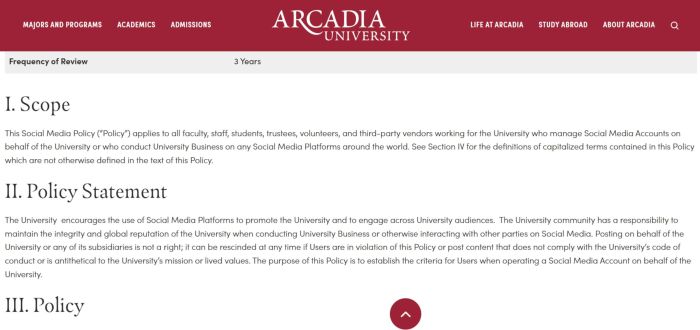
Example: Arcadia University’s social media policy explicitly applies to “all faculty, staff, students, trustees, volunteers, and third-party vendors” who manage accounts on behalf of the university. In other words, anyone handling an official or work-related social media presence is within the policy’s scope, not just employees. This breadth ensures a consistent standard across all channels and individuals associated with the school’s online presence.
Step 2: Risk and Needs Assessment (Ground It in Reality)
Before drafting rules, you need a clear picture of how social media is currently used across your institution. Start with an audit: which accounts exist, who manages them, what devices they use, and what level of access is granted? This mapping exercise not only shows how sprawling your social presence may be but also reveals immediate risks.
Categorize those risks clearly:
Privacy: posting student names, images, or personal data without consent.
Reputational: off-brand messaging, unmoderated comments, or negative publicity.
Operational: lost passwords, shadow accounts, or inactive pages damaging credibility.
Compliance: failures in records retention, accessibility (AODA/WCAG), or anti-spam legislation.
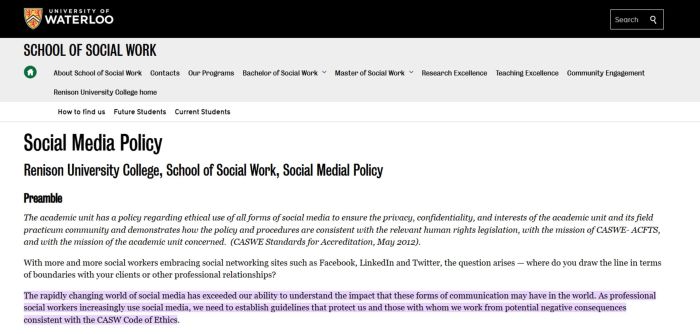
Example: University of Waterloo (Renison University College) – The School of Social Work’s social media policy begins with a frank acknowledgment of the rapidly changing social media landscape and the challenges it poses (e.g. blurred boundaries between students and professionals). It emphasizes the need for guidelines to protect everyone involved from “potential negative consequences,” directly addressing the risks and needs that prompted the policy. This reality-grounded preamble shows the policy was built in response to actual issues observed in practice.
Go further by interviewing principals, faculty, coaches, and IT/security staff. These conversations often uncover grey areas, like student leaders running unofficial team accounts or staff using messaging apps for school business.
For inspiration, review policies like the Toronto District School Board’s Procedure PR735, which provides clear guidance on professional use and compliance (TDSB PR735 PDF).
Finally, create a simple risk register (spreadsheet) listing each risk, its likelihood, potential impact, current controls, and planned mitigations. Revisit this quarterly to keep your policy grounded in reality, not theory.
Step 3: Core Legal and Policy Foundations (Canada-Specific)
Schools and their social media policy must be anchored in the laws and standards that govern privacy, access to information, and accessibility. In Canada, the framework varies depending on the type of institution.
For universities, colleges, and many independent schools in the private sector, PIPEDA applies. Its consent principles require that personal information be collected and shared only with meaningful consent that is specific, informed, and easy to withdraw (Office of the Privacy Commissioner of Canada).
Public institutions must look to provincial laws. In Ontario, MFIPPA governs how student information is collected, used, and disclosed (IPC Guide for Schools). In British Columbia, FOIPPA applies to boards, colleges, and universities, supported by practical guidance like the province’s social media tip sheet (BC FOIPPA Social Media Guide). In Alberta, FOIP covers public school authorities, with resources from the OIPC and universities.
What is an example of a social media policy? In higher education,Mohawk College’s Social Media Policy ties online activity directly to Canadian privacy laws, accessibility requirements, and internal codes of conduct, while also setting expectations for official accounts. For K–12,Greater Victoria School District Policy 1305 offers a concise framework rooted in district values and professionalism.
Accessibility is equally critical. In Ontario, the AODA requires that all digital communications be accessible, aligned with WCAG 2.0 levels A/AA.standards (Ontario Accessibility Guidance). Federally, the Treasury Board recommends WCAG 2.1 AA and EN 301 549 adoption (Government of Canada Digital Accessibility Toolkit).
Anchoring your policy in these laws ensures your institution not only reduces risk but also demonstrates accountability and inclusivity from the outset.
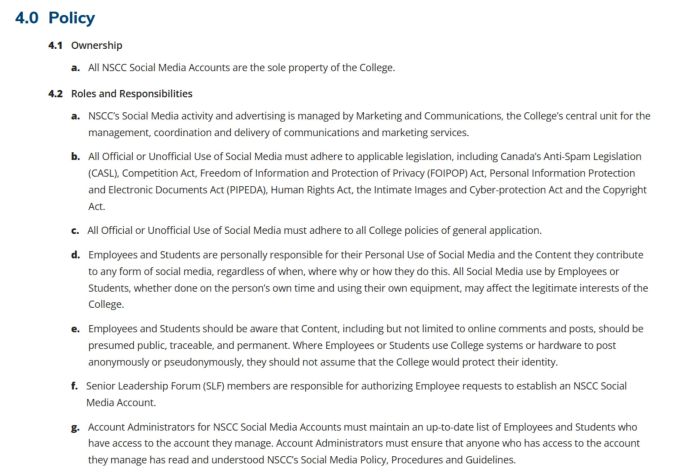
Example: Nova Scotia Community College (NSCC): NSCC’s Social Media Policy explicitly lists the Canadian laws and regulations that underpin acceptable social media use. It requires adherence to legislation such as Canada’s Anti-Spam Law (CASL), privacy laws like FOIPOP (provincial Freedom of Information and Protection of Privacy) and PIPEDA, the Human Rights Act, the Intimate Images and Cyber-protection Act, the Copyright Act, etc., as well as relevant college policies. By doing so, NSCC ensures its policy is grounded in national and provincial legal frameworks, providing a clear legal context for users.
Strong governance is the backbone of any school’s social media policy. Start by maintaining a central registry of all official accounts, whether institutional, departmental, or program-specific. For each, assign three roles: an accountable owner, a backup owner, and a communications/marketing lead. This ensures continuity when staff change roles. Require two-factor authentication across platforms, prohibit credential sharing, and centralize credential storage where possible.
Visual consistency matters, too. Borrow from UBC Brand’s social media guidelines on avatars, logos, and naming conventions to maintain a unified institutional identity (UBC Brand Guidelines).
Before any new account launches, establish an approval workflow. Require an application form documenting the account’s purpose, audience, staffing plan, and moderation strategy. This prevents “shadow accounts” and ensures new initiatives align with institutional priorities.
Finally, don’t overlook records management. Communications conducted through official accounts may constitute institutional records under provincial law. Align your policy with your school’s records retention framework, clarifying who is responsible for archiving social content.
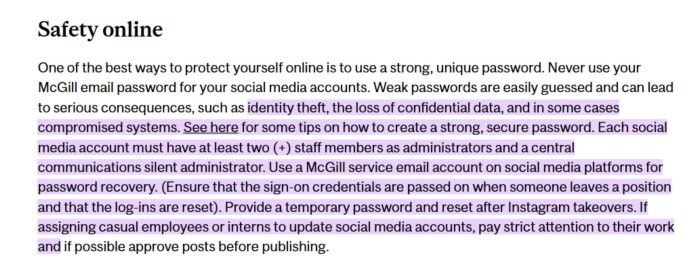
Example: McGill’s guidelines require each institutional account to have at least two staff administrators plus a “central communications” administrator, and that accounts be tied to a departmental email (not an individual’s email) for password recovery. These practices ensure accounts are not “personal fiefdoms,” they belong to the institution, and records (including login info and content archives) are managed responsibly.
For inspiration, look at NYC Public Schools’ staff social media guidance, which requires registration of official accounts and outlines monitoring expectations (NYCPS Guidelines). While U.S.-based, the governance structures translate well to Canadian contexts.
Step 5: Privacy, Consent, and Student–Staff Boundaries
Protecting personal information is one of the most important functions of a school’s social media policy. Define clearly what counts as personal data: names, images, video, voice recordings, and any identifiable details. As the Office of the Privacy Commissioner of Canada advises, consent should always be obtained before posting content involving others online (OPC Guidance).
In Ontario, boards must ensure alignment with MFIPPA. For example, Abbotsford School District’s AP 324 media consent policy demonstrates best practices, including clear parental consent forms and proper recordkeeping (Abbotsford AP 324 PDF). Such models can guide how to design workflows that balance opportunity with privacy protection.
Equally critical are staff–student boundaries. Your policy should mandate the use of approved channels only, no personal phone numbers, no personal accounts, and no “friend” connections with students online. Communication must remain professional and transparent. NYC Public Schools provide a helpful benchmark, with explicit staff guidance and even age-specific student social media guidelines (NYCPS Staff Guidelines).
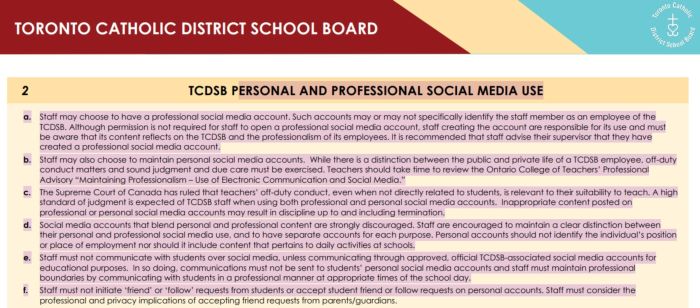
Example: Toronto Catholic District School Board (TCDSB): TCDSB’s social media guidelines draw very clear lines to protect privacy and maintain professional boundaries. Staff are forbidden from “friending” or privately messaging students on personal social media – all communication with students must occur through official, school-sanctioned accounts and only for educational purposes. The policy also enforces strict consent rules: no student’s name, photo, or any identifying information may be posted on social media without written parental consent, and the use of student images on official accounts must follow the board’s annual consent process in compliance with Ontario privacy law (MFIPPA).
✅ Do use only approved institutional channels for all communication.
✅ Do secure and store consent forms before posting student content.
✅ Do respect privacy by default. When in doubt, leave it out.
❌ Don’t use personal accounts, texts, or private messaging apps with students.
❌ Don’t post identifiable student content without explicit, recorded consent.
❌ Don’t blur professional boundaries (e.g., friending or following students on personal profiles).
Are teachers allowed to post their students on social media? Yes, but only with appropriate consent and in full compliance with privacy legislation. In the private sector, PIPEDA requiresmeaningful consent. Ontario’s public boards must follow MFIPPA, with guidance from theIPC’s education resources. By embedding privacy safeguards and clear boundary rules, schools protect students, staff, and their reputation while still enabling authentic digital engagement.
Step 6: Content Rules, Moderation, Accessibility, and Contests
A strong social media policy must tell people what to post, how to post it, and how to manage responses. Start with standards for tone, accuracy, and brand alignment. Require respectful, inclusive language and clear disclosures (e.g., partnerships, sponsorships).
Next, define moderation. Borrow from BC’s corporate moderation policy (BC Gov Guidelines): state what comments are removed (hate speech, spam, off-topic promotions), how warnings are issued, and when accounts are blocked. Make moderation workflows transparent to staff and users.
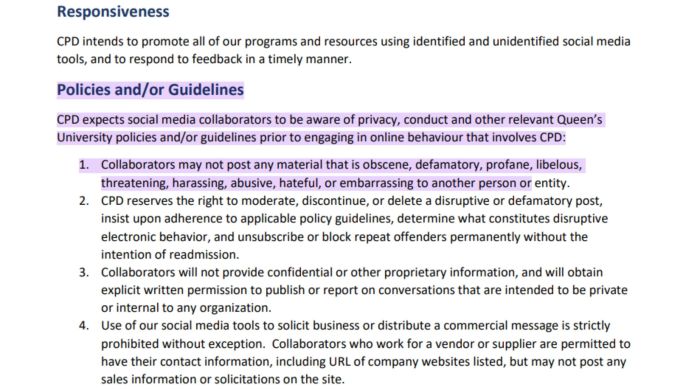
Example: Queen’s University underscores the importance of moderation rights: they reserve the right to delete disruptive or defamatory posts, and to remove or block users who repeatedly violate guidelines. Like other schools, they want to allow dialogue but will intervene if someone is, for instance, spamming the page or attacking others. The guidelines mention that collaborators (i.e., those who contribute to Queen’s social media) must “obtain explicit permission to publish or report on conversations intended to be private or internal”. In other words, don’t take a private email or a closed meeting discussion and post it publicly without consent – doing so could breach confidentiality. Similarly, no confidential or proprietary info about the university or its partners should be shared on social media.
Accessibility is non-negotiable. Every post should follow WCAG 2.0 levels A/AA and AODA requirements: alt text for images, captions for videos, no text-only graphics, and accessible hashtags (#CapitalizeEachWord). See Ontario’saccessibility guide and Canada’sDigital Accessibility Toolkit.
Contests or giveaways add another layer. Do social media contests require special rules? Yes. Schools must comply with Canada’s Anti-Spam Legislation (CASL) when running promotions involving commercial electronic messages or online entries. TheCRTC’s CASL guide andFAQs explain consent and identification requirements. For drafting contest rules, see legal overviews byBLG (2025) andGowling WLG (2023).
Checklist for Staff:
✅ Post accurate, respectful, branded content
✅ Add alt text, captions, and accessible formatting
✅ Moderate comments against clear rules
✅ Secure consent before promotions/contests
❌ Don’t post text-in-images without alternatives
❌ Don’t run contests without legal review
Step 7: Training, Launch, Metrics, and Continuous Improvement
Even the strongest policy fails without training. Translate your guidelines into practice by building role-specific training modules for account owners, moderators, coaches, and student ambassadors. Incorporate Canadian digital literacy resources like MediaSmarts’ Digital Literacy Framework (overview;full PDF) to reinforce safe, ethical, and effective online engagement. Support staff with PD sessions, publish an internal FAQ, and run scenario-based exercises, such as managing a doxxing attempt or handling a viral misinformation post.
When launching, stagger the rollout: pilot in one department, gather feedback, and expand with adjustments. Communicate the policy widely so every stakeholder understands their role. Schedule quarterly refreshers to ensure compliance as platforms, tools, and threats evolve.
Example: University of British Columbia (UBC): UBC provides a detailed Social Media Playbook and Project Planning Tips to guide training and content planning for account managers. They recommend auditing capacity before launch, building content calendars, and using analytics for continuous improvement. UBC also sets platform-specific tips (e.g., mobile-first design, proper hashtag use) to elevate training beyond policy to practice.
Success requires measurement. Track metrics that matter: audience reach, engagement quality, average response time, accessibility compliance (captioning/alt-text rates), harmful content removal time, and incident frequency. Pair this with annual policy reviews against your risk register and evolving legal obligations. Document revisions and circulate them across the institution so no one is left behind.
Checklist for Staff:
Complete mandatory training before account access
Use MediaSmarts or similar frameworks for student modules
Run tabletop exercises annually
Measure engagement, accessibility, and incident response
Review/update policy yearly
How to Use This Checklist
Policies can sometimes feel abstract, but implementation lives in the details. To make your school or institution’s social media policy actionable, translate the principles into operational steps your teams can follow every day.
The following checklist is designed as a drop-in appendix: administrators can copy it directly into their policy, while communications teams and account owners can use it as a quick reference. It consolidates the essentials, governance, privacy, accessibility, moderation, and security into a single, practical tool. Review it regularly, update it as laws and platforms evolve, and use it as both a compliance safeguard and a training guide.
Operational Checklist (Copy-Paste into Your Policy)
Action
Reference / Example
Maintain a central registry of all official accounts, owners, and backups; enforce two-factor authentication on every account.
Creating a modern, compliant, and effective school social media policy isn’t just about managing risk. It’s also about empowering your institution to communicate with confidence. The right framework balances opportunity and responsibility, ensuring your teams can build authentic connections with students and families while safeguarding privacy, accessibility, and professionalism.
At Higher Education Marketing (HEM), we help schools, colleges, and universities do exactly that. From developing policies rooted in Canadian legal standards to training staff and student ambassadors on best practices, our team specializes in building digital strategies that drive engagement and enrollment. Whether you need support crafting your first policy, auditing existing processes, or integrating governance into a broader digital marketing strategy, HEM provides the expertise to make it happen.
In a digital-first world, trust and clarity are everything. By partnering with HEM, your institution can move forward with a social media policy that not only protects your community but also amplifies your brand in the right way.
Struggling with enrollment?
Our expert digital marketing services can help you attract and enroll more students!
Frequently Asked Questions
Question: What is an example of a social media policy? Answer: In higher education,Mohawk College’s Social Media Policy ties online activity directly to Canadian privacy laws, accessibility requirements, and internal codes of conduct, while also setting expectations for official accounts. For K–12,Greater Victoria School District Policy 1305 offers a concise framework rooted in district values and professionalism.
Question: Are teachers allowed to post their students on social media? Answer: Yes, but only with appropriate consent and in full compliance with privacy legislation. In the private sector, PIPEDA requiresmeaningful consent. Ontario’s public boards must follow MFIPPA, with guidance from theIPC’s education resources.
Question: Do social media contests require special rules? Answer: Yes. Schools must comply with Canada’s Anti-Spam Legislation (CASL) when running promotions involving commercial electronic messages or online entries. TheCRTC’s CASL guide andFAQs explain consent and identification requirements. For drafting contest rules, see legal overviews byBLG (2025) andGowling WLG (2023).
The early years are a critical time to teach the foundations of math. That’s when children learn to count, start identifying shapes and gain an early understanding of concepts like size and measurement. These years can also be a time when children are confronted with preconceived notions of their abilities in math, often based on their race, which can negatively affect their math success and contribute to long-standing racial gaps in scores.
These are some of the motivating factors behind the Racial Justice in Early Math project, a collaboration between the Erikson Institute, a private graduate school focused on child development, and the University of Illinois Chicago. The project aims to educate teachers and provide resources including books, teacher tips and classroom activities that help educators combat racial bias in math instruction.
I sat down with Danny Bernard Martin, professor of education and mathematics at the University of Illinois Chicago, project director Priscila Pereira and Jennifer McCray, a research professor at the Erikson Institute, to learn more about their work. This conversation has been edited for length and clarity.
What are some of the key examples of racial injustice that you see in early math education?
Martin: If I say to you, ‘Asians are good at math,’ that’s something that you’ve heard, we know that’s out there. When does that kind of belief start? Well, there’s something called ‘racial-mathematical socialization’ that we take seriously in this project, that we know happens in the home before children come to school. Parents and caregivers are generating messages around math that they transmit to children, and then those messages may get reinforced in schools.
Even at the early math level, there are research projects beginning to construct Black children in particular ways, comparing Black children to white children as the norm. That is a racial justice issue, because that narrative about white children, Black children, Asian American children, Latinx children, then filters out. It becomes part of the accepted truth, and then it impacts what teachers do and what principals and school leaders believe about children.
What does this look like in schools?
McCray: Perhaps the math curriculum doesn’t represent them or their experience. We all know that often schools for children of color are under-resourced. What often happens in under-resourced schools is that the curriculum and the teaching tends to focus on the basics. There might be an overemphasis on drilling or doing timed tests. We also have those situations where people are doing ability grouping in math. And we know what the research says about that, it’s basically ‘good education for you, and poor education for you.’ It’s almost impossible to do any of that without doing harm.
One line of research has been to watch teachers interact with children and videotape or study them. And in diverse classrooms with white teachers … often it is observed that children who are Black or Latina aren’t called on as often, or aren’t listened to as much, or don’t have the same kind of opportunity to be a leader in the classroom.
What should teacher prep programs, administrators and families do to address racial justice issues in early math?
McCray: Maybe the white teacher is reflecting on themselves, on their own biases … trying to connect with families or communities in some way that’s meaningful. We want teachers to have that balance of knowing that sometimes you do want to teach a procedure, but you never want to be shutting down ideas for creative ways to solve a math problem, or culturally distinct ways to solve a math problem that might come from your students.
It might be something like, you’re working on sorting in an early childhood classroom. And what if a child is thinking about a special craft that their parent does that’s like the [papel picado], or papers that get cut in very elaborate designs in Mexico. … If the teacher doesn’t have space to listen, it could be a shutdown moment, instead of a moment of connection, where the child is actually bringing something … that is associated with their own identity.
Pereira: I do feel that sometimes the conversations of racial justice really put the weight on teachers and teachers alone. Teaching is part of a larger structure. Maybe your school will not allow you to do the work that is needed. I’m thinking about [a teacher] who was required to follow a scripted curriculum that did not promote the positive math identity for Black children. It needs to be a whole community effort.
How is your initiative changing this?
Pereira: There are resources in terms of opportunities that we offer to teachers to engage with our content and ideas: webinars, a fellowship and an immersive learning experience in the summer of 2026. These spaces are moments in which educators, researchers and people that are engaged in the education of young learners, can come together … and disrupt mainstream notions of understanding what is racial justice and how one gets that in the classroom.
Right now, research and initiatives zeroing in on race are under scrutiny, especially at the college level. Do you foresee any additional challenges to this work?
Pereira: There was a National Science Foundation grant program focused on racial equity in STEM and we had been planning to apply for funds to do something there. … It’s gone. … The only place we’re welcome is where there’s a governor who is willing to take on Trump. We just have to keep doing the work, because we know what’s right. But it is challenging, for sure.
The Hechinger Report provides in-depth, fact-based, unbiased reporting on education that is free to all readers. But that doesn’t mean it’s free to produce. Our work keeps educators and the public informed about pressing issues at schools and on campuses throughout the country. We tell the whole story, even when the details are inconvenient. Help us keep doing that.