Job shadows are one way to give students a behind-the-scenes look at the daily operations and undertakings of a particular role or industry, giving them a deeper perspective than an informational interview or job description may provide. However, opportunities to engage in career exploration experiences can be limited, particularly for lower-level students.
A winter 2023 survey found 22 percent of respondents had never had experiential learning or an internship while in college. Among first-year respondents, that number grew to 28 percent.
To increase access to career exploration for first-generation students early in their college experience, Harvey Mudd College in California partnered with alumni around the country to offer short-term job shadows in students’ hometowns. The experiences offered students a chance to define their STEM career goals and establish a professional network.
Survey Says
Students say giving them access to and preparation for career-building spaces is critical for their success. A May 2024 Student Voice survey by Inside Higher Ed and Generation Lab found 38 percent of students believe helping them prepare for internships and career success should be a top priority for career centers.
The background: Harvey Mudd is a liberal arts college that provides exclusively STEM degrees. Its current strategic plan focuses on expanding students’ career navigation experiences, particularly helping them connect their major program with life after college, said Shannon Braun, director of career services.
“A lot of time they really know what they want to study because it’s interesting to them, but not how that applies to life after Mudd or during Mudd,” Braun said. “It can be a little difficult.”
Staff elected to focus first on students who could most benefit from a job-shadow experience and exposure to a professional work setting.
“We landed on our first-gen, who may not have had some of the opportunities that other students might have, like a take-your-kid-to-work day,” Braun said.
How it works: The pilot program focused on students enrolled in Mudd’s Summer Institute, a precollege program for incoming students from underresourced high schools and those who are first-generation or from groups historically underrepresented in STEM.
Summer Institute participants indicated if they would be interested in a summer job-shadow opportunity, as well as some information about their hometown, program of study and career goals. From there, the career services office partnered with the alumni and family engagement office to identify hosts that matched students’ location and interests.
The focus on a student’s hometown was in part tied to logistics—most first-year students go home during the summer before their second year, and it was more cost-effective to provide job shadows where they were residing, Braun said. But staff also hoped it would expose students to career opportunities locally and near family, which can be a strong pull for first-generation students in particular, and help them affirm their major decision.
“Another benefit of this program is, let me shadow an engineer and see if I’m into that, or let me shadow a programmer to see if I’m into that,” Braun said.
After the alumni and students were matched up, both groups completed orientations prior to the job shadow addressing what makes a good job-shadow experience, questions to ask of the student or host, and transportation to and from the host site. All job shadows happened in the metropolitan area of the student’s hometown, so most participants commuted at least some distance.
The college also reimbursed students for their travel and lunch for the day, about $150 on average.
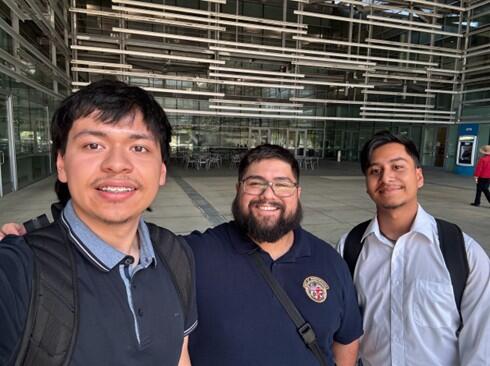
The impact: Ten students participated in cities ranging from neighboring Los Angeles and Altadena to farther away in Redmond, Wash., and Denver. Over all, student and alumni feedback indicated all parties were pleased with the experience.
“Students said this was something that they felt was informative for them, either picking a different major or thinking about an industry that they wanted to go into,” Braun said. Alumni said it was a feel-good experience and an opportunity for them to give back, as well.
One change staff are considering is to rebrand the program. The pilot was titled “Muddship,” a play on internship, which was confusing for both groups, so staff are brainstorming a new title that clarifies this isn’t work-based learning but a low-stakes career-exploration experience.
For next year, Braun and her team are hoping to offer job shadows over winter, spring and summer breaks, allowing more students to participate.
The program has limited funds, but Braun would like to see additional dollars invested for stipends on the front end so the students don’t have to pay out of pocket to participate. Braun also sees value in offering students the opportunity to travel to job shadows or providing students with professional dress to enter job-shadow spaces, which would require more financial resources, as well.
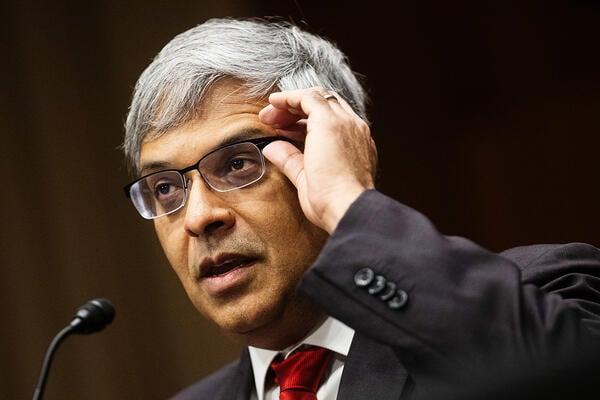
NIH director Jay Bhattacharya said that among other priorities, the agency will focus on artificial intelligence and “ensuring evidence-based health care for children and teenagers identifying as transgender.”
Jim Watson/AFP/Getty Images
The National Institutes of Health’s director ordered employees to “conduct an individualized review of all current and planned research activities,” including active grants and funding opportunity announcements, according to images of a document provided to Inside Higher Ed. The review comes amid concerns that the NIH won’t distribute all of its allocated grant money by the time the federal fiscal year ends Sept. 30, meaning those dollars will return to the U.S. Treasury.
The document images, provided by a source who wished to remain anonymous due to fear of retaliation, show that NIH director Jay Bhattacharya sent the memo Friday and that the review is effective immediately. According to the memo, “relevant NIH personnel” must review grants, funding opportunity announcements, contracts, contract solicitations, applications for new and competing renewal awards, intramural research and research training programs, cooperative agreements, and “other transactions.”
The order is part of a larger memo in which Bhattacharya outlined “select agency priorities” and said projects that don’t align with these priorities may be “restricted, paused, not renewed, or terminated.” The focuses are, among other things, artificial intelligence, “furthering our understanding of autism” and “ensuring evidence-based health care for children and teenagers identifying as transgender.”
In response to a request for an interview about the review and why it’s needed, the NIH press team sent a public statement from Friday, in which Bhattacharya listed the priorities.
Regarding health care for transgender youth, he said, “There are clearly more promising avenues of research that can be taken to improve the health of these populations than to conduct studies that involve the use of puberty suppression, hormone therapy, or surgical intervention.” He says that “by contrast, research that aims to identify and treat the harms these therapies and procedures have potentially caused … and how to best address the needs of these individuals so that they may live long, healthy lives is more promising.”
Bhattacharya’s letter comes after President Trump, earlier this month, ordered senior appointees at federal agencies to annually review discretionary grants “for consistency with agency priorities.”
Joanne Padrón Carney, chief government relations officer for the American Association for the Advancement of Science, said in a statement to Inside Higher Ed that the president’s budget request for fiscal year 2026 already outlined a set priorities for the rest of the current year.
“Switching gears at this stage reinforces confusion, diminishes trust, and increases concerns within the scientific community,” Carney added. “It joins the long list of tactics risking impoundment of congressionally appropriated funds rather than funding biomedical research that is essential for the people’s well-being.”
For many decades, the National Collegiate Athletic Association preserved student athletes’ amateur status by prohibiting their ability to profit off their name, image or likeness (NIL). As a former Division I compliance coordinator, I often felt the NCAA’s amateurism policies went too far—denying student athletes the right to earn money like other college students, such as by running their own sports camps.
But now the courts have turned the NCAA’s concept of amateurism on its head with the approval in June of a $2.8 billion athlete compensation settlement, which will be shared by student athletes who previously missed out on the opportunity to make money from their NIL. This historic deal between Division I athletes, the NCAA and the Division I Power 5 conferences—the SEC, Big Ten, Big 12, Pac-12 and ACC—has also made revenue sharing with current student athletes a reality.
Athletes at top football and basketball programs may be celebrating this financial victory, which allows institutions to share up to $20.5 million each year with student athletes—money generated from media, tickets, concessions and donations.
But many coaches who recruit them—along with professors like me, who teach them—believe that paying college athletes for their athletic ability will hurt college sports. That’s because doing so professionalizes college athletes in a way that hurts other students and sports over all and compromises the institution’s academic mission.
And while some student athletes stand to benefit from the new system, most won’t. Many universities will use the 75-15-5-5 model, meaning that 75 percent of the revenue would be distributed to football, 15 percent to men’s basketball, 5 percent to women’s basketball and 5 percent to all other sports.
Paying players will also change the spirit of college sports. Although the concept of amateurism has been a joke in college athletics for a long time—particularly in revenue-generating sports—a pay-for-play system would further move the emphasis away from educational goals and toward commercial ones. As one big-time head football coach described it to me, “As soon as you start paying a player, they become in some ways their [university’s] employees. It’s not amateurism anymore.”
On many campuses, a separation already exists between student athletes and nonathletes, which some believe is due to student athletes’ perceived privilege. According to one Division I women’s basketball coach I spoke to, implementing revenue sharing will only increase that divide. Student athletes receiving five- or six-figure salaries to play for their institutions will be incentivized to devote more time to their sport, leaving less time to engage in the campus community and further diluting the purpose of college as an incubator for personal and intellectual growth.
There’s also a possibility, one coach told me, that colleges will shrink staff and “avoid facility upgrades in order to fund revenue share,” putting off improvements to gyms or playing fields, for instance. At some institutions, funding the revenue-sharing plan will undoubtedly lead to cuts in Olympic and nonrevenue sports like swimming and track.
What’s more, it remains unclear how revenue-sharing plans will impact gender equity, because revenue distribution may not count as financial aid for Title IX purposes. Since 1972, Title IX has ensured equal opportunities for female student athletes that includes proportionate funding for their college athletic programs. If NIL payments from colleges are not subject to Title IX scrutiny, athletic departments will be allowed to direct all revenue generated from media rights, tickets and donations to their football and men’s basketball programs. As one Division I women’s basketball coach put it to me, “We are widening the gap between men and women athletes.”
To be sure, the college sports system is problematic; as scholars have pointed out, it exploits student athletes for their athletic talent while coaches and athletic leaders reap the benefits. But creating professional athletes within educational institutions is not the answer.
Instead, I propose that all student athletes participate in collective bargaining before being required to sign employment-type contracts that waive their NIL rights in exchange for a share of the revenue.
Collective bargaining would ensure that student athletes are guaranteed specific commitments by their institutions to safeguard their academic success, holistic development and well-being. These could include approved time off from their sport to participate in beneficial, high-impact practices like internships and undergraduate research, and academic support to help them excel in a program of their choosing—not one effectively chosen for them to accommodate their athletic schedule.
The graduation rates of student athletes—particularly Black male football and basketball players at the top Power 5 institutions—are dismal. A 2018 study by Shaun R. Harper found that, across the 65 institutions that then comprised the Power 5 conferences, only 55.2 percent of Black male athletes graduated in six years, a figure that was lower than for all student athletes (69.3 percent), all Black undergraduate men (60.1 percent) and all undergraduates (76.3 percent). Under collective bargaining, student athletes could retain their scholarships, regardless of injury or exhausted eligibility, to help finish their degrees. Such financial support would encourage athletes to stay in college after their athletic careers end.
They could also negotiate better mental health support consistent with the NCAA’s best practices, including annual mental health screenings and access to culturally inclusive mental health providers trained to work with athletes. Coaches would learn to recognize mental health symptoms, which is crucial; as one former women’s basketball coach told me, she didn’t “have the right language” to help her athletes.
Presently, the NCAA’s posteligibility injury insurance provides student athletes only two years of health care following injury. Collective bargaining could provide long-term health care and disability insurance for those sustaining injuries during college. This matters because football players risk their lives every day to make money for their institutions—doubling their chances to develop chronic traumatic encephalopathy with each 2.6 years they play and likely significantly increasing their chances of developing Parkinson’s disease relative to other nonfootball athletes.
As one football coach mentioned to me, it may be too late to put the proverbial genie back in the bottle when it comes to pay for play, but it’s not too late for colleges to prioritize their academic mission in their athletic programs, care for students’ well-being and restore the spirit of college sports.
Debbie Hogan works and teaches at Boston College. Her research focuses on holistic coaching, student athlete development and sense of belonging of Black student athletes.
Over the past seven months, members of the American Association of University Professors, a 110-year-old organization that is fundamental in defining and protecting academic freedom, have found themselves, their disciplines and their universities on the receiving end of the Trump administration’s unrelenting attack on higher ed.
As Republicans in some states diminish the influence of faculty senates, AAUP state- and campus-level chapters, which often also represent faculty as official unions, have led the criticism of the federal government’s actions. But how is the AAUP planning to fight now—more than half a year into Trump’s return to power, as Washington continues to pressure some of the country’s most powerful universities into making concessions?
Late last week, Inside Higher Ed interviewed Todd Wolfson, whom AAUP members elected as their president in June 2024. A former union leader at Rutgers University, Wolfson denounced the Trump-Vance ticket well before the GOP victory in November. Now, he’s leading the AAUP as it protests, sues and otherwise tussles with Trump.
The following transcript of the interview has been edited for clarity and concision.
Q: We’re now more than six months into Trump’s second administration. What is the current state of academic freedom?
A: It’s being washed over by an administration that has no respect, or even probably understanding, of the concept. We’re seeing massive infringement of academic freedom at the individual level. But then, it’s also the academic freedom of institutions.
In the McCarthy era, the attacks on academic freedom were attacks on individual faculty and demands for loyalty oaths and those sorts of attacks on individuals, not on institutions. So I’d say that, in the current moment, academic freedom is under its most fundamental attack we’ve ever seen, both in its attack on individual academics, but also on institutional autonomy from the federal government, ideological control.
Q: Did you expect the Trump administration to target higher ed this much, or in these ways? What has and hasn’t surprised you?
A: We were raising the alarm about this from before the election. We were very concerned about statements coming out of … the Trump campaign and then JD Vance’s mouth. So we recognized a threat. I mean, if you go back and look at Trump’s campaign video about higher ed, it’s like pure lunacy, right?
And it’s not that this was new—because [of Florida governor] Ron DeSantis—but it was alarming. Even with that, though, I would say that, clearly, we underestimated how dangerous it was. I did not expect a wholesale assault on the sector, squeezing it from every direction. And so, yes, I’m surprised. We were not prepared for how they’ve approached dismantling higher education.
I never expected the Trump administration to take a democracy, or the health of American society, to heart, because they’re grifters and they’re in it for their own personal power and their own personal wealth. But I did not expect that they would be so outlandishly intent on destroying a sector that’s so important to the fundamental values and power of American society.
Q: Yeah, you called then–vice presidential candidate JD Vance a fascist last August. Has he turned out to be one?
A: I would say so.
Vance and Trump and [Christopher] Rufo and Stephen Miller and the ilk that run our government are fascist in a 21st-century variant—not operating within the constructs of our society, [but] trying to rip those constructs down. I think the last six months have borne out my position pretty well.
The ilk that run our government are fascist in a 21st-century variant—not operating within the constructs of our society, [but] trying to rip those constructs down.”
Q: How has the AAUP resisted the Trump administration’s actions, and universities’ apparent responses to those actions?
A: The first and most important is we’re organizing our members, we’re doing a lot of political education with them, we’re thinking together about the problems at the campus level and then the problems at the state and national level, and we’re talking about how we approach it. We’ve grown more than this organization has ever grown in the last six months.
We built out coalition[s]. And so I think the most important [coalition]—but not the only one—is that we have established and coordinated a space called Labor for Higher Ed where all the international unions sit together and work together to come up with a coordinated plan to respond to the Trump administration. That’s never happened before. We have every major union that has higher ed workers sitting at that table.
[Secondly,] we sued the Trump administration on our own six times. With our AFT [American Federation of Teachers] as our [union] affiliate … probably another three or four times.
They’re doing so many things that are so obviously unconstitutional and illegal, and so we’re trying to use the courts to slow them down.
The third [tactic]—and you’ll see more of this, but you’ve probably been watching and seen it throughout the spring of last year—is getting our people into the streets, fighting back, offering a different vision. This has primarily happened in response to the NIH, NSF cuts.
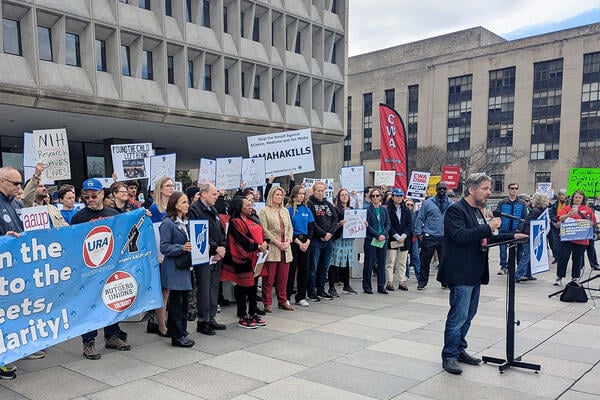
Wolfson (at podium) at a news conference at AAUP headquarters in Washington, D.C.
Ryan Quinn/Inside Higher Ed
The fourth area is that we need to offer … a countervision of higher education to the Trump vision, which is higher education ideologically controlled by the federal government, in its most extreme form, as well as the complete destruction of our biomedical research infrastructure and our research over all.
We’re working on a policy vision that will move us into the midterms … a counterimaginary of higher ed to the imaginary that’s been developed by the Trump administration, by Chris Rufo, one where we’re all Marxist ideologues indoctrinating our students.
The last area is that we’re supporting the development of organizing at the campus level to challenge and hold our administrations accountable, whether supporting the mutual aid defense compact projects that [have] mushroomed across higher ed, or supporting the fights at campus levels around academic freedom and freedom of speech, or any other number of things that we’re doing to support faculty at the campus level, to get their administrations to hold firm and not to bow to the Trump administration’s demands before they even make them.
We had 40,000 members, now we have something like 50,000 members [since Wolfson was elected president last year]. By the end of the calendar year, I’d like to see [60,000]. And that’s dues-paying members.
Q: Has there been an increase in the number of campus chapters or state conferences?
A: Since Trump was elected, I think we’ve grown by at least 40 chapters. Some of those chapters had gone dormant and then renewed and came back to life.
So if we had, when [current AAUP leaders] took office, something like 500 chapters, now there’s something like 550.
Q: Do you have any regrets about tactics or actions your organization has taken so far during the second Trump administration?
A: Certainly, I have regrets. Everyone makes mistakes. I don’t know if this is a regret, [but] I think that our sector is not fully ready to respond to the real threats. Our sector needs to be able to take militant job actions and other sorts of actions as this issue continues to ramp up.
We won’t do that if we don’t have the ability to do it at a scale that makes it powerful and meaningful and effective. And so I think that’s the thing we are working on, and anything we do—and I want to underscore this—would be nonviolent and peaceful.
But, nonetheless, we need to be able to militantly show how concerned we are—not only over our own institutions and our own jobs and our students, but also around higher education and the future of our democracy.
Q: Is what you’re saying is needed is a simultaneous general strike across higher education institutions across the country?
A: If we continue to have a federal government that takes over our cities and puts our cities under martial law and abuses the institutional autonomy of our higher education institutions and does all sorts of things that we all see are undemocratic and dangerous, we need to be prepared not only for a general strike in higher education, but a general strike over all.
I don’t think a higher education general strike is an action that will be effective, because I don’t think that higher education alone has this sort of industrial power to hurt the economy in a way that could force us to try to move through this moment.
If the Trump administration continues on its course … the only force that could respond to that effectively is a labor movement that is willing to withhold its labor, and in a general way.”
But I’m saying if the Trump administration continues on its course—which is a course that’s antidemocratic, that could undermine elections, that could take over cities, that could endanger citizens in the way it did in L.A. and now is doing in D.C., and that is destroying our democracy one piece at a time—that the only force that could respond to that effectively is a labor movement that is willing to withhold its labor, and in a general way.
Q: I was wondering whether you felt that your organization relied a little too much on litigation, or whether protest fell flat.
A: Maybe society writ large in the U.S. is depending too much on courts. I wish we were prepared, as workers in the sector, to take approaches that were more direct than just the courts. But, obviously, we can only be a reflection of the workers in the sector. We cannot, as an institution, push ourselves well beyond where our workers are at.
Q: I think many people would agree that things have gotten worse and worse as the Trump administration has progressed … What does AAUP plan to do differently going forward?
A: There can’t be an expectation that the moment that the Trump administration took office, that … all of the higher ed workers and our students would have been ready and prepared to respond. There is often a lag time between a crisis and the public’s response to that crisis.
We should be critical of ourselves and critical of our tactics and think about how to respond better and move forward better. We see the next 16 months as really important, and that rolls us through the midterms of 2026.
We don’t plan to do this alone. We plan to do this with every higher ed worker, and so that’s why Labor for Higher Ed—this table that represents millions of higher ed workers coming together and working together and coming up with this plan together—is so important. We’re also building an aligned table with our students and student organizations, and also with alumni and alumni organizations. And so we think that if those three forces can come together and fight specifically over higher ed, we can make a real fight.
Wolfson at a rally outside the Health and Human Services Department headquarters.
Ryan Quinn/Inside Higher Ed
But I’ll say this … higher ed workers alone cannot beat back the Trump administration. It needs to be a multisector fight. Federal workers—who are also under attack—we need to build alliance with them. K–12 teachers, health-care workers, immigrant workers, progressive community organizations all need to build an aligned front that is ready to take risks, because if we don’t take those risks, we may look at what we have in 2026 and we might not have clean, fair elections.
I think we have to take that very seriously, and we have to build our power to respond.
[Currently, we need] a real fight around the budget, from now through October, a fight around the budget that demands a fully funded NIH, NSF, NASA, [that] pushes around the destruction of the student loan program [and] fights over the TRIO program … which is a program for first-generation college kids.
From there, we are going to be really working on our campuses, building campus-level campaigns and state-level campaigns around higher education.
The things we want to have in [the national] vision are things like a demand for free public higher education, college for all and an end to adjunctification, an end to student debt, more research funding … and then use that vision to really fight for candidates that lift up our imagination of higher education as we move into the midterms.
We are going to fight in the streets and we’re going to fight politically. This is a political battle, and we need to respond politically in this battle.
Q: How do you fight an enemy that seems to thrive on conflict and to derive strength partly by othering certain groups of people—and, among those groups of people … faculty?
A: Faculty and the press and people of color and women and gay people and trans people and anybody that’s not white, Christian nationalist, in the end, is othered. And then even within the white Christian nationalist community, if you’re not MAGA, or you care about a free press, or care about free inquiry, you’re othered.
That first six months was a freaking whirlwind, and so we were really reactive, we were reacting. The Trump administration set the tone—not just for us, to be clear, obviously [for] the Democratic Party, but the progressive community more generally or any sector under attack.
We have been too reactive to the political environment, and so I think the biggest thing that we need to do is stay on our message and vision.
Now there seems to be some fracturing, maybe over Palestine, in the right-wing echo chamber. But, in general, that echo chamber has operated in lockstep and it’s huge, and we don’t have anything like that. Whatever we do, we’re never going to have the megaphone that they have. But, what I do believe is that we must put out our own proactive vision. It can no longer be “Ron DeSantis is mean, and he’s saying bad things about DEI and we need to stop him,” or “Donald Trump is saying bad things about Harvard,” or “Chris Rufo, can you believe how ridiculous the things he puts out are?”
We can’t be constantly responding to them. We can’t have kids going into hundreds of thousands of dollars of debt to get a college degree, and we need to make sure that we have work with dignity and free inquiry and we need to make sure we have the best research infrastructure in the world.
Q: You mentioned Palestine. What position, what action, if any, does national AAUP need to take on Israel and Palestine at this moment? … I know that you guys already dropped your categorical opposition to academic boycotts before Trump’s election.
A: We believe strongly that no weapons should be sent to Israel, at all. Not defensive or offensive, nothing.
What do we do in the U.S., where antisemitism has been used as a weapon, in many ways, by the Trump administration to bring universities to heel—and many times stripping out, or threatening to strip out, hundreds of millions of research dollars that often affect Jewish faculty members? Versus what our position should be on the conflict in the Middle East?
First and foremost, our job is to safeguard ourselves at home and to set a vision that aligns with what we’re trying to do in the United States. We need to stand up for academic freedom, for freedom of speech, for freedom of assembly for our students so they can protest the war—the genocide, excuse me—that’s taking place in Gaza.
We need to stand up to the weaponization of antisemitism in the Title VI process. And we need to make sure that we defend our members.
We think the Jerusalem Declaration on Antisemitism, which does not get involved with questions of the Israeli state at all, is a much more apt way of defining antisemitism.
The numbers of universities and faculty and university presidents [in Gaza] that have been killed and universities that have been destroyed in this war is mammoth. We are certainly educating our members on this concept of scholasticide.
It seems pretty obvious that they are—but if, in fact, Israel is purposefully destroying the educational infrastructure, both K–12 and higher ed, of Palestine, and of Gaza, that stands against our values of academic freedom. And if that’s the case, and we can unify around that, then we will take a stand and call for an end to the scholasticide.
Q: What will it take, ultimately, to get the Trump administration to relent in its attacks on higher ed?
A: Ultimately, we need a massive movement of higher ed workers and students. But, again, I don’t think that’s enough.
I believe as higher ed goes, so goes democracy. But the converse isn’t absolutely true. Higher ed alone cannot save democracy, but we’re a critical part.
It needs to be a broader societal movement to save our country.
The Oregon Health & Science University will receive a $2 billion gift from Nike co-founder Phil Knight and his wife, Penny, to support the eponymous Knight Cancer Institute, OHSU announced last week.
It is the largest single donation ever made to a U.S. university-affiliated health center and is intended to promote the integration of cancer diagnostics, treatment and patient care.
The gift will allow the cancer institute to become self-governed within OHSU. It will have its own board of directors under the leadership of Brian Druker, a leukemia researcher who has worked closely with the Knights and who helped develop a drug that vastly improved the life span of patients with chronic myeloid leukemia.
“This gift is an unprecedented investment in the millions of lives burdened with cancer, especially patients and families here in Oregon,” said OHSU president Shereef Elnahal. “It is also a signal of trust in the superlative work that our clinicians, researchers and teammates at the Knight Cancer Institute do every day. Dr. Druker’s vision around a multidisciplinary system of care—focused squarely on making the patient’s experience seamless from the moment they receive a diagnosis—will now become reality. And thanks to the extraordinary generosity of Mr. and Mrs. Knight, Oregon will be the place to do it.”
The Knights have been key benefactors of the cancer institute. In 2013 they vowed to donate $500 million if the university could match the funds within two years—which it did, thanks to $200 million in bonds from the Oregon Legislature, $100 million from Columbia Sportswear chair Gert Boyle and assorted donations from some 10,000 individuals from all 50 states and 15 countries.
If you have the opportunity to apply for a job at the University of Michigan’s Center for Academic Innovation, do so. If they offer you the gig, accept.
The two roles that CAI is recruiting for that I want to highlight are:
I asked Suzanne Dove, CAI’s chief education solutions officer, to answer four questions about the roles.
Q: What is the university’s mandate behind these roles? How do they help align with and advance the university’s strategic priorities?
A: Education Solutions is a new team within the University of Michigan’s Center for Academic Innovation, charged with bringing strategic focus and forward momentum to our partnerships with external organizations, both private and public, seeking an innovative educational provider for workforce development.
A growing and robust set of high-value strategic partnerships is an essential component of CAI’s growth strategy in the decade ahead. We are responsible for engaging prospective partners, identifying opportunities and crafting relevant educational solutions in collaboration with other CAI teams and U-M faculty and ensuring a high-quality partner experience. We also provide thought leadership around the shifting workforce-development landscape.
Q: Where do the roles sit within the university structure? How will the hires in these roles engage with other units and leaders across campus?
A: The Center for Academic Innovation is a strategically focused central campus unit at the University of Michigan. We aim to shape the future of learning by unlocking new opportunities for the University of Michigan community and learners, as well as organizations around the world. Our vision is a future in which education connects and empowers learners everywhere to reach their full potential throughout their lives.
The people who join our team in these two new business development roles will play a vital role in connecting CAI to organizations outside the university, understanding and supporting solutions that fulfill these organizations’ evolving workforce and talent development needs, and helping us scale these partnerships in alignment with CAI’s mission. Successful candidates will bring expertise in developing and nurturing strong partnerships with external organizations at regional, national and international levels, as well as the ability to adopt an industry perspective.
Q: What would success look like in one year? Three years? Beyond?
A: Year one is about building the foundations for successful partnerships, both by experimenting with different ways we can serve organizational partners and by taking a systematic approach to deliver, evaluate and learn as we go. We will work together to establish a robust and vibrant pipeline of strategic partner organizations, evaluate their organizational learning needs and determine ways in which our current and future catalog of offerings can serve those needs.
At three years, I expect we will be engaging with a set of strategic external partnerships and have built our understanding of the educational solutions that we’re best positioned to provide. Beyond that, we want to scale these solutions to match the vast needs of workforce trends and transitions around the world.
Q: What kinds of future roles would someone who took either of these positions be prepared for?
A: I am excited for the people we hire as business development specialists because their work will position them at the intersection of building relationships, understanding the dynamic world of workforce learning and building internal processes to allow effective delivery of educational solutions for organizations. The result will be a tangible impact not only on people’s lives but also on the organization’s performance.
I can envision plenty of doors that would open as a result of success in one of these positions, depending on the individual’s interests: HR or talent development leadership; a workforce or economic development agency at the local, state, federal or even global level; or a larger or more complex business development portfolio.
One thing I have noticed about CAI since I joined a few months ago is that there are plenty of opportunities for team members to grow and stretch. If you are an intellectually curious, creative problem solver who leads by listening and collaborating, if you love to take an initial concept and help a team and organization bring it to life, I hope you’ll apply!
Please get in touch if you are conducting a job search at the intersection of learning, technology and organizational change. If your gig is a good fit, featuring your gig on Featured Gigs is free.
Florida State College at Jacksonville has signed an agreement with U.S. Immigration and Customs Enforcement to allow its campus police department to enforce immigration laws.
An ICE database shows the agreement is still pending.
FSCJ joins more than a dozen other public institutions in Florida that struck similar agreements with ICE earlier this year, part of the state’s crackdown on immigration under Republican governor Ron DeSantis.
While police agencies in a number of other states have signed on to participate in the federal government’s immigration enforcement actions, the only campus police forces to join the effort are located in Florida, according to an ICE database that lists partners that have finalized agreements with the federal agency.
College officials previously told the local news outlet Jax Today that they were under the impression that FSCJ’s police department was too small to be considered for an agreement with ICE. However, spokesperson Jill Johnson told Inside Higher Ed by email that is not the case.
“Initially we thought that our police department was not large enough,” Johnson wrote. “This changed last week when we were notified that our officers were in fact eligible to go through the federal training necessary to be able to work with ICE officials, should the need arise.”
This HEPI blog was kindly authored by Joanna Hart, Products, Services, and Innovation Director at the Mauve Group.
In the last couple of months, the UK Government has unveiled a 10-year, Modern Industrial Strategy and published an Immigration whitepaper, which referenced expanding visa pathways such as the High Potential Individual and Global Talent visas. The industrial strategy aims to attract highly skilled global talent in eight priority sectors, with a strong focus on technology and innovation. Collectively, these efforts to attract global graduates are undercut by new barriers facing international undergraduate students.
Ongoing changes to the Skilled Worker visa, including steep increases to salary thresholds, and tighter restrictions on dependents, combined with proposals to shorten the Graduate Visa, and introduce a controversial 6% international student levy, create mounting financial and reputational pressure on UK universities, while also deterring international undergraduates.
In response, institutions are turning to establishing overseas campuses to offset domestic shortfalls and attract local talent who may still benefit from expanded UK visa pathways post-graduation. While attracting high-level international talent is valuable for addressing skills gaps in the UK, it must be part of a broader, symbiotic strategy. One that nurtures international students from undergraduate level through to employment to ensure UK higher education remains globally competitive.
Visa routes
An important step in the much-needed long-term strategy is the implementation of expanded visa pathways such as the High Potential Individual (HPI) visa and the visa, traditionally for internationally educated post-graduates and entrepreneurs.
High Potential Individual (HPI) visa
The High Potential Individual (HPI) visa is a UK immigration pathway designed for recent graduates from 40 top global universities, providing the opportunity to live and work in the UK for several years. At present, 47% of universities on the list are from the US, with just one institution from the entire southern hemisphere featured.
The Immigration whitepaper released in May and the UK government’s industrial strategy referenced extending the HPI visa to a wider selection of global universities. According to the UK government, it intends to roll out a ‘capped and targeted expansion of the HPI route for top graduates, doubling the number of qualifying universities.’ However, we do not yet know whether this expansion will be based on global league tables or geographic location.
Innovator Founder visa
The Innovator Founder visa offers the opportunity for founders of new, innovative, viable and scalable businesses to operate in the UK for three years. Traditionally, it facilitates incoming innovation, but the newly announced UK industrial strategy suggested the Innovator Founder Visa would be reviewed to make it easier for entrepreneurial talent currently studying at UK universities to be eligible. Details are yet to be disclosed but recent figures reveal that the average Innovator Founder Visa application success rate to the UK is almost 88%. While this is significant, it is not as high as other visa types, such as the Skilled Worker Visa, which is 99%. While the overall approval rate for Innovator Founder Visa applications sits at 88%, this figure can be misleading. The critical bottleneck is at the endorsement stage the first hurdle in the process, where the success rate drops sharply to just 36%
Skilled Worker and Graduate visa
Changes to visa pathways for domestically educated international students, including the Skilled Worker and Graduate visas, may result in applicants feeling short-changed. For example, it has been proposed that the standard length of the Graduate visa, which allows international students to remain working in the UK at the beginning of their careers, be reduced from two years to 18 months. If implemented, it may make it hard to secure a career after studying in the UK.
Meanwhile, effective from the 22nd July 2025, the minimum salary threshold for the Skilled Worker visa will rise to £41,700. Occupation-specific salary thresholds will also increase by about 10%, with the minimum skills requirements raised to Royal Qualifications Framework (RQF) level 6 for new applicants. Prior to the changes, between 30 and 70 per cent of graduate visa holders in employment may not have been working in RQF level 6 or above occupations. Although there are some discounted thresholds for PhD students, especially in STEM fields, these changes are set to exclude many current Skilled Worker visa holders.
How will higher education respond to stricter selective visa rules?
Drawbacks
One of the major drawbacks comes from the announcement that the government is considering introducing a 6% levy on higher education provider income from international students. It is likely that universities will be forced to consider passing these costs onto international students. The UK’s higher education sector generates £22 billion annually from international students and education, making it a valuable export to the UK in an increasingly competitive global market. The proposed levy risks discouraging international students and undermining this critical source of economic growth.
Many institutions will already have factored in price increases to account for rising costs going forward, making an additional 6% unfeasible.
Numerous universities are already struggling financially, with courses and entire departments being cut. With the possibility of a highly reduced international student body due to the levy and further changes to graduate visa pathways, these institutions face increased strain, meaning even more drastic cuts may be imminent.
Benefits
With an emphasis on higher visa thresholds, rising costs and the controversial 6% levy on international fees, UK universities face growing challenges to remain competitive in the global education landscape.
In response, many are rethinking their models, with institutions like the Universities of Liverpool and Southampton establishing campuses in Bengaluru and Gurugram, India, respectively. UK Universities operate 38 campuses across 18 countries, educating over 67,750 students abroad. Embracing international collaboration not only broadens the research opportunities available to UK universities but also supports financial sustainability and preserves the UK’s reputation as a global education powerhouse. By establishing overseas campuses and hubs, the UK’s academic influence extends well beyond its borders. This pivot will provide opportunities for international students to receive UK-affiliated accreditations, potentially giving them greater access to selective UK visa pathways post-graduation.
To adapt, higher education must develop a more integrated approach; one that links international recruitment, offshore campuses, and expanded visa pathways in a cohesive, long-term strategy. This means not only attracting global graduates but supporting students from undergraduate level through to employment, driving opportunity and innovation in the UK.
If UK institutions are to remain global leaders, they must work with the government to ensure that opportunity does not begin at graduation; it begins at enrolment. By nurturing this full pipeline, universities can continue to feed the skilled workforce envisioned in the new industrial strategy.
In UK higher education, compassion is often treated as an optional extra, something to be considered once the metrics are met, the audits are done, and the strategies are signed off. This framing misses the point.
Compassion is not a soft skill or a luxury. It is not something we add in once the “real work” is done. It is a strategic ethic and a way of designing systems, relationships, and institutions that enable people to thrive. It is about recognising suffering and taking meaningful action to alleviate it. It is about creating conditions in which students, colleagues, and leaders can do their best work, sustainably.
In higher education, compassion is often misunderstood, mistaken for sentimentality or seen as incompatible with the rigour and excellence that universities are expected to uphold. This is a false dichotomy. Compassion is not the opposite of academic excellence; it is what makes it possible.
When compassion is embedded into the culture and infrastructure of a university, it doesn’t lower standards, it sustains them. It doesn’t avoid challenges; it enables people to meet challenges without burning out. And it doesn’t replace accountability, it reframes it, through a lens of relational responsibility and shared purpose.
The recent Universities UK report, Transformation and efficiency: towards a new era of collaboration, arrives at a moment of reckoning. The pressures facing the sector, whether financial, regulatory, or reputational, are not new, yet they have intensified. The report offers a clear and necessary diagnosis and outlines seven opportunities for transformation, including developing collaborative structures, sharing services and infrastructure, shared procurement, digital transformation, benchmarking efficiency and strengthening leadership and governance.
These are important and they are also technical – but technical change, while necessary, is not sufficient. What’s missing is the cultural infrastructure that helps these changes take hold and endure. Without it, transformation risks becoming transactional and something done to people, rather than with them. This is where compassion becomes essential and as the connective tissue that binds strategy to sustainability as opposed to being an add-on. Compassion enables us to ask different questions: “What can we change?” AND “How will this change be experienced?” or “How do we become more efficient?” AND “How do we remain human while doing so?”
Addressing burnout
At this time of year, the signs are everywhere: exhaustion, disillusionment, a creeping sense that the work is never done, and the values that brought us into the sector are being eroded by the systems we now work within.
Burnout is not a personal failing; it is a systemic signal. As Maslach and Leiter remind us in The truth about burnout, burnout arises when people face too much work, too little control, and a misalignment of values. These are organisational design problems as opposed to individual resilience problems. If we want transformation, we must prioritise the conditions in which people are expected to transform. Compassion, understood as a framework for action, offers a way to do this. It invites us to design systems that are effective, humane and investing in people’s capacity to give, as opposed to just demanding more.
Humility is also something required of us at this moment, acknowledging that we are all stepping into the unknown; planned change in a complex system is, at best, hopeful fiction. We cannot predict exactly what will emerge and we can choose how we show up in the process.
Compassion gives us permission to not have all the answers and it allows us to hold space for uncertainty, and to move forward anyway, together. Transformation is a collective endeavour and one that will only succeed if we create conditions in which people feel safe enough, supported enough, and connected enough to participate.
Transformation needs cultural infrastructure
Transformation is a human and technical exercise. It emerges or recedes in the spaces between people: how they experience change, how they relate to one another, and how they make sense of their work. Without attention to culture, even the most well-designed reforms risk faltering.
Compassion offers a way to build the cultural infrastructure that transformation requires, inviting different, deeper questions, such as how change will affect relationships, how institutions can recognise and respond to emotional experience, what inclusive design looks like in different contexts, and where the spaces are that enable people to reflect, connect, and recover. These questions are central to whether transformation efforts succeed or stall; culture is the medium through which change happens.
The Covid-19 pandemic gave us a glimpse of what compassionate institutions can look like. Faced with crisis, many universities responded with agility and care; extending deadlines, adapting policies, and prioritising inclusion. These were acts of strategy, not charity. They enabled continuity, protected equity, and demonstrated the sector’s capacity for humane innovation.
They also revealed that compassion, when practised in systems not designed to support it, can come at a cost that is less often acknowledged. The compassion extended to others was not always matched by compassion for self. Many colleagues gave more than they had to give, and when the crisis faded, the systems around them reverted to old norms including rigid timelines, performance metrics and competitive cultures. The emotional weight of compassion is not inevitable; it becomes heavy when systems are misaligned, when care is expected and not enabled. In the right conditions, compassion is a way of working that restores us as opposed to a burden.
This reveals a deeper truth: our systems were never designed to sustain compassion. If we want to embed it beyond moments of crisis, we must treat it as a core institutional value and to recognise that compassion includes ourselves.
Compassion in practice
Here are five shifts that can embed compassion into the fabric of transformation.
1. Reframe wellbeing as strategic infrastructure
Wellbeing is not a side project. It is foundational to performance, retention, and innovation. Institutions could move from monitoring wellbeing to designing it through embedding it in curricula, policies, workload models, and leadership practices.Boundaries can be enacted, encouraged, and celebrated.
2. Recognise and resource emotional experience
The work of care, whether in teaching, research, service, or leadership, is often invisible and undervalued. It can become labour and lead to empathic distress, when systems make it unsustainable. When time, space, and support are present, compassion is a source of meaning and connection. We can name it, measure it, and reward it, factoring it into workload models, promotion criteria, and professional development.
3. Design for relational accountability
Compassionate systems are relational systems. Transformation must ask: how will this affect relationships? What power dynamics are at play? Whether it’s a new assessment policy or a shared service model, the relational impact matters.
4. Create space for reflection and connection
Efficiency is not about doing more with less, it’s about doing the right things well. Institutions must create time and space for colleagues and students to reflect, connect, and recover. This is infrastructure, not an indulgence.
5. Build on what already works
Compassion is not new. Across the sector, there are already informal networks, communities of practice, and relational leadership approaches enacted that embody compassionate principles. The task is to amplify, connect, and learn from them.
The Universities UK report rightly identifies collaboration as a route to transformation. Collaboration is a relational practice as well as a structural arrangement that requires trust, shared purpose, and the ability to navigate differences. These capabilities grow through connection and trust and cannot be mandated; they are human ones, developed through compassion and sustained by culture.
Compassion can also help us rethink our perception of resistance. Too often, “resistance to change” is dismissed as inertia or protectionism when it is often a signal of fear, of loss, of values under threat. Compassionate leadership invites active listening to this signal and responsiveness with transparency, inclusion, and care.
Compassion is a whole-university approach as opposed to be the responsibility of student services or human resources and notably visible in:
Teaching: through learning environments that prioritise dialogue, inclusion, and mutual respect.
Support services: by moving from transactional help to meaningful connection.
Leadership: by sharing power, modelling visibility, and practising relational accountability.
Policy: by asking, always, how decisions will affect relationships and wellbeing.
The UUK report offers a timely and necessary roadmap for sector-wide transformation. To realise these ambitions, we will need to prioritise our focus on culture and connection alongside systems and structures; compassion is a strategic imperative.
This is an invitation to those leading transformation, to see compassion as a driver of efficiency; to policymakers, to recognise that sustainable change requires care as well as compliance; and to all of us in the sector, to choose compassion for ourselves and others as a way of being and not just as a crisis response.
The future of higher education depends on what we do and critically how we do it and, on the cultures, we choose to develop. If we create the conditions for compassion to thrive in higher education, it will no longer feel like a burden, it will become a source of meaning, connection, and renewal. This is how transformation becomes possible and sustainable.
All views expressed in this blog are entirely those of the authors and do not represent the views or positions of any affiliated organisations or institutions.
I was absolutely appalled at the anonymous AP Literature and Composition reader’s summary of his time in Salt Lake City. I was even more appalled by his tone, which was condescending, arrogant and unapologetic, and by his sense of superiority. Far be it from me to evaluate how he might be as a teacher (especially if he had a bad night’s sleep, poor lamb), but his emphatic victimhood at the circumstances that accompanied the reading, which he signed up for, was more than off-putting; it was flat out reprehensible.
His attitude, that this whole event is beneath him, is hard to understand. Again, he chose to be there. He blatantly ignored his table leaders, skimmed rather than read essays and, behind the shield of anonymity, celebrated only giving a handful of 5s. He took it as a personal affront when he was asked to follow the rules. I feel especially bad for any AP student who suffered because of the negligence of this dismissive and self-pitying reader.
Worse, he used his entire experience as a microcosm for What’s Wrong With Education Today. The other readers are a part of this excoriation: While he gets up to give himself additional breaks, his colleagues “seem well adapted to the AP regimen, and to regimentation.” He, though, has escaped from Plato’s cave and has come back to tell us all … that the free coffee wasn’t very good.
This, while there are actual problems plaguing the state of college writing, from students uncritically using AI to assignments and essays that aren’t accurately evaluating student learning. With these legitimate concerns, it seems myopic to worry only that he encountered too few essays that contained “something insightful or fluent.” From that small sample, he concludes, “Is this how we’re educating the best and brightest, these college students of the near future? Are the vaunted humanities—assailed for years from without—rotting from within?”
A sharp reader might resist stooping to make such generalizations. A sharp reader might conclude that work written hastily on an unseen topic while myriad other concerns are influencing its writer will rarely be sufficiently fluent. But the author’s preoccupation with these flawed essays reveals something worse: an attitude more concerned with signifying his august tastes than celebrating some of the essays’ successes—which AP readers are explicitly tasked with doing. As many happiness scholars have noted, expressing gratitude is an often-effective way to combat negativity.
If I were the sort of writer who uses few examples to draw overconfident conclusions, I might argue that the anonymous author represents the worst sort of virtue signaler: one who simultaneously laments that the “army of food service workers, mostly Hispanic or Asian,” must serve all the readers, but who also overindulges on the free food (“my waistline expands”). He likewise points out the inequality women professors face (“That fits with the service-heavy load female professors typically shoulder at most universities”) while demeaning his own female table assistant-leader (ignoring her when she asked him to put away his phone). Dare one conclude that he is staring at the mere shadows of true virtue down in his cave of concrete convention center floors and thick black curtains?
Maybe I am overreacting. I have a visceral dislike for the sort of persona he displays here, and it was part of the reason I left higher education after finishing my Ph.D. At most academic conferences, especially in the humanities, where our findings aren’t as obviously helpful to the field as, say, the sciences, postering and self-aggrandizement were pervasive. Seven years ago, I became a high school teacher and now an AP Literature reader, and I’m happy to report that I find myself surrounded more by the optimism of youth than the performative jadedness of some of those in higher education.
I’m sorry the author wears his ennui and disillusionment as a signifier of his superiority. I’m sorry he celebrates his misanthropy alongside his impractically high standards. And it’s a shame that he was so disheartened by this experience, he felt the need to trash it publicly. To what end?
I was not at the author’s table this year. I’m sure my sunny disposition would have made me fodder for his future displeasure. (When he got to his table and saw so many people excited to start reading, he responded, “The enthusiastic vibe can’t help, either.”) But perhaps instead of focusing our energies complaining about the task of wading through essays or the state of writing today, we can embrace the role we have as educators. Few other positions offer that sort of direct influence on such a large number of people.
Hopefully, as we teach our students to write well and insightfully analyze texts, we can also teach them to see the hope that comes with possibility—to see that they can always find something to celebrate, as long as they try to have the right attitude.
Andrew J. Calis is an English teacher at Archbishop Spalding High School in Maryland.