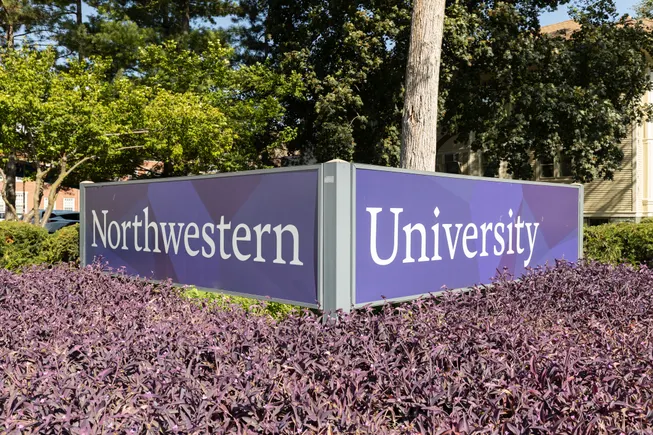
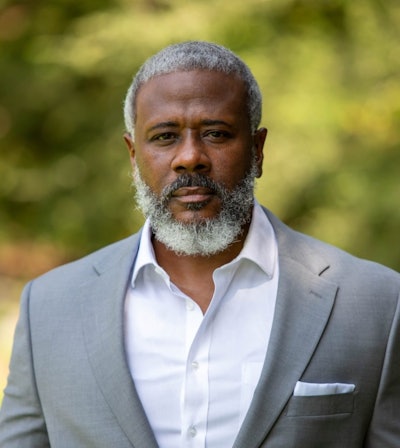
Northwestern University plans to cut about 425 staff jobs— amounting to roughly 5% of the private nonprofit’s staffing budget — senior leaders said Tuesday in a community message.
Nearly half of the jobs are vacant, while others will be cut through layoffs, which administrators are working to complete within 48 hours of the announcement.
The Illinois university is navigating a host of financial challenges, including federal research funding cuts and a potentially higher endowment tax under the Republicans’ new spending law.
Dive Insight:
In their message Tuesday, Northwestern President Michael Schill, Provost Kathleen Hagerty and Chief Financial Officer Amanda Distel described recent months as “among the most difficult in our institution’s 174-year history.”
About a month and a half ago, the same group of officials said the university faced “an increasing strain” on its finances from both looming federal policy changes and increasing expenses.
At the time, they rolled out a series of austerity measures, including a pause on employee raises, a hiring freeze for faculty and staff, health insurance changes, reduced capital spending,and lowered budgets for academic and administrative units.
While the university has cut nonpersonnel budgets by 10%, employee costs make up 56% of Northwestern’s total annual spending. “We still are left with a budgetary gap that cannot be bridged without cutting personnel costs,” the officials said.
The layoffs announced this week represent “a drastic step that causes pain and anxiety both for the individuals whose lives are affected, but also for our entire community, and we do not take it lightly,” they said. They also noted that schools and units were given discretion in making cuts and asked to “think strategically” to minimize the impact to units, workers, students and the university.
Northwestern is among the prominent universities targeted by the Trump administration through probes into their responses to antisemitism on campus by the U.S. departments of Education and Health and Human Services.
The university, however, has reported an 88% year-over-year decline in complaints of antisemitic discrimination or harassment as of November 2024.
Nonetheless, the Trump administration in April reportedly froze $790 million funds to Northwestern.Although the university at the time hadn’t received official notification of a targeted freeze from the government, it saw around 150 stop-work orders and grant terminations from federal agencies by May 1.
Last week, The Wall Street Journal reported via an anonymous source that the Trump administration was in talks with Northwestern and other universities about possible deals that would involve a hefty fine to resolve the investigations. The news followed Columbia University’s controversial settlement with the government requiring a $221 million payment in return for the government restoring most of its research funding.
In an op-ed published in The Daily Northwestern on Tuesday, a group of Northwestern faculty described such fines as a “ransom” and called on university leadership to “resist the administration’s attack on fundamental democratic principles by refusing to ‘make a deal’ with the administration.”
The U.S. Department of Justice alleged Tuesdaythat the University of California, Los Angelesviolated civil rights lawby failing to do enough to protect Jewish and Israeli students from harassment.
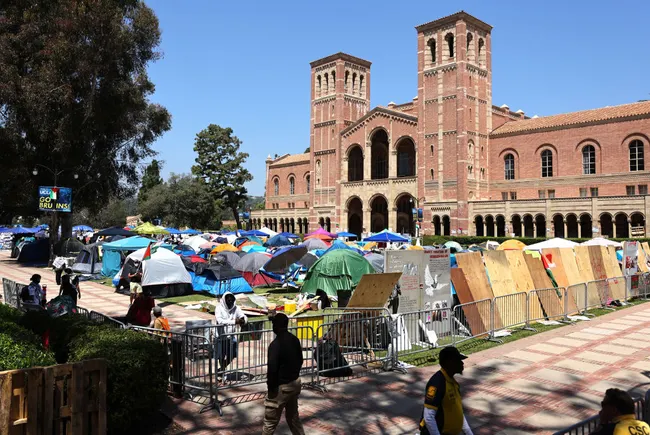
The findings stem from UCLA’s approach to a pro-Palestinian encampment that students erected on the university’s campus in the spring 2024 term.UCLA officials declined to disband the encampment for nearly a week, citing the need to balance free speech protections with student and employee safety.
In a letter to Michael Drake, president of the University of California system,Justice Department officials said they would seek to enter a voluntary resolution with UCLA to “ensure that the hostile environment is eliminated.”
Dive Insight:
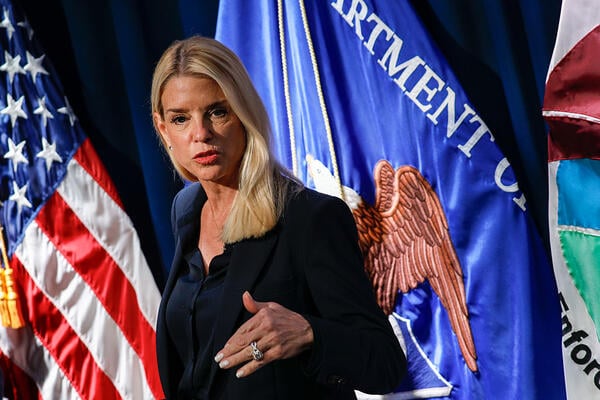
The Justice Department is also investigating the entire University of California system over similar allegations. That systemwide probe found “concerning evidence of systemic anti-Semitism at UCLA that demands severe accountability,” U.S. Attorney General Pamela Bondi said in a Tuesday statement.
“DOJ will force UCLA to pay a heavy price for putting Jewish Americans at risk and continue our ongoing investigations into other campuses in the UC system,” Bondi said.
Justice Department officials gave UCLA leaders until Aug. 5 to reach out about entering a voluntary resolution. They threatened the university with a lawsuit by Sept. 2 if they don’t believe they can strike an agreement with the institution.
The Justice Department investigation focused on the pro-Palestinian encampment erected on UCLA’s campus on April 25, 2024. Encampment demonstrators demanded that the university divest from companies with ties to Israel’s military.
On the same day it was erected, a university spokesperson told the campus community that officials were monitoring the situation to balance the “right to free expression while minimizing disruption” to the institution’s teaching and learning mission.
However, several days into the protest, some demonstrators formed human blockades to prevent some people on campus from moving freely throughout Royce Quad, including students wearing a Star of David or those who refused to denounce Zionism, according to an internal report from a university task forcereleased last October.
The task force also found the encampment violated university rulesand that the blockades disparately impacted Jewish people.
The Justice Department’s letter to UCLA heavily cited the university’s own task force report,as well as 11 complaints the university received alleging that encampment protesters discriminated against them based on their race, religion or national origin.
“UCLA’s documentation established that it did not outright ignore these complaints; however, the University took no meaningful action to eliminate the hostile environment for Jewish and Israeli students caused by the encampment until it was disbanded,” the letter states.
Violence broke out at the site on the night of April 30, 2024, when counterprotesters attempted to dismantle the encampment’s barricade, The New York Times reported.
The counterprotesters attacked those within the encampment,including by launching fireworks into the encampment and hitting the pro-Palestinian protesters with sticks, according to the publication. Some of the pro-Palestinian protesters also fought back.
Police arrived hours later, though they did not immediately break up the violence. The next day, UCLA officials made the call to have police break up the encampment, resulting in over 200 arrests.
“In the end, the encampment on Royce Quad was both unlawful and a breach of policy,” then-UC Chancellor Gene Block said in a statement. “It led to unsafe conditions on our campus and it damaged our ability to carry out our mission. It needed to come to an end.”
In their letter, Justice Department officials criticized university leaders, alleging they knew that protesters were “engaging in non-expressive conduct unprotected by the First Amendment” and were denying“Jewish and Israeli students access to campus resources” days before they moved to disband the encampment.
UCLA did not immediately respond to a request for comment.
The Justice Department findings come the same day the university settled a lawsuit from Jewish students and a Jewish professor, who alleged their civil rights were violated because UCLA allowed protesters to block their campus access.
The agency’s letter mentioned the lawsuit’s filings, though it did not refer to the settlement.
As part of that agreement, UCLA agreed to pay about $6 million,with the funds going directly toward the plaintiffs and their legal fees, as well as to Jewish groups and a campus initiative to combat antisemitism.
Attorney General Pamela Bondi authored the memo declaring all race-conscious practices unlawful.
Photo by Yasin Ozturk/Anadolu via Getty Images
More than three months after a federal court struck down an Education Department directive that barred any practices that consider race at colleges across the country, the Department of Justice declared Wednesday that diversity, equity and inclusion practices are unlawful and “discriminatory.”
But the agency’s memo goes even further than ED’s guidance, suggesting that programs that rely on what they describe as stand-ins for race, like recruitment efforts that focus on majority-minority geographic areas, could violate federal civil rights laws. The directive applies to any organization that receives federal funds, and DOJ officials warned that engaging in potentially unlawful practices could lead to a loss in grant funding.
Other examples of “potentially unlawful proxies” include requirements that job applicants “demonstrate ‘cultural competence,’ ‘lived experience,’ or ‘cross-cultural skills’” or narratives about how the applicant has overcome obstacles, Attorney General Pamela Bondi wrote.
This interpretation of federal law could present new challenges for colleges that have relied on tactics like place-based recruitment to create diverse student bodies since the Supreme Court banned affirmative action in 2023. For instance, some colleges have guaranteed admission to students who graduate in the top 10 percent of their high schools.
“This highlights that every practice of colleges is under scrutiny, even ones that have been viewed as politically safe for years (such as top ten percent plans or even TRIO programs). The only truly safe ways to admit students right now are to admit everyone or only use standardized test scores,” Robert Kelchen, a professor in the University of Tennessee at Knoxville’s Department of Educational Leadership and Policy Studies, wrote in an email to Inside Higher Ed. “Being an enrollment management leader has always been tough, but now it’s even more challenging to meet revenue targets and satisfy stakeholders who have politically incompatible goals.”
The document offers clearer guidance about what the Justice Department considers off-limits as it investigates DEI at colleges and universities. The DOJ is playing a greater role in investigating colleges as it enforces its position that DEI programs as well as efforts to boost diversity among faculty and staff violate federal antidiscrimination laws.
Since President Trump took office in January, he’s targeted DEI programs, practices and personnel via executive orders and other efforts. However, higher ed experts haverepeatedly said that the orders don’t change the underlying laws, so colleges that complied with the law before Jan. 20 remain in compliance. In response to the federal edicts, colleges have rolled back a number of their programs and closed centers that catered to specific student groups.
Many of the practices declared unlawful in the nine-page memo echo those referenced in the Education Department’s February Dear Colleague letter, such as race-based scholarships. But it also explicitly states that “BIPOC-only study lounges” and similar facilities are unlawful. The Education Department’s guidance mentioned race-based facilities generally but not specifically study lounges.
DEI advocates have long argued that these centers or lounges are open to all students. Some have persisted even after state DEI bans, but multiple colleges have in recent months closed centers that catered to specific student groups. Bondi argued that such spaces violate Title VI of the Civil Rights Act of 1964, which bars discrimination based on race and national origin.
“Even if access is technically open to all, the identity-based focus creates a perception of segregation and may foster a hostile environment. This extends to any resource allocation—such as study spaces, computer labs, or event venues—that segregates access based on protected characteristics, even if intended to create ‘safe spaces,’” the order reads.
Lynn Pasquerella, president of the American Association of Colleges and Universities, said that the memo is “another example of governmental overreach into academic freedom, institutional autonomy and shared governance that conditions federal funding on ideological alignment with the administration’s viewpoints.”
She added that the guidelines in the document violate existing constitutional protections and erode federal civil rights law.
“What is missing from the DOJ narrative on DEI is that treating people differently is not always unjust, especially when doing so corrects a broader pattern of systemic injustice. Considering race and gender in the context of historic unjust discrimination to inform policies and practices at colleges and universities doesn’t in and of itself constitute illegal discrimination, though the letter suggests otherwise.”
Beyond race-based practices, the letter also addresses transgender student athletes, building on the Trump administration’s previous actions that advocates say deny the existence of trans individuals and roll back their rights. The memo states that it would “typically be unlawful” for someone assigned male at birth to compete on women’s sports teams or for an institution to “compel” individuals to share an intimate space, like a locker room, with someone of another sex.
Pasquerella noted that the letter offers guidance, not legal mandates.
“Nevertheless,” she said, “what are described as ‘best practices and nonbinding suggestions’ will likely cause another wave of anticipatory compliance and overcorrection given the climate of fear and intimidation created by the weaponization of research funds.”
“A cold wind just blew through every newsroom this morning.”
These were the words of my colleague Bob Corn-Revere upon hearing that Paramount Global had agreed to settle President Donald Trump’s 60 Minutes lawsuit — to the tune of $16 million.
Trump filed the lawsuit in November, demanding $10 billion over what he alleged was the “deceptive editing” of a 60 Minutes interview featuring then-presidential candidate Kamala Harris. The lawsuit claimed CBS’s “substantial news distortion” was calculated to “mislead the public and attempt to tip the scales” of last year’s election in her favor. But despite legalexpertswidelylabeling the lawsuit baseless, Paramount opted to settle.
Why?
Well, the lawsuit was a sticking point in the approval of the $8 billion Paramount-Skydance merger — approval which the Trump administration via the Federal Communications Commission (FCC), led by Chairman Brendan Carr, had the power to grant or deny. That approval was finalized last week, just two days after Trump formally dropped the lawsuit.
It’s an extortion regime much bigger than any one-time cash grab, enveloping the media industry in a cloud of weaponized uncertainty.
The timing is hard to ignore. And while the initial details of the dollar amount in the settlement attracted much controversy, it’s also been gradually revealed that the money was paired with other, more alarming agreements from Paramount Global.
First, they acceded to 60 Minutes releasing unedited transcripts of interviews with all future presidential candidates. Second, there was a rumored side deal — confirmed by Trump last week (SkyDance has not confirmed or denied)— that CBS will run advertising and public service announcements to promote Trump’s favored causes.
Finally, we learned that Skydance promised to appoint an ombudsman to review all complaints of “bias” involving CBS programming moving forward.
These components of the settlement stick out because it connects the ostensibly private matter of the 60 Minutes lawsuit to Trump’s presidential agenda. In other words, they are a function of the Trump administration’s policy priorities, blurring the boundary not just between Trump’s role as a private citizen and his role as president, but also between Paramount’s role as a private enterprise and as an arm of the White House.
But it gets worse. In fact, the Paramount settlement provides only a small window into a larger attempt — on the part of the president and his administration — to transform the relationship between the government and America’s media industry, powered by the machinery of the FCC.
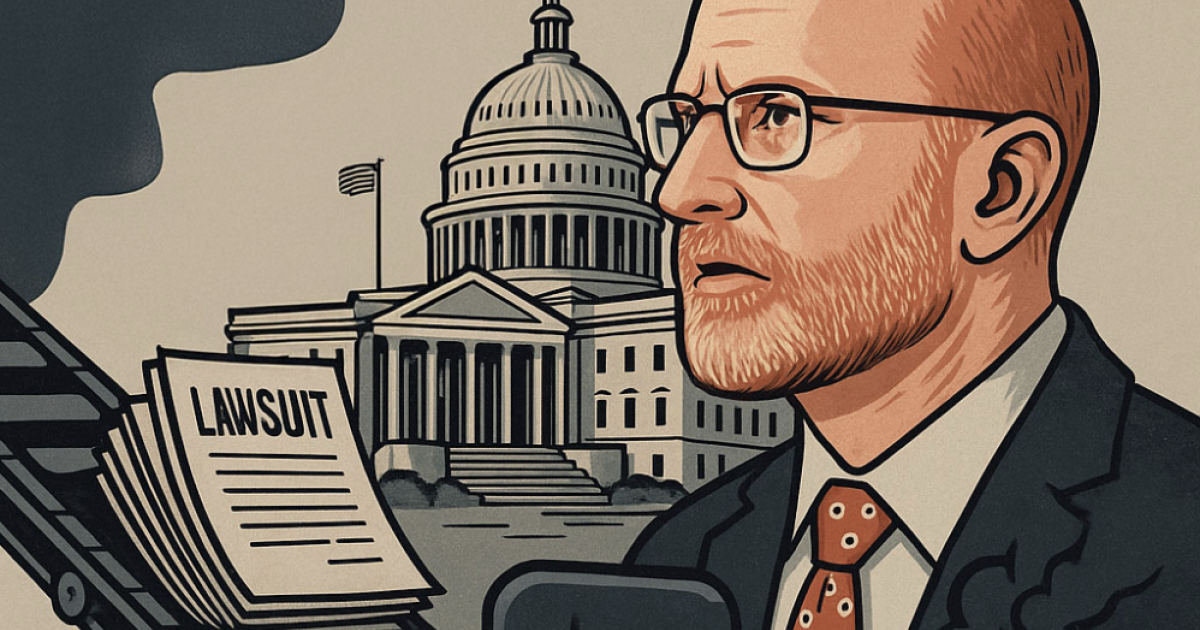
It’s an extortion regime much bigger than any one-time cash grab, enveloping the media industry in a cloud of weaponized uncertainty created by lawsuits, selective regulatory investigations, and slow-walked merger approvals.
The ultimate aim? Getting some of America’s largest media companies to bend the knee and do the administration’s bidding.
Call it the extortion-industrial complex, and Paramount has been just one victim of it.
‘A cold wind…’
Let’s start with the implications of the 60 Minutes case.
First, there’s the “deceptive” editing of the 60 Minutes interview segment that was the target of the lawsuit, in which Harris was asked about the Israel-Hamas War. As FIRE explained in a filing to the FCC, the edited segment did not alter the substance of her response in any way. Rather, it was a routine and unremarkable trim — a simple shortening of a news segment to get to the point.
The president’s original complaint alleges the edit made her more “succinct,” and thus more palatable to voters. This is almost by definition true because an edit, by design, makes a candidate’s response briefer. But if an edit like this is legally actionable, then what editorial decision isn’t? The message to newsrooms, reinforced by the president’s litigious history, is that any anodyne decision they make could land them in court.
Then of course there’s the policy agreements in the settlement, including the ombudsman and the transcript requirements. These concessions serve to solidify private lawsuits as a powerful lever for enforcing the president’s agenda in areas that the government doesn’t actually control.
The role of the FCC
That brings us to the Trump-controlled FCC — the institutional machinery of the extortion-industrial complex that made Paramount’s acquiescence to Trump an almost foregone conclusion.
Paramount’s surrender is due in no small part to the FCC’s final authority over Paramount Global’s merger with Skydance Media, which as we saw, just received approval from the body. Reporting indicates it’s all but explicitly understood by CBS executives and Paramount Global controlling shareholder Shari Redstone that bringing the lawsuit to a close was part of clearing the way for the merger.
Further obstructing the merger was a parallel FCC probe into a consumer complaint about the editing of the 60 Minutes interview. The probe and the lawsuit are supposedly separate, but there’s reason to believe otherwise.
For one, the consumer complaint heavily informed the lawsuit. And while Chairman Carr has been careful to avoid linking the lawsuit itself to the merger talks (wink, wink), he said the consumer complaint is “likely to arise in the context of the FCC review” — meaning, essentially, that the probe allows him to connect the subject of the lawsuit to the merger.
These tools are the core of the extortion-industrial complex, and they have their roots in certain powers of the FCC granted by the Radio Act of 1927 and the Communications Act of 1934, which birthed the agency itself. Those two laws granted the FCC regulatory power over who can use the radio and broadcast television waves, which sit at the low-frequency end of the electromagnetic spectrum (visible light sits in the middle of the spectrum). But signals at the low-end range often interfered with each other, prompting the government to step in and sort things out.
As a result, they introduced a government-sanctioned licensing regime, in which broadcasters could use part of the airwaves as long as they operated in the service of the “public interest, convenience and necessity.” If they didn’t, their license could be denied or revoked. This requirement became known as the “public interest standard,” which the Supreme Court upheld in the 1943 case NBC. v. United States on the basis that the properties of airwaves rendered it a “scarce” resource. This was a recurrent justification that became known as the “scarcity rationale,” and which the FCC used to set rules regulating broadcast programming.
To enforce these rules, the FCC was given a set of powers. They could deny or revoke licenses, decide the transfer of license ownership, and issue fines. In practice, this gave them power over any mergers and acquisitions when an owner of a broadcast station was involved. In addition to FCC’s direct oversight, members of the public could file complaints about violations that the FCC could investigate.
On the back of these powers and the public interest standard, the FCC issued regulations ranging from those on children’s programming all the way to rules governing balance in political coverage — including the well-known fairness doctrine, which required licensed broadcasters to present both sides of controversial issues of public importance.
As our understanding of the technological landscape changed and a vibrant media ecosystem outside broadcast took shape, content-based rules like the fairness doctrine came under scrutiny. A 1985 report commissioned by the FCC noted that not only was the fairness doctrine a “pervasive and significant impediment to the broadcasting of controversial issues of public importance,” It also found that the scarcity rationale “which ha[d] historically justified content regulation of broadcasting … is no longer valid” in the era of cable and satellite and, shortly thereafter, the internet. Why should broadcast operate underneath a web of restrictions that its competition is free from?
The courts and Congress also cast doubt on the viability of the scarcity rationale in the modern media landscape, culminating in the FCC’s 1987 repeal of the fairness doctrine.
In spite of the scarcity rationale falling into disrepute, the public interest standard and other content-based rules predicated on it stayed on the books. Whether those rules were overlooked or left intact as “symbolic regulation,” the remaining public interest-based regulatory infrastructure was a loaded gun left on the table.
Enter Brendan Carr
Despite having lots of nice things to say about free speech before his current position, Carr took on the FCC chairmanship in January with a bold new approach. He understood that while some seismic changes in the broadcast marketplace had rendered the public interest standard antiquated, others opened up new avenues to exercise government power in its name. Big companies began buying up more and more radio and TV stations, so fewer and fewer people owned the airwaves. At the same time, the corporations operating these stations and producing their content grew much larger and more influential.
The FCC already exercises a certain amount of power over the programming of the broadcast corporations through the stations and affiliates that run their content. But now, Carr has taken this to the next level, implicating the broader decisions of the conglomerates that own those broadcasters, and all the other media properties they control. His previously declared free speech principles took a backseat.
The FCC has authority over the licenses of broadcast stations (left column). In practice, Carr has treated that authority as expanding to their owners (middle column), including their vast portfolio of properties (right column).
One of his earliest moves as chairman was to unleash the FCC’s arsenal of tools in support of a top priority in Trump’s agenda that has little to do with the FCC’s traditional authority: the elimination of diversity, equity, and inclusion (DEI).
In February, Carr announced in a letter his intention to investigate the DEI programs of NBCUniversal and their parent company, Comcast. He also set his sights on the telecommunications industry, as a probe into Verizon’s diversity practices soon followed. In March, he came for Disney as well.
Around that time, Carr engaged in a strategy meeting with a conservative activist named Robby Starbuck, known for his pressure campaigns against the diversity efforts of Ford, Boeing, Walmart, and McDonald’s. Following the meeting, Starbuck posted, “Good luck with the FCC if you’re a woke company … You’re gonna need it!”
Two days later, Carr made clear that any businesses seeking approval for mergers or acquisitions — including Paramount Global — would be expected to “get busy ending any sort of their invidious forms of DEI discrimination.”
Corporations promptly complied with Carr’s demands. Verizon and TMobile sent letters to the FCC notifying Carr they had scrapped their DEI-related policies. Comcast withdrew from Pride march sponsorships and scrubbed their website. Just this week, Skydance confirmed to Carr a sweeping list of actions taken by Paramount to remove anything approaching DEI.
It’s important to understand the scope of Carr’s interventions. Under the FCC’s Equal Employment Opportunity (EEO) rules, the commission can prevent radio and TV broadcasters from discriminating in hiring based on race, religion, or sex. So while he had a limited basis to, say, target affirmative action, Carr’s ambitions went beyond hiring practices and implicated First Amendment-protected speech.
For instance, the letter to Comcast notes the EEO rules, but there’s no direct mention of unlawful hiring practices on their part. What Carr does cite is the values of the company as described on their website, and the existence of employees and initiatives responsible for promoting DEI, including in TV and programming. With his letter to Verizon, this became a pattern.
The theory of authority behind all this is not completely new. After the events of the 2020 election and January 6th, 2021, a progressive watchdog group called the Media and Democracy Project (MAD) filed a petition to deny the broadcast license renewal application for Fox Corp-owned television station FOX 29 Philadelphia. Even though Fox News programming was not aired on the network (with the exception of then-host Chris Wallace’s Fox News Sunday), the petition cited their 2020 election coverage as grounds for the denial. Former Fox counsel and FCC officials supported it.
The response to these efforts from previous FCC Chairs was markedly different from Carr’s, however. Obama’s (retired) FCC Chair Tom Wheeler said of the broader scrutiny surrounding Fox, “Unfortunately, the FCC does not have jurisdiction over cable networks. In fact, it doesn’t even have jurisdiction over networks like CBS and NBC who use the airwaves.”
In January, outgoing Biden-appointed FCC Chairwoman Jessica Rosenworcel rejected MAD’s petition, noting in a statement they sought to “weaponize the licensing authority of the FCC in a way that is fundamentally at odds with the First Amendment.” She also rejected three other complaints: against NBC, ABC, and of course the infamous complaint against CBS and 60 Minutes.
Selling out the First Amendment is a debt that always comes due.
Upon assuming the chairmanship in January, however, Carr reopened all three complaints with identical orders, citing an “insufficient investigatory record.” While these orders did not provide specific justifications for the reopenings, in interviews Carr has pointed to enforcing the public interest standard and combating ideological bias in news. In practice, this has played out as combatting disfavorable coverage of Trump — as evidenced by Carr’s curiously leaving the previous petition targeting FOX 29 Philadelphia in the grave.
The three complaints capitalized on the mostly dormant FCC content rules left over from the spectrum scarcity era — including the news distortion rule, which prohibits networks from engaging in deliberate falsification of the news; and the equal opportunities rule, which requires networks to provide the roughly same amount of airtime to competing candidates in federal elections.
However, in both cases the claims fall short of their respective standards. The equal opportunities proceeding against NBC for example — centering around the brief appearance of Harris on NBC’s Saturday Night Live (SNL) — fundamentally misunderstands how the rule works.
As the FCC’s letter dismissing the original complaint points out, Trump came to an agreement with NBC after the SNL airing to give him coveted ad time during a Sunday evening NASCAR race, roughly equivalent in length to that of Harris’s appearance on SNL. The complaint says this is “too little, too late” — ignoring, as the FCC pointed out, “[a]n agreement reached after the use of broadcast facilities is a standard way for broadcasters to adhere to the equal opportunities rule.” FCCs records demonstrate that Carr himself knew that NBC complied with the rule, though that didn’t stop him from claiming otherwise.
This brings us to the news distortion rule, which has historically been understood as having a very high bar, requiring documented evidence that broadcast leadership directed reporters to deliberately mislead the public in order to actually threaten a broadcaster’s license. In fact, there has been only one finding of news distortion since 1982 — involving NBC staging a car explosion in a 1993 Dateline report warning about unsafe gas tanks. Even there, no adverse action was taken against the network beyond a frankly worded letter.
With this in mind, it should follow that the complaint against CBS and 60 Minutes would allege extensive evidence of an elaborate plot to rig then-candidate Kamala Harris’s responses, with orders coming from the very top. But as FIRE’s filing in the FCC’s docket on the matter points out, it did not do that.
The role of the Center for American Rights
Who filed the CBS complaint?
The same organization that filed the complaints against NBC and ABC: the Center for American Rights (CAR). It’s worth parking our car here for a second to get a sense for how rickety and rusty some of the foundation for the extortion-industrial complex is.
The paper-thin CBS complaint leans on speculation from conservative commentators as evidence, appoints CAR as a spokesman for the general public, and fails to actually allege an instance of news distortion, the purported violation CBS is guilty of. Other complaints aren’t much better, from citing Brendan Carr tweets as if they were case law to equating news coverage that mentioned the presence of an autistic child in the back of deported Salvadoran immigrant Abrego Garcia’s car when he was arrested with “villainiz[ing] the police.”
The role of CAR emphasizes how the public input can be abused by a commission with malign intentions. CAR gives the FCC specific public cover to engage in shakedowns of media entities. The chairman gets the benefit of the appearance that he is just looking into the duly filed legal grievances of the faithful public, even if he is granted some agency by the likes of CAR as to when and where those grievances appear.
Take one example from last April: Carr took issue with MSNBC and other outlets’ coverage of Abrego Garcia’s detention and deportation, and went as far as to post allegations of news distortion on the part of Comcast (again, the FCC has zero authority over cable news channels). Within a week of Carr’s social media posts, CAR filed a complaint alleging news distortion on the part of NBC, CBS, and ABC owned properties, citing coverage on their websites in addition to their broadcast channels. It’s like a dog responding to a whistle.
CAR has benefitted from its newfound role in the extortion-industrial complex, as Trump is reportedly considering CAR’s president Daniel Suhr for an appointment on the Seventh Circuit Court of Appeals.
The extortion-industrial complex threatens our First Amendment rights, but we can (and should) fight back
The combined effect of these components — the lawsuits, the complaints, and the FCC’s broader content-based regulatory regime — is to strangle America’s broadcast industry with a series of looming threats. That’s the extortion-industrial complex at its heart, and how they harmonize together is simple. Let’s review.
First, there is often a merger, acquisition, or some other needed regulatory approval coming down the pipeline that introduces a point of leverage for the government. The Skydance-Paramount merger is the second time an entity owning CBS News has been involved in a merger under Trump’s presidency, and the lead-up to a merger like that actually taking place can take years.
That’s ample opportunity for the government to make demands.
And if there isn’t a merger or acquisition coming to provide the government with the opportunity to extort? Then CAR or some other political front group can draft a complaint to the FCC and create one. If an FCC probe isn’t threatening enough, Trump’s legal team will bolster it with a lawsuit. And as we saw with Paramount, when the government’s desires are big enough, they’ll combine all three.
Provided Trump sues, the settlement agreement then acts as the depository for the targeted company’s tributes — whether money, policy concessions, or both. Job done.
The uncertainty with which all this places the companies operating under this protection racket’s thumb is what makes the extortion-industrial complex such an effective force. That uncertainty means less commercial investment, both into the company and out of it.
So, taking advantage of the natural corporate aversion to uncertainty, Trump and his extortion apparatus offer an off-ramp: don’t do anything we don’t like, and your business’s future looks a little more predictable and profitable.
That’s an incredible source of soft power.
This is why Skydance’s agreement to bring on an ombudsman to monitor bias in CBS’s news programming paints a worrying picture. It signals what Trump and Carr’s efforts could be building towards: a future where their interventions are no longer required because soft power does all the work.
That’s a five-alarm fire for free speech, and neither Carr nor the Trump administration show any sign of stopping. As Carr sees it, “the media industry across this country needs a course correction.”
We’ve seen Trump use similar extortionary tactics in other contexts — including with universities and law firms — and unfortunately, many of his targets have capitulated. This includes Columbia University, who acceded to a list of demands provided by the Trump administration and was later forced to pay $200 million dollars. It also includes law firms like Paul Weiss and Willkie Farr & Gallagher — targeted for the crime of employing Trump enemies — who settled under the expectation they would be doing pro bono work on behalf of causes like helping veterans, only to see Trump later suggest they’d be negotiating his trade deals.
All of this has provided us with a chilling reminder: extortion is seldom a one-time deal. Behavior that gets rewarded gets repeated, and too many have caved to the pressure at the expense of free speech in our country’s most important institutions. They’ll discover for themselves that selling out the First Amendment is a debt that always comes due.
Those capitulations are all the more frustrating because we have seen that fighting back can pay off. For example, the law firms Perkins Coie, Jenner & Block, WilmerHale, and Susman Godfrey all fought Trump’s executive orders — and they won. Enforcement of the orders have been blocked on First Amendment grounds for all four of them.
America’s media conglomerates would be wise to take their example. Also, fighting back isn’t limited to their leadership. The creators of South Park saw Paramount announce a $1.5 billion deal with them to create new episodes for their streaming service, and 10 hours later, they aired an episode featuring a scathing criticism of both Trump’s extortion and Paramount’s appeasement. While resistance will help fend off the immediate crisis, the root of the problem remains with the core machinery of the extortion-industrial complex itself. Thankfully, dismantling that wouldn’t be too tall an order.
For example, the next FCC chair can simply get rid of the news distortion rule, which serves little utility other than misuse. Similarly, the FCC could halt unnecessary investigations, both formal and informal, into the content decisions of those under its regulatory purview. FIRE has detailed both of these recommendations in previous filings to the FCC.
Finally, the FCC can use their discretion over the merger process to eliminate content-related considerations. These moves would align the commission with court and congressional guidance, and also close the government’s pivotal extortionary pressure points. Importantly, destroying these levers wouldn’t weaken legitimate oversight. Rather, it would restore the FCC to its core technical mission and insulate speech from bureaucratic ransom.
It’s a necessity that transcends partisan lines. One could very much imagine a future Democratic chairman taking Carr’s playbook, reviving the petition against FOX 29 Philadelphia, and reorienting the extortion-industrial complex’s machinery towards the conservative media ecosystem. If and when that happens, proponents of Carr’s current behavior may change their tune about how permissible and necessary these crackdowns are. And that will only make it more obvious that this usage of government power is not compatible with an open democratic society.
To preserve free expression and our First Amendment rights, the extortion-industrial complex must be dismantled.
Student retention remains one of the most pressing challenges in higher education. While institutions devote considerable resources to attracting new students, ensuring those students persist through to graduation is just as vital for institutional health and student success.
When students leave before completing their programs, colleges and universities lose tuition revenue and see diminished returns on their investments in recruitment and instruction. For students, the stakes are even higher: they often walk away without the credentials or skills they set out to earn, leaving personal and professional goals unfulfilled.
Retention, typically measured by the percentage of students who return to the same institution each year, is now a key performance indicator in higher education. It reflects how well a school supports and engages its students and can influence institutional rankings, funding, and public perception.
Recent data offers a mixed picture. In the United States, the national first-year retention rate for first-time students reached 69.5% in 2022, the highest level in nearly a decade and a slight increase over previous years. Still, that means nearly one in three students don’t return for a second year. In Canada, the pattern is comparable: 15–20% of university freshmen leave after their first year, with even higher attrition rates in colleges.
There is both urgency and opportunity here. This blog explores eight strategic, research-backed approaches that institutions can take to significantly improve student retention, strengthening institutional outcomes and ensuring more students reach the finish line.
Struggling with enrollment and retention?
Our Digital Marketing team can help you generate more leads!
What Causes Students to Leave?
Why is student retention important in higher education? Student retention reflects institutional effectiveness and student success. High retention means students are achieving their goals and institutions are providing strong support. Low retention signals issues like academic or financial struggle. It’s both an ethical responsibility and a financial imperative, reducing dropout rates and maximizing investment in recruitment and instruction.
Student retention is a complex challenge influenced by a range of academic, social, and personal factors. While no two students leave college for exactly the same reason, research has consistently identified several common barriers to persistence. Understanding these roadblocks is essential for developing interventions that work.
Financial Barriers
For many students, the cost of education is a deciding factor. Difficulty paying tuition, fees, and living expenses remains one of the most significant drivers of attrition—particularly for those from lower-income backgrounds. Even small outstanding balances can prevent students from registering for the next semester, pushing them to stop out or drop out entirely.
Lack of Engagement and Belonging
Students who feel disconnected from campus life are far less likely to persist. A strong sense of community, whether through clubs, student organizations, residence life, or peer support networks, has been shown to significantly improve retention. When students feel isolated or out of place, their motivation to stay enrolled often wanes.
Insufficient Academic Support
Academic struggles can quickly lead to frustration and withdrawal if students don’t receive timely help. Without access to tutoring, mentoring, academic advising, or remedial coursework, those who fall behind may begin to doubt their ability to succeed.
Campus Culture and Climate
The broader institutional culture also plays a pivotal role. A welcoming, inclusive environment supported by compassionate faculty and staff can boost student morale and engagement. In contrast, campuses that feel unwelcoming or where students sense a lack of support often see higher rates of attrition.
Life Outside the Classroom
External pressures, including mental health concerns, family responsibilities, work conflicts, or physical health issues, can interfere with students’ ability to continue their studies. When schools lack the flexibility or resources to help students manage these challenges, even the most motivated learners may be forced to leave.
The First-Year Experience
The transition into higher education is a make-or-break period. Students who struggle during their first year, due to academic shock, poor orientation programs, or difficulty making friends, are at greater risk of not returning for a second year. Supporting students during this critical period can make a long-term difference.
What Is the Difference Between Persistence and Retention?
Retention refers to students returning to the same institution, while persistence tracks students continuing in higher education, even if they transfer. A student may not be retained by one college but still persist by enrolling elsewhere. Persistence offers a broader view of student progress beyond a single campus.
What Are the Factors Affecting Student Retention?
Student retention is influenced by academics, finances, social belonging, mental health, and institutional climate. Academic unpreparedness, isolation, financial strain, and life challenges are leading causes of dropout. The first-year experience is especially critical. Successful retention strategies address multiple areas, supporting students academically, socially, and personally to help them stay enrolled.
With these contributing factors in mind, it’s clear that improving student retention requires a holistic, proactive approach. Fortunately, institutions have a range of strategies at their disposal. In the next section, we’ll explore eight of the most effective ways colleges and universities are addressing these issues, complete with real-world examples from Canada, the U.S., and beyond.
1. Personalize Communication and Support for Students
Today’s students are used to receiving customized experiences in almost every aspect of their lives, from social media feeds to online shopping recommendations. They now expect the same level of personalized communication from their college or university. When schools meet students with timely, tailored support, they show that they care, and that can make all the difference in whether a student stays or leaves.
This kind of proactive outreach can take several forms. Some institutions segment their automated email campaigns by group, such as first-years, international students, or those on academic probation, to deliver more relevant content and reminders. Others implement 24/7 text messaging systems or AI-powered chatbots that answer routine questions, offer words of encouragement, and send reminders about key deadlines. More advanced platforms go a step further, using predictive analytics to monitor signs of disengagement or academic trouble, alerting advisors to intervene before it’s too late.
These tools offer a concierge-style model of support: always on, always responsive. Students can get help after hours or over the weekend, when live staff may not be available, which helps reduce frustration and drop-off.
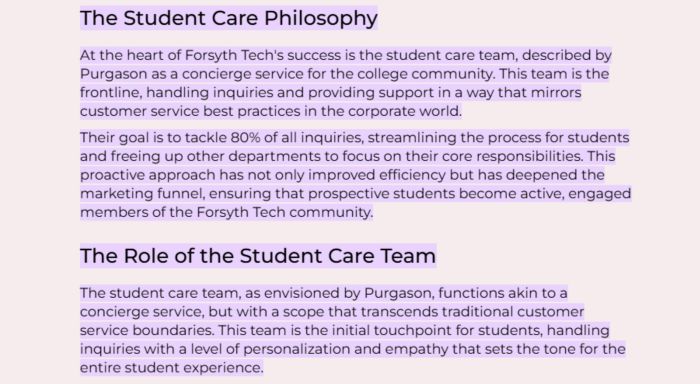
Example: Forsyth Technical Community College in the U.S. revamped its approach to student communication by adopting a “customer service” mindset, ensuring that both staff and automated systems responded quickly, kindly, and proactively to student needs. This overhaul included faster response times, friendly messaging, and a systematic effort to check in on students rather than waiting for problems to surface. The result? A 9% increase in student retention after implementing this new communication model.
To replicate this approach, consider implementing a CRM (Customer Relationship Management) or student engagement platform that allows advisors to monitor student status and send targeted messages. This could be as simple as congratulating a student on a strong midterm, or as critical as reaching out after several missed classes.
Even small gestures like a personalized check-in from a faculty member can make students feel they belong. When institutions shift from one-size-fits-all messaging to individualized outreach, they build a sense of care and connection that reinforces students’ decisions to stay enrolled.
2. Foster a Strong Sense of Community and Belonging
A strong sense of belonging is one of the most powerful predictors of student retention. When students feel connected, through friendships, mentors, and shared campus culture, they’re more likely to persist despite academic or personal challenges. Conversely, loneliness and disconnection are key drivers of attrition.
To support student connection, institutions should create structured opportunities for involvement: orientation, residence life, clubs, intramurals, volunteer work, and student leadership. Participation in these activities increases engagement and reinforces a sense of purpose. Social media can amplify this by highlighting student life and celebrating individual voices.
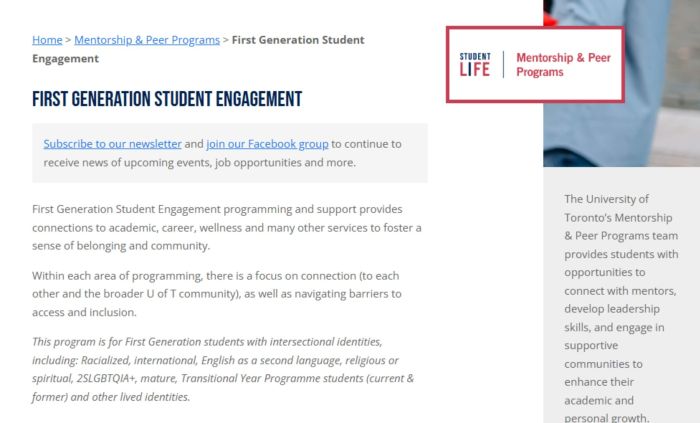
Example: The University of Toronto supports student retention by building community and belonging for underrepresented students through mentorship. In particular, U of T offers programming for first-generation students that connects them with mentors and resources across campus. This First Generation Student Engagement program focuses on helping students navigate barriers to access and inclusion by linking them to academic support, career guidance, wellness services, and peer networks. The goal is to ensure first-gen and other marginalized students feel a strong sense of belonging and are supported throughout their journey.
Ultimately, when students feel they matter to peers, faculty, and the institution, they’re more likely to stay. Belonging isn’t a bonus; it’s foundational to retention.
3. Offer Robust Academic Support and Advising
Academic challenges are a leading cause of student attrition. When students feel lost, overwhelmed, or unsupported, they’re more likely to withdraw. That’s why proactive academic support is one of the most effective student retention strategies.
Effective strategies include offering accessible tutoring (in-person and 24/7 online), writing assistance, and supplemental instruction for high-failure courses. Just as crucial is structured academic advising. When advisors monitor progress and flag early signs of struggle, like low grades or unbalanced course loads, they can intervene with timely solutions.
Institutions must also normalize help-seeking by actively promoting support services. Social media, email campaigns, and website content can encourage students to use academic resources without stigma.
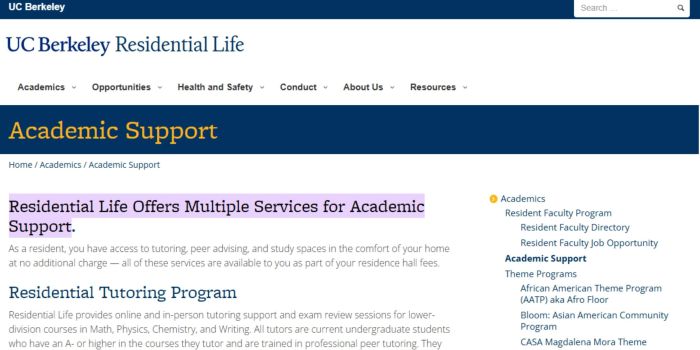
Example – UC Berkeley has built an ecosystem of academic support services combined with faculty mentorship to improve student success and retention. On the academic side, Berkeley provides extensive tutoring, peer advising, and dedicated study spaces in residence halls, free for students and readily accessible where they live.
Early alert systems are another retention tool. By analyzing attendance and coursework in the first weeks, schools can identify at-risk students and reach out before they disengage.
The message is simple: when students know help is available and feel encouraged to use it, they’re more likely to succeed.
4. Provide Career Development Opportunities From Day One
Career uncertainty is a major driver of student attrition. To counter this, institutions must integrate career development early, ideally from the first year.
Career workshops, alumni networking, LinkedIn training, and highlighting the career potential of different majors help students connect academics to future employment. Research confirms that uncertainty about career direction strongly correlates with dropout risk.
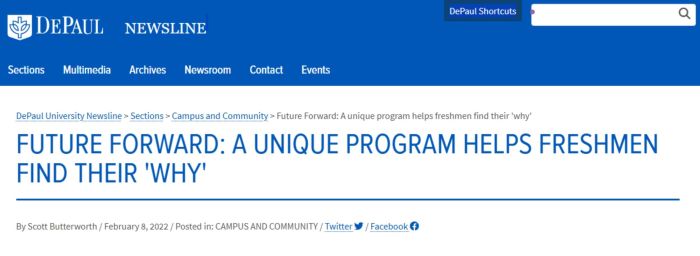
Example: DePaul University launched the Future Forward program, a year-long career incubator for first-year students, to bolster their sense of purpose and keep them enrolled. The idea is to help freshmen find their “why” for attending college by engaging them in self-discovery, skill-building, and career exploration starting in their first quarter. Future Forward combines online learning modules (on topics like growth mindset, design thinking, networking) with mentorship from older student peers and staff. By integrating career development into the first-year experience, DePaul addresses a major attrition risk: lack of direction. Many freshmen enter undecided about their field, which can sap motivation. Future Forward helps students clarify goals and see how their studies link to future careers, thereby increasing their commitment to persist.
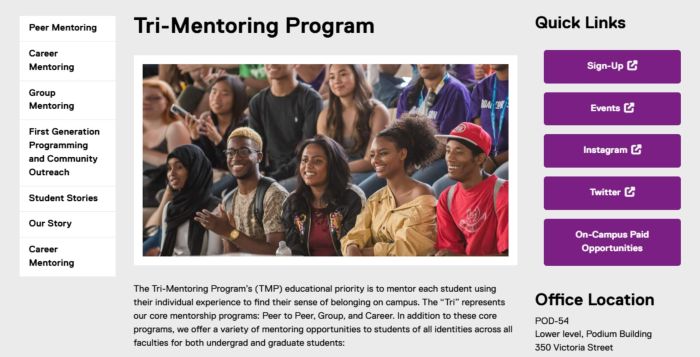
Mentorship is another effective strategy. Toronto Metropolitan University’s Tri-Mentoring Program connects upper-year students with professionals to support the transition to work.
Example: Toronto Metropolitan University (TMU) – formerly Ryerson University – pioneered the Tri-Mentoring Program (TMP) to support student retention through layered mentorship and inclusion. The educational priority of TMP is “to mentor each student using their individual experience to find their sense of belonging on campus.”
In practice, the “Tri” refers to three tiers of mentoring: Peer Mentoring (matching first-year students with trained upper-year mentors in the same program or with similar backgrounds), Group Mentoring (regular group sessions and community events for students from equity-deserving groups, facilitating peer networking and mutual support), and Career Mentoring (matching third-year or higher students with industry professionals, often alumni, for guidance as they prepare for careers).
Similarly, internships, job shadowing, and embedded career-planning courses give students confidence in their trajectory. Institutions can also integrate career goals into academic advising and marketing, using alumni stories to reinforce long-term value. When students see a clear path from degree to career, their motivation and likelihood of staying enrolled dramatically improve.
5. Leverage Data and Early Alerts to Identify At-Risk Students
Predictive analytics enables institutions to proactively support students showing signs of disengagement or academic risk. By monitoring GPA, class attendance, LMS activity, or even ID card swipes, colleges can detect early warning signs and act before a student drops out.
Many platforms offer dashboards and AI-driven messaging to flag risks and send targeted resources. When paired with advisor outreach, this approach becomes highly effective.
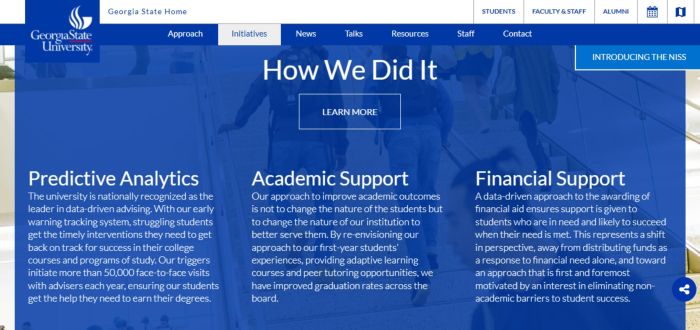
Example: Georgia State University’s Predictive Analytics: Georgia State tracks over 800 risk indicators, triggering alerts when students show signs of academic or financial distress. This system led to the Panther Retention Grant, which helps students with small outstanding balances, one of the biggest dropout triggers. Combined with advisor follow-ups, this strategy has significantly improved retention, especially for underrepresented students.
Even basic early alert systems can help. Faculty-initiated midterm warnings and proactive outreach have been shown to improve persistence by making students feel supported. Benchmarking tools like the IPEDS database can also guide institutions on where to improve.
In short, using data transforms retention from reactive to proactive. With the right tools and team, schools can identify challenges early, intervene meaningfully, and prevent students from slipping through the cracks.
6. Enhance Financial Aid Awareness and Support
Financial strain is a top reason students consider stopping out. To improve retention, institutions must ensure students are aware of, and able to access, funding options before small financial issues force them out.
Colleges should proactively promote scholarships, bursaries, emergency grants, and flexible payment plans. Hiring financial aid coaches or sending alerts to students with incomplete forms or unpaid balances can help prevent unnecessary dropouts. Georgia State University’s Panther Retention Grants exemplify this approach, offering micro-grants to students at risk of losing enrollment over modest fees. Over 10,000 students have benefited, with research showing faster graduations and lower debt loads as a result.
COVID-era aid also proved powerful: community colleges and HBCUs that used relief funds to clear student debts saw thousands stay enrolled. Additionally, financial literacy programs, like budgeting workshops or one-on-one counselling, equip students to manage limited resources wisely and reduce financial stress.
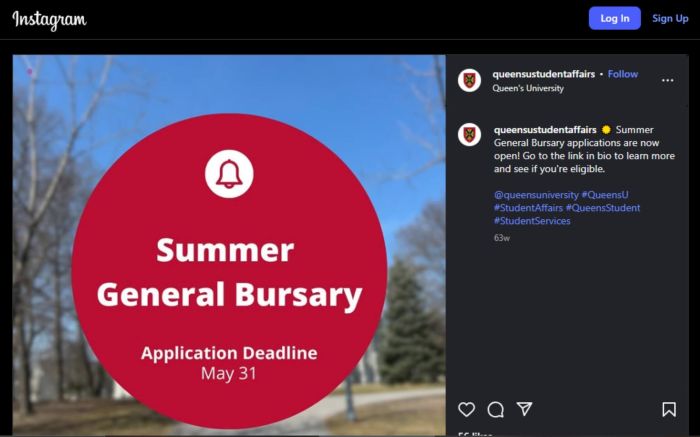
Example: Queen’s University has focused on reducing financial barriers and the misinformation around them by proactively promoting financial aid opportunities to students, using channels like social media, email, and digital signage. The goal is to ensure students know about and utilize available aid (scholarships, bursaries, grants), thereby decreasing the number who drop out due to financial strain. In practice, Queen’s Student Affairs runs ongoing Instagram awareness campaigns about bursary deadlines, loan applications, and financial wellness tips. Below we see Queen’s official Student Affairs Instagram has posts reminding students “it’s not too late to apply for the 2023–24 General Bursary for winter and summer terms” and to apply for government aid like OSAP (Ontario Student Assistance Program).
Bottom line: funding support and strong communication are critical tools in retaining financially vulnerable students.
7. Offer Flexible and Inclusive Learning Options
Modern college students are diverse; many are part-time, working, parenting, or have accessibility needs. Rigid policies and teaching methods can alienate these learners, making flexibility and inclusivity essential to retention.
Flexible scheduling options, like evening, weekend, online, or hybrid classes, help students balance education with life responsibilities. Allowing part-time enrollment, asynchronous learning, or summer online courses can reduce dropout risk, especially among non-traditional learners.
Credit for prior learning (e.g., PLAR in Canadian colleges) also supports older students by recognizing experience and accelerating time to completion. Inclusive learning environments ensure students of all abilities and styles thrive.
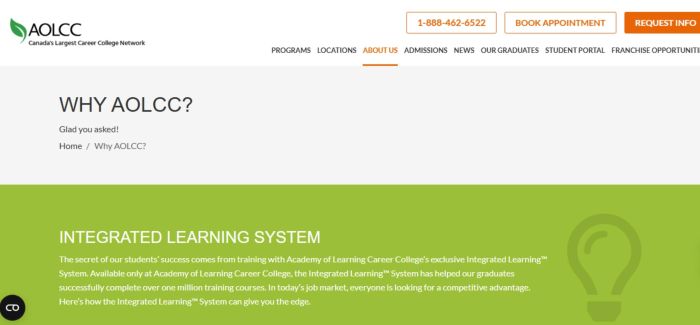
Example: Academy of Learning Career College (AOLCC) uses its proprietary Integrated Learning System (ILS) to maximize student retention by offering flexibility, personalization, and one-on-one support in the learning process. The ILS is a self-directed, multi-sensory training system that lets each student learn at their own pace on a schedule that suits them. A crucial feature since many AOLCC students are adult learners, working, or have family obligations.
Support for online students is also critical. Strong virtual infrastructure; 24/7 tech help, online tutoring, and proactive instructor check-ins help remote learners feel connected. Some schools have engagement teams dedicated to online students.
Additionally, flexible academic policies such as compassionate leaves or grading options (used during the pandemic) can prevent student loss under strain. By adapting to student realities rather than enforcing a traditional mold, colleges show they care and turn potential stop-outs into future graduates.
8. Strengthen Faculty-Student Engagement and Mentorship
Faculty play a pivotal role in student retention through their daily interactions with students. Strong faculty-student engagement, including mentorship, accessibility, and supportive instruction, helps students feel seen, guided, and motivated to persist, especially when challenges arise.
Research shows that meaningful faculty contact improves students’ sense of integration and commitment to college. Gen Z students, in particular, value professors who demonstrate authenticity and personal interest. Without that, disengagement and dropout risk increase.
Colleges can enhance engagement through mentorship programs, pairing students with faculty advisors who offer academic, career, and personal guidance. Faculty training in inclusive teaching and student outreach empowers instructors to recognize and assist struggling students early. Simple actions, like checking in on absences, can make a big difference.
Example: Faculty as Mentors at Berkeley:As noted earlier, UC Berkeley emphasizes that its faculty are among the most accessible, citing programs like the Resident Faculty Program where professors live in residence halls to interact with students outside of class. They highlight that faculty often serve as mentors and even friends to students, and note statistics such as a 19:1 student-faculty ratio and many small classes. This environment of approachability contributes to student success and retention at Berkeley; students feel supported academically and personally by instructors of that caliber, which deepens their commitment to staying.
Interactive teaching methods, such as discussions or group work, foster stronger connections. Faculty who use student names, encourage participation, and integrate feedback build rapport and community. Schools like UC Berkeley go further, housing faculty in residence halls and maintaining small class sizes to promote mentorship.
Faculty should be viewed as frontline retention agents. By celebrating teaching and providing tools for meaningful student relationships, institutions can greatly boost persistence through a caring, connected academic culture. In retention, relationships matter, and faculty are key.
Retention Starts With Intention and the Right Support
Improving student retention isn’t about a single silver bullet. As we’ve explored, it takes a coordinated, research-driven strategy, one that centers students at every point of their journey. Whether it’s delivering personalized outreach, fostering belonging, offering early career guidance, or using data to proactively intervene, the most successful institutions treat student retention as both a mission and a metric.
But knowing what works is only half the equation. Implementing these strategies at scale, consistently and effectively, requires the right tools, technology, and expertise. That’s where Higher Education Marketing can help.
At HEM, we equip colleges and universities with the CRM systems, marketing automation, and digital engagement strategies needed to nurture students from application to graduation. From crafting segmentation-based communications to building data-informed retention workflows, our solutions are built for institutions ready to prioritize persistence.
If you’re looking to boost your retention rates, build stronger student connections, and create a more responsive campus experience, explore how HEM’s services can support your goals. Together, we can help more students reach the finish line and help your institution thrive in the process.
Do you want to explore strategic and effective university student retention strategies?
Contact HEM for more information.
Struggling with enrollment and retention?
Our Digital Marketing team can help you generate more leads!
Frequently Asked Questions
Question: Why is student retention important in higher education?
Answer: Student retention reflects institutional effectiveness and student success. High retention means students are achieving their goals and institutions are providing strong support. Low retention signals issues like academic or financial struggle.
Question: What is the difference between persistence and retention?
Answer: Retention refers to students returning to the same institution, while persistence tracks students continuing in higher education, even if they transfer.
Question: What are the factors affecting student retention?
Answer: Student retention is influenced by academics, finances, social belonging, mental health, and institutional climate. Academic unpreparedness, isolation, financial strain, and life challenges are leading causes of dropout.
Higher education is at an inflection point. As college enrollment continues to decline and pressure mounts to demonstrate return on investment, the federal government has responded with a potentially transformative shift: the creation of Workforce Pell Grants.
Included in the sweeping One Big Beautiful Bill Act (OBBBA) recently signed into law, this expansion of Pell Grant eligibility could open the door to new student populations, new revenue streams, and new institutional strategies — if colleges and universities act quickly and strategically.
What is the Workplace Pell Grant?
Traditionally, Pell Grants have been limited to students enrolled in credit-bearing, degree-seeking programs. That changed with the passage of OBBBA. Workforce Pell expands access to federal financial aid for students enrolled in short-term, non-degree training programs that lead directly to high-demand jobs.
Under the law, students may now use Pell Grants to pay for qualifying workforce training programs that meet the following criteria:
Are between 150 and 600 clock hours (roughly 8 to 15 weeks of instruction);
Are offered by eligible institutions of higher education (IHEs)
Lead to industry-recognized credentials tied to in-demand occupations as defined by the U.S. Department of Labor and/or state workforce boards.
This development reflects a growing bipartisan consensus that higher education must play a more responsive role in preparing learners for rapidly evolving labor market needs.
Why Workforce Pell matters for colleges and universities
The proposed expansion of Pell Grant funding isn’t just a policy update — it’s a strategic opportunity. Here are some key opportunities institutions should be paying attention to:
1. New enrollment markets
Workforce Pell unlocks funding for adult learners, displaced workers, and non-traditional students who may not have the time, resources, or need to pursue a two- or four-year degree. For institutions facing enrollment declines, particularly at the community college level, this represents a powerful new market.
2. Revenue diversification
Short-term credentialing programs — especially those that can scale — offer a way to generate net new revenue without over-reliance on traditional tuition models. With federal aid now available, these programs become more accessible and financially sustainable.
3. Employer partnerships
The law encourages alignment between institutions and regional labor market demands. Institutions that already collaborate with employers or workforce boards will be well-positioned to fast-track qualifying programs and potentially receive direct funding support or partnership commitments.
4. Strategic positioning
Institutions that embrace short-term, skills-based credentialing can position themselves as hubs of workforce development and talent pipelines. This enhances their relevance with local governments, employers, and adult learners alike.
Ready for a Smarter Way Forward?
Higher ed is hard — but you don’t have to figure it out alone. We can help you transform challenges into opportunities.
How can institutions prepare for the Workplace Pell?
Now is the time for higher ed leaders and innovators to act on these policy changes. Here’s where you can start:
1. Audit existing offerings
Begin by reviewing current non-credit or certificate programs. Identify which ones could meet the new Workforce Pell criteria with limited modification—particularly programs already tied to industry credentials and high-demand jobs.
2. Build approval infrastructure
Programs must be approved by the U.S. Department of Education and/or state agencies. Start building a compliance plan, including documentation of program outcomes (e.g., job placement rates, earnings gains) and accreditation alignment. Consider appointing a cross-functional task force including financial aid, academic leadership, compliance, and workforce liaisons.
3. Seek out strategic partnerships
Engage with local employers, chambers of commerce, and workforce boards to validate demand and align curriculum. Public-private partnerships can strengthen program justification and outcomes data—key elements for gaining approval and maintaining eligibility.
4. Invest in marketing and outreach
Many potential Workforce Pell students are not currently in your database. Institutions must rethink marketing strategies to reach adult learners, incumbent workers, and individuals navigating career transitions. Messaging should highlight affordability, short duration, and job outcomes.
5. Track the data
Institutions must monitor the performance of Workforce Pell students and programs. The Department of Education will evaluate outcomes like employment rates and earnings. Underperforming programs may lose eligibility, so building robust reporting systems is not optional — it’s critical.
A new era of credentialing is coming
The Workplace Pell Grant represents more than a funding change — it’s a shift in federal policy philosophy. It signals growing recognition that short, focused training can be just as powerful as a traditional degree in driving upward mobility.
This policy has the potential to reshape the education market within a few years, favoring modular, job-connected learning and expanding access for nontraditional students. For institutions ready to lead, the opportunity is clear.
At Collegis, we partner with institutions to navigate policy shifts like the Workplace Pell with confidence, bringing the strategy, technology, and operational support needed to move quickly, ensure compliance, and deliver real impact.
The future of workforce-connected education is coming fast. Let’s lead it together.
Innovation Starts Here
Higher ed is evolving — don’t get left behind. Explore how Collegis can help your institution thrive.
Tricia serves as vice president and general counsel at Collegis Education, bringing years of deep experience in setting strategy, overseeing compliance, and leading policy development. She also directs contract and litigation management, driving efficiency and alignment across legal and operational functions.
Dr. Lorin Basden ArnoldLorin Basden Arnold has been promoted to senior vice president for Academic Affairs at Kutztown University. Basden Arnold has served as chief academic officer and second-in-command for the institution since June 2021.
In the last four years, Basden Arnold has led the university’s vision of its academic offerings, including the addition of new concentrations and certificates as well as new non-credit learning opportunities. In addition, she plays a pivotal role in the university’s Middle States review process.
In 2023, Basden Arnold helped the university acquire a multi-million-dollar grant from the U.S. Department of Education to increase undergraduate retention and graduation rates and eliminate equity gaps for KU students. Under her guidance, the university launched a new student support platform (Starfish), began assigning a student success navigator for each incoming student, engaged in the transition to a new student information system (Banner) and broadened non-credit learning opportunities through KU Advance.
Basden Arnold came to KU in June 2021 from SUNY New Paltz, New Paltz, N.Y., where she served three years as provost and vice president for Academic Affairs; and five years as professor of Communication. She provided leadership and direction for six academic divisions, serving nearly 7,000 students. Before SUNY New Paltz, Basden Arnold spent seven years as dean of the College of Communication and Creative Arts at Rowan University, Glassboro, N.J. She provided leadership for six academic departments and nearly 250 faculty and staff, serving more than 1,700 students enrolled in both undergraduate and graduate degree programs at an institution of 16,000 students. She oversaw a $11 million budget and established the Rowan Writing Center.
A three-time graduate of Purdue University, Basden Arnold earned her doctorate in interpersonal communication in 1996, her master’s degree in public affairs/issue management in 1991 and her bachelor’s degree in communication/public relations in 1988.
Katie Ratke is a rising senior and Shloka Mehta is a rising sophomore, both working as FIRE summer interns.
Nearly 250 years ago, mere steps from the National Constitution Center in Philadelphia, a group of men locked in sweltering rooms debated the blueprint for a new nation, conceived in liberty. First among the freedoms they secured was the right to speak one’s mind, free from the chill of government meddling or the heat of mob intimidation.
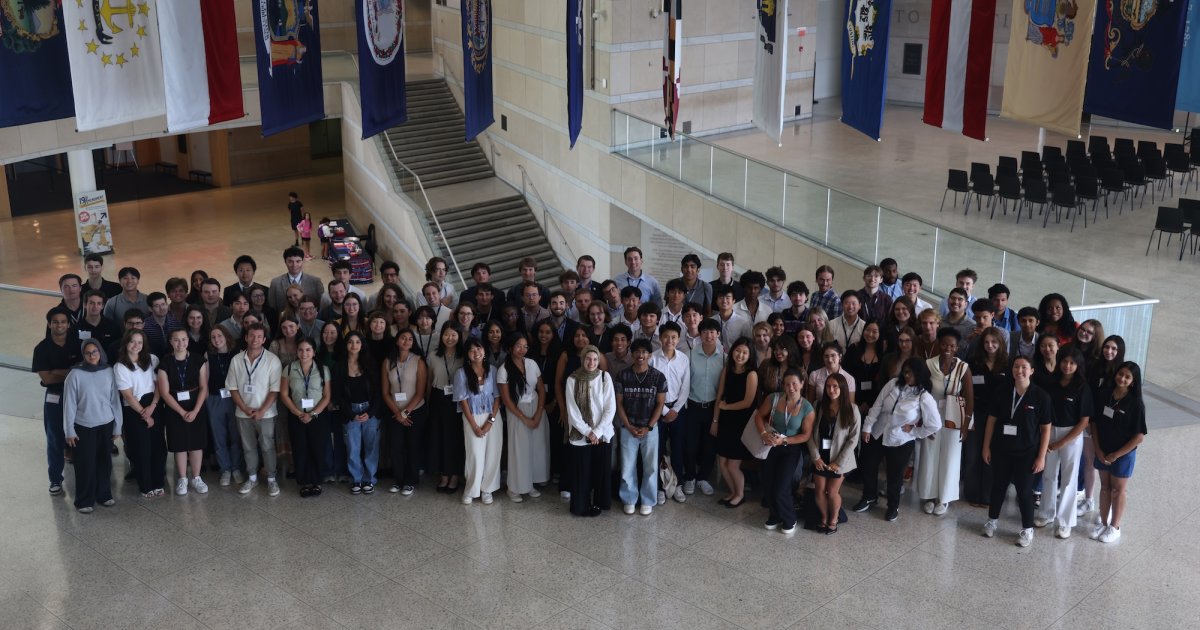
Today, the floor echoes in the National Constitution Center. The walls are lined with powerful quotes. Along the gentle curve of the tall, marble ceilings hang the flags of all 50 states. And normally, these rooms are relatively still. But this July, the Center came alive when over 100 students from 70 universities across the country gathered there, not to write a constitution, but to figure out how to keep its promises alive.
From July 11-13, FIRE hosted its annual Student Network Summer Conference at the National Constitution Center — a weekend-long crash course in civil liberties for young Americans who still believe the First Amendment matters, especially on campuses today. And, thanks to the generosity of FIRE’s donors, they were able to attend at no cost — with their travel, lodging, and meals entirely covered.
“Hosting FIRE’s Summer Conference serves as a way to unite college students who care about preserving a climate of free expression on their campuses,” said Molly Nocheck, FIRE’s vice president of Student Development. “We hope students are able to take the lessons from this weekend and use them to foster a culture of civil discourse at their institutions.”
The conference kicked off Friday evening in the Grand Hall Overlook, perched above exhibits of the very Constitution students had come to defend. FIRE’s Chief Operating Officer Alisha Glennon opened the program with a brief history of FIRE’s work protecting Americans’ First Amendment rights.
Then came a crowd favorite: a live podcast recording of Advisory Opinions, hosted by New York Times columnist and former FIRE President David French, alongside Politico contributing editor Sarah Isgur, who is also former senior counsel to the deputy attorney general at the Department of Justice. The two unpacked a grab bag of pressing legal issues, including a new Florida decision regulating the use of pronouns in public schools and the long-running tug-of-war over campaign finance.
Isgur ended the podcast with a rousing call-to-action: “To all you students, go out there and fight the fight!”
Judging from the energy and spirit of debate on display throughout the weekend, the audience seemed ready to take up Isgur’s challenge.
Saturday morning kicked off with “Free Speech 101,” led by FIRE Legal Director Will Creeley in a no-frills tour of key Supreme Court precedents and core First Amendment concepts. Afterwards, FIRE’s undergraduate summer interns turned up the heat with a fast-paced quiz game asking students to identify whether landmark cases involved protected or unprotected speech.
Next, FIRE General Counsel Ronnie London joined Creeley in dissecting the recent Supreme Court decision in Free Speech Coalition v. Paxton. This talk focused on the reasons why age restrictions burden free speech and raise privacy concerns.
After lunch, participants engaged in small group sessions where they discussed everything from global censorship to the underlying philosophy behind free speech. One student said the philosophy session was their favorite event of the weekend. “One of the exercises we did was about making the strongest cases against free speech,” they noted, “which was very useful.”
Later that evening, David French returned for an open Q&A session that pulled no punches. Students asked about political polarization in the digital age and how to foster bipartisan dialogue on college campuses. These questions sparked probing discussions that continued well into dinner.
The final day blended reflection with application. On Sunday morning, students put their First Amendment knowledge to the test with a Kahoot! quiz featuring scenarios based on Supreme Court cases, hosted by FIRE’s summer interns. Participants were then given the opportunity to play a massive game of “This or That,” a political debate in which peers defended opposing views in real time.
Then came one of the weekend’s most forward-looking sessions. Ari Cohn, FIRE’s lead counsel for tech policy, gave a talk on the growing role of artificial intelligence in shaping public discourse and its relationship to freedom of speech.
Before wrapping up, students heard from FIRE’s Chief People Officer Cait Scanlan, who mapped out career pathways within the civil liberties world.
Then the FIRE summer interns closed out the weekend with a session introducing FIRE’s “Let’s Talk!” curriculum, which teaches respectful civil discourse. Participants demonstrated key free speech principles through considering the arguments for their opponents side and ensuring everyone had an opportunity for their voice to be heard.
“A version of ‘Let’s Talk’ will definitely make an appearance on my campus,” one student said. But it’s not just this curriculum. This year’s cohort returns with more than just a handful of business cards. They walk away with a newfound mission to return to campus and begin work reviving the culture of civil discourse in this nation. Philadelphia may have been where free speech first became law, but for these students, it’s where their fight for it began.
Want to join us next time? Stay tuned here for details about next year’s Student Network Summer Conference.
Katie Ratke is a rising senior and Shloka Mehta is a rising sophomore, both working as FIRE summer interns.
Nearly 250 years ago, mere steps from the National Constitution Center in Philadelphia, a group of men locked in sweltering rooms debated the blueprint for a new nation, conceived in liberty. First among the freedoms they secured was the right to speak one’s mind, free from the chill of government meddling or the heat of mob intimidation.
Today, the floor echoes in the National Constitution Center. The walls are lined with powerful quotes. Along the gentle curve of the tall, marble ceilings hang the flags of all 50 states. And normally, these rooms are relatively still. But this July, the Center came alive when over 100 students from 70 universities across the country gathered there, not to write a constitution, but to figure out how to keep its promises alive.
From July 11-13, FIRE hosted its annual Student Network Summer Conference at the National Constitution Center — a weekend-long crash course in civil liberties for young Americans who still believe the First Amendment matters, especially on campuses today. And, thanks to the generosity of FIRE’s donors, they were able to attend at no cost — with their travel, lodging, and meals entirely covered.
“Hosting FIRE’s Summer Conference serves as a way to unite college students who care about preserving a climate of free expression on their campuses,” said Molly Nocheck, FIRE’s vice president of Student Development. “We hope students are able to take the lessons from this weekend and use them to foster a culture of civil discourse at their institutions.”
The conference kicked off Friday evening in the Grand Hall Overlook, perched above exhibits of the very Constitution students had come to defend. FIRE’s Chief Operating Officer Alisha Glennon opened the program with a brief history of FIRE’s work protecting Americans’ First Amendment rights.
Then came a crowd favorite: a live podcast recording of Advisory Opinions, hosted by New York Times columnist and former FIRE President David French, alongside Politico contributing editor Sarah Isgur, who is also former senior counsel to the deputy attorney general at the Department of Justice. The two unpacked a grab bag of pressing legal issues, including a new Florida decision regulating the use of pronouns in public schools and the long-running tug-of-war over campaign finance.
Isgur ended the podcast with a rousing call-to-action: “To all you students, go out there and fight the fight!”
Judging from the energy and spirit of debate on display throughout the weekend, the audience seemed ready to take up Isgur’s challenge.
Saturday morning kicked off with “Free Speech 101,” led by FIRE Legal Director Will Creeley in a no-frills tour of key Supreme Court precedents and core First Amendment concepts. Afterwards, FIRE’s undergraduate summer interns turned up the heat with a fast-paced quiz game asking students to identify whether landmark cases involved protected or unprotected speech.
Next, FIRE General Counsel Ronnie London joined Creeley in dissecting the recent Supreme Court decision in Free Speech Coalition v. Paxton. This talk focused on the reasons why age restrictions burden free speech and raise privacy concerns.
After lunch, participants engaged in small group sessions where they discussed everything from global censorship to the underlying philosophy behind free speech. One student said the philosophy session was their favorite event of the weekend. “One of the exercises we did was about making the strongest cases against free speech,” they noted, “which was very useful.”
Later that evening, David French returned for an open Q&A session that pulled no punches. Students asked about political polarization in the digital age and how to foster bipartisan dialogue on college campuses. These questions sparked probing discussions that continued well into dinner.
The final day blended reflection with application. On Sunday morning, students put their First Amendment knowledge to the test with a Kahoot! quiz featuring scenarios based on Supreme Court cases, hosted by FIRE’s summer interns. Participants were then given the opportunity to play a massive game of “This or That,” a political debate in which peers defended opposing views in real time.
Then came one of the weekend’s most forward-looking sessions. Ari Cohn, FIRE’s lead counsel for tech policy, gave a talk on the growing role of artificial intelligence in shaping public discourse and its relationship to freedom of speech.
Before wrapping up, students heard from FIRE’s Chief People Officer Cait Scanlan, who mapped out career pathways within the civil liberties world.
Then the FIRE summer interns closed out the weekend with a session introducing FIRE’s “Let’s Talk!” curriculum, which teaches respectful civil discourse. Participants demonstrated key free speech principles through considering the arguments for their opponents side and ensuring everyone had an opportunity for their voice to be heard.
“A version of ‘Let’s Talk’ will definitely make an appearance on my campus,” one student said. But it’s not just this curriculum. This year’s cohort returns with more than just a handful of business cards. They walk away with a newfound mission to return to campus and begin work reviving the culture of civil discourse in this nation. Philadelphia may have been where free speech first became law, but for these students, it’s where their fight for it began.
Want to join us next time? Stay tuned here for details about next year’s Student Network Summer Conference.
NDr. Tryan McMickensorth Carolina Central University has received a $500,000 grant from the Walton Family Foundation to launch a research initiative addressing the systemic barriers that prevent young men in the Research Triangle region from accessing career pathways and educational opportunities.
The two-year study, titled “Understanding Education as a Career Choice for NC Research Triangle Youth,” will focus on what researchers term “opportunity youth” – young men between ages 18 and 24 who have become disconnected from both education and employment systems. Despite broader national gains in educational access, this demographic continues to face significant obstacles that contribute to high dropout rates and limited postsecondary success.
Dr. Tryan McMickens, professor of higher education and coordinator of NCCU’s higher education administration program, will lead the initiative alongside Dr. Jim Harper II, professor of history and associate dean of the School of Graduate Studies. Their research team will include faculty members, six graduate students from the higher education administration and history programs, and a dedicated project manager. Dr. Jim Harper II
“I am thrilled that the Walton Foundation has chosen to invest in NCCU faculty to advance research on postsecondary attainment among boys and young men,” said Dr. Ontario Wooden, NCCU provost and vice chancellor for academic affairs. “This support highlights the importance of this critical area and empowers our faculty to deliver meaningful, evidence-based results. I eagerly anticipate the insights and impact this work will bring.”
The research aims to move beyond simply identifying problems to developing concrete solutions through research-based interventions, community engagement, and policy recommendations. The project will culminate in a two-day conference planned for 2026, where findings and potential interventions will be shared with stakeholders across the region.
McMickens brings extensive expertise in higher education access and the experiences of Black male students to the project. His research centers on college mental health and historically Black colleges and universities, and he authored Black Male College Students’ Mental Health: Providing Holistic Support in Higher Education. Harper’s scholarship focuses on African and African American education and innovative uses of technology for public engagement with history. He co-authored With Faith in God and Heart in Mind: A History of Omega Psi Phi Fraternity, Inc.
The Research Triangle region, encompassing Raleigh, Durham, and Chapel Hill, represents one of the nation’s most concentrated areas of higher education institutions and technology companies. However, the economic opportunities created by this educational and technological hub have not been equally accessible to all young people in the region, particularly young men from underserved communities.
The Walton Family Foundation, established by descendants of Walmart founders Sam and Helen Walton, focuses its philanthropic efforts on three primary areas: improving K-12 education, protecting rivers and oceans along with their communities, and investing in Northwest Arkansas and the Arkansas-Mississippi Delta. The foundation also supports projects reflecting individual family members’ personal interests.
The timing of this research initiative comes as higher education institutions nationwide are examining their role in addressing broader social and economic inequities, particularly those affecting young men of color who face disproportionate barriers to educational and career advancement.