Author: admin

  • New Research Highlights the Power of Access Work — and the Tools We Need to Evaluate It 

    New Research Highlights the Power of Access Work — and the Tools We Need to Evaluate It 

    • This blog was kindly authored by Dr Anna Anthony, director of HEAT. HEAT provides a collaborative data service enabling higher education providers, Uni Connect partnerships and Third Sector Organisations to show the impact of their equality of opportunity delivery through a shared, standardised data system. By aggregating data from across the membership, HEAT can publish national-level impact reports for the sector. 

    It has never been more important for providers across the sector to show that access and participation activities have an impact. With resources stretched, we need to know the work we are doing is making a measurable difference. New research from HEAT reveals a series of powerful findings: 

    1. Intensive outreach boosts HE entry by up to 29% – Students who received at least 11 hours of intensive outreach were up to 29% more likely to enter higher education (HE) than matched peers receiving minimal support. 
    1. Disadvantaged students see the biggest gains – Free school meal (FSM) eligible students were up to 48% more likely to progress to HE when engaged in intensive outreach. 
    1. Uni Connect makes a difference – The largest relative increases in HE entry were observed in FSM-eligible students who participated in Uni Connect-funded activities, further demonstrating the importance of impartial outreach delivered collaboratively. 
    1. Access to selective universities improves – Intensive outreach from high-tariff providers increased the chance of progressing to a high-tariff university by 19%. 
    1. Sustained support across Key Stages is vital – Outreach delivered across both Key Stages 4 and 5 had the greatest impact, highlighting the need for long-term, multi-stage interventions throughout secondary education. 

    These findings provide compelling evidence that the work being done across the sector to widen participation is not only reaching the right students but changing trajectories at scale. Crucially, this latest research includes previously unavailable controls for student-level prior attainment — adding new rigour to our understanding of outreach impact. You can read the full report on our website

    What’s next for national-level research? 

    Our ability to generate this kind of national evidence is set to improve even further thanks a successful bid to the Office for Students (OfS) Innovation Fund. Through a collaboration with academics at the Centre for Education Policy and Equalising Opportunities (CEPEO) at the UCL Institute of Education, HEAT will lead on the development and piloting of a pioneering new Outreach Metric, measuring providers’ broader contribution to reducing socio-economic gaps in HE participation. More details about this project can be found here, and we look forward to sharing early findings with the sector in 2026. 

    Local-level evaluation is just as important 

    While national analyses like these are essential to understanding the big picture, the OfS rightly continues to require providers to evaluate their own delivery. Local evaluations are critical for testing specific interventions, understanding how programmes work in different contexts, and learning how to adapt practice to improve outcomes. Yet robust evaluation is often resource-intensive and can be out of reach for smaller teams. 

    This is where use of a sector-wide system for evaluation helps – shared systems like HEAT provide the infrastructure to track student engagement and outcomes at a fraction of the cost of building bespoke systems. Thanks to a decade of collaboration, we now have a system which the sector designed and built together, and which provides the tools necessary to deliver the evaluation that the OfS require providers to publish as part of their Access and Participation Plans (APP).  

    We’re also continuing to improve our infrastructure. Thanks to a second successful bid to the OfS Innovation Fund we are building system functionality to support providers to use their tracking data when evaluating their APP interventions. This includes an ‘automated comparator group tool’ that will streamline the process of identifying matched participant and non-participant groups based on confounding variables. By reducing the need for manual data work, the tool will make it easier to apply quasi-experimental designs and generate more robust evidence of impact. 

    Next steps – sharing through publication 

    With all these tools at their disposal, the next step is to support the sector to publish their evaluation. We need shared learning to avoid duplication and siloed working. HEAT is currently collaborating with TASO to deliver the Higher Education Evaluation Library (HEEL), which will collect, and share, intervention-level evaluation reports in one accessible place for the first time. By collating this evidence, the HEEL will help practitioners and policymakers alike to see what works, what doesn’t, and where we can improve together. 

    If we want to continue delivering meaningful progress on access and participation, we need both meaningful, critical local evaluation and powerful national insights. Centralised data tracking infrastructure can give the sector the tools it needs to do both. 

    Source link

  • Harnessing Intercultural Expertise in an International Classroom – Faculty Focus

    Harnessing Intercultural Expertise in an International Classroom – Faculty Focus

    Source link

  • Harnessing Intercultural Expertise in an International Classroom – Faculty Focus

    Harnessing Intercultural Expertise in an International Classroom – Faculty Focus

    Source link

  • The estate we’re in | Wonkhe

    The estate we’re in | Wonkhe

    Sometimes you walk through a city and the city changes around you.

    There’s a subtle modulation in feel – the style and tenor of the place is renewed, the rhythm of green spaces shifts, the architectural language expands. Statements made in concrete, brick, limestone, and plate glass are more assertive.

    And a new form of power and control begins to be felt. You see what look like guard posts, staffed by a private police force. Gates and passes dictate where you can and cannot go. Parking a car holds a byzantine mystery of its own. Signs are branded, sometimes incomprehensibly, for the attention of an elite you suddenly feel you are not part of.

    And who runs these places? Well, you don’t get to choose. What do they do? You don’t get a say. This part of your city is not your city.

    It’s a university estate.

    Special economic zones

    If you like, a university is a freeport – where the goods coming in and out are ideas. It is, to be clear, absolutely a part of a nation state – but it is a separate polity – designed and separated for a purpose. Individually these areas are tiny, but when you start adding things together it gets interesting.

    The total population (the FTE of every staff member and student that could be counted as a “citizen” of our higher education zones) is 2.4 million – that’s around the size of Slovenia or Latvia. Staff FTE is closer to 396,000 – larger than the population of Iceland.

    University sites extend across 12,887 hectares of land in the UK – that’s more space than Bristol (the unitary authority area), and larger than Jersey. But for the number of people involved that isn’t a lot of space: the population density (again, using FTE here) is 0.02 FTE/m2 (behind only Macau and Monaco in global terms).

    Financially, we are looking at £48bn in income and £39bn in expenditure (these as reported in the Estates dataset, not the Finances dataset, giving us a positive (if weak) balance of trade. Gross national income per FTE (if we use staff only) is £12,192 (that’s 16,518 USD at current prices, a higher equivalent GNI per capita than Russia!)

    Land management

    According to the Association of University Directors of Estates (AUDE, using last year’s data) our hypothetical micronation spends around £200m on defence (or security if you’d rather) each year. If you include maintenance and repair – another essential way to protect the value of your estates assets, we’re pushing our total up beyond £1bn. And if you factor in all spending on premises (cost centre 205, which includes things like taxes, rental payments, energy, and insurance) – we are talking in the region of £6bn.

    This spending covers a lot of work. Higher education involves the use of just under 16,000 buildings – everything from student accommodation and office blocks, from nuclear reactors to wind tunnels, from listed buildings to literal pigsties. It isn’t published in the open data, but last year AUDE tells us the proportion of buildings rated as being in condition C (operational but major repair or replacement needed in the short to medium-term) and D (inoperable or serious risk of major failure or breakdown) was 23.8 per cent – the building stock is deteriorating, year on year, as repair and maintenance backlogs grow.

    What we do see in published data is display energy certificates (DEC) and and energy performance (EPC) certificates, two broadly comparable ways of rating the environmental performance of buildings. It’s not a direct line that can be drawn, but a well maintained estate (or an estate where old buildings are replaced with new) is likely to become more energy efficient over time and a poorly maintained estate will tend to lose efficiency. This year 28.21 per cent of sector non-residential estates were in categories E, F, or G – broadly the same as last year, for a larger estate that still includes a number of older buildings that are never going to reach modern efficiency standards, but still a concern.

    [Full screen]

    Though higher education involves the creation of intangible assets (everything from intellectual property to the future value of graduates in wider society), the estate represents the sector’s tangible assets. Should we lose a provider to the financial storms the sector faces, it is to the estate that creditors (or potential buyers) might look to release funds.

    Zero and below

    The UK’s COP29 pledges – in the service of a global “net zero” carbon in 2050 – have become increasingly politically controversial as the costs of doing pretty much anything have risen (due to a range of geopolitical factors far too well-known and tedious to go into here having an impact on supply chains and labour availability).

    In our hypothetical UK higher education micronation – given what is popularly imagined to be a progressive, science-informed, population – you would expect an element of leadership in sustainability and decarbonisation. And indeed, this has been the case. But this stuff comes at a cost.

    OfS’s review of the financial stability of providers in England in 2024 suggested that a key driver of continued financial challenge was:

    The affordability of necessary estate maintenance and development and the significant cost of investment needed to reduce carbon emissions as part of providers’ commitments to achieve net zero.

    A year later, the mention of net zero had been scrubbed entirely:

    the significant cost of investment needed to reduce carbon emissions as part of a commitment to tackling environmental sustainability

    Despite governments having an interest in the improving the sustainability of, and reducing emission from campuses (for example the education system sustainability and climate change strategy, first published by DfE in 2021 under the auspices of noted doyenne of woke activism Nadhim Zahawi) there is no statutory energy and carbon reporting route in English higher education(as there is for FE colleges and schools). The closest OfS gets is to gently ask those bidding for historically tiny amounts of capital to offer “assurance that providers have considered practical solutions towards achieving environmental sustainability as part of their bid”.

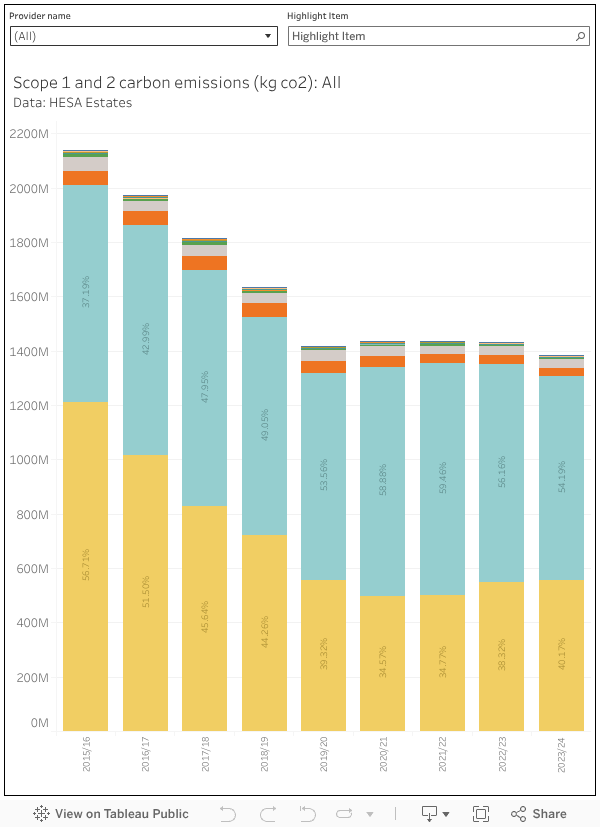
    Our UK HE micronation, as well as being a good global citizen, also has an interest in driving down long-term costs. Fossil fuels are only going to get more expensive in the long run, switching to alternatives and moving to greater efficiency makes business sense even if there are initial costs. There has been some progress with scope 1 and 2 emissions (another fall last year), though this is limited compared to what could be achieved last decade: much of the “easy” work has already been done. That said, we’re still talking about 1.4m tonnes of carbon a year, equivalent to a small African country (Eswatini, formerly Swaziland, is a decent comparator) – and this is only scope 1 and 2 (direct) emissions, factoring in the supply chains and travel within scope 3 is another matter.

    [Full screen]

    Zones of proximal development

    So, while it is undeniably fun to see UK higher education at the scale of a small country, it still remains firmly rooted in the four home nations. But the exercise prompted me to think – are there other zones within the UK that have been designed to optimise specific benefits for the areas and nations around them?

    These days its all industrial strategy zones, but in terms people may recognise we might think about enterprise zones designed to stimulate economic growth by offering incentives to business – there are 48 in England. We have the internationally focused freeports, of course – 12 of them in the UK, and 7 investment zones (to date) that aim to unlock opportunities for business. In each of these examples the actual zones are quite small (almost like campuses, in fact) but the focus is on the impact on a wider local area (where workers may commute from, for example).

    Zones like this reflect a global trend towards special economic zones (SEZs) which disapply national rules (around tax, customs, state aid, planning and so on – in some international examples we get as far as labour laws and immigration rules) in the interests of commercial activity. The wilder fringes of policies like this are pretty terrifying, but the UK does appear to be open to paddling in the shallower waters.

    Which prompts the question – if universities are like freeports (better than freeports, in fact, as they have a proven track record of providing local benefits) why not offer the relaxation of some national regulations to encourage them to expand and develop in the areas that we want them to? Perhaps it should be easier for UK higher education to recruit international staff – perhaps there should be reductions of employer national contributions with respect to UK staff. Perhaps planning could be easier around established campuses? Perhaps it should be easier to unlock state investment to improve estates without triggering the rules that would drag us into the public sector? Perhaps we could unlock investment and incentives for clean electricity generation and area heating systems?

    In the absence of an increase in tuition fees or income from OfS, a special economic zone (or zones) for higher education might be a way forward. The ideas of universities as largely self-administrating state-like entities within a country is an old one (the early days of Oxford featured a parallel judicial system, that ended up provoking riots and the foundation of Cambridge!) and perhaps worth revisiting.

    Source link

  • Degree apprenticeships are quietly redesigning how we teach at university

    Degree apprenticeships are quietly redesigning how we teach at university

    The apprentice-student is changing higher education – from curriculum to culture. It’s time we stopped treating them like traditional undergraduates.

    Degree apprenticeships (DAs) are not just reshaping the student experience – they’re redesigning the university itself. As the Office for Students (OfS) emphasises outcomes, progression, and employer engagement, and as Skills England continues to define standards for higher-level technical education, DAs are becoming a proving ground for some of higher education’s most urgent policy challenges.

    Yet they are often marginalised in strategic thinking, treated as vocational bolt-ons or niche offerings rather than core to institutional purpose. That’s a mistake. DAs demand that we think differently about curriculum, assessment, and academic infrastructure. Quietly but decisively, they are exposing the limitations of legacy systems, and pointing the way to a more integrated, future-facing university model.

    Different learners, different accountability

    Degree apprentices are full-time employees and students, legally entitled to spend 20 per cent of their working time on off-the-job learning. This is not simply “study leave” – it encompasses formal teaching, applied projects, reflective practice, and continuous professional development.

    This dual status creates a distinctive learner profile, and a distinctive teaching challenge. In designing a level 6 accounting and finance manager degree apprenticeship, we couldn’t simply repackage existing content. We had to co-develop new modules that satisfied two sets of demands: the academic rigour expected by the university and the occupational standards defined by the Institute for Apprenticeships and Technical Education (IfATE). These must also align with professional accounting syllabi from bodies such as CIMA, ACCA and ICAEW.

    This triple mapping – to university, regulatory, and professional standards – creates what might be called multi-stakeholder accountability. It requires curriculum teams to work in ways that are more agile, responsive, and externally engaged than many traditional degree programmes.

    Rethinking assessment

    If OfS regulation is pushing universities toward more transparent, outcomes-focused assessment practices, DAs offer a blueprint for how that can work in practice. Assessment in degree apprenticeships is not an end-of-module activity; it’s a longitudinal, triangulated process involving the learner, the employer, and the academic team. Learners are required to build portfolios of evidence, reflect on their practice, and complete an end-point assessment, which is externally quality-assured.

    In our programme, this means apprentices must show how they’ve applied ESG frameworks to real reporting challenges or used digital tools to improve efficiency. These are not hypothetical case studies, they’re deliverables with real organisational impact.

    This demands a fundamental shift in how we understand assessment. It moves from a one-directional judgement to a co-produced, real-world demonstration of competence and critical thinking. It also raises practical challenges: how do we ensure equity, consistency, and academic standards in these shared spaces?

    Practice must evolve too. Assessment boards and quality teams need confidence in workplace-verified evidence and dialogic tools like professional discussions. Regulations may need adjusting to formally recognise these approaches as valid and rigorous. Co-created assessment models will only work if they’re institutionally supported, not just permitted.

    Institutional systems still speak undergraduate

    Despite their growth – and repeated nods in policy papers from DfE, OfS, and IfATE (now Skills England) – DAs still struggle to integrate fully into institutional structures designed around traditional undergraduates.

    Timetabling, academic calendars, support services, and digital access systems are still largely predicated on a three-year, 18- to 21-year-old, campus-based model. Degree apprentices, who may study in blocks, access learning from workplaces, and require hybrid delivery modes, often fall through the gaps.

    This institutional lag risks positioning apprenticeships as peripheral rather than core to university provision, and undermines the very work-based, flexible, lifelong learning that national policy increasingly promotes.

    To move beyond legacy assumptions, institutional systems must adapt. Timetabling and delivery planning should treat block teaching as core, not marginal. Learner support must accommodate hybrid work-study lives with flexible pastoral care and digital access. Even workload models and quality assurance processes may need tailoring to reflect co-delivery demands

    If we are serious about the Lifelong Learning Entitlement, future modularity, and widening participation, DAs are not just a test case, they are the early evidence base.

    Who owns the curriculum?

    DAs also reconfigure academic authority. In designing the our degree apprenticeship programme, we co-developed curriculum with employers, professional bodies, and regulators. At its best, this is collaborative innovation. At its most complex, it’s curriculum by committee.

    Some employers overestimate their control over content or underestimate their responsibilities around mentoring and assessment. Professional bodies may be supportive in principle, but slow to recognise apprenticeship pathways in formal qualifications. The university becomes a mediator, balancing academic integrity, regulatory compliance, and employer priorities.

    This is delicate, sometimes frustrating work. But it also shifts the purpose of curriculum design, from academic transmission to negotiated, contextualised learning and demands that academic teams are supported to work across professional and regulatory boundaries without compromising standards

    What universities can learn

    DAs are more than a niche. They’re a stress test, revealing how well universities are equipped to deliver flexible, employer-engaged, outcome-driven learning.

    They challenge traditional pedagogies, reward authentic assessment, and open up new relationships between knowledge and practice. They also model the kinds of teaching and learning the sector is being increasingly nudged toward by policy: modular, flexible, accountable, and co-created with employers.

    This is not an argument for turning every degree into an apprenticeship. But it is a call to stop treating DAs as bolt-ons or exceptions. If we take seriously the structural and pedagogical shifts they demand, we may find in them a pathway to broader institutional transformation.

    In a higher education landscape increasingly shaped by regulation, scrutiny, digital disruption and workforce change, the apprentice-student may not just be part of the future – they may be leading it.

    Source link

  • Breaking Down Columbia U.’s Settlement with Trump Admin

    Breaking Down Columbia U.’s Settlement with Trump Admin

    With a 22-page document and $221 million fine, Columbia University ended its months-long battle with the Trump administration that included accusations of civil rights violations, an accreditation review and a funding freeze that disrupted research and forced layoffs.

    The settlement agreement, announced Wednesday night, will force changes to admissions, disciplinary processes and academic programs. In exchange, Columbia should get about $400 million in federal research funding back. The seemingly unprecedented deal will also see the federal government close investigations into alleged failures to police antisemitism on campus. (Despite the settlement, Columbia has not admitted to any allegations of wrongdoing but has acknowledged reforms were needed.)

    Critics have decried the agreement as a concession to authoritarian demands imposed for political control, while supporters have argued reforms are necessary at Columbia after a pro-Palestinian encampment in spring 2024 and subsequent protests disrupted campus life.

    Although Trump officials purportedly began their crusade against Columbia in an effort to address campus antisemitism, officials’ comments indicate that conservative politics also factored into the settlement.

    “This is a monumental victory for conservatives who wanted to do things on these elite campuses for a long time because we had such far left-leaning professors,” Education Secretary Linda McMahon said in a FOX Business interview following the settlement announcement.

    The Trump administration has made clear that this agreement will serve as a roadmap for its dealings with other universities, including Harvard. Much of the agreement reflects what the administration had demanded of Columbia in March, but other provisions—such as a requirement to turn over admissions data and scrutinize international student enrollment—are new and reflect demands sent to other universities.

    Here’s what is in the agreement and what it means for Columbia.

    Funding Streams Restored

    Columbia will see at least a partial restoration of federal research funds.

    The federal government will restore grants terminated by the Department of Health and Human Services and National Institutes of Health. However, grants terminated by the Department of Education “and other terminated contracts are excluded from this provision,” according to the agreement.

    Columbia will be eligible for future grants, contracts, and awards “without disfavored treatment.”

    Columbia acting president Claire Shipman emphasized that the agreement was about much more than $400 million, telling CNN on Thursday that federal scrutiny imperiled $1.3 billion a year.

    “There are many headlines about $400 million dollars. This is really access to billions of dollars in future funding. And it’s not just money for Columbia. I mean, this is about science. It’s about curing cancer. Cutting edge, boundary breaking science that actually benefits the country and humanity,” she said, emphasizing the deal “reset” Columbia’s relationship with the government.

    Closure of Investigations

    The agreement will close pending investigations or compliance reviews related to potential violations of Title VI of the Civil Rights Act of 1964, which prohibits discrimination based on race or national origin. That includes a probe by the U.S. Equal Employment Opportunity Commission into the treatment of Jewish employees at Columbia. Of the $221 million settlement, $21 million will go toward the EEOC complaint.

    However, the Trump administration noted in the agreement that the deal does not affect “in any way EEOC’s right to bring, process, investigate, litigate, or otherwise seek relief in any charge filed by individual charging parties or third parties that may later be filed against Columbia.”

    Protest Restrictions

    Columbia will maintain policies announced in March that deem protests inside of academic buildings and related spaces to be a “direct impediment” to the university’s academic mission.

    “Such protests in academic buildings, and other places necessary for the conduct of University activities, are not acceptable under the Rules of University Conduct because of the likelihood of disrupting academic activities,” part of Columbia’s settlement with the federal government reads. All protest activity will be subject to university anti-discrimination and anti-harassment policies.

    Prohibitions on masks announced in March will also remain in place.

    Education Secretary Linda McMahon has said Columbia’s “unlawful encampments and demonstrations” deprived Jewish students of learning opportunities.

    Mary Altaffer-Pool/Getty Images

    Student Life Changes

    The agreement codifies changes to disciplinary processes announced in March, such as placing the University Judicial Board under the Office of the Provost who reports to the president. Students previously served on the board, but now, it will be restricted to faculty and staff members.

    The university president will make the final determinations on appeals cases.

    Columbia will also add a student liaison “to further support Jewish life and the wellbeing of Jewish students on campus” who will advise administrations on issues such as antisemitism.

    DEI Ban

    Diversity, equity and inclusion initiatives, a frequent target of the Trump administration, are also included in the agreement. The deal bars Columbia from maintaining “programs that promote unlawful efforts to achieve race-based outcomes, quotas, diversity targets, or similar efforts.”

    Per the agreement, Columbia will be required to provide reports “summarizing its compliance with this obligation” and to ensure that university programs do not “promote unlawful DEI goals.”

    Changes to Admissions

    The agreement emphasizes merit-based admissions and bars Columbia from giving preference to applicants due to “race, color, or national origin.” It also prevents Columbia from using personal statements, diversity narratives or references to race “to introduce or justify discrimination.”

    Columbia will also be required to submit admissions data to the federal government on both rejected and admitted students, including demographic details and standardized test scores.

    International applicants at Columbia will also be subject to additional scrutiny with the agreement dictating that the university “undertake a comprehensive review of its international admissions processes and policies.” That review is designed to ensure those applicants are “asked questions designed to elicit their reasons for wishing to study in the United States.”

    Columbia is also required to provide details of “all disciplinary actions involving student visa-holders resulting in expulsions or suspensions, and arrest records that Columbia is aware of” to the extent that is permissible under the Family Educational Rights and Privacy Act.

    A person walks on Columbia's campus in Morningside Heights

    Columbia also agreed to examine its business practices and decrease its financial dependence on international students.

    CHUYN/iStock Unreleased/Getty

    Program Reviews

    Maintaining a senior vice provost to provide greater administrative oversight of Middle East studies (and other regional programs), as initially announced in March, is also part of the agreement.

    That official will conduct reviews of programs such as the Institute for Israel and Jewish Studies; Middle Eastern, South Asian, and African Studies; the Middle East Institute; and various other programs, according to the agreement. Those reviews are intended to ensure programs are “comprehensive and balanced” and include “all aspects of leadership and curriculum.”

    But some faculty members have expressed skepticism about additional administrative scrutiny.

    Michael Thaddeus, president of the Columbia chapter of the American Association of University Professors, wrote in an emailed statement that the agreement poses threats to academic freedom at U.S. universities.

    “Columbia’s insistence that it will not allow the government to interfere in appointments, admissions, or curriculum is welcome. Yet the creation of a monitor, charged with scrutinizing our admissions data and our Middle Eastern studies department, opens the door to just such interference,” Thaddeus said.

    Resolution Monitor

    As part of the deal, a third-party resolution monitor will police the agreement.

    Bart Schwartz, co-founder of Guidepost Solutions and former Chief of the Criminal Division of the United States Attorney’s Office for the Southern District of New York, will serve in that role.

    The agreement will allow the resolution monitor to access campus for assessment purposes.

    Asked if Columbia believed the Trump administration would live up to its side of the agreement and if it had obtained any assurances, a university spokesperson did not provide a statement but instead pointed Inside Higher Ed to language in the agreement on dispute resolution.

    That section noted opportunities for arbitration “if either party reasonably believes that the other is in violation of the terms of this agreement,” including reporting obligations outlined in the deal.

    Hiring Requirements

    The deal also places restrictions on university hiring processes.

    Columbia’s agreement will bar the use of “personal statements, diversity narratives, or any applicant reference to racial identity as a means to introduce or justify discriminatory practices in hiring or promotion.” Other unspecified “indirect methods or criteria that serve as a substitute for race conscious hiring or promotion practices” are also prohibited per the deal.

    Columbia is required to submit data on hiring and promotion practices to the resolution monitor.

    Codifying and Introducing Changes

    While some elements of the agreement are new, other parts simply codify prior changes. For example, changes to disciplinary processes, and greater administrative oversight of Middle East studies (and other regional programs) already announced in March are now codified in the deal.

    David Pozen, a Columbia law professor who has argued that “the agreement gives legal form to an extortion scheme,” noted while some of the deal was foreshadowed, other parts go beyond what was previously announced.

    Some provisions “are novel and don’t track what was already said in March,” Pozen said. “There’s language, for example, about all-female locker rooms and sports teams in paragraph 20. I don’t believe that has any antecedent and just seems like a new anti-trans provision. So, it’s a mix of memorialization, extension and innovation in what Columbia has conceded.”

    Jessica Blake contributed to this report.

    Source link

  • Antisemitic beliefs rare among faculty, Brandeis University study finds

    Antisemitic beliefs rare among faculty, Brandeis University study finds

    Dive Brief:

    • Just 3% of non-Jewish faculty members hold views about Israel that would fit definitions of antisemitism put forward by Jewish groups, according to a spring survey of over 2,300 faculty members at 146 research universities released by Brandeis University in July. 
    • Less than 10% of faculty reported actively teaching about the Israel-Palestine conflict. Despite widespread media attention to campus protests and targeted attacks on universities by the Trump administration over allegations of antisemitism, more than three-fourths said the Israel-Palestine conflict never came up in class discussions. 
    • Only a minority of faculty were politically active or posted on social media about major current issues, including the Israel-Palestine conflict, racism in America, climate change and President Donald Trump’s impact on American democracy, the survey found. 

    Dive Insight:

    The new study comes at a time of roiling political tensions around college campuses. 

    On the campaign trail, Trump described colleges as being “dominated by Marxist maniacs and lunatics.” Since taking office in January, his administration has launched investigations and pulled research funding from major institutions — Columbia and Harvard universities, among others — over claims of rampant antisemitism on campus. 

    The administration has also sought to impose “intellectual diversity” on college faculties, including through an executive order on accreditation and in its dealings with individual universities. 

    While the Brandeis study found that nearly three-quarters of faculty — 72% — identify as liberal, they also hold “a wide range of views on controversial political issues,” the researchers wrote.

    For instance, when looking at the intensity of opinions, over 60% said they “strongly” believed that climate change was a crisis requiring immediate attention and that Trump represented a threat to democracy. 

    But only 33% expressed strong belief that racism was widespread in America and 14% that Israel is an apartheid state. (Overall, a majority of faculty backed those statements, including only those who somewhat agreed, with a much larger majority agreeing with the racism statement.) 

    That said, activism around any of those topics was relatively scant. With the Israel-Palestine conflict, 78% of faculty reported no activism at all, including on social media. Around two-thirds reported no activism around racism or climate change. 

    When it comes to teaching, a majority of faculty said they would present a variety of perspectives on those news topics, with the exception of climate change. Only 45% of faculty said they would present a variety of perspectives on climate change while another 40% said they would do so but with some perspectives “more justified than others.”

    When it came to the Middle East conflict, even among the 14% of faculty who said they strongly believed Israel to be an apartheid state, a majority (56%) said they would present a variety of perspectives when teaching about the issue.

    The researchers posed questions intended to study when faculty views of Israel veered into antisemitism as defined by Jewish groups, including the International Holocaust Remembrance Alliance, and that Jewish students frequently agree are antisemitic. They also used the definition by the Jerusalem Declaration on Antisemitism, which has accused the IHRA’s version of blurring the line between antisemitism and criticism of Israel. 

    The researchers asked whether survey respondents agreed with statements such as “Israel does not have the right to exist,” “all Israeli civilians should be considered legitimate targets for Hamas,” and “I wouldn’t want to collaborate with a scholar who supports the existence of Israel as a Jewish state.”

    Large majorities strongly disagreed with those statements, and fewer than 10% agreed with them with any intensity. Those who did were more likely to identify as liberal. 

    Likewise, a small minority of non-Jewish faculty — 7% — expressed views considered antisemitic about Jewish people as a group rather than Israel. Those faculty were more likely to be politically conservative, according to the study. 

    Amid the Trump administration’s attacks on colleges, close to half (46%) of faculty and a majority of those identifying as liberals expressed serious concerns about being targeted by the federal government for their political views, the study found.

    Source link

  • ‘A dangerous precedent’: Critics slam Columbia’s agreement with Trump administration

    ‘A dangerous precedent’: Critics slam Columbia’s agreement with Trump administration

    This audio is auto-generated. Please let us know if you have feedback.

    Federal officials hope their agreement with Columbia University will be a “template for other universities around the country,” U.S. Education Secretary Linda McMahon said Thursday. 

    Her remarks, made in a NewsNation interview, come as some critics publicly worry that the deal will spur the Trump administration to put financial pressure on other universities. Columbia law professor David Pozen, for instance, wrote in a blog post Wednesday that “the agreement gives legal form to an extortion scheme.”

    Despite praise for the deal from some corners of the university, critics have also accused Columbia of capitulating to the Trump administration’s attacks on higher education.

    The Trump administration has withheld federal funding from a long list of colleges, often claiming they are not doing enough to address antisemitism or otherwise violating civil rights laws. Columbia became the face of those battles in March, when the Trump administration canceled $400 million of the New York institution’s federal grants and contracts. 

    Under the deal reached Wednesday, Columbia agreed to a litany of policy changes and concessions, including paying the federal government $221 million, to settle civil rights investigations and to have the “vast majority” of $400 million in federal grant funding reinstated, according to the university’s announcement.

    Along with having most of the money reinstated, “Columbia’s access to billions of dollars in current and future grants will be restored,” the university said in Wednesday’s announcement. 

    The deal ends the Trump administration’s probes into whether Columbia had failed to protect Jewish students from harassment and the Equal Employment Opportunity Commission’s similar investigation into its treatment of employees. 

    The 22-page agreement is wide-ranging. Columbia agreed to provide the federal government with admissions data on both its accepted and rejected applicants, craft training “to socialize all students to campus norms and values,” and have an independent monitor oversee its compliance with the deal. It also said it would establish processes to ensure students are committed to “civil discourse, free inquiry, open debate, and the fundamental values of equality and respect.”

    Additionally, the university said it would decrease its financial dependence on international students — who make up roughly 40% of enrollment — and ask foreign applicants for their reasons “for wishing to study in the United States.” 

    And Columbia will codify measures it announced in March, which include banning masks meant to conceal one’s identity and having a senior vice provost review programming focusing on the Middle East, including the university’s Center for Palestine Studies; Institute for Israel and Jewish Studies; and Middle Eastern, South Asian, and African Studies. 

    That leader, Miguel Urquiola, will review those and other programs — including their leadership and curriculum — to ensure they are “comprehensive and balanced,” according to the agreement. 

    Columbia also agreed to appoint an administrator to serve as a student liaison to address concerns about antisemitism. That administrator will make recommendations to top officials about how the university can support Jewish students. 

    ‘A dangerous precedent’

    Claire Shipman, Columbia’s acting president, suggested the deal doesn’t undermine the university’s autonomy. “It safeguards our independence, a critical condition for academic excellence and scholarly exploration, work that is vital to the public interest,” she said in a Wednesday statement

    Indeed, the agreement says it does not give the federal government control over the university’s employee hiring, admission decisions or academic speech. 

    However, critics have swiftly and vociferously denounced the deal, arguing that the university has yielded to an authoritarian administration and harmed the higher education sector at large.

    Source link

  • Wales can lead the way on student engagement – if it chooses to

    Wales can lead the way on student engagement – if it chooses to

    Imagine studying in a Wales where every student understands their rights and responsibilities.

    Where module feedback drives real change, where student representatives have time, resources and power to make a difference, and where complaints drive learning, not defensiveness.

    Where every student contributes to their community in some way – and where decisions can’t be made about students without students.

    When the Tertiary Education and Research (Wales) Act 2022 was being drafted, the inclusion of a mandatory Learner Engagement Code was important – Wales resolved to put into primary legislation what England had buried in the B Conditions and Scotland had largely left to institutional discretion.

    Section 125 now requires the Commission to prepare and publish a code about learner involvement in decision-making that’s not optional, or best practice – it’s law.

    This year the newly formed commission (MEDR) has been informally consulting on it – but it’s now been so long since the original debates that there’s a danger everyone helping to develop the thing will forget what it was supposed to do.

    Nobody will benefit from something that emerges as something weak or vague. The opportunity is for Wales to lead the way with some crunchy “comply or explain” provisions for universities in Wales that reflect the fact that this has been put in primary legislation.

    The cost of getting it wrong

    We know what happens when learner engagement is treated as an afterthought. In England, providers often silence critique on reputational grounds – the Office for Students’ (OfS) free speech guidance had to explicitly state that students have the right to publicly criticise their institutions. Imagine needing regulatory clarification that criticism is allowed in a democracy.

    Meanwhile, Scottish institutions celebrate their “partnership” approach while student representatives struggle to influence decisions that matter. Sparqs frameworks look good on paper, but without regulatory teeth, they rely on institutional goodwill. And goodwill, as any student rep will tell you, tends to evaporate when difficult decisions need making.

    When module evaluation becomes a tick-box exercise rather than genuine dialogue, problems fester. When student reps are excluded from decisions about their own education, drop-out rates climb. When complaints are buried rather than learned from, the same issues affect cohort after cohort.

    I’ve seen a lot of it over the years. The disabled student who gave up trying to get adjustments implemented because every lecturer claimed the central service’s plans were “merely advisory”. The international PGT student who couldn’t complain about teaching quality because they feared visa implications. The part-time student who couldn’t access support services because everything was designed around full-time, on-campus students.

    The student facing disciplinary proceedings who wasn’t allowed an advocate and faced a panel with no student members – in contrast to the support available to staff in similar situations.

    These aren’t edge cases – they’re systematic failures that a robust Code could prevent. Wales has a genuine opportunity to do something different – to create a Code with teeth that makes learner engagement mandatory, measurable and meaningful.

    Learning from what works

    The most effective student engagement systems require common features. They’re comprehensive, covering everything from module evaluation to strategic planning, and are backed by resources, ensuring student representatives aren’t expected to volunteer countless hours without support. And crucially, they have consequences when institutions fail to comply.

    The key is moving from “should” to “must”, with a comply or explain mechanism that has genuine bite.

    Here’s how it could work. The Code would set out clear standards – not aspirations but requirements. Providers would either have to comply with the standards or publicly explain why they’ve chosen an alternative approach that delivers equivalent or better outcomes.

    But – and this is crucial – explanations wouldn’t be allowed to be boilerplate excuses. They would need to be evidence-based, time-limited, and subject to scrutiny.

    The Commission would assess compliance annually, not through tick-box returns but through triangulated evidence – student surveys, complaint patterns, representation effectiveness metrics, and crucially, the views of student representatives themselves.

    Where providers persistently fail to meet standards without adequate justification, consequences would follow – from improvement notices to conditions on funding.

    There would be an expectation of an annually agreed student partnership agreement – setting out both processes and priority actions – and an expectation that students’ unions would produce an annual report on the experiences of students at that provider.

    This isn’t about micromanaging institutions – it’s about establishing minimum standards while allowing flexibility in how they’re met. A small FE provider might implement representation differently than a large university, but both must demonstrate their approach delivers genuine student voice in decision-making.

    Student rights and democratic education

    The Code should first establish that students are both consumers with enforceable rights and partners in their education. This dual recognition ends the sterile debate about whether students are one or the other. It means providers must respect consumer rights (quality, promises kept, redress) while creating genuine partnership structures.

    Knowing your rights matters. Following Poland’s model, all students should receive comprehensive training on their rights and responsibilities within 14 days of starting. That shouldn’t be an optional freshers’ week session – it should be mandatory education covering consumer rights, representation opportunities, complaints procedures, support services, and collective responsibilities.

    Crucially, the training should be developed and delivered by the SU. There should be written materials in (both) plain language(s), recorded sessions for those who can’t attend, annual refreshers, and staff trained to respect and uphold these rights. When every graduate understands both their rights and responsibilities, Wales will transform not just higher education but society.

    Protected status and academic adjustments

    Following Portugal’s model, student representatives should get protected status. That means academic adjustments for representative duties, just as providers must accommodate pregnancy or disability. No student should face the choice between failing their degree or fulfilling their democratic mandate.

    Representatives should get justified absences for all activities – not just formal meetings but preparation, consultation, and training. Assessments should be rescheduled without penalty, deadlines adjusted based on representative workload, and attendance requirements modified. Reps should get protection from any form of academic discrimination.

    The Finnish model adds another layer – ideally, student representatives in governance should receive academic credit or remuneration (or both). Learning through representation is learning – about negotiation, governance, and strategic thinking. They are skills that matter in any career.

    Module evaluation as universal engagement

    The Estonian approach shows what’s possible when feedback becomes embedded in academic culture. Making evaluation mandatory for module completion ensures universal participation. But it must be meaningful – published results, documented actions, closed feedback loops. Every student becomes a partner in quality enhancement, not just the engaged few.

    Wales should adopt Estonia’s three-part structure – teaching quality, student engagement, and learning outcomes. This recognises that educational success requires both good teaching and student effort. No more blaming students for poor outcomes while ignoring teaching failures, and no more student satisfaction surveys that ignore whether students are actually engaging with their learning.

    Results should be published within modules – not buried in committee papers but visible where students choose modules. Previous evaluation results, actions taken, ongoing improvements – all should be required to be transparent. Future students should be able to see what they’re signing up for, and current students should see their feedback matters.

    Comprehensive scope of engagement

    Sweden’s clarity is instructive – students must be represented “when decisions or preparations are made that have bearing on their courses or programmes or the situation of students.” There’s no weasel words about “where appropriate” or “when practicable” – if it affects students, students must be involved.

    In the Netherlands, where decisions are made by individuals, not committees, information must be provided and consultation must occur at least 14 days in advance. And written explanations should be required when student recommendations aren’t followed – because accountability matters in managerial decisions.

    Beyond academic structures, students should be represented on professional service boards, IT committees, estates planning groups, marketing focus groups. Decisions about campus facilities or digital systems affect students as much as curriculum design – yet these areas often lack any student voice.

    The digital environment deserves special attention. Student representatives should be involved in decisions about learning platforms, assessment systems and communication tools – not after implementation but during planning. Because digital accessibility and usability directly impact educational success.

    Consent not consultation

    Wales could be bold. Following the Dutch model, some decisions should require student consent, not just consultation. The Code could distinguish clearly between:

    Matters requiring consent (cannot proceed without student agreement):

    • Teaching and Assessment Regulations
    • Significant programme structure changes
    • Student charter content
    • Institutional policy frameworks affecting learners
    • Quality assurance procedures
    • Representation structure and changes
    • Elective module options for the following year

    Matters requiring consultation (mandatory input but not binding):

    • Budget allocations affecting student services
    • Campus development plans
    • Strategic planning
    • Staff appointments affecting students
    • Marketing and recruitment strategies

    Matters governed by a council of staff and students:

    • Student accommodation
    • Student employment
    • Student services and mental health
    • Harassment and sexual misconduct policy

    Matters delegated to the students’ union

    • Student engagement and representation
    • Student activities and volunteering

    This isn’t radical – it’s a recognition that students are genuine partners. No other stakeholder group would accept purely advisory input on regulations governing their activities. Why should students?

    From course reps to citizens

    Another area where Wales could be genuinely radical would take Wales’ vision of students as citizens by going beyond traditional representation structures – broadening “engagement” beyond academic quality.

    The European model of subject-level associations – common from Helsinki to Heidelberg – shows what’s possible. These aren’t just academic societies but genuine communities combining social activities, career development, representation, and civic engagement. They create belonging at the discipline level where students actually identify.

    In Tallinn, departmental student bodies aren’t sideshows but partners in departmental culture. They organise orientation, run mentoring, coordinate with employers, feed into curriculum development – and crucially, they’re funded and recognised as essential, not optional extras.

    In some countries there’s even a “duty of contribution” where students volunteer to help run the institution. Green officers, peer mentors, student ambassadors – multiple routes to engagement beyond traditional representation. Not everyone wants to be a course rep. But everyone can contribute something.

    Even if we’re just talking about student clubs and societies, Wales should mandate that providers support and fund these diverse engagement routes.

    Every student should serve somehow during their studies – it’s citizenship education in practice. Some will be traditional representatives, others will mentor new students, run sustainability initiatives, organise cultural events, support community engagement. All develop democratic skills. All should share responsibility for their community.

    Taking part

    Some countries maintain a tripartite principle for major bodies – equal representation of students, academic staff, and professional staff – to recognise that universities are communities, not hierarchies. Maybe that’s asking too much – but even with a minimum of two students in the room, representation means nothing without support.

    Some countries require that student reps receive all documentation at least five days in advance, training on context and background, briefings on complex issues, and support to participate fully – you can’t contribute if you don’t understand what’s being discussed.

    When new committees or working groups are established, there should be active consideration of student membership with default presumption of inclusion. Decisions and justifications should be communicated to student representatives, and there should be annual reviews of representation effectiveness with evidence-based changes.

    Some countries transform meetings from tokenistic to meaningful. Materials distributed five working days in advance means no ambushing student representatives with complex papers. Everything in accessible language, translated where needed, should be a standard too.

    The Swedish innovation of publishing all decisions and rationales builds accountability. Rather than being buried in minutes, decisions get actively communicated. Students can see what’s decided in their name and why – democracy requires transparency. And committees should pick up minimum student membership levels with voting rights, and there should never (ever) be just one student in a room.

    Funded independence

    Latvia mandates that SUs receive at least 0.5 per cent of institutional income, and minimums were agreed as part of the Australian Universities Accord. This isn’t generous – it’s the minimum needed for effective representation. The Welsh Code should set a minimum as a % of income, or fees – ensuring student bodies have resources to train representatives, gather evidence, and hold institutions accountable.

    Funding should come with independence safeguards. There should be no conditions that compromise advocacy, no reductions for challenging decisions, and protected status even when (especially when) relationships become difficult. Written agreements should protect core funding even during institutional financial difficulties.

    Beyond core funding, providers should be required to supply facilities, administrative support, IT access, and time for representatives. The split between guaranteed core funding for democratic functions and negotiated funding for service delivery would protect both representation and student services.

    Complaints as learning and conduct

    Complaints are a really important part of student engagement – and so the OIA’s Good Practice Framework, which learns from them, should be mandatory, not optional. A proper system treats complaints as valuable intelligence, not irritations to be managed.

    Wales should then go further, automatically converting failed appeals containing service complaints into formal complaints. When patterns emerge, compensation should go to all affected students, not just those who complained. And every provider should be required to publish on what it’s learned from complaints over the past year, and what it’s doing about it – with sign off from the SU.

    The Swedish model’s restrictions on disciplinary proceedings protect students from institutional overreach. Proceedings are only allowed for academic misconduct, disruption of teaching, disruption of operations and harassment. And students are given full procedural rights – including representation, disclosure and presence during evidence.

    Wales should go further. Every student facing disciplinary proceedings should have the right to independent support, and any panel should include student members who are properly trained and supported. Peer judgement matters in community standards.

    And neither disciplinary nor funding processes should ever be used to silence criticism, punish protest, retaliate for complaints or discourage collective action. The free speech protections in OfS’ guidance should be baseline – students’ right to criticise their institution is absolute, whether individually or collectively.

    Disability rights are student rights

    Every year, countless disabled students arrive with hope and ambition, only to find themselves trapped in a Kafkaesque system of “support” that demands disclosure, documentation, negotiation, repetition, and often – silence. If Wales is to lead, then it should be unflinching in acknowledging the daily indignities that disabled students face – and bold in tackling the systemic failures that allow them to persist.

    Adjustments, when granted, are inconsistently implemented, and advocacy, if it exists at all, is fractured and under-resourced. In many departments, reasonable adjustments are still treated as optional extras. Central services write the plans, but academic departments dispute their legitimacy, claiming subject expertise trumps legal obligation. Students are asked to justify, to prove, to persuade – again and again. And often in public – as if their access needs were a debate.

    Disabled students can’t be expected to fight these battles alone. Wales should require institutions to facilitate advocacy, embedded close to academic departments, co-located with SUs where possible, and independent enough to challenge unlawful behaviour when necessary. Not every rep can be an expert in disability law. But every student should have access to someone who is.

    The law is clear – providers have an anticipatory duty. That means planning ahead for the barriers Disabled students face, not waiting until they fall. But few providers conduct serious, evidence-based assessments of their disabled student population by type of impairment, by subject area, by mode of study. Without that, how can anyone claim to be meeting the duty? Wales could also set the tone nationally with a mandatory bank of questions in the NSS that probes access, implementation, and inclusion.

    Wales’ code should mandate that providers move beyond warm words to hard strategy – analysing disability data with student input, mapping gaps, and resourcing change. Every provider should be required to publish a Disability Access Strategy – co-designed with students, informed by evidence, and backed with budget. And implementation should be monitored – not through passive complaints, but active auditing. Where there are failures, there should be automatic remedies – and if patterns persist, the Commission must intervene.

    And briefing all students on disabled students’ rights would help too. If every student understood what disabled students are legally entitled to, fewer adjustments would be denied, more peers would offer solidarity, and institutions would face pressure from all sides to comply with the law. Education here is empowerment – for disabled and non-disabled students alike.

    Wales could lead

    If all of that feels like a lot, that’s because it is.

    But that’s why it was put in primary legislation – to show what’s possible when you take student engagement seriously, to create structures that outlast changes in institutional leadership or political climate, and to graduate citizens who understand democracy because they’ve practiced it.

    But most importantly, to lead:

    The Commission will ensure that Welsh PCET providers lead the UK in learner and student engagement and representation.

    Universities Wales isn’t so sure. In its response to the Regulatory System Consultation it said:

    We do have a number of concerns about regulatory over-reach that can be found in several of the pillars. For example, in the Learner Engagement pillar, the demand for investment of resources and support for learner engagement could be deemed to be a breach of institutional autonomy, particularly in light of this being married to ‘continuous improvement’ – if this ends up being a metric on which the sector is judged, it could be particularly contentious in tight financial circumstances.

    Good grief. It really isn’t a breach of institutional autonomy for students to expect that a little slice of their fees (whether paid by them or not) will be allocated to their active engagement and will be under their control. As Welsh Government put it during the passage of the Bill:

    There is already some excellent learner engagement within the sector, but the prize now is to ensure this is the norm across all types of provisions and for all learners.

    Welsh Government talks about civic mission, distinctive Welsh values, and education for citizenship – in universities, the Code is where rhetoric can meet reality.

    Fine words should become firm requirements, and partnership can stop being what institutions do to students and become what students and institutions do together.

    I know which Wales I’d rather study in. The question now is whether MEDR has the courage to mandate it.


    Source link

  • Justin Amash | The Foundation for Individual Rights and Expression

    Justin Amash | The Foundation for Individual Rights and Expression

    Throughout his career, former Congressman Justin Amash
    has been a strong advocate for freedom of speech, writing that “The
    value of free speech comes from encountering views that are
    unorthodox, uncommon, or unaccepted…Free speech is a barren
    concept if people are limited to expressing views already widely
    held.”

    In this special live episode, filmed in front of 200+
    high schoolers attending FIRE’s Free Speech Forum at American
    University in Washington, D.C., Amash takes questions from the
    audience and discusses his upbringing, his political career, the
    state of American politics, and how the Constitution guided his
    work in Congress.

    Earlier this year, Congressman Amash
    joined
    FIRE’s Advisory Council.

    Timestamps:

    00:00 Intro

    03:30 Upbringing

    06:21 Law school

    13:15 Time in Congress

    15:59 Why Amash publicly explained each of his
    votes

    26:30 On being the first libertarian in Congress

    30:57 Connection between his principles and free
    speech

    33:10 Trump’s first impeachment

    42:48 Dealing with pushback from constituents

    46:03 Term limits for members of Congress?

    55:25 How high schoolers can pursue a career in
    politics

    59:45 Has there been a regression in First Amendment
    protections?

    01:07:32 What Amash is up to now

    01:08:06 Outro

    Enjoy listening to the podcast? Donate to FIRE today and
    get exclusive content like member webinars, special episodes, and
    more. If you became a FIRE Member
    through a donation to FIRE at thefire.org and would like access to
    Substack’s paid subscriber podcast feed, please email
    [email protected].

    Source link