Author: admin

  • From where student governors sit, Dundee isn’t the only institution with governance challenges

    From where student governors sit, Dundee isn’t the only institution with governance challenges

    There are a couple of typical ways to “read” Pamela Gillies’ investigation report into financial oversight and decision making at the University of Dundee.

    One is to imagine that the issues in it are fairly unique to that university – that a particular set of people and circumstances were somehow not picked up properly by a governing body apparently oblivious to what was happening below the surface.

    In that extreme, the key failing was not doing all the Scottish Code for Good Higher Education Governance asks its governors to do.

    Another is to wonder whether, even with a clean bill of “good governance” health, it could happen elsewhere.

    One of the things that is fascinating about organisational failure is the way in which governance tends to be picked up as a problem – because it can lead to the conclusion that because organisational failure is not widespread, the governance issues must be local.

    If you position governance exclusively as scrutiny, it could of course be the case that the culture of governance is weak across the board – it’s just that most senior teams in universities don’t make the mistakes that were evidently made at Dundee, and thus we’d never know.

    After all, nobody questions governance when things are going well, when funding is flowing and when student numbers are on the up. If anything, in that positioning, the danger is in complacency – because governance needs to come into its own to avoid mistakes and catch issues before they become catastrophes.

    When Gillies’ report was published, I couldn’t avoid recalling countless conversations I’ve had over the years with student members of governing bodies about everything from the lateness of papers to the culture of decision making.

    So to test the waters, I pulled out 14 governance issues from the investigation and put a brief (anonymous) survey out to students’ union officers who are members of their Board, Council or Court.

    I can’t claim that 41 responses (captured in the second half of June and the first half of July) are representative of the whole sector, and nor are they representative of the whole of the governing bodies on which respondents have sat.

    But there is enough material in there to cause us concern about how universities around the UK are governed.

    A culture of control

    One issue that Pam Gillies picked up was leadership dominance, where the vice chancellor and chair were found to have “behaved like they have everything under control” while governing bodies failed to provide adequate challenge.

    When we asked whether student governors had experienced leadership that “routinely dominates discussions, controls narratives to present overly positive pictures, or makes it difficult for governors to raise concerns,” 68 per cent said they’d experienced this “a lot”. Another 27 per cent said “a little.”

    That’s 95 per cent of respondents experiencing some level of what one might generously call “narrative management” by their senior teams.

    The comments flesh out what this looks like in practice. One student governor observed:

    You are told at the start that your job is to manage the VC and the SMT but they manage the governors. The Chair and the VC behave like they have everything under control. The room just does not seem interested in education or the student experience, more whether it is running as a business.

    Another captured the emotional impact:

    Whenever I have asked a question or said something even questioning let alone critical about UEG it’s like I have suggested burning down their office. They are allowed to be both over-defensive and over-reassuring rather than treat contributions from me and some of the other more vocal governors as contributions to thinking. It makes the whole thing quite pointless.

    It’s not just about dominance – it’s also about active silencing. Gillies found that dissenting voices were marginalised and that “critical challenge was not welcomed.” Our survey bears this out.

    When asked about governors being “shut down, spoken over, dismissed as ‘obstructive,’ or otherwise discouraged when trying to challenge decisions,” 51 per cent reported experiencing this “a lot”. Another 37 per cent said “a little”.

    The mechanisms are subtle but effective. One respondent noted being warned at the start of their term that the previous student president had not been “constructive” and that to get things done, they needed to be “constructive” instead. The implied threat was clear – play nice or be frozen out.

    It was made very clear to me at the start that the previous President had not been ‘constructive’ and that if I wanted to get things done I needed to be ‘constructive’. All year I have felt torn – other governors would regularly ask me at the meal what was ‘really going on’ but I never felt like I could be critical in the actual meeting because of the ‘partnership’. I feel like the VC was under a lot of pressure to perform for the governors, and that makes it impossible to say anything about what you think is going wrong.

    Another described the choreography of exclusion:

    The power dynamics are fascinating if you’re into that sort of thing. Watch who the Chair makes eye contact with, whose contributions get minuted vs. ‘noted’, who gets interrupted vs. who can ramble for 10 minutes unchecked. I never got the premium treatment – I feel that the Chair needs some feedback on whose thoughts they obviously value.

    That isolation extends beyond meetings. Multiple respondents noted deliberate strategies to separate them from support:

    One tendency we picked up on a lot was to isolate me from support, I wasn’t allowed to discuss the papers with my CEO or have my CEO in the room. It’s only student on the board. They say that’s for confidentiality, but everyone else in the room is clearly discussing their issues with people who can put everything into a context. I think it should be the law that two students are on the board.

    The theatre of governance

    Gillies found that important decisions at Dundee were made outside formal governance structures, with a “small inner circle” controlling key outcomes. Our survey question on decision-making transparency suggests this is far from unique.

    When asked whether “important decisions are made by a small inner circle before reaching the governing body,” 51 per cent said this happened “a lot”, with another 44 per cent saying “a little”.

    The comments reveal how that manifests. One student governor described discovering a shadow governance structure:

    I think there’s a huge element of culture at my institution which prevents effective governance but it’s also the structure. There’s a meeting which isn’t included in the governance structure but everything goes to it before it can go anywhere else and it’s restricted to senior managers at the university. If it isn’t approved there, it won’t happen, even if things like rent negotiations have taken place in the ‘proper’ meetings, they can just scrap it and say ‘no, this is what needs to happen’ and then we’re just told. It feels like secret meeting which secretly governs everything and every other meeting is a rubber stamp for decisions made there.

    Another put it more bluntly:

    The meetings are very odd places, we don’t have any input at all on anything. Everything that comes to the Court is finished, and our job seems to be to politely probe what is in front of us (always once, follow ups frowned upon). Eye-opening but completely pointless.

    Gillies highlighted how late papers and missing documentation hampered effective governance at Dundee – the control of information emerges as a critical tool in maintaining this system across the sector. Over half (54 per cent) of respondents in our survey reported experiencing late papers, missing documentation, or “critical updates given verbally rather than in writing” frequently.

    But it goes deeper than administrative incompetence. When asked about financial information quality – an area Gillies found particularly problematic at Dundee – 37 per cent said they’d frequently received reports that “were unclear, seemed to obscure the true position, contained unexplained anomalies, or lacked integrated information.”

    One respondent shared a particularly telling anecdote:

    Training – our old CFO was a dick. He said that he wouldn’t train student members of Council in the finances because we ‘wouldn’t understand it’ which, in my mind, seems like something to a) find out and b) entirely irrelevant to a governor asking to see financial information.

    The systematic exclusion of student perspectives from board papers then compounds it:

    Many of the budget requests and department updates did not reflect the student experience accurately whether it was missing data from specific feedback routes or lacking in student perspective entirely, it made approvals difficult for me and difficult for the board as I would then be asked for the data and even though I can share some of the issues I know of I cannot represent the entire student body. With only 48hrs notice.

    The message seems to be that knowledge is power – and student governors aren’t meant to have it.

    Living in fantasy land

    Gillies found that Dundee’s governing body had been presented with “overly positive pictures” that obscured institutional reality. Quite striking in our survey is the disconnect between the institution presented in governance meetings and the one students actually experience.

    Multiple respondents described sitting through presentations that bore no resemblance to reality:

    The university that gets presented isn’t the university I was at as a student.

    Another elaborated:

    It feels a lot like a fantasy world in there but they really don’t know how the university actually works, and the questions they ask are so weird, like they are desperate for the university to be as good as they imagine it is when there are really a lot of problems with how it runs especially at school level.

    This fantasy is then maintained through what we might call the tyranny of positivity. When asked whether they’d felt “pressure to maintain positive messaging even when you have legitimate worries,” 61 per cent said they’d experienced this “a lot”.

    The enforcement mechanisms vary. Some are explicit:

    They love talking about ‘student voice’ in the abstract but hate it when we actually speak. I raised concerns about library hours during exams and the DVC literally rolled his eyes. Later the Chair pulled me aside and said I should ‘pick my battles more carefully’ and focus on ‘strategic matters’.

    Others are more subtle. Multiple respondents described being praised for contributions that never led to change:

    I was often praised in the minutes. ‘Thoughtful contribution from the student member.’ But praise without change feels hollow – a polite pat on the head.

    This disconnect between fantasy and reality is exacerbated by what several respondents identified as an unhealthy fixation on rankings:

    A lot of the meetings were really interested in what I had to say, but the obsession with league tables is bizarre. We spent easily an hour at the last meeting discussing how to game NSS metrics but when I suggested actually fixing the issues students raise – timetabling chaos, inconsistent feedback, broken IT systems – I got blank stares. One governor literally said ‘can’t we just manage student expectations better?’ What’s the point?

    Another observed:

    There are about sixteen of us in theory but really there are six people who speak at every meeting, and it is always about whether we are beating other universities. I don’t think the governors have any way to judge how well the university is doing other than by thinking about other universities. It is very weird.

    This comparative obsession substitutes for genuine evaluation of institutional health – where things become filtered through the lens of institutional positioning rather than student experience.

    The survey responses also reveal how regulatory compliance has become another distorting filter. Several respondents noted how the Office for Students has inadvertently created perverse incentives:

    It is very weird to me that whenever I’ve talked about student issues they are responded to with things like ‘that would not be an issue for the OfS’, like we are only supposed to worry about the student experience if OfS are doing a visit.

    It suggests that governing bodies are more concerned with regulatory perception than addressing underlying problems – a dangerous conflation of compliance with quality.

    The impossible position

    A particularly Byzantine aspect of student perceptions of governance emerges in the contradictions around representation. Multiple respondents noted being told explicitly that they were “not a representative” of students, only to have governors constantly ask them about student views:

    At the start of the year it is drilled into you that you are not a representative, and then at every meeting someone has asked me what students think, what students are saying, how students would react, and so on. It really is ridiculous.

    It creates an impossible position – student governors are simultaneously expected to embody the student voice whilst being forbidden from claiming to represent it, and are consulted when convenient but dismissed when challenging.

    The tokenism extends to how “the student experience” is conceptualised:

    There is a pressure not to rock the boat too much or the SU funding will be under threat. One other thing is that the other governors see ‘the student experience’ as one homogeneous thing. I represent 30,000 students – disabled students, commuters, mature students, international students, care leavers – but I get 5 minutes at the end of every meeting to cover ‘student matters.’ When I highlight different needs across student groups, eyes glaze over.

    One response powerfully captured another dimension of the problem:

    Too many decisions are made by white upper-middle class men who have no real understanding of student demographics or experiences and the effects that rushed, ill informed decisions can have on the student body.

    This homogeneity problem compounds all the others – if governance doesn’t reflect the communities it serves, how can it possibly understand their needs?

    Throughout the responses runs a theme of performative partnership that masks fundamental power imbalances. Student governors describe being valued for their “input” on predetermined decisions whilst being told their contributions are “premature” on anything still under genuine consideration:

    Two types of agenda items, ones where student input is ‘valued’ (anything they’ve already decided) and those where student input is ‘premature’ (anything they haven’t decided yet). Its never the right time for meaningful student contribution.

    The contrast between public and private behaviour is also revealing:

    I feel that the UET are like Jekyll and Hyde, they have listened to me outside of the meetings but when I have asked about things during Board meetings they react very defensively. I’m not supposed to be a rep for students but nobody else ever talks about students unless we count recruiting students.

    When push comes to shove

    Gillies found that committees at Dundee operated as “rubber stamping exercises” rather than providing genuine oversight. Our survey revealed similar patterns, with 46 per cent reporting committees feeling like “rubber stamping exercises.”

    Even when committees try to assert themselves, the resistance is telling:

    We had an issue with the auditors and the closest I’ve seen us come to blows as a Council was when the exec tried to treat the issue as annoying but closed and move on but Council had to say ‘actually, no, we’d like an audit of our auditors to work out how [confidential] was missed.’

    The fundamental problem, as one respondent observed, may be structural:

    I honestly think that the huge number of things the council are expected to know about and make decisions on are beyond them. They don’t meet often enough and they really do not understand their responsibilities.

    Gillies documented how Dundee’s governance processes were abandoned during crisis periods. Our survey asked about governance during “difficult periods,” and of those who didn’t say “N/A”, 51 per cent reported seeing “normal governance processes abandoned, informal advisory groups bypass committee structures, or key oversight bodies become inactive when they’re most needed.”

    It suggests that whatever thin veneer of good governance exists in normal times rapidly dissolves under pressure – precisely when robust governance is most essential:

    Student input in governance is at a real risk of just becoming a box ticking exercise as I have sat in meetings where the student experience is discussed by everyone but the students in the room. Once decisions need to be made at speed all thought for student and staff is ignored and it is often because of their own burdensome governance structures that inhibit the agility needed for such a volatile time in HE.”

    The human cost

    The emotional toll shouldn’t be underestimated. Multiple respondents described feeling “out of place,” “invalidated,” or like they were “betraying everyone” simply by asking questions.

    One particularly poignant comment came from a sabbatical officer who left their role early:

    It was a really tough experience as I had students relying on me. I wish that I could’ve stayed in my role for longer but the lack of transparency and wish to subdue the view for students contradicted my individual beliefs and leadership style. I was supportive and I wanted students to know what I was doing. This wasn’t always possible.

    And the lack of institutional learning is telling:

    It is telling that they spent so much time with me at the start but haven’t spent any time with me to get my feedback at the end. I feel that they should do exit interviews to learn about how intimidating the atmosphere can be.

    Perhaps most damning is the response to our final question. When asked whether they “feel confident that your governing body would identify and respond appropriately to serious institutional risks,” only 32 per cent expressed confidence.

    That means 68 per cent of student governors – governors who usually have the most intimate knowledge of how their institutions actually operate – doubt their governing body’s ability to spot and address serious problems.

    One captured the fundamental dysfunction:

    If I compare it to being on my union board I think the governors is a joke. If I ask why or how in the union we have a decent conversation. If I do it at governors the atmosphere is like I’ve betrayed everyone. And if I say something isn’t clear that is turned into something I’ve not done or read. We’re not governors. We’re an audience.

    Another summed up the experience with clarity:

    I feel that the whole thing is engineered to make the vice chancellor and her team to look good rather than gather our input or ideas, I would have side conversations with some of the community governors who shared my view but there just is not any part of any meeting where ‘input’ is welcome.

    We’re not governors. We’re an audience

    Some of the most problematic critiques came in respondents’ final reflections on what governance actually means in practice:

    What frustrates me most is the wasted potential. These are genuinely smart, accomplished people who could transform this place. But they’re trapped in this weird bubble where everything’s fine and any criticism is disloyalty. I know I’m not the only one.

    The sense of governance as performance came through repeatedly:

    In the January meeting I was invited to do a presentation before the formal meeting on what student life is like and I got a lot of praise from the Chair about how eye-opening it was. But about half of the governors were not there and the PVC-E went off on one about how the university’s surveys contradicted some of the things we were saying. I feel that the whole body just doesn’t have a clue about students or staff and what it is like to be a student in 2025.

    One respondent captured the Kafkaesque nature of their experience:

    The whole ‘critical friend’ thing is such a con. We’re meant to be critical but every time I challenge something I get ‘well, Council can only advise, we cannot instruct the executive.’ So we’re legally responsible for decisions we can only ‘advise’ on? The Vice Chancellor keeps saying Council is ‘not a court’ whenever we try to hold them accountable. I’ve started asking ‘what CAN Council actually do?’ because honestly I’m not sure anymore.

    The broader implications were spelled out starkly:

    The big, big, BIG thing for us as student leaders has been ‘what Council is and is not for’. Often, when we’ve brought issues for discussion or ‘airing’ at Council, I have had every variation of ‘Council is not a court’ ‘Council can only advise the exec, it cannot instruct it’ ‘Council is for critical challenge but cannot dictate’ some of which is absolutely at odds with then being legally responsible for the decisions you have only ‘advised on’ and ‘cannot dictate’.

    And perhaps most damningly:

    As a new Sabbatical officer, I felt extremely out of place with the culture of Court meetings, as if I wasn’t supposed to be or welcome there. It made my input feel invalidated and overlooked. Structurally, important decisions are already decided upon within committees before reaching court.

    What next?

    It’s important to set what I’ve gathered in context. Student governors have a particular perspective and a specific set of confidence and cultural capital asymmetries that are bound to make being on a body of the “great and good” a difficult experience.

    41 responses is not the whole sector (and may not even be from 41 universities), and it was a self-selecting survey. But we should be worried.

    Out of the back of the Dundee episode, both Graeme Day and the Scottish Funding Council have committed to exploring ways to strengthen governance to avoid a repeat.

    Universities Scotland has committed to collective reflection on Gilles’ findings and the lessons it shares to give “robust assurance” of financial management and good governance to funders, regulators, supporters and all who depend on universities.

    It has also said it will “connect” to Universities UK’s work to consider the leadership and governance skills required in the sector in times of transformation and challenge.

    As such, the same issue that students see in governing bodies is playing out nationally – there are questions that suggest a loss of autonomy, and reassurance about “performance” designed to retain it.

    There is therefore a real danger that the processes will conclude what these sorts of things always conclude – that with the right “skills” and adherence to a given Code, all will be well.

    But the experiences from students suggest that neither “getting the right skills” nor calls for better codes will solve the fundamental problems. The issue isn’t just about getting the “right” people around the table or training them better – it’s about reconsidering what we’re asking governance to do.

    Vertical or horizontal?

    As I noted here and here, the Dutch experience offers an alternative. Following a series of governance scandals in the early 2000s, the Netherlands rejected both excessive state control and unfettered institutional autonomy. Their 2016 Education Governance Strengthening Act created a “third way” – creating multi-level democratic participation from program to institutional level.

    Rather than imposing rigid rules, the framework promoted “horizontal dialogue” where students, staff, management, and supervisors engage in ongoing conversations about their university.

    A 2021 evaluation found meaningful channels for student and staff input had been created, with improved dialogue quality between stakeholder groups. If there’s enough of them, staff and students have turned out to be better at scrutiny than skilled lay members or someone from the funding council sat in the corner.

    It’s also partly about what is discussed. Most boards operate primarily in fiduciary mode (overseeing budgets, ensuring compliance) or strategic mode (setting priorities, deploying resources). While essential, these modes often crowd out what governance scholars call the “generative mode” – critical thinking, questioning assumptions, and framing problems in insightful ways.

    Generative governance asks probing questions: “What is our fundamental purpose?” and “How does this decision align with our core values?” It involves scenario planning, delving into root causes rather than symptoms, and actively considering ethical implications beyond legal compliance. And it allows senior staff to participate, rather than perform – a culture that then improves scrutiny in fiduciary mode.

    It is where staff, student, and community governors could add most value – yet it’s often where their contributions are most dismissed as inappropriate or “operational.” The standard line that governors should be “concerned with the university rather than as representatives” misses the point that understanding the lived experience of those working and studying there is essential to good governance, and actually improves fiduciary scrutiny.

    Put another way, maybe better fiduciary mode scrutiny could have probed more on the Nigerian students focussed business plan at Dundee. But it’s more likely that better generative mode governance could have explained what was starting to happen to the currency in Nigeria, how tough students were funding it to pay their fees, and what families were going through as the Naira went into collapse.

    It’s also partly about what we think “effectiveness” means. Universities facing unprecedented challenges – financial pressures, technological disruption, legitimacy crises – need governance capable of navigating complexity, not just ticking out risk registers. They need what the Dutch reforms sought – genuine accountability to the communities they serve, not just reassuring compliance with regulatory requirements.

    Universities at their best are spaces where different forms of knowledge encounter each other, and where democratic values are modeled and sustained. Their governance should reflect this reality.

    As such, we need to ensure we’re solving the right problem. The issue isn’t governors who need better training or institutions that need tighter control. It’s a governance model designed for a different era and different types of organisation, struggling to cope with contemporary complexity while excluding the voices that could help navigate it.

    What we do next requires courage to move beyond the false choice between corporatisation and collegial nostalgia. A third way is possible – one that takes seriously both institutional sustainability and democratic participation, that values both expertise and lived experience, that reconciles the university interest with the interests of those who study and work there rather than separating them or elevating one of them, and that governs for the public good rather than just institutional survival.

    The students sitting in those boardrooms, feeling like audiences rather than governors, deserve better. So do the staff, the communities universities serve, and democracy itself.

    Source link

  • College Employees in Kansas Can’t List Pronouns in Emails

    College Employees in Kansas Can’t List Pronouns in Emails

    College Employees in Kansas Can’t List Pronouns in Emails

    Ryan Quinn

    Wed, 07/23/2025 – 05:25 PM

    Lawmakers in Topeka, like those in some other state capitals, used a budget bill to order nonfinancial changes to public higher ed. DEI was the target this time.

    Byline(s)

    Source link

  • ‘Inadequate and deeply troubling’: George Mason AAUP votes no confidence in board

    ‘Inadequate and deeply troubling’: George Mason AAUP votes no confidence in board

    This audio is auto-generated. Please let us know if you have feedback.

    Dive Brief:

    • A faculty group at Virginia’s George Mason University this week adopted a no-confidence resolution aimed at the institution’s board for its handling of recent attacks on the university by the Trump administration. 
    • George Mason’s chapter of the American Association of University Professors described the board’s response to four government investigations, launched in less than a month, as “inadequate and deeply troubling” in a letter Tuesday to members of George Mason’s board of visitors and state officials. 
    • The group called on the board to publicly defend George Mason President Gregory Washington and to “reaffirm the university’s unwavering commitment to academic freedom, diversity, equity, and inclusive excellence.”

    Dive Insight:

    Over the course of roughly three weeks, the Trump administration has opened multiple civil rights probes into George Mason through the U.S. Department of Education and U.S. Department of Justice. 

    The most recent investigation, launched by the Justice Department’s civil rights unit, is looking at whether George Mason’s admissions and scholarship practices violate Title VI, which forbids discrimination based on race, color or national origin at federally funded institutions. It is also probing the university’s response to antisemitism. 

    A letter this week to the head of George Mason’s board from Harmeet Dhillon, the assistant attorney general for the Justice Department’s civil rights division, didn’t contain any specific allegations against the university, but stated that “a school administration’s deliberate indifference to a racially hostile educational environment is illegal.” 

    It followed the Justice Department’s earlier announcement of a probe into racial discrimination in George Mason’s employment practices. In informing officials of that investigation, Dhillon cited past comments by Washington about George Mason’s efforts to diversify its ranks and support women and faculty members of color.   

    The probes come just weeks after former University of Virginia President Jim Ryan abruptly announced his resignation in June amid pressure from Trump’s Justice Department and a similar investigation into the public institution’s diversity efforts.

    In public statements, George Mason’s board — headed by Charles Stimson, who holds leadership positions at The Heritage Foundation, a conservative think tank — has said little beyond that it will provide government agencies with requested information and comply with law.

    In a statement Tuesday in response to the latest probe, the board said it will “ensure GMU complies with all federal anti-discrimination laws.” In an earlier statement, it said it had a fiduciary obligation to “ensure that the University continues to thrive as the largest public university in Virginia.”

    George Mason’s board did not immediately respond to a request for comment.

    Washington himself has defended the university’s diversity efforts, writing last week, “It is inaccurate to conclude that we created new university policies or procedures that discriminated against or excluded anyone.”

    In the resolution, the George Mason AAUP chapter defended Washington’s record at the university where the board has been publicly silent. 

    “President Washington has demonstrated exceptional leadership by advancing the university’s longstanding commitment to inclusion and diversity, overseeing significant improvements in the university’s national rankings, while still maintaining Mason’s ethos of access and affordability, particularly for first-generation students,” it stated.

    The resolution also blasts the board as having “utterly failed to support President Washington and George Mason University during this period of unprecedented and increasing federal scrutiny and political targeting,” adding that “the silence from the Board has become deafening.”

    The faculty group additionally called out the board’s choice of attorneys to represent it in talks with the Trump administration, noting that the firm Torridon Law was co-founded by former Attorney General Bill Barr, who served under Trump, and has several prominent Republican lawyers on staff. 

    Among them is Mike Fragoso, who is handling communications about the investigations for George Mason and was previously chief counsel to former Senate Republican Leader Mitch McConnell.

    “The hiring of Torridon Law PLLC to defend GMU against the Trump administration’s ideological attacks is like hiring a wolf to protect the sheep,” the faculty group wrote. 

    Torridon’s Fragoso did not immediately respond to a request for comment.

    The George Mason AAUP “overwhelmingly” voted in favor of the no-confidence resolution, according to the letter to the university’s board.

    Source link

  • Tennessee launches direct admissions pilot with student aid component

    Tennessee launches direct admissions pilot with student aid component

    Dive Brief: 

    • Tennessee is joining the ranks of states with direct admissions programs by launching a pilot this fall that will automatically offer certain high school students spots at the state’s two- and four-year colleges based on their academic records. 
    • The program, led by the Tennessee Higher Education Commission, will pair admissions offers with financial aid information for about half the high school students to test whether that boosts their chances of enrolling
    • In a statement Wednesday, THEC Executive Director Steven Gentile cast the initiative as a way to simplify the path to college. “For the first time in the nation, we are pairing direct admissions with personalized financial aid information, so students not only know where they’ve been accepted — they’ll also know how they can afford to go.”

    Dive Insight: 

    The TN Direct Admissions pilot is to launch in November, when roughly 41,000 students from more than 230 randomly selected high schools in the state will receive letters listing which participating colleges have automatically accepted them. Around half of those students will also get information about available state and institutional financial aid tailored to them based on their GPA, test scores or other criteria. 

    To participate, students will need to complete an application for the Tennessee Promise program by Nov. 1.

    Researchers will use the information from the pilot to study how providing this information influences college-going behavior. 

    They aim to find out whether high school students who receive both financial aid information and direct admissions bids are more likely to attend college than those who just get automatic admissions offers. They will also compare the data against that for students who don’t receive direct admissions letters at all. 

    “Through this study, we will learn not only about the impact of direct admissions and financial aid on students’ college enrollment, but how students feel about their direct admission experience,” Trisha Ross Anderson, a Harvard University researcher working on the project, said in a Wednesday statement. 

    The financial aid component — which THEC said in a Wednesday statement is the first of its kind for a direct admissions program — will inform students of their eligibility for institutional grants and scholarships, as well as for state programs such as the Tennessee Promise. That program covers remaining tuition and fees for students at state community or technical colleges after all other grant aid has been applied.  

    Overall, 53 colleges are participating in the fall pilot. That includes all 13 of the state’s community colleges and its 23 technical colleges, as well as 17 public and private universities. 

    Tennessee joins several other states that have recently launched direct admissions programs. Earlier this year, Illinois Gov. JB Pritzker signed a bill into law to send high school and community college students direct admissions offers to the state’s universities depending on their academic performance. 

    And last October, New York launched an effort to guarantee fall 2025 spots to at least one of its public universities for high school students graduating in the top 10% of their class. The nine initial participating colleges included the state’s two flagships, University at Buffalo and Stony Brook University.

    Source link

  • New book argues child care is a ‘societal imperative’

    New book argues child care is a ‘societal imperative’

    The other day, I came across an article about child care that felt so familiar I let out an exasperated sigh. Child care, the article announced, is now more expensive than college tuition and rent in most states. Many of us had just read another version of the article in March. And before that, in November 2024. Then there’s the one that dates back a little further — to 2013

    Many of these stories, which seem to come out on an annual basis, fail to mention that this is a problem that spans decades. The real news is that it hasn’t gotten any better, and many American lawmakers don’t seem to care enough to take action. 

    I asked Elliot Haspel his thoughts on this a few weeks ago when I interviewed him about his new book, “Raising a Nation,” which will be available Aug. 11. In the book, he presents 10 arguments — some of them well known and others less intuitive — for why child care needs to be a more supported part of American society. His book starts with an anecdote that echoes my observation on the dispiriting lack of momentum around the issue: In 1998, President William Jefferson Clinton stood in the Rose Garden and declared in an address that child care was essential to the nation’s economy. President Barack Obama made the same argument in 2015. President Donald Trump did the same in 2019. Yet as the years go by, little changes.

    “We have been having many of the same child care battles for a long time, for decades and decades and decades,” Haspel told me.

    Haspel’s arguments in “Raising a Nation” include “The Economic Case,” where he digs into how child care affects business productivity and the labor force; and the “The Patriotic Case,” where he presents parenthood as patriotic and argues child care is important for American democracy.

    He cites numerous worrisome examples of the consequences of insufficient policy and investment. In making “The Community Case,” for instance, he tells a jarring story from Montrose, Colorado, where the lack of child care has led to difficulties recruiting and retaining police officers. That, in turn, negatively affects the city’s crime rate and response time to emergency calls. And in arguing “The Antipoverty Case,” he highlights extensive research on how a lack of child care is a key theme for families who are unable to move out of poverty.  

    “Care is, in fact, just as important to our social infrastructure as having a public education system, having public libraries, having public parks,” he told me.

    As he writes, it’s clear why we haven’t made much progress as a nation, and why we remain behind nearly every other wealthy country in investing in child care: “We have never established that good child care belongs among the pantheon of American values.” 

    While Haspel’s book focuses more on why we need more robust child care policy than how we get there, he provides a few ideas for the latter: giving child care educators a wage that could support their own families, investing in stay-at-home parents and informal caregivers along with licensed care, and including before- and after-school care and summer care in the system. While those seem like lofty goals, Haspel argues it is indeed fully “American” to embrace such policies. Access to high-quality child care, he argues, is not an “individual family obligation but rather a societal imperative.”

    Contact staff writer Jackie Mader at 212-678-3562 or [email protected]

    This story about child care was produced by The Hechinger Report, a nonprofit, independent news organization focused on inequality and innovation in education. Sign up for the Hechinger newsletter.

    The Hechinger Report provides in-depth, fact-based, unbiased reporting on education that is free to all readers. But that doesn’t mean it’s free to produce. Our work keeps educators and the public informed about pressing issues at schools and on campuses throughout the country. We tell the whole story, even when the details are inconvenient. Help us keep doing that.

    Join us today.

    Source link

  • Turkish police arrested magazine staff over Muhammad cartoon, but it doesn’t actually depict the prophet

    Turkish police arrested magazine staff over Muhammad cartoon, but it doesn’t actually depict the prophet

    Last year, FIRE launched the Free Speech Dispatch, a regular series covering new and continuing censorship trends and challenges around the world. Our goal is to help readers better understand the global context of free expression. Want to make sure you don’t miss an update? Sign up for our newsletter.


    Five arrests over cartoon “publicly demeaning religious values”

    Turkish police officers walking down street in Istanbul. (Shutterstock.com)

    Cartoons depicting Muhammad are a common feature in censorship news but the latest developments out of Turkey are a little unusual in that the magazine involved is adamant that the cartoon under fire…does not actually depict the prophet. 

    On June 30, Turkish police arrested four employees of satirical magazine LeMan on charges of “publicly demeaning religious values,” with one cartoonist also charged with “insulting the president.” They raided the magazine’s office as well and, two weeks later, arrestedLeMan editor at Istanbul’s airport upon his return from France. The arrests followed an attack on the LeMan office, with a mob breaking open windows and doors.

    The origin of the dispute? A June 26 LeMan edition with an anti-war cartoon depicting two winged men — one depicted as Muslim and introducing himself as Muhammad and the other as Jewish and calling himself Moses — shaking hands as they ascend over a burning city with bombs raining down. The Muhammad character, the magazine said, “is fictionalised as a Muslim killed in Israel’s bombardments” and is named so because it’s the “most commonly given and populous name in the world.”

    The magazine remains adamant its staff is being arrested on the basis of a willful misunderstanding, but for now Turkish officials — including President Erdogan, who called it a “vile provocation” that must be “held accountable before the law” — are intent on prosecution and have seized copies of the edition.

    There’s more free speech news out of Turkey. A new law granted the country’s Presidency of Religious Affairs the authority to ban Quran translations it deems “do not correspond to the basic characteristics of Islam,” including online and audio versions. Meanwhile, a Turkish court blocked some content produced by xAI’s Grok for insulting Erdogan and religious values.

    And Spotify has threatened to leave the Turkish market in part over a censorship dispute with the deputy minister of culture and tourism, who has accused the site of hosting “content that targets our religious and national values and insults the beliefs of our society.” That content apparently includes playlists like “The songs Emine Erdogan listens to while cleaning the palace,” which mocks Erdogan’s wife’s allegedly lavish spending. 

    UK’s free speech controversies online and off — and in American visa policy

    The UK’s free speech issues are nothing new, but this time the U.S. is part of the story, too. UK prosecutors had already announced an investigation into Belfast rap trio Kneecap earlier this year — which, as of last week, has been dropped — but now duo Bob Vylan is on the list. 

    Bob Vylan caught global attention last month in a controversial Glastonbury set which included a “Death, death to the IDF” chant led by the band. Avon and Somerset Police confirmed they were reviewing footage to confirm “whether any offences may have been committed that would require a criminal investigation.” Prime Minister Keir Starmer also objected to the “appalling hate speech” and demanded answers from the BBC about its broadcast of the set. Shadow Home Secretary Chris Philp also said the BBC “appears to have also broken the law.”

    Then the Trump administration joined in. Deputy Secretary of State Christopher Landau announced shortly after the incident that the U.S. revoked the visa of Bob Vylan members ahead of the band’s upcoming tour. “Foreigners who glorify violence and hatred are not welcome visitors to our country,” he wrote.

    Speech controversies also bloomed outside Glastonbury. UK police have now arrested dozens of demonstrators for attending events opposing the ban on Palestine Action, an activist group restricted under British anti-terrorism legislation for damaging military planes in a protest. Simply “expressing support” for the banned group is a crime. 

    The Wall Street Journal covered the UK’s (and Europe’s) “far and wide” crackdown on speech in a July 7 piece that also discussed the recent targeting of activist Peter Tatchell, arrested by police in London for a “racially and religiously aggravated breach of the peace.” Tatchell’s offense was holding a sign “that criticized Israel for its Gaza campaign as well as Hamas for kidnapping, torturing and executing a 22-year-old.”

    Also, in more unsurprising news, the UK’s troubling Online Safety Act is making its mark on the internet as social media platforms begin the process of age verification for UK-based users. Bluesky users will be required to use Kid Web Services or face content blocks and app limitations. Reddit users must verify too, or lose access to categories of material including “content that promotes or romanticizes depression, hopelessness and despair” and “content that promotes violence.”

    And, finally, is the UK getting a government-imposed swear jar? A district council in Kent is considering a £100 fine for swearing in public. That definitely won’t backfire. 

    Fake news, social media for teens, and more in the latest tech and speech developments 

    • Last week, Russian legislators passed rules issuing fines for people who “deliberately searched for knowingly extremist materials,” with heightened fines for those using a VPN to access them. That’s not just censorship of what you say, but also of what you simply try to see.
    • The European Court of Human Rights ruled in Google’s favor in its dispute with Russia over penalties the government issued against the company over its decision not to remove some political content and to suspend a channel tied to sanctions. Russia, it found, “exerted considerable pressure on Google LLC to censor content on YouTube, thereby interfering with its role as a provider of a platform for the free exchange of ideas and information.”
    • The Indian state of Karnataka is considering legislation that would punish fake news, misinformation, and other verboten forms of speech with fines and prison terms up to seven years.
    • India’s Allahabad High Court refused bail to a man who had posted “heavily edited and objectionable” videos of Prime Minister Modi relating to the country’s recent conflict with Pakistan. “Freedom of speech and expression does not stretch to permit a person posting videos and other posts disrespecting the Prime Minister of India,” the court wrote.
    • An 8-3 vote from Brazil’s Supreme Court ruled that social media companies will be held liable for failure to monitor and remove “content involving hate speech, racism, and incitement to violence.”
    • German police conducted a search of more than 65 properties in a crackdown on online hate speech, seeking out offenders allegedly engaged in “inciting hatred, insulting politicians and using symbols of terrorist groups or organizations that are considered to be unconstitutional.”
    • Dozens of online gay erotica writers, mostly young women, have been arrested in recent months in China for “producing and distributing obscene material.”
    • The Pakistan Telecommunication Authority has now blocked over 100,000 URLs across the internet for “blasphemous content.”
    • An Australian Administrative Review Tribunal ruling reversed a March order by the country’s eSafety Commissioner requiring X to take down a post from Canadian activist Chris Elston or face a $782,500 fine. Elston had called Teddy Cook, a trans man appointed to a World Health Organization panel, a “woman” who “belong[s] in psychiatric wards.”
    • New guidelines issued by the European Commission press for EU nations’ adoption of tools to verify internet users’ age to protect them against harmful content. The verification methods should be “accurate, reliable, robust, non-intrusive and non-discriminatory” — quite a Herculean feat to expect.
    • China is introducing a new digital ID system transferring the possession of users’ identifying information away from internet companies and into government hands. The process, voluntary at this time, will require users to submit personal information, including a facial scan.

    Former Panamanian president alleges U.S. visa revocation for his political speech 

    Martín Torrijos, a former president of Panama, says the U.S. canceled his visa over his opposition to political agreements made between the two countries. Torrijos suggested his signature on the “National Unity and Defense of Sovereignty” statement, which criticized “expansionist and hegemonic intentions” by the United States, also contributed to the revocation. 

    “I want to emphasize that this is not just about me, neither personally nor in my capacity as former president of the Republic,” Torrijos said. “It is a warning to all Panamanians: that criticism of the actions of the Government of Panama regarding its relations with the United States will not be tolerated.”

    Free press news, from Azerbaijan to Arad 

    • Zimbabwe Independent editor Faith Zaba penned a satirical column about the country’s role in the Southern African Development Community — and was then arrested by police and charged with “undermining the authority of the president.”
    • Yair Maayan, mayor of Israeli city Arad, announced he intended to ban the sale of Haaretz over the newspaper’s investigation into the IDF.
    • Tel Aviv police arrested journalist Israel Frey on suspicion of incitement to terrorism for his response to the death of five IDF soldiers. “The world is a better place this morning, without five young men who partook in one of the most brutal crimes against humanity,” he posted on social media.
    • The Baku Court of Serious Crimes sentenced seven staffers at Azerbaijani investigative outlet Abzas Media to prison terms ranging from seven to more than nine years on various tax and fraud charges. Press freedom advocates say the charges are in retaliation for the outlet’s reporting on presidential corruption.
    • A German court overturned the ban on Alternative for Germany-linked magazine Compact, which Interior Minister Nancy Faeser had called “a central mouthpiece of the right-wing extremist scene.” The court found that the measure was not justified.
    • The Democratic Republic of the Congo’s military arrested journalist Serge Sindani after he shared a photo showing military planes at Bangoka International Airport.
    • At least two journalists were injured during recent protests in Kenya, where the country’s Communications Authority demanded “all television and radio stations to stop any live coverage of the demonstrations” or risk “regulatory action.”
    • Police in Nepal are ignoring a court order and attempting to hunt down and arrest journalist Dil Bhushan Pathak for his reporting alleging political corruption.  

    Changes on the horizon in higher education abroad

    New wide-ranging guidance from the UK’s Office for Students includes the recommendation that universities amend or terminate international partnerships and agreements if necessary to protect the speech rights of their community. This is welcome advice given global higher education’s failure to acknowledge and account for the challenges internationalization has posed to expressive rights, a problem I discuss in my forthcoming book Authoritarians in the Academy, out Aug. 19 and available for pre-order now.

    And, like in the United States, universities in Australia are facing pressure over allegations of campus antisemitism. The nation’s Special Envoy’s Plan to Combat Antisemitism advocates various measures, including adoption of the International Holocaust Remembrance Alliance’s definition and its examples. Universities that “facilitate, enable or fail to act against antisemitism” may face defunding. (FIRE has repeatedly expressed concerns about these applications of the IHRA definition in the U.S. and the likelihood it will censor or chill protected political speech.) The report also advises that non-citizens, which would include international students, “involved in antisemitism should face visa cancellation and removal from Australia.”

    Source link

  • Are LLMs.txt Files Being Implemented Across the Web?

    Are LLMs.txt Files Being Implemented Across the Web?

    For the past year, our team at Archer has fully embraced the shift towards AI in enrollment marketing, especially in SEO. We have reshaped the way we think about the tools, experiences, and content we can deliver across the student journey. This radical shift in approach now has us pushing for more automation and innovation. 

    As a team, we decided to leave no stone unturned until we could reverse-engineer the output and influence it at will. Under that lens, we examined an emerging web standard for AI, the LLMs.txt file

    Are LLMs.txt files being implemented across the web? The short and simple answer is no. As of today, Anthropic is the only major player in the LLM space that supports this standard. But the file is getting crawled. As of this blog post, our log file shows that our LLMs.txt files have been pinged over 8,000 times

    The table below shows the total number of pings for eight sites that we tested this file with. 

    AGENT TOTAL %
    8LEGS 5 0.06%
    AhrefsBot 162 1.83%
    AhrefsSiteAudit 8 0.09%
    Applebot 3 0.03%
    AwarioBot 6 0.07%
    Barkrowler 20 0.23%
    bingbot 41 0.46%
    CCBot 5 0.06%
    Chrome/Safari 101 1.14%
    DataForSeoBot 10 0.11%
    Dataprovider.com 8 0.09%
    Edge 1 0.01%
    Facebook 1 0.01%
    facebookexternalhit 9 0.10%
    Firefox 14 0.16%
    Google-Apps-Script 3 0.03%
    Googlebot 55 0.62%
    GPTBot 2 0.02%
    meta-externalagent 6 0.07%
    Mobile Safari 4 0.05%
    Mozilla 3 0.03%
    Mozilla/5.0 26 0.29%
    OAI-SearchBot 8,330 94.35%
    Opera 1 0.01%
    PTST 9 0.10%
    Safari 1 0.01%
    Scrapy 1 0.01%
    search.marginalia.nu 1 0.01%
    SEOkicks 1 0.01%
    SemrushBot 12 0.14%
    SiteAuditBot 1 0.01%
    Slurp 1 0.01%
    Yahoo Slurp 1 0.01%
    YandexBot 8 0.09%
    TOTAL 8,829

    What is LLMs.txt and Why Does It Matter?

    If you’re tuned into the GEO/SEO debate, there seems to be a great shift in how LLMs differ from traditional search engines. An LLMs text file is most comparable to a robots.txt file, as it lives in the root directory of a site and provides instructions for crawling. The LLMs.txt file enables the conversion of your site’s information architecture into Markdown language, resulting in a simplified and clean view of your site’s structure. 

    This simple, clean view offers LLM crawlers an unmitigated path to your content, and that matters because LLMs cannot render JavaScript. This means that LLM scrapers are inferring context around a document from raw HTML. As Jono Alderson noted back in May 2025, this has a profound impact on how LLMs ingest your content. 

    Websites built using client-side rendering have a chance of displaying no content at all, which reduces the likelihood of your content being cited. Simply put, if LLMs can’t parse your content, then you won’t be able to stay competitive. 

    How Crawlers Are Interacting with Archer’s LLMs.txt Files

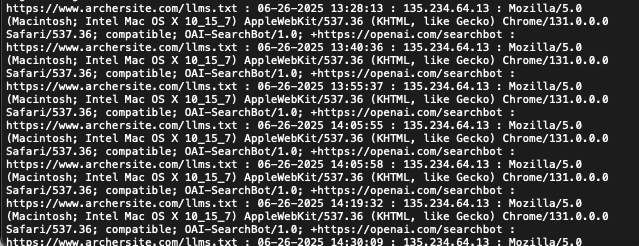
    When looking at the crawl numbers, OpenAI is dominating the crawl, with over 94% of our pings coming from OpenAI’s search bot. When examining the log file, we can see that the search bot pings our servers several times per hour, sometimes even within seconds of each other. 

    I had Gemini 2.5 analyze the log file for patterns, and here’s what it identified:

    This pattern is consistently observable throughout the logs. For example:

    • On June 26, 2025, the bot requested a URL from genericsite.com at 14:05:55 UTC and then again just three seconds later at 14:05:58 UTC.  
    • On July 10, 2025, genericsite2.com was subjected to a sustained burst of requests, with hits logged at 15:21:46, 15:23:03, 15:29:09, and 15:32:16 UTC.  
    • On July 6, 2025, two requests were made to the same domain just one second apart, at 02:49:15 and 02:49:16 UTC.

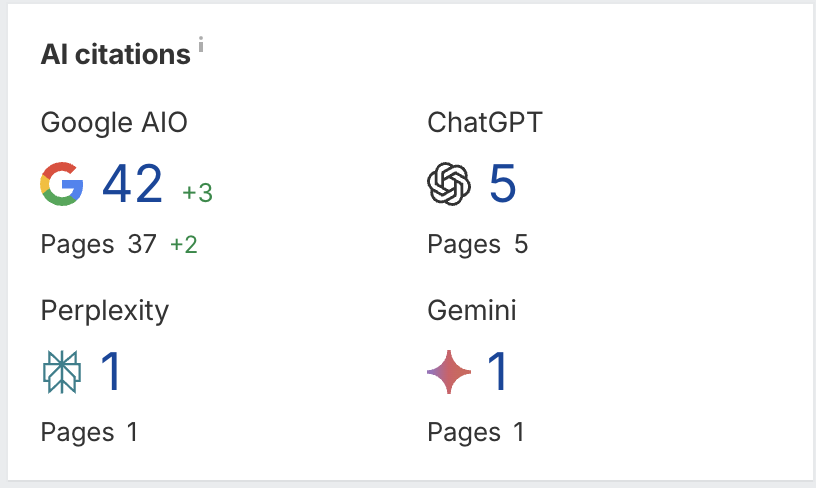
    When looking at the Ahrefs AI citations sections, we’ve only just begun to see an uptick in performance for citations across AI. The screenshot below shows what we’d expect from such low-traffic sites. A few weeks ago, when this reporting feature launched, these numbers were closer to zero.

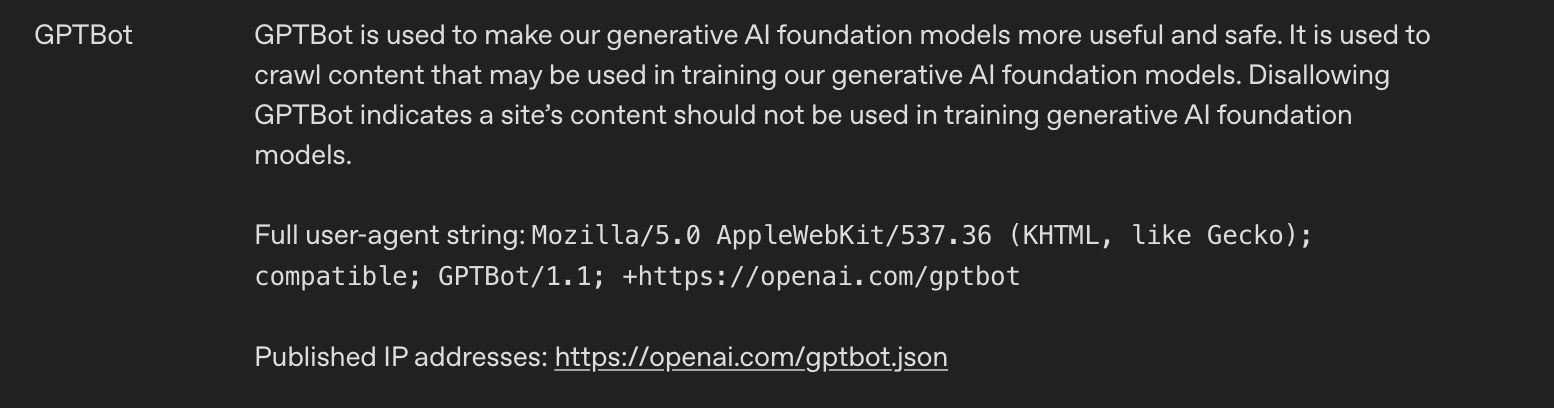
    What’s also interesting  to note is that GPT bot pinged our LLMs.txt file for two smallers sites, which saw less pings from OpenAI’s search bot. GPT bot is exclusively used to train the model, so this indicates that OpenAI found our file valuable. 

    In full opaqueness, I’ve anonymized our sites to avoid malicious intent, but these sites are niche-specific. The sites focus on industry-specific degrees and mainly features informational content around career outcomes, licensure, variations of degrees, and helpful information for prospective students looking to enroll. There’s a lot of great information to train on and surface in outputs. 

    How Did We Get AI Bots to Crawl our LLMs.txt File?

    I saw your questions, asking us how we coaxed LLM bots to crawl our file. Many of you wanted to know if we added a link to our file; of course, we did! We treated this file like any other standard for SEO. If this were an XML sitemap, we’d submit it to Google Search Console and link to it on our robots.txt file.  So why wouldn’t we treat this standard the same way?

    I’m a big baseball fan, and our methodology for implementing the file is inspired by a line from one of my favorite baseball movies, Field of Dreams.

    “If you link to it, they will come.”

    Thanks to the brilliance of our team, we decided to approach this differently. Rather than listing a link to the file in robots.txt, which is common practice for an XML sitemap, we decided to inject a link to the file in the

    section of our sites. 

    We implemented this using the “alternate” link relationship type, which suggests an alternative version of a document. We expected to get crawls from all sorts of bots, but we didn’t expect to get so many in such a short period. 

    Have We Checked the IP Addresses of AI Bots?

    When I first announced this on Twitter, many of the initial comments inquired about IP abuse and malicious intent. Given the frequency of server pings, we were concerned about the potential for spoofers looking for site vulnerabilities.  We checked the IP address 135.234.64.13, which is identified within OpenAI’s documentation.

    Should You Implement LLMs.txt on Your Site?

    When looking at the evolving landscape, I’d say yes. Google has a 20-year head start, which enables it to parse unstructured data with ease. That’s a significant investment in infrastructure, which means competitors must raise substantial capital to catch up. 

    With that said, if you have a deadline-driven product, such as a master’s degree or a relatively new offering with limited documentation, and your site is not optimized for AI, your users may encounter hallucinations. I hypothesize that the LLMs.txt file serves as a safeguard, providing pertinent information to the LLMs and can help reduce errors by serving fresh content. 

    For example, a prospective student searches for a Fall application deadline, but LLM models have been trained on an earlier version of our site. LLMs need to do a live search or RAG to satisfy user intent. Another example might be sweeping changes to the curriculum for a new semester. How can we maintain accuracy for our students? 

    The Future of LLMs.txt

    I am not a crystal ball gazer, nor do I possess the power of prescience. At this moment, all we can do is test and monitor the file. Our team will continue to monitor bot behavior and report on our findings. 

    With each passing day, we’re seeing shifts in user behavior, improved models, and wide-scale change. No one knows what the future holds for agentic search, but I do know that the industry needs to evolve with the tech stack. 

    At Archer, our team would learn firsthand. It’s the only way we can future-proof our university partner’s success. In higher education, we face various challenges, including declining enrollments, which is an industry-wide issue.

    Final Thoughts on the LLMs.txt File

    While the LLMs text file is not yet a widely adopted standard across the web, the recent flurry of bot activity suggests there is value. Given the limitations of current LLM crawlers, this file might be your best bet in safeguarding against pitfalls that will have you excluded from these new systems. 

    As the industry evolves, it’s our duty as stewards of the web to test, try, break, and fix things. I encourage marketers, SEOs, and web engineers to think differently and lean into curiosity. It is through that lens that we can help our partners be found wherever their students are. 
    If you’d like to talk more about AI-powered SEO and how Archer is helping universities show up where students are searching, the Archer team is ready to help.

    Source link

  • Three Unique Assignments You’ll Want to Replicate

    Three Unique Assignments You’ll Want to Replicate

    Reading Time: 2 minutes

    Today’s educators have yet to meet a challenge they can’t navigate. And according to our recent research, 50% of faculty say they feel comfortable handling their top challenges alone. Yet, one challenge stands out from the rest: the need to produce creative content to entertain students.

    To help you overcome this hurdle, we asked our Faculty Partners across disciplines, including English, psychology and finance to share some of the creative assignments they’ve come up with to keep class both educational and fun for students. Here are three innovative ideas you should take note of.

    1.    Social media profiles of characters

    Do you ever wonder what your favorite literary character’s social media profile would look like if they had one? Kerry L. Frabizio, Associate Professor of English at Warren County Community College, told us about a unique group project she introduced to her English Composition students. It lets them develop social media personalities based on characters from some of the most iconic plays in American history.

    Project instructions: Each group will create a fictional but realistic social media presence for each assigned character. Be creative, but stay true to the character’s attitude, motivations and story arc.

    Required components: Students must produce the following for each of their assigned characters:

    • Social Media Platform
    • Handle/Username
    • Profile Picture
    • Occupation or Life Role
    • Favorite Hashtags
    • Followers/Following (Optional)
    • One main post

    This entertaining assignment reframes course content in a way that’s relatable and engaging for today’s tech-driven students.

    2.     Music video discussion

    You might know the lyrics to your favorite song by heart, but have you considered the deeper meaning or significance behind them? Marc Wilson, Ph.D. Professor and Director of Graduate Psychology Programs at Fisher College, has transformed that concept into a media-based assignment for his psychology students.

    Each week, students watch a music video relevant to one or more of their course topics. They’re asked to respond to the video, discussing how they think the lyrics or video relate to one of the disorders they’re studying that week.

    Additionally, students are asked to find and share media that they think reflects that week’s course material. This assignment not only helps students develop critical thinking and analysis skills, but also gives them an opportunity to connect with topics in a meaningful way.

    3.     Discussion forum

    If you’re looking for a creative assignment in finance, consider this discussion forum activity, courtesy of Ann Snell, Instructor, Business Administration at Alamance Community College. This activity gets students thinking critically about the role finance plays in their everyday lives, and the world around them. Each week, students receive engaging prompts based on their course content. They’re asked to reflect on questions like:

    • What’s one financial goal you care about? This could be saving for a trip, paying off student loans, starting a business, or investing in your future. Why is it important to you?
    • What’s something that represents your “money personality”? Maybe it’s your favorite budgeting app, a piggy bank, a vintage coin or even your go-to coffee splurge — anything that reflects your style with money.
    • If you could work anywhere in the world, where would it be — and why?

     Students are allowed to record their answers on their phones or webcams. They can even use props to liven up their presentations.

    These types of assignments get students actively engaged with their course content in. By tapping into their sense of creativity and imagination, they can grow into confident learners built for future success.

    Source link

  • Pennsylvania officers face First Amendment lawsuit for trying to criminalize profanity and using patrol car to chase man who recorded police

    Pennsylvania officers face First Amendment lawsuit for trying to criminalize profanity and using patrol car to chase man who recorded police

    ALLENTOWN, Pa., July 23, 2025 — In a bizarre scene, a police officer in Allentown, Pennsylvania, drove his patrol cruiser down a sidewalk at a man who was protesting police misconduct by filming outside a police station. 

    Today the Foundation for Individual Rights and Expression filed a lawsuit defending Phil Rishel’s rights to film and criticize police activity in public spaces — behavior that is protected by the First Amendment — without being assaulted or retaliated against for doing so. 

    “The retaliation over my speech confirms that there is a huge issue with the culture of the Allentown Police Department,” said Phil. “These officers have a disdain for the rights of the people they’re sworn to protect — and I hope my lawsuit changes things for the better.”

    Since 2015, the City of Allentown, Pennsylvania, has paid at least $2 million related to claims of police misconduct. In 2023, Phil began protesting in Allentown by non-disruptively recording police activity while standing on public sidewalks outside local police precincts.

    COURTESY PHOTOS OF PHIL RISHEL

    On March 26, 2024, Phil went to the Hamilton Street police station, where he stood on a public sidewalk and recorded what he could see in plain view. Approximately 15 minutes after he arrived, an officer approached him and briefly paused while looking at a “No Trespassing” sign. Phil responded, “Yeah, that’s a nice sign. Too bad it doesn’t apply to the public sidewalk.” The officer then silently walked away from Phil into the depths of the garage and up a vehicle ramp. Phil called out after him about his disregard of a sign next to the ramp that read: “PEDESTRIANS MUST USE STAIRS ONLY.”

    About 10 minutes later, the officer drove his patrol car out of the garage and sharply turned onto the sidewalk towards Phil while blaring the siren. The officer pursued him down the sidewalk, even driving around a lamppost in his way and back onto the sidewalk to chase Phil. The officer then exited the car, went into the office, and emerged with a police sergeant. They accused Phil of loitering and banned him from the public sidewalk under threat of arrest. 

    WATCH THE VIDEO FOOTAGE

    The next day, Phil returned to the same public sidewalk outside the Hamilton Street station’s parking garage and picked up where he left off, recording police activity in plain view. The same sergeant threatened to arrest him for returning and told him that filming the police “is not a First Amendment right,” while also claiming that Phil’s profanity the previous day constituted disorderly conduct. Ultimately, he charged Phil with disorderly conduct and loitering via a criminal citation sent in the mail.

    At the hearing on the criminal charge, the sergeant testified that Phil was in an area closed for construction and blocked pedestrian traffic and the parking garage entrance, but none of this was true, as shown by the video Phil took that day. Based on the sergeant’s testimony, the court found Phil guilty on the loitering charge, although the conviction was reversed on appeal. The disorderly conduct charge was dismissed by the lower court based on longstanding Pennsylvania case law.

    The First Amendment protects citizens’ right to film police officers and their activities. It also protects individuals who verbally criticize police and their actions, even by cursing or using profane language. 

    FIRE’s lawsuit seeks to enforce these established constitutional rights for Phil and other Allentown citizens. The complaint seeks a declaration that the Allentown police violated First Amendment rights, an injunction against the City of Allentown for failing to provide adequate training to its police officers about protecting and respecting First Amendment rights, and an award of damages to Phil for the treatment he received.

    “Citizens trying to hold police officers accountable should not be punished,” said FIRE attorney Zach Silver. “Public officials, including police officers, must uphold the law and respect citizens’ right to record police and to use harsh language, not bully them into silence.”

    The Foundation for Individual Rights and Expression (FIRE) is a nonpartisan, nonprofit organization dedicated to defending and sustaining the individual rights of all Americans to free speech and free thought—the most essential qualities of liberty. FIRE educates Americans about the importance of these inalienable rights, promotes a culture of respect for these rights, and provides the means to preserve them.

    CONTACT
    Katie Stalcup, Communications Campaign Manager, FIRE: 215-717-3473; [email protected] 

    Source link

  • Is peace in the Middle East even possible?

    Is peace in the Middle East even possible?

    The State of Israel was created in 1948. The key word is created. While countries come into being in many different ways, such as violence, revolutions and treaties, the creation of the state of Israel was unique and has proven highly controversial.

    To understand the chaos that is now taking place in Israel and the Palestinian territories, one needs to return to that original creation.

    The British government ruled the territory known as Palestine under the League of Nations from 1922 until 1948. Already in 1917, the British government issued what is known as the Balfour Declaration which envisioned a Jewish state in what had been claimed a historic Jewish homeland.

    Jewish organisations had argued that the land called Israel has been the religious and spiritual center for Jews for thousands of years. While many countries recognized the new State of Israel in 1948, its creation did not effectively redress the dislocation of those who had been living on the territory that Israelis would inhabit.

    Following the end of World War II, European Jews who had been displaced during the Holocaust flocked to Israel. The United Nations divided the land into two states, one Jewish, one Arab, which further divided the Arab territory into three sections — the Golan Heights at the Syrian border, the West Bank at the Jordanian border and the Gaza Strip at the Egyptian border.

    The creation of deep divisions

    The division gave more than 50% of the land to Israel, leaving the Arabs with 42% even though they made up two-thirds of the population.

    This resulted in massive Arab displacement and is why the Jewish Independence Day of May 14 is followed by the marking of Nakba Day by Arabs, translated as “The Catastrophe”.

    Since Israel’s founding in 1948, there have been several outbreaks of violence between Israel and its neighbors. Among them were the 1948–49 War of Israeli Independence; 1956 Suez Canal Crisis; 1967 Six-Day War; 1973 Yom Kippur War; 1982 Lebanon War and various large-scale Palestinian uprisings known as Intifadas.

    None of these conflicts resulted in reparations for the hundreds of thousands of Arabs displaced by Israel’s creation, many of whom ended up in crowded refugee camps in Gaza, the West Bank and neighboring countries.

    Further inflaming tensions, Israeli settlers have continued establishing communities in the West Bank, which was conquered by Israel in the 1967 Six-Day War. The international community considers these colonies illegal, and some of the settlers have been found guilty of violence against the Arabs who live there.

    Working towards peace

    There have been several attempts to have peace agreements between Israel and its neighbors.

    The most important are the Camp David Accords of 1978 which was finally reduced to simple diplomatic relations between Egypt and Israel, and the 1993 Oslo accords which established formal relations between Israel and the Palestinian leadership, giving the latter self-governance over the Gaza Strip and the West Bank. Recently, there were talks about a larger regional agreement including Saudi Arabia.

    Then came 7 October 2023, when Hamas, an Islamist militant group, attacked Israeli settlers killing more than a thousand people, many of them women and children, and taking over 200 Israeli hostages.

    Israel’s response to the Hamas attack, which it justified as legitimate self-defense, has seen more than 32,000 Gazans killed with over 70,000 wounded, mostly civilians with many elderly and children. Much of Gaza’s infrastructure has been destroyed, including hospitals and humanitarian aid has been blocked. Fighting has continued for more than six months as Israel seeks to destroy Hamas and at the same time free the hostages.

    The emotions behind the conflict are extreme. The Israelis condemn Hamas as a terrorist organisation whom they argue are out to kill all Jews and destroy the State of Israel. Hamas, which was the official ruling organisation in the Gaza Strip, maintains that Palestinians have been reduced to living in an open-air prison since it took control of Gaza in 2005 when Israel disengaged.

    Israel and the international community

    The fighting in Gaza has raised many questions relevant to international humanitarian law. South Africa brought a case before the International Court of Justice in The Hague accusing Israel of genocide. The Court ruled that there was “plausible” genocide and ordered several provisional measures Israel must follow, among them increasing access to humanitarian aid.

    Beyond Israel, Hamas and the International Court of Justice, various resolutions have been proposed before the United Nations Security Council concerning a ceasefire. Although the latest resolution did pass, with the United States abstaining and not using its veto power, no ceasefire has taken place, although increased humanitarian aid is now entering Gaza.

    But the situation of the Palestinians remaining in Gaza remains precarious at best.

    The Israel/Hamas conflict has spread to other countries in the region, including Iran, which has long been a supporter of Hamas. On 1 April 2024, Israeli warplanes destroyed a building in Damascus, Syria, part of an Iranian Embassy complex, killing several Iranian officers involved in covert actions in the Middle East.

    Shortly after, Iran sent hundreds of drones and cruise missiles towards Israel, which were largely intercepted by Israeli and U.S. air defenses. Subsequently, several drones were downed by Iran’s air defense system near Isfahan, but it is not clear whether they came from Israel or other sources.

    What is clear is that there has been enormous international pressure to de-escalate the current situation in order to stop the Israel/Hamas conflict from growing into a regional conflict involving Iran and other countries, or even a more global escalation of violence.


    Questions to consider:

    1. How did the United Nations divide Palestine to create the state of Israel?

    2. What happened to the people displaced in 1948 when Isreal was created?

    3. What kind of compromises do you think might have to take place for there to be peace between Israelis and Palestinians? 


    Source link