Tennessee is joining the ranks of states with direct admissions programs by launching a pilot this fall that will automatically offer certain high school students spots at the state’s two- and four-year colleges based on their academic records.
The program, led by the Tennessee Higher Education Commission, will pair admissions offers with financial aid information for about half the high school students to test whether that boosts their chances of enrolling.
In a statement Wednesday, THEC Executive Director Steven Gentile cast the initiative as a way to simplify the path to college. “For the first time in the nation, we are pairing direct admissions with personalized financial aid information, so students not only know where they’ve been accepted — they’ll also know how they can afford to go.”
Dive Insight:
The TN Direct Admissions pilot is to launch in November, when roughly 41,000 students from more than 230 randomly selected high schools in the state will receive letters listing which participating colleges have automatically accepted them. Around half of those students will also get information about available state and institutional financial aid tailored to them based on their GPA, test scores or other criteria.
To participate, students will need to complete an application for the Tennessee Promise program by Nov. 1.
Researchers will use the information from the pilot to study how providing this information influences college-going behavior.
They aim to find out whether high school students who receive both financial aid information and direct admissions bids are more likely to attend college than those who just get automatic admissions offers. They will also compare the data against that for students who don’t receive direct admissions letters at all.
“Through this study, we will learn not only about the impact of direct admissions and financial aid on students’ college enrollment, but how students feel about their direct admission experience,” Trisha Ross Anderson, a Harvard University researcher working on the project, said in a Wednesday statement.
The financial aid component — which THEC said in a Wednesday statement is the first of its kind for a direct admissions program — will inform students of their eligibility for institutional grants and scholarships, as well as for state programs such as the Tennessee Promise. That program covers remaining tuition and fees for students at state community or technical colleges after all other grant aid has been applied.
Overall, 53 colleges are participating in the fall pilot. That includes all 13 of the state’s community colleges and its 23 technical colleges, as well as 17 public and private universities.
Tennessee joins several other states that have recently launched direct admissions programs. Earlier this year, Illinois Gov. JB Pritzker signed a bill into law to send high school and community college students direct admissions offers to the state’s universities depending on their academic performance.
And last October, New York launched an effort to guarantee fall 2025 spots to at least one of its public universities for high school students graduating in the top 10% of their class. The nine initial participating colleges included the state’s two flagships, University at Buffalo and Stony Brook University.
The other day, I came across an article about child care that felt so familiar I let out an exasperated sigh. Child care, the article announced, is now more expensive than college tuition and rent in most states. Many of us had just read another version of the article in March. And before that, in November 2024. Then there’s the one that dates back a little further — to 2013.
Many of these stories, which seem to come out on an annual basis, fail to mention that this is a problem that spans decades. The real news is that it hasn’t gotten any better, and many American lawmakers don’t seem to care enough to take action.
I asked Elliot Haspel his thoughts on this a few weeks ago when I interviewed him about his new book, “Raising a Nation,” which will be available Aug. 11. In the book, he presents 10 arguments — some of them well known and others less intuitive — for why child care needs to be a more supported part of American society. His book starts with an anecdote that echoes my observation on the dispiriting lack of momentum around the issue: In 1998, President William Jefferson Clinton stood in the Rose Garden and declared in an address that child care was essential to the nation’s economy. President Barack Obama made the same argument in 2015. President Donald Trump did the same in 2019. Yet as the years go by, little changes.
“We have been having many of the same child care battles for a long time, for decades and decades and decades,” Haspel told me.
Haspel’s arguments in “Raising a Nation” include “The Economic Case,” where he digs into how child care affects business productivity and the labor force; and the “The Patriotic Case,” where he presents parenthood as patriotic and argues child care is important for American democracy.
He cites numerous worrisome examples of the consequences of insufficient policy and investment. In making “The Community Case,” for instance, he tells a jarring story from Montrose, Colorado, where the lack of child care has led to difficulties recruiting and retaining police officers. That, in turn, negatively affects the city’s crime rate and response time to emergency calls. And in arguing “The Antipoverty Case,” he highlights extensive research on how a lack of child care is a key theme for families who are unable to move out of poverty.
“Care is, in fact, just as important to our social infrastructure as having a public education system, having public libraries, having public parks,” he told me.
As he writes, it’s clear why we haven’t made much progress as a nation, and why we remain behind nearly every other wealthy country in investing in child care: “We have never established that good child care belongs among the pantheon of American values.”
While Haspel’s book focuses more on why we need more robust child care policy than howwe get there, he provides a few ideas for the latter: giving child care educators a wage that could support their own families, investing in stay-at-home parents and informal caregivers along with licensed care, and including before- and after-school care and summer care in the system. While those seem like lofty goals, Haspel argues it is indeed fully “American” to embrace such policies. Access to high-quality child care, he argues, is not an “individual family obligation but rather a societal imperative.”
This story about child care was produced by The Hechinger Report, a nonprofit, independent news organization focused on inequality and innovation in education. Sign up for the Hechinger newsletter.
The Hechinger Report provides in-depth, fact-based, unbiased reporting on education that is free to all readers. But that doesn’t mean it’s free to produce. Our work keeps educators and the public informed about pressing issues at schools and on campuses throughout the country. We tell the whole story, even when the details are inconvenient. Help us keep doing that.
Last year, FIRE launched the Free Speech Dispatch, a regular series covering new and continuing censorship trends and challenges around the world. Our goal is to help readers better understand the global context of free expression. Want to make sure you don’t miss an update? Sign up for our newsletter.
Five arrests over cartoon “publicly demeaning religious values”
Turkish police officers walking down street in Istanbul. (Shutterstock.com)
Cartoons depicting Muhammad are a common feature in censorship news but the latest developments out of Turkey are a little unusual in that the magazine involved is adamant that the cartoon under fire…does not actually depict the prophet.
On June 30, Turkish police arrested four employees of satirical magazine LeMan on charges of “publicly demeaning religious values,” with one cartoonist also charged with “insulting the president.” They raided the magazine’s office as well and, two weeks later, arrested a LeMan editor at Istanbul’s airport upon his return from France. The arrests followed an attack on the LeMan office, with a mob breaking open windows and doors.
The origin of the dispute? A June 26 LeMan edition with an anti-war cartoon depicting two winged men — one depicted as Muslim and introducing himself as Muhammad and the other as Jewish and calling himself Moses — shaking hands as they ascend over a burning city with bombs raining down. The Muhammad character, the magazine said, “is fictionalised as a Muslim killed in Israel’s bombardments” and is named so because it’s the “most commonly given and populous name in the world.”
The magazine remains adamant its staff is being arrested on the basis of a willful misunderstanding, but for now Turkish officials — including President Erdogan, who called it a “vile provocation” that must be “held accountable before the law” — are intent on prosecution and have seized copies of the edition.
There’s more free speech news out of Turkey. A new law granted the country’s Presidency of Religious Affairs the authority to ban Quran translations it deems “do not correspond to the basic characteristics of Islam,” including online and audio versions. Meanwhile, a Turkish court blocked some content produced by xAI’s Grok for insulting Erdogan and religious values.
And Spotify has threatened to leave the Turkish market in part over a censorship dispute with the deputy minister of culture and tourism, who has accused the site of hosting “content that targets our religious and national values and insults the beliefs of our society.” That content apparently includes playlists like “The songs Emine Erdogan listens to while cleaning the palace,” which mocks Erdogan’s wife’s allegedly lavish spending.
UK’s free speech controversies online and off — and in American visa policy
The UK’s free speech issues are nothing new, but this time the U.S. is part of the story, too. UK prosecutors had already announced an investigation into Belfast rap trio Kneecap earlier this year — which, as of last week, has been dropped — but now duo Bob Vylan is on the list.
Bob Vylan caught global attention last month in a controversial Glastonbury set which included a “Death, death to the IDF” chant led by the band. Avon and Somerset Police confirmed they were reviewing footage to confirm “whether any offences may have been committed that would require a criminal investigation.” Prime Minister Keir Starmer also objected to the “appalling hate speech” and demanded answers from the BBC about its broadcast of the set. Shadow Home Secretary Chris Philp also said the BBC “appears to have also broken the law.”
Then the Trump administration joined in. Deputy Secretary of State Christopher Landau announced shortly after the incident that the U.S. revoked the visa of Bob Vylan members ahead of the band’s upcoming tour. “Foreigners who glorify violence and hatred are not welcome visitors to our country,” he wrote.
Speech controversies also bloomed outside Glastonbury. UK police have now arrested dozens of demonstrators for attending events opposing the ban on Palestine Action, an activist group restricted under British anti-terrorism legislation for damaging military planes in a protest. Simply “expressing support” for the banned group is a crime.
TheWall Street Journalcovered the UK’s (and Europe’s) “far and wide” crackdown on speech in a July 7 piece that also discussed the recent targeting of activist Peter Tatchell, arrested by police in London for a “racially and religiously aggravated breach of the peace.” Tatchell’s offense was holding a sign “that criticized Israel for its Gaza campaign as well as Hamas for kidnapping, torturing and executing a 22-year-old.”
Also, in more unsurprising news, the UK’s troubling Online Safety Act is making its mark on the internet as social media platforms begin the process of age verification for UK-based users. Bluesky users will be required to use Kid Web Services or face content blocks and app limitations. Reddit users must verify too, or lose access to categories of material including “content that promotes or romanticizes depression, hopelessness and despair” and “content that promotes violence.”
And, finally, is the UK getting a government-imposed swear jar? A district council in Kent is considering a £100 fine for swearing in public. That definitely won’t backfire.
Fake news, social media for teens, and more in the latest tech and speech developments
Last week, Russian legislators passed rules issuing fines for people who “deliberately searched for knowingly extremist materials,” with heightened fines for those using a VPN to access them. That’s not just censorship of what you say, but also of what you simply try to see.
The European Court of Human Rights ruled in Google’s favor in its dispute with Russia over penalties the government issued against the company over its decision not to remove some political content and to suspend a channel tied to sanctions. Russia, it found, “exerted considerable pressure on Google LLC to censor content on YouTube, thereby interfering with its role as a provider of a platform for the free exchange of ideas and information.”
The Indian state of Karnataka is considering legislation that would punish fake news, misinformation, and other verboten forms of speech with fines and prison terms up to seven years.
India’s Allahabad High Court refused bail to a man who had posted “heavily edited and objectionable” videos of Prime Minister Modi relating to the country’s recent conflict with Pakistan. “Freedom of speech and expression does not stretch to permit a person posting videos and other posts disrespecting the Prime Minister of India,” the court wrote.
An 8-3 vote from Brazil’s Supreme Court ruled that social media companies will be held liable for failure to monitor and remove “content involving hate speech, racism, and incitement to violence.”
German police conducted a search of more than 65 properties in a crackdown on online hate speech, seeking out offenders allegedly engaged in “inciting hatred, insulting politicians and using symbols of terrorist groups or organizations that are considered to be unconstitutional.”
Dozens of online gay erotica writers, mostly young women, have been arrested in recent months in China for “producing and distributing obscene material.”
The Pakistan Telecommunication Authority has now blocked over 100,000 URLs across the internet for “blasphemous content.”
An Australian Administrative Review Tribunal ruling reversed a March order by the country’s eSafety Commissioner requiring X to take down a post from Canadian activist Chris Elston or face a $782,500 fine. Elston had called Teddy Cook, a trans man appointed to a World Health Organization panel, a “woman” who “belong[s] in psychiatric wards.”
New guidelines issued by the European Commission press for EU nations’ adoption of tools to verify internet users’ age to protect them against harmful content. The verification methods should be “accurate, reliable, robust, non-intrusive and non-discriminatory” — quite a Herculean feat to expect.
China is introducing a new digital ID system transferring the possession of users’ identifying information away from internet companies and into government hands. The process, voluntary at this time, will require users to submit personal information, including a facial scan.
Former Panamanian president alleges U.S. visa revocation for his political speech
Martín Torrijos, a former president of Panama, says the U.S. canceled his visa over his opposition to political agreements made between the two countries. Torrijos suggested his signature on the “National Unity and Defense of Sovereignty” statement, which criticized “expansionist and hegemonic intentions” by the United States, also contributed to the revocation.
“I want to emphasize that this is not just about me, neither personally nor in my capacity as former president of the Republic,” Torrijos said. “It is a warning to all Panamanians: that criticism of the actions of the Government of Panama regarding its relations with the United States will not be tolerated.”
Free press news, from Azerbaijan to Arad
Zimbabwe Independent editor Faith Zaba penned a satirical column about the country’s role in the Southern African Development Community — and was then arrested by police and charged with “undermining the authority of the president.”
Yair Maayan, mayor of Israeli city Arad, announced he intended to ban the sale of Haaretz over the newspaper’s investigation into the IDF.
Tel Aviv police arrested journalist Israel Frey on suspicion of incitement to terrorism for his response to the death of five IDF soldiers. “The world is a better place this morning, without five young men who partook in one of the most brutal crimes against humanity,” he posted on social media.
The Baku Court of Serious Crimes sentenced seven staffers at Azerbaijani investigative outlet Abzas Media to prison terms ranging from seven to more than nine years on various tax and fraud charges. Press freedom advocates say the charges are in retaliation for the outlet’s reporting on presidential corruption.
A German court overturned the ban on Alternative for Germany-linked magazine Compact, which Interior Minister Nancy Faeser had called “a central mouthpiece of the right-wing extremist scene.” The court found that the measure was not justified.
The Democratic Republic of the Congo’s military arrested journalist Serge Sindani after he shared a photo showing military planes at Bangoka International Airport.
At least two journalists were injured during recent protests in Kenya, where the country’s Communications Authority demanded “all television and radio stations to stop any live coverage of the demonstrations” or risk “regulatory action.”
Police in Nepal are ignoring a court order and attempting to hunt down and arrest journalist Dil Bhushan Pathak for his reporting alleging political corruption.
Changes on the horizon in higher education abroad
New wide-ranging guidance from the UK’s Office for Students includes the recommendation that universities amend or terminate international partnerships and agreements if necessary to protect the speech rights of their community. This is welcome advice given global higher education’s failure to acknowledge and account for the challenges internationalization has posed to expressive rights, a problem I discuss in my forthcoming book Authoritarians in the Academy, out Aug. 19 and available for pre-order now.
And, like in the United States, universities in Australia are facing pressure over allegations of campus antisemitism. The nation’s Special Envoy’s Plan to Combat Antisemitism advocates various measures, including adoption of the International Holocaust Remembrance Alliance’s definition and its examples. Universities that “facilitate, enable or fail to act against antisemitism” may face defunding. (FIRE has repeatedlyexpressedconcerns about these applications of the IHRA definition in the U.S. and the likelihood it will censor or chill protected political speech.) The report also advises that non-citizens, which would include international students, “involved in antisemitism should face visa cancellation and removal from Australia.”
For the past year, our team at Archer has fully embraced the shift towards AI in enrollment marketing, especially in SEO. We have reshaped the way we think about the tools, experiences, and content we can deliver across the student journey. This radical shift in approach now has us pushing for more automation and innovation.
As a team, we decided to leave no stone unturned until we could reverse-engineer the output and influence it at will. Under that lens, we examined an emerging web standard for AI, the LLMs.txt file.
Are LLMs.txt files being implemented across the web? The short and simple answer is no. As of today, Anthropic is the only major player in the LLM space that supports this standard. But the file is getting crawled. As of this blog post, our log file shows that our LLMs.txt files have been pinged over 8,000 times.
The table below shows the total number of pings for eight sites that we tested this file with.
AGENT
TOTAL
%
8LEGS
5
0.06%
AhrefsBot
162
1.83%
AhrefsSiteAudit
8
0.09%
Applebot
3
0.03%
AwarioBot
6
0.07%
Barkrowler
20
0.23%
bingbot
41
0.46%
CCBot
5
0.06%
Chrome/Safari
101
1.14%
DataForSeoBot
10
0.11%
Dataprovider.com
8
0.09%
Edge
1
0.01%
Facebook
1
0.01%
facebookexternalhit
9
0.10%
Firefox
14
0.16%
Google-Apps-Script
3
0.03%
Googlebot
55
0.62%
GPTBot
2
0.02%
meta-externalagent
6
0.07%
Mobile Safari
4
0.05%
Mozilla
3
0.03%
Mozilla/5.0
26
0.29%
OAI-SearchBot
8,330
94.35%
Opera
1
0.01%
PTST
9
0.10%
Safari
1
0.01%
Scrapy
1
0.01%
search.marginalia.nu
1
0.01%
SEOkicks
1
0.01%
SemrushBot
12
0.14%
SiteAuditBot
1
0.01%
Slurp
1
0.01%
Yahoo Slurp
1
0.01%
YandexBot
8
0.09%
TOTAL
8,829
What is LLMs.txt and Why Does It Matter?
If you’re tuned into the GEO/SEO debate, there seems to be a great shift in how LLMs differ from traditional search engines. An LLMs text file is most comparable to a robots.txt file, as it lives in the root directory of a site and provides instructions for crawling. The LLMs.txt file enables the conversion of your site’s information architecture into Markdown language, resulting in a simplified and clean view of your site’s structure.
This simple, clean view offers LLM crawlers an unmitigated path to your content, and that matters because LLMs cannot render JavaScript. This means that LLM scrapers are inferring context around a document from raw HTML. As Jono Alderson noted back in May 2025, this has a profound impact on how LLMs ingest your content.
Websites built using client-side rendering have a chance of displaying no content at all, which reduces the likelihood of your content being cited. Simply put, if LLMs can’t parse your content, then you won’t be able to stay competitive.
How Crawlers Are Interacting with Archer’s LLMs.txt Files
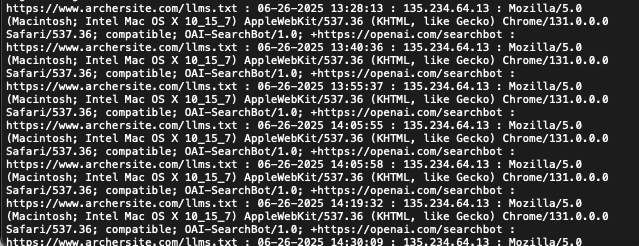
When looking at the crawl numbers, OpenAI is dominating the crawl, with over 94% of our pings coming from OpenAI’s search bot. When examining the log file, we can see that the search bot pings our servers several times per hour, sometimes even within seconds of each other.
I had Gemini 2.5 analyze the log file for patterns, and here’s what it identified:
This pattern is consistently observable throughout the logs. For example:
On June 26, 2025, the bot requested a URL from genericsite.com at 14:05:55 UTC and then again just three seconds later at 14:05:58 UTC.
On July 10, 2025, genericsite2.com was subjected to a sustained burst of requests, with hits logged at 15:21:46, 15:23:03, 15:29:09, and 15:32:16 UTC.
On July 6, 2025, two requests were made to the same domain just one second apart, at 02:49:15 and 02:49:16 UTC.
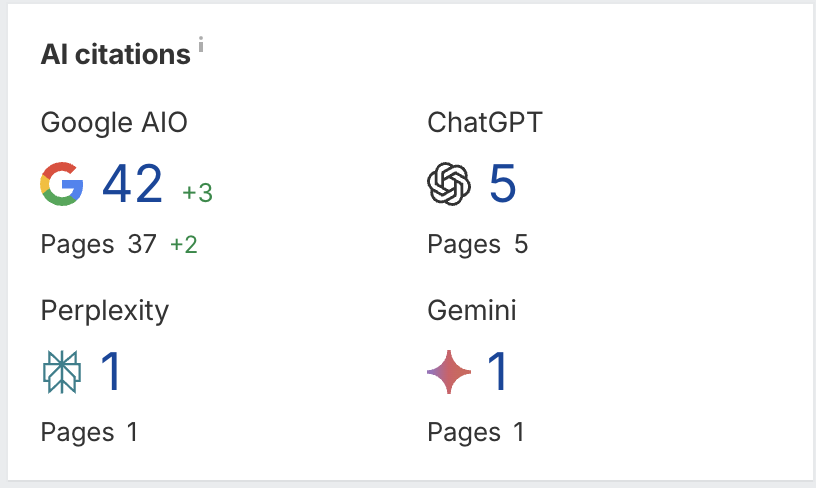
When looking at the Ahrefs AI citations sections, we’ve only just begun to see an uptick in performance for citations across AI. The screenshot below shows what we’d expect from such low-traffic sites. A few weeks ago, when this reporting feature launched, these numbers were closer to zero.
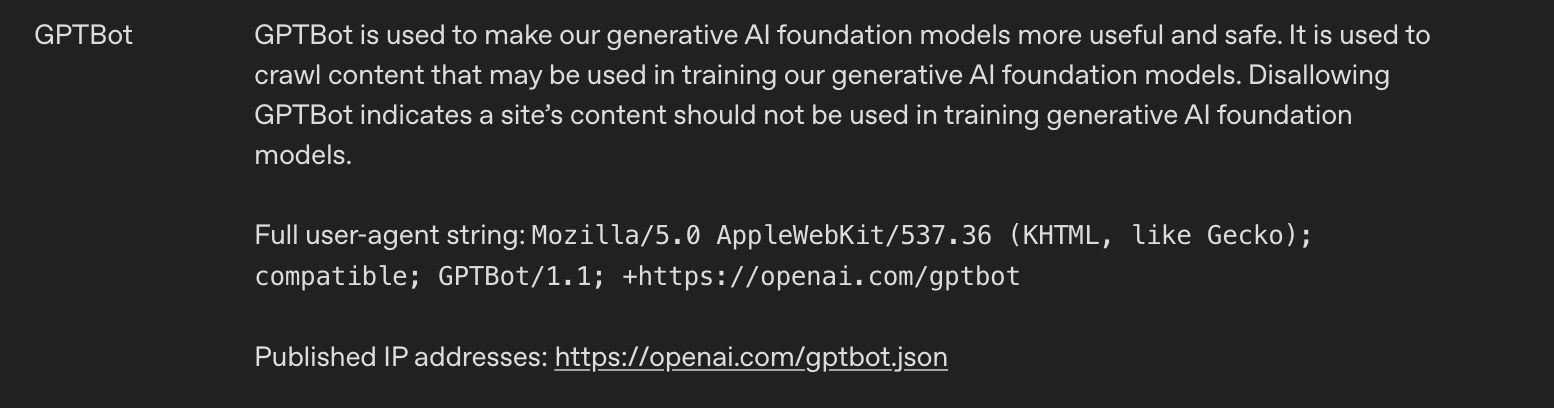
What’s also interesting to note is that GPT bot pinged our LLMs.txt file for two smallers sites, which saw less pings from OpenAI’s search bot. GPT bot is exclusively used to train the model, so this indicates that OpenAI found our file valuable.
In full opaqueness, I’ve anonymized our sites to avoid malicious intent, but these sites are niche-specific. The sites focus on industry-specific degrees and mainly features informational content around career outcomes, licensure, variations of degrees, and helpful information for prospective students looking to enroll. There’s a lot of great information to train on and surface in outputs.
How Did We Get AI Bots to Crawl our LLMs.txt File?
I saw your questions, asking us how we coaxed LLM bots to crawl our file. Many of you wanted to know if we added a link to our file; of course, we did! We treated this file like any other standard for SEO. If this were an XML sitemap, we’d submit it to Google Search Console and link to it on our robots.txt file. So why wouldn’t we treat this standard the same way?
I’m a big baseball fan, and our methodology for implementing the file is inspired by a line from one of my favorite baseball movies, Field of Dreams.
“If you link to it, they will come.”
Thanks to the brilliance of our team, we decided to approach this differently. Rather than listing a link to the file in robots.txt, which is common practice for an XML sitemap, we decided to inject a link to the file in the
section of our sites.
We implemented this using the “alternate” link relationship type, which suggests an alternative version of a document. We expected to get crawls from all sorts of bots, but we didn’t expect to get so many in such a short period.
Have We Checked the IP Addresses of AI Bots?
When I first announced this on Twitter, many of the initial comments inquired about IP abuse and malicious intent. Given the frequency of server pings, we were concerned about the potential for spoofers looking for site vulnerabilities. We checked the IP address 135.234.64.13, which is identified within OpenAI’s documentation.
Should You Implement LLMs.txt on Your Site?
When looking at the evolving landscape, I’d say yes. Google has a 20-year head start, which enables it to parse unstructured data with ease. That’s a significant investment in infrastructure, which means competitors must raise substantial capital to catch up.
With that said, if you have a deadline-driven product, such as a master’s degree or a relatively new offering with limited documentation, and your site is not optimized for AI, your users may encounter hallucinations. I hypothesize that the LLMs.txt file serves as a safeguard, providing pertinent information to the LLMs and can help reduce errors by serving fresh content.
For example, a prospective student searches for a Fall application deadline, but LLM models have been trained on an earlier version of our site. LLMs need to do a live search or RAG to satisfy user intent. Another example might be sweeping changes to the curriculum for a new semester. How can we maintain accuracy for our students?
The Future of LLMs.txt
I am not a crystal ball gazer, nor do I possess the power of prescience. At this moment, all we can do is test and monitor the file. Our team will continue to monitor bot behavior and report on our findings.
With each passing day, we’re seeing shifts in user behavior, improved models, and wide-scale change. No one knows what the future holds for agentic search, but I do know that the industry needs to evolve with the tech stack.
At Archer, our team would learn firsthand. It’s the only way we can future-proof our university partner’s success. In higher education, we face various challenges, including declining enrollments, which is an industry-wide issue.
Final Thoughts on the LLMs.txt File
While the LLMs text file is not yet a widely adopted standard across the web, the recent flurry of bot activity suggests there is value. Given the limitations of current LLM crawlers, this file might be your best bet in safeguarding against pitfalls that will have you excluded from these new systems.
As the industry evolves, it’s our duty as stewards of the web to test, try, break, and fix things. I encourage marketers, SEOs, and web engineers to think differently and lean into curiosity. It is through that lens that we can help our partners be found wherever their students are. If you’d like to talk more about AI-powered SEO and how Archer is helping universities show up where students are searching, the Archer team is ready to help.
To help you overcome this hurdle, we asked our Faculty Partners across disciplines, including English, psychology and finance to share some of the creative assignments they’ve come up with to keep class both educational and fun for students. Here are three innovative ideas you should take note of.
1. Social media profiles of characters
Do you ever wonder what your favorite literary character’s social media profile would look like if they had one? Kerry L. Frabizio, Associate Professor of English at Warren County Community College, told us about a unique group project she introduced to her English Composition students. It lets them develop social media personalities based on characters from some of the most iconic plays in American history.
Project instructions:Each group will create a fictional but realistic social media presence for each assigned character. Be creative, but stay true to the character’s attitude, motivations and story arc.
Required components: Students must produce the following for each of their assigned characters:
Social Media Platform
Handle/Username
Profile Picture
Occupation or Life Role
Favorite Hashtags
Followers/Following (Optional)
One main post
This entertaining assignment reframes course content in a way that’s relatable and engaging for today’s tech-driven students.
2. Music video discussion
You might know the lyrics to your favorite song by heart, but have you considered the deeper meaning or significance behind them? Marc Wilson, Ph.D. Professor and Director of Graduate Psychology Programs at Fisher College, has transformed that concept into a media-based assignment for his psychology students.
Each week, students watch a music video relevant to one or more of their course topics. They’re asked to respond to the video, discussing how they think the lyrics or video relate to one of the disorders they’re studying that week.
Additionally, students are asked to find and share media that they think reflects that week’s course material. This assignment not only helps students develop critical thinking and analysis skills, but also gives them an opportunity to connect with topics in a meaningful way.
3. Discussion forum
If you’re looking for a creative assignment in finance, consider this discussion forum activity, courtesy of Ann Snell, Instructor, Business Administration at Alamance Community College. This activity gets students thinking critically about the role finance plays in their everyday lives, and the world around them. Each week, students receive engaging prompts based on their course content. They’re asked to reflect on questions like:
What’s one financial goal you care about? This could be saving for a trip, paying off student loans, starting a business, or investing in your future. Why is it important to you?
What’s something that represents your “money personality”? Maybe it’s your favorite budgeting app, a piggy bank, a vintage coin or even your go-to coffee splurge — anything that reflects your style with money.
If you could work anywhere in the world, where would it be — and why?
Students are allowed to record their answers on their phones or webcams. They can even use props to liven up their presentations.
These types of assignments get students actively engaged with their course content in. By tapping into their sense of creativity and imagination, they can grow into confident learners built for future success.
ALLENTOWN, Pa., July 23, 2025 — In a bizarre scene, a police officer in Allentown, Pennsylvania, drove his patrol cruiser down a sidewalk at a man who was protesting police misconduct by filming outside a police station.
Today the Foundation for Individual Rights and Expression filed a lawsuit defending Phil Rishel’s rights to film and criticize police activity in public spaces — behavior that is protected by the First Amendment — without being assaulted or retaliated against for doing so.
“The retaliation over my speech confirms that there is a huge issue with the culture of the Allentown Police Department,” said Phil. “These officers have a disdain for the rights of the people they’re sworn to protect — and I hope my lawsuit changes things for the better.”
Since 2015, the City of Allentown, Pennsylvania, has paid at least $2 million related to claims of police misconduct. In 2023, Phil began protesting in Allentown by non-disruptively recording police activity while standing on public sidewalks outside local police precincts.
On March 26, 2024, Phil went to the Hamilton Street police station, where he stood on a public sidewalk and recorded what he could see in plain view. Approximately 15 minutes after he arrived, an officer approached him and briefly paused while looking at a “No Trespassing” sign. Phil responded, “Yeah, that’s a nice sign. Too bad it doesn’t apply to the public sidewalk.” The officer then silently walked away from Phil into the depths of the garage and up a vehicle ramp. Phil called out after him about his disregard of a sign next to the ramp that read: “PEDESTRIANS MUST USE STAIRS ONLY.”
About 10 minutes later, the officer drove his patrol car out of the garage and sharply turned onto the sidewalk towards Phil while blaring the siren. The officer pursued him down the sidewalk, even driving around a lamppost in his way and back onto the sidewalk to chase Phil. The officer then exited the car, went into the office, and emerged with a police sergeant. They accused Phil of loitering and banned him from the public sidewalk under threat of arrest.
The next day, Phil returned to the same public sidewalk outside the Hamilton Street station’s parking garage and picked up where he left off, recording police activity in plain view. The same sergeant threatened to arrest him for returning and told him that filming the police “is not a First Amendment right,” while also claiming that Phil’s profanity the previous day constituted disorderly conduct. Ultimately, he charged Phil with disorderly conduct and loitering via a criminal citation sent in the mail.
At the hearing on the criminal charge, the sergeant testified that Phil was in an area closed for construction and blocked pedestrian traffic and the parking garage entrance, but none of this was true, as shown by the video Phil took that day. Based on the sergeant’s testimony, the court found Phil guilty on the loitering charge, although the conviction was reversed on appeal. The disorderly conduct charge was dismissed by the lower court based on longstanding Pennsylvania case law.
The First Amendment protects citizens’ right to film police officers and their activities. It also protects individuals who verbally criticize police and their actions, even by cursing or using profane language.
FIRE’s lawsuit seeks to enforce these established constitutional rights for Phil and other Allentown citizens. The complaint seeks a declaration that the Allentown police violated First Amendment rights, an injunction against the City of Allentown for failing to provide adequate training to its police officers about protecting and respecting First Amendment rights, and an award of damages to Phil for the treatment he received.
“Citizens trying to hold police officers accountable should not be punished,” said FIRE attorney Zach Silver. “Public officials, including police officers, must uphold the law and respect citizens’ right to record police and to use harsh language, not bully them into silence.”
The Foundation for Individual Rights and Expression (FIRE) is a nonpartisan, nonprofit organization dedicated to defending and sustaining the individual rights of all Americans to free speech and free thought—the most essential qualities of liberty. FIRE educates Americans about the importance of these inalienable rights, promotes a culture of respect for these rights, and provides the means to preserve them.
The State of Israel was created in 1948. The key word is created. While countries come into being in many different ways, such as violence, revolutions and treaties, the creation of the state of Israel was unique and has proven highly controversial.
To understand the chaos that is now taking place in Israel and the Palestinian territories, one needs to return to that original creation.
The British government ruled the territory known as Palestine under the League of Nations from 1922 until 1948. Already in 1917, the British government issued what is known as the Balfour Declaration which envisioned a Jewish state in what had been claimed a historic Jewish homeland.
Jewish organisations had argued that the land called Israel has been the religious and spiritual center for Jews for thousands of years. While many countries recognized the new State of Israel in 1948, its creation did not effectively redress the dislocation of those who had been living on the territory that Israelis would inhabit.
Following the end of World War II, European Jews who had been displaced during the Holocaust flocked to Israel. The United Nations divided the land into two states, one Jewish, one Arab, which further divided the Arab territory into three sections — the Golan Heights at the Syrian border, the West Bank at the Jordanian border and the Gaza Strip at the Egyptian border.
The creation of deep divisions
The division gave more than 50% of the land to Israel, leaving the Arabs with 42% even though they made up two-thirds of the population.
This resulted in massive Arab displacement and is why the Jewish Independence Day of May 14 is followed by the marking of Nakba Day by Arabs, translated as “The Catastrophe”.
Since Israel’s founding in 1948, there have been several outbreaks of violence between Israel and its neighbors. Among them were the 1948–49 War of Israeli Independence; 1956 Suez Canal Crisis; 1967 Six-Day War; 1973 Yom Kippur War; 1982 Lebanon War and various large-scale Palestinian uprisings known as Intifadas.
None of these conflicts resulted in reparations for the hundreds of thousands of Arabs displaced by Israel’s creation, many of whom ended up in crowded refugee camps in Gaza, the West Bank and neighboring countries.
Further inflaming tensions, Israeli settlers have continued establishing communities in the West Bank, which was conquered by Israel in the 1967 Six-Day War. The international community considers these colonies illegal, and some of the settlers have been found guilty of violence against the Arabs who live there.
Working towards peace
There have been several attempts to have peace agreements between Israel and its neighbors.
The most important are the Camp David Accords of 1978 which was finally reduced to simple diplomatic relations between Egypt and Israel, and the 1993 Oslo accords which established formal relations between Israel and the Palestinian leadership, giving the latter self-governance over the Gaza Strip and the West Bank. Recently, there were talks about a larger regional agreement including Saudi Arabia.
Then came 7 October 2023, when Hamas, an Islamist militant group, attacked Israeli settlers killing more than a thousand people, many of them women and children, and taking over 200 Israeli hostages.
Israel’s response to the Hamas attack, which it justified as legitimate self-defense, has seen more than 32,000 Gazans killed with over 70,000 wounded, mostly civilians with many elderly and children. Much of Gaza’s infrastructure has been destroyed, including hospitals and humanitarian aid has been blocked. Fighting has continued for more than six months as Israel seeks to destroy Hamas and at the same time free the hostages.
The emotions behind the conflict are extreme. The Israelis condemn Hamas as a terrorist organisation whom they argue are out to kill all Jews and destroy the State of Israel. Hamas, which was the official ruling organisation in the Gaza Strip, maintains that Palestinians have been reduced to living in an open-air prison since it took control of Gaza in 2005 when Israel disengaged.
Israel and the international community
The fighting in Gaza has raised many questions relevant to international humanitarian law. South Africa brought a case before the International Court of Justice in The Hague accusing Israel of genocide. The Court ruled that there was “plausible” genocide and ordered several provisional measures Israel must follow, among them increasing access to humanitarian aid.
Beyond Israel, Hamas and the International Court of Justice, various resolutions have been proposed before the United Nations Security Council concerning a ceasefire. Although the latest resolution did pass, with the United States abstaining and not using its veto power, no ceasefire has taken place, although increased humanitarian aid is now entering Gaza.
But the situation of the Palestinians remaining in Gaza remains precarious at best.
The Israel/Hamas conflict has spread to other countries in the region, including Iran, which has long been a supporter of Hamas. On 1 April 2024, Israeli warplanes destroyed a building in Damascus, Syria, part of an Iranian Embassy complex, killing several Iranian officers involved in covert actions in the Middle East.
Shortly after, Iran sent hundreds of drones and cruise missiles towards Israel, which were largely intercepted by Israeli and U.S. air defenses. Subsequently, several drones were downed by Iran’s air defense system near Isfahan, but it is not clear whether they came from Israel or other sources.
What is clear is that there has been enormous international pressure to de-escalate the current situation in order to stop the Israel/Hamas conflict from growing into a regional conflict involving Iran and other countries, or even a more global escalation of violence.
Questions to consider:
1. How did the United Nations divide Palestine to create the state of Israel?
2. What happened to the people displaced in 1948 when Isreal was created?
3. What kind of compromises do you think might have to take place for there to be peace between Israelis and Palestinians?
SRHE News is published quarterly as one of the benefits of SRHE membership. The 40-page July 2025 issue included this summary of some recent developments in US HE. To join SRHE go to https://srhe.ac.uk/individual-membership-benefits/.
Abolishing the Education Department may be illegal
It seems that many Education Department functions are codified in federal law, so may need Congressional approval or new legislation before they can be abolished, as Jessica Blake reported for insidehighered.com on 31 March 2025.
The ignorance of Linda McMahon
Shaun Harper reported for insidehighered.com on 9 June 2025 on the way US Education Secretary Linda McMahon had been unprepared and unbriefed on so many questions in a US Senate subcommittee hearing in the previous week, probably because of the massive staff cuts she had made in her department.
Trump promised ‘gold standard science’; Make America Healthy Again uses fake citations
Columbia University folded under Trump’s objections to its alleged anti-semitism, and acceded to multiple demands in the face of cuts to $400million of public funding. Discussions started about how to restore the cuts, but in internal discussions interim President Katrina Armstrong seemed to deny that some of the demands would ever be implemented. Now Armstrong has stepped down, replaced by a new interim President, Claire Shipman, the co-chair of Columbia’s board of trustees. Johanna Alonso reported for insidehighered.com on 29 March 2025.
Steven Mintz (Texas at Austin), a former Columbia academic, blogged for insidehighered.com on 31 March 2025 arguing that the roots of current campus disputes go right to the heart of the university’s mission and purpose: “The Gaza-Israel conflict became a flashpoint not simply because of its geopolitics, but because it sits at the crossroads of the deepest fissures in campus life: between liberalism and radicalism, identity and ideology, tradition and transformation.” The story of Columbia University in New York and its alleged failure to resist then depredations of the Trump administration was told by Andrew Gumbel for The Observer on 28 April 2025 in his article “Destroying higher education with the veneer of going after antisemitism”. Max Matza reported for the BBC on 4 June 2025 that: “The Trump administration is looking to strip Columbia University of its accreditation over claims it violated the rights of its Jewish students.” A letter from Linda McMahon, US Education Secretary, told accreditor the Middle States Commission on Higher Education that “Columbia “no longer appears to meet the Commission’s accreditation standards” by its alleged violation of anti-discrimination laws.
The appeasement strategy didn’t work, then.
Trump goes after Harvard
Brock Read reported for The Chronicle of Higher Education on 31 March 2025 that the Trump administration would review $255million of current federal contracts and $8.7billion of multi-year contracts as part of its move “to reprove colleges it portrays as hotbeds of antisemitism.” A Trump official said the 18 April letter making extensive demands of Harvard about hiring, admissions and curriculum had been sent by mistake, according to Michael S Schmidt and Michael C Bender in their report for the New York Times on 18 April 2025. Jessica Blake reported for insidehighered.com on 18 April 2025 that “… Trump has made it clear that he’ll use billions of dollars in federal grants and contracts, primarily for research, as a lever to force colleges and universities to bow to his agenda and increase the representation of conservative ideology on their campuses.”
The next round of bullying of Harvard in an effort to make it do what Donald Trump decrees came in the move by the Department of Homeland Security under the notorious Kristi Noem to revoke Harvard’s ability to enrol international students, as Karin Fischer reported for the Chronicle of Higher Educationon 22 May 2025.
Then Trump interfered in Fulbright scholar selection, by vetoing about 20% of Fulbright nominations for 2025-2026 on “clearly political” grounds, ruling out applicants with proposals on diversity or climate change, as Liam Knox reported for insidehighered.com on 29 May 2025. Liam Knox reported for insidehighered.com on 11 June 2025 that 11 of 12 members of the Fulbright Scholarship Board resigned on 11 June 2025 “… in protest of the Trump administration’s intervention in the selection process, which they say was politically motivated and illegal.”
The Harvard experience: could it happen here? by GR Evans
US higher education is exposed both to presidential and to state interference. Government powers to intervene in US HE reside in presidential control of federal funding, which may come with conditions. Trump cannot simply shut down the Department of Education by executive order but it seems he can direct that the Department’s grant- and loan-giving functions are taken on by another government department. … read the full blog here.
Politicians rule in Florida
Two weeks after the Florida Board of Governors rejected Santa Ono they approved three new presidents, none having led a university before. On 18 June 2025 they confirmed Jeanette Nuñez as president of Florida International University, Marva Johnson at Florida A&M University, and Manny Diaz Jr at the University of West Florida. Nuñez had been interim President after leaving her job as state lieutenant governor; Diaz is currently Florida commissioner of education; Johnson is a lobbyist whom State Governor Ron DeSantis appointed to the Florida State Board of Education. Josh Moody reported for insidehighered.com on 23 June 2025.
Indiana wants to take over HE
JD Vance said in 2021 that “universities are the enemy” and Iris Sentner for Politico said that in March 2025 ” “… the White House declared war against them”. Ryan Quinn reported for insidehighered.com on 30 April 2025 that Indiana’s state budget bill would “… require faculty at public colleges and universities to post their syllabi online and undergo “productivity” reviews … prohibit faculty emeriti from voting in faculty governance organizations, place low-enrolled degree programs at risk of elimination by the Indiana Commission for Higher Education and end alumni elections for three Indiana University Board of Trustees seats by filling them with gubernatorial appointees. In addition, it has a provision that would let [State Governor] Braun remove the currently elected board members before their terms expire. “I think overreach doesn’t begin to describe the actions of the Legislature,” said Russ Skiba, a professor emeritus of education at IU Bloomington. “This is really a sweeping takeover of higher education in Indiana.”
Why aren’t students protesting against Trump’s university attacks?
A bill which passed the House of Representatives in late May proposes to increase the tax on endowments from 1.4% to 21% for private colleges with an endowment of $2 million or more per student, as Patrick Jack reported for Times Higher Education on 2 June 2025. It would affect only the 35 or so richest institutions in the USA.
But not for everyone: Jaison R Abel and Richard Deitz blogged for the NY Fed’s Liberty Street Economics on 16 April 2025: “In our last post, we showed that the economic benefits of a college degree still far outweigh the costs for the typical graduate, with a healthy and consistent return of 12 to 13 percent over the past few decades. But there are many circumstances under which college graduates do not earn such a high return. Some colleges are much more expensive than average, and financial aid is not guaranteed no matter which college a student attends. In addition, the potentially high cost of living on campus was not factored into our estimates. Some students also may take five or six years to finish their degrees, which can significantly increase costs. Further, our calculations were based on median wages over a working life, but half of college graduates earn less than the median. Indeed, even when paying average costs, we find that a college degree does not appear to have paid off for at least a quarter of college graduates in recent decades.”
Santa Ono not for Florida
After the embarrassment of Ben Sasse, the not-very-well-known Republican politician with little HE experience but with a large spending habit, the University of Florida seemed to be playing safe by naming Santa Ono as the only preferred candidate to replace Sasse. Ono was President at Michigan and previously headed the universities of British Columbia and Cincinnatti. He might have become the highest paid university leader in the US, as Chris Havergal reported for Times Higher Education on 6 May 2025. One of his current colleagues, Silke-Maria Weineck, thought after his controversial Michigan tenure he might be better suited to red-state (Republican) politics, in her opinion piece on 5 May 2025 for the Chronicle of Higher Education. Ono’s salary would have been $3million a year: he was unanimously approved by the University of Florida Board, but on 3 June 2025 in an anti-DEI move the State University System of Florida Board of Governors voted not to approve his appointment, as David Jesse reported for the Chronicle of Higher Education. There was more detail from Josh Moody of insidehighered.comon 3 June 2025: “That process included a no vote from Paul Renner, a former Republican lawmaker in the state who had previously angled for the UF presidency …”. Patrick Jack reported for Times Higher Educationon 9 June 2025 that after the Santa Ono brouhaha many commentators had said the only people willing to lead Florida institutions would be right wing ideologues.
Rob Cuthbert is editor of SRHE News and the SRHE Blog, Emeritus Professor of Higher Education Management, University of the West of England and Joint Managing Partner, Practical Academics. Email [email protected]. Twitter/X @RobCuthbert. Bluesky @robcuthbert22.bsky.social.
In a nation that throws trillions at war, banks, and billionaires while students drown in debt and public schools crumble, the Bronx-based hip-hop duoRebel Diaz has carved out a necessary lane—one where education doesn’t come from a classroom but from struggle, solidarity, and sound. Formed by Chilean-American brothers Rodrigo (RodStarz) and Gonzalo (G1) Venegas, Rebel Diaz is more than a music group. They are truth-tellers, radical educators, and architects of a liberatory curriculum that centers the oppressed and calls the system by its name.
Nowhere is that more evident than in their track “A Trillion,” a searing critique of post-9/11 U.S. capitalism, war profiteering, and the impunity of Wall Street elites. It opens with an indictment so sharp it borders on satire:
“A lotta people askin’—‘Is that really nine zeroes?’
Nah, homie, it’s twelve.”
And then the verses drop—complex, accessible, and devastating in their precision. G1 raps:
“Lotta speculations on the moneys they made
Markets they played
Pimping the system because they run the game
They trades is inside of the old boy network
Money stays in while they build they net worth.”
This is economics with teeth—naming not just the scale of corruption but the two-tiered justice system that underwrites it. G1 continues:
“If I was to flip money that ain’t exist
Or get a loan on my home and not pay back that shit
Interest will stack up
Moving truck or backup
And the repo man will pack everything up.”
These aren’t abstract critiques. They’re visceral comparisons between the impunity of the rich and the precarity of everyday people. Wall Street collapses the economy and gets bailed out with public funds. Meanwhile, poor and working-class people are criminalized for far less—whether it’s defaulting on a loan, evading rent, or “flipping currency” in the underground economy.
A Trillion was written in the shadow of the Bush administration’s wars in Iraq and Afghanistan—wars that cost American taxpayers more than a trillion dollars, all while social services were gutted and inequality soared. Rebel Diaz doesn’t just call out that grotesque spending. They tie it directly to neoliberal austerity, to gentrification, to student debt, and to the very structure of a U.S. economy built on extraction and punishment.
Their music functions as what bell hooks called engaged pedagogy. It’s teaching that risks something—something real. And it’s rooted not in theory alone, but in a lifetime of organizing, community-building, and lived experience. The brothers’ political lineage runs deep: they are children of Chilean exiles who fled the Pinochet dictatorship, and that legacy of resistance is embedded in every syllable they spit.
Their broader body of work—songs like “Runaway Slave,”“Crush,”“I’m an Alien,” and “Which Side Are You On?”—challenges both the prison-industrial complex and the nonprofit-industrial complex, the police and the politicians, the landlords and the labor exploiters. In their hands, hip-hop becomes a weapon against what Paulo Freire called banking education—where students are seen as empty vessels to be filled, rather than agents of transformation.
Rebel Diaz refuses that model. They’ve facilitated workshops for youth around the world. They founded the Rebel Diaz Arts Collective (RDAC) in the South Bronx—a radical cultural center that functioned as studio, classroom, and sanctuary. While elite universities peddle “diversity” through PR campaigns, Rebel Diaz built power in real time.
A Trillion reminds us that debt and inequality aren’t natural—they’re designed. That a trillion dollars could be conjured for war and bailouts, while education remains underfunded and healthcare inaccessible, isn’t a fluke. It’s policy. It’s ideology. It’s class warfare.
And while most institutions of higher learning remain silent—or worse, complicit—Rebel Diaz offers a curriculum of truth. Their syllabus includes economic justice, anti-imperialism, grassroots organizing, and critical media literacy. Their lectures come through speakers, not Zoom screens. And their degrees? Measured not in credits, but in collective awakening.
In a society that leaves millions in debt for chasing knowledge, and rewards only the knowledge that maintains power, Rebel Diaz flips the script. They aren’t just part of the resistance—they are building the new university.
And in that space, “A Trillion” isn’t just a song. It’s a lesson. A warning. A call to action.
Rebel Diaz Playlist: A Syllabus of Sound
Listen to these Rebel Diaz tracks as an alternative curriculum—one that speaks to the struggles universities often silence:
“A Trillion” — A blistering takedown of war spending, corporate bailouts, and the injustice of capitalism.
“Which Side Are You On?” — A rallying cry against complicity, rooted in a long tradition of protest music.
“Runaway Slave” — A powerful indictment of the prison-industrial complex and systemic racism.
“Crush” — A sharp narrative linking gentrification, police violence, and displacement.
“I’m an Alien” — A migrant anthem reclaiming humanity against the backdrop of dehumanizing immigration policy.
“Work Like Chávez” — A celebration of working-class resistance and Latin American liberation.
“Revolution Has Come” — An intergenerational call to remember the lessons of past uprisings.
These tracks are available via Rebel Diaz’s Bandcamp page, Spotify, YouTube, or independent archives. Better yet, invite them to speak—virtually or in person—if your institution has the courage to confront its own contradictions.
In a recent opinion piece entitled “This Law Made Me Ashamed of My Country,” former Harvard University president and U.S. Secretary of the Treasury Lawrence Summers details the human brutality that will result from the recent unprecedented cuts to Medicaid. One glaring omission in his compelling narrative is concern for the estimated 3.4 million college students who are Medicaid recipients.
Especially vulnerable are those students with disabilities and chronic conditions, including mental health issues, which recently surpassed financial considerations as the primary reason students are either dropping out of college or not attending in the first place. In addition, when states face budget shortfalls, as they will with the federal Medicaid cuts, higher education is often one of the first areas targeted, leading to higher tuition, fewer resources for students and cuts to academic support services. It is certain that reductions in state-funded appropriations will have a direct negative impact on college access and quality for the approximately 13.5 million students enrolled in America’s community colleges and public universities. The catastrophic repercussions, including the exacerbation of existing healthcare disparities, will be disproportionately felt in rural and underserved communities.
Moreover, both poor health and financial insecurity are known to significantly reduce cognitive bandwidth, impeding the ability of students to learn and resulting in lower completion rates. While racism, sexism, homophobia, ableism and other forms of discrimination each contribute to diminished cognitive bandwidth. studies show that belonging uncertainty is one of the biggest bandwidth stealers. Since the passage of the One Big Beautiful Bill Act, I haven’t been able to stop thinking about the long-term consequences for those who already have doubts about whether they belong in college.
My understanding of the subtle but powerful ways in which policies and practices communicate exclusion is not a mere exercise in moral imagination—it is at the core of my lived experience. When I began college as a first-generation student at the age of 17, I was able to escape the factory work I had done alongside my mother the previous summer only because of funding I received under the Comprehensive Employment and Training Act. At the time, CETA funds were reserved for those at the lowest socioeconomic rungs who were considered at risk of being permanently unemployable. That fall, with the additional help of Pell grants and Perkins loans, I attended a local community college that had just opened in the small, rural town in which I lived. Throughout my first two years in college, I worked 35 hours a week under the CETA contract, took a full course load of five classes a semester, and served as a caregiver to my mother, who was chronically ill. Like my mother, I suffered from severe asthma, during the days before biologics and inhaled corticosteroids were available to manage the disease, and Medicaid was a lifeline for both of us.
One late afternoon, I rushed across town to the pharmacy from my American literature class that was held in the basement of the Congregational church, trying to make it before going to my Bio 101 lab, taught in the public high school after hours. My exchange with the pharmacist was straight out of a Monty Python skit. There were people milling around, browsing the makeup aisle and buying toiletries, but there was no one other than me picking up prescriptions. Yet, when I handed over my Medicaid card, the person controlling access to the medicine yelled, loud enough for everyone to hear, “Title XIX patients line up over there.” Regardless of his intention, the pharmacist’s insistence that I was in the wrong line and that I move to a different, nonexistent line, when in fact I was the only one in any line and he was the only person behind the counter, was more than an exercise in blind adherence to pointless bureaucratic protocol—it was a reinscription of the notion that there are spaces across all sectors of society reserved for those who are wealthier, healthier and more “deserving.” Students who are already uncertain about whether they belong in college begin to internalize the idea that their presence on campus is conditional and tolerated.
When national leaders frame Medicaid as an “entitlement” and abuse of taxpayer money, their rhetoric conveys a sense of stigmatization and the appropriateness of shame felt by those relying on it. And I am especially concerned about the effect of stricter Medicaid work requirements on those in communities like mine, with limited job opportunities and little to no public transportation. The recent cuts to Medicaid send a message to them that their struggles are either invisible or unimportant.
The new Medicaid policies aren’t accidental missteps. They are the result of a social policy ecosystem built to privilege some while sidelining others. Thus, when we see Medicaid cuts and rollbacks in programs such as SNAP (supplemental nutrition assistance program), we need to understand them not just as budgetary decisions, but as deliberate reinforcements of exclusion. Indeed, Medicaid cuts don’t just remove healthcare—they erode the social contract that says everyone is deserving of access to education and well-being. Rather than reaffirming higher education as a cornerstone of the American Dream for students at the lowest socio-economic rungs, the message from cuts to Medicaid is loud and clear: If you are poor, you don’t belong in college. Higher education is reserved for those who don’t need help to get or stay there.
As Jessica Riddell, an American Association of Colleges and Universities board member, reminds us, “The systems in higher education are broken and the systems are working the way they are designed.” For this reason, higher education advocates at all levels must organize, teach and lead in ways that dismantle that design.
Lynn Pasquerella is president of the American Association of Colleges and Universities.