Sarah DeMark is vice-president of workforce intelligence and credential integrity at Western Governors University; an online, Utah-based institution.
Please login below to view content or subscribe now.
Membership Login


Sarah DeMark is vice-president of workforce intelligence and credential integrity at Western Governors University; an online, Utah-based institution.
Please login below to view content or subscribe now.

Get stories like this delivered straight to your inbox. Sign up for The 74 Newsletter
When a white teacher at Decatur High School used the n-word in class in 2022, students walked out and marched in protest. But Reyes Le wanted to do more.
Until he graduated from the Atlanta-area school this year, he co-led its equity team. He organized walking tours devoted to Decatur’s history as a thriving community of freed slaves after the Civil War. Stops included a statue of civil rights leader John Lewis, which replaced a Confederate monument, and a historical marker recognizing the site where Rev. Martin Luther King, Jr. was jailed for driving with an out-of-state license.
But Le feared his efforts would collapse in the face of the Trump administration’s crackdown on diversity, equity and inclusion. An existing state law against “divisive concepts” meant students already had to get parent permission to go on the tour. Then the district threw out two non-discrimination policies April 15.
“I felt that the work we were doing wouldn’t be approved going into the future,” Le said.
Decatur got snared by the U.S. Department of Education’s threat to pull millions of dollars in federal funding from states and districts that employed DEI policies. In response, several organizations sued the department, calling its guidance vague and in violation of constitutional provisions that favor local control. Within weeks, three federal judges, including one Trump appointee, blocked Education Secretary Linda McMahon from enforcing the directives, and Decatur promptly reinstated its policies.
The reversal offers a glimpse into the courts’ role in thwarting — or at least slowing down — the Trump education juggernaut. States, districts, unions, civil rights groups and parents sued McMahon, and multiple courts agreed the department skirted the law in slashing funding and staff. But some observers say the administration is playing a long game and may view such losses as temporary setbacks.
“The administration’s plan is to push on multiple fronts to test the boundaries of what they can get away with,” said Jeffrey Henig, a professor emeritus of political science and education at Teachers College, Columbia University. “Cut personnel, but if needed, add them back later. What’s gained? Possible intimidation of ‘deep state’ employees and a chance to hire people that will be ‘a better fit.’ ”
A recent example of boundary testing: The administration withheld nearly $7 billion for education the president already approved in March.
But the move is practically lifted from the pages of Project 2025, the right-wing blueprint for Trump’s second term. In that document, Russ Vought, now Trump’s director of the Office of Management and Budget, argues that presidents must “handcuff the bureaucracy” and that the Constitution never intended for the White House to spend everything Congress appropriated.
The administration blames Democrats for playing the courts. White House Deputy Chief of Staff Stephen Miller accused “radical rogue judges” of getting in the president’s way.
The end result is often administrative chaos, leaving many districts unable to make routine purchases and displaced staff unsure whether to move on with their lives.
While the outcome in the lower courts has been mixed, the Supreme Court — which has looked favorably on much of Trump’s agenda — is expected any day to weigh in on the president’s biggest prize: whether McMahon can permanently cut half the department’s staff.
In that case, 21 Democratic attorneys general and a Massachusetts school district sued to prevent the administration from taking a giant step toward eliminating the department.
“Everything about defunding and dismantling by the administration is in judicial limbo,” said Neal McCluskey, director of the libertarian Cato Institute’s Center for Educational Freedom. As a supporter of eliminating the department, he lamented the slow pace of change. “If the Supreme Court allows mass layoffs, though, I would expect more energy to return to shrinking the department.”
The odds of that increased last week when the court ruled that mass firings at other agencies could remain in effect as the parties argue the case in the lower courts.
While the lawsuits over the Education Department are separate, Johnathan Smith, chief of staff and general counsel at the National Center for Youth Law, said the ruling is “clearly not a good sign.” His case, filed in May, focuses on cuts specifically to the department’s Office for Civil Rights, but the argument is essentially the same: The administration overstepped its authority when it gutted the department without congressional approval.
Solicitor General John Sauer, in his brief to the Supreme Court, said the states had no grounds to sue and called any fears the department couldn’t make do with a smaller staff merely “speculative.”
Even if the Supreme Court rules in McMahon’s favor, its opinion won’t affect previous rulings and other lawsuits in progress against the department.
Here’s where some of those key legal battles stand:
McMahon stunned states in late March when she said they would no longer receive more than $2 billion in reimbursements for COVID-related expenses. States would have to make a fresh case for how their costs related to the pandemic, even though the department had already approved extensions for construction projects, summer learning and tutoring.
On June 3, a federal judge in Maryland blocked McMahon from pulling the funds.
Despite the judicial order, not all states have been paid.
The Maryland Department of Education still had more than $400 million to spend. Cherie Duvall-Jones, a spokeswoman, said the agency hasn’t received any reimbursements even though it provided the “necessary documentation and information” federal officials requested.
The cancellation forced Baltimore City schools to dip into a reserve account to avoid disrupting tutoring and summer school programs.
Madison Biedermann, a spokeswoman for the department, declined to comment on why it had yet to pay Maryland or how much the department has distributed to other states since June.
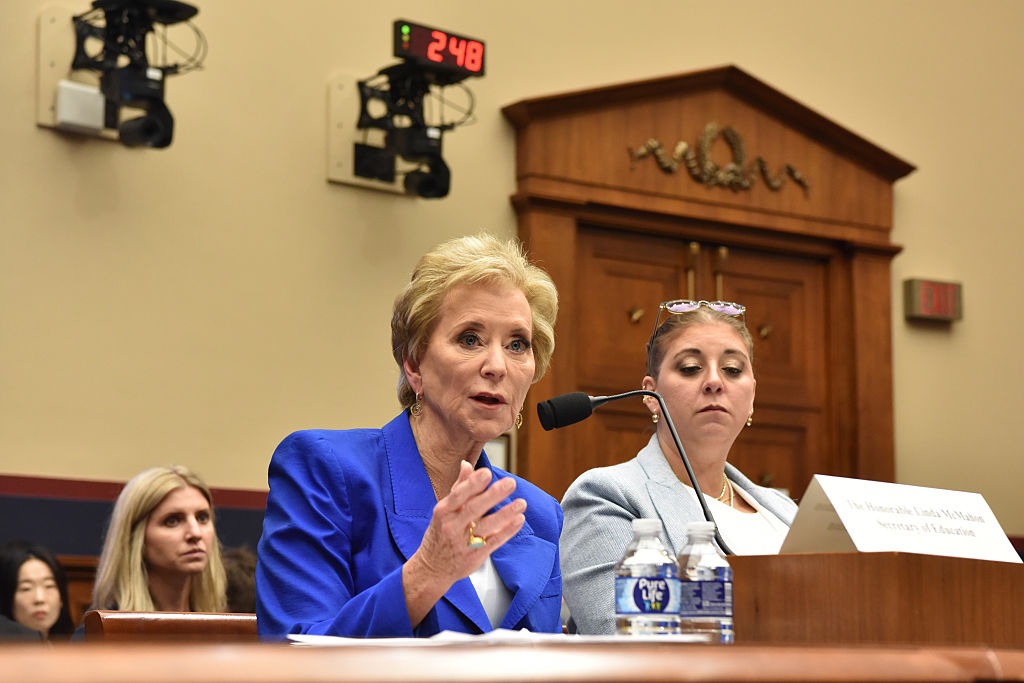
In the administration’s push to wind down the department, McMahon admits she still needs staff to complete what she calls her “final mission.” On May 21, she told a House appropriations subcommittee that she had rehired 74 people. Biedermann wouldn’t say whether that figure has grown, and referred a reporter to the hearing video.
“You hope that you’re just cutting fat,” McMahon testified. “Sometimes you cut a little in the muscle.”
The next day, a federal district court ordered her to also reinstate the more than 1,300 employees she fired in March, about half of the department’s workforce. Updating the court on progress, Chief of Staff Rachel Oglesby said in a July 8 filing that she’s still reviewing survey responses from laid off staffers and figuring out where they would work if they return.
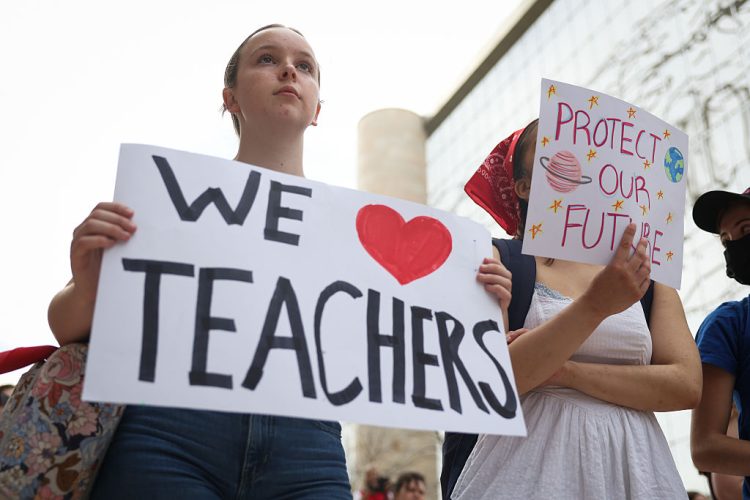
But some call the department’s efforts to bring back employees lackluster, perhaps because it’s pinning its hopes on a victory before the Supreme Court.
“This is a court that’s been fairly aggressive in overturning lower court decisions,” said Smith, with the National Center for Youth Law.
His group’s lawsuit is one of two challenging cuts to the Office for Civil Rights, which lost nearly 250 staffers and seven regional offices. They argue the cuts have left the department unable to thoroughly investigate complaints. Of the 5,164 civil rights complaints since March, OCR has dismissed 3,625, Oglesby reported.
In a case brought by the Victim Rights Law Center, a Massachusetts-based advocacy organization, a federal district court judge ordered McMahon to reinstate OCR employees.
Even if the case is not reversed on appeal, there’s another potential problem: Not all former staffers are eager to return.
“I have applied for other jobs, but I’d prefer to have certainty about my employment with OCR before making a transition,” said Andy Artz, who was a supervising attorney in OCR’s New York City office until the layoffs. “I feel committed to the mission of the agency and I’d like to be part of maintaining it if reinstated.”
An aspect of that mission, nurtured under the Biden administration, was to discourage discipline policies that result in higher suspension and expulsion rates for minority students. A 2023 memo warned that discrimination in discipline could have “devastating long-term consequences on students and their future opportunities.”
But according to the department’s Feb. 14 guidance, efforts to reduce those gaps or raise achievement among Black and Hispanic students could fall under its definition of “impermissible” DEI practices. Officials demanded that states sign a form certifying compliance with their interpretation of the law. On April 24, three federal courts ruled that for now, the department can’t pull funding from states that didn’t sign. The department also had to temporarily shut down a website designed to gather public complaints about DEI practices.
The cases, which McMahon has asked the courts to dismiss, will continue through the summer. In court records, the administration’s lawyers say the groups’ arguments are weak and that districts like Decatur simply overreacted. In an example cited in a complaint brought by the NAACP, the Waterloo Community School District in Iowa responded to the federal guidance by pulling out of a statewide “read-In” for Black History Month. About 3,500 first graders were expected to participate in the virtual event featuring Black authors and illustrators.
The department said the move reflected a misunderstanding of the guidance. “Withdrawing all its students from the read-In event appears to have been a drastic overreaction by the school district and disconnected from a plain reading of the … documents,” the department said.
The administration’s DEI crackdown has left many schools confused about how to teach seminal issues of American history such as the Civil Rights era.
It was the Civil Rights Act of 1964 that established “desegregation centers” across the country to help districts implement court-ordered integration.
In 2022, the Biden administration awarded $33 million in grants to what are now called equity assistance centers. But Trump’s department views such work as inseparable from DEI. When it cancelled funding to the centers, it described them as “woke” and “divisive.”
Judge Paul Friedman of the U.S. District Court for the District of Columbia, a Clinton appointee, disagreed. He blocked McMahon from pulling roughly $4 million from the Southern Education Foundation, which houses Equity Assistance Center-South and helped finance Brown v. Board of Education over 70 years ago. His order referenced President Dwight Eisenhower and southern judges who took the ruling seriously.
“They could hardly have imagined that some future presidential administration would hinder efforts by organizations like SEF — based on some misguided understanding of ‘diversity, equity, and inclusion’ — to fulfill Brown’s constitutional promise to students across the country to eradicate the practice of racial segregation.”
He said the center is likely to win its argument that canceling the grant was “arbitrary and capricious.”
Raymond Pierce, Southern Education Foundation president and CEO, said when he applied for the grant to run one of the centers, he emphasized its historical significance.
“My family is from Mississippi, so I remember seeing a ‘colored’ entrance sign on the back of the building as we pulled into my mother’s hometown for the holidays,” Pierce said.
Trump’s Justice Department aims to dismiss many of the remaining 130 desegregation orders across the South. Harmeet Dhillon, assistant attorney general for civil rights, has said the orders force districts to spend money on monitoring and data collection and that it’s time to “let people off the hook” for past discrimination.
But Eshé Collins, director of Equity Assistance Center-South, said the centers are vital because their services are free to districts.
“Some of these cases haven’t had any movement,” she said. “Districts are like ‘Well, we can’t afford to do this work.’ That’s why the equity assistance center is so key.”

Her center, for example, works with the Fayette County schools in Tennessee to recruit more Black teachers and ensure minority students get an equal chance to enroll in advanced classes. The system is still under a desegregation order from 1965, but is on track to meet the terms set by the court next year, Collins said. A week after Friedman issued the injunction in the foundation’s case, Ruth Ryder, the department’s deputy assistant secretary for policy and programs, told Collins she could once again access funds and her work resumed.
As they entered the Department of Education in early February, one of the first moves made by staffers of the Department of Government Efficiency was to terminate nearly $900 million in research contracts awarded through the Institute for Education Sciences. Three lawsuits say the cuts seriously hinder efforts to conduct high-quality research on schools and students.
Kevin Gee from the University of California, Davis, was among those hit. He was in the middle of producing a practice guide for the nation on chronic absenteeism, which continues to exceed pre-pandemic levels in all states. In a recent report, the American Enterprise Institute’s Nat Malkus said the pandemic “took this crisis to unprecedented levels” that “warrant urgent and sustained attention.” Last year’s rate stood at nearly 24% nationally — still well above the 15% before the pandemic.
Gee was eager to fully grasp the impact of the pandemic on K-3 students. Even though young children didn’t experience school closures, many missed out on preschool and have shown delays in social and academic skills.
Westat, the contractor for the project, employed 350 staffers to collect data from more than 860 schools and conduct interviews with children about their experiences. But DOGE halted the data collection midstream — after the department had already invested about $44 million of a $100 million contract.
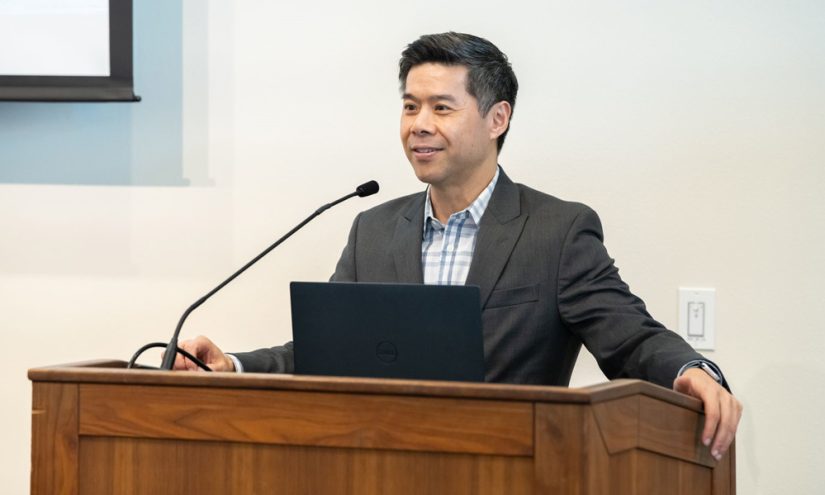
“The data would’ve helped us understand, for the first time, the educational well-being of our nation’s earliest learners on a nationwide scale in the aftermath of the pandemic,” he said.
The department has no plans to resurrect the project, according to a June court filing. But there are other signs it is walking back some of DOGE’s original cuts. For example, it intends to reissue contracts for regional education labs, which work with districts and states on school improvement.
“It feels like the legal pressure has succeeded, in the sense that the Department of Education is starting up some of this stuff again,” said Cara Jackson, a past president of the Association for Education Finance and Policy, which filed one of the lawsuits. “I think … there’s somebody at the department who is going through the legislation and saying, ‘Oh, we actually do need to do this.’ ”
Amid the legal machinations, even some Republicans are losing patience with McMahon’s moves to freeze spending Congress already appropriated.
In April, she terminated $1 billion in mental health grants approved as part of a 2022 law that followed the mass school shooting in Uvalde, Texas. The department told grantees, without elaboration, that the funding no longer aligns with the administration’s policy of “prioritizing merit, fairness and excellence in education” and undermines “the students these programs are intended to help.”
The secretary told Oregon Democratic Sen. Jeff Merkley in June that she would “rebid” the grants, but some schools don’t want to wait. Silver Consolidated Schools in New Mexico, which lost $6 million when the grant was discontinued, sued her on June 20th. Sixteen Democrat-led states filed a second suit later that month.
The funds, according to Silver Consolidated’s complaint, allowed it to hire seven mental health professionals and contract with two outside counseling organizations. With the extra resources, the district saw bullying reports decline by 30% and suspensions drop by a third, according to the district’s complaint. Almost 500 students used a mental health app funded by the grant.
A judge has yet to rule in either case, but Republican Rep. Brian Fitzpatrick of Pennsylvania and other members of a bipartisan task force are holding McMahon to her word that she’ll open a new competition for the funds.
“These funds were never intended to be a theoretical exercise — they were designed to confront an urgent crisis affecting millions of children,” Fitzpatrick said in a statement. “With youth mental health challenges at an all-time high, any disruption or diversion of resources threatens to reverse hard-won progress and leave communities without critical supports.”
Get stories like these delivered straight to your inbox. Sign up for The 74 Newsletter

Get stories like this delivered straight to your inbox. Sign up for The 74 Newsletter
A version of this essay originally appeared on Robert Pondiscio’s SubStack.
A recent report from the University of Virginia—Good Fathers, Flourishing Kids — confirms what many of us know instinctively but rarely see, or avoid altogether, in education debates: The presence and engagement of a child’s father has a powerful effect on their academic and emotional well-being. It’s the kind of data that should stop us in our tracks — and redirect our attention away from educational fads and toward the foundational structures that shape student success long before a child ever sets foot in a classroom.
The research — led by my AEI colleague Brad Wilcox and co-authored by a diverse team that includes another AEI colleague, Ian Rowe — finds that children in Virginia with actively involved fathers are more likely to earn good grades, less likely to have behavior problems in school, and dramatically less likely to suffer from depression. Specifically, children with disengaged fathers are 68% less likely to get mostly good grades and nearly four times more likely to be diagnosed with depression. These are not trivial effects. They are seismic.
Most striking is the report’s finding that there is no meaningful difference in school grades among demographically diverse children raised in intact families. Black and white students living with their fathers get mostly As at roughly equal rates — more than 85% — and are equally unlikely to experience school behavior problems. The achievement gap, in other words, appears to be less about race and more about the structure and stability of the family.
This may be a surprising finding to some, but not to William Jeynes, a professor of education at California State University, Long Beach, whose meta-analyses have previously demonstrated the outsized academic impact of family structure and religious faith. (The new UVA report does not study the role of church-going).
As I wrote in How the Other Half Learns, Jeynes’ work highlights how two-parent households and religious engagement produce measurable benefits in educational achievement. “When two parents are present, this maximizes the frequency and quality of parental involvement. There are many dedicated single parents,” Jeynes has noted. However, the reality is that when one parent must take on the roles and functions of two, it is simply more difficult than when two parents are present.” Jeynes’ most stunning finding, and his most consistent, is that if a Black or Hispanic student is raised in a religious home with two biological parents the achievement gap totally disappears—even when adjusting for socioeconomic status.
My colleague Ian Rowe has been a tireless advocate for recognizing and responding to these patterns. He has long argued that NAEP, the Nation’s Report Card, should disaggregate student achievement data by family composition, not just by race and income. That simple step would yield a more honest accounting of the challenges schools are facing — and help avoid both unfair blame and unearned credit.
Yet this conversation remains a third rail in education. Many teachers and administrators are understandably wary of saying too much about family structure for fear of stigmatizing children from single-parent households, particularly in settings where single-parent households are dominant. Rowe has also faced resistance to his efforts to valorize the “Success Sequence,” the empirical finding that graduating high school, getting a full-time job and marrying before having children dramatically increases one’s odds of avoiding poverty. But being cautious is not the same as being silent, and it’s not compassionate to pretend these dynamics don’t matter when the data so clearly shows that they do.
None of this absolves educators of their duty to reach and teach every child. But it does suggest we should be clear-eyed in how we interpret data and set expectations. Teachers, particularly those in low-income communities, often shoulder the full weight of student outcomes while lacking the ability to influence some of the most powerful predictors of those outcomes. That’s frustrating — and understandably so.
Citing compelling evidence on fatherhood and family formation is not a call for resignation or excuse-making. It’s a call for awareness and intelligent action. While schools can’t influence or re-engineer family structure, teachers can respond in ways that affirm the role of fathers and strengthen the school-home connection. They can make fathers feel welcome and expected in school life — not merely tolerated. They can design family engagement activities that include dads as co-participants, not afterthoughts. They can build classroom cultures that offer structure and mentoring, especially to students who may lack it at home.
And maybe — just maybe — the field can overcome its reluctance to share with students what research so clearly shows will benefit them and the children they will have in the future. Rowe takes pains to note his initiative to teach the Success Sequence is intended to help students make decisions about the families they will form, not the ones they’re from. “It’s not about telling them what to do,” he says, “it’s about giving them the data and letting them decide for themselves.”
This leads to a final point, and for some an uncomfortable one: If we truly care about student outcomes, perhaps we should be willing to support the institutions that reliably foster them. And that includes religious schools.
Religious schools — particularly those rooted in faith traditions that emphasize marriage, family life and moral formation — often create environments where the presence of fathers and the reinforcement of shared values are not incidental but central. A recent analysis by Patrick J. Wolf of the University of Arkansas, published in the Journal of Catholic Education, found that adults who attended religious schools are significantly more likely to marry, stay married, and avoid nonmarital births compared to public‑school peers. The effects are most pronounced among individuals from lower‑income backgrounds.
In states with Education Savings Accounts (ESAs) and other school choice mechanisms, we have an opportunity — perhaps an obligation — to expand access to these institutions. That’s not merely a question of parental rights or religious liberty. It’s a matter of public interest. If these schools produce better education and social outcomes by encouraging family formation and reinforcing the value of fatherhood, the public benefits — even if instruction is delivered in a faith-based context. Said simply: The goal of educational policy and practice is not to save the system. It’s to help students flourish.
So yes, let’s fund fatherhood initiatives. Let’s run PSAs about the importance of dads. But let’s also get serious about expanding access to the kinds of schools — whether secular or religious in nature — that support the kind of family culture where children are most likely to thrive. Because if we follow the evidence where it leads, we must conclude that the biggest intervention in education is not another literacy coach or SEL curriculum. It’s dad.
Get stories like these delivered straight to your inbox. Sign up for The 74 Newsletter


The coming academic year (2025-26) is the first in which classroom-based foundation year (FY) fees will be capped at a level below the higher level fee cap.
For many who have experienced or supported foundation year tuition this is a retreat from a proven method for supporting people who have been failed by compulsory schooling in continuing their education. Critics would point to a few years of sustained growth, particularly in franchised provision, that is of more questionable quality and benefit.
Foundation years are an anomaly in that they sit neither at level three (alongside other pre-university qualifications like A levels or the Access to HE Diploma [AHED]) or level four (alongside higher national diplomas, and the first years of both undergraduate degrees and higher technical qualifications). As such, they will face the worst of both worlds: level 3 funding (for classroom-based provision) covered by level 4 repayment rules and level 4 regulatory interventions.
In a ministerial statement that, in a dazzling display of self-awareness, actually used the phrase “fix the foundations” twice, the Secretary of State set a fee limit of £5,760 (the maximum current cost of an AHED, though in practice fees are nearer £4,000) as a maximum for “classroom-based” (non-STEM) foundation years on 4 November 2024.
There’s a paragraph on the ostensible reasoning for this that is worth bearing in mind:
The government recognises the importance of foundation years for promoting access to higher education, but they can be delivered more efficiently in classroom-based subjects, at a lower cost to students.
This sounds more like an access-focused intervention rather than an attempt to cut provision, although it is rather divorced from the cost of provision. This is despite a 2023 report from IFF Research which noted that, based on the available data and on a series of interviews:
the cost of delivering FY and the first year of a UG degree in the same subject area was found to be broadly similar
Indeed, there were suggestions that FYs may actually work out more expensive, given the need for more contact time and the tendency towards smaller classes. We should leave aside for the moment the great difficulties we have in understanding the cost of higher education provision more generally, and note that the evidence base for this particular decision is weak. And there is, to be clear, a huge absence of meaningful data about FYs more generally – something DfE itself attempted (after a fashion) to remedy with an ad hoc data release in October of 2023.
If you were wondering where the impetus for this policy intervention originally came from, you have to look back to Philip Augar’s review of post-18 fees and funding back in 2019:
We recommend that student finance is no longer offered for foundation years, unless agreed with the OfS in exceptional cases.
In broad-brush terms, his argument was that foundation years did a similar job to some level 3 qualifications (specifically the Access to HE Diplomas) at greater cost: he characterised this as “enticing” underqualified students onto expensive four year degrees that may not be in their best interests.
It was one of many largely arbitrary (and mercifully forgotten) Augar recommendations on higher education funding, to the credit of the previous government it was very much more aligned to addressing the value offered to students. As Michelle Donelan said in 2022:
We also know that there are some people who need a second chance, an opportunity to get into higher education through a less conventional route. Often this route is through foundation years, but we think it is unfair that some of those who take advantage of this transformational opportunity have to pay over the odds. So we are reducing the fee limit for foundation years to make them more accessible and more affordable for those who need a second chance.
Okay. So, ignoring Augar, there’s never been an agenda to cancel or limit the availability of foundation years. The cuts are based (albeit on some quite shaky data) on reducing costs for students while maintaining affordability for providers.
There is, however, widely reckoned to be a quality issue with some FYs offered via franchise or partnership arrangement – something which DfE did not appear to have considered in collecting data or commissioning reports.
With the 2025 recruitment cycle mostly over, we now have the ability to assess how the sector has responded to these interventions via the Unistats dataset.
As I never tire of telling people, Unistats is not perfect but it is useful. The big headline story we’ve tracked in recent years is a reduction in the number of undergraduate courses on offer overall – down 6 per cent between 2023 and 2024, and down a further 3 per cent between 2024 and 2025.
But underneath this we lost one in ten courses with compulsory foundation years (courses that must start with a foundation year) between 2023 and 2024, and a further five percent between 2024 and 2025. The latter year also saw nearly 6 per cent of optional foundation years (courses that can include a foundation year if required) disappear.
What about franchise provision? Using a unistats proxy (does the registered UKPRN match the display UKPRN, or is there an additional UKPRN for a different teaching location) it appears that the number of franchised compulsory foundation years grew from 90 in 2023 to 107 in 2024. This trend reversed between 2024 and 2025 (with numbers falling back below 80), but the number of optional franchised foundation years fell off a cliff after 2023: from 53 in 2023 to just 12 in 2024, and 13 in 2025.
At a (top level) subject area the dominance of social sciences and business foundation years has declined a little – engineering foundation years have always been popular and have broadly persisted over the three years in question (and are the most popular by far at Russell Group providers). Among franchised provision business and management still dominates, but the last three years has seen a rise in the number of creative and engineering foundation years offered (largely with specialised providers as franchisers).
So, it all depends on how you take the impetus of the government’s change in foundation year policy. If it was a measure to reduce overall the number of classroom (non-STEM) foundation years it has had some questionable success, likewise if you believe it was a policy designed to limit the spread of franchised foundation year degrees.
It is possible that it has driven savings within universities – allowing foundation years to be run more cheaply. This might explain things like the paradoxical rise in franchised foundation years in creative arts alongside a drop in non-franchised provision – smaller and less historically encumbered (and potentially lower quality) providers may be better at running these foundation years at a lower overall cost.
Here’s who is offering these courses – and what they are.

This defaults to FY provision in 2025 but is – with a bit of effort, a fascinating tool for looking over the complete three years of courses advertised to undergraduates.
As usual, we are hugely short of data – the fact that unistats (of all things) offers the best lens on what is happening suggests that there’s nobody in DfE with an eye on what is going on.
But rumours of the demise of the classroom based foundation year, or even the franchise model in providing this, are likely to be overstated. It remains to be seen, by whatever measure, whether the cut-price offer is as good.

Get stories like this delivered straight to your inbox. Sign up for The 74 Newsletter
This story was originally reported by Chabeli Carrazana of The 19th.
Two years ago, Nicolle Orozco Forero walked into an in-home day care in Seattle, Washington, looking for a job. She was barely 22, a whole five feet tall — if that. But she was calm, focused. Her presence struck the owner, Stephanie Wishon, because it’s not easy to find qualified staff who can work with children with disabilities.
Orozco Forero had experience working with kids who had autism back in Colombia, so Wishon had her come in for a trial run and hired her after the first day. The children, who needed someone who had love and care to give in abundance, gravitated toward her. She was good at the hardest stuff. She changed diapers and outfits the moment they were soiled. She was vigilant; her kids stayed pristine. And she got them to do the things they wouldn’t do for other people, like say “ah” when it was time to get their teeth brushed or sit still long enough for her to twist a braid down their back.
Some people just have that way about them.
And people like Orozco Forero are exceptionally rare. Already, the staffing shortage in child care is near crisis levels. It’s far worse for children with disabilities — about a third of those families say they face significant difficulty finding care for their kids, partly because there are too few people with the ability, expertise or desire to work with their children. Immigrant women like Orozco Forero have been helping to fill that void. They now make up 20 percent of all child care workers.
At home, Orozco Forero was also caring for her own young boys, one of whom started to show symptoms of a serious illness over the past two years that doctors have not yet been able to diagnose. She took some time off to care for him last year, before returning to the kids at Wishon’s day care.
Her work has kept an already precarious safety net together. Without women like Orozco Forero, families who have nowhere else to turn for care have to make difficult decisions about how to survive and keep their children safe. Without her, the safety net snaps.
And that’s exactly what happened on June 18, the day she was detained.
It was supposed to be a routine meeting with U.S. Immigration and Customs Enforcement (ICE). Orozco Forero and her husband had been to all their monthly meetings for the past year and change, since their asylum charge was denied in April 2024.
The family — Orozco Forero; her husband, Juan Sebastian Moreno Acosta; and their two sons, Juan David, 7, and Daniel, 5 — fled Colombia two years ago. Moreno Acosta, a street vendor, had been persecuted by gangs who target vendors for money.
After arriving in the United States, they sought the help of a lawyer with their asylum claim, but when they couldn’t pay his full fee ahead of their hearing, he pulled out. They represented themselves in court and lost the case. With no knowledge of the U.S. court system, they didn’t know they had 30 days to appeal the ruling, either. Ever since, ICE has been monitoring them, requiring they wear a wrist tracker and meet with an immigration officer once a month, sometimes more, according to a family member. (The 19th is not naming the family member to protect their identity.) It’s unclear why ICE has allowed them to stay in the country all this time, though it’s not necessarily uncommon; ICE typically prioritized immigrants with felonies for deportation.
Orozco Forero had seen the reports of illegal immigrants being rounded up at their immigration appointments. President Donald Trump’s mass deportation effort has led to the detention of about 30,000 migrants with no criminal record, like Orozco Forero, who now make up about half of those detained. Her husband does have a misdemeanor reckless driving conviction for driving under the influence of alcohol on his record, but he completed a court-mandated alcohol course for that and has no other convictions.
Still, Orozco Forero wasn’t worried when she headed to her appointment on the morning of June 18. If ICE planned to detain her, Orozco Forero thought, they would have asked her to come with the boys, right?
And she had been doing everything right: She’d gone to all her appointments, taken documentation to show she was going to school at Green River Community College taking courses in English and early childhood education. She had completed a child care internship that trained her to open her own licensed in-home day care. Her licensure approval was set to arrive any moment, likely that same week, and the day care was just about ready to go.
But that morning, her family was still wary, asking her to share her location just in case.
Shortly after 10 a.m., Orozco Forero texted her family member: “They are going to deport us”
“Nicolle what happened? Nicolle answer me,” they texted back. “What do I do?”
“I can’t speak I feel like I’m going to faint,” Orozco Forero replied. And then: “I’m sorry it wasn’t what we expected.”
Two-and-a-half hours west, on the coast of Washington in a town called Southbend, Wishon was frantic. Orozco Forero had texted her, too. ICE was asking for the boys.
In two years, Wishon had grown incredibly close to Orozco Forero, who had cared for her own kids. After her family moved to the coast, Wishon rented out her house in Seattle to Orozco Forero, whose boys were excited to have a home with a yard.
Wishon’s husband, Gabriel, hopped into his truck and headed to Seattle. Wishon, meanwhile, got on the phone with the Orozco Forero family’s ICE agent and every lawyer she could. They were going to take them into detention at a facility 2,200 miles away in Texas, a facility that was reopened earlier this year by the Trump administration to detain families. Wishon wanted to find a lawyer who could stop the deportation order, and she wanted to make sure the boys would be reunited with their parents if they took them to meet the ICE agent.
And that was especially important, not just because they were young children, but because Juan David is still sick.
For the past year, he’s been seeking treatment at Seattle Children’s Hospital for an illness that is turning his urine muddy. So far, doctors have determined he’s losing red blood cells and protein through his urine, indicating a possible kidney issue, but they haven’t yet zeroed in on what is causing the problem. They likely need a kidney biopsy to be sure.
“Given the complexity of his case, it is essential that Juan remain in the United States for continued testing and treatment,” his nephrologist Jordan Symons wrote in a March letter to ICE. “We kindly request that you consider this medical necessity in your review of his immigration status and grant him the ability to stay in the United States until his treatment and evaluation are completed.”
Juan David’s care team has been monitoring him closely to ensure his red blood cell and protein levels never drop too low. His condition could become serious quickly.
“You can die from that,” said Sarah Kasnick, a physician’s assistant who is familiar with his case. Kasnick is also a foster parent, and Orozco Forero provided care for her family.
When Gabriel Wishon arrived to pick up the boys, they were confused and disoriented. Where were their parents? Why was everyone crying? They didn’t want to go to Colombia, they told him on the drive. They wanted to stay in the United States.
Around 5:30 p.m. that evening, he met with the ICE agent, who had waited past her work hours for them to arrive.
“Bye boys, you are going to see your parents right now. They are right inside,” Wishon told them. He watched them walk in carrying two stuffed animals, a Super Mario doll and Chase, the popular cartoon dog dressed as a police officer.
The families Orozco Forero cares for are now in a free fall.
Jessica Cocson, whose son has been in Orozco Forero’s care for more than a year, described her in a character letter to ICE as a “blessing to us in ways I struggle to fully express.”
Orozco Forero and her husband “support working families, provide quality childcare, and demonstrate compassion and commitment every day,” Cocson wrote. “It is heartbreaking to think that someone who gives so much and asks so little could be forced to leave.”
Tamia Riley, whose two sons with autism were also in Orozco Forero’s care, said losing her was like watching “a father walking out the door.”
“These people, these day care providers, sitters, they are a form of family members for me and my children,” Riley said.
Now, the day care she was set to open lays empty. Inside, the walls are plastered with posters listing colors and sight words. There are cushioned mats on the floor and play stations. Tables with tiny chairs. A tall pink dollhouse. High chairs and a pack and play for the babies. Outside, two play houses, a ball pit, toys to ride on and little picnic tables set across an artificial turf. But no children to enjoy any of it.
Big Dreams Day Care she was going to call it, for the dreams she wanted the kids in her care to strive for, and the ones that were finally coming to fruition for her.
Orozco Forero’s detention has rattled child care workers across the country. In Texas, workers represented by the Service Employees International Union have been rallying in her name. U.S. Rep. Joaquin Castro, a Texas Democrat, spoke in support of the family’s release at a rally on June 29 in San Antonio. And a group of union workers is attempting to deliver supplies to the family. It’s an effort Orozco Forero knows little about; she only has limited communication with those on the outside.
Tricia Schroeder, the president of the Seattle-based SEIU chapter that represents care workers, said that, for years unions like hers have been working to improve quality, access and affordability in child care, a system in such deep crisis it’s been called by the Treasury Department “a textbook example of a broken market.”
Immigrant women like Orozco Forero were part of that effort to improve access, doing jobs few Americans want to take on.
“Detaining child care providers, especially those who care for kids with special needs, just deepens the crisis in early learning,” Schroeder said.

Orozco Forero was also the connective tissue that kept families employed. Her loss has rippled across industries.
Kasnick, the foster parent, said one of the children in her care had been tentatively set to start at Orozco Forero’s day care as soon as it opened. Orozco Forero had been the only provider who would take the child, who has autism and is nonverbal.
Orozco Forero had cared for the girl at Wishon’s day care as if she was her own, even taking her in once when the child’s care had fallen through and no foster family in the entire county would take her in because of the complexity of her needs. The girl arrived at Orozco Forero’s house at midnight on a weekend “with no clothing, toys, medication or any of her belongings … this did not [deter] Nicolle and Sebastian instead they immediately went and purchased all the things” the child needed, a social worker wrote in a letter to ICE. Kasnick said Orozco Forero was even considering becoming a foster parent.
Without her, Kasnick is out of options: She quit her job as a physician’s assistant to care for the child after Orozco Forero was detained.
“There are now 44 patients a day who don’t have anyone to provide their health care, and I can’t go to work because Nicolle’s day care didn’t open,” Kasnick said.
In the weeks since, Kasnick has had an overwhelming feeling of helplessness, she said. How could this happen to someone who gave back so much?
“The security of knowing that you can be in your home one day and in a prison the next week, and you didn’t do anything except exist?” she said. “It makes you feel like there’s no good left in the world.”
Orozco Forero’s family has now been in ICE detention for nearly a month awaiting a bond hearing that could buy them time in the United States. Orozco Forero and the boys are together; her husband is in the same facility but separated from them.
Juan David hasn’t been eating. It took three weeks for him to receive medical care, Orozco Forero told her attorney, James Costo.
Costo has been working to get the details of why ICE allowed the family to stay in the country with monitoring after they lost their asylum case last year. There has been an order for their deportation since then, but ICE never attempted to deport them until the Trump administration ramped up efforts. The number of immigrants without criminal convictions who have been detained has doubled since May.
The process to fight an asylum claim and appeal a denial is complicated — there are court deadlines, documents that need to be submitted and translated.
“They think maybe they can do it themselves and go in and say what happened but they are not understanding the whole legal process,” Costo said. “The system isn’t made for things to be easy.”
Costo is hopeful a judge will allow them to stay in the country temporarily as Juan David seeks care. They have almost no family left in Colombia, and no way to obtain care for him there, their family said. If they can stay, then perhaps Orozco Forero could try to obtain a work visa as a domestic worker.
He has gathered letters of support from numerous people whose lives the Orozco Forero family touched, and Wishon set up a GoFundMe to cover her legal expenses.
In the letters, Juan David’s first grade teachers call him an exceptional student who went from one of the lowest reading levels in the class — 10 words a minute — to one of the highest at 70 words a minute.
“He shows the qualities of a model citizen at a young age — dependable, ethical, and hard-working,” wrote his teacher, Carla Trujillo.
They were all on their way to shaping a better future, Wishon wrote in hers. The couple “worked tirelessly to build a better life for their children and to open their own licensed child care business. In all my years of employing and mentoring caregivers, I have rarely met a couple as responsible, driven, and capable as Nicolle and Sebastian.”
“This family is not a threat,” she concluded. “They are an asset.”

Get stories like these delivered straight to your inbox. Sign up for The 74 Newsletter

Get stories like this delivered straight to your inbox. Sign up for The 74 Newsletter
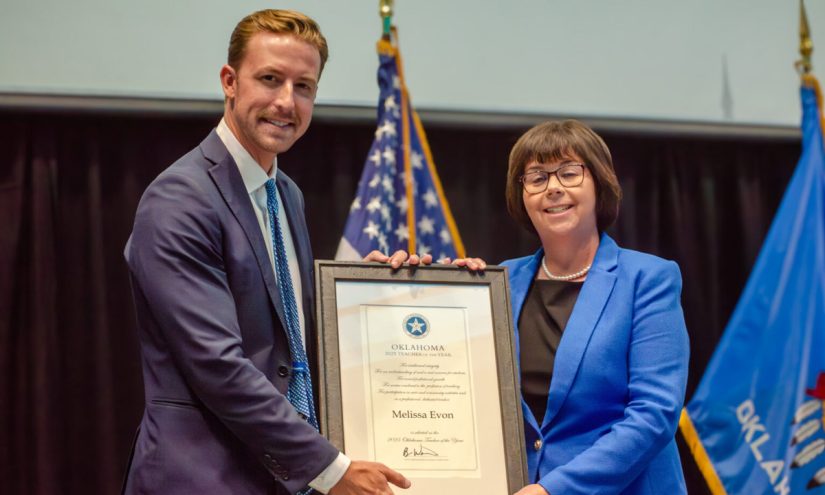
OKLAHOMA CITY — Those who knew Melissa Evon the best “laughed really hard” at the thought of her teaching family and consumer sciences, formerly known as home economics.
By her own admission, the Elgin High School teacher is not the best cook. Her first attempt to sew ended with a broken sewing machine and her mother declaring, “You can buy your clothes from now on.”
Still, Evon’s work in family and consumer sciences won her the 2025 Oklahoma Teacher of the Year award on Friday. Yes, her students practice cooking and sewing, but they also learn how to open a bank account, file taxes, apply for scholarships, register to vote and change a tire — lessons she said “get kids ready to be adults.”
“Even though most of my career was (teaching) history, government and geography, the opportunity to teach those real life skills has just been a phenomenal experience,” Evon told Oklahoma Voice.
After graduating from Mustang High School and Southwestern Oklahoma State University, Evon started her teaching career in 1992 at Elgin Public Schools just north of Lawton. She’s now entering her 27th year in education, a career that included stints in other states while her husband served in the Air Force and a break after her son was born.
No matter the state, the grade level or the subject, “I’m convinced I teach the world’s greatest kids,” she said.
Her family later returned to Oklahoma where Evon said she received a great education in public schools and was confident her son would, too.
Over the course of her career, before and after leaving the state, she won Elgin Teacher of the Year three times, district Superintendent Nathaniel Meraz said.
So, Meraz said he was “ecstatic” but not shocked that Evon won the award at the state level.
“There would be nobody better than her,” Meraz said. “They may be as good as her. They may be up there with her. But she is in that company of the top teachers.”
Like all winners of Oklahoma Teacher of the Year, Evon will spend a year out of the classroom to travel the state as an ambassador of the teaching profession. She said her focus will be encouraging teachers to stay in education at a time when Oklahoma struggles to keep experienced educators in the classroom.
Evon herself at times questioned whether to continue teaching, she said. In those moments, she drew upon mantras that are now the core of her Teacher of the Year platform: “See the light” by looking for the good in every day and “be the light for your kids.”
She also told herself to “get out of the boat,” another way of saying “take a leap of faith.”
Two years ago, she realized she needed a change if she were to stay in education. She wanted to return to the high-school level after years of teaching seventh-grade social studies.
The only opening at the high school, though, was family and consumer sciences. Accepting the job was a “get out of the boat and take a leap of faith moment,” she said.
“I think teachers have to be willing to do that when we get stuck,” Evon said. “Get out of the boat. Sometimes that’s changing your curriculum. Sometimes it might be more like what I did, changing what you teach. Maybe it’s changing grade levels, changing subjects, changing something you’ve always done, tweaking that idea.”
Since then, she’s taught classes focused on interpersonal communication, parenting, financial literacy and career opportunities. She said her students are preparing to become adults, lead families and grow into productive citizens.
And, sure, they learn cooking and sewing along the way.
“I’m getting to teach those things, and I know that what I do matters,” Evon said. “They come back and tell me that.”
Oklahoma Voice is part of States Newsroom, a nonprofit news network supported by grants and a coalition of donors as a 501c(3) public charity. Oklahoma Voice maintains editorial independence. Contact Editor Janelle Stecklein for questions: [email protected].
Get stories like these delivered straight to your inbox. Sign up for The 74 Newsletter

At the Higher Education Inquirer, we see through the spin. We’ll keep digging, exposing the absurdity, and telling the stories no one else will. More muckraking ahead. Stay tuned.