Author: admin

  • The Importance of Early Career Planning (opinion)

    The Importance of Early Career Planning (opinion)

    It’s never too early, but it can be too late. This simple phrase has transformed our advising sessions with graduate students and postdocs, resonating deeply with those navigating the uncertain waters of career transitions. As career advising experts who have guided countless individuals through this journey, we have seen firsthand the power of early career planning and the pitfalls of procrastination.

    Today’s graduate students and postdocs are navigating more than just personal uncertainty. They are facing a rapidly shifting professional landscape influenced by political and societal forces beyond their control. The value of advanced degrees is being questioned in public discourse; funding cuts, hiring freezes and massive layoffs are affecting job prospects; and visa restrictions continue to impact international scholars. These trends are unsettling, but they underscore the same truth: Proactive, flexible career planning is necessary.

    The path from graduate school or a postdoctoral position to a fulfilling career is rarely a straight line. We understand; we both hold Ph.D.s and were postdocs ourselves. Yet, many students and early-career researchers delay thinking about their next steps, often until the pressure of impending graduation or the end of an appointment looms large. This delay can turn the exciting question of “What’s next?” into the anxiety-inducing “What now?”

    One common fear we encounter in our advising sessions is the fear of the unknown, and now more than ever, our best advice remains the same: Start sooner rather than later. When harnessed properly, this fear can become a powerful motivator for early career planning. If you build in time to explore your options, test possibilities and develop a flexible plan, you will be far better equipped to navigate unforeseen changes.

    Crucially, starting early does not mean locking yourself into one path. It means giving yourself enough time to adapt, explore and build a more informed and confident future, even if that future changes along the way.

    Your Hidden Advantage

    As graduate students or postdocs, you are in a unique position: You are essentially being paid to learn and become experts in your field. Beyond your specific area of study, you also have access to a wealth of resources at your research institutions designed to support your professional development. These resources include:

    • Career services: Do not wait until your final year to visit the career office. Start early and make regular appointments to discuss your evolving career goals and strategies. Career service professionals can help you save precious time and effort and remain advocates for you in your career-exploration journey. Many of us know exactly how you are feeling because we have been there, too!
    • Workshops and seminars: Attend professional and career-development workshops offered by your institution. These often cover crucial topics like résumé writing, interview preparation or networking strategies.
    • Alumni networks: Leverage your institution’s alumni network. Alumni can provide valuable insights into various career paths, and many are eager to help current graduate students and postdocs navigate the job search process.
    • Professional associations: Join relevant professional associations in your field. Many offer graduate students and postdocs memberships at reduced rates and provide access to job boards, conferences, networking events and leadership opportunities.
    • International student and scholar services: If you are on a visa, connect early with your institution’s international center. These offices can offer critical guidance on work authorization options, strategies for transitioning from an academic-sponsored visa to another type of professional visa (such as the H-1B visa) and long-term planning toward permanent residency. They can also connect you with immigration attorneys and employer resources to help you advocate for yourself throughout the process.

    Now is the time to take action. This month, schedule an appointment with your institution’s career services office (trust us, we are excited to meet and help you) and/or attend a networking event or workshop outside your immediate field of study.

    If your plan involves stepping beyond the academic landscape, do not underestimate the power of building your professional network, as referrals and recommendations play a growing role in hiring decisions. The relationships you build now, through informational interviews, mentorship and community engagement, can become invaluable sources of insight, opportunity and support throughout your career.

    The Perils of Procrastination

    Waiting until the final months of your program or position to begin your job search is a recipe for stress and missed opportunities. Early preparation not only reduces anxiety but also allows you to explore multiple career paths, build necessary skills and make meaningful connections.

    As career professionals, we see the impact of procrastination all the time: rushed applications, unclear goals, missed deadlines and tremendous stress. In our own career-exploration journey, we have been fortunate to experience the opposite. Our approach to prepare early opened doors to valuable opportunities and reduced the pressure to find just any job at the end of our postdoc. That contrast is a big reason why we now advocate so strongly for starting career planning before urgency sets in, even if you are still figuring out where you want to go.

    So what does early preparation look like?

    If you already have a strong idea of your next career step, whether it is to become faculty at a R-1 institution or secure an R&D position in industry, you should begin preparing at least a year before your intended transition. This gives you time to identify target roles, network meaningfully, develop your application materials and be ready when opportunities arise.

    If you are still unsure about what your next career step is, start your exploration journey as soon as possible. Identifying careers of interest, scheduling informational interviews, developing your professional network in the areas of interest and learning or building new skills take time. Remember that the earlier you begin, the more options you will be able to explore. Career planning is not just for people with a clear path—it is also how you find your path.

    Another critical reason to start early? Networking. Building professional relationships is one of the most powerful tools in your career exploration and job search tool kit, but it takes time. The best networking conversations happen when you are genuinely curious and not urgently seeking a job. If you wait until you are in crisis mode, panicked, pressed for time and desperate for a position, that energy can unintentionally seep into your conversations and make them less effective. By starting to connect with people well before you are actively applying for jobs, you can ask better questions, get clearer insights and build authentic relationships that may open doors later on.

    The International Perspective

    International graduate students and postdocs are navigating career planning under especially difficult circumstances. The experience of working and building a life in another country already comes with challenges, what with being far from home, managing complex visa systems and building support networks from scratch. With the current increasing political scrutiny, shifting immigration policies and rising uncertainty around international education, the pressure has only grown.

    We want to acknowledge that this is not just a logistical issue—it is also an emotional one. For many international scholars, the stress of career planning is compounded by fears about stability, belonging and being able to stay in the country to which you have contributed so much. These are not easy conversations, and they should not be faced alone.

    That is why early, informed and strategic planning is especially important. With the right tools, guidance and support system, you can better navigate the uncertainty and advocate for your future.

    • Use your resources. Connect early and often with your university’s international student or scholar office. They can clarify visa timelines, regulations and documentation requirements.
    • Get legal support. Consult with a qualified immigration attorney who can help you understand your options and advocate for you.
    • Network with intention. Seek out events, professional associations and communities that are welcoming to international scholars. These relationships can lead to valuable advice, referrals or even job opportunities.

    While visa policies and political rhetoric may be out of your control, the way you prepare and position yourself is not. Planning ahead can help you reduce uncertainty, take advantage of time-sensitive opportunities and build a support system to help you succeed wherever your career takes you.

    Know Your Path to Success

    Many students and postdocs have a clear vision of their desired career but lack understanding of how to get there. For example, many aspiring faculty underestimate how important it is to gain teaching experience or to have early conversations with their supervisor about which projects they can pursue independently for their future research statements. Similarly, those aiming for roles in industry or policy may overlook essential skills such as project management, stakeholder communication or regulatory knowledge until they begin applying and realize the gap.

    Career paths are often shaped by more than just qualifications. They are influenced by relationships, timing, self-awareness and luck, but especially by the ability to recognize and act on opportunities when they arise. That is why we often reference “planned happenstance,” a career-development theory by John Krumboltz, which encourages people to remain open-minded, take action and position themselves to benefit from unexpected opportunities. It is not about having a rigid plan, but about preparing enough that you can pivot with purpose.

    Here are three practical strategies to help you do just that:

    1. Conduct informational interviews: Speak with professionals in your target roles for invaluable insights into their day-to-day realities and career paths. Ask about those hidden requirements—the transferable skills and experiences crucial for success, but not necessarily listed in job descriptions. Use this knowledge to identify and address skill gaps early in your academic journey.
    2. Perform skill audits: Regularly assess your skills against job descriptions in your desired field and identify gaps you need to address through coursework, volunteer experiences or side projects.
    3. Seek mentorship: A good mentor can provide guidance, open doors and help you avoid common pitfalls in your career journey. Consider building a network of mentors rather than relying on a single person; different mentors can support different aspects of your professional growth. Your career services office is a great place to start!

    Early planning gives you the ability to shape your own narrative, develop key experiences intentionally and take advantage of unexpected opportunities. Do not wait to be ready to start; start now, and readiness will come.

    Start Here: A Career Planning Checklist

    Career planning does not have to be overwhelming. Small steps, taken consistently, can lead to powerful outcomes, whether you are in year one of a Ph.D. program or year four of a postdoc. Use this checklist to begin or re-energize your professional development journey.

    This month, try to:

    • Schedule a career advising appointment—even if you’re “just exploring.”
    • Attend one workshop or seminar outside of your research area.
    • Reach out to someone for an informational interview (a colleague, alum or speaker whose path interests you).
    • Identify one skill you want to build in the coming months and one way to begin (e.g., take a course, volunteer, shadow someone).
    • Join or re-engage with a professional association or community.

    By starting your career planning early, you are not just preparing for a job: You are laying the foundation for a fulfilling career. Small, consistent efforts can lead to significant results over time. The resources available to you as graduate students and postdocs are invaluable, but only effective if you use them. Do not wait for your future to happen; start building it today!

    Ellen Dobson, G.C.D.F., is the postdoctoral and graduate program manager at the Morgridge Institute for Research, where she leads professional and career-development programming for early-career researchers. Drawing on her experience as a Ph.D., postdoc and staff scientist, she is dedicated to helping graduate students and postdocs explore fulfilling career paths through supportive, practical guidance.

    Anne-Sophie Bohrer is the program manager for career and professional development in the Office of Postdoctoral Affairs at the University of Michigan. In this role, she leads the development of programs to support postdoctoral fellows from all disciplines.

    Source link

  • Transforming higher education learning, assessment and engagement in the AI revolution: the how

    Transforming higher education learning, assessment and engagement in the AI revolution: the how

    • By Derfel Owen, London School of Hygiene & Tropical Medicine and Janice Kay, Higher Futures.

    Generative AI and other new technologies create unprecedented challenges to some of the deepest and longest-held assumptions about how we educate and support students. We start from a position that rejects a defensive stance, attempting to protect current practice from the perceived threat of AI. Bans, restrictions and policies to limit AI use have emerged in an effort to uphold existing norms. Such approaches risk isolating and alienating students who are using AI anyway and will fail to address its broader implications. The point is that AI forces us to reconsider and recapitulate current ways of how we teach, how we help students to learn, how we assess and how we engage and support.  Four areas of how we educate require a greater focus:

    • Critical Thinking and Problem-Solving: Teaching students to evaluate, analyse, and synthesise information while questioning AI-generated outputs.
    • Creativity and Innovation: Focusing on nurturing original ideas, divergent thinking, and the ability to combine concepts in novel ways.
    • Emotional Intelligence: Prioritising skills like empathy, communication, and collaboration,  essential for leadership, teamwork, and human connection.
    • Ethical Reasoning: Training students to navigate ethical dilemmas and critically evaluate the ethical implications of AI use in society.

    Here we set out some practical steps that can be taken to shift us in that direction.

    1. Emphasise Lifelong Learning and Entrepreneurialism

    Education should equip students with the ability to adapt throughout their lives to rapidly evolving technologies, professions and industries. Fostering the ability to learn, unlearn, and relearn quickly in response to changing demands is essential. A well-rounded education will combine new and established knowledge across subjects and disciplines, building in an assumption that progress is made through interdisciplinary connections and creating space to explore the unknown, what we might not know yet and how we go about finding it.

    The transformation of traditional work through AI and automation necessitates that students are fully equipped to thrive in flexible and diverse job markets. Entrepreneurial thinking should be nurtured by teaching students to identify problems, design innovative solutions, and create value in ways that AI can support but not replicate. Leadership development should focus on fostering decision-making, adaptability, and team-building skills, emphasising the inherently human aspects of leadership.

    We should be aware that jobs and job skills in an AI world are evolving faster than our curricula. As McKinsey estimates, AI will transform or replace up to 800 million jobs globally, and the stakes are too high for incremental change.

    2. Promote Originality and Rigour though Collaboration

    AI’s strength lies in the processing speed and the sheer breadth of existing data and knowledge that it can access. It can tell you at exceptional pace what might have taken hours, days or weeks to discover. This should be viewed as a way to augment human capabilities and not as a crutch. Incorporating project-based, collaborative learning with AI will empower students to collaborate to create, solve problems, and innovate while reinforcing their roles as innovators and decision-makers. Working together should be a means of fostering communication skills, but can also be strengthened to encourage, promote and reward creativity and divergent thinking that goes further than conventional knowledge. Students should be encouraged to pursue discovery through critical thinking and verification, exploring unique, self-designed research questions or projects that demand deep thought and personal engagement. These steps will build digital confidence, ensuring students can use AI with confidence and assuredness, are able to test and understand its limitations and can leverage it as a tool to accelerate and underpin their innovation. Examples include generating content for campaigns or portfolio outputs, using AI to synthesise original data, demonstrating Socratic dialogue with AI and its outputs, challenging and critiquing prompts.

    3. Redesign Assessments

    Traditional assessments, such as essays and multiple-choice tests, are increasingly vulnerable to AI interference, and the value they add is increasingly questionable. To counter this, education should focus on performance-based assessments, such as presentations, debates, and real-time problem-solving, which showcase students’ ability to think critically and adapt quickly. Educators have moved away from such assessment methods in recent years because evidence suggests that biases creep into oral examinations. This needs reevaluating to judge the balance of risk in light of AI advancements. Stereotyping and halo biases can be mitigated and can increase student engagement with the assessment and subject matter. What is the greater risk? Biases in oral assessment? Or generating cohorts of graduates with skills to complete unseen, closed-book exams that are likely to be of limited value in a world in which deep and complex information and instruction can be accessed in a fraction of the time through AI? We must revisit these norms and assumptions.

    Collaborative assessments should also be prioritised, using group projects that emphasise teamwork, negotiation, and interpersonal skills. Furthermore, process-oriented evaluation methods should be implemented to assess the learning process itself, including drafts, reflections, and iterative improvements, rather than solely the final outputs. Authenticity in learning outputs can be assured through reflective practices such as journals, portfolios, and presentations that require self-expression and cannot be easily replicated by AI, especially when accompanied by opportunities for students to explain their journey and how their knowledge and approach to a topic have evolved as they learn.

    Achieving such radical change will require a dramatic scaling back of the arms race in assessment, dramatic reductions in multiple, modularised snapshot assessments. Shifting the assessment workload for staff and students is required, toward formative and more authentic assessments with in-built points of reflection. Mitigating more labour-intensive assessments, programme-wide assessment should be considered.

    4. Encourage understanding of the impact of AI on society, resilience and adaptability

    AI will accentuate the societal impact of and concerns about issues such as bias, privacy, and accountability. Utilising AI in teaching and assessment must build an expectation that students and graduates have an enquiring and sceptical mindsets, ready to seek further validation and assurance about facts as they are presented and how they were reached, what data was accessed and how; students need to be prepared and ready to unlearn and rebuild. This will require resilience and the ability to cope with failure, uncertainty, and ambiguity. A growth mindset, valuing continuous learning over static achievement, will help by enhancing their ability to adapt to evolving circumstances. Simulated scenario planning for real-world application of learning will help equip students with the skills to navigate AI-disrupted workplaces and industries successfully.

    The new kid on the block, DeepSeek, has the important feature that it is an open-source reasoning model, low cost (appearing to beat OpenAI o1 that is neither open-source nor free) with the benefit that it sets out its ‘thinking’ step-by-step, helpful for learning and demonstrating learning. It is not, however, able to access external reports critical of the Chinese state, de facto showing that Gen AI models are wholly dependent on the large language data on which they are trained. Students need fully to understand this and its implications.

    Navigating these wide-ranging challenges demands robust support for those shaping the student experience—educators, mentors, and assessors. They remain the heart of higher learning, guiding students through an era of unprecedented change. Yet, bridging the gap between established and emerging practices requires more than just adaptation; it calls for a transformation in how we approach learning itself. To thrive in an AI-integrated future, educators must not only enhance their own AI literacy but also foster open, critical dialogues about its ethical and practical dimensions. In this evolving landscape, everyone—students and educators alike—must embrace a shared journey of learning. The traditional role of the academic as the sole expert must give way to a more collaborative, inquiry-driven model. Only by reimagining the way we teach and learn can we ensure that AI serves as a tool for empowerment rather than a force for division.

    Source link

  • Let’s remove the roadblocks to four-year STEM degrees for community college transfer students

    Let’s remove the roadblocks to four-year STEM degrees for community college transfer students

    In the nearly two years since the U.S. Supreme Court struck down race-conscious admissions, there have been repeated calls for universities to address the resulting decline in diversity by recruiting from community colleges.  

    On the surface, encouraging students to transfer from two-year colleges sounds like a terrific idea. Community colleges enroll large numbers of students who are low-income or whose parents did not attend college. Black and Latino students disproportionately start college at these institutions, whose mission for more than 50 years has been to expand access to higher education. 

    But while community colleges should be an avenue into high-value STEM degrees for students from low-income backgrounds and minoritized students, the reality is sobering: Just 2 percent of students who begin at a community college earn a STEM bachelor’s degree within six years, our recent study of transfer experiences in California found.  

    There are too many roadblocks in their way, leaving the path to STEM degrees for community college students incredibly narrow. A key barrier is the complexity of the process of transferring from a community college to a four-year institution. 

    Related: Interested in innovations in higher education? Subscribe to our free biweekly higher education newsletter. 

    Many community college students who want to transfer and major in a STEM field must contend with three major obstacles in the transfer process: 

    1. A maze of inconsistent and often opaque math requirements. We found that a student considering three or four prospective university campuses might have to take three or four different math classes just to meet a single math requirement in a given major. One campus might expect a transfer student majoring in business to take calculus, while another might ask for business calculus. Still another might strongly recommend a “calculus for life sciences” course. And sometimes an institution’s website might list different requirements than a statewide transfer site. Such inconsistencies can lengthen students’ times to degrees — especially in STEM majors, which may require five- or six-course math sequences before transfer.  

    2. Underlying math anxiety. Many students interviewed for the study told us that they had internalized negative comments from teachers, advisers and peers about their academic ability, particularly in math. This uncertainty contributed to feelings of anxiety about completing their math courses. Their predicament is especially troubling given concerns that required courses may not contribute to success in specific fields. 

    3. Course scheduling conflicts that slow students’ progress. Two required courses may meet on the same day and time, for example, or a required course could be scheduled at a time that conflicts with a student’s work schedule. In interviews, we also heard that course enrollment caps and sequential pathways in which certain courses are offered only once a year too often lengthen the time to degree for students. 

    Related: ‘Waste of time’: Community college transfers derail students 

    To help, rather than hinder, STEM students’ progress toward their college and professional goals, the transfer process needs to change significantly. First and foremost, universities need to send clear and consistent signals about what hoops community college students should be jumping through in order to transfer.  

    A student applying to three prospective campuses, for example, should not have to meet separate sets of requirements for each. 

    Community colleges and universities should also prioritize active learning strategies and proven supports to combat math anxiety. These may include providing professional learning for instructors to help them make math courses more engaging and to foster a sense of belonging. Training for counselors to advise students on requirements for STEM pathways is also important.  

    Community colleges must make their course schedules more student-centered, by offering evening and weekend courses and ensuring that courses required for specific degrees are not scheduled at overlapping times. They should also help students with unavoidable scheduling conflicts take comparable required courses at other colleges. 

    At the state level, it’s critical to adopt goals for transfer participation and completion (including STEM-specific goals) as well as comprehensive and transparent statewide agreements for math requirements by major. 

    States should also provide transfer planning tools that provide accurate and up-to-date information. For example, the AI Transfer and Articulation Infrastructure Network, led by University of California, Berkeley researchers, is using artificial intelligence technology to help institutions more efficiently identify which community college courses meet university requirements. More effective tools will increase transparency without requiring students and counselors to navigate complex and varied transfer requirements on their own. As it stands, complex, confusing and opaque math requirements limit transfer opportunities for community college students seeking STEM degrees, instead of expanding them. 

    We must untangle the transfer process, smooth pathways to high-value degrees and ensure that every student has a clear, unobstructed opportunity to pursue an education that will set them up for success. 

    Pamela Burdman is executive director of Just Equations, a California-based policy institute focused on reconceptualizing the role of math in education equity. Alexis Robin Hale is a research fellow at Just Equations and a graduate student at UCLA in Social Sciences and Comparative Education.  

    Contact the opinion editor at [email protected]. 

    This story about community college transfers was produced by The Hechinger Report, a nonprofit, independent news organization focused on inequality and innovation in education. Sign up for Hechinger’s weekly newsletter. 

    The Hechinger Report provides in-depth, fact-based, unbiased reporting on education that is free to all readers. But that doesn’t mean it’s free to produce. Our work keeps educators and the public informed about pressing issues at schools and on campuses throughout the country. We tell the whole story, even when the details are inconvenient. Help us keep doing that.

    Join us today.

    Source link

  • Artificial Intelligence and Critical Thinking in Higher Education: Fostering a Transformative Learning Experience for Students – Faculty Focus

    Artificial Intelligence and Critical Thinking in Higher Education: Fostering a Transformative Learning Experience for Students – Faculty Focus

    Source link

  • Artificial Intelligence and Critical Thinking in Higher Education: Fostering a Transformative Learning Experience for Students – Faculty Focus

    Artificial Intelligence and Critical Thinking in Higher Education: Fostering a Transformative Learning Experience for Students – Faculty Focus

    Source link

  • Embed! How to save the civic agenda

    Embed! How to save the civic agenda

    The Civic University Commission was interesting, rigorous, and almost perfectly timed.

    Coming off the back of Brexit, on the heels of Covid, and foreshadowing a putative levelling up agenda, it gave shape to things universities had always done and permission to discuss more openly the things they had always wished to do.

    The civic university agreements were sometimes a fresh coat of paint on already ongoing work but undoubtedly provided new momentum to an old idea. There has been significant debate on how to define civic, the National Civic Impact Accelerator (NCIA) happens to have a very good framework, but this is less important than the interest that was generated which made the debate worth having.

    The civic movement – and whether it is a movement is also debatable – has given an intellectual hinterland to a set of disparate activities. It is the wrapper through which anything can be presented as being civic. The research project in the heritage centre, the outreach programmes with school, and employing people, are no longer just things universities do but they are part of a grander civic mission.

    It can also all feel a bit hollow. The shell of the strategies break open to reveal a kind of saccharine sweetness of advertisement and gross value added appraisals that tell the world what a university is doing, but tell us very little about what has been done differently thanks to their renewed civic approach.

    Commissioning

    The test of whether a civic approach is working can’t be whether a university is doing things that are labelled civic. Every single university that employs anyone locally, or puts students in the NHS, or does any kind of access scheme in their local area, is doing something civic. Universities have to geographically exist somewhere (mostly) and therefore they are lashed to the mast of their places.

    Recent work by NCIA talks about civic capitals. These are the deep internal resources that allow civic work to happen:

    Civic capitals are resources that exist in an organisation that enable it and the individuals who work within it to achieve their civic goals. They include day-to-day resources such as the budgets that pay for staff time and activities, and the resources such as skills and knowledge that are built up over time and that individuals and teams draw on to do their work.

    This is not the same as how these resources might be structured. As the UPP Foundation note in their recent report emerging from a series of roundtables with sector leaders:

    Participants highlighted that the civic role doesn’t fall under typical funding or strategic pillars, and has in the past been prone to being seen as a ‘nice-to-have’ extra, rather than a necessary function of the university, making it vulnerable to cuts in times of financial pressure. With the Government’s renewed attention on civic purpose, universities should embrace the chance to re-embed this ambition into their work and future-proof it for the coming decades.

    Put together, the fundamental weakness at the heart of the civic agenda is that at the point it becomes separate from other business in the university it becomes vulnerable. It becomes far too easy to cut or quietly put away.

    Incentives

    The people I speak to across the sector give a sense that programmes of work are being scaled back and posts that were once devoted to civic work are being quietly not filled. Last week’s report from the National Civic Impact Accelerator appears to agree with these conclusions.

    Aside from the roles that are distinctly labelled as civic there is definite pressure on activities that are civic in and of themselves. It is much harder for universities to be good employers, or run significant school interventions, or co-build research projects, when there is such acute financial pressure facing the sector.

    Outside of anything that universities can do to maintain their civic work there are a set of incentives that militate against their ambitions. Their primary financial incentive is to recruit students whose fees are uncapped above any consideration for the local labour market or local recruitment cold spots. Their major research incentives are about quality, their university environment, and impact – but impact does not have to be in their places. And while the access regime is tilting toward school engagement the business of raising educational standards is expensive, difficult, and often gets comparatively few students through the door.

    The secretary of state has called for universities to “to shape and deliver the economic and social change that is needed across skills, research and innovation,” but this is hard to do with a range of incentives working against them doing things in skills, research, and innovation.

    Give up?

    The fatal risk in all of this is not that universities stop doing civic work. Every university, to a lesser or greater extent, is civic. The risk is that universities try to salami slice their civic activity in the same way they might other funding pots. The widespread harm would potentially fatally damage the whole civic project.

    The work of being civic should be everyone’s business but aside from finances and national incentives there are substantive barriers.

    The main one is that civic work, done properly, is a long-term endeavour. Improving school attainment, or deploying research for local impact, or shared capital ambitions, and the litany of things which actually improve the economic fortunes of a place and the people that live in it take years, sometimes decades, not months. The things that actually move the dial on civic impact will often live well beyond the tenure of any one vice chancellor.

    The problem is that it is often the case that investing in long-term civic capacity comes at a distinct short-term cost. Universities could do more to support school improvement, there are lots of examples universities who are, but often this will come from the same funding pot used for bursaries for current students. Embedded research projects which meet a local need require deep listening, trust, and expertise that cannot easily be built over a single REF cycle.

    The irony is that being civic is usually used as a proxy for being “nice” but to do it properly means making some very hard decisions. The most crucial is whether the greatest civic impact is achieved through the cumulation of small wins within an institution or through the longer-term, less immediately rewarding, and very difficult, capacity building out in the town or city.

    Put bluntly, every pound spent on the students of today is a pound not spent on the students of tomorrow.

    Embed

    A strategy, no matter how well thought out and how popular, is not the same as doing civic work well. There is no lack of excellent ideas. There are significant and ambitious pieces of work with widespread support on getting in, getting on, and getting out of higher education. There are universities like LJMU that have thought deeply about the needs of their local businesses and places and built new partnerships and programmes off the back of their analysis.

    The impact of civicness is sometimes achieved through the big-bang initiatives but more often civic impact is mundane. For example, the University of Derby is doing a lot of excellent things – but crucially civic is one of their key organisational purposes. It is not this fluffy sense of doing good but a series of embedded work packages with targets, staff, and a shared responsibility throughout the organisation for doing civic good.

    This means not a dramatic moment of civic leadership but the slow tedious grind of looking at every single activity through a civic lens and supporting and rewarding staff members who do so. Analysing not just how many students can be recruited but how recruitment would have to change to support more local students into university. Targeting not only research income but how much research funding is redistributed to civic, business, and education partners. Engaging not only in on campus developments but considering how the university estate should be shared, expanded, or condensed, to meet the needs of a place.

    The prize

    The government has not lost sight of the civic agenda and while it might no longer be called levelling up the idea that universities should make their places better is embedded in every major education and research strategy, missive, and ministerial statement. The government may not save universities on their own terms but they may save places where universities are key to their economic success.

    The tragedy would be that just as a constellation of industrial strategies, new modes of qualifications, and new research funds become available, the sector steps away from the civic strategy. It may save some short-term income but in the long-term it would close doors to future income, harm the prospects of a place, and make everything a university does with their partners that much harder.

    Source link

  • University funding tied to antisemitism action – Campus Review

    University funding tied to antisemitism action – Campus Review

    Universities could be subject to a ’report card’ that assesses their responses to antisemitism, which could result in cut funding, according to Australia’s antisemitism envoy’s report released on Thursday.

    Please login below to view content or subscribe now.

    Membership Login

    Source link

  • Graeme Turner’s ‘broken’ universities – Campus Review

    Graeme Turner’s ‘broken’ universities – Campus Review

    AnalysisCommentary

    Graeme Turner’s new book on the sector surveys the wreckage and offers some solutions

    The Australian university sector has come under considerable pressure in recent years. It is currently in a parlous state.

    Please login below to view content or subscribe now.

    Membership Login

    Source link

  • What is an achievement wallet? – Campus Review

    What is an achievement wallet? – Campus Review

    Sarah DeMark is vice-president of workforce intelligence and credential integrity at Western Governors University; an online, Utah-based institution.

    Please login below to view content or subscribe now.

    Membership Login

    Source link

  • How is the Trump Education Juggernaut Faring in Court? – The 74

    How is the Trump Education Juggernaut Faring in Court? – The 74


    Get stories like this delivered straight to your inbox. Sign up for The 74 Newsletter

    When a white teacher at Decatur High School used the n-word in class in 2022, students walked out and marched in protest. But Reyes Le wanted to do more.

    Until he graduated from the Atlanta-area school this year, he co-led its equity team. He organized walking tours devoted to Decatur’s history as a thriving community of freed slaves after the Civil War. Stops included a statue of civil rights leader John Lewis, which replaced a Confederate monument, and a historical marker recognizing the site where Rev. Martin Luther King, Jr. was jailed for driving with an out-of-state license.

    Reyes Le, a Decatur High graduate, sits at the base of Celebration, a sculpture in the town’s central square that honors the city’s first Black commissioner and mayor. (Linda Jacobson/The 74)

    But Le feared his efforts would collapse in the face of the Trump administration’s crackdown on diversity, equity and inclusion. An existing state law against “divisive concepts” meant students already had to get parent permission to go on the tour. Then the district threw out two non-discrimination policies April 15. 

    “I felt that the work we were doing wouldn’t be approved going into the future,” Le said.

    Decatur got snared by the U.S. Department of Education’s threat to pull millions of dollars in federal funding from states and districts that employed DEI policies. In response, several organizations sued the department, calling its guidance vague and in violation of constitutional provisions that favor local control. Within weeks, three federal judges, including one Trump appointee, blocked Education Secretary Linda McMahon from enforcing the directives, and Decatur promptly reinstated its policies.

    The reversal offers a glimpse into the courts’ role in thwarting — or at least slowing down — the Trump education juggernaut. States, districts, unions, civil rights groups and parents sued McMahon, and multiple courts agreed the department skirted the law in slashing funding and staff. But some observers say the administration is playing a long game and may view such losses as temporary setbacks.

    “The administration’s plan is to push on multiple fronts to test the boundaries of what they can get away with,” said Jeffrey Henig, a professor emeritus of political science and education at Teachers College, Columbia University. “Cut personnel, but if needed, add them back later. What’s gained? Possible intimidation of ‘deep state’ employees and a chance to hire people that will be ‘a better fit.’ ”

    A recent example of boundary testing: The administration withheld nearly $7 billion for education the president already approved in March.

    But the move is practically lifted from the pages of Project 2025, the right-wing blueprint for Trump’s second term. In that document, Russ Vought, now Trump’s director of the Office of Management and Budget, argues that presidents must “handcuff the bureaucracy” and that the Constitution never intended for the White House to spend everything Congress appropriated.  

    The administration blames Democrats for playing the courts. White House Deputy Chief of Staff Stephen Miller accused “radical rogue judges” of getting in the president’s way. 

    The end result is often administrative chaos, leaving many districts unable to make routine purchases and displaced staff unsure whether to move on with their lives. 

    While the outcome in the lower courts has been mixed, the Supreme Court — which has looked favorably on much of Trump’s agenda — is expected any day to weigh in on the president’s biggest prize: whether McMahon can permanently cut half the department’s staff. 

    In that case, 21 Democratic attorneys general and a Massachusetts school district sued to prevent the administration from taking a giant step toward eliminating the department.

    “Everything about defunding and dismantling by the administration is in judicial limbo,” said Neal McCluskey, director of the libertarian Cato Institute’s Center for Educational Freedom. As a supporter of eliminating the department, he lamented the slow pace of change. “If the Supreme Court allows mass layoffs, though, I would expect more energy to return to shrinking the department.”

    The odds of that increased last week when the court ruled that mass firings at other agencies could remain in effect as the parties argue the case in the lower courts.

    While the lawsuits over the Education Department are separate, Johnathan Smith, chief of staff and general counsel at the National Center for Youth Law, said the ruling is “clearly not a good sign.” His case, filed in May, focuses on cuts specifically to the department’s Office for Civil Rights, but the argument is essentially the same: The administration overstepped its authority when it gutted the department without congressional approval.

    Solicitor General John Sauer, in his brief to the Supreme Court, said the states had no grounds to sue and called any fears the department couldn’t make do with a smaller staff merely “speculative.”

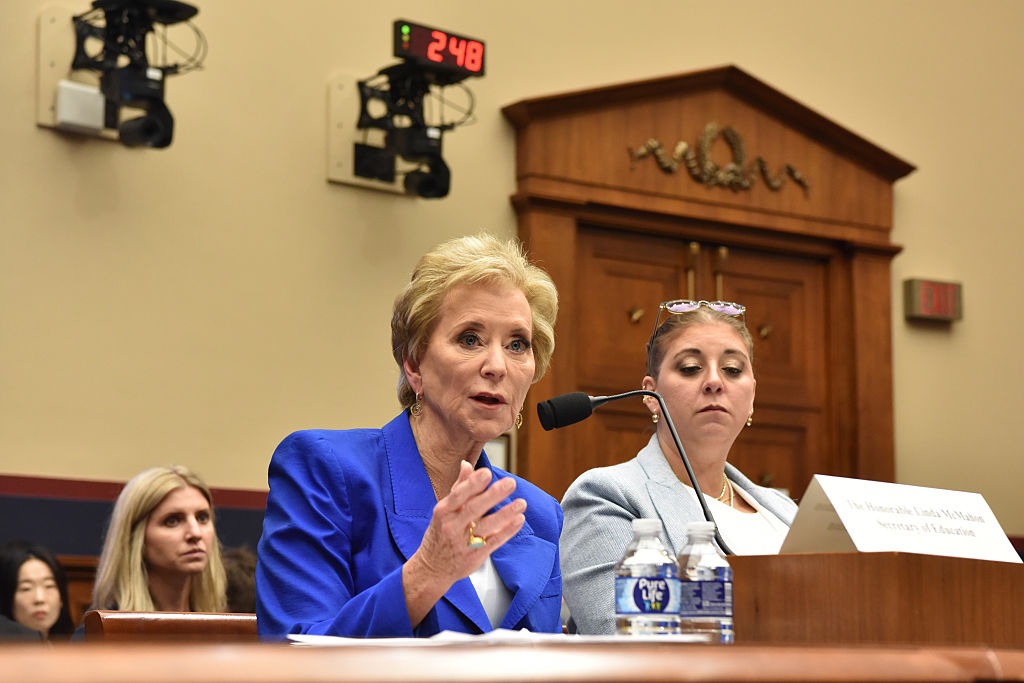
    Education Secretary Linda McMahon defended her cuts to programs and staff before a House education committee June 4. (Sha Hanting/China News Service/VCG via Getty Images)

    Even if the Supreme Court rules in McMahon’s favor, its opinion won’t affect previous rulings and other lawsuits in progress against the department.

    Here’s where some of those key legal battles stand:

    COVID relief funds

    McMahon stunned states in late March when she said they would no longer receive more than $2 billion in reimbursements for COVID-related expenses. States would have to make a fresh case for how their costs related to the pandemic, even though the department had already approved extensions for construction projects, summer learning and tutoring. 

    On June 3, a federal judge in Maryland blocked McMahon from pulling the funds.

    Despite the judicial order, not all states have been paid.

    The Maryland Department of Education still had more than $400 million to spend. Cherie Duvall-Jones, a spokeswoman, said the agency hasn’t received any reimbursements even though it provided the “necessary documentation and information” federal officials requested. 

    The cancellation forced Baltimore City schools to dip into a reserve account to avoid disrupting tutoring and summer school programs.

    Madison Biedermann, a spokeswoman for the department, declined to comment on why it had yet to pay Maryland or how much the department has distributed to other states since June.

    Mass firings

    In the administration’s push to wind down the department, McMahon admits she still needs staff to complete what she calls her “final mission.” On May 21, she told a House appropriations subcommittee that she had rehired 74 people. Biedermann wouldn’t say whether that figure has grown, and referred a reporter to the hearing video.

    “You hope that you’re just cutting fat,” McMahon testified. “Sometimes you cut a little in the muscle.” 

    The next day, a federal district court ordered her to also reinstate the more than 1,300 employees she fired in March, about half of the department’s workforce. Updating the court on progress, Chief of Staff Rachel Oglesby said in a July 8 filing that she’s still reviewing survey responses from laid off staffers and figuring out where they would work if they return.

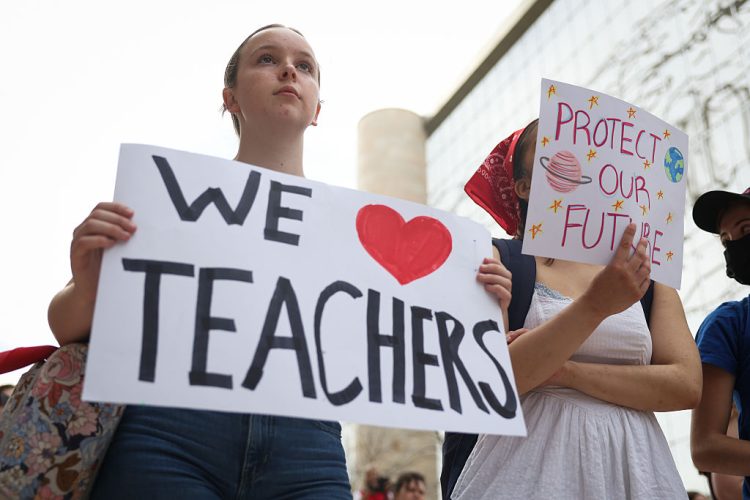
    Student protestors participate in the “Hands Off Our Schools” rally in front of the U.S. Department of Education on April 4 in Washington, D.C. (Getty Images)

    But some call the department’s efforts to bring back employees lackluster, perhaps because it’s pinning its hopes on a victory before the Supreme Court. 

    “This is a court that’s been fairly aggressive in overturning lower court decisions,” said Smith, with the National Center for Youth Law. 

    His group’s lawsuit is one of two challenging cuts to the Office for Civil Rights, which lost nearly 250 staffers and seven regional offices. They argue the cuts have left the department unable to thoroughly investigate complaints. Of the 5,164 civil rights complaints since March, OCR has dismissed 3,625, Oglesby reported.

    In a case brought by the Victim Rights Law Center, a Massachusetts-based advocacy organization, a federal district court judge ordered McMahon to reinstate OCR employees. 

    Even if the case is not reversed on appeal, there’s another potential problem: Not all former staffers are eager to return.

    “I have applied for other jobs, but I’d prefer to have certainty about my employment with OCR before making a transition,” said Andy Artz, who was a supervising attorney in OCR’s New York City office until the layoffs. “I feel committed to the mission of the agency and I’d like to be part of maintaining it if reinstated.”

    DEI

    An aspect of that mission, nurtured under the Biden administration, was to discourage discipline policies that result in higher suspension and expulsion rates for minority students. A 2023 memo warned that discrimination in discipline could have “devastating long-term consequences on students and their future opportunities.”

    But according to the department’s Feb. 14 guidance, efforts to reduce those gaps or raise achievement among Black and Hispanic students could fall under its definition of “impermissible” DEI practices. Officials demanded that states sign a form certifying compliance with their interpretation of the law. On April 24, three federal courts ruled that for now, the department can’t pull funding from states that didn’t sign. The department also had to temporarily shut down a website designed to gather public complaints about DEI practices. 

    The cases, which McMahon has asked the courts to dismiss, will continue through the summer. In court records, the administration’s lawyers say the groups’ arguments are weak and that districts like Decatur simply overreacted. In an example cited in a complaint brought by the NAACP, the Waterloo Community School District in Iowa responded to the federal guidance by pulling out of a statewide “read-In” for Black History Month. About 3,500 first graders were expected to participate in the virtual event featuring Black authors and illustrators. 

    The department said the move reflected a misunderstanding of the guidance. “Withdrawing all its students from the read-In event appears to have been a drastic overreaction by the school district and disconnected from a plain reading of the … documents,” the department said.

    Desegregation 

    The administration’s DEI crackdown has left many schools confused about how to teach seminal issues of American history such as the Civil Rights era.

    It was the Civil Rights Act of 1964 that established “desegregation centers” across the country to help districts implement court-ordered integration. 

    In 2022, the Biden administration awarded $33 million in grants to what are now called equity assistance centers. But Trump’s department views such work as inseparable from DEI. When it cancelled funding to the centers, it described them as “woke” and “divisive.”

    Judge Paul Friedman of the U.S. District Court for the District of Columbia, a Clinton appointee, disagreed. He blocked McMahon from pulling roughly $4 million from the Southern Education Foundation, which houses Equity Assistance Center-South and helped finance Brown v. Board of Education over 70 years ago. His order referenced President Dwight Eisenhower and southern judges who took the ruling seriously.

    “They could hardly have imagined that some future presidential administration would hinder efforts by organizations like SEF — based on some misguided understanding of ‘diversity, equity, and inclusion’ — to fulfill Brown’s constitutional promise to students across the country to eradicate the practice of racial segregation.”

    He said the center is likely to win its argument that canceling the grant was “arbitrary and capricious.”

    Raymond Pierce, Southern Education Foundation president and CEO, said when he applied for the grant to run one of the centers, he emphasized its historical significance.

    “My family is from Mississippi, so I remember seeing a ‘colored’ entrance sign on the back of the building as we pulled into my mother’s hometown for the holidays,” Pierce said. 

    Trump’s Justice Department aims to dismiss many of the remaining 130 desegregation orders across the South. Harmeet Dhillon, assistant attorney general for civil rights, has said the orders force districts to spend money on monitoring and data collection and that it’s time to “let people off the hook” for past discrimination.

    But Eshé Collins, director of Equity Assistance Center-South, said the centers are vital because their services are free to districts.

    “Some of these cases haven’t had any movement,” she said. “Districts are like ‘Well, we can’t afford to do this work.’ That’s why the equity assistance center is so key.”

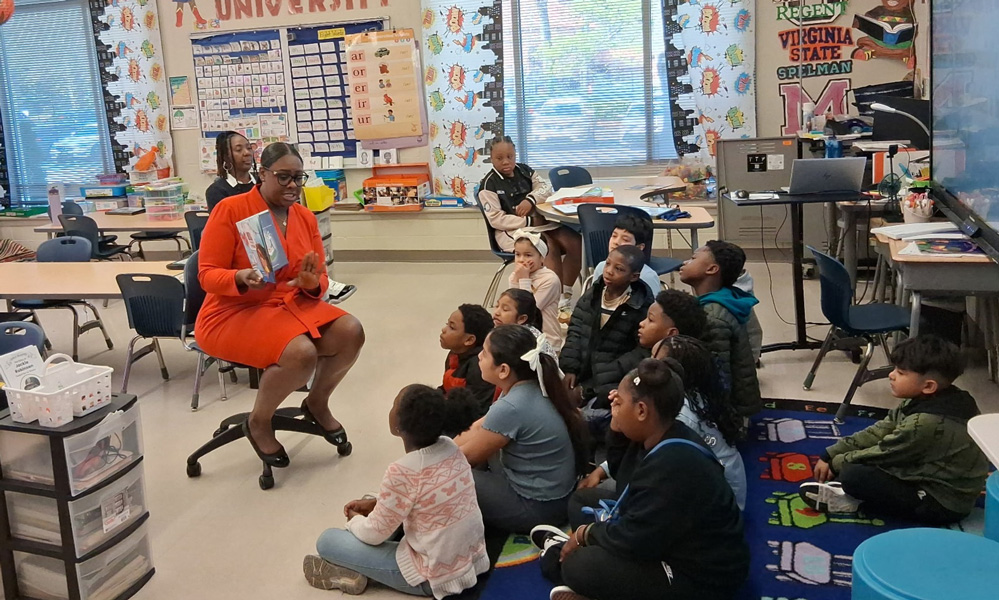
    Eshé Collins, director of Equity Assistance Center-South and a member of the Atlanta City Council, read to students during a visit to a local school. (Courtesy of Eshé Collins)

    Her center, for example, works with the Fayette County schools in Tennessee to recruit more Black teachers and ensure minority students get an equal chance to enroll in advanced classes. The system is still under a desegregation order from 1965, but is on track to meet the terms set by the court next year, Collins said. A week after Friedman issued the injunction in the foundation’s case, Ruth Ryder, the department’s deputy assistant secretary for policy and programs, told Collins she could once again access funds and her work resumed.

    Research

    As they entered the Department of Education in early February, one of the first moves made by staffers of the Department of Government Efficiency was to terminate nearly $900 million in research contracts awarded through the Institute for Education Sciences. Three lawsuits say the cuts seriously hinder efforts to conduct high-quality research on schools and students.

    Kevin Gee from the University of California, Davis, was among those hit. He was in the middle of producing a practice guide for the nation on chronic absenteeism, which continues to exceed pre-pandemic levels in all states. In a recent report, the American Enterprise Institute’s Nat Malkus said the pandemic “took this crisis to unprecedented levels” that “warrant urgent and sustained attention.” Last year’s rate stood at nearly 24% nationally — still well above the 15% before the pandemic.

    Gee was eager to fully grasp the impact of the pandemic on K-3 students. Even though young children didn’t experience school closures, many missed out on preschool and have shown delays in social and academic skills.

    Westat, the contractor for the project, employed 350 staffers to collect data from more than 860 schools and conduct interviews with children about their experiences. But DOGE halted the data collection midstream — after the department had already invested about $44 million of a $100 million contract.

    Kevin Gee, an education researcher at the University of California, Davis, had to stop his research work when the Trump administration cancelled grants. (Courtesy of Kevin Gee)

    “The data would’ve helped us understand, for the first time, the educational well-being of our nation’s earliest learners on a nationwide scale in the aftermath of the pandemic,” he said. 

    The department has no plans to resurrect the project, according to a June court filing. But there are other signs it is walking back some of DOGE’s original cuts. For example, it intends to reissue contracts for regional education labs, which work with districts and states on school improvement. 

    “It feels like the legal pressure has succeeded, in the sense that the Department of Education is starting up some of this stuff again,” said Cara Jackson, a past president of the Association for Education Finance and Policy, which filed one of the lawsuits. “I think … there’s somebody at the department who is going through the legislation and saying, ‘Oh, we actually do need to do this.’ ”

    Mental health grants 

    Amid the legal machinations, even some Republicans are losing patience with McMahon’s moves to freeze spending Congress already appropriated.  

    In April, she terminated $1 billion in mental health grants approved as part of a 2022 law that followed the mass school shooting in Uvalde, Texas. The department told grantees, without elaboration, that the funding no longer aligns with the administration’s policy of “prioritizing merit, fairness and excellence in education” and undermines “the students these programs are intended to help.”

    The secretary told Oregon Democratic Sen. Jeff Merkley in June that she would “rebid” the grants, but some schools don’t want to wait. Silver Consolidated Schools in New Mexico, which lost $6 million when the grant was discontinued, sued her on June 20th. Sixteen Democrat-led states filed a second suit later that month.

    The funds, according to Silver Consolidated’s complaint, allowed it to hire seven mental health professionals and contract with two outside counseling organizations. With the extra resources, the district saw bullying reports decline by 30% and suspensions drop by a third, according to the district’s complaint. Almost 500 students used a mental health app funded by the grant.

    A judge has yet to rule in either case, but Republican Rep. Brian Fitzpatrick of Pennsylvania and other members of a bipartisan task force are holding McMahon to her word that she’ll open a new competition for the funds. 

    “These funds were never intended to be a theoretical exercise — they were designed to confront an urgent crisis affecting millions of children,” Fitzpatrick said in a statement. “With youth mental health challenges at an all-time high, any disruption or diversion of resources threatens to reverse hard-won progress and leave communities without critical supports.”


    Get stories like these delivered straight to your inbox. Sign up for The 74 Newsletter

    Source link