Author: admin

  • An Oklahoma Teacher Took a Leap of Faith. She Ended Up Winning State Teacher of the Year – The 74

    An Oklahoma Teacher Took a Leap of Faith. She Ended Up Winning State Teacher of the Year – The 74


    Get stories like this delivered straight to your inbox. Sign up for The 74 Newsletter

    OKLAHOMA CITY — Those who knew Melissa Evon the best “laughed really hard” at the thought of her teaching family and consumer sciences, formerly known as home economics.

    By her own admission, the Elgin High School teacher is not the best cook. Her first attempt to sew ended with a broken sewing machine and her mother declaring, “You can buy your clothes from now on.”

    Still, Evon’s work in family and consumer sciences won her the 2025 Oklahoma Teacher of the Year award on Friday. Yes, her students practice cooking and sewing, but they also learn how to open a bank account, file taxes, apply for scholarships, register to vote and change a tire — lessons she said “get kids ready to be adults.”

    “Even though most of my career was (teaching) history, government and geography, the opportunity to teach those real life skills has just been a phenomenal experience,” Evon told Oklahoma Voice.

    After graduating from Mustang High School and Southwestern Oklahoma State University, Evon started her teaching career in 1992 at Elgin Public Schools just north of Lawton. She’s now entering her 27th year in education, a career that included stints in other states while her husband served in the Air Force and a break after her son was born.

    No matter the state, the grade level or the subject, “I’m convinced I teach the world’s greatest kids,” she said.

    Her family later returned to Oklahoma where Evon said she received a great education in public schools and was confident her son would, too.

    Over the course of her career, before and after leaving the state, she won Elgin Teacher of the Year three times, district Superintendent Nathaniel Meraz said.

    So, Meraz said he was “ecstatic” but not shocked that Evon won the award at the state level.

    “There would be nobody better than her,” Meraz said. “They may be as good as her. They may be up there with her. But she is in that company of the top teachers.”

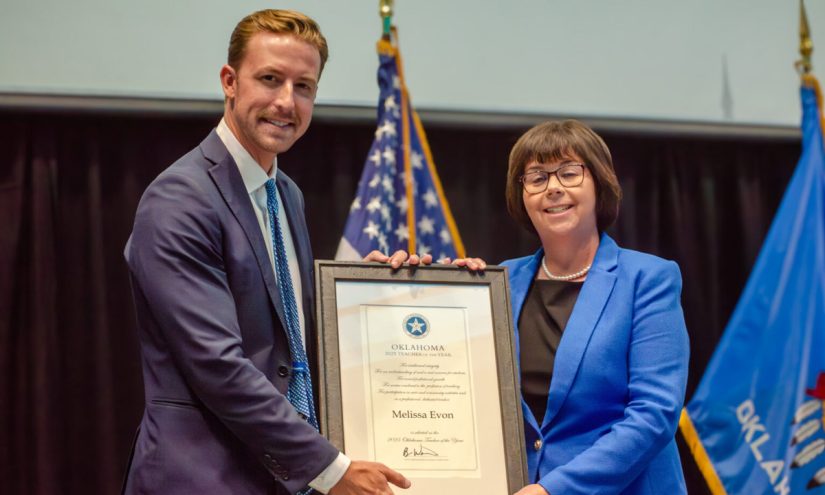
    Oklahoma Teacher of the Year Melissa Evon has won her district’s top teacher award three times. (Photo provided by the Oklahoma State Department of Education)

    Like all winners of Oklahoma Teacher of the Year, Evon will spend a year out of the classroom to travel the state as an ambassador of the teaching profession. She said her focus will be encouraging teachers to stay in education at a time when Oklahoma struggles to keep experienced educators in the classroom.

    Evon herself at times questioned whether to continue teaching, she said. In those moments, she drew upon mantras that are now the core of her Teacher of the Year platform: “See the light” by looking for the good in every day and “be the light for your kids.”

    She also told herself to “get out of the boat,” another way of saying “take a leap of faith.”

    Two years ago, she realized she needed a change if she were to stay in education. She wanted to return to the high-school level after years of teaching seventh-grade social studies.

    The only opening at the high school, though, was family and consumer sciences. Accepting the job was a “get out of the boat and take a leap of faith moment,” she said.

    “I think teachers have to be willing to do that when we get stuck,” Evon said. “Get out of the boat. Sometimes that’s changing your curriculum. Sometimes it might be more like what I did, changing what you teach. Maybe it’s changing grade levels, changing subjects, changing something you’ve always done, tweaking that idea.”

    Since then, she’s taught classes focused on interpersonal communication, parenting, financial literacy and career opportunities. She said her students are preparing to become adults, lead families and grow into productive citizens.

    And, sure, they learn cooking and sewing along the way.

    “I’m getting to teach those things, and I know that what I do matters,” Evon said. “They come back and tell me that.”

    Oklahoma Voice is part of States Newsroom, a nonprofit news network supported by grants and a coalition of donors as a 501c(3) public charity. Oklahoma Voice maintains editorial independence. Contact Editor Janelle Stecklein for questions: [email protected].


    Get stories like these delivered straight to your inbox. Sign up for The 74 Newsletter

    Source link

  • More Muckraking Ahead

    More Muckraking Ahead


    At the Higher Education Inquirer, we see through the spin. We’ll keep digging, exposing the absurdity, and telling the stories no one else will.  More muckraking ahead. Stay tuned.

    Source link

  • American Higher Education and the Debt Trap

    American Higher Education and the Debt Trap

    They call it a “path to opportunity,” but for millions of students and their families, American higher education is just Flirtin’ with Disaster—a gamble with long odds and staggering costs. Borrowers bet their future on a credential, universities gamble with public trust and private equity, and the system as a whole plays chicken with economic and social collapse. Cue the screeching guitar of Molly Hatchet’s 1979 Southern rock anthem, and you’ve got a fitting soundtrack to the dangerous dance between institutions of higher ed and the consumers they so aggressively court.

    The Student as Collateral

    For the last three decades, higher education in the United States has increasingly behaved like a high-stakes poker table, only it’s the students who are holding a weak hand. Underfunded public colleges, predatory for-profits, and tuition-hiking private universities all promise upward mobility but deliver it only selectively. The rest? They leave the table with debt, no degree, or both.

    Colleges market dreams, but they sell debt. Americans now owe more than $1.7 trillion in student loans. And while some elite schools can claim robust return-on-investment, most institutions below the top tiers produce increasingly shaky value propositions—especially for working-class, first-gen, and BIPOC students. For them, education is often less an elevator to the middle class than a trapdoor into a lifetime of wage garnishment and diminished credit.

    Institutional Recklessness

    Universities themselves are no saints in this drama. Fueled by financial aid dollars, college leaders have expanded campuses like land barons—building luxury dorms, bloated athletic programs, and administrative empires. Meanwhile, instruction is increasingly outsourced to underpaid adjuncts, and actual student support systems are skeletal at best.

    The recklessness isn’t limited to for-profits like Corinthian Colleges, ITT Tech, and the Art Institutes, all of which collapsed under federal scrutiny. Even brand-name nonprofits—think USC, NYU, Columbia—have been exposed for enrolling students into costly, often ineffective online master’s programs in partnership with edtech firms. The real product wasn’t the degree—it was the debt.

    A Nation at the Brink

    From community colleges to research universities, institutions are now being pushed to their financial and ethical limits. The number of colleges closing or merging has skyrocketed, especially among small private colleges and rural campuses. Layoffs, like those at Southern New Hampshire University and across public systems in Pennsylvania, Oregon, and West Virginia, show that austerity is the new norm.

    But the real disaster is systemic. The American college promise—that hard work and higher ed will lead to security—is unraveling in real time. With declining enrollments, aging infrastructure, and increasing political pressure to defund or control curriculum, many schools are shifting from public goods to privatized risk centers. Even state flagship universities now behave more like hedge funds than educational institutions.

    Consumers or Victims?

    One of the cruelest ironies is that students are still told they are “consumers” who should “shop wisely.” But education is not like buying a toaster. There’s no refund if your college closes. There’s no protection if your degree is devalued. And there’s no bankruptcy for most student loan debt. Even federal forgiveness efforts—like Borrower Defense or Public Service Loan Forgiveness—are riddled with bureaucratic landmines and political sabotage.

    In this asymmetric market, the house almost always wins. Institutions keep the revenue. Third-party contractors keep their profits. Politicians collect campaign checks. And the borrowers? They’re left flirtin’ with disaster, hoping the system doesn’t collapse before they’ve paid off the last dime.

    No Exit Without Accountability

    There’s still time to change course—but it will require radical rethinking. That means:

    • Holding institutions and executives accountable for false advertising and financial harm.

    • Reining in tuition hikes and decoupling higher ed from Wall Street’s expectations.

    • Fully funding community colleges and public universities to serve as real social infrastructure.

    • Expanding debt cancellation—not just piecemeal forgiveness—for those most harmed by a failed system.

    • Ending the exploitation of adjunct labor and restoring the academic mission.

    Otherwise, higher education in the U.S. will continue on its reckless path, a broken-down system blasting its anthem of denial as it speeds toward the edge.

    As the song goes:

    “I’m travelin’ down the road and I’m flirtin’ with disaster… I got the pedal to the floor, my life is runnin’ faster.”

    So is the American student debt machine—and we’re all strapped in for the ride.


    Sources:

    • U.S. Department of Education, Federal Student Aid Portfolio

    • “The Trillion Dollar Lie,” Student Borrower Protection Center

    • The Century Foundation, “The High Cost of For-Profit Colleges”

    • Inside Higher Ed, Chronicle of Higher Education, Higher Ed Dive

    • National Center for Education Statistics

    • Molly Hatchet, Flirtin’ with Disaster, Epic Records, 1979

    Source link

  • Despite Reservations, Florida BOG Approves New Accreditor

    Despite Reservations, Florida BOG Approves New Accreditor

    The Florida Board of Governors voted Friday afternoon to create a controversial new accrediting agency, in coordination with five other state university systems. The decision came after about an hour of heated discussion between board members and the State University System of Florida’s chancellor regarding details of the plan.

    Chancellor Raymond Rodriguez argued that the new accreditor, called the Commission for Public Higher Education, would eliminate the bureaucracy that comes with existing accrediting agencies and focus specifically on the needs of public universities.

    “The Commission for Public Higher Education will offer an accreditation model that prioritizes academic excellence and student success while removing ideological bias and unnecessary financial burdens,” he said. “Through the CPHE, public colleges and universities across the country will have access to an accreditation process that is focused on quality, rooted in accountability and committed to continuous improvement.”

    But before voting in favor of the motion, board members repeatedly pushed back, arguing that the plans for starting an accreditor from scratch were half-baked. They raised a litany of questions about how the CPHE would work in practice.

    Some wanted to hash out the details of the would-be accreditor’s governance structure before voting. According to the CPHE business plan, the Florida governing board would incorporate the accreditor as a nonprofit in Florida and serve as its initial sole member, using a $4 million appropriation from the Florida Legislature for start-up costs. (Other systems are expected to put in similar amounts.) A board of directors, appointed by all the university systems, would be responsible for accrediting decisions and policies.

    But multiple BOG members worried that the roles of the governing board and board of directors were not clearly delineated.

    “With us as the sole member, it appears, or could appear, to stakeholders that the accreditor lacks independence from the institution being accredited,” said board member Kimberly Dunn.

    Alan Levine, vice chair of the Board of Governors, called for a clear “proverbial corporate veil” between the two in corporate documents.

    “Our role is not to govern or direct the activities of this body,” Levine said of CPHE. “It has to be independent or it won’t even be approvable by the Department of Education.”

    Board member Ken Jones pressed for greater detail on the governing board’s “fiduciary or governance obligation to this new entity.”

    “I’m in support of this … I really believe this is the right path,” he said. “I just want to be sure that we all go in, eyes wide-open, understanding what is our responsibility as a BOG? … We’re breaking new ground here, and we’re doing it for the right reasons. But I want to be sure that when the questions come—and I’m sure they certainly will—that we’ve got the right answers.”

    Members asked questions about the accreditor’s future cybersecurity and IT infrastructure, as well as its associated costs. Some asked whether accreditors have direct access to universities’ data systems and raised concerns about potential hacking and the board’s liability; they were given reassurance that colleges themselves report their data. Some board members also asked for budget projections of what CPHE would cost.

    “I have an internal, unofficial estimation around the funds and revenues, but nothing I’d be prepared and comfortable to put forward publicly,” said Rachel Kamoutsas, the system’s chief of staff and corporate secretary, who fielded questions about the initiative.

    The answers didn’t seem to fully satisfy the governing board.

    “I do think the chancellor and team have a lot of work to do to continue to educate this board, to be blunt,” said BOG chair Brian Lamb, “because a lot of the questions that we’re asking—forecast, IT, infrastructure, staffing—every last one of those are appropriate.”

    He emphasized to other board members, however, that voting in favor of the motion would jump-start the process of incorporating the new accreditor and provide seed money for it. But, he added, “not a penny is going anywhere until we have an agreed-upon document on how this money will be spent.”

    Accreditation expert Paul Gaston III, an emeritus trustees professor at Kent State University, raised similar questions in an interview with Inside Higher Ed.

    “The credibility of accreditation really is directly related to whether the public can accept it is an authoritative source of objective evaluation that is in the public interest,” he said. “And the question that I would ask as a member of the public is, how will an accreditor that is created by and that is answerable to the institutions being evaluated achieve that credibility?”

    Despite all the pushback, the BOG ultimately voted unanimously to approve the measure. Now CPHE can file for incorporation, establish its Board of Directors and set out on the multiyear process of securing recognition from the Department of Education.

    Source link

  • A 20-Year Reflection on Transparency and the Illusion of Access (Glen McGhee)

    A 20-Year Reflection on Transparency and the Illusion of Access (Glen McGhee)

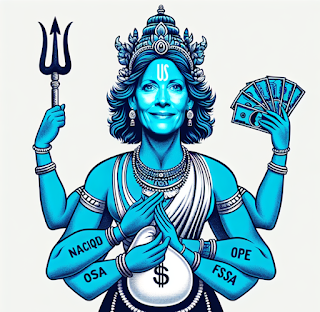
    The cancellation of the latest NACIQI (National Advisory Committee on Institutional Quality and Integrity) meeting brought back bitter memories that refuse to fade. 

    It’s been twenty years since I traveled to Washington, DC—dressed in my best lobbying attire and carrying a meticulous roster of Department of Education staff—to visit the Office of Postsecondary Education (OPE) on K Street. My goal was simple, even noble: to seek answers about the opaque workings of accreditation in American higher education. What I encountered instead was a wall of silence, surveillance, and authoritarianism.

    I stepped off the elevator on the seventh floor of the Department building and signed in. Under “Purpose of Visit,” I wrote: Reform. I was calm, professional, and respectful. I asked to see the NACIQI Chair, Bonnie, hoping that she would be willing to speak with me about a system that, even then, was falling into disrepair. But what happened next still infuriates me.

    Within seconds, two armed, uniformed guards approached me. They didn’t ask questions. They gave an ultimatum: leave or be arrested.

    I eventually complied, descending into the lobby, still stunned. From there I began dialing—one by one—through the directory of names I had so carefully assembled. I called staffers, analysts, assistants, anyone who might answer. Not a single person picked up. I could feel the eyes of the guards watching me, one of them posted on the mezzanine like a sniper keeping watch over a public enemy. I was not dangerous. I was not disruptive. I was, however, unwanted.

    The next day, I turned to my Congressman, Allen Boyd, whose LA generously tried to intervene. His office contacted OPE, attempting to broker a meeting on my behalf. The Department didn’t even return his call. Apparently, a sitting member of Congress—who didn’t sit on a high-ranking committee—carried no weight at the fortress of federal education oversight.

    This most recent overstepping by US ED—unilaterally postponing NACIQI’s Summer 2025 meeting—reminds observers of how limited the oversight provided by NACIQI really is. It is, apparently, nothing more than a performative shell that fulfills ceremonial functions, and not much more.

    I would argue that this latest episode reveals that NACIQI is less an independent watchdog and more a ceremonial body with limited real power, and so my view differs somewhat from David Halperin, because he sees more substantive activity than I do.

    The history of ACICS (Accrediting Council for Independent Colleges and Schools) and SACS (Southern Association of Colleges) appearing before NACIQI illustrates how regulatory capture can manifest not only through industry influence, but also through bureaucratic design and process control. The OPE’s central role, combined with NACIQI’s limited enforcement power, has allowed failing accreditors to retain recognition for years, even in the face of overwhelming evidence of noncompliance and harm to students.

    The illusion of accountability has long been a feature of the accreditation system, not a flaw. NACIQI meetings, when they occur, are tightly scripted, with carefully managed testimony and limited public engagement. The real decisions are made elsewhere, behind closed doors, often under the influence of powerful lobbying groups and entrenched bureaucracies that resist transparency and reform at every turn.

    Despite the increasing scrutiny on higher education and growing public awareness of student debt, poor educational outcomes, and sham institutions, the federal recognition of accreditors remains an elite-controlled process. It is a closed loop. Institutions, accreditors, and government officials all play their roles in a carefully choreographed performance that rarely leads to systemic change. The result is a system that protects institutions at the expense of students, particularly the most vulnerable—low-income, first-generation, and minority students who are often targeted by predatory schools hiding behind federal accreditation.

    This is the reality of the U.S. Department of Education’s accreditation apparatus: inaccessible, unaccountable, and increasingly symbolic. NACIQI, far from being an independent advisory body, has always functioned as a ceremonial front for political appointees and entrenched interests. It is, as I see it, just another arm of Vishnu—multiplicitous, all-seeing, but ultimately indifferent to critique or reform. Whether it’s chaired by a bureaucrat or a former wrestling executive like Linda McMahon, the outcome is the same: the process is rigged to exclude dissent and suppress scrutiny.

    And yet, pundits today still fail to grasp the implications. They speak of accreditation as if it were a technocratic process guided by evidence and integrity. They act as if NACIQI were a neutral arbiter. But I know otherwise, because I was there—thrown out, silenced, and treated like a trespasser in the very institution that claims to protect educational quality and student interest.

    This is more than personal bitterness. It’s about structural rot. When critics are expelled, when staff are muzzled, and when public servants ignore elected representatives, we are not dealing with oversight—we are witnessing capture. Accreditation in this country serves the accreditors and the institutions, not students, not taxpayers, and certainly not reformers.

    Two decades later, the anger remains. So does the silence.


    Sources:
    Department of Education building directory and procedures (2005)
    Congressional Office of Rep. Allen Boyd (archival record, 2005)
    Public notices regarding NACIQI meeting cancellations (2024–2025)
    David Halperin, Republic Report

    Source link

  • School districts grapple with ‘budgetary chaos’ in wake of federal funding freeze

    School districts grapple with ‘budgetary chaos’ in wake of federal funding freeze

    This audio is auto-generated. Please let us know if you have feedback.

    The U.S. Department of Education’s withholding of $6.2 billion in federal K-12 grants has local and state school systems scrambling to figure out how to make up for the budget shortages. It has also caused a swell of advocacy from families, lawmakers, educators and others across the nation.

    The withheld funds for fiscal year 2025 were expected to be released by the Education Department July 1. Programs at risk due to the funding hold include English learner services, academic supports, after-school programming and professional development. 

    The frozen funds represent at least 10% or more of states’ overall K-12 federal revenues if the money is not distributed, according to the nonpartisan Learning Policy Institute.

    At the local level, superintendents and principals are voicing concern about how the funding freeze will impact their school services, particularly those that serve English learners, homeless students and students from low-income families. 

    Chase Christensen, principal and superintendent of the 80-student Sheridan County School District #3 in rural Clearmont, Wyoming, said his district was expecting $30,000 in Title II and IV funding that is being withheld. 

    The district had nearly finalized its roughly $4 million budget for the upcoming school year when it learned of the federal funding freeze. It then adjusted the budget to remove those federal funds and is making up the difference by leaving a staffing position vacant.

    Although the budget adjustment means student services under those title programs can continue, Christensen said “every dollar of federal funding for education is impactful” at the individual student level.

    “When these funds are pulled, especially this late in the game for budget planning and everything else, students are going to be the ones that lose out,” Christensen said.

    Nationally, bigger districts have the largest funding gaps, according to a New America analysis of data from 46 states that had available funding figures. Those districts include Los Angeles Unified School District ($82 million), Florida’s Dade County School District ($38 million), and Nevada’s Clark County School District ($22 million).

    Advocacy groups and policymakers are calling on the Trump administration to restore the funds. The Boys and Girls Clubs of America, a nonprofit that supports afterschool programs, said the impact of the blocked funds will be “swift and devastating,” in a statement from President and CEO Jim Clark. 

    Clark said 926 Boys and Girls Clubs across the country could close, and 5,900 jobs would be lost if the funding is not released. “Afterschool and summer learning programs are cornerstones of academic success, public safety, and family stability for millions of young people — but right now, we stand at a dangerous tipping point,” Clark said. 

    The National English Learner Roundtable, a coalition of more than a dozen national and state-based organizations supportive of English learner services, said in a Thursday statement, “This unprecedented move by the Department has blindsided schools that have always been able to rely on these funds to support the start of the school year, and has created budgetary chaos for nearly every K-12 school district.” 

    On Thursday, 150 Democratic House lawmakers sent a letter to U.S. Education Secretary Linda McMahon and White House Office of Management and Budget Director Russell Vought demanding the title funds be released.

    This late-breaking decision, which provided no timeline for which states can expect a final decision, is leaving states financially vulnerable and forcing many to make last minute decisions about how to proceed with K12 education in this upcoming school year,” the letter said.

    The funding hold has already led to staff layoffs, program delays and cancellations of services, the House members said.

    Spending under review

    The withheld funds were appropriated by Congress and approved by President Donald Trump earlier this year. States expected to gain access to the monies starting July 1, as routine. But the day before, on June 30, the Education Department told grantees not to expect the funds while it conducts a review and referred questions to OMB.

    The specific grant funding being withheld includes:

    • Title II-A for professional development: $2.2 billion.
    • Title IV-A for student support and academic enrichment: $1.4 billion.
    • Title IV-B for 21st Century Community Learning Centers: $1.3 billion.
    • Title III-A for English-learner services: $890 million.
    • Title I-C for migrant education: $375 million.

    On Thursday, in a statement to K-12 Dive, OMB said no funding decisions have been made and that it is conducting a “programmatic review of education funding.”

    The office also said, “initial findings show that many of these grant programs have been grossly misused to subsidize a radical leftwing agenda.”

    OMB and the Education Department have not indicated a timeframe for the review of the frozen federal funds.

    Source link

  • The Platform Monopoly on Jobs and Careers

    The Platform Monopoly on Jobs and Careers

    In the platform-dominated economy, Indeed.com has established itself as the central marketplace for jobseekers and employers alike, boasting tens of millions of listings across industries and geographies. But behind its user-friendly design lies a powerful, opaque system that reinforces labor precarity, exploits the desperation of the underemployed, and facilitates fraud and exploitation—including through job scams designed to funnel people into for-profit colleges and dubious training schemes.

    Indeed’s rise is emblematic of a larger pattern in the U.S. political economy, where platforms extract profit from human need—especially from the millions of Americans struggling to find secure employment in a shrinking labor market. While claiming to connect jobseekers with opportunity, Indeed increasingly operates as a gatekeeper and a filter, favoring employers with the ability to pay for prominence, and quietly profiting from a user base navigating worsening inequality.

    From Opportunity to Exploitation: The Platform Economy

    Indeed’s near-monopoly over online job listings positions it as the Amazon of employment—a central aggregator of job ads, resume submissions, employer reviews, and workforce data. Its business model is rooted in ad-based revenue: companies pay to boost job visibility, while jobseekers receive a flood of suggested listings—many of which are irrelevant, low-quality, or outright deceptive.

    One particularly disturbing trend: a growing number of “job postings” on Indeed are not job offers at all, but veiled advertisements for for-profit colleges and unaccredited training programs. These listings typically appear legitimate, bearing the titles of medical assistant, phlebotomist, cybersecurity technician, or paralegal. But once an applicant shows interest, they are quickly routed to admissions representatives, not employers. In short, they’ve fallen for a bait-and-switch scheme.

    Indeed does little to prevent these tactics. Despite flagging mechanisms and user complaints, scammers and aggressive recruiters return repeatedly under new listings or shell company names. And because these advertisers pay to promote their listings, there is a built-in conflict of interest: Indeed profits from ads designed to exploit vulnerable jobseekers, many of whom are already burdened by unemployment, underemployment, or student debt.

    The Job Training Charade: A National Problem

    As labor economist Gordon Lafer argues in The Job Training Charade, job training programs have long functioned as a public relations tool for elected officials, who promise “skills-based solutions” rather than structural labor reform. Publicly funded retraining programs and for-profit career schools capitalize on this narrative, convincing jobseekers that their struggles stem from a personal “skills gap” rather than systemic inequality.

    Indeed’s platform reinforces this logic by flooding users with listings that promote training and certification programs as prerequisites for jobs that often don’t exist or pay poorly. Even in legitimate industries—like healthcare and IT—the overabundance of credential inflation and unnecessary gatekeeping leads to further debt accumulation without guaranteeing meaningful work.

    As Lafer writes, “Training has become a substitute for economic policy—a way of appearing to do something without actually improving people’s lives.” And Indeed is a willing partner in this substitution, profiting from a constant churn of dislocated workers trying to retool their résumés and lives to meet an ever-shifting set of employer demands.

    The Educated Underclass and Platform Paternalism

    Gary Roth, in The Educated Underclass, identifies another critical aspect of this ecosystem: the overproduction of college graduates relative to the needs of the labor market. As more people earn degrees, the wage premium diminishes, and once-secure professions become crowded with overqualified applicants chasing scarce opportunities.

    Indeed’s platform becomes the proving ground for this underclass: college-educated workers competing for service jobs, temp contracts, or entry-level roles barely above minimum wage. Meanwhile, the site’s tools—resume scores, AI-based job match algorithms, and automated rejection letters—reinforce the idea that unemployment is a personal failure rather than a structural outcome.

    This is platform paternalism at its worst. Jobseekers are “nudged” into applying for low-quality work, “encouraged” to pursue unnecessary training, and surveilled through behavioral data that is packaged and sold to employers and third-party marketers. Career development becomes not a public good but a private product—sold back to workers in pieces, with no guarantee of outcome.

    Job Scams and Regulatory Blind Spots

    The Federal Trade Commission (FTC) and state attorneys general have received thousands of complaints about online job scams—including fake recruiters, phony employers, and misleading school advertisements. Yet enforcement remains weak, and platforms like Indeed enjoy limited legal liability, protected by Section 230 of the Communications Decency Act, which shields them from responsibility for user-generated content.

    Even when caught, fraudulent advertisers often reappear. As one whistleblower told The Higher Education Inquirer, “We’d flag scam listings, and two days later they’d pop back up under a new name. It was like a game of whack-a-mole—and no one at the top cared.”

    Indeed’s user agreement explicitly disclaims responsibility for the authenticity of job listings. And although the company has instituted basic verification and reporting tools, they are inadequate to stem the tide of predatory postings, especially those tied to the multibillion-dollar for-profit education industry.

    A Broken System Masquerading as Innovation

    The consolidation of online job markets under platforms like Indeed represents a profound shift in the political economy of labor. No longer mediated by public institutions or strong unions, the search for work is now a privatized experience, managed by algorithms, monetized through ads, and vulnerable to deception.

    To be clear: Indeed does not create jobs. It creates the illusion of access. It obscures labor precarity behind UX design and paid listings. It enables fraudulent training pipelines while pushing the burden of risk and cost onto workers. And it profits from the widening chasm between what higher education promises and what the economy delivers.

    At The Higher Education Inquirer, we demand accountability—not just from institutions of higher learning but from the platforms that now mediate our futures. The illusion must be pierced, and jobseeking must be reclaimed as a public function, free from predation, profiteering, and platform capture.


    Sources:

    • Lafer, Gordon. The Job Training Charade. Cornell University Press, 2002.

    • Roth, Gary. The Educated Underclass: Students and the Promise of Social Mobility. Pluto Press, 2019.

    • U.S. Federal Trade Commission (FTC). “Job Scams: What You Need to Know.” 2024.

    • Recruit Holdings. Annual Reports and Investor Presentations, 2020–2024.

    • U.S. Department of Labor. “Contingent and Alternative Employment Arrangements.” 2023.

    • Brody, Leslie. “Students Lured Into For-Profit Colleges Through Fake Job Ads.” Wall Street Journal, 2022.

    • Zuboff, Shoshana. The Age of Surveillance Capitalism. PublicAffairs, 2019.

    • Glassdoor, Indeed, and CareerBuilder community complaint forums (2021–2025).

    Source link

  • All that glitters is not gold: A brief history of efforts to rebrand social media censorship

    All that glitters is not gold: A brief history of efforts to rebrand social media censorship

    Whenever a bill aimed at policing online speech is accused of censorship, its supporters often reframe the conversation around subjects like child safety or consumer protection. Such framing helps obscure government attempts to shape or limit lawful speech, yet no matter how artfully labeled such measures happen to be, they inevitably run headlong into the First Amendment.

    Consider the headline-grabbing Kids Online Safety Act (KOSA). Re-introduced this year by Sens. Marsha Blackburn (R-Tennessee) and Richard Blumenthal (D-Connecticut) as a measure to protect minors, KOSA’s sponsors have repeatedly characterized its regulations as merely providing tools, safeguards, and transparency. But in practice, it would empower the federal government to put enormous pressure on platforms to censor constitutionally protected content. This risk of government censorship led KOSA to stall in the House last year after passing the Senate. 

    Child safety arguments have increasingly surfaced in states pursuing platform regulation, but closer inspection reveals that many such laws control how speech flows online, including for adults. Take Mississippi’s 2024 social media law (HB 1126), which was described as a child safety measure, that compelled platforms to verify every user’s age. Beneath that rhetoric, however, is the fact that age verification affects everyone, not just children. By forcing every user — adult or minor alike — to show personal identification or risk losing access, this law turned a child-safety gate into a universal speech checkpoint. That’s because identity checks function like a license: if you don’t clear the government’s screening, you can’t speak or listen. 

    A judge blocked HB 1126 last month, rejecting the attorney general’s argument that it only regulated actions, not speech, and finding that age verification gravely burdens how people communicate online. In other words, despite the bill’s intentions or rationales, the First Amendment was very much at stake.

    Utah’s 2023 Social Media Regulation Act demanded similar age checks that acted as a broad  mandate that chilled lawful speech. FIRE sued, the legislature repealed the statute, and its 2024 replacement — the Minor Protection in Social Media Act — met the same fate when a federal judge blocked it. Finding there was likely “no constitutionally permissible application,” the judge underscored the clear conflict between such regulations and the First Amendment. 

    Speech regulations often show up with different rationales, not just child safety. In Texas, HB 20 was marketed in 2021 as a way to stop “censorship” by large social media companies. By trying to paint the largest platforms as public utilities and treating content moderation decisions as “service features,” the legislature flipped the script on free expression by recasting a private actor’s editorial judgment as “conduct” the state could police. When the U.S. Court of Appeals for the Fifth Circuit upheld the law, in a decision that was later excoriated by the Supreme Court, the court repeated this inversion of the First Amendment: “The Platforms are not newspapers. Their censorship is not speech.” 

    Florida tried a similar strategy with a consumer-protection gloss. SB 7072 amended the state’s Deceptive and Unfair Trade Practices Act to include certain content moderation decisions, such as political de-platforming or shadow banning, exposing platforms to enforcement and penalties for their speech. Unlike the Fifth Circuit, the Eleventh Circuit blocked this law, calling platform curation “unquestionably” expressive and, therefore, protected by the First Amendment. 

    In July 2024, the Supreme Court took up the question when considering challenges to these two state laws in Moody v. NetChoice. Cutting through the branding, the Court rejected the idea that these laws merely regulated conduct or trade practices. Instead, it said content moderation decisions do have First Amendment protection and that the laws in Texas and Florida did, in fact, regulate speech. 

    The Court clarified in no uncertain terms that “a State may not interfere with private actors’ speech to advance its own vision of ideological balance.” And it added that “[o]n the spectrum of dangers to free expression, there are few greater than allowing the government to change the speech of private actors in order to achieve its own conception of speech nirvana.”

    California tried the dual framing of both child safety and consumer protection. AB 2273, the California Age Appropriate Design Code Act, was described as a child-safety bill that just regulated how apps and websites are built and structured, not their content. The bill classified digital product design features, such as autoplaying videos or default public settings, as a “material detriment” to minors as well as an unfair or deceptive act under state consumer-protection statutes. But this too failed and is now blocked because, the court noted, “the State’s intentions in enacting the CAADCA cannot insulate the Act from the requirements of the First Amendment.”

    Multiple nationwide lawsuits now claim social media feeds are defective products, using product-liability law to attack the design of platforms themselves. But by calling speech a “product” or forcing it into a product liability claim, it recharacterizes the editorial decisions of lawful content as a product flaw, which attempts to shift the legal analysis from speech protections to consumer protection. State attorneys general, however, cannot erase the First Amendment protections that still apply.

    A sound policy approach to online speech looks not at branding, but impact. Even when packaged in terms of child safety, consumer protection, or platform accountability, it is essential to ask whether the rule forces platforms to host, suppress, or reshape lawful content. Regardless of the policy goal or rhetorical framing, if a requirement ultimately pressures platforms to host or suppress lawful speech, expect judges to treat it as a speech regulation. 

    Unfortunately, re-branding speech regulations can obfuscate their censorial ends and make them politically attractive. That’s what’s happening with KOSA’s obvious appeal of protecting children, combined with the less obvious censorship threat from targeting “design features,” has made it popular in the Senate.

    Giving the government power to censor online speech puts everyone’s liberty at risk. Just as Americans enjoy the right to read, watch, and talk about whatever we want offline, those protections extend to our speech online as well. Protecting free expression now keeps the marketplace of ideas open and guards us from sacrificing everyone’s right to free expression.

    Source link

  • Department of Education Blocks Undocumented Students from Career and Technical Programs

    Department of Education Blocks Undocumented Students from Career and Technical Programs

    The U.S. Department of Education announced it will no longer allow federal funds to support career, technical, and adult education programs for undocumented students, rescinding a nearly three-decade-old policy that permitted such access.

    The department said it is rescinding a 1997 “Dear Colleague Letter” from the Clinton administration that allowed undocumented immigrants to receive federal aid for career, technical, and adult education programs. The interpretive rule, published in the Federal Register, clarifies that federal programs under the Carl D. Perkins Career and Technical Education Act and the Adult Education and Family Literacy Act are “federal public benefits” subject to the Personal Responsibility and Work Opportunity Reconciliation Act of 1996.

    Education Secretary Linda McMahon stated that “under President Trump’s leadership, hardworking American taxpayers will no longer foot the bill for illegal aliens to participate in our career, technical, or adult education programs or activities”.

    The policy change affects access to dual enrollment programs, postsecondary career and technical education, and adult education programs. The department said it will send letters to postsecondary schools and adult education programs clarifying that undocumented immigrants cannot receive federal aid and may take enforcement actions against schools that do not comply by August 9.

    Augustus Mays, vice president of partnerships and engagement at EdTrust, a Washington-based education equity advocacy organization, condemned the decision.

    “This move is part of a broader, deeply disturbing trend,” Mays said. “Across the country, we’re seeing migrant communities targeted with sweeping raids, amplified surveillance, and fear-based rhetoric designed to divide and dehumanize.”

    Mays argued the change “derails individual aspirations and undercuts workforce development at a time when our nation is facing labor shortages in critical fields like healthcare, education, and skilled trades”. He noted the decision compounds existing barriers, as undocumented students are already prohibited from accessing federal financial aid including Pell Grants and student loans.

    The department maintains that the Clinton-era interpretation “mischaracterized the law by creating artificial distinctions between federal benefit programs based upon the method of assistance,” a distinction the department says Congress did not make in the 1996 welfare reform law.

    The change comes as President Trump proclaimed February 2025 as Career and Technical Education Month, stating his administration will “invest in the next generation and expand access to high-quality career and technical education for all Americans”.

    Career and technical education programs served approximately 11 million students in 2019-20, with about $1.3 billion in federal funds supporting such programs through the Department of Education in fiscal year 2021.

    The interpretive rule represents the department’s current enforcement position, though officials indicated they do not currently plan enforcement actions against programs serving undocumented students before August 9.

    EdTrust called on policymakers, education leaders, and community advocates to oppose the change. 

    “We must fight for a country where every student, regardless of where they were born, has access to the promise of education and the dignity of opportunity,” Mays said.

    Source link