Author: admin

  • Defining the value of the UK’s international research partnerships

    Defining the value of the UK’s international research partnerships

    It might not be news that the UK research sector is strikingly international, but the scale of our global collaboration is striking – and it’s growing.

    Over 60 per cent of Russell Group academics’ publications involved an international co-author in 2023, 16 per cent higher than in 2019, and in 2022 this proportion was higher for UK academics than any of our global competitors. Pooling ideas and talent makes for better research and more innovation, so supporting them to do more matters deeply to researchers – as our universities are well aware, given their own longstanding global connections.

    International collaboration matters for the UK at large too, helping us tackle shared challenges and forming a large part of our global contribution. In a more uncertain world, protecting and growing research collaborations is becoming more important – complementing the government’s efforts to deepen links with the EU, protect ties with the US, and build relationships in India.

    These initiatives are bound up with both security and growth. This is no accident: a strong economy is the route to creating jobs and supporting public services. We have always argued that international university partnerships should be part of the wider offer to global investors and trade partners, but we need to find new ways to demonstrate their value.

    To that end, Jisc has done new analysis for the Russell Group looking at the scale and value of international research partnerships. Jisc’s unique data-matching analysis of UK, US and EU patent data held by the European Patents Office covers over 30 years of international collaboration in patent applications. The data identifies partnerships that UK institutions hold with both international companies and universities.

    It’s booming

    So what did we learn? Jisc’s analysis shows the proportion of patents co-filed by UK universities and an international partner grew from 12 per cent in 2000 to 22 per cent in 2022. It also found a remarkably high share of collaborations with international businesses, not just fellow academics: 43 per cent of co-filings since 2018 were with an overseas company and 36 per cent with a university abroad.

    Since 2018, the data shows UK universities filed over 100 EU, US and UK patents with international partners every year. The analysis also allows us to see individual patents, not just numbers, so we can understand how impactful this work is not just to academic excellence, but to society. For example:

    • the world’s first gene therapy for adults with severe haemophilia A, from pioneering research between University College London and St. Jude Children’s Research Hospital in the US
    • a new type of gene therapy from Newcastle University and the University of Heidelberg in Germany, which can help to protect and strengthen muscles in people with muscular dystrophy
    • improvements to machine-learning models by the University of Edinburgh and University of Manchester with Toyota in Japan – refining the ability to interpret images, a step on the way to driverless cars.

    These projects, and many more of their kind, demonstrate the cutting-edge R&D that can underpin the government’s growth mission, industrial strategy and NHS ambitions. Jisc’s analysis therefore suggests that to make the most of universities’ strengths, and secure a global advantage for the UK, support for both home-grown innovation and high-value overseas collaborations will be crucial.

    Potential for even more

    This includes additional support for the work universities do with and for businesses, in sectors like clean energy and advanced manufacturing. Academics and innovators can do much of this themselves, but government can help by working with us to deliver a stable platform to build on including reliable funding streams, improved incentives for SME-university collaboration and a long-term strategy for industrial renewal.

    We also need a strategic focus on higher education’s financial sustainability, so universities can maximise the impact of the £86bn government is committing to R&D over the next few years and support plans for economic growth and public service improvement.

    It also means maintaining a supportive, stable and cost-effective visa system for staff and students – further expanding the commitments already made on building global talent pathways – so UK universities can attract and educate our future academics, innovators and collaborators, as well as securing important cross-subsidies for research and teaching. A strategic approach to skills and infrastructure across the UK would complement this, ensuring all nations and regions can benefit.

    Finally, building the right platform for international collaboration means backing stable, flexible routes for academics and innovators to work together. UKRI’s work to develop lead agency agreements with counterparts in other countries has been a positive and warmly-welcomed example. Above all, however, our relationship with the world’s largest international collaborative programme for R&D – Horizon Europe, and its successor Framework Programme 10 – will be vital.

    We’re currently awaiting the European Commission’s official “first draft” for FP10. We know it will be a standalone programme with a research and innovation focus, which is very reassuring. At the moment, Horizon Europe is providing more collaborative research opportunities than any one country can alone, as well as helping UK universities attract top researchers. Universities are working hard to boost Horizon participation, taking the lead in European Research Council Advanced Grant wins in 2024, and nurturing the encouraging green shoots in the collaborative Pillar II. Keeping this going is vital for global collaborations which contribute so much to our, and our partners’, economic and societal progress.

    Researchers need certainty so they can rely on a shared long-term framework when building collaborations. The more open FP10 is to like-minded countries, and the more positive the UK is about association early on, the more confidence academics can be in continuing – and indeed expanding – invaluable international partnerships.

    Source link

  • ‘One big mistake’: Higher ed sounds warning over GOP budget law

    ‘One big mistake’: Higher ed sounds warning over GOP budget law

    This audio is auto-generated. Please let us know if you have feedback.

    The American higher education system is in for a big shake-up with the enactment of Republicans’ massive bill full of tax and spending cuts 

    The Senate voted 51-50 on the package, with Vice President JD Vance casting the deciding ballot, after which the bill passed the House by a four-vote margin. President Donald Trump signed it into law on Friday, the deadline he had set for lawmakers

    One of the architects of the bill’s higher ed provisions, Sen. Tim Walberg, a Michigan Republican who chairs his chamber’s education committee, called it “the first set of significant conservative reforms to the higher education landscape in two decades,” adding that it would “maintain America’s world-class higher education system.”

    The new law means higher taxes for some university endowments and a new college accountability system tied to financial aid, as well as several changes to the federal student aid program — including ending the GRAD Plus loan program and capping student borrowing overall — that advocates say will limit college access. 

    The American Council on Education on Thursday described the bill as “a significant improvement” over an earlier House version, but added that it “combines major tax changes with deep spending cuts that will carry significant negative consequences for campuses and students.” 

    Sameer Gadkaree, president and CEO of The Institute for College Access & Success, said in a July 3 statement, “This bill can only be described as one big mistakethe consequences of which will negatively affect college students, borrowers, and their families for years to come.”

    The law cuts $300 billion in federal support to students over 10 years, including by limiting borrowing to graduate students — to $100,000 per borrower, or $200,000 for those in professional programs such as law or medicine. It would also cap Parent PLUS loans to $65,000 per student. 

    The caps on federal student lending will likely lead more borrowers “to pursue riskier private loans or forego further education,” Gadkaree said.

    At the same time, the law culls a handful of federal student loan repayment programs down to just two choices. That reduction — billed as a simplification by supporters — which will leave many borrowers on the hook for larger monthly payments, according to TICAS. 

    By increasing the amount, riskiness, and duration of student loan debt, the law directly reduces the likelihood that current borrowers and future students can do better financially than their parents,” Gadkaree said. 

    He also noted that the law’s funding cuts to Medicaid — the largest in the program’s history — and food assistance could add to the financial difficulties of attending college for many. 

    Aissa Canchola Bañez, policy director of the Student Borrower Protection Center, decried the law as one that will “push millions off their healthcare, leave children to go hungry, and push dreams of a college education even further out of reach for working people across this country.” 

    Walberg, meanwhile, said the loan system changes “increase simplicity and affordability so students don’t borrow excessive debt they can never repay.”

    Changes to the federal student aid program will also bring financial impact to colleges. 

    Combined with higher tax rates on the wealthiest private college endowments, the bill’s aid cuts “will force even more difficult decisions on chief business officers and further strain revenue that helps make college affordable for students and families,” Kara Freeman, CEO and president of the National Association of College and University Business Officers, said in a July 3 statement. 

    Colleges could also be rendered ineligible to receive student loan funds entirely if their former students don’t meet new earnings measures in the bill.

    However, changes to the bill narrowed the funds at stake for colleges from a previous version and tweaked the metrics to include only graduates of the programs in question. The accountability system “represents a more targeted and data-informed alternative” to the “punitiverisk-sharing proposal in an earlier House version of the bill, the American Council on Education said on July 3. 

    Source link

  • Trump’s OCR steps up pace for dismissing complaints

    Trump’s OCR steps up pace for dismissing complaints

    This audio is auto-generated. Please let us know if you have feedback.

    As public complaints continue to pile up at the U.S. Department of Education’s Office for Civil Rights, the agency is dismissing them at a pace that is alarming former OCR employees.

    From the time of the agency’s reduction in force on March 11 until June 27, OCR dismissed 3,424 complaints, according to court documents filed by Rachel Oglesby, who has been chief of staff at the Education Department since January. By comparison, the office dismissed 2,527 cases in the three-month period between November 2024 and January 2025 under the Biden administration, according to Catherine Lhamon, who led the agency under the last presidency. 

    A similar contrast can be seen in the agency’s other benchmarks. 

    The Trump administration’s OCR opened 309 complaints for investigation in the March-June period, compared to 674 during the Biden administration’s final three months between Nov. 1, 2024, and Jan. 1, 2025. The Trump Education Department recently resolved 290 complaints with voluntary agreements, OCR-mediated settlements and technical assistance, while Lhamon said the previous administration, around the same three-month period, resolved 595 through mediation or voluntary resolution alone. 

    The contrast “reflects a shocking diminution of work output from the office,” Lhamon said by text message on Monday.  

    “A dismissal rate this high suggests a fundamental shift in how OCR is triaging and processing complaints,” said Jackie Gharapour Wernz, an education civil rights attorney who worked for the OCR under the Obama and first Trump administrations. “It raises serious concerns about whether civil rights issues are being meaningfully evaluated and whether the agency is adhering to its own case processing manual and relevant law in dismissing cases.”

    An Education Department spokesperson, however, strongly defended the agency’s work.

    In dismissing complaints, OCR is taking actions according to federal law, regulations and the OCR case processing manual, which outlines the steps the agency must take to process complaints, said Julie Hartman, an Education Department spokesperson, in an email to K-12 Dive late Monday. 

    Hartman also pointed to the agency’s work with the Department of Justice, which it partnered with to expedite climbing sex-based discrimination claims.

    “OCR has taken unprecedented steps to streamline its functions according to demand,” said Hartman. “OCR’s daily accomplishments under the Trump Administration disprove the rampant fear-mongering by the media” and makes clear that “OCR is vigorously upholding its responsibilities to protect all Americans’ civil rights.”

    The high number of case dismissals comes after the department let go of hundreds of its OCR employees and shut down seven of its 12 regional offices. The moves prompted concerns from civil rights advocates that the agency wouldn’t be able to fulfill its duties to protect students — especially those from traditionally marginalized groups. 

    Those layoffs came amid historic high OCR caseloads, which had prompted the Biden administration to advocate for increased funding to beef up the office’s investigative staff. Lhamon at the time had said investigators were juggling “untenable” caseloads of upward of 40 cases per person.

    Since the mass layoffs, existing investigative staff have been juggling nearly double that workload. And the Trump administration has proposed slashing the office’s funding for fiscal year 2026 by $49 million compared to the $140 million appropriated in 2024.

    The concerns led to a lawsuit, Victim Rights Law Center v. U.S. Department of Education, filed by Victim Rights Law Center. In a ruling last month, U.S. District Judge Myong Joun said the mass terminations and closure of multiple OCR offices meant the office had “abdicated its enforcement duties” and ordered that OCR be restored to its status quo. 

    Source link

  • N.C. Gov. Vetoes Bills Targeting ‘DEI,’ ‘Divisive Concepts’

    N.C. Gov. Vetoes Bills Targeting ‘DEI,’ ‘Divisive Concepts’

    North Carolina’s Democratic governor has vetoed two bills the Republican-led General Assembly passed targeting what lawmakers dubbed “diversity, equity and inclusion”; “discriminatory practices”; and “divisive concepts” in public higher education.

    Senate Bill 558 would have banned institutions from having offices “promoting discriminatory practices or divisive concepts” or focused on DEI. The bill defined “discriminatory practices” as “treating an individual differently [based on their protected federal law classification] solely to advantage or disadvantage that individual as compared to other individuals or groups.”

    SB 558’s list of restricted divisive concepts mirrored the lists that Republicans have inserted into laws in other states, including the idea that “a meritocracy is inherently racist or sexist” or that “the rule of law does not exist.” The legislation would have prohibited colleges and universities from endorsing these concepts.

    The bill would have also banned institutions from establishing processes “for reporting or investigating offensive or unwanted speech that is protected by the First Amendment, including satire or speech labeled as microaggression.”

    In his veto message Thursday, Gov. Josh Stein wrote, “Diversity is our strength. We should not whitewash history, police dorm room conversations, or ban books. Rather than fearing differing viewpoints and cracking down on free speech, we should ensure our students learn from diverse perspectives and form their own opinions.”

    Stein also vetoed House Bill 171, which would have broadly banned DEI from state government. It defined DEI in multiple ways, including the promotion of “differential treatment of or providing special benefits to individuals on the basis of race, sex, color, ethnicity, nationality, country of origin, or sexual orientation.”

    “House Bill 171 is riddled with vague definitions yet imposes extreme penalties for unknowable violations,” Stein wrote in his HB 171 veto message. NC Newsline reported that lawmakers might still override the vetoes.

    Source link

  • Extortion in plain sight | The Foundation for Individual Rights and Expression

    Extortion in plain sight | The Foundation for Individual Rights and Expression

    This essay was originally published by The Dispatch on July 4, 2025.


    Paramount Global’s decision to pay $16 million to end President Donald Trump’s lawsuit over a 60 Minutes interview with Kamala Harris was a “win for the American people,” according to Trump’s lawyers. And it happened because “CBS and Paramount Global realized the strength of this historic case and had no choice but to settle.”

    Well, not quite.

    The case is “historic” for sure, but not in a good way or because the advocates came up with profound theories of media law. Quite to the contrary: The case is so baseless, so devoid of factual or legal support, and so diametrically opposed to basic First Amendment principles it is hard to imagine how those who filed it sleep at night. 

    The main question about Paramount’s decision to settle this comically frivolous lawsuit is not why the company decided to settle, but why did resolving it take this long if the “historic case” were so “strong?” The reason for the settlement is obvious. Paramount, the corporate parent of the CBS television network, had a gun to its head. 

    Paramount must get approval from the Federal Communications Commission for its proposed $8 billion merger with Skydance Media (which includes the transfer of 28 CBS-owned and -operated broadcast stations). The merger agreement expired April 7 but was extended to July 7. So it was pay-up or shut-up time.

    The holdup, in every sense of that word, came in the form of FCC Chairman Brendan Carr, whom President Trump elevated to head the commission on Inauguration Day. As one of his first official acts, Carr opened his own investigation of the Harris interview over supposed “news distortion,” and he slow-rolled the FCC’s merger review process. The Securities and Exchange Commission and European regulators had approved the merger back in February, but the FCC continued to “ponder” the matter as the deal clock ticked down.

    Trump’s $16M win over ’60 Minutes’ edit sends chilling message to journalists everywhere

    Trump’s $16M win over a “60 Minutes” edit sends a chilling message to journalists everywhere. FIRE’s Bob Corn-Revere calls it what it is: the FCC playing politics.


    Read More

    But let’s give him the benefit of the doubt: Couldn’t it be that Carr was just carefully considering nuanced issues of media law in order to safeguard the public from big-network media bias? After all, Trump had claimed that CBS had edited its interview deceptively to make Harris “look better” — something he called “totally illegal,” an “UNPRECEDENTED SCANDAL,” and for which the FCC should “TAKE AWAY THE CBS LICENSE.” Never mind that networks are not licensed by the FCC (stations are), the rant led to the lawsuit in Texas and later the FCC investigation.

    Loopy all-cap social media posts aside, there was never a legitimate basis either for the lawsuit or the FCC action. Every day, from the smallest newspaper to the largest network, reporters and editors must digest and condense the information they collect — including quotes from politicians and other newsmakers — to tell their stories concisely and understandably. For instance, Trump has repeatedly received the same treatment. Fox News repeatedly edited interviews with then-candidate Trump during the campaign, editing answers to enhance coherence, eliminate digressions, and excise insults. Making sense of the stuff that pours from politicians’ mouths is not easy. And here, CBS was accused of something unforgivable: committing standard journalism. 

    This was never about swapping out answers to different questions or rewriting answers, as Trump and his supporters falsely claim. During the interview, 60 Minutes correspondent Bill Whitaker asked then-Vice President Harris a question about the Biden administration’s relationship with Israeli Prime Minister Benjamin Netanyahu: 

    MR. BILL WHITAKER: But it seems that Prime Minister Netanyahu is not listening. The Wall Street Journal said that he — that your administration has repeatedly been blindsided by Netanyahu, and in fact, he has rebuffed just about all of your administration’s entreaties.

    VICE PRESIDENT KAMALA HARRIS: Well, Bill, the work that we have done has resulted in a number of movements in that region by Israel that were very much prompted by, or a result of many things, including our advocacy for what needs to happen in the region. And we’re not going to stop doing that. We are not going to stop pursuing what is necessary for the United States to be clear about where we stand on the need for this war to end.

    CBS broadcast two excerpts of Harris’ answer on two separate programs: On Face the Nation, CBS aired the first sentence of Harris’ answer. On 60 Minutes, CBS aired the last sentence of the answer. Really — that’s all this is about.

    The FCC in the past has never defined the editing process as “news distortion.” In fact, it has steadfastly maintained the First Amendment bars it from doing so. Chairman Carr’s decision to reopen a closed complaint in a matter he knows to be baseless and beyond the FCC’s authority is unprecedented and indefensible.

    We need a far stronger word than ‘hypocrite’ to capture this moment. We have a president who on day one issued an executive order purporting to ‘restore free speech’ … [then] deployed agency heads to retaliate against news organizations that displease him.

    And the arguments in the now-settled lawsuit are even more frivolous (if that’s even possible). Trump’s lawyers argued that the Harris interview violated the Texas Deceptive Trade Practices Act and the federal Lanham Act as a “false, misleading, or deceptive act or practice” and asserted $20 billion in damages. Those laws are designed to prevent consumer deception in marketing practices (like turning back the odometer on a used car) or false advertising. They simply don’t apply to editorial judgments by news organizations. No court in any jurisdiction has ever held that such a cause of action might be valid, and few plaintiffs have ever attempted to bring such outlandish claims. Those who have done so were promptly dismissed.

    But who needs good arguments or supporting legal authority when federal regulators are willing to ignore their oath to uphold the Constitution and back your political power play?

    Of course, Carr has maintained that there was no link between the Texas lawsuit and the FCC’s merger review or news distortion investigation. But let’s get real. Before he was named chairman, Carr said he didn’t think the 60 Minutes interview “should be a federal case,” and “we don’t want to get into authenticating news or being a Ministry of Truth.”

    But once Trump announced Carr as his pick to head the agency, Carr changed his tune, telling Fox News the FCC would review the 60 Minutes complaint while considering whether to approve the Paramount-Skydance merger. The hypocrisy here is staggering. As chairman, Carr has routinely boasted that he wants to move quickly to spur business and investment. Yet here, he mysteriously lagged in reviewing the Paramount Global-Skydance merger (coincidentally, no doubt) as settlement negotiations dragged on in Texas.

    We need a far stronger word than “hypocrite” to capture this moment. We have a president who on day one issued an executive order purporting to “restore free speech” and to bar any federal official from engaging in censorship. At the same time, the very same president deployed agency heads to retaliate against news organizations that displease him and to do so in support of his private litigation efforts. And we have an FCC chairman who used to say things like “[a] newsroom’s decision about what stories to cover and how to frame them should be beyond the reach of any government official, not targeted by them,” who has made micromanaging news editing a defining principle of his administration.

    Meanwhile, settlement of Trump’s case against CBS and the anticipated merger approval raise some significant questions. Sens. Elizabeth Warren, Bernie Sanders, and Ron Wyden have asked whether the settlement might violate federal bribery laws, which prohibit corruptly giving anything of value to public officials to influence an official act. In a similar vein, the Freedom of the Press Foundation has threatened (as a Paramount shareholder) to bring a derivative action against the company for conflict of interest, and last May filed a shareholder information demand. 

    Whatever else may happen, this week’s settlement announcement is not the end of this saga. But one thing is clear: The bullying tactics that led to this settlement stain our nation’s character and taint not just those who engage in them but also those who give in.

    Source link

  • Trump Team Weakens Bipartisan Law That Protects Students and Veterans From Predatory Colleges (David Halperin)

    Trump Team Weakens Bipartisan Law That Protects Students and Veterans From Predatory Colleges (David Halperin)

    On the eve of the 4th of July holiday, when they probably hoped no one was paying attention, the Trump Department of Education issued an Interpretive Rule that will make it easier for for-profit colleges to evade regulations aimed at protecting students, and especially student veterans and military service members, from low-quality schools.

    The Department’s 90-10 rule, created by Congress, requires for-profit colleges to obtain at least ten percent of their revenue from sources other than taxpayer-funded federal student grants and loans, or else — if they flunk two years in a row — lose eligibility for federal aid. The purpose is to remove from federal aid those schools of such poor quality that few students, employers, or scholarship programs would put their own money into them.

    For decades, low quality schools have been able to avoid accountability through a giant loophole: only Department of Education funding counted on the federal side of the 90-10 ledger, while other government funding, including GI Bill money from the VA, and tuition assistance for active duty troops and their families from the Pentagon, counted as non-federal. That situation was particularly bad because it motivated low-quality predatory schools, worried about their 90-10 ratios, to aggressively target U.S. veterans and service members for recruitment.

    After years of efforts by veterans organizations and other advocates to close the loophole, Congress in 2021 passed, on a bipartisan basis, and President Biden signed, legislation that appropriately put all federal education aid, including VA and Defense Department money, on the federal side of the ledger.

    The Department was required by the new law to issue regulations specifying in detail how this realignment would work, and the Department under the Biden administration did so in 2022, after engaging in a legally-mandated negotiated rulemaking that brought together representatives of relevant stakeholders. In an unusual development, that rulemaking actually achieved consensus among the groups at the table, from veterans organizations to the for-profit schools themselves, on what the final revised 90-10 rule should be.

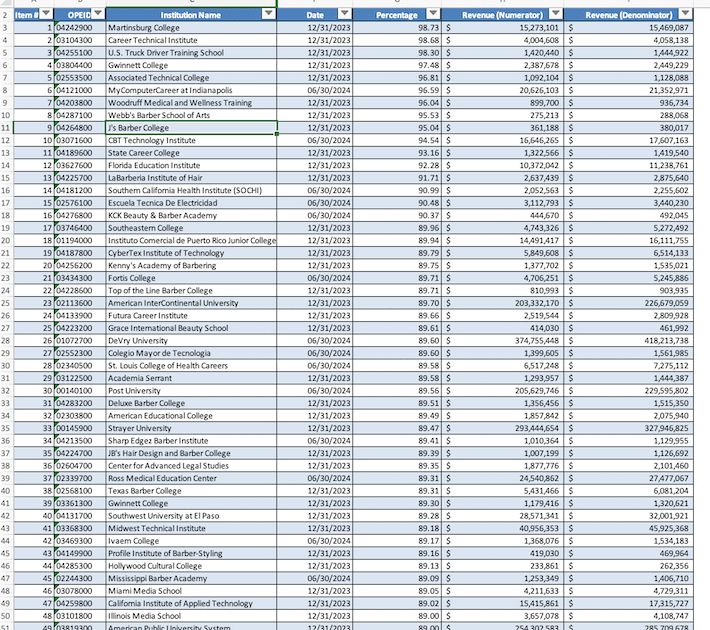
    The new rule took effect in 2023, and when the Department released the latest 90-10 calculations, for the 2023-24 academic year, sixteen for-profit colleges had flunked, compared with just five the previous year. These were mostly smaller schools, led by West Virginia’s Martinsburg College, which got 98.73 percent of its revenue from federal taxpayer dollars, and Washington DC’s Career Technical Institute, which reported 98.68 percent. Another 36 schools, including major institutions such as DeVry University, Strayer University, and American Public University, came perilously close to the line, at 89 percent or higher.

    The education department last week altered the calculation by effectively restoring an old loophole that allowed for-profit colleges to use revenue from programs that are ineligible for federal aid to count on the non-federal side. That loophole was expressly addressed, via a compromise agreement, after Department officials discussed the details with representatives of for-profit colleges, during the 2022 negotiated rulemaking meetings.

    All the flunking or near-flunking schools can now get a new, potentially more favorable, calculation of their 90-10 ratio under the Trump administration’s re-interpretation of the rule.

    In the lawless fashion of the Trump regime, the Department has now undermined a provision of its own regulation without going through the required negotiated rulemaking process. (The Department’s notice last week included a labored argument about why its action was lawful.)

    As it has done multiple times over its first six months, the Trump Department of Education, under Secretary Linda McMahon, has again taken a step that allows poor-quality predatory for-profit colleges to rip off students and taxpayers.

    Source link

  • Jailed for basic journalism, Texas reporter takes free speech fight to Supreme Court

    Jailed for basic journalism, Texas reporter takes free speech fight to Supreme Court

    For years, Priscilla Villarreal has fought to hold officials accountable when they violate Americans’ First Amendment rights, including the Laredo officials who threw her in jail just for asking police to verify facts as part of her everyday news reporting. 

    Priscilla sued, and last fall, the Supreme Court gave her a shot at justice, granting her petition and ordering the U.S. Court of Appeals for the Fifth Circuit to reconsider Priscilla’s case against the officials who tried to turn routine journalism into a felony.

    But in April, a divided Fifth Circuit doubled down, holding the Laredo officials had qualified immunity, a doctrine that often shields government officials from lawsuits even when they violate the Constitution. In his dissent, one judge lamented that the court had simply reinstated what it “mistakenly said before, just in different packaging.”

    So Priscilla and FIRE are doubling down, too. We’re heading back to the Supreme Court, asking it to make crystal clear that Americans have every ability to hold officials accountable for violating core First Amendment rights — like the right to ask government officials questions, and publish what they share.

    That’s exactly what Priscilla has been doing for years, reporting on local crime, traffic, and other news for her 200,000 Facebook followers. She’s made a name for herself too. The New York Times describes her as “arguably the most influential journalist in Laredo.”  But despite her experience, her journey from Laredo, a city on the Mexican border, to the Supreme Court has been a long one.

    In 2017, she reported on a high-profile suicide and a fatal car accident. For both stories, Priscilla received tips from private citizens and verified those facts by asking a Laredo police officer. The First Amendment squarely protects this routine journalistic practice. After all, at the heart of the First Amendment is the freedom to ask government officials and institutions questions, even tough ones.

    Angered by Priscilla’s reporting on these incidents, Laredo officials tried to bully her into silence by arresting her. But with no legitimate basis on which to charge her with a crime, police and prosecutors turned to a decades-old statute that no local official had ever enforced. 

    That law makes it a felony to ask for or receive non-public information from a government official with the intent to benefit from that information. Laredo police and prosecutors pursued two warrants for Priscilla’s arrest under the statute. In short, Priscilla went to jail for basic journalism. 

    So in 2019, she sued the officials for violating her First and Fourth Amendment rights. As Judge James Ho later remarked in his dissent at the Fifth Circuit, it “should’ve been an easy case for denying qualified immunity.”

    But it hasn’t been. A Texas federal district court dismissed her claims on the basis of qualified immunity. A three-judge panel of the Fifth Circuit reversed that decision, denying qualified immunity. But when the whole Fifth Circuit reheard the case at the government’s request, it reversed the panel ruling in a splintered 9-7 decision.

    In 2024, Priscilla and FIRE took her fight to the Supreme Court for the first time. The Court granted Priscilla’s petition to review the Fifth Circuit’s decision and ordered it to reconsider her case in light of the Supreme Court’s 2024 decision, Gonzalez v. Trevino. That decision affirmed the ability to sue government officials when they retaliate against protected speech by selectively enforcing statutes.

    But last April, a splintered Fifth Circuit decided against Priscilla again, granting qualified immunity to the officials who defied longstanding Supreme Court precedent and core principles of American liberty by orchestrating her arrest.

    The Fifth Circuit’s ruling not only denies Priscilla justice, but gives police and prosecutors a free pass to turn core First Amendment rights into a crime. That result cannot stand. And that’s why Priscilla and FIRE are going back to the Supreme Court.

    Priscilla’s fearless reporting has made her a local “folk hero.” Now, she’s channeling the same grit into defending not just her own rights, but the First Amendment rights of all Americans.

    Source link

  • Release of NAEP science scores

    Release of NAEP science scores

    UPDATE: After this story was published, the Education Department issued a press release Monday afternoon, July 7, announcing that Matthew Soldner will serve as acting commissioner of the National Center for Education Statistics, in addition to his role as acting director of the Institute of Education Sciences. The job of statistics chief had been vacant since March and had prevented the release of assessment results.

    The repercussions from the decimation of staff at the Education Department keep coming. Last week, the fallout led to a delay in releasing results from a national science test.

    The National Assessment of Educational Progress (NAEP) is best known for tests that track reading and math achievement but includes other subjects, too. In early 2024, when the main reading and math tests were administered, there was also a science section for eighth graders. 

    The board that oversees NAEP had announced at its May meeting that it planned to release the science results in June. But that month has since come and gone. 

    Why the delay? There is no commissioner of education statistics to sign off on the score report, a requirement before it is released, according to five current and former officials who are familiar with the release of NAEP scores, but asked to remain anonymous because they were not authorized to speak to the press or feared retaliation. 

    Related: Our free weekly newsletter alerts you to what research says about schools and classrooms.

    Peggy Carr, a Biden administration appointee, was dismissed as the commissioner of the National Center for Education Statistics in February, two years before the end of her six-year term set by Congress. Chris Chapman was named acting commissioner, but he was fired in March, along with half the employees at the Education Department. The role has remained vacant since.

    A spokesman for the National Assessment Governing Board, which oversees NAEP,  said the science scores will be released later this summer, but denied that the lack of a commissioner is the obstacle. “The report building is proceeding so the naming of a commissioner is not a bureaucratic hold-up to its progress,” Stephaan Harris said by email.

    The delay matters. Education policymakers have been keen to learn if science achievement had held steady after the pandemic or tumbled along with reading and math. (Those reading and math scores were released in January.)

    The Trump administration has vowed to dismantle the Education Department and did not respond to an emailed question about when a new commissioner would be appointed. 

    Related: Chaos and confusion as the statistics arm of the Education Department is reduced to a skeletal staff of 3

    Researchers hang onto data

    Keeping up with administration policy can be head-spinning these days. Education researchers were notified in March that they would have to relinquish federal data they were using for their studies. (The department shares restricted datasets, which can include personally identifiable information about students, with approved researchers.) 

    But researchers learned on June 30 that the department had changed its mind and decided not to terminate this remote access. 

    Lawyers who are suing the Trump administration on behalf of education researchers heralded this about-face as a “big win.” Researchers can now finish projects in progress. 

    Still, researchers don’t have a way of publishing or presenting papers that use this data. Since the mass firings in mid-March, there is no one remaining inside the Education Department to review their papers for any inadvertent disclosure of student data, a required step before public release. And there is no process at the moment for researchers to request data access for future studies. 

    “While ED’s change-of-heart regarding remote access is welcome,” said Adam Pulver of Public Citizen Litigation Group, “other vital services provided by the Institute of Education Sciences have been senselessly, illogically halted without consideration of the impact on the nation’s educational researchers and the education community more broadly.  We will continue to press ahead with our case as to the other arbitrarily canceled programs.”

    Pulver is the lead attorney for one of three suits fighting the Education Department’s termination of research and statistics activities. Judges in the District of Columbia and Maryland have denied researchers a preliminary injunction to restore the research and data cuts. But the Maryland case is now fast-tracked and the court has asked the Trump administration to produce an administrative record of its decision-making process by July 11. (See this previous story for more background on the court cases.)

    Related: Education researchers sue Trump administration, testing executive power

    Some NSF grants restored in California

    Just as the Education Department is quietly restarting some activities that DOGE killed, so is the National Science Foundation (NSF). The federal science agency posted on its website that it had reinstated 114 awards to 45 institutions as of June 30. NSF said it was doing so to comply with a federal court order to reinstate awards to all University of California researchers. It was unclear how many of these research projects concerned education, one of the major areas that NSF funds.

    Researchers and universities outside the University of California system are hoping for the same reversal. In June, the largest professional organization of education researchers, the American Educational Research Association, joined forces with a large coalition of organizations and institutions in filing a legal challenge to the mass termination of grants by the NSF. Education grants were especially hard hit in a series of cuts in April and May. Democracy Forward, a public interest law firm, is spearheading this case.

    Contact staff writer Jill Barshay at 212-678-3595, jillbarshay.35 on Signal, or [email protected].

    This story about delaying the NAEP science score report was written by Jill Barshay and produced by The Hechinger Report, a nonprofit, independent news organization focused on inequality and innovation in education. Sign up for Proof Points and other Hechinger newsletters.

    The Hechinger Report provides in-depth, fact-based, unbiased reporting on education that is free to all readers. But that doesn’t mean it’s free to produce. Our work keeps educators and the public informed about pressing issues at schools and on campuses throughout the country. We tell the whole story, even when the details are inconvenient. Help us keep doing that.

    Join us today.

    Source link

  • How worried are we about the future? Let’s quantify it.

    How worried are we about the future? Let’s quantify it.

    Fear. Uncertainty. Those are human emotions that many people are feeling these days. It turns out you can quantify fear and uncertainty by looking at the stock market.

    Stocks are shares of a business that people can buy on a public market, betting that the business will grow and profit and the shares will be more valuable over time. But share prices also rise and fall based on how people feel about the economic future. 

    So individual stocks, as well as whole sectors of an industry or the overall market in general, can rise or fall on economic or company reports, politics, geopolitical events, unexpected news and whether investors are optimistic or pessimistic about the future. 

    When these kinds of changes or reports cause stocks to suddenly and frequently rise and fall, we say the market is “volatile.” 

    Throughout 2025, the U.S. stock market, which is the biggest in the world, has been pretty volatile. One way to measure it is through the Standard and Poor’s 500 Index, which is a snapshot of 500 major company stocks. 

    Politics and plunging markets

    From mid-February to early April, the S&P 500 index plummeted 19% as U.S. President Donald Trump launched a trade war that raised fears of inflation, a recession, job losses and a swelling national debt.  

    The U.S. market has largely recovered those losses in response to Trump pausing his tariff wars and lowering tariffs from scary levels. As of 30 June 2025, the stock market was dancing in record high territory. 

    Robert Whaley, a finance professor at Vanderbilt University and director of its Financial Markets Research Center, developed a way to measure a stock market’s volatility by keeping track of stock options — contracts that gives investors the right, but not an obligation, to buy or sell a stock at a predetermined price at a set future date. 

    It is popularly known as the “fear index” and goes by the symbol VIX. 

    The fear index is a measure of how much volatility is expected in the next month. Historically, its long-term average has been 17. During April, it was 40-50. In comparison, the index was at 85 in the COVID-19 market crash of March 2020 and at 89.5 during the global financial crisis of 2008-2009. 

    Buying and selling on fear

    What happens during market volatility? High volatility usually implies higher risk because price movements are less predictable. While some short-term stock traders can make money during market volatility, longer-term buy-and-hold investors might get jittery. 

    Mutual fund cash holdings were at a 15-year high in March. That means that professional money managers held onto cash and stayed on the sidelines. What do global investors crave? Stability and predictability. 

    “The VIX as of now (intraday June 30) is at 17 so things are calmer which is surprising given what is happening in Ukraine and Iran,” Whaley said. “It seems the markets have become quite comfortable about it.” 

    He underscored that the fear index is intended to help institutional investors — such as those who manage pension funds or retirement accounts that many people invest in — predict market volatility over the next 30 days. For people who might not be actively involved in the stock market, all of this still matters. 

    “It reflects how institutions are feeling about the marketplace,” Whaley said. “An analogy would be if you own a house on the beach and learn a hurricane is coming. How much might insurance cost if you could actually buy it that late?” 

    Reading the market

    Whaley said that young people should develop an intuitive feel of stock market volatility, since it is an expression of nervousness. 

    “In essence, it’s a fear gauge,” he said. “If people are getting nervous buying put options [that gives investors a right to buy] that drives up put prices. If VIX was at 30-40% institutions are scared to death. Right now at 17%, there’s no concern in the short run.”

    Whaley said the index is normally around 15-20%, but a reading below 15% would reflect that investors are complacent. 

    As for the limitations of the fear index, Whaley said some people read too much into it and some institutions might overpay for VIX options and futures to try to insure their investments against losses. 

    While the fear index was born on a real-time basis in 1993, Whaley calculated that it would have reached an intraday high of 172 and closed at 156 on October 19, 1987, the date of the global stock market crash known as Black Monday. Whaley said other market earthquakes that caused big percentage drops included the 2008 financial crisis and Trump’s tariffs. 

    Whaley said viewed in a historical context, the fear index is like any other index — like the Dow Jones Industrial Average — that has a market value. “Indices are useful in terms of their history,” he said. “A barometer of fear. If VIX is higher, figure out what is going on.” 


    Questions to consider:

    1. What type of news might cause fear in a stock market?

    2. If there is a lot of uncertainty in a stock market, what do many professional investors do? 

    3. Can you think of another way to measure how fearful people are about the future?


    Source link

  • On the Sensibility of Cognitive Outsourcing (opinion)

    On the Sensibility of Cognitive Outsourcing (opinion)

    I am deeply worried about my vacuuming skills. I’ve always enjoyed vacuuming, especially with the vacuum cleaner I use. It has a clear dustbin, and there’s something cathartic about running it over the carpet in the upstairs hallway and seeing all the dust and debris it collects. I’m worried, however, because I keep outsourcing my downstairs vacuuming to the robot vacuum cleaner my wife and I bought a while back. With three kids and three dogs in the house, our family room sees a lot of foot traffic, and I save a lot of time by letting the robot clean up. What am I losing by relying on my robot vacuum to keep my house clean?

    Not much, of course, and I’m not actually worried about losing my vacuuming skills. Vacuuming the family room isn’t a task that means much to me, and I’m happy to let the robot handle it. Doing so frees up my time for other tasks, preferably bird-watching out the kitchen window, but more often doing the dishes, a chore for which I don’t have a robot to help me. It’s entirely reasonable for me to offload a task I don’t care much about to the machines when the machines are right there waiting to do the work for me.

    That was my response to a new high-profile study from a MIT Media Lab team led by Nataliya Kosmyna. Their preprint, “Your Brain on ChatGPT: Accumulation of Cognitive Debt When Using an AI Assistant for Essay Writing Task,” details their experiment. The team enlisted 54 adult participants to write short essays using SAT prompts over multiple sessions. A third of the participants were given access to ChatGPT to help with their essay writing, a third had access to any website they could reach through a Google search engine but were prohibited from using ChatGPT or other large language models and a third had no outside aids (the “brain-only” group). The researchers not only scored the quality of the participants’ essays, but they also used electroencephalography to record participants’ brain activity during these writing tasks.

    The MIT team found that “brain connectivity systematically scaled down with the amount of external support.” While the brain-only group “exhibited the strongest, widest‑ranging [neural] networks,” AI assistance in the experiment “elicited the weakest overall coupling.” Moreover, the ChatGPT users were increasingly less engaged in the writing process over the multiple sessions, often just copying and pasting from the AI chat bot by the end of the experiment. They also had a harder time quoting anything from the essay they had just submitted compared to the brain-only group.

    This study has inspired some dramatic headlines: “ChatGPT May Be Eroding Critical Thinking Skills” and “Study: Using AI Could Cost You Brainpower” and “Your Reliance on ChatGPT Might Be Really Bad for Your Brain.” Savvy news readers will key into the qualifiers in those headlines (“may,” “could,” “might”) instead of the scarier words, and the authors of the study have made an effort to prevent journalists and commentators from overplaying their results. From the study’s FAQ: “Is it safe to say that LLMs are, in essence, making us ‘dumber’? No!” As is usually the case in the AI-and-learning discourse, we need to slow our roll and look beyond the hyperbole to see what this new study does and doesn’t actually say.

    I should state now for the record that I am not a neuroscientist. I can’t weigh in with any authority on the EEG analysis in this study, although others with expertise in this area have done so and have expressed concerns about the authors’ interpretation of EEG data. I do, however, know a thing or two about teaching and learning in higher education, having spent my career at university centers for teaching and learning helping faculty and other instructors across the disciplines explore and adopt evidence-based teaching practices. And it’s the teaching-and-learning context in the MIT study that caught my eye.

    Consider the task that participants in this study, all students or staff at Boston-area universities, were given. They were presented with three SAT essay prompts and asked to select one. They were then given 20 minutes to write an essay in response to their chosen prompt, while wearing an EEG helmet of some kind. Each subject participated in a session like this three times over the course of a few months. Should we be surprised that the participants who had access to ChatGPT increasingly outsourced their writing to the AI chat bot? And that, in doing so, they were less and less engaged in the writing process?

    I think the takeaway from this study is that if you give adults an entirely inauthentic task and access to ChatGPT, they’ll let the robot do the work and save their energy for something else. It’s a reasonable and perhaps cognitively efficient thing to do. Just like I let my robot vacuum cleaner tidy up my family room while I do the dishes or look for an eastern wood pewee in my backyard.

    Sure, writing an SAT essay is a cognitively complex task, and it is perhaps an important skill for a certain cohort of high school students. But what this study shows is what generative AI has been showing higher ed since ChatGPT launched in 2022: When we ask students to do things that are neither interesting nor relevant to their personal or professional lives, they look for shortcuts.

    John Warner, an Inside Higher Ed contributor and author of More Than Words: How to Think About Writing in the Age of AI (Basic Books), wrote about this notion in his very first post about ChatGPT in December 2022. He noted concerns that ChatGPT would lead to the end of high school English, and then asked, “What does it say about what we ask students to do in school that we assume they will do whatever they can to avoid it?”

    What’s surprising to me about the new MIT study is that we are more than two years into the ChatGPT era and we’re still trying to assess the impact of generative AI on learning by studying how people respond to boring essay assignments. Why not explore how students use AI during more authentic learning tasks? Like law students drafting contracts and client memos or composition students designing multimodal projects or communications students attempting impossible persuasive tasks? We know that more authentic assignments motivate deeper engagement and learning, so why not turn students loose on those assignments and then see what impact AI use might have?

    There’s another, more subtle issue with the discourse around generative AI in learning that we can see in this study. In the “Limitations and Future Work” section of the preprint, the authors write, “We did not divide our essay writing task into subtasks like idea generation, writing, and so on.” Writing an essay is a more complicated cognitive process than vacuuming my family room, but critiques of the use of AI in writing are often focused on outsourcing the entire writing process to a chat bot. That seems to be what the participants did in this study, and it is perhaps a natural use of AI when given an uninteresting task.

    However, when a task is interesting and relevant, we’re not likely to hand it off entirely to ChatGPT. Savvy AI users might get a little AI help with parts of the task, like generating examples or imagining different audiences or tightening our prose. AI can’t do all the things that a trained human editor can, but, as writing instructor (and human editor) Heidi Nobles has argued, AI can be a useful substitute when a human editor isn’t readily available. It’s a stretch to say that my robot vacuum cleaner and I collaborate to keep the house tidy, but it’s reasonable to think that someone invested in a complex activity like writing might use generative AI as what Ethan Mollick calls a “co-intelligence.”

    If we’re going to better understand generative AI’s impact on learning, something that will be critical for higher education to do to keep its teaching mission relevant, we have to look at the best uses of AI and the best kinds of learning activities. That research is happening, thankfully, but we shouldn’t expect simple answers. After all, learning is more complicated than vacuuming.

    Derek Bruff is associate director of the Center for Teaching Excellence at the University of Virginia.

    Source link