Author: admin

  • Own Your Narrative: Why Personal Branding Matters for University Leaders

    Own Your Narrative: Why Personal Branding Matters for University Leaders

    Many university leaders are uneasy about the idea of personal branding. It can feel self-promotional, even uncomfortable – and it’s often a concept that jars with their personal values, the culture of their institution, and indeed their perception of how higher education itself operates.

    However, personal branding should not be about ego or marketing. It’s about clarity, authenticity, and trust. In an environment where leadership visibility, credibility, and alignment with institutional values are increasingly scrutinised, shaping how you’re understood by others isn’t merely helpful, it’s essential.

    So, while we’re a bit uncomfortable with the term, personal brand, we think it’s extremely important for aspiring university leaders to think about how they go about developing one for themselves.

    Personal branding – it’s not just what you say about yourself

    It’s perhaps worth reflecting on what Jeff Bezos has said in this context because it’s helpful:

    “Your brand is what other people say about you when you’re not in the room.”

    Your title and role may open doors, but it’s your values, your expertise and your contribution that leave a lasting impression. Personal brand is the space you occupy in other people’s minds: your colleagues, students, and external connections. In today’s digital world, you are visible in search results, social feeds, LinkedIn and other platforms. If you’re not actively shaping your own narrative, others will do it for you – forming opinions and perceptions that may not be accurate or aligned with your values.

    Why should personal branding matter for aspirational university leaders?

    Thinking about your personal branding allows you to control the narrative. Essentially, if you don’t shape your story, someone else will. It allows you to build trust and credibility authentically. This is vital, we all know that a consistent, values-led brand is consonant with reliability in times of change. Where there is so much information out there, it can be a strong signal among confusion and noise. It also gives you a better handle on future-proofing your career.

    Executive search companies, partnerships, board appointments all begin with discovery, and if you can’t be found, you can’t be considered. Distilling your experience and expertise beyond the role you’re in now makes moves to other roles easier. People do their homework on you, they want to know what kind of person you are, not necessarily the nitty gritty detail (although bad social media lingers) but to know that you are real. And it’s not always about a positive career trajectory to the next job. In these times your role might be at risk, and you might need to consider your next position, even beyond your current role, institution and sector.

    This is about developing a personal mark, but it’s worth noting that an authentic personal brand also benefits your institution. Visible leaders attract talent and partnerships, and can draw top academics, high-calibre students, and external funders. People will engage because of what you stand for in terms of your values and your impact. And got right, it will help your students, staff, external connections and the public to be more confident about your vision and your decisions.

    Equally important, a clear and visible personal brand enables you to communicate more effectively – an essential skill for building strong teams, driving change, and leading through crisis. You are future-proofing yourself, becoming a trusted authority, so that you are known for more than just your job title and credentials. 

    It starts with how you present yourself in meetings, working groups, committees, stakeholder meetings, even corridor conversations and incidental interactions.

    Articulating your expertise beyond your job title

    To be able to develop your personal brand, you need to ask yourself several questions and answer them honestly. And bear in mind that ‘showing up’ is not showing off, you can’t make a difference if you’re invisible!

    Truly understand what your goals are: who you are trying to help, and what positive difference do you want to make? Understanding your reason for doing what you do makes being visible that much easier.

    1. Do I want to make a positive difference?
    2. What do I want to change and how?
    3. What do I want to be known for?
    4. Who do I want to help?

    Ask yourself these questions in the context of what you want to change or influence, such as Leadership & Change Management; Equity, Diversity & Social Mobility; Research Impact & Knowledge Exchange; Student Experience & Wellbeing; The Future of Work & Skills. These should, of course, be significant topics that reflect what you want to be known for and the people or communities you aim to support.

    Before you can become an authority on your topic, you need to have a proven track record of success in that area. Your credibility is built not just on what you say, but on what you’ve delivered; your demonstrable achievements and real impact that others can recognise and rely on. Without this foundation, personal branding risks sounding empty or a promissory note rather than coming from a position of authority and authenticity.

    When you are speaking to others about what you are doing, it is helpful to reflect on how you should structure what you say. Make sure, for example, that you’re clear about defining the issue: speak directly to the challenges your audience faces (e.g. navigating grant applications, improving departmental culture); position the challenges. Share frameworks, tips, or toolkits you’ve developed, and humanise your advice – weave in a short anecdote or lesson learned, for example.

    Do these things in the context of people you might be able to support by being more visible: students and research students, people more junior, and those wanting to get into HE, particularly those from minoritised backgrounds. Essentially, leadership isn’t just about climbing, your role should be to hold the ladder down for others.

    Practical Tips

    To help you maximise your impact – here are some ideas:

    1. Digital Footprint Audit

      • Search Yourself: Google your name in incognito mode. Note the top 10 results.
      • Review Social Profiles: Ensure consistency of photo, headline, and bio across LinkedIn, Twitter, ResearchGate, etc.
      • Clean Up: Archive or delete outdated posts or profiles that conflict with your current values.

      2. Think about Content, Calendar & Cadence

      • Plan regular outputs (blog posts, LinkedIn articles, micro-posts) aligned to your expertise, but don’t worry if you can’t maintain a consistent frequency right away.
      • It is important that they are insightful, add value and contribute.
      • Use simple tools (e.g. Trello or a shared spreadsheet) or agentive AI to track ideas, deadlines, and performance.

      3. Collect Metrics & Evaluation

      • Engagement: Likes, comments, shares on social platforms.
      • Opportunities: Invitations to speak, consult, sit on panels or boards.
      • Search Trends: Monitor Google Analytics (if you host a blog) or LinkedIn analytics for profile views and keyword searches.

      4. Network Activation

      • Identify, say, 10 key contacts (internal & external) each quarter to reconnect with.
      • Offer value first. Be gracious and share – share an article, congratulate them on their achievement, propose a brief call.
      • Leverage your network to co-author articles, co-host webinars, or nominate others for awards.

      And avoid:

      • Oversharing: While transparency is good, avoid extraneous personal detail that can detract from your message.
      • Inconsistency: Mixed messaging erodes trust. Align every post and presentation with your core values.
      • Neglecting Offline Presence: A strong digital brand should be backed up by consistent behaviour in meetings and events.
      • Ignoring Feedback: Listen to comments, direct messages, and 360-degree reviews to refine your approach.

      What Leaders Say

      Professor Shân Wareing, Vice-Chancellor and CEO, Middlesex University

      People are always going to draw conclusions from what they see you do, so you always need to be aware of that. I don’t use personal brand with the goal of ‘selling’ me. However, I do want to consistently communicate important and specific aspects of how I work – such as that I care about other people’s growth – and I try to align all my social media and other communications with that message.”

      Professor Simon Biggs Vice Chancellor and President, James Cooke University

      Senior leaders represent their organisation externally. A strong personal brand helps amplify and align their values with the organisation in public forums, industry discussions, and policy advocacy. Personal branding signals what a leader stands for ethically, strategically, and culturally. It helps align teams and attract talent who resonate with that leadership style.

      Professor Theo Farrell, Vice-Chancellor, Latrobe University, Australia

      I think aspiring leaders need to think carefully about the kind of leader they want to be – and this will involve reflecting on their own values, the ambitions they have for the organisation or unit they lead, and their aspiring leadership journey. For me, personal brand is simply the outward expression of this leadership ethos and style. It is expressed in communications, including social media, and also in every interaction with people inside and outside the organisation. Being consistent with your personal brand, in everything you do is important for authentic leadership. In terms of social media, the goal is to communicate your values. Being consistent is obviously important. At the same time, my experience is one of posting fewer personal reflections and more corporate content as I have become more senior, and in these senior roles increasingly represent my organisation.

      And finally

      Leadership and personal branding are inseparable in today’s higher education landscape. Your brand is not a luxury. It’s your strategic asset made up of your values, your story, your impact on others and ultimately your legacy.


    Source link

  • Civic engagement offers a firm foundation for universities contributing to regional economic growth agendas

    Civic engagement offers a firm foundation for universities contributing to regional economic growth agendas

    When searching for friendly support or warm words from politicians, the media, and the public, UK universities are increasingly being left empty-handed.

    Last year’s modest increase in tuition fees allowed universities a temporary reprieve after years of tightening financial constraints but came with a firm warning that standards must improve and was quickly wiped out by rises in National Insurance. Meanwhile, culture wars and negative perceptions on quality and graduate outcomes continue to dominate discourse around the sector, fuelling criticism of universities from all directions.

    Richard Jones, vice president for regional innovation and civic engagement at the University of Manchester posited last week that university leaders may be tempted to look for easy savings in their civic impact work – initiatives that engage with and benefit their local community but ultimately fall outside of a university’s traditional mission of teaching and research. But as he argues, this would be a profound mistake.

    The outlook in recent years for universities may have been challenging, but hope lies in Labour’s focus on place-based policy. Place has driven flagship funding decisions and policies including the Spending Review and the Industrial Strategy, with more money being devolved from Whitehall to the regions in pursuit of growth. New Mayoral Strategic Authorities have been empowered to take the reins on transport, investment, spatial planning and skills, with the promise of further autonomy as they mature. A new Green Book – government’s methodology for assessing public investments – is being updated and will broaden the criteria to look more favourably at investments outside London and the South East.

    Universities are perfectly placed to be the drivers of Labour’s regional growth ambitions. The priority sectors in last week’s Industrial Strategy – including advanced manufacturing, life sciences, and clean energy industries – are some of UK universities’ best strengths. Moreover, as anchor institutions located in the heart of communities, universities are physically well-placed to address causes of economic decline.

    Civic engagement for economic growth

    The civic university movement, which champions collaboration between universities and their localities, has an established framework for institutions looking to ramp up civic impact initiatives with their civic university agreements. More than 70 civic university agreements are already in place between universities and their local authorities, with universities in Manchester, Nottingham, Sheffield, Exeter, Derby and London, among others, providing a range of examples for institutions to learn from.

    A UPP Foundation series of roundtables held in four regions across England recently has also highlighted that the civic university movement remains active, with a wealth of civic activity taking place across the country. Universities are finding creative ways to engage with their local communities, with examples including offering to host events in university spaces, or running a café that demystifies the benefits of nuclear energy while providing employment and training for local people. For institutions nervous about signing up to lengthy and potentially costly partnerships, participants at the roundtables instead stressed that smaller gestures can be just as meaningful. Rather than draining resources, civic activity can in fact alleviate funding pressures when universities work together to learn from one another.

    Irrespective of geography, participants were united in their contention that universities should collaborate with their local partners to develop civic initiatives, working collaboratively to address the real day-to-day problems communities want help with, such as helping local businesses transition to net zero.

    Labour’s devolution agenda also offers an opportunity for universities to become visible bridges working across regions and political geographies. While mayoral devolution has been lauded in cohesive urban centres like Manchester and Birmingham, there are concerns the model will work less well in rural areas where proposed Mayoral Combined Authorities will intersect with traditional county borders. For such regions, universities can both serve as bolsters to wider regional identity and can benefit from the flexibility of their own geography that may span mayoral regions.

    The opportunities are there for universities to re-embed civic activity into their core work under Labour’s agenda – but it needs brave leadership to embrace them. In the face of tough financial decisions, university leaders must champion the benefits of civic activity. The late Bob Kerslake, chair of the UPP Foundation’s Civic University Commission 2018–19, deeply understood the potential and necessity for universities to be rooted in their local communities. For a higher education sector that has spent recent years on uncertain footing, tapping into Kerslake’s vision could provide a more certain path forward.

    The UPP Foundation’s full report UPP Foundation Spring 2025 Roundtables: The Role of Universities in Regional Placemaking explores the key themes of the roundtable discussions. You can download the report here.

    Source link

  • Is CTE the future of arts career pathways?

    Is CTE the future of arts career pathways?

    This audio is auto-generated. Please let us know if you have feedback.

    Dive Brief:

    • While career and technical education has long connected students to real-world job skills and opportunities in different fields, it may also offer an avenue to strengthen arts programming and diversify career pathways for students interested in the arts. 
    • CTE experts emphasize the importance of thinking outside the traditional arts education framework by combining foundational techniques with an awareness of how those skills can be applied in the real world and meet local job market needs.
    • “There’s a dismissiveness about careers in the arts because it’s assumed that you have to be a starving artist, but that’s truly not the case,” said Ashley Adams, executive director of Arts Media Entertainment Institute, a nonprofit that connects educators to creative professionals. “There are incredible jobs for students that use their creative skills, and it empowers them if you can teach them about those careers early on.”

    Dive Insight:

    Adams began as a classroom teacher at a school with a robust Parent Teacher Association that regularly fundraised to support high-quality arts programming. However, not every school has access to this type of resource, Adams said, which is why she views CTE in the arts as an avenue for equity and access for students.

    For example, a theater teacher in Colorado launched a new course that teaches technical theater skills such as set design and sound design in order to qualify for CTE state and federal level funding. 

    Technical training is valuable for students because graduating with a certification in an industry-recognized software platform boosts and strengthens their resume when applying for jobs, Adams said. She added that because CTE programs are project-based, it’s a great preparation for the workforce, as many jobs are seeking professionals who can work collaboratively.

    For an arts-oriented CTE course to succeed, one of the main factors to take into consideration — as with any CTE course — is labor market value. Dan Hinderliter, associate director of state policy for Advance CTE, a national association for CTE directors and professionals, explained that there needs to be at least some level of local labor market analysis to determine which careers and opportunities are available, and to make these explicitly clear to stakeholders.

    “There’s a lot of programs in, say, California — where there’s more opportunity because they have the labor market — than you would find in rural Oklahoma, where they don’t inherently have a lot of need for students with a lot of technical arts skill and background,” Hinderliter said.

    If a school district decides they have a local labor market that’s looking for a much more technical approach to arts education, Hinderliter encourages them to make sure they partner with the employers in that area and, more comprehensively, with the state. 

    At the local level, the AME Institute connects teachers with creative industries and ensures they have training resources and the knowledge necessary to prepare students for these jobs. The organization provides virtual learning opportunities, in-person institutes that include visits to industry studios, and curated programming to strengthen pathway curriculum. 

    “It’s workforce development, and our workforce needs creators, it needs innovators, if we are going to continue to be a leader,” Adams said. “Entertainment is a huge industry sector within our economy, but if we’re going to continue to lead in that industry sector and many others, we have to have creative thinkers. We have to have people who are taking these tools and using them in innovative ways.”

    Source link

  • Trump’s $16M win over ’60 Minutes’ edit sends chilling message to journalists everywhere

    Trump’s $16M win over ’60 Minutes’ edit sends chilling message to journalists everywhere

    On Tuesday, Paramount announced an agreement to pay $16 million to settle President Donald Trump’s lawsuit over the editing of a “60 Minutes” interview with Kamala Harris.

    The following can be attributed to FIRE attorney Bob Corn-Revere, who filed a comment to the FCC calling its investigation into the Harris interview a “political stunt”:

    A cold wind just blew through every newsroom this morning. Paramount may have closed this case, but it opened the door to the idea that the government should be the media’s editor-in-chief.

    Trump has a long history of filing frivolous lawsuits to intimidate critics, and his targets have a long history of capitulating to avoid legal headaches. And here, he had the added tactic of using the FCC and its review of the multi-billion dollar Paramount-Skydance merger to bring added pressure to bear.

    Behavior that gets rewarded gets repeated. This settlement will only embolden the president to continue his flurry of baseless lawsuits against the press — and against the American people’s ability to hear the news free from government intrusion.

    Source link

  • How to Launch a School Podcast in 7 Steps

    How to Launch a School Podcast in 7 Steps

    Reading Time: 11 minutes

    As of 2023, more than 464 million people listen to podcasts regularly, and this number is growing each year. And with over 70% of parents listening with their children, podcasts are a communication channel your school can’t afford to overlook.

    Why does this matter for education marketing?

    Because parents, students, and alumni increasingly expect content that’s on demand, easy to consume, and aligned with how they already engage with other brands. A podcast offers exactly that. It provides a way to humanize your institution, give voice to your values, and build stronger relationships with your audience, all without requiring a massive budget or full production studio.

    Is a school podcast worth the effort?

    Here’s the reality: Schools that use podcasting strategically are finding new ways to connect with prospective families, boost engagement, and increase brand awareness. Whether you’re trying to showcase your faculty, highlight student achievements, or simply keep your community informed, a podcast gives you a direct line to your audience’s attention.

    First things first, what is a podcast in school? A school podcast is an audio series created by educators, students, or staff to share news, stories, or educational content. It can highlight campus life, feature interviews, or support learning, helping schools connect with their communities in an accessible, on-demand format.

    This blog post breaks down seven clear steps for launching a school podcast, from planning and production to promotion and measurement.

    Struggling with enrollment?

    Our Digital Marketing team can help you generate more leads!

    Step 1: Define Your Podcast’s Purpose

    Before you record a single second of audio, it’s important to answer one key question: Why are we starting this podcast?

    A well-defined purpose ensures your content stays focused and impactful. Are you hoping to:

    • Attract and engage prospective families?
    • Showcase student life and culture?
    • Build thought leadership through staff and faculty interviews?
    • Strengthen alumni connections?

    The most successful school podcasts have a clear audience and goal. For example, a private school may want to build trust with prospective families by featuring authentic stories from teachers and students. A language institute might use a podcast to demonstrate teaching methods or highlight student success stories. A university could aim to strengthen alumni ties through interviews and updates.

    Whatever the goal, be specific. Broad intentions like “we want to communicate better” are too vague. Instead, anchor your podcast in a focused objective, be it enhancing recruitment, increasing transparency, or offering value-added resources to your community.

    Once the purpose is clear, ensure leadership is aligned. Gaining buy-in from school administrators and relevant departments will give your project momentum, credibility, and cross-functional support.

    Example: Yale University’s admissions office launched an official podcast called Inside the Yale Admissions Office to pull back the curtain on their application process. Their goal was to demystify college admissions for prospective students by sharing firsthand insights from actual admissions officers. Because the project aligned perfectly with Yale’s outreach goals, it had strong internal buy-in. Admissions staff themselves host the show, with support from the Dean.

    HEM BP Image 2HEM BP Image 2

    Source: Yale University

    Pro tip: Avoid trying to appeal to everyone. Tailor your podcast to a specific listener group and let that clarity shape your voice, content, and messaging.

    Step 2: Choose the Right Format

    The best podcast format is the one that plays to your strengths and fits your resources. You don’t need to copy what others are doing. What matters most is that your format fits your team and speaks to your audience.

    Popular school-friendly formats include:

    • Interviews with staff, students, or alumni to spotlight personalities and accomplishments
    • Thematic episodes exploring topics like student life, curriculum innovations, or study tips.
    • Student-produced episodes that give learners ownership and boost engagement, or other types of user-generated content
    • Roundtable discussions where multiple voices weigh in on a key theme.

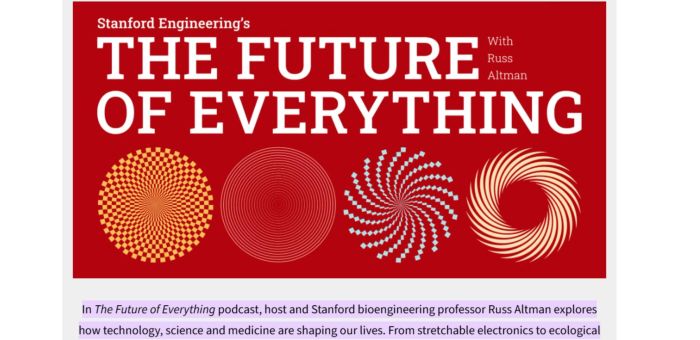
    Example: A great illustration of a defined concept is Stanford University’s The Future of Everything podcast, produced by its School of Engineering. The show’s premise is crystal clear – each episode explores how technology, science, and medicine are shaping our lives and future. Hosted by a Stanford bioengineering professor, it follows an interview format where experts discuss innovations in fields from AI to health care. This distinctive theme and structure leverage Stanford’s academic strengths and consistently deliver on what the title promises.

    HEM BP Image 3HEM BP Image 3

    Source: Stanford University

    Whatever you choose, aim for consistency in tone and structure. A 20-minute interview series sounds very different from a 10-minute solo voice memo, but either can be powerful if well-executed.

    Remember: A podcast is more than a recording; it’s a conversation. Make space for authenticity and spontaneity to shine through.

    Step 3: Build a Content Plan and Plan Episodes in Advance

    Now that you’ve defined your purpose and format, it’s time to think long-term. One of the biggest mistakes new podcasters make is launching without a content roadmap. Jumping into production without a plan can lead to burnout or disjointed messaging.

    Ask yourself:

    • What themes or topics will we cover across the season?
    • Which internal experts or guests should we feature?
    • Are there recurring segments that can anchor each episode?

    A solid content calendar will help you avoid scrambling for ideas and ensure your messaging supports broader marketing campaigns (like admissions deadlines, open houses, or graduation season).

    Here’s an example of a 6-episode launch plan for a K–12 school podcast:

    1. Welcome from the Head of School
    2. A Day in the Life of a Student
    3. Meet Our Parent Community
    4. Inside the Classroom: A Faculty Roundtable
    5. From Our Alumni: Life After Graduation
    6. How We Support Student Wellbeing

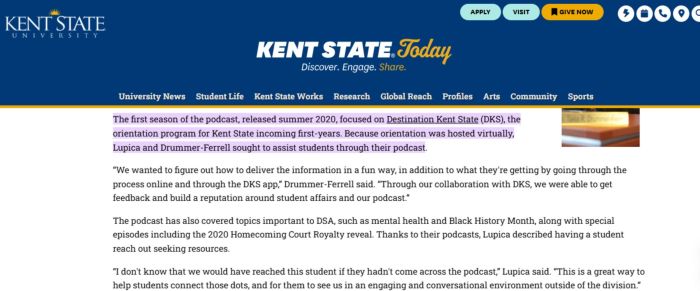
    Example: At Kent State University, the Division of Student Affairs took a strategic approach when launching its podcast. They deliberately planned the first season of the podcast to coincide with the university’s virtual orientation program for new students. Because orientation had moved online (due to the pandemic), the podcast team organized a series of episodes addressing topics incoming freshmen needed, essentially turning the podcast into a fun, on-demand extension of orientation. They collaborated with the orientation staff (Destination Kent State) to ensure content was relevant and even gathered feedback from that partnership to improve the show.

    HEM BP Image 4HEM BP Image 4

    Source: Kent State University

    Bonus tip: Batch-record your first few episodes in advance so you can launch with momentum and buffer time.

    Step 4: Set Up Your Equipment and Software

    Worried about needing a full recording studio? Don’t be. Getting started doesn’t require expensive equipment. Here’s a basic setup to launch your podcast with professional quality:

    Essentials:

    • Microphone: A USB mic like the Blue Yeti or Samson Q2U delivers clear, studio-like audio.
    • Headphones: Avoid audio bleed and ensure consistent sound levels during editing.
    • Recording Software: Tools like Audacity (free) or Descript (freemium) let you easily record and edit.
    • Hosting Platform: Services like Buzzsprout, Podbean, or Anchor distribute your podcast to Spotify, Apple Podcasts, and Google Podcasts.

    Tip for schools on a budget: Consider using your media or IT lab for recordings. You may already have access to podcast-friendly tools through student programs.

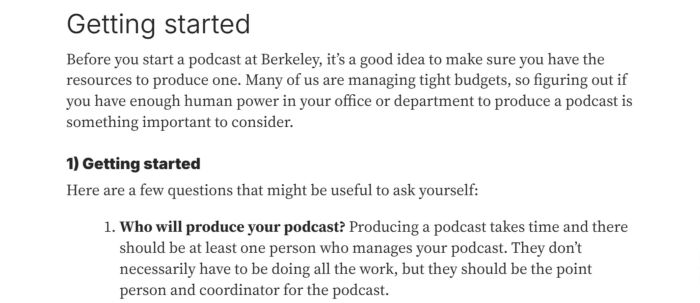
    Example: At UC Berkeley, staff in the communications department use a variety of clever do-it-yourself strategies to produce high-quality podcasts on a tight budget, proving that high production value is possible even without a fancy studio or expensive equipment.

    HEM BP Image 5HEM BP Image 5

    Source: UC Berkeley

    Step 5: Record and Edit With Your Audience in Mind

    Now it’s time to hit “record.” As you begin, remember that quality matters, not just in audio clarity, but in tone, pacing, and structure.

    Keep your episodes:

    • Concise. Aim for 15 to 30 minutes per episode. That’s long enough to deliver substance, but short enough to fit into a morning commute or lunchtime walk.
    • Focused. Each episode should revolve around a single topic or theme. If you have more to say, turn it into a two-part series.
    • Natural. Avoid reading from a script word-for-word. Outline your key points, then speak conversationally.

    Editing is where your podcast becomes polished. Using editing software, you can tighten up the conversation, remove umms/uhs, add intro music or segues, and generally polish the recording. Aim to balance the sound levels between speakers and cut any extraneous digressions to keep the episode flowing. The goal is an episode that sounds natural but also stays on topic and within your desired length. 

    Don’t be discouraged if the first few recordings feel rough. Podcasting has a learning curve for everyone, and you’ll get more comfortable and skilled with each episode. Incorporate feedback from early listeners and continuously improve your technique.

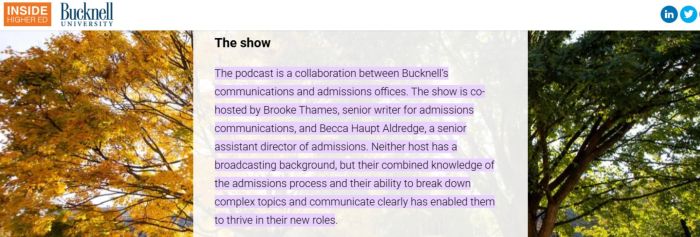
    Example: The team behind Bucknell University, which produces the College Admissions Insider podcast, began with two co-hosts from the admissions office and communications staff who had no prior podcasting experience. They weren’t trained radio personalities, but their deep knowledge of the admissions process and ability to communicate enabled them to create engaging episodes from the get-go. In their case, the hosts’ confidence and skill grew quickly as they recorded more sessions. After the first few episodes, they found their rhythm in interviewing guests and editing the content into a polished final product.

    HEM BP Image 6HEM BP Image 6

    Source: Bucknell University

    Pro tip: If editing feels overwhelming, explore student help or freelance editors. Podcast production is a great opportunity for cross-department collaboration.

    Step 6: Publish and Distribute Your Podcast

    With a finished episode in hand, it’s time to share it with the world. This step involves uploading your episode to your chosen podcast hosting platform and ensuring it gets distributed to all the major listening apps. The good news: once set up, this process is straightforward.

    Start by choosing a podcast hosting service (if you haven’t already). There are many options – from free platforms like Anchor (Spotify for Podcasters) to paid hosts like Libsyn, Podbean, or Buzzsprout. The host is essentially where your audio files live and where your podcast’s RSS feed is generated. When you upload a new episode, your host will update the RSS feed, which in turn notifies podcast directories (like Apple Podcasts) to pull the new content.

    Upload your MP3 file to the host and fill in the episode details: title, description, episode number, season (if applicable), etc. Use this metadata to attract listeners – write a clear, engaging description and include relevant keywords (e.g., “STEM education chat with our Science Department” or “Tips for college admissions interviews”). Also, upload your cover art if you haven’t already, as it will display on players.

    Next, distribute your podcast. Submit the RSS feed to major platforms such as Apple Podcasts, Spotify, Google Podcasts, and Amazon Music. Many hosts provide one-click distribution or guides to do this. Usually, you only need to do the submission once for each platform; after that, new episodes will appear automatically. Don’t forget any niche or regional platforms popular with your audience. Essentially, you want your school’s podcast to be available wherever listeners might look.

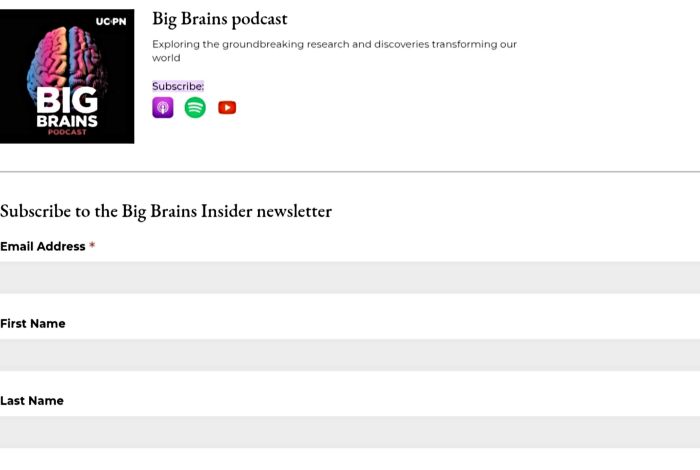
    Example: The University of Chicago hosts its award-winning Big Brains podcast on a platform that syndicates it widely – on the official UChicago site, the podcast page prominently offers subscribe buttons for Apple Podcasts, Spotify, and even YouTube. Once UChicago uploaded episodes and submitted their feed, their content became available across all those apps. In practice, this means a parent commuting to work can pull up Apple Podcasts and find the school’s show, while a student on Android might use Spotify to listen – the experience is seamless.

    HEM BP Image 7HEM BP Image 7

    Source: University of Chicago

    Step 7: Promote Your Podcast Across Channels

    “If you build it, they will come” doesn’t quite apply in podcasting. After creating a podcast for students and other members of your school’s community, you have to actively promote your school podcast so that your community (and beyond) know it exists. Promotion is an ongoing step, not a one-time task.

    Here’s how to promote your school podcast effectively:

    • Website: Create a dedicated podcast page with episode archives and show notes.
    • Social Media: Share episode clips, quotes, or audiograms on social media platforms like Instagram, Facebook, and LinkedIn.
    • Email Marketing: Feature new episodes in newsletters or nurture campaigns.
    • Admissions Materials: Mention your podcast in brochures or application confirmation emails.
    • Student Portals and Alumni Networks: Make your episodes discoverable for internal and extended communities.

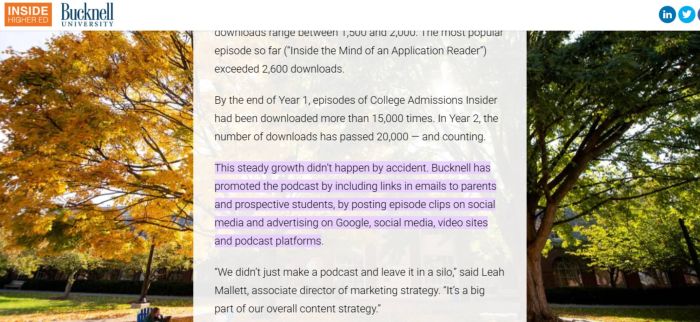
    Example: Bucknell didn’t just publish episodes and hope people would find them. The university made the podcast an integral part of its outreach. They promoted it vigorously by including podcast links in emails to prospective students and parents, sharing episode clips on social media, and even running targeted online ads to reach more listeners.

    HEM BP Image 8HEM BP Image 8

    Source: Bucknell University

    Think beyond downloads: Use the podcast to reinforce messaging in other marketing assets like blog posts, webinars, or virtual tours.

    Bonus Tip: Track Performance and Evolve

    Like any marketing initiative, measurement is key. Use analytics tools (often provided by your podcast host) to track:

    • Number of downloads
    • Listener demographics
    • Episode drop-off points
    • Subscription growth

    But don’t stop at the numbers. Solicit feedback from listeners. What do they want to hear more of? Which episodes resonated most?

    Note: Your podcast will evolve. You might tweak your format, test new topics, or expand your production team. That’s a good thing. Podcasting, like all great content marketing, thrives on iteration.

    Partner With HEM to Create an Authentic Podcast That Stands Out

    Starting a school podcast isn’t about jumping on a trend. It’s about creating a platform to tell your school’s story in a compelling, authentic way. 

    Why are podcasts good for school? Podcasts are engaging, cost-effective, and easy to access. They help schools build trust, highlight culture, and communicate more personally with students, parents, and alumni, especially in today’s mobile-first world where audio content fits busy lifestyles.

    In today’s crowded education market, families crave meaningful connections. They want to hear directly from your community, not just what you offer, but who you are. A podcast helps you do exactly that.

    It’s a platform that humanizes your brand, showcases your values, and builds real relationships with your audience. In short, it allows your community to hear your voice, quite literally. 

    In a nutshell, the answer to the question “How do I make an academic podcast?” can be summed up in a few crucial steps. Start by defining your goal and audience. Choose a format, plan episodes, and use basic recording equipment or software. Feature faculty or students, keep episodes concise, edit for clarity, and publish on platforms like Spotify or Apple Podcasts. Promote it across your school’s channels.

    Ready to bring your school’s story to life through podcasting? Start by defining your audience and recording a pilot episode. With each step, you’ll gain clarity and momentum.

    If you’d like support planning your podcast strategy, identifying compelling topics, or aligning the content with your admissions goals, HEM is here to help.

    Would you like to learn how to create a podcast for students? 

    Contact HEM for more information.

    Struggling with enrollment?

    Our Digital Marketing team can help you generate more leads!

    Frequently Asked Questions

    Question: What is a podcast in school?
    Answer: A school podcast is an audio series created by educators, students, or staff to share news, stories, or educational content. It can highlight campus life, feature interviews, or support learning, helping schools connect with their communities in an accessible, on-demand format.

    Question: Why are podcasts good for school?
    Answer: Podcasts are engaging, cost-effective, and easy to access. They help schools build trust, highlight culture, and communicate more personally with students, parents, and alumni, especially in today’s mobile-first world where audio content fits busy lifestyles.

    Question: How do I make an academic podcast?
    Answer: Start by defining your goal and audience. Choose a format, plan episodes, and use basic recording equipment or software. Feature faculty or students, keep episodes concise, edit for clarity, and publish on platforms like Spotify or Apple Podcasts. Promote it across your school’s channels.

    Source link

  • Columbia University Settles Class Action Lawsuit Over Inflated Rankings Data for $9 Million

    Columbia University Settles Class Action Lawsuit Over Inflated Rankings Data for $9 Million

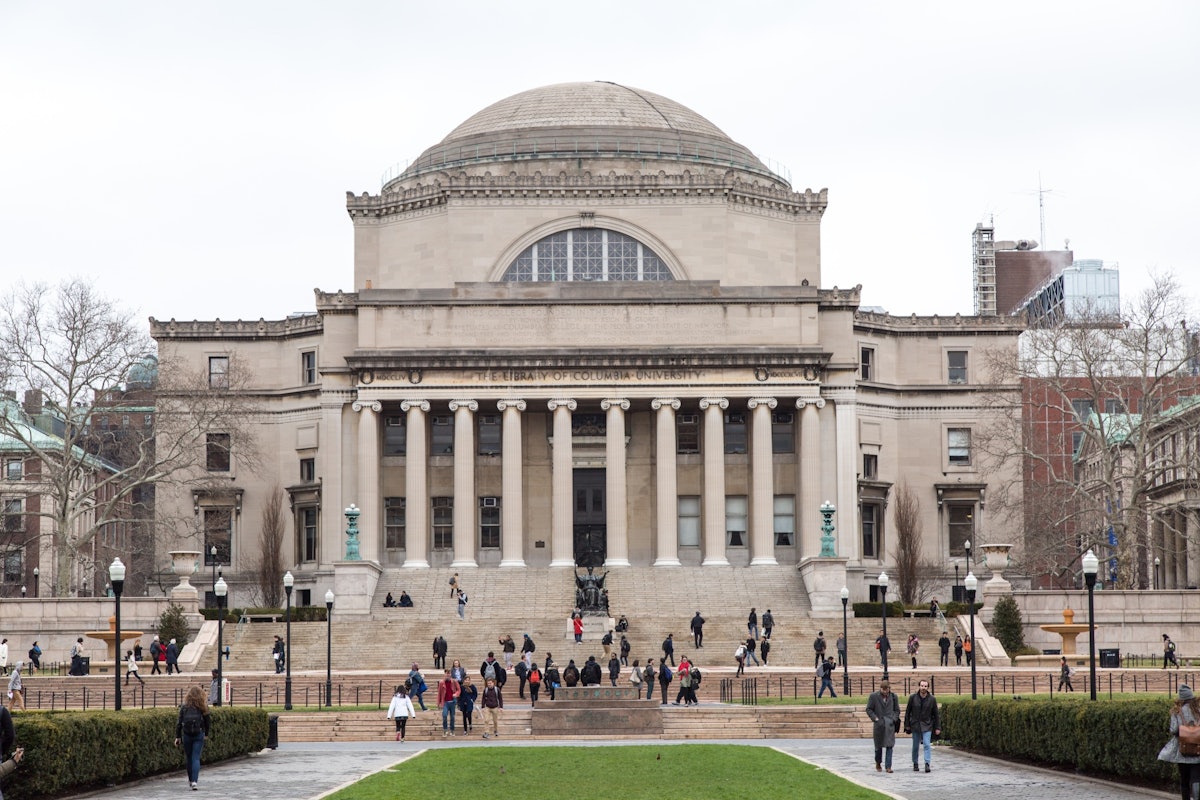
    Columbia University has reached a $9 million settlement agreement with undergraduate students who alleged the institution deliberately submitted false information to U.S. News & World Report to artificially boost its college rankings position.

    The preliminary settlement, filed last Monday in Manhattan federal court and pending judicial approval, resolves claims that Columbia misrepresented key data points to enhance its standing in the influential annual rankings. The university reached as high as No. 2 in the undergraduate rankings in 2022 before the alleged misconduct came to light.

    Students alleged that Columbia consistently provided inaccurate data to U.S. News, including the false claim that 83% of its classes contained fewer than 20 students. The lawsuit argued these misrepresentations were designed to improve the university’s ranking position and, consequently, attract more students willing to pay premium tuition rates.

    The settlement covers approximately 22,000 undergraduate students who attended Columbia College, the Fu Foundation School of Engineering and Applied Science, and the School of General Studies between fall 2016 and spring 2022.

    The controversy began in July 2022 when Columbia mathematics professor Dr. Michael Thaddeus published a detailed analysis questioning the accuracy of data underlying the university’s No. 2 ranking. His report alleged that much of the information Columbia provided to U.S. News was either inaccurate or misleading.

    Following the publication of Thaddeus’s findings, Columbia’s ranking plummeted to No. 18 in September 2022. The dramatic drop highlighted the significant impact that data accuracy has on institutional rankings and reputation.

    In response to the allegations, Columbia announced in June 2023 that its undergraduate programs would withdraw from participating in U.S. News rankings altogether. The university cited concerns about the “outsized influence” these rankings have on prospective students’ decision-making processes.

    “Much is lost when we attempt to distill the quality and nuance of an education from a series of data points,” Columbia stated in explaining its decision to withdraw from the rankings process.

    While denying wrongdoing in the settlement agreement, Columbia acknowledged past deficiencies in its reporting practices. The university stated it “deeply regrets deficiencies in prior reporting” and has implemented new measures to ensure data accuracy.

    Columbia now provides prospective students with information that has been reviewed by an independent advisory firm, demonstrating the institution’s commitment to transparency and accurate representation of its educational offerings.

    Columbia’s decision to withdraw from U.S. News rankings reflects a growing skepticism among elite institutions about the value and impact of college ranking systems. Harvard and Yale have also stopped submitting data to U.S. News for various programs, signaling a potential shift in how prestigious universities approach rankings participation.

    Under the terms of the agreement, student attorneys plan to seek up to one-third of the settlement amount for legal fees, which would leave approximately $6 million available for distribution among affected students. The settlement requires approval from a federal judge before taking effect.

    Student lawyers characterized the accord as “fair, reasonable and adequate” given the circumstances of the case and the challenges inherent in proving damages from ranking manipulation.

    Source link

  • The Untimely Disappearance of Investigative Reporter Mike Vasquez

    The Untimely Disappearance of Investigative Reporter Mike Vasquez

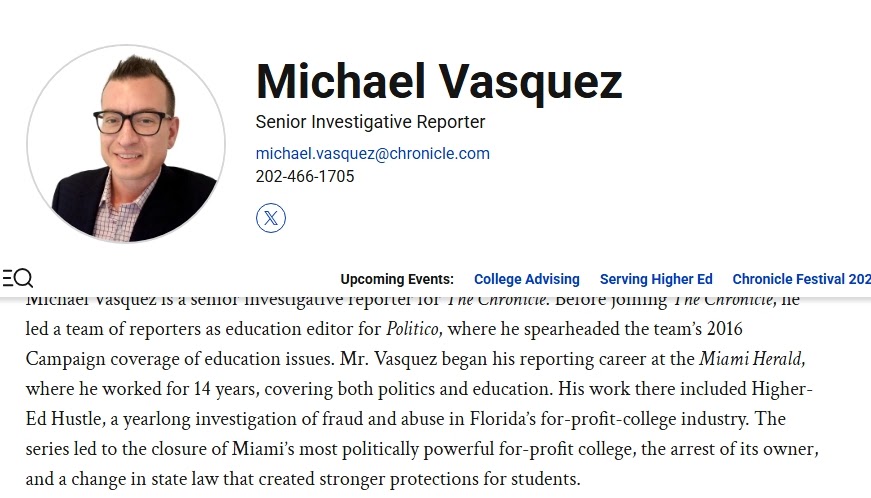
    Michael Vasquez, a veteran investigative journalist known for his dogged reporting on the for-profit college industry and higher education corruption, appears to have been quietly laid off by The Chronicle of Higher Education in 2024even though he is still listed on their website as a senior investigative reporter.

    Vasquez’s last byline for The Chronicle appeared in August 2024, with no public announcement of his departure from the publication. His silence since then has raised questions among media observers and watchdogs who followed his work. Given the importance of his investigations—often exposing powerful institutions that exploit vulnerable students—his absence is conspicuous and troubling.

    Before joining The Chronicle, Vasquez led education coverage at Politico and served as a longtime reporter at The Miami Herald. His career has been marked by award-winning investigations into fraudulent colleges, political influence in higher education, and the failings of accreditation and oversight systems. In a time when public interest journalism is shrinking, his work stood out for its rigor, clarity, and impact.

    That Vasquez was laid off in a year of wider cutbacks and financial uncertainty in journalism is hardly surprising. But his continued listing on The Chronicle’s website could reflect an industry practice of obscuring layoffs to protect institutional reputation, or a lack of transparency about the ongoing hollowing out of serious investigative reporting.

    His departure comes as the for-profit college industry appears to be regaining political momentum under a second Trump presidency, and as student borrowers, whistleblowers, and contingent faculty face mounting challenges. Without voices like Vasquez’s, the public may lose one of its fiercest advocates for truth and accountability in U.S. higher education.

    If Michael Vasquez has moved on to other work—or has been pushed out by institutional pressures—he hasn’t said so publicly. But the silence speaks volumes.

    Source link

  • Public Higher Education is Splitting in Two (Robert Kelchen)

    Public Higher Education is Splitting in Two (Robert Kelchen)

    Even though there have been longstanding ideological differences across states, higher education leadership was largely insulated against these differences over the last half-century. Yes, they popped up in meaningful ways on topics such as South African divestment, affirmative action, and antiwar protests, but it was possible for university leaders to move from red states to blue states and vice versa. It helped to share the state’s political leanings, but it was generally not a requirement.

    The last month has clearly shown that potential presidents now must pass an ideological litmus test in order to gain the favor of governing boards and state policymakers. Here are three examples:

    • Santa Ono’s hiring at Florida was rejected by the system board (after being approved by the campus board) due to his previous positions in favor of diversity initiatives and vaccine mandates. He tried to pivot his views, but it was not enough for Republican appointments on the board.
    • Six red states, led by Florida and North Carolina, are seeking to launch a new accreditor to break free from their longtime accreditor (which was the only major institutional accreditor to never have a DEI requirement, although their diversity page is now blank). Florida Governor Ron DeSantis used his press conference to go on a tirade against higher education, but the North Carolina system’s statement was more cautious, focused on academic quality.
    • The Trump administration’s Justice Department effectively forced out University of Virginia president James Ryan over his alleged noncompliance in removing diversity initiatives from campus. This effort was successful because Virginia’s Republican governor also supported removal and has the ability to push the institution’s governing board to take action.

    While there has been a long history of politicians across the ideological spectrum leading universities (such as Mitch Daniels at Purdue, John King at the State University of New York, and Dannel Molloy at Maine), these politicians have generally set aside most of their ideological priors that are not directly related to running an institution of higher education. But now a growing number of states are expecting their campus presidents to be politicians that are perfectly aligned with their values.

    There are two clear takeaways from recent events. The first is that college presidents are now political appointments in the same way that a commissioner of education or a state treasurer would be in many states. Many boards will be instructed (or decide by themselves) to only hire people who are ideologically aligned to lead colleges—and to clean house whenever a new governor comes into power. The median tenure of a college president is rapidly declining, and expect that to continue as more leaders get forced out. Notably, by threatening to withhold funding, governors do not even have to wait for the composition of the board to change before forcing a change in leadership. New presidents will respond by requesting higher salaries to account for that risk.  

    Second, do not expect many prominent college presidents to switch from red states to blue states or vice versa. (It may still happen among community colleges, but even that will be more difficult). The expectations of the positions are rapidly diverging, and potential leaders are going to have to choose where they want to be. Given the politics of higher education employees, blue-state jobs may be seen as more desirable. But these positions often face more financial constraints due to declining enrollments and tight state budgets, in addition to whatever else comes from Washington. Red-state jobs may come with more resources, but they also are likely to come with more strings attached.

    It is also worth noting that even vice president and dean positions are likely to face these same two challenges due to presidential transitions and the desire of some states to clean house within higher education. That makes the future of the administrative pipeline even more challenging.  

    [This article first appeared at the Robert Kelchen blog.]

    Source link

  • Decoder Replay: Is truth self-evident?

    Decoder Replay: Is truth self-evident?

    Fake news is dangerous. But it’s hardly new.

    More than 3,000 years ago, the largest chariot battle ever pitted the forces of one of the most powerful pharaohs of ancient Egypt — Ramesses the Great — against the Hittite Empire in Kadesh, near the modern-day border between Lebanon and Syria.

    The battle ended in stalemate.

    But once back in Egypt, Ramesses spread lies portraying the battle as a major victory for the Egyptians. He had scenes of himself killing his enemies put up on the walls of nearly all his temples.

    It was propaganda. “It is all too clear that he was a stupid and culpably inefficient general and that he failed to gain his objectives at Kadesh,” Egyptologist John A. Wilson wrote.

    Disinformation in ancient Rome

    The Roman general Mark Antony killed himself with his sword after his defeat in the Battle of Actium upon hearing false rumors — fake news — propagated by his lover Cleopatra claiming that she had committed suicide.

    American patriots, including the esteemed U.S. statesman and inventor Benjamin Franklin, and their British enemies swapped spurious allegations during the American Revolution that murderous Native Americans were working in league with their adversaries, scalping allies.

    How about the 1938 radio drama, “The War of the Worlds”? Adopted from a novel by H.G. Wells, the radio broadcast fooled some listeners into believing that Martians had landed in America. Newspapers of the day said the broadcast sparked panic.

    But historians today say the panic was exaggerated. So it was fake news about fake news!

    There is no shortage of modern-day instances of fake news. In Myanmar in 2018, the military spearheaded a campaign of fake news, mainly on Facebook, claiming the Rohingya minority had murdered and raped members of the Buddhist majority. The Rohingya were described as dogs, maggots and rapists. The fake news helped trigger violence against the Rohingya that forced 700,000 people to flee their homes.

    The irony is that many in Myanmar had turned to Facebook for information because the military had alienated many citizens with its control of the media. But the same military took advantage of the false reports to crack down on the Muslim minority.

    Election falsehoods

    Similarly, fake news has been used in the Philippines, Indonesia, Malaysia and Sri Lanka to influence the outcome of elections, hide corruption and stir up religious animosity.

    One of the ironies of fake news is it can embolden authoritarian governments to turn the tables and use made-up news as an excuse to crack down on the media. That can enable the regime to control the media message. In other words, fake news to the rescue of autocrats.

    But we should not fool ourselves into thinking that fake news can be cured merely through technological solutions, that it’s a product of our times, that it’s mainly political and that it’s peddled only by our opponents. It’s not the property of any one political party or interest.

    Fake news takes root in the gray area between truth and fiction, an area we can be quite comfortable in. There is something very enticing about fake news, especially if it aligns with our pre-conceived notions. Yet we are apt to think that fake news is the exception, a new aberration.

    We can easily fall victim to fake news in part because we are not always disgusted by lies. We are taught at a very early age that deceit – deception, dishonesty, disinformation – is all around us. And that not all lies are as harmful as others. Our parents read us fairy tales from the earliest of ages, and many tales involve lies.

    The telling of fairy tales

    Take the ancient fable of “The Cock and the Fox,” included in the medieval collection of Middle Eastern folk tales, “One Thousand and One Nights.”

    A hungry fox tries to coax a rooster out of a tree by telling him a tall tale — that there is universal friendship now among hunters and the hunted. The cock has nothing to fear, the wily fox says. It’s a lie, of course.

    So, the equally wily cock resorts to his own lie: he tells the fox that he sees greyhounds running towards them, surely with a message from the King of Beasts. The fox, outwitted, runs away in fear. So here we have two lies in a single story. The moral? “The best liars are often caught in their own lies.”

    Children and their parents are quite comfortable surrounded by lies. Is Santa Claus a malicious or harmless lie?

    Do you know the story of the Wizard of Oz? That classic U.S. movie about a young girl lost in a fantasy world, pursued by witches, struggling to go home? The entire plot relies on a deceit – a supposedly powerful wizard who is nothing more than a bumbling, ordinary conman, who uses magic tricks to make himself seem great and powerful.

    Deceit at the service of entertainment.

    Advertisements are often innocent exaggerations, fiction if you will in the service of business and profit-making. But sometimes ads can veer into falsehoods.

    So fake news is not new. And we’re no strangers to lies. What does that mean for those of us interested in making the world a better place? Should we simply give up because the task is too great?

    Hardly. The lesson is that truth is not black and white, but grey, and it’s a moving target.

    Take, for example, colonialism. From the 15th century on, white Europeans conquered huge swathes of the Americas, Africa, the Middle East, Asia and Oceania. They subjugated millions of people, using brutal violence in many places to subdue indigenous populations. They brought diseases that wiped out millions.

    They exploited natural resources, using native labor and pocketing most of the profit from sales into a global trading network that they established. By 1914, Europeans had gained control of 84% of the globe.

    We know all of that now because colonized peoples have revolted against their colonial rulers and won independence. The wars of independence have been won, yet so many countries around the world are still grappling with the shameful effects of colonialism and racism.

    The ambiguity of truth

    But would everyone have agreed on that depiction of Europeans as rapacious colonialists before the wars of independence?

    Certainly not most of the Europeans, who believed they were exporting a superior civilization to backward natives. Missionaries who led many colonial ventures believed they were doing God’s will by converting native populations to Christianity. And not a few natives turned a blind eye to atrocities and benefited financially.

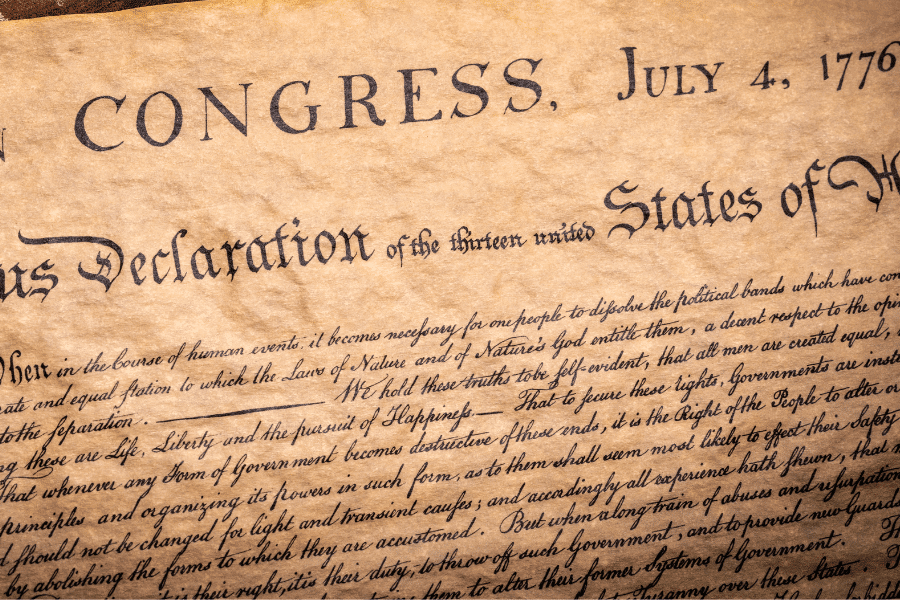
    For a glaring example of the ambiguity of truth, take the United States. Its Declaration of Independence, borrowing from the French enlightenment, states that “all men are created equal,” with “unalienable Rights” to “Life, Liberty, and the pursuit of Happiness.” It put notions of freedom and equality at the heart of the American experiment. Yet it was written by a slave owner, Thomas Jefferson, and represented 13 colonies that all, to one degree or another, allowed slavery.

    Convinced of their superiority and driven by an almost unquenchable appetite for wealth, white settlers drove Native Indians from their homes. The U.S. government authorized more than 1,500 attacks and raids on Indians. By the end of the 19th century, fewer than 238,000 indigenous people remained, down from some 5-15 million living in North America when Columbus arrived in 1492.

    What is more, settlers in the South imported slaves from Africa, forcing them to work on vast plantations and denying them the very rights to life and liberty spelled out in the Declaration of Independence.

    Rights and repercussions

    Both Native Indians and African Americans are struggling to this day to come to terms with the treatment they suffered at the hands of the white colonials.

    Would a white settler have seen himself or herself as a murderer? Hardly. In their minds, they were doing God’s work.

     Mind you, the desire to colonize is not peculiar to Europeans. Imperial Japan and imperialist China both established overseas empires. The Empire of Japan seized most of China and Manchuria. To this day, Chinese nationals and South Koreans harbor ill feelings towards the Japanese. Chinese dynasties won control over parts of Vietnam and Korea.

    There’s an expression in newsrooms around the world: “One man’s terrorist is another man’s freedom fighter.” Put another way, the same individual might seem a terrorist to some, a hero to others.

    Take Yagan, a 19th century indigenous Australian warrior from the Noongar people. He played a key role in early resistance to British colonial rule in an area that is now Perth. His execution by a young settler figures in Australian history as a symbol of the unjust treatment of indigenous peoples by colonial settlers.

    A hero to his people, he was a murderer in the eyes of the British.

    Different perspectives on history

    Or take the Incan emperor, Atahualpa, who resisted the explorer and conquistador Francisco Pizarro, to this day a Spanish hero. Pizarro forced Atahualpa to convert to Christianity before eventually killing him, hastening the end of one of the greatest imperial states in human history.

    How you view Pizarro may depend on where you are sitting and when you lived.

    There are countless modern examples of radically different perspectives on events. Such discrepancies may be inevitable. Dogged journalists can shed light on events and protagonists, and help shape history – for better or for worse.

    Joseph McCarthy was a U.S. senator who in the early years of the Cold War spearheaded a smear campaign against alleged Communist and Soviet spies. Only courageous reporting by a small group of journalists who dared question McCarthy’s tactics and risked being tarred as Communist sympathizers themselves led to McCarthy’s downfall.

    Joseph McCarthy (L) with his attorney Roy Cohn, who later mentored Donald Trump (Wikimedia Commons)

    The New York Times and Washington Post went out on a legal limb when in 1971 they published the Pentagon Papers, a U.S. government history of the Vietnam War that laid bare official lies that drove American policy for more than a decade in Southeast Asia.

    The government called the man who leaked the government documents a criminal and sought to prevent the newspapers from publishing the damning revelations.

    The newspapers won their case before the Supreme Court, and their reporting increased public pressure on the government to withdraw from Vietnam.

    Watergate upended a presidency.

    You’ve perhaps heard of Watergate? Literally speaking, it’s a hotel in Washington, DC. But it has come to stand for the dogged and courageous news reporting by two journalists with the Washington Post who exposed crimes by President Richard Nixon and helped lead to his resignation in 1974.

    Courageous investigative journalism is hardly confined to the United States. A non-profit news outfit called AmaBhungane — in Zulu, “dung beetle,” an animal that digs through shit – has reported on corrupt business deals at the highest levels of South Africa’s government.

    In the Arab world, investigative journalists in Egypt, Yemen, Tunisia, Syria, Lebanon, Jordan, Iraq, Bahrain, Palestine, Mauritania, Algeria, Kuwait and Sudan have uncovered tax evasion, money laundering, drug smuggling, torture and slavery. They have unmasked doctors who have removed the wombs of mentally disabled girls with the consent of parents.

    But it’s not all easy sailing. According to Freedom House, in 2017 there were only 175 investigative journalists in all of China, down 58% since 2011.

    What does this mean for you, a young activist who wants to help change the world?

    Truth is murky.

    The lesson is that the truth may not lie squarely on one side or the other, but rather in a murky, grey area. It can take courage to shine a light in the shadows, teeming with lies. And you may have to hear viewpoints that differ radically from your own. It pays to listen.

    Progress against racism, inequality and injustice depends on an informed public.

    The best journalists recognize their responsibility to uphold the Universal Declaration of Human Rights, which state that: all human beings are born free and equal in dignity and rights; and everyone has the right to freedom of opinion and expression; this right includes freedom to hold opinions without interference and to seek, receive and impart information and ideas through any media and regardless of frontiers.

    As the third U.S. President Thomas Jefferson said: “Were it left to me to decide whether we should have a government without newspapers or newspapers without a government, I should not hesitate a moment to prefer the latter.”

    So stick up for your rights, including the right to free expression. Be fair. And remember that one man’s terrorist may be another man’s freedom fighter. You don’t have a lock on the truth.


    Questions to consider:

    1. Why is it important to understand that fake news is nothing new?

    2. Do you think there is any way to stamp out fake news?

    3. What does it mean to say, “One man’s terrorist is another man’s freedom fighter”?


    Source link

  • Indiana public colleges to shed or consolidate over 400 degree programs

    Indiana public colleges to shed or consolidate over 400 degree programs

    This audio is auto-generated. Please let us know if you have feedback.

    Dive Brief: 

    • Six of Indiana’s higher education institutions are moving to collectively cut or consolidate over 400 programs in the face of a state law taking effect Tuesday that aims to end academic offerings that award low numbers of degrees. 
    • The programs on the chopping block account for 19% of all degree offerings at the state’s public higher education institutions. The colleges opted to consolidate 232 programs, suspend 101 and eliminate 75. 
    • Under the new state law, public colleges must seek approval from the Indiana Higher Education Commission to continue degree programs that don’t graduate enough students to meet certain thresholds. If the commission doesn’t grant approval, colleges must eliminate those programs. 

    Dive Insight: 

    The new quotas are a part of a slate of last-minute provisions that Indiana lawmakers added to the state’s budget plan, which was signed into law in early May, to reshape college governance. Along with the quotas, lawmakers also implemented post-tenure reviews for faculty and gave Republican Gov. Mike Braun full control over selecting Indiana University’s governing board. 

    Braun praised the degree cuts and consolidations in a statement Monday, casting them as a way to ensure public colleges prepare students for in-demand fields and streamline their offerings. 

    “This will help students make more informed decisions about the degree they want to pursue and ensure there is a direct connection between the skills students are gaining through higher education and the skills they need most,” Braun said. 

    Under the new law, associate degree programs are on the chopping block if the average number of students they graduate falls under 10 students over the past three years, while bachelor’s programs are at risk if they graduate fewer than an average of 15 students. Master’s and doctoral programs have slightly lower thresholds — an average of seven and three students, respectively. 

    Indiana University is moving to cut or consolidate 249 programs across its campuses, the most out of the six institutions. Of those, the university is immediately eliminating 43, suspending another 83 and consolidating 123. 

    Indiana University Bloomington, the flagship campus, will see 116 degree cuts or consolidations. 

    The cuts and consolidations at Bloomington heavily impact programs in education, humanities and foreign languages, including bachelor’s programs in Spanish, French, Italian and Portuguese. However, they also include STEM programs, such as bachelor’s in statistics and atmospheric science. 

    Ahead of the news, some faculty members expressed concern they could lose their jobs due to the state law, Heather Akou, president-elect of the Bloomington Faculty Council, recently told WFYI

    “Even tenured faculty are wondering, am I going to have a job in two months?” Akou told the station. “We’re scheduled to teach classes. Will I be allowed to teach the classes I’m scheduled to teach this fall? I don’t know. That’s really the level of chaos and confusion that’s going on right now.”

    An Indiana University spokesperson on Tuesday said that 27 programs would be created through consolidating other programs. The spokesperson did not answer questions about how the cuts and consolidations would impact faculty, but referred Higher Ed Dive to a university announcement detailing the changes.  

    Purdue University is moving to cut or consolidate 83 programs, followed by Ball State University (51 programs), Indiana State University (11 programs), Ivy Tech Community College (10 programs) and University of Southern Indiana (4 programs).

    Source link