Author: admin

  • A Harvard College Has a Plan B for International Students

    A Harvard College Has a Plan B for International Students

    The Harvard Kennedy School announced a contingency plan for its international students Tuesday in the event that the Trump administration successfully bars the university from enrolling foreign students, according to The Boston Globe.

    The Kennedy School, Harvard’s postgraduate college of government, public policy and international affairs, said that both incoming and returning students could study remotely, and returning students would be given the option to finish their degree at the University of Toronto’s Munk School of Global Affairs and Public Policy. 

    “We are announcing these contingency plans now to alleviate the uncertainty many students feel, but we will not officially launch these programs unless there is sufficient demand from students who are unable to come to the United States,” Kennedy School dean Jeremy Weinstein wrote in an email Tuesday.

    Harvard needs the approval of its accreditor, the New England Commission of Higher Education, to allow students to complete their degrees online, and current students who want to study in Toronto would have to apply for a Canadian visa next month.  

    The Kennedy School is the first college at the university to release its formal contingency plan; others are working on developing their own. HKS is particularly vulnerable to a foreign student ban: 59 percent of its students are international, compared to 24 percent of Harvard’s total student population.

    Harvard is currently suing the Trump administration over multiple attempts to ban its foreign student population, including by revoking the university’s Student Exchange and Visitor Program certification and issuing an executive proclamation. Last Friday, a federal judge granted Harvard a preliminary injunction in one of its court challenges. 

    Even if the Trump administration’s efforts targeting Harvard specifically are struck down by the courts, other moves—such as revoking Chinese students’ visas en masse or banning nonimmigrant visa holders from a dozen countries—could prevent some of the Kennedy School’s current and incoming students from attending.

    Source link

  • DOJ Sues Minnesota Over In-State Tuition for Noncitizens

    DOJ Sues Minnesota Over In-State Tuition for Noncitizens

    The U.S. Department of Justice sued Minnesota lawmakers Wednesday over the state’s policy allowing in-state tuition benefits for undocumented students.

    The lawsuit names Gov. Tim Walz, Attorney General Keith Ellison and the state’s Office of Higher Education as defendants. It claims Minnesota is violating federal law and discriminating against U.S. citizens by permitting noncitizens who grew up in the state to pay in-state tuition rates. Under the Minnesota Dream Act, signed into law in 2013, undocumented students have to meet various criteria to qualify, including spending three years at and graduating from a Minnesota high school.

    The suit also takes issue with the state’s North Star Promise Program, a free college program launched last year for Minnesotans who meet certain requirements, including undocumented students who live in the state.

    The lawsuit comes after the Justice Department successfully sued Texas over the same issue earlier in June. Texas swiftly sided with the federal government, and within hours, its two-decade-old law allowing in-state tuition for undocumented students became moot. The DOJ also sued Kentucky politicians over its in-state tuition policy last week. The lawsuits cite President Donald Trump’s May executive order that called for a crackdown on cities and states with laws that benefit undocumented immigrants, including those that offer in-state tuition benefits.

    “No state can be allowed to treat Americans like second-class citizens in their own country by offering financial benefits to illegal aliens,” Attorney General Pamela Bondi said in a news release. “The Department of Justice just won on this exact issue in Texas, and we look forward to taking this fight to Minnesota in order to protect the rights of American citizens first.”

    Source link

  • Universities “At Risk of Overassessing” in Response to AI

    Universities “At Risk of Overassessing” in Response to AI

    The number of assessments set by universities is steadily rising, but there are worries this could result in student burnout and prove counteractive if implemented without centering learning.

    recent report by the U.K.-based Higher Education Policy Institute (Hepi) and Advance HE found that assessments at U.K. institutions have risen to 5.8 summative assignments and 4.1 formative assignments per semester in 2025, compared to five summative assessments and 2.5 formative assessments in 2020.

    Josh Freeman, policy manager at Hepi and co-author of the report, said the advent of AI is “reducing the accuracy of assessments as a measure of students’ performance,” prompting universities to re-evaluate their examination methods.

    “It’s possible that course organizers are assessing students more to improve the confidence they have in their assessments,” he said.

    “It’s also possible that, as they redo assessment models, which may have remained the same for a long time, they are switching to alternative models of assessment—for example, those that assess students on an ongoing basis, rather than simply once at the end of the year.”

    However, rising numbers of exams risks universities “overassessing” students, he added, as “students now face an intense battle over their time,” noting that the number of hours that students spend studying has fallen.

    “[Many are making] sacrifices around social activities, sports and societies. These ‘extra’ activities are the first to go when students are squeezed and would probably be cut further if the academic elements of university become more demanding.”

    Some 68 percent of students in the U.K. are now undertaking part-time work during term time, a record high, largely in response to cost-of-living pressures.

    Michael Draper, a professor in legal education at Swansea University and chair of the university’s academic regulations and student cases board, said that some universities have begun supplementing assessments with “some form of in-person assessment” to counteract AI “credibility concerns.” But “that of course does lead to perhaps overassessment or more assessments than were in place before.”

    “Students have got so many competing claims on their time, not just in relation to work, but care responsibilities and work responsibilities, that you run the risk of student burnout,” he continued.

    “That is not a position you actually want to be in. You want to make sure that students have got a fair opportunity to work consistently and get the best grade possible. You want students to have a chance to reflect upon their feedback and then to demonstrate that in other assessments, but if they’re being continuously assessed, it’s very difficult to have that reflection time.”

    However, Thomas Lancaster, principal teaching fellow in the Department of Computing at Imperial College London, speculated that a rise in the number of exams could be a sign that assessments are being “split into smaller stages,” with more continuous feedback throughout the process, which could also simultaneously have benefits for counteracting AI use.

    “This is something I’ve long recommended in response to contract cheating, where it’s good practice to see the process, not just the final product. So I do hope that the revised assessment schedules are being put in place to benefit the students, rather than purely as a response to AI.”

    While breaking assessments down could prove beneficial to student learning, Drew Whitworth, reader at the Manchester Institute of Education, questioned, “How does one count what constitutes ‘separate’ assessments?”

    “If a grade is given partway through this process … this is actually quite helpful for students, answering the question ‘How am I doing?’ and giving them a pragmatic reason to show [their work and that they are working] in the first place.

    “But does this count as a separate assessment or just part of a dialogue taking place that helps students develop better work in response to a single assessment?”

    Source link

  • Researchers “Cautiously Optimistic” NIH Will Restore Grants

    Researchers “Cautiously Optimistic” NIH Will Restore Grants

    Months after individual researchers, advocacy groups and a coalition of Democratic state attorneys general filed two lawsuits against the National Institutes of Health for terminating hundreds of active research grants misaligned with the Trump administration’s ideologies, some scientists are hopeful that the agency will soon restore the grants and allow them to resume their research.

    Last week, a federal judge in Massachusetts ordered the NIH to restore the roughly 900 grants named in the lawsuits, including many focused on studying vaccine hesitancy, LGBTQ+ health and diversity, equity and inclusion in the medical field. U.S. District Judge William Young, who was appointed by President Ronald Reagan, ruled the terminations void and unlawful, stating during a hearing that in all his years on the bench he’d “never seen” discrimination by the government to this extent.

    Although Science reported Thursday morning that the NIH has internally communicated plans to restore those grants “as soon as practicable”—and also cease further grant terminations—researchers say they still don’t know when they can expect to get the money they were promised.

    “Since the ruling, we are really encouraged,” said Heidi Moseson, a plaintiff in one of the cases and a senior researcher at Ibis Reproductive Health. “But we haven’t heard anything from the NIH about our grants being reinstated, and we don’t have a window into what that process looks like.”

    Back in March, Moseson received a letter from the agency terminating her grant, which was aimed at improving the accuracy of data collected in sexual and reproductive health research for all people, including those who identify as transgender and gender diverse. The award “no longer effectuates agency priorities,” the letter said. “Research programs based on gender identity are often unscientific, have little identifiable return on investment, and do nothing to enhance the health of many Americans.”

    The NIH did not respond to Inside Higher Ed’s request for comment on its specific plans for restoring the terminated grants.

    Appeal Anxiety

    Moseson said each week that goes by with the grant on pause “is another week where people are not being appropriately screened into clinical care and research that would be relevant for their bodies, leading to missed preventative care or, conversely, unnecessary preventive care.”

    While her team is ready to resume their research as soon as the NIH restores the funding in accordance with the judge’s ruling, she’s bracing for further disruptions ahead, depending on what happens with the appeals process.

    On Monday, the NIH filed a notice of appeal with the U.S. Court of Appeals for the First Circuit. It also filed a motion to stay the judge’s order to restore the grants while pending the appeal, but Young denied that motion on Tuesday, noting that a stay “would cause irreparable harm to the plaintiffs.”

    “This is a case in equity concerning health research already bought and paid for by the Congress of the United States through funds appropriated for expenditure and properly allocated during this fiscal year,” the judge wrote. “Even a day’s delay further destroys the unmistakable legislative purpose from its accomplishment.”

    The following day, Michelle Bulls, a senior NIH official who oversees extramural funding, told staffers in an email that the agency must restore funding for the hundreds of projects identified by the plaintiffs, Science reported. “Please proceed with taking action on this request as part of the first phase of our compliance with the court’s judgment,” Bulls wrote, noting that “additional information is forthcoming.”

    Noam Ross, executive director at rOpenSci, a nonprofit that supports reproducible open research, and co-founder of the website Grant Watch, which is tracking grant terminations, put out a call for information on LinkedIn Wednesday about any grants the NIH has restored. But he told Inside Higher Ed Thursday afternoon that he has yet to receive any verified reports of restored NIH grants.

    Shalini Goel Agarwal, counsel for Protect Democracy, a nonprofit focused on combating perceived authoritarian threats, and one of the lawyers representing the plaintiffs, said Thursday morning that she also had not yet heard of any researchers getting grant money the NIH previously terminated.

    Though it’s not clear what could come of the government’s effort to appeal Young’s ruling, “at this moment the judge’s order is in effect and the NIH should be returning money to the researchers whose grants were terminated,” she said. “NIH should right now be undoing the effects of its directives.”

    ‘Cautiously Optimistic’

    Katie Edwards, a social work professor at the University of Michigan and a plaintiff in one of the cases, said that as of Thursday afternoon, she had yet to receive any communication from the NIH about its plans to restore her numerous multiyear grants.

    Edwards, whose research focuses on Indigenous and LGBTQ+ youth, said that delaying the grants much longer will undermine the research she’s already started, to the detriment of public health research.

    “For some of our studies, it’s just a matter of weeks before they’ll be really hard if not impossible to restart. I’m feeling a lot of anxiety,” she said. “We’re in a waiting phase, but I’m trying to be cautiously optimistic.”

    Despite the uncertainty of what’s ahead, she did get some reassuring news from the NIH on Thursday. The agency notified her that it approved her bid for a new three-year, $710,000 grant to develop and evaluate a self-defense program for adult women survivors of sexual violence. Like many other applications for new grants, the application had been in limbo for months. “So something (good??) is going on there!” she said in an email.

    Other cases moving through the courts also look promising for federally funded researchers eager to get their grants restored.

    On Monday, U.S. District Court Judge Rita Lin ruled that the Environmental Protection Agency, the National Science Foundation and the National Endowment for the Humanities had also unlawfully terminated grants that had already been awarded to researchers in the University of California’s 10-campus system. The judge, a Biden appointee, ordered the government to restore them, adding that she is weighing extending the order to 13 other federal agencies, including the NIH.

    “Many of the cases that are making their way through the courts share claims that are being made about the illegality of the federal government’s actions,” said Olga Akselrod, counsel for the American Civil Liberties Union and a lawyer representing the plaintiffs in one of the suits against the NIH. “Any time we have a win in one of these cases it’s an important statement of the applicable law, and that’s relevant for all of the cases that are proceeding.”

    Source link

  • DfE sets out the detail on the free speech act

    DfE sets out the detail on the free speech act

    In some ways, there’s little that’s new in the Department for Education’s Command Paper on the future of the Higher Education (Freedom of Speech) Act 2023.

    Over 30 pages or so, it basically puts some meat on the bones of the two announcements made by Secretary of State Bridget Phillipson – the one from last Summer where the act’s implementation was paused, and the one from January which discussed the plan in outline to partially repeal.

    This isn’t the first Command Paper from DfE on the issue – back in 2021, then Secretary of State Gavin Williamson’s effort was a fairly heavily ideological compendium of Telegraph stories and Policy Exchange talking points – picking up everything from cancel culture to students being encouraged “to report others for legal speech”.

    This run at things tends to deftly avoid all of that. It’s about as technical as you can get, with pretty much all of the critique justifying the approach based on workability and burden. Even that “sources close to the Secretary State” quote from last Summer on the Act representing some sort of “hate speech charter” is missing in action here – with the only discussion on harassment surrounding the ban on non-disclosure agreements.

    That’s either savvy politics from a government keen to douse down culture war flames, or a hostage to fortune when OfS’ particular approach to the balancing act between free speech and EDI at some stage comes back to bite – with ministers caught in the middle.

    And we’re off

    We already knew that the government had decided to commence the duties on providers regarding freedom of speech and academic freedom, as set out in Section 1 of the Act. The regulations were made on 28 April 2025, the duties come into force on 1 August 2025, and we got some actual (if controversial) guidance from OfS on 19 June.

    These include requirements for providers to take reasonably practicable steps to secure freedom of speech within the law for staff, members, students, and visiting speakers, as well as protecting academic freedom for academic staff. The Command Paper is keen to point out that the expanded definition of academic freedom will be retained, protecting academic staff from suffering adverse employment consequences solely based on their opinions or ideas.

    Ditto Section 2 of the Act, which covers constituent institutions of providers. DfE says that its decision ensures that constituent institutions such as colleges, schools, or halls within universities (for example, the individual colleges at Oxford and Cambridge) are subject to the same obligations as their parent HE providers.

    It says that the clarification was particularly important to put beyond doubt that these constituent institutions cannot avoid the freedom of speech duties that apply to the main institution – although to the extent to which you see these things as a see-saw, that does mean that Oxbridge Colleges will each be able to maintain their own free speech code of practice, while it’s the central university that will hold a central responsibility for the harassment and sexual misconduct duty as of 1 August.

    Given that Oxbridge colleges tend to be fiercely guarded about their autonomy and independence, that harassment duty and features like its “single source of information” were going to be interesting enough – but given that OfS’ free speech guidance repeatedly mentions harassment considerations when making decisions on free speech, you can see how some astonishing complexity and internal conflict could be coming further down the track.

    It’s also worth noting in passing that while DfE seems keen to put Oxbridge colleges’ direct duties beyond doubt, there’s nothing in here on transnational education – which as we noted in the commentary on OfS’ guidance, is asserted to be outside of the scope of the Act without anything in the way of meaningful justification.

    The other thing in this section is DfE’s pride at extending the non-disclosure agreement ban OfS was already putting in place for harassment and sexual misconduct cases to bullying. It quotes campaigns like “Can’t buy my silence”, but of course doesn’t explain to students why silence can be bought over other types of complaint.

    Yes yous

    The original version of the Bill proposed regulating students’ unions directly – although notably, the SUs of those constituent colleges were to have been exempted on the basis that the college exercises sufficient control.

    Pretty much by accident, that did mean that an FE union whose College was on the register and in receipt of OfS funding was going to be expected to bear all of the complex legal duties and issue a Code of Practice – even if it was unincorporated and run entirely by FE (rather than HE) volunteers.

    So entirely sensibly, there’s confirmation that the government has decided to repeal sections 3 and 7 of the act in their entirety, which would have imposed the direct freedom of speech duties and given OfS regulatory powers over them.

    The workaround is the one that’s been in place since 1994 – regulating SUs through their provider. The rationale for repeal centres on concerns that SUs can lack the financial resources, regulatory capacity, and legal expertise to handle complex duties, that monetary penalties or damage awards could severely impact their ability to provide services and support to students, and the government recognised that SUs are already regulated as charities by the Charity Commission, which oversees their compliance with legal duties including furthering educational purposes through enabling discussion and debate.

    So instead of direct regulation, the government has decided to adopt our proposal from 2021 – the government will expect providers to take reasonably practicable steps to ensure their students’ unions follow codes of practice, which is what already happens over a whole range of issues. Some will see that as an attack on autonomy, others a charter for avoidance – sensible people will see this as the approach that will work.

    Or at least it should work, were it not for the fact that OfS seems to be requiring universities (and therefore by proxy their SUs) to adopt an approach to the balance between free speech and harm that is not legally compliant. More on that in our commentary on OfS’ guidance, suffice to say that SUs at the sharp end of some of the tensions may end up resolving that what OfS might have told them to do is not what they actually should do on a given issue.

    Complainants will be able to complain about the reasonably practicable steps thing – DfE civil servants may have forgotten that the Education Act 1994 also sets up some statutory complaints requirements on SUs themselves, which involve provider review. The other odd bit is that DfE’s amendments to the Act will require providers to set out in their Code of Practice how their students’ union will ensure that affiliation is not denied to any student society on the grounds of its lawful policy or objectives, or the lawful ideas or opinions of its members.

    That goes slightly further than the compliance already expected of SUs as charities over protected beliefs, and extends (very slightly) an existing provision in the Education Act 1994 that the procedure for allocating resources to groups or clubs should be fair and should be set down in writing and freely accessible to all students. It’ll cause conflict at the edges – students do expect to be able to vote on things, and votes can be problematic – but overall this all makes sense.

    Tort a lesson

    You might remember the controversy over the statutory tort – the thing that would have allowed staff, students, and external speakers to bring civil claims against HE providers, constituent institutions, or students’ unions for breaches of their freedom of speech duties.

    The government’s rationale for repealing that bit centres on concerns about its potentially harmful effects on the higher education sector – a chilling effect on freedom of speech that might make institutions more risk-averse about inviting challenging or controversial speakers due to fear of litigation. And so given judicial review, employment tribunals, the OIA complaints scheme for students, and the forthcoming enhanced OfS complaints scheme are all alternatives, plus the financial burden of potential legal costs, it’s gone.

    That all pretty much matches Lords speeches opposed to the Tort at the end of 2022 – this we might expect this to re-emerge as a flashpoint when all of this finds its “appropriate legislative vehicle”.

    This section also says that the government is also concerned that the threat of legal proceedings might lead institutions to prioritise protecting hateful or degrading speech over the interests of those who feel harassed or intimidated – an interesting idea given that both hateful and degrading speech can still be within the law, or at least OfS’ interpretation of it.

    Complaints chaos

    As expected, the Office for Students is going to be stripped of the ability to hear complaints from… students over academic freedom and freedom of speech.

    To be fair, the sensible rationale there is that the Office of the Independent Adjudicator (OIA) is a well-established route that is recognised and understood by students and providers – and that approach will prevent students being baffled about who to approach, or worse, arbitrary categories that had the potential to take a wide-ranging complaint and insist on it being sliced up.

    That won’t remove the potential problem of students on one end of the see-saw and staff on the other each making complaints about the same issue – or OfS and OIA potentially making different judgements. There’s also the prospect that OfS and OIA will handle things at a different pace, and while OfS was proposing to allow a complaint to roll in without exhausting internal procedures, OIA usually needs a Completion of Procedures letter.

    It’s all very well asking the OIA to look at OfS’ guidance, but presumably there’s some risk that the OIA will look at the way OfS is defining free speech within the law and have representations made to it that disagree. Wales would feel pretty aggrieved if OfS’ particular interpretation was imposed on it via OIA’s dual country coverage, and presumably it would be wild for the OIA to say one thing about an incident in Wales and another in England.

    It all feels like the two bodies are being asked to get in a room and talk – on that, DfE just points at Section 63 of HERA (OfS may co-operate with others where appropriate) and says you two should talk. It might strengthen it if needs be.

    DfE also says that it will ask OfS to consider and then set out in requirements or guidance what fit for purpose internal complaints processes for academic freedom look like, although you could just as easily ask the OIA to build something into its Good Practice Framework.

    The other aspect here is that the legislation will switch from OfS having a power rather than a duty to consider complaints under its scheme. DfE says that will enable it to prioritise, for example, the most serious complaints or complaints on issues affecting the whole sector.

    The expectation is that “OfS and Dr Ahmed” will be transparent, independent and neutral in how they prioritise consideration of those complaints – notwithstanding the position-taking evident in the guidance already, that presumably points to some sort of criteria for folk to fight about.

    Lurking in the background of all that is academic freedom – in its consultation on the complaints scheme, OfS pointed at the Higher Education and Research Act and said “the Act will require us to consider every complaint that is capable of being referred under the scheme. It does not preclude us from considering matters of academic judgement.”.

    The OIA of course can’t look at such matters – and with “duty” switched to “power”, we’re going to need OfS to take a view on whether it will do things for staff and speakers that the OIA won’t be able to do for students.

    Foreign funding

    The one policy area where an announcement was pending was section 9 of the legislation, related to OfS’ monitoring of overseas funding to providers with an eye to assessing the extent to which such funding presents risks to freedom of speech and academic freedom. This measure is not currently in force.

    When Bridget Phillipson updated Parliament on Labour’s plans in January, it was the one area where a decision was not announced:

    I will take more time to consider implementation of the overseas funding measures. I remain fully committed to tackling cases of interference by overseas Governments, and the wider measures in the Act will further strengthen our protections. However, I want to ensure that any new reporting requirements for providers add value without being overly burdensome. We continue to work at pace with the sector on the wider implementation of the Foreign Influence Registration Scheme. My officials are working across Government and with the sector to review our response, and I will confirm my final decision in due course.

    Now we get a decision of sorts – and that decision is to continue to keep this under review, and introduce “alternative mitigations to support HE providers to improve international due diligence.”

    For a long time under the last government, the response to any and all bugbears that commentators and politicians had with universities’ and students’ relationships with other countries – ranging from overreliance on international students from certain countries, to research collaborations in weapons technology, to transnational repression, to the activities of Confucius Institutes and Chinese student associations – was that this would all be sorted out through the twin approach of the free speech act and the Foreign Influence Registration Scheme (FIRS). Labour has instead taken the approach that the latter needs to be implemented first.

    FIRS will come into effect on 1 July – we reviewed its implications for the sector back in April – and the policy paper promises to assess what comes out of it. FIRS, we are told, will provide “greater visibility of foreign state influence in the UK,” and information disclosed will be shared with DfE and OfS where relevant, allowing for pattern recognition as well as the prevention of specific threats.

    The alternative – that is, additional – mitigations mentioned above include asking the Office for Students to “consider the value of an explicit regulatory expectation” around due diligence on international partnerships. There’s also work on possible codes of practice and best practice sharing.

    The caveat here is that as FIRS is implemented:

    …it may demonstrate that further reporting on financial or other international arrangements would be beneficial to improve the identification and mitigation of these risks. As a result, we will keep the overseas funding provisions in the act under review in the event that, during FIRS implementation, evidence indicates further transparency reporting is necessary.

    But it feels that the government has come down on the side of listening to the sector about avoiding burden and duplication and, as the paper says, “minimising diversion of resources away from teaching and research.”

    There’s an interesting table on pages 24 and 25 of the command paper, perhaps anticipating criticism over the wait-and-see approach. The table lists all the different measures (ATAS, export controls, harassment duties, financial monitoring, national security act powers) that are already in place to mitigate against “foreign interference”, even without implementing OfS’ new powers.

    (In this context it’s worth briefly noting that Monday’s industrial strategy announced that the government will consult on updating the definitions of the 17 areas of the economy subject to mandatory notification under the National Security and Investment Act, to ensure that they remain “targeted and proportionate”. This could – potentially – see a slight loosening of the areas of research collaboration where higher education institutions need to notify and get approval from the government.)

    Equality impacts

    Finally, there’s a very odd section at the end of the command paper that describes and comments on an Equality Impact Assessment that DfE has, for some mysterious reason, not actually published.

    One of the sections might give us a clue as to why:

    Expanding these duties may lead to more open expression of views which could have a negative impact on those who currently face elevated levels of lawful but offensive comments related to their protected characteristics. They could also potentially lead to increased unlawful harassment against groups with specific protected characteristics.

    It’s almost as if DfE doesn’t want to publish a document that makes the legislation Phillipson is progressing sound like a “Tory hate charter” after all.

    It all partly depends on how OfS plays its duty – again, see the article on the meaning of free speech within the law – but you’d also have to assume that the detail is pretty bleak, and/or offers up all of the remaining fine lines and rhetorical contradictions being dumped on universities to navigate. The tort might be gone, but all of that complexity very much remains.

    Source link

  • “It stays with us”: Leading change in diversity and inclusion for professional services staff

    “It stays with us”: Leading change in diversity and inclusion for professional services staff

    • Nearly five years after the 2020 Universities UK report on racial harassment, the experiences of careers services staff, who shoulder the heavy lifting of employability and inclusion from Graduate Outcomes to Access and Participation and other core metrics, remain unaddressed. Leena Dattani-Demirci, Head of Student Success & Professional Development at De Montfort University, and Claire Toogood, Research and Strategic Projects Manager at AGCAS, share reflections on recent and ongoing research and resources that can help to inform change, leading to action and impact.

    It is clear that existing inequity can inhibit engagement with higher education careers support, creating a vicious cycle where the students with the greatest need for these services may not take up  valuable opportunities. Given the wider lack of diversity in professional services leadership and staffing, there is also a risk that higher education policy and practice will continue failing to incorporate the lived experience and diverse voices that can help to drive change.

    Leena Dattani-Demirci’s current doctoral studies explore the experiences of ethnically minoritised staff within university career services, an area comparatively underexplored despite extensive research on inequalities experienced by academic staff. Her research aims to address that gap, giving voice to the lived realities of those working to support students’ career aspirations. Claire is the author of What Happens Next?, the latest report in a long-running series from AGCAS that identifies and explores disabled graduates’ employment outcomes.

    Barriers and burnout

    Early findings from Leena’s research highlight persistent challenges faced by ethnically minoritised staff.  Drawing on 37 hours of interviews over eight months, this study explored the experiences of 21 ethnically minoritised career professionals in UK higher education. Participants worked in a wide variety of institutions, and most came from working-class backgrounds, with diverse ethnicities, faiths, and, in some cases, experiences of disability. These research participants reported exhaustion, career bottlenecks, and felt forced to leave their institutions to progress. The emotional labour of supporting minoritised students disproportionately fell on minoritised staff. Many staff felt immense pressure, particularly where the diversity of careers teams did not reflect the diversity of the student body. Career professionals described feelings of guilt for not being able to meet the demand for support from minoritised students.

    Microaggressions remain commonplace: Participants described mocking of accents dismissed as “jokes” and being labelled “too sensitive” when raising concerns. “People say things and don’t think about the impact on those of us from BAME families; it stays with us,” one participant noted. Others described ill-equipped managers, promoted through time served, resulting in poor trust and under-reporting of inappropriate comments.

    Performative inclusion is common: initial support for Black Lives Matter faded, and universities responded swiftly to Ukraine but remained silent on Gaza, revealing that, for many, inclusion feels conditional. One research participant highlighted how inclusion and diversity are part of the conversation around students, but not staff, “We’ve had team days where diversity and recruitment have come up for students, but if the topic moves onto our teams, it’s always shut down. People get defensive.”

    Signs of hope and the need for structural change

    Yet compassionate leaders and allies do exist. “When my manager asked me ‘Are you okay?’ during the summer riots, it meant the world to me,” shared one participant in Leena’s research. There is also excellent work happening across higher education, such as staff/student partnerships at the Open University that integrate the lived experiences of marginalised groups in curriculum design, and collaboration to ensure inclusive language across graduate attributes at Bath Spa University. However, default systems and cultures continue to shape staff progression and team structures. As one of Leena’s research participants explained, ‘I felt excluded because a lot of the candidates who did get the roles fit the mould of what managers had in their heads. I’ll never be that”.

    Addressing oversights and inequity within careers services requires accurate data on staff demographics. Gathering the data on who works inside HE careers services is a crucial first step towards meaningful change. AGCAS recently came together with other higher education sector membership bodies to highlight why professional services staff should be included in the HESA staff record; this would support better understanding at a sector level, and lead the way for institutions.

    Intersectional identity

    The AGCAS “What Happens Next?” report underscores the complexity of student identities and outcomes, revealing how intersectional disadvantage can further compound employment challenges for many individuals. This year, the report included outcome evaluations incorporating ethnic background and gender alongside disability status and type. The report showed that while disabled graduates have lower rates of full-time employment than graduates with no known disability across all ethnic backgrounds, White disabled graduates are more likely to be in full-time employment than disabled graduates from any other ethnic background.

    The need for joined-up approaches to careers and employability delivered by a diverse staff team is clear. We need to recognise that each individual’s identity is complex and multi-faceted, and to model equity and inclusion for students.

    Looking forward

    AGCAS has been working with careers professionals in their Equality, Diversity and Inclusion Working Party, Disability Task Group, and Social Mobility, Widening Participation and Regional Inequality Working Party to develop provision that supports genuine sector-wide action in this space. A recent positive action toolkit for members offers clear insights into relevant legislation across the UK and Ireland, including practical examples of how universities and careers services can apply positive action principles. Upcoming drop-in networking sessions support AGCAS members who identify as having Black, Asian and Ethnic heritage to build contacts and develop their network. AGCAS are keen to encourage members and wider higher education stakeholders to be part of our work towards much-needed change, whilst also championing and supporting individual projects like Leena’s that move the conversation forward.

    Source link

  • LEO has a role to play in picking winners

    LEO has a role to play in picking winners

    Perhaps we have LEO all wrong?

    In the week of the industrial strategy, which brought confirmation as to how central higher level skills will be to our plans for national growth, the annual release of longitudinal education outcomes (LEO) data) hits a bit different.

    In the past, ministers and higher education obsessives, have seen the release as a chance to rank universities and subjects – and perhaps even a chance to spot the infamous “low quality courses” – based on median graduate earnings. As we’ve been through time and time again on Wonkhe, this doesn’t really work.

    But quietly, and at the instigation of the former Unit for Future Skills which now forms a part of Skills England, earnings have taken something of a back seat to more detailed information about subject areas, place, and industrial sectors. If you wanted to understand the way in which investment in particular subjects might translate to benefits to particular industries (to support changes to the allocation of the Office for Students Strategic Priorities Grant, for example), LEO is where you would look.

    Factory model

    And you can illustrate this with today’s release of LEO data on graduate outcomes and provider level data. (There’s even a new DfE dashboard.)

    Let’s take a worked example. Advanced manufacturing is one of the eight sectors named in the industrial strategy as a national priority. As a sector it is going to be receiving £4.3bn over the next five years, including £2.8bn in research and development, from the state. Of the “frontier industries” within the manufacturing sector battery technology and advanced materials feel like clear priorities – and exactly the kind of things that might need the higher level skills that a university education might bring – although manufacturing as a whole will be in a similar position.

    How do you develop these skill sets?

    First up, we can see what graduates that work in manufacturing industries have studied. Engineering is the main route (and the route to the kind of high earnings that suggest senior roles) – just over 1,900 people with a first degree in engineering are working in the sector.

    [Full screen]

    But it is clear that manufacturing also needs business expertise (there are 1,350 business graduates in the field) and design capability (890 creative arts and design graduates). Both these groups earn rather less than the engineers – the low level of pay for creative arts graduates suggests that these workers may have recently moved into the sector or are in non-graduate roles, or (whisper it) we might need to pay them better. This latter interpretation is backed up by the fact that similar proportions of graduates are in this sector a year after graduation, and designers are consistently paid less.

    There is a regional component to this too (using the purple filters at the bottom of the chart, note that you can only use one of these at once) as we can see that when we look at London we can see that salary differentials shrink between our top three.

    In terms of specific manufacturing specialisms giving design graduates good jobs ten years on, another plot of the same data suggests automotive, and aircraft/space craft, manufacturing are particularly positive destinations. That said, they are not the primary destinations for creative arts and design graduates ten years out: as with many subject areas teaching is well represented, as are retail and advertising.

    [Full screen]

    The regional dimension

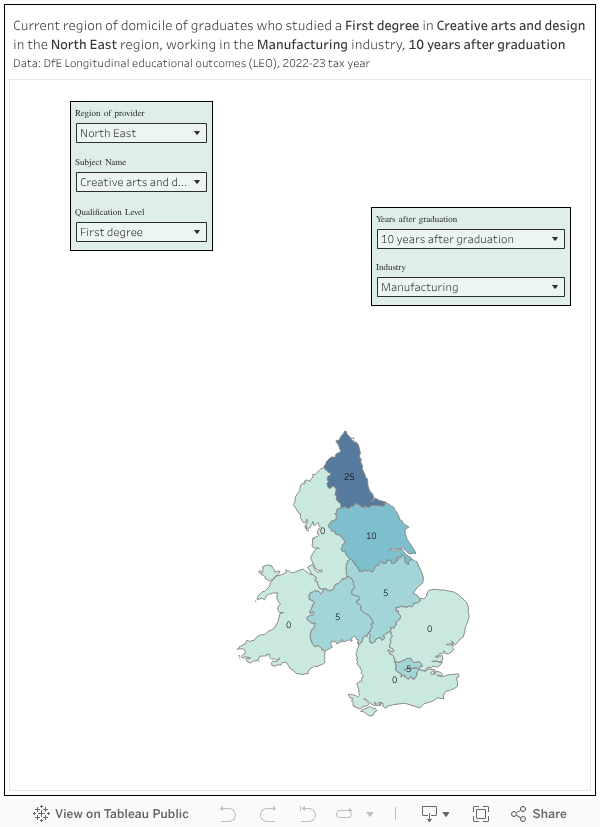
    Let’s say that we also want to use state investment in skills for manufacturing to have a regional benefit – and we wanted to focus on manufacturing in the north east. Would we need to specifically grow design provision in the north east of England in order to provide design graduates for firms there?

    Based on the data, the answer is yes. Most design graduates who studied in the north east working in manufacturing, are working in the north east ten years on. Though the numbers are small, the same appears to be true at other career points.

    [Full screen]

    Do we know if design students (rather than creative arts students) are the ones working in manufacturing? We don’t for certain but we can be reasonably sure. There are more design students than any other subjects in the creative arts and design area – and they tend to earn more ten years on than their peers in the arts. The median salaries also seem to match up – designers aren’t big earners, but they do earn more than some more traditional “skills priority” areas like ecology and mineral technology.

    [Full screen]

    Picking winners

    Seasoned LEO-watchers will be aware that there are issues when you look at specific sub-groups within the data. One of the drawbacks here is that we can’t track design specifically by provider – it would be helpful, if we decide we need more product designers in the north east, we knew which existing provider was landing them that well paid senior roles later in their careers. Best we can tell (and only five years out) it might be Newcastle and Northumbria – but we also need to factor in more granular effects (is Newcastle more likely to offer higher-paid design jobs than Sunderland or Middlesborough – I’d expect so, but we don’t get that data).

    [Full screen]

    It’s also likely that Teesside and Sunderland will be recruiting students with less traditional backgrounds, and we know that will have an impact on careers and salaries – but interestingly it appears to be Northumbria that are getting the best results for students from a domicile in a POLAR4 quintile one area.

    So there we have it: if we want to invest in advanced manufacturing in the north east of England in a way that gets the best results for local people, we need to support the design courses at Northumbria University. Which is something of a shame as we cut state support for design provision a couple of years ago.

    Source link

  • Military education committees and universities’ civic role

    Military education committees and universities’ civic role

    The publication of the Strategic Defence Review (SDR) in early June 2025 emphasised a whole-of-society approach to defence and recognised the importance of societal engagement and resilience-building.

    But there was also an element of missed opportunity – the review should also have been a moment to highlight the role of the network of 19 regional military education committees (MECs) which exist to foster good relations between universities and the armed forces, and their associated university service units (USUs).

    Although universities were prominently featured in the SDR, the focus was narrowly confined to their ability to serve as a talent pipeline and to provide technology to support “warfighting” and “lethality”.

    What’s missing is a more engaged understanding of the broader value universities provide for defence, particularly the role of MECs in fostering this relationship, building on Haldane’s earlier vision of a civic university with strong links to the armed forces.

    We see a need to outline a broad vision for MECs that builds on the SDR but also looks beyond it, offering a future-focused perspective for leaders in the armed forces and academia.

    Universities and civil-military relations

    Universities play a crucial – though often overlooked – role at the interface of civil-military relations. Our graduates are the officers of the future, and with seven per cent of UK households including a veteran, and over 180,000 currently serving, many of our students’ university experiences are inherently shaped by military life, whether as part of service families or as future personnel.

    Established as part of the Haldane Reforms of the armed forces in 1908, MECs were initially created to ensure that officer cadets received a balanced education, combining academic study with military training.

    Today, MECs are a vital bridge between two distinct worlds: academia and the military. They offer a unique forum where these cultures meet, enabling universities to better understand the particular pressures facing students in university service units and students from service families, while helping the military appreciate the academic environment through the eyes of those teaching their officer cadets.

    Military education committees and the student experience

    MECs support students serving in university service units by helping them navigate the dual demands of academic study and armed forces activities. These officer cadets face unique pressures and challenges, but also gain valuable opportunities for skills development, leadership training, and even paid experiences through social and sporting activities including overseas trips and training deployments. For those interested in an armed forces career, scholarships are available which provide a crucial route to higher education, often for those who would otherwise find it financially prohibitive.

    A recent commentary from the Royal United Services Institute underscores the importance of these activities, particularly the role of the University Officer Training Corps (UOTCs) in the British Army’s officer training pipeline. The authors warn against proposals to centralise all training at the Royal Military Academy Sandhurst, which they argue would undermine the historical and practical value of UOTCs as springboards for leadership and national resilience. They argue that UOTCs are vital for building the skills and networks needed for future mobilisations and for sustaining the Army Reserve’s capacity.

    This vital role underscores how the meeting of minds facilitated by MECs is more than just symbolic. In practical terms, MECs bring together universities and university service units for events ranging from Remembrance Sunday commemorations, to officer cadet-led debates on topical issues, to high-profile guest lectures, like Newcastle’s annual defence lecture.

    It has also helped bridge defence and the lecture hall. For example, through the Hacking 4 MoD module, facilitated by the Common Mission Project, where students tackle real-world challenges set by the Ministry of Defence. To date, this is run in over 20 universities across the UK, and is often led by MEC members, whose insights into defence make it easier for academics with no military background to teach and engage confidently in this space to better support students.

    Pluralism, oversight, and civic values

    The relationship between academic and the military is not without its critics. Some argue that engagement with the armed forces risks the militarisation of academic spaces, threatening academic freedom and raising ethical concerns.

    Yet universities have never been entirely “de-militarised” spaces. The concept of the “military-university nexus” is useful here in that it challenges any simplistic binary between civilian and military spheres, requiring us to consider each relationship on its own merits.

    MECs provide essential civilian oversight of USUs, establishing lines of communication that build trust and mutual understanding. As autonomous institutions, universities thrive on debate and competing viewpoints – this pluralism is vital if they are to remain places of innovation and critical thought.

    Challenges and opportunities ahead

    Looking to the future, MECs face the challenge of adapting to a rapidly changing educational and geopolitical landscape – one in which the UK will increasingly rely on societal resilience, whether to counter misinformation or respond to threats against NATO allies. Universities therefore have a crucial role in national security, not as talent pipelines alone, but as civic institutions producing future leaders, both civilian and military.

    The national security landscape outlined in the SDR echoes Haldane’s idea of a “nation in arms”, fostering closer ties between the army and society to mobilise civilian resources during wartime.

    The risk of the SDR, however, is that it frames universities too narrowly, as talent pipelines supporting STEM innovation in service of “lethality”, rather than recognising the wider civic contribution they make. In a democracy, we expect the armed forces to reflect the society they serve, in both composition and leadership values. Tomorrow’s officers are shaped in part by their university experiences – ignoring this reality is a missed opportunity.

    Moreover, the emphasis in the SDR on AI, cyber warfare, and space defence requires a re-evaluation of MECs and their engagement with USUs. This sits alongside a broader shift from civic universities to a more regionally-engaged model – globally connected but rooted in local innovation and committed to addressing societal challenges. Universities and their respective MECs will need to foster adaptability and technological literacy, preparing students and staff for non-conventional challenges, whether in warfare or not.

    Diversity and inclusive leadership

    Taking a whole society approach to defence, MECs will need to redouble their efforts to champion inclusivity and diversity, fostering lesson-sharing between universities and USUs.

    The armed forces struggle to be representative of the society they serve – with a level of ambition set for 30 per cent intake of women by 2030 (currently at 11.6%) and only incremental improvement in ethnic minority representation (currently 15.3 per cent).

    Many USUs in contract already achieve or approach gender balance, though challenges remain in recruiting ethnic minority cadets, and translating the gender balance into those who chose to go through the full officer selection process. That said, MECs need to focus efforts to ensure the offer from USUs is inclusive, addressing barriers to participation and creating welcoming environments for all. At the Northumbrian Universities Military Education Committee, for example, we have a standing agenda item for USUs to report on the status of women within their units. This has led to several collaborations between university colleagues and their military counterparts to tackle the issue head-on.

    The civic role, reimagined

    The civic role of universities in supporting societal resilience – essential for an effective defence, through fostering informed debate, critical thinking, and understanding – is too important to lose. MECs remain central to this mission, ensuring that universities continue to be spaces of pluralism and partnership, bridging military and academic worlds for the benefit of both.

    As universities reimagine their civic role, it is crucial that engagement with the armed forces remains anchored in inclusivity and democratic values, rather than reduced to recruitment pipelines or simply extracting STEM expertise in service of “lethality”. MECs have a key role in this, bringing together academic and military leaders to create spaces for reimagining civil-military partnerships – championing diversity, civic leadership, and mutual understanding in all areas of their work.

    Source link

  • Higher education postcard: University of Bologna

    Higher education postcard: University of Bologna

    Saluti da Bologna!

    A long time ago, in a European country far, far away, the notion was stirring that learning might get you somewhere in life. (This was already known in other parts of the world, as my posts on Taxila, Nalanda, Fez and Al-Azhar show.) One place in which there were plenty of learned men from who to learn was Bologna, and it is to there that we travel today.

    This is the eleventh century (that is, years beginning with 10xx CE) and Bologna was a centre for the study of law, because it was itself the centre of some controversy. Having been part of the Carolingian empire, it seems that the city – and others like it – were wanting more autonomy. (After all, there were some alps between them and Aachen, so out-of-sight, out-of-mind, I guess.) But it was also in the buffer zone between the papacy and the Holy Roman Emperor. So they needed to grow lawyers to try to keep disputes in courts and not on battlefields.

    Students travelled to Bologna to study under these men, in what were private arrangements (that is, not under forms established by the state). Now, at that time, Bologna’s laws included collective punishment for crimes committed by foreigners (that is, if a foreigner committed a crime, all of those in Bologna from that nationality were liable for punishment.) Students – to protect themselves – formed collectives, known as nations; and these nations then became the groups who hired professors to teach.

    (You might at this point want to check out the learned Mike Ratcliffe’s presentation on higher education history, which includes an early slide on Bologna.)

    The students were definitely in charge, policing teachers’ attendance and punctuality in delivering lectures and requiring of teachers an oath to obey the students. Eventually the nations grouped together still further, forming what was known as a studium. From this position of strength they were able to negotiate collectively with the city itself, and collective punishment was dropped.

    It seems, by the way, that the studium was established in 1088; this is the date now mostly used for the establishment of the university, although charters and so forth didn’t come until later. And after the studium had been established, the teachers also sought to rebalance the power, and formed collegia doctorum, or doctors’ committees in each subject area. This enabled them to assert the right to set examination fees and to determine the criteria for admission to a degree. The different elements of a university were beginning to come into place.

    Now, I’m not a historian, and I’m definitely not a historian of the Holy Roman Empire, so to be honest the to-ing and fro-ing at this point gets a bit much for me. There were contests – some bloody, some wordy – between the papacy and the empire; sometimes one was on top, sometimes the other; the city states in the north of Italy grew in strength and autonomy; there were changes in leaders, plots and all sorts. Guelphs and Ghibellines, that sort of thing. Suffice to say that the University of Bologna was ultimately a beneficiary, gaining the emperor’s protection, and a charter (1158). And so the de facto university became one de jure.

    In 1219 the Pope – Honarius III – muscled in, insisting that the archdeacon of Bologna was the only office empowered to award the licentia docendi, or permission to teach. By 1278 the city of Bologna became part of the papal states – no longer under the Holy Roman Emperor – and in 1291 the licentia docendi of Bologna was ruled as being valid anywhere. At this time only law graduates could get a licentia docendi; as a few years later arts graduates could also gain the license to teach.

    Also at this time, the students of the other faculties – rhetoric, notary, medicine and philosophy – set up their own university in the city. No conditions of registration for them!

    In the following century there was yet more strife, and the politics impacted upon Bologna. This is the period when there was a Pope in Avignon and an Anti-Pope in Rome. To cement power, the Pope sent a legate who ruled in Bologna, and ruled despotically. Ownership of the city changed hands several times, but the influence of the university continued: teachers were often selected for fulfilling government and religious office. And in 1381 the city took action against the studium. Four Reformers of the Studium were to be elected each year, who would agree the contracts with teachers; the curricula and the subjects to be taught, and who would appoint the Punctator, the person in charge of ensuring the proper functioning of the university. The university had very much become a civic creature. And, for those so minded, there are some splendid role titles to consider resurrecting.

    Bologna was changing. As new forms of government were enacted in the late 1300s, the city became more self-confident, and also more insular. University teachers were put on the public payroll, and with a very few exceptions only Bolognese citizens could teach at the university. This led over time, inevitably, to a decline in the quality of the teaching and education at Bologna.

    One feature of the University Bologna at this stage which, to modern minds seems very odd, is that it didn’t have central premises. Teaching took place in private houses or rented halls – a throwback to the days of students hiring professors. This changed in the mid-16th century, as part of the more general rebuilding of the centre of Bologna. But is also enabled greater control over the university by the city authorities.

    Over the next couple of centuries the university was also drawn into the counter-reformation, with scholars leaving the university, and more timid academic appointments being made (Galileo Galilei passed over for the professorship of astronomy, for instance.)

    In the 1600’s, the university went further into a decline. Professorships salaries increased, and they became even more seen as a sinecure for local noble families. It is suggested by the University’s own history that at one point there were four professors for each student. But not many of them were any good. As the university ossified, and teaching stagnated in line with the doctrinal positions of a very conservative church, a few students sought to change things. The Academy of the Restless was established – a private club for discussion. In time this became part of the Academy of Sciences of the institute of Bologna: intellectual life was thriving, despite the university!

    Fast forward to the late 1700s, and revolution was in the air. Failed, in Bologna, but alive in France. In 1796 French troops entered Bologna, overthrowing the existing government. Reform of the university and its curriculum followed, as well as a move to new buildings. Italy was having a turbulent century, but as the modern state gradually coalesced, the University adopted more and more modern practices, with new faculties covering more branches of knowledge.

    The University was ingloriously fascist led during Mussolini’s reign; and the later twentieth century was also marked by disputes and unrest. But it was also a time for intellectual ferment and reinvention. In 1988, at its 900th anniversary celebrations, hundreds of university presidents, vice-chancellors and rectors from around the world signed the Magna Charta Universitatum; and the process of harmonization of European university qualifications is named the Bologna process in part after the university.

    This is an inadequate telling of the university’s story, but it isn’t, I think, fundamentally wrong. The University’s website has much detail, and probably reads better in Italian.

    And a positive note: despite its being overwhelmingly male for most of its history, the university hasn’t been entirely so. In 1237 Bettisia Gozzadini graduated in law from the university, and in 1239 was appointed lecturer. And in 1732 Laura Bassi became the first woman to be awarded a doctorate in science, and only the second to be awarded a PhD.

    One final thing to say: matriculation at Bologna looks a lot more fun than enrolment at most UK universities is today. A basket of hats! A lion! Minerva! No wonder they’re all queuing nicely.

    The card was sent ‘Alla Gentil Signorina Lina Mattia, via S Stefano 36, Bologna” in the most wonderful copperplate. It was sent in the days before split-back cards so there’s no message, or anything to indicate who it is from. If I can read the postmark correctly, it was posted on 28 September 1899. Here’s a jigsaw of the card – hope you enjoy it.

    Source link

  • Podcast: Industrial strategy, cashpoint colleges, social mobility

    Podcast: Industrial strategy, cashpoint colleges, social mobility

    This week on the podcast we examine the government’s new industrial strategy and what it really means for higher education – from regional clusters and research funding to skills bootcamps and spin-out support.

    Will the plans finally integrate universities into the UK’s economic future, or is this another case of policy promises outpacing delivery?

    Plus we discuss the franchising scandal and the damning case for urgent reform, and ask whether new research on social mobility challenges the sector’s claims about access, aspiration, and advancement.

    With Katie Normington, Vice Chancellor at De Montfort University, Johnny Rich, Chief Executive at the Engineering Professors’ Council and Push, James Coe, Associate Editor at Wonkhe and presented by Mark Leach, Editor-in-Chief at Wonkhe.

    Higher education and the industrial strategy priority areas

    The cashpoint campus comeback franchising, fraud, and the failure to learn from the FE experience

    On the move: how young people’s mobility responds to and reinforces geographical inequalities

    Inequalities in Access to Professional Occupations

    Source link