Author: admin

  • This Is Not Business as Usual. This Is What’s Next.

    This Is Not Business as Usual. This Is What’s Next.

    The future of higher education belongs to those willing to build it. We’re not waiting for enrollment trends to rebound or for funding streams to stabilize. We believe growth is possible, sustainable and measurable when institutions take control of their narrative and align their strategies around what really moves the needle: revenue and reputation.

    That belief is at the heart of why the unique capabilities of EducationDynamics and RW Jones have come together. We recognized the need for a new kind of partner in higher ed, one that doesn’t just respond to the market but helps institutions shape it. By integrating experts in strategic communications, brand development, enrollment and performance strategy under one roof, we are offering something institutions haven’t had before: clarity, speed, and cohesion across the full student and stakeholder journey.

    This isn’t a campaign. It’s a movement to redefine what growth looks like for colleges and universities that are ready to lead.

    The Power of Revenue and Reputation Working Together

    For too long, institutions have operated as if revenue and reputation were separate tracks. Reputation was seen as a branding exercise. Revenue was the responsibility of enrollment, retention and advancement teams. But in reality, the two have always been connected. The strength of your brand directly influences your ability to attract students, secure funding, build partnerships, and earn public trust. Today’s stakeholders are making decisions based on value, outcomes and credibility. They are not just choosing programs. They are choosing institutions they believe in. When that belief is strong, growth follows. When it is not, performance slips.

    Modern Learners are sophisticated decision-makers. They are comparison shoppers, outcome seekers and relevance-driven consumers. They expect personalization, transparency and ROI. And they won’t be moved by static messaging or outdated enrollment models. Each semester is a new sales cycle, and if your strategy isn’t aligned from brand to enrollment to advancement, you’re starting from behind.

    This is where our integrated approach comes in. We are helping institutions stop chasing fragmented goals and start building unified momentum. We align strategic communications with enrollment strategy. We turn brand equity into market performance. And we help institutions speak to all their audiences from prospective students to policymakers with a single, compelling voice.

    Growth That Doesn’t Guess

    We don’t deal in vague promises. Our outcomes speak for themselves.

    Top clients working with our teams exceed national average enrollment growth by 47 percent. In the first year of partnership, institutions see an average application growth rate of 22 percent and a 30 percent improvement in cost-per-start. And we deliver measurable demand generation, with one recent partner experiencing a 51 percent increase in search demand and a 33 percent rise in organic traffic within a single year.

    These results aren’t coincidental. They are the product of a philosophy rooted in research, strategy, action and measurement. We build systems that connect mission with the market. We deliver insight and execution. And we do it with the confidence that comes from knowing how institutional ecosystems really work—from the boardroom to the enrollment office to the faculty senate.

    A Model Built for What Comes Next

    Higher education is under pressure, but the opportunity to adapt has never been more tangible. The cost of inaction is growing, and so are the expectations of students, families and communities. Waiting for federal funding shifts or traditional student populations to rebound isn’t a plan. Institutions need proactive strategies that account for inflation, shifting demographics and public skepticism, while still holding true to their mission and academic excellence.

    The model we’ve built is designed for exactly this moment. We are not a vendor, and we are not selling tactics. We are a strategic growth partner working across the institution to create alignment, drive outcomes and reestablish trust in the value of higher education.

    That includes helping leaders take action across every dimension of growth. Whether it’s enrollment and retention, brand and messaging, advancement communications or integrated marketing strategy, we provide tailored solutions backed by data and guided by impact. And when institutions face moments of reputational risk or public scrutiny, we are there too with the kind of steady, experienced counsel that only comes from decades in the field.

    Leading Institutions Are Choosing a New Path

    We are proud to work with colleges and universities that are ready to defy outdated models. The ones that don’t want to blend in or coast on legacy. The ones that know sustainability comes not from cutting corners, but from cutting through the noise with clarity and conviction.

    When revenue and reputation are treated as part of the same strategic engine, institutions don’t just survive, they grow.

    If you are ready to build a smarter institution—one that is aligned, strategic and built to thrive—we’re ready to help.

    CEO, EducationDynamics + RW Jones

    Source link

  • The Higher Education Inquirer’s Dramatic Rise in Viewership

    The Higher Education Inquirer’s Dramatic Rise in Viewership

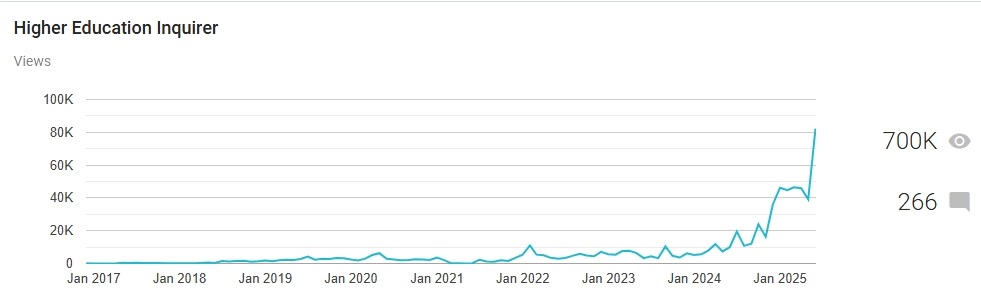
    The Higher Education Inquirer has experienced a dramatic surge in readership in recent months, defying the odds in a media ecosystem dominated by corporate influence, algorithmic manipulation, and declining public trust. Without the benefit of advertising dollars, search engine optimization tactics, or institutional backing, the Inquirer has built an expanding audience on the strength of its investigative rigor, academic credibility, and fearless confrontation of power in higher education.

    The Inquirer’s success lies in its refusal to chase headlines or appease stakeholders. Instead, it examines the underlying systems that have shaped the American higher education crisis—escalating student debt, the exploitation of adjunct faculty, administrative overreach, the encroachment of private equity, and the weakening of regulatory oversight. Its reporting draws directly from primary source documents: internal university records, SEC filings, FOIA requests, and government data from the U.S. Department of Education, Department of Veterans Affairs, and other public institutions. Readers trust the Higher Education Inquirer not simply because it is independent, but because it is evidence-based and relentlessly honest.

    This journalistic integrity has attracted a diverse and influential group of contributors whose work amplifies the publication’s reach and credibility. Among them is David Halperin, an attorney, journalist, and watchdog who has long held the for-profit college industry accountable. Halperin’s sharp investigative writing has helped shape federal policy, inform regulatory action, and expose the inner workings of a powerful, often unregulated sector of higher education.

    Other essential contributors include Henry Giroux, whose writing connects neoliberalism, authoritarianism, and education policy; Bryan Alexander, who offers foresight into technological and demographic changes shaping the future of academia; and Michael Hainline, who combines investigative rigor with grassroots activism. Together, these voices reflect a commitment to intellectual diversity grounded in a shared mission: to make sense of a higher education system in crisis, and to imagine alternatives.

    HEI’s timing could not be more significant. As student loan debt hits historic levels, public confidence in higher education erodes, and international students reassess their futures in the United States, people are seeking answers—and not from the usual pundits or PR firms. They’re turning to sources like the Inquirer that offer clarity, accountability, and a refusal to look away from injustice.

    With more than 700 articles and videos in its growing archive, the Inquirer has become a vital resource for researchers, journalists, educators, and activists alike. And unlike many mainstream outlets, it remains open-access, free of paywalls and advertising clutter. It encourages participation from readers through anonymous tips, public commentary, and shared research, building a collaborative community that extends beyond the screen.

    Last week, more than 30,000 readers visited the site—a significant number for an independent, ad-free platform. But more than numbers, this growth signals a shift in how people consume and value journalism. It shows that there is a real appetite for media that holds power accountable, that prioritizes substance over spectacle, and that dares to tell the truth even when it’s inconvenient.

    The Higher Education Inquirer is not chasing influence—it’s earning it. Through fearless reporting, scholarly insight, and a commitment to justice, it has become a trusted voice in the fight to reclaim higher education as a public good. And with its core group of contributors continuing to inform and inspire, the Inquirer is poised to grow even further, serving as a beacon for those who believe that education—and journalism—should serve the people, not the powerful.

    Source link

  • Three Questions for Tulane’s Ashley Francis

    Three Questions for Tulane’s Ashley Francis

    Tulane University’s Freeman School of Business recently launched its first fully online M.B.A. program, marking a significant step in expanding its offerings for working professionals. As assistant dean at the Stewart Center for Professional and Executive Education, Ashley Francis plays a pivotal role in shaping and overseeing these programs. With a background in online learning and program development, she brings deep expertise in designing market-competitive programs that maintain Tulane’s unique academic experience.

    I wanted to sit down with Ashley to learn more about the strategy behind launching an online M.B.A. at Tulane’s Freeman School of Business, how the program distinguishes itself in a competitive landscape and what universities should consider when developing online offerings.

    Q: Why did Tulane’s Freeman School of Business decide to launch an online M.B.A. and how did you approach designing a program that stands out in an increasingly competitive market?

    A: Tulane University’s Freeman School of Business launched its online M.B.A. program as part of a comprehensive strategy complementing the school’s portfolio of programs directed towards working professionals and meeting students where they are. It was conceptualized in response to both an evolving institutional culture and a clear demand for accessible, high-quality business education.

    The COVID-19 pandemic further accelerated this momentum. With support from Dean Paulo Goes and our partnership with AllCampus, Tulane’s Freeman School of Business was able to build a rigorous and forward-thinking program.

    What sets Freeman’s online M.B.A. apart is its commitment to academic excellence, flexibility and support. The curriculum is designed specifically for working professionals, offering the same tenured faculty who teach on campus—a rarity among online programs, which often rely on adjunct instructors. The program underwent a rigorous four-month development process to ensure that our curricula offered engaging, culturally rich courses. We specifically structured a program with reduced credits to help lower cost and time to completion.

    The Freeman School’s online M.B.A. program is not only competitive but it’s also deeply student-centric. We offer unique, customized career support and access to tutoring services that not many other programs offer. While being competitive in the market was a top priority, ultimately the onus was on us to create a program that truly benefited students.

    Q: When selecting an online program management partner, what key factors did Tulane’s Freeman School of Business consider? Why was working with an OPM important to you?

    A: We went into the OPM selection process knowing the values and capabilities of working with an OPM and that this partnership style would set our online M.B.A. up for the most success. At their best, OPMs are sophisticated, passionate and willing to invest in the success of the program. At the same time, my previous experiences with OPMs had left me feeling wary and cautious when choosing our partner.

    For the new online M.B.A. program, we ended up going with AllCampus, and they’ve absolutely met my high expectations. Tulane’s Freeman School of Business was seeking a true partner—one that would collaborate deeply, offer full transparency and share in the school’s mission for success and AllCampus has embraced those values fully.

    My advice to other higher education leaders considering working with an OPM would be to build a relationship framed around mutual commitment and trust, with a shared goal of creating a standout program. Having a hands-on partnership allowed us to move quickly and tactfully when launching a high-quality program.

    Q: Tulane University is deeply connected to the culture and identity of New Orleans. How does the online M.B.A. program incorporate that sense of place and community for students logging in from around the country?

    A: Tulane’s Freeman online M.B.A. is infused with the spirit of New Orleans, bringing the city’s vibrancy and community-driven ethos into the virtual classroom. One of the core pillars of the program is “bringing the joy of New Orleans” to students—wherever they are. Rather than creating a hypercompetitive environment, the Freeman School fosters a sense of belonging and cultural richness, helping students feel the NOLA experience even if they never set foot on campus.

    This is accomplished through course design, community engagement strategies and faculty involvement that reflect our university’s values and strengths. Our courses embed the city’s ethos and leverage our expertise in energy, supply chain, brand management and entrepreneurial resilience. Tulane’s brand affinity, loyal alumni network and supportive student services—such as a dedicated career management center and a financial aid adviser—all contribute to building a connected environment. The result is a program that not only educates but also inspires a lifelong connection to the Tulane community and the unique culture of New Orleans.

    Source link

  • Higher Ed Must Recommit to Its Enlightenment Roots (opinion)

    Higher Ed Must Recommit to Its Enlightenment Roots (opinion)

    American higher education is on its back foot. As part of the Trump administration’s broader project of regime consolidation, universities are facing new and shockingly direct threats to their independence and academic freedom. And in the past few months, we’ve seen that reality start to sink in. Sometimes there is no more compromise to be had and the only way to stand on principle is to forthrightly say no. In the process, the academic community can reclaim fundamental values that had been eroding well before the present crisis.

    This campaign to assert government control is bad for the academy, but it’s even worse for liberal democracy. Despite the political challenges facing higher ed, or rather, in light of those challenges, it’s critical that scholars, academic leaders and students reclaim what seems to have been forgotten —that the modern university is a living legacy of Enlightenment-era liberalism, the tradition that champions political liberty, constitutional constraints on power, freedom of thought and evidence-based reasoning.

    Founding-era academic leaders understood, in concrete terms, that universities were cornerstone institutions of the fledgling American experiment. They took it as their duty to educate not royal subjects but politically free, self-governing citizens capable of managing complex matters of private, commercial and public life. They believed that liberty and intellectual agency were inextricably linked.

    As Benjamin Rush, a prominent signer of the Declaration of Independence and founder of Dickinson College, observed, “Freedom can exist only in the society of knowledge. Without learning, men are incapable of knowing their rights, and where learning is confined to a few people, liberty can be neither equal nor universal.” In other words, right from the start, the ethos of American universities was bound up with the American ideal of liberal democracy.

    To be clear, I am not suggesting that only liberal perspectives should be taught in institutions of higher learning. Far from it. Among liberalism’s most distinctive strengths is that it creates space for its own critics. But while individual scholars may explore and promote alternatives to constitutionally constrained liberal democracy, the institution itself must assertively defend the liberal rules of the game that make those critiques possible in the first place.

    In other words, if universities are to have a future as cornerstone institutions of a free society, they must assert their role as caretakers of the liberal democratic project. My point is not that it would be nice if universities were to play this role. As my co-author Bradley Jackson and I have argued, “The future of higher education and the future of the liberal order are inextricably bound to one another. As goes one, so goes the other.”

    As I take stock of the past decade, a few moments stick in my mind as emblematic of the current state in which higher education now finds itself. The first was in 2015, when a professor of mass media at the University of Missouri famously called for “some muscle” to prevent a student photojournalist from exercising his First Amendment rights to cover a public demonstration on the campus quad. At least one other Mizzou staff member assisted in the effort to intimidate the journalist.

    The 2017 episode at Middlebury College, when students organized to shout down invited speaker Charles Murray, was another. Like so many others, I was shocked and angry that outsiders saw it as an opportunity to engage in political violence. But what broke my heart was the fact that students carefully prepared for the event not by marshaling their best arguments to counter Murray, but by crafting prescripted chants designed to shut down the open exchange of ideas. As a professor and provost, I cringed as I considered what these incidents said about the profession to which I was so passionately dedicated. And wasn’t it obvious that attacks on intellectual freedom would always, one way or another, end up harming the marginalized and those fighting for social justice? Somehow, we had lost the plot.

    Perhaps the most cringe-inducing episode before this year’s events was in December 2023, when the presidents of Harvard University, the Massachusetts Institute of Technology and the University of Pennsylvania were summoned before a congressional committee to face allegations of antisemitism for not shutting down protests opposing Israel’s response to the Oct. 7 Hamas attack. I winced not just at the Inquisition-style interrogation and the lawyerly responses the witnesses offered. I cringed because, in their attempts to invoke First Amendment freedoms as their rationale, the presidents of three of our most prestigious institutions had zero credibility. Their allegiance to First Amendment principles read like an unconvincing foxhole conversion.

    My point is not to relitigate these incidents. Rather, it is to suggest a pattern —and to provide context for why universities are so vulnerable to the Trump administration and state legislatures seeking to compel ideological compliance. When academic leaders, professors and students disregard the academy’s liberal foundations, we no longer have ground to stand upon when illiberal forces come to tear it all down. The weaponization of federal funding, deportation of students and scholars engaged in protected political speech, bans on “divisive concepts,” and threats of consent decrees— legal settlements that would place universities under long-term federal control—effectively strip universities of governance autonomy and set dangerous precedents for political interference in academic institutions.

    Now faced with a truly existential crisis, many institutions are starting to fight back. Harvard has dug in its heels in the face of previously unthinkable threats, turning to the courts to protect its rights—fighting not just its blacklisting from federal research grants, but a flagrantly lawless attack on its tax-exempt status and an equally illegal attempt to revoke its certification to enroll international students on visas. In a response to the government through its lawyers, Harvard made clear its refusal to cave in no uncertain terms: “The university will not surrender its independence or relinquish its constitutional rights. Neither Harvard nor any other private university can allow itself to be taken over by the federal government.”

    Harvard isn’t the only institution finding its courage. Georgetown University, when menaced by the interim federal prosecutor for Washington, D.C., correctly asserted, as a matter of both speech and religious freedom (as a Jesuit university), its right to determine its own faculty and curriculum. It’s not a matter of abstract principle. A member of Georgetown’s own faculty has been targeted for abduction and meritless deportation. Princeton University, as well, has aggressively pushed back.

    Nor is the resistance limited to elite universities. As students are disappeared for speech displeasing the government, and as Trump’s overt censorship demands mount, smaller private colleges and state institutions have been sounding the alarm. In the process, they aren’t just defending their own self-interest, they are rallying civil society to resist incipient authoritarianism. Charles Murray’s work provides a compelling example of how the tit-for-tat cycle of illiberal escalation unfolds. At the U.S. Naval Academy in Annapolis, the office of Secretary of Defense Pete Hegseth ordered the removal of supposed “DEI” works. While The Bell Curve survived the purge, a pointed critique of Murray’s most controversial book did not.

    The irony is hard to ignore. Upon entry into the Naval Academy, midshipmen swear an oath to defend the Constitution “against all enemies, foreign and domestic.” Shouldn’t we trust America’s future military leaders to exercise the very freedoms we’re asking them to defend with their lives? (Most of the books that were initially removed have since been returned to the Naval Academy’s shelves.)

    Fortunately for civilian institutions, the courts are proving up to the task in pushing back. Tufts University student Rümeysa Öztürk was freed after several weeks in Immigration and Customs Enforcement custody, having been targeted for co-authoring an op-ed critical of the war in Gaza. That such a thing would happen in the United States is an unthinkable attack on free speech at its very core. Öztürk was incarcerated and threatened with expulsion not for protests, which can devolve into physical conflict and rule breaking, but simply for writing an opinion the government decided it disliked.

    No liberal education—no liberal society—can endure under such a menacing shadow of state retaliation and suppression. We shouldn’t lose sight of the longer term, and the need to recommit ourselves to first principles. We must reinforce the principle of academic freedom as the constitutional order that governs a functioning university. Further, as we welcome new students and colleagues into the academy, we can’t leave it to chance that liberal values that privilege openness, curiosity, ingenuity and intellectual humility will take hold. We must be deliberate in our efforts to cultivate those values.

    But an important, though less obvious, recommendation is one that won’t be easy to follow in a moment when our impulse is to defend the academy at all cost. Simply put, we must own our mistakes. If we are to refortify the liberal foundations of American higher education, we must proactively name the failures that have contributed to a permission structure that now accommodates illiberal and authoritarian reactionary forces. In some cases, that will mean replacing leaders who have tarnished their credibility with those who can better meet the moment.

    To be clear, in owning our mistakes, we will not be currying favor with political elites on either side of the aisle. We will be speaking to and rebuilding trust with the public who support institutions of higher learning through their taxes and tuition payments. And we will be speaking to our own campus communities who seek principled leadership.

    Taking full responsibility for the course correction will be good for the academy, as it will reset the path by which colleges and universities become sites of intellectual openness, challenge and discovery. But it will also be good for the future of our country. It will offer an example of how, after shifting away from its liberal foundations, a cornerstone institution of the American experiment can once again find its bearings, re-establish its independence and assertively take the lead in fortifying, in its most urgent hour, our system of constitutionally constrained liberal democracy.

    Emily Chamlee-Wright is president of the Institute for Humane Studies at George Mason University and was previously provost and dean at Washington College.

    Source link

  • RFK Jr. Falsely Claims New Vax Board Member Works at GWU

    RFK Jr. Falsely Claims New Vax Board Member Works at GWU

    Robert F. Kennedy Jr., secretary of the Department of Health and Human Services, falsely said he named a doctor from George Washington University to a federal vaccine advisory board, reported News 4, the NBC affiliate in Washington, D.C. 

    Last Monday, Kennedy, who denies that vaccines are safe and effective and whose department has previously cited fake studies to support parts of its public health agenda, fired all 17 members of the federal Advisory Committee on Immunization Practices. By Wednesday, he posted on X that he had “repopulated” it with eight new members.

    “The slate includes highly credentialed scientists, leading public-health experts, and some of America’s most accomplished physicians,” he wrote. “All of these individuals are committed to evidence-based medicine, gold-standard science, and common sense.”

    One of them, according to Kennedy, is Michael A. Ross, a clinical professor of obstetrics and gynecology at George Washington University and Virginia Commonwealth University, with a career spanning clinical medicine, research and public health policy.

    But a GWU spokesperson told News 4 that Ross hasn’t taught there in eight years; a VCU spokesperson also said Ross hasn’t taught there for four years. Instead, Ross is listed as an operating partner for the private equity fund Havencrest, and his company bio says he “serves on the boards of multiple private healthcare companies.”

    Kennedy’s post on X made no mention of Ross’s current involvement with the company.


    Source link

  • Are universities too safe in their vice-chancellor recruitment?

    Are universities too safe in their vice-chancellor recruitment?

    Following publication of our joint GS/HEPI reporting into vice-chancellor recruitment and a vibrant LinkedIn debate,  the complex dynamics shaping leadership in the sector have been brought to light. The conversation reveals a sector at a crossroads, wrestling with tradition and transformation.

    Insider vs. Outsider: Who Should Lead?

    Should vice-chancellors come from within academia or be recruited from other sectors? Out-of-sector candidates can bring a fresh perspective on leading change and challenging the status quo. Inside sector candidates offer deep cultural understanding, academic credibility, and governance experience. Many argue for a hybrid model and leaders who can bridge both worlds.

    The CEO-ification of the VC Role

    Today’s vice-chancellors are expected to be more than academic figureheads. They must be visionary strategists, financially astute operators, and empathetic people leaders. But, much more is needed to nurture leadership development pipelines with, perhaps, a reappraisal required of the very many leadership development programmes that exist already.

    Diversity and Inclusion: Still a Distant Goal

    Leadership in higher education remains homogenous. There remains a pressing need to broaden the pool, not just in terms of gender and ethnicity, but also professional and disciplinary backgrounds. Scepticism, especially in research-intensive institutions, about whether university leaders without academic credibility should lead universities persists. Valuing potential over pedigree could unlock untapped leadership talent.

    Culture, Metrics, and Mission

    Effective leadership in universities demands cultural intelligence and emotional literacy. Metrics like rankings and KPIs, while useful, often fail to capture the true impact of leadership. A more holistic, context-specific approach is needed; one that honours the civic and educational purpose of universities.

    Collective Leadership and Cross-Sector Learning

    Leadership should not and cannot rest on one individual. Distributed models featuring diverse senior teams and strategic co-leads are gaining traction. Embracing mobility between academia and industry can enrich leadership with fresh insights and mutual respect.

    Join the Conversation: Upcoming Webinar

    These themes and more will be explored in our upcoming webinar. Whether you’re an academic, policymaker, or sector professional, this is your chance to engage with thought leaders and shape the future of higher education leadership.

    Source link

  • In defence of university halls of residence

    In defence of university halls of residence

    During my five years living alongside 340 undergraduate students as a hall warden, I have become a firm believer that residential halls are powerful civic learning environments.

    This realisation did not come immediately; if anything, I saw my role as strictly pastoral rather than having any connections to learning and teaching.

    At first glance, the role of a warden has little to do with learning. The term, warden, is an outdated and often confusing title (we are in the process of changing it) to describe a staff member responsible for responding to high-level mental health and disciplinary matters and occasional residential life events.

    I initially approached my role with misplaced enthusiasm, intervening in all manner of student conflicts, leaving little room for their own responsibility. Finding a middle ground between complete non-intervention and excessive control proved a real challenge.

    Over time, I came to understand that effective support meant creating space for disagreement and face-to-face conflict resolution rather than solving problems on students’ behalf.

    Too shy shy

    When I first started, the complaints I received usually came because a student came to my front of house colleagues to alert them of their problem. Whereas now they arrive electronically through e-mail.

    It makes sense. It’s easier, quicker and also means students who may not be around during my formal working hours can make me aware of any issues.

    But sometimes the multiple reports I receive overnight detail seemingly minor problems like a roommate not turning off lights or leaving a window open.

    I think the ease with which students can complain, especially virtually, prevents students from developing crucial conflict resolution skills. Part of living amongst other people is learning to address disagreements. It’s not easy and it’s certainly not comfortable, but it does help you grow as a person.

    It forces you to connect with others you may not agree with – either because of various socio-economic backgrounds, religious views or with those who have different ideas of cleanliness from you.

    I have witnessed meaningful connections form across religious and gender identities, and social classes within student halls. For example, the son of a billionaire bonding with a flatmate who had spent summers as an agricultural labourer in fields in Lincolnshire. Two people who likely would not have crossed paths if they had not chosen to study at the same university.

    I’ve seen interfaith events attended by those with differing faiths or none at all leading to genuine friendships.

    These interactions lack formal learning objectives or assessment metrics, yet provide education that our lecture halls struggle to deliver. Providing the literal space for students to meet helps them develop social capital they cannot necessarily get in a classroom.

    Learning from home

    As a sector, we could do more to analyse and report on the civic benefits offered by halls of residence, and we are beginning to do this work at LSE.

    Most UK university halls operate under an outdated property management model, functioning more like luxury hotels than educational spaces. Some private accommodation companies have introduced luxury facilities where students from wealthy families isolate themselves in environments featuring swimming pools and designer furnishings. While aesthetically impressive, these spaces lack genuine community or learning opportunities.

    These approaches miss a crucial opportunity. Residence halls are sites of learning graduate skills, just as much as the formal classroom. Future employers want complex problem-solving and collaboration skill but the added value of being able to resolve conflict well lies beyond career preparation.

    Holding space

    In my view, modern universities have moved away from an integrated educational vision, focusing primarily on specialised knowledge instead. This fragmentation leaves students ill-equipped to interrogate complex questions and self-discovery.

    Part of this includes being able to navigate conflict constructively and understanding how to create community across differences.

    Residence halls provide spaces where intellectual, ethical, social, and practical dimensions of education can be reintegrated. Abstract concepts from seminars become concrete realities when negotiating shared living. Moral and civic education requires practical engagement with substantive questions about the common good.

    Living amongst peers is a way of acknowledging higher education as a collective endeavour rather than a timetable of classes and lectures.

    Is this overthinking spaces that should prioritise fun and exploration? I don’t think so. Our halls of residence aren’t peripheral to education. Properly reconceived, they could become central to what makes university education distinctive and valuable as higher education confronts an uncertain future.

    Source link

  • We need a better quality of conversation about education and the skills agenda for the screen industries

    We need a better quality of conversation about education and the skills agenda for the screen industries

    Every few years, the drumbeat of the skills agenda grows louder in higher education.

    Those of us who teach media courses are reminded (again) that universities are held responsible for the screen sector’s talent pipeline. Policymakers and industry voices call for greater ‘relevance’ in our course content, and stronger ties between academia and the screen industries.

    Yet, genuine collaboration has remained elusive, in part, because of layers of misunderstanding about both HE and the media industries. A better quality of conversation is now needed.

    So, let’s start by clearing the ground and challenging several of the persistent myths that have undermined progress in this area. By myths, we simply mean common assumptions that are not always entirely false but collectively oversimplify and distort what is both possible and desirable for collaboration between these sectors.

    Universities exist primarily to serve the needs of employers

    Wrong. Universities serve a range of stakeholders and beneficiaries, but their priority is their students. Certainly, we put considerable energy and resources into improving our students’ chances of finding suitable work, but the model of employment has changed. Today’s graduate is unlikely to be heading for a stable, consistent, long-term occupation.

    Work in the screen industries is based on contingent work arrangements and ever-evolving skillsets. If employability is to mean anything it is in the notion of career readiness – being prepared to manage an individual career over time. Of course, we want to ensure that industry can draw on a broad skills base for the graduate workforce, but we do so by prioritizing the immediate and long-term interests of our students, rather than the shifting “needs of the employer”.

    The screen industries do not require a graduate workforce

    Wrong. Despite there being no formal qualification requirement for many jobs in the screen industries, a degree matters a great deal. It is true that the graduate nature of media work is often downplayed within the industry, not least by the culture of “paying one’s dues” – the idea that whatever their qualifications, new entrants must prove themselves in the menial aspects of the job before they can progress.

    But over 70 per cent of the workforce are graduates (and a higher proportion of new entrants). In the words of a recent report commissioned by the All-Party Parliamentary Group for Creative Diversity, “a degree will not guarantee an individual a job in the creative industries; but an individual is unlikely to get a creative industries job without a degree.”

    Media work requires media graduates

    Wrong. Media degrees are not a prerequisite for most screen industry roles. While certain degrees may offer added value for specific positions, the primary qualification sought is simply a degree.

    Media employers appear to be more interested in what used to be called “graduateness” – a broader set of skills, attributes, and intellectual capabilities not limited to subject-specific knowledge. Graduates who work within the screen industries, therefore, are drawn from the full gamut of science, social science and humanities degree programmes.

    The value of a media degree is determined by how well it prepares students for entry-level media jobs

    Wrong. Given that graduates working in the screen industries are not drawn in any systematic way from media courses, it must follow that media courses are not necessarily any better placed to provide successful new entrants than are others. Conversely, skills developed on media courses make for graduates employable in a range or roles and sectors.

    This is not to argue that these courses have no distinctive value for media industry employers. On the contrary, as employer-led entry-level training provision has been eroded, subject-specific knowledge, critical insight or practical media skills and experience can provide a valuable grounding for many media roles. Yet to fixate on ‘industry relevance’ is to miss the point that media work is now integral to all economic and cultural development and extends far beyond the screen industries.

    Practice-based and “practical” courses exist primarily to produce “set-ready” graduates for specific industry roles

    Wrong. This may be the pitch that many universities make to potential students and it may be the reason that students give when asked why they chose their degree programme. But both the complexity of student motivations and the critical purpose that practice plays within pedagogy are frequently misunderstood.

    Many students who choose courses that foreground their practical components identify themselves as practical people who learn in a practical way. For many such students, these courses provide a path through HE that others do not. Thus, in opening the door of the university to a wider constituency, courses that contain practical elements ensure a richer diversity of talent for employers to draw from. Put simply, the value of university-based media practice is less as an end, than as a means.

    Universities are a barrier to industry diversity

    Wrong. The greatest challenges for those from minority groups are their lower employment prospects following graduation. The UK screen industries have historically been affected by a conspicuous lack of diversity. This has remained a problematic feature of the sector and is currently getting worse.

    A more diverse industry is clearly an important goal towards which greater HEI-industry partnership and collaboration could profitably be focused, but this is unlikely to happen if the idea prevails that universities are the principal barrier.

    Beyond the mythos

    While collectively incoherent, these myths have tended to dominate initiatives for sector collaboration and partnership. Education and industry alike need to move beyond these unhelpful misconceptions to develop collaborative ventures based on authentic reciprocal relationships and a recognition that while employers bring industry insight and expertise, universities are leaders in education – a field in which industry is both a contributor and a beneficiary.

    But for this to happen, there must be greater honesty and pragmatism about both the nature of work in the screen sector and the responsibility of universities to develop the broader career readiness of their students.

    For a more detailed discussion of this topic, see our recently published open access article: Higher Education and the screen industries in the UK: the need for authentic collaboration for student progression and the talent pipeline

    Source link

  • Senate Outlines Plans for Endowment Tax Hike

    Senate Outlines Plans for Endowment Tax Hike

    The Senate Committee on Finance is proposing to raise the endowment tax on private colleges and universities, but not to the extent the recently passed bill in the House calls for, according to a draft plan released Monday.

    The less dramatic excise tax tops out at 8 percent for the wealthiest institutions, compared to 21 percent in the House plan, but the Senate’s proposal keeps the House’s tiered rate structure, with some colleges paying more depending on the value of their endowment per student. The current rate for affected institutions is 1.4 percent.

    Institutional lobbyists and college presidents have warned that the sharp increase in the House plan would hurt their ability to provide need-based aid and be debilitating for some low-income students. Although the Senate’s iteration offers some relief, it’s not as much as they hoped for.

    “The Senate version of the so-called endowment tax is better, but it’s still bad and harmful tax policy,” said Steven Bloom, assistant vice president of government relations​​ at the American Council on Education. “They’re going to take money that would likely have been devoted to financial aid and research and other academic purposes on campus, and they’re going to send it to Washington, where it’s used largely for purposes unrelated to higher education.”

    The Senate committee’s plan, like the House proposal, also still exempts religious colleges and requires colleges to take international students out of the total roll call when calculating the endowment’s value per student. If passed, this stipulation would increase the tax rate significantly for institutions like Columbia University that have 20 percent or more foreign students.

    The finance committee legislation, which also includes cuts to Medicaid that could put pressure on states’ budgets, is part of a broader package of bills that would make significant changes to higher education policy and cut spending and taxes in order to pay for President Donald Trump’s priorities, which include increased deportations and tax cuts for the wealthy. The House version of the reconciliation bill known as the One Big Beautiful Bill Act passed by a one-vote margin last month. Senators are aiming to pass their version by July 4 and only need 51 votes thanks to the reconciliation process, as opposed to the traditional 60 votes.

    Unlike the House proposal, colleges that don’t accept federal financial aid would be exempt from the tax entirely. Hillsdale College president Larry Arnn blasted the House plan in an op-ed last month as an attack on the institution’s independence. (Hillsdale doesn’t participate in the federal financial aid system.)

    “The resources entrusted to Hillsdale College are not drawn from the public treasury,” Arnn wrote. “They are given freely by those who believe in our mission. To tax these gifts is to tax philanthropy itself—to burden those who would lift burdens. It is to weaken those who do good precisely because they are free to do it. It weakens them and strengthens the federal government, reversing the order intended by our Founders.”

    Hillsdale wasn’t the only college that pushed back on the rate increase. In recent weeks, private institutions big and small have pitched their own alternatives to Congress.

    Some of the largest and wealthiest research institutions that would be affected by the tax—such as Harvard, Stanford and Princeton Universities—pledged to spend 5 percent of their endowment’s value annually in exchange for a much lower 2.4 percent endowment tax rate, The Wall Street Journal reported. Bloom agreed that if the tax is to increase, he would like to see some kind of incentive introduced, like financial aid spending thresholds, to mitigate the tax rate.

    “They’ve created no incentive for schools to behave in ways that we believe that they would want schools to behave,” he said.

    Other institutions suggested that the tax rate should be based on what percentage of endowment revenue an institution spends each year on student financial aid or how many students enrolled come from a low-income background and receive the federal Pell Grant.

    A coalition of 24 smaller institutions, including Grinnell and Davidson Colleges, which would be hit hardest by the House endowment tax, proposed adjusting the excise rate based on the number of students enrolled. Colleges with fewer than 5,000 students have a different economic model than an institution with 30,000, they said.

    Grinnell president Anne Harris, who spent part of the last week educating lawmakers about the harm of the increased endowment tax, said Monday evening that the Senate plan still disproportionately burdens smaller institutions. She noted that her institution will likely still face the maximum 8 percent tax.

    “I deeply appreciate all the work that’s gone on and clearly all the consideration that has informed what we’re seeing this afternoon, but having said that, the current proposal still disproportionately burdens small colleges,” Harris said. “You’re going to find a school like Grinnell College with 1,700 students, a small college in a rural setting, bearing a much greater burden of this tax than a research institution in a large city.”

    She could only speculate that senators stuck with a tiered structure for simplicity, but added that “the simple fix” would be to make a stipulation that places all small private colleges in the lowest bracket and maintain the current 1.4 percent tax rate.

    Harris is hopeful that there will still be further opportunities for compromise and said she will continue to advocate for small liberal arts institutions like her own. But in the meantime, her executive team will also continue to plan out all the possible scenarios to figure out the best course of action to protect student aid if the bill passes as it currently stands.

    “All responsible options that provide the most money for financial aid and mission fulfillment are on the table as part of our scenario planning with the board,” she said.

    Source link

  • How to Build a High-Impact Data Team Without the Full-Time Headcount [Webinar]

    How to Build a High-Impact Data Team Without the Full-Time Headcount [Webinar]

    You’re under increased pressure to make better, data-informed decisions. However, most colleges and universities don’t have the budget to build the kind of data team that drives strategic progress. And even if you can hire, you’re competing with other industries that pay top dollar, making it hard, if not impossible, to find the right data resource with all the skills to move your operation forward. Don’t let hiring roadblocks make you settle for siloed insights and stagnant dashboards.

    How to Build a High-Impact Data Team
    Without the Full-Time Headcount
    Thursday, June 26
    2:00 pm ET / 1:00 pm CT 

    In this webinar, Jeff Certain, VP of Solution Development and Go-to-Market, and Dan Antonson, AVP of Data and Analytics, break down how a managed services model can help you create a high-impact data team at a fraction of the cost and give you access to a robust bench of highly specialized data talent. They will also share some real-world examples of nimble, high-impact data teams in action. 

    You’ll walk away knowing: 

    • Which data roles are needed for success and scale in higher ed 
    • How to rapidly scale data operations without adding FTEs 
    • Why managed services are a smarter investment than full-time hires 
    • Ways to tap into cross-functional expertise on demand 
    • How to build a future-ready data infrastructure without ballooning your org chart 

    Whether you’re starting from scratch or trying to scale a lean team, this session will offer practical, flexible strategies to get there faster — and more cost-effectively.  

    Who Should Attend:

    If you are a data-minded decision-maker in higher ed or a cabinet-level leader being asked to do more with less, this webinar is for you. 

    • Presidents and provosts 
    • CFOs and COOs 
    • Enrollment and marketing leaders  

    Expert Speakers

    Jeff Certain

    VP of Solution Development and Go-to-Market

    Collegis Education

    Dan Antonson

    AVP of Data and Analytics

    Collegis Education

    It’s time to move past the piecemeal approach and start driving real outcomes with your data. Complete the form to reserve your spot! We look forward to seeing you on Thursday, June 26. 

    Source link