Since January, President Donald Trump has taken countless steps to transform the nation’s colleges and universities. His administration has cut scientific and medical research, ended efforts to promote diversity equity and inclusion (DEI), introduced newly aggressive policies on loan repayment, revoked visas for international students, and more. While Trump’s battles with Harvard and Columbia have received the most attention, the administration’s actions have had consequences far beyond those two universities.
We want to know how the Trump administration is affecting higher education and life on your campus. What, if any, changes are you seeing at your college or university because of federal policy shifts? In what ways do you see higher education changing?
If you prefer, you can also email us directly at [email protected]. Contact editor Lawrie Mifflin at [email protected] or 212-678-4078. Contact editor Caroline Preston at 212-870-8965, via Signal at CarolineP.83 or on email at [email protected].
This story about higher education was produced by The Hechinger Report, a nonprofit, independent news organization focused on inequality and innovation in education. Sign up for our newsletters.
The Hechinger Report provides in-depth, fact-based, unbiased reporting on education that is free to all readers. But that doesn't mean it's free to produce. Our work keeps educators and the public informed about pressing issues at schools and on campuses throughout the country. We tell the whole story, even when the details are inconvenient. Help us keep doing that.
State legislators from both parties want to expand family child care — the home-based sector of licensed child care, which has shrunk by more than a third since 2018. Both the House and Senate budget proposals include pilots to open new programs to meet the needs of families and employers.
For the past two years, a team from the nonprofit Southwestern Child Development Commission (SWCDC) has done just that, creating North Carolina’s first statewide system of support for family child care. In the past year, the organization has helped launch 27 new family child care programs, 20 of which are open, creating at least 160 new slots for children. Two are the first family child care programs in their counties.
Since September 2023, the team has awarded start-up grants to another 26 programs and business sustainability grants to 38 programs. It has created the first statewide family child care mentorship program, regional communities of practice, and a marketing campaign that has garnered interest from more than 200 prospective providers since April.
As state leaders ask how to improve child care access and affordability, the project’s lessons should carry forward, said Daniel Bates, the statewide project’s manager.
“I just really felt like we’ve done something here, and I hope that, no matter what, it still continues, because family child care is so incredibly important,” Bates said. “And they are part of early childhood education.”
‘People that will be around for a while’
Expanding family child care takes one-on-one support for new providers who often bring a passion for children but little knowledge of the complex regulations and business challenges that come with starting and operating a program, the project leaders said. It also requires funding.
In 2024, SWCDC, a nonprofit focused on early care and education based in western North Carolina, was awarded $525,000 from the Division of Child Development and Early Education (DCDEE) from legislative pilot funding to expand access to family child care. The project’s expected output was to help 18 programs get started. Instead, it has helped launch 27 programs by awarding grants to cover start-up costs.
The grants ranged from $5,000 to $20,000 depending on the providers’ needs and the strategic goals of the project. The average grant was about $13,000.
Providers also spent their own money to open their programs outside of the grants. A survey of some of the providers found that most had spent between $1,000 and $5,000 before receiving grants to prepare their homes and buy materials.
The new providers are in 19 counties. In Alleghany and Montgomery counties, grant recipients will be the only family child care providers in their counties. Two providers speak Spanish fluently, according to the project leaders. At least 18 have college degrees. Four of the new providers were under 30 years old. Six were in their 30s; 10 were in their 40s.
“These are people that will be around for a while,” said Vickie Ansley, SWCDC’s Child Care Resource & Referral (CCR&R) regional programs manager and family child care in-home program activity coordinator.
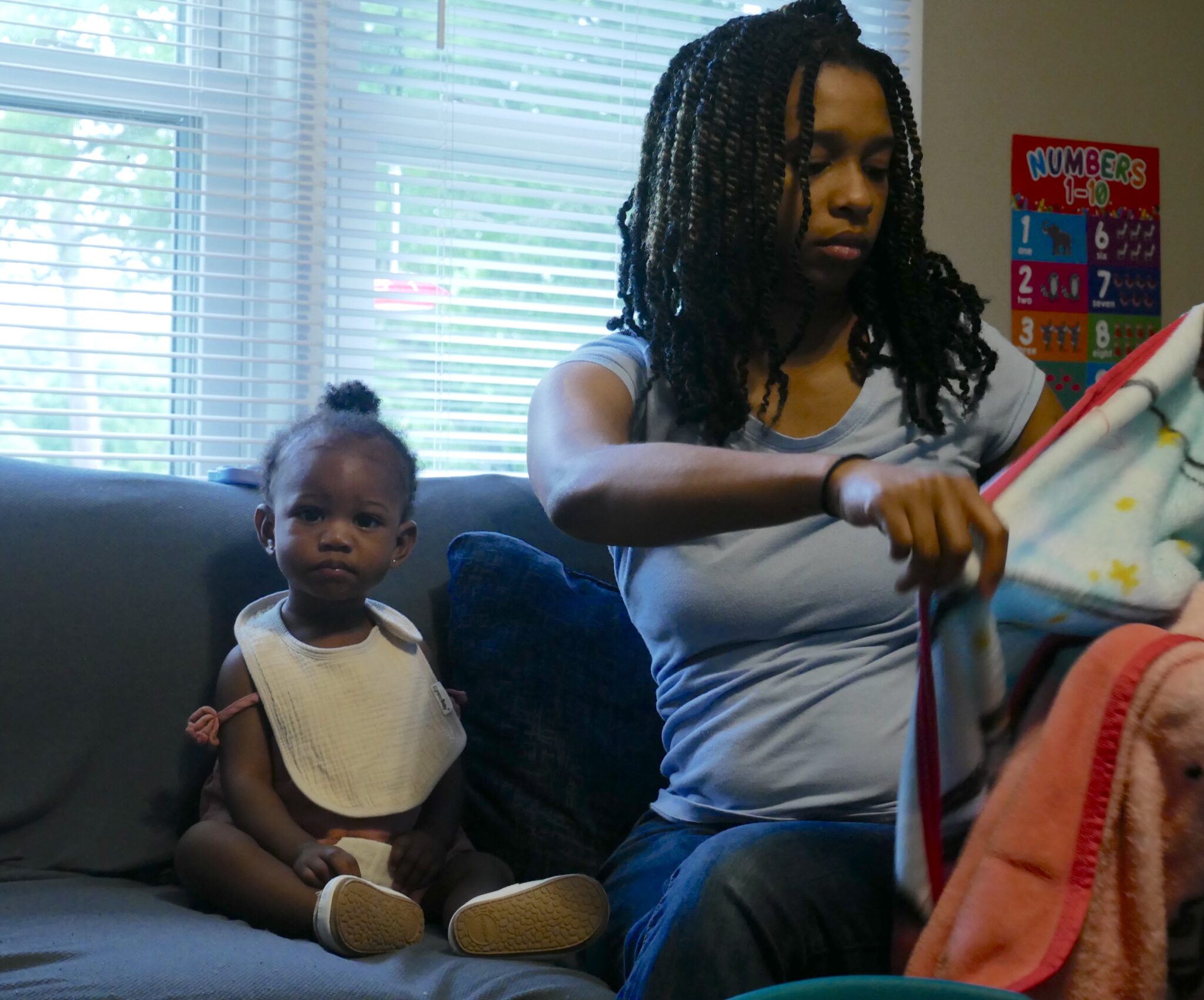
Danielle Dixon wakes up students from nap time at Helen Cole’s Day Care. (Liz Bell/EducationNC)
That grant funding was layered onto a larger statewide family child care project the organization has been leading since February 2023 through a separate $3 million contract with DCDEE from the CCDF, the federal funding stream that helps states raise the quality of child care and helps working families afford it.
The statewide project had many components, including start-up grants of up to $10,000 and business grants of up to $5,000 for access to business training, software, or devices to manage programs. It provided 64 professional development workshops to providers on a range of issues. It also created a framework for family child care substitute pools and a database of zoning contacts and information.
Hands-on support from regional consultants
The crux of the project, however, was all about hands-on support and community building, the project leaders said. The project funded 17 family child care consultants who reached 477 providers in 73 counties with coaching and consultation.
The consultants, trained in the specifics of owning and operating a family child care program, were embedded in the 14 regional CCR&R hubs covering all 100 counties.
“We’re talking about people located in those communities,” Ansley said. “They know the (providers), or they know somebody who knows them.”
Helen Cole, a family child care provider in Taylortown, says the grants she received from Southwestern Child Development Commission helped her buy high-quality materials. (Liz Bell/EducationNC)
The PDG contract is in process but will be awarded to Acelero Charitable Foundation “in collaboration with multiple agencies that support family child care.” It will focus on increasing quality and family engagement, the spokesperson said.
DCDEE employs licensing consultants who meet with all types of potential child care owners to begin the licensure process. The licensing consultants began recommending reaching out to the regional family child care consultants to new providers.
The family child care consultants then could provide knowledge specific to family child care, dedicate time and energy to decipher the complexities of starting and sustaining a business, and offer support that was independent from regulatory oversight and compliance. Some of the consultants were former family child care providers themselves.
“Prior to that, if an agency had capacity, then they provided support,” Bates said. “The services were somewhat limited, whereas this was full 100% dedication for family child care.”
The regional consultants received business training to advise providers on budget planning, financial reports, marketing, and recruiting and retaining staff.
Kathleen Hoffler, a regional consultant at the Partnership for Children of Cumberland County who once owned a family child care home, described the role as her “dream job.”
Hoffler said she has helped providers take better care of their businesses, their children, and themselves. She encouraged providers to take time off and to reach out for help.
“If you’re having issues with enrollment, if you’re having issues with collecting payments from parents, if you’re having behavior issues with kids or you’re worried that one of your kids might need some developmental screening, and you don’t have anybody to talk that out with, it’s real easy to get discouraged and possibly decide it’s not for you and you’re going to close your program,” Hoffler said.
The family child care consultants connected providers to the pilot grant opportunities and helped them budget what they needed and how they should spend the funding.
Since the consultants were embedded in CCR&R agencies, they could connect providers with a variety of professional development opportunities and resources.
And they connected providers to mentors — seasoned family child care providers who provided a listening ear and advice on overcoming obstacles — and to communities of practice, regional teams that met to share ideas and support one another.
Annette Anderson-Samuels, owner of Phenomenal Kids Child Care Services, a family child care home in Kings Mountain, was one of those mentors. She said her advice to two new providers on how to advertise their programs kept them from closing. She recently helped a provider navigate a tough conversation with parents who were not following her policies.
“It’s to help each other become better at what we do as child care providers,” Anderson-Samuels said.
There were 22 mentors and 44 mentees across the state. In his decades working in early childhood, Bates said the group has been a standout.
“They’ve crossed county lines to go help each other in person,” he said. “The interest and the willingness, wanting to improve themselves, is really out there if they have the opportunity to do that.”
‘The lost segment of early childhood education’
The number of family child care programs, child care businesses within a residence, has fallen by about 36% since 2018, compared with an overall 15% decline in all types of licensed child care.
As a generation of providers age out of the work, a lack of awareness, funding, and support — along with increased regulation — has kept new providers from entering the field, project leaders said.
The team was intentional about listening to providers’ experiences and needs before developing a system of support.
Helen Cole said her family child care home has better equipment and provides higher-quality care because of the support she received from the Southwestern Child Development Commission’s family child care projects. (Liz Bell/EducationNC)
Many brought up the low rates that family child care providers receive per child to participate in the state’s subsidy program. These rates, the state has found, do not cover the full cost of providing child care in any setting. Home-based programs receive lower amounts per child than centers. And providers in rural and low-income areas often receive lower rates than those in higher-income counties.
In rural areas where market rates are lower, “even though we need family child care in those communities desperately, market rates are a hindrance,” said Lori Jones-Ruff, SWCDC’s regional programs manager.
Jones-Ruff also sits on Gov. Josh Stein’s Task Force on Child Care and Early Education, where members have discussed the need for higher subsidy rates and a statewide floor rate that would level the playing field among counties. Research has shown the geographic disparities are wider than place-based differences in cost.
“That’s not just a center issue,” she said. “It’s for family child care as well.”
Low funding from public sources and private tuition leads to low compensation for family child care professionals. The median wage for home-based providers in 2023 was $10.20.
The team also heard about obstacles due to HOA rules and zoning regulations. They found that local ordinances were putting up barriers to new programs in some places. Septic tank requirements were among the most common and most expensive problems.
“(Providers) have recognized, ‘I don’t really need to run to Raleigh; some of the challenges I have are really just in my own backyard, and I just need to talk to my town or county,’” Bates said.
The team heard about the isolation many providers feel, being alone in their homes all day without a network to air ideas or lean on when challenges arise. Providers said they did not feel respected or supported by the state.
“Historically, there was a huge emphasis put on center-based care in North Carolina,” Jones-Ruff said. “Homes did not feel that they were as valued and as supported as center-based. And so there was a period of time where they really felt like they were kind of the lost segment of early childhood education in North Carolina.”
So the team built a strategy based on both funding and relationships.
‘Like a prayer answered’
For Helen Cole, that assistance and funding was key to opening her family child care home in Taylortown in Moore County.
“I just feel like this wouldn’t have been possible without the support and the funds,” said Cole, who recently earned her four-star license to care for children from infancy to 12 years old at Helen Cole’s Day Care.
She received more than $17,000 to start her program from the legislative pilot funding. She bought new outside equipment, furniture, dramatic play sets, age-appropriate toys and books, a new kitchen faucet, a state-approved curriculum, and a new laptop.
Cole heard about the potential grant funding for start-up costs from the state licensing consultant. She was also connected with Hoffler.
Students at Helen Cole’s program work on their counting skills. (Liz Bell/EducationNC)
Cole was excited to open after hearing about a local demand for second-shift care. After retiring as a substitute teacher in her local school district, she needed more income and was eager to fill a community need.
But after her initial meeting with a licensing consultant, she received a long checklist of everything she had to do. She said she felt overwhelmed.
“It was just so much information,” she said. “There are things on the website, but how do you adjust it for your day care?”
Plus, Cole had experience helping in her sister’s child care program, but she did not know the ins and outs of operating a small business. Even with a background in accounting, she knew the role would be challenging. So she reached out to Hoffler for an in-person meeting.
“It was like a prayer answered,” Cole said. “She broke it down for me.”
Hoffler helped Cole navigate the tough decisions that come with operating a business from your home, such as how much living space she was willing to sacrifice and what renovations were needed. And she helped Cole create a budget to apply for grant funding through the legislative pilot. She gave her ideas on high-quality and age-appropriate materials.
She also connected Cole with a mentor, helped her with business skills, and connected her with other resources through the Smart Start partnership.
Hoffler has helped her advertise her program and hold on through the ups and downs of enrollment, Cole said. Because she needed to hire another teacher, her niece Danielle Dixon, Cole said she is breaking even but has not started making a profit or been able to pay herself. She said she has been advised that it can take nine months to a year.
She said low subsidy rates and parents’ inability to afford her private rates have also been financially challenging. She serves one student whose parents are both working, making too much to qualify for a subsidy, but cannot afford her private rate of $200 per week. She only charges that family $85 per week.
Danielle Dixon, a teacher at Helen Cole’s Day Care, has worked in child care for 11 years. (Liz Bell/EducationNC)
Dixon, who has been working in child care professionally for 11 years but informally since she was 16 years old, has both of her children enrolled at the program. Dixon said her grandmother and mother, as well as three of her aunts, have worked in child care. She decided to partner with her aunt, Cole, to return to working with young children in a creative, exploratory environment after working in public schools.
Helen Cole’s Day Care opened in December in the home she was raised in, and where her mother used to take care of children whose parents were at risk of losing custody.
“All of our lives, we’ve had other children here,” Cole said.
Both Dixon and Hoffler have helped Cole strengthen her understanding and practice of early childhood care and education. Her program’s philosophy is based on relationships, exploration, and emotional and social development. Then academic foundations are added.
“It’s that give and take between you and this child,” Hoffler said. “They’re going to learn more from you if you are actively engaging with them and talking to them throughout the day, than they’ll ever learn if you give them a coloring sheet and try to teach them how to stay in the lines. There are no lines in early childhood.”
“That was a wow moment,” Cole said. “I understand that we have to have a curriculum, and we do, but the biggest thing is for them to develop on their own.”
It is this one-on-one attention and intimate environment that make family child care appeal to so many parents. Rural children, low-income children, and children of color are more likely to access home-based care than center-based, according to national advocacy and research group Home Grown. It is often more affordable, more convenient and flexible for nontraditional working hours, and more culturally and linguistically relevant to diverse families.
Inside Helen Cole’s child care program. (Liz Bell/EducationNC)
Kailyn Green, whose daughter has been at the program for a month, said she toured other programs with open spots but they “didn’t feel right.” Then she visited Cole’s program and did a walk-through.
“I was like, ‘I’m sold. I’m good,’” Green said.
A licensed clinical social worker, Green said she has been able to return to work without worrying. She receives texts and videos of her daughter’s days and has been impressed by how much she has progressed, especially with eating more consistently.
“I love that she truly gets the attention,” she said. “She’s been able to form a relationship with her. It’s been great.”
Hoffler said she was excited to hear about Cole’s recent accomplishment: earning four out of five stars on the state’s quality rating scale.
“I’m just so proud of her,” she said. “She handled it like a pro.”
What’s next?
There are multiple efforts to build different kinds of supports for family child care. DCDEE said the project with SWCDC taught them that “Family Child Care Homes (FCCHs) would benefit from additional funding, continued community engagement, and professional development to improve quality,” according to a DCDEE spokesperson.
“FCCHs are a vital part of our state’s early care and learning network, and DCDEE is committed to continuing our support for these small businesses,” the spokesperson said in an emailed statement.
Though the contract for the statewide project ends on June 30, the spokesperson said the division will continue using CCDF funds and federal funds from the Preschool Development Grant (PDG) Birth through Five to provide business technical assistance and other services to family child care programs.
The PDG contract is in process but will be awarded to Acelero Charitable Foundation “in collaboration with multiple agencies that support family child care.” It will focus on increasing quality and family engagement, the spokesperson said.
DCDEE is also contracting with Frank Porter Graham Child Development Institute at UNC-Chapel Hill to provide evaluation and coordination of the PDG Elevate FCCH project, which will provide extra subsidy funding to family child care programs to increase wages for providers.
The House and Senate budget proposals direct DCDEE to use CCDF funds to expand family child care capacity. The House would allocate $7 million over two years for a pilot in three localities, and the Senate would allocate $6 million for a pilot in Alamance, Harnett, and Johnston counties. The funding would go to councils of governments in each of those counties to select a third-party vendor. Both proposals have specific requirements for the chosen vendor, including experience in establishing family child care homes in at least three other states and rural areas, experience in operating a substitute pool in another state, and technology that connects families with providers and includes billing and coaching functions.
Meanwhile, Jones-Ruff said SWCDC will continue supporting family child care by retaining a statewide team with organizational funding — and will seek outside funding to continue other aspects of the project. Some of the family child care consultants will continue their work through local CCR&R or Smart Start funding.
“I can see just the monumental amount of work and the progress that has happened in such a short amount of time,” she said. “We’re not going away.”
This story was originally published by CalMatters. Sign up for their newsletters.
California’s schools and colleges receive billions in federal funding each year — money that President Donald Trump is threatening to terminate over the actions of one student. AB Hernandez, a junior from Jurupa Valley High School, is transgender, and on May 31 she won first- and second-place medals at the state track and field championship.
“A Biological Male competed in California Girls State Finals, WINNING BIG, despite the fact that they were warned by me not to do so,” Trump said in a social media post last week. “As Governor Gavin Newscum (sic) fully understands, large scale fines will be imposed!!!”
Despite this post and a similar threat a few days earlier to withhold “large-scale” federal funding from California, Trump lacks the authority to change the state’s policy toward transgender athletes without an act of Congress or a decision by the U.S. Supreme Court. And recent court cases suggest that Trump also may have a hard time withholding money from California.
California state law explicitly allows transgender students in its K-12 school districts to compete on the team that matches their preferred gender, but the Trump administration has issued multiple directives that restrict access to girls’ sports, including a letter last week from the U.S. Department of Justice telling high schools to change their policies.
On Monday, California Attorney General Rob Bonta sued the Justice Department over its letter, saying it had “no right to make such a demand.”
“Let’s be clear: sending a letter does not change the law,” said State Superintendent of Public Instruction Tony Thurmond in a statement to school districts. “The DOJ’s letter to school districts does not announce any new federal law, and state law on this issue has remained unchanged since 2013.” On Monday, Thurmond sent his own letter to the Trump administration, refuting its legal argument.
California receives over $2 billion each year for its low-income Title I schools, as well as over $1 billion for special education. At the college level, students receive billions in federal financial aid and federal loans. Even if Trump lacks the legal authority to change state law, he could still try to withhold funding from California, just like he tried with Maine. In February, Trump asked Maine Gov. Janet Mills if her state was going to comply with a presidential executive order — which is not a law — that directed schools to bar transgender girls from certain sports. Mills said she’d comply with “state and federal laws,” effectively rebuking the president.
The Trump administration has since tried to withhold funding from Maine, but legal challenges have prevented it.
The NCAA vs. California state law
Trump made banning transgender youth athletes a centerpiece of his 2024 presidential campaign, and it’s remained a focal point for his administration this year. Nationally, Americans increasingly support restrictions on transgender athletes, according to surveys from the Pew Research Center. Gov. Gavin Newsom, who last year signed legislation supporting trans students, spoke out against transgender athletes in a podcast this March, saying it was “deeply unfair” to allow transgender girls to compete in girls’ sports.
Female athletes with higher levels of testosterone or with masculine characteristics have long faced scrutiny, biological testing and disqualification. Debates about who gets to participate in girls’ or women’s sports predate the Trump administration — and Newsom — and policies vary depending on the athletic institution.
In 2004, the International Olympic Committee officially allowed transgender athletes to compete in the sport that aligned with their gender identity, as long as the athlete had sex reassignment surgery, only to change that policy in 2015 and require hormone testing. In 2021, the committee changed the policy again, creating more inclusive guidelines but giving local athletic federations the power to create their own eligibility criteria.
Across California, youth leagues, private sports leagues and other independent athletic associations all have their own policies. Some allow transgender women and men to participate; some restrict who can compete. Some require “confirmation” of a participant’s gender, such as a government ID or statements from health care professionals, while other associations take the athletes at their word.
California’s colleges and universities are not allowed to discriminate against transgender students but state law doesn’t provide any guidance beyond that. After the presidential executive order in February, the National Collegiate Athletic Association (NCAA), which independently regulates college sports, changed its rules, prohibiting transgender women from competing and putting colleges in a bind. Roughly 60 California universities are part of the NCAA, including almost all of the UC and many Cal State campuses. Community colleges, which represent the bulk of the state’s undergraduates, are not part of the NCAA.
“There’s a strong argument (the NCAA rules) could violate state law and federal equal protection,” said Elana Redfield, the federal policy director at UCLA’s Williams Institute, which studies LGBTQ+ issues.
Amy Bentley-Smith, a spokesperson for the California State University system, declined to comment about how the NCAA policy conflicts with state and federal regulations. She said the Cal State campuses abide by the NCAA rules — preventing transgender athletes from competing — while still following state and federal non-discrimination laws regarding trans students.
Stett Holbrook, a spokesperson for the University of California system, said the UC does not have a system-wide policy for transgender athletes. He did not respond to questions about whether the campuses abide by NCAA rules.
Unlike the NCAA, the California Community College Athletic Association allows transgender athletes to compete. A spokesperson for the association, Mike Robles, said he’s aware of the NCAA rules and the Trump administration’s priorities but he did not say whether the association will modify its own policy.
The U.S. Constitution is silent on trans students
In February, just days after the president’s inauguration and the executive order regarding transgender athletes, the U.S. Department of Education launched an investigation into San Jose State after a women’s volleyball player outed her teammate as transgender. The education department has yet to provide an update on that investigation.
With the Trump administration’s focus now on CA K-12 school districts, the legal debate has intensified. In its letter to the state’s public schools last week, Assistant U.S. Attorney General Harmeet Dhillon said allowing transgender girls to compete in girls’ sports is “in violation” of the Equal Protection Clause of the U.S. Constitution and asked schools to change their policies.
But the U.S. Constitution doesn’t say anything about transgender athletes, at least not explicitly.
Instead, Dhillon is offering an interpretation of the Constitution, “which doesn’t carry the full force of law,” Redfield said. The laws that do govern transgender athletes, such Title IX, aren’t clear about what schools should do, and the U.S. Supreme Court — the entity with the power to interpret federal law and the Constitution — has yet to decide on the matter.
That said, many lower level judges have already weighed in on whether the Constitution or Title IX law protects transgender students or athletes.“The preponderance of cases are in favor of trans plaintiffs,” Redfield said. “The federal government is contradicting some pretty strong important precedent when they’re making these statements.”
After Trump’s comments about AB Hernandez, the nonprofit entity that regulates high school sports, the California Interscholastic Federation, changed its policy, slightly. For the state’s track and field championship, the federation said it would implement a new process, whereby AB Hernandez would share her award with any “biological female” that she beat. All “biological female” athletes below Hernandez would also move up in ranking.
On May 31, Hernandez shared the first-place podium twice and the second-place podium once, each time with her competitors smiling supportively, the San Francisco Chronicle reported.
A spokesperson for the governor, Izzy Gardon, said that approach is a “reasonable, respectful way to navigate a complex issue without compromising competitive fairness.”
This is an edited version of a speech giving by Vivienne Stern, Chief Executive of Universities UK, to the HEPI Annual Conference on Thursday 12 June.
Thank you, Nick, for the invitation to speak today.
In a somewhat pathetic attempt to prove the utility of my degree in English Literature, I once learned that the way to prove the validity of your argument was to back it with reference to a work of literature, preferably by someone who was good and dead.
And so, I want to start with the opening lines of Winnie-the-Pooh.
Here is Edward bear, coming downstairs now, bump, bump, bump, on the back of his head, behind Christopher Robin. It is, as far as he knows, the only way of coming downstairs, but sometimes he feels that perhaps there is another way, if only he could stop bumping for a moment and think of it.
How like being a Vice Chancellor.
Most mornings, I imagine you leaping out of bed, full of the joys of spring and filled with a sense of possibility. Between that point and, let’s say, breakfast, you probably find yourself getting hit on the back of the head by 20 or 30 things that will, unequivocally, need dealing with. It is not dull. But this constant stream of new bumps can make it difficult to take a step back and think. Where is this all heading?
We are challenged on both sides of the political spectrum, and there is a curious degree of political consensus around some of the major issues. Anxiety about whether the massification of higher education has gone too far; whether too many students are studying for degrees that have limited value; whether this represents a good use of public money in the form of the loan write-off, and that some of these students would be better off doing something else. There is a concern from both right and left about the degree to which the sector has become increasingly characterised by competition which seems to serve no one well.
Research, currently being undertaken on behalf of Universities UK by Stonehaven and Public First, has illuminated public concerns about the financial motives at play in the sector – a sense that somehow students and graduates are getting screwed by the system – bound up with widespread dissatisfaction about the state of the economy, public services and a growing anxiety that the future for us and our children is one of inevitable decline.
This is underpinned, both in the current government and on the right of the political spectrum by that old conviction that there are ‘good universities’ – generally confused with the Russell Group – and ‘other universities’ which are generally suspect. On the upside, from the Chancellor on down, there is a genuine belief in the power of universities to power the economy and individual opportunity. Government wants more of the good stuff. But in both government and the official opposition, questions are being asked about public funding could be directed in a more targeted way to support, to encourage and incentivise those things which public and politicians would like to see more of – and weed out the stuff they are less convinced by.
I have told you nothing that you don’t already know.
The question is, what are we going to do about it?
When I started in this job, nearly three years ago, I thought I knew what to expect. A few months in I found myself saying to my husband ‘What on earth was I thinking? I used to have this lovely job, swanning around the world listening to Ministers in other governments tell me how wonderful our university system was. It was like wandering into the bottom right-hand corner of the Hundred Acre Wood – Eeyore’s Gloomy Place (rather boggy and sad).
How do we get out of it?
One path leads us deeper into the bog.
Political distrust and pressure on public finances, coupled with a belief that somehow other parts of the education system have more to offer, leads to the continuing erosion of funding -in all four nations of the UK.
You have less money to teach and support students; while scrutiny, scepticism and expectations continue to grow. This forces you into increasingly competitive measures – increased risk appetite in areas like international recruitment, transnational education (TNE) and franchising, fiercely competitive recruitment behaviour which hobbles one university at the expense of another. In research, the paramount need to remain internationally competitive and to retain rank position drives more and more universities deeper and deeper into financial difficulty. The only way out is to press the pedal on international recruitment, to the extent that the Home Office will let you.
This feeds public and political distrust and a sense that something is irretrievably broken here. Even tighter immigration controls follow. More regulation of outcomes and franchising. All sorts of people start to think your problems are of your own making, and that they have simple solutions: whether that’s cutting or capping student numbers, or deciding what to fund or not fund, to determining which universities do research and which do not.
This is the path we’re on.
At UUK, we have spent the last two years trying to map the other path – what gets us out of this bog, and back to the bit of the forest with more of the bees and butterflies?
That was the point of the Blueprint, which we published nine months ago.
There are many people who think that the answer is just explaining ourselves better. I partly agree with them. Of course, we should do more to increase public and political understand of the fantastic work that universities do in all sorts of areas. I see this stuff every single day, in universities of all types, and in all parts of the country. At UUK, we’ve been doing much more of this front-footed stuff through a series of interlocking campaigns to reinforce three key messages: a degree is an overwhelmingly good investment for most graduates; universities power local, regional and national economies; and that universities are a vital national asset.
We need to do more of this, and more effectively. We’re working closely with communications teams in universities to help us.
But I don’t think doing more of this is going to solve the problem or change the path we’re on.
And I don’t think that we can counter negative perceptions of the sector by explaining why they are wrong.
That was the point of the Blueprint. We took a good hard look at what was working well, and what could be better. We enlisted critical friends to provide challenge, and to try to keep us focussed not what on we needed from the Government, but on what the country needed from us.
And we are following through: there are far too many recommendations in the Blueprint – but we are delivering on the most significant ones already, and we can see evidence of the influence of the agenda we set in the Westminster government Higher Education Reform agenda.
The Transformation and Efficiency work is one part of this. A couple of weeks ago we published the first outputs of that work, describing seven opportunities which would help the university system move towards a New Eara of Collaboration. We will shortly publish the next output; a guide to what we are calling ‘Radical Collaboration’ produced by KPMG and Mills and Reeve. JISC sharing with the sector outline business cases for three major areas of sector-level cooperation: procurement; shared business services; and collaboration to sustain vulnerable subjects.
Step by step, we’re trying to pick our way towards the other path through the woods. A route which starts with an attempt to be objective and, where necessary, self-critical; not defensive when faced with criticism, but confident enough to listen to it and respond thoughtfully and proactively. To build pride in what our universities currently represent in the national self-image, and to present them as a reason for optimism about our country’s future. I’d like us to be able to capture some of the excitement you all encounter in labs and seminar rooms – students and staff who are busy discovering something new, and can’t wait to tell other people about it.
At heart, what I think we are working towards is a proposition that the university system should not resist the growing clamour for change, it should own it. We should lean into change. We should remind people change is part of our story: that every so often, the university system goes through a major evolution: think of the 1850s and the establishment of a generation of technical institutes for the education of working men, to the radical decision to start admitting women, to the 60s White Heat of Technology universities; to the removal of the binary divide and the age of massification.
Our universities are constantly changing, and change is good.
Like the rings in a tree, these moments of transformation happen periodically as the sector grows. But they happen around a recognisable core. If a scholar from the 1400s pottered through a wormhole in time, they would recognise what is happening in our universities – the pursuit of knowledge and its transmission within a scholarly community – but the way that successive eras of change have left their marks would tell the history of the sector.
Seismic social changes, which have changed who is in our universities: what they study, how they study and how closely we work with wider society, industry and public services.
So, here’s the thing. I believe we are going through one of those periods of change which leaves a mark. That we’re entering a new era and we’re the lucky folks who get to try to work out what the change will be.
What will enable this great university system to go from strength to strength?
But we’re not alone in thinking that this is a moment where change is needed. There is a window, which is open for now, but is not going to stay open too long.
In July, the Westminster government will publish its Higher Education Reform strategy, embedded in a post-16 White Paper. At some point, either alongside that or slightly later in the year, the Department for Science and Technology (DSIT) will set out their vision for the research system and the university place within it.
The current line of thought tends towards differentiation of mission; specialisation and a more directive approach to the distribution of scare public funds to support national priorities.
An extreme version of this might result in universities being put into boxes; constrained in their mission; to government picking winners and losers – from amongst institutions, or types of institution, or from amongst subjects.
The traditional metaphor here requires jam. Since we are in the Hundred Acre Wood, I will substitute jam for honey.
It will be from thinly spread honey to honey concentrated in a smaller number of places, or used for a smaller number of things. The strategic priorities grant, made up of about 30 tiny honey pots, will see quite a bit of smashing up. A smaller number of bigger pots will take its place. Government will use these to incentivise and support the things it wants to see. Since we don’t anticipate there being, overall, much more honey, it implies that some will end up on bread and water.
I am going to get myself out of a sticky mess by dropping the metaphor.
I am instinctively a bit jumpy about Ministers deciding what universities should and should not do, simply because I have worked with quite a lot of them.
Can we come up with a compelling vision, behind which we can enlist the support of both universities themselves, and the government alongside it?
The Blueprint and the Efficiency and Transformation Taskforce are trying to point the way. They set out:
A conviction that we should not turn back on the road to massification: that although there are many who doubt it, we should keep going, until your background is not the most likely determinant of whether or not you go to university.
A belief that further expansion should not necessarily be more of the same: we can work to present choices, illustrating the many different ways universities already offer higher education. From degree apprenticeships, fully online, blended, and accelerated provision, to courses developed for specific employers in partnership with them. Presenting the three-year degree as one option amongst many for those who want a higher education – but a positive choice with distinct and valuable features, which explain its enduring appeal.
But we could lead the debate about what the LLE could become – how it could allow students and employers to club together to support professional development throughout a career, in a structured and accredited fashion.
And while there are those who say that there is no such thing as the university system; we might assert that we should act to make sure that we don’t see a slow falling apart of something that should be a system, by an over-emphasis on competition within a market. This county needs universities which are capable of filling a range of needs – from world leading specialist institutions, like the Courtauld Institute which I will visit later today, or the Royal College of Music; to the post graduate institutions which don’t appear in the rankings because NEWS FLASH the rankings don’t capture post graduate institutions; to the small community based universities which are often church foundations, and which focus on a public service mission. We need these things just as we need the enormous powerhouses that are our great dual-intensive and research-intensive institutions. If it can be argued that we don’t have a system, we should look to change that.
We should acknowledge again and again that this country is in a bit of an economic funk and that, as it has done many times before, the university system will put its shoulder to the wheel to help turn that around. That we’re open to being more forensic in our analysis of what is effective, to spreading the best practice more widely, to being held to account. What I really mean is that we should stop just producing studies on our economic impact, which the Treasury ignores, and work with government to develop a shared understanding of the economic value created by the university system, which we could actually use – as we have HEBCI and REF – to influence behaviour and improve what we do.
Above all, we have an emerging conviction that universities can and should collaborate more – both to be more efficient and to be more effective in their collective mission. We should be willing to think radically about this. The next phase of the Transformation and Efficiency work will be focussed on how we might support this direction of travel in very practical ways.
And the role for Government? Perhaps more Christopher Robin than AA Milne. More ‘in the forest with us, finding our way together’, than ‘sitting in an office in Whitehall and deciding who does what’.
But we do want Government in there – most importantly we want Government to recognise that there is a public interest in the way this system works. That public funding can play a role in smoothing the rough edges of the market and correcting for its failures, and that have a responsibility alongside the sector itself for the stewardship of the system.
Going back to Winnie the Pooh has been a pleasure. I am going to end where I began, as the book itself does, with the image of Winnie, going upstairs this time, ankle first, gripped by the little fist of Christopher Robin. Let’s stop bumping a while, so we can think.
This audio is auto-generated. Please let us know if you have feedback.
Dive Brief:
University of Nebraska System leaders aim to raise tuition and cut millions of dollars from the institution’s budget after state allocations fell well short of inflation and their request.
Its fiscal 2026 budget proposal calls for $20 million in spending cuts to the four-campus system’s core budget and a 5% average tuition increase.The state’s board of regents plans to vote on the budget at a meeting next Thursday.
The reduced spending comes on top of $11.8 million in permanent cuts for the current fiscal year and $30 million the year before. The system joins other major state institutions making cuts amid state and federal funding shortfalls.
Dive Insight:
University of Nebraska System President Jeffrey Goldsaid in a statement this week that the public institution needs to “manage every dollar with discipline, care and transparency” while maintaining affordability and educational quality.
The system is feeling the squeeze from inflation in labor and operating costs while also contending with federal and state funding challenges, according to a presentation from Anne Barnes, the university’s finance chief.
“We will need to continue to reduce spending and make increasingly difficult choices to ensure fiscal discipline as we have done for the past decade evidenced by over $100 million in cuts and internal efficiencies,” Barnes said in the presentation.
Fiscal challenges for the university include an increase in state funding of just over 0.6% — well short of the university’s requested appropriations based on a 3.5% inflation rate. However, the 0.6% uptick is still better than the 2% cut recommended by the Nebraska Gov. Jim Pillen recommended earlier this year.
The Trump administration’s policies are also weighing on the university’s budget, including interruptions and cuts to federal grants and contracts, as well as moves to limit reimbursement for research overhead costs, the university said.
The National Institutes of Health’s 15% cap on overhead funding — blocked permanently by a federal court in April but appealed by the Trump administration — would mean the University of Nebraska would need to cover an additional $27 million to sustain its research, Gold said earlier this year.
The university’s flagship Lincoln campus has coped with budget pressures by freezing hiring, a move that follows staff cuts in recent years.
Looking at the fiscal year ahead, the university plans to shrink spending on staff salaries by 4.2%, while it expects faculty salaries to grow 3.2%based on collective bargaining agreements and tenure promotions.
With the proposed tuition increases, the University of Nebraska anticipates overall tuition revenue will increase 4.6%, though it expects nonresident and international student revenue to fall 3.1%.
The proposal calls for increasing in-state undergraduate tuition at the UNL from $277 to $291 per credit hour and out-of-state tuition from $888 to $932.
The university said that even with the tuition hike, Nebraska “would remain one of the most affordable institutions of higher education among its peers” in the Big Ten Conference.
This audio is auto-generated. Please let us know if you have feedback.
Dive Brief:
Harvard University argued Thursday that the Trump administration may attempt to use “creative relabeling” to circumnavigate a court order blocking its attempt to end the institution’s ability to enroll international students.
U.S. District Judge Allison Burroughs has twice blocked attempts by the federal government to halt all international students from attending Harvard through temporary orders. Now, Harvard and the Trump administration are clashing over what a more permanent preliminary injunction should look like.
In legal filings, the Ivy League institution called on the court to approve its own proposal, which would place more restrictions on the Trump administration and require it to provide a status report detailing its compliance with the pending preliminary injunction.“Given the government’s pattern of behavior thus far and the chaos it has inflicted, this surety is more than warranted,” it said.
Dive Insight:
In late May, the U.S. Department of Homeland Security revoked Harvard’s ability to enroll international students by terminating its Student and Exchange Visitor Program certification.The agency alleged that the university had permitted a “toxic campus climate” to flourish by accommodating “anti-American, pro-terrorist agitators.”
The loss of SEVP certification — required to host international students — would have devastating impacts on both Harvard and its international students.
In the 2024-25 academic year, nearly 6,800 foreign students attended Harvard,according to institutional data. They made up 27.2% of the university’s total student body.
The day after the SEVP revocation, Harvard sued the federal government, arguing that the Trump administration acted abruptly and without “rational explanation.”
Burroughs granted Harvard’s request for a temporary restraining order to block DHS’ decision later that day, ruling the university would undergo “immediate and irreparable injury” if the ban was enforced before she could hear from both parties.
After the judge issued the order, the federal government formally notified Harvard of its intent to revoke the university’s SEVP certification on May 28, according to court documents.
The notification alleged in part that Harvard failed to sufficiently fulfill a federal information request about its international studentsand gave the university 30 days to rebut the allegations.
The next day, Burroughs ruled that she would issue a preliminary injunction in the case and directed Harvard and the Trump administration to negotiate the terms of the order.
The Trump administration then tried another tactic. President Donald Trump signed a proclamation in early June ordering top federal officials to stop all international students heading to Harvard from entering the country.
The university updated its lawsuit and asked Burroughs also to block the proclamation, arguing it is tantamount to a “government vendetta against Harvard.” Burroughs issued a temporary restraining order on June 5 against Trump’s proclamation and extended the block on the SEVP revocation.
Now, Harvard and the Trump administration are fighting out the specifics of that injunction in court.
In legal filings Thursday, Harvard said its proposed preliminary injunction is “tailored to preserve the status quo” while its lawsuit proceeds.
But the Trump administration is pushing back on multiple aspects. One disputed passage would prohibit the federal government from restricting Harvard’s ability to sponsor student visas outside of the attempted SEVP revocation, the university said.
If DHS again tries to revoke Harvard’s DHS certification, another part of the proposed order would delay the decision by 30 days. The timeframe would give Harvard time to seek another injunction, it argued.
“Requiring Harvard to rush to the courthouse for a third time, and requiring the Court to take up these issues on an emergency basis yet again to prevent predictable harms — the inevitable result of the government’s approach — is inefficient, ineffective, and unnecessary,” it said.
The federal government also pushed back on a proposal that would require it to promptly demonstrate how it intends to comply with the court order once approved.
New York, NY –Counslr, a leading B2B mental health and wellness platform, announced today that it has expanded its footprint into the State of Texas starting with a partnership with Colorado Independent School District (ISD) in Colorado City, TX. This partnership will empower students and staff to prioritize their mental health by enabling them to access unlimited live texting sessions with Counslr’s licensed and vetted mental health support professionals, who are available on-demand, 24/7/365 and also utilize the app’s robust and curated wellness resources. By increasing accessibility to Counslr’s round-the-clock support, Colorado ISD aims to empower those silent sufferers who previously did not or could not access care, whether due to cost, inconvenience, or stigma.
Texas is facing a critical mental health care crisis, with over 95% of its counties officially designated as Mental Health Professional Shortage Areas. This alarming statistic underscores the severe lack of access to mental health services across the state, particularly in rural, border, and frontier communities. This resource scarcity underscores the urgent need for additional resources and innovative solutions to bridge this critical care gap for school communities.
“We’re excited to partner with Counslr to bring innovative, accessible mental health resources to our school community,” said Alison Alvarez, Family and Community Engagement Coordinator, of Colorado ISD. “This partnership empowers our 6-12 grade students and staff with the support they need to thrive—both in and out of the classroom.”
As factors such as academic pressures, social media influence, burnout and world events contribute to an increase in mental health challenges for young people, schools throughout the country are recognizing the growing need to offer more accessible, prevention-focused resources. A recent study found that digital mental health apps like Counslr can play an important role in expanding access to mental health support, especially for school communities. Most users turned to Counslr through on-demand sessions, showing just how valuable it is to have someone available in the moment when support is needed most. Interestingly, more than 80% of sessions happened between 7 PM and 5 AM, a time when traditional counseling services are usually unavailable. This suggests that Counslr helps fill a critical gap, offering students and school community members a reliable way to talk to licensed counselors around the clock. The app was also used for a wide range of concerns, highlighting its potential to meet diverse mental health needs through both immediate and scheduled support.
“As we expand across the country, we’re proud to partner with new school communities to ensure that every student, regardless of location or background, has access to the mental health support they deserve,” said Josh Liss, Counslr CEO. Adding that, “With most of Counslr’s users being first-time care seekers, we’re excited to help reach those traditionally unreachable, who need help but do not or cannot access it, no matter where they are located.”
ABOUT COUNSLR
Counslr is a text-based mental health support application that provides unlimited access to robust wellness resources and live texting sessions with licensed professionals, 24/7/365. Users can access support on-demand within two minutes of opening the app, or by scheduled appointment. Through real-time texting, users enjoy one-on-one, private communication with a licensed counselor that can be conducted anytime, anywhere. Counslr was designed to help individuals deal with life’s day-to-day issues, empowering individuals to address concerns while they are “small” to help ensure that they stay “small”. Counslr partners with organizations of all shapes and sizes (companies, unions, nonprofits, universities/colleges, high schools, etc) so that these entities can provide Counslr’s services to their employees/members/students at no direct cost. For more information, please visit www.counslr.com.
eSchool Media staff cover education technology in all its aspects–from legislation and litigation, to best practices, to lessons learned and new products. First published in March of 1998 as a monthly print and digital newspaper, eSchool Media provides the news and information necessary to help K-20 decision-makers successfully use technology and innovation to transform schools and colleges and achieve their educational goals.
Restrictive immigration policy in Australia has boosted numbers coming to UK.
75% of the market is searching for undergraduate options with affordable fees.
Medium-of-instruction (MOI) English language waivers are common, and often linked to TNE college partnerships.
Nepal has been a key recruitment market for both Australia and the UK for many years – but as the number of students applying to the UK rises, many more universities are starting to explore the market.
In the year ending March 2024, according to ONS data, 9,003 Nepalese students were issued study visas for the UK, with the number undoubtedly larger for the intakes since.
According to Enroly, the number of CASs issued for the January 2025 intake was up 200% while CAS issuance for its entire UK portfolio was only up 23%. Overall, the total market share of CAS issuance for Nepal grew from 3% to 7% in 2024.
This impressive growth has come at a time when some British universities have seen falling demand from other international markets, and the government has announced a student visa clamp-down on Bangladesh, Pakistan, Nigeria and Sri Lanka – linked to asylum claims.
So why are Nepalese students choosing the UK and will it last?
Over 60,000 Nepalese students previously chose to study in Australia each year, making it the third biggest source market for the country.
Recent visa restrictions imposed by the Albanese government, however, are now forcing many students to seek an alternative destination.
While the Australian visa process requires detailed evidence on income, the UK system allows students to show a mature bank account, often supplemented by private student loans.
Enroly estimates that 78% of Nepalese students are now funded through education loans, or a combination of an education loan and university discount.
Affordable fees and scholarships
Despite economic growth, projected to be 4.61% this fiscal year, Nepal is still a price-senstitive market.
As a consequence, there are 15-20 British universities from the ‘Million Plus’ and ‘Alliance’ groups attracting a large market share in the country.
Many of these institutions are the same UK universities that are diversifying income through franchise activity, brand campuses and TNE articulations.
Offering average annual fees of between £11,500 and £13,500 enables them to attract a large number of predominently undergraduate students to supplement their numbers.
According to HESA statistics, some of the biggest recruiters are BPP, University of Sunderland and Coventry University.
The latter have validation partnerships with local providers such as ISMT College and Softwarica College of IT and eCommerce, respectively, creating a pipeline of students that can top-up with a final year in the UK or progress easily on to masters degree.
The UK universities recruiting the most students from Nepal:
University of West Scotland, London
BPP
Coventry University
University of Sunderland
University of Roehampton
York St John University
Ravensbourne University London
University of East London (UEL)
University of West London
University of Wolverhampton
University of Central Birmingham (UCB)
University of Hertfordshire
University of Greenwich
Ulster University
The trend for universities to accept Nepalese students directly has significantly reduced the demand for foundation programmes in the region.
Accpetance of MOI letters as proof of English
Another key factor is the widespread acceptance of MOI letters as a waiver of additional English language tests.
These letters are used as proof that the qualification gained by a prosepctive student was both taught and assessed in English to a level acdepted by a university as having met English language requirements. The UK government is currently consulting with the sector on the way universities make English language self-assessment decisions for admissions purposes.
Agents and immigration consultants use English language waivers as one of the areas to save prospective students money and support partner universities.
According to Enroly, 82% of course deposits paid by Nepalese students for the UK, come from applications supported by an education agent.
The PIE News visited Nepal to better understand the challenges education agents face in a competitive market. Read the full report here.