Author: admin

  • Senate HELP Committee Releases Big Beautiful Bill

    Senate HELP Committee Releases Big Beautiful Bill

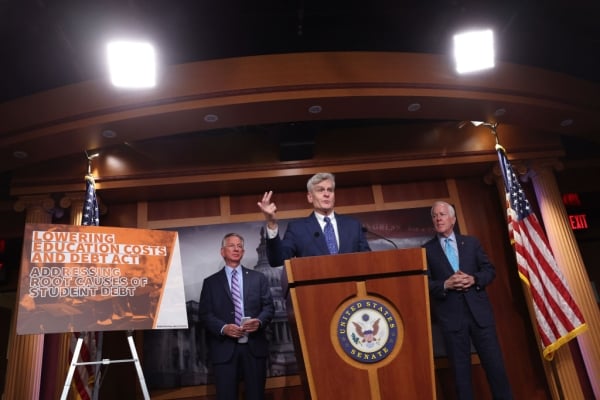
    Kevin Dietsch/Getty Images

    Senate Republicans want to eliminate so-called “inflationary loans,” stop federal aid to degrees that leave students worse off and expand the Pell Grant to workforce training programs as part of a draft plan released late Tuesday evening to overhaul higher education policy. 

    The 71-page legislation is part of the Senate’s response to the One Big Beautiful Bill Act, which passed the House last month and is designed to fund President Donald Trump’s tax cuts, his crackdown on immigration and other top agenda items.

    The Senate Health, Education, Labor and Pensions committee drafted the higher education portion of the legislation. As expected, the plan mirrors the House bill in many ways as it calls for significant changes to the federal student loan system. For instance, both plans would end the Grad Plus loans and restrict the Parent Plus program.

    But the Senate has a different plan to hold colleges accountable, nixing the House’s proposed risk-sharing model, under which colleges would have to pay a fee for their graduates’ unpaid loans, for a measure like gainful employment. Under the Senate plan, colleges would have to report their average postgraduate income levels and could lose access to federal aid, depending on students’ earnings and debt. The Senate bill also omits a provision from the House bill that would exclude part-time students from the Pell grant. Overall, the changes in the Senate bill would save $300 billion over 10 years compared to the House bill, which would save $350 billion.

    “American higher education has lost its purpose. Students are graduating with degrees that won’t get them a job and insurmountable debt that they can’t pay back,” said Sen. Bill Cassidy, the Republican chair of the HELP committee, in a news release.  “We need to fix our broken higher education system, so it prioritizes student success and ensures Americans have the skills to compete in a 21st century economy. President Trump and Senate Republicans are focused on delivering results for American families and this bill does just that.”

    Lawmakers are using the process known as reconciliation to advance the legislation, so it only needs 51 votes to pass the high chamber instead of the typical 60 votes. But before senators can vote, the Senate Budget committee and then the parliamentarian will have to scrutinize the various provisions and ensure they adhere to the reconciliation rules. For example, the policy changes must have a budgetary impact and be within the jurisdiction of the committee that proposed it. 

    President Donald Trump has set an ambitious July 4 deadline to sign the measure into law, which would require quick action from the Senate.

    From the beginning of the Trump administration in January, House Republicans have been pushing a more radical plan with steep cuts to key welfare programs like Medicaid, the Supplemental Nutrition Assistance Program, and, most recently, student financial aid like the Pell Grant. Meanwhile, senators have talked about more modest, though still significant, spending cuts. 

    Now, Republicans from both chambers will have to get on the same page if they want to meet their deadline. All the while, lobbyists, policy analysts and political figures—including ex-Trump advisor, Elon Musk—are expected to come at the bill from every angle with critiques.

    Source link

  • Prime Minister announces productivity roundtable – Campus Review

    Prime Minister announces productivity roundtable – Campus Review

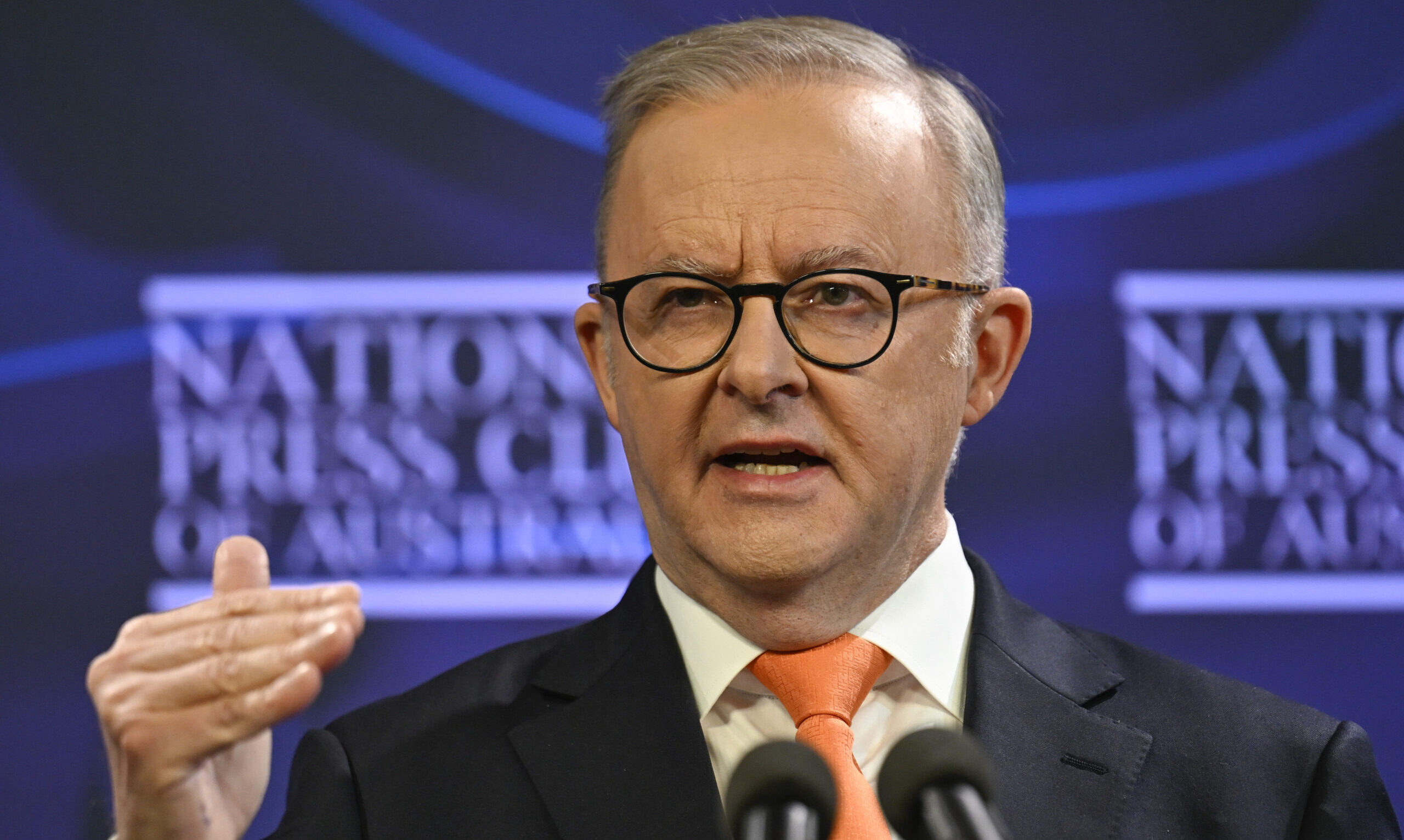
    Prime Minister Anthony Albanese has announced a productivity roundtable between business leaders, unions and community associations with the aim of boosting economic growth and wages, in his National Press Club address on Tuesday.

    Please login below to view content or subscribe now.

    Membership Login

    Source link

  • What I learned from US universities – Campus Review

    What I learned from US universities – Campus Review

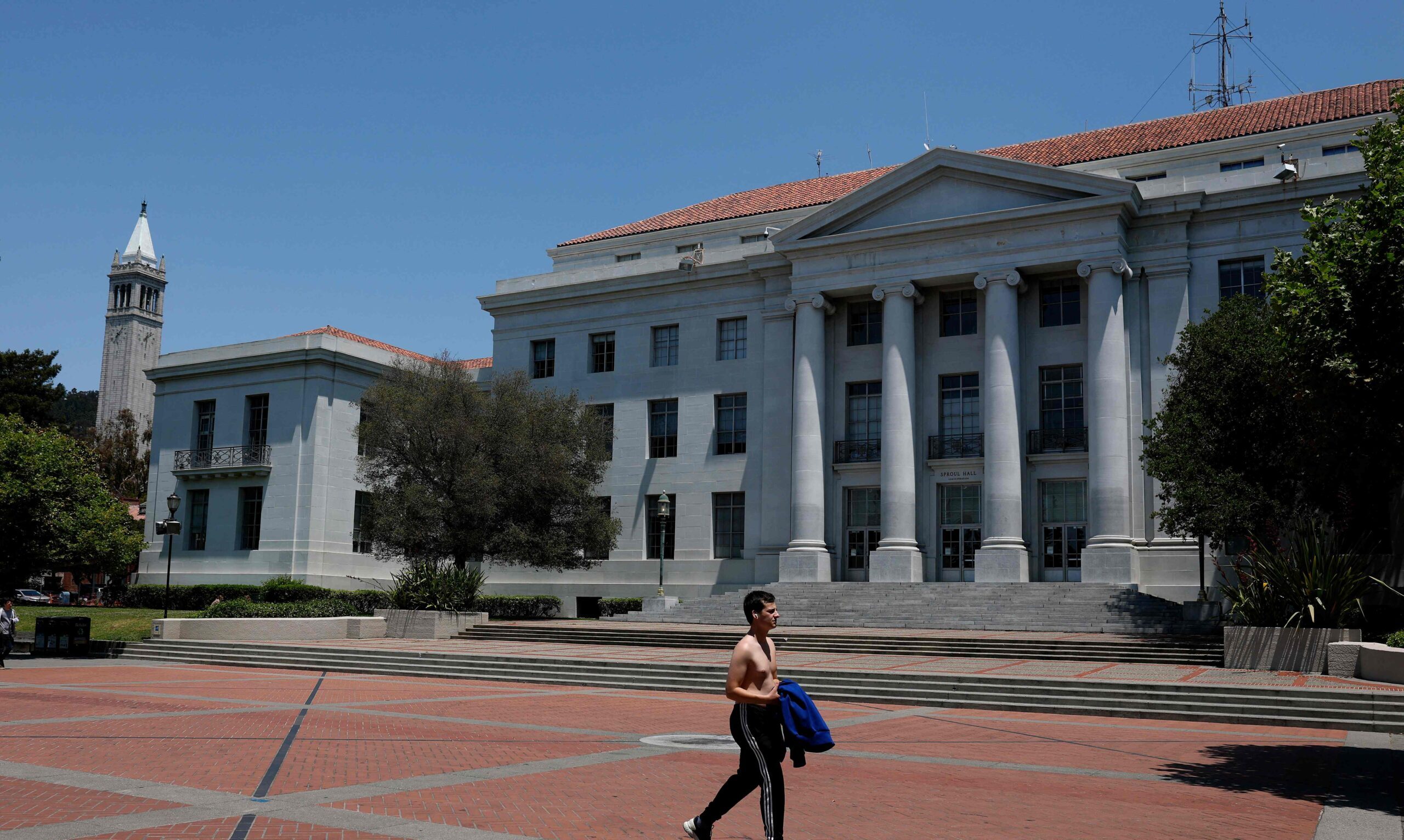
    I have greatly benefited from an academic and leadership career spanning three continents over 40 years, and always viewed the US as a different stage, but one with much to learn from. 

    Please login below to view content or subscribe now.

    Membership Login

    Source link

  • Seeing universities as others see us

    Seeing universities as others see us

    As the comparison between spending (per student) in Scottish and English universities comes into my argument later, Robert Burns’ famous lines from To a Louse seems a good place to start.

    O wad some Power the giftie gie us To see oursels as ithers see us

    We are very familiar with how we see ourselves. Higher education is facing an intolerable financial squeeze.

    In England the maximum fee which institutions are allowed to charge has only been been upgraded once, and only marginally, since the switch from state grants to tuition fees as the main source of funding for teaching 13 or more years ago. Its real value is barely 70 per cent of what it was then, although the Labour government has agreed to another – marginal – increase from 2025-26.

    In Scotland, where Scottish domiciled students pay no fees, public expenditure on higher education has similarly failed to keep pace with inflation.

    The substantial increase in full-fee paying international students, which many institutions relied on to fill the gap has ground to a halt because of less generous visa rules imposed as part of the backlash against large-scale immigration. The never-had-it-so-good years when growing your income was easy are over.

    Red ink

    Meanwhile costs have piled up. Higher education faces not only the standard inflationary pressures – higher wage, pension, energy, estates and other costs. As employers institutions must also pay higher rates of higher national insurance, without the possibility of passing on these extra costs (because of frozen fees and frowned-upon international recruitment). They may also face a levy on international students, although the Government has weakly promised that, if imposed, its proceeds would be redistributed within the system.

    As a result an escalating number of institutions are reporting deficits. The talk is all of transformation, a new code for everything from sharing back-office services to full-blown institutional mergers. The prospect of outright institutional failures cannot be excluded. Dundee has already come close, although not perhaps as close as initial alarmist scenarios suggested. Scotland, of course, still has a funding council able to intervene in such situations. In England the Office for Students has only recently begun to focus on financial sustainability, so it is far from clear what the fate of an English Dundee might be.

    That is our story – and we sticking to it. Rightly so, because it is almost entirely true, although it might help to convince others if it was not sometimes expressed in a spirit of aggrieved entitlement.

    The other side

    However, going back to Burns, we also need to think a bit more about how others see us. It is not simply that we are living in a post-truth world, so the marshalling of incontrovertible evidence while still necessary is now far from sufficient. This applies in particular to the toxically tangled issues of international students and immigration. No amount of evidence of the benefits of “soft power”, or economic multiplier effects, or of the way non-UK PhD students and post-docs have allowed us to punch above our weight in science and scholarship (same in the US, of course) will persuade those who fear they will have to live in, in the queasy but presumably deliberate phrase of the Prime Minister, “an island of strangers”.

    But there is no need to go down the post-truth rabbit hole. There are perfectly rational and plausible ways in which others can see us that are radically different from the way we see ourselves, ways that might appeal to politicians set upon from all sides by multiple clamouring claims for increased state support and to their officials focused on delivery and free-lance advisers thrilled by difficult choices.

    For example, these others might highlight the fact that spending per student on higher education, from all sources, is high by international standards. Among OECD countries the UK comes third, really second after the US because Luxembourg in the number-one spot is clearly a special case. In OECD’s book expenditure per student is substantially higher than in every other European country.

    Of course, international comparisons are notoriously unreliable because of the difficulty of making like-for-like comparisons and disentangling higher from wider tertiary education. Even the apparently simpler task of just comparing public expenditure and excluding private expenditure is fraught, as the difficulty of categorising expenditure on student loans in England has demonstrated. But, with all these caveats, it is still fair to conclude that UK expenditure per student is towards the generous end of the international spectrum.

    A counter ability

    The counter-argument is that this higher expenditure pays dividends because there are so many UK institutions among the top universities in global rankings. But there are clearly other factors that explain our stand-out performance, although Switzerland actually has more highly graded institutions in proportion to its population. Also our global eminence is essentially rooted in research not teaching performance, which is only relevant to expenditure-per-student in terms of cross subsidy. A better counter-argument is that, because of shorter course lengths – three-year undergraduate degrees and one-year Masters – and high completion rates, expenditure per graduate is pretty average by international standards.

    The same ‘others’, faced with evidence that funding per student in England is higher than in Scotland (spelt out, for example, in the recent report by London Economics for a Royal Society of Edinburgh conference), might not automatically conclude, as we do, that therefore funding in Scotland should be raised to the English level. On the contrary they might conclude that, because Scottish universities offer the same quality (whether measured by league tables, shares of competitively won research funding or external examiners’ and other reports on teaching) and the incidence of financial distress is not greater north of the Border, perhaps English funding levels may actually be (too?) generous…

    Of course, all Anglo-Scottish unit funding comparisons are compromised by the fact that undergraduate degrees are three-years south and four-years north of the Border. Historically the younger age of university entrants in Scotland, the lower intensity of Highers and persistence of “democratic intellect” general degrees may have justified the different course lengths. But there is now no difference in entry ages, Highers and Advanced Highers are clearly equivalent to A levels (as English universities acknowledge in their admissions criteria) and ordinary degrees have almost disappeared.

    Nor is it immediately obvious why, if an English system were to be adopted (which is not going to happen), Scottish graduates should be burdened with substantially more debt. The pressure for shorter, and less costly, degrees would clearly increase. But that is an argument for another time and place – and an educationally informed outcome could well be that English undergraduate degrees should also be four-year, which after all is the international standard in the rest of Europe, the US and almost everywhere else.

    Shiny new buildings

    The same ‘others’, faced with this prima facie evidence of  “inefficiency”, might also express some concern about the less-than-prudent management of some – English – universities since the high-fees regime was introduced 13 years ago. Was it really reasonable to plan, as the cranes went up on campus, on the basis that the tuition fees windfall would last for ever? Or that in crabby post-Brexit Britain the very considerable expansion in the number of international students would not provoke a populist backlash?

    They might even point back to historical precedents, and argue there is nothing fixed or sacred about any particular level of funding. Back in 1981 the former University Grants Committee bet on protecting the unit of resource – and lost. The student demand displaced by this vain attempt at protection flowed into the then polytechnics, creating the shape of higher education with which we are familiar today. When expansion really took off in the 1990s the unit of resource was further degraded, Better times only returned with the revival of public expenditure under Tony Blair and, crucially, Gordon Brown and, later, for a while, with high tuition fees.

    Finally they might channel, in a much more moderate way of course, Donald Trump’s threat to use the money he is withdrawing from Harvard to fund “trade schools”. There are plenty of influential people who argue higher education, and specifically universities, has been expanded at the expense of further education. This may demonstrate how little they know and understand about what actually happens in universities today, in particular post-1992 universities. But they represent an important strand of political, if not public, opinion which is hardly sympathetic to increased funding for higher education.

    To be clear, I am not endorsing this alternative viewpoint. My absolute preference is for a better funded higher education system, and also for increased public funding and a managed retreat from the narrowly transactional and crassly commodified regime imposed in England (do you really, Scotland, want to go there?). Nevertheless, surely it is important to remember Burns’ “giftie… to see oursels as ithers see us”. It can only only strengthen our arguments.

    Source link

  • University spending and cost recovery, 2023-24

    University spending and cost recovery, 2023-24

    If you are the kind of person who sits down to read analysis of the latest available TRAC (officially, Transparent Approach to Costing) data the last thing you would expect would be cautious optimism.

    The sector, after all, is circling the financial drain – and when you can read press releases from unions and sector representative bodies that say fundamentally the same thing you could feel confident that this is the situation.

    Much of what we’ve recently read in the press is about the impacts of measures taken to address this financial peril – course closures, job cuts, changes in terms and conditions, and a retreat from spending plans on everything from maintenance to recruitment.

    And what the latest TRAC tells us is that these measures are working.

    Who turned on the light?

    To be clear, it’s not time to quit lobbying for a better funding settlement.

    Based on 2023-24 submissions from 128 institutions in England and Northern Ireland the sector has an aggregate deficit of £2,003m – down substantially from £2,854m in 2022-23. The sector has made savings of more than £800m between two years – no mean feat where costs are rising and the value of income is falling.

    What’s going on under the hood is that institutions are getting better at recovering the costs of things they are funded to do – 95.7 per cent of costs were recovered in 2023-24, up from 93.6 per cent in 2022-23. Costs still exceed income (they have done since the pandemic) but the direction of travel is promising – providers are generating more income (up 5.8 per cent to £44,508m) while limiting increases in costs (up 3.5 per cent to £46,511m).

    This is good news, but counterintuitive. We know that staff costs are rising (there was an annual pay uplift, and pensions spending has increased substantially for those providers involved in TPS), we know that the cost of doing business (everything from maintenance to logistics to consumables is rising). And TRAC confirms this – staff costs are up 6.4 per cent, other operating costs are up 4.7 per cent, on last year.

    There are savings in the costs of finance (such as interest payments) – these have fallen 13.3 per cent over last year, though this does not make a huge contribution to overall spending.

    MSI (coming on like a seventh sense)

    We do, however, need to talk about the margin for sustainability and investment (MSI). It’s the most controversial part of the TRAC specification, and when you tell people that universities need to have at least some money for non-income generating fripperies like student support and estates maintenance within any calculation of the cost of doing business they will lose their minds.

    The calculation is done by institution and is based on an average of three years of data and three years of projections (the nerd in me wants to be clear that these are based on Earnings Before Interest Taxation Depreciation and Amortisation – EBITDA) expressed as a proportion of full economic costs. In 2022-23 this was £3,770m (8.4 per cent of FEC), in 2023-24 this was £3,548 (7.6 per cent of FEC) for the sector as a whole.

    The effect here is that the total costs of running a university (FEC plus MSI) looks lower than it did last year. This is more evidence of savings over multiple years – cutting spending on maintenance, sustainability, and student services. This will make cost recovery and the deficit look better: it doesn’t explain all of the improvements this year but it explains some of them.

    The document provides a fuller list of institutional decisions that would have an impact on the MOS calculation – inflationary pressures, a (regulator advocated) caution in recruitment income growth and research activity growth, variability in forecasts as more institutions design in large changes of focus to plans for future spending, and the usual weirdnesses around pension provisions.

    Spend less, earn more

    So institutions are making cuts, and look financially healthier for it. But there is still an overall deficit, and if cuts and efficiencies are the only answer to financial constraints there is a long and painful road left to walk.

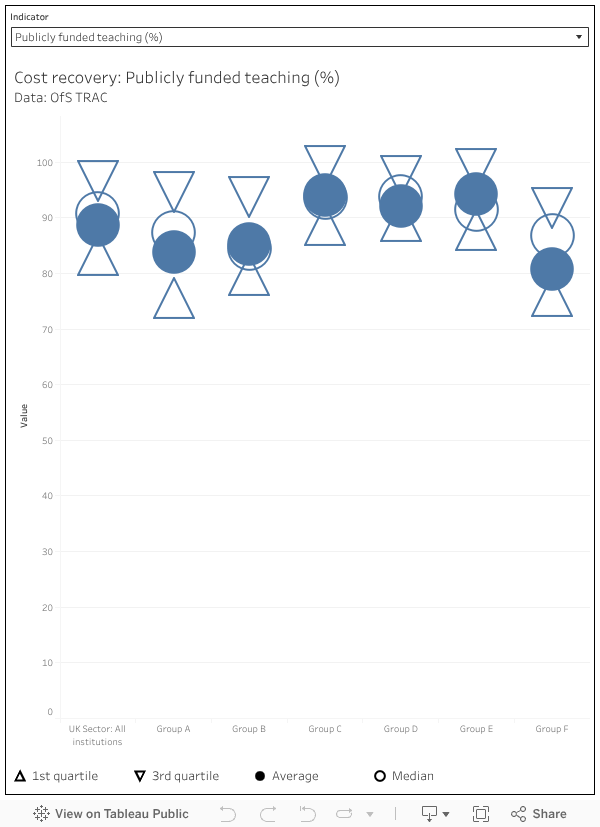
    Within the overall £2,003m deficit, the £1,693m deficit on publicly funded teaching is a major contributing factor: for every £100 a university spends on teaching home students, it receives £89.20 from the public purse. This varies, as we will see, by the type of institution in question and what else it gets up to. In real terms income is actually up slightly (a slight rise in the number of students), but it costs more to pay staff and to do all the other things that teaching requires.

    Conversely non-publicly funded teaching (all overseas students, and some self-funded home students) has a 143.1 per cent recovery rate, generating at a £3,232m surplus. The recovery rate is actually down marginally on last year, but the overall income from this source is up by 7.8 per cent (to £10,727m).

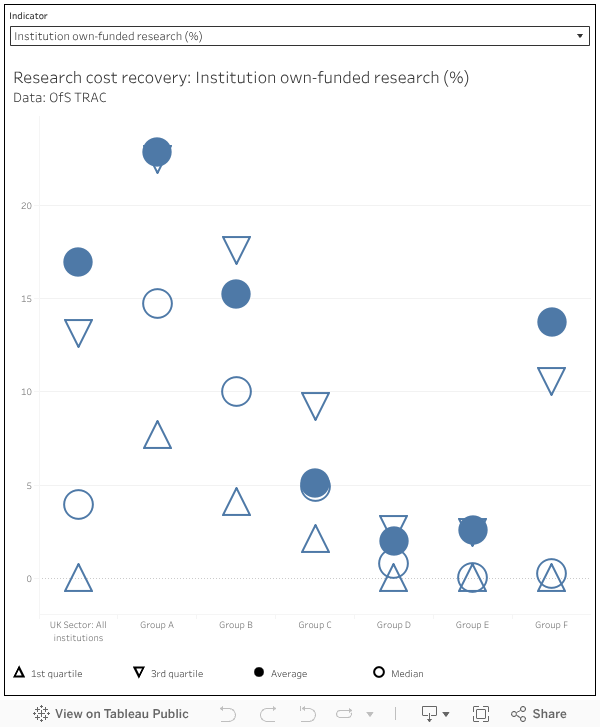
    Research has never had a good recovery rate – we’re now down to 66 per cent for 2023-24, from 68.5 per cent the previous year, and again there’s substantial differences by provider type. Again we can point to staff costs and operating costs rising as the reason, but we should also recall that most publicly funded research returns 80 per cent, and some research has no income attached at all.

    We should also note that other (income generating) activities like catering and accommodation run a small deficit, while other non-commercial activity (investments, donations, endowments) have an on-paper surplus.

    Peer pressure

    While the sector level figures are useful, they disguise a lot of diversity in the sector. We still – in 2025 – do not get institutional TRAC data, which would genuinely be useful for understanding where providers have costs that are substantially higher than comparators.

    Instead, we are back with groups A-F:

    • Group A: Institutions with a medical school that get 20 per cent or more of their total income from research (pretty much the Russell Group)
    • Group B: Other institutions with research income constituting 15 per cent or more of all income (largely the big, research intensive, traditional universities that sit outside of the Russell Group).
    • Group C: Research income between 5 and 15 per cent of all income (larger and research focused post-92 providers with some pre-92s mixed in)
    • Group D: Research income less than 5 per cent of a total income greater than £150m (Other big post-92 providers)
    • Group E: Research income less than 5 per cent of a total income less than £150m (the rest of the traditional universities, plus specialist providers)
    • Group F: Specialist music and arts institutions (as you might expect)

    Here’s what they all spend money on, as a proportion of total expenditure:

    [Full screen]

    And here’s the proportion of costs they recover on each kind of spending:

    [Full screen]

    And here’s what happens when you drill down into research:

    [Full screen]

    It’s not usually a good idea to make blanket statements about sector finances – what’s true for one university is generally not true for another. But in this case the generality is valuable – it highlights that the problems facing the sector are less to do with autonomous decisions and more to do with the overall financial settlement. Individual, provider action is clearly helping the situation. But it won’t be enough.

    Source link

  • From crisis to community: engaging students in post-pandemic classrooms

    From crisis to community: engaging students in post-pandemic classrooms

    School and other learning environments are often a safe place for students who have difficult home lives.

    I know, I was one of those students. I take that knowledge into every classroom that I enter, and my understanding of student engagement and student experience are woven into my pedagogy of care and teaching to transgress.

    I cannot, (and do not wish to!) separate my lived experience from my teaching. As someone who dropped out of the university that I now work at, I do have an interesting insight into building community and belonging into the curriculum.

    As I wrote here with Lisa Anderson, we require a radical shift in how we consider the needs of students. I want every student in my classroom to experience it as a safe and welcoming space.

    These are not buzzwords or trends, it is how I ensure that students are able to learn – I want them to be in the room. Teaching is a relational activity that requires commitment, experience, honing our craft and being willing to adapt.

    The university sector is not in a good place, and as committed as I am to my research, it is teaching that brings me joy and new ideas every single time I enter the classroom. When we teach to transgress, it is for us as much as it is for the students.

    The classroom reminds me of what is possible. Engaging strongly with the literature of the UK’s leading emergency and disaster planner, Lucy Easthope, I recognise the education will be impacted forever by the pandemic, and I want to play my part in the recovery.

    Crime, justice and the sex industry

    I lead the largest optional final year module in my department, with 215 registered students, based on my 23 years’ experience of the sex industry. It was a community of care that got me here, with colleagues from around the country (and globe!) sharing material and ideas with me when I launched this module in 2020. Collaboration and teaching go hand-in-hand and we must allow time for this.

    The module is underpinned by my nonlinear pedagogy which I write about here. The design empowers students to have control over the direction and pace of their learning. All content is uploaded to our virtual learning environment Canvas in week one. There are weekly recorded lecture summaries, and 2-hour weekly workshops.

    The content also includes a comprehensive library reading list, weekly reading folders, watch folder and collaborative tools.

    This year the module is celebrating its fifth birthday and the student engagement is better than ever before. Here are some things that I have learned and that I am reflecting on.

    A welcoming classroom and learning names

    Where possible, I always enter the classroom ten minutes before class begins (this is definitely not always possible in a large and busy campus with extreme demands on estates and our time) to provide a prepared and calm setting for students to arrive. This is also helpful for me as a neurodiverse teacher.

    I like to greet students as they arrive, and learn names wherever possible (photo class lists are your friend).This sets the tone for our warm and welcoming teaching community. It demonstrates the way in which we will invite peers to contribute and talk through the content. It may seem a small thing, but it makes a huge difference to teaching and learning.

    Front-loaded prep

    As a dyslexic I need to be prepared. This is a large module, and a busy teaching load. I spend the weeks before semester begins frontloading my prep so that I am ready to go. This involved re-recording the summary E lectures, updating workshop materials, sheets, reading folders, module guides, etc.

    Visitors to my office are surprised to see a row of 12 piles along the floor- with each week’s content printed out, highlighted, and ready to go. I am always very grateful once semester starts that I took the time to do this. It creates a calm tone to classes that students explicitly comment on.

    Lesson plans

    This year I went old-school in multiple ways, including buying a hardback lesson planner, in which I mapped out the learning objectives for every workshop – mapping against learning outcomes for the module.

    Physically mapping these out, with prompts, links to the readings and case studies, was something that students positively picked up on. This also ensured adaptability and that I was reflecting upon and updating my material. Students need calm and expert guidance; experienced teachers are key.

    Workbooks

    Acting on student feedback from the previous year, I designed a workbook that students can print out or use digitally. Students always make a lot of notes on this module, and the workbook helps them with organising those thoughts. In class, I was very pleased to see rows of pink workbooks looking back at me.

    The workbook also includes space for questions, and learners can bring this to my student support hours. I have been learning a lot from school teachers, and recognising how much extra structure students need post-pandemic.

    Learning through tempo

    I made an active decision this year to experiment with the tempo of each workshop class, with differences even between some workshop groups. This was in response to student feedback who wanted some slower sessions in order to read in class, and more time to talk with their groups/peers.

    This was music to my ears (pun absolutely intended) and it made me reflect on the pace and rhythm of my classes. I am a high-energy teacher and I like to pack a lot into classes, but stripping (pun not intended!) some of this back to create quieter time (for class reading) and slower sessions with more time for groups to talk, has been a game-changer. Students actively requesting some slower workshops so they could read together in class, was amazing to witness. Students reacted overwhelmingly positively to my ability to respond and adapt.

    Learning through play

    It is interesting in this post-disaster period of the pandemic to witness students enjoying, and requesting, playful activities in class. As I argue here, we need to build community into the curriculum to boost attendance.

    Poster paper and felt tip pens might have attracted horrified faces a few years ago and a low uptake, but this year, every single “play” activity that I have offered has been taken up by almost every student. I always offer a range of engagement tools, with non-verbal options such as our collaborative google doc, padlet, and other online tools, and I offer the option for sheets, paper, pens etc.

    A welcoming, hospitable classroom where students know they are being considered, pays dividends in engagement and mutual respect. Once students feel safe and able to take risks, no matter how low-stakes, they open up, and engage in difficult and complex debates.

    One group activity looked at sexual entertainment venue closures using five different pieces of coloured card to map out key findings from two different journal articles, identify and apply concepts from earlier weeks in the module, examples of venue closures, and examples of campaign group discourse.

    A “fun” activity that involves deep critical thinking and the ability to successfully weave together multiple forms of evidence to formulate a convincing argument. I then took a photo of the giant map we all created across the module. Every single student wanted to take part; students are actively seeking community and togetherness within the classroom.

    As Treasa Kearney and I argue here, campus should be a treasured space that offers valuable connections to students.

    The activity with foam stickers, which I thought students would resist, was the most popular activity of the semester (after the guided walk, below). Through the mechanism of light-hearted play, students successfully navigated a tricky and sensitive topic examining the harms, dangers and exploitation associated with online sex work. We ended up with students stickering their laptops, phones, their workbooks, and themselves! We cannot forget that these are all students of the pandemic, they missed out on so many opportunities to interact with peers. They are embracing every opportunity to connect with each other within timetabled sessions.

    Guided walk

    Another activity on the module (and the one that students most favourably comment on) is our guided walk of sexual entertainment venues in Liverpool city centre. I provide online material for accessibility purposes recognising that not all students can walk around the city, or may not wish to.

    For students who attend, we map out the city in terms of gendered harm and risk, and I give a lecture inside of a sexual entertainment venue that opens exclusively for our class. This brings the Policing and Crime Act 2009 to life, and gives students a unique insight into what the key texts are discussing. It is also very much a community building exercise, with a large proportion of our module cohort in attendance. Learning outside of the classroom is very important for student engagement.

    Scaffolding learning

    I intentionally choose to layer texts: curating texts of various complexity, using tools such as padlet. Students choose what texts to access based on their own areas of interests and confidence, as they progressively build up skill and academic knowledge of the area. This ensures that the module is accessible to all students, with learners challenged at a point which feels appropriate for them.

    It also means that students always have supported content to work with. In week ten, we looked at the media, and we returned to a key text from week eight, to apply three media myths from a journal article to three documentary clips. Using worksheets, the students demonstrated a sophisticated ability to apply a criminological concept to media sources.

    Responding to ongoing feedback

    Building a rapport with students through modelling a pedagogy of care and inclusion, equips students with the ability to provide feedback throughout the semester. Students appreciate the wealth of resources available from the beginning of semester, but others may feel overwhelmed with choice.

    In rapid response to student feedback, I started to provide recommended readings in addition to the large selection. Students appreciated this speedy closing of the feedback loop, and being valued co-producers of the module approach. The student feedback for the module was the best yet.

    Accessible assessment as the default position

    With growing numbers of students experiencing health issues, it is good practice to think of accessibility as the default position, not an additional bolt-on. I am in favour of different modes of assessment that students can choose from, or developing an assessment that can be approached in different ways. I have written here about my letter assessment, inspired by the work of Katie Tonkiss. Students often feel worried about “academic writing”, and this assessment allows students to use the first person, and to use a more colloquial writing tone if desired. The students develop a nuanced, convincing and influential writing style, with the ability to hold conflicting and competing harms in tension.

    Ultimately, it is about remembering that teaching is a huge privilege and blessing. We get to have an impact on so many people and play a part in shaping ideas and innovations of the future. I will never lose the gratitude for getting to do this job and remembering where I come from.

    Source link

  • HR and the Courts — June 2025 – CUPA-HR

    HR and the Courts — June 2025 – CUPA-HR

    by CUPA-HR | June 10, 2025

    Each month, CUPA-HR General Counsel Ira Shepard provides an overview of several labor and employment law cases and regulatory actions with implications for the higher ed workplace. Here’s the latest from Ira.

    Federal Court Allows Nationwide Class Action Alleging AI Age Discrimination To Proceed

    A federal court recently ruled that Workday’s artificial intelligence scoring algorithm for screening job applicants meets the standard to conclude that it may violate the Age Discrimination in Employment Act (ADEA) in discriminating against older job applicants. The court ruled that the nationwide class action may proceed (Mobley v. Workday (N.D. Cal. 3:23-cv-00770, 5/16/25)).

    While the court has not yet ruled on other allegations, the lawsuit also alleged that the algorithm has an unlawful disparate impact based on race and disability. President Trump has instructed the Equal Employment Opportunity Commission and the Department of Justice not to prosecute disparate impact cases, but this executive order does not apply to private lawsuits or state equal employment opportunity laws.

    Conflicting Federal Court Decisions on President Trump’s Executive Order Involving Mass Layoffs and Office Closings at the Education Department’s Office of Civil Rights

    On May 22, 2025, a federal court judge in Massachusetts issued a broad injunction prohibiting the mass layoffs and office closings at the Department of Education. The judge ordered the administration to reinstate all laid-off employees, and carry out all duties mandated by U.S. law, including managing student loans, aiding state educational programs and enforcing civil rights laws. The judge ruled that the personnel cuts would likely “cripple the department.” The judge concluded that the president lacked the power to effectively dissolve a federal agency created by Congress by getting rid of employees, closing offices and transferring duties to other agencies (Somerville Public Schools v. Trump (D. Mass. 25-cv-10667, 5/22/25)). The Trump administration will appeal the decision. Learn more.

    The day before, on May 21, 2025, a federal court judge in Washington, D.C. denied a private lawsuit to enjoin President Trump’s executive order, which resulted in placing nearly half of the Education Department’s Office for Civil Rights (OCR) staff on administrative leave and closing seven of the OCR’s 12 regional offices. The lawsuit was brought by a group of parents and students and the Council of Parent Attorneys and Advocates. The judge denied the request for a temporary injunction, holding that the plaintiffs lacked appropriate standing to sue and were unlikely to prevail on the merits (Carter v. United States Department of Education (D.D.C. No. 1:25-cv-007044, 5/21/25)).

    Presidential Executive Order Disfavors Criminal Enforcement of Federal Agency Rules

    An executive order signed by President Trump on May 9, 2025, advised all federal agencies that they should consider civil rather than criminal enforcement of their regulations. This could have a significant impact on the enforcement of federal laws and regulations in the HR field. The Employee Retirement Income Security Act (ERISA), Occupational Safety and Health Administration (OSHA) and the Fair Labor Standards Act (FLSA) all have an optional criminal enforcement capability, which is in addition to the standard civil enforcement typically pursued by the Department of Labor. The executive order also stated that agencies should avoid imposing a “strict liability” standard to their rules. Strict liability allows the government to pursue a person or entity in a situation regardless of intent.

    The executive order also requires all agencies to, within one year, provide the Department of Justice with a list of criminal regulatory offenses they are enforcing and the range of the criminal penalties for violation.

    Teacher Loses First Amendment Case Against School District After Firing

    A federal court recently ruled that the Unified Oakland School Board was immune from a lawsuit by a kindergarten teacher who refused to call a student by the pronouns they use, despite the student’s and parents’ wishes. The teacher claimed that to do so was inconsistent with her religious beliefs and to require her to do so violated her First Amendment right to freedom of religion. The school district had offered the plaintiff several accommodations before termination, including the option to call the student by their first name. The plaintiff refused and was ultimately terminated.

    The court dismissed the claim against the school district on sovereign immunity grounds and against individual officials on qualified immunity grounds (Ramirez v. Oakland Unified School District et al. (2025 BL 181443 N.D. Cal., No. 24-cv-09223, LB, 5/27/25)). The plaintiff was given 28 days to file an amended complaint against individual defendants.

    The judge also dismissed the teacher’s First Amendment free speech claim, holding that her refusal to use the pronoun the student uses was not protected free speech.

    Harvard Wins Temporary Reprieve From Presidential Executive Order Banning Its International Students From Entering the United States

    A federal judge issued a temporary restraining order (TRO) barring the government from enforcing a presidential executive order which would have banned Harvard from continuing to enroll foreign students. The judge ruled that it would cause Harvard irreparable harm and issued the TRO barring enforcement of the executive order and ordering that a hearing be held on the issue on June 16, 2025 (Harvard v. U.S. Department of Homeland Security (25-cv-11472, U.S. D Ct. Maa. (Boston) 6/5/25)).

    The TRO will be in effect until the June 16, 2025, hearing when the court will hear arguments over whether to extend the injunction. Learn more.

    NCAA and Power Five Conferences $2.8 Billion Settlement Proposal of Antitrust, NIL Suit Approved by Federal Judge

    On June 7, 2025, Judge Claudia Wilkens of the U.S. District Court for the Northern District of California approved the proposed NCAA and Power Five conferences (the ACC, Big 12, Big Ten, Pac-12, and SEC) settlement of the antitrust lawsuit brought against them for not allowing college athletes to receive payments for name, image and likeness (NIL) related to their college sports status. The judge approved a $2.8 billion settlement proposal to be distributed among student-athletes playing during the 2016-2024 seasons. In addition, the colleges are allowed to share up to 22% of revenue received annually from athletic programs with college athletes — capped at $20.5 million a year — going forward for 10 years. The cap will be adjusted upward by 4% during the first two years of the agreement.

    It is estimated that, of the $20.5 million annual cap, about 90% will go to football players and about 10% will go to male basketball players. In addition, NIL payments made by boosters and other sports-related entities are subject to outside review by the accounting firm Deloitte.

    Because of the unprecedented and fast-changing pronouncements of the new presidential administration and the intervening court challenges, the developments contained in this blog post are subject to change. Before acting on the legal issues discussed here, please consult your college or university counsel and, as always, act with caution.


    Source link

  • Marketing Can’t Lead If It’s Shackled by Structure 

    Marketing Can’t Lead If It’s Shackled by Structure 

    Over the past few years, I’ve had the opportunity to conduct organizational assessments for a range of colleges and universities, from small private institutions to large public campuses. Despite the wide variety in size, mission, and complexity, one core issue continues to surface: 

    The greatest threat to effective integrated marketing communications in higher education isn’t a lack of creativity, talent, or ambition; it’s internal misalignment. We have to get out of our own way. 

    This misalignment isn’t just a problem with processes or a cause of inefficiencies. It directly impacts a university’s ability to generate revenue, build and protect its reputation, and, ultimately, secure its long-term viability. 

    Below are five consistent themes I’ve observed across the institutions I’ve worked with, including those I personally worked for before consulting. I have found patterns that emerge regardless of structure, budget or institutional type. They’re internal challenges that severely undermine the very work marketing and communications professionals are tasked to deliver. 

    1. Decentralized Chaos 

    Most institutions operate under some form of distributed marketing where individual colleges, divisions, and programs employ their own communications and/or marketing staff. That’s not inherently problematic. The issue arises when these teams operate independently without shared planning cycles, coordinated messaging, or a central strategy to anchor their work. 

    At best, this results in duplicate efforts, inconsistent voice, and campaign overlap. At worst, it results in undertrained and underresourced staff holding the institution’s reputation and revenue in their hands with anchor to a central strategy.  

    2. Roles That Don’t Match Reality 

    Job descriptions across campuses are often written for tactical support roles: social media posting, event promotion, basic writing. In practice, many of these individuals are leading strategic initiatives, advising campus leaders, coordinating major campaigns, and serving as the face of their departments. 

    This gap between expectation and reality leads to chronic role strain, under-recognition, and burnout. Institutions end up relying on strategic thinking that they haven’t resourced or defined. Additionally, these roles tend to live in isolation, left to their own devices to prioritize their time and resources and even improve their own skillsets, while any connection to the central marcom unit is deemed optional. 

    3. Data Without Direction 

    Marketing technology is everywhere (CRMs, CMSs, project management tools, calendars, analytics platforms). However, the ability to extract meaningful, coordinated insight from those systems is rare. This may be the most critical issue I have seen uniformly across campuses.  

    Too often, teams track different metrics (if they track at all), interpret success in different ways, and lack access to integrated dashboards or audience journey data. There’s no central hub for marketing intelligence, and no unified approach to campaign evaluation. And in most cases, there are no connections between data sources to see if efforts are working. 

    4. Strategy Without Governance 

    Even when a university-wide marketing strategy exists, it often lacks enforcement mechanisms. Central communications teams may offer brand guidelines, campaign frameworks, or shared messaging, but unit-level teams aren’t always required or even incentivized to use them. 

    This results in fragmentation of messaging and a reactive culture in which strategy is optional and consistency is left to chance. 

    5. The Forgotten Internal Audience 

    Internal communications are frequently overlooked in the broader marketing ecosystem. Staff often describe a culture of “self-navigation,” where onboarding is informal, institutional goals are unclear, and team alignment is hit-or-miss. 

    Without strong internal communication, even the most ambitious marketing strategies falter. People can’t execute on what they don’t understand or weren’t invited into. 

    The Cost of Misalignment 

    These internal barriers are often invisible to the public but have real consequences: 

    • Missed enrollment targets 
    • Ineffective or underperforming campaigns
    • Brand inconsistency 
    • Lack of alumni engagement 
    • Delayed crisis responses 
    • Low morale and high turnover 
    • Internal resentment and lack of respect 
    • Risk to institutional reputation 

    In short, when internal teams aren’t set up to succeed, the institution’s ability to drive revenue and protect its reputation is compromised.

    What Institutions Must Do Now 

    If colleges and universities want to compete, marketing and communications cannot be treated as a service unit or support function. They must be positioned as strategic leaders with the authority and infrastructure to drive outcomes that directly influence institutional viability. 

    This means moving beyond collaboration and into accountability, with clear decision rights, cross-campus responsibility, and presidential endorsement. Just as individual units cannot hire a person without HR, they should not be able to advertise on behalf of the institution without central authority. 

    Here’s what that requires: 

    Elevate Marcom to a Strategic Leadership Function 

    Marketing and communications must sit at the strategy table, not just in times of crisis or campaign launches, but as a permanent fixture in institutional planning. That includes having a seat on executive leadership teams. While a reporting line to the president or chancellor is ideal, it isn’t necessary if access and support exist.  

    No major initiative—enrollment, advancement, academic innovation—should move forward without Marcom’s leadership embedded from the beginning. 

    Centralize Authority, Decentralize Execution 

    Establish a clear governance structure that defines who owns the brand, who approves campaigns, and how messaging is prioritized. Marcom should lead the strategy, planning cycles, audience research, and brand integrity, while colleges and units execute within those frameworks. 

    This approach balances institutional consistency with local relevance and eliminates duplicative, misaligned marketing efforts. 

    Redefine Roles to Match Reality 

    Audit all marketing and communications roles across the institution. Rewrite job descriptions to reflect the actual strategic, analytical, and leadership work staff are doing. Then, align titles, compensation, and reporting structures accordingly, building accountability to the central Marcom strategy. 

    The reality is that many professionals are already acting as strategists but without the recognition, decision-making authority, or organizational support to do so effectively. This should include much-needed professional development for those typically forced to self-teach. 

    Build the Infrastructure for Insight and Alignment 

    Invest in integrated systems (integrated CRMs, content management platforms, campaign dashboards, and persona libraries) but pair those tools with processes. This means shared campaign calendars, institution-wide planning cycles, and a unified set of performance indicators. 

    Without alignment on audiences, channels, timing, and outcomes, even the best content will underdeliver. 

    Use a Marketing Maturity Model to Drive Progress 

    Adopt a clear roadmap to measure and grow marketing capabilities across six key domains: brand management, audience journey integration, insights infrastructure, strategic alignment, risk management, and organizational culture. 

    Then give Marcom the responsibility (and the resources) to lead that transformation. Not just participate in it. Own it. 

    This is not about creative polish or tactical execution. It’s about institutional sustainability. The higher education market is louder, more competitive, and less forgiving than ever. 

    Institutions that continue to treat marketing and communications as a support function will struggle to adapt. Those that empower it as a core leadership discipline, with the needed structure, authority, and resources, will build stronger brands, increase revenue, and secure their relevance for the future. 

    Source link

  • Top Hat Named Courseware Solution Provider of the Year

    Top Hat Named Courseware Solution Provider of the Year

    Prestigious EdTech Breakthrough award highlights Top Hat’s leadership in delivering flexible, AI-powered courseware to support faculty and students.

    TORONTO – June 6, 2025  – Top Hat, the leader in student engagement solutions for higher education, has been named the 2025 Courseware Solution Provider of the Year. The annual EdTech Breakthrough Awards honor organizations that push the boundaries of educational technology—benefiting students, educators, and institutions across North America and around the world. In a global field of over 2,700 nominations, Top Hat stood out for its efforts to empower faculty to create and deliver engaging, connected, and affordable learning experiences for students.

    “Receiving this award is an honor and supports our belief that better student outcomes begin with the course itself,” said Maggie Leen, CEO of Top Hat. “We’re proud to support thousands of faculty with tools that make it easier to adopt proven teaching practices, and grateful to our team for the creativity and care they show everyday in making great learning experiences a reality for more students.”

    Now in its seventh year, the EdTech Breakthrough Awards have become a benchmark for excellence in educational technology. The program celebrates the industry’s most visionary companies—those dreaming bigger, innovating further, and setting new standards for enhancing the practice of teaching and learning. Top Hat’s selection reflects its track record of building solutions that drive measurable academic outcomes and dramatic improvements in student engagement, inside and outside the classroom. 

    Top Hat’s courseware platform gives instructors unprecedented flexibility to tailor content to their teaching goals. The platform integrates interactive assessments, multimedia, and AI-powered tools that allow educators to instantly create in-class questions and reflection prompts. This makes it easier than ever for instructors to apply evidence-based practices like active learning and low-stakes assessment. Students also benefit from AI-powered on-demand study support and unlimited practice questions rooted directly in course content. 

    Top Hat has a long-standing commitment to helping faculty adopt, adapt, or create modern, interactive course materials that improve engagement and comprehension while advancing institutional goals around student affordability and equity. By supporting the use of low- or no-cost learning materials—including customizable OpenStax and OER titles enriched with interactive features—Top Hat empowers educators to design meaningful learning experiences that reflect their unique pedagogical goals while reducing costs for students.

    About Top Hat

    As the leader in student engagement solutions for higher education, Top Hat enables educators to employ evidence-based teaching practices through interactive content, tools, and activities in in-person, online, and hybrid classroom environments. Thousands of faculty at 900 leading North American colleges and universities use Top Hat to create meaningful, engaging and accessible learning experiences for students before, during, and after class. To learn more, please visit tophat.com.

    Source link

  • Elevate Your Higher Education YouTube Channel with Proven SEO Tactics

    Elevate Your Higher Education YouTube Channel with Proven SEO Tactics

    In today’s competitive digital landscape, higher education institutions must continually evolve to reach and engage prospective students. YouTube has evolved from a video-sharing platform into a dynamic search engine where students explore campus life, academic programs, and authentic student experiences. That’s why developing and optimizing a higher education YouTube channel is more important than ever.

    Smart video SEO strategies can significantly improve visibility, build brand authority, and support enrollment goals for institutions. A well-crafted YouTube strategy plays a crucial role in this effort, ensuring that content reaches and resonates with prospective students.

    Why YouTube SEO matters for higher ed video marketing

    YouTube SEO goes beyond views. It positions your institution within one of the most influential search engines in the world. YouTube has become the second-largest search engine after Google, and for today’s prospective students — many of whom are digital natives — video is a primary method of discovery and research.

    Whether exploring campus life, comparing academic programs, or seeking authentic student voices, prospective learners turn to YouTube to gather insights that influence their decisions. A well-optimized higher education YouTube channel offers a range of benefits, including:

    • Builds credibility and trust by providing authentic, engaging content.
    • Expands visibility on a platform used heavily by prospective students.
    • Drives enrollment by surfacing at key moments in the decision-making journey.
    • Strengthens your digital footprint through content that aligns with search behavior.
    • Supports multi-channel strategies by integrating with websites, email, and social media.
    • Improves AI-driven search visibility as AI-powered search results increasingly prioritize video content. (Tools like YouTube’s auto-transcription and AI tagging can further enhance discoverability.)

    Optimizing your channel ensures your content appears when it matters most and positions your institution as a leader in digital engagement.

    “Video content is the future of marketing—it’s authentic, engaging, and capable of building trust with your audience faster than any other medium.”

    Neil Patel, digital marketing expert

    Build a strong SEO foundation for your higher education YouTube channel

    Every video your institution shares is more than just content — it’s an opportunity to shape perceptions, highlight your strengths, and connect with your audience. Before diving into more advanced strategies, it’s essential to ensure that each video is built on a solid SEO foundation.

    When executed consistently, these foundational elements can make the difference between content that gets buried and content that drives meaningful engagement. Foundational elements include:

    • Accurate video transcripts: Ensure transcripts are complete and error-free. This enhances accessibility and helps search engines understand your content. Also, include captions and alt text to enhance accessibility and meet ADA standards.
    • Optimized video settings: Configure each video correctly (e.g., mark as “not for children”, assign relevant categories, add strategic tags) to improve discoverability.
    • Robust video descriptions: Use keyword-rich, detailed descriptions aligned with your academic offerings. Think like a prospective student searching for programs or campus life.
    • SEO-friendly video titles: Titles should be compelling, clear, and keyword-focused. Avoid jargon — focus on what the viewer will gain.

    Apply advanced channel strategies to stand out

    Once the foundational elements are in place, it’s time to move beyond the basics. Elevating your higher education YouTube channel requires thoughtful planning and strategic segmentation. This is especially important for institutions with diverse academic offerings and multiple audiences, such as prospective undergraduate and graduate students.

    Taking a more advanced approach can help differentiate your content, make navigation easier for users, and deliver tailored experiences that align with varied student needs. To elevate your channel’s performance and support segmented marketing goals:

    • Create dedicated channels: Maintaining separate channels for different audiences (like graduate versus undergrad) allows for more targeted messaging and cleaner audience segmentation.
    • Use playlists strategically: Group videos by topic or series and apply consistent naming conventions. This improves navigation, boosts engagement, and supports channel SEO.
    • Optimize thumbnails and preview content: High-quality thumbnails and concise preview text boost click-through rates, especially on mobile devices.

    Ready for a Smarter Way Forward?

    Higher ed is hard — but you don’t have to figure it out alone. We can help you transform challenges into opportunities.

    Enhance viewer engagement

    Even if your department isn’t directly producing every video, there’s still an opportunity to influence engagement and performance. By implementing a few proven tactics, institutions can increase viewer interaction and strengthen their presence on YouTube.

    These strategies work in tandem with foundational SEO practices to extend the reach and impact of your video content:

    Include clear calls-to-action (CTAs): Ask viewers to like, comment, subscribe, or visit your website. These actions signal relevance to YouTube’s algorithm.

    Leverage end screens and cards: Use these to direct viewers to related content, encouraging longer sessions and deeper engagement.

    Maintain consistent branding: Ensure videos reflect your institution’s visual identity and messaging tone to reinforce brand equity.

    Integrate video into your broader strategy

    YouTube content shouldn’t exist in a silo. When part of a cohesive higher ed video marketing approach, your higher education YouTube channel becomes a versatile asset that supports communication and engagement across platforms.

    To truly maximize its value, it must be woven into your institution’s broader marketing and communication ecosystem. When aligned with your website, email campaigns, and social media channels, your YouTube strategy reinforces key messages and creates a cohesive experience for prospective students.

    YouTube videos can be a powerful asset across multiple marketing channels:

    • Website integration: Embed program overviews, testimonials, and campus tours to enrich landing pages and drive engagement.
    • Email campaigns: Incorporate personalized video content into outreach and drip campaigns to boost open and click-through rates.
    • Social media amplification: Repurpose YouTube content into short clips for Instagram, TikTok, Facebook, and LinkedIn to reach broader audiences.
    • Virtual events and webinars: Leverage recorded content as follow-up resources or promotional teasers.
    • Advertising and paid media: Use high-performing videos in YouTube ads or across PPC campaigns to increase reach and ROI.

    Stay agile and stay ahead

    YouTube SEO isn’t a one-time effort — it’s a continuous process. Use YouTube Studio to track key performance metrics such as watch time, engagement, and search impressions. These insights help guide your strategy and identify opportunities to improve content.

    Monitor analytics regularly, refresh metadata, and adapt to changing viewer behaviors. Institutions that stay agile will be better positioned to engage digital-native audiences.

    Take your higher ed video marketing to the next level

    YouTube remains a powerful tool to build institutional visibility and connect with prospective students. At Collegis Education, our expansive marketing services are backed by deep expertise in higher ed SEO, digital strategy, and content performance. Whether you’re refining your current efforts or starting fresh, a smart, scalable strategy can turn your YouTube channel into a powerful tool for student engagement.

    Let’s connect and start building a smarter strategy today.

    Innovation Starts Here

    Higher ed is evolving — don’t get left behind. Explore how Collegis can help your institution thrive.

    Source link