Keystone College has completed a merger with the Washington Institute for Education and Research, a fledgling think tank, after nearly three years of work, officials announced Monday.
Last week, Keystone’s accreditor, the Middle States Commission on Higher Education, announced that it had reviewed and signed off on the ownership change, making it official at the end of May.
The Pennsylvania Department of Education, the Pennsylvania Office of the Attorney General and the U.S. Department of Education already approved the merger.
Keystone president John F. Pullo Sr. noted the merger effort was both lengthy and challenging.
“I am pleased to report that the merger transaction between Keystone and WIER was concluded on Friday, May 30, finally joining the College with its strategic partner after nearly a three-year journey that at times threatened the future of the College,” Pullo said in a news release.
Pullo’s remarks are a likely nod to Keystone’s precarious position in recent years. Last spring, MSCHE warned that the private college was “in danger of immediate closure.” However, Pullo noted at the time that officials were in talks with “an investment partner” to help stabilize the college. (Keystone’s accreditation was also at risk last year, but it remains accredited.)
Keystone’s new owner is a largely unknown think tank based in Washington, D.C.
WIER, founded in 2023, describes its purpose on its website as “The establishment and operation of post-secondary degree-granting institutions for the instruction of students” and “Funding and supporting other post-secondary 501(c)(3) degree-granting institutions.” WIER does not list any staff members on its website except for founder and president Ahmed Alwani.
Alwani was previously president of Fairfax University of America in Northern Virginia, which quietly closed in December due to its inability to find a new accreditor after the Accrediting Council for Independent Colleges and Schools lost federal recognition, according to the FXUA website. The private, nonprofit institution, formerly known as Virginia International University, was almost shut down by state regulators in 2019 due to various issues highlighted by the State Council of Higher Education for Virginia, including a lack of academic rigor and other concerns.
Despite a flurry of announcements for the higher education sector in the first half of 2025, much remains unknown about what is to come in this summer’s promised higher education reform plans. However, it is a pretty safe bet that opportunity and access will feature prominently. The Government has put ‘breaking down barriers to opportunity’ as one of its key missions for this Parliament, and higher education remains a core driver of social mobility.
Data consistently show that higher education qualifications are clearly and unambiguously associated with increased earnings and employment prospects. Research from the Sutton Trust found that attending a Russell Group university narrows the existing gap between state school students eligible for school meals and their privately educated peers in the likelihood of becoming a top earner.
At the same time, deeply entrenched inequalities prevail, as the UPP Foundation inquiry into widening participation highlights. The stark findings in itsrecent report included the difference in progression to higher education across the country: 71.6% of 18-year-olds in Battersea, compared to just 11.1% in Barrow-in-Furness. The Government is right to be looking at ways to address this striking imbalance, and universities are ready to be even more ambitious to reach more young people.
It is undoubtedly a huge challenge – both the task itself, given these inequalities are largely set at primary school and are already entrenched by the time it comes to post-16 options; and the wider context, given the university sector’s own financial challenges.
But good progress is being made. The number of young people from the most underrepresented backgrounds studying at Russell Group universities has seen a 56% increase since 2019. The number of Black placed applicants has increased by 62% in the same period. However, there is a mixed picture across the different measures of disadvantage – not helped by a cost-of-living crisis hot on the heels of the pandemic, both of which are still having an impact.
In this context, the Russell Group has today published a new paper, Building Opportunity For All. This sets out just some of the ambitious work our universities are already doing alongside new commitments they’ve made to going further. These commitments include expanding participation in regional partnerships, committing to a tailored support package for care leavers and care-experienced students, improving transparency around contextual admissions, and supporting the new TASO Evaluation Library to track the impact of activity.
These new collective commitments build on the work already detailed in universities’ access plans. These are being supported by an investment of more than £250m a year across the Russell Group.
Widening access is not a solo endeavour, which is why many of our ambitions involve making the most of partnerships with others inside and outside higher education. Combining ambitions and resources with others means our universities can go even further. Russell Group universities already spend millions of pounds a year on third sector partnerships, enabling us to provide almost 100,000 young people across the UK with practical support in achieving their university ambitions – from tutoring to advice on completing university applications.
Across the UK, universities are thinking creatively about what participation in higher education means for different people and how we can open up our campuses and opportunities to everyone. At the University of Bristol, partnership working not only helps young people gain a place at the University but also improves community engagement more broadly. The university has two micro-campuses located in areas of the city with the lowest higher education participation rates. Since 2020, the Barton Hill campus has worked with over 60 partners annually and welcomes 160+ users each week as a hub for research, teaching and outreach. Meanwhile, the new Hartcliffe campus is co-developing a micro-qualification with local colleges, employers and community groups to create new routes into work and study.
Our partnerships with further education are also developing more flexible learning pathways to raise attainment. The University of Glasgow, for example, runs Higher National Certificate (HNC) Articulation Programmes, developed with eight West of Scotland colleges. These enable eligible students – care-experienced individuals, estranged students, carers and those with refugee or asylum seeker status – to progress directly into Year 2 of some undergraduate degrees. Integrating college-based HNC study with university-led sessions and full access to campus resources fosters academic readiness and a sense of belonging, helping participants progress further in their educational journeys.
Opportunity is a shared challenge, and the Government needs to be our partner on this. We expect the Department for Education – quite rightly – to put opportunity as a central pillar of higher education reform. Our universities are already responding by increasing their ambition and being creative in their thinking. For example, the care leaver support packages our universities are implementing encompass everything from assistance applying to university and finding accommodation, to providing kitchenware, luggage, vouchers and gym memberships to help with a smooth transition and settling into university life.
But we can’t solve everything alone. We have long been calling on successive governments to improve student maintenance to remove financial barriers. Universities are doing what they can to support students. Over 60% of Russell Group universities’ £250m annual investment in access goes on direct financial support for students who need it the most. However, while significant, this is the context of the poorest students in 2025/26 being entitled to borrow around £1,125 (10%) less in real terms towards their living costs than in 2020.
It is also challenging to narrow equality gaps that have been growing since childhood. It’s vital that the Government’s opportunity mission considers the whole lifecycle of a student’s journey, from early years to post-16 education and beyond. Universities are ready and willing to be a vital part of the picture of improving opportunity, but they are still just one element. If inequalities are addressed at a young age, it will become easier to ensure access to university for everyone – not only helping students achieve their individual ambitions, but also bringing greater rewards for the government’s skills and workforce ambitions.
Over the last two years, I’ve witnessed the rise in students’ use of generative AI as whole. Not surprisingly, more students are using generative AI to assist them in writing.
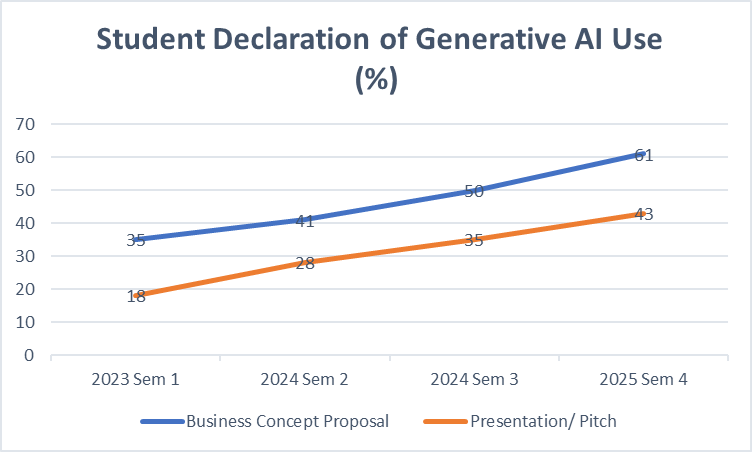
In an undergraduate business communication course that I oversee, the percentage of students who declared their use of generative AI for a writing assessment (i.e. business proposal) increased steadily over four semesters from 35% in 2023 to 61% in 2025. What’s more fascinating is the corresponding increase in the reported use of generative AI for their spoken assessment – their presentation (i.e. pitch) – from only 18% in 2023 to 43% in 2025.
*Note that there were about 350 students per semester and a total of about 1,400 students over four semesters/two years.
You may be wondering, how exactly are these students using generative AI for presentations?
They reported using generative AI to:
Create and edit visuals (e.g. images, prototypes/ mockups, logos)
Get inspiration for rhetorical devices (e.g. taglines, stories, alliterations)
Prepare for the Q&A (e.g. generate questions, review/structure answers)
Beyond verbal language,visuals are an important facet of communication and students need to be prepared for more multimodal communication tasks at the workplace (Brumberger, 2005). With digital media, there has been a shift in balance between words and images (Bolter, 2003) which can be seen in websites, reports and even manuals. A students’ ability to communicate in writing and speaking must now be complemented with a proficiency in visual language. Now, generative AI can reduce those barriers to creative visual expression (Ali et al., 2004).
For example, students on my business communication course use AI tools to create prototypes and mockups of their project ideas to complement their explanations. When they are unable to generate exactly what they need, they edit those images with traditional editing software or more recently, software with generative AI editing abilities such as Adobe firefly which allows users to select specific areas of an image and use “generative fill” to brainstorm and edit it without advanced technical skills. This and other AI text generators including Dall-e (Openart) and Midjourney have opened up possibilities for communicators to enhance their message using visuals.
Here are the AI Visual Tools students have reported using in their written and spoken assessment over two years:
What’s interesting from the list is not only an increase in the number of AI tools used but the type of tools used (1) for specific purposes like Logopony, for the creation of logos, Usegalileo, for app Interface designs, and Slidesgo, for the creation of slides, as well as AI tools (2) for editing such as Photoshop AI, Adobe Firefly, and Canva. Beyond that, we can see how students are using different tools from companies that are constantly evolving such as Canva with Magic Studio and Dream Lab, OpenAI who has integrated Dall-e into ChatGPT, as well as their latest offering, Sora, and even Google who now has Gemini Flash 2.0. Generative AI is also becoming more accessible on different platforms with the integration of Meta AI to WhatsApp, a cross-platform messaging app.
Ultimately, this list provides a glimpse of what some undergraduate business students are dabbling with and educators should consider trying them out. More importantly, we could guide students in thinking about the visuals and graphics that they ultimately use because not all graphics are equally effective (Mayer and Moreno 2003).
Some graphics are:
Decorative They are neutral and may enhance the aesthetics but is not interesting or directly relevant.
Seductive They may be highly interesting but may not be directly relevant and can distract the audience and cause their cognitive processing to focus on irrelevant material.
Instructive They are directly relevant to the topic (Sung and Maye, 2012).
However, it doesn’t mean that all visuals should be instructive because it depends on the goal of the communicator. For example, if the main goal is for enjoyment, then decorative visuals can enhance the aesthetics and seductive visuals can be so interesting that it leads to higher satisfaction, so we should remind students to be intentional in their use of visuals and AI tools. For example, AI tools tend to create visuals with a lot of extraneous details that may be distracting and lead to cognitive overload (Deleeuw and Mayer 2008) so students should refine their prompts by being more specific and precise (Hwang and Wu 2024) and they should be prepared to use editing software which can include other AI enhanced software like Adobe firefly and Imagen to achieve their final goal.
There are limitations to what AI can do at the moment.
It cannot be truly innovative because it learns from existing data.
It cannot fully understand subtle aspects like culture, values or emotional nuances (Hwang and Wu 2024).
But it can provide the stepping stone for students to visualize their ideas.
Let’s encourage our students to be aware of what they want to achieve when using AI tools and be proactive in selecting, rearranging, editing and refining the visuals to suit their purposes.
Aileen Wanli Lam is a Senior Lecturer and technology enthusiast at the National University of Singapore. She is fascinated by education technology and enjoys conversations about the latest industry developments. She is also passionate about professional communications, student engagement and educational leadership.
References
Ali, Safinah, Prerna Ravi, Randi Williams, Daniella DiPaola, and Cynthia Breazeal. “Constructing dreams using generative AI.” In Proceedings of the AAAI Conference on Artificial Intelligence, vol. 38, no. 21, pp. 23268-23275. 2024.
Bolter, Jay David. “Critical theory and the challenge of new media.” (2003).
Brumberger, Eva R. “Visual rhetoric in the curriculum: Pedagogy for a multimodal workplace.” Business Communication Quarterly 68, no. 3 (2005): 318-333.
DeLeeuw, Krista E., and Richard E. Mayer. “A comparison of three measures of cognitive load: Evidence for separable measures of intrinsic, extraneous, and germane load.” Journal of educational psychology 100, no. 1 (2008): 223.
Hwang, Younjung, and Yi Wu. “Methodology for Visual Communication Design Based on Generative AI.” International journal of advanced smart convergence 13, no. 3 (2024): 170-175.
Mayer, Richard E., and Roxana Moreno. “Nine ways to reduce cognitive load in multimedia learning.” Educational psychologist 38, no. 1 (2003): 43-52.
Sung, Eunmo, and Richard E. Mayer. “When graphics improve liking but not learning from online lessons.” Computers in human behavior 28, no. 5 (2012): 1618-1625.
Brian Schmidt said research funding has been “a year-to-year series of wallpaper jobs for the last 20 odd years.” Picture: Martin Ollman
A Nobel laureate and an esteemed economist outlined the sub-par state of Australian research funding and sovereignty in a joint address to the National Press Club last Wednesday.
Please login below to view content or subscribe now.
Mark Scott received a 150k pay rise last year. Picture: Martin Ollman
The University of Sydney (USyd) recorded a $500 million surplus in 2024 and boosted its vice-chancellor Mark Scott’s pay by $150,000 to a $1.349 million salary, its 2024 financial result showed.
Please login below to view content or subscribe now.
Pro-Palestine campers at Sydney University. Picture: Thomas Lisson
University of Sydney (USyd) vice-chancellor Mark Scott on Monday wrote to students and staff to inform them that students will not be allowed to make non-course related announcements at the beginning of class.
Please login below to view content or subscribe now.
Expert in student experience from the University of Queensland Kelly Matthews is guest host this week and interviews Monash University Associate Professor Tim Fawns and the University of Sydney’s Dr Stephen George-Williams.
Please login below to view content or subscribe now.
Earnings data—especially at subject level—has become key to debates about the value of higher education.
But we know far less about how graduates themselves experience their early careers. Until now, subject-level data on graduate job quality—how meaningful their work is, how well it aligns with their goals, and whether it uses their university-acquired skills—has been missing from the policy debate.
My new study (co-authored with Fiona Christie and Tracy Scurry and published in Studies in Higher Education) aims to fill this gap. Drawing on responses from the 2018-19 graduation cohort in the national Graduate Outcomes survey, we provide the first nationally representative, subject-level analysis of these subjective graduate outcomes.
What we find has important implications for how we define successful outcomes from higher education—and how we support students in making informed choices about what subject to study.
What graduates tell us
The Graduate Outcomes survey includes a set of questions—introduced by HESA in 2017—designed to capture core dimensions of graduate job quality. Respondents are asked (around 15 months after graduation) whether they:
find their work meaningful
feel it aligns with their future plans
believe they are using the skills acquired at university
Our analysis shows that most UK graduates report positive early-career experiences, regardless of subject. Across the sample, 86 per cent said their work felt meaningful, 78 per cent felt on track with their careers, and 66 per cent reported using their degree-level skills.
These patterns generally hold across disciplines, though clear differences emerge. The chart below shows the raw, unadjusted proportion of graduates who report positive outcomes. Graduates from vocational fields—such as medicine, subjects allied to medicine, veterinary science, and education—tend to report particularly strong outcomes. For instance, medicine and dentistry graduates were 12 percentage points more likely than average to say their work was meaningful, and over 30 points more likely to report using the skills they acquired at university.
However, the results also challenge the narrative that generalist or academic degrees are inherently low value. As you can see, most subject areas—including history, languages, and the creative arts, often targeted in these debates—show strong subjective outcomes across the three dimensions. Only one field, history and philosophy, fell slightly below the 50 per cent threshold on the skills utilisation measure. But even here, graduates still reported relatively high levels of meaningful work and career alignment.
Once we adjusted for background characteristics—such as social class, gender, prior attainment, and institutional differences—many of the remaining gaps between vocational and generalist subjects narrowed and were no longer statistically significant.
This chart shows the raw proportion of 2018-19 graduates who agree or strongly agree that their current work is meaningful, on track and using skills, by field of study (N = 67,722)
Employment in a highly skilled occupation—used by the Office for Students (OfS) as a key regulatory benchmark—was not a reliable predictor of positive outcomes. This finding aligns with previous HESA research and raises important questions about the appropriateness of using occupational classification as a proxy for graduate success at the subject level.
Rethinking what we measure and value
These insights arrive at a time when the OfS is placing greater emphasis on regulating equality of opportunity and ensuring the provision of “full, frank, and fair information” to students. If students are to make informed choices, they need access to subject-level data that reflects more than salary, occupational status, or postgraduate progression. Our findings suggest that subjective outcomes—how graduates feel about their work—should be part of that conversation.
For policymakers, our findings highlight the risks of relying on blunt outcome metrics—particularly earnings and occupational classifications—as indicators of course value. Our data show that graduates from a wide range of subjects—including those often labelled as “low value”—frequently go on to report meaningful work shortly after graduation that aligns with their future plans and makes use of the skills they developed at university.
And while job quality matters, universities should not be held solely accountable for outcomes shaped by employers and labour market structures. Metrics and league tables that tie institutional performance too closely to job quality risk misrepresenting what higher education can influence. A more productive step would be to expand the Graduate Outcomes survey to include a wider range of job quality indicators—such as autonomy, flexibility, and progression—offering a fuller picture of early career graduate success.
A richer understanding
Our work offers the first nationally representative, subject-level insight into how UK graduates evaluate job quality in the early stages of their careers. In doing so, it adds a missing piece to the value debate—one grounded not just in earnings or employment status, but in graduates’ own sense of meaning, purpose, and skill use.
If we are serious about understanding what graduates take from their university experience, it’s time to move beyond salary alone—and to listen more carefully to what graduates themselves are telling us.
DK notes: Though the analysis that Brophy et al have done (employing listwise deletion, examining UK domiciled first degree graduates only) enhances our understanding of undergraduate progression and goes beyond what is publicly available, I couldn’t resist plotting the HESA public data in a similar way, as it may be of interest to readers:
A series of key government announcements over the coming weeks will set the direction of travel for research and innovation for years to come. Next week’s spending review will set the financial parameters for the remainder of this Parliament – and we shouldn’t expect this outcome to maintain the status quo, given this is the first zero-based review under a Labour government for 17 years.
Accompanying this will be the industrial strategy white paper, which is likely to have a focus on driving innovation and increasing the diffusion and adoption of technologies across the economy – in which the UK’s universities will need to be key delivery partners. We can also expect more detail on the proposals in the immigration white paper, with implications for international student and staff flows to the UK.
The outcome for higher education and research remains hard to call, but the government has sent early signals that it recognises the value of investment in R&D as crucial to transforming the UK’s economy. In a volatile fiscal environment, DSIT’s R&D budget saw a real-terms increase of 8.5 per cent for 2025–26 with protection for “core research” activity within this.
Looking ahead to the spending review, the Institute for Fiscal Studies has pointed out that the fiscal envelope set by the Chancellor for capital spending – which is how R&D is classified – at the spring statement is significantly frontloaded. There is scope for increases in the early years of the spending review period and then real-terms declines from 2027–28. With such significant constraints on the public finances, it’s more essential than ever that the UK’s R&D funding system maximises efficiency and impact, making the best possible use of available resources.
International comparisons
Last month, the Russell Group published a report commissioned from PwC and funded by Wellcome which considered the experiences of countries with very different R&D funding systems, to understand what the UK might learn from our competitors.
Alongside the UK, the report examined four countries: Canada, Germany, the Netherlands and South Korea, scoring them across five assessment criteria associated with a strong R&D system: strategic alignment to government priorities; autonomy, stability and sustainability; efficiency; and leveraging external investment. It also scored the countries on two measures of output: research excellence and innovation excellence.
The analysis can help to inform government decisions about how to strike a balance between these criteria. For example, on the face of it there’s a trade-off between prioritising institutional autonomy and ensuring strategic alignment to government priorities. But PwC found that providing universities with more freedom in how they allocate their research funding – for example, through flexible funding streams like Quality-Related (QR) funding – means they can also take strategic long-term decisions, which create advantage for the UK in key research fields for the future.
Over the years, QR funding and its equivalents in the devolved nations have enabled universities to make investments which have led to innovations and discoveries such as graphene, genomics, opto-electronics, cosmology research, and new tests and treatments for everything from bowel disease to diabetes, dementia and cancer.
Conversely, aligning too closely to changing political priorities can stifle impact and leave the system vulnerable. PwC found that, at its extreme, a disproportionate reliance on mission-led or priority-driven project grant funding inhibits the ability of institutions to invest outside of government’s immediate priority areas, resulting in less long-term strategic investment.
With a stretching economic growth mission to deliver, policymakers will be reaching for interventions which encourage private investment into the economy. The PwC report found long-term, stable government incentives are crucial in leveraging industry investment in R&D, alongside supporting a culture of industry-university collaboration. This has worked well in Germany and South Korea with a mix of incentives including tax credits, grants and loans to strengthen innovation capabilities.
Getting the balance right
The UK currently lags behind global competitors on the proportion of R&D funded by the business sector, at just over 58 per cent compared to the OECD average of 65 per cent. However, when considering R&D financed by business but performed by higher education institutions, the UK performs fifth highest in the OECD – well above the average.
This demonstrates the current system is successfully leveraging private sector collaboration and investment into higher education R&D. We should now be pursuing opportunities to bolster this even further. Schemes such as the Higher Education Innovation Fund (HEIF) deliver a proven return on investment: every £1 invested in HEIF yields £14.8 in economic return at the sector-level. PwC’s report noted that HEIF has helped develop “core knowledge exchange capabilities” within UK HEIs which are crucial to building successful partnerships with industry and spinning out new companies and technologies.
In a time of global uncertainty, economic instability and rapid technological change, investments in R&D still play a key role in tackling our most complex challenges. In its forthcoming spending review – the Russell Group submission is available here – as well as in the industrial strategy white paper and in developing reforms to the visa system, the government will need to balance a number of competing but interrelated objectives. Coordination across government departments will be crucial to ensure all the incentives are pointing in the right direction and to enable sectors such as higher education to maximise the contribution they can make to delivering the government’s missions.