Author: admin

  • Texas lawmakers shelve SLAPP bills that would have allowed the rich and powerful to sue critics into silence

    Texas lawmakers shelve SLAPP bills that would have allowed the rich and powerful to sue critics into silence

    Good news for Texans who like their speech free. Three bills that would have gutted speech protections under the Texas Citizens Participation Act are officially dead in the water.

    At the start of the 2025 legislative session, FIRE teamed up with the Protect Free Speech Coalition — a broad coalition of civil liberties groups, news outlets, and other organizations that support free speech in Texas — to fight these bills. 

    The TCPA protects free speech by deterring frivolous lawsuits, or SLAPPs (strategic lawsuits against public participation), intended to silence citizens with the threat of court costs. 

    SLAPPs are censorship disguised as lawsuits. And laws like the TCPA are a vital defense against them.

    The first bill, HB 2988, would have eroded the TCPA by cutting its provision of mandatory attorney fees for speakers who successfully get a SLAPP dismissed. 

    That provision ensures two very important things.

    First, it makes potential SLAPP filers think twice before suing. The prospect of having to pay attorney’s fees for suing over protected speech causes would-be SLAPP filers to back off.

    Second, when a SLAPP is filed, mandatory fees ensure the victim can afford to defend their First Amendment rights. They no longer face the impossible choice between self-censorship and blowing their life savings on legal fees. Instead, they can fight back, knowing that they can recover their legal fees when they successfully defend their constitutionally protected expression against a baseless lawsuit.

    Even though the Constitution — and not one’s finances — guarantees the freedom to speak out about issues affecting their community and government, making TCPA fee-shifting discretionary would have undermined that freedom for all but the most deep-pocketed Texans. 

    FIRE’s own JT Morris testified in opposition to HB 2988 when it received a hearing in the Judiciary & Civil Jurisprudence committee.

    The other two bills — SB 336 and HB 2459 — would have made it easier for SLAPP filers to run up their victim’s legal bills before the case gets dismissed, thereby putting pressure on victims to settle and give up their rights. 

    Since last fall, FIRE has been working with the Protect Free Speech Coalition to oppose these bills. We’ve met with lawmakers, testified in committee, published commentary, and driven grassroots opposition.

    All three bills are now officially dead for the 2025 legislative session, which ends today. That means one of the strongest anti-SLAPP laws in the country remains intact and Texans can continue speaking freely without fear of ruinous litigation.

    Make no mistake: SLAPPs are censorship disguised as lawsuits. And laws like the TCPA are a vital defense against them. That defense still stands. And the First Amendment still protects you and your speech on important public issues — no matter how much money’s in your wallet.

    Source link

  • Last Week in Parliament: Three Takeaways

    Last Week in Parliament: Three Takeaways

    It was a busy week in Parliament last week.  The King came to Ottawa to deliver a Speech From the Throne.  His speech – almost exclusively a re-hash of Liberal promises from the April election – was deeply depressing for anyone who thinks the words “knowledge economy” have any meaning.   

    The main feature of the Speech from the Throne was that it spelled out, in excruciating detail, how the Liberals intend to double down on re-creating the Canadian economy of the 1960s.  Oh sure, the King uttered a line in there early on about how his government is committed to “building a new economy.”  But read the document: that sentiment was in no way followed up by anything resembling a commitment to any kind of new economy.  Instead, here are the major economic elements to which the government is committed:

    • Speeding up permits for major construction projects like roads and pipelines and whatnot: because natural resources have to get to the coasts somehow!
    • Building a lot of houses
    • Spending more on defense
    • Breaking down internal trade barriers
    • Er…
    • That’s it.

    Whatever you think of the merits of the various proposals here, this is not a new economy.  It is barely even a warmed-over version of the old economy.  At best, it is about finding new markets for old products, not developing any new products.  I am unsure if it is more that the Liberals have no sweet clue about how to create a new economy, or that they are uninterested in doing so.  But it’s one of those two.

    Now some might argue otherwise because look!  Evan Solomon!  Minister of Artificial Intelligence and Digital Innovation!  How New Economy is that?  All I can say is: please try not to be that person.  Solomon is a Minster without a department with a mandate which is completely undefined.  Is it an internally-facing ministry meant to diffuse digital innovation and AI throughout government?  Or an externally-facing ministry meant to diffuse these things across the economy?  Two weeks after Solomon was named Minister, we still have no clue.   And the Liberal Manifesto and the cabinet’s One Big Mandate Letter give conflicting impressions about the extent to which the Government sees its AI/digital strategy is about skill expansion/diffusion vs. handing money to techbros (the mandate letter reads like the former, the manifesto the latter). One would be forgiven for suspecting the Carney government is making things up as it goes along.

    Anyways, the point here is still: despite Carney’s globe-trotting central banker/Goldman Sachs reputation, this government seems to be staying as far away from a Davos/future industry agenda as humanly possible.  The Liberal “new economy” is all pretty much all construction and primary industries.  This is not a world which requires a lot of higher education.

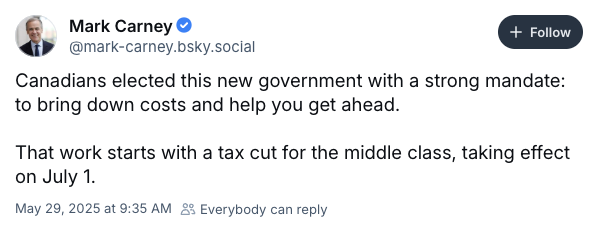
    Scared yet?  We’re just getting started.  Back on Thursday our new Prime Minister was seen to tweet:

    In other words, this government seems determined to continue in the tradition of both the former government – and the opposition parties for that matter – in framing the country’s ills as problems of costs to be solved by tax cuts and giveaways rather than problems of growth and the institutional investments required to generate it.  This way lies Peronism and perpetual stagnation. 

    And this is from our allegedly “serious” party.

    So, takeaway number one.  Universities need to throw away EVERYTHING in their playbooks for Government Relations.  Selling yourself as “the future” to a government that is desperately trying to reverse our economy into the 1960s is pointless.  This government and this Prime Minster Do. Not. Care.   Until they do, arguing for universities as “crucial” investments is a waste of time.  The real fight is over the shape of the Canadian economy.

    On to a more abstract point about budgeting.  One of the reasons we aren’t getting a budget before fall, despite the government just having been elected with a pretty detailed budget-ready manifesto and the Department of Finance being perfectly capable of putting together a set of Main Estimates for the House of Commons (as it showed on Thursday), is that Carney is trying to introduce a new set of rules with respect to public budgeting.  He spent part of this week insisting that he would balance the “operating budget” within three years, which sparked a lot of incredulity given that i) the economy is about to be in the tank and ii) the Liberals have ring-fenced most of the federal budget by saying they won’t touch transfers to provinces or transfers to institutions.  In theory, that means very significant cuts to program spending.  Like, say, research budgets.

    Except: there is currently no such thing as an “operating budget”.  What Carney wants to do is to exempt from the budget balance requirement anything that can be seen as “capital investment”, which means basically that the main game in Ottawa over the next few years is going to be how to get your favourite piece of spending classed as “capital” instead of “operating”.  And that’s a live issue because the definition the Liberals touted in the election campaign, to wit…

    …anything that builds an asset, held directly on the government’s own balance sheet, a company’s or another order of government’s.  This will include direct investments the government makes in machinery, equipment, land and buildings, as well as new incentives that support the formation of private capital (e.g. patents, plan and technology) or which meaningful raise private sector productivity.

    …is so loose you could drive a truck through it.  Will CFI spending count as capital?  Probably, but not necessarily since universities (in most provinces anyway) are neither a government nor a company.  Will tri-council spending?  Probably not, but that’s not going to stop folks claiming it supports capital formation/raises productivity, so who knows?  So, takeaway number two: get used to arguing distinctions between capital and operating because this might be the only place the sector gets traction in the next little while.

    A final point of importance is something that is not exactly new but has been given fresh salience by being in the Throne Speech, and that is the government’s commitment to limit temporary immigration – that is Temporary Foreign Workers (TFWs) plus international students – to below five percent of the population by 2027.  Or, to put it another way: every extra TFW is one international student less.  What the government has done here is set up a zero-sum game between institutions of higher education and people like the manager of the Kincardine Tim Horton’s whose business model simply cannot work if they are not allowed to employ foreign nationals at below-market rates. 

    This, my friends, is the fight post-secondary education needs to pick and needs to win.  It won’t be easy, because the captains of Canadian industry are largely clueless about competing on anything other than price, meaning low-wage labour is pretty dear to their hearts and they will fight hard for TFWs.  But it is the dilemma this country faces in a nutshell: should we use our scarce temporary immigration spots to make things cheaper in the short-term?  Or should we use them to develop a skilled workforce and build our scientific and technological talent base for the long term? 

    So, I know this won’t come easy to institutions but: screw Bay Street.  Light the torches.  Find the pitchforks.  Pick up anything you have handy and smash the windows of your local Tim Horton’s.  Fight for international students and against TFWs.  This is an existential contest: it decides whether Canada is going to be a country that gets wealthier based on investments in skills, education and science, or a country that bathes in mediocrity because we go mental if the price of a cruller goes up twenty-five cents. 

    And if the sector ducks this fight because direct confrontation with business is icky and makes some Board members uncomfortable?  Well, then the sector deserves everything it gets.  That’s the third, and most important takeaway of the last week.

    Source link

  • Federal Court Orders Reinstatement of Southern Education Foundation Grant After DEI Controversy

    Federal Court Orders Reinstatement of Southern Education Foundation Grant After DEI Controversy

    Raymond PierceThe Southern Education Foundation has secured a significant legal victory in its fight against the U.S. Department of Education, with a federal judge ordering the reinstatement of a key grant that was terminated earlier this year over allegations of illegal diversity, equity, and inclusion practices.

    On May 21, 2025, a judge in the U.S. District Court for the District of Columbia granted SEF’s motion for preliminary injunction, ordering the Department of Education to restore the organization’s Equity Assistance Center-South grant and reimburse all outstanding expenses. The grant, which had been terminated on February 13, 2025, enables SEF to provide technical assistance to public school districts and state agencies across 11 Southern states to help them comply with federal civil rights law.

    The court’s ruling was particularly pointed in its criticism of the Education Department’s decision to terminate the grant. 

    “In view of the history of race in America and the mission of SEF since the Civil War, the audacity of terminating its grants based on ‘DEI’ concerns is truly breathtaking,” the judge wrote in the opinion.

    The Southern Education Foundation, which has operated for more than 150 years with a mission to advance educational opportunities for Black students in the South, traces its origins to the late 1800s when it supported education for individuals recently emancipated from enslavement. The organization’s Equity Assistance Center represents a continuation of work that began with the original Desegregation Assistance Centers.

    “We are pleased with the Department of Education’s compliance with the court order by reinstating our grant,” said SEF President and CEO Raymond Pierce. “With the grant reinstated, SEF can move forward with developing the assistance needed to free school districts from policies and practices that remain from the dark era of lawful segregation which continue to hinder equal education opportunity for far too many children.”

    The preliminary injunction provides temporary relief while the case proceeds through the courts. The judge found that SEF was likely to succeed on the merits of its claim that the Department violated federal law in terminating the grant. However, the reinstatement is not yet permanent, pending the outcome of the full legal proceedings.

    The case highlights ongoing tensions around diversity, equity, and inclusion initiatives in education, particularly as they relate to organizations with deep historical roots in civil rights work. The Southern Education Foundation’s century-and-a-half commitment to educational equity predates modern DEI terminology by decades, making the Department’s allegations particularly contentious.

    The EAC-South serves a critical function in the region, providing technical assistance to help school districts navigate complex federal civil rights requirements. This support is particularly vital in states with histories of legal segregation, where legacy policies and practices can continue to create barriers to equal educational opportunity.

    The reinstatement allows SEF to resume its work immediately, though the organization will be watching closely as the legal case progresses. The preliminary nature of the court’s order means that while SEF can continue operating the program, the long-term resolution of the dispute remains uncertain.

    The case represents a broader debate about the role of equity-focused programming in education and the extent to which federal agencies can regulate or restrict such work. For the Southern Education Foundation, the stakes extend beyond a single grant to encompass the organization’s fundamental mission and its ability to continue serving communities that have historically faced educational inequities.

    Source link

  • Why Small Colleges Matter—Now More Than Ever – Edu Alliance Journal

    Why Small Colleges Matter—Now More Than Ever – Edu Alliance Journal

    June 2, 2025, by Dean Hoke: In the ongoing debate about the future of higher education, small colleges are often overlooked—yet they are indispensable. On May 21st, Higher Education Digest published my article, Small Colleges Are Essential to American Higher Education,” in which I make the case for why these institutions remain vital to our national educational fabric.

    Small colleges may not grab headlines, but they provide transformative experiences, especially for first-generation students, rural communities, and those seeking a deeply personal education. As financial pressures mount and demographic shifts continue, it’s easy to underestimate the impact of these campuses—but doing so comes at a cost. These schools are not only educators; they are regional economic engines, community partners, and laboratories for innovation.

    In the article, I outline key reasons why we need to support and strengthen small colleges, including their unique role in economic development, workforce provider, and civic engagement. I also explore the consequences of neglecting this sector and what we can do about it.

    I hope you’ll take a few minutes to read the whole piece and share it with your colleagues and networks. Read the article here.

    As always, I welcome your thoughts and reflections.


    Dean Hoke is Managing Partner of Edu Alliance Group, a higher education consultancy. He formerly served as President/CEO of the American Association of University Administrators (AAUA). With decades of experience in higher education leadership, consulting, and institutional strategy, he brings a wealth of knowledge on small colleges’ challenges and opportunities. Dean is the Executive Producer and co-host for the podcast series Small College America. 

    Source link

  • Universities UK’s new era of collaboration

    Universities UK’s new era of collaboration

    The first major report of Universities UK’s transformation and efficiency taskforce – Towards a new era of collaboration – is a milestone in the ongoing national debate about unlocking maximum value from state investment in the higher education system.

    Though “transformation and efficiency” is the headline, the focus of the group has largely been on collaboration – ways in which universities and other providers can work together, and ways in which government and regulators can make it easier for this to happen.

    The drive for transformation came slowly at first and then all at once. The financial pressures on the sector – arising from Covid recovery, uneven patterns of student recruitment, rising pensions costs and erosion of the unit of resource for undergraduate tuition – are long standing (remember then chief of staff Sue Gray’s “shitlist” for the new government which featured the financial collapse of a large university?)

    Why and how

    The election of a new Labour government prompted the publication of the Universities UK Blueprint which hoped for a shift in relations between government and the sector based on effort on both sides to address the structural challenges facing higher education, of which a taskforce on transformation was one recommendation.

    Even at the point of the formation of the taskforce, led by former University of the Arts London vice chancellor Nigel Carrington, there was a degree of scepticism about how feasible the promised “new era of collaboration” might be. Wonkhe and Mills & Reeve’s Only Connect report on the opportunities for cooperation in the English sector found an appetite in principle among university leadership for new models for collaboration, along with a sense that the cultural and regulatory barriers were so significant as to make meaningful exploration of those opportunities unlikely.

    The taskforce, through a series of in-depth interviews with stakeholders, and detailed work with sector organisations, professional bodies and external experts, has therefore made an enormous stride forward in setting out the potential for system-wide change.

    The case for change

    There is a genre of departmental spending review submission called the “bleeding stumps” report, wherein civil servants offer up apocalyptic and or foolish ways in which spending constraints can be overcome – ex-DfE adviser Sam Freedman loves to tell the story of a pre-spending review report that suggested that pupils could attend school either in the morning or the afternoon.

    What Universities UK has produced is pretty much the diametric opposite of this approach. While recognising the dwindling availability of cash, the impact of these circumstances is set out via the results of a survey conducted in May of this year. While this is pretty bleak reading – 55 per cent of universities are consolidating courses (94 per cent would consider in the next three years), 25 per cent have seen compulsory staff redundancies already (up 14 percentage points on last year) and 36 per cent are cutting student support services (77 per cent would consider) – it comes across neither as sensationalist nor overblown to reflect the way the sector is having to change.

    The “would consider in next three years” column will be of most concern to the government, even beyond DfE: 79 per cent would consider cutting academic research activity, 71 per cent would be looking at cutting civic and local growth activity. To be clear this is based on a survey completed by 57 providers, so while it does show a concerning direction of travel you couldn’t expect a precise picture of what is happening on the ground everywhere.

    One interesting nugget within this section is a call for sector stewardship – with OfS focusing on teaching through a market-based regulatory lens, and Research England acting as a research council UUK argues that no single body has an eye on the health of the sector as a whole with the ability to intervene where action is needed. The declining value of tuition fee income and other state support is part of the issue, but a rise in the number of providers and what is described as “an increasingly competitive environment” has played a part in many of the pressures universities are facing. As consultees told the taskforce:

    the focus had shifted too far to the individual student or institution, even where that created conflict with wider national interests, including disadvantaging activity that could benefit economic objectives and wider society but may not translate into student demand, such as the provision of highly specialised skills to meet the needs of certain industries or the protection of universities playing important civic roles in parts of the country with higher levels of disadvantage.

    Opportunities and actions

    The taskforce’s findings are neatly split across seven “opportunities”, each with associated actions for university leaders, Universities UK itself, other organisations, and government:

    1. Pursuing innovative collaborative structures
    2. Sharing more services and infrastructure
    3. Leveraging sector buying power
    4. Supporting digital transformation
    5. Adopting a common approach to assessing efficiency and benchmarking costs
    6. Developing leadership skills in those mandated to deliver change and further improving governance
    7. Developing the current regulatory environment and supportive structures to help collaboration and transformation to go further, faster

    Each is also supported by case studies (drawing primarily on existing work in the UK higher education sector, though the net is occasionally cast further afield) and indications of appetite from consultation respondees.

    Collaboration and sharing

    The case for university collaboration in the UK has been made with increasing frequency as the financial squeeze starts to make itself felt in profound ways. That said, there has been little tangible activity – the report points to longstanding structures such as the University of London federation, existing networks of research collaborations, and strategic working with local stakeholders. The taskforce adds the multi-academy trust-esque group structures employed by the (HE and FE) University of the Highlands and (cross sector) London South Bank to the list., and there is a nod to the world of sharing expensive research infrastructure too.

    A third strand covers the sharing of infrastructure and services – major examples here include UCAS and the Jisc Janet network, alongside more specialist activity like Uniac on auditing services (further examples are worth digging into via the recent Jisc/KPMG report).

    Though the big newsworthy two-become-one moments exemplified by ARU Writtle may be few and far between, what comes across powerfully is just how much of this stuff is going one, and the potential that exists to do more. One of the big gaps is expertise and understanding – tackling the legal, technical, and process aspects of joint working is not for the faint of heart and if this is the direction of travel both specialist staff and institutional leaders need to be clear and up to date on how this works. There’s scope for detailed advice and guidance (that the taskforce itself will produce) alongside an ongoing support function at Universities UK – we need regulatory tweaks to allow for innovation in organisational forms too.

    The bigger asks are for a transformation fund, and specific advice from the Competition and Markets Authority (CMA) on what would constitute a breach of competition law in this space. The latter appears to be in progress – there was an encouraging blog post from CMA at the end of last week. The cost of transformation (ie investing in the infrastructure and systems that can enable efficiency) could, the taskforce suggests, arrive in a straightforward way by allowing universities to access a “small portion” of the existing £3.25bn Transformation Fund available to the public sector.

    Spending and benchmarking

    Taken as a whole, the higher education sector spends £20.1bn on operating expenses each year – much of the non-pay end of this happens via procurement processes at individual institutions. The cumulative impact of all this spending can often enable the sector to get a better deal, but this needs to be coordinated across multiple providers for the benefits to kick in. Initiatives like the UK University Purchasing Consortia and Jisc’s procurement on behalf of the sector are unlocking big, existing, savings – the report suggests savings of £116m via UKUPC, and £138m for the Jisc activity – taking maximum advantage of these proven schemes could drive further savings.

    But there is potential to unlock even more – the work of the taskforce indicates that there is both scope and appetite for this kind of collaborative spending in information technology (ask your IT department, the cost of software licenses and cloud-based solutions are spiralling) and estates (bear in mind the maintenance backlog that the precarious financial environment has led to).

    Another angle is making it easier to understand when your university is spending over the odds. Finance teams are very keen on benchmarking spending with comparable institutions – why should it cost more to do fundamental stuff than at the university down the road? – but it is difficult to access reliable and comparable data. There’s a suggestion that an Association of the Heads of University Administration (AHUA) organisational efficiency maturity model (basically best practice on understanding and reporting spending) could help get the sector on the same page, and that UUK could drive a more collaborative approach to sharing and using this data to drive savings.

    Digital transformation

    There’s any number of promises that the latest and greatest software can save your university time and money, but your IT director will tell you that such promises take substantial time and money to realise. The rise of large language model generative tools has unlocked another round of wild claims, and both institutional leaders and IT and administrative specialists are being asked to evaluate spending even more to make these efficiencies a reality. There’s so many questions – not least around whether your shiny new system will work with the systems and processes you already use.

    The trouble is, understanding and implementing this stuff takes time and expertise at both specialist and leadership levels – and both are at a premium in higher education. Jisc is already supporting 24 providers in understanding and benchmarking their digital transformation maturity – helping, in essence, to understand where further help may be needed. There’s also a need to actively and meaningfully involve senior leaders, and to understand the digital competencies of staff and students. The taskforce calls for a wider roll-out of this maturity model, and for Jisc and UCISA to promote shared standards around software and processes.

    Regulation and leadership

    The need for an advancement in leadership skills runs throughout the taskforce report. Transformations like the ones advocated require competencies and knowledge that go far beyond business as usual, and correspondingly more is being asked of senior staff and governors – all of which comes alongside a more onerous (and fast-moving) regulatory regime that requires its own expanding set of skills.

    The report is supportive of the current Committee of University Chairs (CUC) initiative to review university governance (via updating its current code for governors), and Universities UK proposes to facilitate ongoing and sector-led improvement activity.

    There’s immediate stuff that can be done on cost pressures – there’s a specific ask of government on relaxing the rules that require some universities to enroll all staff onto the increasingly expensive teacher’s pension scheme (TPS), and a more general suggestions that the government avoid putting additional costs on the sector such as introducing new and unfunded expectations, or inventing new levies.

    There is clearly scope to address the regulatory burden placed on the sector – one easy win would be to address the barriers to collaboration. Recent regulatory activity (particularly in England) has focused on individual providers – the recent shift in the OfS remit to consider the wider health of the sector offers scope to reestablish the idea of a “custodian” of the sector that could deliver on the long-term goals set all levels of government and by wider civic society.

    What’s next?

    This report marks the end of the first phase of Universities UK work on transformation and efficiency. Phase two will create an oversight group to keep an eye on the various asks from sector agencies and monitor both progress and impact. This is not in any sense a political report – though it is clearly politically useful – and it is clear that both UUK and the sector are in this for the long haul.

    More broadly the report stands as another signal to government that the sector is prepared to go further and faster on transformation and collaboration that has previously been the case – but there is a clear desire for a reciprocal “vision” or plan from government around which the sector can do, ideally backed up with some investment in that vision.

    The rather dour communications that have so far issued from DfE on HE reform and funding suggest that the government is not yet prepared to give the sector a full-throated endorsement, but there is scope for that to change following next week’s spending review and the publication of the post 16 education and skills and HE reform white paper this summer.

    Economic circumstances notwithstanding the policy agenda in the next few months will set a course for HE for the rest of this parliament and beyond – it would be a real own-goal not to seize the opportunity to work with the sector to get things onto a firmer footing.


    Source link

  • For women athletes, world recognition is a long time coming

    For women athletes, world recognition is a long time coming

    Last year was arguably the best year for women’s sports yet.

    According to data analysis company S&P Global, in-person attendance and viewership were higher, with women’s professional sports sponsorships increasing by 22% since 2023. According to UN Women Australia, globally, there has been a lack of interest in women’s sports. But it seems that they might finally be getting the attention they deserve.

    To find out what is driving this change in attitude towards women’s sports, I interviewed 10 women athletes across high school, university, and coaching. 

    Historically, women’s sports have not gotten the recognition that they deserve. However, during 2024, women’s collegiate basketball had a significant increase in viewership compared to the previous year. The Final Four game in 2024 was a showdown between two players from two U.S. universities: Caitlin Clark of the University of Iowa and Paige Bueckers of the University of Connecticut. The game drew in a peak audience of 16.1 million, according to an article in Sports Illustrated

    Women’s media coverage has tripled since 2019. At this rate, if coverage trends continue, women’s share of coverage could reach 20% by the end of this year, according to Women.org, an organization within the United Nations devoted to gender equality and the empowerment of women. 

    Gender parity in sports

    The Paris Olympic and Paralympic Games were officially the first to see 50:50 coverage in gender equality.

    Avery Elliot, a track and field athlete from the University of Pennsylvania, attended the Paris Olympics as a spectator and said she noticed the change – more social media presence and sponsorships, particularly highlighting women of color, especially in women’s gymnastics, spurred by the popularity and success of U.S. athletes Simone Biles and Jordan Chiles and Brazilian Rebeca Andrade. 

    The lack of media coverage of women has always played a role in the lack of recognition that they receive. Lanae Carrington, a track star at Lehigh University in the U.S. state of Pennsylvania, said that in the past, women athletes would get dismissed for getting a low number of views or for the belief that women’s games were not as entertaining as those of men. “Overall, women are making a stronger impact in the entertainment industry, whether that’s more highlight reels on TikTok or screen time on TV,” Carrington said. “It’s finally becoming normalized.” 

    One of the hardest things to deal with as an athlete is a lack of support, whether from the media, in person or on the sidelines. 

    Brianna Gautier, a volleyball and basketball sensation at Neumann University in Pennsylvania, said it is hard to play a game where you’re not going to have a full house. “But it’s kind of helped me learn to just play for myself instead of waiting for people to show up and relying on that to bring some type of energy because I feel like it starts within you and your teammates,” she said.

    Play for yourself first

    As a track and field athlete, I have seen this firsthand. It is unfortunate to see people walk away after the men are finished competing. But I found that when you start showing up for yourself with energy, success comes rolling in. Gautier has embraced the idea of playing for herself and nobody else.

    It used to be that at Neumann, people would attend the men’s basketball games but never stay afterward to support the women. She also expressed the importance of the support of NBA players such as Steph Curry, who came out to watch several women’s Stanford basketball games in 2023. Gautier said that people think to themselves that if their favorite male basketball players are tuning in to watch women’s sports, it must be worthwhile. 

    Carrington said parents also need to support their daughters in athletics. “This is important because many girls don’t have parents who encourage them to play more traditionally masculine sports, such as basketball and soccer,” she said. 

    Most of the women I interviewed commented on the change in the WNBA as the catalyst for the change in women’s sports.. 

    Liz Spagnolo is a soccer player at Tower Hill High School in the U.S. state of Delaware who appreciates the opportunities she now has. “Women in sports is big for us because based on women 100 years ago, we wouldn’t be expected to play sports, or be expected to do something like cheer,” Spagnolo said. 

    The Caitlin Clark effect

    Arianna Montgomery, an athlete at The Tatnall School, the private school in Delaware that I also attend, said she appreciates the change in women’s basketball.

    “It’s gotten a lot more fame, definitely more college sports have gotten a lot more fame,” Montgomery said. “I think women’s games are starting to become more popular. People are starting to look more towards women’s sports as well as men’s sports, and even since before, instead of men’s sports now, a decade ago, that wasn’t the case.”

    Many of the women I spoke to said that a big contributor to the success of women’s sports is due to the Catlin Clark effect. The Caitlin Clark effect is a term that was created after her record-breaking seasons playing women’s basketball at the University of Iowa during the years of 2023-2024.

    As a result, she has become the all-time leading scorer in college basketball before entering the WNBA,  and has reportedly signed sponsorship deals worth more than $11 million. 

    Ruth Hiller, a lacrosse coach at my school said that are a number of successful women athletes that young women can now look up to, including tennis superstars Venus and Serena Williams and Alex Morgan, the former captain of the U.S. women’s soccer team, women’s tennis pioneer Billie Jean King and Charlotte North, a professional lacrosse player who broke the all-time goals record in college lacrosse. 

    Women now rack up medals and points

    Daija Lampkin, my track and field coach, pointed to Alison Felix, who won more medals than any other U.S. track and field athlete, and tennis superstar Serena Williams.

    It is important, Lampkin said, that women support women. “Our body is critical, and some women are self-conscious that they are going to be muscular,” Lampkin said. “It can tear down your confidence. It’s not talked about in sports how women look at their bodies. People tear down Serena Williams and her body all the time, but look at where she is and how much she has accomplished”. 

    I have been participating in sports since I was 3 years old, when my parents signed me up for gymnastics. I run track and field and am a runner, jumper and hurdler. I began training for track and field competitions at the age of 8, and my dad has been my coach since the very beginning. 

    In my experience, my father was instrumental in encouraging me to participate in dance and gymnastics growing up, while also encouraging me to run track and play basketball and soccer for fun.

    With opportunity comes pressure, and Gautier said it is important for girls not to put too much pressure on themselves. “When you are an athlete, you tend to feel that you have to perform a certain way to be successful or please everyone else, but I feel you kind of get blinded by the fact that you are doing it for yourself,” she said. 


    Questions to consider:

    1. Why have women not gotten the same recognition and pay as male athletes in sports? 

    2. What does “parity” mean when it comes to gender in sports?

    3. Should there be any differentiation when it comes to gender in sports and why?


    Source link

  • A Twilight Zone Warning for the Trump Era and the Age of AI

    A Twilight Zone Warning for the Trump Era and the Age of AI

    Rod Serling’s classic 1961 episode of The Twilight Zone, “The Obsolete Man,” offers a timeless meditation on authoritarianism, conformity, and the erasure of humanity. In it, a quiet librarian, Romney Wordsworth (played by Burgess Meredith), is deemed “obsolete” by a dystopian state for believing in books and God—symbols of individual thought and spiritual meaning. Condemned by a totalitarian chancellor and scheduled for execution, Wordsworth calmly exposes the cruelty and contradictions of the regime, ultimately reclaiming his dignity by refusing to bow to tyranny.

    Over 60 years later, “The Obsolete Man” feels less like fiction and more like a documentary. The Trump era, supercharged by the rise of artificial intelligence and a war on truth, has brought Serling’s chilling parable into sharper focus.

    The Authoritarian Impulse

    President Donald Trump’s presidency—and his ongoing influence—has been marked by a deep antagonism toward democratic institutions, intellectual life, and perceived “elites.” Journalists were labeled “enemies of the people.” Scientists and educators were dismissed or silenced. Books were banned in schools and libraries, and curricula were stripped of “controversial” topics like systemic racism or gender identity.

    Like the chancellor in The Obsolete Man, Trump and his allies seek not just to discredit dissenters but to erase their very legitimacy. In this worldview, librarians, teachers, and independent thinkers are expendable. What matters is loyalty to the regime, conformity to its ideology, and performance of power.

    Wordsworth’s crime—being a librarian and a believer—is mirrored in real-life purges of professionals deemed out of step with a hardline political agenda. Public educators and college faculty who challenge reactionary narratives have been targeted by state legislatures, right-wing activists, and billionaire-backed think tanks. In higher education, departments of the humanities are being defunded or eliminated entirely. Faculty governance is undermined. The university, once a space for critical inquiry, is increasingly treated as an instrument for ideological control—or as a business to be stripped for parts.

    The Age of AI and the Erasure of the Human

    While authoritarianism silences the human spirit, artificial intelligence threatens to replace it. AI tools, now embedded in everything from hiring algorithms to classroom assessments, are reshaping how knowledge is produced, disseminated, and controlled. In the rush to adopt these technologies, questions about ethics, bias, and human purpose are often sidelined.

    AI systems do not “believe” in anything. They do not feel awe, doubt, or moral anguish. They calculate, replicate, and optimize. In the hands of authoritarian regimes or profit-driven institutions, AI becomes a tool not of liberation, but of surveillance, censorship, and disposability. Workers are replaced. Students are reduced to data points. Librarians—like Wordsworth—are no longer needed in a world where books are digitized and curated by opaque algorithms.

    This is not merely a future problem. It’s here. Algorithms already determine who gets hired, who receives financial aid, and which students are flagged as “at risk.” Predictive policing, automated grading, and AI-generated textbooks are not the stuff of science fiction. They are reality. And those who question their fairness or legitimacy risk being labeled as backwards, inefficient—obsolete.

    A Culture of Disposability

    At the heart of “The Obsolete Man” is a question about value: Who decides what is worth keeping? In Trump’s America and in the AI-driven economy, people are judged by their utility to the system. If you’re not producing profit, performing loyalty, or conforming to power, you can be cast aside.

    This is especially true for the working class, contingent academics, and the so-called “educated underclass”—a growing population of debt-laden degree holders trapped in precarious jobs or no jobs at all. Their degrees are now questioned, their labor devalued, and their futures uncertain. They are told that if they can’t “pivot” or “reskill” for the next technological shift, they too may be obsolete.

    The echoes of The Twilight Zone are deafening.

    Resistance and Redemption

    Yet, as Wordsworth demonstrates in his final moments, resistance is possible. Dignity lies in refusing to surrender the soul to the machine—or the regime. In his quiet defiance, Wordsworth forces the chancellor to confront his own cowardice, exposing the hollow cruelty of the system.

    In our time, that resistance takes many forms: educators who continue to teach truth despite political pressure; librarians who fight book bans; whistleblowers who challenge surveillance technologies; and students who organize for justice. These acts of courage and conscience remind us that obsolescence is not a matter of utility—it’s a judgment imposed by those in power, and it can be rejected.

    Rod Serling ended his episode with a reminder: “Any state, any entity, any ideology that fails to recognize the worth, the dignity, the rights of man—that state is obsolete.”

    The question now is whether we will heed the warning. In an age where authoritarianism and AI threaten to render us all obsolete, will we remember what it means to be human?


    The Higher Education Inquirer welcomes responses and reflections on how pop culture can illuminate our present crises. Contact us with your thoughts or your own essay proposals.

    Source link

  • College parents speak out in new survey: Weekly updates, mental health info and more access needed

    College parents speak out in new survey: Weekly updates, mental health info and more access needed

    As colleges nationwide double down on enrollment, retention, and student success strategies, one key voice is becoming harder to ignore: the family. According to the 2025 Current Families Report released by CampusESP, families want more updates, more access, and more say in the college journey, and they’re increasingly dissatisfied when they don’t get it. In addition, when parents do receive the information they need to support their student, research shows significant gains in student yield and retention.

    The survey, conducted across 81 colleges and universities and with more than 32,000 parents and supporters of current students, is the most comprehensive look at family engagement to date. And the findings are impossible to miss.

    Mental health, money, and mentorship

    Nearly half of all parents talk to their student daily, with the number jumping to over 60% for low-income and first-generation households. These families aren’t just chatting about weekend plans — they’re offering support on mental health (53%), academic advice (57%), and student life (69%).

    “Parents aren’t bystanders — they’re active advisors,” says the report. “And they need the right tools to guide their students.”

    Communication expectations are high

    A staggering 77% of families want to hear from their student’s college weekly or more, up 12% in just four years. While email is still the go-to channel, the demand for text messaging is surging, especially among Black, Hispanic, low-income, and first-gen families.

    However, a gap remains: 48% of families prefer text, but only 28% of colleges offer it.

    Trust wavers without transparency

    Families are becoming more skeptical about the return on their tuition investment. Only 59% say college is worth the cost — a sharp drop from 77% the year before. Their #1 request? More info on career services and job placement, which ironically ranked lowest in satisfaction.

    Families want in, but feel left out

    Even when they receive a high number of communications from their student’s college, families still feel sidelined. Just 46% are satisfied with their opportunities to get involved on campus, down from 63% last year. And only 30% feel they have good ways to connect with other families.

    Yet the desire is there: 38% want to be more involved, and 22% say they’re more likely to donate to their student’s college than their own alma mater.

    Financial aid frustration runs deep

    Navigating costs is a pain point. 59% say it’s hard to pay for college, and only 25% found financial aid information easy to understand.

    And with confusion comes attempts at self-education. Nearly half of families rely on their student’s login to access key financial records—posing serious data privacy concerns.

    The report confirms what many enrollment leaders have long suspected: families aren’t just part of the support system — they are the support system. The challenge for institutions? Reaching them with the right information, in the right format, at the right time.

    “Family engagement isn’t optional — it’s a strategic advantage,” the report concludes.

    Download the full 2025 Current Families Report from CampusESP to explore the findings and access actionable strategies for turning family influence into institutional success.

    Source link

  • Week in review: Trump administration targets Chinese student visas

    Week in review: Trump administration targets Chinese student visas

    Most clicked-on story from last week: 

    House Republicans passed — by one vote — a massive spending bill backed by President Donald Trump with heavy implications for higher education. Among other proposals, it would raise and expand the endowment tax, introduce a risk-sharing program that would put colleges on the hook for unpaid student debt, nix subsidized loans and narrow eligibility for Pell Grants. Many expect the Senate to make changes to the bill.

    Number of the week


    7

    That’s how many regional branch campuses Pennsylvania State University is set to close after a 25-8 vote by its trustee board. The plan will pare down the university’s commonwealth campuses to 13 to cope with demographic declines and budget pressure. Detractors said the decision was made too hastily, ignored some campuses’ recent progress and could hurt the state’s rural areas.

    Trump administration updates:

    • The Trump administration aims to “aggressively revoke visas for Chinese students” while ramping up scrutiny and changing criteria for student visa applications from China and Hong Kong, U.S. Secretary of State Marco Rubio said Wednesday. With nearly 278,000 students from China studying in the U.S. during the 2023-24 academic year, the move could have a steep impact on U.S. colleges.
    • Sixteen states sued the National Science Foundation over the agency’s 15% cap on indirect research costs and its mass termination of grants related to diversity, equity and other topics. The states’ colleges “will not be able to maintain essential research infrastructure and will be forced to significantly scale back or halt research, abandon numerous projects, and lay off staff,” plaintiffs said in their complaint. 
    • The Trump administration plans to cut Harvard University’s remaining federal contracts, amounting to about $100 million. An official with the U.S. General Services Administration cited what he alleged was “Harvard’s lack of commitment to nondiscrimination and our national values and priorities.” The salvo is the latest in the federal government’s escalating battle with the Ivy League institution. 

    Texas legislators look to tighten control of colleges:

    • The Texas House approved a bill that would give the state’s regents — who are appointed by the governor — the power to recommend required courses at public colleges and to reject courses deemed too biased or ideological. Regents would also gain approval authority over the hiring of administrators. 
    • Another bill approved by the House would limit where and how students can protest on campuses. The Texas House and Senate are working to resolve their differences over the bill, according to The Texas Tribune. 

    Quote of the week:

    There’s a bit of anxiousness among accreditors and institutions and state legislators because of the uncertainty. Is it that they are intentionally being vague or general until they can work out all of the nuances of the policies that they want to implement? I can tell you, less is not more in this situation.”

    That’s Cynthia Jackson Hammond, president of the Council for Higher Education Accreditation, on the effects of Trump’s executive order on college accreditation.

    Source link

  • Aerial Aviators: Helping STEM minds soar one afternoon at a time

    Aerial Aviators: Helping STEM minds soar one afternoon at a time

    After a long day of school, most kids are ready to head home—but in San Antonio, teachers across Northside Independent School District’s (NISD) several middle schools are giving them a reason to stay.

    Amanda Quick, NISD’s K–8 STEM Coordinator, organizes Aerial Aviators for the district—an out-of-school time (OST) program that skips the busy work. Instead, students are learning to fly drones, solve problems, and build real skills they can apply in school, at work, and in life. 

    The Newest OST Program Takes Off

    Middle school is when students start figuring out who they are—caught between wanting more independence and being open to new challenges. It’s also when out-of-school-time programs have the most potential to make an impact.

    “We were looking at additional afterschool STEM opportunities for our middle school students that would build upon the coding skills they learn in elementary STEM classes,” Amanda explains. “We already offered a robotics program and a solar-car design program that have been highly engaging. With all the local development that uses drones in industry, having an afterschool drone program was a natural addition.”

    In San Antonio—home to the nation’s second-largest cybersecurity hub—the answer was practically built into the landscape: drones.

    With Echo Drones in hand and a city full of real-world inspiration, NISD launched Aerial Aviators, a program that goes far beyond the basics. Students take part in flight challenges, work together on real missions, and build the kind of confidence that sticks. It’s not just about learning to fly—it’s about seeing where they’re capable of going.

    Never Leaving Relevance Up in the Air

    Even with exposure to aviation, cybersecurity, construction, and engineering, not every student saw themselves heading into those fields. Instead, many came to the afterschool program thinking drones would be fun—but not exactly tied to their future plans.

    While visiting one school’s Aerial Aviators program, Amanda noticed a girl who had more of an entrepreneurial spirit than an engineering one. “Drones don’t feel like something I can use in my future. I want to own a restaurant,” she explained.

    Despite the depth of her imagination, the girl struggled to see how drones could be connected to her ambitions. But with some critical thinking and a fresh perspective, Amanda helped her see things differently.

    “Remember the Covid pandemic? What if you didn’t have the option of using people to deliver food? How could you solve this problem to keep your business running?” 

    Suddenly, “women in STEM” took on new meaning for the girl as she realized how much her dream job depended on technology. “I could use drones!”

    Like the girl, some students had their futures already mapped out, while others hadn’t even started to imagine careers beyond what they saw through the classroom window. No matter whether the students had their sights set on adulthood, or just their afternoon, Amanda and campus program sponsors knew the right opportunity would be memorable for everyone.

    “We want kids to see drone knowledge as a skill, not just a trend. We can’t predict exactly how drones will be used in the future, but we want them to ask, ‘How does this connect to something I’m already passionate about?’”

    The goal wasn’t to change their dreams, but to mold them—and for some, to show how a STEM mindset could make those dreams more attainable.

    Skilled Students are Soaring Students

    Students don’t have to look far to see how STEM technology fuels innovation. Right in their own community, drones are elevating industries—helping strip and repaint airplanes to protect workers from harmful chemicals, and delivering medical supplies in emergencies. As students get hands-on with drones, they begin to see how industries are connected and how transferable skills—beyond coding, engineering, and tech literacy—are key to making it all happen.

    “We’re seeing a lot of students troubleshooting when they connect devices to the wrong drone,” Amanda shares. “They’re collaborating, thinking critically, communicating with peers and tech support, and developing grit—lots of it.”

    When students get the chance to lead flight challenges, they don’t just show off their skills—they gain the confidence to share what they’ve learned with others. The campus program sponsors have seen this firsthand, noting how eager the kids are to include everyone in the fun:

    “At a family event held at one of our high schools where Aerial Aviators students displayed their knowledge and skills, one mom was nervous about her child struggling or breaking something. But before she could worry too much, one student stepped up and reassured her: ‘Don’t worry! If he breaks it, we know how to fix it!’ That moment left everyone smiling.”

    Although each student has different interests, the drone program’s design and flight challenges make sure every kid feels their talents are recognized. And the results speak for themselves: 100% of students in the post-program survey said they had a great time.

    Just the Beginning

    Aerial Aviators has already made an impact on students. Even when things don’t go according to plan—like a broken propeller or a misconfigured drone—these middle schoolers stay motivated, always eager to learn from setbacks.

    Looking ahead, students are eager to deepen their STEM experience—especially through coding. Many have even expressed interest in competitions where they can showcase their skills. It’s a level of enthusiasm that educators are proud of—and one they’re ready to champion. Amanda and the campus sponsors are now exploring ways to weave these opportunities into the program, ensuring student voice continues to shape its future.

    The success of Aerial Aviators has sparked growing interest, with the program expanding from three schools last year to seven this year. With more funding, the goal is to continue this growth and reach even more students in the year ahead.

    No matter how the program evolves, it’s leaving a lasting legacy with the students—whether they’re back in class, opening their own restaurant, applying to college, or building with friends. Equipped with critical 21st century skills, these kids will step into high school, careers, and society as inspired leaders, ready to lend a hand so everyone’s dreams can take flight.

    More Out of School Time Resources

    Source link