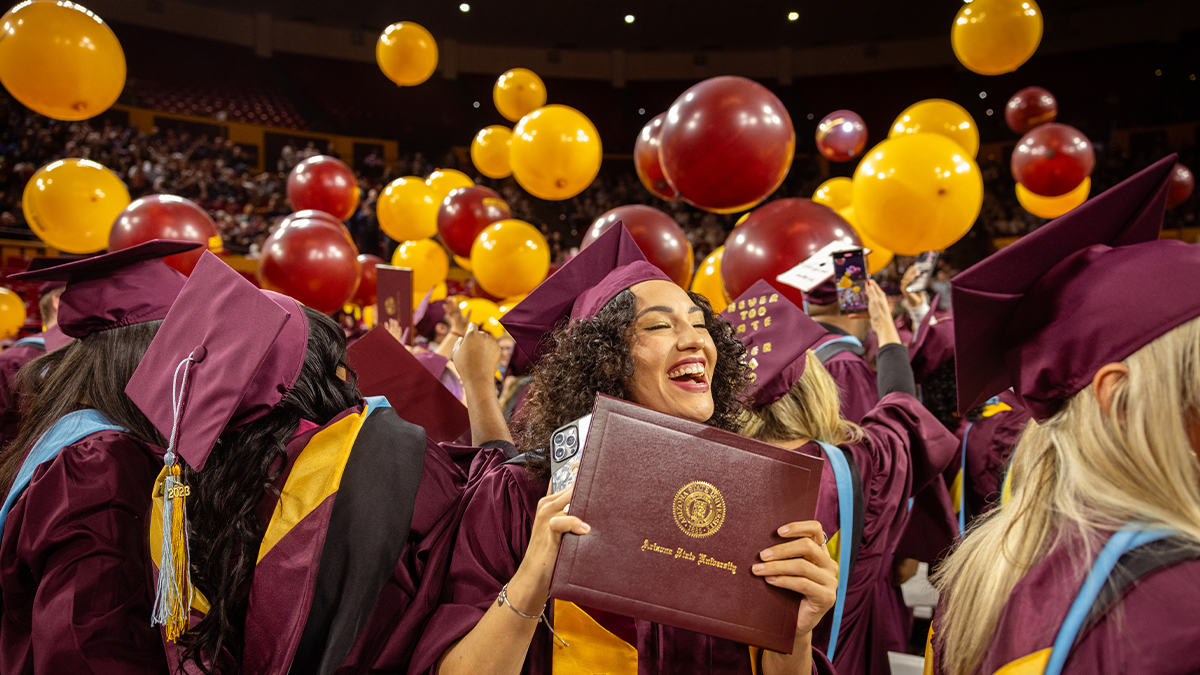
What is your passion? What sparks your curiosity and brings you joy? Whatever it is, Arizona State University (ASU) will help you find it, study it, master it, and turn it into a rewarding career, regardless of your previous educational journey.
Casey Evans
Chief Operating Officer, EdPlus at ASU
For more than 15 years, ASU has offered high-quality programs online taught by the same world-renowned faculty that teach on-campus students, using the same rigorous curriculum. ASU offers more than 300 degree programs online, with over 100,000 graduates now working across nearly every industry, helping to strengthen the university’s reputation for educational excellence and career readiness. ASU graduates are highly recruitable, with ASU ranking No. 2 in the United States among public universities for the employability of its graduates, ahead of UCLA, the University of Michigan, and Purdue University.
ASU Online combines the exceptional resources and academic excellence of the nation’s most innovative university with a rigorous, world-class online learning experience. Students are supported every step of the way, ensuring they gain the skills and knowledge they need to thrive in their career, no matter where they are in the world.
“ASU’s rigorous coursework and knowledgeable instructors have been instrumental in preparing me for my career, equipping me with the skills to excel in my field,” said Evelyn M., ’24 BS in speech and hearing science.
Inserting brief quiz questions into an online lecture can boost learning and may reduce racial achievement gaps, even when students are tuning in remotely in a distracting environment.
That’s a main finding of our recent research published in Communications Psychology. With co-authors Dahwi Ahn, Hymnjyot Gill and Karl Szpunar, we present evidence that adding mini-quizzes into an online lecture in science, technology, engineering or mathematics – collectively known as STEM – can boost learning, especially for Black students.
In our study, we included over 700 students from two large public universities and five two-year community colleges across the U.S. and Canada. All the students watched a 20-minute video lecture on a STEM topic. Each lecture was divided into four 5-minute segments, and following each segment, the students either answered four brief quiz questions or viewed four slides reviewing the content they’d just seen.
This procedure was designed to mimic two kinds of instructions: those in which students must answer in-lecture questions and those in which the instructor regularly goes over recently covered content in class.
All students were tested on the lecture content both at the end of the lecture and a day later.
When Black students in our study watched a lecture without intermittent quizzes, they underperformed Asian, white and Latino students by about 17%. This achievement gap was reduced to a statistically nonsignificant 3% when students answered intermittent quiz questions. We believe this is because the intermittent quizzes help students stay engaged with the lecture.
To simulate the real-world environments that students face during online classes, we manipulated distractions by having some participants watch just the lecture; the rest watched the lecture with either distracting memes on the side or with TikTok videos playing next to it.
Surprisingly, the TikTok videos enhanced learning for students who received review slides. They performed about 8% better on the end-of-day tests than those who were not shown any memes or videos, and similar to the students who answered intermittent quiz questions. Our data further showed that this unexpected finding occurred because the TikTok videos encouraged participants to keep watching the lecture.
For educators interested in using these tactics, it is important to know that the intermittent quizzing intervention only works if students must answer the questions. This is different from asking questions in a class and waiting for a volunteer to answer. As many teachers know, most students never answer questions in class. If students’ minds are wandering, the requirement of answering questions at regular intervals brings students’ attention back to the lecture.
This intervention is also different from just giving students breaks during which they engage in other activities, such as doodling, answering brain teaser questions or playing a video game.
Why it matters
Online education has grown dramatically since the pandemic. Between 2004 and 2016, the percentage of college students enrolling in fully online degrees rose from 5% to 10%. But by 2022, that number nearly tripled to 27%.
Our study therefore offers a scalable, cost-effective way for schools to increase the effectiveness of online education for all students.
What’s next?
We are now exploring how to further refine this intervention through experimental work among both university and community college students.
As opposed to observational studies, in which researchers track student behaviors and are subject to confounding and extraneous influences, our randomized-controlled study allows us to ascertain the effectiveness of the in-class intervention.
Our ongoing research examines the optimal timing and frequency of in-lecture quizzes. We want to ensure that very frequent quizzes will not hinder student engagement or learning.
The results of this study may help provide guidance to educators for optimal implementation of in-lecture quizzes.
The Research Brief is a short take on interesting academic work.
The Higher Education Inquirer cannot be neutral, not in times like these. These times, 2025 and beyond, demand that working-class folks, including journalists, expose the truth as we perceive it, just as other media outlets present the truth through the lens of those in power: the neoliberal elites and the Trumpian elites. We cannot pretend we do not see the climate chaos ahead or the nextman-made economic crisis. And we cannot believe we are as important or as courageous as the muckrakers of the 20th century, women and men like Ida B. Wells, Ida Tarbell, and Upton Sinclair. But we do hope we have made a difference, ever so slight. We believe our readers can do the same. #NoKings
This audio is auto-generated. Please let us know if you have feedback.
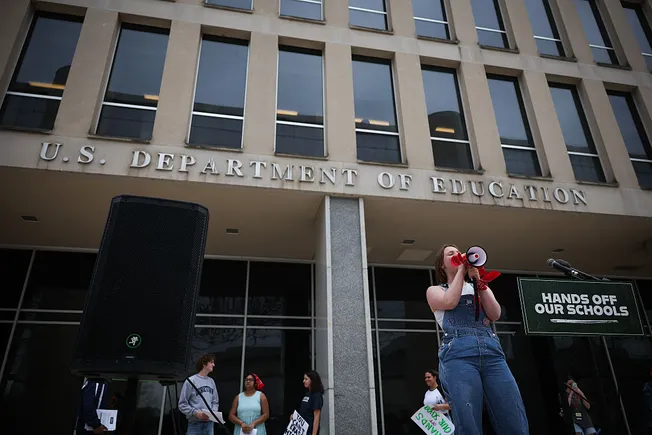
The Trump administration’s decision to gut federal programs administered by the U.S. Department of Education and lay off half of the agency’s staff in an attempt to increase its efficiency has been met with resistance from lawmakers and, most recently, a federal judge whose court order brought efforts to close the department to an abrupt halt.
In an update required by a May 22 court order, the Education Department posted on its website that it has notified its employees of the court-ordered reversal of the reduction in force that left the agency with only about 2,183 out of 4,133 employees. The department on May 27 acknowledged its being compelled by the order in State of New York v. McMahon“to restore the Department to the status quo such that it is able to carry out its statutory functions.”
U.S. District Judge Myong Joun, in temporarily reversing the reduction in force, said gutting the department would lead to “irreparable harm that will result from financial uncertainty and delay, impeded access to vital knowledge on which students and educators rely, and loss of essential services for America’s most vulnerable student populations.”
“This court cannot be asked to cover its eyes while the Department’s employees are continuously fired and units are transferred out until the Department becomes a shell of itself,” Joun said in his decision.
The Education Department appealed Joun’s ruling the same day it was issued. The agency did not respond to K-12 Dive’s request for comment.
Delays in distributing grant funds
The decision came on the heels of a May 16 letter sent by Democratic lawmakers to U.S. Education Secretary Linda McMahon. They claimed the Education Department was delayed in distributing grant funding for the 2025-26 school year. The delay gives states and districts less time to allocate funds meant to help students experiencing homelessness and other underserved students the grants are meant to help, they said.
“States and school districts are best able to plan to most effectively use federal funds with advance knowledge of expected funding, as Congress intends by providing funds on a forward-funded basis,” said Sen. Patty Murray of Washington, Sen. Tammy Baldwin of Wisconsin, and Rep. Rosa DeLauro of Connecticut in the letter.
Murray is vice chair of the Senate Committee on Appropriations, of which Baldwin is also a member. DeLauro is ranking member of the House Appropriations Committee.
“We believe you need to immediately change course and work in partnership with states and school districts to help them effectively use federal funds,” the lawmakers wrote in their reprimand of the department’s delay.
By the lawmakers’ count, the department took three times as long under this administration to distribute Title I-A grants than under the Biden administration. Whereas the former administration took two weeks to distribute the funds after the appropriate law was signed in 2024, the current administration took more than 50 days after the enactment of the 2025 appropriations law to distribute Title I-A funds. The program provides $18.4 billion by formula to more than 80% of the nation’s school districts.
The department also delayed applications for the Rural Education Achievement Program, which funds more than 6,000 rural school districts. It opened applications to REAP’s Small, Rural Schools Assistance program nearly two months later than the Biden administration, and gave districts half the time to apply — just 30 days compared to 60 in FY 2024.
AASA, The School Superintendents Association, said it was aware of this delay. “We understand this release date is significantly later than usual coupled with a shortened application window, so it is important to ensure all eligible districts are aware of this change,” the association said in a May 7 post, prior to the application’s release on May 14. The deadline for program applications is June 13.
These delays in funding distribution and last week’s letter from Democrats come as the department bumped funding for charter schools by $60 million this month.
In April, the department also abruptly canceled billions in federal pandemic aid reimbursements for COVID-19 spending, a move that was met with pushback from Democratic lawmakers and states. Sixteen states and the District of Columbia sued for access to the funds and scored a victory earlier this month when a judge ordered a temporary reversal of the administration’s cancellation as the litigation is pending.
The lawmakers blasted the department’s reduction in force as the culprit behind the delays. “We were told your Department’s work would be efficient, particularly after the reduction in force in which you reduced half of the Department’s workforce, but that does not appear to be the case here,” the lawmakers wrote in their letter.
Following the layoffs, education policy experts worried the department’s efforts to prevent waste, fraud and abuse by eliminating key federal programs and employees would backfire, as a reduced workforce could lead to less oversight and delayed support for states and districts.
However, the department has repeatedly said its decision to push out nearly 1,900 employees would not impact its ability to deliver on its responsibilities required by law.
Since February 2007, International Higher Education Consulting Blog has provided timely news and informational pieces, predominately from a U.S. perspective, that are of interest to both the international education and public diplomacy communities. From time to time, International Higher Education Consulting Blog will post thought provoking pieces to challenge readers and to encourage comment and professional dialogue.
This audio is auto-generated. Please let us know if you have feedback.
Dive Brief:
Eastern Michigan Universityis ending engineering teaching partnerships with two Chinese universities after a pair of prominent Republican lawmakers raised national security concerns.
The university announced Wednesday it is terminating its partnership withGuangxi University and Beibu Gulf University. Eastern Michigan President James Smithsaid the university is working with Beibu Gulf to ensure affected students can complete their studies elsewhere.The Guangxi partnership did not enroll any students.
The move comes as Republican lawmakers increasingly raise research theft concerns about colleges’ partnerships with Chinese universities. The Trump administration is also moving to “aggressively revoke” the visas of international students from China, U.S. Secretary of State Marco Rubio said this week.
Dive Insight:
In February, two high-profile lawmakers from Michigan — Rep. Tim Walberg, the chair of the House’s education committee, and Rep. John Moolenaar, the chair of the House Select Committee on the Chinese Communist Party — called on Eastern Michigan and two other universities in their state to end their partnerships with Chinese colleges.
“The university’s [People’s Republic of China] collaborations jeopardize the integrity of U.S. research, risk the exploitation of sensitive technologies, and undermine taxpayer investments intended to strengthen America’s technological and defense capabilities,” the letter stated.
Shortly afterward, Oakland University said it would end its partnerships with three Chinese universities. The University of Detroit Mercy, the third institution that received a letter in February, is likewise ending its teaching partnerships with Chinese universities.
University of Detroit MercyPresident Donald Taylorsaid in a Friday statement that the institution is working to ensure students can finish their studies.He also noted that the partnerships have not included any research or technology transfer.
“They are solely for undergraduate teaching programs only with course content that is available publicly,” Taylor said.
In Eastern Michigan’s Wednesday announcement, Smith stressed that both partnerships had been exclusively focused on teaching and did not involve research or the transfer of technology. He added that the programs did not encompass cybersecurity teaching.
“The course content for all offered classes is widely available in the public domain,” Smith said.
In October, Moolenaar also urged theUniversity of Michiganto end its two-decade partnership with Shanghai Jiao Tong Universityon a joint institute.Moolenaar alleged the partnership had helped the Chinese government advance their defense technologies, from rocket fuel research to improving imaging to detect flaws in military equipment.
The University of Michigan announced in January it would end academic collaboration with Shanghai Jiao Tong and ensure students enrolled in the joint institute’s programs would be able to complete their degrees.
Last year, the Georgia Institute of Technology also announced it would pull out of a partnership that established an overseas campus in China, while the University of California, Berkeley recently severed ties with Tsinghua University following a House report raising concerns with colleges’ partnerships with Chinese institutions.
The Trump administration recently opened an investigation into UC Berkeley over its partnership with Tsinghua University,alleging that it failed to properly report its foreign gifts and contracts.
Earlier this month, two House committees set their sights on Harvard University’s ties with China, arguing that some of its partnerships “raise serious national security and ethnical concerns.” Lawmakers demanded the Ivy League institution hand over internal documents related to its partnerships with China and certain other countries by June 2.
The Trump administration is also planning a crackdown on international students from China, citing national security concerns. Rubio said Wednesday that the federal government will revoke visas from Chinese students “with connections to the Chinese Communist Party or studying in critical fields,” though he didn’t specify what those disciplines would be.
The Supreme Court just declined to review a case that threatens freedom of speech for over a million students across New England. In thousands of public schools, administrators now have power to silence student speech they dislike.
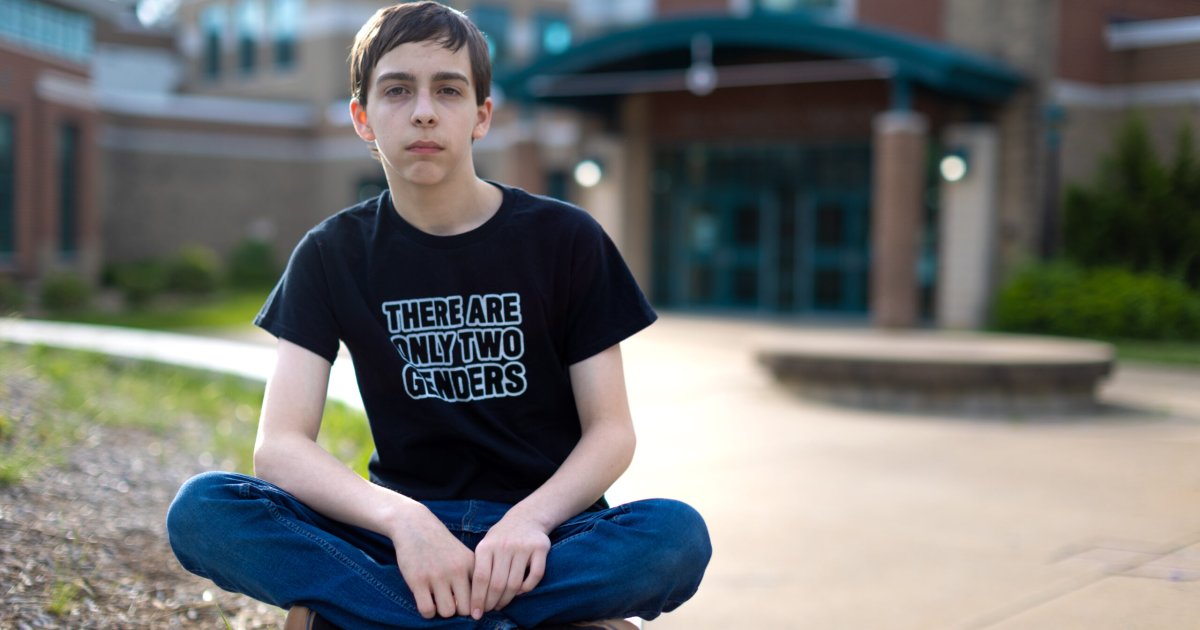
Last year, the First Circuit Court of Appeals significantly weakened student speech rights in L.M. v. Town of Middleborough. The case involved a Massachusetts middle schooler named Liam Morrison who was banned from class for wearing a shirt that read, “There are only two genders.” When he taped “CENSORED” over the original message, the school banned that, too.
Morrison’s school encourages students to express the view that there are many genders, but when he offered a contrary view — the school silenced him. However, if schools want to teach gender identity to seventh graders, the law says they must tolerate dissenting views on the issue. As the Supreme Court famously held in Police Dept. of Chicago v. Mosley, “above all else, the First Amendment means that government has no power to restrict expression because of its message, its ideas, its subject matter, or its content.”
The prohibition on viewpoint-based censorship is a cornerstone of our First Amendment. Without it, the concept of free speech loses much of its meaning. Yet when Morrison and his parents, represented by the Alliance Defending Freedom, brought suit against the school and the town of Middleborough for violating his freedom of speech, the First Circuit disregarded settled First Amendment law to uphold the school’s censorship. Specifically, the First Circuit misapplied the Supreme Court’s landmark 1969 student speech case Tinker v. Des Moines Independent Community School Dist., which established the baseline rule that students do not “shed their constitutional rights to freedom of speech or expression at the schoolhouse gate.”
According to Tinker, schools cannot censor student speech absent evidence that doing so is “necessary” to avoid “material and substantial interference with schoolwork or discipline” or “invasion of the rights of others.” A few years ago, the Court reaffirmed the Tinker standard and emphasized that it’s a “demanding” one.
But the First Circuit’s recent decision lowers that bar, replacing Tinker’s “substantial interference” test with a far more permissive one. Now, in thousands of public schools across Rhode Island, Massachusetts, New Hampshire, Maine, and Puerto Rico, student speech that is “reasonably interpreted” to “demean personal characteristics” and thus “reasonably forecasted to poison the educational atmosphere” can be censored even if it doesn’t target any particular student.
That isn’t just a bad ruling. It’s a dangerous one.
It distorts Tinker’s long-established standard and gives school administrators enormous power to silence unpopular student opinions. In doing so, it elevates disagreement to the level of “disruption” — and permits those experiencing the “discomfort and unpleasantness that always accompany an unpopular viewpoint” to silence dissenters in ways that directly contradict Tinker.
The Supreme Court could have reviewed the First Circuit’s problematic decision and put it to rest. Instead, it looked the other way, leaving the lower court’s decision to remain on the books.
That is quite a blow to student speech rights. As the Supreme Court recently said in Mahanoy Area School District v. B.L., “America’s public schools are the nurseries of democracy.”
Unfortunately, the First Circuit’s decision sends a very different message — and the Supreme Court has failed to set the record straight.
This audio is auto-generated. Please let us know if you have feedback.
Dive Brief:
More states are defining what it means to be a man and woman in state law, with Texas poised to become the 14th Republican-leaning state to do so since 2023. The state’s sex definition bill was approved last week and now awaits Gov. Greg Abbott’s signature.
Two additional states — Nebraska and Indiana — regulate the definition of sex through state executive orders, according to the Movement Advancement Project, a nonprofit that tracks legislation related to LGBTQ+ issues.
While the impact of these laws may vary from state to state, they set the stage to prevent transgender students from accessing facilities and joining athletic teams aligning with their gender identities.
Dive Insight:
Proponents of sex definition legislation say it protects women and girls from sex discrimination based on “immutable biological differences” that can be seen before or at birth. Advocates have used the same argument in recent years to interpret Title IX, the federal civil rights law preventing sex discrimination in education programs, to separate transgender students from girls and women athletic teams and spaces.
The Texas legislation, for example, says “biological differences between the sexes mean that only females are able to get pregnant, give birth, and breastfeed children” and that “males are, on average, bigger, stronger, and faster than females.” These differences, it says, “are enduring and may, in some circumstances, warrant the creation of separate social, educational, athletic, or other spaces in order to ensure individuals’ safety and allow members of each sex to succeed and thrive.”
The language closely mirrors an executive order issued by President Donald Trump upon his return to the Oval Office in January. That order established that “it is the policy of the United States to recognize two sexes, male and female.” The order said “these sexes are not changeable and are grounded in fundamental and incontrovertible reality,” and that the concept of “gender identity” is “disconnected from biological reality and sex and existing on an infinite continuum.”
The language was also reflected in a draft resolution agreement proposed to the Maine Department of Education by the U.S. Department of Education after a short, one-month investigation by the federal agency’s Office for Civil Rights found the state was violating Title IX in its policy allowing transgender students to participate in girls’ and women’s sports teams.
The agreement, which Maine refused to sign, would have had the state department and public schools define “females” and “males” in their policies and require the state to publicize the definitions on its website.
The Maine agency would have been required to notify schools that “there are only two sexes (female and male) because there are only two types of gametes (eggs and sperm); and the sex of a human — female or male — is determined genetically at conception (fertilization), observable before birth, and unchangeable.”
“Gender” would be the same as “sex” under the agreement.
The case is currently pending with the U.S. Department of Justice, which took over enforcement of the investigation and its findings after the state refused to sign the agreement.
The agreement would have also required the state to change its records to erase transgender girls’ athletic accomplishments on girls’ sports teams, which is also a potential side effect of the legislation in 13 states defining sex.
Those opposing recent sex definition laws say they are transphobic, as they don’t recognize transgender people’s gender identity.
“These laws couldhave dangerous implications for transgender people when it comes to bathrooms, identity documents, and other areas of law or policy,” MAP said, “but because these government gender regulation laws are often vaguely written, the actual impact of these laws remains to be seen in each state.”
District judge moves to take out an injunction on Trump administration’s Harvard international enrolment ban while the case moves through the legal system.
University’s international students report “emotional distress” as many cancel travel plans over fears they will not be allowed back into the US.
US Department of Homeland Security boss accuses Harvard of “disdain” for American people and spreading hate.
Following on from her decision last week to temporarily block the move, district judge Allison Burroughs told a packed court that she wanted to “maintain the status quo” while Harvard’s case works its way through the legal system.
It’s the latest twist in the university’s ongoing battle with the Trump administration, which has accused it of anti-semitism and stripped it of billions of dollars in funding. For its part, Harvard is coming out swinging against the directive, swiftly mounting a legal challenge – the latest step of which culminated in Burroughs’ judgement in a hearing yesterday.
In court documents filed ahead of the hearing, Harvard’s director of immigration services at the institution’s international office, Maureen Martin, detailed the toll that the administration’s announcement is taking on the campus’s international students.
She wrote that the revocation notice has caused both students and faculty to express “profound fear, concern, and confusion” – with the university “inundated” with queries from worried international students.
“Many international students and scholars are reporting significant emotional distress that is affecting their mental health and making it difficult to focus on their studies,” said Martin, adding that some are too afraid to attend their own graduation ceremonies this week in case immigration-related action is taken against them.
Meanwhile, others are cancelling international travel plans over concerns they will not be able to re-enter the US. “Some fear being compelled to return abruptly to home countries where they might not be safe due to ongoing conflicts or where they could face persecution based on their identity or background,” Martin wrote.
Many international students and scholars are reporting significant emotional distress that is affecting their mental health and making it difficult to focus on their studies Maureen Martin, Harvard University
While US stakeholders may be breathing a sigh of relief at Harvard’s temporary reprieve, Donald Trump’s government is showing no signs of backing down.
In a letter sent to Harvard before Thursday’s hearing, US Immigration and Customs Enforcement (ICE) confirmed that it wanted to move ahead with revoking the university’s SEVP certification, which would mean it could no longer host international students. Notably, though, the letter did not repeat last week’s assertion that Harvard would have 30 days to challenge the decision and suggested the government would not look to immediately enact the directive.
In a statement released yesterday, US secretary of the Department of Homeland Security, Kristi Noem, doubled down on accusations that Harvard has not complied with SEVP regulations, has “encouraged and allowed anti-semitic and anti-American violence to rage on its campus” and has been working with the Chinese Communist Party.
“Harvard’s refusal to comply with SEVP oversight was the latest evidence that it disdains the American people and takes for granted US taxpayer benefits,” she said. “Following our letter to Harvard, the school attempted to claim it now wishes to comply with SEVP standards. We continue to reject Harvard’s repeated pattern of endangering its students and spreading American hate – it must change its ways in order to participate in American programs.”
Harvard’s row with the Trump administration stems from the stand it took against a raft of government demands, including that it reform its admissions and hiring practices to combat antisemitism on campus, end DEI initiatives and hand over reports on international students.
When the institution refused to comply with the demands, the government – seemingly in retaliation – froze $2.2 billion in the university’s funding, threatened to revoke its tax-exempt status, and demanded that international students’ records be handed over. If Harvard didn’t play ball, it was warned, it risked losing its SEVP certification.
Although Harvard did send over some student information on April 30, and maintained that it had provided the information it was legally bound to supply, this seems to have been insufficient for the Trump administration, which then moved to black the institution from hosting international students.
In yet another blow to the US international education sector, the US government announced this week that it would pause all new study visa interviews at American consulates around the world – sparking dismay from stakeholders.
And Chinese students studying in the US were plunged into uncertainty yesterday after – amid a trade war with Beijing – the government announced plans to “aggressively revoke” their visas. As yet, it remains unclear whether all Chinese students will be affected or just those with links to the Chinese Communist Party or studying in so-called key areas.