Young people are often accused of naivety. But in journalism, naivety can be powerful.
Being naive means sounding innocent or unsophisticated about something. You often get accused of naivety when you question why things are the way they are. Many people hate being accused of that, so they accept generally accepted standards — a fancy term I like is “prevailing paradigms.”
Often these are notions that some problems are so rooted that they can’t be fixed so you just have to accept them: polluted rivers or entrenched corruption or homelessness or discriminatory policies.
When you question these notions you might be accused of being naive. I say wear that like a badge. Why? Because if we accept problems without seeking solutions we won’t ever improve a community or society or nation. And that means that you must reject the idea that some problems can’t be solved.
It means we have to go back to the idea that everyone deserves clean air and water, healthy food, a basic education, shelter and safety. Nowadays you might add internet access, heat and electricity to that list and maybe a decent transportation system. The more I add, the more naive I sound.
Question prevailing paradigms.
Good journalism comes from asking why people don’t have these things, not from accepting that they don’t have them.
So I suggest this: Draw an imaginary line. It represents a perfect world. In a perfect world everyone would have those things I listed: clean air and water, healthy food, etc. Then draw a line next to it that represents the current situation, and make the space between them wider the more off we are from that perfect world. Therein lies your story.
How far off is your community from having clean water or clean air? How bad are diets or how bad is the food shortage?
Then ask why. Why are people drinking or fishing out of contaminated water streams? Why are people going hungry? Why are people homeless? These are basic questions that come from the naive perspective that these problems shouldn’t exist in a perfect world.
Only when you ask these questions can you get to the heart of causes. Here is the hard part. The accusation of naivety comes not because these problems can’t be solved. It comes because the solutions are complicated. Sometimes they are really complicated. So the naivety comes in the idea that no one — including you or me — is willing to take the time and effort and brain power to unravel all those complications to get to solutions.
Prove them wrong.
This all gets to the two traits that make someone a great journalist: Persistence and patience. It is the persistence to not just walk away when someone tells you that you are being naive or that a problem is too complicated, and the patience to work through the complicated elements.
All the complications people will throw at you are like protective layers around a problem. They are like the levels you need to surmount in a video game.
Once you peel them away, you get to causes that are pretty basic: Not enough money because people with money aren’t willing to spend it; a lack of power because people with power aren’t willing to cede it; and basic human failings like racism, homophobia, sexism or greed.
If you can call out people or communities or government representatives on their racism or homophobia or sexism or greed, maybe you can get them to work on solutions. Only by finding solutions to problems can we get a little closer to that perfect world.
Isn’t a perfect world the one you want to work towards? Or am I being naive?
Questions to consider:
1. What does the author mean by “prevailing paradigms”?
2. Why can naivety be powerful in journalism?
3. What are some problems in your community that people seem to accept without question?
For years now, the promise of AI in education has centered around efficiency–grading faster, recommending better content, or predicting where a student might struggle.
But at a moment when learners face disconnection, systems are strained, and expectations for personalization are growing, task automation feels…insufficient.
What if we started thinking less about what AI can do and more about how it can relate?
That’s where agentic AI comes in. These systems don’t just answer questions. They recognize emotion, learn from context, and respond in ways that feel more thoughtful than transactional. Less machine, more mentor.
So, what’s the problem with what we have now?
It’s not that existing AI tools are bad. They’re just incomplete.
Here’s where traditional AI systems tend to fall short:
NLP fine-tuning Improves the form of communication but doesn’t understand intent or depth.
Feedback loops Built to correct errors, not guide growth.
Static knowledge bases Easy to search but often outdated or contextually off.
Ethics and accessibility policies Written down but rarely embedded in daily workflows.
Multilingual expansion Translates words, not nuance or meaning across cultures.
These systems might help learners stay afloat. They don’t help them go deeper.
What would a more intelligent system look like?
It wouldn’t just deliver facts or correct mistakes. A truly intelligent learning system would:
Understand when a student is confused or disengaged
Ask guiding questions instead of giving quick answers
Retrieve current, relevant knowledge instead of relying on a static script
Honor a learner’s pace, background, and context
Operate with ethical boundaries and accessibility in mind–not as an add-on, but as a foundation
In short, it would feel less like a tool and more like a companion. That may sound idealistic, but maybe idealism is what we need.
The tools that might get us there
There’s no shortage of frameworks being built right now–some for developers, others for educators and designers. They’re not perfect. But they’re good places to start.
Framework
Type
Use
LangChain
Code
Modular agent workflows, RAG pipelines
Auto-GPT
Code
Task execution with memory and recursion
CrewAI
Code
Multi-agent orchestration
Spade
Code
Agent messaging and task scheduling
Zapier + OpenAI
No-code
Automated workflows with language models
Flowise AI
No-code
Visual builder for agent chains
Power Automate AI
Low-code
AI in business process automation
Bubble + OpenAI
No-code
Build custom web apps with LLMs
These tools are modular, experimental, and still evolving. But they open a door to building systems that learn and adjust–without needing a PhD in AI to use them.
A better system starts with a better architecture
Here’s one way to think about an intelligent system’s structure:
Learning experience layer
Where students interact, ask questions, get feedback
Ideally supports multilingual input, emotional cues, and accessible design
Agentic AI core
The “thinking” layer that plans, remembers, retrieves, and reasons
Connects with existing infrastructure: SIS, LMS, content repositories, analytics systems
This isn’t futuristic. It’s already possible to prototype parts of this model with today’s tools, especially in contained or pilot environments.
So, what would it actually do for people?
For students:
Offer guidance in moments of uncertainty
Help pace learning, not just accelerate it
Present relevant content, not just more content
For teachers:
Offer insight into where learners are emotionally and cognitively
Surface patterns or blind spots without extra grading load
For administrators:
Enable guardrails around AI behavior
Support personalization at scale without losing oversight
None of this replaces people. It just gives them better support systems.
Final thoughts: Less control panel, more compass
There’s something timely about rethinking what we mean by intelligence in our learning systems.
It’s not just about logic or retrieval speed. It’s about how systems make learners feel–and whether those systems help learners grow, question, and persist.
Agentic AI is one way to design with those goals in mind. It’s not the only way. But it’s a start.
And right now, a thoughtful start might be exactly what we need.
Rishi Raj Gera, Magic EdTech
Rishi Raj Gera is Chief Solutions Officer at Magic EdTech. Rishi brings over two decades of experience in designing digital learning systems that sit at the intersection of accessibility, personalization, and emerging technology. His work is driven by a consistent focus on building educational systems that adapt to individual learner needs while maintaining ethical boundaries and equity in design. Rishi continues to advocate for learning environments that are as human-aware as they are data-smart, especially in a time when technology is shaping how students engage with knowledge and one another.
Latest posts by eSchool Media Contributors (see all)
This audio is auto-generated. Please let us know if you have feedback.
Ohio University processes more than five tons of food waste every day, turning the scraps left over from hungry college students at the institution’s cafeterias into “brown gold” — compost that the university uses to fertilize plants around the campus and sell to neighbors.
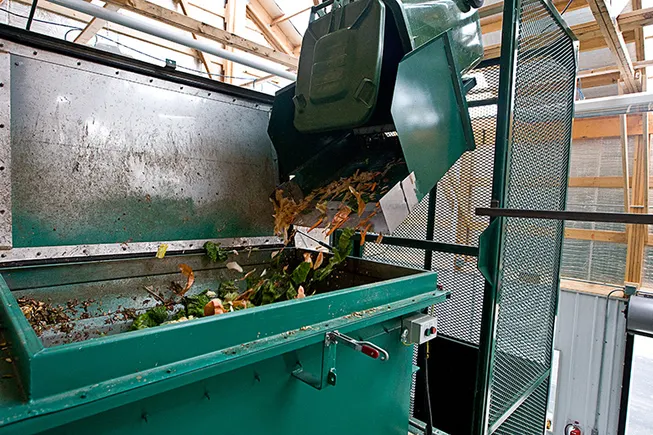
In most dining halls, any leftover food is placed on a conveyor belt where an employee from the university’s Culinary Services department separates the contents into food waste, landfill waste and recyclable waste. This collection process allows the University to compost nearly 100% of food waste from campus dining halls and its central food facility, the university said April 17 in a blog post.
“Basically, it’s completely circular in that we take that food waste out of the earth, we process it, we make a soil amendment and then we return it to our grounds,” Sam Crowl, director of sustainability at Ohio University, told Facilities Dive.
Compost bins are collected, five days a week, and taken to the OHIO facility, which is co-managed by the university’s facilities management team and the Office of Sustainability. The facility contains two-ton and four-ton in-vessel systems that help to ensure the recycling process is effective by churning out quality soil while also limiting any chance of methane-producing bacteria, Ohio University says.
After adding in wood chips to create a chemically-balanced mixture, the compost is turned and heated to further the decomposition process. “We have a chipper so we’re able to produce some of our own wood chips, but we also have to purchase [some]. So that’s an expense,” Crowl said.
After two weeks in the vessel, the material is taken outside to be cured in long outdoor piles, or windrows, for 90 to 180 days, that are turned by tractor.
“The vast majority of the product that the system produces is returned to our campus grounds. It goes into our landscape beds. It is used anywhere we want to provide nutrients, so we put it around our trees,” Crowl said. In addition, the compost is provided to community gardens through partnerships with local schools and other departments on campuses.
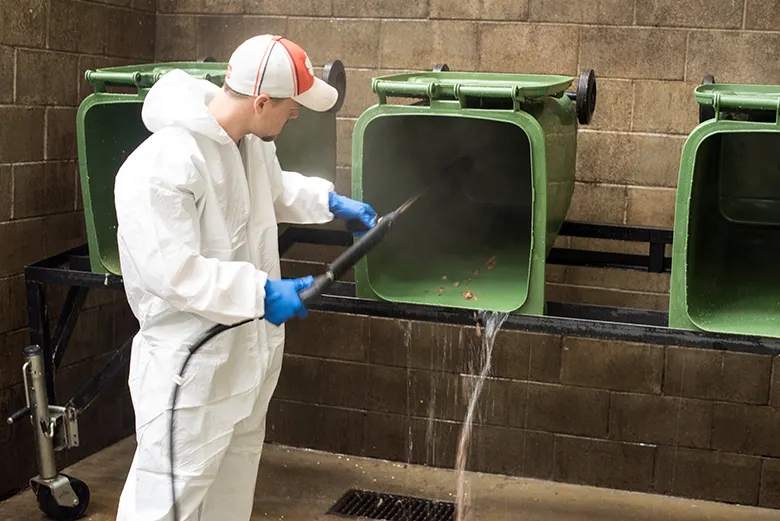
An Ohio University employee powerwashes compost bins. The bins are set up on a rack and power washed with water from a rainwater collection system so that they can be reused.
“So it’s available internally to university partners, and then also it’s available externally. We do have a process where community members or small local farmers can purchase the product,” Crowl said. “We don’t really do a lot of marketing or advertising of that, so it’s not a huge part of our economics, or how we support the system. But it is available, and it is sold locally.”
Once compost bins are dropped off at the OHIO facility, which features a specialized solar-thermal system, waste oil burner and plastic skylights for heating the building, the bins are set up on a rack and power washed with water from a rainwater collection system so that they can be reused.
The problem with kids — and teachers — these days
The compost bins can also be found at the university’s central food facility in Athens, Ohio, as well as various offices and even some resident halls via an opt-in program. While the system has been operating pretty seamlessly since it began in 2009, the university did run into a challenge when attempting to expand the system to include waste from its student union’s food court: the public.
Compost facilities in Ohio are rate limited by the Ohio Environmental Protection Agency, which examines the facility once a year to check ground water and make sure that no leaks are contaminating the ground water supply or nearby streams.
“Our biggest challenge has been contamination of the water stream,” Crowl said. Despite many attempts over a year and a half to improve signage at the public food court, properly separating food waste from landfill waste and recyclable waste “was something that the public just couldn’t really handle,” he said.
After running an internal audit and examining the situation, Crowl realized that it wasn’t just students failing to separate garbage from food waste, “it was pretty much everybody. Not everybody, but a wide spectrum of different people who were incorrectly putting items in the wrong place.”
While the university’s cafeterias have employees for separating materials, it doesn’t have the staff to go through each bin to make sure they are completely clean of non-food waste. “There was so much contamination coming out of the student union that they couldn’t get it all, and the Ohio EPA came up for their annual inspection and there were potato chip bags, or plastic lids and utensils, in the compost,” according to Crowl.
“They said, ‘Look, you have to clean this up or we are not going to be able to give you your permit this year.’ It was a small fraction of the overall sort, but I can understand their concerns,” he said. “And so the only way, after we tried different signage and instructions, we could really solve that problem was by not having a compost collection effort at the student union.”
Now that the university stopped collecting from the union, it no longer has any more problems keeping compost clean, Crowl said.
Plaintiffs allege both moves violate federal lawand threaten major research projects and millions of dollars in federal funding at universities in their states. An NSF spokesperson declined to comment on the lawsuit.
The suing states — nearly all of whom have Democrat attorneys general —asked a federal judge in New York to block NSF’s indirect cost cap and its April directive barring diversity-related grants.
Dive Insight:
On April 18, the science research agency — which was founded in 1950and had a budget of $9 billion last fiscal year — issued a statement announcing it would prioritize research focused on creating “opportunities for all Americans everywhere.”
“Research projects with more narrow impact limited to subgroups of people based on protected class or characteristics do not effectuate NSF priorities,” the agency said at the time.
The same day, NSF began issuing mass termination notices for projects that seek to boost participation in scientific fields by “women, minorities, and people with disabilities,” according to Wednesday’s complaint. Studies on misinformation and environmental justice also received termination notices.
The canceled projects include a University of Delaware study on post-traumatic stress disorder and suicidality among veterans;a new doctoral program in New Jersey promoting increased participation of underrepresented groups in science-related Ph.D.s; and a University of Oregon initiative providing some 20,000 students with learning experiences in computer science.
Later, in May, NSF moved to cap reimbursement for indirect research costs at 15% for all new grants issued to colleges. The cuts affect funding for equipment, administrative staff, laboratory construction and other expenses in research programs.
The funding cap already sparked at least one other lawsuit, from a group of higher education associations.
The change could bring steep financial and infrastructural damage to university research programs that the government relies on to advance knowledge and technology in the country, the state plaintiffs argued.
According to Wednesday’s lawsuit, the “vast majority” of university projects in the plaintiff states had negotiated indirect research rates between 40% and 60% with NSF. Those states’ “institutions will not be able to maintain essential research infrastructure and will be forced to significantly scale back or halt research, abandon numerous projects, and lay off staff,” the plaintiffs argued.
In both cases — the April directive and May indirect cost cap — the NSF violated law, the states said.
In the case of the April directive, the plaintiffs pointed to statutes that explicitly direct the agency to promote scientific participation among underrepresented groups in the U.S.
They further argue that the longstanding policy has worked, citing statistics showing that the number of women in science and engineering occupations or with related degrees doubled between 1995 and 2017. Participation in these fields by those from minority groups rose from 15% to 35% during the period.
The plaintiffs likewise argued that the indirect cost cap undermines a federal law directing the NSF to support basic scientific research and education programs.
Under the Trump administration this year, the National Institutes of Health and the U.S. Department of Energy also both adopted similar 15% caps on overhead reimbursement. Courts have blocked both policies, though the cases are ongoing.
This audio is auto-generated. Please let us know if you have feedback.
Indoor air pollution has especially powerful effects on babies and young children, not only due to more time spent indoors but because they breathe more rapidly and inhale more air relative to their body size than adults, according to a working paper by the Center on the Developing Child at Harvard University.
Most spend more than 90% of their time in enclosed buildings, where air pollutants can be two to five times higher than outdoor levels due to poor ventilation, say the researchers, citing estimates from the U.S. Environmental Protection Agency.
During early childhood, the amount of time spent inside is also due to the additional time spent in childcare facilities, schools, community centers, summer camp buildings, offices and homes, according to the paper. Elevated levels occur for those during pregnancy as well, the researchers say.
One example of volatile organic compounds, or VOCs, commonly found inside children-focused locations stems from the frequent use of cleaning products — particularly scented spray products — that result in a higher risk of wheezing in early childhood and the development of asthma and lower respiratory tract infections in childhood, the researchers say.
The paper notes that actionable solutions to improve indoor air quality exist. These range from policy and regulation to pollutant-free cleaners, healthier housing and furniture materials, new building technologies and “simply maintaining and using ventilation systems with high-quality filters.”
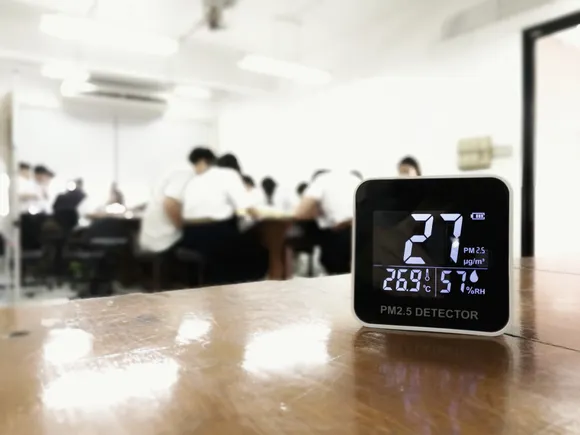
The EPA defines indoor air quality management as the control of airborne pollutants, introduction and distribution of adequate outdoor air and the maintenance of acceptable temperature and relative humidity. Key pollutants present in children’s environments that can cause serious harm when exposure occurs include VOCs; pesticides, phthalates, forever chemicals and flame retardants; particulate matter; wildfire smoke; germs, viruses, bacteria and allergens; gases; and heat, according to the Harvard research paper.
A balanced approach to cleaner indoor air means three approaches: protection, adaptation and prevention, the paper says. Facility managers can protect occupants by monitoring indoor air quality, switching to safer cleaning products, using hooded kitchen exhaust fans that vent to the outside, and utilizing portable, room-based air purifiers with HEPA filters, according to the paper.
Adaptation includes the reduction and absorption of emissions by creating vegetation barriers, transitioning to less polluting appliances and by making buildings healthier. According to the Healthy Buildings Program at the Harvard T.H. Chan School of Public Health, an approach to improving air quality includes the use of ventilation that controls indoor sources of pollutants, providing regulation maintenance of ventilation systems and implementing an integrated pest management plan. This plan should focus on preventative measures, such as sealing entry points, preventing moisture buildup and removing trash, according to the paper.
Operators should also install and maintain adequate ventilation and filtration systems in schools located in low-income neighborhoods and verify that building systems are operating as designed. The researchers noted that proper maintenance and use of these systems is “surprisingly rare,” citing a California study of schools with recently retrofitted HVAC systems that found only 5% of classrooms met minimum ventilation rates due to improperly selected equipment, incorrect fan control settings and maintenance issues.
Prevention measures include policy interventions and the development of health-based regulatory standards for indoor air quality, researchers say.
The EPA’s IAQ Tools for Schools program is one resource that operators can use to implement these strategies, including a framework for effective school IAQ management, guidance documents and an IAQ assessment mobile app that can be used to address critical building-related environmental health issues.
It’s more important than ever to focus on student experience. The Albanese Government’s recent re-election has given higher education institutions a clearer idea of what’s ahead.
With the Australian Tertiary Education Commission set to begin operations on 1 July 2025, we can expect further action on the recommendations laid out in the Australian Universities Accord.
At the same time, the shifting geopolitical landscape presents Australia with an opportunity to become an even more attractive destination for international students. Ongoing debates around enrolment caps could influence this, but the potential is there.
Meanwhile, the rise of artificial intelligence (AI) has once again raised the bar for digital expectations. Students now expect their university experience to match the ease and responsiveness of tech giants like Amazon or Meta.
Together, these forces are putting pressure on universities to rise to the occasion and deliver better educational experiences.
The Universities Accord is changing the landscape
The Australian Universities Accord, released in 2024, outlines a vision for a more educated workforce with more accessible and flexible learning pathways. A key goal is for 80 per cent of the workforce to hold a tertiary qualification by 2050, up from around 60 per cent today.
The Accord also calls for doubling the number of placements, reducing inequality in access to higher education, and addressing growing skill shortages. It encourages more regional hubs and deeper integration between VET and university providers.
To achieve this, universities will need to create more flexible, hybrid learning environments that accommodate students from all walks of life. Whether a student is studying remotely or regionally, they’ll expect full access to resources, a sense of community, and seamless transitions across providers.
This is where digital experience becomes critical. If university and VET learning are to be integrated, will students navigate one central dashboard or juggle 10 separate platforms?
Improving the student experience is essential to achieving the Accord’s vision. Without a seamless, supportive and accessible student journey, the ambitious goals of expanding participation, reducing inequality and building a highly skilled workforce simply won’t be met.
Delivering on the Accord’s goals will mean strengthening digital infrastructure and taking a holistic view of how students interact with services, from enquiry and enrolment to study and graduation.
Student experience can be Australia’s global edge
Student experience is also a powerful competitive advantage. International education is one of Australia’s largest exports. Recent discussions around student caps have created uncertainty, but a stable government may help clear the path.
With rising tensions in countries like the US, Australia is well-positioned to attract more students, as long as it can compete. And student experience is a key part of that value proposition.
From easy access to support services to the ability access resources from anywhere in the world, the small things make a big difference. Admin should be smooth. Communication should be seamless. The better the student experience, the higher Australia’s competitive advantage becomes.
AI has changed the rules of engagement
The pandemic fast-tracked digital adoption across universities and the AI boom is driving another major shift. Students are now interacting daily with AI-powered tools that offer personalised, intelligent, and immediate support. They’ll expect the same from their institution. Think AI chatbots for self-service, automated timetables, study recommendations, and more intuitive platforms.
The question for institutions is what their student experience actually looks like right now, and how quickly they can evolve it. Keeping up with the modern market demands continuous adaptation.
This is a critical moment to evaluate the entire student journey and make intentional improvements. Institutions have a choice: steer the ship with purpose or risk being swept off course by rapid change. A strong, student-centred experience is the compass that will keep them on track.
Turning complexity into connection: where to focus next
From admissions to graduation, there are countless ways to improve the student journey. But right now, many institutions are held back by legacy systems, under-resourcing, and tighter budgets.
A bigger and more immediate challenge is the number of disconnected systems in use. When platforms don’t talk to each other, students feel the impact. You can have the best AI chatbot in the world, but if it’s buried across five different logins, the value is lost.
The good news is, these problems aren’t new and there are technologies designed to solve them. Digital experience platforms (DXPs) act as a bridge between systems, bringing them together into one simple, seamless interface. Whether it’s a student portal, public-facing website, or alumni platform, DXPs let institutions improve the student-facing experience without having to rebuild their entire backend systems.
That means you can start by improving how students interact with your institution – such as by creating a modern student portal that centralises resources and streamlines communication, then updating older systems over time.
Once the right digital foundations are in place, you can unlock the power of your data, using insights to deliver personalised, real-time communication that meets students where they are.
Right now, there’s a real opportunity for institutions to lead. The policy environment is shifting, AI is changing expectations, and students are demanding more flexible and human experiences. Institutions that can simplify the complexity and focus on what matters to students won’t just keep up, they’ll set the standard.
Liferay’s education portal solutions are designed to meet the unique needs of your institution, from online student portals to alumni networks and research collaboration platforms. Download our exclusive e-book, which explores how three Australian institutions leveraged Digital Experience Platforms (DXPs) here.
Math courses are often a barrier for students seeking to pursue a college credential, and for some, a lack of math curriculum during high school can make a STEM career seem out of reach.
A new course at Wentworth Institute of Technology in Boston serves as a stepping-stone for students who may not have had access to precalculus or calculus courses but are still interested in calculus-based learning. The university hopes the program will boost student enrollment and eliminate barriers to access for disadvantaged students.
What’s the need: The conversation about offering precalculus at Wentworth began in 2019, after university leaders saw that some students, despite having the same GPAs and high school transcripts as their peers, were less mathematically prepared, said Deirdre Donovan, Wentworth’s director of first-year math and interim associate dean of the School of Computing and Data Science.
At that time, Wentworth did not offer a math placement course, so all enrolled students launched at the calculus level.
Wentworth, like many colleges and universities, requires students to have already completed calculus coursework to enroll in specific major programs, which is “a barrier that can prevent otherwise qualified students from pursuing engineering and computing degrees,” Donovan said.
To complete calculus by the end of high school, students had to complete Algebra I in eighth grade, and not every student was ready, aware of or offered that course at their school, Donovan said.
Some high schools also push students to complete AP Statistics in lieu of calculus, and Donovan said this shift “can actually close more doors at STEM schools than it might open, because those AP credits can’t replace the calculus-based statistics required for engineering degrees.”
Campus leaders at Wentworth opted to review policies that were barring students from participating in STEM programs, starting with creating a math placement process and then developing a precalculus course.
How it works: In 2024, Wentworth removed precalculus as an admissions requirement for students, paving the way for the college to admit about 10 percent more students who might have previously received a conditional acceptance, Donovan said.
New students without calculus credit are now enrolled in a four-credit, first-semester course called Foundations of Calculus that helps them get up to speed. The investment in additional content hours is an indication of the university’s commitment to opportunities for students who may not have been able to enroll and succeed previously, Donovan said.
In addition to two hours of lectures each week, students also participate in two hours of labs that focus on engineering problem-solving skills, using real-world problems that are tied directly to a student’s major.
The course is also supported by embedded peer tutors who can address student questions, clarify confusing content and facilitate study groups outside of class time.
It was important to Donovan and her faculty team not to work from a deficit-minded perspective about students’ knowledge gaps. Language regarding the course and its content hours was specifically crafted to help students feel like they’re being guided onto an on-ramp, not held back or punished for not having precalculus experience.
The results: After the first semester, staff have seen promising results, Donovan said. “We are pinching ourselves that it went exactly how we had hoped it would go.”
In fall 2024, about 200 students participated in precalculus either because they lacked the course in high school or their placement exam results indicated it would benefit them.
Approximately 75 percent of precalc students passed their course in the first term, on par with national averages. When they attempted calculus in their second semester, students had similar passing rates to their peers who completed calculus in the first term.
University faculty and staff were encouraged to see that engineering programs received 20 percent more applications this year, signaling an increased level of interest in rigorous programs, Donovan said.
Fall-to-spring retention rates were slightly lower for precalc students, but that could be due to other factors, including students re-evaluating their chosen major or deciding whether they want to be at a STEM-focused institution.
The course has also expanded enrollment opportunities for students who otherwise might not have considered Wentworth. Overall applications were up 25 percent year over year this past application cycle, and deposits were up 30 percent, Donovan said.
What’s next: Student feedback from the first term has indicated a need for an additional credit hour of in-person, interactive lab work, which will be implemented this fall. The hour, which the university is calling a companion class, will function similarly to a first-year seminar, teaching students study skills and metacognition, as well as connecting back math concepts.
None of the downstream courses such as physics have undergone a curriculum change, requiring students to get up to speed in their first term to be successful over all in college. Students who complete precalc also may need to take summer classes to ensure they graduate in four years, but the university is looking to offer affordable online courses to accommodate learners, Donovan said.
Do you have an academic intervention that might help others improve student success? Tell us about it.
Erik Jacobsen, an associate professor of mathematics education at Indiana University, was nearing the end of a years-long project designed to address teacher biases with the goal of helping more students excel in math and pursue STEM careers. But that all stopped several weeks ago, when the National Science Foundation notified him that it had terminated the grant because it was “not in alignment with current agency priorities.”
Jacobsen’s grant, which was funding multiple graduate students and a postdoc, who are all now in limbo, is far from the only STEM education–focused grant the NSF recently canceled.
Of the approximately 1,500 grants the agency recently terminated, at least 750 came from the NSF’s education directorate, according to Grant Watch, an independent website that tracks terminated NSF grants. And that’s not the only shake-up happening at the NSF, which Congress created in 1950 to “promote the progress of science; advance the national health, prosperity and welfare; and secure the national defense.” The Trump administration has also laid off staff and proposed slashing the agency’s budget.
Additionally, NSF announced new priorities that include not funding projects aimed at recruiting more Americans from underrepresented backgrounds to the STEM workforce—a key focus for the agency historically.
The Trump administration says all these changes are part of its plan to reform the NSF, correct an alleged “scientific slowdown,” build a “a robust domestic STEM workforce” and “rapidly accelerate its investment in critical and advanced technologies such as artificial intelligence, quantum computing and biotechnology.” The NSF sends billions to colleges and universities to support STEM education and nonmedical scientific research.
Researchers and policy experts are worried that the major cuts to STEM education programs will jeopardize the long-term future of the STEM workforce and leave the nation with a deficit of scientists and other skilled workers who are capable of carrying out Trump’s vision of winning “the technological race with our geopolitical adversaries.”
“There may be enough scientists to do the projects that are left. But for how long? They’re eventually going to retire and there won’t be this robust pipeline,” Jacobsen said. “There’s so many kids in our country that learn math and science every day. And the reason they learn it as well as they do is because of NSF’s historic investment in education.”
‘Nearsighted’ Changes
Since Trump started his second term in January, the NSF has upended its operations and spurred chaos and uncertainty within the research community. In February, the agency fired 10 percent of its staff—many who help university researchers navigate the grant application and funding process—though a federal judge later ordered the NSF to reinstate some of those employees.
“Their absence means that even if the budget is sufficient to fund new projects, distributing that money fairly and appropriately is going to be delayed if not made impossible,” Suzanne Ortega, president of the Council of Graduate Schools, said. While those and other changes are already “having immediate effects on graduate students, postdocs and early-career scientists,” she said there will also be “major downstream consequences” that won’t come home to roost for at least five years.
According to the Bureau of Labor Statistics, employment in STEM occupations is expected to grow 10.4 percent between 2023 and 2033, more than double the projections for non-STEM careers. But decimating the NSF’s education directorate—which funds many projects focused on researching how to improve STEM education outcomes starting in K-12—will make it harder to cultivate the robust STEM workforce Trump says he wants, Ortega said.
“This kind of research tells us how we can develop curricula that makes the pathway from a Ph.D. program into industry more seamless. Or how we can create mentoring networks or other kinds of connections that foster more rapid degree completion,” she said. “To forget that education research itself is vital to improving the system that our research enterprise depends on is very nearsighted.”
Adding to the challenges is the Trump administration’s crackdown on international student visa holders—who make up a sizable portion of STEM graduate students—which could make strengthening the STEM career pipeline increasingly difficult, said Holden Thorp, editor in chief of the Science family of journals.
“We desperately need more effort to produce scientists who are U.S. citizens,” he said. “Regardless of whether those programs are devoted to marginalized groups or anyone else, there’s people we need to encourage to go into science. Even if you don’t accept the reason why some of these programs were set up. It’s a disastrous economic strategy to get rid of programs—especially when they were in midstream—that would be growing the supply of scientists in the American workforce.”
As these changes keep coming, the NSF remains without permanent leadership. Sethuraman Panchanathan—the Trump appointee who had run the agency since 2020—resigned in late April, stating that he’d done all he could “to advance the critical mission of the agency.”
Earlier this month, the NSF announced a plan to cap indirect cost rates—which fund laboratory space and other research supports that can be used for multiple projects—for universities at 15 percent. At the same time, Trump’s budget bill proposed cutting the NSF’s 2026 budget by 55 percent, which includes cutting $3.5 billion from the agency’s general education and research budget, $1.1 billion from the Broadening Participation programs and $93 million for agency operations and awards management.
A coalition of former NSF directors and National Science Board chairs blasted the proposal, saying it “would thwart scientific progress, decimate the research workforce and take a decade or more to recover” and “fast-track China’s plans for technological dominance.”
Although Congress will have to approve Trump’s budget proposal later this year for it to become law, the NSF is already preparing for a future with less funding.
According to Science, NSF has eliminated 37 divisions across its eight directorates and is also creating a new oversight body of unknown membership that will have the final say in reviewing a proposal to ensure it doesn’t violate the agency’s new anti-DEI priorities. Additionally, the NSF announced earlier this month that it plans to cut more than half of its senior administrations and slash the number of “rotators”—academic scientists who serve two- to four-year terms to help the NSF choose which research to fund—as part of its cost-saving strategies.
That has big implications for NSF-funded initiatives like the Advanced Technological Education (ATE), which is a congressionally mandated effort led by community colleges designed to improve and expand educational programs for technicians to work in high-tech STEM fields that drive the U.S. economy.
“ATE is heavily influenced by rotators from community colleges,” said Ellen Hause, associate vice president for academic and student affairs at American Association of Community Colleges. “With the rotators on the chopping block, we would lose some of this expertise not only in STEM technician education, but in the community college space, which is a unique piece of the STEM workforce and STEM education.”
Many of the future community college students who may want to participate in a program like ATE in the coming years are just now getting exposure to STEM fields in their K-12 classrooms. And projects like Jacobsen’s (the math education researcher at IU) were supposed to help more of those students get comfortable with the academic material required to pursue such careers. But canceling his and other STEM education research grants midstream is already undermining decades of federal investment in STEM education, he and others said.
“We’d already done most of the work and spent most of the money,” he said. “By not having the final amount, we can’t complete our work, which means the public doesn’t get the benefit of the knowledge we would have learned. We still don’t know if the tool we were developing works. And now we’ll never know. It’s just wasting that investment.”
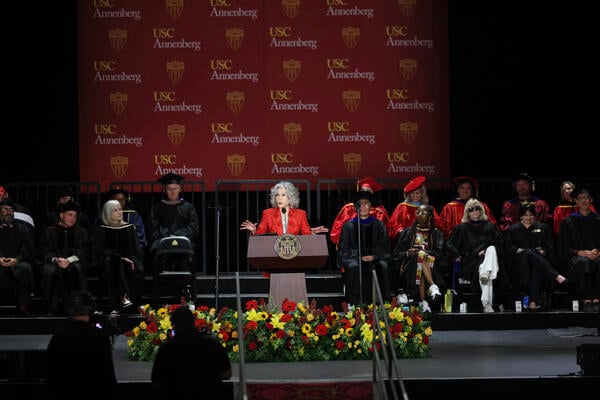
Commencement this year comes at a time of uncertainty for graduates, who find themselves entering a polarized country steeped in political and economic tumult. It’s a scenario many graduation speakers confronted head-on; actress Jane Fonda told the Class of 2025 that “the world has never faced anything like the challenges we face today.”
Much like 2024, this year’s commencement season has been marked by controversy, including at least twoinstances where student speakers were penalized for talking about the war in Gaza. Graduates also protested right-wing commencement speakers, including President Donald Trump himself, who spoke at the University of Alabama—which doesn’t traditionally invite guest speakers to commencement—and at the U.S. Military Academy at West Point, where his hourlong, meandering speech went viral.
But for many graduates, commencement went on as expected, with speakers doling out advice about how to survive—and even thrive—in these difficult times. Here’s what they had to say.
On the Current Political Climate
“Ignorance works for power. First, make the truth seekers live in fear. Sue the journalists and their companies for nothing, then send masked agents to abduct a college student who wrote an editorial in her college paper defending Palestinian rights and send her to a prison in Louisiana, charged with nothing. Then, move to destroy the law firms that stand up for the rights of others. With that done, power can rewrite history with grotesque false narratives. They can make criminals heroes and heroes criminals. Power can change the definition of the words we use to describe reality. ‘Diversity’ is now described as illegal. ‘Equity’ is to be shunned. ‘Inclusion’ is a dirty word. This is an old playbook, my friends. There’s nothing new in this. George Orwell, who we met on the street in London, 1949, he warned us about what he called ‘newspeak.’ He understood that ignorance works for power. But then it is ignorance, isn’t it, that you have repudiated every single day here at Wake Forest University? … Can the truth win? My friends, nothing else does.”
“I could never have imagined 55 years [after I graduated college] that a young woman would write her truth in your paper and find herself kidnapped and arrested for speaking her truth, somehow. And be put in jail. I could not have imagined that, 55 years later. But let me tell you that all of America salutes your president and Tufts University for supporting that student, Ms. Öztürk. It’s so important, and there’s the point when you think about Rümeysa. She said something recently. She said, ‘I still believe in this country and the right to free speech and to due process.’ … And so I can tell you when you say, ‘Oh, we’re going down the tubes.’ No, we are not. I believe in this country. As Rümeysa said, ‘We believe in the people.’ In you. This country will be OK.”
—Freeman Hrabowski III, education advocate and former president of the University of Maryland Baltimore County, May 18 at Tufts University
On Persistence
Maggie Rogers, pictured here in 2024, spoke at her alma mater, NYU, this month.
“My career arrived overnight. It’s this Cinderella story of a video—maybe you’ve seen it, maybe it was force-fed to you. If you haven’t seen it, I play a song for Pharrell Williams, he really likes it, his reaction goes on YouTube—ta-da, I’m famous. What people saw in that video was this moment of alignment; they saw a past life or the universe or whatever you want to call it come along and hold my hand to the flame. But no one saw all the hard work or all the times I almost quit. They never heard the songs that didn’t work or the shows that were just bad … I don’t know any artist that hasn’t considered quitting. But you didn’t get here because you wanted to do something easy; you got here because you wanted to do something great.”
“There’s a saying from one of America’s most practical minds, Benjamin Franklin, that I’ve used almost every day of my life: ‘Little strokes fell great oaks.’ It’s simple, it’s old, it’s absolutely true … I did run for governor in 1994 and lost, and one of the reasons I lost, I think, is I didn’t show my heart. I had five-point plans to cure every ailment in the state, but I didn’t really connect at a human level with people.
“So, in 1998, when I ran again, I vowed to campaign differently. For example, I went to visit 260 schools in a matter of a year. Back then, my views on education were considered pretty radical, so in essence I went into the lion’s den over and over and over again, trying to dehorn myself, I guess, with people that were skeptical of the ideas that I was advocating. I listened and learned, I shared my passion, I told stories of the challenges that teachers had. And I believe I became governor in 1998 because I was doggedly determined to show my heart. It’s easy to look at the world and believe that success happens overnight. We live in a world of immediate gratification, don’t we? Social media, movies, headlines often highlight the moments of triumph without showing the years of work, sacrifice and persistence that came before.”
“Don’t let anxiety or depression or hopelessness cause you to isolate. On the contrary, grow yourself a deep, solid community of people who share your values, have each other’s backs, check up on each other regularly, and be intentional about this. You know, in these uncertain times, we need to strengthen our ties to community, to our colleagues, our friends and family, because, more and more, we’re going to need this support for safety, for love, for help, for fun—let’s not forget fun—and for survival. You may not be aware of this, but since the 1980s, there’s been a concerted effort to promote individualism. You know, ‘I’m here for me and mine.’ And this shift to individualism is no accident; it’s being driven by people who want us disempowered. The myth of the rugged individual who needs no one is just that: It’s a myth created by stories through culture, told through culture, and the kinds of things that you all are going to be doing. So graduate students working with words and images—do the reverse. Encourage community versus individualism.”
Henry Winkler, pictured here in 2024, gave the commencement address at Georgetown University.
Harmony Gerber/Getty Images
“I was a negative thinker. I wanted to beat the system. ‘I can’t, I won’t, I’ll never, oh, she won’t go out with me.’ So, I tried to find the answer to negative thinking. I found Gurdjieff. He’s an Armenian philosopher who wrote a gigantic book. But he doesn’t want you to finish the book unless you understand him—so I didn’t. ’Cause I didn’t know what the hell he was talking about. And I found a disciple of his, Ouspensky—also a big book. I got one sentence. OK, so, you’re walking to your dream. Never let your dream out of your brain. And when you decide what it is you want to do, just know it without a doubt, know it without ambivalence. So you’re walking to your dream, and you have your dream in your brain, and all of a sudden a negative thought comes in. Your shoulders drop, your head drops and then that negative thought, it blooms into a thesis of negativity. A negative thought comes into your mind—you say out loud, you say out loud, ‘I am sorry, I have no time for you now.’
“Yes, people will look at you very strangely, but it doesn’t matter, because it becomes your habit. A negative thought comes into your mind, you move it out, you move a positive in. For me, it is a Bundt cake with melty chocolate chips—no icing—and all of a sudden your shoulders fly back, your head flies up and you continue your dream. And then you get to stand here and talk to you.”
“[I was] sitting in a doctor’s office, facing one of the most difficult decisions I’ve ever had: continue living my life in pain, or consider having my leg amputated. In that moment, something clicked. I stopped letting the reality of my present circumstances dictate the potential of my future. I stopped coming from a place of victim mentality and realizing that everything happens for a reason and something bigger was going on. That shift in perspective gave me the courage to move forward, to make the decision to have my leg amputated and hope of a better future.
“Since then, I’ve come to realize something. Experiencing pain doesn’t disqualify you from discovering your purpose. It prepares you for it. The reality is, every single person here has lost something at some point, a dream, a loved one, a friend. You see, the promise in [James 1:2–3] wasn’t that trials would go away; it was that endurance would grow. That’s what trials do. They forge something in us that comfort never could. They teach us to keep going when nothing makes sense to believe, when hope feels distant, to see ourselves, not by what we’ve lost, but by who we’re becoming. That’s the hidden gift in pain, because it’s the journey, not the destination that shapes us the most. So if you’re in the middle of something broken, don’t run from it. Embrace it. Life is hard, but the journey is worth it.”
Rep. Jasmine Crockett spoke at the Southern University of New Orleans, an HBCU in Louisiana.
“I will start by saying your existence as a graduate of this HBCU alone is and will be seen as a resistance. Let me break it down this way: They never wanted us to be educated. This isn’t false. It is absolutely a fact. I know y’all know the history, but there is something special in this moment in time to be allowed to tell the story in the midst of the many haters and agitators being elevated to the highest positions of power and trying to use an old-school eraser—emphasis on old-school. You know, the old pink one? They want to use that old-school eraser to erase us. They have no idea that this big pink eraser can’t erase what was written in blood. Blood that was shed by the many who bled so that brighter days like this could come.
“Much like the creation of this school, nothing in this life will be given to you. You will always walk into spaces due to your meritocracy. And even the spaces they seek to disallow you from, just know that they fear your greatness. You see, in 1956, Act 28 of the Louisiana Legislature established SUNO, but only after local African American leaders in the ’40s pushed for public college for Black students during segregation. Turn to your neighbor and say, ‘SUNO wasn’t created out of generosity.’ [graduates repeat] ‘It was created out of segregation.’ [graduates repeat] You see, they sought to build barriers. But SUNO built beginnings.”
“So, you might wonder why I’m speaking here instead of at the business school. Well, it’s because the business school got Snoop Dogg. Hard to compete with Snoop. Even though I did later go to business school, I could not have navigated the business world the way I did without the liberal arts education I earned right here. USC is where I discovered what I liked and what I didn’t. I did not, for example, like writing. That’s ironic for the CEO of a publishing company, I know. Eventually I came around.
“Physics, though, that hooked me right away … Physics instilled something in me that was more valuable than equations and theories. It gave me confidence. It became second nature to think, ‘I don’t know how to solve this problem, but I do know that I will figure out how to solve it.’ And that, Trojans, is what your USC education is giving you. More than a degree, more than a line on a résumé. It’s equipped you with a way of thinking. You now know how to distinguish between fact and fiction, how to analyze and approach problems, how to craft arguments, and how to lead. And whether you know it or not, whether you study law or literature, physics, philosophy, political science or the lab-based kind of science, and whether it took you, like me, an extra year to finish quantum mechanics—that’s a true story—you now have the confidence to navigate the unknowns of life.”
“The artist de Kooning said, ‘The problem with being poor is that it takes up all your time.’ I came here as a scholarship kid, first-gen, loaded up with Pell Grants, work-study, which is actually quite isolating. I never went on a spring break. I never studied abroad. I never had an unpaid internship. I needed all my time to be billable. I was privileged to look like a rich girl, a city girl, a girl who had ridden in a yellow taxi and should rush Tabard. But no, I had, in fact, never ridden in a yellow taxi and should be a Tri Delt. I found a rusted 10-speed bike in the basement of a frat house, tuned it up, rode it around for three years, and left it unlocked on 40th and Irving the day I graduated. Why was I in the basement of a frat house? You know why.
“The point is, I didn’t come to Penn to pursue a career in the arts. I came here to use the best tool for class migration that’s ever existed: higher education. And that was it. It was a low bar: be employable, hopefully well-paid. When people ask me when I knew I wanted to be an actor, my answer is, when I got paid for it. Was I passionate about it? Sure. Did it bring me self-esteem and joy? It did. But I was practical, pragmatic. But during my time here, I began to think differently. I was in control of my life, and I was working hard to build the confidence, the life skills, the connections and the grit to believe success at anything I devoted myself to was possible.”
The Trump administration still won’t be able to prevent Harvard University from enrolling international students after a federal judge decided Thursday to keep a temporary restraining order in place.
The hearing before Judge Allison Burroughs in Massachusetts District Court came a week after the Department of Homeland Security revoked Harvard’s ability to enroll international students and required those currently at the university to transfer. Harvard quickly sued to block that decision, and Burroughs granted a temporary restraining order May 23.
Harvard argued in the lawsuit that the administration violated the First Amendment and the university’s due process rights with the abrupt revocation. In an apparent effort to address Harvard’s concerns, the administration said ahead of the hearing that it would go through a more formal administrative process to decertify Harvard from the Student and Exchange Visitor Program. According to the notice filed in court Thursday morning, Harvard has 30 days to respond to the claims that it failed to comply with certain reporting requirements and to maintain a campus free from discrimination as well as “practices with foreign entities raising national security concerns.”
But while that process continues, Burroughs wants to maintain the status quo for Harvard, which means that international students can remain at the university. She plans to eventually issue a preliminary injunction, the next step after a temporary restraining order.
Burroughs said an order would give “some protection to international students who might be anxious about coming here or anxious about remaining here once they are here,” The Boston Globe reported.
The government lawyers argued in the hearing that an order wasn’t necessary because of the new notice. But Harvard’s lawyer Ian Heath Gershengorn countered that “we want to make sure there are no shenanigans” while Harvard challenges the Trump administration’s action.
And despite Burroughs’s quick restraining order, current and prospective international students at Harvard have faced disruptions.
Maureen Martin, director of immigration services in the Harvard International Office, wrote in a court filing that students scheduled to travel to the United States in the fall found out by the morning of May 23 that their visa applications were denied. (The administration revoked Harvard’s certification May 22.)
“I am personally aware of at least ten international students or scholars whose visa applications were refused for ‘administrative processing’ immediately following the Revocation Notice,” Martin wrote, adding that none of the visa applications that were refused or revoked following the revocation have been approved or reinstated.
For example, when a visiting research scholar at the Harvard School of Dental Medicine tried to obtain a J-1 visa at the U.S. embassy in Prague on May 23, her visa application was rejected.
“The officer gave the scholar a slip that stated she had ‘been found ineligible for a nonimmigrant visa based on section 221(g) of the U.S. Immigration and Nationality Act (INA).’ The slip said, ‘In your case the following is required,’ and the consular officer checked the box marked ‘Other’ and handwrote, ‘SEVP Revocation / Harvard,’” Martin wrote.
Martin wrote that the Trump administration has caused “significant emotional distress” for current international students and raised a number of questions for either incoming or prospective students who are trying to assess their options. At least one student deferred admission for a year for visa-related reasons.