Author: admin

  • Email Marketing for Universities That Converts

    Email Marketing for Universities That Converts

    Reading Time: 11 minutes

    In a world obsessed with TikTok trends and digital ad spends, it’s easy to overlook the humble email. Yet, email marketing for universities and other higher educational institutions isn’t just surviving, it’s thriving.

    While newer platforms grab headlines, email continues to deliver results where it matters most: student recruitment. In fact, email engagement has surged by a staggering 78% in recent years. That’s a clear signal: email is not just relevant, it’s essential.

    Email remains one of the most powerful channels in higher education marketing, and for good reason. By the end of 2025, global email users are projected to reach 4.6 billion, with over 376 billion emails sent daily.

    Our targeted email marketing services can help you attract and enroll more students.

    Discover how we can enhance your recruitment strategy today!

    The ROI speaks for itself: email marketing returns around $36 for every $1 spent, outshining many other channels. Here’s the surprising part. Students want your emails. In a recent survey, more than 68% of students prefer to receive content via email from higher-ed institutions.

    But many schools are still doing it wrong. They send the same message to every contact, ignore personalization, and fail to align emails with the student journey. The result? Missed opportunities and low conversions.

    This guide will walk you through how to craft student-first, high-converting email campaigns, from audience research to measuring real impact. Ready to turn your inbox into an enrollment engine? Let’s dive in. 

    Why Email? Why Now?

    Let’s start from the very beginning. What is educational marketing? Educational marketing refers to the strategies and tactics used by schools, colleges, and universities to attract, engage, and enroll students. It includes campaigns across digital channels like email, social media, SEO, and paid ads to promote programs and build institutional brand awareness.

    From there, we move on to the big question: Is email still relevant in 2025? Absolutely. In fact, 69% of education marketers say email provides a good to excellent ROI, outperforming heavy hitters like social media (55%), display ads (19%), and even SEO (46%).

    Why is that?

    Because email does three things exceptionally well. It provides a direct line to decision-makers, allows for scalable personalization, and supports long-term engagement without burning through your budget.

    But, and this is key, many schools still aren’t tapping into its full potential. Too often, the same message is sent to everyone, without clearly defined audience profiles to guide the way. That’s where opportunity lives, for those willing to do it right.

    Know Your Audience: Meet Sophie

    Let’s talk about what separates forgettable campaigns from unforgettable ones.

    It starts with understanding your audience, not just broadly, but deeply. This is where student personas come into play.

    Meet Sophie.

    She’s a 30-something international career professional with 3–7 years of experience. Sophie is exploring MBA programs and micro-credentials, driven by career advancement and global networking opportunities. She’s ROI-conscious, skeptical about short courses, and likely found your school via Instagram or Google.

    See the difference?

    When you write with Sophie in mind, you’re not just blasting content, you’re building trust. She wants to know your credentials are legit. She’s inspired by student success stories. She’s curious about cultural experiences.

    So instead of saying, “Join our business program,” try, “Boost your global career with accredited micro-credentials and a community that spans five continents.” Now that’s an email that connects. Now that we’ve seen what a well-developed persona looks like, let’s explore how to apply this kind of insight through segmentation.

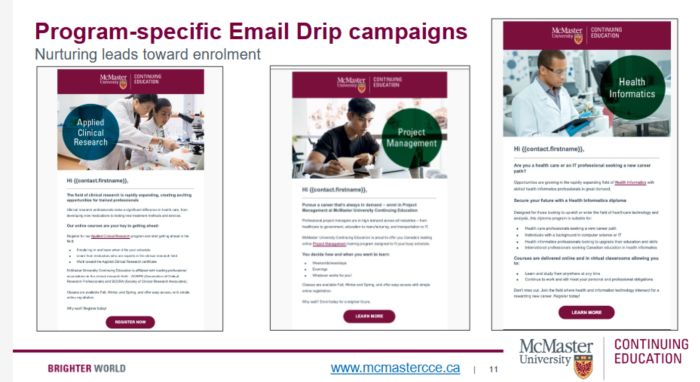
    Example: McMaster University’s Continuing Education division’s persona-based email drip campaigns for lead nurturing show how each email is tailored to a persona (e.g. career changers in Project Management or Applied Clinical Research) with personalized greetings (“Hi {{FirstName}}”) and program-specific content.
    HEM Image 2HEM Image 2

    Source: McMaster University

    Make It Personal: Segmentation and Customization

    Different students have different interests and needs, so your university email campaign should too. 

    Segmentation

    By dividing your email list into meaningful groups (or “segments”), you can send each group content that truly matters to them. The result? Dramatically better performance.

    For instance, marketers have seen a staggering 760% increase in email revenue from segmented campaigns. Campaign Monitor also found that segmented education campaigns can achieve open rates around 18%, far above the industry average. Clearly, segmentation isn’t just a nice-to-have; it’s a game-changer.

    How to segment effectively? Think about the factors that distinguish your prospective students. Common segmentation angles in higher ed include:

    • Stage in enrollment journey: Are they brand-new inquiries, applicants, or admitted students? (More on this later.)
    • Academic interests: What program or major are they interested in? Emails tailored by program (e.g. Engineering vs. Liberal Arts prospects) will highlight different selling points.
    • Demographics/Location: Is the student international or domestic? High school senior or adult learner? Local or out-of-state? Each group may respond to different messaging.
    • Behavioural engagement: How have they interacted with your school so far? (Attended a webinar, downloaded a brochure, etc.) Those actions can trigger targeted follow-ups.

    Segmenting your list by criteria like these ensures each student gets content that speaks to their specific situation. As a result, your emails feel more relevant, and relevance drives results.

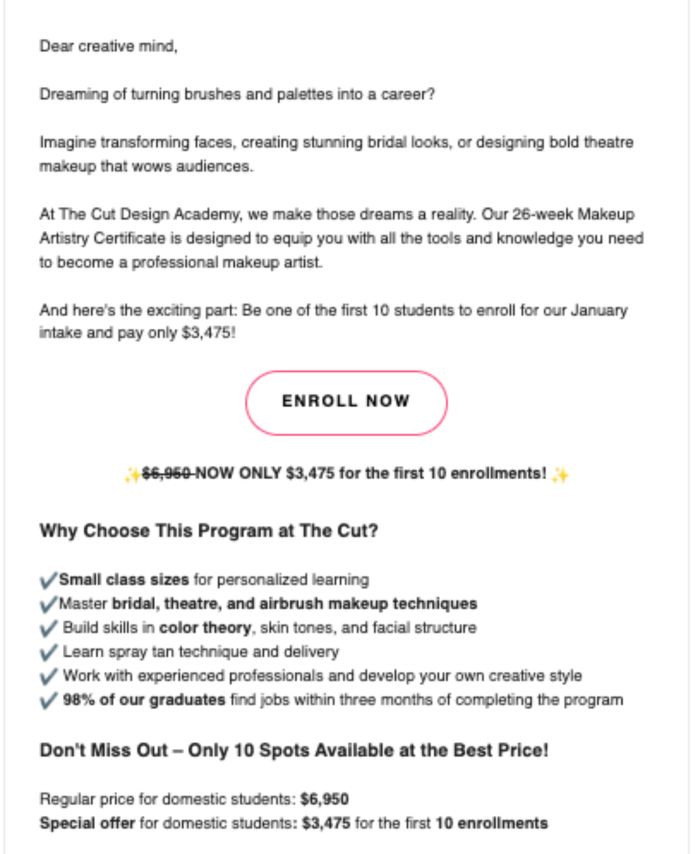
    Example: The Cut Design Academy launched a promotional recruitment email targeting prospective students for its January 2025 Makeup Artistry Certificate intake. The campaign focused on driving immediate applications from students close to the decision stage, offering a limited-time tuition discount to accelerate conversions. Framed around an exclusive offer, the email used urgency, clear benefits, and student-focused messaging to stand out. The campaign leveraged personalization through tone (“Dear creative mind”) and clear calls to action, guiding prospects from interest to enrollment with stage-aligned messaging.
    HEM Image 3HEM Image 3

    Source: The Cut Design Academy

    Segmented emails consistently outperform generic blasts, leading to stronger engagement, greater relevance, and improved results across the board. Marketers find that tailoring messages to specific audience groups makes campaigns more effective and impactful. The bottom line? When you embrace the diversity of your audience and tailor your messaging accordingly, they’ll reward you with higher engagement.

    Let’s say you have a student interested in your Executive MBA. They’ve clicked on emails but haven’t registered for an event. You wouldn’t send them the same message as a high school student in Colombia interested in ESL. 

    Personalization

    Now add personalization on top. If segmentation is about who you’re writing to, personalization is about what and how you communicate to each person. Today’s prospective students expect a personalized touch, and they respond when they get it.

    Here’s why: Research shows that emails with personalized content have a 29% higher open rate and a 41% higher click-through rate than non-personalized emails. Simply put, personalization grabs attention. It signals to the student that “this is about you,” cutting through the clutter of impersonal mass communications.

    Personalization can be as simple as using the student’s first name in the greeting or subject line – emails with a personalized subject are 29% more likely to be opened, according to Experian. But it goes much deeper than that. Effective enrollment emails often incorporate personal details like the student’s intended major, specific interests, or past interactions.

    Let’s Look At Two Examples:

    • If a prospect has shown interest in your business program, your follow-up emails should reflect that. Highlight business-specific content such as alumni success stories, internship opportunities, and upcoming events related to the program. This reinforces relevance and keeps the student engaged with information they care about.
    • If a student clicks on a link about financial aid, your next email could focus on scholarships, bursaries, or affordability tips. This kind of targeted follow-up shows that you’re paying attention to their concerns. And students notice this effort.

    An EAB survey in 2024 found that 93% of students said receiving a personalized message from a college would encourage them to explore that school further.

    That’s an overwhelming majority who are more likely to engage simply because your email spoke directly to their interests or concerns. 71% of students expect personalized interactions from brands (including universities), and 76% get frustrated when they don’t get them. The message is clear: personalization isn’t just a nice touch; it’s expected.

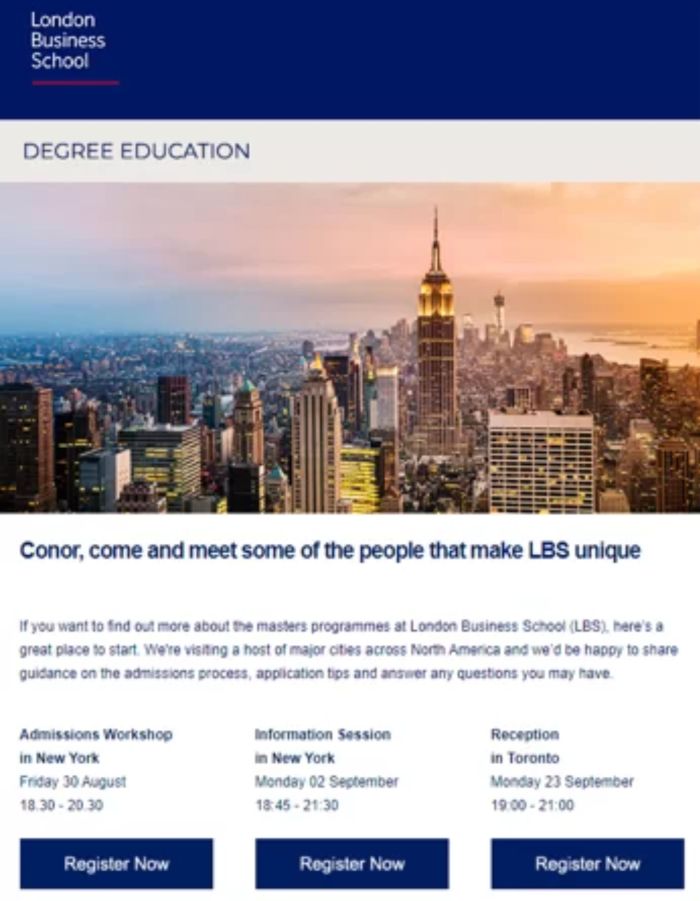
    Example: This email from London Business School (LBS), addressed personally to the recipient (“Conor, come and meet some of the people that make LBS unique”), exemplifies effective personalization (using the student’s name and regional relevance) and event-based drip sequencing, reinforcing LBS’s presence and availability as the student prepares to make a decision.
    HEM Image 4HEM Image 4

    Source: London Business School

    So, how can you infuse personalization into your campaigns? Here are a few proven tactics (think of these as the “little things” that yield big results):

    • Use dynamic fields: Most email platforms allow you to insert the recipient’s name or other attributes automatically. A subject like “John, here’s info on the Computer Science program you liked” is far more engaging than a generic “Learn about our programs.”
    • Tailor content to personas: If you’ve segmented by persona or interest, craft the email copy and images to match each segment. A student athlete might get an email highlighting campus sports facilities and team success, whereas a fine arts prospect might see content about your art studios or student exhibits.
    • Leverage behavioural data: Personalization can also be triggered by what a student does. For instance, “We noticed you started an application – here are the next steps,” or “Thanks for downloading our Nursing Program guide – would you like to attend a nursing info session?” These timely, relevant messages show that you’re paying attention and ready to help.

    In a nutshell, how do you develop a marketing strategy for a university? Start by defining clear goals (e.g., increase applications or improve yield), identify target audiences using personas, choose the right channels (email, social, SEO), create tailored content for each stage of the student journey, and measure results regularly to optimize performance.

    Align With the Student Journey

    A student’s path from curiosity to commitment isn’t linear. Your email marketing strategy shouldn’t be either.

    Awareness

    This is your digital handshake. Send welcome emails that reflect your institution’s voice: professional, warm, and resourceful. Keep it brief and include CTAs to helpful blog posts, reports, or program videos. The goal here? Spark interest and build trust.

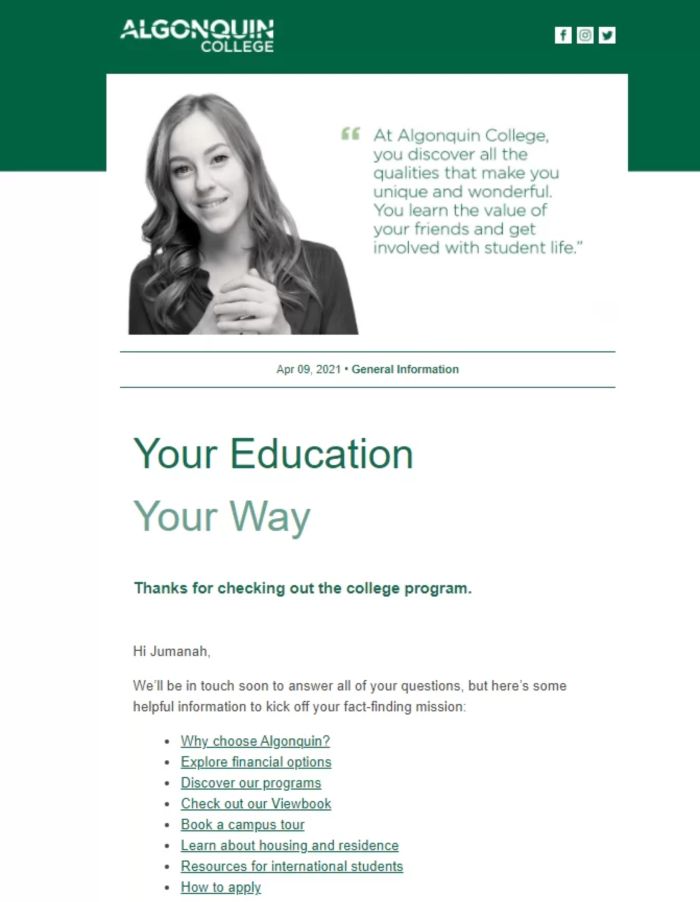
    Example: Algonquin College initiated a welcome email campaign targeting newly inquiring students, aimed at supporting the awareness stage of the enrollment funnel. This automated email is sent immediately after a student checks out a program or completes an inquiry form, making it a textbook example of an early-stage drip campaign designed to keep the college top-of-mind and help prospects begin their research journey.
    HEM Image 5HEM Image 5

    Source:  Algonquin College

    Consideration

    Now that they’re paying attention, it’s time to educate. Share program benefits, tuition details, and testimonials. Even better, offer personalized interaction, like a Q&A session with advisors. Emails at this stage become your student’s research partner.

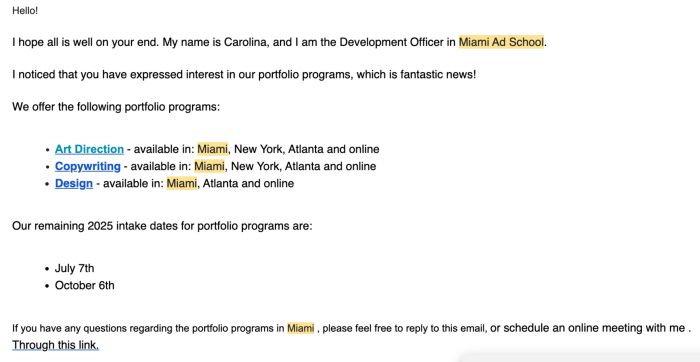
    Example: Miami Ad School implemented a direct and informative follow-up email targeting prospective students who had expressed prior interest in one of its portfolio programs. The message used light personalization and concise formatting to clearly lay out the next steps for engagement. This email served as an early-stage consideration touchpoint designed to convert inquiry-stage leads into applicants.
    HEM Image 6HEM Image 6

    Source: Miami Ad School

    Decision

    Here’s where the magic happens, or it doesn’t. Use emails to overcome last-minute doubts, emphasize application deadlines, and make it ridiculously easy to act. Offer a call with an advisor. Include direct application links. This is where you close the loop.

    Enrollment

    Don’t stop now. Once students say “yes,” keep the momentum going. Celebrate with a warm welcome, then guide them through the next steps: registration links, orientation videos, and community invites. Make them feel like part of something exciting.

    The Anatomy of a Winning Email

    So what does a high-converting email actually look like?

    1. Craft Irresistible Subject Lines

    • Include first names or program names
    • Add urgency (“Last Chance!”) or exclusivity (“Just for You”)
    • Steer clear of spammy ALL CAPS and excessive punctuation

    Example:
    [Alex], Your Journey to an International Career Starts Here

    2. Write Compelling CTAs

    • Be specific and action-driven:
      • “Apply Now”
      • “Book a Call”
      • “Join the Webinar”
    • Explore more about email CTA best practices

    3. Optimize for Timing and Mobile

    • Test send times (mid-week often work well)
    • Mobile-first design is a must; 55% of emails are opened on phones
    • Responsive layouts = higher clicks and happier readers

    Stay Out of Spam and In Their Good Books

    Even the best content won’t help if it lands in the junk folder. Avoid spam triggers (like “FREE!!!”). Keep your database clean, and follow laws like CAN-SPAM (US), CASL (Canada), and PECR (UK). And yes, always include that unsubscribe link; it builds trust.

    Fun fact: The average inbox placement rate is 83%, so there’s room to optimize.

    Build Relationships With Drip Campaigns

    Think of a drip campaign as a well-timed sequence of nudges. It starts with a thank-you or auto-response after form submission.

    Then, over days or weeks, you send emails that deepen interest, event invites, alumni success stories, or a reminder to complete an application. Every email has a purpose. Every message moves the needle.

    Track What Really Matters

    If you’re only looking at open rates, you’re missing the bigger picture.

    Here’s a smarter approach:

    • Use open rates to gauge subject line effectiveness (aim for 46–50%)
    • Analyze click-through rates to measure engagement, event invites can hit 15–25%
    • Most importantly, track conversion rates: Are students applying, booking meetings, or showing up?

    The data doesn’t lie. HEM’s insights show that most student bookings happen only after a lead is nurtured, sometimes weeks after their first touchpoint.

    Final Thoughts: Your Enrollment Power Tool

    We’ve covered a lot of ground, and you might be thinking, “How do I implement all of this?” The key is to view these strategies not as isolated tactics, but as complementary pieces of a holistic email marketing plan.

    Segmentation gives you the framework (who gets what), personalization adds the special sauce (making content relevant to each individual), drip campaigns provide the delivery engine (timing and automation), mobile optimization ensures your efforts actually get seen on students’ preferred devices, and enrollment-stage alignment keeps your messaging strategy coherent from start to finish.

    Each strategy is powerful on its own, but together they truly transform your email marketing from a simple broadcast tool into an engaging, research-backed recruitment machine.

    You’ll be speaking to the right student with the right message at the right time – and that’s a recipe for higher open rates, click-throughs, and conversion to applications and enrollments. Just ask the institutions we discussed: they’ve seen application surges, increased yield, and record enrollments by putting these principles into practice.

    To recap, how can colleges increase enrollment? Colleges can boost enrollment by improving lead nurturing (e.g., drip email campaigns), enhancing website conversion, offering personalized communication, streamlining the application process, and using data to better target and engage prospective students.

    Done right, email isn’t just part of your marketing mix. It’s the glue that holds your enrollment strategy together.

    Our targeted email marketing services can help you attract and enroll more students.

    Discover how we can enhance your recruitment strategy today!

    Frequently Asked Questions

    Question: What is educational marketing?

    Answer: Educational marketing refers to the strategies and tactics used by schools, colleges, and universities to attract, engage, and enroll students. It includes campaigns across digital channels like email, social media, SEO, and paid ads to promote programs and build institutional brand awareness.

    Question: How do you develop a marketing strategy for a university?

    Answer: Start by defining clear goals (e.g., increase applications or improve yield), identify target audiences using personas, choose the right channels (email, social, SEO), create tailored content for each stage of the student journey, and measure results regularly to optimize performance.

    Question: How can colleges increase enrollment?

    Answer: Colleges can boost enrollment by improving lead nurturing (e.g., drip email campaigns), enhancing website conversion, offering personalized communication, streamlining the application process, and using data to better target and engage prospective students.
    Source link

  • The Supreme Court made your rights harder to defend — Congress must now step up

    The Supreme Court made your rights harder to defend — Congress must now step up

    This essay was originally published in The Hill on May 8, 2025.


    From free speech rights and desegregation to gun rights and religious freedoms, civil rights litigation has long been a cornerstone of personal liberty in America. But in February, the Supreme Court issued an opinion that will make it harder for us as Americans to vindicate our constitutional rights when the government violates them.

    In Lackey v. Stinnie, a group of Virginia drivers challenged a state law that punished people for failing to pay court fees by automatically suspending their driver’s licenses. The plaintiffs secured a preliminary injunction — a court order issued early in a case to prevent potential harm while it is litigated in full — allowing them to keep their licenses. Virginia did not appeal that ruling, and before the case went to trial, the legislature changed the law and reinstated any licenses that had been suspended under it.

    In cases alleging violations of constitutional rights, a federal statute preempts the general rule that litigants pay their own fees and costs by allowing “prevailing” parties to recover attorney’s fees from the government actor who violated their rights. But in this case, the federal district court held the drivers had not in fact “prevailed” given that the case did not progress to a final conclusion, making them ineligible to recover attorney’s fees. This flew in the face of what courts and litigators had understood the law to be for decades.

    The case eventually made its way to the Supreme Court to determine what “prevailing” meant in federal law and whether the drivers were entitled to reimbursement. The court, to the disappointment of advocates for civil rights and liberties, held that plaintiffs who do not obtain a final judgment on the merits do not qualify as “prevailing” even if, as with the Virginia drivers, they prevail in getting the government to change the law. 

    Unlike corporate litigation, civil rights cases rarely involve large financial recoveries. In any event, plaintiffs often seek changes to laws or policies rather than monetary gain. Yet these are vital cases, not just for the individuals involved but for the communities they represent, even if they rarely provide enough financial incentive to make private representation feasible — unless attorneys receive compensation after winning the case.

    Congress intended to encourage civil rights litigation by tying fee awards to success, whether through final judgments or preliminary relief. The House Judiciary Committee report on the legislation enacting the attorney’s fees provision noted, “a defendant might voluntarily cease the unlawful practice. A court should still award fees even though it might conclude … that no formal relief, such as an injunction, is needed.” Despite this clear evidence of congressional intent, the court held otherwise.

    Importantly, as the court pointed out, Congress has the power to clarify in the statute that attorney’s fees can be awarded before a final judgement on the merits. Congress must do so. 

    The breadth of amicus briefs submitted in this case — from the ACLU to the Alliance Defending Freedom to the Firearms Policy Coalition — demonstrates that across the ideological spectrum, organizations recognize the critical role awarding attorney’s fees plays in civil rights litigation. 

    As FIRE noted in its amicus brief to the Supreme Court, “Withholding attorney’s fees from victims of these First Amendment violations would be devastating — not just for them individually, but for access to justice more broadly.”

    Congress must enact a simple, clarifying change that will have broad support and ensure all Americans can vindicate their constitutional rights. Justice isn’t free, but we can ensure it remains accessible to all.

    Source link

  • Corruption, Fraud and Scandal at Los Angeles Community College District (LACCD Whistleblower)

    Corruption, Fraud and Scandal at Los Angeles Community College District (LACCD Whistleblower)

    During the weekend of May 16-19, 2025, the San Francisco Bay Area Independent Media Center – IndyBay which operates as open platform news source against injustice, scrubbed two years of news articles ranging from May 2023 – May 2025.

    The focus of these articles was corruption, fraud and scandal in the Los Angeles Community College District, primarily at Los Angeles Valley College’s Media Arts Department.

    A few of these articles summarized.

    Erika Endrijonas faces new questions in LACCD fraud | May 2, 2023 |

    Pasadena City College President-Superintendent Erika Endrijonas being fired from the institution and trying to get a job at Santa Barbara City College, Mt. SAC, and Los Angeles City College. Endrijonas had been subjected to a vote of no confidence by the Pasadena Academic Senate, Pasadena Full-Time Faculty Union, protests by Part-Time Faculty, and finally the vote to reduce her contract by the newly elected board of trustees.

    The article dived into Endrijonas’s tenure at her previous institution – Los Angeles Valley College. Endrijonas was announced in her new role at PCC in December 2018, the same week that a jury in Van Nuys awarded a former LAVC employee $2.9 million jury award for illegal retaliation and abuse. A few months earlier, the Los Angeles Times published a major story about the Valley Academic and Cultural Center – a project meant to be Endrijonas’s crowning achievement – being an alleged massive racketeering scheme.

    Further it documented the Media Arts Department the VACC would house had a lengthy history of lawsuits and accreditation complaints against the faculty for not providing the education and training advertised – negating the need for the new building. The building’s approval vote happened in August 2016, the lawsuit happened in 2009, and the Accreditation Complaints happened in June 2016.

    Dozen LAVC Cinema Students Narratives challenge Erika Endrijonas’s LACCD Success Story | May 5, 2023 |

    This article covered a release of an email thread from a dozen students in 2016 that was ultimately sent to the Accreditation Commission for Junior and Community Colleges in 2016, substantiating that there was widespread fraud in the department. Classes were not scheduled by Department Chair Eric Swelstad, training was not provided, labs were not held, etc . . .

    Van Nuys/Los Angeles College Screenwriting Professor Faked Writer’s Guild Membership | May 17, 2023 |

    Revealed that LAVC Media Arts Department Chair Eric Swelstad faked his membership in the Writer’s Guild of America – West, and then used it in multiple professional bios.

    Los Angeles Valley College perpetuated wage theft against students on Julie Su’s watch | May 19, 2023 |

    Documented how Grant Director Dan Watanabe engaged in wage theft against students for two years from 2013 – 2016.

    Two Los Angeles Film Professors Bilked Taxpayers Over $3.5 Million Dollars | May 21, 2023 |

    Described how LAVC Media Arts Department Founder Joseph Dacursso’s retirement first as Department Chair, then as a full-time faculty in 2012, left Department Chair Eric Swelstad and Arantxa Rodriguez to engage in petty infighting and squabbling that spilled over into scheduling decisions. In short, two faculty members collected six-figure-salaries while putting students in the middle of department in-fighting.

    LAVC Omsbudsman Stalked Whistleblowers | August 8, 2023 |

    Described how LAVC’s Dean of Students, Annie G. Reed (Goldman) retaliated and stalked students that went to Accreditation, going as far as running a smear campaign that one of them was a potential school shooter. Worse, she began stalking him after he left school – including on social media.

    [Image: Annie G. Reed Goldman, Dean of Labor and HR at LACCD]

    Further articles questioned where Academic Degrees were given out to students who had not completed Academic classes and criteria, the role of Jo Ann Rivas turned YouTube Personality ‘AuditLA’ who was on the Los Angeles Valley College Citizen’s Building Oversight Committee, whether a number of students with falsified resumes received payments from a Grant as ‘Professional Experts’ etc . . .

    The scrubbing of these articles coincided with the formal appointment of Alberto J. Roman as the new Chancellor of the Los Angeles Community College District, following the retirement of disgraced administrator Francisco Rodriguez.

    It also came with the publication of two final articles. One about Annie G. Reed’s being named as a Defendant in a lawsuit by former faculty at Los Angeles City College, who came to her about an administrator engaging in illegal behavior – including planting drugs on employees to get them fired.

    The second article, probed Los Angeles Valley College Department Chair, Eric Swelstad’s professional bio again and provided evidence that he repeatedly lied and engaged in deceptive advertising and practices for two decades. It provided students who held loans with information about student borrower defenses.

    The censorship also came months after Jo Ann Rivas aka AuditLA, herself probed by the articles, launched a barrage of attacks for about a week in January about a former student who had grievance’s against the school. Rivas had previously engaged in a similar barrage in July 2020.

    This was not the first time that an attempt was made to censor this news stream.

    In 2020, an attempt was made to hack the community news feed account on Twitter/X.com @LACCDW. Then a week before the LACCD Board of Trustees election in November 2020, Twitter suspended the community newsfeed altogether. It was only restored two years later after Twitter’s sale and the re-evaluation of previous suspended accounts.

    In a final update – The Valley Academic and Cultural Center, despite having a 2018 completion date, remains unfinished. According to minutes of the LAVC Work Environment Committee Minutes from 2025-05-08;

    “The Valley Academic and Cultural Center (VACC) is as of Friday, May 8th, about 80% complete. They are still patching the roof. There are still some critical items like stage protection net.”

    Source link

  • Degrees and Skills: A More Promising Approach

    Degrees and Skills: A More Promising Approach

    Earlier this week, we announced a new partnership between the University of Michigan and Google to provide free access to Google Career Certificates and Google’s AI training courses for more than 66,000 students across U-M’s Ann Arbor, Dearborn and Flint campuses. These high-demand, job-ready programs are now available through the university’s platform for online and hybrid learning, Michigan Online. The courses and certificates help students to develop in-demand skills in areas like cybersecurity, data analytics, digital marketing, UX design, project management and foundational AI.

    We’re both proud graduates of the University of Michigan. Our undergraduate experiences in Ann Arbor were transformational, shaping how we think, who we are and the lives we’ve led. There are countless ways to take advantage of an extraordinary place like U-M. But with the benefit of hindsight, one lesson stands out: Learning how to learn may be the most valuable thing you can take with you.

    That has always been true. But it’s becoming more essential in a world where technological change is accelerating and the life span of a “job-ready” skill is shrinking.

    A False Choice We Can’t Afford to Make

    Today’s learners are navigating a noisy debate: Is a degree still worth it? Should they invest in college—or seek out a set of marketable skills through short-term training?

    Too often, this is framed as an either-or choice. But our new partnership underscores the power of both-and.

    A college degree is a powerful foundation. And when paired with flexible, high-impact programs like Google Career Certificates, AI Essentials and Prompting Essentials, students are positioned to thrive in a dynamic global workforce. This is not about diluting the value of higher education. It’s about enhancing it—by equipping students with the durable intellectual tools of a university education and the technical fluency to succeed in real-world roles.

    The stakes are high. Nearly 70 percent of recent college graduates report needing more training on emerging technologies, while a majority of employers expect job candidates to have foundational knowledge of generative AI. As noted in a New York Times opinion piece by Aneesh Raman, chief economic opportunity officer at LinkedIn, the rise of AI and automation is reshaping the skills required for many jobs, making it imperative for educational institutions to adapt their curricula accordingly. This underscores the importance of integrating practical, technology-focused training into traditional degree programs to ensure graduates are prepared for the modern workforce. The world of work is changing rapidly. Higher education can and must evolve with it.

    Rethinking What It Means to Prepare Students for the Future

    This partnership is part of a larger effort at the University of Michigan to reimagine what it means to support lifelong learning and life-changing education. Through Michigan Online, U-M students already have access to more than 280 open online courses and series created by faculty in partnership with the Center for Academic Innovation, as well as thousands of additional offerings from universities around the world. These new certificates and AI courses deepen that commitment, creating new on-ramps to opportunity for every student, regardless of background or campus.

    Through Google’s flexible online programs, we’ve seen how high-quality, employer-validated training can make a meaningful difference. More than one million learners globally have completed Google Career Certificates, and over 70 percent report a positive career outcome—such as a new job, raise or promotion—within six months of completion. Google’s employer consortium, including more than 150 companies like AT&T, Deloitte, Ford, Lowe’s, Rocket Companies, Siemens, Southwest, T-Mobile, Verizon, Wells Fargo and Google itself, actively recruits from this pool of talent. Google partners with over 800 educational institutions in all 50 states, including universities, community colleges and high schools, to help people begin promising careers in the Google Career Certificate fields.This new partnership extends these opportunities to U-M students to further support career readiness.

    By offering accessible, skill-based programs like the Google Career Certificates, we aim to provide additional scaffolding for student success and career readiness, alleviating some of the pressures associated with traditional academic routes and recognizing diverse forms of achievement.

    An Invitation to Higher Ed and Higher Ed Ecosystem Leaders

    We believe this partnership is a model for how industry and education can come together to create scalable, inclusive and future-forward solutions.

    But it’s just one step.

    As we reflect on this moment, we invite fellow leaders in higher education, industry and government to ask,

    • How can your institution better integrate career-relevant skills into the student journey without sacrificing the broader mission of a liberal arts education?
    • What partnerships or platforms might allow your students to benefit from both a degree and credentials with market value?
    • In an era defined by AI, how will your institution ensure students are not just informed users of new tools, but thoughtful, responsible and empowered innovators?
    • How can your institution or organization expand equitable access to high-value learning opportunities that lead to social and economic mobility?
    • What role should public-private partnerships play in shaping the future of education, work and innovation, and how can we design them for long-term impact?

    The path forward isn’t a binary choice. It’s a commitment to both excellence and access, both degrees and skills, both tradition and transformation.

    We’re honored to take this step together. And we look forward to learning alongside our students and our peers as we navigate what’s next. In a rapidly shifting higher education environment, we see reason for optimism: opportunities to reimagine student success, forge lasting strategic partnerships and strengthen the bridge between higher education and the future of work.

    James DeVaney is special adviser to the president, associate vice provost for academic innovation and the founding executive director of the Center for Academic Innovation at the University of Michigan.

    Lisa Gevelber is the founder of Grow with Google.

    Source link

  • New Book Helps Academics Become Public Writers

    New Book Helps Academics Become Public Writers

    I’d be hard-pressed to find any person in higher ed who has had a larger influence on my own thinking than James Lang. Many folks will know Jim from his books like Cheating Lessons, Small Teaching and Distracted. He’s consistently ahead of the curve when it comes to identifying a problem in teaching and learning spaces—academic dishonesty, class disengagement, student attention problems—and proposing remedies that instructors can explore and make use of for themselves.

    His new book, Write Like You Teach: Taking Your Classroom Skills to a Bigger Audience, part of the University of Chicago Press series of guides to writing, editing and publishing, is the best book I’ve ever seen for showing academics how to translate their current skills and practices to another audience and purpose. I’m excited by this book because we need as many academics as possible putting their voices into the world, not just because they have so many interesting and worthwhile things to say as individuals, but because it also helps remind everyone about the value of institutions where this kind of work happens.

    I had a great time talking to Jim over email. This Q&A even breaks some news on Jim’s next book, too.

    Jim Lang is a professor of the practice at the Kaneb Center for Teaching Excellence at the University of Notre Dame, and an emeritus professor of English at Assumption University. He’s the author of multiple books, including Small Teaching and Distracted, and a longtime columnist for The Chronicle of Higher Education. You can follow him on Substack at A General Education or connect with him on LinkedIn.  

    John Warner: One of my favorite initial questions for people who write is if they enjoy writing. So that’s my question: Do you enjoy writing?

    James Lang: “Enjoyment” doesn’t seem like the right word for my feelings about writing. Writing has always been the activity that drives and gives meaning to my life. It helps me make sense of the world; if I have deep questions about the purpose of my life, or questions about anything important, I seek answers through writing, both within my published work and in my various notebooks. I have always been a very curious person who gets excited about learning new things, so writing has always been a way to satisfy those curiosities and push me into new places in my life.

    If I focus specifically on the emotion of enjoyment … I hate to admit it, but I don’t seem to enjoy the actual writing process quite as much as I used to. I think I had a more unreserved embrace of writing when I was younger, when I felt like I had a lot to say and was confident that I had the ability to say it. I think both of those feelings have diminished, which I attribute in equal parts to the stroke I had a few years ago and to my age. I had to learn to speak and write again after my stroke, and while I have regained all of the words and writing skills I had before, I have to work a little harder than I used to [to] call them up and apply them. But even beyond the stroke, I guess I feel less of a desire to announce my ideas confidently to the world than I once felt. I have a great family, lots of friends and ongoing interests in many areas of my life. As my appreciation for those things has increased, the available real estate in the enjoyment part of my brain has shrunk slightly.

    But the key word in that sentence is “slightly.” I do still take much pleasure from finding the perfect word, crafting a great sentence or launching a new essay or book. Writing still fills my life with meaning, and I could never envision my life without writing, or at least the desire to write, being part of who I am.

    Q: What you describe sounds a bit like a winding down or maybe a shift in focus? I often say about myself that I’m never going to retire because I can’t imagine not reading and writing, which is both my pleasure and my work. But I do sometimes wonder if there’s a space to do less of it, if that makes sense. But as you note, it seems impossible to shut off that curiosity that drives those activities.

    Where does that curiosity come from for you? You’ve had a varied career and it seems like every so often you shifted gears. Was that necessity or design or something else?

    A: It comes from both a negative and a positive place. The negative place is that I do get bored of routines in any form, and when I feel like my life has fallen into a routine place, I start getting this itch to break it. I received tenure in the usual time frame, and it was only a couple of years after that I was seeking a new challenge, so I applied to direct our honors program. I enjoyed that work tremendously, but then once again sought a change and founded a new teaching center on campus. Right after the pandemic, based on the success of Small Teaching and Distracted, I decided to give myself a new challenge: give up tenure and try to make it with a mix of writing, speaking and adjunct teaching. That plan was upended by my long medical ordeal, but even after I was able to return to that life, I realized that I missed deeply having a home on a campus, which led me to Notre Dame. So that has definitely been a pattern in my career and in my life.

    For the positive explanation for this restlessness, I would point to something my wife (an elementary school teacher) told me about the kids who come into her classrooms each year. She says that while we might be all born curious, by the time children get into school, they are already separating in terms of how much curiosity they bring to school. The differentiating factor she sees is how much exposure kids have to different kinds of life experiences. The kids who sit in their bedroom on their parents’ tablets all day or play video games in their rooms just don’t see as much of the world, and they aren’t being prompted to ask questions, wonder and explore. The ones who come in curious are the ones whose parents have deliberately tried to expose them to new things in some form—trips, walks outside, reading aloud, giving them books, etc.

    When I heard that, I realized that I had been raised as one of those latter kids. My mother was also an elementary school teacher, but her best years were in preschool. She had a special love, and special gift, for very young children. And while I have only a few memories of my preschool years, I know from seeing how she interacted with my children that I must have been raised to become a curious person.

    Q: I had a mini epiphany while reading the opening section of Write Like You Teach, which is that good teachers and good writers think of the needs of their audience (students/readers) first. This is something I think I’ve always done as a teacher, perhaps because I was a writer before I was a teacher, but you make it pretty explicit and then give it a little specific flesh. When did this connection first come to you?

    A: I actually can’t quite remember where that specific connection came from. I do know that this book really came out of my desire to write some more about attention, the subject of my previous book. I have written books about several major issues in teaching and learning, and some of them I finished and felt like I was done with that topic. That wasn’t true for attention. The more you read and learn about attention, the more you realize how it has a part in almost everything that matters in our lives. Work, play, relationships, spirituality, learning—all of them demand our attention. They often go well or poorly depending upon the quality of our attention. And so I still find attention fascinating, and I keep reading and thinking and writing about it. I also just really enjoyed writing the book Distracted. So I think maybe I was trying to determine what else I could write about attention which would relate to another area where I have some interest and expertise.

    Reading was the initial bridge to further thinking about attention. Anyone who reads a lot knows that some books capture our attention more than others. I think the teaching-writing connection that produced this book came from realizing both in classrooms and books, you have to be aware of the limits of a learner’s attention. Both as teachers and writers, we can either just expect people to pay attention or we can try to help them. I had made the case for the latter approach in Distracted and realized I could make the same case to writers: If you want readers to sustain their attention over the course of many pages, don’t just bang away at them with paragraph after paragraph of argument and idea. They need breaks, they need stories, they need space to pause and think—just as students do in the classroom. Seeing how attention informs both teaching and writing led to the basic idea of the book: The things we do in the classroom to help students learn can also be useful for our readers.

    Q: In a note at Substack, Arvind Narayanan (coauthor of AI Snake Oil) offered a “hypothesis on the accelerating decline of reading.” It’s got a bunch of bullets, so I’ll do my best to paraphrase: Essentially, people mostly read for pleasure or to obtain information. These functions have been replaced by other things. Video is more entertaining than reading. We can use large language models to summarize long texts and deliver information to us. He theorizes that most people will be happy with the trade-off of increased speed/efficiency, the same way we’ve gravitated toward “shallow web search over deeper reading.” He’s worried about this but also believes that merely “moralizing” about this is not going to be helpful. (I tend to agree.) I’ve argued for years that getting students engaged with writing is a great way to get them reading, because reading is the necessary fodder for writing. Writing is also a tremendous way to cultivate our ability to pay attention. I’m wondering if you’re worried in the same way as Narayanan or if you have any additional ideas of what we can do about this.

    A: First, thanks for sharing that note, which will be helpful to me as I am working on my next project—which I am happy to announce here. My next book will be The End of Reading?, which will be published by W. W. Norton, a publisher whose books I have been reading since high school and assigning in my courses for my entire teaching career. I’m so excited to dig into this project, but I am going to beg off on an answer here because I am just in the beginning of my thinking and writing and need more time to formulate my ideas. Put another way: Ask me that question again in two years!

    Q: I have sort of the opposite problem as the folks this book is addressed to, in that I find it very natural to write to regular people—because that’s where I started—while writing for more formal or academic audiences is something I can struggle with. What is it about the experience of the academic that makes the transition you’re writing about difficult?

    A: The problem here is that experts often lose track of what novices don’t know in their fields. The more we know in a discipline, the further away we get from our memories of what it was like to know very little about biology or literature or politics. When academics write to each other, they can assume their readers know certain things: basic facts, theories, common examples or cases, histories, major players in the field. Let’s say I’m a scholar of Victorian literature and want to write something about a work of Victorian literature. If I am writing to other scholars in that field, I can be confident that my readers know things I know: the expansion of the British Empire during that time period, the impact of Darwin and evolutionary theory on many writers in that era, the political turbulence and social unrest accompanying the Industrial Revolution.

    If I am writing to a more public audience, I can’t assume my reader knows any of that stuff. In a classroom, I can always stop and just ask students, “Have you heard of this before?” If they haven’t, I can give a quick introduction. But as a writer with deep expertise in a subject, I have no idea what a more public audience knows or doesn’t know. Faced with that problem, I think a lot of academics just say, “Never mind, I’ll just keep writing to my people.” And that writing is important and can be great! I love a good scholarly book, and I still read them regularly. That kind of writing also helps people get and keep academic jobs, so I am not on some crusade to encourage everyone to write for the public. But I think the major sticking point for people who do want to expand their audiences is thinking more deeply about their audiences: what they know or don’t know, why they are reading your work, and what you want them to take away from the experience.

    Q: Something I’ve often said about both writing and teaching is that they are “extended exercises in failure,” where failure means not missing the target entirely, but falling short of one’s initial expectations. I find this reality interesting, fascinating, really, because with both activities, you usually get a chance to try again. Does this make sense to you, or do you have any different frames for how you view these two activities?

    A: No absolutely, and in fact that framework applies to all of the pursuits that give me satisfaction, including the other major intellectual pursuit of my life: learning languages. I did not start learning other languages until my first year of high school, where I started with Latin. Immediately I was fascinated, and so in my junior year I added ancient Greek into my curriculum. When I got to college, I took classes in both those languages, and then also took French. Over the next 30 years I have gone back and forth with those original three languages and also tried to learn Spanish and Italian and German.

    I start every new language with this expectation that this time I’m going to really dig in and master this thing and become just totally fluent. The truth is that I have some basic knowledge in all six of those languages but know none of them particularly well. But I just love the fact that I can go back to any of them, at any time, and start trying again. I’m 55, and my brain has a different shape than it used to (because of the stroke), so I have to be realistic and acknowledge that it’s unlikely that I will ever become a fluent speaker in any other language than English. But gosh, I just love to keep trying.

    As you say, teaching and writing are the same. You start off with such hope and expectation and excitement: This will be the best class I will ever teach! This essay or book is the one that will change people’s lives! But it never quite works out that way. Even when you teach a great course, not every class period will be perfect. Not every student will have a great experience. When I look at my own books, I am proud of them but can see places where I cringe and wish I had done better. But I don’t feel defeated by those feelings: They make me want to keep trying.

    Q: The book is filled with practical approaches to writing for broader audiences, but I wouldn’t quite call it a book of “advice.” The word that comes to mind is “guidance.” Does that distinction make sense to you?

    A: This distinction matters a lot to me, actually. I think because of the success of Small Teaching, which had a lot of concrete pieces of advice, people can view me as a “teaching tips” guy. I do love learning and thinking about specific practices in the classroom, so I don’t wholly disavow that association. Presenting theories and big ideas about teaching only gets people so far; they need to envision what those theories look like when they are standing in the classroom on Tuesday of week seven with 20 blank faces in front of them. Describing examples of specific practices helps them with that imaginative work.

    But I always want people to understand that I am not advising them to do anything in particular: I am showing examples designed to spur their own creative thinking. Write Like You Teach, for example, has a chapter about the challenge of reader attention, and I do offer some very concrete pieces of advice based on writing strategies that I have observed in great writers. Ultimately, though, I want the readers of my book to move beyond these specific examples and develop their own strategies based on the principle readers are learners, and learners need support for their attention. With that principle in mind, I want people to analyze their classroom practices and see what translates to the page.

    That leads me to the final thing I want to say: The first and final goal of this book is to help academics feel empowered and enabled to write for the public. The prospect of doing that kind of writing can be intimidating, and many of us shy away from it. But if I can convince academics of this one principle—a great teacher can become a great writer—then I hope they will be able to develop their own writing practices based on their experiences in the classroom.

    Q: And finally, the last question I ask everyone: What’s one book you recommend that you think not enough people are aware of?

    A: When people ask me to recommend a novel to them, or when people ask me to share my favorite novel, I always mention two: Zadie Smith’s White Teeth and Arundhati Roy’s The God of Small Things. I am cheating a little bit here because both of these novels were very well-known when they were published, sold many copies and won prizes. But they are both a couple of decades old now, and I believe that their themes are as relevant today as they were when they were first published. If you are a word person, choose Roy, whose prose comes as close to poetry as a novel can get; if you love a great plot, choose Smith, whose genius shines through the ebullience of her narrative construction. If I were forced to choose between the two, I would choose … I can’t. I just can’t.

    Source link

  • Something’s Lost, but Something’s Gained

    Something’s Lost, but Something’s Gained

    In reflecting on my feelings about the advent of artificial intelligence in our lives, I must report they are mixed. I have the strong sense of the inevitability that this technology will meet and exceed its hype to alter the course of humanity, generally for the better. However, at the same time there is a measure of trepidation in my awe of the potential power and performance of AI.

    I am receiving more frequent emails from colleagues reporting renewed intransigence among faculty regarding the push to adapt to AI use by students, to integrate the technology into teaching and to help prepare learners for the AI-enhanced workplace. I see parallels to the 1990s and early 2000s, when faculty also resisted the advent of online and blended learning. That resistance gradually subsided until the pandemic, when remote learning, albeit a less refined use of the technology, came to the rescue of universities.

    In both instances, the resistance seems to be prompted by a general lack of understanding and comfort with the technology. This creates an elevated level of anxiety. It also requires a change in pedagogy to adapt to expanded capabilities in the hands of students. This involves reconceiving and rewriting lesson plans and, in some cases, learning outcomes for multiple classes. This can be time-consuming. Yet, this is not the first time that emerging technology has impacted teaching modes and methods.

    I am fortunate to remember, as a faculty member, the advent of the personal computer in the late 1970s, graphing calculators in the mid-1980s, the rise of the World Wide Web in the early 1990s, Google Search in 1998 and, in 2001, the launch of Wikipedia. Each one of these technologies demanded changes in the ways we presented and assessed learning. Questions of student integrity were raised in each of these cases. We also were urged to consider the students’ needs to become facile with these tools as they left to commence their careers. Imagine HR’s response to applicants who could not conduct an internet search or use a personal computer. The pressure was on to adapt to the emerging technologies while ensuring integrity.

    Each of the technologies has become incrementally more sophisticated and more capable. They have required more and more attention by faculty to maintain a quality learning environment, and to prepare students for the rapidly changing workplace environment. In the case of AI, larger leaps in sophistication are coming on a weekly or monthly basis. The stakes are high. The integrity of the instruction, the relevance of the learning and the future employment of the students hang in the balance. The pressure is on the faculty to maintain quality and security in a rapidly changing environment.

    Change in the AI field comes not on the rather pedestrian pace of new releases of the past, when we would see new versions released on annual schedules by just a handful of providers. Now, we must track 10 or 12 of the largest providers, as each of them releases new versions about every three or four months, or more often. Generative models still see improvements while agentic models offering awesome deep research and autonomous agents are flooding the market from around the world.

    In a TED talk recorded last month in Vancouver, former Google CEO and chairman Eric Schmidt explained that, if anything, artificial intelligence is wildly underhyped, as near-constant breakthroughs give rise to systems capable of doing even the most complex tasks on their own. He points to the staggering opportunities, sobering challenges and urgent risks of AI. Schmidt asserts that everyone will need to engage with this technology in order to remain relevant. Meanwhile, in an interview this month, the current Alphabet/Google CEO, Sundar Pichai, on the All In podcast, affirms the commitment of the company to developing AI. He describes the evolution from Google search through AI, while it continues on the continuum of a discovery path of quantum computing and pursuing the concept of autonomous robots.

    Just as Google is working to further develop and refine their multiple versions of AI, so too are many other major corporations and start-ups. What they come up with over the coming months and years will have a huge impact on higher education, the workplace, job market and society as a whole. The very nature of human jobs will change. Meanwhile, Elon Musk predicts smart robots will proliferate and will outnumber humans. His Optimus robots are to sell under the Tesla label, priced at $20,000 to $30,000. Of course, AI is central to the operation and functioning of such humanoid robots.

    So, what might the workplace, or more specifically the individual human work assignment within that workplace, look like? In his recent podcast, Wes Roth reviews “The Age of the Agent Orchestrator” by OpenAI’s Shyamal Hitesh Anadkat. In the article, Anadkat describes the key new role that humans may play in the AI-enhanced workplace, noting that in the future “the scarce thing is no longer ‘who knows how to do that task by hand.’ The scarce thing becomes ‘who can orchestrate resources well’—compute, capital, access to data, and human/expert judgment.” That role he describes as the “agent orchestrator.” In sum, Anadkat writes,

    “As always, the most important thing is to build something that users want. In a world where your marginal cost of expertise/knowledge goes to zero, your ability to turn cheap intelligence and expensive resources into valuable products is what will matter. i’m [sic] very excited to see the new companies, the new tools, and the new jobs that come out of this. Welcome to the Age of the Agent Orchestrator!”

    The human will orchestrate what may be a very large number of highly capable intelligent AI agents. That may not seem as creative of a job as many of us now hold, such as authors, researchers, graphic designers, Web developers and the diversity of positions in designing and enhancing instructional resources. Yet, there is creativity, and certainly impact, in marshaling the vast resources at hand in the workplace of the future. Implicitly, the job becomes one of orchestrating abundant resources in conducting a symphony of interacting virtual workers to achieve desired goals. Doing so in the very best way calls upon higher-order creative thinking, strategic planning and execution.

    All of these developments bring to mind the assertion of the pre-Socratic philosopher, Heraclitus, who is credited with saying 2,500 years ago, “The only constant is change.” We can expect much more change in the field of AI over the coming months and years. It will be far-reaching and long-lasting. It will penetrate the very essence of what it means to be a human in a technological society. We in higher education cannot ignore this change or make it stop simply because it is inconvenient or incompatible to our teaching style. The money, momentum and weight of advantages of AI make it an inevitable advance to civilization. It is not stoppable. We must change our practice to meet the needs of the students and society.

    I am left with a less-than-easy feeling to welcome artificial intelligence with all of its sweeping ramifications into our work, lives and future. Yet, at the same time, I know that we must move forward to meet that future, if not so much for ourselves, but rather for our students who will live the greater part of their lives alongside their AI companions.

    In the late 1960s, a gifted folk music composer and performer, Joni Mitchell, released an impactful song titled “Both Sides Now.” Within that song is a phrase that has stayed with me through the decades: “Well, something’s lost, but something’s gained in living every day.” I suppose it helps to sum up my feelings about this new technology that is rapidly gaining momentum and promising to change our learning systems, workplaces, lives, identities and society.

    Source link

  • UWF Taps Florida GOP Official as Interim President

    UWF Taps Florida GOP Official as Interim President

    Another former Florida lawmaker is stepping into a presidency after the University of West Florida Board of Trustees voted to hire Manny Diaz Jr. in an interim capacity Tuesday.

    Diaz, who is currently Florida’s education commissioner, served in Florida’s Senate from 2019 to 2022. The former GOP lawmaker is a close ally of the state’s Republican governor, Ron DeSantis. 

    The UWF board approved the hire despite the objections of two trustees who raised concerns about transparency and argued that the process of selecting an interim was rushed. UWF’s current president, Martha Saunders, announced her resignation earlier this month after a board member took issue with social media posts from the university dating back several years. Zach Smith, who works for the Heritage Foundation, said he was troubled by actions that included encouraging students to read a book about antiracism and promoting a drag event in 2019.

    Both board members and the public questioned Diaz’s qualifications at the meeting.

    Trustee Alonzie Scott noted that it was unusual to select an interim without considering internal options and questioned how Diaz was elevated as a sudden candidate without a prior board discussion. He also pressed board chair Rebecca Matthews on whom she spoke with before advancing Diaz as the pick, though she did not offer specifics on those conversations.

    “I don’t feel as if I have to run through that list with you today,” Matthews told Scott when he asked whom she had discussed the appointment with before adding it to the board agenda.

    Scott also questioned whether the board had violated state sunshine laws.

    “I can’t prove that any of us have violated the sunshine guidelines, but I can tell you everything that I read about all the different Florida news outlets, it appears that those decisions were made before this board even had a chance to even discuss. And to me, ma’am, that is a travesty in terms of how we operate,” Scott said, adding the process was “a disservice to the community.”

    Matthews defended the hire, noting Diaz’s past work in K-12 education and the State Legislature.

    Diaz will formally assume the interim presidency July 14. Despite tapping Diaz as interim, the board will begin a search for its next president, though some trustees argued that naming Diaz instead of an internal candidate to lead UWF would likely suppress the number of applicants.

    Of five presidents hired at Florida’s public universities this year (including interim roles), Diaz is one of four who are either former lawmakers or directly connected to the governor’s office. Santa Ono, who was hired as president of the University of Florida on the same day UWF tapped Diaz, is the outlier.

    Source link

  • Teaching Students Practical Life Skills

    Teaching Students Practical Life Skills

    Higher education is designed to prepare students for their future lives and careers by imparting technical and soft skills, but what about practical, hands-on tasks, like managing a home or vehicle?

    A 2023 survey found that young adults lack practical life skills, with two-thirds (68 percent) of millennials and Gen Z unable to change their car oil, nearly half (48 percent) unable to change a tire and 46 percent unable to tie a tie. Eighty percent of Gen Z respondents said they do not feel like they have figured out adulting.

    A workshop series at George Mason University in Virginia, titled Now What?, helps build students’ practical knowledge and well-being by giving them life advice and skills, such as how to change a tire.

    In this episode of Voices of Student Success, host Ashley Mowreader spoke with Ethan Carter, associate director of programs, well-being and assessment, and graduate student assistant Dianna Philipps, to learn more about the program offerings and how it supports student success.

    An edited version of the podcast appears below.

    Inside Higher Ed: I wonder if we can just start by talking about the inspiration for this program. Where did the idea come from?

    Ethan Carter: I came up with the idea, because as a [student activities] programmer, it is difficult to replicate things. When I thought a lot about being a college student—which was several years ago—I was like, “Man, what were the things that I wish I had known back then?” And so I kind of tried to think about something catchy, and I said, “Well, there were lots of things— I would do something, and then I’d be like, ‘So now what?’’ And so I was like, “Oh, that would be a really good little catchy phrase.”

    Also, from a programming standpoint, it is very adaptable to what we want to do. I don’t have to replicate my programs, but we can have the theme of Now What?, and seeking what students would want to know more about in their lives. Not that what I wanted to learn was bad. It was just, things change.

    Inside Higher Ed: When you address that question of Now What?, what are some of the themes you all have talked about? What has programming looked like practically?

    Dianna Philipps: One of our main ones would be the “how to change a tire” one. I feel like most people on campus have a car, [but] they don’t really think of the things that come with having a car.

    So when you see the tire-changing [workshop], you’re like, “Oh, what if I do get a flat tire? Like, maybe I should learn how to handle that if I’m on my own on the road or something.” I feel like things like that really stand out to students when they see it.

    Inside Higher Ed: Something I thought was cool is that your roles focus on well-being and recreation and this program is an interesting intersection of those two ideas. I wonder if you can talk about how this contributes to students’ well-being and thriving on campus.

    Carter: When you work on a college campus, and the big theme behind the campus is about well-being, you try and find out, where do you fit? And for us, it wasn’t just in the fitness realm. We wanted to think about something that was what we would consider our niche.

    I settled on practical well-being because it is adaptable and relatable. Recreation is usually seen as something that does provide movement, but I wanted to capitalize on that and build off of the aspect of, just, living in general can be tough. It also opens the door for us to be able to partner, because a lot of our programs within themselves are not things that we run, and it’s not our expertise, but it is a place where we can be a hub and connect individuals, which kind of ties in with the well-being aspect, like, you need to find your own well-being.

    Inside Higher Ed: Who are those partners across campus, and how do they participate in this?

    Carter: Anyone and everyone is actually who we get to partner with. The [change a] tire one is done with our facilities group and specifically the auto shop—they help us with any vehicle-based activities that we have going on.

    We’ve also connected with Student Health Services for ones that are related to health insurance, with anything about self-care. And then we did another [event] with academics for a little bit, talking about preparing for exams and test-taking and things like that.

    One of my other favorite [events] is intercollaboration within a department. So like, how to do a hike, how to change a flat tire on a bike.

    I think we had one more connection, oh, with dining. Dining teaches us how to cook, and so we’ve done a Super Bowl one where we made a special dip and some other little fun delicacies.

    Inside Higher Ed: What have you learned from students and their feedback as you’ve done the events over the past year or so? What did they enjoy about it?

    Philipps: I would say the main feedback is that it was very helpful for them. I think most of the people who have come to one event, they’re the ones who continue going to each of the events. I think it just helps them learn the things that they don’t know, because they’re like, you don’t know what you don’t know until you, I guess, go to the event. So that kind of helps them a lot.

    Inside Higher Ed: There are knowledge gaps for all students as they come on college campuses—whether that’s academic preparedness or just life skills that you might not know. If you’ve never owned a car before, you might not know how to jump your car or change a tire, or if you’ve never had a full-size kitchen before, you might not know how to cook a Super Bowl dish. So I think it’s really cool that you all give them the opportunity to identify what they don’t know, but then also just close those gaps and help them feel like they’re not left behind or unsure of what they do next.

    Carter: I would also add that they’ve enjoyed putting their hands on the tools that help them.

    We do one [workshop] on how to use hand tools, and sometimes the power drill is the [tool] that we get to play around with. Other times it’s a hammer and nail. Sometimes we play around with a tape measure. And I’ve appreciated the vulnerability of the students and admitting like, “Hey, this is what I don’t know,” and it provides an opportunity for me to talk more about like, “Hey, this is what I was feeling when I was a college student.”

    When you are thinking about all the resources that are available to you on campus, it’s important that you’re able to admit that you don’t know how to do something, and then go out and ask someone, because most of the time, most of those tools are readily available for you on campus. You just have to be pointed in the right direction, and people can’t give you what they don’t know you need. So that would be something else that I would say has been a great benefit for me in connecting with other campus partners and connecting with those students.

    Inside Higher Ed: I remember when I was a college student, I was really afraid of the makers’ studio, where the VR lab and the 3-D printing are. It just felt so intimidating to go in and actually try things out. But once you have an experience like this, where it’s a little more hands-on and assisted, you feel like you have the skills to do it.

    I bet there’s also an element of introduction to staff on campus. Maybe students have never met a facilities manager before, and now, after changing a tire with them, they can ask for help in other ways. Or if you’ve never talked to the Student Health Center, now you feel more comfortable talking about health insurance or other things like that.

    If you had to give advice or insight to another college or university that was looking to replicate your idea, what would you say you’ve learned? Or what are some best practices for people to know?

    Carter: First one is, what I actually tell the students all the time, is to be yourself within your organization. You maybe have a limited budget, and you only have certain resources available to you, so it’s important for you to not try and go and do what everybody else is doing. It’s important for you to do what you’re able to do, and then to connect with your students and allow them to be part of the construction of what your program is going to be.

    It may start out as just being something where you’re looking at budgets, and then another student comes in—because you are making this for the students. So if you don’t have the student audience that is available for what you’re providing, like, it isn’t super helpful.

    So do that, and then the adaptability aspect: Be OK with something not working. Because when you hear “no” or no one comes, that is good information; you know not to do that anymore. A lot of people get offended by that and are like, “Oh, I’m a horrible programmer” or whatnot.

    It could be that you’re doing it at the wrong time, or it’s just that students are not available for that. Why would we do something that’s related to budget and all the students that need to do the budget stuff are in class in the a.m., so maybe I should try it in the evening. Things of that nature. So be OK not always having everything get hit out of the ballpark. And then if you do find something, you try and make it better as you go.

    Inside Higher Ed: You mentioned that this is a different sort of programming and something that you all can adapt to reflect student needs. I’ve heard a lot from people who work on college campuses that post-COVID, it’s just been harder to get students to show up for things or feel like you’re being responsive to their needs. Have you felt like this has accomplished that goal in being adaptable, but also engaging students?

    Carter: I would say it depends, and it really depends on what’s going on and what the particular group you’re working with is all about. So, Dianna, if you don’t mind sharing some of your ideas to try and help us get some people coming.

    Philipps: One of the main ones would be changing locations. Especially if you’re on a bigger campus, trying to make it more central so it can target different types of people, either coming from class or coming from the dining hall or things like that.

    Just back to what Ethan had said about being creative with it, and if something doesn’t work, look at what did work, keep that and then change what didn’t work. You can learn from that. See what things people are actually going to, what they actually need help with. So, again, being adaptable to things.

    Inside Higher Ed: You mentioned earlier that students who come to one event might come to multiple—like, they really appreciate the skills that they’re building. Have you seen that that’s true of a handful of students or more?

    Carter: It makes you feel good when you see somebody that you’ve seen before; it kind of increases your self-esteem. You’re like, “Oh, I did something, right?”

    I think the bonus is that they invite their friends and they make them aware. I think that a lot of times, even as an adjunct professor, I’ve had to change my perspective of it isn’t what the student looks like, because most of the time when I’ve talked to my students, they look like they don’t care about my class. But then I mentioned that to them, and they’re like, “No, you’re one of the coolest professors that I’ve ever had.” I’m like, “I can’t tell from looking at your face.”

    So when we’re doing our programming, it may not be that the students don’t like it, they just may not be aware, which is why we’ve tried really, really hard to go to the students to make the things available—not just putting a flier in front of their face, but providing them an opportunity where they can go and do something.

    I would say we’ve gotten the greatest number of students coming to things when we went to another class with content that was in line with what we were doing; we were complimenting what an instructor was teaching. And then the students are like, “We had no idea that this was going on; what other programming do you have available?”

    So I would say that that has been super, super helpful, going to the students and just becoming more and more visible, shaking hands and getting to know people, which, again, it seems like it’s common sense, but you do have to become visible in a way that is helpful and not harmful.

    Inside Higher Ed: You mentioned working with other staff on campus; have faculty been a partner in this work as well?

    Carter: We have gotten to work with them. And like I said, when we invite ourselves to their class, it doesn’t work out so well. When we are paying attention to what it is that they’re teaching and ask them, “Hey, this is something that we’re offering. Is there, maybe, 15 or 20 minutes that we can come and complement some of the stuff that you’re teaching?” That actually ends up being a two-way thing, because usually that instructor is willing to come over to our workshops and provide some informational knowledge, and so that has been super, super helpful with that. So having a crossover is good.

    Inside Higher Ed: This series is all about helping Gen Z prepare for unknown futures and navigate their world after college. When we talk about the role of higher education, I think we talk a lot about careers, about students building life skills like critical thinking and things like that. But there’s also this idea of helping students just be people, having that practical wellness. I wonder if you can tie this all together—why this is important for colleges and universities to do, and how this is foundational to not only the students’ success, but also just being responsive to their needs?

    Carter: We have a saying in our well-being practices—our goal is to help students to live just as they breathe.

    When you think about well-being and the holistic aspect of it, it’s important that people realize that eating well can be tied into you, just coming and sitting in a facility, being around people. It can also be exercise. It can also be yoga. It can also be about you being able to get the job done, or even going through a bout of anxiety and finding out you know how to be resilient in that space, or how to ask for help.

    When it comes to our programming, we want to do what’s going to help people to be the best version of themselves. And that’s a journey that students have to take, and we’re on that journey with them.

    We want to walk alongside the student and provide the things that they need, to help them to feel like, “Hey, you know, I feel like I’m a better adult,” and at the end of the day, want to come back and give to other students. So being a human being is what we’re all about, and we want to support that in the best way possible, through our programming. And if we don’t have the programming, we can point them to other services and other individuals on a college campus, because that’s what universities are here for.

    In higher education, the more that we acknowledge the humanity of others, I think the better off that we’ll be, as opposed to trying to figure out things in a box. We’re not people built in boxes; we’re people with unique qualities and differences.

    Philipps: I would add that these events also teach us how to ask for help. Because I feel like that’s a big thing, especially when we’ll have actual careers and stuff, you don’t know everything as much as you may think you do. So just having that skill of asking for help, or just even getting assistance collaborating with others, is really important, and I think we get that from these events.

    Get more content like this directly to your inbox. Subscribe here.

    Source link

  • State Dept. to Expand Social Media Screening for Intl. Students

    State Dept. to Expand Social Media Screening for Intl. Students

    John McDonnell/Getty Images

    The Trump administration is planning to implement a policy that would require all student visa applicants to undergo social media vetting, according to a cable sent by Secretary of State Marco Rubio, Politico reported Tuesday. All new student visa interviews have been paused in preparation for the new policy.

    “The Department is conducting a review of existing operations and process for screening and vetting of student and exchange visitor (F, M, J) visa applicants, and based on that review, plans to issue guidance on expanded social media vetting for all such applicants,” the memo reads, according to a copy published in full on social media by independent journalist Marisa Kabas.

    The planned changes come amid the federal government’s ongoing attacks on student visa holders, which began in March with the detention of multiple students and recent graduates who had been involved in pro-Palestinian protests on their campuses. Shortly after, the administration terminated thousands of student visa holders’ records in the Student Exchange and Visitor Information System, the database the houses international students’ records, leading to a slew of legal actions from students who feared they wouldn’t be able to continue studying in the U.S.

    Most recently, the Trump administration announced last week that it would prohibit Harvard University from enrolling international students as punishment for allegedly failing to prevent antisemitism and harassment on campus during last year’s pro-Palestinian encampments. Though that action was quickly blocked by a judge, the move could be devastating for the Ivy League institution, where international students make up more than a quarter of the student body.

    The proposed policy would increase the amount of time, manpower and resources required to process visa applications, according to experts.

    Faye Kolly, an immigration attorney based in Texas, noted that it’s not unusual for immigration officials to review visa applicants’ social media profiles, which they are required to list on certain immigration forms. But the administration has begun specifically screening the social media accounts of some returning students with visas who had participated in pro-Palestinian campus protests, though Politico reported that State Department officials had found the guidance on how to complete those screenings vague.

    It is not clear how this expanded vetting process will unfold; Rubio included no details in the memo, which said further guidance would be disseminated in the coming days. Though the memo didn’t say as much, Kolly predicted that the extra screening will involve looking “at [applicants’] social media handles more closely for what I’m assuming is going to be speech that could be considered either anti-Israel or pro-Gaza.”

    International education advocates have sounded the alarm on the proposed policy, arguing that it limits prospective students’ right to free expression and illustrates the Trump administration’s devaluation and distrust of international students.

    Fanta Aw, the CEO of NAFSA, an association for international educators, told Politico, “The idea that the embassies have the time, the capacity and taxpayer dollars are being spent this way is very problematic. International students are not a threat to this country. If anything, they’re an incredible asset to this country.”

    Kolly told Inside Higher Ed that the move harks back to the SEVIS terminations in March and April. Both actions, she said, indicate the administration’s lack “of nuance … regarding international students. It’s [taking] a simplistic approach to a very complex issue. When you target international students en masse, it’s irresponsible.”

    Daryl Bish, the president of EnglishUSA, which represents all English language programs in the country, said the change will reverse recent progress on the visa approval process and have an “immediate impact” on enrollment in English language programs.

    “The extraordinary decision to pause visa interviews, under the guise of security and enhanced vetting, is a dangerous precedent that will have immediate short-term consequences,” Bish said. “Visa appointment wait times have, generally, improved since the pandemic. This means that many students apply for the visa close to their program start date. The pause in interviews, if protracted, will force these students to change their plans.”

    Elora Mukherjee, a law professor at Columbia University and the director of the law school’s Immigrants’ Rights Clinic, also criticized the government for pausing new student visa interviews in the interim—especially as the memo gave no indication of how long the pause might last.

    “The pause is destructive to our national interests and America’s reputation in the world, and its effects may be felt for years. It has thrown the lives of tens of thousands of prospective international students into turmoil and will cause chaos and disruption at colleges and universities across the country. International students have been preparing for months to join U.S. colleges and universities in the fall, and schools have been preparing to welcome them,” she wrote in an email to Inside Higher Ed.

    “It is unclear how long the ‘pause’ will be in place, what heightened scrutiny visa applicants will face once the pause is lifted, and the extent to which decisions about granting visas may be tainted by prejudices based on race, religion, and national origin.”

    Source link