Author: admin

  • As colleges close, small religious campuses in rural states are among the most imperiled

    As colleges close, small religious campuses in rural states are among the most imperiled

    DAVENPORT, Iowa — The Catholic prayer for the faithful echoed off the limestone walls and marble floor of the high-ceilinged chapel.

    It implored God to comfort the poor and the hungry. The sick and the suffering. The anxious and the afraid.

    Then it took an unexpected turn.

    “Lord, hear our prayer for St. Ambrose and Mount Mercy University,” the young voice said, “that the grace of the Holy Spirit may help us to follow God’s plan for our new partnership.”

    The speaker was talking about ongoing efforts to unite St. Ambrose University, where this weeknight Mass was being held, with fellow Catholic university Mount Mercy. Small religious schools in rural states are shutting down at an accelerating rate, a fate these two are attempting to avoid.

    Credit: Mike Rundle for The Hechinger Report

    “Lord, hear our prayer,” responded the congregation of students in St. Ambrose-branded T-shirts and hoodies.

    The heads of both St. Ambrose and Mount Mercy, which is in Cedar Rapids, said they’ve watched as nearby religiously affiliated colleges, athletic rivals and institutions that employed their friends and former colleagues closed.

    With falling numbers of applicants to college — especially in the Midwest — “we just don’t have the demographics anymore,” said St. Ambrose President Amy Novak. Now, as fewer graduates emerge from high schools, combining forces is a way to forestall “the reality that we might all see in five or seven years,” Novak said.

    For many other small religiously affiliated institutions, time has already run out.

    See a list of religiously affiliated colleges that have closed, been merged, or announced that they are closing or merging.

    More than half of the 77 nonprofit colleges and universities that have closed or merged since 2020, or announced that they will close or merge, were religiously affiliated, according to a Hechinger Report analysis of news coverage and federal data. More than 30 that are still in business are on a U.S. Department of Education list of institutions considered “not financially responsible” because of comparatively low cash reserves and net income and high levels of debt.

    Related: Interested in innovations in higher education? Subscribe to our free biweekly higher education newsletter.

    Some small, religiously affiliated institutions that are not on these lists are also showing signs of strain. Saint Augustine’s University in North Carolina, which is Episcopal, has 200 students, down from 1,100 two years ago, and has lost its accreditation. The 166-year-old St. Francis College in New York, which is Catholic, has sacked a quarter of its staff. Catholic Saint Louis University in Missouri laid off 20 employees, eliminated 130 unfilled faculty and staff positions and sold off its medical practice after running a deficit.

    Bluffton University in Ohio, which is Mennonite, is looking for a new partner after a planned merger fell through in February and the president resigned. Catholic St. Norbert College in Wisconsin is eliminating 11 majors and minors and 21 faculty positions. And Georgetown College in Kentucky averted closing only after an alumnus gave it $16 million, which, along with another $12 million in donations, was enough to pay off crippling debt that was costing the small Baptist institution $3 million a year just in interest.

    Other religiously affiliated schools are also taking steps to buttress themselves against demographic and financial challenges. Ursuline College in Ohio, for instance, which has fewer than 1,000 students, has agreed to merge with larger Gannon University, 95 miles away. Both are Catholic. Spring Hill College in Alabama and Rockhurst University in Missouri, both also Catholic, are teaming up so they can jointly offer more academic programs, though they will remain independent.

    More than a fifth of colleges and universities in the United States, or 849 out of 3,893, are religiously affiliated, according to the most recent figures from the National Center for Education Statistics.

    The threats to them are getting new attention. Presidents of 20 Catholic universities and colleges met in November in Chicago at a conference sponsored by DePaul University and held at the offices of the Deloitte consulting firm, which collected data to help them figure out solutions to the challenges they face.

    “The intent was to think about a blueprint for the future of Catholic higher education,” including more partnerships, shared services and other kinds of alliances, said Donna Carroll, president of the Association of Catholic Colleges and Universities. “Survival of the fittest is not the strategy that will advance the common good of Catholic higher education. We have to work together.”

    The American Council on Education last year launched a Commission on Faith-Based Colleges and Universities, with leaders of what has since grown to 17 institutions including Pepperdine, Brigham Young and Yeshiva universities and the University of Notre Dame.

    The idea of the commission, which is scheduled to meet in Washington in June, is “to increase visibility for the important contributions of religious and faith-based colleges and universities and to foster collaboration” among them.

    Some religious colleges and universities are doing fine, and even posting enrollment gains — at least in part because of growing political divisions, campus protests and ideological attacks on secular institutions, said David Hoag, president of the Council for Christian Colleges and Universities.

    Credit: Mike Rundle for The Hechinger Report

    Parents are “wanting to put their son or daughter at a safe place that’s going to have a biblical worldview or a way to look at challenges that’s not polarized,” Hoag said. “At our institutions, you’re not going to be seeing protests or things that are happening at many of these [other] universities and colleges. You’re going to see them rallying together, whether it’s for a sporting event or for a revival or baptisms.”

    Other trends also offer some hope to religiously affiliated colleges and universities. A long decline in the proportion of adults who consider themselves affiliated with a religion appears to have leveled off, the Pew Research Center finds. And while enrollment at parochial schools that feed graduates to Catholic universities fell more than 10 percent from 2017 to 2021, the most recent year for which the figure is available, the number of students at other kinds of religious primary and secondary schools is up.

    Even religiously affiliated institutions confronting the realities of falling enrollment and financial woes fill a critically important role, their advocates say. They often serve low-income students who are the first in their families to go to college and are reluctant to enroll at large public universities.

    Related: The number of 18-year-olds is about to drop sharply, packing a wallop for colleges — and the economy 

    Many are in rural areas where access to higher education is more limited than in urban and suburban places and is becoming less available still as public universities in rural states have merged or closed or cut dozens of majors.

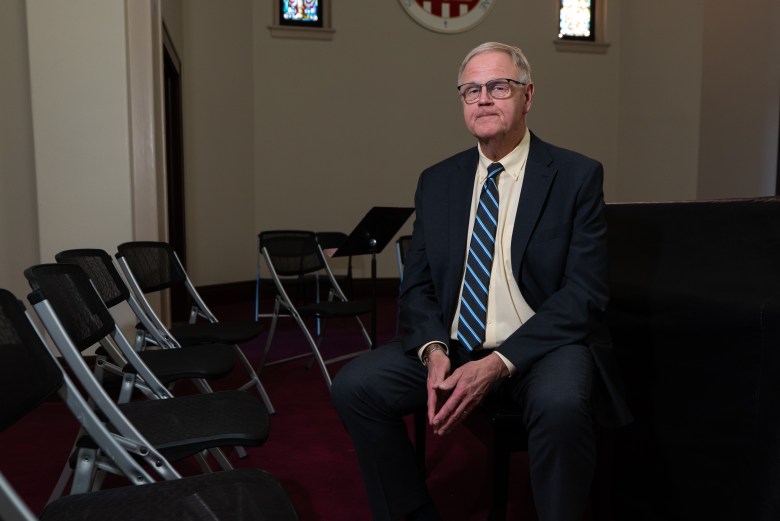
    Attending a small rural, religiously affiliated institution “is, I think — especially for rural students — a great opportunity,” said Todd Olson, president of Mount Mercy, above the sound of trains crossing Cedar Rapids outside his window. “I know kids from very small towns around Iowa,” like the one where he grew up, Olson said. “This campus is a much more comfortable place for them.”
    Credit: Mike Rundle for The Hechinger Report

    When Jacob Lange arrived at St. Ambrose from East Dubuque, Illinois, and attended a Mass on campus, “all of a sudden all these new people I had never met were kind of chatting with me and it was really kind of nice. It felt like I was kind of included and I didn’t really think I would be originally,” he said. “You figure, ‘I’m probably going to sit in the back and probably not talk to anyone all night,’ and then I showed up, and I walked out here and all of a sudden they’re, like, ‘Here, come join our group.’ ”

    His parents also liked that he decided to go to a Catholic university, Lange said. “You know, you go to one of these big schools with 25,000 kids, and you’re kind of worried about your kid — like, what kind of dumb things is he going to get up to?”

    Catholic universities in particular have a slightly higher four-year graduation rate than the national average, according to the Center for Catholic Studies at St. Mary’s University in Texas. Graduates have a stronger sense of community purpose, the center found in a survey. Alumni are 9 percentage points more likely to say they participate in civic activities.

    Related: See Hechinger’s list of all college closures since 2008

    More students at religiously affiliated than at secular institutions receive financial aid, the American Council on Education says. Three out of five get scholarships from the colleges themselves, compared to fewer than one in four at other kinds of schools. At both Mount Mercy and St. Ambrose, which have about 1,450 and 2,700 students, respectively, 100 percent get financial aid.

    But these benefits for students can be vulnerabilities for budgets, said Novak, at St. Ambrose.

    “We serve the poor. We educate the poor,” she said. “That is a risky financial proposition at the moment for small, regional institutions that are largely tuition-driven.”

    The threats to smaller religiously affiliated institutions in rural areas stem largely from the downturn in the already short supply of high school graduates choosing to enroll. The proportion of such students going straight to college has fallen even more sharply in many largely rural states.

    While they’re generous with their financial aid, religiously affiliated colleges are also generally more expensive than many other higher education institutions, at a time when many families are questioning the return on their investments in tuition. Median tuition and fees average $25,416 a year, according to the American Council on Education.

    Related: ‘Easy to just write us off’: Rural students’ choices shrink as colleges slash majors

    St. Ambrose and Mount Mercy, about 90 minutes away, are teaming up from positions of relative strength. Publicly available financial documents suggest that neither faces the immediate enrollment or financial crises that threaten many similar institutions. But their leaders say that they’re trying to fend off problems that could arise later. By joining forces, each can increase its number of programs while lowering administrative costs.

    Reaction among students and alumni has been mixed.

    Combining with St. Ambrose “was kind of nerve-racking at the beginning because it’s, like, ‘Oh, this is a lot of change,’ ” said Alaina Bina, a junior nursing major at Mount Mercy.

    She picked the university in the first place because she liked the small, hilly campus.

    “I came from a small town, so I didn’t really want to go bigger,” she said. “Even when I came here on a tour, people would say ‘Hi’ to each other. You just know everyone, and that’s kind of how it is in a small town, too.”

    Students were worried about what name would appear on their degrees (the degrees will still say “Mount Mercy”) and whether sports teams that once competed against each other would be merged. Novak and Olson promised to keep their athletics programs separate and even add a sport at Mount Mercy: football, beginning in 2026.

    Combining sports teams “would not be wise at all from a business perspective,” Olson said the two agreed, because they are “a powerful enrollment driver” for both schools.

    Credit: Mike Rundle for The Hechinger Report

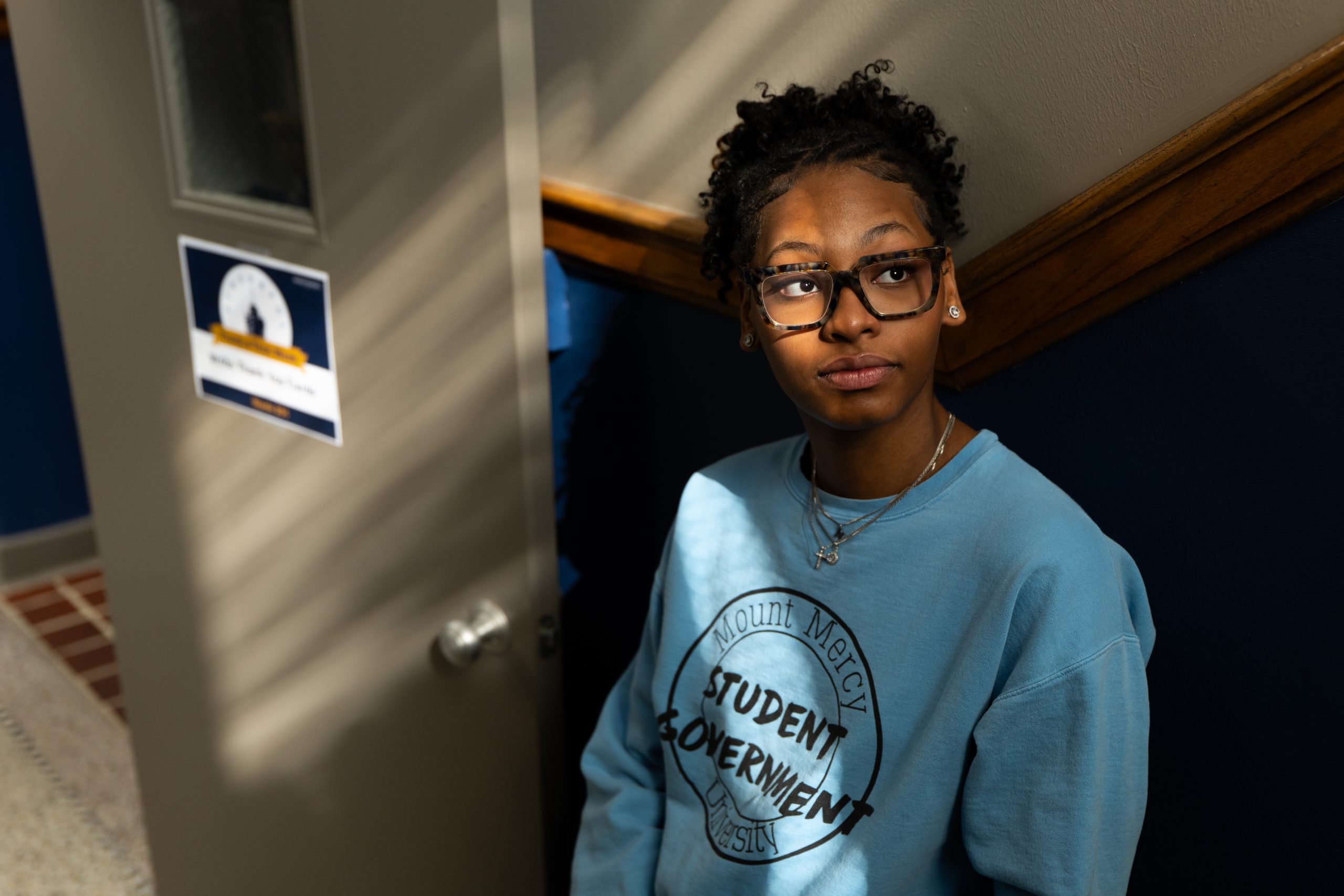
    “Honestly, this was probably the biggest student concern,” said Nasharia Patterson, student government president at Mount Mercy, who was wearing a brace on her wrist from an awkward back tuck basket catch during cheer practice. Keeping the athletics teams “gives us a piece of Mount Mercy specifically to just hold on to.”

    Among alumni, meanwhile, “there’s mixed feelings” about what’s happening to their alma mater, said Sarah Watson, a leadership development consultant who graduated from Mount Mercy in 2008.

    Still, she said, “I know the great challenges that higher ed is facing right now. It’s not just Mount Mercy. It’s not just St. Ambrose. It’s the bigger schools, too. Enrollment numbers have dropped. The desire to go to a traditional four-year college is just not quite what it used to be.”

    For Mount Mercy, which was founded by an order of nuns in 1928, Watson said, “If we don’t do this, what’s the alternative? We want to be around for another hundred years.”

    After all, said Novak, the St. Ambrose president, “to watch universities close across the heartland because we can’t make it work will leave our communities fallow.”

    Carroll, of the Catholic colleges and university association, said that many other religiously affiliated institutions are closely watching what’s happening at St. Ambrose and Mount Mercy.

    “It’s a leap of faith,” she said. “And who better to take a leap of faith than a Catholic institution?”

    Religiously affiliated colleges that have closed or merged, or announced that they will merge, since 2020

    Alderson Broaddus University, West Virginia, Baptist

    Alliance University, New York, Christian

    Ancilla College, Indiana, Catholic

    B. H. Carroll Theological Institute, Texas, Baptist

    Birmingham-Southern College, Alabama, Methodist

    Bloomfield College, New Jersey, Presbyterian

    Cabrini University, Pennsylvania, Catholic

    Cardinal Stritch University, Wisconsin, Catholic

    Chatfield College, Ohio, Catholic

    Clarks Summit University, Pennsylvania, Baptist

    College of Saint Rose, New York, Catholic

    Compass College of Film & Media, Michigan, Christian

    Concordia College New York, Lutheran

    Concordia University, Oregon, Lutheran

    Eastern Nazarene College, Massachusetts, Christian

    Finlandia University, Michigan, Lutheran

    Fontbonne University, Missouri, Catholic

    Holy Family College, Wisconsin, Catholic

    Holy Names University, California, Catholic

    Iowa Wesleyan University, Iowa, Methodist

    Judson College, Alabama, Baptist

    Limestone University, South Carolina, Christian

    Lincoln Christian University, Illinois, Christian

    MacMurray College, Illinois, Methodist

    Magdalen College, New Hampshire, Catholic

    Martin Methodist College, Tennessee, Methodist

    Marymount California University, California, Catholic

    Mount Mercy University, Iowa, Catholic

    Multnomah University, Oregon, Christian

    Nebraska Christian College, Nebraska, Christian

    Notre Dame College of Ohio, Catholic

    Ohio Valley University, West Virginia, Christian

    Presentation College, South Dakota, Catholic

    Rosemont College, Pennsylvania, Catholic

    St. Louis Christian College, Missouri, Christian

    St. Augustine College, Illinois, Episcopal

    St. John’s University Staten Island campus, New York, Catholic

    University of Saint Katherine, California, Orthodox Christian

    Ursuline College, Ohio, Catholic

    Wave Leadership College, Virginia, Christian

    Wesley College, Delaware, Methodist

    SOURCE: Hechinger Report analysis of news coverage and federal data.

    Back to story

    Contact writer Jon Marcus at 212-678-7556 or [email protected].

    This story about religious colleges and universities was produced by The Hechinger Report, a nonprofit, independent news organization focused on inequality and innovation in education. Sign up for our higher education newsletter. Listen to our higher education podcast.
    The Hechinger Report provides in-depth, fact-based, unbiased reporting on education that is free to all readers. But that doesn’t mean it’s free to produce. Our work keeps educators and the public informed about pressing issues at schools and on campuses throughout the country. We tell the whole story, even when the details are inconvenient. Help us keep doing that.

    Join us today.

    Source link

  • Agency Information Collection Activities; Submission to the Office of Management and Budget for Review and Approval; Comment Request; Borrower Defense to Loan Repayment Universal Forms

    Agency Information Collection Activities; Submission to the Office of Management and Budget for Review and Approval; Comment Request; Borrower Defense to Loan Repayment Universal Forms

    A Notice by the Education Department on 05/19/2025

    Department of Education[Docket No.: ED-2025-SCC-0002]

    AGENCY:

    Federal Student Aid (FSA), Department of Education (ED).

    ACTION:

    Notice.

    SUMMARY:

    In accordance with the Paperwork Reduction Act (PRA) of 1995, the Department is proposing a revision of a currently approved information collection request (ICR).

    DATES:

    Interested persons are invited to submit comments on or before June 18, 2025.

    ADDRESSES:

    Written comments and recommendations for proposed information collection requests should be submitted within 30 days of publication of this notice. Click on this link www.reginfo.gov/​public/​do/​PRAMain to access the site. Find this information collection request (ICR) by selecting “Department of Education” under “Currently Under Review,” then check the “Only Show ICR for Public Comment” checkbox. Reginfo.gov provides two links to view documents related to this information collection request. Information collection forms and instructions may be found by clicking on the “View Information Collection (IC) List” link. Supporting statements and other supporting documentation may be found by clicking on the “View Supporting Statement and Other Documents” link.

    FOR FURTHER INFORMATION CONTACT:

    For specific questions related to collection activities, please contact Carolyn Rose, 202-453-5967.

    SUPPLEMENTARY INFORMATION:

    The Department is especially interested in public comment addressing the following issues: (1) is this collection necessary to the proper functions of the Department; (2) will this information be processed and used in a timely manner; (3) is the estimate of burden accurate; (4) how might the Department enhance the quality, utility, and clarity of the information to be collected; and (5) how might the Department minimize the burden of this collection on the respondents, including through the use of information technology. Please note that written comments received in response to this notice will be considered public records.

    Title of Collection: Borrower Defense to Loan Repayment Universal Forms.

    OMB Control Number: 1845-0163.

    Type of Review: A revision of a currently approved ICR.

    Respondents/Affected Public: Individuals and Households.

    Total Estimated Number of Annual Responses: 83,750.

    Total Estimated Number of Annual Burden Hours: 217,750.

    Abstract: On April 4, 2024 the U.S. Court of Appeals of the Fifth Circuit granted a preliminary injunction against 34 CFR 685.400 et seq. (“2023 Regulation”) enjoining the rule and postponing the effective date of the regular pending final judgment in the case. The current Borrower Defense to Repayment application and related Request for Reconsideration are drafted to conform to the enjoined provisions of the 2023 Regulation. This request is to revise the currently approved information collection 1845-0163 to comply with the regulatory requirements of the borrower defense regulations that are still in effect, 34 CFR 685.206(e) (“2020 Regulation”), 34 CFR 685.222 (“2016 Regulation”), and 34 CFR 685.206(c) (“1995 Regulation”) (together, the “current regulations”). These regulatory requirements are distinct from the 2023 Regulation’s provisions. The revision is part of contingency planning in case the 2023 Regulation is permanently struck down. The Department of Education (“the Department”) is attaching an updated Borrower Defense Application and application for Request for Reconsideration. The forms will be available in paper and electronic forms on studentaid.gov and will provide borrowers with an easily accessible and clear method to provide the information necessary for the Department to review and process claim applications. Also, under the current regulations, the Department will no longer require a group application nor group reconsideration application.

    Dated: May 13, 2025.

    Brian Fu,

    Program and Management Analyst, Office of Planning, Evaluation and Policy Development.

    [FR Doc. 2025-08857 Filed 5-16-25; 8:45 am]

    BILLING CODE 4000-01-P
    Published Document: 2025-08857 (90 FR 21296)

    Source link

  • San Jose Middle School Offers College Class to 13-Year-Olds – The 74

    San Jose Middle School Offers College Class to 13-Year-Olds – The 74


    Get stories like this delivered straight to your inbox. Sign up for The 74 Newsletter

    This story was originally published by CalMatters. Sign up for their newsletters.

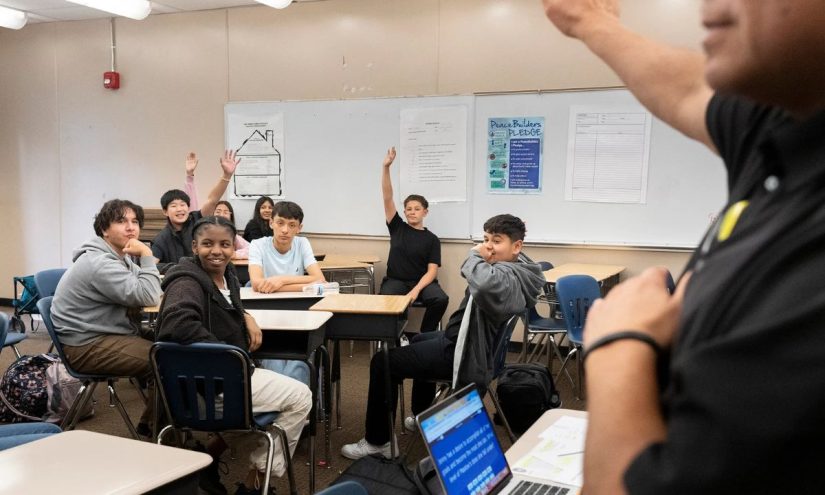
    By 2:45 p.m. the regular school day at August Boeger Middle School had already ended, but one class is about to start. More than 20 eighth graders drop their backpacks and settle into desks — not for extra credit but for college credit.

    These 13- and 14-year-old students in East San Jose are taking their first college course, an entry-level class on career planning. This middle school is one of the first in the state to offer a college-level course. In the coming years, the San Jose Evergreen Community College District wants all middle school students in this school district to be able to complete three college courses before they start high school, and soon, the district plans to offer other courses, such as sociology and ethnic studies, said Beatriz Chaidez, the chancellor for the community college district.

    Middle schoolers have long been eligible to enroll in college classes in California, though only a few, high-achieving students actually do it. By offering a college class at a middle school — especially one in a high-poverty area — the community college district is looking to make that enrollment easier. The class is taught by a middle school staff member, and it’s reserved exclusively for middle school students.

    But with so few programs, there is little research about whether students are benefitting, and the local faculty union is worried middle school students might not be ready.

    Chaidez disagrees. “Navigating (college) as early as middle school is unheard of in their community,” she said. “So when they experience success, it really motivates them to continue.”

    California is increasingly pushing high schools to offer community college classes directly to students during the regular school day, a set-up known as “dual enrollment.” Unlike AP classes, which include expensive exams and are limited to certain subjects and high-performing students, these community college classes cover a range of topics and are open to all students. By 2030, California Community Colleges Chancellor Sonya Chiristian wants all high school students to graduate with at least four college courses completed.

    Chaidez wants to go further. She wants every local high school student to be able to complete about 20 college courses by the time they graduate — enough to earn an associate’s degree.

    CalMatters reached out to the college district’s faculty union, which was surprised to learn the district is offering classes at a middle school.

    “This opens up some problems,” said Jessica Breheny, an English professor and the union’s vice president. “I’m sure there are 12-year-olds that are college-ready, but there are just less of them and it’s less likely. Developmentally, they have other things going on.”

    Research shows that high schoolers who take college classes are more likely to attend college and graduate, but there’s little research on how middle school students fare, said John Fink, a senior researcher at Columbia University’s Community College Research Center. “Nationally, and in most states, this is very, very rare, and in many states this is not allowed.” Instead, he said the focus is typically on enrolling more 10th, 11th and 12th graders in college courses.

    A college-level course, with a few middle school games

    About 10% of California’s high school students took a community college class in the 2021-22 school year, according to an analysis by professors at UC Davis using the most recent data. California’s community college system doesn’t track how many middle school students take college courses.

    So far, the Mount Pleasant Elementary School District, which includes August Boeger Middle School, offers only one college course, called “Career Planning,” and it’s almost indistinguishable from any other class on its campus. The college course is taught in a regular middle school classroom, and the professor, Oscar Lamas, already works at the middle school, where he’s a counselor. Perhaps the only noticeable difference is the timing: The middle school day ends at 2:30 p.m. and Lamas’ course starts at 2:45. He’s paid separately by the community college to teach the course.

    Career Planning helps students learn about career paths, practice resume-writing and learn psychological theories related to professional success. A governing board of college district professors, known as the Academic Senate, sets the objectives for each college course, but Lamas has broad discretion in teaching it. The Academic Senate responsible for setting the parameters of Lamas’ course did not respond to multiple requests for comment.

    The dean of the community college’s counseling department, Victor Garza, refused an interview request from CalMatters but issued a written statement. Garza said the middle school class is akin to other dual enrollment courses, which maintain the college’s “academic rigor.”

    “Some adjustments might be needed to cater to the unique needs and experiences” of students, he added.

    On a Thursday before spring break, Lamas tries to make his class more fun by breaking the students into five teams to play a Jeopardy-style quiz game on the topic of the day, Maslow’s Hierarchy of Needs.

    Natalie Mendoza, 14, becomes the default spokesperson of her team, named the “Tacos R Us Club,” but she answers the first question wrong, putting her team back 300 points and prompting her classmates to burst into chatter and analyze their mistakes.

    As part of the class, she has to study a career, write a short essay about it and present it at a career fair. She picked intellectual property law. “A lot of people say I’m assertive,” she said. “I think that’s a really good trait for a lawyer, and I think it’d be fun to fight for people who have created stuff.”

    Natalie said she’d be the first in her family to attend college but she’s already planning to go and has a few schools in mind, including UC Berkeley and San Jose State. If she does attend one of those schools, her grade in this counseling class would be part of her official college transcript.

    Breheny, with the union, said she’s concerned about the quality of the classes, especially once the college district begins teaching other subjects, such as ethnic studies.

    “Faculty designed their courses for adult learners,” Breheny said. An ethnic studies class may cover topics such as sexual violence and genocide, she added — topics that may be difficult to convey to a middle schooler. “Some of the material assumes a certain knowledge about the world, about politics, which you may not have at 11, 12, 13 years old.”

    High schools offer few dual enrollment classes

    August Boeger Middle School sits at the base of the Diablo Range mountains, tucked between the ranch-style homes and strip malls that color East San Jose. Teachers and staff greet each other with mucho gusto instead of hello. All around the open-air campus, murals tell the story of the region’s multi-cultural heritage, especially its Mexican and Chicano roots.

    That celebration of culture is a direct response to a history of adversity, Lamas said. “East San Jose has always been a marginalized, disadvantaged environment.” As a result, schools in the community contend with education disparities, he said, such as a high dropout rate and a high teen pregnancy rate.

    Offering a college class to these middle school students allows them to “see a possibility for their future that doesn’t exist within these walls here” and can inspire them to reach for a higher goal, said Marisa Peña, a school advisor.

    Male students, Black and Latino students and students from rural areas are underrepresented in the community college courses offered at California’s school districts. California lawmakers have signed numerous bills in the hopes of expanding access but certain regions in the state, such as Los Angeles, enroll a higher percentage of students.

    Natalie said she hopes to continue taking college courses when she starts at Mount Pleasant High School this fall, which is just around the corner from her middle school. But her options are limited.

    Mount Pleasant High School offers just three community college courses, which serve about 10% of the school’s roughly 1,000 students, said Kyle Kleckner, the school district’s director of instructional services. All of the classes are in “multimedia” studies, he said, which teaches students how to create their own podcasts or YouTube channels, along with other digital marketing skills. 

    Although Mount Pleasant High School’s dual enrollment is about on par with the state average, it trails other districts in the region. Less than 20 miles away, at high schools in the Milpitas Unified School District, roughly 25% of students enrolled in a community college class in 2021-22, according to the UC Davis analysis.

    Finding professors to teach middle school

    Part of the dual enrollment challenge is finding qualified college professors who are willing and able to work at a high school or middle school. Existing middle and high school teachers are allowed to teach college courses but they have to meet the qualifications, which usually include a master’s degree in the area of instruction. Most of California’s high school and middle school instructors lack a master’s degree, according to a study by the Public Policy Institute of California.

    “We have graduation requirements that students have to accomplish,” Kleckner said. “The trick is finding that community college course that also fulfills those requirements and also finding a teacher who can teach it.” He said Mount Pleasant High School is committed to expanding the number of college courses but noted that it’s smaller and therefore has fewer teachers who meet the requirements to teach a college course.

    In turn, many college professors lack experience teaching children, said Breheny, who teaches at San Jose City College. “We have had some problems already with dual enrollment where faculty have gone to different (high schools) to teach and have dealt with classroom management issues that they wouldn’t have in a college course.” In one case, she said a college faculty member saw bullying in a high school classroom but didn’t feel equipped to respond.

    Lamas has a master’s degree, which is required for most school counselors. He’s gentle with the middle school students in his class, occasionally awarding points in the Jeopardy game even when the answer isn’t perfect. Lamas had two quiz games planned that day, each one covering a different topic, but the first game took up almost all of the class time.

    He ends class by taking questions about the upcoming final project. Although spring break is minutes away, the students sit still through the final minutes, except for the occasional joke and bursts of laughter. Not a single phone was in sight.

    Once class ends, however, chatter ensues, the students pull out their phones, and staff escort them to the parking lot. While they may be taking a college course, they still must wait for their parents to pick them up.

    This article was originally published on CalMatters and was republished under the Creative Commons Attribution-NonCommercial-NoDerivatives license.


    Get stories like these delivered straight to your inbox. Sign up for The 74 Newsletter

    Source link

  • Florida A&M Hires DeSantis Ally as President

    Florida A&M Hires DeSantis Ally as President

    Photo illustration by Justin Morrison/Inside Higher Ed | Jemal Countess/Getty Images for NOBCO | JHVEPhoto/iStock/Getty Images

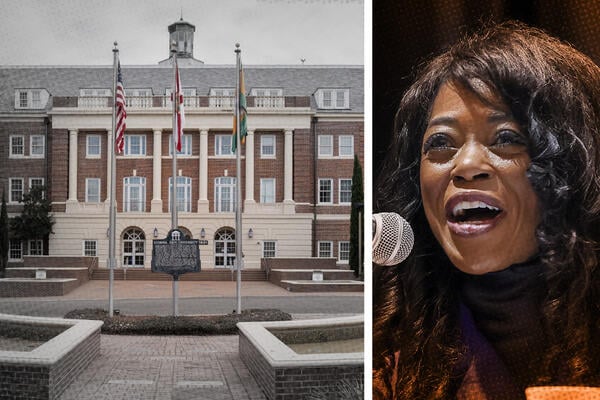
    Following a contentious selection process, Florida A&M University hired a new president with no experience working in higher education but long-standing ties to Republican governor Ron DeSantis.

    Marva Johnson, a lobbyist for Charter Communications, faced sharp opposition from students and alumni, who dubbed her “MAGA Marva.” But despite questions about her lack of experience, Florida A&M’s board voted 8 to 4 in a Friday meeting to make her the next president.

    Johnson was also criticized by community members and board chair Kristin Harper for her salary demands, which included base pay of $750,000 plus performance bonuses. (Two other candidates requested compensation in the $500,000 range, while one other was negotiable.)

    Harper was one of the four trustees who voted against hiring Johnson.

    “In an age of merit-based hiring decisions, how can one justify settling for a candidate who does not meet all of the position criteria? Or turning a blind eye to exceptionally qualified candidates?” Harper asked.

    She added that FAMU community members “have been very clear” with their feedback.

    But other trustees emphasized Johnson’s experience in the political world. Jamal Brown, the Faculty Senate president, who sits on the board, argued that FAMU needed a president who has “access and political connections” to ensure the university’s financial success. In voting for Johnson, he argued that “this moment calls for someone who understands the systems that fund and govern us, because right now our survival depends on how we navigate those systems.”

    While Johnson has never worked in higher education in any capacity, she spent eight years on the Florida State Board of Education, including time as chair. During the hiring process, critics highlighted her lack of experience, as did some trustees who voted against her.

    Johnson beat out Donald Palm, executive vice president and chief operating officer of Florida A&M, who received four votes. Other candidates included Rondall Allen, provost and vice president for academic affairs at the University of Maryland Eastern Shore, and Gerald Hector, senior vice president for administration and finance at the University of Central Florida.

    Palm, the internal candidate, was overwhelmingly endorsed by FAMU’s alumni association.

    At a tense meet-and-greet with Johnson on Wednesday, the candidate assured the university community she was “not a Trojan horse” and promised she “would fight and win for FAMU.”

    However, critics have argued she failed to articulate a clear vision for the university.

    Additional drama accompanied the hire when the board cut Harper out of contract negotiations. While board chairs have traditionally negotiated the contract with incoming presidents at Florida A&M, trustees voted to delegate that responsibility to another member at Friday’s meeting.

    “I take personal offense at what is happening,” Harper said during that discussion.

    Another controversy arose earlier in the search amid speculation that Johnson was added to a list of three finalists at the last minute. Last month trustee Ernie Ellison called to restart the search, arguing, “There are too many clouds hanging over this process.” He stepped down earlier this month and was quickly replaced by a new DeSantis appointee, who then voted to hire Johnson.

    Johnson steps into the FAMU job, which is currently held by an interim, after Larry Robinson, who led the university from 2017 to 2024, resigned amid controversy over a fraudulent gift.

    Last spring Florida A&M announced at commencement that the university had received a $237 million donation from Greg Gerami, a relatively unknown businessman with no connection to the institution. Florida A&M appeared to ignore warning signs that Gerami had also pledged $95 million to Coastal Carolina University in 2020, despite having no ties to CCU other than previously dating an employee. Gerami walked that donation back due to what he viewed as disrespect by officials at Coastal Carolina. Gerami’s FAMU donation was later invalidated.

    Despite the opposition to her candidacy, Johnson fits the profile favored in recent years by the governing boards at Florida’s public institutions, which have emphasized nontraditional applicants. Johnson is one of multiple presidential hires with ties to DeSantis or the GOP since 2022, when the State Legislature passed a bill allowing universities to shield applicant identities until the end of the hiring process, breaking with a long-standing tradition of making those names public. State lawmakers recently proposed injecting more transparency into searches, but that effort failed.

    Other political hires include Ben Sasse, a former Republican U.S. senator from Nebraska, who had a short-lived presidency at the University of Florida; former Florida lieutenant governor Jeanette Nuñez at Florida International University; and former state lawmakers Adam Hasner at Florida Atlantic University and Richard Corcoran at New College of Florida, among several others. Former GOP lawmaker Ray Rodrigues was also hired to lead the State University System of Florida in 2022.

    The University of Florida is currently in the process of replacing Sasse with an interim appointed to the job after his abrupt departure. Sole finalist Santa Ono, a traditional academic who left the University of Michigan to take the Florida job, marks a reversal of course compared to recent hires. However, Ono’s candidacy has sparked criticism from some conservative power players.

    Source link

  • New Jersey City University takes key step to become part of Kean University

    New Jersey City University takes key step to become part of Kean University

    Dive Brief:

    • New Jersey City University is set to become part of nearby Kean University after the two public institutions signed a letter of intent Thursday to combine by June 2026. The merger would be subject to accreditor and regulatory approvals.
    • Under the plan, Kean would assume NJCU’s assets and liabilities and operate the institution as “Kean Jersey City,” the universities said. Executive oversight would fall to Kean’s president, who would appoint a chancellor to lead Kean Jersey City. NJCU will have some representation on Kean’s board of trustees, per the letter.
    • NJCU signaled in March that it planned to pursue a merger with Kean after past years of budgetary struggles and a directive from a state-appointed monitor to find a financial partner.

    Dive Insight:

    In Thursday’s release, Kean and NJCU said that their combination would “preserve NJCU’s mission of serving first-generation, adult and historically underserved students while advancing Kean’s role as the state’s urban research university and a newly designated R2 research university.” 

    Luke Visconti, chair of the NJCU’s trustee board, said Thursday’s letter of intent “provides an important framework for the detailed discussions that will follow.” 

    Still to come are full due diligence, a definitive agreement and a detailed outline for combining the two public universities. That process will be collaborative and “rooted in student and community engagement” so that the merger with Kean celebrates the two “distinct cultures” of the universities, NJCU Interim President Andrés Acebo said in a statement. 

    According to the institutions, an integration planning team with representatives from both universities will begin work immediately, coordinating with New Jersey’s state higher education office. The two universities will develop shared services agreements to streamline operations and boost student success, officials said. 

    Kean is the larger institution of the two, with 13,352 students in fall 2023, which was down by 5% from five years prior, according to federal data.  NJCU, meanwhile, had 5,833 students in 2023, down 10.8% from the year before and 27% lower than 2018 levels. 

    NJCU’s enrollment declines have contributed to its recent financial turmoil. A little over three years ago, the university declared a full-blown financial crisis after heavy spending on real estate expansions, student services and scholarships failed to reverse its enrollment slowdown and enlarged the university’s expenses.

    In 2023, the state comptroller’s office issued a scathing report that accused administrators of failing to fully inform NJCU’s board of the dire financial state, and which also suggested the university “likely” broke federal law by using emergency pandemic funding for an existing scholarship program. 

    Since then, Acebo has taken the reins, and the state has appointed a monitor to help ensure NJCU rights its finances and operations. State lawmakers also provided $17 million in critical stabilization funding to the institution.  

    In November, Fitch Ratings lifted the university’s outlook from negative to stable, citing “significant progress toward achieving fiscal balance despite continued pressure on student enrollment.”

    Source link

  • ICE Warns International Students of More SEVIS Terminations

    ICE Warns International Students of More SEVIS Terminations

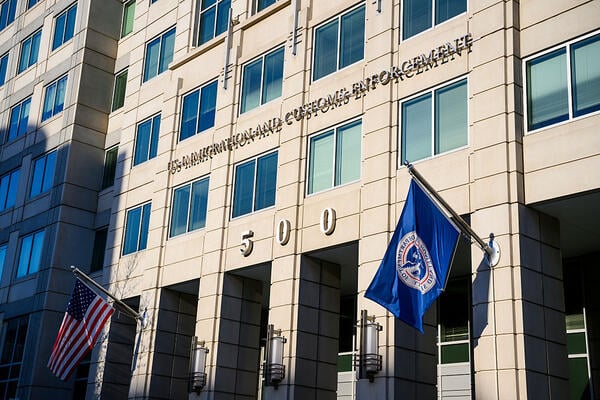
    Immigration officials sent letters to international students on short-term work visas Thursday night, threatening to terminate their legal status in the Student Exchange and Visitor Information System and remove them from the country. The number of affected students is still unknown, but Inside Higher Ed can confirm at least 35.

    It’s the first sign that the Trump administration is resuming its campaign to deport student visa holders, weeks after restoring the statuses of thousands of students. ICE recently released an updated policy that significantly expands the agency’s authority to terminate students’ SEVIS status and pave the way for deportation proceedings. 

    This time, they’re targeting students on Optional Practical Training visas, or OPTs, which allow international postgraduates the opportunity to work in a field relevant to their study on a short-term extension. Students on OPT are allowed a total of 90 days of unemployment every 12 months before falling out of compliance. It’s still not known whether any of the affected students were on a special visa extension known as OPT for STEM, awarded to graduates in high-demand technology, science and engineering fields. 

    One international student adviser, who spoke with Inside Higher Ed on the condition of anonymity, said 28 of his institution’s students on OPT received the letter in the past day, and he expects that number will grow. 

    In a copy of one letter received by an international student and obtained by Inside Higher Ed, Immigration and Customs Enforcement warned those who have not reported employment status within 90 days of starting their OPT visa that they must do so in 15 days. If they don’t, the Student Exchange and Visitor Program “will set your SEVIS record to ‘terminated,’” the letter reads, which “may result in the initiation of immigration proceedings to remove you from the United States.”

    The letter is nearly identical to those sent by officials during the first Trump administration in 2020. The only difference: Back then, the Student Exchange and Visitor Program was the letter’s sole signatory. This time, ICE and the Department of Homeland Security are also named. 

    The 2020 letters were sent two years after officials issued an update to designated school officials informing them that the administration had begun a review of OPT students’ employment status to find noncompliant visa holders. But that notice also said SEVP would not automatically terminate students’ SEVIS status for going over the 90-day unemployment limit before notifying students. 

    It’s not clear whether immigration officials engaged in a review process before beginning to notify students of potential SEVIS terminations this week. Spokespeople for ICE and DHS did not respond to questions in time for publication. 

    It was also not immediately clear if OPT students’ SEVIS terminations would result in subsequent visa revocations, which are the purview of the State Department. A spokesperson for the State Department wrote in an email that they “cannot preview future visa-related decisions, which are made on a case-by-case basis, based on the individual facts relevant to the case,” and deferred other questions sent by Inside Higher Ed to DHS.

    In an internal communication sent to international student advisers and support specialists, NAFSA, an organization of international educators, urged college officials to regularly check the SEVIS database for notices of OPT students’ compliance with “accrued unemployment days” and to reach out to any students who are over the 90-day limit as soon as possible. 

    Immigration officials began systematically terminating thousands of students’ SEVIS statuses along with their visas in late March, an unprecedented move that threw international student support offices into chaos and left students scrambling to avoid deportation. 

    Last month, immigration officials restored the SEVIS statuses of more than 5,000 international students after losing dozens of court cases challenging the legality of efforts to revoke foreign students’ legal residency at a breakneck pace.

    The anonymous international student adviser said students on OPT often forget to report their employment details before the 90-day deadline. Many are distracted by graduations and finals well after they receive approval for the visa and forget, he said; in other cases, the lapse can be due to technical issues within SEVIS.

    Because of that, they’re often given some leeway, and he said he’s never seen or heard of a student having their SEVIS status terminated for not reporting employment details on time, including the last time these letters were sent in 2020. Then again, much of the Trump administration’s treatment of student visa holders is unprecedented, and he’s worried this could be a real danger for them.

    “There’s a lot of panic and uncertainty as our students are waiting to see what will happen, and we’re waiting to see if they’ll really go through with it,” he said. “I think this is the real deal.”

    Source link

  • How much does chronic absenteeism cost communities?

    How much does chronic absenteeism cost communities?

    This audio is auto-generated. Please let us know if you have feedback.

    Dive Brief:

    • For each student who is chronically absent in California schools, there’s a $5,630 economic burden to the community, according to a report released Wednesday by the University of Pennsylvania Graduate School of Education’s Center for Benefit-Cost Studies.
    • Each expulsion costs $70,870 in social burdens such as increased likelihood of dropping out, said the report, which was developed with the University of California, Los Angeles’ Center for the Transformation of Schools.
    • Using state, school and student data, researchers calculated the total economic burdens and gains resulting from factors such as graduation rates, school attendance and disciplinary infractions. To improve those factors and offset burdens, the report calls for more equitable opportunities for student success, as well as efficiency-based reforms like the use of a multi-tiered system of supports framework.

    Dive Insight:

    Like many other localities, California’s chronic absenteeism rate rose because of the COVID-19 pandemic. In the 2019-20 school year, the state’s chronic absenteeism rate for all students was 10%, compared to 30% in 2021-22, which was the same rate nationally. The report uses a common definition of chronic absenteeism, which is when a student misses 10% of the school year, or about 18 days.

    The report also calculates that each suspension costs $27,260 and each disciplinary restraint adds up to $6,040.  The economic burden for each student who does not graduate high school is $478,440.

    On the other hand, a 3 percentage point increase in California’s high school graduation rate would add almost $10 billion to state coffers and $3 billion in taxpayer savings.

    To calculate these financial burdens and gains, researchers used an economic model that accounts for all the resources that are needed or contributed to for each educational status over an individual’s working life. 

    For example, the lifetime social gain of an 18-year-old who graduates high school is $478,440, or $681,930 if the student enrolls in college, according to the report. A variety of factors are taken into consideration in this calculation, including the estimation of higher earnings with additional education and the assumption of reduced criminal activity, improved health status and less reliance on a social safety net.

    A. Brooks Bowden, an associate professor of educational policy at the University of Pennsylvania and director of the Center for Cost-Benefit Studies of Education, said the study’s findings in California are an indication of potential economic burdens nationwide.

    “Addressing these challenges can lead to substantial savings and improved educational outcomes across the country,” said Bowden in a statement. 

    The report also said multi-tiered system of supports holds the promise of efficiency in education, because rather than schools delivering extensive support to all students, the MTSS framework provides resource-intensive supports to students with the highest need, as well as equitable services because interventions are individualized based on data.

    The MTSS framework has been used by districts across the country to address stubborn absenteeism rates. This approach — which begins with universal supports and increases the intensity of interventions based on student needs — is also promoted by Attendance Works, a nonprofit that provides school attendance resources.

    Source link

  • Supporting Student Wellbeing in Uncertain Times

    Supporting Student Wellbeing in Uncertain Times

    Higher education is operating in a time of rapid change and uncertainty. Changes in federal and state policy, funding, and increasing polarization are reshaping campus environments and profoundly affecting many students’ experiences. As leaders, it is critical to understand how these forces are impacting student wellbeing—and what actions institutions can take to adapt and strengthen their supports for students.

    The Action Network for Equitable Wellbeing (ANEW) is a networked community of higher education changemakers working together to advance systems-level transformation to improve student wellbeing. Drawing on the involvement of more than 200 colleges and universities, our experience shows that while there is no single solution, institutions can act quickly and intentionally to strengthen student support using a practical, data-driven, human-centered approach.

    Through this collaborative work, we’ve identified three strategies that are helping campuses respond more effectively to the rapidly evolving needs of their students: using real-time disaggregated data, conducting empathy interviews, and building a rhythm of frequent data collection and sense-making.

    Collect real-time quantitative data and analyze it thoughtfully

    How students are doing can change rapidly as policies and rhetoric shift, availability of external resources change, significant events on campus or in the world occur, and new barriers or supports emerge. Relying on older data (e.g. survey data collected nine months ago) can miss important changes. Without timely insight, decisions may be based on outdated information or an incomplete understanding. Systematically collecting real-time data helps institutions stay aligned with students’ current realities.

    To support this kind of real-time data collection, ANEW institutions have used the Wellbeing Improvement Survey for Higher Education Settings (WISHES)—a short survey, available at no cost, that provides institutions with timely and actionable data on a range of outcomes and experiences influencing student wellbeing. WISHES helps institutions monitor student wellbeing and stay responsive to the present moment.

    But aggregate data tell only part of the story. To understand how different groups of students are faring, disaggregating data by relevant student characteristics can reveal patterns that may be hidden in campus-wide averages and allow institutions to focus support where it is most needed, such as groups of students who might be disproportionately struggling.

    In fall 2023, the University of California, Irvine administered WISHES, disaggregated its data, and found that Middle Eastern students seemed to be experiencing more challenges than their peers in some measures. “Aggregate data really doesn’t tell you anything [about what to do]—you have to disaggregate,” said Doug Everhart, director of student wellness and health promotion at UC Irvine. “In order to find meaning behind the data, you have to follow up and ask questions to dig into the lived experience and the ‘why’. That focus is what makes [the ANEW] approach so useful.” The real-time disaggregated data allowed the team to better understand the Middle Eastern student experience and develop strategies responsive to their needs.

    Conduct empathy interviews to develop actionable, human-centered insights

    Real-time disaggregated survey data can reveal where differences exist—but it likely won’t explain them. Empathy interview is a method used in diverse sectors and settings to understand what’s behind the patterns in quantitative data. These insights are important for informing what specific changes are needed to better support students.

    An empathy interview is a one-on-one session that uses deep listening and responsive prompts to explore the lived experience of an individual on a specific topic such as wellbeing. Empathy interviews uncover holistic and nuanced perspectives about a student’s life—including what they’re facing, what matters to them, and how they navigate challenges and opportunities. Empathy interviews are not formal research, but they offer a structured way for leaders to move beyond assumptions and gain insights that are authentic, revealing, and actionable from those who are most affected.

    Katy Redd, executive director of the Longhorn Wellness Center at the University of Texas at Austin, reflected on the value of this strategy, “Going through this process pushed us to confront the gap between how we assume students experience college and what their day-to-day reality actually looks like for low-income students. Listening closely helped us notice invisible norms and structures that many students are expected to navigate without support. It shifted our mindset—away from surface-level solutions and toward deeper questions about how our systems function and for whom.”

    Michelle Kelly, assistant vice president for health and wellbeing at the University of Texas at Arlington, described a similar shift in perspective: “There was a moment after our empathy interviews where it just clicked: we’d been asking students to navigate systems we ourselves hadn’t fully mapped. It was humbling—but also motivating. Hearing their stories reminded us that the data isn’t just about trends—it’s about real people trying to make it through college while juggling a hundred other things.”

    These interviews, coupled with WISHES data, revealed insights that were difficult to uncover through other methods and have helped institutions think and act more systematically about what’s shaping students’ experiences and outcomes.

    Develop a rhythm of frequent data collection and sense-making

    Being responsive to student needs isn’t about changing course in response to every complaint—it’s about noticing patterns early and adjusting when needed, which requires more than one-time or yearly data collection. Institutions that build a regular rhythm of frequent data collection and sense-making are better equipped to detect shifts, learn from them, and adapt in ways that support student wellbeing.

    WISHES is most effective when administered multiple times per semester over many years. Data collected frequently over time provide helpful context when trying to understand how students are impacted by significant events on campus or in the world. Institutions can better answer questions like: Are students struggling more or less than they were at similar points of the semester in previous years? In times of extraordinary change, it is easy to imagine that students are doing worse than they were previously. Frequent data collection and sense-making allow us to objectively determine if this assumption is true.

    ANEW institutions that frequently collect data over time using WISHES have been able to understand in close to real time how large external events—such as the pandemic, October 7, and the shifting political environment—have impacted student wellbeing. Schools have reported that WISHES data enabled them to check their assumptions about the impact these events had on student wellbeing. In some cases, assumptions have been disproven using data, allowing schools to avoid trying to solve nonexistent problems or the wrong problem.

    As the University of Maryland reflects, “We’ve administered WISHES 10 times over the past two years and have seen firsthand the benefits of frequent data collection and are excited for the future. We most recently have begun to build a dashboard to display our WISHES metrics over time and democratize these critical insights to a myriad of roles within our campus community, which we hope will lead to more effective support for students across our university.”

    In the face of today’s challenges, higher education has a powerful opportunity—and responsibility—to lead with empathy, insight, and action. By embracing a data-driven, student-centered approach, institutions can move beyond assumptions and truly understand what their students need to flourish. The experiences shared by ANEW institutions demonstrate that meaningful change is not only possible but already underway. Now is the time for campuses to lean in, listen deeply, and build the systems that will support every student’s wellbeing.


    This post was written by Joanna Adams (Rochester Institute of Technology), Jennifer Maltby (Rochester Institute of Technology), and Allison Smith (New York University), with the co-leadership and insights of hundreds of changemakers contributing to the Action Network for Equitable Wellbeing.


    If you have any questions or comments about this blog post, please contact us.

    Source link

  • Ohio District Awarded CoSN Trusted Learning Environment Mini Seal for Student Data Privacy Practices

    Ohio District Awarded CoSN Trusted Learning Environment Mini Seal for Student Data Privacy Practices

    Washington, D.C.    CoSN today awarded Delaware Area Career Center in Delaware, Ohio, the Trusted Learning Environment (TLE) Mini Seal in the Business Practice. The CoSN TLE Seal is a national distinction awarded to school districts implementing rigorous privacy policies and practices to help protect student information. Delaware Area Career Center is the sixth school district in Ohio to earn a TLE Seal or TLE Mini Seal. To date, TLE Seal recipients have improved privacy protections for over 1.2 million students.

    The CoSN TLE Seal program requires that school systems uphold high standards for protecting student data privacy across five key practice areas: Leadership, Business, Data Security, Professional Development and Classroom. The TLE Mini Seal program enables school districts nationwide to build toward earning the full TLE Seal by addressing privacy requirements in one or more practice areas at a time. All TLE Seal and Mini Seal applicants receive feedback and guidance to help them improve their student data privacy programs.

    “CoSN is committed to supporting districts as they address the complex demands of student data privacy. We’re proud to see Delaware Area Career Center take meaningful steps to strengthen its privacy practices and to see the continued growth of the TLE Seal program in Ohio,” said Keith Krueger, CEO, CoSN.

    “Earning the TLE Mini Seal is a tremendous acknowledgement of the work we’ve done to uphold high standards in safeguarding student data. This achievement inspires confidence in our community and connects us through a shared commitment to privacy, transparency and security at every level,” said Rory Gaydos, Director of Information Technology, Delaware Area Career Center.

    The CoSN TLE Seal is the only privacy framework designed specifically for school systems. Earning the TLE Seal requires that school systems have taken measurable steps to implement, maintain and improve organization-wide student data privacy practices. All TLE Seal recipients are required to demonstrate that improvement through a reapplication process every two years.

    To learn more about the TLE Seal program, visit www.cosn.org/trusted.

    About CoSN CoSN, the world-class professional association for K-12 EdTech leaders, stands at the forefront of education innovation. We are driven by a mission to equip current and aspiring K-12 education technology leaders, their teams, and school districts with the community, knowledge, and professional development they need to cultivate engaging learning environments. Our vision is rooted in a future where every learner reaches their unique potential, guided by our community. CoSN represents over 13 million students and continues to grow as a powerful and influential voice in K-12 education. www.cosn.org

    About the CoSN Trusted Learning Environment Seal Program The CoSN Trusted Learning Environment (TLE) Seal Program is the nation’s only data privacy framework for school systems, focused on building a culture of trust and transparency. The TLE Seal was developed by CoSN in collaboration with a diverse group of 28 school system leaders nationwide and with support from AASA, The School Superintendents Association, the Association of School Business Officials International (ASBO) and ASCD. School systems that meet the program requirements will earn the TLE Seal, signifying their commitment to student data privacy to their community. TLE Seal recipients also commit to continuous examination and demonstrable future advancement of their privacy practices. www.cosn.org/trusted

    About Delaware Area Career Center Delaware Area Career Center provides unique elective courses to high school students in Delaware County and surrounding areas. We work in partnership with partner high schools to enhance academic education with hands-on instruction that is focused on each individual student’s area of interest. DACC students still graduate from their home high school, but they do so with additional college credits, industry credentials, and valuable experiences. www.delawareareacc.org

    Connect With Us

    Facebook,Twitter, LinkedIn

    eSchool News Staff
    Latest posts by eSchool News Staff (see all)

    Source link