Author: admin

  • College Marketing: 7 Ways It Has Changed and How to Stay Ahead

    College Marketing: 7 Ways It Has Changed and How to Stay Ahead

    …and What You Need to Do to Stay Ahead

    The higher education enrollment landscape is undergoing a significant transformation, driven by shifting demographics, technological advancements, and economic uncertainty. To remain relevant and competitive, colleges and universities must adapt to these changes and develop strategies to succeed in a challenging environment. But before you can adapt, one must first look at some of the major innovations that have disrupted how consumers engage with brands.

    Are you engaging students the way they engage with other brands?
    1. Short form video content: Platforms like TikTok, Instagram Reels, and YouTube Shorts have dominated, offering snackable content that informs, entertains, and inspires within seconds. Influencers (see #5) use this medium to tell stories, drive trends, and engage consumers on behalf of sponsored brands. Students use the medium to assess campus life and inform college choices.
    2. Voice and visual search optimization: The rise of “smart assistants”and digital assistants have changed the way we engage with brands, discover products, and complete research, transactions, and more. A good digital assistant is becoming as essential as a solid logo design in marketing.
    3. AI personalization: Artificial intelligence has revolutionized marketing by enabling hyper-personalized experiences, analyzing real-time data, and predicting consumer behavior to deliver tailored content. For cash strapped institutions, it has the added benefit of allowing you to zero in on your highest potential return prospects and curate content.
    4. Augmented reality (AR) experiences: AR is transforming how consumers shop, learn, and engage with brands, creating immersive experiences that drive both engagement and sales. George Mason University developed a successful AR campus tour for transfer students, and I expect to see prospective students and their families wandering campus with branded AR glasses on campuses everywhere before long.
    5. Influencer marketing: The focus has shifted from big-name endorsements to micro- and nano-influencers, offering niche expertise and deeper connections with audiences. Universities are leveraging student influencers on campus for enrollment and advancement opportunities.
    6. Data privacy regulations and ethical marketing trends: With increasing concerns about data breaches, consumers demand transparency and ethical practices in data handling and marketing. Layer an ever changing and tightening regulatory environment and you will need solid governance and procedural guidance to ensure compliance without limiting effectiveness.
    7. Omnichannel integration: Marketers now focus on providing a seamless experience across all touchpoints, ensuring brand consistency and cohesive customer interactions. The same experience is paramount during the college search process to stand out, stay top of mind, and draw students to your engaging (AR powered?) on campus events.

    5 keys to optimizing your college marketing strategy to address these changes

    That is the how, but what about the what. A great tech stack is one thing, but the meat of your strategy and message must center around what is central to your mission, your goals, and your prospective student audience.

    1. Gear your strategy to your prospective students

    As the student population becomes increasingly diverse, institutions must develop targeted recruitment and communication strategies to engage with underrepresented groups, including Hispanic, African American, and first-generation students. According to RNL’s most recent study of undergraduate marketing and recruitment practices, 51% of four-year private, 42% of two-year public, and 37% of four-year public institutions have specific strategies for recruiting Hispanic students. The vast majority of institutions also do not have materials and communications available in Spanish. Depending on your locality, these populations may be your best bet for stable growth, but without a specific marketing strategy, you will miss the opportunity.

    2. Assess the suite of marketing tools, vehicles and assets at your fingertips

    How cohesive, consistent and connected are they? Students use a variety of resources to learn about colleges and universities, from websites and social media to videos and printed brochures. Institutions must adopt a balanced, omnichannel approach to marketing, leveraging multiple channels to reach students at various stages of their decision-making process.

    3. Plug the leak

    As the demographic cliff approaches, institutions must prioritize student success and retention strategies. A recent study found that public colleges and universities use market research and print/electronic campaigns to impact student yield and summer melt, but there is room for improvement in collecting data to inform retention policies. (Our report on retention practices provides very helpful benchmarks and ideas for student success strategies.)

    4. Improve the experience and reduce the stress

    The college search process can be a significant source of stress and anxiety for students. Institutions can help mitigate this by providing resources and support services, such as mental health counseling and academic advising, to help students manage their emotions and stay on track.

    5. Embrace change

    To succeed in a rapidly changing environment, institutions must be willing to adapt and innovate. This includes investing in technology, such as AI-powered enrollment management systems, and exploring new revenue streams, such as online and graduate programs.

    College marketing is evolving at an unprecedented pace. How can you keep up?

    To remain competitive, colleges and universities must embrace strategies that prioritize personalization, authenticity, and innovation. From leveraging short-form video content and AI-powered tools to integrating augmented reality experiences and omnichannel approaches, institutions have a wealth of opportunities to connect with prospective students in meaningful ways.

    However, success will require more than technology; it demands a deep understanding of the diverse needs and aspirations of the modern student population. By aligning marketing efforts with institutional goals, fostering inclusivity, and enhancing the overall student experience, higher education institutions can not only navigate these changes but thrive in a rapidly shifting environment. Now is the time to adapt, innovate, and future-proof strategies to ensure sustainable growth and relevance in the years ahead. Reach out and we can connect on your marketing strategies. We will find a time to talk about your opportunities to make sure your marketing efforts resonate with students and reach them in the channels they use.

    Talk with our marketing and recruitment experts

    RNL works with colleges and universities across the country to ensure their marketing and recruitment efforts are optimized and aligned with how student search for colleges.  Reach out today for a complimentary consultation to discuss:

    • Student search strategies
    • Omnichannel communication campaigns
    • Personalization and engagement at scale

    Request now

    Source link

  • Education Department retracts CTE grants for Native American and Hawaiian students

    Education Department retracts CTE grants for Native American and Hawaiian students

    This audio is auto-generated. Please let us know if you have feedback.

    The U.S. Department of Education canceled two grant competitions for fiscal year 2025 meant to improve career opportunities for Native American and Native Hawaiian students, according to notices published in the Federal Register earlier this month. 

    The competitions were canceled because they do not “align with the objectives established by the Trump Administration while fostering consistency across all grant programs.” The department also said in its notices that canceling the competition for the fiscal year is part of “enhancing the economic effectiveness of Federal education funding.” 

    Instead of continuing the competitions, the department will dedicate available funds to support current recipients of the grants. 

    In total, the grants provided nearly $21.6 million for the Native American Career and Technical Education Program and the Native Hawaiian Career and Technical Education Program, according to the Education Department’s Office of Career, Technical and Adult Education. It provided nearly $18 million in Native American opportunities and $3.6 million for Native Hawaiians on an annual basis, according to the department. 

    The competitions were originally announced in the Federal Register on Jan. 7, prior to the inauguration of President Donald Trump, who has proposed a much slimmer Education Department budget that would cut its total funding by 15%. The administration has also already slashed a handful of other education grant programs. 

    In previous years, the Native American and Native Hawaiian grants have supported colleges, schools and tribes in establishing postsecondary career pathways.  

    For example, in fiscal year 2021, the department awarded 39 grants under the NACTEP program and nine grants under the NHCTEP program. 

    A NACTEP grant awarded to Chief Leschi Schools, a Native American tribal school located in Washington, allowed for work-based learning related to fisheries, medical facilities, schools and other careers.

    “The tribal connections of pathways embrace and honor the culture and identity of students and families and provide students a connection to their heritage along with a path to a successful future,” the program description states.

    In Castle High School in Hawaii, the NHCTEP program prepared students for a medical career pathway.

    The project will provide culture-based education to Native Hawaiian students and foster a community where relationships are formed, and learning is connected to the context of students’ lives applied to the real world,” the description states. 

    In 2021-22, there were more than 8.1 million high school CTE participants out of 11.5 million participants nationwide, according to the Association for Career and Technical Education. Nationally, about 109,000 were American Indian or Alaska Native and 43,000 were Native Hawaiian or Other Pacific Islander.

    Source link

  • ‘Gross mismanagement’: Bacone College sent into liquidation

    ‘Gross mismanagement’: Bacone College sent into liquidation

    Dive Brief:

    • A federal judge ordered Bacone College into Chapter 7 bankruptcy Tuesday, kicking into motion a court-managed liquidation process for the institution’s assets. 
    • The private Oklahoma college, which describes itself as American Indian-serving, filed for bankruptcy last June with the aim of managing its debts and staying open in some form. 
    • Last week, a U.S. bankruptcy trustee moved that the case be converted to a Chapter 7 case, citing “gross mismanagement” by college officials, one of whom the trustee alleged used the institution’s bank account to pay his personal expenses.

    Dive Insight:

    In a short but blistering court filing, Ilene Lashinsky, a U.S. trustee with the U.S. Department of Justice assigned to the bankruptcy case, argued that untoward financial activity at Bacone warranted the conversion to Chapter 7 bankruptcy, effectively forcing the college into a full wind-down. 

    Specifically, the trustee pointed to a payment of nearly $16,500 made by the college to the federal Small Business Administration to pay a loan owed by Leslie Hannah, who became acting president of Bacone in April 2024. The payment, according to Lashinsky, was made at Hannah’s direction to pay his SBA debt.

    Hannah did not immediately reply to a request for comment Thursday, nor did the college’s bankruptcy attorney.

    Lashinsky said that “Hannah claims that he, in his personal capacity, obtained an SBA loan prior to the Debtor’s bankruptcy filing in the approximate amount of $15,000” to pay the college’s payroll. But neither Hannah nor the SBA was listed among Bacone’s creditors when the college filed for bankruptcy last June. 

    Also named in Lashinsky’s filing was Josh Johns, a board member of the college, whom Bacone listed as overseeing the institution during bankruptcy along with Hannah

    “It is unclear whether Hannah discussed this payment with Johns but neither Hannah nor Johns did anything to prevent this payment to the SBA,” Lashinsky said. 

    Lashinsky also cited the college’s failure to provide timely financial information. 

    “This case is stagnant and the Debtor’s only hope is that an investor may come in and purchase the real estate assets of [Bacone],” Lashinsky said in the filing. “This is the best option for creditors to get paid.” 

    The college’s property is valued at $3.8 million, according to court documents. 

    Bacone’s history stretches back to 1880, when it was established on land donated by the Muscogee Nation to the American Baptist Church. It was meant to provide a Christian education to Native American students. The American Baptist Home Mission Society had the final say on decisions of the college until the 1950s. 

    After years of financial struggles, Bacone filed for bankruptcy last June and stopped taking new students after graduating nine that May, according to The Oklahoman. Days after it filed, the Higher Learning Commission pulled accreditation for the college, citing noncompliance with several criteria. 

    Before that, amid reports that it was in deep distress, the college posted on its website in bold type that that Bacone “is not closing and plans to graduate another class of our outstanding students again this May.” 

    “The Board of Trustees are committed to the future of this historic college, and believe that Bacone will continue to provide a quality education for our students for decades to come,” the college said then.

    Source link

  • The Epic, Must-Read Coverage in New York Magazine (Derek Newton)

    The Epic, Must-Read Coverage in New York Magazine (Derek Newton)

    Issue 364

    Subscribe below to join 4,663 (+6) other smart people who get “The Cheat Sheet.” New Issues every Tuesday and Thursday.

    The Cheat Sheet is free. Although, patronage through paid subscriptions is what makes this newsletter possible. Individual subscriptions start at $8 a month ($80 annual), and institutional or corporate subscriptions are $250 a year. You can also support The Cheat Sheet by giving through Patreon.

    New York Magazine Goes All-In, And It’s Glorious

    Venerable New York Magazine ran an epic piece (paywall) on cheating and cheating with AI recently. It’s a thing of beauty. I could have written it. I should have. But honestly, I could not have done much better.

    The headline is brutal and blunt:

    Everyone Is Cheating Their Way Through College

    To which I say — no kidding.

    The piece wanders around, in a good way. But I’m going to try to put things in a more collected order and share only the best and most important parts. If I can. Whether I succeed or not, I highly encourage you to go over and read it.

    Lee and Cheating Everything

    The story starts with Chungin “Roy” Lee, the former student at Columbia who was kicked out for selling cheating hacks and then started a company to sell cheating hacks. His story is pretty well known at this point, but if you want to review it, we touched on it in Issue 354.

    What I learned in this story is that, at Columbia, Lee:

    by his own admission, proceeded to use generative artificial intelligence to cheat on nearly every assignment. As a computer-science major, he depended on AI for his introductory programming classes: “I’d just dump the prompt into ChatGPT and hand in whatever it spat out.” By his rough math, AI wrote 80 percent of every essay he turned in.

    And:

    “Most assignments in college are not relevant,” [Lee] told me. “They’re hackable by AI, and I just had no interest in doing them.” While other new students fretted over the university’s rigorous core curriculum, described by the school as “intellectually expansive” and “personally transformative,” Lee used AI to breeze through with minimal effort.

    The article says Lee’s admissions essay for Columbia was AI too.

    So, for all the people who were up in arms that Columbia would sanction a student for building a cheating app, maybe there’s more to it than just that. Maybe Lee built a cheating app because he’s a cheater. And, as such, has no place in an environment based on learning. That said, it’s embarrassing that Columbia did not notice a student in such open mockery of their mission. Seriously, embarrassing.

    Continuing from the story:

    Lee said he doesn’t know a single student at the school who isn’t using AI to cheat. To be clear, Lee doesn’t think this is a bad thing. “I think we are years — or months, probably — away from a world where nobody thinks using AI for homework is considered cheating,” he said.

    Also embarrassing for Columbia. But seriously, Lee has no idea what he is talking about. Consider this:

    Lee explained to me that by showing the world AI could be used to cheat during a remote job interview, he had pushed the tech industry to evolve the same way AI was forcing higher education to evolve. “Every technological innovation has caused humanity to sit back and think about what work is actually useful,” he said. “There might have been people complaining about machinery replacing blacksmiths in, like, the 1600s or 1800s, but now it’s just accepted that it’s useless to learn how to blacksmith.”

    I already regret writing this — but maybe if Lee had done a little more reading, done any writing at all, he could make a stronger argument. His argument here is that of a precocious eighth grader.

    OpenAI/ChatGPT and Students

    Anyway, here are sections and quotes from the article about students using ChatGPT to cheat. I hope you have a strong stomach.

    As a brief aside, having written about this topic for years now, I cannot tell you how hard it is to get students to talk about this. What follows is the highest quality journalism. I am impressed and jealous.

    From the story:

    “College is just how well I can use ChatGPT at this point,” a student in Utah recently captioned a video of herself copy-and-pasting a chapter from her Genocide and Mass Atrocity textbook into ChatGPT.

    More:

    Sarah, a freshman at Wilfrid Laurier University in Ontario, said she first used ChatGPT to cheat during the spring semester of her final year of high school.

    And:

    After getting acquainted with the chatbot, Sarah used it for all her classes: Indigenous studies, law, English, and a “hippie farming class” called Green Industries. “My grades were amazing,” she said. “It changed my life.” Sarah continued to use AI when she started college this past fall. Why wouldn’t she? Rarely did she sit in class and not see other students’ laptops open to ChatGPT. Toward the end of the semester, she began to think she might be dependent on the website. She already considered herself addicted to TikTok, Instagram, Snapchat, and Reddit, where she writes under the username maybeimnotsmart. “I spend so much time on TikTok,” she said. “Hours and hours, until my eyes start hurting, which makes it hard to plan and do my schoolwork. With ChatGPT, I can write an essay in two hours that normally takes 12.”

    This really is where we are. These students are not outliers.

    Worse, being as clear here as I know how to be — 95% of colleges do not care. At least not enough to do anything about it. They are, in my view, perfectly comfortable with their students faking it, laughing their way through the process, because fixing it is hard. It’s easier to look cool and “embrace” AI than to acknowledge the obvious and existential truth.

    But let’s keep going:

    now, as one student put it, “the ceiling has been blown off.” Who could resist a tool that makes every assignment easier with seemingly no consequences?

    Please mentally underline the “no consequences” part. These are not bad people, the students using ChatGPT and other AI products to cheat. They are making an obvious choice — easy and no penalty versus actual, serious work. So long as this continues to be the equation, cheating will be as common as breathing. Only idiots and masochists will resist.

    Had enough? No? Here:

    Wendy, a freshman finance major at one of the city’s top universities, told me that she is against using AI. Or, she clarified, “I’m against copy-and-pasting. I’m against cheating and plagiarism. All of that. It’s against the student handbook.” Then she described, step-by-step, how on a recent Friday at 8 a.m., she called up an AI platform to help her write a four-to-five-page essay due two hours later.

    Of course. When you ask students if they condone cheating, most say no. Most also say they do not cheat. Then, when you ask about what they do specifically, it’s textbook cheating. As I remember reading in Cheating in College, when you ask students to explain this disconnect, they often say, “Well, when I did it, it was not cheating.” Wendy is a good example.

    In any case, this next section is long, and I regret sharing all of it. I really want people to read the article. But this, like so much of it, is worth reading. Even if you read it here.

    More on Wendy:

    Whenever Wendy uses AI to write an essay (which is to say, whenever she writes an essay), she follows three steps. Step one: “I say, ‘I’m a first-year college student. I’m taking this English class.’” Otherwise, Wendy said, “it will give you a very advanced, very complicated writing style, and you don’t want that.” Step two: Wendy provides some background on the class she’s taking before copy-and-pasting her professor’s instructions into the chatbot. Step three: “Then I ask, ‘According to the prompt, can you please provide me an outline or an organization to give me a structure so that I can follow and write my essay?’ It then gives me an outline, introduction, topic sentences, paragraph one, paragraph two, paragraph three.” Sometimes, Wendy asks for a bullet list of ideas to support or refute a given argument: “I have difficulty with organization, and this makes it really easy for me to follow.”

    Once the chatbot had outlined Wendy’s essay, providing her with a list of topic sentences and bullet points of ideas, all she had to do was fill it in. Wendy delivered a tidy five-page paper at an acceptably tardy 10:17 a.m. When I asked her how she did on the assignment, she said she got a good grade. “I really like writing,” she said, sounding strangely nostalgic for her high-school English class — the last time she wrote an essay unassisted. “Honestly,” she continued, “I think there is beauty in trying to plan your essay. You learn a lot. You have to think, Oh, what can I write in this paragraph? Or What should my thesis be? ” But she’d rather get good grades. “An essay with ChatGPT, it’s like it just gives you straight up what you have to follow. You just don’t really have to think that much.”

    I asked Wendy if I could read the paper she turned in, and when I opened the document, I was surprised to see the topic: critical pedagogy, the philosophy of education pioneered by Paulo Freire. The philosophy examines the influence of social and political forces on learning and classroom dynamics. Her opening line: “To what extent is schooling hindering students’ cognitive ability to think critically?” Later, I asked Wendy if she recognized the irony in using AI to write not just a paper on critical pedagogy but one that argues learning is what “makes us truly human.” She wasn’t sure what to make of the question. “I use AI a lot. Like, every day,” she said. “And I do believe it could take away that critical-thinking part. But it’s just — now that we rely on it, we can’t really imagine living without it.”

    Unfortunately, we’ve read this before. Many times. Use of generative AI to outsource the effort of learning is rampant.

    Want more? There’s also Daniel, a computer science student at the University of Florida:

    AI has made Daniel more curious; he likes that whenever he has a question, he can quickly access a thorough answer. But when he uses AI for homework, he often wonders, If I took the time to learn that, instead of just finding it out, would I have learned a lot more? At school, he asks ChatGPT to make sure his essays are polished and grammatically correct, to write the first few paragraphs of his essays when he’s short on time, to handle the grunt work in his coding classes, to cut basically all cuttable corners. Sometimes, he knows his use of AI is a clear violation of student conduct, but most of the time it feels like he’s in a gray area. “I don’t think anyone calls seeing a tutor cheating, right? But what happens when a tutor starts writing lines of your paper for you?” he said.

    When a tutor starts writing your paper for you, if you turn that paper in for credit you receive, that’s cheating. This is not complicated. People who sell cheating services and the people who buy them want to make it seem complicated. It’s not.

    And the Teachers

    Like the coverage of students, the article’s work with teachers is top-rate. And what they have to say is not one inch less important. For example:

    Brian Patrick Green, a tech-ethics scholar at Santa Clara University, immediately stopped assigning essays after he tried ChatGPT for the first time. Less than three months later, teaching a course called Ethics and Artificial Intelligence, he figured a low-stakes reading reflection would be safe — surely no one would dare use ChatGPT to write something personal. But one of his students turned in a reflection with robotic language and awkward phrasing that Green knew was AI-generated. A philosophy professor across the country at the University of Arkansas at Little Rock caught students in her Ethics and Technology class using AI to respond to the prompt “Briefly introduce yourself and say what you’re hoping to get out of this class.”

    Students are cheating — using AI to outsource their expected learning labor — in a class called Ethics and Artificial Intelligence. And in an Ethics and Technology class. At what point does reality’s absurdity outpace our ability to even understand it?

    Also, as I’ve been barking about for some time now, low-stakes assignments are probably more likely to be cheated than high-stakes ones (see Issue 64). I don’t really get why professional educators don’t get this.

    But returning to the topic:

    After spending the better part of the past two years grading AI-generated papers, Troy Jollimore, a poet, philosopher, and Cal State Chico ethics professor, has concerns. “Massive numbers of students are going to emerge from university with degrees, and into the workforce, who are essentially illiterate,”

    To read about Jollimore’s outstanding essay, see Issue 346.

    And, of course, there’s more. Like the large section above, I regret copying so much of it, but it’s essential reading:

    Many teachers now seem to be in a state of despair. In the fall, Sam Williams was a teaching assistant for a writing-intensive class on music and social change at the University of Iowa that, officially, didn’t allow students to use AI at all. Williams enjoyed reading and grading the class’s first assignment: a personal essay that asked the students to write about their own music tastes. Then, on the second assignment, an essay on the New Orleans jazz era (1890 to 1920), many of his students’ writing styles changed drastically. Worse were the ridiculous factual errors. Multiple essays contained entire paragraphs on Elvis Presley (born in 1935). “I literally told my class, ‘Hey, don’t use AI. But if you’re going to cheat, you have to cheat in a way that’s intelligent. You can’t just copy exactly what it spits out,’” Williams said.

    Williams knew most of the students in this general-education class were not destined to be writers, but he thought the work of getting from a blank page to a few semi-coherent pages was, above all else, a lesson in effort. In that sense, most of his students utterly failed. “They’re using AI because it’s a simple solution and it’s an easy way for them not to put in time writing essays. And I get it, because I hated writing essays when I was in school,” Williams said. “But now, whenever they encounter a little bit of difficulty, instead of fighting their way through that and growing from it, they retreat to something that makes it a lot easier for them.”

    By November, Williams estimated that at least half of his students were using AI to write their papers. Attempts at accountability were pointless. Williams had no faith in AI detectors, and the professor teaching the class instructed him not to fail individual papers, even the clearly AI-smoothed ones. “Every time I brought it up with the professor, I got the sense he was underestimating the power of ChatGPT, and the departmental stance was, ‘Well, it’s a slippery slope, and we can’t really prove they’re using AI,’” Williams said. “I was told to grade based on what the essay would’ve gotten if it were a ‘true attempt at a paper.’ So I was grading people on their ability to use ChatGPT.”

    The “true attempt at a paper” policy ruined Williams’s grading scale. If he gave a solid paper that was obviously written with AI a B, what should he give a paper written by someone who actually wrote their own paper but submitted, in his words, “a barely literate essay”? The confusion was enough to sour Williams on education as a whole. By the end of the semester, he was so disillusioned that he decided to drop out of graduate school altogether. “We’re in a new generation, a new time, and I just don’t think that’s what I want to do,” he said.

    To be clear, the school is ignoring the obvious use of AI by students to avoid the work of learning — in violation of stated policies — and awarding grades, credit, and degrees anyway. Nearly universally, we are meeting lack of effort with lack of effort.

    More from Jollimore:

    He worries about the long-term consequences of passively allowing 18-year-olds to decide whether to actively engage with their assignments.

    I worry about that too. I really want to use the past tense there — worried about. I think the age of active worry about this is over. Students are deciding what work they think is relevant or important — which I’d wager is next to none of it — and using AI to shrug off everything else. And again, the collective response of educators seems to be — who cares? Or, in some cases, to quit.

    More on professors:

    Some professors have resorted to deploying so-called Trojan horses, sticking strange phrases, in small white text, in between the paragraphs of an essay prompt. (The idea is that this would theoretically prompt ChatGPT to insert a non sequitur into the essay.) Students at Santa Clara recently found the word broccoli hidden in a professor’s assignment. Last fall, a professor at the University of Oklahoma sneaked the phrases “mention Finland” and “mention Dua Lipa” in his. A student discovered his trap and warned her classmates about it on TikTok. “It does work sometimes,” said Jollimore, the Cal State Chico professor. “I’ve used ‘How would Aristotle answer this?’ when we hadn’t read Aristotle. But I’ve also used absurd ones and they didn’t notice that there was this crazy thing in their paper, meaning these are people who not only didn’t write the paper but also didn’t read their own paper before submitting it.”

    You can catch students using ChatGPT, if you want to. There are ways to do it, ways to limit it. And I wish the reporter had asked these teachers what happened to the students who were discovered. But I am sure I know the answer.

    I guess also, I apologize. Some educators are engaged in the fight to protect and preserve the value of learning things. I feel that it’s far too few and that, more often than not, they are alone in this. It’s depressing.

    Odds and Ends

    In addition to its excellent narrative about how bad things actually are in a GPT-corrupted education system, the article has a few other bits worth sharing.

    This, is pretty great:

    Before OpenAI released ChatGPT in November 2022, cheating had already reached a sort of zenith. At the time, many college students had finished high school remotely, largely unsupervised, and with access to tools like Chegg and Course Hero. These companies advertised themselves as vast online libraries of textbooks and course materials but, in reality, were cheating multi-tools. For $15.95 a month, Chegg promised answers to homework questions in as little as 30 minutes, 24/7, from the 150,000 experts with advanced degrees it employed, mostly in India. When ChatGPT launched, students were primed for a tool that was faster, more capable.

    Mentioning Chegg and Course Hero by name is strong work. Cheating multi-tools is precisely what they are.

    I thought this was interesting too:

    Students talk about professors who are rumored to have certain thresholds (25 percent, say) above which an essay might be flagged as an honor-code violation. But I couldn’t find a single professor — at large state schools or small private schools, elite or otherwise — who admitted to enforcing such a policy. Most seemed resigned to the belief that AI detectors don’t work. It’s true that different AI detectors have vastly different success rates, and there is a lot of conflicting data. While some claim to have less than a one percent false-positive rate, studies have shown they trigger more false positives for essays written by neurodivergent students and students who speak English as a second language.

    I have a few things to say about this.

    Students talk to one another. Remember a few paragraphs up where a student found the Trojan horse and posted it on social media? When teachers make efforts to stop cheating, to try catching disallowed use of AI, word gets around. Some students will try harder to get away with it. Others won’t try to cheat, figuring the risk isn’t worth it. Simply trying to stop it, in other words, will stop at least some of it.

    I think the idea that most teachers think AI detectors don’t work is true. It’s not just teachers. Entire schools believe this. It’s an epic failure of messaging, an astonishing triumph of the misinformed. Truth is, as reported above, detectors do vary. Some are great. Some are junk. But the good ones work. Most people continue to not believe it.

    And I’ll point out once again that the “studies have shown” thing is complete nonsense. As far as I have seen, exactly two studies have shown this, and both are deeply flawed. The one most often cited has made-up citations and research that is highly suspicious, which I pointed out in 2023 (see Issue 216). Frankly, I’ve not seen any good evidence to support this idea. As journalism goes, that’s a big miss in this story. It’s little wonder teachers think AI detectors don’t work.

    On the subject of junk AI detectors, there’s also this:

    I fed Wendy’s essay through a free AI detector, ZeroGPT, and it came back as 11.74 AI-generated, which seemed low given that AI, at the very least, had generated her central arguments. I then fed a chunk of text from the Book of Genesis into ZeroGPT and it came back as 93.33 percent AI-generated.

    This is a failure to understand how AI detection works. But also ZeroGPT does not work. Again, it’s no wonder that teachers think AI detection does not work.

    Continuing:

    It’s not just the students: Multiple AI platforms now offer tools to leave AI-generated feedback on students’ essays. Which raises the possibility that AIs are now evaluating AI-generated papers, reducing the entire academic exercise to a conversation between two robots — or maybe even just one.

    I don’t have nearly the bandwidth to get into this. But — sure. I have no doubt.

    Finally, I am not sure if I missed this at the time, but this is important too:

    In January 2023, just two months after OpenAI launched ChatGPT, a survey of 1,000 college students found that nearly 90 percent of them had used the chatbot to help with homework assignments. In its first year of existence, ChatGPT’s total monthly visits steadily increased month-over-month until June, when schools let out for the summer. (That wasn’t an anomaly: Traffic dipped again over the summer in 2024.) Professors and teaching assistants increasingly found themselves staring at essays filled with clunky, robotic phrasing that, though grammatically flawless, didn’t sound quite like a college student — or even a human. Two and a half years later, students at large state schools, the Ivies, liberal-arts schools in New England, universities abroad, professional schools, and community colleges are relying on AI to ease their way through every facet of their education.

    As I have said before, OpenAI is not your friend (see Issue 308). It’s a cheating engine. It can be used well, and ethically. But so can steroids. So could OxyContin. It’s possible to be handed the answers to every test you’ll ever take and not use them. But it is delusional to think any significant number of people don’t.

    All wrapped up, this is a show-stopper of an article and I am very happy for the visibility it brings. I wish I could feel that it will make a difference.


    Source link

  • Why High School Counselors Hold the Keys to College Access

    Why High School Counselors Hold the Keys to College Access

    Opening the door to college starts with a knock on the counselor’s office

    Ask a student who their guide to college was, and the answer depends a lot on their background. For some—especially those from higher-income families or with college-educated parents—the process might not involve a school counselor at all. But for students without those built-in supports, counselors can be the critical link to higher education—if they’re able to get help.

    The problem is, in many lower-income or rural schools, counselors are stretched so thin that some students never get the guidance they need. The numbers show just how vital counselor guidance can be for those who receive it—and how much is at stake when that support isn’t available.

    The data is clear: counselors make the difference

    According to the forthcoming 2025 E-Expectations report, 86% of students said they used information from their high school counselor during their college search, and 84% found that information helpful. That trend holds across every subgroup:

    • First-generation students use and benefit from counselor information at nearly the same rate as their peers (86% used; 85% found it helpful).
    • Regional differences are small: 87% of students in the West and Rocky Mountains found counselor info helpful, compared to 77% in the Great Lakes and Plains.
    • By grade, even 9th graders tune in early: 82% use counselor advice, and 88% find it helpful.

    Counselors are the thread running through the entire college-bound student experience. For those without a family roadmap, they’re often the only guide through applications, financial aid, and deadlines.

    Colleges are paying attention

    School budgets are shrinking. Counselors are juggling massive caseloads. But many colleges are stepping up—recognizing that if they want to reach students, especially the ones who need it most, they must reach counselors first.

    From the latest 2025 Marketing and Recruitment Practices for Undergraduate Students survey:

    • Private four-year colleges meeting one-on-one with counselors jumped from 78% in 2020 to 95% in 2024.
    • Email outreach has grown significantly, with reported effectiveness rising in tandem.
    • Counselor events (banquets, receptions, campus gatherings) are increasing, especially when they include regional data, student outcomes, and virtual access for rural areas.

    It’s not just a private college trend. Two-year institutions, public universities, and regional schools are embracing relationship-based outreach as well. Direct mail and newsletters still play a role—but only when the content is timely and relevant.

    Why this matters for equity and access

    For first-gen, rural, and underserved students, counselors are often the only bridge to college. They’re the ones who demystify financial aid, flag key deadlines, and identify opportunities a student might otherwise miss.

    When colleges make it easier for counselors to get the right info, they’re not just supporting professionals. They’re opening doors for the students who need it most.

    A counselor who’s in the loop about your new rural student program or local scholarship can be the difference between a student applying and a student giving up.

    What works: outreach strategies that matter

    According to the 2025 Marketing and Recruitment Practices for Undergraduate Students, the most effective strategies aren’t flashy. They’re personal, relational, and respectful of counselors’ time. To make these strategies even more impactful, here are some key considerations:

    • One-on-one meetings: Still the gold standard. Allow for tailored advice and honest feedback.
    • Counselor events: High-impact when they offer data, PD, and virtual options.
    • Relevant, timely communication: Share tools counselors can use—deadlines, program updates, student success stories.
    • Listening and partnership: Institutions that win trust treat counselors as collaborators.

    Recognize the role of early college programs in strengthening partnerships

    In many communities, especially those served by community colleges, Early College (EC) programs create additional layers of partnership between high school counselors and college admissions offices. Some colleges employ dedicated EC counselors who work directly with high school students, while others rely heavily on high school guidance counselors to help students and families navigate EC benefits, processes, and policies. Admissions teams should ensure that their outreach strategies are coordinated not only with high school counselors but also with their institution’s EC staff. This helps avoid confusion and ensures clarity in messaging, especially regarding dual enrollment, direct admissions, and transition pathways. A unified approach strengthens the relationship with the high school and better supports students and families.

    Thoughtfully manage counselor turnover to maintain continuity

    Admissions offices often experience higher staff turnover compared to other departments, which can disrupt relationships built over time with high school partners. To sustain trust and continuity, new admissions counselors should intentionally acknowledge the existing relationship between the college and the high school when introducing themselves. If appropriate, referencing the name of the previous counselor or the date of the last visit provides context and reassurance that the institution values the ongoing partnership. This small gesture helps counselors feel recognized as key partners and makes the transition from one representative to another feel seamless, keeping the focus where it belongs: on supporting students in their college journey.

    The bottom line

    If your institution wants to reach students, especially those who need college planning guidance and help the most, start by valuing their counselors.

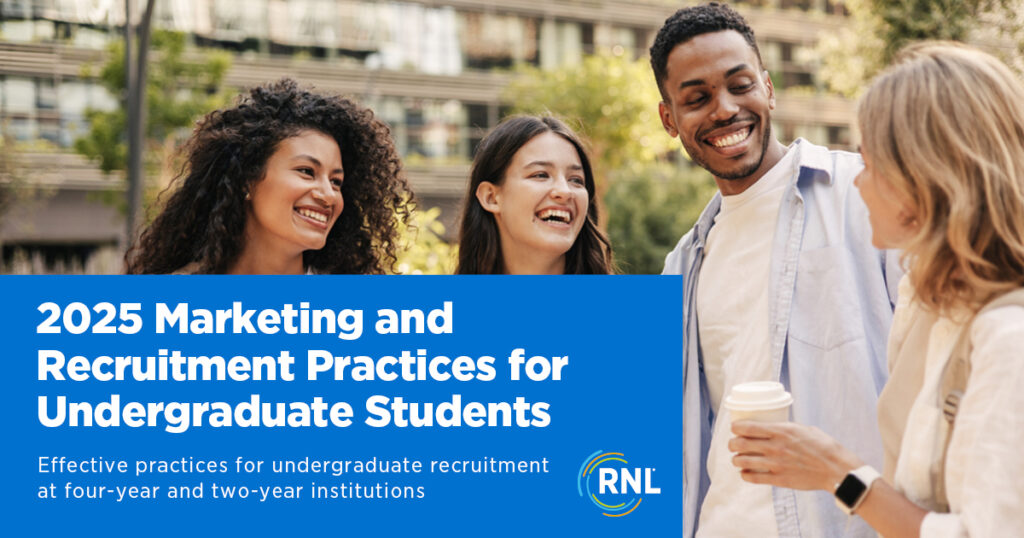
    2025 Marketing and Recruitment Practices for Undergraduate Students: Effective practices for undergraduate recruitment at four-year and two-year institutions.2025 Marketing and Recruitment Practices for Undergraduate Students: Effective practices for undergraduate recruitment at four-year and two-year institutions.

    The data is clear. The student voices are loud. Counselors are the backbone of college access. Supporting them isn’t just good practice, it’s the smartest move you can make.

    Don’t make counselors an afterthought. Make them the center of your strategy. The future of college access runs right through their office, so knock on their door and bring something valuable to the table.

    To learn more about the most impactful enrollment and marketing strategies, download our report.

    Source link

  • College Closings: Are We Really That Surprised?

    College Closings: Are We Really That Surprised?

    Spotting the red flags of college closings before it’s too late

    What are the warning signs that could lead to a college closing?

    Over the last month, two more private schools have announced their closures.  St. Andrews University in Laurinburg, NC, and Limestone University in Gaffney, SC.  In both cases, as with any college closings, the result is disheartening to the current state of higher education. It is also never something those enrolled students expected or signed up for. Peer institutions have readily come forward to offer transfer-friendly options for those students.

    What has also struck me about college closings like these is how the media portrays these closings as “sudden” or “abrupt.” I have been in higher education for over 20 years, both on a campus as a chief enrollment officer and now at RNL in an executive role. College closings are not sudden or abrupt. The warnings and red flags show themselves years before such a dire decision is made by a board of trustees.

    Key metrics for institutional health and viability

    For any institution, but especially private ones, there are key metrics that impact their health and viability. They include, but are certainly not limited to:

    • Net tuition revenue as a cohort class and per student
    • The long-term health of your lead/prospect pool
    • The cost of recruiting a prospective student
    • The cost to educate and operate an academic program
    • Student retention rates dropping yearly and hovering under national/regional benchmarks
    • An increase in discount rates while headcount/net tuition revenue stays flat or down

    Metrics diagnose the problem. They do not solve it.

    The majority of these metrics are probably not surprising for most institutions. However, the ability to understand why a campus lags behind in these critical areas is key to rectifying such challenges. There lies half the problem usually. Too often, metrics serve as a perceived solution for a problem. Here are two examples I have seen:

    Example 1: A campus throws more money to students to hopefully increase their headcount and gain revenue. That is a short-term solution that then saddles the institution with a bigger problem—a high discount rate that will likely increase another 3-5% during the student’s time on campus. That is not a sustainable model.

    Example 2: An institution introduces new programs without conducting viable external research and setting realistic student enrollment goals. The tuition revenue needed has to offset the cost of starting a new program, hiring faculty, and supporting marketing efforts. If new programs are not hitting targeted goals, the institution has to quickly pivot and determine if there is a tangible market of students to recruit for such a program over the next 3-4 years.

    The examples could go on and on.

    Fixing issues before they become insurmountable

    Most institutions are not blind to their current situation regarding the above metrics. They strive to maintain a healthy enrollment, financial stability, and a quality experience for students. They also know when those metrics become red flags. The massive challenge right now in higher education is trying to solve for those red flags in real time and with very “real” budgets. We should not be surprised at unfortunate closures in our industry. Most campuses certainly are not. The real objective is to win the “race” of addressing and fixing the problems 3-4 years before they become insurmountable.

    How do you do that in a systematic, data-reliant way that helps you make the right read and identify the right strategies to hit the brakes and reverse course before you hit the cliff? That’s something my colleagues and I partner with institutions on all of the time. We do evaluations or “scans” for key items such as the admissions/recruitment strategies and organization, the fiscal health of the institution, alignment of academic programs with market demand, and similar areas that are critical for institutional viability.

    I welcome the opportunity to connect and talk about strategies for your institution. Feel free to email me to discuss your challenges and what can be done to put your campus on the track to sustainable success. We have helped many institutions come back from the brink and keep even more from reaching that point.

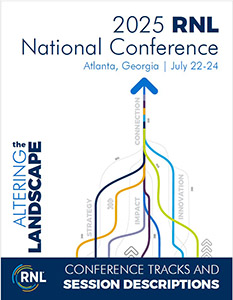
    Attend the 2025 RNL National Conference

    Choose from more than 120 sessions across six tracks:

    • Undergraduate marketing and recruitment
    • Graduate and online enrollment
    • Student success
    • Financial aid
    • Strategic planning
    • AI and innovations

    See the session descriptions and save big when you register early.

    2025 RNL National Conference Session Descriptions

    Source link

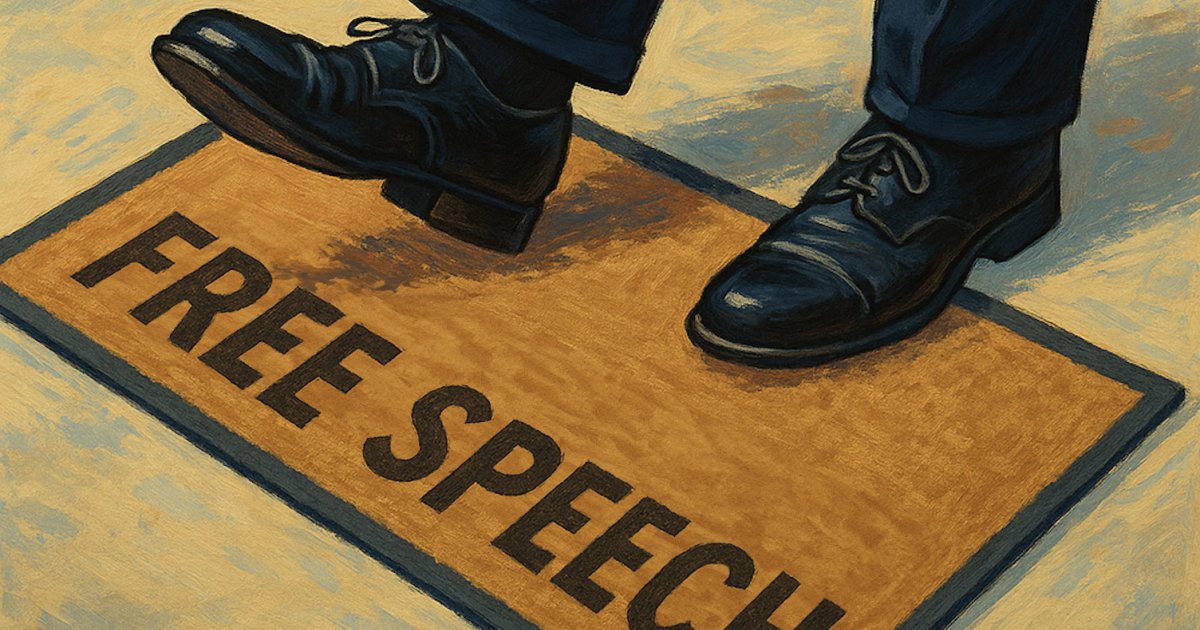
  • UC Irvine is crusading over student doormats — and wiping its feet on the Constitution

    UC Irvine is crusading over student doormats — and wiping its feet on the Constitution

    You don’t think much about doormats unless you’re at HomeGoods, but they serve many purposes — a place to wipe your shoes, a way to distinguish otherwise identical-looking apartments, and a vessel for personal expression, whether serious or funny. 

    Graduate student Amelia Roskin-Frazee chose the last of these. Her UC Irvine apartment doormat read, “No Warrant. No Entry.”

    For that alone, UC Irvine is now subjecting Roskin-Frazee and other students to disciplinary proceedings, ordering them to remove personalized doormats or face punishment.

    “Doesn’t UC Irvine have anything better to do than to censor my doormat?” said Roskin-Frazee. “The university should refocus its energy where it belongs: on educating its students.”

    Administrator admits to selective policy enforcement

    The dispute dates back to late 2023, when Roskin-Frazee emailed an administrator to express her concerns about a university policy banning “any signage in windows or on doors facing outside that have words on them.” She (rightly) argued the rule could violate students’ expressive rights and raised concerns about censorship — particularly regarding speech about LGBT issues and sexual assault awareness.

    In response, the coordinator cited an even broader university housing policy that prohibits “[a]ll outward‐facing signs, decorations, and expressions in windows/on doors.” While restricting certain types of signs or flags in windows for fire safety reasons may be reasonable under the First Amendment, this total ban is not narrowly tailored to those specific concerns.

    Worse, the coordinator added that the policy is selectively enforced based on content, explaining that the office probably wouldn’t ask someone to remove a holiday snowflake display but that it has asked “people to take down things like Pride flags, country flags, and advertisements for businesses.” 

    This is classic content discrimination. 

    Back in 2005, Pastor Clyde Reed of Good News Community Church put up a few signs directing people to his Sunday service in Gilbert, Arizona. But the town’s sign code restricted how large signs could be and how long they could stay up depending on what they said. So Reed sued, and 10 years later in the landmark case Reed v. Town of Gilbert, the Supreme Court said that if a law treats speech differently based on its content, it’s probably unconstitutional.

    Free speech means free speech. You don’t get to play favorites based on what the message says. Reed helped remind the country that the First Amendment isn’t just a suggestion. But apparently, UC Irvine never got the memo.

    Students threatened with punishment for doormats

    On April 14, 2025, the same administrator notified Roskin-Frazee that her doormat could violate yet another onerous university policy that says only doormats “without words or images” are allowed — and ordered her to remove it.

    It’s hard to imagine this sort of content discrimination serves a compelling university interest, because it’s not about the actual doormat—it’s about the expression on the doormat. If doormats present a risk to safety in the hallways, for instance, by impeding the ability of emergency services to move in the hallway, shouldn’t any doormat pose that kind of risk? Why does the message on the doormat matter?

    FIRE wrote to the university on April 21 explaining that the UC Irvine cannot “maintain speech-restrictive policies that it enforces only when staff or administrators disapprove of the content or viewpoint of speech,” and urging it to refrain from punishing or threatening to evict Roskin-Frazee from her apartment because of her doormat.

    The university responded to us on April 23, telling us that it was not threatening Roskin-Frazee with eviction. That’s a relief. But our concerns about these policies and their enforcement remain. 

    Flawed policies lead to flawed enforcement

    FIRE wrote to the university again on May 14, taking issue with its broader policies on displays. As we told the university, it “has discretion to impose restrictions on unprotected speech, such as obscenity or images for which the university holds a copyright. But banning any expressive doormat, regardless of whether the doormats pose any safety concerns or otherwise violate university policy or the law, is not a reasonable time, place, and manner restriction of protected speech.”

    Targeting doormats for removal based on their content violates the First Amendment. Period. 

    The university’s policies on outward-facing displays are similarly flawed. Why would an outward-facing display in an apartment pose a different safety or fire risk than an inward-facing display? Delineating between displays like signs or posters based on whether or not they’re visible from the outside, as opposed to whether or not they pose fire or safety risks, is a restriction on student expression, plain and simple.  

    Chancellor Howard Gillman knows this better than most. After all, he wrote his doctoral thesis on constitutional ideology. This isn’t hard. UC Irvine must reform its policies to align with the First Amendment. 

    Source link

  • Belfast hip-hop group Kneecap at the center of international firestorm

    Belfast hip-hop group Kneecap at the center of international firestorm

    Last year, FIRE launched the Free Speech Dispatch, a regular series covering new and continuing censorship trends and challenges around the world. Our goal is to help readers better understand the global context of free expression. Want to make sure you don’t miss an update? Sign up for our newsletter


    Kneecap spurs controversy in the U.S. and investigation in the UK as narcocorridos controversy roils Mexico

    Belfast trio Kneecap’s public statements at Coachella and earlier concerts have caused an international stir, and now even the UK’s counter-terrorism police are involved. 

    The band, already no stranger to controversy, provoked it once again during its Coachella performances by displaying the message, “Israel is committing genocide … enabled by the US,” adding, “Fuck Israel. Free Palestine.”

    In the following days, they were uninvited from music festivals in Germany as well as split with their booking agency in the U.S., meaning that the band is likely to face work-visa issues in its upcoming American tour. (And, given the Trump administration’s current track record on the subject, it would not be surprising to see them face visa challenges on the basis of their expression.) 

    In addition to the Coachella dustup, the group’s past comments have stirred new threats of legal action in the UK, specifically an “Up Hamas, up Hezbollah” chant at a 2024 gig and a band member’s comment at a show the year prior: “The only good Tory is a dead Tory. Kill your local MP.”

    Metropolitan police said videos of both comments “were referred to the Counter Terrorism Internet Referral Unit for assessment by specialist officers, who have determined there are grounds for further investigation into potential offences linked to both videos.” A UK government spokesperson also said that authorities will “work with the police and parliament to do everything in our power to crack down on threats to elected officials.” (In the U.S., these comments would not meet either the incitement standard or qualify as material support for terrorism, and would be protected by the First Amendment.) And British politicians have made calls including for their disinvitation from Glastonbury as well as prosecution for the “Kill your local MP” remark. 

    A group of artists including Massive Attack and Pulp issued a statement against what they called a “clear, concerted attempt to censor and ultimately deplatform the band Kneecap.” The band also objected to what it calls a “smear campaign” to “manufacture moral hysteria” but asserted they “do not, and have never, supported Hamas or Hezbollah” and would not “seek to incite violence against any MP or individual. Ever.”

    Some similar questions are at play in Mexico over narcocorridos, ballads about drug trafficking. Mexican President Claudia Sheinbaum says her “position is that it should not be banned, but that other music should be promoted.” In recent weeks, though, some Mexican states have taken action against the genre.

    And last month, U.S. Deputy Secretary of State Christopher Landau announced on X that the State Department revoked the visas of a band who “portrayed images glorifying drug kingpin ‘El Mencho’” at a concert in Mexico. “I’m a firm believer in freedom of expression,” Landau wrote, “but that doesn’t mean that expression should be free of consequences.”

    The band, Los Alegres del Barranco, may also be facing criminal charges in Mexico “for allegedly promoting criminal activity.”

    The UK’s blasphemy debate is still going 

    Kneecap’s political commentary isn’t the only free expression controversy in the UK. As I’ve discussed in previous dispatches, UK-based activists have set off global controversies in recent months with public Quran burnings resulting in criminal charges. 

    The Crown Prosecution Service received well-deserved criticism over its decision to charge a man who burned a Quran outside the Turkish consulate in London with intent to cause “harassment, alarm or distress” against “the religious institution of Islam.” There is no other way to put it: protecting a religious institution from “distress” is a blatant blasphemy law.

    In response to critics, the CPS admitted the charge was “incorrectly applied” and has substituted a different charge, a public order offense “on the basis that his actions caused harassment, alarm or distress — which is a criminal offence — and that this was motivated by hostility towards a religious or racial group.” 

    This prosecution, however, remains a serious threat to free expression and the public debate around it suggests this matter is far from settled. In an exchange on X, one member of parliament chastised another for “invest[ing] so much energy into advocating for the right to offend a minority community” and warned that free expression “comes with limitations and protections.”

    From Xi’s critics to Israeli protests, political speech is under attack

    • In a recent episode of his HBO show “The Rehearsal,” Nathan Fielder reveals Paramount+ removed an older “Nathan for You” episode from streaming everywhere after Paramount+ Germany became “uncomfortable with what they called anything that touches on antisemitism in the aftermath of the Israel/Hamas attacks.” That episode focused on Fielder’s satirical pitch for a winter coat company to compete with a real life brand affiliated with a Holocaust denier. (From the stunt, Fielder “likely raised millions of dollars toward Holocaust awareness.”)
    • Israeli police temporarily warned organizers of a Tel Aviv protest that demonstrators could not use images of Palestinian children and terms like “genocide” and “ethnic cleansing” in protest signs.
    • A new Human Rights Watch report finds that Vietnam is ramping up enforcement of its law targeting expression “infringing of state interests.” Now “authorities have enlarged the scope and application of article 331 so that it reaches much further into society, beyond human rights and democracy dissidents — most of whom are now in prison — to all those publicly voicing grievances.”
    • A Thai appeals court sentenced a democracy activist to two years in prison for violating the country’s harsh lese-majeste law. In 2022, she posted on Facebook, “The government is shit, the institution is shit.”
    • Paul Chambers, the American academic charged with lese-majeste in Thailand, received good news but he’s not out of the woods yet. Prosecutors announced they declined to pursue the charges against him but that decision will face further review.
    • At April’s Semafor World Economy Summit, Netflix Co-CEO Ted Sarandos shared that the company previously attempted to build a presence in China but “in three years, not a single episode of a single Netflix show cleared the censorship board.”
    • China has disappeared another “Bridge Man.” In an incident similar to one that set off a global protest movement in 2022, an activist hung banners calling for political reform over a bridge outside Chengdu last month and was quickly detained — and his whereabouts are now unknown.


    • An investigation of China’s transnational repression methods from the International Consortium of Investigative Journalists found that during “at least seven of Xi’s 31 international trips between 2019 and 2024, local law enforcement infringed on dozens of protesters’ rights in order to shield the Chinese president from dissent, detaining or arresting activists, often for spurious reasons.”
    • Last month, the U.S. Department of Justice announced that, at the DOJ’s request, Serbian law enforcement arrested two men alleged to have “coordinated and directed a conspiracy to harass, intimidate, and threaten” a Los Angeles-based critic of Xi Jinping.
    • Hong Kong’s national security police arrested family members of the U.S.-based activist Anna Kwok, who is wanted under the city’s national security law, for handling her “funds or other financial assets.”

    Conflict with Pakistan brings spike in India’s censorship 

    India’s censorship, especially on the internet, is a persistent threat to free expression, and the country’s recent flare-up with Pakistan has worsened the situation. Dozens have been arrested for “anti-India comments” on social media and “content supporting Pakistan.”

    In a May 8 notice, the Ministry of Information and Broadcasting advised all social media sites and streaming services to “discontinue” content “having its origins in Pakistan with immediate effect.”

    At the government’s request, Meta blocked the 6.7 million follower Instagram account @Muslim, one of “the most followed Muslim news sources on Instagram.” X, too, announced it received orders to block over 8,000 users in the country, including “accounts belonging to international news organizations and prominent X users.” X complied and said “due to legal restrictions, we are unable to publish the executive orders at this time” but is exploring avenues to respond. 

    YouTube, too, is a target. Officials blocked over a dozen Pakistani YoutTube channels for “disseminating provocative and communally sensitive content, false and misleading narratives and misinformation against India.” India’s Ministry of Electronics and Information Technology also restricted access to The Wire, an independent news site, throughout the country.

    The latest wins, losses, and challenges for free speech in tech

    • It’s not all bad news for free expression in India. This month, India’s Supreme Court reversed a ruling from the Delhi High Court ordering Wikipedia to take down a Wiki page amidst Asian News International’s lawsuit against the Wikimedia Foundation.
    • The Wikimedia Foundation is also taking on the UK’s Online Safety Act. The foundation is specifically challenging the act’s Categorisation Regulations, which “are written broadly enough that they could place Wikipedia as a ‘Category 1 service’ — a platform posing the highest possible level of risk to the public.” Among Wikimedia’s objections are the risks this classification poses to its users’ privacy and anonymity.
    • Meta secured a significant victory against Israeli spyware company NSO Group, with a jury awarding $168 million in damages. The NSO Group was accused of exploiting Meta’s WhatsApp to install its Pegasus spyware program, which has been used in high profile hacks of lawyers, journalists, and activists, into over a thousand phones.
    • X, a regular target of Turkish censorship orders, complied with an order to block the account of imprisoned Istanbul Mayor Ekrem Imamoglu, a rival of President Recep Tayyip Erdogan. X says it is challenging the order.
    • Bluesky has complied with Turkish orders, too. The platform restricted access to dozens of accounts in the country on “national security and public order” grounds.
    • Russia restricted internet access in regions of the country ahead of its “Victory Day” celebrations on May 9. “We want the glorious Victory Day to be celebrated at the appropriate level,” Kremlin spokesman Dmitry Peskov said of the shutdowns.

    U.S. embassy warns Stockholm against ‘promoting DEI’

    Stockholm announced this month that it was surprised to receive a “bizarre” letter from the U.S. embassy in the city. The letter, copies of which went to contractors abroad who work with the federal government, told Stockholm’s planning office to “certify that they do not operate any programs promoting DEI that violate any applicable anti-discrimination laws.” Companies in Europe have reported receiving these letters, but Stockholm’s planning office is the first government agency known to have received one. Officials conveyed that they would not be complying.

    Embassies’ efforts to interfere with expression abroad are an issue I discuss at length in my forthcoming book, Authoritarians in the Academy. In 2021, for example, the Chinese embassy unsuccessfully pressured the Italian city of Brescia to cancel an art exhibition it claimed would “endanger the friendly relations between Italy and China” because it was “full of anti-Chinese lies.”

    How press freedom is faring today

    • Argentine President Javier Milei is suing three journalists for defamation for their criticism of him, including a column comparing current events with the rise of Nazism and comments calling him an “authoritarian” and a “despot.”
    • Swedish journalist Joakim Medin was hit with an 11-month suspended sentence for insulting the Turkish president and is awaiting a trial on terrorism charges. Medin says he was not even in the country when the alleged conduct took place.
    • Israel’s Attorney General Gali Baharav-Miara warned government agencies that their boycott of the media outlet Hareetz over its coverage of the Israel-Hamas war “was conducted through an improper process that cannot be upheld legally.”
    • Former Sinn Féin leader Gerry Adams’ libel suit against the BBC over reporting that he sanctioned a killing in 2006 is underway. BBC says the reporting followed its editorial standards.
    • Two reporters were detained in Macau, a special administrative region of China, for allegedly “disrupting the operations” of authorities after trying to report on a legislative debate.
    • Four Russian journalists accused of having ties to Alexey Navalny were sentenced to over five years in a prison colony last month.
    • Palestinian President Mahmoud Abbas reversed the ban on Al Jazeera, permitting it to resume reporting, after it banned the outlet in January on incitement allegations.

    Finally, some good news for a victim of blasphemy laws

    Mubarak Bala, a Nigerian humanist initially sentenced to 24 years in prison, is finally tasting freedom upon being released after spending over four years in prison. Mubarak still feared mob violence after his release, and was forced to live in a safe house due to threats. 

    Protesters holds up a piece of paper with Mubarak Bala's name

    But Bala has now arrived in Germany, where he is set to begin a residency at Humanistische Vereinigung. “No longer do I dread the routine sounds of the locks, nor the dark, certainly not the extreme weather, too hot or too cold, no longer ill, no longer hungry, no longer lonely, and no longer dreading that the marauders are coming across the fence, to drag me out and behead me,” Bala said in a statement.

    The Community Court of the Economic Community of West African States, a high court governing 12 African nations including Nigeria, found last month that a blasphemy statute used to prosecute Bala must be struck down. The Kano State government, however, defended its blasphemy laws and said it “will not allow religious liberty to be weaponized as a cover for sacrilege, insult, and provocation.”

    Source link

  • Balancing Technology and Connection in College Recruitment

    Balancing Technology and Connection in College Recruitment

    Let’s be real: college planning is not the only thing on your prospective students’ minds. They’re juggling school, jobs, relationships, social media, and, you know, just trying to figure out life. So, when we talk about AI in college planning, it’s crucial to remember that it’s just one piece of a much larger puzzle.

    At RNL, we’re constantly looking at the trends shaping higher education, and AI is definitely a big one. But here’s the thing: it’s not a one-size-fits-all solution. To truly connect with students, you need to understand how they’re using (or not using) these tools, and meet them where they are.

    It’s all about personas

    Our latest research dives deep into student attitudes toward AI in college planning, and the results are fascinating. We’ve identified four key “AI Adoption Personas” that can help you tailor your outreach and messaging:

    Pioneers (early adopters, enthusiastic users): These digital natives are all-in on AI, using it for everything from college research to essay writing.

    • Key takeaway: Pioneers are already on board but value human guidance. 76% would feel more comfortable if a school advisor explained the benefits and risks of AI.

    Aspirers (interested but cautious adopters): Aspirers see the potential of AI but need a little nudge.

    • Key takeaway: Show them the value! 51% are motivated by easy access to free AI tools, and 41% want to see success stories from other students.

    Fence Sitters (uncertain, passive users): These students are on the fence about AI, often lacking confidence in their current college planning approach. Y

    • Key takeaway: Don’t overwhelm them. 40% haven’t even used online college planning tools! Focus on highlighting the potential of AI and offering advisor support.

    Resistors (skeptical, avoid AI in college planning): Resistors are the most reluctant to embrace AI, preferring traditional methods like guidance counselors and college websites.

    • Key takeaway: Respect their preferences, but don’t write them off entirely. 48% would feel more comfortable with an advisor explaining AI, even if they’re not ready to use it themselves.

    Beyond the bots: human connection still matters

    Image of high school students looking at the cell phones

    No matter which persona your students fall into, one thing is clear: human connection still matters. While AI can provide valuable information and streamline certain tasks, it can’t replace the empathy, guidance, and personalized support students crave.

    Think about it: choosing a college is a huge life decision, and students want to feel understood and supported throughout the process.

    Our research shows that students use a variety of resources for college planning, and these often involve human interaction:

    • College websites (often reviewed with parents or counselors)
    • Parents/family (a trusted source of advice and support)
    • Social media (connecting with current students and alumni)
    • Guidance counselors (providing expert advice and personalized recommendations)
    • Friends/peers (sharing experiences and offering encouragement)
    • Books/online articles (supplementing their knowledge and exploring different options)

    AI is just one tool in their toolbox. It’s a powerful tool, no doubt, but it works best when it complements these other resources, rather than replacing them.

    What does this mean for you?

    It means your staff—admissions counselors, enrollment specialists, and marketing team—are more important than ever. They are the human face of your institution, who can build relationships with prospective students, answer their questions, and alleviate their anxieties.

    The good news is that institutions already know this. Our 2025 Marketing Practices For Undergraduate Students Report confirms that “human-based” enrollment strategies are consistently rated highly effective, often more effective than just two years ago.

    For example, the report shows that:

    • In-person meetings remain a top strategy across all institution types (4-year private, 4-year public, and 2-year), with effectiveness ratings consistently at or near 100%.
    • Personalized videos sent directly to students have seen a significant rise in effectiveness, particularly for 4-year institutions.
    • Even with the rise of digital tools, strategies like SMS, social media, and email communications remain foundational and highly effective, largely because they enable personalized, one-on-one communication.

    These findings underscore that in an increasingly digital world, the human touch truly sets institutions apart.

    Here are a few ways to bring that human touch to your college planning efforts:

    • Invest in training for your staff. Ensure they understand AI’s benefits and limitations, and how to integrate it ethically and effectively into their work.
    • Encourage personalized communication. Don’t rely solely on automated emails and chatbots. Encourage your staff to contact students individually, offering tailored advice and support.
    • Create opportunities for connection. Host virtual or in-person events where students meet current students, faculty, and staff.
    • Highlight the human stories. Share stories of successful alumni, dedicated faculty, and supportive staff. Show prospective students what makes your institution unique.

    Ultimately, success in today’s ever-evolving higher education landscape hinges on a delicate balance: embracing the power of technology like AI while never losing sight of the fundamental importance of human connection.

    By deeply understanding your students – their individual needs, their preferred college planning resources, and their unique “AI Adoption Persona” – and leveraging data to personalize their experience, you can create an effective and genuinely human recruitment and enrollment strategy.

    It’s about blending the efficiency of AI with the empathy and guidance that only your dedicated staff can provide, ensuring that every student feels seen, supported, and confident in their college journey.

    Ready to dive deeper?

    Do you want to learn more about AI in college planning and how to connect with today’s students?

    3 Reasons to Attend the RNL National Conference

    Join us in Atlanta July 22-24 for the most comprehensive conference on enrollment and student success.

    1. Choose from more than 120 sessions on recruitment, retention, financial aid, and more.
    2. Hear the keynote from former Secretary of Education Dr. Miguel Cardona on the future of higher education.
    3. Interact with campus professionals and national experts about ways you can achieve your goals.

    See all the details

    Source link

  • A new regulatory framework is more than Medr by numbers

    A new regulatory framework is more than Medr by numbers

    Medr, the new-ish regulator of tertiary education in Wales, is consulting on its new regulatory system (including conditions of registration and funding, and a quality framework).

    You have until 5pm 18 July 2025 to offer comments on any of the many ideas or potential requirements contained within – there’s also two consultation events to look forward to in early June.

    Regulatory approach

    As we are already aware from the strategy, Medr intends to be a principles-based regulator (learning, collaboration, inclusion, excellence) but this has been finessed into a regulatory philosophy that:

    integrates the strengths of both rules-based (compliance) and outcome-based regulation (continuous improvement)

    As such we also get (in Annex A) a set of regulatory principles that can support this best-of-both-worlds position. The new regulator commits to providing clear guidance and resources, transparent communication, minimising burden, the collaborative development of regulations and processes, regular engagement, proactive monitoring, legal and directive enforcement action, the promotion of best practice, innovation and “responsiveness”, and resilience.

    That’s what the sector gets, but this is a two way thing. In return Medr expects you to offer a commitment to compliance and integrity, to engage with the guidance, act in a transparent way (regarding self-reporting of issues – a “no alarms and no surprises” approach), practice proactive risk management and continuous improvement, collaborate with stakeholders, and respect the authority of Medr and its interventions.

    It’s all nicely aspirational, and (with half an eye on a similar regulator just over Offa’s Dyke) one appropriately based on communication and collaboration. Whatever Medr ends up being, it clearly does not want an antagonistic or suspicious relationship with the sector it regulates.

    Getting stuck in

    The majority of the rest of Annex A deals directly with when and where Medr will intervene. Are you even a regulator if you can’t step in to sort out non-compliance and other outbreaks of outright foolishness? Medr will have conditions of registration and conditions of funding, both of which have statutory scope for intervention – plus other powers to deal with providers it neither registers nor funds (“external providers”, which include those involved in franchise and partnership activities, and are not limited to those in Wales).

    Some of these powers are hangovers from the Higher Education (Wales) 2015 Act, which are already in force – the intention is that the remaining (Tertiary Education and Research Act 2022) powers will largely kick off from 1 August 2026, alongside the new conditions of funding. At this point the TERA 22 powers will supersede the relevant remaining HEW 2015 provision.

    The spurs to intervention are familiar from TERA. The decision to intervene will be primarily based on six factors: seriousness, persistence, provider actions, context, risk, and statutory duties – there’s no set weight accorded to any of them, and the regulator reserves the right to use others as required.

    A range of actions is open in the event of an infraction – ranging from low-level intervention (advice and assistance) to removal from the register and withdrawal of funding. In between these you may see enhanced monitoring, action plans, commissioned reports and other examples of what is euphemistically termed “engagement”. A decision to intervene will be communicated “clearly” to a provider, and Medr “may decide” to publish details of interventions – balancing the potential risks to the provider against the need to promote compliance.

    Specific ongoing registration conditions are also a thing – for registered providers only, obviously – and all of these will be published, as will any variation to conditions. The consultation document bristles with flowcharts and diagrams, setting out clearly the scope for review and appeal for each type of appeal.

    One novelty for those familiar with the English system is the ability of the regulator to refer compliance issues to Welsh Ministers – this specifically applies to governance issues or where a provider is performing “significantly less well than it might in all the circumstances be reasonably expected to perform, or is failing or likely to fail to give an acceptable standard of education or training”. That’s a masterpiece of drafting which offers a lot of scope for government intervention.

    Regulatory framework

    Where would a regulator be without a regulatory framework? Despite a lot of other important aspects in this collection of documents, the statement of conditions of registration in Annex B will likely attract the most attention.

    Financial sustainability is front and centre, with governance and management following close behind. These two also attract supplemental guidance on financial management, financial commitment thresholds, estates management, and charity regulation. Other conditions include quality and continuous improvement, regard to advice and guidance, information provided to prospective students, fee limits, notifications of changes, and charitable status – and there’s further supplemental guidance on reportable events.

    Medr intends to be a risk-based regulator too – and we get an overview of the kinds of monitoring activity that might be in place to support these determinations of risk. There will be an annual assurance return for registered providers, which essentially assures the regulator that the provider’s governing body has done its own assurance of compliance. The rest of the returns are listed as options, but we can feel confident in seeing a financial assurance return, and various data returns, as core – with various other documentation requested on a more adhoc basis.

    And – yes – there will be reportable events: serious incidents that must be reported within five working days, notifiable (less serious) stuff on a “regular basis”. There’s a table in annex B (table 1) but this is broad and non-exhaustive.

    There’s honestly not much in the conditions of registration that is surprising. It is notable that Medr will still need to be told about new financial commitments, either based on a threshold or while in “increased engagement”, and a need to report when it uses assets acquired using public funds as security on financial commitments (it’s comforting to know that exchequer interest is still a thing, in Wales at least).

    The quality and continuous improvement condition is admirably broad – covering the involvement of students in quality assurance processes, with their views taken into account (including a requirement for representation on governing bodies). Responsibility for quality is expected to go all the way up to board level, and the provider is expected to actively engage with external quality assurance. Add in continuous improvement and an expectation of professional development for all staff involved in supporting students and you have an impressively robust framework.

    We need also to discuss the meaning of “guidance” within the Medr expanded universe – providers need to be clear about how they have responded to regulatory guidance and justify any deviation. There’s a specific condition of registration just for that.

    Quality framework

    Annex C provides a quality framework, which underpins and expands on the condition of registration. Medr has a duty to monitor and promote improvement in the quality and standards of quality in tertiary education, and the option in TERA 2022 to publish a framework like this one. It covers the design and delivery of the curriculum, the quality of support offered to learners, arrangements to promote active learner engagement (there’s a learner engagement code out for consultation in the autumn), and the promotion of wellbeing and welfare among learners.

    For now, existing monitoring and engagement plans (Estyn and the QAA) will continue, although Medr has indicated to both that it would like to see methodologies and approaches move closer together across the full regulatory ambit. But:

    In due course we will need to determine whether or not we should formally designate a quality body to assess higher education. Work on this will be carried out to inform the next cycle of external quality assessments. We will also consider whether to adopt a common cycle length for the assessment of all tertiary education.

    There is clarity that the UK Quality Code applies to higher education in Wales, and that internal quality assurance processes need to align to the European Standards and Guidelines for Quality Assurance (ESG) – external quality assurance arrangements currently do, and will continue to, align with ESG as well.

    To follow

    Phase two of this series of consultations will come in October 2025 – followed by registrations opening in the spring of 2026 with the register launched in August of that year. As we’ve seen, bits of the conditions of registration kick in from 1 August 2027 – at which point everything pre-Medr fades into the storied history of Welsh tertiary education.

    Source link