Author: admin

  • Understanding the Impact of Workplace Incivility in Higher Education – Faculty Focus

    Understanding the Impact of Workplace Incivility in Higher Education – Faculty Focus

    Source link

  • Understanding the Impact of Workplace Incivility in Higher Education – Faculty Focus

    Understanding the Impact of Workplace Incivility in Higher Education – Faculty Focus

    Source link

  • Labour is learning the wrong lessons from Reform on immigration

    Labour is learning the wrong lessons from Reform on immigration

    The working classes are an easy foil for the dreams of conservative politicians. They are the salt of the earth, proper people who do real stuff, unlike the woke metropolitan elite who sit around and think things but are removed from the real world.

    As Joel Budd points out in his new book Underdogs The Truth About Britain’s White Working Class, they are to the conservative imagination “sensible truth-tellers and bulwarks against left-wing nonsense.” Even more so they are the consensus position on immigration “The mass immigration that the elite has tolerated is crushing their wages, burdening the public services they rely on and filling their neighbourhood with strangers.” As Budd also points out this, well, isn’t true. In 2024 they voted for Starmer’s Labour Party who campaigned on public finances, NHS, and inflation.

    New Labour old problems

    It is with this in mind that Labour’s response to Reform’s election performance is as wrong as it is entirely predictable. Its wrongness could have significant consequences for universities.

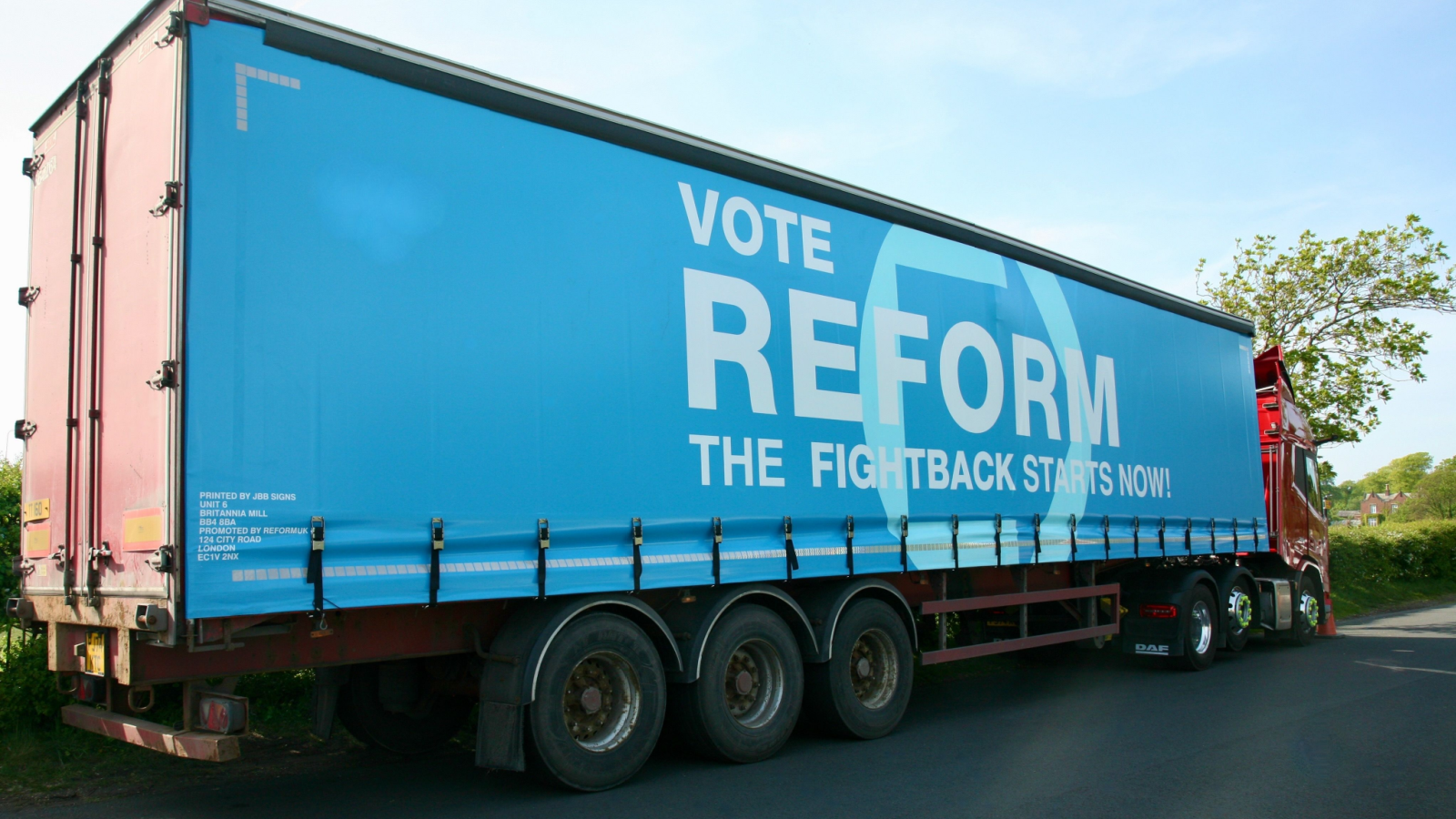
    Let’s start with the big results. In May’s local elections in England Reform gained 677 councillors,ten councils, two mayors, and an MP. The votes are spread across the country but as John Curtice points out for the BBC there is an education faultline.

    Reform did best in places that most overwhelmingly voted for Brexit. University graduates overwhelmingly did not vote for Brexit. Reform received less than 20 per cent of the vote in wards where more than two in five people have a degree compared to 43 per cent in wards where over half of adults have few qualifications. As Curtice states

    In summary, Reform did best in what has sometimes been characterised in the wake of the Brexit referendum as ‘left-behind’ Britain – places that have profited less from globalisation and university expansion and where a more conservative outlook on immigration is more common.

    The policy solution alighted on by outriders in the Labour Party has so far been to say that Reform has done well therefore Labour should do things that appeal to the kind of people that vote for Reform. Or, at least, the kind of things Labour assumes appeal to the people that vote for Reform. And one of the key assumptions is that getting immigration down, whoever those immigrants might be, including students, is necessary for their electoral survival.

    Blue Labour redux

    University of Oxford graduate, and Blue Labour standard bearer, Jonathan Hinder MP has said he would not be “that disappointed” if universities went bust because of reducing international student immigration. Presumably he does not mean his own alma mater. Jo White, of the Red Wall Caucus, has urged Labour to “take a leaf out of President Trump’s book” when it comes to immigration. The end of the Labour Party which purports to be closer to its working class roots is moving rapidly and decisively against immigration. Tightening restrictions on graduates, and by extension making the UK a less attractive place to study, has been reported as an idea winning favour at the Home Office.

    The issue with the general public is that it is complicated. On its own, reducing student immigration will not win Labour a single vote in Runcorn in Helsby where Reform most recently won an MP. For a start Runcorn does not have a university so it will certainly not address immigration issues brought up during the election. Runcorn does however have several organisations that benefit from a vibrant university sector. SME net-zero collaboration with Lancaster. INEOS which benefits from the proximity of a university workforce and industrial collaborations. And Riverside College, amongst other examples, as a franchise partner of the University of Staffordshire.

    It is also worth making entirely clear that people in Runcorn also go to university. It’s a particular fault of both an understanding of class and an understanding of universities that this conflation is often made.

    Immigration, immigration, immigration

    If reducing student immigration will not make a material difference perhaps it will signal a vibes shift that will bring places like Runcorn on side. Again, here is where the working class will let you down. Analysis of the British Election Study collated by Joel Budd demonstrates that “Young white working-class people are not as liberal as young white middle-class people. But when it comes to immigration and race, they resemble them more closely than they resemble old white working-class people.” Again, there is just not a long term winning strategy in discouraging student and graduate migration.

    For universities this might be comforting but it isn’t the point.

    The extent to which anyone is willing to defend student immigration is the question of the extent to which they are willing to defend the value of universities. The value of universities is felt in exports and jobs but it is most directly felt on the extent to which the effects of a university make a place feel better. The thing that Boris Johnson, or at least his advisors, understood that higher education consistently has not is that people see politics through their places. Crime. Clean high streets. Local shops. Good jobs. Green spaces. Feeling safe to go out at night. And the myriad of tangible things that make up a place.

    In policy terms the absolute antithesis of levelling up are reforms which will depress international student numbers. The last thing Runcorn needs is a poorer Liverpool and weaker universities. The challenge for universities is to tilt the scale toward being popular not just being valuable. So popular as to make decisions on cutting student immigration culturally and electorally harder not just economically wrongheaded.

    The question then is how can universities do things in places that feel like they are doing good as well as actually doing good.

    A day like today is not for soundbites

    A key question is how infrastructure can be use toward a broad and good civic end. For example, of all of the things that the University of Liverpool did during Covid (of which there were many I have direct experience of, having worked there), the one that looms largest in my memory is when it gave up its car parks for NHS staff. Not the vaccines it helped develop or the PPE it manufactured but a low cost, high kindness gesture that resonated with people at the time. The other part of this is how largely universities loom in local communities. The extent to which their infrastructure, offices, shops, cafes, and other buildings and amenities are dispersed across the towns, cities, and localities so their presence has a resonance with the lives of people from day to day. People will often be aware of a university where it precedes the word hospital. There are opportunities for other collaborative infrastructures.

    Universities tend to be pretty good at turning their research into lectures, experiments, and days out for young people in an education setting. They are less good at making their research experiential for adults. Light Years by the University of Durham (full disclosure: I volunteer in supporting this work) has taken research to places people actually gather, places of worship, highstreets, and places of local interest across Durham county, as opposed to just the city.

    And it’s harder to articulate or even work out, but the extent to which local people feel universities are on their side matters. The cultural closeness universities build to their populations is not always about what they do but whether local people feeling it’s “their” or “the” university. There is no magic bullet for this beyond the slow grind of knowing a local place and acting with it.

    The political vibes risk overtaking a political reality. The key to Labour winning back its voters is to make tangible differences in the places they live. The economic headroom for them to do that runs through higher education institutions and their success. The permission to do so depends on people feeling like universities are a thing worth saving even with difficult political trades offs.

    Source link

  • What the latest HESA data tells us about university finances

    What the latest HESA data tells us about university finances

    The headlines from the 2023-24 annual financial returns were already pretty well known back in January.

    Even if you didn’t see Wonkhe’s analysis at the time (or the very similar Telegraph analysis in early May), you’d have been well aware that things have not been looking great for the UK’s universities and other higher education providers for a while now, and that a disquieting number of these are running deficits and/or making swingeing cuts.

    What the release of the full HESA Finance open data allows us to do is to peer even deeper into what was going on last academic year, and start making sense of the way in which providers are responding to these ongoing and worsening pressures. In particular, I want to focus in on expenditure in this analysis – it has become more expensive to do just about everything in higher education, and although the point around the inadequacy of fee and research income has been well and frequently made there has been less focus on just how much more money it costs to do anything.

    Not all universities

    The analysis is necessarily incomplete. The May release deals with providers who have a conventional (for higher education) financial year – one that matches the traditional academic year and runs through to the end of August. As the sector has become more diverse the variety of financial years in operation have grown. Traditional large universities have stayed with the status quo – but the variation means that we can’t talk about the entire sector in the same way as we used to, and you should bear this in mind when looking at aggregate 2023-24 data.

    A large number of providers did not manage to make a submission on time. Delays in getting auditor sign off (either because there was an audit capacity problem due to large numbers of local authorities having complex financial problems, or because universities themselves were having said complex financial problems) mean that we are down 18 sets of accounts. A glance down the list shows a few names known to be struggling (including one that has closed and one that has very publicly received a state bailout).

    So full data for the Dartington Hall Trust, PHBS-UK, Coventry University, Leeds Trinity University, Middlesex University, Spurgeon’s College, the University of West London, The University of Kent, University of Sussex, the Royal Central School of Speech and Drama, The Salvation Army, The London School of Jewish Studies, Plymouth Marjon University, the British Academy of Jewellery Limited, Multiverse Group Limited, the London School of Architecture, The Engineering and Design Institute London (TEDI) and the University of Dundee will be following some time in autumn 2025.

    Bad and basic

    HESA’s Key Financial Indicators (KFIs) are familiar and well-documented, and would usually be the first place you would go to get a sense of the overall financial health of a particular university.

    I’m a fan of net liquidity days (a measure showing the number of days a university could run for in the absence of any further income). Anything below a month (31 days) makes me sit up and take notice – when you exclude the pension adjustment (basically money that a university never had and would never need to find – it’s an actuarial nicety linked to to the unique way USS is configured) there’s 10 large-ish universities in that boat including some fairly well known names.

    [Full screen]

    Just choose your indicator of interest in the KFI box and mouse over a mark in the chart to see a time series for the provider of your choice. You can find a provider using the highlighter – and if you want to look at an earlier year on the top chart there’s a filter to let you do that. I’ve filtered out some smaller providers by default as the KFIs are less applicable there, but you can add them back in using the “group” filter.

    I’d also recommend a look at external borrowing as a percentage of total (annual) income – there are some providers in the sector that are very highly leveraged who would both struggle to borrow additional funds at a reasonable rate and are likely to have substantial repayments and stringent covenants that severely constrain the strategic choices they can make.

    Balance board

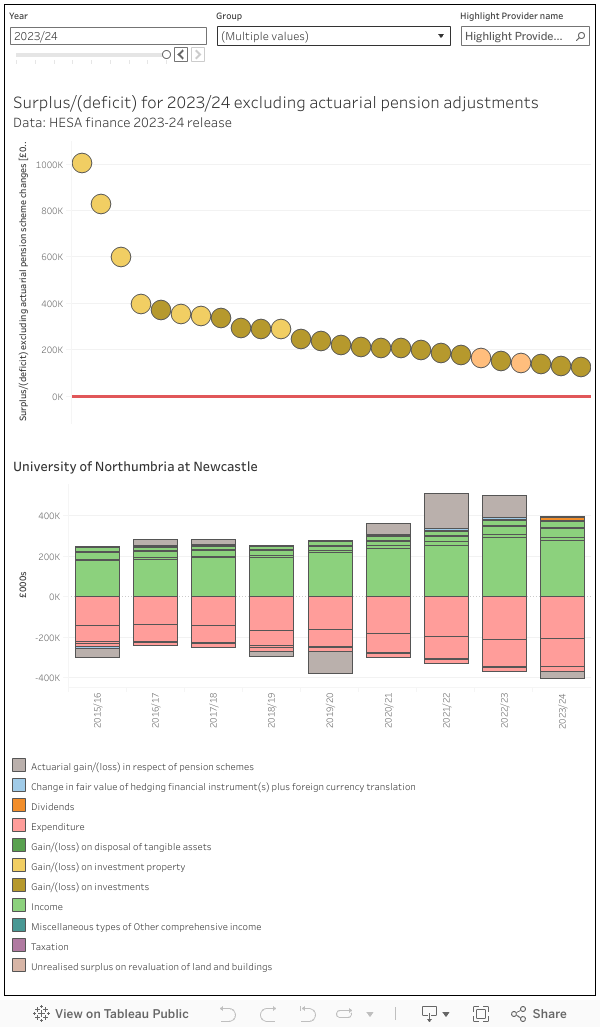
    This next chart lets you see the fundamentals of your university’s balance sheet – with a ranking by overall surplus and deficit at the top. There are 29 largeish providers who reported a deficit (excluding the pension adjustments again) in 2023-24, with the majority being the kind of smaller modern providers that train large parts of our public sector workforce. These are the kind of universities who are unlikely to have substantial initial income beyond tuition fees, but will still have a significant cost base to sustain (usually staffing costs and the wider estates and overheads that make the university work).

    [Full screen]

    This one works in a pretty similar way to the chart above – mousing over a provider mark on the main surplus/deficit ranking lets you see a simplified balance sheet. The colours show the headline categories, but these are split into more useful indications of what income or expenditure relates to. Again, by default and for ease of reading I have filtered out smaller providers but you could add them in using the “group” filter. For definitions of the terms used HESA has a very useful set of notes below table 1 (from which this visualisation is derived)

    There’s very little discretionary spend within the year – everything pretty much relates to actually paying staff, actually staying in regulatory compliance, and actually keeping the lights on and the campus standing: all things with a direct link to the student experience. For this reason, universities have in the past been more keen to maximise income than bear down on costs although the severity and scope of the current pressure means that cuts that students will notice are becoming a lot more common.

    What universities spend money on

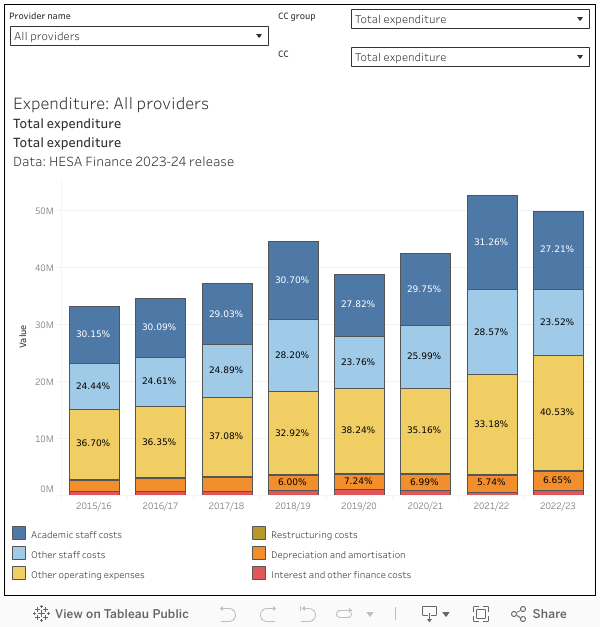
    As a rule of thumb, about half of university expenditure is on staff costs (salaries, pensions, overheads). These costs rise slowly but relatively predictably over time, which is why the increase in National Insurance contributions (which we will see reflected in next year’s accounts) came as such an unwelcome surprise.

    But the real pressure so far has been on the non-staff non-finance costs – which have risen from below 40 per cent a decade ago to rapidly approach 50 per cent this year (note that these figures are not directly comparable, but the year to date includes most larger providers, and the addition of the smaller providers in the regular totals for other years will not change things much).

    What are “other costs”? Put all thoughts of shiny new buildings from your mind (as we will see these are paid for with capital, and only show up in recurrent budgets as finance costs) – once again, we are talking about the niceties of there being power, sewage, wifi, printer paper, and properly maintained buildings and equipment. The combination of inflationary increases and a rise in the cost of raw materials and logistics as a result of the absolute state of the world right now.

    [Full screen]

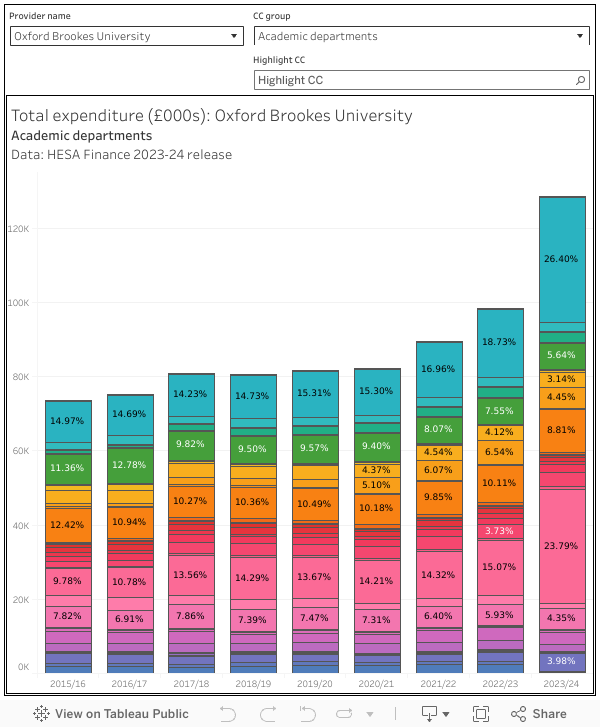
    Though this first chart defaults to overall expenditure you can use it to drill down as far as individual academic cost centres using the “cc group” and “cc filters”. Select your provider of interest (“All providers” shows the entire sector up to 2022-23, “All providers (year to date)” shows everything we know about for 2023-24. It’s worth being aware that these are original not restated accounts so there may be some minor discrepancies with the balance sheets (which are based on restated numbers).

    The other thing we can learn from table 8 is how university spending is and has been split proportionally between cost centres. Among academic subject areas, one big story has been the rise in spending in business and management – these don’t map cleanly to departments on the ground, but the intention to ready your business school for the hoped-for boom in MBA provision is very apparent.

    [Full screen]

    That’s capital

    I promised I’d get back to new builds (and large refurbishment/maintenance projects) and here we are. Spending is categorised as capital expenditure when it contributes to the development of an asset that will realise value over multiple financial years. In the world of universities spend is generally either on buildings (the estate more generally) or equipment (all the fancy kit you need to do teaching and research).

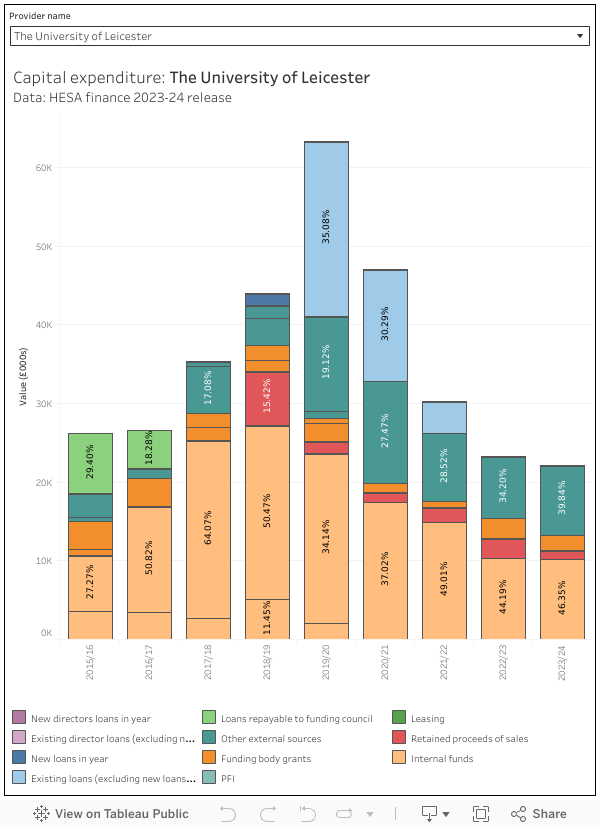
    What’s interesting about the HESA data here is that we can learn a lot about the source of this capital – it’s fairly clear for instance that the big boom in borrowing when OfS deregulated everything in 2019-20 has long since passed. “Other external sources” (which includes things like donations and bequests) are playing an increasingly big part in some university capital programmes, but the main source remains “internal funds” drawn from surpluses realised in the recurrent budget. These now constitute more than 60 per cent of all capital spend – by contrast external borrowing is less than ten per cent (a record low in the OfS era)

    [Full screen]

    What’s next?

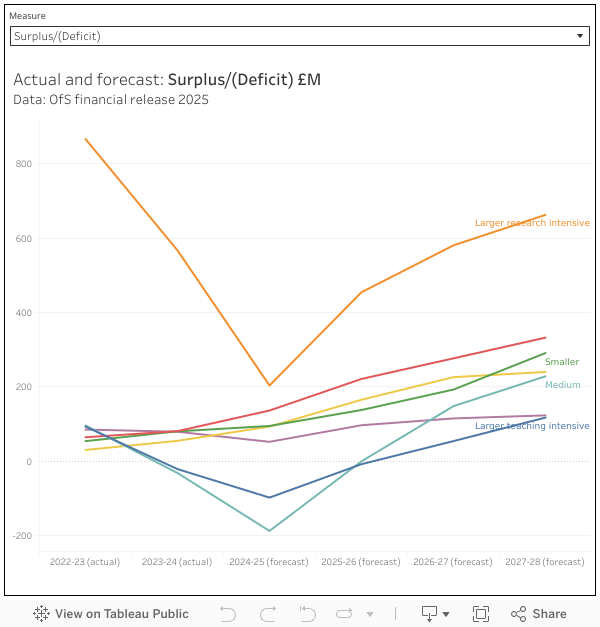
    As my colleague Debbie McVitty has already outlined on the site, the Office for Students chose the same day to publish their own analysis of this crop of financial statements plus an interim update giving a clearer picture of the current year alongside projections for the next few.

    Rather than sharing any real attempt to understand what is going on around the campuses of England, the OfS generally uses these occasions to complain that actors within a complex and competitive market are unable to spontaneously generate a plausible aggregate recruitment prediction. It’s almost as if everyone believes that the expansion plans they have very carefully made using the best available data and committed money to will actually work.

    The pattern with these tends to be that next year (the one people know most about) will be terrible, but future years will gradually improve as awesome plans (see above) start to pay off. And this iteration, even with the extra in year data which contributes to a particularly bad 2025-26 picture, is no exception to this.

    While the HESA data allows for an analysis of individual provider circumstances, the release from OfS covers large groups of providers – mixing in both successful and struggling versions of a “large research intensive” or “medium” provider in a generally unhelpful way.

    [Full screen]

    To be clear, the regulator understands that different providers (though outwardly similar) may have different financial pressures. It just doesn’t want to talk in public about which problems are where, and how it intends to help.

    Source link

  • Higher education postcard: Harvard University

    Higher education postcard: Harvard University

    Greetings from Cambridge! No, not that one.

    This is Cambridge, Massachusetts, home of Harvard University. Harvard is one of the world’s great universities; it’s the oldest university in the United States of America; and it is currently the target of attempted coercion by the executive of the USA. There’s quite a story to tell!

    April showers bring May flowers

    In the 1630s, the northeast of what would become the USA was a series of colonies from Britain: parties of settlers had landed, established small towns, fought and traded with the people who were already there (this was no terra incognita), and either died out or survived. The colonies were not independent states: they were British, and ultimately ruled from Britain. But local government was needed, and in the case of the Massachusetts Bay colony this was via the charter obtained by the Massachusetts Bay Company.

    The General Court of Massachusetts was the local government, and in 1636 it allocated £400 to establish a college to be located in Newetowne. In 1638, Newetowne was renamed Cambridge; this was coincident with a bequest by John Harvard, a graduate of the University of Cambridge in England, who left the college half of his estate, and his library of 400 books.

    John Harvard was born in Southwark in 1607; he studied at Emmanuel College, Cambridge and gained a BA in 1632, and an MA in 1635. He moved to the Massachusetts colony in 1637 and was a puritan preacher, he died in 1638. The value of his estate was £1700, worth about 300,000 today. And the college got half of that. Not a huge amount, but enough to get the college going; and it was named for him in commemoration.

    Here’s two fun facts: the statue of Harvard at Harvard says on its plinth that he was the founder. Not true. Also, it isn’t an image of Harvard, but of an 1884 student who was descended from an early president of the university.

    The first students graduated in 1642. In 1650 the college was granted a charter – issued by the General Court, not the British monarch, for by 1650 Britain was temporarily a commonwealth not a monarchy. The charter created the Harvard Corporation, being the president and the fellows of Harvard College; and it is this corporation which continues to this day.

    Harvard College continued to grow and develop, as successful colleges do. Its curriculum was modelled on the Cambridge liberal arts approach; its theology was Puritan. It enrolled a native American student, John Sassemon, in 1653. When serving as interpreter to Metacom, the Wampanoag chief in 1675, he was murdered as an English informant, sparking the worst of the many wars between settlers and existing populations in New England.

    Independence day

    The late eighteenth century was momentous in America. Eight Harvard graduates (John Hancock, Samuel Adams, John Adams, Robert Treat Paine, Elbridge Gerry, William Ellery, William Williams, and William Hooper) signed the declaration of independence in 1776.

    In 1780, when Massachusetts as a state gained a constitution, it granted to Harvard the title of university. In 1781 a chapter of Phi Beta Kappa opened at Harvard – it is the oldest continually running chapter of the society. And in 1782 it opened a medical school – which, interestingly, the university’s own history regards as the start of it being a proper university.

    A side note on Phi Beta Kappa. This described itself as an academic honour society; such societies also might be known as fraternities. Frat houses cause no end of trouble on some American university campuses, as well as providing a location for some sometimes dubious comedy.

    You may recall in my blog on Purdue University that one of its presidents resigned having failed to ban fraternities from campus. There’s loads of them – the Wikipedia entry has too many for me to count – and there are accrediting bodies. I may have to find a postcard one day…

    Football crazy

    In the nineteenth century Harvard continued to grow, adding schools of divinity and law in the first couple of decades, a science school in the 1850s, a dental school in the 1860s, and a graduate school in 1872. In 1852 the first intercollegiate boat race – Harvard versus Yale – took place on Lake Winnipesaukee. And in 1875 the first intercollegiate football match (gridiron, not association, union or league) took place. Harvard won.

    Let’s at this point note Tom Lehrer, mathematician, satirist, Harvard alumnus and academic, who I regard as one of Harvard’s finest. An early song of his, Fight fiercely, Harvard, satirizes the football fight song. And the YouTube video linked above has some fabulous footage of Harvard v Yale games through the ages.

    Lehrer also wrote Bright College Days, a satire of college songs. Which includes the wonderful line, “ivy-covered professors, in ivy-covered halls”. A great Lehrer quote: “political satire became obsolete when Henry Kissinger was awarded the Nobel peace prize.” And finally, Lehrer in 2022 gave all his songs to the public, making them available without copyright on a website: well done, sir.

    Establishment

    Harvard was by now a firm fixture in the US establishment. Eight US Presidents have been educated at Harvard (as was the most recent Canadian Prime Minister, Mark Carney). In 1886, at its 250th anniversary celebrations, President Grover Cleveland, not an alumnus, was in attendance.

    In 1908 the Harvard Business School opened, the first in the country restricting its intake to graduates. More schools were established; the Harvard University Press opened in 1913; the first Harvard Nobel laureate was crowned in 1914 (Theodore Richards, for determination of atomic weights).

    In 1947 General George C Marshall (pictured, when he himself was a student at the Virginia equivalent of Colonel Oates’ miliary academy), then Secretary of State, received an honorary degree. He used his speech to announce the Marshall Plan, via which the US supported the rebuilding of post-war Europe. To be fair this knocks most graduation speeches I have heard into a cocked hat.

    Opening the door a little wider…

    It would be fair to characterise Harvard as not having been, historically, at the forefront of change. One example is women’s education.

    Harvard was, like (I suspect but can’t demonstrate) nearly all universities previously, restricted to men only. In 1879 Arthur Gilman, a banker, and his wife Stella Scott Gilman, wished their daughter to have a university education. Harvard would not admit women, so they persuaded the president of Harvard to allow them to employ Harvard academics, part-time, to deliver courses to women in what became known as the Harvard Annex.

    They had hoped that Harvard might relax its stance and accept women to study for degrees, but the attitude of the university was summed up in 1869 by its President, Charles Eliot, who in his inaugural address said:

    The world knows next to nothing about the capacities of the female sex. Only after generations of civil freedom and social equality will it be possible to obtain the data necessary for an adequate discussion of woman’s natural tendencies, tastes, and capabilities…It is not the business of the University to decide this mooted point.

    And this in 1888 from Eliot to a potential new faculty member:

    There is no obligation to teach at The Annex. Those professors who on general grounds take an interest in the education of women…feel some obligation but there are many professors who think it their duty NOT to teach there, in which opinion some of the Corporation and Overseers agree.

    Nevertheless, the Harvard Annex thrived, with increasing numbers of women wishing to study there. In 1894 a compromise was reached: the annex became a degree-awarding college – Radcliffe College – with Harvard staff teaching and guaranteeing standards.

    In the 1930s a subsequent Harvard President – Lawrence Lowell – felt that Radcliffe was a distraction to Harvard’s academics, and a limit was placed on the number of students who could be admitted to Radcliffe: 750 undergraduates in total, 250 graduate students. These limits stayed in place until 1979, when Radcliffe was incorporated into Harvard, which finally became co-educational.

    It wasn’t only women with which Harvard, historically, had a problem. In the 1923, Lowell had sought to put a cap on the proportion of Jewish students at Harvard. He was unsuccessful. Harvard presidents don’t always get what they want.

    Lowell also enforced racial segregation where he could. In 1921 he refused to allow black students to reside in the university’s dormitories. Writing to the father of one such student, he said:

    We owe to the colored man the same opportunities for education that we do to the white man, but we do not owe to him to force him and the white into social relations that are not, or may not be, mutually congenial.

    Do the right thing

    Faced with examples like these, you might be forgiven for thinking Harvard would always behave badly where it could. But they are currently taking a stand for academic autonomy.

    Threatened with withdrawal of funding and tax exempt status, the university has refused to accede to the US government’s demands which are, frankly, a full-on assault on academic autonomy. Here’s the letter of 11 April sent to the university; here’s the university’s response.

    It is worth taking a minute to read the demands made of Harvard. They relate to student discipline; the appointment and employment of faculty; the content of programmes; the admission of students. The US government cavilled that the letter was sent in error (and if you believe that I’d like to talk to you about a bridge I have for sale) but its my view that where a country’s government threatens universities, that country is in trouble.

    Harvard has an endowment of over $50 billion, so it has the financial resources to cushion the significant blow. But it didn’t have to resist, and we should all be glad that it is doing so.

    Missed opportunities

    With such a big university, such a famous university and such an old university, there’s a stack of things which I haven’t been able to write about. Another time, maybe.

    For now, here’s a jigsaw of the card, which was sent in November 1907 to Miss Adeline Tower at Rutgers Prep School, New Jersey. The message on the front – to save you straining you eyes – reads:

    Dear Ade: how are you? Eliza came home alright. I missed her very much. Hope to see you Xmas. Love Grandma

    Source link

  • Johnson & Wales University to lay off 91 faculty and staff

    Johnson & Wales University to lay off 91 faculty and staff

    Dive Brief:

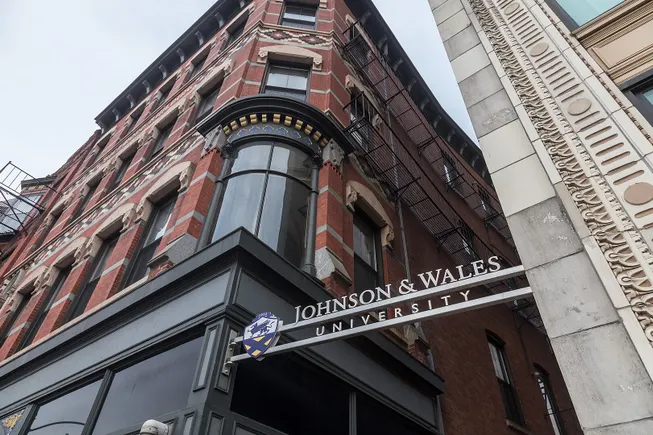
    • Johnson & Wales University plans to lay off 91 faculty and staff members — about 5% of its workforce — as it tries to rapidly evolve its operating model, officials said. The cuts will affect its two campuses in Providence, Rhode Island, and Charlotte, North Carolina.
    • The private nonprofit faces an operating deficit of $34 million after more than a decade of enrollment declines. “We simply cannot afford to be the size that we once were, and we believe this reduction will allow us to close a financial deficit and to move forward with a balanced budget,” Chancellor Mim Runey said Monday in a community message.
    • With its cash reserves almost depleted, the university is also delaying salary increases until later this year when officials can “evaluate what is possible,” Runey said.

    Dive Insight:

    To explain why Johnson & Wales is reducing its workforce, Runey pointed to a 54% decline in overall enrollment since fiscal 2012, with headcounts falling from a high of 17,294 to over 8,000 in recent years. 

    The chancellor attributed the shrinking student body to demographic declines, fewer international students and shifting public attitudes about higher education.

    Staffing and budgets, meanwhile, have fallen at a slower pace than enrollment, Runey said, framing the layoffs as rightsizing the university’s operations. 

    “While there is some indication that we are on the right track with enrollment, we do not believe we will return to levels of enrollment that supported a much larger organization and operating budget,” she said.

    The university has already downsized in the recent past. In 2021, Johnson & Wales shuttered its campuses in Florida and Coloradoboth of which opened to expand the university during times of growth in the higher education market

    Along with reducing expenses, the sale of those former campus buildings added to university’s endowment and reserves. Those reserves, however, have been drained to plug recent budget gaps.

    The university has also pared down the number of senior leaders by about half since 2012, Runey noted. Additionally, it has consolidated academic programs, closed others with low enrollment, reduced jobs through attrition and streamlined aspects of its operations.

    At the same time, Johnson & Wales has invested in a wide array of new programs to try to attract students. Over the past decade, some of those new offerings have “yielded great results while others less so, and some were reduced or discontinued,” Runey said. 

    She also pointed to more recently launched health and wellness programs. Those come with start-up costs such as specialized facilities, faculty and marketing efforts. 

    “These new program investments, while showing great early outcomes, have not yet had time to yield returns that would significantly improve the operational budget,” Runey said.

    That stands in contrast to more rapid enrollment growth other rounds of new programming brought the university in the past, when market conditions were better. 

    “Today we plan with the conservatism that the times demand,” the chancellor said.

    Source link

  • Podcast: Finances and cuts, VC pay

    Podcast: Finances and cuts, VC pay

    This week on the podcast we discuss “naming and shaming” over vice-chancellor pay packages when student outcomes fall short.

    Source link

  • Senate approves repeal of E-rate Wi-Fi hotspots for schools, libraries

    Senate approves repeal of E-rate Wi-Fi hotspots for schools, libraries

    Dive Brief:

    • The end of E-rate eligibility for Wi-Fi hotspots came one step closer Thursday as the Senate voted 50-38 along party lines to overturn a 2024 expansion of the program overseen by the Federal Communications Commission.
    • A similar House resolution was introduced in February to strike down the recent inclusion of Wi-Fi hotspots in the E-rate program, which has helped connect schools and libraries to affordable telecommunications services for the last 29 years.
    • School districts have shown high demand for using E-rate funds to purchase Wi-Fi hotspots during fiscal year 2025, the first year for which the devices were eligible.  

    Dive Insight:

    In fiscal year 2025, schools and districts requested a total of $27.5 million for Wi-Fi hotspots alone. The devices are often used to help students who don’t have home internet access complete homework assignments that require digital connections.

    The FCC’s decision to expand E-rate to include hotspots followed the expiration of the Emergency Connectivity Fund established by the American Rescue Plan Act of 2021. The pandemic-era fund allocated $123 million to the FCC to purchase hotspots for schools and libraries.

    Both Senate and House measures were introduced by Republicans who say the FCC’s partisan move under the Biden administration to expand the E-rate program was overreach under the federal law that defined the Universal Service Fund’s E-rate program as intentionally providing discounts for broadband services only to “school classrooms” and libraries.

    Sen. Ted Cruz, R-Texas, introduced the resolution of disapproval in January under the Congressional Review Act, which gives federal lawmakers the authority to nullify a federal regulation. Cruz said in a January statement that the FCC regulation expanding E-rate “violates federal law, creates major risks for kids’ online safety, harms parental rights, and will increase taxes on working families.”

    “Every parent of a young child or teenager either worries about, or knows first-hand, the real dangers of the internet,” Cruz said. “The government shouldn’t be complicit in harming students or impeding parents’ ability to decide what their kids see by subsidizing unsupervised access to inappropriate content.”

    Before this week’s vote, several organizations representing school superintendents, K-12 business officials, rural educators, transportation providers and educational service agencies sent a letter on May 6 to Senate Majority Leader John Thune, R-S.D., urging him to vote against the resolution.

    The letter noted that nearly 20,000 schools and libraries are applying for several hundred thousand hotspots nationwide through the E-rate program. If passed, the education groups wrote, the resolution would “prevent millions of students and library patrons” from gaining internet access. 

    “We strongly disagree with the argument that allowing students and adults to access hotspots on buses or at home opens the door to them accessing inappropriate content online,” the letter said. “The rules adopted by the FCC require that all Wi-Fi hotspots include blocking and filtering of inappropriate material. Thus, any claim that providing home Internet access through these hotspots exposes children to pornography and other inappropriate content are completely untrue.”

    Hotspots particularly benefit low-income and rural students and educators who need internet access at home to complete homework assignments, the letter said. The groups added that passing such a resolution through the Congressional Review Act will prevent the FCC from ever approving an expansion of E-rate to include hotspots again. 

    With the end of the one-time influx of federal pandemic-era funds, a Consortium for School Networking survey released earlier this week found that 14% of district ed tech leaders said initiatives to fund broadband access off school campuses were at risk of losing future sustainable funding. 

    That same CoSN survey also revealed that most school districts are deeply concerned about the future of the E-rate program as a whole, given that the U.S. Supreme Court is expected to decide in the coming months whether the program’s funding mechanism is unconstitutional. Some 74% of district respondents told CoSN that should the justices strike down E-rate in FCC v. Consumers’ Research, the decision would have “catastrophic” or “major” effects for schools.

    Source link

  • Do transgender student athletics fall under DOGE Subcommittee jurisdiction?

    Do transgender student athletics fall under DOGE Subcommittee jurisdiction?

    This audio is auto-generated. Please let us know if you have feedback.

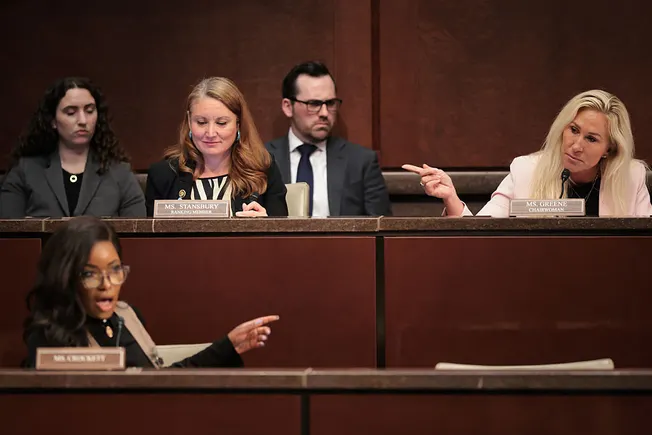
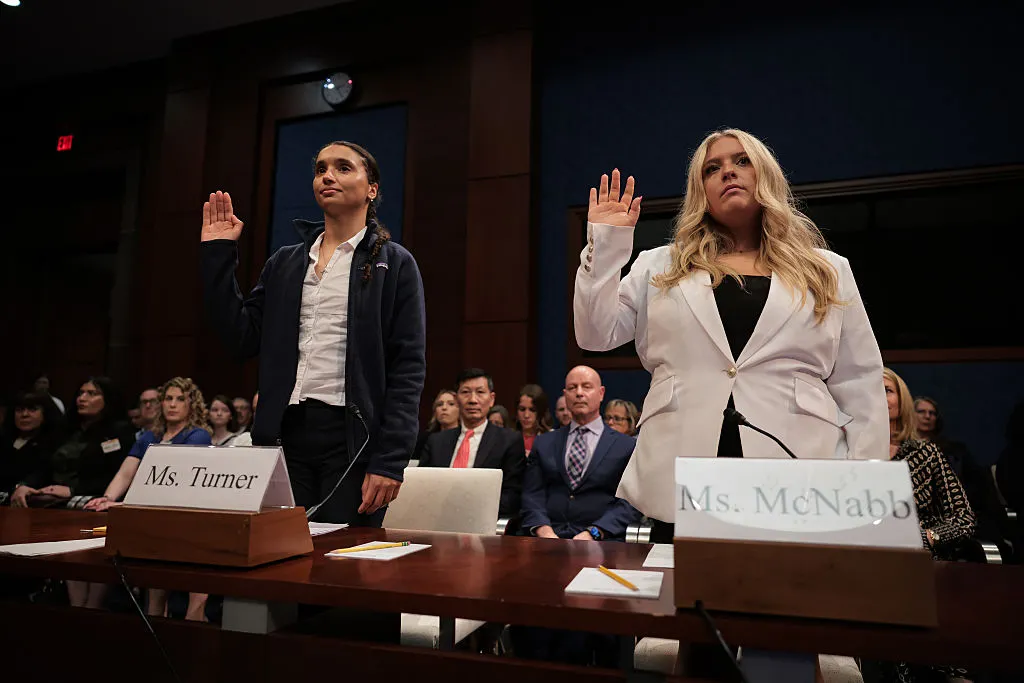
    Do transgender student athletes’ involvement in girls’ and women’s sports — an issue that has recently jeopardized schools’ federal funding — fall under government efficiency and oversight? That question starkly divided lawmakers among party lines in a nearly 4-hour hearing on Wednesday held by the Delivering on Government Efficiency Subcommittee, a newly-formed subcommittee of the House Committee on Oversight and Accountability. 

    The DOGE Subcommittee hearing — meant to discuss the politically charged issue of Title IX and transgender student rights that has taken center stage under the Trump administration — quickly deteriorated to repeated gavel-banging, a motion to adjourn the meeting, disagreement over the committee’s purpose, arguments over lawmakers’ allotted speaking times, and discussions of differences in male and female elbow-joint anatomy and muscle mass. 

    The subcommittee was created to oversee “federal civil service, including compensation, classification, and benefits; federal property disposal; government reorganizations and operations, including transparency, performance, grants management, and accounting measures generally,” according to the Committee on Oversight and Government Reform’s rule book. 

    Witnesses included two cisgender female athletes advocating for athletic teams without transgender students, the chair for the USA Fencing Board of Directors, and the CEO of National Women’s Law Center, a nonprofit organization that advocates for LGBTQ+ rights.

    Republican lawmakers, who have called for less federal oversight of education and a return of that power to the states, said the hearing was necessary because it related to Title IX, a federal law meant to prohibit sex discrimination in federally funded education programs. 

    “It’s an important issue that biological men stay out of women’s sports,” said Rep. Marjorie Taylor Greene, chair of the committee and Republican from Georgia. 

    Rep. William Timmons, R-S.C., said the hearing was meant to “shine a light not only on the integrity of women’s sports,” but also on how institutions like USA Fencing and others may be misusing their authority to “push controversial policies that violate basic human rights and disregard their Congressionally-authorized mission.”

    “This is what happens when you allow God to be pushed out of everything,” added Rep. Eli Crane, R-Ariz. 

    Democratic lawmakers at the hearing, however, said it was a waste of the subcommittee’s time and did not fall under the body’s jurisdiction, which instead includes issues like proposed cuts across the government. 

    “This subcommittee could be focusing on the layoffs that President Trump has executed: over 200,000 firings of federal employees,” said Rep. Stephen Lynch, D-Mass. “That does affect the efficiency of our government programs.” 

    Rep. Robert Garcia, D-Calif., concurred, saying the subcommittee has “never really talked about government efficiency or any serious legislative work,” and that he was “surprised that this subcommittee is not apparently in charge of policing women’s sports.” 

    Witnesses at a DOGE Subcommittee hearing raise their hands in oath

    Stephanie Turner, left, a fencer who refused to compete against a transgender athlete, and Payton McNabb, right, a former North Carolina high school volleyball player injured by a transgender opponent, are sworn in during the hearing held by the Delivering on Government Efficiency Subcommittee at the U.S. Capitol on May 7, 2025, in Washington, D.C.

    Kayla Bartkowski/Getty Images via Getty Images


    DOGE impacts on K-12

    The DOGE Subcommittee is among the latest in a series of efforts by the Trump administration and Republicans to cut back on what they say are instances of abuse, fraud and waste in the government. Its formation is an extension of similar efforts conducted by the Department of Government Efficiency, also referred to as DOGE. 

    Those efforts have had major implications for the K-12 sector in recent months, including gutting the Education Department by laying off more than 1,300 employees, closing or significantly reducing its offices, canceling grants entirely or retracting grant competitions, and proposing a 15% cut to the department’s funding. 

    The reduction in expenses from DOGE’s efforts is also expected to put a strain on K-12 finances, according to a Moody’s report released in April. 

    Among DOGE cuts were seven of the Education Department’s 12 local offices for the Office for Civil Rights, leaving schools with reduced oversight of civil rights compliance. Those offices were in charge of investigating allegations of Title IX violations — the subject of the hearing Wednesday — for half of states. 

    Source link

  • Indiana governor sued by state ACLU over university board control

    Indiana governor sued by state ACLU over university board control

    This audio is auto-generated. Please let us know if you have feedback.

    Dive Brief:

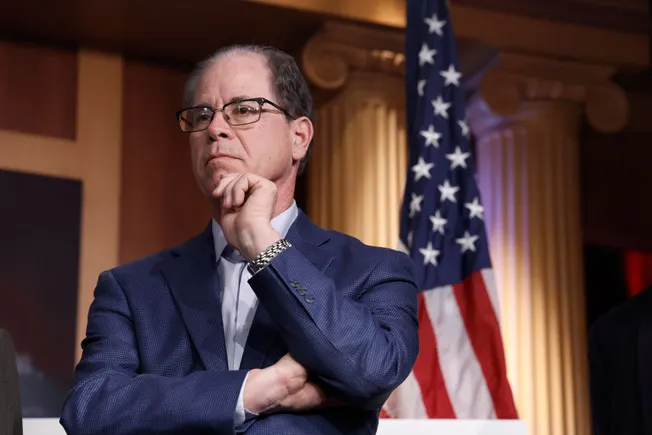
    • The American Civil Liberties Union of Indiana is suing the state’s governor, Mike Braun, over a new law giving him full control over the selection of Indiana University’s trustee board.
    • Last month, Republican lawmakers added several last-minute changes to Indiana’s budget bill that expanded the state’s control over its public colleges. Braun signed the budget into law Tuesday.
    • One provision empowers the governor to appoint all nine members of Indiana University’s board, eliminating the institution’s longstanding tradition of alumni trustee elections. That change illegally targets Indiana University and violates the state’s constitution, ACLU of Indiana’s lawsuit argues.

    Dive Insight:

    Indiana University has held alumni trustee elections since 1891, with the process codified into state law. Board members oversee everything from admissions standards to presidential appointments to faculty promotions and tenure. 

    Prior to the change in law this month, three trustees on the university’s nine-person were elected by alumni. The governor appointed the rest.

    ACLU of Indiana is suing Braun on behalf of a candidate who was vying for a board position this summer, Justin Vasel.

    “This challenge addresses a law that strikes at the heart of democratic governance at Indiana’s flagship university,” Vasel said in a statement Wednesday. “This unconstitutional legislation threatens IU’s 134-year-old tradition of alumni representation while an election for those very positions is already underway.”

    Before the change in law, the university’s over 790,000 graduates were eligible to cast a ballot, according to the university’s alumni association, making the voter pool larger than the populations of Wyoming, Vermont or Alaska.

    Six members of the university’s alumni association had announced their candidacy for trustee, and the month-long election was set to begin in June. Had it gone on as scheduled, the winner would have joined the board July 1.

    Now, Braun has the power to appoint who he wishes, so long as five trustees are university alumni and five are Indiana residents. The governor also received the power to remove any previously elected members at his discretion. 

    Braun defended the change during an April 30 press conference, citing low alumni voter turnout in the trustee elections, according to the Indiana Capital Chronicle.

    “It wasn’t representative. It enabled a clique of a few people to actually determine three board members. And I don’t think that is real representation,” the governor told reporters.

    The university’s next trustee meeting is set to take place June 12.

    The lawsuit castigated lawmakers for not following the normal legislative process when approving the change, instead relying on last-minute amendments.

    “No hearings were held concerning the proposal,” it said. “Instead the change was inserted at the eleventh hour deep within a lengthy budget bill that otherwise would have nothing to do with the election of members of the boards of trustees of Indiana’s higher education institutions.”

    Vasel and the ACLU of Indiana also questioned the constitutionality of the budget’s targeting of Indiana University’s board selection.

    The process for appointing trustees varies among the state’s other public universities. But the alumni of each institution have the ability to vote on or nominate graduates to the board, the lawsuit said. The change Braun signed into law takes that ability away from Indiana University alone.

    “Every other four-year public university in the state has a process for allowing alumni to select at least some members of the board of trustees, and there is no justification for denying that ability to the alumni of IU,” Ken Falk, legal director of ACLU of Indiana, said in a Tuesday statement.

    Indiana Republicans, who control both chambers of the Legislature and the governor’s mansion, have attempted to control other aspects of Indiana University.

    Earlier this year, the state comptroller and two lawmakers joined an event where an advocacy group questioned if the university was illegally routing state funds to the Kinsey Institute, a sexuality and gender research center housed on its Bloomington campus.

    Lt. Gov. Micah Beckwith joined the opposition of the institute and said he and Braun are committed to ensuring Indiana University “is not using taxpayer dollars to fund something that is rooted in this wickedness,” according to WFYI.

    Beckwith also threatened the university and its editorially independent student newspaper, the Indiana Daily Student, over the publication’s coverage of President Donald Trump. 

    The lieutenant governor derided a November cover story that showcased quotes critical of the president made by former Trump officials, though Beckwith misattributed the quotes as from the paper’s staff. He went on to call the story “WOKE propaganda at its finest.”

    “This type of elitist leftist propaganda needs to stop or we will be happy to stop it for them,” Beckwith said in a social media post.

    Source link