Author: admin

  • Republican lawmakers grill 3 more college presidents over antisemitism concerns

    Republican lawmakers grill 3 more college presidents over antisemitism concerns

    This audio is auto-generated. Please let us know if you have feedback.

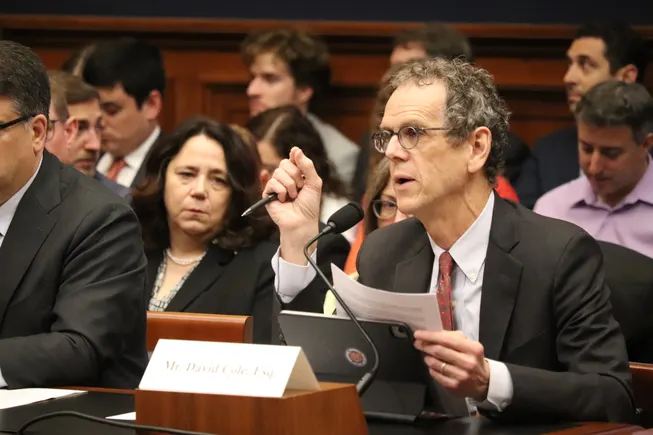
    Republicans on the House’s education committee grilled three college presidents Wednesday about how they’ve handled alleged incidents of antisemitism in the wake of the Israel-Hamas war, expanding their probe beyond the Ivy League and other well-known research universities. 

    The leaders came from Haverford College, a small private liberal arts college in Pennsylvania; DePaul University, a private Catholic research university in Chicago; and California Polytechnic State University, San Luis Obispo, a public institution in California. 

    All three institutions have been a hotbed of political activity for over a year. Pro-Palestinian protesters set up encampments at both Haverford and DePaul last year. Cal Poly also saw demonstrations, including a pro-Palestinian protest held around the one-year anniversary of the Oct. 7, 2023, Hamas attack on Israel. 

    Republicans on the House Committee on Education and Workforce said they sought to crack down on campus antisemitism and uphold Title VI of the Civil Rights Act, which prohibits discrimination based on race, color and national origin in federally funded programs. 

    However, some Democrats accused the panel’s GOP members of using antisemitism concerns to quell free speech. They also blasted the Trump administration for detaining international students involved in pro-Palestinian demonstrations and for its heavy cuts to the U.S. Department of Education’s Office for Civil Rights, which investigates antisemitism and other discrimination allegations at colleges and schools. 

    Wednesday’s hearing was the first the House education committee has held on campus antisemitism since President Donald Trump retook office. Since then, his administration has frozen funding at several high-profile institutions that have been probed by the committee, claiming the colleges haven’t done enough to protect students from antisemitism. 

    “The Trump administration has taken a sledgehammer to due process rights of institutions,” said Virginia Rep. Bobby Scott, the top Democrat on the committee. “The public has seen a barrage of reports of this administration taking action without any investigation, such as taking away federal funding.” 

    Haverford’s federal funding threatened

    Haverford President Wendy Raymond and DePaul President Robert Manuel struck a conciliatory tone in their opening remarks, and all three leaders outlined steps they have recently taken to protect Jewish students from discrimination, including setting up an antisemitism task force and tightening protest rules.

    “I recognize that we haven’t always succeeded in living up to our ideals,” Raymond said. “I remain committed to addressing antisemitism and all issues that harm our community members. I am committed to getting this right.”

    Last year, a group of Haverford students sued the college over allegations it had denied Jewish students the ability to participate in classes and educational activities “without fear of harassment if they express beliefs about Israel that are anything less than eliminationist.” 

    The lawsuit contains accounts of several incidents and comments it says are antisemitic, including one professor sharing a social media post on Oct. 11, 2023. The post included an image the lawsuit described as Hamas breaking through the border between Gaza and Israel and stating, “We should never have to apologize for celebrating these scenes of an imprisoned people breaking free from their chains.” 

    A federal judge dismissed the case in January but allowed plaintiffs to file an amended lawsuit, which they did that month.  

    Rep. Elise Stefanik, a Republican from New York, asked Raymond whether the professor who shared the post had faced disciplinary action, but the Haverford president declined throughout the hearing to talk about individual cases or share specific figures on disciplinary actions. The professor, Tarik Aougab, is listed on Haverford’s website as a faculty member.

    “Many people have sat in this position who are no longer in the positions as president of universities for their failure to answer straightforward questions,” Stefanik replied. 

    Source link

  • Academic judgement? Now that’s magic

    Academic judgement? Now that’s magic

    Every day’s a school day.

    In my head, I thought I understood the line between what counts as “academic judgement” and what doesn’t in cases, processes, appeals and complaints.

    It matters because my understanding has long been that students can challenge and appeal all sorts of decisions – right up to the Office of the Independent Adjudicator (OIA) in England and Wales – but not if the decision is one that relates to matters of academic judgment.

    Thus in a simplistic coin sorter, “this essay looks like a 2:1 to me” can’t be challenged, but “they’ve chucked me out for punching someone when I didn’t” can.

    I’ve often wondered whether the position can hold when we think about the interaction between consumer protection law – which requires that services be carried out with reasonable skill and care – and this concept of unchallengeable academic judgement in the context of workloads.

    Back in the halcyon days of Twitter, I’d regularly see posts from academic staff bemoaning the fantasy workload model in their university that somehow suggested that a 2,000 word essay could be read, graded and fed back on in 15 minutes flat.

    Add in large numbers of assignments dribbling in late via extensions and accommodations, the pressure to hit turnround times generated by the NSS question, wider workload issues and moderation processes that look increasingly thin (which were often shredded or thinned out even further during the marking boycotts), and I imagined a judge evaluating a student’s case to say something along the lines of “to deploy your magic get out jail free card, sunshine, you’ll need to have used more… care.”

    But that’s about an academic judgement being made in a way that isn’t academically defensible. I had a conversation with an SU officer this afternoon about academic misconduct off the back of a webinar they’d attended that OfS ran on AI, and now I’m more confused than ever.

    Do not pass go

    The bones first. The Higher Education Act 2004 mandated a body that would review complaints to replace the old “visitor” system, and it includes a line on what will and won’t qualify as follows:

    A complaint which falls within subsection (1) is not a qualifying complaint to the extent that it relates to matters of academic judgment.

    The concept is neither further defined nor mentioned anywhere else in UK law – but has deep roots. In medieval universities scholarly masters enjoyed autonomous assessment rights, and it gained legal recognition as universities developed formal examination systems during the Enlightenment period.

    By the 20th century, academic judgment became legally protected from external interference, exemplified by landmark cases like Clark v. University of Lincolnshire and Humberside (2000), which established that courts should not intervene in academic assessments except in cases of procedural unfairness:

    This is not a consideration peculiar to academic matters: religious or aesthetic questions, for example, may also fall into this class. It is a class which undoubtedly includes, in my view, such questions as what mark or class a student ought to be awarded or whether an aegrotat is justified.

    The principle that most understand is that specialised academic expertise uniquely qualifies academics to evaluate student performance and maintain educational standards, free from political or economic pressures.

    The OIA takes the line in the legislation and further defines things as follows:

    Academic judgment is not any judgment made by an academic; it is a judgment that is made about a matter where the opinion of an academic expert is essential. So for example a judgment about marks awarded, degree classification, research methodology, whether feedback is correct or adequate, and the content or outcomes of a course will normally involve academic judgment.

    It also helpfully sets out some things that it doesn’t consider fall into the ambit:

    We consider that the following areas do not involve academic judgment: decisions about the fairness of procedures and whether they have been correctly interpreted and applied, how a higher education provider has communicated with the student, whether an academic has expressed an opinion outside the areas of their academic competence, what the facts of a complaint are and the way evidence has been considered, and whether there is evidence of bias or maladministration.

    I’m not convinced that that “what’s in, what’s out” properly considers or incorporates the consumer protection law issue I discuss above – but nevertheless it hangs together.

    In his paper on whether the concept will hold in an era of consumerism, David Palfreyman argues that academic judgment properly applies to subjective assessments requiring specialised expertise – grading student work, designing curriculum, and evaluating learning outcomes.

    Educational institutions and courts generally consider these issues beyond external scrutiny to protect academic freedom and professional autonomy – because academics possess unique qualifications to make nuanced, context-dependent judgments about academic quality that outside parties lack the expertise to evaluate effectively.

    On the other side of that see-saw, he argues that academic judgment should not shield factual determinations, procedural errors, or administrative decisions from review. When institutions make claims about whether they properly applied their own rules, or failed to follow fair procedures, these issues fall outside protected academic judgment.

    Religious or aesthetic?

    But then back in the OIA’s guidance on its scheme rules at 30.4, there’s this curious line:

    Decisions about whether a student’s work contains plagiarism and the extent of that plagiarism will normally involve academic judgment, but that judgment must be evidence based.

    If that feels like a fudge, it’s because it is. “Whether” feels like a significantly different concept to “extent of that”, insofar as I can see how “did you punch the student” is about weighing up facts, but “how much harm did you cause” might require an expert medical judgement. But in a way, the fudge is topped off with that last sub-clause – what the OIA will insist on if someone uses that judgement is that they’ve used some actual evidence.

    And if they haven’t, that then is a process issue that becomes appealable.

    The problem here in 2025 is that 30.4 starts to look a little quaint. When someone was able to say “here’s one student’s script, and here’s another” with a red sharpie pointing out the copying, I get the sense that everyone would agree that that counts as evidence.

    Similarly, when Turnitin was able to trawl both the whole of the internet and every other essay ever submitted to its database, I get the sense that the Turnitin similarity score – along with any associated reports highlighting chunks of text – counts as evidence.

    But generative AI is a whole different beast. If this blog over-used the words “foster” and “emphasize”, used Title Case for all the subheadings, and set up loads of sentences using “By…” and then “can…”, not only would someone who reads a lot of essays “smell” AI, it would be more likely to be picked up by software that purports to indicate if I have.

    That feels less like evidence. It’s guess work based on patterns. Even if we ignore the research on who “false flags” disproportionately target, I might just like using those phrases and that style. In that scenario, I might expect a low mark for a crap essay, but it somehow feels wrong that someone can – without challenge – determine whether I’m “guilty” of cheating and therefore experience a warning, a cap on the mark or whatever other punishment can be meted out.

    And yes, all of this relates back to an inalienable truth – the asynchronous assessment of a(ny) digital asset produced without supervision as a way of assessing a students’ learning will never again be reliable. There’s no way to prove they made it, and even if they did, it’s increasingly clear that it doesn’t necessarily signal that they’ve learned anything when they did.

    But old habits and the economics of massification seem to be dying hard. And so in the meantime, increasing volumes of students are being “academically” judged to have “done it” when they may not have, in procedures and legal frameworks where, by definition, they can’t challenge that judgement. And an evaluation of whether someone’s done it based on concepts aligned to religion and aesthetics surely can’t be right.

    Cases in point

    There’s nothing that I can see in the OIA’s stock of case summaries that sheds any light on what it might or might not consider to count as “evidence” in its scheme rules.

    I don’t know whether it would take as its start point “whatever the provider says counts as evidence”, or whether it might have an objective test up its sleeve if a case crossed its desk.

    But what I do know is just how confusing and contradictory a whole raft of academic misconduct policies are.

    The very first academic misconduct policy I found online an hour or so ago says that using AI in a way not expressly permitted is considered academic misconduct. Fair enough. It also specifies that failing to declare AI use, even when permitted, also constitutes misconduct. Also fair enough.

    It defines academic judgement as a decision made by academic staff regarding the quality of the work itself or the criteria being applied. Fair enough. It also specifically states that academic judgement does not apply to factual determinations – it applies to interpretations, like assessing similarity reports or determining if the standard of work deviates significantly from a student’s usual output. Again, fair enough.

    But in another section, there’s another line – that says that the extent to which assessment content is considered to be AI generated is a matter of academic judgement.

    The in-principle problem with that for me is that a great historian is not necessarily an LLM expert, or a kind of academic Columbo. Expertise in academic subject matter just doesn’t equate to expertise in detecting AI-generated content.

    But the in-practice problem is the thing. AI detection tools supplying “evidence” are notoriously unreliable, and so universities using them within their “academic judgment” put students accused of using AI in an impossible situation – they can’t meaningfully challenge the accusation because the university has deemed it unchallengeable by definition, even though the evidence may be fundamentally flawed.

    Academic judgements that are nothing of the sort, supported by unreliable technology, become effectively immune from substantive appeal, placing the burden on students to somehow prove a negative (that they didn’t use AI) against an “expert judgment” that might be based on little more than algorithmic guesswork or subjective impressions about writing style.

    Policies are riddled with this stuff. One policy hedges its bets and says that the determination of whether such AI use constitutes academic misconduct is “likely to involve academic judgement”, especially where there is a need to assess the “extent and impact” of the AI-generated content on the overall submission. Oil? Water? Give it a shake.

    Another references “academic judgment” in the context of determining the “extent and nature” of plagiarism or misconduct, “including the use of AI” – with other bits of the policy making clear that that can’t be challenged if supported by “evidence”.

    One I’m looking at now says that the determination of whether a student has improperly used AI tools is likely to involve academic judgement, particularly when assessing the originality of the work and whether the AI-generated content meets the required academic standards. So is the judgement whether the student cheated, or whether the essay is crap? Or, conveniently, both?

    Set aside for a minute the obvious injustices of a system that seems to be profoundly incurious about how a student has come to think what they think, but seems obsessed with the method they’ve used to construct an asset that communicates those thoughts – and how redundant that approach is in a modern context.

    Game over

    For all sorts of reasons, I’ve long thought that “academic judgement” as something that can be deployed as a way of avoiding challenge and scrutiny is a problem. Barristers were stripped of their centuries-old immunity from negligence claims based on evolving expectations of professional accountability in the 2000s.

    In medicine, the traditional “Bolam test” was that a doctor was not negligent if they acted “in accordance with a responsible body of medical opinion” among their peers But a case in the nineties added a crucial qualification – the court must be satisfied that the opinion relied upon has a “logical basis” and can withstand logical analysis.

    Or take accountancy. Prior to 2002, accountants around the world enjoyed significant protection through the principle of “professional judgment” that shielded their decisions from meaningful challenge, but the US Congress’s Sarbanes-Oxley Act radically expanded their liability and oversight following Arthur Andersen’s role in facilitating Enron’s aggressive earnings management and subsequent document shredding when investigations began.

    Palfreyman also picks out architects and surveyors, financial services professionals and insurance brokers, patent agents and trademark lawyers, software suppliers/consultants, clergy providing counseling services, and even sports officials – all of whom now face liability for their professional judgments despite the technical complexity of their work.

    As Palfreyman notes in his analysis of the Eckersley v Binnie case (which defined the standards for “reasonable skill and care” for professionals generally), the standard that a professional “should not lag behind other ordinarily assiduous and intelligent members of his profession” and must be “alert to the hazards and risks” now applies broadly across professions, with academics sticking out like a sore, often unqualified thumb.

    Maybe the principle is just about salvageable – albeit that the sorry state of moderation, external examining, workload modelling and so on does undermine the already shaky case for “we know better”. But what I’m absolutely sure of is that extending the scope of unchallengeable decisions involving “academic judgement” to whether a student broke a set of AI-misconduct rules is not only a very slippery slope, but it’s also a sure fire way to hasten the demise of the magic power.

    Source link

  • Creating Human-Centered Workplaces: Takeaways From CUPA-HR’s Spring Conference – CUPA-HR

    Creating Human-Centered Workplaces: Takeaways From CUPA-HR’s Spring Conference – CUPA-HR

    by Christy Williams | May 7, 2025

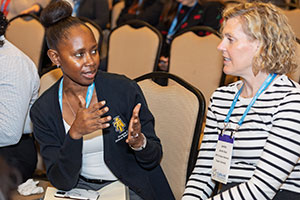
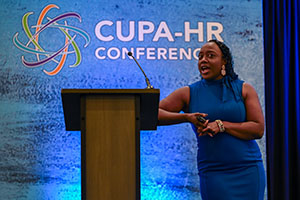
    At the 2025 CUPA-HR Spring Conference in Seattle, our keynote speakers shared their insights into the future of the higher ed workplace. They encouraged HR practitioners to step boldly into brave leadership, to investigate neuroscience’s insights into human behavior, to embrace advances in artificial intelligence, and to use data to enhance the employee experience.

    But the key message was that innovation should be people-centered and align with HR’s fundamental goal: creating workplaces where people feel safe, valued and free to thrive.

    The Brain Needs to Belong 

    The brain is a social organ, Dr. Jessica Sharp stressed in her opening keynote. Whether or not we’re conscious of it, we’re always searching for connection and belonging — for psychological safety.

    “Our brains need affirmation that we belong. Without it, we don’t feel safe,” Dr. Sharp said.

    Because our brains interpret emotional threats in the same way as physical threats, feeling unsafe at work can provoke a similar feeling to walking alone in a dark parking garage or seeing a snake on a hiking trail. But when we feel a sense of psychological safety and social belonging, our brains shift into connected mode. When we feel safe, we’re more likely to collaborate with our team, be less resistant to change and feel creative.
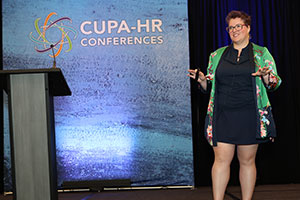

    Dr. Sharp invited higher ed HR to step into the future of work through neuroleadership. Neuroleadership is a model of talent management that understands the connection between the brain’s inner workings and people’s best work.

    Takeaway: The brain can’t be inspired when it’s in survival mode. Prioritize safety and belonging to encourage creativity.

    Further reading: Explore more ways to strengthen resilience and enhance psychological safety.

    AI Is Your Time-Saving HR Assistant

    AI is the future of work, said Jennifer Parker, the assistant director of HR operations at Colorado Community College System. While this may sound intimidating, it’s important to know that AI won’t replace you, but rather free up time and mental energy so that you can focus on strategy and long-term projects.

    Here’s how Parker uses AI to simplify routine HR tasks:

    • As a brainstorming partner. For example, you can say to AI, “help me write my leadership statement.” Provide context about your career to enhance the responses.
    • To write or revise emails. Parker’s communication mode tends to be folksy, so she has ChatGPT rewrite her emails to be more formal in tone.
    • As a software coach. Ask AI to give you step-by-step directions on creating an Excel formula.
    • To develop presentations, trainings and professional development sessions. ChatGPT helped Parker write microsessions for an online civility campaign, create slide decks and a video explaining benefits to employees.
    • As an employee engagement assistant. Tell AI the dynamics of your culture and ask how you can help foster a healthy workplace.
    • As an event planner. Ask AI to create a training calendar or other complex timeline. For events like open enrollment, ask it for an invitation to the health fair or to craft an inspiring message to remind employees to review their benefits.

    AI can also summarize complex information, break down survey results, act as a career coach or problem solver, offer advice, and more. Get creative! But always review what AI generates for accuracy, and make it your own.

    Takeaway: AI can simplify HR’s daily tasks and free up time for strategic thinking.

    Further reading: Read this step-by-step guide to learn how Parker used ChatGPT as her assistant in creating a virtual civility training program.

    Benchmark Your Employee Experience Using CUPA-HR’s Data 

    What does it take to attract top talent to higher ed? CUPA-HR’s new survey — the Benefits, Employee Experience, and Structure Survey — gives higher ed a snapshot of what it takes to be an employer of choice in a competitive employment landscape, explained Melissa Fuesting, associate director of research at CUPA-HR.

    Using the BEES Survey, colleges and universities can benchmark traditional benefits. And now, for the first time, explore data on:

    • Flexible work
    • Professional development
    • Campus and community engagement
    • Hiring metrics
    • Performance reviews
    • Institutional structure (such as where HR is housed)
    • Policies

    The BEES survey also allows you to take a deep dive on these topics. For example, when it comes to flexible work, you can find answers to questions such as: Which employees have the ability to work flexible schedules or flexible hours? Who determines the policies around hybrid and remote work? Which employee groups can be hybrid or remote?

    Takeaway: To enhance your employee value proposition, benchmark your benefits and employee experience using data from CUPA-HR’s new BEES Survey with DataOnDemand.

    Further reading: For more on attracting and retaining talent, check out the results of the 2023 Employee Retention Survey and stay tuned for the results of the 2025 survey coming this fall.

    “Who We Are Is How We Lead” 

    Cheryl Cofield closed this year’s spring conference with a compelling message: “Who we are is how we lead.” In her powerful keynote, Cofield challenged higher ed HR professionals to examine the leadership armor we wear — the protective behaviors that keep us from leaning into vulnerability and courage. Instead of avoiding difficult conversations or striving for unattainable perfection, brave leaders must be willing to get uncomfortable, speak honestly and model the values they profess.

    Drawing from Brené Brown’s research, Cofield identified four key skill sets that support courageous leadership: vulnerability, values, trust and learning. She described how emotional armor — such as perfectionism, detachment, or a need to always be right — gets in the way of connection, inclusion and growth.

    Through self-reflection and practical tools like emotional literacy, empathy and curiosity-based conversation cues, Cofield encouraged attendees to identify their own “call to courage.” She reminded us that courage in leadership is not only a personal practice but a collective force. When one person shows up bravely, others are more likely to do the same.

    Takeaway: Courage is contagious. When leaders remove their armor and lead with vulnerability, they create more inclusive, trusting and human-centered workplaces.

    Further reading: Learn why leadership development is essential in higher ed and how it strengthens engagement, inclusion and institutional resilience.


    Source link

  • Beyond the AI Hype: Strategic AI Implementation in Higher Education

    Beyond the AI Hype: Strategic AI Implementation in Higher Education

    The buzz around AI in higher ed is undeniable. The topic dominated conference discussions at ASU + GSV, with nearly every booth, breakout, and keynote referencing AI somehow. When AI gets tossed around so often, it can be hard to differentiate between what’s real and what isn’t.  

    While the transformative promise of AI is exciting, successful AI implementation requires more than fast adoption. The more important question is: How can institutions move from ideas to impact? 

    The reality is that achieving meaningful results with AI requires more than just purchasing the latest tool. That’s often the easiest part, but it can also be a trap. Tool and tech procurement, absent a well-informed implementation strategy, can add to your technical debt. It’s critical to look beyond the buzzword and first define where you want your institution to be in the future. With your north star in place, you can determine how AI can play a role in a holistic solution. 

    Operationalizing AI for Real Impact 

    Many discussions around AI for higher ed focus on its evolving capabilities to generate content, automate tasks, engage and support students, and handle other critical functions. But what is the impact you’re looking to make, and how are you going to measure the return on investment? Those questions tend to be missing from higher ed’s ongoing AI conversation. Don’t implement tactics (or tools) until you know their role in your broader tech strategy. Too often, there is a heightened sense of urgency to implement and not enough focus on the complexities of weaving these tools into the intricate fabric of an institution. There is no easy button in AI. 

    Trying to catch the AI hype without having a strategic AI implementation plan is like buying state-of-the-art lab equipment before you’ve decided what type of science courses you are going to offer.  Effective integration involves significant change management, process design, and ongoing investment.  

    For example, many schools already use AI-powered agents to assist with student recruitment by answering prospects’ questions and suggesting next steps. These bots can scale engagement significantly — but to be effective, they require meticulous training, constant monitoring, and attentive human oversight to ensure the interaction is aligned with a school’s culture and values. As technology evolves, the operational model must adapt. Without constant care and feeding, AI tools can become outdated, provide incorrect information, or fail to align with the institution’s unique voice and mission. Remember, technology and tool outputs are only as good as the inputs.  

    And the investment isn’t just the initial software cost. The investment also includes ongoing commitment to deployment, integration, training, and ensuring the technology drives the desired outcomes. Many underestimate this operational heavy lifting in the rush to adopt AI, yet it’s the linchpin for success. 

    Start with Strategy, Not Just Software 

    A more effective, pragmatic approach to AI implementation in higher education begins by identifying the institution’s core challenges and strategic objectives. 

    Are you focused on reversing enrollment declines? Improving student retention rates? Enhancing support services? Increasing operational efficiency? By defining your goals and measurable key performance indicators (KPIs) from the outset, you’re in the best position to strategically evaluate how AI — alongside other data, technology, and talent resources — can contribute to a solution that supports the entire student lifecycle. 

    Without this clarity, institutions risk spending significant resources without achieving tangible returns. It’s about focusing efforts, perhaps starting with a contained, controllable area where impact can be carefully monitored and measured, rather than attempting to boil the ocean. 

    Leveraging AI Strategically 

    Currently, many institutions are grappling with important discussions around AI ethics, academic integrity, and preventing misuse by students to cheat. It’s important not to get stuck there. Students who want to circumvent rules will find a way. AI is simply the newest tool. Focusing excessively on policing AI use means missing the boat on its strategic potential. 

    The real opportunity lies in leveraging AI across the entire student lifecycle — from recruitment and enrollment to engagement, support, and retention. AI can personalize outreach, provide 24/7 advising support, identify at-risk students earlier, and automate administrative tasks, freeing up staff for higher-value interactions. It will almost certainly be part of effective solutions, but it shouldn’t be the only part. 

    The Indispensable Human Element  

    In the race to apply AI, we must not forget the crucial role of human intelligence (HI). AI tools, even sophisticated ones, require human oversight. They must train on the correct data and the institution’s values, mission, and unique persona.   

    Humans are essential for guiding AI, correcting its inevitable errors and ensuring its outputs align with institutional standards. Furthermore, education remains a fundamentally human endeavor. While AI can enhance efficiency and scale, it cannot replace true empathy, mentorship, and social-emotional connection, which are vital to student success and belonging. The most effective approach combines the power of AI with the irreplaceable value of human talent — a synergy Collegis champions through its focus on data, tech, and talent. 

    Moving Fast, But Moving Smart 

    The desire to rapidly adopt AI in higher ed is understandable. However, a rushed implementation without a clear strategy is likely to falter. Stepping back to define objectives, plan the integration, and establish metrics is the best way to accelerate the path to meaningful impact. 

    This more deliberate, strategic approach enables institutions to harness AI’s power effectively, ensuring it serves their unique mission and drives measurable results. It’s about moving beyond the hype and focusing on the pragmatic steps needed to make AI work for higher ed, creating sustainable value for the institution and the students it serves. The journey requires careful navigation, a focus on operational reality, and often, a partner who understands how to bridge the gap between potential and practice. 

    Innovation Starts Here

    Higher ed is evolving — don’t get left behind. Explore how Collegis can help your institution thrive.

    Source link

  • National Science Foundation faces lawsuit over 15% indirect research cap

    National Science Foundation faces lawsuit over 15% indirect research cap

    This audio is auto-generated. Please let us know if you have feedback.

      Dive Brief:

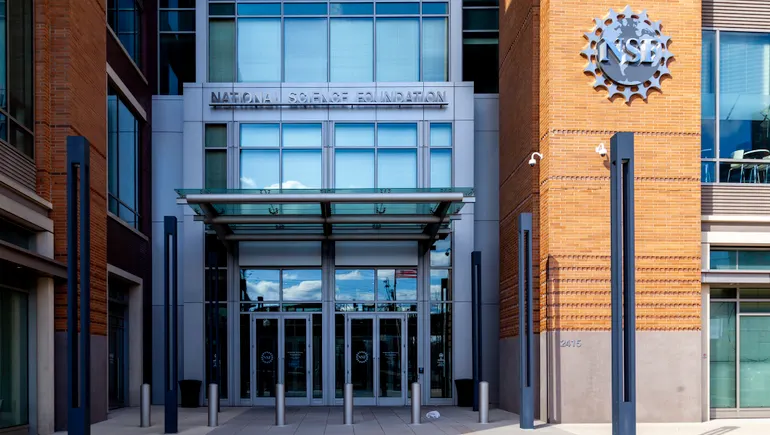
    • A group of universities and higher education associations is suing the National Science Foundation over its new cap on reimbursement for indirect research costs for all future college grants.
    • In court documents filed Monday, the plaintiffs — led by the American Council on Education, the Association of American Universities and the Association of Public and Land-Grant Universities — allege the unilateral 15% cap, which took effect May 5, violates the law in “myriad respects” and that its effects will be “immediate and irreparable.”
    • The new lawsuit follows two other legal challenges over similar caps implemented by the National Institutes of Health and the U.S. Department of Energy — both of which have been blocked, at least temporarily.

    Dive Insight:

    NIH implemented the first federal cap on indirect research costs in February. Colleges and higher ed groups sued, and a federal judge permanently blocked the agency’s plan last month. 

    In the ruling, the judge said NIH unlawfully implemented the cap and violated constitutional prohibitions on applying new rules retroactively. The Trump administration quickly appealed the ruling, and the case is ongoing.

    Next came the Energy Department. In April, the agency announced the same 15% cap on indirect research costs, alleging the plan would save taxpayers $405 million annually. Again, colleges sued, and a federal judge blocked the plan — albeit temporarily — while the lawsuit moves forward.

    The ACE, AAU and APLU are plaintiffs in both cases.

    Now NSF has introduced its own cap, to the chagrin of colleges and higher ed experts. When announcing the 15% cap, the agency argued the move would streamline and add transparency to the funding process and “ensure that more resources are directed toward direct scientific and engineering research activities.”

    But the new lawsuit argues that NSF’s policy echoes the other agencies’ attempts, to deleterious effect.

    “NSF’s action is unlawful for most of the same reasons, and it is especially arbitrary because NSF has not even attempted to address many of the flaws the district courts found with NIH’s and DOE’s unlawful policies,” it said. 

    Like the lawsuits against NIH and Energy Department’s policies, the plaintiffs allege that the NSF’s cap oversteps the agency’s authority.

    “It beggars belief to suggest that Congress — without saying a word — impliedly authorized NSF to enact a sweeping, one-size-fits-all command that will upend research at America’s universities,” it said.

    In fiscal 2024, Congress gave NSF $7.2 billion to fund research and related activities. In turn, the agency funded projects at 1,850 colleges — more than 1 in 4 of the higher education institutions in the U.S. eligible to receive federal dollars.

    That year, NSF awarded Arizona State University, one of the plaintiffs, 172 awards worth a total of $197.5 million in anticipated and obligated funding, according to court documents. Prior to the NSF’s new policy, the institution negotiated a 57% rate for indirect costs in fiscal 2026. 

    The University of Illinois, another plaintiff, received just over $129 million in NSF funding in fiscal 2024 — making the agency its biggest funder — and negotiated an indirect research funding rate of 58.6%.

    The university said in court documents that it has received the most NSF funding of all U.S. colleges for six years in a row, and it is poised to lose more than $23 million a year if the agency’s new cap is allowed to continue.

    The college plaintiffs are:

    • Arizona State University.
    • Brown University, in Rhode Island.
    • California Institute of Technology.
    • The University of California.
    • Carnegie Mellon University, in Pennsylvania.
    • The University of Chicago.
    • Cornell University.
    • The University of Illinois.
    • Massachusetts Institute of Technology.
    • The University of Michigan.
    • The University of Minnesota.
    • The University of Pennsylvania.
    • Princeton University, in New Jersey.

    The lawsuit also cited an attempt by the first Trump administration to cap rates for indirect research at a federal agency. In 2017, the White House proposed cutting the cap to 10% for all NIH grants. Congress – then under Republican control as it is now — “identified serious problems immediately” and took “swift and bipartisan” action against the proposal, the lawsuit said.  

    Source link

  • Redefining Student Success with Digital Marketing and CRM

    Redefining Student Success with Digital Marketing and CRM

    Reading Time: 10 minutes

    The way higher institutions define and acknowledge student success in higher education today is changing rapidly. Today, diplomas and transcripts are no longer the benchmarks for measuring the success rate of students in their academics. To define success, you have to consider a complete and holistic journey and vision. Factors like the student’s academic excellence, mental and physical growth, and preparation for what comes next are increasingly becoming key to defining academic success. This is why universities are looking beyond enrolment figures, they are now more focused on helping their students thrive academically, socially, and professionally.

    This brings us to the role of modern digital marketing tactics and advanced CRM tools. Colleges can create an environment that supports every student with the right resources they need to succeed, using the data-driven outreach and personalized support that these tools offer. In this blog post, we’ll explore the true meaning of student success and what key metrics are best placed to measure student success in higher education. We’ll also show you how marketing automation and CRM platforms (including HEM’s own Mautic for Education and Student Portal) can help drive real student achievement. Read on to find out what strategies and tools are best suited to define modern student success.

    Looking for an all-in-one student information and CRM solution tailored to the education sector?

    Try the HEM Student Portal!

    Redefining Student Success Metrics in Higher Education: Beyond GPAs and Graduation Rates 

    Who you ask about the definition of academic success will also determine the type of answer you get. Administrators might lean towards metrics and retention rates. Students tend to have a more personal definition of success, like having supportive mentors, developing confidence, and building lasting connections.

    This brings us to the question: What is the definition of student success? The definition of student success encompasses building communication skills and critical thinking activities, career or grad school readiness. In essence, a successful student grows through campus life, engages with the community, and adequately prepares themself for future opportunities.

    Below are components of a comprehensive student success definition:

    • Academic Achievement: Mastering course material and maintaining strong GPAs
    • Persistence and Retention: Continuing enrolment term after term until graduation
    • Personal Development: Cultivating critical thinking, communication skills, and emotional intelligence
    • Engagement and Belonging: Finding community through meaningful campus involvement
    • Career Readiness: Building the confidence and skills needed for post-graduation success

    As EDUCAUSE, a prominent education technology organization, points out, student success programs “promote student engagement, learning, and progress toward the student’s own goals through cross-functional leadership and the strategic application of technology.” This reaffirms the fact that true success calls for a harmonious relationship between human connection and technology. 

    Measuring What Matters: The Metrics of Achievement 

    How do we truly and correctly measure student success if we say that there are many sides to it? What is the definition of a successful student, and how to measure student success in higher education? While this question has intrigued higher educational professionals for decades, today’s schools are finding the right answers by combining traditional metrics and emerging indicators.

    Traditional measurements include retention rates (are students returning each semester?), graduation rates (are they completing their degrees?), and academic performance (are they mastering the material?).

    Now, these numbers matter. They help us tell to a reasonable degree if students are progressing toward their educational goals, or not. However, there’s a richer story to be told beyond these statistics, and you’ll learn about it shortly.

    Student success metrics commonly include:

    • Retention Rates: The percentage of students who return for subsequent terms
    • Graduation Rates: How many students complete their degrees within expected timeframes
    • Academic Performance: Beyond grades—how students grow intellectually over time
    • Student Engagement: Participation in everything from research opportunities to campus events
    • Student Satisfaction: Feedback that reveals how students experience their education
    • Post-Graduation Outcomes: Career placement, graduate school acceptance, and alumni achievements

    Away from these quantifiable measures, today’s schools value the essence of student-defined success. For them, it could be a first-generation student finding their voice, an international student building cross-cultural friendships, or a working parent balancing studies with family life. The schools that manage to combine statistical trends with individual stories will ultimately get the most complete picture of things. 

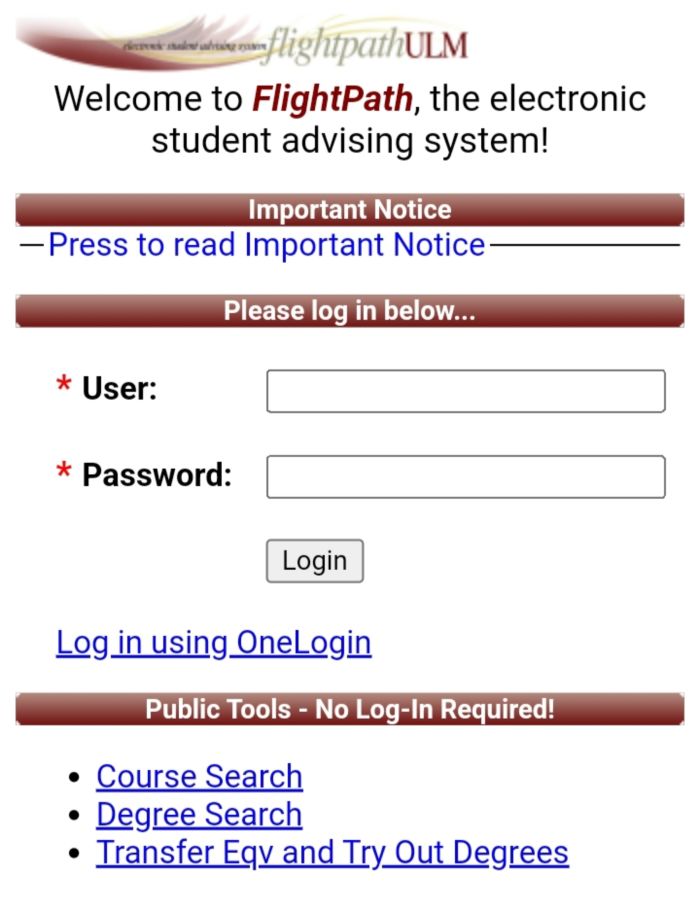
    Examples: ULM developed FlightPath, an open-source advising system for degree audits, early alerts, and “What If?” planning. It is designed to help you determine your progress toward a degree.

    HEM Image 2HEM Image 2

    Source: ULM FlightPath

    Digital Marketing: Setting the Stage for Success

    What do marketing strategies have to do with student success? What does digital marketing contribute to student success? Higher education marketing and student success are interconnected through a series of key touchpoints.

    The path to college student success often begins with that first Instagram post that catches a high school junior’s eye or that personalized email that addresses their specific interests. It is all part of the coordinated digital marketing campaigns that today’s schools employ, to great success.

    Here’s how digital marketing strategies  can help nurture student success:

    • Attracting the right-fit students: When marketing materials paint an authentic picture of campus culture, incoming students arrive with realistic expectations and are more ready to engage.
    • Personalized communication: Tailored messages that speak to individual aspirations create early connections. When a prospective engineering student receives content about robotics competitions or research labs, they begin envisioning their place in your community.
    • Seamless onboarding: The summer before freshman year can be overwhelming. Automated campaigns that introduce new students to campus resources, share advice from current students, and foster peer connections help transform nervousness into excitement.
    • Feedback loops: Savvy marketing teams don’t just broadcast – they listen. Social media monitoring and regular surveys help identify pain points before they become barriers to success.

    Examples: Gonzaga’s English Language Center moved from siloed data to a Student Success CRM on Salesforce, improving collaboration and early-alert capabilities for ESL learners.

    HEM Image 3HEM Image 3

    Source: Gonzaga University

    CRM Tools: The Backbone of Student Support

    Customer Relationship Management (CRM) systems are now important tools for tracking and supporting the student journey, especially in today’s data-driven world. These platforms present themselves as centralized hubs that help schools track student progress, identify potential challenges, and carry out timely interventions.

    Colleges can transform how they engage with students at every stage using the right CRM. Take this scenario for example: A first-year student misses out on many classes and fails to log into the learning management system for two weeks. While this might have gone on without being detected in the past, probably until midterm grades showed a significant gap, not anymore. With a CRM, a trigger will set off based on this pattern and send automatic alerts to the students’ advisor, who can now contact support resources to arrest the decline before it further spirals.

    Example: King’s College uses CRM Advise to flag risk factors, like missed classes, and automatically route alerts to advisors and support centers.

    HEM Image 4HEM Image 4

    Source: King’s College – CRM Advise

    Here are six ways CRM tools elevate student success in higher education:

    1. Centralizing the 360° Student View: Modern CRMs integrate data from admissions, advising, financial aid, and student life to create comprehensive student profiles. When an advisor can see that a struggling student is also working 30 hours weekly, they can provide more targeted support.
    2. Enabling Early Alerts: By analyzing patterns like missed assignments or decreased LMS activity, CRMs can identify at-risk students before a crisis develops.
    3. Automating Support Workflows: Smart CRMs ensure consistent communication throughout the student journey. From congratulatory messages when students ace exams to gentle nudges when they miss classes, automated workflows maintain continuous engagement without overwhelming staff.
    4. Providing Data-driven Insights: Institutions can analyze which interventions are best-suited to promote student success, using comprehensive data collection.
    5. Streamlining Administrative Processes: By simplifying registration, financial aid processes, and advising appointments, CRMs eliminate frustrating barriers that might otherwise derail student progress.
    6. Promoting Community: Many platforms include features that connect students with mentors, study groups, and support communities. These all help to nurture the sense of belonging that anchors students during challenging times.

    With solutions like Mautic by HEM, schools can enjoy robust CRM and marketing automation tailored specifically for them. The platform provides a central hub where you can manage all of your leads, applicants, agents, and parent contacts, enabling personalized support throughout the student lifecycle.

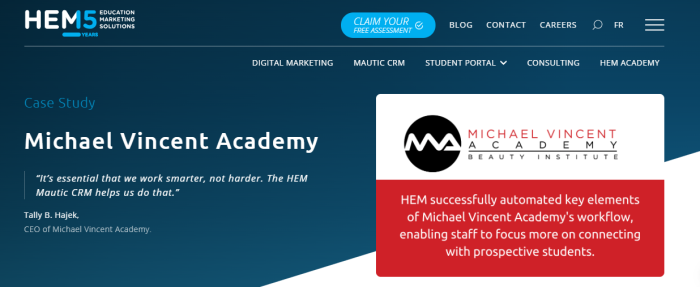
    Example: Michael Vincent Academy, a Los Angeles-based beauty school, sought to enhance its student recruitment efficiency by streamlining lead management and follow-up processes. With HEM’s Mautic CRM, the academy automated key marketing tasks and introduced lead scoring, enabling staff to focus on high-value prospects. This allowed the team to dedicate more time to building meaningful connections with prospective students, ultimately improving recruitment outcomes.

    IMAGE 8IMAGE 8

    Source: HEM

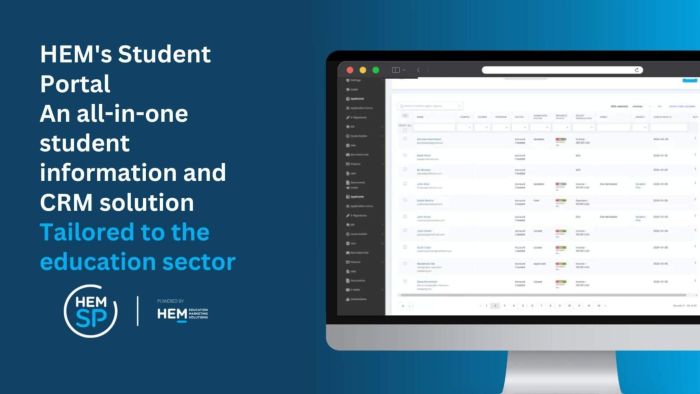
    HEM’s Student Portal combines online application creation and management, SIS functionality, and lead-nurturing tools in one centralized system. As a student, this is designed to help you manage your journey – from initial application to enrolment to graduation and beyond.

    As a school, using these specialized tools can help you address your institution’s unique needs and leverage the capacity of generic CRMs.

    IMAGE 9IMAGE 9

    Source: HEM

    Example: Students at Western Michigan University (WMU) use the Student Success Hub’s CRM to schedule and manage appointments, review advising notes, work on success plans, and tasks.

    HEM Image 6HEM Image 6

    Source: WMU Student Success Hub Training

    The Impact of Dedicated Success Programs

    One of the key ingredients of college student success is the use of structured programming that helps students navigate important stages of their academic journey. Many schools have found value in offering a student success class or course, such as a freshman seminar or “College 101” course that equips students with essential skills and connections.

    What is a student success class in college? It’s a course designed to help students be successful in college. It aims to help students properly navigate both academic requirements and college culture. Here is a list of subjects that these classes typically cover:

    • Effective study strategies tailored to college-level expectations
    • Time management techniques for balancing academic and personal demands
    • Campus resource navigation, introducing students to everything from tutoring to counselling
    • Financial literacy skills to manage college costs
    • Stress management and wellness practices
    • Career exploration and professional development

    Research continues to show that the students who complete these courses earn more credits and have a higher graduation rate than those who don’t participate. 

    The Power of Storytelling in Student Success Marketing

    By channelling authentic storytelling into their marketing narratives, schools can connect with prospective and current students. Stories have a way of transforming abstract content as “retention initiatives” into relatable human experiences that inspire action.

    What if you created a series featuring diverse student voices? Think of the impact it can have. Think of first-generation students who initially had doubts about themselves but connected with mentors who had faith in them, the transfer student who found unexpected opportunities, or the international student who calls the school home.

    Not only do these narratives attract prospective students, but they remind the current ones that challenges are not special and that success is very much achievable. 

    Tips to Boost Student Success with Marketing and CRM

    Institutions looking to take advantage of digital marketing and CRM tools more effectively should consider these practical strategies.

    1. Use Data to Personalize Outreach: Segment your communications based on student interests, challenges, and milestones to provide relevant support throughout their journey.
    2. Implement Early Alert Systems: Configure your CRM to identify warning signs like decreased engagement or academic struggles, enabling timely, personalized interventions.
    3. Integrate Your Systems: Ensure your marketing automation, CRM, and student information systems communicate seamlessly for a complete view of each student’s experience.
    4. Maintain Consistent Communication: Develop messaging flows that accompany students from prospective inquiry through graduation while remaining authentic and supportive.
    5. Leverage Student Feedback for Content: Gather testimonials and success stories that inspire current students and set realistic expectations for prospects.
    6. Train Your Team on Tools: Invest in comprehensive training so everyone, from admissions counselors to faculty advisors, can effectively use your CRM to support student success.

    Example: GSU’s Student Success 2.0 initiative includes implementing an enterprise CRM for a unified student record and early-alert triggers to boost retention by up to 1.2 % annually, with the National Institute for Student Success (NISS) also set up to that effect.

    HEM Image 7HEM Image 7

    Source: GSU Student Success 2.0 Initiative

    Creating a Culture of Success: A Holistic Approach

    The most effective approach to student success blends marketing insights, CRM capabilities, and human connections in one big package. With these elements working in harmony, institutions can create environments where students from all backgrounds can thrive.

    Remember that behind every data point is a student with dreams, challenges, and unlimited potential. When you align marketing, technology, and support programs around a student-centred vision of success, you can get positive outcomes in return. We don’t just improve statistics, we transform lives and fulfill higher education’s fundamental promise.

    Looking for an all-in-one student information and CRM solution tailored to the education sector?

    Try the HEM Student Portal!

    Frequently Asked Questions

    Question: What is the definition of student success?

    Answer: The definition of student success encompasses building communication skills and critical thinking activities, career or grad school readiness.

    Question: How to measure student success in higher education?

    Answer: While this question has intrigued higher educational professionals for decades, today’s schools are finding the right answers by combining traditional metrics and emerging indicators.

    Question: What is a student success class in college?

    Answer: It’s a course designed to help students be successful in college. It aims to help students properly navigate both academic requirements and college culture.

    Source link

  • Probably not the next Laurentian, but…..

    Probably not the next Laurentian, but…..

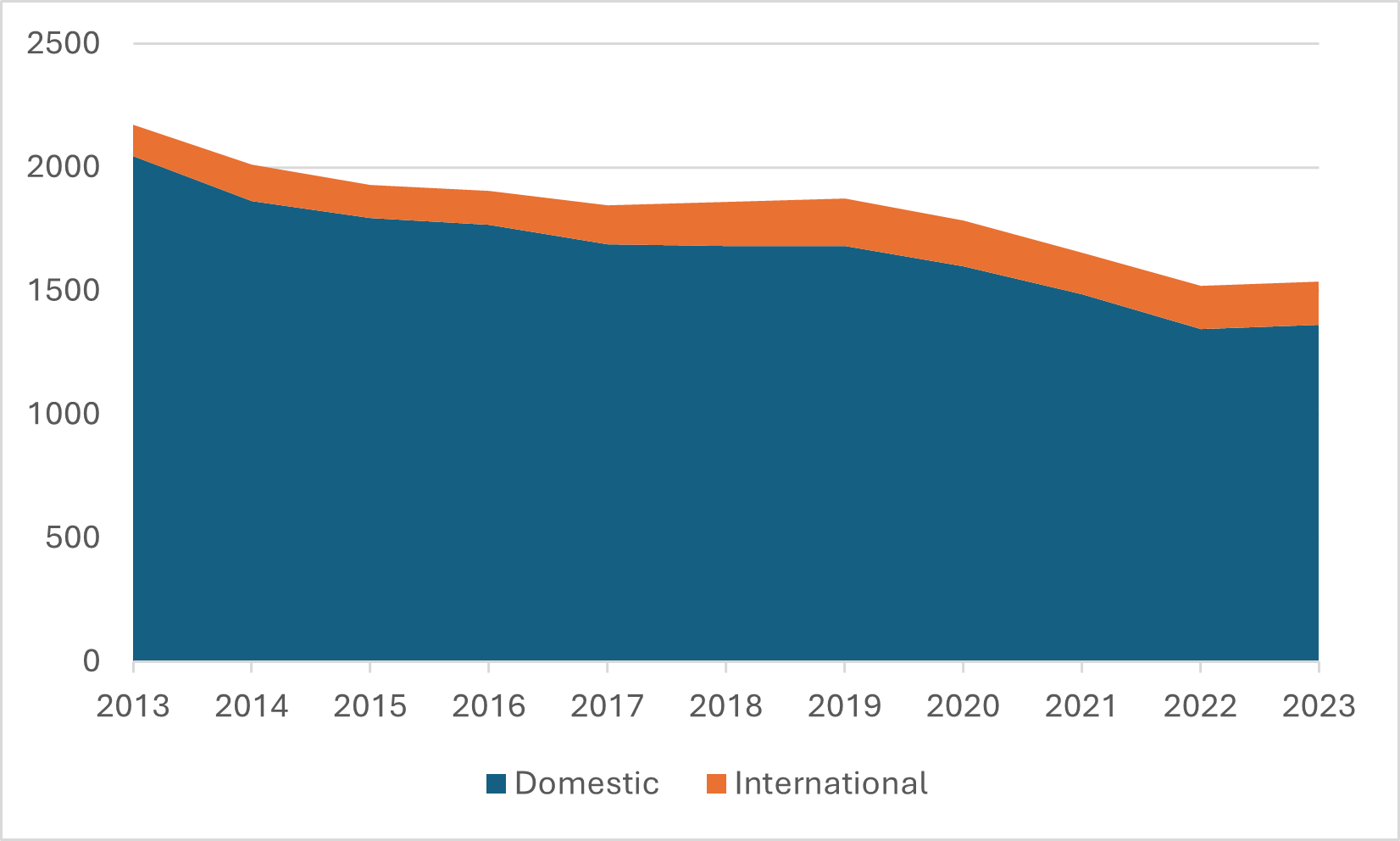
    As I noted yesterday, there are only two institutions in Canada which have run deficits in each of the last five years: St. Thomas University (STU) and Vancouver Island University (VIU). In both instances, these institutions have had deficits averaging between 4 and 5% of their total income over the course of those five years. By any definition, this puts them on some kind of watch list.

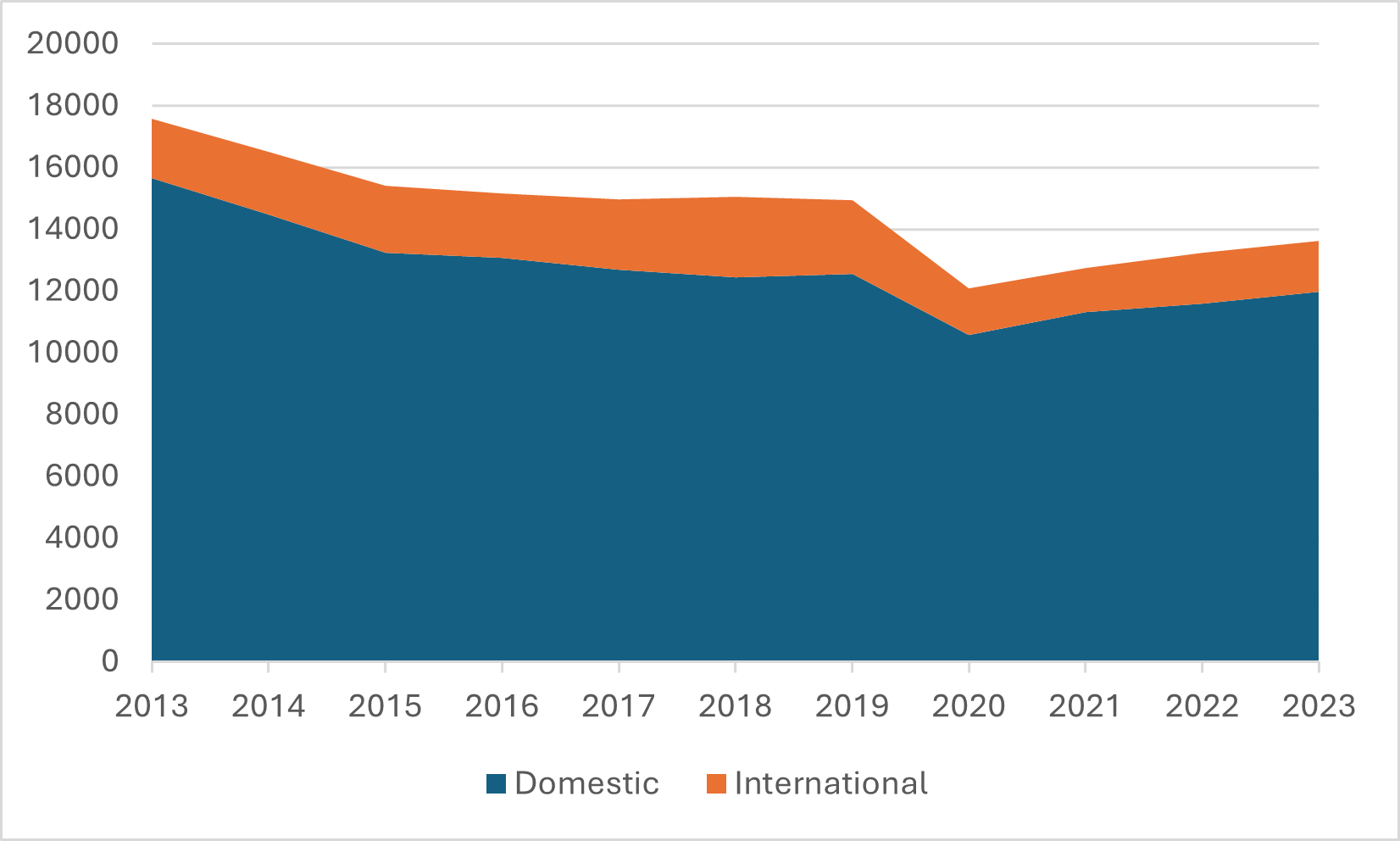
    As Figures 1 and 2 show, the root cause of both institutions’ problems is the same—namely, a big two-stage decline in enrolment. The first stage came in the early 10s, when the domestic youth population was shrinking, and the second came during Covid. The numbers are particularly bad at VIU, where the number of international students is down by over 35%. If these institutions could just get their enrolment numbers back to where they were in 2018, then STU’s tuition income would be about $3 million higher, while VIU’s would rise by roughly $20 million. In both cases, that would be enough to put the institutions well into the black. The much larger numbers at VIU are not just because it is a larger institution, but because the recent fall in student numbers is happening disproportionately on the international student side.

    Figure 1: Domestic and International Enrolment, St Thomas University, 2012-12 to 2022-23

    Figure 2: Domestic and International Enrolment, Vancouver Island University, 2012-12 to 2022-23

    At this point, folks, I am going to have to do something which some might find triggering, which is to invoke the L-word, because I am quite certain that everyone remembers the extent to which falling enrolment and a drop in tuition revenue were among the key elements in the collapse at Laurentian. I am not going to do this because I necessarily think either of these institutions is following the Laurentian path exactly. One very big dissimilarity is that neither STU nor VIU has any long-term debt, which was another of the key factors at work at Laurentian. Rather, I am doing it because I think at least some of the same dynamics are at play, particularly at VIU, which just happens to be about the same size as Laurentian in terms of enrolment and budget size, albeit without some of Laurentian’s big ambitions with respect to research. In fact, given the VIU/Laurentian similarity, I will concentrate the rest of this analysis on this west coast institution. I might come back to STU sometime, but for the moment, I will leave it aside.

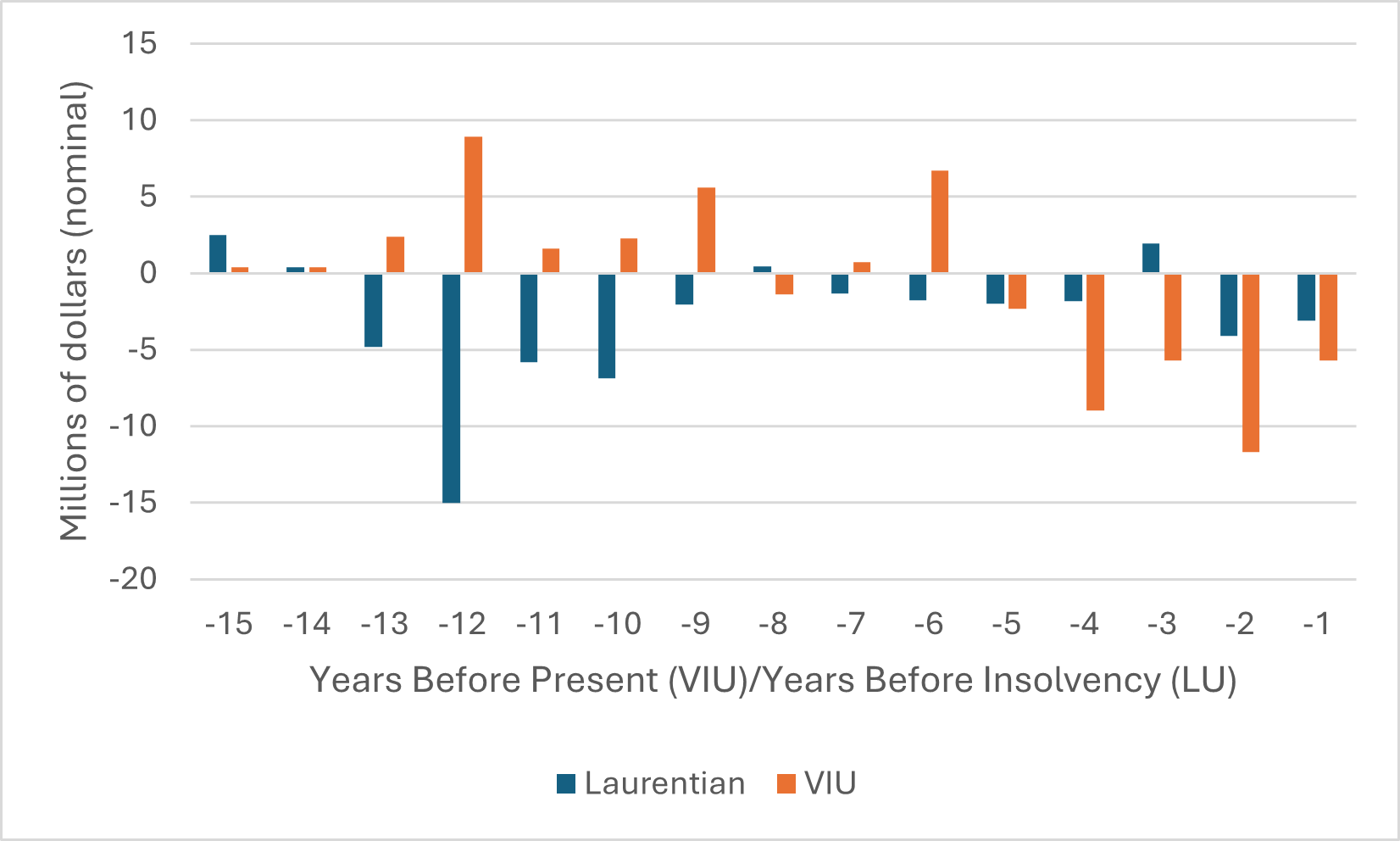
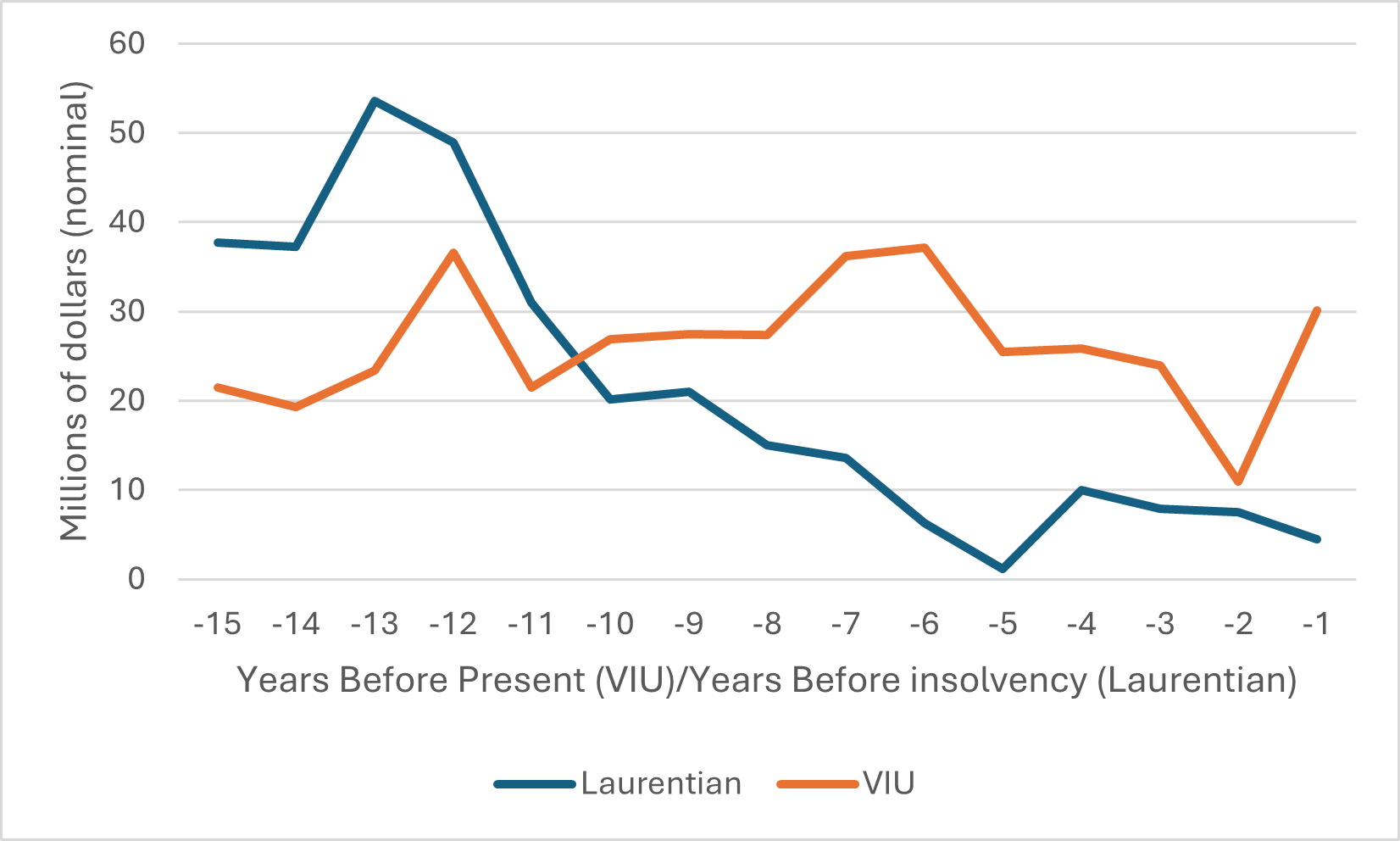
    Let’s start by looking at budget surpluses over time at VIU and Laurentian. Figure 3 shows the last fifteen years of VIU’s surpluses/deficits and compares them to the fifteen years prior to the insolvency declaration at Laurentian. Based simply on the last five years or so, there is no question that VIU is actually worse than Laurentian. The institution has spent $34 million more than it earned in the last five years; Laurentian, in contrast, was only $9 million in the red over a similar period prior to insolvency. But shift your eyes to the left of that graph for a minute, and you’ll see another difference: Laurentian ran deficits basically for most of the fifteen years prior to its events, whereas VIU was in pretty good shape. What that meant was that when the bad times started five years ago, VIU had a decent accumulated surplus to draw from. That is why the institution has been able to carry on over the past few years, but since it has now drawn down well over half of its accumulated surplus ($30.6 million in 2024, down from $78 million in 2018), that strategy doesn’t really have any more room to run.

    Figure 3: Long-term Record of Surpluses/Deficits, in Millions, Laurentian vs VIU

    There are also significant differences between the two institutions when you look at cash balances, as below in Figure 4. Laurentian was basically out of gas and surviving on fumes for several years prior to the collapse, with cash reserves barely enough to cover a couple of weeks of operating expenditures; VIU has never been anywhere near that point. However, note the big dip in VIU’s cash last year. It reversed itself, but only because the institution sold off a big chunk of portfolio investments precisely (I think) to boost cash reserves. There are warning signs here for sure, albeit nothing like Laurentian’s blaring klaxons.

    Figure 4: Long-term Record of Cash Position at End of Fiscal, in Millions, Laurentian vs VIU

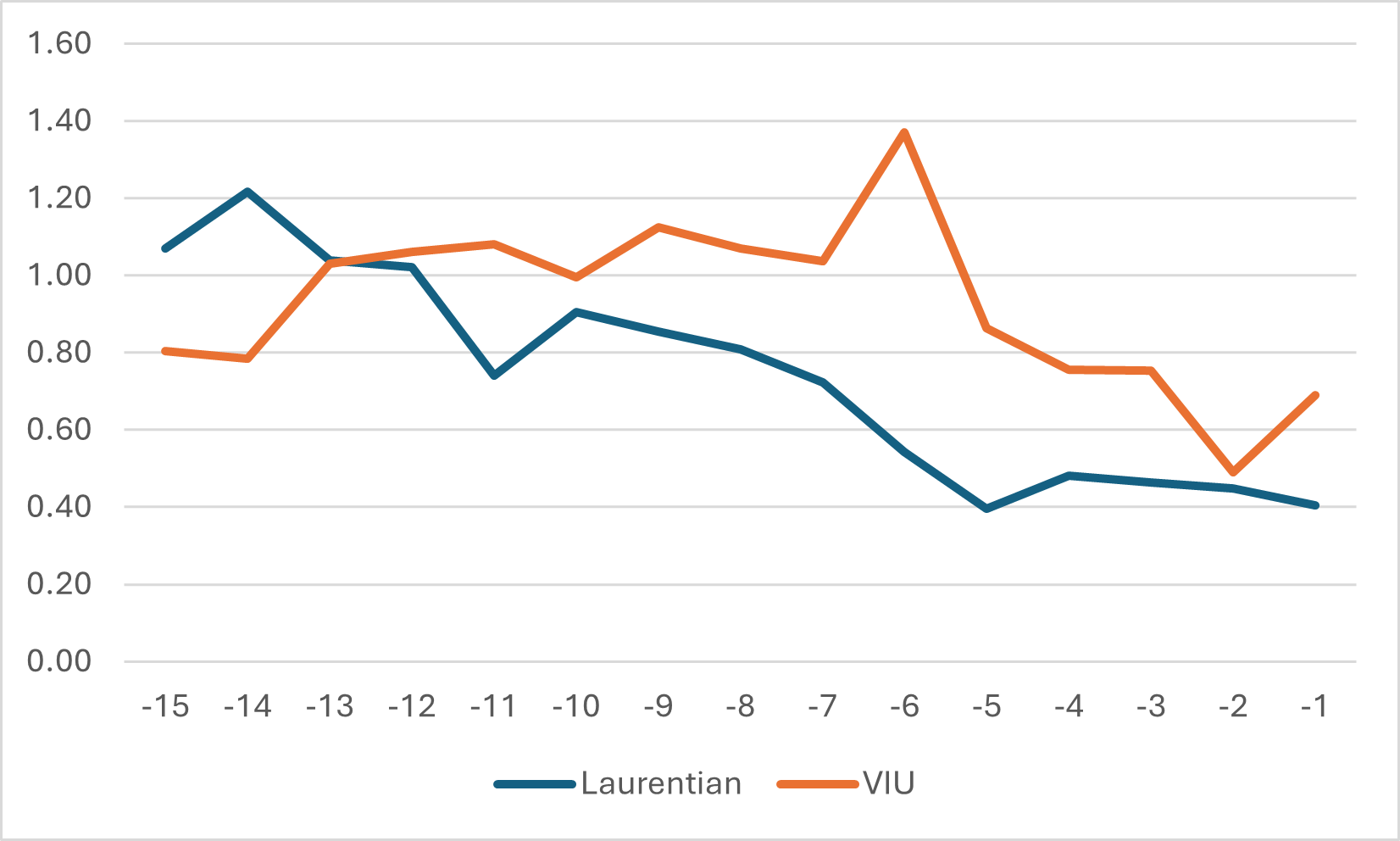
    The final comparison I want to make has to do with what is known as the “working capital ratio.” This is one of the key financial tests that the Government of Ontario uses to identify institutions in financial trouble, and it is the ratio between “current assets” (basically, cash plus accounts receivable) to current liabilities plus deferred contributions for research. Anything below a ratio of 1 puts you in the “high-risk” category.

    (Nota bene: some people think this ratio is not very useful because in a liquid market, institutions can move “long-term” investments to short-term fairly easily—as indeed VIU seems to have done last year when it sold off some of its portfolio investments in order to recharge cash reserves. However, since it’s an official government metric, it’s probably due a little respect, so I am using it here anyway.)

    One challenge in comparing VIU and Laurentian on the working capital metric is that they don’t quite calculate their liabilities identically, mainly because their respective provincial governments don’t ask them to categorize balance sheets in the same way. Specifically, VIU does not break out “current” from long-term liabilities, and also it lists substantial sums of tuition fees owed as “deferred revenue” while Laurentian does not. My read of this is therefore that to make the two sets of data on current liabilities comparable, one has to exclude from VIU’s numbers both “deferred capital contributions” and “deferred revenue”. Which is what I have done below in Figure 5.

    What Figure 5 shows is arguably similar to what Figure 3 shows: a metric in which a) neither institution looks particularly good, but b) Laurentian’s position is on the whole worse, and c) Laurentian’s deterioration is long and gradual while VIU’s is rather sharp.

    Figure 5: Long-term Record of Working Capital Ratios, Laurentian vs VIU

    To be crystal clear: I don’t think VIU is really on the verge of Laurentian-ing. It has no long-term debt. It has had a bigger cushion to fall back on. The province is on the verge of a youth boom, which should help a bit in bringing student numbers and revenues back up. It is working for a provincial government which is far more proactive than the frequently clueless one in Queen’s Park. And in fall 2023, it adopted a fairly aggressive if not especially strategic program of cost-cutting (ten percent for all units over three years), which in theory was supposed to right the ship.

    However:

    1. Even if VIU is not Laurentian, many of its key financial indicators look awfully familiar. From deficits to cash levels, to working cash ratios, it all seems very Mark Twain: history does not repeat, but it rhymes.
    2. That aggressive deficit reduction package didn’t reckon with Marc Miller, whose cuts to visas and policy of publicly crapping on the quality of Canadian institutions is likely to result in further drops in international student numbers and therefore reductions in income in the millions of dollars. There could still be problems ahead (I assume this may be what has been behind this week’s decision to consider suspending and/or cancelling roughly twenty programs at the diploma, undergraduate and graduate levels).
    3. The VIU community appears to be only dimly aware of how bad things are. When VIU President Deborah Saucier recently resigned, it was—according to CBC at least—because the VIU community would not support further cuts because they were not “supported by evidence.” Now, there may have been more to it than that (Lord knows CBC can be pretty crapulous at fact-checking post-secondary stories), but if it is anywhere near the truth, then the VIU community is clearly having some trouble facing a pretty serious reality, and that complicates any revival plan.

    Vancouver Island needs a second, flourishing undergraduate university and that can only be achieved through a strong financial base. Best wishes, therefore, to the folks at VIU as they grapple with these issues.

    Source link

  • Decoder Replay: Australia waltzes with two superpowers

    Decoder Replay: Australia waltzes with two superpowers

    The index ranks 26 countries and territories in terms of their capacity to shape their external environment. It evaluates international power through 133 indicators across themes including military capability and defense networks, economic capability, diplomatic and cultural influence, as well as resilience and future resources.

    The portrait that emerges from its latest survey is that while China’s overall power still lags the United States, it is not far behind, even though the current economic slowdown is holding it back in the short term.

    After the two superpowers, trailing a long way back as the next most powerful countries in the Asia-Pacific are Japan, India, Russia and then Australia.

    Economic versus military power

    The index confirms that China draws its power from its central place in Asia’s economic system, while that of the United States comes from its military capability and unrivaled regional defense networks.

    Australia’s relationship with the two mirrors the dilemma facing the whole region.

    The United States is far and away Australia’s main strategic partner and has been since the Second World War.

    In a deal signed in March 2023, Australia is set to acquire a conventionally-armed, nuclear-powered submarine capability with help from the United States through the AUKUS Treaty, which also involves the United Kingdom.

    This was followed by plans to station more U.S. forces in Australia, especially in air bases in northern and western Australia. There are also moves to increase cooperation between both countries in space, speed up efforts for Australia to develop its own guided missile production capability and work with the United States to deepen security relationships with other countries in the region — most notably Japan.

    This comes as Australia has been working hard to get trade restrictions eased with China after it imposed tariffs on a range of Australian products in 2020 during a standoff with the previous government.

    Dining with Joe and Jinping

    China is still Australia’s largest two-way trading partner in goods and services, accounting for almost one third of its trade with the world. Two-way trade with China grew 6.3% in 2020-21 to A$267 billion (about US$180 billion), mostly due to the coal and iron ore sectors.

    So as it stands, Australia’s security relies on the United States but its economic prosperity is heavily influenced by China.

    It’s no surprise then that Prime Minister Albanese had to walk a fine line in 2023 — going from a state dinner at the White House with U.S. President Biden on 26 October to meeting with Chinese president Xi Jinping 11 days later.

    Colin Heseltine, a former Deputy Head of Mission at the Australian Embassy in Beijing and now senior advisor for independent think tank Asialink, said Australia is in a conundrum over China.

    “Australia’s major trading partner is also perceived as our No.1 security threat,” he said.

    Normalizing relations before an abnormal U.S. election

    Heseltine believes there is a mood of cautious optimism about the growing relationship between Australia and China since the election of the Albanese government, but expects the future will not be completely free of headwinds.

    In the end, Australia, like many other nations in the region, is pragmatically making the situation work. It has seen relations with Beijing normalize, or as some prefer to describe it, stabilize.

    As for the United States, relations between Canberra and Washington remain vibrant and strong.

    The next big issue for Australia in managing this twin policy of improving ties with the Asia-Pacific’s two diverse superpowers could well be the 2024 U.S. presidential election — who wins it and if China features in it.

    And those things are outside its control.


    Three questions to consider:

    1. What is the emerging dilemma facing most democratic nations in the Asia-Pacific region?
    2. Is China likely to overtake the United States as the Asia-Pacific’s major superpower anytime soon?
    3. What is the biggest threat to the current status quo facing nations in the region?


    Source link

  • Columbia student Mohsen Mahdawi says "justice will prevail" after ICE release (CBS Mornings)

    Columbia student Mohsen Mahdawi says "justice will prevail" after ICE release (CBS Mornings)

    Columbia University student Mohsen Mahdawi spoke with CBS News in his first TV interview since his release from ICE custody. He spent 16 days in detention and now awaits deportation hearings for protesting the war in Gaza.
     

    Source link

  • To fill “education deserts,” some states want community colleges to offer bachelor’s degrees

    To fill “education deserts,” some states want community colleges to offer bachelor’s degrees

    MUSCATINE, Iowa — The suspect moved menacingly toward her, but Elexiana Oliva stood her ground, gun drawn and in a half crouch as she calmly tried to talk him down.

    The confrontation wasn’t real, and neither was the gun. But the lesson was deadly serious.

    Oliva is a criminal justice major at Muscatine Community College in this largely agricultural community along the Mississippi River. She was in a simulation lab, with that scenario projected on a screen as classmates watched, spellbound.

    Just 18, Oliva is determined to become a police detective, a plan that includes earning a bachelor’s degree after she finishes her associate degree here. But she’ll have to go somewhere else to do it — likely, in her case, to a university in Texas.

    Oliva and her classmates here are among the 13 million adults across the country who the American Council on Education estimates live beyond a reasonable commute from the nearest four-year university — a problem getting worse as private colleges in rural places close, public university campuses merge or shut down and rural universities cut majors and programs.

    “It’s not our fault that we grew up in a place where there’s not a lot of big colleges and big universities,” Oliva said.

    Related: Interested in innovations in higher education? Subscribe to our free biweekly higher education newsletter.

    Iowa has joined a growing number of states that are considering letting community colleges like this one offer bachelor’s degrees, or where community colleges have already started adding them, as a way of filling these so-called rural higher education deserts and training workers in rural places for jobs in fields where there are growing shortages.

    “It would be a big game-changer, especially for those who have a low income or a medium income and want to go and further our education,” Oliva said.

    Downtown Muscatine, Iowa. About an hour from the nearest public university, Muscatine could benefit from a proposal to let community colleges offer bachelor’s degrees. Credit: Mike Rundle for The Hechinger Report

    About half of states allow community colleges to offer bachelor’s degrees. In Iowa, which is among the half that don’t, lawmakers have commissioned a study to determine whether it should add bachelor’s degrees in some programs at the state’s 15 community colleges. An interim report is due in May.

    A similar proposal in Illinois is backed by that state’s governor, JB Pritzker, who has said the move would make it easier and more affordable for residents to get degrees — “particularly working adults in rural communities.” Three-quarters of community college students in Illinois said they would pursue bachelor’s degrees if they could do it on the same campus, according to a survey released by Pritzker’s office.

    Kentucky’s legislature is considering converting one technical and community college into a four-year institution offering both technical and bachelor’s degrees. Some Wyoming community colleges have also added a limited number of bachelors degrees.

    And in Texas, Temple College will open a center in June where students at the two-year public institution will be able to earn bachelor’s degrees through partner Texas A&M University-Central Texas, including in engineering technology with a concentration in semiconductors.

    “When you can offer university classes on community college campuses, that makes a world of difference” to rural students, said Christy Ponce, the president of Temple.

    What’s been blocking many of these students from continuing their educations, Ponce said, “is the sheer distance. There’s not a public university option within an hour or more away. And affordability and transportation barriers are huge issues.”

    Fewer than 25 percent of rural Americans hold bachelor’s degrees or higher, according to the National Center for Education Statistics, compared to the national average of 33 percent. And the gap is getting wider, the U.S. Department of Agriculture finds in its most recent analysis of this.

    Related: ‘Easy to just write us off’: Rural students’ choices shrink as colleges slash majors

    Significantly fewer students in rural places than in urban areas believe that they can get degrees, a Gallup survey for the Walton Family Foundation found, citing the lack of nearby four-year universities as a principal reason.

    In those states that already allow community colleges to offer bachelor’s degrees, they’re often limited to certain high-demand fields, such as teaching and nursing. Even as this idea has spread, America’s 960 public community colleges collectively confer only about 1 percent of bachelor’s degrees each year, the American Association of Community Colleges reports.

    In many places, what’s stopping them from giving out more is opposition from four-year universities and colleges, many of which are increasingly hard up for students as the number of 18-year-olds begins to fall — a phenomenon enrollment managers have dubbed the demographic cliff.

    That Illinois proposal, for example, is stalled in committee after several public and private university presidents issued a statement opposing it. Negotiations are continuing.

    While community colleges in California have been allowed since 2021 to offer bachelor’s degrees, several have been blocked from adding four-year programs that the California State University System contends it already offers. An independent mediator has been brought in to resolve the impasse.

    Related: Fewer students and fewer dollars mean states face closing public universities and colleges 

    And while the two-year, public College of Western Idaho will launch a bachelor’s degree in business administration in the fall, it’s doing so only over the objections of Boise State University, which said it “could hurt effective and efficient postsecondary education in Idaho, cannibalizing limited resources available to postsecondary education and duplicating degree offerings.”

    Community colleges also need more students; their enrollment declined by 39 percent from 2010 to 2021, and they face that same impending demographic cliff. Those that add bachelor’s degrees increase their full-time enrollment from 11 percent to 16 percent, research conducted at the University of Michigan has found.

    The Norbert F. Beckey Bridge, seen from the Mark Twain Overlook in Muscatine, Iowa, which links Muscatine with Rock Island County, Illinois, across the Mississippi River. Credit: Mike Rundle for The Hechinger Report

    The principal impetus for the largely bipartisan push to offer bachelor’s degrees at community colleges, however, is to train more workers for those fields in which there are shortages.

    “What I think is misunderstood is that, in general, these are not like the baccalaureates that conventional four-year institutions offer,” said Davis Jenkins, a senior research scholar at the Community College Research Center at Teachers College, Columbia University. (The Hechinger Report, which produced this story, is an independent unit of Teachers College.)

    Related: In this tiny and shrinking Mississippi county, getting a college degree means leaving home behind

    Bachelor’s degrees at community colleges, said Jenkins, “meet an economic need for bachelor’s degree graduates that isn’t being met by other institutions.”

    That includes by helping rural workers move up in their jobs without leaving home. “It’s all about serving our workforce needs,” said Iowa state Rep. Taylor Collins, Republican chair of Iowa’s House Committee on Higher Education, who requested the study into whether bachelor’s degrees should be offered at community colleges in that state. “It’s a way to upskill our workforce.”

    In his own district, south of Muscatine, “we’re kind of on an island where we only have the community college” — especially since the closing of nearby private Iowa Wesleyan University in 2023. “There are a lot of students who are place-bound. There are a lot of students who want to live locally” and not move away to get a bachelor’s degree.

    That’s a focus of the ongoing study, said Emily Shields, executive director of Community Colleges for Iowa, which is conducting it. “Sometimes people have ties, responsibilities, jobs, family things, where moving to where there is a degree available isn’t an option for them,” Shields said.

    Sure, she said, rural students can take courses online. But “you’re not getting the student services, you’re not getting activities, you’re not getting the other sort of enrichment support and belonging that a lot of our students, I think, are looking for.” 

    Many also say they’re looking for the kind of individual attention they get in their hometown and at a community college such as the one in Muscatine, which has an enrollment of 1,800.

    Related: Tribal colleges win reprieve from federal staff cuts

    Shiloh Morter stayed in his hometown of Muscatine, Iowa, to go to community college. Among the advantages, he says: “The sunsets here are pretty nice. I can tell you, there’s not a whole lot of other places that have clouds like we do.” Credit: Mike Rundle for The Hechinger Report

    Shiloh Morter bikes to campus on all but the very coldest days. He plans to become an engineer, but “figured I would save the money and go to community college and try and branch out and develop better habits” first, said Morter, who is 20.

    In the automotive technology garage off the main corridor of the small school, cars were lined up neatly with their hoods popped. Nursing students worked on anatomically correct crash test dummy-style “patients.”

    Twenty-year-old Mykenah Pothoff enrolled at the college when it debuted a registered nursing program, saving herself money on tuition and a nearly hourlong drive, each way, to the University of Iowa. She also was worried about “just, like, finding my way around” the university, which has more than 30,000 students.

    Jake Siefers is majoring in psychology at an Iowa community college. If he could stay and get his bachelor’s degree in the same place, “it would be huge,” he says. “There’s a lot of untapped human potential” in rural places that could benefit from more access to higher education. Credit: Mike Rundle for The Hechinger Report

    Jake Siefers, 32, is a psychology major planning to go on to get bachelor’s and master’s degrees. Siefers said he hopes to help other people who, like him, are recovering from alcoholism, and for whom he said there are too few services in Iowa. So he came home to Muscatine to start working toward an associate degree at the community college.

    I could afford it, and it was close and I actually know a lot of people that work here,” said Siefers. “It’s great coming in here and being, like, ‘Hey, I went to high school with you, and you work in the office.’ I mean, that’s everyone in Iowa, right?”

    If he could stay and get his bachelor’s degree in Muscatine, “it would be huge,” he said. “There’s a lot of untapped human potential” in rural places that could benefit from the kind of access to a higher education that is now more limited, said Siefers. 

    Letting students like them finish bachelor’s degrees near where they live “would make it easier for everybody,” said Jaylea Perez, 19, another psychology major who also plans to earn one.

    Jaylea Perez is enrolled in community college in Iowa but eventually hopes to earn a bachelor’s degree in psychology. Adding bachelor’s degrees at community colleges “would make it easier for everybody,” she says. Credit: Mike Rundle for The Hechinger Report

    Simply having bachelor’s degrees available would make rural students aspire to them who otherwise might not, said Naomi DeWinter, president of Muscatine Community College.

    “Everything opens up to them,” said DeWinter, in a coffee shop across the highway from the Walmart.

    She sees the most potential among people already working, such as paraprofessionals in schools who want to become teachers; a state job board lists nearly 1,000 vacancies in Iowa for teachers.

    DeWinter recalled a graduate so exemplary that he was featured in a promotional video, who after earning his associate degree started substitute-teaching while commuting in his free time to the University of Iowa to get his bachelor’s degree — one course at a time.

    “He said, ‘That’s how I’m juggling my work, my family and the affordability,’ ” she said. “His whole career is going to be over before he’s a [full-time] teacher. I feel as though we failed him.”

    Like the substitute teacher, students said they want to stay in Muscatine, despite those limits. They like the peace and quiet compared to cities — hardly anyone ever honks, they noted — and the sense of community evident among the friends who run into each other at the Hy-Vee.

    “We don’t have the best view of the Milky Way, but we for sure definitely don’t have a bad one,” said Shiloh Morter, ticking down a list of advantages to living on the sweeping plain carpeted with cultivated fields and dotted with barns and silos. “And, yeah, the sunsets here are pretty nice. I can tell you, there’s not a whole lot of other places that have clouds like we do.”

    Contact writer Jon Marcus at 212-678-7556 or [email protected].

    This story about rural higher education and community college bachelor’s degrees was produced by The Hechinger Report, a nonprofit, independent news organization focused on inequality and innovation in education. Sign up for our higher education newsletter. Listen to our higher education podcast.

    The Hechinger Report provides in-depth, fact-based, unbiased reporting on education that is free to all readers. But that doesn't mean it's free to produce. Our work keeps educators and the public informed about pressing issues at schools and on campuses throughout the country. We tell the whole story, even when the details are inconvenient. Help us keep doing that.

    Join us today.


    Source link