In February 2022, then Secretary of State for Education Nadhim Zahawi told Parliament the Johnson government’s decision on post-qualification admissions.
Clear as a welcome school bell, he stated “we will not be reforming the admissions system to a system of PQA at this time”.
But who says that we don’t already have PQA?
Admissions reform by stealth
The “Decline My Place” button introduced by UCAS instead of Adjustment basically introduced PQA anyway. The only reason we haven’t noticed is that we were not, then, very focused on undergraduate home numbers. How things change.
Let’s think about JCQ results day 2025. Let’s say I work at an institution in the Russell Group with good recruitment opportunities for UG home and some uncertainties (I enjoy understatement) about postgraduate international numbers. And let’s say I decide to make hundreds more spaces available than previously planned earlier in the cycle.
But let’s also say that my colleagues further north, west and east do the same. I have a wonderfully smooth confirmation, accepting lots of well qualified and soon-to-be happy young people. I arrive on results day less stressed and tired than usual which is just as well because all hell breaks loose.
From 8:00am until 1:00pm I am frantically confirming Clearing places and, I’m hitting refresh on our numbers forecast every 5 minutes. My blood pressure is rising as is my cake consumption (the renewable energy of choice for any self-respecting Admissions Office). I am desperately trying to work out if our gains are ahead of our losses.
That’s because hundreds (more?) of our nurtured, valued and cultivated unconditional firm offer-holders have hit a button at UCAS and declined their place to go elsewhere. On top of this, for the first time in 2025, some who are still conditional have released themselves too. Fine, I hear you say – If you haven’t processed a decision you deserve to lose the student. But several of these students are still awaiting results (excluded from the requirement that Decline My Place is only for those with a complete set of Level 3 results).
You may well ask where the problem is here.
A better offer
Well, these particular students are from schools and colleges where we have a partnership. Several have been on long-term aspiration-raising enrichment programmes with us for over two years. We have invested all we can in their (everyone must have one) journey. It’s just that they’ve had “a better offer”.
This may be an offer from an institution in London where “our” student has been offered a big financial incentive, and which grew its Clearing intake from zero to 200 in two years. An offer from a delightful campus in the Midlands where “our” student will be very happy and which would not have been an option when only 45 Clearing places were available – but now there are 500. An offer from an exciting and vibrant institution in the north which can take “our” student for Economics – a real surprise as spaces are not often available for a subject like that, but then this university grew its Clearing intake from 200 to 885 over the last two cycles.
These are all real examples from last year. Companies may well have to say that past performance is no guarantee of future results, but we wouldn’t select on the basis of predicted grades if it wasn’t to some degree – now would we?
Personally I have always been in favour of PQA in theory. It is just that the jeopardy I enjoy about admissions doesn’t quite extend to the levels of uncertainty I predict for the few days after 14 August 2025. I wonder how many members of the UCAS Board and how many vice chancellors realise that there is, in a theoretical model that may very well be tested this summer, every possibility that every single firm accept that we have all secured, conditional or unconditional, melts on or before Results Day.
They can all, with absolutely no controls (apart from a quick call to UCAS if you are still conditional) decline their place and go to the pub to celebrate “trading up”. If that isn’t PQA what is? I need another cake.
From Levin Kim, HELU Chair Over the first 100 days of the Trump Administration, higher ed workers from coast to coast have been fighting back against attacks on critical lifesaving research, on immigrant workers, on education and research in the public interest. We’re in the fight of our lives, for our work, our communities, and our future.
Despite alarming news on the daily—from students and workers removed from our campuses, firings, program closures, government intervention in classroom curriculum, and brazen attacks on academic freedom—we refuse to be immobilised into inaction because we know a better world is possible if we fight for it. We’re standing up for the future of higher ed by building a wall-to-wall, coast-to-coast movement of workers ready to organize, to fight, and to win. Now is the time for coalition-building, for moving your coworkers to take action together, and getting out in the streets. Find and attend a May Day event near you tomorrow, and stay tuned for more ways to take action.
This audio is auto-generated. Please let us know if you have feedback.
Dive Brief:
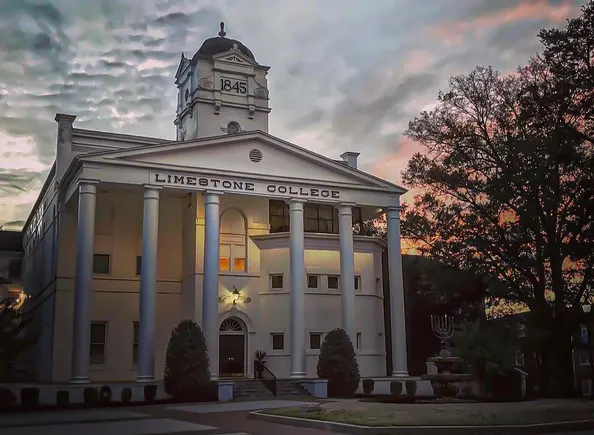
Limestone University, in South Carolina, will close when its current semester ends this week after last-ditch fundraising efforts came up short, the Christian institution announced Tuesday.
The university’s trustee board voted to permanently shutter Limestone despite raising $2.1 million from almost 200 donors in the last two weeks. The board previously said Limestone would need $6 million to stabilize operations.
“In the final analysis, we could not continue operations on-campus or online without a greater amount of funding,” board Chair Randall Richardson said in a Thursday statement.
Dive Insight:
Limestone ended last week on a hopeful note, with Richardson describing the board as “cautiously optimistic.”
“One of the largest in Limestone’s recent history, the transformative donation comes at a pivotal time as the institution rallies to secure critical funding that will help sustain its mission of providing life-changing educational opportunities,” the university said in the Fullerton announcement.
But even for a small university, the multimillion dollar campaign wasn’t enough to sustain Limestone.
Founded in 1845, Limestone’s enrollment has declined in recent years, with fall headcount dipping 27% to 1,782 students between 2018 and 2023, according to federal data. Current enrollment stands at about 1,600 students, the university said last week.
The university’s board has blamed those drops, as well as rising costs, for its financial travails. For fiscal 2024, it logged a budget deficit of $9.2 million, following an $11.4 million shortfall in 2023.
As it prepares to close, the university has promised an “orderly wind-down process” and said it will help students transfer to other institutions.
“More detailed information about the closure timeline, academic records, transfer assistance, employment impact, and other support services will be provided in the coming days,” it said.
Limestone plans to hold its commencement ceremony on Saturday for those students graduating at the end of the term, 246 in all.
“Our Limestone spirit will endure through the lives of our students and alumni who carry it forward into the world,” Richardson said. “Though our doors may close, the impact of Limestone University will live on.”
The year is 2025, and the influence of a rapidly evolving social media space in shaping education marketing campaigns is as critical as ever. While it has undoubtedly brought up several opportunities for those in the picture, it has also thrown up a few challenges that require the right gears to navigate. The stats are quite interesting: An increasing number of Gen Z users now turn to TikTok and Instagram as search tools, often preferring them over Google for quick information and exploration. This simply means that having a social presence for your school is no longer open to debate, it is an absolute necessity.
Today’s prospective students spend a lot of time browsing through multiple social media platforms. They make key decisions about their academic future based on what they see on these platforms. This is why an active social media presence is a key part of today’s educational marketing campaigns. However, beyond being active on these platforms, it takes a deliberate and strategic social marketing strategy to curate and create winning margins in this space.
At Higher Education Marketing Agency, we have several years of experience helping schools navigate the social space, converting interest into enrollment, and producing positive outcomes for many schools. Our personal, tested, and tried social media playbook for education marketers combines insights from leading education marketing experts with real-world examples. This playbook is designed to help your institution not just survive but thrive in today’s digital ecosystem. Read on to find out how.
Struggling with enrollment?
Our expert digital marketing services can help you attract and enroll more students!
The New Social Landscape: Multiple Platforms, Multiple Touchpoints
With social media evolving and becoming even more powerful, it is no longer a good idea to focus all your school’s attention on one platform. Today’s prospective students split most of their time among different platforms, and that’s why schools must be visible everywhere.
Prospective students might discover your school through a friend’s TikTok, research your programs on Instagram, watch alumni testimonials on YouTube, and check what parents are saying about you on Facebook, all before visiting your website. Your presence on each of these social media platforms will offer you unique opportunities to engage with different audiences.
Here’s a brief outline of the roles that different social media trends and platforms can play in your education marketing efforts.
Instagram: Great for visual storytelling, event promotions, and engaging reels showing student experiences.
TikTok: Ideal for short, fun, and informative content that drives brand awareness among younger audiences.
YouTube: The best place to show long-form videos, student testimonials, virtual tours, and other educational content.
Facebook: Essential for connecting with parents, alums, and local communities.
LinkedIn: Great for professional connections and showing academic credibility, targeting parents and graduate prospects.
While having a presence across key platforms is essential, mastering the content formats that resonate most, particularly short-form video, has become equally critical.
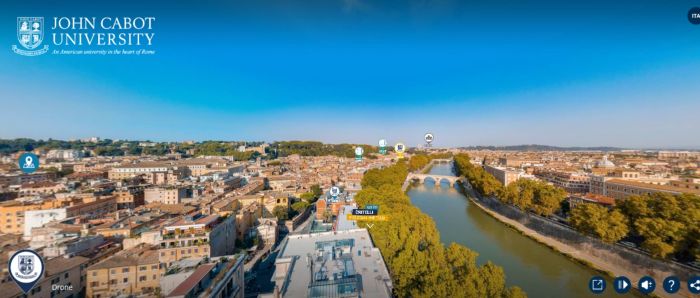
Example: John Cabot University offers virtual tours of its campuses, some of which you’ll find via its social media pages, YouTube, and straight off its website.
The influence of short-form video in shaping social media trends is at an all-time high today. Gen Z and Gen Alpha consume information fast, they don’t want to watch traditional ads or sit through long videos all day. Prospective students want to see what life at a school looks like in under 60 seconds.
A large number of these students now turn to TikTok and its bite-sized videos for everything from study tips to campus tours. This is why things like TikTok and Instagram Reels have become key for student recruitment, school branding, and engagement.
“Your goal is to freeze the thumb,” as one marketing expert puts it, creating content compelling enough to make someone stop scrolling.For best results, it is crucial to create educational short-form videos along these lines:
1. Day-in-the-life glimpses: A student takes viewers through their campus routine
2. Quick tips/educational snippets: A professor explaining a complex concept in 30 seconds
3. Behind-the-scenes peeks: Showing areas of campus rarely seen on official tours
4. Celebration moments: Capturing authentic reactions during events like graduation or move-in day
5. “Did you know” facts about your institution’s unique features or history
How can schools use short-form video to attract students? The key to creating winning short-form videos is to go for authenticity. Start by identifying what makes your institution stand out, whether it’s a unique program, a beloved campus tradition, or exceptional career outcomes.
You can then showcase these elements through quick, visually engaging stories highlighting your unique value proposition.
The Authenticity Advantage: User-Generated Content
The content created by your existing community is a powerful tool for building trust and driving engagement. User-generated content (UGC) from students, faculty, and alumni offers authentic perspectives as it comes from a real person, hence its effectiveness. Research shows that 84% of consumers trust UGC more than polished advertisements.
How can we get user-generated content from students? One proven strategy in this line is to allow a student to manage your school’s Instagram Stories for a day, sharing their authentic campus experience. These glimpses into real student life help prospective students envision themselves at your institution in ways that traditional marketing cannot achieve.
Here are some ways to incorporate UGC in your education marketing efforts:
Find your existing ambassadors: Search your school’s hashtags and location tags to find students already creating content about your institution. These natural enthusiasts often make the best collaborators.
Create participation opportunities: Develop challenges, contests, or hashtag campaigns encouraging content creation. For example, a “#MyFirstDayAt[YourSchool]” campaign can generate authentic content while welcoming new students.
Feature diverse voices: Ensure your UGC represents various perspectives, undergraduate and graduate students, international students, faculty members, alumni at different career stages, and parents.
Provide gentle guidance without controlling: When working with student content creators, provide general themes or questions but allow their authentic voice to shine through. Over-scripting defeats the purpose.
Amplify and appreciate contributors: Always credit creators when sharing their content and express genuine appreciation. This encourages continued participation while signaling to others that their contributions are valued.
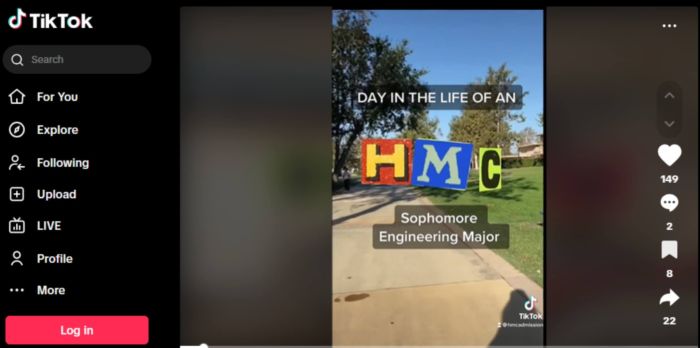
Example: Harvey Mudd College frequently posts user-generated content of its students on its social media pages, like this one featuring a day-in-the-life of a sophomore engineering student posted on TikTok.
Social Media as Search Engines: Optimizing for Discoverability
Today, social media platforms are increasingly taking on the role of search engines for young people. Two-thirds of Gen Z use social platforms to research topics, including potential schools. A teenager is more likely to find your school by watching videos and posts on TikTok or Instagram than by visiting your website or Googling the school. This brings us to Social SEO, a way to optimize your content to be discoverable via social media platform searches.
What is social SEO, and why is it important? Social SEO is the practice of optimizing your content to be discoverable through social media platform search functions. It’s important because younger audiences now use platforms like TikTok and Instagram as search engines. Optimizing SEO for visibility on these platforms helps schools reach and engage prospective students where they’re already searching.
Here are some key steps to improve your school’s visibility in social media searches:
Profile optimization: Treat your social profiles like mini homepages. Use clear, keyword-rich descriptions, consistent branding, and up-to-date contact information across all platforms.
Content that answers questions: Create videos and posts that address common queries, such as “What’s the student-faculty ratio at [Your School]?” or “What’s housing like at [Your School]?” These directly match what prospective students search for.
Strategic hashtags and keywords: Research what terms and keywords your target audience uses when searching for educational content. Incorporate these naturally into your posts, captions, and hashtags.
Geo-tagging: Always tag your location in posts. Many users search by location when researching schools in specific areas.
Consistent posting: Regular activity signals relevance to algorithms, improving your visibility in search results.
It is important to note that these social platforms have different search algorithms; a hashtag strategy that worked on Instagram may need to be adjusted for TikTok or LinkedIn. To make your school more discoverable, explore and learn what best practices apply to each platform and what topics drive current conversations.
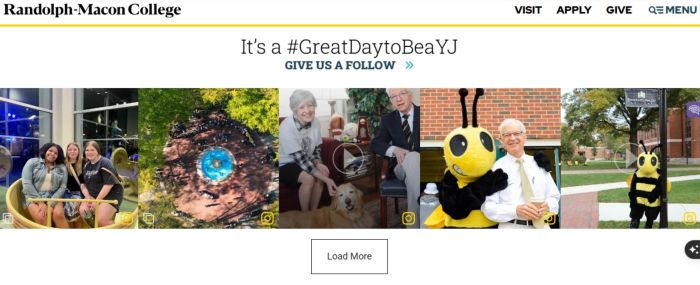
Example: Randolph-Macon College frequently posts social media content featuring catchy headlines and hashtags, such as the one seen here promoting its athletics team, the Yellow Jackets.
Although maintaining a presence across multiple social platforms is great, using a tailored approach for each one is even better. Here’s how you can leverage the strengths of major platforms.
Facebook
Often dismissed as an “older person” platform, Facebook continues to be key to reaching parents who double as key decision-makers for many prospective students. It is great for community building and event promotion. Here’s how to successfully use Facebook marketing for schools in your social marketing campaigns:
Use Facebook Events for open houses, application deadlines, and virtual info sessions
Create targeted ad campaigns using Facebook’s detailed demographic filters
Establish groups for admitted students or parents to foster community
Share longer-form content like student success stories and program highlights
Instagram
Instagram is a predominantly visually driven platform favored by people of different age groups. It is great at showcasingcampus aesthetics and student experiences.
Post high-quality photos showcasing campus beauty and student life
Use Stories for day-in-the-life content, quick announcements, and behind-the-scenes glimpses
Create highlight collections for key topics (Admissions, Student Life, Athletics)
Utilize Reels for short-form video marketing
Leverage the Explore page for discovery by new audiences
TikTok
TikTok, the fast-growing epicenter of youth engagement and viral content, is important for reaching Gen Z. Some students now select schools based on how the schools will look on TikTok.
Create authentic, entertaining content that aligns with platform trends
Feature charismatic students or faculty who connect naturally with viewers
Participate in challenges relevant to education (with your institutional twist)
Use TikTok’s native editing tools and popular sounds to boost algorithm visibility
Don’t be afraid of humor and personality. TikTok rewards authenticity over polish
YouTube
YouTube for education favors long-form content and resources that can be searched.
Produce both longer videos (3-10 minutes) and YouTube Shorts
Optimize video titles and descriptions with relevant keywords
Use cards and end screens to guide viewers to related content
Consider hosting live Q&A sessions during key decision periods
LinkedIn
LinkedIn is an underutilized tool that can help shape your education marketing. It is great for engagingparents, graduate prospects, and professionals.
Share thought leadership from faculty and administrators
Highlight alum success stories and career outcomes
Post about research innovations and academic achievements
Engage in industry conversations relevant to your programs
Encourage faculty and alumni to mention your institution in their profiles
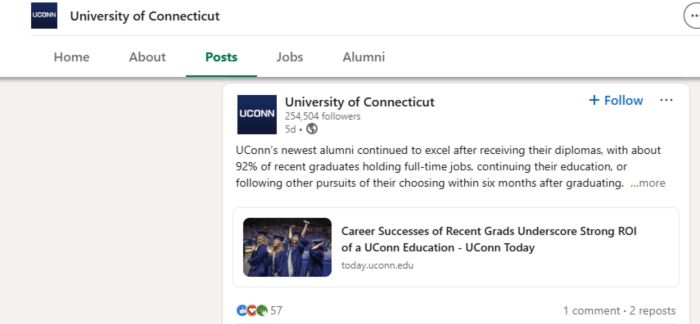
Example: The University of Connecticut regularly posts news about its recent graduates, alumni, and students on its LinkedIn page. The LinkedIn post below highlights the success of its recent graduates.
Education marketing should be serious and informative, but serious does not mean bland and uninspiring. This is where gamification comes in, for fun and engaging learning. With gamification, you incorporate game-like elements and interactive content into your school’s content, effectively turning passive scrolling into active participation. Here are some gamification content and approaches:
Instagram Story quizzes about campus facts or traditions
TikTok challenges that showcase student creativity
Digital scavenger hunts across your website and social platforms
“Day in the life” simulation content where viewers “choose their adventure”
Trends are the main driver of conversations across social media. Connecting your content to a broader cultural conversation can give your school more relevance in the social space. Follow these three trends to place your institution in a position of opportunity.
Nostalgia Marketing: For institutions with some history to draw from, using content that brings back some memories of the past can provoke nostalgic feelings and add value to social marketing campaigns. This is nostalgia marketing. For best results, share throwback campus photos, compare “then and now” scenes, or invite alumni to submit memories. This content typically generates high engagement and shares.
Values and Social Impact: Today’s students care deeply about the position their schools take on issues of social and environmental relevance. To leverage this situation, highlight your school’s sustainability initiatives, community service programs, or research contributions. Point students to recycling initiatives and green campus programs via your social media videos and blogs.
Wellness and Mental Health: Any content that addresses student well-being will resonate strongly with prospects and parents concerned about support systems. This is why you must ensure you share resources from your counseling center and feature student wellness initiatives in your content. Also, create content acknowledging the stresses of academic life and how your institution helps students manage them. A student testimonial about how a mentor or counselor helped them thrive can help humanize your brand, so consider it.
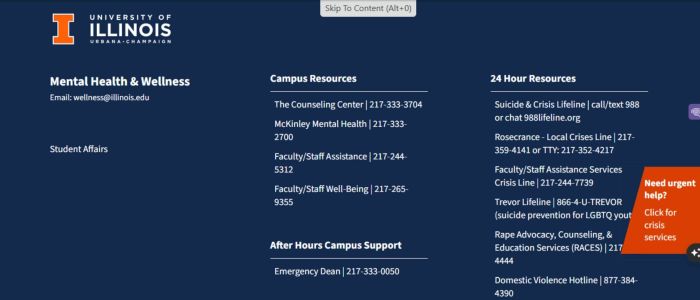
Example: The University of Illinois runs a mental health and awareness program with a full complement of staff and resources committed to student and staff welfare on campus.
Successful social media marketing calls for consistency in learning and adaptation. Platform algorithms are subject to regular changes that affect content visibility and engagement. Here’s what you can do to stay visible and ahead of the curve:.
Monitor metrics to identify which content types perform best
A/B test different formats and approaches
Stay alert to algorithm changes and platform updates
Focus on generating quality engagement (comments, shares)
Adopt new platform features early for visibility boosts
Although social engagement is key to positive brand building, it’s not the ultimate goal. That would be converting interest into action, from website visits to inquiries or applications.
To effectively bridge the gap between interest and action, here are a few tips worth considering:
Optimize your social profiles: Link every platform you’re active on to relevant landing pages. Consider using “link in bio” tools that offer multiple destination options (Apply Now, Virtual Tour, Financial Aid, etc.).
Strategic calls to action: Not every post needs a CTA, but regularly include invitations to learn more, especially on high-interest content. For example, after sharing a student success story, add something like “Discover how you can follow in Sarah’s footsteps—check out our Business program (link in bio).”
Track and analyze traffic sources: Find out which social platforms and specific posts drive the most valuable traffic using resources like UTM parameters. With this information in hand, you can refine your strategy toward what converts.
Amplify high-performing content: When a post generates strong engagement organically, extend its reach to similar audiences by allocating an ad budget to it. By putting out content that resonates with your existing community, you can reach prospects who share similar interests and achieve the desired engagement result.
Align social and search strategies: While many prospects might discover your school on social media, they often go on to later search your name on Google. This is why you must ensure that your search engine marketing complements your social strategy for a seamless user journey.
Building Your School’s Social Media Playbook
As social media continues to evolve and draw more prospective students, today’s schools have to target it with intentional and strategic content. The most successful education marketers approach social media as conversations with future students, current community members, parents, and alumni.
The goal of these conversations goes beyond promoting your institution, it involves bringing its unique culture and value to life in ways that traditional marketing can not achieve. This is why schools must develop an effective social media marketing strategy that factors in all the essentials and adds some extras. While at it, remember a few things: authenticity resonates, visual content engages, and genuine connection converts.
By embracing short-form video, leveraging user-generated content, optimizing for social search, and maintaining a strategic presence across platforms, you create multiple pathways for meaningful connection. Add gamification elements and cultural relevance, and you have a formula for visibility and genuine engagement that drives enrollment outcomes.
See the full Webinar here:
Struggling with enrollment?
Our expert digital marketing services can help you attract and enroll more students!
Frequently Asked Questions
Question: What is social SEO, and why is it important?
Answer: Social SEO is the practice of optimizing your content to be discoverable through social media platform search functions. It’s important because younger audiences now use platforms like TikTok and Instagram as search engines. Optimizing for visibility on these platforms helps schools reach and engage prospective students where they’re already searching.
Question: How can we get user-generated content from students?
Answer: One proven strategy in this line is to allow a student to manage your school’s Instagram Stories for a day, sharing their authentic campus experience. These glimpses into real student life help prospective students envision themselves at your institution in ways that traditional marketing cannot achieve.
Question: How can schools use short-form video to attract students?
Answer: The key to creating winning short-form videos is to go for authenticity. Start by identifying what makes your institution stand out, whether it’s a unique program, a beloved campus tradition, or exceptional career outcomes.
You can then showcase these elements through quick, visually engaging stories highlighting your unique value proposition.
“Under my watch, the partisan weaponization of the Department of Justice will end. America must have one tier of justice for all.” — Pamela Bondi (confirmation hearing for U.S. attorney general, Jan. 15, 2025)
“After years and years of illegal and unconstitutional federal efforts to restrict free expression, I will also sign an executive order to immediately stop all government censorship and bring back free speech to America.” — Donald J. Trump (Jan. 20, 2025, inaugural address)
“Government censorship of speech is intolerable in a free society.” — Donald J. Trump (Jan. 20, 2025, executive order)
So many lies, so many orders, so much suppression. The “flood” of free expression abridgments continues to be dizzying and depressing.
Unprecedented! That is the word for this new form of silencing that is spreading like a deadly cancer.
The rules of the past cease to be honored. Retribution has replaced righteousness. Fear triumphs over courage. A one-party-led Congress has abdicated its authority. Judicial review is derided. And our system of justice as constituted is unable to adequately address the wrongs perpetuated by an authoritarian figure aided by his confederates. A blitzkrieg takeover of the federal government seeks to vest unchecked power in the Executive while normalizing suppression on the vile pretense of advancing free speech and equality — a page right out of Orwell’s “1984.”
In some respects, we are witnessing what constitutes a threat perhaps as great as the Sedition Act of 1798, the Civil War actions taken by Lincoln, and the World War I, Cold War, and Vietnam War abridgments of free speech. Nonetheless, the number and frequency of such abridgments make it difficult to comprehend the cumulative gravity of this threat to our First Amendment freedoms.
Within the Trump administration’s first 100 days, the government has ushered in a new era of direct and indirect suppression of speech. Meanwhile, cases are being litigated, individuals and institutions are being silenced, books banned, “settlements” coerced, scientific research squelched, history erased, while lower court rulings struggle to be relevant. And all of this, in its many forms, has occurred in the absence of any near-final resolution by the Supreme Court, as if that too might be slighted someday soon.
We are beyond any “there are evils on both sides” mentality, much as we were beyond it in 1798. Recall that while John Adams, the lawyer, championed free speech in his writings, he later backed the Alien and Sedition Acts as “the Federalist” president.
Calling out tyranny is not partisan; it is American! And yet, many are relatively detached, silent, and clueless.
Trump’s “flood the zone” tactics have taxed the American mind to such an extent that few can barely, if at all, remember yesterday’s free speech abridgments let alone those of last week or last month. The result: who remembers all of the trees leveled not to mention any big picture of the forest devastated in the process? What to do?
Enter “First Amendment Watch” and the Zick Resource Report
Thanks to Professor Stephen Solomon and Susanna Granieri over at First Amendment Watch (FAW), there is a meaningful way to begin to get a conceptual hold on what has occurred within the first 100 days of the Trump administration and its attacks on free speech.
Happily, FAW today released what is surely the most important First Amendment resource documenting the numerous First Amendment abridgments committed by the Trump administration within its first 100 days. This invaluable resource was prepared by Professor Timothy Zick.
Professor Timothy Zick
Though the full resource repository is available over at FAW, its table of contents is reproduced below:
Introduction by Timothy Zick
I. First Amendment-Related Executive Orders and Memoranda
A. Freedom of Speech and Censorship B. Foreign Terrorism and National Security C. Law Firms D. Retribution Against Former Government Officials E. Diversity, Equity, and Inclusion F. Gender and Gender Identity G. K-12 Education H. Museums, Libraries, and Public Broadcasting I. Political Donations J. University Accreditors
II. First Amendment-Related Litigation
A. Lawsuits Challenging Executive Orders, Guidance, and Policies
1. Diversity, Equity and Inclusion 2. Immigration 3. Educational Funding 4. Law Firms 5. Gender and Gender Identity 6. Data and Scientific Inquiry 7. Libraries and Museums 8. Public Broadcasting
B. Retaliatory Dismissal and Other Employment Lawsuits C. Lawsuits Filed by Media and Journalists D. Defamation and Other Civil Lawsuits Filed By Donald Trump
III. Commentary and Analysis
A. Actions Against the Press and Journalists B. Defamation and Other Civil Lawsuits C. Broadcast Media D. Social Media E. Education
1. DEI Programming and Initiatives 2. Antisemitism Investigations and Demands 3. Academic Freedom 4. K-12 Curriculum
F. Immigration Enforcement
1. International Students 2. Foreign Scholars 3. Immigration Activism
G.Public Employees H. Private Sector
1. Law Firms 2. Individual Critics and Enemies
I. Transparency, Data, and Information
1. Data, Information, and Scientific Research 2. Museums and Libraries 3. Public Broadcasting 4. Misinformation and Disinformation 5. “DOGE” and Transparency
J. Grants and Funding K. Protests and Demonstrations
1. Campus Protests 2. Public Protests
L. Governmental Orthodoxy
1. Race and DEI 2. Gender and Gender Identity 3. History and Patriotism
M. Retribution and Chilling Speech N. Investigations O. The Bigger Picture P. Tracking All Trump 2.0 Lawsuit
Related
Coming Next Week
The next installment of Professor Timothy Zick’s ongoing posts is titled “Executive Orders and Official Orthodoxies.”
Justice Department to go after reporters’ records in government leak cases
Senate Judiciary Committee considers the nomination of Pamela Bondi for Attorney General on Jan. 15, 2025. (Maxim Elramsisy / Shutterstock.com)
The Justice Department is cracking down on leaks of information to the news media, with Attorney General Pam Bondi saying prosecutors will once again have authority to use subpoenas, court orders and search warrants to hunt for government officials who make “unauthorized disclosures” to journalists.
New regulations announced by Bondi in a memo to the staff obtained by The Associated Press on Friday rescind a Biden administration policy that protected journalists from having their phone records secretly seized during leak investigations — a practice long decried by news organizations and press freedom groups.
The new regulations assert that news organizations must respond to subpoenas “when authorized at the appropriate level of the Department of Justice” and also allow for prosecutors to use court orders and search warrants to “compel production of information and testimony by and relating to the news media.”
The memo says members of the press are “presumptively entitled to advance notice of such investigative activities,” and subpoenas are to be “narrowly drawn.” Warrants must also include “protocols designed to limit the scope of intrusion into potentially protected materials or newsgathering activities,” the memo states.
Former FCC Chairs attack FCC’s attack on First Amendment principles
(T. Schneider / Shutterstock.com)
As former chairmen of the Federal Communications Commission (FCC) — one appointed by a Democrat, the other by a Republican — we have seen firsthand how the agency operates when it is guided by its mission to uphold the public interest. But in just over two months, President Donald Trump and his handpicked FCC Chair Brendan Carr have upended 90 years of precedent and congressional mandates to transform the agency into a blatantly partisan tool. Instead of acting as an independent regulator, the agency is being weaponized for political retribution under the guise of protecting the First Amendment.
Their actions fall into two categories. First, the president used executive orders (EOs) to strip the agency of its independence, making it subservient to the White House. Second, the chairman has exploited the commission’s powers to undermine the very First Amendment rights it is supposed to uphold.
Mchangama on the ‘New McCarthyism’
Jacob Mchangama
Despite being Danish, I’ve always found America’s civil-libertarian free speech tradition more appealing than the Old World’s model, with its vague terms and conditions. For much of my career, I’ve been evangelizing a First Amendment approach to free speech to skeptical Europeans and doubtful Americans, who are often tempted by laws banning “hate speech,” “extremism,” and “disinformation.” That appreciation for the First Amendment is something I share with many foreigners — Germans, Iranians, Russians — who now call America home.
[ . . . ]
It’s now clear that the government is targeting noncitizens for ideas and speech protected by the First Amendment. The most worrying example (so far) is a Turkish student at Tufts University, apparently targeted for co-authoring a student op-ed calling for, among other things, Tufts to divest from companies with ties to Israel. One report estimates that nearly 300 students from universities across the country have had their visas revoked so far.
Instead of correcting this overreach, the government has doubled down. U.S. Citizenship and Immigration Services recently announced that it would begin screening the social media posts of aliens “whose posts indicate support for antisemitic terrorism, antisemitic terrorist organizations, or other antisemitic activity.” Shortly after, the X account of USCIS posted about a “robust social media vetting program” and warned: “EVERYONE should be on notice. If you’re a guest in our country — act like it.” And four days later, White House homeland security adviser Stephen Miller promised to deport “anyone who preaches hate for America.” What that means is anybody’s guess — and seems to depend entirely on subjective assessments.
[ . . . ]
Had America been known for deporting, rather than welcoming, dissent, I would never have made it my home. That might not have been much of a loss. But consider this: 35 percent of U.S.-affiliated academic Nobel laureates are immigrants, and nearly half of all American unicorn startups have founders born outside the country. How many of these brilliant minds would have chosen the United States if they risked exile for crossing the speech red lines of the moment?
As a European who owes my freedom in life thus far to the America that fought Nazism and defeated communism, I feel a responsibility to speak out when this country strays from its founding ideals. I came to America for its freedom, not just to enjoy it, but to defend it — even if that puts me at risk.
Related
New scholarly article on commencement speaker provocateurs
This Article explores an untheorized area of First Amendment doctrine: students’ graduation speeches at public universities or private universities that embrace free speech principles, either by state statute, state constitutional law, or internal policy. Responding to recent graduation speech controversies, it develops a two-tier theory that reconciles a multiplicity of values, including students’ expressive interests, universities’ institutional interests in curating commencement ceremonies and preventing reputational damage, and the interests of captive audiences in avoiding speech they deem offensive or profane.
The Article challenges the prevailing view that university students’ graduation speeches implicate individual First Amendment rights. It develops a site-specific understanding of the ritualistic sociology of the university commencement speech, which the Article argues is firmly within the managerial purview of the university. But it also argues that heavy-handed administrative regulation of student graduation speeches has the potential to undermine the academic freedom of students and professors.
Reflecting on the history of the university commencement speech in the American intellectual tradition, it urges university administrators to exercise their authority to regulate speeches through transparent standards, a longitudinal view, and collaborative negotiation with student speakers.
It concludes by discussing the conceptual dangers of turning the First Amendment into a metonym for every instance of speech abridgment within a managerial sphere.
‘So to Speak’ podcast: Rabban and Chemerinsky on academic freedom
Our guests today signed onto a statement by a group of 18 law professors who opposed the Trump administration’s funding threats at Columbia on free speech and academic freedom grounds.
Since then, Northwestern, Cornell, Princeton, Harvard, and nearly 60 other colleges and universities are under investigation with their funding hanging in the balance, allegedly for violations of civil rights law.
To help us understand the funding threats, Harvard’s recent lawsuit against the federal government, and where universities go from here are:
David Rabban — distinguished teaching professor at The University of Texas at Austin School of Law
Erwin Chemerinsky — distinguished professor of law and dean at UC Berkeley Law.
2024-2025 SCOTUS term: Free expression and related cases
Cases decided
Villarreal v. Alaniz(Petition granted. Judgment vacated and case remanded for further consideration in light of Gonzalez v. Trevino, 602 U. S. ___ (2024) (per curiam))
Murphy v. Schmitt (“The petition for a writ of certiorari is granted. The judgment is vacated, and the case is remanded to the United States Court of Appeals for the Eighth Circuit for further consideration in light of Gonzalez v. Trevino, 602 U. S. ___ (2024) (per curiam).”)
TikTok Inc. and ByteDance Ltd v. Garland (9-0: The challenged provisions of the Protecting Americans from Foreign Adversary Controlled Applications Act do not violate petitioners’ First Amendment rights.)
Review granted
Pending petitions
Petitions denied
Emergency Applications
Yost v. Ohio Attorney General (Kavanaugh, J., “IT IS ORDERED that the March 14, 2025 order of the United States District Court for the Southern District of Ohio, case No. 2:24-cv-1401, is hereby stayed pending further order of the undersigned or of the Court. It is further ordered that a response to the application be filed on or before Wednesday, April 16, 2025, by 5 p.m. (EDT).”)
Free speech related
Mahmoud v. Taylor (argued April 22 / free exercise case: issue: Whether public schools burden parents’ religious exercise when they compel elementary school children to participate in instruction on gender and sexuality against their parents’ religious convictions and without notice or opportunity to opt out.)
Thompson v. United States (decided: 3-21-25/ 9-0 w special concurrences by Alito and Jackson) (interpretation of 18 U. S. C. §1014 re “false statements”)
This article is part of First Amendment News, an editorially independent publication edited by Ronald K. L. Collins and hosted by FIRE as part of our mission to educate the public about First Amendment issues. The opinions expressed are those of the article’s author(s) and may not reflect the opinions of FIRE or Mr. Collins.
Unlike kings or queens, dictators and autocrats find it helpful not to have a clear successor or rival who might soften their hold on power.
Much as that iron-fisted ruler may be loathed, their abrupt departure from the throne can bring significant risk of subsequent turmoil. They have created a system that puts them alone at the centre of power.
The White House in March was very quick to deny that President Joe Biden was pressing for regime change when he said that his Russian counterpart, Vladimir Putin, should not remain in power.
There is no shortage of countries in recent decades where fallen autocrats have left a power vacuum all too quickly filled by chancers, thugs and weird ideologues, or simply some drab toady of the old regime.
Covering tyranny
As a reporter, it was impossible for me not to get caught up in the excitement after popular unrest had driven out yet another long-serving despot in power so long that they had forgotten who was serving whom. It really is exhilarating.
During a long career as a journalist, I reported in a number of countries where autocratic, often staggeringly corrupt, leaders were forced unwillingly out of office. Sometimes, I’ve been there at the moment, more often to report on the aftermath.
The first time was just over 30 years ago in Bangladesh, whose military dictator Hussain Ershad had lost power in the face of mass protests. And in a rarity for the impoverished country, whose relatively short period of independence had been marked by violence and assassinations, the leader’s downfall had been almost bloodless.
By the time I arrived in Dhaka, crowds were cheerfully marching through the capital’s streets. The two people who would dominate Bangladeshi politics until today — the widow of one assassinated leader and the daughter of another — were happily giving interviews to visiting journalists, promising a new era for their country.
Since then, Bangladesh’s economy has indeed grown. But the country’s politics remain plagued by autocratic leadership, corruption and a drawn-out feud between those two women.
The lingering influence of despotism
In the Philippines, a reporter colleague liked to tell stories about joining a crowd streaming through the Malacanang presidential palace, vacant after President Ferdinand Marcos and his wife Imelda fled the country in the face of a People’s Power revolt in 1986 following more than 20 years of rule marked by excess and rampant graft.
This month, their son was elected president with little to offer by way of a platform beyond the promise of a return to those “halcyon days” when his parents were in charge some four decades earlier.
In neighbouring Indonesia, the family of President Suharto, who led another Southeast Asian kleptocracy into near financial ruin until he was forced to step down in 1998 after more than 32 years of iron rule, continues to try to get back into politics. Suharto’s downfall came with mass protests, violence and fears the giant archipelago would split apart. The country has largely recovered, but some of the elites established during the Suharto years remain a powerful influence.
Later, I was involved in reporting on the “colour” revolutions of former Soviet states, including Georgia and Ukraine. In both cases, infectious enthusiasm for change and the end of the old regimes did not take all that long to sour.
The leader of the 2003 Georgian revolution, Mikheil Saakashvili, eventually fled into exile. He is now back in his country where he was jailed on charges of abuse of power.
Sidelining of opposition
Ukraine struggled to find a competent leader after casting aside the old guard from the Soviet era with its Orange Revolution, which began the following year.
Paradoxically, and very unexpectedly, it has taken this year’s Russia’s invasion of Ukraine to reveal a leader of commanding stature in President Volodymyr Zelenskiy, a former comedian.
In many of these countries and others ruled by long-serving autocracies, the incentive is for leaders to crush any emerging threat to their hold on power. Rising political stars are sidelined, opponents are exiled, jailed or killed and domestic news coverage is limited to the official line.
And Russia? Rumours abound that Putin, ever tightening his control during more than 20 years in power, is seriously ill or even faces a coup. As with the likes of Suharto or Marcos, Putin took office when his country was lurching through economic crisis. He was a bit dull. Unlike his predecessor, Boris Yeltsin, Putin didn’t make a habit of rolling up drunk.
He was smart, focused on the economy, not in thrall to Russia’s plundering oligarchs and able to bring stability to the lives of ordinary Russians exhausted and disoriented by the collapse of the Soviet Union. He became hugely popular.
But there was a sense that his inner circle didn’t quite trust that popularity. By most accounts, Putin would easily have won a second term in the 2004 presidential election. But the Kremlin could not resist making sure the deck was stacked in his favour. He won 71.9% of the vote.
What would Russia be like post-Putin
Putin has run the country ever since, either as president or prime minister. Such is the state’s grip on Russian media that it is not really possible to be sure how popular Putin may be now. One recent poll suggested his star, which had started to look a bit faded, has brightened considerably since the invasion of Ukraine.
His government is clearly in no mood to put that popularity up for too much public scrutiny, throttling the remaining independent Russian media and introducing a law to hand long prison terms to those who openly oppose the war on Ukraine.
Prominent Russians who might credibly challenge Putin’s grip on the country live abroad, are in prison or dead. His most recent serious opponent, Alexei Navalny, is looking at years in a Russian prison. It isn’t all that clear, either, whether the bulk of Russians would prefer Navalny as their next leader.
If Putin is no longer in office for whatever reason, who would be in the running to replace him?
It seems very unlikely that the current political elite would readily allow a reformer to sweep them from power. Quite possibly, the average Russian — sympathetic to the view that the West has for years been treating their country with contempt — would prefer stability, a job and some international prestige.
When Russia faced revolution more than a century ago, an estimated 10 million people died after the autocrat Tsar Nicholas II was removed from power.
Perhaps that’s why Biden officials were so quick to rule out regime change. Better the devil you know than the devil you don’t.
Questions to consider:
• If you were working for local media in Moscow, how would you write about the war in Ukraine?
• Do you think your country’s mainstream media can be relied on to be factual in reporting? Why?
• If the current leader of your nation loses power, how peaceful do you think the aftermath will be?
Correction: The editor’s note at the top of the story was changed to correct the date the article was originally published.
by Rebecca Turner, Jennie Winter & Nadine Schaefer
Student voice is firmly embedded within the architecture of universities, with multiple mechanisms existing through which we (as educators) can ‘hear’, and students can ‘leverage’ their voice. The notion of student voice is widely debated (and critiqued – see Mendes & Hammett, 2023), and whilst relevant to this blog post, it is not what we seek to focus on here. Rather we focus on one of the primary figureheads of student voice within universities – the sabbatical officer – and consider how they are empowered to represent the ‘voice’ of their peers to their university.
Sabbatical officers are elected by the student body to represent their interests to the wider university community. They are leaders and trustees of their student union – semi autonomous organisations that operate alongside universities to advocate for the student body (Brooks, Byford & Sela 2016). As elected student representatives, sabbatical officers sit on high-level university committees where student voice is ‘required,’ making the rapid transition from a student in a lecture hall, to a voice for all. Though this is an anticipated move, it is potentially challenging. Becoming a sabbatical officer is the accumulation of a hard-fought election campaign, which commonly builds on several years of working with their students’ union alongside their undergraduate studies (Turner & Winter, 2023).
In collaboration with the NUS, and with the support of a small grant from the Staff and Educational Development Association (SEDA), we undertook a national survey to develop contemporary insights into the work of elected sabbatical officers. Sabbatical officers were clearly keen to share their experiences as we achieved responses from 59% of student unions affiliated to the NUS. We also undertook interviews with a sample of sabbatical officers (n=4) and permanent student union staff (n=6) who supported them during their time in office. Here we reflect on headlines emerging from this study, to place a brief spotlight on the work of sabbatical officers.
What a busy year (or two!)
Sabbatical officers were often negotiating multiple, potentially competing, demands – as this survey respondent reflected when invited to comment on the main challenges they faced:
‘Getting up to speed with the fast-moving world of [being] a sabbatical officer and the many roles I had (sabb, trustee, leader, admin andcampaigner)’.
Sabbatical officers had a long list of responsibilities, including jobs inherited from their predecessor, union and university commitments, as well as the commitments they made through their own manifestos. Attending university committees to give the student voice took considerable time, with many questioning the value of the time spent in meetings:
‘It’s very much the case that you are in a room for two hours where you will be speaking for, I don’t know, two minutes. So sometimes it seems very boring to get involved with those random conversations which have very little to do directly with student experience.’ SO1
It was a common theme that sabbatical officers were silent during these meetings, waiting for the brief interlude when they were invited to speak. Leading us to question both where their agency as student representatives lay in these committees, and how they could effect change in this space, when their engagement was limited. A concern shared across survey respondents, for example:
‘I’m in a huge number of meetings which significantly reduces the amount of time I have to work on manifesto objectives.’
With a jobs list (and a diary) that echoed that of many Vice Chancellors (though with considerably less experience in HE), sabbatical officers reported engaging in trade-offs for who they worked with, whose voice was heard and opinions sought, to balance the demands of their role. As this sabbatical officer reflected, this could leave the wider student body questioning their actions:
‘[Students] want to see the battle happening. What they don’t want to see, is me sit for three hours and hash out the middle ground with some members of staff who probably aren’t going to change their mind.’ SO2
Finding their voice
Though given a seat at high level tables, respondents did not always feel at ease speaking up, the sentiments of this respondent were repeated many times in our data:
‘I think the hardest part is, we are sitting on committees with individuals who have worked here for years. We’re never going to have that same knowledge, so that makes it quite a challenge um to be able to understand the ins and outs of the university and the institution, and the politics.’ SO3
We did question whether the expectation to engage in these spaces may further reinforce the inequalities in student leadership highlighted by Brooks et al (2015). However, sabbatical officers were not working alone. Permanent officers played an important role, helping them, for example, to decode paperwork and plan their contributions. Leadership allies, who may, for example, provide early access to meeting paperwork to aide preparation, or coach sabbatical officers in advance of meetings, assisted sabbatical officers to find their voice:
‘I think the university has been really accommodating giving me the heads up on things that I could then have a bit more time to read up on things and to improve my knowledge.’ SO4
Developing effective support networks was essential; through these networks they gained the knowledge needed to contribute confidently in ‘university’ spaces. However, this took considerable time and resulted in many reprioritising their work. They focused on activities deemed essential (which were many!) with other areas of the work being streamlined to ensure promised commitments could be fulfilled (Turner & Winter, 2023).
The time taken for sabbatical officers to get up to speed was discussed at length by those serving a second term, which as this respondent noted, was ‘when the real work got done.’ They had learnt the ropes, and as another Sabbatical Officer (SO) reflected:
‘There’s a lot of stuff [to learn] when you come into this role. I think sabbatical officers do well if they are re-elected because they’ve had to learn a lot.’ SO2
‘Knowing the route to achieve my goals’
Our data captured the committed and driven nature of this (overlooked and overworked) constituent of the HE community. Though working in challenging circumstances, they embraced opportunities to influence policy and practice. Successes were based on the support they received and the strategies they developed to undertake their work. The value of an effective handover from their predecessor cannot be overlooked and permanent student union staff provided much needed continuity and support. Sabbatical officers drew on their student representatives to provide the eyes on the ground and engaged with senior leaders to develop their understanding of how universities work and through these individuals they grew in confidence to speak in front of diverse audiences. As individuals, many respondents performed their roles with tenacity, approaching their work both pragmatically and innovatively. Yet the time limited nature of this role added pressure and delineated what could be achieved:
‘Knowing the route to achieve my goals was difficult because it requires knowing what exactly you want before you’ve even started the job [so that you can] achieve what you want in year.’
This prompted us to question the sustainability of the sabbatical officer role; realistically who can manage, at this early stage in their career, the breadth of demands placed on them for more than a short period of time?
Promoting the voice of sabbatical officers?
As pedagogic researchers, we have a final, curious observation to make regarding the dearth of systematic research into this field of HE. Student unions have a long history; reference is still made to the activism and uprise of the 1960s (Klemenčič 2014). As a community we lament how student voice activities have become the realm of quality assurance, and question whether students have become politically apathetic (Raaper, 2020). The re-positioning of student unions has increased accountability and encouraged partnership working with their affiliated university (Brooks et al, 2016; Squire 2020). This leads us to question how relevant it is to continue to look backwards and talk of how students’ unions used to operate in the past. As the sector becomes increasingly diverse and how students engage with HE becomes more fragmented, we need to play closer attention to students’ unions to ensure they are supported to function effectively and represent the interest of students.
Dr Rebecca Turner is an Associate Professor in Educational Development at the University of Plymouth, UK. Alongside her interest in student voice and representation, Rebecca’s research addresses themes relating to inclusivity, student success and widening participation.
Professor Jennie Winter is Dean of Teaching and Learning and Professor of Academic Development at Plymouth Marjon University, a National Teaching Fellow, and a Principal Fellow of the UK Higher Education Academy. She holds numerous external roles, contributes to international pedagogic research, and her work has been utilised by the European Commission and presented globally.
Dr Nadine Schaefer is an Educational Developer at the University of Plymouth. Her research interests include student voice, student engagement and wider quality assurance issues in HE. Nadine is a Senior Advance HE Fellow (SFHEA).
“Harvard Law Review’s article selection process appears to pick winners and losers on the basis of race, employing a spoils system in which the race of the legal scholar is as, if not more, important than the merit of the submission,” said Acting Assistant Secretary for Civil Rights Craig Trainor in a statement. “Title VI’s demands are clear: recipients of federal financial assistance may not discriminate on the basis of race, color, or national origin … The Trump Administration will not allow Harvard, or any other recipients of federal funds, to trample on anyone’s civil rights.”
The statement alleged that the editor of the Harvard Law Review wrote that it was “concerning” that the vast majority of people seeking to respond to an article about police reform “are white men.” It also accused another editor of suggesting that a submission receive “expedited review because the author was a minority.”
Education Secretary Linda McMahon reposted a tweet from the Free Beacon that purports to show additional evidence of race-based decision-making at the Law Review.
“We will not allow recipients of federal funding to discriminate on the basis of race,” McMahon wrote.
Members of the Harvard Law Review have not publicly commented on the allegations. But an HLS spokesperson told Axios, “Harvard Law School is committed to ensuring that the programs and activities it oversees are in compliance with all applicable laws and to investigating any credibly alleged violations.”
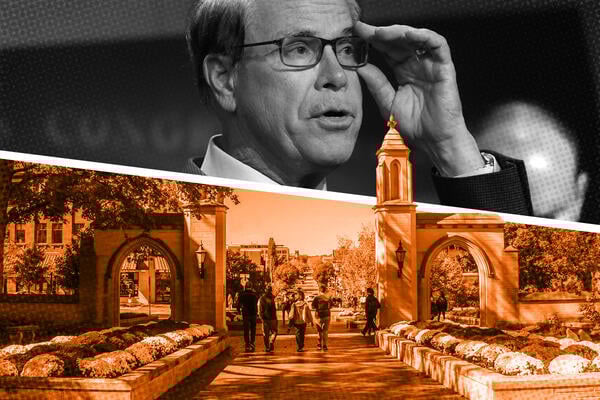
Indiana state lawmakers have sent their governor a state budget bill that goes beyond setting funding levels. If Republican governor Mike Braun signs it into law, House Enrolled Act 1001 will require faculty at public colleges and universities to post their syllabi online and undergo “productivity” reviews.
The bill would also—among other things—prohibit faculty emeriti from voting in faculty governance organizations, place low-enrolled degree programs at risk of elimination by the Indiana Commission for Higher Education and end alumni elections for three Indiana University Board of Trustees seats by filling them with gubernatorial appointees. In addition, it has a provision that would let Braun remove the currently elected board members before their terms expire.
“I think overreach doesn’t begin to describe the actions of the Legislature,” said Russ Skiba, a professor emeritus of education at IU Bloomington. “This is really a sweeping takeover of higher education in Indiana.”
The Republican-controlled Indiana General Assembly passed the legislation—which runs more than 200 pages—less than two days after revealing it Wednesday, April 23. The state House approved it around 12:45 a.m. Friday, followed by the Senate’s agreement at about 1:20 a.m.
“I know a lot of legislators … simply didn’t have enough time to fully read it,” Skiba said. “There was no opportunity whatsoever for any sort of public input.”
Matt Pierce, a Democratic Indiana House member who’s a senior lecturer at IU Bloomington, said the conference committee report revealing the budget bill wasn’t even released until Wednesday evening.
“As people began to kind of go through it, they discovered all these higher education provisions that had never been discussed anywhere,” Pierce said. To have “provisions of this magnitude” pass in the budget bill “with no hearing or public input, that was pretty shocking,” he said.
The budget bill’s higher education provisions echo those passed, or at least proposed, in other red states. But Indiana’s General Assembly continues to be in the vanguard among even GOP-controlled legislatures in its fervor for regulating public higher education. Last year, state lawmakers passed, and the former governor signed, a law threatening the jobs of nontenured and tenured faculty who don’t sufficiently foster “intellectual diversity,” as defined by campus boards of trustees.
These bills follow pro-Palestine protests at IU Bloomington and tensions between faculty and university president Pamela Whitten. And with a further reduction of tenure protections looming in the new bill, a tenured professor at IU Bloomington says he’s under investigation for allegedly violating a policy the university wrote to uphold last year’s intellectual diversity law.
Ben Robinson, an associate professor of Germanic studies and a prominent pro-Palestine campus protester, told Inside Higher Ed that an anonymous student filed a complaint against him in October. The unnamed student, according to a copy of the complaint Robinson provided, wrote that Robinson “talks negatively about the state of Israel and describes the war in untrue and unfair ways” and has discussed being arrested at a pro-Palestine rally “on numerous occasions.” The student also complained that Robinson had spoken “against Indiana University on several occasions” and used class time to say the university was restricting free speech.
This complaint was filed in IU’s bias incident reporting system, which wouldn’t have involved potential discipline, Robinson said, but university administrators appeared to refile it as an intellectual diversity–related complaint under the policy passed after the General Assembly’s intellectual diversity law. He said he thinks administrators “want to overcomply on particularly this ideological issue, because that’s what they’re being told they have to enforce” by the federal government.
“How can a professor know what’s going to be called bias?” Robinson said. He also said IU Bloomington is “a campus in which the witch hunts are alive and well, and I, along with many others, have been an open target of them.”
IU spokesperson Mark Bode, in response to Inside Higher Ed’s requests for an interview and written questions about Robinson’s situation, wrote in an email simply that “IU does not comment on personnel matters.”
Accusations of IU Involvement
Multiple critics have accused IU leaders of backing one or more of the 11th-hour budget bill’s higher education changes. When asked about this, Bode provided a written statement that didn’t say whether IU was specifically involved.
“Throughout the session, Indiana University engaged with state lawmakers to shape meaningful conversations about the university’s commitments to making higher education accessible to Hoosiers and driving the state’s economy through life-changing research and innovation,” the statement said. IU “will be working over the coming weeks to understand the full impact of state legislation and ensure compliance.”
Before the bill passed, Pierce said, he texted an IU lobbyist asking the university’s position on it. The lobbyist replied that the institution didn’t have a position because it was still carefully reviewing the legislation, Pierce said.
“And right then and there I knew that IU was behind it,” Pierce said. He also questioned how lawmakers would have the “pretty esoteric” knowledge that emeritus faculty serve in some faculty governance organizations.
“You now have a convergence of the Republican attacks on higher education and the actual administration of Indiana University, and that’s a pretty shocking development,” he said.
The IU Board of Trustees currently has six gubernatorial appointees—including a student with a two-year term—plus three members elected by alumni. If Braun signs the budget bill, he and future governors will be able to appoint all nine members, the student member’s term will drop to one year and there will be no more alumni-elected members.
Braun has expressed support for this change, according to the Indiana Capital Chronicle.
“I think it’s being done because the current process [has] not maybe yielded the proper results on the entirety of how you want that important part of our state to be run—from curriculum to cost to the whole way one of our flagship universities has been operating,” Braun said, according to the Capital Chronicle. “I want to get a board there that is going to be a little more rounded, that’s going to produce better results.”
Vivian Winston, one of the elected board members, who previously announced she’s not seeking re-election, said she voted against IU president Whitten’s contract extension and the university’s post-encampment protest restrictions. But she said she doesn’t know whether her votes were related to the board change part of the legislation—which, like the other higher ed provisions in the bill, caught her “unaware.”
“I found out through the media,” Winston said of the changes in the bill.
Rodric Bray, a Republican and Indiana’s Senate president pro tem, provided Inside Higher Ed a rationale for the part of the bill ending alumni elections.
“A very small fraction of the IU alumni have been participating in the election for the alumni seats on the IU Board of Trustees,” Bray said in an emailed statement. “Of the approximately 790,000 alumni around the world, only about 2.5% of alumni voted in the most recent election for trustee. Because the number is so small, it is not a fair representation.”
But some opponents of the provision don’t see it that way. Skiba, the IU Bloomington emeritus faculty member, said, “This is clearly payback for opposition of policies favored by the president of the university and the Legislature.” He said the change would “take those voices of opposition off the Board of Trustees and essentially give complete control of the Board of Trustees over to the governor.”
Over all, Skiba said, “this Legislature is following the Trump lead—wishing to put an airtight lid on free expression. And if you’re wishing to do that, universities are an obvious place to start.”
The Mellon Foundation is giving $15 million in emergency funding to state humanities councils after the National Endowment for the Humanities eliminated $65 million in support for the councils, amid sweeping cuts to its grants and workforce, the foundation announced Tuesday.
These councils, established by Congress in 1971, are nonprofits that support educational programming for the public, such as literacy initiatives, lectures, book fairs and cultural programs. The support will go toward all 56 state and jurisdictional humanities councils across the country in hopes of staving off possible deep cuts and closures. The foundation plans to allocate $2.8 million to challenge grants of up to $50,000 for each council, to be matched by other funders. And each council will received $200,000 in immediate operational support, The New York Timesreported.
Elizabeth Alexander, president of the Mellon Foundation, said in the announcement that while the emergency funds can’t cover the full extent of cuts, it’s a show of support.
“At stake are both the operational integrity of organizations like museums, libraries, historical societies in every single state, as well as the mechanisms to participate in the cultural dynamism and exchange that is a fundamental part of American civic life,” Alexander said.
Phoebe Stein, president of the Federation of State Humanities Councils, called the foundation funding a “lifeline.”
“Mellon’s support allows us to not only preserve this vital network—it helps ensure that everyday Americans can thrive through lifelong learning, connection, and understanding of one another,” she said in the announcement.